62.8 F
Chicago
Tuesday, September 22, 2026
Home Blog Page 2605

Iran’s Military Concludes No Foul Play In Raisi Helicopter Crash

Iran’s Military Concludes No Foul Play In Raisi Helicopter Crash

A preliminary report produced by Iran’s military has found no evidence of criminal activity or foreign interference in last Sunday’s helicopter crash that killed the late President Ebrahim Raisi and seven others, according to state media.

The report was produced by the general staff of the armed forces, and it states Raisi’s helicopter “caught fire after hitting an elevated area” and found no traces of “bullet holes” on the helicopter among the wreckage.

Rescue teams combing the mountains, via AJ/WANA

The aircraft had been flying on a “pre-planned route and did not leave the designated flight path” before the crash into the side of a mountain, official IRNA news agency reports.

“No suspicious content was observed during the communications between the watch tower and the flight crew,” the findings concluded. The final radio communications between the presidential helicopter and two others flying nearby occurred one-and-half minutes before the crash.

The “complexity of the area, fog and low temperature” had also hindered the search and rescue efforts, which took hours. The site had been located with the help of an advanced drone sent by Turkey’s military which has thermal imaging capabilities.

Initially, when news first hit international press reports that Raisi was ‘missing’ – Iranian state media reported the incident as a mere “hard landing” and strongly suggested that at least some aboard survived. However, as hours passed and conflicting information emerged, Iran’s Supreme Leader made statements preparing the population for the worst, telling them to “pray”. 

Almost immediately as news broke of the crash Sunday, the question was raised: was Israel or another foreign enemy of Tehran behind this? As if anticipating this, and given the volatility of the Mideast region at this tense moment, Israeli officials issued statements rejecting any suggestion of its involvement.

This was the first question on the minds of many when news of the helicopter downing broke…

Additionally and perhaps most importantly Iran itself had never alleged any act of sabotage. From the start, the official explanation has focused on ‘technical failure’ and the hazards of low visibility weather.

With other big incidents or assassinations (for example of Iranian nuclear scientists), Tehran officials haven’t been shy about pointing to foreign intelligence like Israel’s Mossad or the CIA. So if there was any evidence of a foreign plot, it is likely Tehran would have alleged it by now.

Tyler Durden
Fri, 05/24/2024 – 22:00

Trump Suggests Nikki Haley Will Be ‘On Our Team In Some Form’

Trump Suggests Nikki Haley Will Be ‘On Our Team In Some Form’

Authored by Chase Smith via The Epoch Times (emphasis ours),

Following her announcement that she would be voting for former President Donald Trump after challenging him in the Republican primaries this year, President Trump said he was sure that former South Carolina Governor Nikki Haley would be joining his team in some capacity.

(Left) Former President Donald Trump at Mar-a-Lago Club in Palm Beach, Fla., on March 5, 2024. (Right) Republican presidential hopeful Nikki Haley speaks during a campaign rally in Portland, Maine, on March 3, 2024. (Chandan Khanna, Joseph Prezioso/AFP via Getty Images)

Ms. Haley was previously the United Nations ambassador under President Trump’s first administration. She noted in her first remarks since dropping out of the race on May 22 that she would be supporting her former boss and opponent while calling President Joe Biden’s presidency a “catastrophe.”

In a revealing interview with News 12 New York after a campaign rally in the Bronx, New York, President Trump responded to Ms. Haley’s recent public endorsement of him following her exit from the presidential race.

When asked about the possibility of Ms. Haley being a part of his team or even his ticket, Trump responded positively. “Well, I think she’s going to be on our team because we have a lot of the same ideas, the same thoughts,” President Trump stated. “I appreciated what she said. You know, we had a nasty campaign, it was pretty nasty, but she’s a very capable person and I’m sure she’s going to be on our team in some form absolutely.”

The endorsement marks a significant change in the public-facing relationship between the two despite the heated and often contentious primary battles. Ms. Haley’s change of tune suggests a more unified front by the GOP against the current administration, signaling a strategic move to consolidate conservative support ahead of the general election.

Mr. Trump also declined to name his top three possible running mates in the interview but had previously noted that Ms. Haley was not on the list for his vice presidential running mate.

The former president also said in a prior interview that he would likely make his announcement around the time of the GOP convention later this summer.

Haley’s Endorsement

Ms. Haley said during a conversation at the Hudson Institute, a Washington-based think tank where she is now the Walter P. Stern Chair, that, “I put my priorities on a president who’s going to have the backs of our allies and hold our enemies to account, who would secure the border.”

“No more excuses,” she said. “A president who would support capitalism and freedom. A president who understands we need less debt, not more debt. Trump has not been perfect on these policies. I’ve made that clear many, many times. But Biden has been a catastrophe. So I will be voting for Trump.”

Ms. Haley has urged President Trump to engage with her supporters.

Despite ending her campaign, she has still garnered support in GOP primaries. Last week, Ms. Haley notched 20 percent of the vote in the Maryland Republican primary and 18 percent in Nebraska. Earlier this month, she won 22 percent in the Indiana GOP primary.

Ms. Haley has been critical of both Democrat and Republican approaches to foreign policy, particularly concerning Israel, Ukraine, and China’s potential threat to Taiwan. She emphasized the importance of addressing both domestic and foreign issues simultaneously to prevent enemies from gaining strength.

In her speech at the Hudson Institute, Ms. Haley rebuked President Biden, the Democratic Party, and the GOP regarding foreign policy.

Ms. Haley decried Democrats’ response to the war between Israel and Hamas. She cited President Biden’s decision to withhold some bombs and munitions over concerns about Israel using them in the southern Gazan city of Rafah, where the last remaining Hamas battalions are believed to be operating.

She also criticized President Biden’s response to the war in Ukraine, blaming him for not sending Kyiv what they needed.

Ms. Haley warned that China is watching how the United States responds to the war in Ukraine and that it will either deter or encourage Beijing to invade Taiwan.

Jackson Richman, Stacy Robinson, and Janice Hisle contributed to this report.

Tyler Durden
Fri, 05/24/2024 – 21:40

First McDonald’s, Now Burger King Admits Consumers Are Broke With Planned Reintroduction Of $5 Meal Deal

First McDonald’s, Now Burger King Admits Consumers Are Broke With Planned Reintroduction Of $5 Meal Deal

A recent trend of mega corporations rolling back prices and reintroducing deals has emerged. Whether this is potentially due to pressure from the White House ahead of elections or, as Goldman pointed out, “Consumer caution mounts as cracks in resilience theme emerge,” there’s growing evidence that working poor consumers are struggling in the era of failed Bidenomics.

About two weeks ago, after three years of ‘McFlation‘ that sent the price of combo meals as high as $18, McDonald’s weighed on new plans to reintroduce $5 combo meal deals. The report, initially from Bloomberg, specified the deal could include a McChicken or a McDouble, fries, and a drink. 

Elsewhere, Walmart, Target, and Aldi have lowered prices on thousands of everyday items, including staple foods. This comes in response to a spending slowdown among cash-strapped working-poor consumers who are drowning in insurmountable credit card debt and drained personal savings amid elevated inflation. 

Covering the faltering consumer theme have been the analysts at Goldman: 

The value war kicked off earlier this month as corporations strive to retain their customer base and prevent trade-downs or migrations to competitors. This is why McDonald’s meal deal push has prompted Burger King to offer a similar deal. 

Bloomberg reported that Burger King is preparing to launch a $5 meal deal. The deal will include the choice of one of three sandwiches with nuggets, fries, and a drink. Franchisees approved the deal in April. 

“Regardless of their plans, we are moving full speed ahead with our own plans to launch our own $5 value meal before they do — and run it for several months,” Burger King US and Canada President Tom Curtis wrote in an internal memo obtained by Bloomberg. 

The bigger story is that mega-corporations are cutting prices and offering deals because, as Goldman has shown, working-poor consumers have hit a proverbial brick wall. 

Tyler Durden
Fri, 05/24/2024 – 21:20

Putin Wants Ceasefire Which Freezes Current Lines In Ukraine

Putin Wants Ceasefire Which Freezes Current Lines In Ukraine

President Vladimir Putin is offering a ceasefire with Ukraine and its Western backers to end what has long been a full-fledged proxy war. But it’s unlikely to be agreed to by Kiev as he reportedly wants to freeze current positions.

Putin can fight for as long as it takes, but Putin is also ready for a ceasefire – to freeze the war,” a senior Russian source said to be close to the Russian leader told Reuters. If it happened, Putin would most certainly present this as ‘victory’ to his people and to the world.

Image: Associated Press

Putin himself told a press conference Friday that peace talks with Ukraine should be renewed, but they “must reflect realities on the ground.

Reuters writes that “Three of the sources, familiar with discussions in Putin’s entourage, said the veteran Russian leader had expressed frustration to a small group of advisers about what he views as Western-backed attempts to stymie negotiations and Ukrainian President Volodymyr Zelenskiy’s decision to rule out talks.”

Any scenario which sees current lines frozen would mean Ukraine would have to cede substantial chunks of four Ukrainian regions. And in Kharkiv, for example, where a new Russian offensive is taking place, the border has been moved deeper into Ukrainian territory over the last weeks.

But Zelensky has repeatedly ruled out ceasefire negotiations with Moscow so long as Putin remains in power, calling this “impossible”. 

The fact that the US just recently passed Biden’s $61 billion in new defense aid for Ukraine also provides less incentive for Zelensky to come to the table, even if Ukraine continues losing many troops.

Ukraine media and officials have charged that any Putin ceasefire offer is in the end a ploy meant to buy time to reenforce and resupply his troops, and to solidify current battlefield gains.

If the lines were frozen today, what would it look like? Forbes outlines:

  • Russia occupies about 18% of Ukraine, including parts of the country’s four southeastern regions—Donetsk, Luhansk, Zaporizhzhia and Kherson—according to the Council on Foreign Relations, a U.S.-based think tank.

  • Kremlin spokesperson Dmitry Peskov told Reuters Russia did not want “eternal war,” adding Russia would not return territory in those four regions to Ukraine because they are now a permanent part of Russia.

  • Three sources suggested Putin would be against further advances into Ukraine because it would require another nationwide mobilization, after a previous call-up resulted in a dip in popularity for Putin.

Source: Institute for the Study of War

Putin is now said to be of the view that “gains in the war so far were enough to sell a victory to the Russian people.”

According to more from the new Reuters report, “the sources said that Putin, re-elected in March for a new six-year term, would rather use Russia’s current momentum to put the war behind him. They did not directly comment on the new defense minister.”

Tyler Durden
Fri, 05/24/2024 – 18:40

House Republicans Take Aim At Biden Energy Policies, Vow To Install “Different Vision” In 2025

House Republicans Take Aim At Biden Energy Policies, Vow To Install “Different Vision” In 2025

Authored by John Haughey via The Epoch Times,

The Republican-led House Oversight and Accountability Committee staged its 15th review in the last 15 months of the Biden administration’s energy policies during a two-hour May 23 hearing that Democrats say was orchestrated more as a forum for election-year rhetoric than for a sober assessment of energy policy and Department of Energy (DOE) spending proposals.

DOE Secretary Jennifer Granholm was grilled over administration plans to domestically source critical minerals, adopt conservation standards for appliances, advance commercial nuclear power, restore the Strategic Petroleum Reserve, boost electric grid reliability, provide billions in subsidies for renewable energies, its liquid natural gas (LNG) export-permit “pause,” and even how it deals with UFO sightings around power plants.

Much of Ms. Granholm’s give-and-take with panelists was more semantics than substance, such as lengthy exchanges with Reps. Clay Higgins (R-La.), Scott Perry (R-Pa.), and Byron Donalds (R-Fla.) on whether the administration’s January “pause” in new LNG export permits is, in effect, a “ban.”

Under the Natural Gas Act’s (NGA) Section 3, the DOE is required to review applications for import or export of natural gas, including LNG, to or from a foreign country and approve those deemed “consistent with the public interest.”

Advances in fracking spurred a natural gas boom. Before 2016, the U.S. did not export LNG. By 2023, it was the world’s top LNG exporter. This year, LNG exports will top 12 billion cubic feet per day (Bcfd) and are expected to increase to 14 Bcfd in 2025—all records, Ms. Granholm said, noting repeatedly that the “pause” does not affect operating and already approved LNG exports.

“By the time all authorized projects currently under construction are complete later this decade, our export capacity is set to reach over 26 Bcfd, more than double our current level of exports,” she said. “The United States will have more LNG export capacity than any other country by more than 40 percent, even taking into account announced capacity additions in other countries.”

Mr. Higgins and other panel Republicans said the DOE overstepped its statutory authority in unilaterally ordering a permitting pause to determine if increasing LNG exports serves “the public interest” in ensuring ample domestic supply keeps prices competitive and maintains the administration’s overriding goals in reducing carbon emissions.

“Why have you issued a long-term ban on export permit approvals prior to determining whether or not exporting LNG is within the public interest?” he asked.

“Number one, we have not issued a ban. Number two, it is not long-term. It is a pause to update our assessment,” Ms. Granholm said. “The assessment will be done by the first quarter of next year. It is not a ban, sir.”

“It is a ban,” Mr. Higgins said, claiming he was “not going to get a straight answer” from the secretary, “which is not a bad answer,” and read into the record the NGA’s Section 3, which states DOE “shall issue such an order upon application unless, after opportunity for a hearing … that the proposed exportation or importation will not be consistent with the public interest.”

There was no such hearing or determination, he said, so the NGA’s language states, by default, that export permits “shall be” issued unless deemed not in the public interest in a hearing. The Obama administration conducted a similar 2014-15 assessment without pausing permits, he added.

“You do not have the authority, nor the precedence, to take the actions that you have, indeed, taken,” Mr. Higgins said. “This pause jeopardizes billions of dollars of interest, American jobs, American families, and a clean reliable energy source that contributes to our national security and energy security and world security by allies. This is yet another illegal action by the Biden administration being forced upon we the people.”

Ms. Granholm said under NGA’s Section 3, the sharp increase in LNG exports provides the statutory authority to conduct a “public interest” review, repeating again it will be done by February 2025 and does not affect any permits already approved.

“You have put in a pause and you saying it’s in the ‘public interest,’” Mr. Donalds said. “But you can’t really identify what the ‘public interest’ is because it’s in the ‘public’s interest’ for prices to go down. It is in America’s ‘public interest’ to limit the ability of the Russian regime to earn more money on the open market with their resources. Wouldn’t you agree with that?”

No, Ms. Granholm said. Determining “public interest” is what the review is about, she said.

“I would argue, madam secretary, that the pause that you are doing is against the law because you have not finalized your parameters, what you’re looking at” in defining “public interest,” Mr. Donalds said. “You do need to execute the permits that are waiting.”

A model of an LNG tanker is seen in front of the U.S. flag in this illustration taken May 19, 2022. (Dado Ruvic/Reuters)

Rep. Jamie Raskin (D-Md.) said Republicans were asking the same questions they’ve asked for months, with this hearing more about campaign sound bites than a substantive discussion on energy policy.

What impact will the pause have on current LNG exports into “the foreseeable future?” Mr. Raskin asked, hoping to “restore some sense of proportion and reality to the conversation.”

“It has absolutely no impact on any exports happening now,” Ms. Granholm said. “We have authorized 48 billion cubic feet of export of liquefied natural gas—48 billion. That is three times what we are currently exporting. We have authorized another 22 billion (cubic feet)” for export from terminals and projects under construction.”

The “oversight” hearings aren’t about accountability, efficiency, and cost-savings, Mr. Raskin said, but to provide forums for Republicans to tout opposition to the Biden administration’s “war on energy’” and make “convoluted rhetorical claims” that make for good campaign sound bites, but not for thoughtful discussion.

But elections have consequences, and winning the House in the 2022 midterms put GOP chairs in committees, and they will tort their opposition to the Biden administration’s “green energy obsession” as often as they can.

Committee chair Rep. James Comer (R-Ky.) said Republicans, not Democrats, are seeking substantive answers to energy policy questions that have dominated Congress since President Joe Biden assumed office in January 2021.

Expect more such hearings into fall, he said.

“While Democrats politicize energy and target American producers,” gasoline prices and electricity costs have increased by 30 percent since 2021, he said.

“Congressional Republicans share a different vision for America’s energy future,” Mr. Comer said. “We will not stand by silently about as an administration subverts America’s energy independence and demonizes this critical industry.”

Tyler Durden
Fri, 05/24/2024 – 18:20

DARPA And DoD-Backed AI Chip Company Seeks To Raise $70 Million

DARPA And DoD-Backed AI Chip Company Seeks To Raise $70 Million

It shouldn’t come as much of a surprise that DARPA is hurriedly throwing in with the ongoing AI trend…

In fact, Bloomberg reported this week that the US Defense Advanced Research Projects Agency is looking for an additional $70 million to help further its “quest to develop an ultra-efficient chip for artificial intelligence technology”.

It is backing a company called EnCharge AI Inc., which seeks to build chips specifically suited for AI.

The company is pioneering in-memory computing—a technology mainly theoretical until recently that could significantly reduce the energy consumption of AI processing chips. It started from work conducted at Princeton. 

CEO Naveen Verma, who is also a professor of electrical and computer engineering at Princeton, noted that EnCharge was launched with substantial support from the Defense Advanced Research Projects Agency and the DOD.

The report says that this technology has the potential to perform data processing directly where it is stored, thereby conserving energy by eliminating the need to move data across different components.

EnCharge is not alone in its research; major firms like Taiwan Semiconductor Manufacturing Co., Intel Corp., and Samsung Electronics Co. are also exploring similar advancements.

Currently, the U.S. government, emphasizing a shift towards boosting American manufacturing, has shown significant interest in such innovations, providing over $23 million in funding to EnCharge, with additional private investment nearing double that amount from entities including Raytheon Technologies’ venture arm.

This is part of a broader initiative backing startups and enhancing the domestic production capabilities.

In addition to the technology’s appeal to private sector firms, the U.S. government sees crucial applications in defense, particularly for running AI-driven military applications in power-constrained environments such as remote areas and aircraft, Verma explained.

EnCharge is preparing for its next investment round and is in pursuit of strategic investors, although Verma did not disclose specifics about the funding discussions or the company’s valuation.

The startup has already started deploying its chips, which are tailored not for training AI models like those of OpenAI or Anthropic, but for applications utilizing these models for predictive tasks.

With a workforce of 50, EnCharge anticipates launching products manufactured by TSMC in the coming year and currently has customers evaluating its technology.

Tyler Durden
Fri, 05/24/2024 – 18:00

The Doom Of The Total State

The Doom Of The Total State

Authored by Jeffrey Tucker via The Epoch Times,

We’ve been waiting for the big thoughts on the meaning of it all. Where does the crisis of our times fit into the historical trajectory? What does it all imply for how we should think about politics, culture, society, our lives, and our futures? A frustrating part of current intellectual life is that too few dare even to think much less write such big thoughts.

I truly crave them. My own work, particularly my latest book “Life After Lockdown,” is fine but I’m not up to the task I hope for from others.

This is why I’m absolutely thrilled by Auron MacIntyre’s wonderful new book “The Total State.” The author fully understands the essential dynamics of our time, including the calamitous failure of the great war on the virus. It’s not a book of epidemiology, thank goodness, but of sociology, history, and political theory. Therefore, he doesn’t miss the essential class element behind the disaster.

As he clearly states, the COVID experience was all about the rights and privileges of the professional managerial class in government, media, and large corporations. They rigged the response to the virus in a way that maximized their safety and income, while exploiting those without power to serve their every need.

The slogan was “We are all in this together” but the reality was of the working class stepping up to deliver goods and services to the elite classes until the vaccine could arrive. Then the new shot was forced on all those who had bravely faced the pathogen in order to get them biologically clean before being integrated back into society.

The author gets this entirely correct, and I’m thrilled for it because so few authors do. But it is just a piece of his larger analysis, which is quite challenging. The essence of the thesis is in the subtitle: “How Liberal Democracies Become Tyrannies.” His view is not that they might, or can, or are in danger of becoming so with the wrong policy decisions. The thesis here is more bold than that. He says that they will and they must.

Wow. Intrigued? I certainly was when I began the journey of this book.

I read as someone with a classical liberal heart, a person with warm feelings for all the great Enlightenment thinkers of the 17th and 18th centuries, a partisan fan of Thomas Paine and Thomas Jefferson, a person with tremendous affection for the achievements of the freedom project of the last several centuries but also a person deeply saddened by what’s become of it.

MacIntyre does not hold that view. Not at all. He believes that the liberal project of the 17th and 18th centuries were the product of rationalistic arrogance, the belief that whole societies and cultures could be cajoled into a single model of organization by virtue of pieces of parchment, governmental architectures, slogans about human rights, and strict models of what defines the very notion of freedom and progress.

He attempts to map out how the freedom of past centuries gradually mutated into the total state of today, a political order in which the entrenched and global bureaucratic elite face no limits to their power and ambition. He is not even slightly shocked that the center of the empire is the United States simply because the U.S. was the most successful deployment of the liberal democracy in history, and hence the one most vulnerable to the trajectory of arrogance, corruption, decadence, bloat, and hegemonic imposition without limit.

Still intrigued? Read on.

The journey begins with the neglected genius of Bertrand de Jouvenel, who traces the origins of freedom not with big declarations of human rights and democracy for all but with the insistence on the part of cultural centers for independence from state power. In European history, it was the minor royals, the landed gentry, the multigenerational centers of wealth and enterprise, and the keepers of faith that formed the real resistance to state power.

De Jouvenel further argues that it is precisely these robust institutions of cultural and social power that keep state power at bay in a way that individuals on their own never could. When they die out, everyone becomes vulnerable to pillaging but higher powers. In his view, the sloganizing around individual rights and infinite choice and progress is but a masquerade that hides a power grab. When these mediating institutions are weakened, state power only grows.

You might recognize this outlook as conventional old-world Tory theory, one that is anti-liberal at its core. That seems true in some respects but the journey has only begun as our author takes us through a highly competent tour of thinkers I doubt most students have encountered in generations, simply because they have been smeared as reflexively right-wing: Joseph de Maistre, Gaetano Mosca, Carl Schmitt, Vilfredo Pareto, James Burnham, and Samuel Francis.

I will just say plainly that these thinkers are not my cup of tea. I’ve been severely critical of all of them for reasons I don’t need to explain here. That said, we must admit the following. Together they have provided the single most powerful attack on liberalism classically understood that has ever been marshaled. It’s not even obvious to me that it has been sufficiently answered by anyone, unless I’m missing something.

The critique is this.

Liberalism is a form of rationalism, one born of intellectuals rather than real human experience, a construct involving definitive propositions about how life should be conducted that is necessarily imperial in that it overrides the aims, ethos, and operations of all other organic institutions in society. It says, in essence, that you must think this way or hit the highway. In so doing, it tramples on religious traditions, familial aspirations, local folkways, tacit knowledge born of long experience, norms and manners of local communities, and diminishes the role of mediating structures in the social order.

Liberalism, in this view, is a managerial project—like an architectural blueprint drawn up by someone who has only studied but never built anything—one requiring expertise to administer and hence experts and bureaucrats at all levels of society. But the people who inhabit these positions are relatively detached from the social order they presume to manage and hence their decision-making and interests are necessarily less knowledgeable and humane than they otherwise would be if people were truly left to their own devices.

The critique is deepened by the observation that liberalism as a philosophy is necessarily devoid of genuine meaning of the sort that traditional religion seeks to provide. It extols the inherent glory of material achievement and progress but offers no real solace when it turns out—as it always does—that success alone does not fulfill deep human longings.

In that sense, his view is that democratic liberalism is a false god that always fails. Having robbed people of a moral and faith-based center, liberalism is well-positioned to invade lives and communities with bureaucratic management while promoting dependency and arbitrary power.

The author uses all the modern crises to illustrate his point: the COVID disaster, the U.S. proxy war with Russia, the imperialism of world bureaucracies, the hegemony of the administrative state and the impotence of the judiciary to control it, and so on.

If all of this sounds dreadful—and it does indeed—there is some light on the other side: he predicts that the total state of the 21st century is destined to fail.

“Liberal democracy made assumptions about human nature that were false. It outran the consequences for a long time because it was able to amass an unprecedented amount of wealth and power, but eventually the bill always comes due. Constitutions are not eternal guardians of the political will and states do not become objective and self-governing machines simply because rules get written down on a piece of paper. Man has not moved beyond either religion or politics. Questions of faith and sovereignty will continue to sit at the core of the human experience, just as they always have. Matters of meaning, identity, and existential conflict cannot be removed by the promise of cold objective reason and credentialed experts.”

In this prediction, I sense that he is correct. The world state cannot work. The total state cannot work. The resistance of administrative totalitarianism is growing, as the population grows ever more impoverished, subjected, and inflamed in fury against the overlords who are not in hiding any longer. We know who they are. They are parading on TV every night, like a scene from District One in “The Hunger Games.”

This is truly unsustainable.

MacIntyre ends his book with some speculations about how all of this will unfold. His speculations are well thought out.

Having mapped all of this out, I feel the need to register fundamental disagreement. I simply cannot accept his big theory. In fact, I see the whole apparatus as an unnecessary overreach. Liberalism is wholly defensible, not as an imperial and rationalistic product of intellectuals but as a simple aspiration for a society that can manage itself complete with mediating institutions, traditions, familial dynasties, and a state that is nearly invisible to daily life, something like what the United States experienced under the Articles of Confederation.

I’m not nearly as pessimistic as he is about the whole liberal project. As an answer, I might propose the writings of Benjamin Constant, Adam Smith, and Lord Acton, while admitting that I do long for a longer and more pointed refutation of the tradition of thought that has so heavily informed this book. That said, I truly hope everyone will read this, and ironically hope you can learn from it while rejecting the darker features of the work.


Tyler Durden
Fri, 05/24/2024 – 17:40

Janet Yellen Acknowledges: “Cost Of Living Is A Problem” For Consumers

Janet Yellen Acknowledges: “Cost Of Living Is A Problem” For Consumers

Americans are quickly realizing, by their empty wallets, that the leftists in the Biden administration are fueling the inflation storm with reckless government spending, amounting to $1 trillion every 100 days. No more blaming ‘Putin Price Hikes’ – Bidenomics has been one of the great policy mistakes in a generation, as working poor folks are crushed by persistently high inflation, forced to rack up insurmountable credit card debts and drain personal savings, all in a move to pay shelter costs, put food on the table, and service monthly auto payments. 

Commenting on the inflation shitstorm is US Treasury Secretary Janet Yellen. She actually admitted that living costs are a “problem to a lot of people” following “substantial increases” in prices for goods. 

In an interview with the Financial Times on Thursday, Yellen acknowledged that housing and everyday goods prices were still very high for many consumers despite solid wage growth in recent months. 

Great observation, Janet. Let’s remind readers that negative real wage growth decimated tens of millions of working-poor consumers in the first few years of Biden’s first term.  

It’s not just us criticizing Bidenomics. Duquesne Family Office Chairman & CEO Stan Druckenmiller slapped Biden’s economic policies with an “F” and warned that the Federal Reserve and federal government “misdiagnosed Covid, mistakenly believing we were heading into a depression.”

Druckenmiller spoke with CNBC hosts earlier this month, outlining the problems with the federal government spending like there is no tomorrow, which we outlined last year as a “stealth stimulus” propelling Bidenomics. Meanwhile, Fed chair Jerome Powell has enabled the Bidenomics disaster as the government spends $1 trillion every 100 days.

Plus, analysts at Goldman provide a lot of color on the imploding low-income consumer: 

Back to Yellen, who said, “They see it when they shop for food. They see it in terms of rentals. With higher mortgage rates, it’s tough for young people who would like to buy a house to enter the market.” 

“Although wages have gone up significantly, and, at least on average, more than prices have gone up, there are substantial increases in prices that are important to people — and it’s substantial increases in a relatively short period of time that are very noticeable to people,” she said.

Especially with food prices – have yet to come back to Earth.

Yellen continued, “The cost of living is a problem to a lot of people,” adding, “So I think this is a concern that people legitimately have.” 

It’s a little too late, Janet. Americans have been suffering way too long in this inflation storm while the administration officials have ignored these problems. Perhaps that’s why polling data (FT-Michigan Ross) shows more Americans prefer Trump on the economy than Biden. 

Tyler Durden
Fri, 05/24/2024 – 17:20

‘Best’ Macro Week In 4 Months Is Bad News For Most; But Nasdaq And Ethereum Surged

‘Best’ Macro Week In 4 Months Is Bad News For Most; But Nasdaq And Ethereum Surged

After six straight weeks of ‘weakness’, US Macro Surprise data surged higher this week (Good News) – it’s biggest positive weekly shift since January.

Source: Bloomberg

And that ‘good news’ sent rate-cut expectations tumbling (hawkishly) lower

Source: Bloomberg

Nasdaq dramatically outperformed on the week while the S&P managed to rally today to get green for the week (both up for five straight weeks). Small Caps and The Dow were both down notably on the week. Hawkish Fed Minutes spooked stocks mid-week but NVDA’s earnings saved the tech-heavy indices…

After four straight weeks of gains, The Dow suffered its worst week since March 2023.

The Russell 2000 also saw its first weekly loss in the last five.

This was Nasdaq’s best week relative to Russell 2000 since Nov 2023…

Source: Bloomberg

…which pulled the Nasdaq/Russell pair up to critical resistance…

Source: Bloomberg

Defensives have been leading in May so far and while both fell this week, Cyclicals underperformed…

Source: Bloomberg

The basket of ‘Magnificent 7’ stocks rallied for the fifth straight week to a new record high (obviously helped generously by NVDA).

Source: Bloomberg

NVDA refuses to dance to CSCO’s historical pattern and is headed to the moon…

Source: Bloomberg

Interestingly, ‘most shorted’ stocks suffered their worst week since Nov 2023

Source: Bloomberg

Treasury yields were all higher on the week, but it was the short-end that notably lagged (2Y +12bps, 30Y +1bps)…

Source: Bloomberg

The 2Y yield rallied up toward the 5.00% danger-zone (its biggest weekly yield increase in six weeks)…

Source: Bloomberg

The yield curve (2s30s) flattened bigly this week (-12bps – the biggest weekly flattening since February)

Source: Bloomberg

The dollar continued to flip-flop, rallying this week after last week’s decline

Source: Bloomberg

Gold’s worst week in 8 months (since Sept 2023)

Source: Bloomberg

Silver was down on the week but outperformed gold, holding above $30

Source: Bloomberg

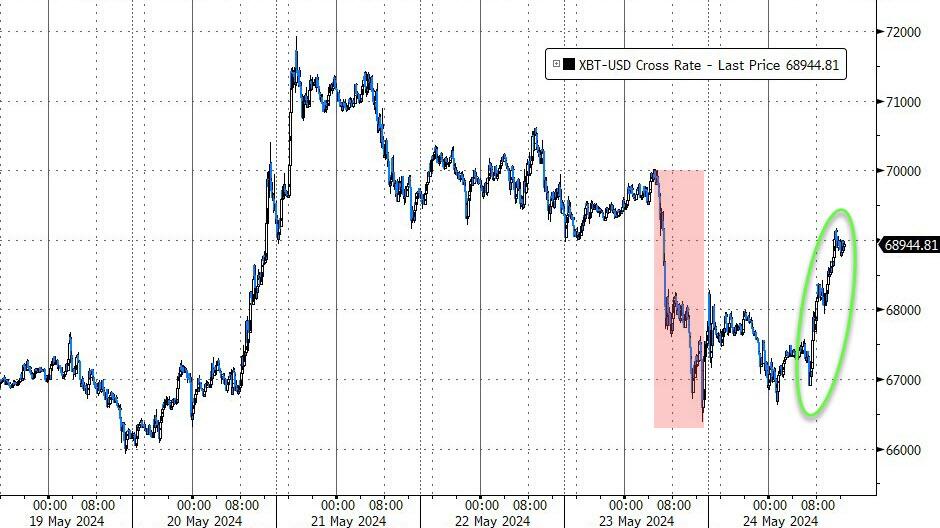
Bitcoin rallied for the second week in a row, rebounding today to $69,000

Source: Bloomberg

Ethereum dramatically outperformed bitcoin with its best week since July 2021

Source: Bloomberg

It was ETH’s best week relative to BTC since May 2021…

Source: Bloomberg

Despite a rebound today, oil prices ended lower on the week with WTI clinging to $78

Source: Bloomberg

Finally, US equity market capitalization remains drastically decoupled from bank reserves at The Fed – a relationship that had held and reverted for much of the last four years…

Source: Bloomberg

Have a great long weekend.

Tyler Durden
Fri, 05/24/2024 – 16:00

House Panel Approves Measure To Rehire Troops Fired For Refusing COVID-19 Vaccine

House Panel Approves Measure To Rehire Troops Fired For Refusing COVID-19 Vaccine

Authored by Caden Pearson via The Epoch Times (emphasis ours),

The House Armed Services Committee adopted an amendment in the annual defense policy bill on May 22 that, if cleared through Congress, would force the Pentagon to rehire U.S. troops who were fired for refusing a COVID-19 vaccine.

Rep. Mike Rogers (R-Ala.) in the Rayburn House Office Building in Washington on Sept. 29, 2021. (Rod Lamkey/Reuters)

The measure was adopted late on May 22 by lawmakers on the panel, who marked up and advanced their version of the annual appropriations bill, authorizing a defense budget of $849.8 billion.

The 2025 bill, titled the Servicemember Quality of Life Improvement and National Defense Authorization Act, will serve as the base text for forthcoming debate as it makes its way through Congress.

On May 22, Rep. Nancy Mace (R-S.C.), who offered the amendment on rehiring veterans separated under the vaccine mandate policy, confirmed its adoption.

During the debate, she said the measure would direct the Pentagon to develop a strategy to recruit from among the thousands of servicemembers who “were made veterans overnight” under the COVID-19 vaccine mandate.

“This amendment seeks to address the loss of skilled, experienced personnel who were willing and able to serve their country and overcome the resistance of the Department in recruiting from this population,” Ms. Mace said ahead of a panel vote.

The Department has so far failed to recruit a significant number of servicemembers separated under the COVID mandate. This is unacceptable.

‘Vaccines Save Lives’

Offering a counter perspective after Ms. Mace spoke, Rep. Salud Carbajal (D-Calif.) said servicemembers are required to get a broad range of vaccines, including region-specific vaccines, when deployed to certain areas.

“Vaccines save lives,” Mr. Carbajal told lawmakers on the panel.

“I must say, it’s bewildering how the COVID-19 vaccine has become the boogeyman issue, but in reality, it is a readiness issue. We currently vaccinate our forces to protect them and to protect their fellow troops.”

Congress ended the Pentagon’s COVID-19 vaccine mandate in 2022 and last year directed Defense Secretary Lloyd Austin to create a path back to service for those who were separated for refusing the vaccine.

On April 30, Mr. Austin told the panel that he didn’t know of any efforts to recruit servicemembers who had been previously let go under the mandates. Ms. Mace said on May 22 that this was “disappointing.”

The measure faces an uncertain future later this year when the committee meets with the Democrat-led Senate Armed Services Committee to reconcile differences in the National Defense Authorization Act before full passage in Congress.

According to the Pentagon, during fiscal year 2023, the military services collectively missed recruiting goals by about 41,000 recruits. This was attributed to a “smaller eligible population.”

Other reasons stated included the attractiveness of jobs in the private sector, younger generations having “low trust” in the military and following other career paths, and younger people having fewer families who served, decreasing their wish to follow suit.

Committee Advances Draft Defense Spending Bill

House Armed Services Committee Chair Rep. Mike Rogers (R-Ala.) said the 2025 defense spending bill considers the quality of life for servicemembers, boosting compensation money, improving housing, expanding health care and child care access, and other issues that directly affect troops and their families.

This is in addition to strengthening the military to face challenges posed by China, Iran, Russia, and North Korea, according to Mr. Rogers.

“Strengthening our military and investing in our defense is how we send our adversaries a message that we will not be intimidated,” he added.

The lawmakers authorized a defense budget of $849.8 billion in line with the debt ceiling agreement made earlier this year.

“For the first time in decades, the bill before us today carries a different short title. It is the Servicemember Quality of Life Improvement and National Defense Authorization Act. We did that to underscore the tremendous gains this bill makes toward improving the quality of life for all of our service members and their families,” Mr. Rogers said in a statement.

“No service members should have to live in squalid conditions. No military family should have to rely on food stamps to feed their children. And no one serving this country should have to wait weeks to see a doctor or mental health specialist. This bill goes a long way toward fixing those problems.”

He welcomed the bill’s passage through the committee.

The bill was introduced on April 18 by Mr. Rogers and ranking Democratic member Adam Smith (D-Wash.) to serve as the base text for the 2025 defense spending bill.

Tyler Durden
Fri, 05/24/2024 – 15:40