63.1 F
Chicago
Tuesday, September 22, 2026
Home Blog Page 2608

The Income A Family Needs To Live Comfortably In Every US State

The Income A Family Needs To Live Comfortably In Every US State

Families in the top five most expensive U.S. states require an annual income exceeding $270,000 to live comfortably.

This visualization, via Visual Capitalist’s Bruno Venditti, illustrates the income necessary for two working adults with two children to maintain a comfortable lifestyle in each state.

“Comfortable” is defined as the income needed to cover a 50/30/20 budget, with 50% allocated to necessities like housing and utilities, 30% to discretionary spending, and 20% to savings or investments.

The calculations for family income needed in each state were done by SmartAsset, using the cost of necessities sourced from the MIT Living Wage Calculator, last updated on Feb. 14, 2024.

Massachusetts Tops the List

Massachusetts is the most expensive state to live comfortably in, requiring a total family income of about $301,184. Hawaii ($294,611) comes in second, followed by Connecticut ($279,885).

Housing is one main reason Massachusetts is an expensive state to live in, particularly in the Boston area. In addition, the state also has a high cost of living, including expenses such as healthcare and utilities.

Rank State Income for 2 working adults raising 2 children
1 Massachusetts $301,184
2 Hawaii $294,611
3 Connecticut $279,885
4 New York $278,970
5 California $276,723
6 Colorado $264,992
7 Washington $257,421
8 Oregon $257,338
9 New Jersey $251,181
10 Rhode Island $249,267
11 Vermont $248,352
12 Minnesota $244,774
13 New Hampshire $244,109
14 Alaska $242,611
15 Maryland $239,450
16 Nevada $237,286
17 Virginia $235,206
18 Illinois $231,962
19 Arizona $230,630
20 Pennsylvania $230,464
21 Maine $229,549
22 Delaware $228,966
23 Wisconsin $225,056
24 Utah $218,483
25 Michigan $214,490
26 Nebraska $213,075
27 Georgia $212,826
28 Montana $211,411
28 Iowa $211,411
30 Idaho $211,245
31 North Carolina $209,331
31 Ohio $209,331
33 Florida $209,082
34 Indiana $206,003
35 New Mexico $203,923
36 Wyoming $203,424
37 Missouri $202,259
38 North Dakota $202,176
39 Texas $201,344
40 South Carolina $200,762
41 Kansas $196,768
42 Tennessee $195,770
43 Oklahoma $194,106
44 Alabama $193,606
45 South Dakota $192,608
46 Kentucky $190,112
47 Louisiana $189,613
48 West Virginia $189,363
49 Arkansas $180,794
50 Mississippi $177,798

Meanwhile, Mississippi is the least expensive state for a family to live comfortably, requiring $177,798 per year. Arkansas ($180,794) comes in second, followed by West Virginia ($189,363). In common, all these states share low prices of housing.

If you enjoyed this post, be sure to check out this graphic, which ranks the median down payment for a house by U.S. state.

Tyler Durden
Thu, 05/23/2024 – 21:20

Senate Again Blocks Border Bill With GOP Opposition

Senate Again Blocks Border Bill With GOP Opposition

Authored by Joseph Lord and Stacy Robinson via The Epoch Times,

The U.S. Senate on May 23 again rejected a proposed border bill as the issue continues to dominate voters’ concerns ahead of the 2024 election. The bill was previously blocked by Republicans in February when it was rolled into a broader foreign aid package.

Republicans have criticized Senate Majority Leader Chuck Schumer’s (D-N.Y.) decision to bring the bill back up for a vote, saying it was a political move aimed at bolstering Democrat messaging ahead of the 2024 elections.

The legislation, dubbed the Border Act of 2024, was rejected in a 43–50 vote that included more opposition from members of both parties than the previous vote in February.

The bill includes $20 billion in funding for border security and a mechanism to shut down the border after seven consecutive days with an average of 5,000 illegal immigrants encountered per day or if more than 8,500 illegal aliens are encountered in a single day.

Proponents of the bill say that it would grant President Joe Biden additional authority to close the border, and say that it would alleviate the situation by providing new funding that could help stop the flow of fentanyl over the border.

“It’s a chance to show we’re serious about fixing the border,” Mr. Schumer (D-N.Y.) said ahead of the vote.

Opponents say the opposite, with many contending it would only make the situation worse—particularly through a clause that could effectively codify allowing 5,000 illegal aliens into the country a day.

In February, the bill failed to advance a 49–50 vote, including support from four Republicans and opposition from four Democrats.

On Thursday, Several Democrats, including Sens. Cory Booker (D-N.J.) and Bernie Sanders (I-Vt.), who caucuses with Democrats, voted against the measure.

These lawmakers tied their opposition to the measure’s lack of protection for “Dreamers,” the recipients of deferred immigration enforcement under President Barack Obama.

Sens. Kyrsten Sinema (I-Ariz.) and John Lankford (R-Okla.), key negotiators for the initial package, both defected to vote against the measure.

No Republicans supported the measure during its second round, with many saying that the vote itself was a political ploy by Democrats that would only worsen the situation at the southern border.

Political PR War

The bill comes amid a PR war among Republicans and Democrats on whose border credentials are stronger even as both sides continue to accuse the other of politicizing the issue, even as its failures on both May 23 and during its original vote came due to bipartisan opposition.

That PR war comes as the border issue continues to dominate voters’ priorities in 2024, with poll after poll showing that voters have far more confidence in former President Donald Trump’s ability to handle the border than have faith in President Biden’s policies.

Now, Democrats are trying to show that they can be strong on the border too—but Republicans say that the whole package is unnecessary, as President Biden already has the authority he needs to close down the border.

“The fact of the matter is that President Trump had the authority to secure the border. He did. Biden used that exact same authority to open it back up,” Sen. Ron Johnson (R-Wis.) told The Epoch Times.

Democrats, meanwhile, extolled the effects the bill could potentially have on reducing the flow of fentanyl into the country.

In a memo sent to the press, the White House accused Republicans of being on the side of fentanyl pushers.

“Instead of supporting legislation endorsed by the Border Patrol Union, congressional Republicans sided with fentanyl traffickers,” the White House said.

President Biden has repeatedly endorsed the legislation and called on Congress to take it up.

Amid the debate, both parties are claiming—and responding to claims—that the other party is motivated primarily by politics.

Sen. Dan Sullivan (R-Alaska) told The Epoch Times that the bill “seems like it’s a Schumer lifeline to guys like Tester,” a reference to Sen. Jon Tester (D-Mont.) who’s facing a tough reelection bid in ruby-red Montana.

“Biden could fix the border tomorrow if he wanted to—Trump fixed the border without additional authority,” Mr. Sullivan said. “So my message to President Biden? Fix the border the way Trump did.”

The sentiment was repeated by Sen. Rand Paul (R-Ky.), who called the second push on the bill “completely a political stunt. I don’t even think it’ll get any Republican votes.”

Like his colleagues, Mr. Paul called on President Biden to fix the border with his preexisting authorities.

Sen. Chris Murphy (D-Conn.), Democrats’ lead negotiator on the package, meanwhile rejected the claim that Democrats were pursuing the bill for political advantage, blaming Republicans with political motives seeking to kill the bill.

“I think it’s pretty ironic for a party that openly admits they killed the bill for political reasons to claim that we’re trying to pass a law for political reasons,” Mr. Murphy told reporters.

Mr. Murphy, one of the lead negotiators on the bill, said that it was very different from the House’s H.R. 2 border security bill, which Mr. Murphy dismissed as “transparently a partisan political exercise,” while the Senate bill, he said, is “transparently bipartisan.”

“I just think … Republicans have zero interest in fixing the border because they can’t imagine living in a world in which the border isn’t a political issue,” Mr. Murphy said.

Tyler Durden
Thu, 05/23/2024 – 21:00

Last Hope Against Biden-Bucks – House Passes Bill Blocking The Fed From Issuing A CBDC

Last Hope Against Biden-Bucks – House Passes Bill Blocking The Fed From Issuing A CBDC

The CBDC Anti-Surveillance State Act passed the United States House of Representatives on a largely partisan vote on May 23.

As CoinTelgraph’s Derek Andersen reports, the bill, which must still face a vote in the Senate, amends the Federal Reserve Act of 1913 to prohibit Federal Reserve banks “from offering certain products or services directly to an individual, to prohibit the use of central bank digital currency for monetary policy, and for other purposes.”

The Republican-backed bill’s debate was sparsely attended. Republican supporters spoke about the potential for the abuse of a central bank digital currency (CBDC), while Democrats concentrated on innovation, the dollar’s international competitiveness and the bill’s poor drafting.

French Hill, the Chairman of the Financial Services Committee Subcommittee on Digital Assets, Financial Technology and Inclusion, said:

“We live in a world where the government can abuse the tools it has.”

Representative Mike Flood reused his rhetorical device urging the audience to “imagine the politician you despise the most” with control over a CBDC.

Financial Services Committee member Warren Davidson called the New York Fed’s Project Hamilton “the same creepy surveillance tool” as China’s digital yuan. He said the pilot project “could be developed to something further.” The Fed was not responding to dialog, so it must respond to law, he said.

Warren called a digital currency the “creepiest surveillance tool known to man” that would lead to “coercion and control.”

“Why would we enable it?” he said. “Everywhere it’s depicted as evil.”

Davidson said the Fed should not pursue a digital currency without authorization from Congress, arguing it doesn’t have a place in a free society.

“We don’t want them to design it,” he said. “We don’t want them to build it.”

Frequent references were made to the digital yuan and the blockage of bank accounts in Canada during a trucker drivers’ demonstration against COVID-19 vaccination. Davidson also mentioned George Orwell – author of the novel 1984 – the New Testament Book of Revelations and the Deathstar – a device in the Star Wars film franchise – in his arguments.

The CBDC Anti-Surveillance State Act. Source: congress.gov

That idea was echoed by Rep. Alexander Mooney, author of an amendment to the bill that restricted CBDC research, who said a CBDC should not be “available at a moment’s notice.”

Marjorie Taylor Greene spoke about the “deep state” and the “Democrat regime.”

The exact implications of the bill were also disputed. Brad Sherman called the bill a “word salad” that favored “crypto bros.” He added that no one would be required to use a CBDC.

While Republican arguments focused on a retail CBDC, Financial Services Committee ranking member Maxine Waters claimed the bill could be construed to ban a wholesale CBDC as well.

Waters argued that the bill would “risk undermining the primacy of the U.S. dollar” globally.

The bill could also be interpreted to ban Federal Reserve holdings of bank reserves, which is necessary to administer payment systems, Waters said:

“[The bill] blocks the American economy as it operates today and has for decades.”

Waters also mentioned zero-knowledge proof technology that could guarantee user privacy. Dollar-pegged stablecoins could lose their value in a run, while a CBDC could not, she added.

Source: XRP Drops

Financial Services Committee member Jake Auchincloss said that his proposed bill, “Power of the Mint Act,” would accomplish similar goals without the drawbacks of the bill under consideration, but it had been blocked by Republicans.

The CBDC Anti-Surveillance State Act was introduced into the House by Rep. Tom Emmer in February 2023. It passed by a vote of 216-192.

For the past two years, Jim Rickards – among many others – have been warning about the emergence of central bank digital currencies (CBDCs), or as some like to call the U.S. version, “Biden Bucks.”

These Biden Bucks would have the full backing of the U.S. Federal Reserve. They’d replace the cash (“fiat”) dollar we have now. And if Biden got his way, they’d be the sole, mandatory currency of the United States.

What does this mean for you?

As Rickards details below, it would make your money less truly your own. It would be subject to government control.

Biden Bucks are being peddled as a more efficient and convenient form of money. They say they’re just simplifying the payment system and making it more efficient. It’ll be much more convenient than the convoluted system we have today.

And they’re actually right about that. A digital dollar will be simpler, more efficient and more convenient to use.

Assume you buy gasoline at your local gas station. You pay with a credit card, which begins a payment process involving maybe five separate parties.

These include the merchant from whom you bought the gas, the credit card company, the bank and an intermediary called a merchant acquirer (no need to explain what a merchant acquirer does for today’s purposes, but just realize that it’s part of the payment system).

Ultimately the bank that issues your credit card sends you a bill, which you pay. You also pay a fee, maybe 3%, all to buy the gas.

But with a central bank digital currency, you could simply pay for the gas with an account you have at the Fed.

You would get rid of all the middlemen. You could bypass the merchant acquirer, the banks and the credit card company. A digital dollar would also eliminate many of the fees we currently face.

So yes, the payment system would be faster, cheaper, easier, more streamlined and more secure. What’s not to like as far as you’re concerned?

Well, if you’re concerned about your personal privacy, everything.

We Can’t Let You Destroy the Environment

Imagine this. To further advance his Green New Scam, what if Joe Biden and his cronies decided that gasoline needed to be rationed?

Your Biden Bucks could be rendered useless at the gas pump once you’ve purchased a certain amount of gasoline in a week! You want gas, but all you get is a one-word message: Declined.

How’s that for control?

Biden Bucks would create new ways for the government to control how much you could buy of an item, or even ban purchases altogether. It would keep score of every financial decision you make.

In a world of Biden Bucks, the government will even know your physical whereabouts at the point of purchase.

It’s a short step from there to putting you under FBI investigation if you vote for the wrong candidate or give donations to the wrong political party. If any of this sounds extreme, fantastical or otherwise far-fetched, it’s not.

Look at all the ways the government has abused its power to target its opposition in recent years.

Government Always Wants More Power

From unconstitutional “lawfare” against Trump, to the jailing of harmless J6 protesters who did nothing more than walk around the Capitol taking selfies (I’m not talking about those who committed violence that day, who should be punished to the full extent of the law), the federal government has overstepped its bounds.

Several months ago, the FBI and Financial Crimes Enforcement Network (FinCEN) sent letters to U.S. banks asking them to identify and provide a list to the government of customers using Zelle, Venmo and similar payment channels who mentioned “MAGA,” or “Trump” in their message traffic.

They also asked for details on bookstore purchases of religious articles including Bibles. Finally, they asked for details on those shopping at Cabela’s, Dick’s Sporting Goods or Bass Pro Shops, presumably on the view that those are places to buy guns and ammo.

This is a clear-cut violation of the First Amendment (free speech, freedom of religion), Second Amendment (right to bear arms) and Fourth Amendment (no unreasonable search and seizure).

It’s not a crime to write “MAGA,” etc. and therefore there’s no reasonable basis for suspecting a crime, and therefore no right to get the information without a warrant, which requires a judge. Any judge would likely reject the warrant request since there’s no probable cause.

This is an obvious case of profiling. If you shoot someone and you’re wearing a MAGA hat, you get arrested for the shooting, not the hat. In this case, the hat is enough to put you under surveillance because you have been profiled as “an enemy of the people” by the government’s definition.

I predicted this kind of surveillance would arise with the use of Biden Bucks since the government would have your financial records and would not have to go to the banks or get a warrant. I’d like to say I was wrong, but unfortunately I was right.

Why do you think it would stop there? Government always seeks to expand its power.

The Slippery Slope

In the latest example of federal overreach, the latest update of the IRS Internal Review Manual expands the scope of IRS investigation and audit activity to include anyone who impedes the government’s “ability to govern” or who poses a “threat to public safety or national security.”

Such phrases sound benign when applied to foreign terrorists or criminal masterminds. Then you realize they can just as easily be applied to political opponents, Trump supporters, podcasters, opinion writers, political organizers or everyday Americans who stand in the way of the administration’s ambitions.

The IRS can use threats of audits and investigations to intimidate social media platforms like Google, Facebook and Instagram into shutting down MAGA Republicans and others who oppose Biden policies.

The updated IRS manual also allows the IRS to leak taxpayer information to the Justice Department, the Department of Homeland Security or other agencies with enforcement power in order to sic those agencies on targeted victims.

This happens in a context where simple political opposition has been criminalized giving the IRS carte blanche to choose their victims. If you’re outspoken against the Biden administration, keep your tax records handy and get ready for a knock on the door.

So, again, why would you be surprised if the government used Biden Bucks to punish its political opponents? It’s just the natural progression.

Can it be stopped? There’s one possibility — and it comes from the individual states.

The Last Hope?

Last year, Indiana became the first state to reject CBDCs as a form of money. This year it enacted an additional measure that prohibited state agencies from accepting CBDCs as payments.

Florida, North Dakota, South Dakota, Tennessee, Utah, Alabama and Georgia have passed similar laws to block the imposition of CBDCs.

Will they succeed? It would be a triumph of federalism if they did, which has a rich American tradition.

But proponents of Biden Bucks invoke Article VI, Paragraph 2 of the Constitution, otherwise known as the federal Supremacy Clause. It establishes that the federal law takes precedence over state law.

Over the years, the federal government has gradually expanded its powers under the Supremacy Clause.

It might be an uphill battle, but the states might just be our best defense against the implementation of Biden Bucks.


Tyler Durden
Thu, 05/23/2024 – 20:40

China’s Rapid Nuclear Expansion Is Threatening US Dominance In The Sector

China’s Rapid Nuclear Expansion Is Threatening US Dominance In The Sector

Authored by Haley Zaremba via OilPrice.com,

  • China is quickly becoming the world’s leading producer of nuclear energy, raising concerns for US competitiveness.

  • China’s plans for floating nuclear plants in the disputed South China Sea create tension with neighboring countries.

  • China and Russia’s joint project to build a nuclear reactor on the moon raises questions about safety and militarization.

China’s runaway nuclear energy expansion has competitors biting their fingernails. As nuclear energy regains traction around the world as a promising baseload power source for a decarbonized future, it’s also become more and more of a geopolitical battleground. As countries scramble to keep a strategic foothold in a rapidly changing energy landscape, becoming a nuclear energy powerhouse is suddenly important for world superpowers. And China seems to be winning this race. 

While the United States has been the biggest nuclear power generator in the world for decades, the American market has significantly slowed in recent years at the same time that Beijing has doubled down on deployment, adding a whopping 34 gigawatts of nuclear energy capacity over the last ten years. As a result, China is set to overtake the United States (and France) to become the world’s biggest producer of nuclear energy within the decade. 

China currently has 55 operating nuclear power reactors compared to the United States’ 94, but it already has 23 new reactors under construction and more on the way. In fact, it’s taken China just 10 years to add the same amount of nuclear capacity that the United States needed four decades to build. 

Beijing is able to approve new nuclear reactors at a much faster clip than the United States, at a blazing rate of ten new plant approvals per year. Chinese plants are also much less expensive to build, in part thanks to preferential loans with particularly favorable terms from state-owned banks. While the United States has recently taken pains to kick-start its own stalled nuclear energy sector, its newest power plant is so behind schedule and over budget that nuclear energy advocates are worried that it might derail the nation’s nuclear ambitions altogether. 

While the sharp rise in nuclear energy deployment in China is great news for the nation’s decarbonization potential – and therefore great news for the entire world’s ability to meet mid-century climate goals – China’s fast and furious approach has put a number of world leaders on edge. Policymakers in the United States have demonstrated concern that China’s rapidly increasing nuclear energy capacities could allow it to export nuclear reactors at a large scale, ultimately undermining U.S. foreign relations in the importing countries. This would not be a new trend, but a continuation of China’s already massive expansion of energy influence in emerging markets

Meanwhile, China’s plans to put floating nuclear power plants in the South China Sea have stirred up tensions with its Southeast Asian neighbors. China, Malaysia, Vietnam, and the Philippines all have overlapping claims to parts of the sea, which China claims almost in its entirety despite a 2016 ruling by the Permanent Court of Arbitration which rejected Beijing’s claim as “having no legal basis.” In contempt of this ruling, China has continued to ‘reclaim’ land to build artificial islands in the Sea and now plans to send about 20 floating nuclear power plants to some of those islands. 

Experts have widely condemned these plans, warning that “China’s planned deployment of floating nuclear reactors to the disputed South China Sea may risk ramping up tensions with other claimants and undermining regional security.” Adding to these tensions, there is some legitimate concern that China will be using these plants to power military operations in the conflicted region, which would be in violation of international law. 

Indeed, China’s outsized nuclear ambitions cannot be hemmed in by its own borders, or even terrestrial bounds. Earlier this year, Moscow and Beijing announced joint plans to put a nuclear reactor on the moon within the next decade. Russian state media even claims that development of the plant is already underway and Russia and China are currently working on experimental and research facilities under the project.

Tyler Durden
Thu, 05/23/2024 – 20:20

Bitcoin & The Wrong Lessons From Pizza Day

Bitcoin & The Wrong Lessons From Pizza Day

Authored by Jimmy Song via BitcoinMagazine.com,

The following is an excerpt on Bitcoin Pizza Day from “Fiat Ruins Everything” by Jimmy Song. Visit the Bitcoin Magazine Store to order a printdigital or audio copy of the book.

Pizza Day is often viewed with a sense of regret.

The well-known story goes like this: many years ago, Laszlo Hanyecz bought two Papa John’s pizzas, and in return, some fortunate person received 10,000 BTC.236 This tale resembles that of Peter Minuit purchasing Manhattan Island for a mere $24. It’s hard to believe such a transaction took place, considering the current value.

The story has several intriguing aspects. It marked the first real-world good or service purchased with Bitcoin. It also established Bitcoin’s price; since the two pizzas cost around $41, one BTC was approximately $0.0041.

Another aspect of this narrative is Laszlo, a pioneer in mining Bitcoin using GPUs (graphics processing units). He spent around 100,000 BTC on pizzas, as he made similar deals multiple times throughout the month. In a way, he’s the Santa Claus of this story, giving away value almost flippantly.

RENT-SEEKING FANTASIES

Pizza Day often triggers daydreams of becoming a Bitcoin billionaire through a single brilliant trade. Many people don’t fantasize about being Laszlo, as they aren’t GPU programming experts. However, they can easily imagine being the person on the bitcointalk forums offering to buy Bitcoin for a couple of pizzas.

The idea of having made such a trade sparks envy, as we all secretly resent the person who actually executed it. We perceive them as lucky, as if they had won the lottery.

These fantasies stem from a fiat mentality, where the value hierarchy is rooted in fiat money. The desire is to be lucky rather than skilled. People would prefer making money without working, versus earning it by providing valuable goods and services.

It’s revealing that the regret lies in missing out on luck rather than innovation. In a fiat-driven world, it’s easier to dream about being the person who sold the pizza, rather than the one who had the skill and foresight to mine with GPUs. This mindset prioritizes fiat accomplishments—getting lucky with money—over real achievements, which involve earning money by providing value to the market. Most people would rather ride the coattails of an innovator than be one themselves.

BITCOIN REGRET

We all have our Bitcoin regret stories. I remember learning about Bitcoin in February 2011. I tried to find a way to buy it using a credit card, but I couldn’t. I attempted mining on Amazon Web Services and didn’t find any blocks solo-mining for two days. I began the process of moving dollars into Mt. Gox, but when the price dropped from $1 to $0.90, I decided it was too much of a hassle to set up. I could have bought Bitcoin at $0.90, but I didn’t. It’s one of the biggest regrets of my life.

Everyone has different regret stories. Perhaps you heard about Bitcoin back in June 2011 when it ran up to $30 and regret not buying it then. Maybe you discovered Bitcoin in April 2013 when it reached $266, or later that year in December 2013 when it soared to $1,100. Or perhaps it was in 2017 when it hit $2,500, $5,000, and then $19,000. Or even more recently, in March 2020 when Bitcoin crashed to under $4,000, or later that year when it was breaking $10,000. Anyone who’s heard about Bitcoin at any point in its history has a regret story.

Bitcoin regret stories are like bad-beat stories in poker. Everyone has them, and they are fantasies about different, luckier outcomes. They are unproductive stories because the feelings of regret come from a fantasy that assumes virtues that are not common.

THE CHALLENGE OF HOLDING

In these regret stories, we often overlook something. What if we had bought Bitcoin when we first heard about it? How would we have handled the subsequent challenges? Would we have had the diamond hands to hold through the 85% drawdowns in 2011, 2013, 2014, and 2018?

When you fantasize about the Pizza Day story, do you ever consider the difficulty of holding during the tough times in 2011, 2013, 2014, and 2018? There’s a tendency to assume that we would have had the conviction that we possess now, like how a time traveler might feel. I’ve experienced those drawdowns firsthand, and let me tell you, most people didn’t have that conviction, and they sold. Many believe they would have held strong through all the difficult times, but like the original O.J. Simpson verdict, that assumption goes against all evidence.

Holding 10,000 BTC wasn’t uncommon back in 2010. Many people had a significant amount of Bitcoin because they were worth pennies at the time, but where are they now? Most of them sold when the Bitcoin price doubled or tripled and never looked back.238 They viewed Bitcoin as a plaything and didn’t grasp its revolutionary nature. So, they sold it to buy a new computer, a new bike, or a new car.

SHATTERING YOUR DREAMS

Had you sold Laszlo two pizzas for 10,000 BTC in 2010, you probably would have sold them in the new few years. To think otherwise is hubris. Most people back then didn’t understand what Bitcoin was, and there were no educational resources explaining why you should hold. We now have an abundance of resources for understanding Bitcoin.239 In 2023, it’s much easier to comprehend that Bitcoin is a better form of money than anything that came before. Back in 2010, it was much more difficult. Do you still think you would have had diamond hands?

To hold Bitcoin is to have a deep conviction about what it is. There are necessary virtues to be a long-term holder. Holders understand the fundamental value of Bitcoin being sound money and can thus withstand the 85% drawdowns that occur regularly. Only the truly extraordinary managed to hold from 2010, and you likely would not have been one of those people.

But suppose you beat the odds and had conviction. You held through 2011 and even the first bubble in 2013. Would you have had the foresight to withdraw to your wallet before Mt. Gox collapsed in 2013?240 Or if you used another exchange before then, would you have gotten out before they exit-scammed?241 We say “not your keys, not your coins” now, but back then, this was not common practice. Many people had to be burned for that lesson to become a meme. Even with conviction, there’s a good chance you would have been one of the many who suffered.

There were also other dangers, like the advent of altcoins starting in 2011. How many Bitcoins would you have lost in Geistgeld,242 Feathercoin,243 and MasterCoin?244 There were also numerous scams, including Pirate40245 and others who promised high returns by running Ponzi schemes. Would you have avoided those? There were also several ASIC startups that sold machines that weren’t built yet. Would you have avoided getting duped by Butterfly Labs246 or TerraMiner?247 How about the cloud mining services248 that took your Bitcoin and paid out only a fraction over the next 12 months? Would you have avoided these tempting offers that ended up diminishing many Bitcoin stacks? You would have needed the instinct to get in on Bitcoin early while not falling for these similar-sounding investments, which frankly is not an easy needle to thread.

Looking back on those dangers, it’s a miracle that people made it past those years with any Bitcoin at all. Many OGs are like Vietnam veterans, reflecting on the times when they were fortunate to escape the numerous hazards.

BUILDING CONVICTION IS CHALLENGING

Developing deep conviction is not easy, and for early adopters, it was especially difficult. Remember, everyone was calling Bitcoin a scam back then. Even now, it takes years of study and unwavering resolve to develop that conviction. Back in 2010-2013, having Bitcoin conviction was as rare as a physically-fit government health official.

Going against conventional wisdom and following your convictions requires a great deal of courage, which many people lack. Consider what happened during COVID-19. How many people had the conviction to voice opinions against the mainstream narrative in March 2020? That’s the level of conviction you had to possess to hold Bitcoin through those early years.

In 2023, we have numerous resources that help us save in Bitcoin. Podcasts, books, and videos are available to help us navigate this space, not only to develop the conviction but also to adopt best practices for holding. The early years were a minefield of traps to lose your Bitcoin. It’s much easier these days to avoid those traps, but back then, there weren’t OGs who could warn you about them. The resources that exist now and the Bitcoin memes we have today (“Not your keys, not your coins.”) are not propaganda. They are the fruit of hard-earned experience.

BITCOIN DERANGEMENT

Studying the early individuals in the Bitcoin space reveals a troubling pattern. Almost every non-technical Bitcoin advocate pre-2013 is now promoting an altcoin. Why have so many early adopters become Bitcoin-deranged?

We can find some answers by looking at the fiat world of lottery winners. Years after winning, numerous lottery winners end up worse off than before they won the lottery. They are ill-equipped to manage the windfall, and many find themselves with greater debt, damaged relationships, and a worse life. Some even commit suicide. While not everyone experiences such negative outcomes, enough do that many lottery agencies proactively offer assistance.

Unfortunately, bad outcomes have been the fate of many early Bitcoin adopters. At some point in the last decade, they either fell victim to scams or became scammers themselves. As a result, many of them have turned against Bitcoin.

So, to further shatter your daydream, there’s a good chance that if you had gotten in early, you would be an altcoin scammer or would have been scammed by an altcoin. These are serial scammers with no qualms about lying, cheating, or stealing their way to wealth. They exist in a rent-seeking nightmare of shattered dreams. That’s not a desirable fate, and it’s something I wouldn’t wish on my worst enemy.

LEVEL UP YOUR CONVICTIONS

For many, Pizza Day is an opportunity to indulge in time-traveling fantasies where they daydream about being wealthy. This mindset often leads people to explore altcoins, as it stems from the fiat money mentality. Essentially, Pizza Day is a fantasy about being lucky and not having to work. In other words, it represents a rent-seeking desire on a grand scale.

Fiat money has fostered a consumerist mentality, which exacerbates the urge to rent seek. Governments capitalize on this desire through lotteries, profiting from the allure of easy wealth. Altcoins exploit the same yearning. Unfortunately, Pizza Day often reinforces this mentality, focusing on the desire to be fortunate rather than skilled.

Instead, Pizza Day should serve as a reminder that forming conviction is no easy task. True conviction demands knowledge, wisdom, and courage—virtues that require time, energy, and effort to develop. Rather than envying early adopters and fantasizing about joining their ranks, we should strive to cultivate the conviction needed to hold through challenging times and provide value in the process. As the saying goes in the Bitcoin community, “It’s still early.”

On Pizza Day, commit to leveling up your convictions.

TEN THINGS YOU BOUGHT INSTEAD OF BITCOIN

– 1- 

That sleek, irresistible Apple gadget you just had to have, only to replace it two years later with an even shinier, more irresistible version.

– 2 –

Green gems in Clash of Clans, because clearly, the defense of your virtual village was of greater importance than securing your financial future.

– 3 –

A college degree with about as much relevance to your current job as a penguin waddling through the Sahara Desert.

– 4 –

Litecoin, the less secure, less functional cousin of Bitcoin— because who needs the real deal when you can settle for something much worse?

– 5 –

A dating app subscription that merely solidified your status as forever alone.

– 6 –

Steam games on sale, eagerly awaiting their debut in your library, wondering when they’ll finally bask in the glow of your screen.

– 7 –

That exercise equipment now serving as an exquisite clothes rack, because let’s face it, the allure of the couch is simply too strong to resist.

– 8 –

An online class you signed up for, attended just long enough to say “hello” and “goodbye,” then promptly ghosted.

– 9 –

The, uh, “adult entertainment” that left you feeling deflated and questioning your life choices the next day.

– 10 –

An MLM product from a Facebook friend that you abandoned quicker than you can say “pyramid scheme.”

*  *  *

Click here to order a copy of “Fiat Ruins Everything: How Our Financial System is Rigged and How Bitcoin Fixes It”, by Jimmy Song.

Tyler Durden
Thu, 05/23/2024 – 19:00

Bipartisan Calls Grow For Ukraine To Hit Russian Territory With US Arms

Bipartisan Calls Grow For Ukraine To Hit Russian Territory With US Arms

Officials in the US are growing more vocal in making the case for allowing Ukraine to use Washington-supplied weaponry to attack Russian territory.

On Wednesday, House Speaker Mike Johnson came out with a full-throated statement expressing support for such a move which would certainly risk bringing NATO and Russian into more direct conflict. Biden’s Secretary of State Antony Blinken is also said to be on board with a policy change.

US Army image

Johnson was asked by Voice of America if he supported a scenario where Ukraine forces attack Russian soil utilizing American weapons. He responded by saying that the US needs “to allow Ukraine to prosecute the war in the way they see fit.”

“They [Ukraine] need[s] to be able to fight back. And I think us trying to micromanage the effort there is not a good policy for us,” he said.

Ukrainian parliament member Oleksandra Ustinova was among a delegation from Kiev that was in Washington days ago in order to lobby US lawmakers for a change in policy. The Biden administration has long communicated a strict ban on pro-Kiev forces attacking Russia with American arms.

Watch Johnson sign off on Ukraine using US weapons to attack inside Russian territory:

“Realizing that we do not have the right to use, for instance, HIMARS [rocket launchers] on the territory of Russia, the Russians display all their equipment along the border and use it to destroy the Kharkiv region,” Ustinova has been cited as saying. “And we simply cannot get to them, because there’s a ban on the usage of American weapons on the territory of Russia.”

In Kharkiv oblast in particular, Russia earlier this month launched a new major offensive to push the border 10km deep into Ukrainian territory, with the stated aim of establishing a buffer zone to make it harder for Ukrainian artillery to reach Russian settlements across the border.

The Biden White House has yet to give in to the intensified lobbying campaign to loosen restrictions on US weaponry, on a public level at least.

On Monday a group of House lawmakers from both parties issued a formal letter urging the lifting of any restrictions on Ukraine’s use of US weapons.

“It is essential the Biden administration allows Ukraine’s military leaders to conduct a full spectrum of operations necessary to respond to Russia’s unprovoked attack on their sovereign land,” the letter said.

At this point President Zelensky is going so far as to request that NATO directly intercept and shootdown Russian missiles sent against Ukrainian cities. Indeed the messaging and requests are growing more desperate, given Ukraine forces are being rapidly beaten back in places like Kharkiv.

Tyler Durden
Thu, 05/23/2024 – 18:40

“Dangerous Racial Gerrymandering” – White House Fumes As Supreme Court Backs GOP’s New South Carolina Congressional Map

“Dangerous Racial Gerrymandering” – White House Fumes As Supreme Court Backs GOP’s New South Carolina Congressional Map

The U.S. Supreme Court on May 23 ruled in favor of South Carolina’s redrawn congressional map, reversing a lower court decision.

The National Association for the Advancement of Colored People (NAACP) challenged the map, arguing legislators were motivated by race when drawing district lines and committed “intentional racial discrimination.”

As Zachary Stieber reports via The Epoch Times, a panel of federal judges in 2023 said that “race predominated over all other factors” when legislators redrew South Carolina’s First Congressional District, currently represented by Rep. Nancy Mace (R-S.C.). The finding was based in part on the movement of more than 30,000 black voters to a different district.

To show that race was the predominant factor motivating legislators who are redrawing districts, plaintiffs challenging a new map must prove the state elevated race above other factors, such as contiguity, according to court precedent.

The judges who handed down the earlier ruling “clearly erred” because the challengers did not provide such proof, Justice Samuel Alito, writing for the majority, said.

The challengers “provided no direct evidence of a racial gerrymander, and their circumstantial evidence is very weak,” he wrote. “Instead, the challengers relied on deeply flawed expert reports.”

Justice Alito, an appointee of former President George W. Bush, was joined by Justice John Roberts, another appointee of President Bush, and Justices Neil Gorsuch, Brett Kavanaugh, and Amy Coney Barrett, all appointees of former President Donald Trump.

Justice Thomas, another appointee of President Bush, wrote in an opinion, concurring in part.

Justice Elena Kagan, an appointee of former President Barack Obama, filed a dissent. She was joined by Justice Sonia Sotomayor, another appointee of President Obama, and Justice Ketanji Brown Jackson, an appointee of President Joe Biden.

The panel that entered the 2023 ruling consisted of U.S. District Judges Mary Geiger Lewis and Richard Gergel, both appointees of President Obama; and U.S. Circuit Judge Toby Heytens, an appointee of President Biden.

The new map, created after the receipt of data from the 2020 census, was enacted in 2022.

“We’re always going to have concerns about elections but I think the Supreme Court was clear. They examined the question and they followed the law,” South Carolina Gov. Henry McMaster, a Republican who signed the updated map, told reporters at an unrelated briefing. “I have not read it, but I know about it, and I think they made the right decision.”

South Carolina Senate President Thomas Alexander, another Republican defendant in the case, did not respond to a request for comment.

“Today, the Supreme Court has failed the American people. Voting rights have taken another gut punch, and the future of democracy in South Carolina is dangling by a thread,” Brenda Murphy, president of the South Carolina State Conference of the NAACP said in a statement.

South Carolina’s 1st Congressional District includes over half of the state’s coast and parts of Charleston. It has a population of about 762,000.

Republicans won elections in the district for decades starting in the 1980s. Former Rep. Joe Cunningham (D-S.C.) upended that trend in the 2018 election. After one term, he was unseated by Ms. Mace.

Ms. Mace won with 50.6 percent of the vote in 2020 and in 2022 earned another term with 56.3 percent of the vote.

Justice Alito also criticized the lower court judges for not finding challengers at fault for their failure to provide an alternative map showing how legislators could have achieved their “legitimate political objectives” while producing “significantly greater racial balance.”

The majority also said they found similar errors in the lower court’s finding that legislators intentionally diluted the votes of black people, because that finding was based on the same facts that underpinned the analysis of the racial gerrymandering claim.

Justices remanded the portion of the case relating to vote dilution back to the district court, with guidance on how to analyze dilution allegations.

Justice Thomas said in his opinion that he agreed with most of Justice Alito’s opinion but that he does not think the Supreme Court has the power to decide claims of racial gerrymandering.

“Drawing political districts is a task for politicians, not federal judges. There are no judicially manageable standards for resolving claims about districting, and, regardless, the Constitution commits those issues exclusively to the political branches,” he wrote.

Justice Kagan said in her dissent that reversing factfinding about redistricting can only be done if a “clear error” is found, citing a previous ruling. “This court must give a district court’s view of events ’significant deference,‘ which means we must uphold it so long as it is ’plausible,’” she wrote. “Under that standard, South Carolina should now have to redraw District 1.”

The Supreme Court earlier this year ruled that Louisiana needed to use a congressional map with two black-majority districts in the upcoming election. The three justices appointed by Democrats dissented in that order as well.

In 2023, the nation’s top court struck down Alabama’s redrawn map, finding it was racially discriminatory in violation of the Voting Rights Act.

The White House was quick to issue a statement condemning The Supreme Court’s decision:

The right to vote is the foundation of American democracy.  Key to that right is ensuring that voters pick their elected officials — not the other way around. The Supreme Court’s decision today undermines the basic principle that voting practices should not discriminate on account of race and that is wrong.

This decision threatens South Carolinians’ ability to have their voices heard at the ballot box, and the districting plan the Court upheld is part of a dangerous pattern of racial gerrymandering efforts from Republican elected officials to dilute the will of Black voters. Vice President Harris and I are ironclad in our commitment to protecting the sacred right to vote, and we will not stop fighting until Congress passes both the John Lewis Voting Rights Advancement Act to restore and strengthen the Voting Rights Act, and the Freedom to Vote Act to ensure fair Congressional maps for all Americans.

Given the demise of Biden’s share of the black vote, maybe this actually did him a favor?

Tyler Durden
Thu, 05/23/2024 – 18:20

SEC Approves Spot Ether ETFs In Major Crypto Victory

SEC Approves Spot Ether ETFs In Major Crypto Victory

What until just a few days ago was viewed as an extremely low-probability event, has just come true, when the highly politicized Securities and Exchange Commission, headed by Liz Warren’s soon to be terminated lackey Gary Gensler, has – against its desires – been forced again to approve no less than eight crypto ETFs, this time for spot Ethereum, following what was reportedly urgent political intervention from the White House.

Following relentless pushback which prompted Bloomberg’s ETF expert Eric Balchunas to give a spot ETH ETF only 25% odds of approval, in the first-of-its-kind blessing, the SEC signed off on a proposal by venues run by Cboe, Nasdaq and the New York Stock Exchange to list products tied to the world’s second-biggest cryptocurrency. The move removes a key hurdle for spot Ether ETF trading in the US.

Issuers now need a separate sign-off from the regulator, and no deadline has been set for that decision. In other words, as Bloomberg’s James Seyffart explains, today’s approval does not mean ethereum ETFs will begin trading tomorrow: this is just 19b-4 approval. Now the SEC will need to approve the S-1 documents which is going to take time: “We’re expecting it to take a couple weeks but could take longer. Should know more within a week or so”

Ahead of the approval, SEC boss Gary Gensler had been cryptic on his views over whether Ether is a security, stoking concerns that the agency was hardening its stance. Others, such as this website, duly noted that in the grand scheme of things it is not what Gary Gensler or “Senator Karen” want, but rather only the wishes of Larry Fink…

… and JPMorgan matter…

… And while crypto enthusiasts said they were worried about Gensler trying to subject Ether — and various other projects based on the Ethereum blockchain — to the agency’s arbitrary, capricious, and onerous investor-protection rules, claiming that Ether is in fact a security despite claiming previously that it is not, the recent sharp policy stance reversal driven by an abrupt change in the political climate, revealed that the only thing that decides whether something is a security or not, is a phone call from the White House which is trailing Donald Trump in the polls by double digits.

Which is why, as recently as last week, companies were banking the SEC would reject the Cboe plan — and potentially others — by Thursday’s deadline. Additional SEC approval is still needed for the issuers, but the signoff is a huge victory for the industry, and especially those who held on to Ether since January, which continued to sink mercilessly even as bitcoin soared.

Backers hope a listing will bring a new flood of money to the asset class by appealing to retail and institutional investors, who are interested in crypto but more comfortable investing in ETFs than tokens.

Overall, investors, many who retreated after FTX exchange’s collapse, have already been piling back into crypto. Ether, the native token of the Ethereum blockchain, is up more than 60% this year alone thanks to the frenzy. And, as both Goldman and Bernstein have noted, the upside for Ether is likely far greater than that of bitcoin in the long run.

Full report available to pro subscribers

Some of Ether’s recent rally is also due to optimism that the US crackdown on the industry – led by such congressional knucle-draggers as Elizabeth Warren – is finally waning. The Republican-led House on Wednesday advanced sweeping cryptocurrency legislation despite opposition from the White House and Gensler. Although the Senate isn’t expected to approve the measure, it also garnered notable Democratic support in the House.

On the jurisdictional question, Lee Reiners, policy director of the Duke Financial Economics Center at Duke University, said that exchange bids to list the products were based on Ether being a commodity and not a security. An SEC decision to green light the plan bolsters the view that the SEC still considers Ether not to be a security, he said. Investment companies seeking to list the products have already been making concessions to win SEC approval.

Fidelity Investments said it will keep Ether it buys as part of the ETF out of programs that pay rewards for blockchain maintenance, known as staking. The latter has been a hot-button issue for Ether because it raises questions about whether the token should be treated as a security. Last year, the SEC in a lawsuit accused Coinbase Global Inc. of breaking its rules by offering staking services.

And so, we now wait for the various ETH ETF issuers to make adjustments for today’s latest clarifications and to get S1 approval imminently which will finally greenlight trading; indeed, VanEck which was the first to apply for a spot Ether ETF wasted no time in filing an amendment to their S-1 filing.

And speaking of Van Eck, here is what the head of the company’s digital asset research team, Matthew Sigel published seconds after the ETF approval:

We are so thrilled to confirm that the SEC has approved, pursuant to Section 19(b) of the Securities Exchange Act of 1934, our exchange partner CBOE’s proposed rule change to list and trade a @vaneck_us
 spot #Ethereum ETF on the CBOE!

TLDR: We expect the improved political backdrop will lead to further victories for digital asset investors & developers, via new laws & in the courts, that draw investment to #Bitcoin, Ethereum and other open-source blockchain software.

We applaud this decision, as we believe the evidence clearly shows that #ETH is a decentralized commodity, not a security.  ETH’s status as a commodity has now been recognized in a variety of circumstances, including the CFTC’s regulation of ETH futures, public statements by Commission officials, rulings by federal courts, and now, hopefully, this ETF.

The high degree of correlation between ETH spot prices and CME Ethereum futures prices, similar to the correlation seen with Bitcoin, proved that the spot ETH market is tightly linked to the regulated futures market. This tight linkage supports the listing of spot ETH ETFs, as it allows for the market surveillance the SEC requires. Additionally, the presence of liquid, regulated ETH futures trading on the CME and the approval of ETFs tracking those futures demonstrated to all neutral observers that Ethereum meets the same criteria as Bitcoin for an ETF holding the spot asset. The SEC approved the listing of spot Bitcoin ETFs based on these exact criteria, and we have long believed that Ethereum warrants the same treatment.

Any claim that Ethereum’s move to proof-of-stake has turned it into a security, or that staking itself is a securities transaction is misguided and harmful to innovation. Proof-of-stake is simply an alternative consensus mechanism to proof-of-work mining – it does not fundamentally alter Ethereum’s decentralized nature or transform ETH into a security issued by a central entity. Since the DAO hack in 2016, Ethereum has become highly decentralized, with no centralized issuer or promoter controlling a material supply or percentage of validators. The Ethereum Foundation’s ETH holdings have steadily declined to just 0.30% of the circulating supply, and Vitalik Buterin holds around 0.23%. This widespread distribution of ETH contradicts the idea of it being a security issued by a common enterprise.

We have also heard arguments that Ethereum’s transition to proof-of-stake (PoS) was a securities transaction. This misunderstands the decentralized nature of Ethereum’s governance. Ethereum’s transition to PoS was driven by social consensus, involving broad community discussions, transparent development processes, and voting mechanisms within a decentralized network. This contrasts sharply with traditional financial systems, where decisions are made by centralized entities or a small group of registered stakeholders. Changes in Ethereum are proposed through Ethereum Improvement Proposals (EIPs), debated publicly, and adopted only with widespread community support, ensuring no central authority controls the network. This decentralized, community-driven process highlights that Ethereum remains a decentralized commodity, not a security, as its evolution reflects the collective agreement of its diverse global participants.
 
As the UK Prime Minister on this topic just recently said: “We are pro-open source. Open-source drives innovation. It creates start-ups. It creates communities. There must be a very high bar for any restrictions on open source.”

Many traditional finance market participants may not fully understand that ETH is not just a speculative asset but has extensive real-world utility underpinning a vibrant decentralized application ecosystem. Ethereum supports over 270 million unique user addresses and processes an average of 1.2 million transactions daily. On-chain value settlements exceeded $2.8 trillion over the last year, compared to global remittances of $860B, PayPal volumes of $1.5 trillion, and Visa network volume of $15 trillion. Ethereum boasts a robust developer community, with more than 2,300 monthly active developers contributing to 113,000 distinct Githib repositories. Thanks to the network effects from this decentralized community, Ethereum has become the foundational layer for a vast ecosystem of over 3,000 applications, including financial services, games and collectibles. Its smart contract functionality enables automated lending/borrowing, decentralized exchanges, NFT marketplaces, play-to-earn games, and tokenization of real-world assets. Major companies like Reddit, Ubisoft, Nike, and Visa have launched Ethereum-based projects. Regulating Ethereum NFTs differently from physical collectibles like baseball cards or Rolex watches is often absurd – both represent unique digital/physical scarcity and ownership. A Bored Ape Yacht Club NFT and a rare 1952 Topps Mickey Mantle rookie card can serve similar purposes as status symbols and stores of value. But governance structures like those enabled by Ethereum underpin much of the innovation happening in open-source databases, including real-world asset tokenization. Stifling this utility through misguided regulation would hamper technological progress and drive those talented entrepreneurs overseas.

The situation has been made even more confusing by the inconsistent stances taken by different U.S. regulators. While the SEC has recently declined to clarify ETH’s status, the Commodity Futures Trading Commission (CFTC) allowed Ether futures products to trade as commodities. The Chairman of the CFTC has stated repeatedly under oath that ETH is a commodity. Even the SEC’s own guidance has stated that a digital asset may transition away from being a security as it becomes sufficiently decentralized over time, though critical details are lacking. Adding to the contradictions, just last week the U.S. Attorney’s Office for the Southern District of New York unveiled an indictment that referred to Ethereum as a “decentralized” blockchain. Needless to say, this regulatory discord has fostered harmful uncertainty and, contrary to the SEC’s mandate of capital formation, has inflicted a lot of pain in the market.

That’s why today feels particularly sweet to VanEck, the first traditional ETF issuer to file for both Bitcoin & Ethereum ETFs. It is so encouraging to observe the growing bipartisan support for digital assets in DC, reflecting widespread voter input, & culminating in today’s ETF news and this week’s congressional repeal of SAB 121, an accounting rule hostile to crypto that was enacted through unorthodox means.

We expect this improved political backdrop will lead to further victories via new laws and in the courts that draw investment to Bitcoin, Ethereum and other open-source blockchain software.

Stay tuned for further updates.

PS – we expect to go FIRST.

After tumbling just after the close because someone was stupid enough to assume that since there was no approval by 4:00:00pm it means the SEC won’t bless the ETF, Ethere was last trading just above $3,800…

… and rapidly approaching its YTD high just above $4,000, from where it will proceed to move much higher in the coming months.

Tyler Durden
Thu, 05/23/2024 – 17:58

Current PLA Drills Around Taiwan Are Bigger In Scope Than Exercises Triggered By Pelosi

Current PLA Drills Around Taiwan Are Bigger In Scope Than Exercises Triggered By Pelosi

As part of China’s two days of encircling drills around Taiwan, its military has dispatched about 30 aircraft toward the island Thursday, most of which crossed the Median Line in the Taiwan Strait. About a dozen PLA naval ships have also surrounded the self-ruled island, and in response Taiwan’s military has deployed warships to monitor the situation.

An additional dozen Chinese coast guard ships have been spotted close to Taiwan’s disputed outlying islands as well, according to Taipei officials. PLA Naval Colonel Li Xi has called the exercises “a strong punishment for the separatist acts of Taiwan independence forces and a serious warning against interference and provocation by external forces.”

Illustrative: prior PLA drills, via Reuters

As we reported previously, the large-scale drills are were launched just days after Taiwan’s new president, Lai Ching-te, was sworn into office at the start of the week. Beijing has called Lai a “dangerous separatist” who will ensure future “war and decline” for the island of Taiwan, which China has long claimed as its own.

CNN has cited Chinese state television to describe:

As part of the drills, dozens of Chinese fighter jets carrying live ammunition conducted mock strikes against “high-value military targets” of the “enemy” alongside destroyers, frigates and missile speedboats, according to China’s state broadcaster CCTV.

…China’s state broadcaster CCTV said multiple destroyer and frigate formations of the Eastern Theater Command Navy “maneuvered at high speed in multiple directions in the waters surrounding Taiwan, creating an omnidirectional approach in pushing toward the island.”

Dozens of fighter jets were also seen near the outlying islands which include Kinmen, Matsu, Wuqiu, and Dongyin in the East China Sea.

China’s CCTV broadcaster further detailed of the drills, “Under the support and cover of the Army and the Rocket Force, multiple types of aircraft were organized and loaded with live ammunition, flew to the predetermined airspace to establish multiple strike positions, and coordinated with destroyers, frigates, and missile speedboats to simulate attacking the ‘enemy’s’ high-value military targets and reconnaissance and patrol aircraft.”

Regional analyst Arnaud Bertrand says that these ongoing two-day exercises are actually bigger in scale and scope compared to those which ensued in August 2022, in reaction to then House Speaker Nancy Pelosi’s ultra-provocative visit to Taiwan. His words follow below the maps:

Before: What the 2022 PLA ‘encircling’ drills in response to Nancy Pelosi’s visit looked like…

Via CGTN

Currently: The expanse of the ongoing Thurs-Fri PLA military drills surrounding Taiwan…

These are major military exercises by China around Taiwan, with more “exclusion zones” that are larger in scale than the exercises triggered by Pelosi’s visit and closer to the island.

They are basically demonstrating that they can completely blockade the islands, with the zones placed in front of Taiwan’s biggest ports (like Kaohsiung to the South, where a lot of Taiwan’s navy is, or Hualien to the East), as well as protect the mainland at the same time. It’s not a sign of imminent war, simply a reaction to Lai’s presidential inauguration speech where he hinted at significant changes to the status quo towards independence, so much so that even the Financial Times ran an article saying that “China has a point” when they were warning about Lai’s intention to change the status quo.

This is China telling him “don’t get any ideas”.

Tyler Durden
Thu, 05/23/2024 – 17:20

‘I Did Delete All Of Peter’s Emails Relating To Origin’: COVID Cabal Conspired To Destroy Evidence To Evade FOIA Requests

‘I Did Delete All Of Peter’s Emails Relating To Origin’: COVID Cabal Conspired To Destroy Evidence To Evade FOIA Requests

A new trove of emails released by the House Select Subcommittee on the Coronavirus Pandemic reveal that top researchers involved in manipulating bat coronaviruses to better-infect humans then conspired to delete email evidence of their communications surrounding the Covid-19 outbreak.

Peter Daszak, David Morens, Peter Hotez

The communications focus on top NIH adviser Dr. David Morens, who solicited help from the NIH’s Freedom of Information Act (FOIA) office to dodge records requests. Morens is currently on administrative leave.

“Evidence in possession of the Select Subcommittee suggests that Dr. Morens, while employed by NIAID and NIH acted as an agent on behalf of a federal grantee, EcoHealth,” the Subcommittee notes. “Morens began assisting Dr. Daszak in how to respond to NIH compliance efforts,” the release continues – referring to EcoHealth Alliance boss Peter Daszak, whose organization was suspended this month from receiving federal funds for three years.

i learned from our foia lady here how to make emails disappear after I am foia’d but before the search starts,” Morens wrote in a Feb. 24, 2021 email to an unknown recipient, adding “Plus i deleted most of those earlier emails after sending them to gmail.

In another email, Morens claims that “With the help of our IT folks, I went over the whole computer and phone situation… Basically, my gmail is safe from FOIA.”

“Please pass this on to Peter and I ask you both that NOTHING gets sent to me except to my gmail.

Morens also emailed Daszak, advising him: “We are all smart enough to know never to have smoking guns, and if we did we wouldn’t put them in emails and if we found them we’d delete them.”

And in another email to Peter Hotez, Morens writes: “The email somehow fell into the hands of the Congressman, probably via FOIA of someone who didn’t delete it, as I did (delete all of Peter’s emails and others relating to origin) when the shit started hitting the fan.”

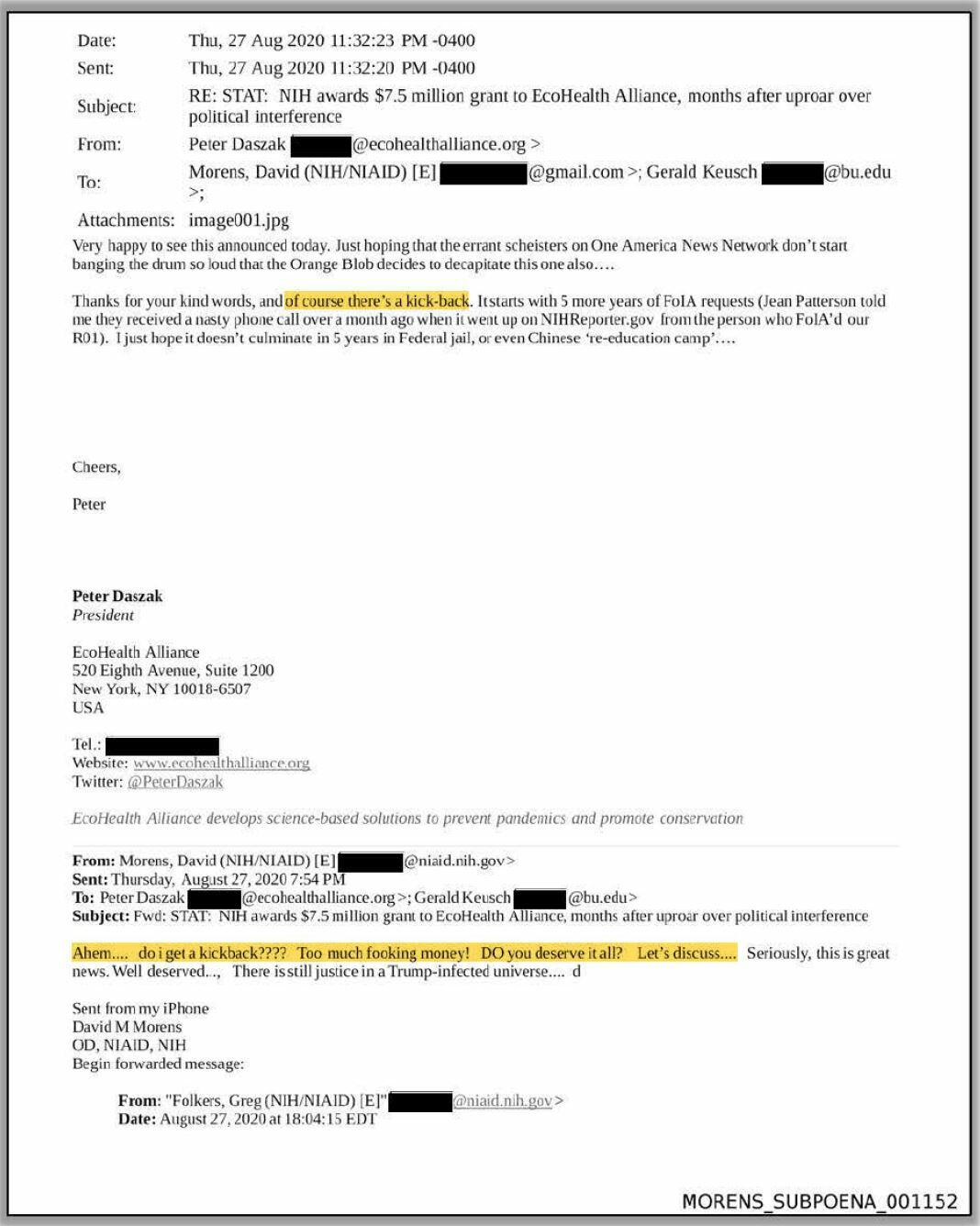
Meanwhile, Morens joked about getting a kickback from EcoHealth, to which Daszak replied jokingly: “of course there’s a kickback. It starts with 5 more years of FoIA requests … I just hope it doesn’t culminate in 5 years in Federal jail, or even Chinese ‘re-education camp’…

According to Diane Cutler, an ex-investigator for the US Department of Health and Human Services Office of Inspector General, “He has violated the ethical standards of conduct for executive branch employees and has potentially violated criminal law,” she said, referring to Morens, the NY Post reports.

Both Republicans and Democrats on the panel were united in their denunciations of Morens.

The information contained in these 30,000 pages of emails are deeply concerning, and in my opinion reflects poorly upon Dr. Morens and the Office of the National Institute of Allergy and Infectious Disease under Dr. Fauci’s leadership and the NIH under Dr. Francis Collins,” Subcommittee chairman Brad Wenstrup (R-Ohio) said in his opening remarks.

“Dr. Fauci’s NIAID was unfortunately less pristine than so many, including the media, would have had us all believe,” he added.

Ranking member Raul Ruiz (D-Calif.) echoed Wenstrup’s remarks in calling Morens’ behavior was “deeply troubling” — but cautioned the emails were “not a breakthrough moment in actually understanding the actual origins of the COVID-19 pandemic.” -NY Post

Now what?

Tyler Durden
Thu, 05/23/2024 – 16:40