65 F
Chicago
Monday, May 4, 2026
Home Blog Page 263

Humanoid Robots Get “Brains” As Dual-Use Fears Mount

0
Humanoid Robots Get “Brains” As Dual-Use Fears Mount

Chinese humanoid robotics firms are laser-focused on advancing “robot brains” for next-gen platforms already entering series production and headed to factory floors this year. Once these intelligent models push beyond scripted video stunts – we’ve all seen in promotional videos – into real-world autonomy, the systems become battlefield-ready, dual-use robots.

The Shanghai Morning Post reports that China-based robotics firm Dobot has developed Dobot-VLA, a vision-language-action model that allows its full-size humanoid Atom robot to “see through” clusters of tasks, “understand” ambiguous instructions, and make autonomous decisions to “get the job done.”

“[This] ability to adapt autonomously based on an understanding of the environment is the starting point for humanoid robots to create value in industrial applications,” the company told SCMP.

Rival UBTech open-sourced its humanoid-focused multimodal model, “Thinker,” on GitHub and Hugging Face, aiming to address common embodied-robot issues such as lag and spatial inaccuracies.

UBTech claims strong benchmark results against Nvidia and ByteDance models and reports near-perfect performance (99.9%) on certain factory-floor tasks, such as moving boxes and sorting parts, with its “Walker S2” humanoid robot.

SCMP pointed out, “China’s robotics industry is accelerating a shift from physical stunts that rely on preprogrammed routines to sophisticated abilities that require learning and adapting in the real world, seen as essential for mass commercial adoption in manufacturing and other scenarios.”

The broader theme is that humanoid robot brains are being developed at hyperspeed, suggesting these robots will be marching on factory floors in the very near term, not just in China but also across the Western world, starting later this year.

We’ve warned readers that “Humanoid Robots Begin March on Assembly Lines and Beyond,” meaning some of these systems could be dual-use and could soon appear at polygon weapon-testing facilities in Ukraine, potentially headed for battlefield deployment later this year if there’s no peace deal by spring. The same could be said of Russian forces, which may soon be experimenting with Chinese bots.

Read the latest:

Skynet is already here.

The rise of humanoid robotics, first on the factory floor and then on the modern battlefield, is inevitable. 

Tyler Durden
Sun, 02/08/2026 – 07:35

China Takes Step Towards ‘Starlink Killer’, Could Be Game-Changer In Ukraine

0
China Takes Step Towards ‘Starlink Killer’, Could Be Game-Changer In Ukraine

Via Remix News,

A new, compact, high-power microwave weapon, the TPG1000Cs, has been developed at a Shanghai Nuclear Technology Institute, which could become one of the most serious threats to the Starlink satellite network. The device can deliver 20 gigawatts of energy for up to a full minute, the South China Morning Post reported, cited by Portfolio.

The TPG1000Cs, the world’s first compact driver for high-power microwave weapons, has been created at the Northwest Institute of Nuclear Technology in Shanghai. The device can deliver 20 gigawatts of power for up to one minute.

At just four meters long and weighing just five tons, the device is small enough to be mounted on trucks, warships, airplanes, or even satellites. Some Chinese experts estimate that a ground-based microwave weapon with a power of over 1 gigawatt could be capable of seriously disrupting or even damaging satellites in low Earth orbit, such as Starlink, being used in the Russian-Ukrainian war.

Previously known similar systems could operate continuously for no more than three seconds and were much larger. The Russian Sinus-7 drive, for example, was operational for about a second, delivered about 100 pulses per shot, and weighed up to 10 tons.

China has repeatedly signaled that Starlink poses a serious threat to its national security. Chinese military researchers are currently developing new “Starlink killer” weapons, including high-powered microwave systems and lasers, that could be used to relatively cheaply combat large constellations of low-orbit satellites if necessary.

SpaceX has lowered the orbital altitude of its Starlink satellites to reduce the risk of collisions. But that makes them much more vulnerable to attacks from ground-based directed energy weapons. If China eventually deploys the TPG1000Cs in space, the invisible strikes could be even more devastating.

Read more here…

Tyler Durden
Sun, 02/08/2026 – 07:00

Will Falling Birth Rates Mean A More Conservative World?

0
Will Falling Birth Rates Mean A More Conservative World?

Authored by Michael Barone via The Epoch Times (emphasis ours),

George Orwell was on to it almost 80 years ago—the problem of below-replacement level birth rates. In a short book written for the Britain in Pictures series in 1947, written just as Britain was emerging from wartime rigors into an uncharted postwar future, Orwell noted that despite an upward blip in birth rates during the war, “the general curve is downward. The position is not quite so dangerous as it is sometimes said to be, but can only be put right if the curve not only rises sharply but does so within ten or at most twenty years.”

David Veksler/Unsplash.com

“Otherwise,” he went on, forebodingly, “the population will not only fall, but, what is worse, will consist predominantly of middle-aged people. If that point is reached, the decline may never be retrievable.” Orwell did not live to see it—he died at the age of 46 in 1950—but the danger was averted. Postwar birth rates rose in Britain and parts of Europe, though not so robustly as in the United States, where the baby boom peaked in 1957 and petered out after the introduction of the birth control pill in 1962.

The peak U.S. fertility rate, or the projection of how many children the median woman would have if current birth rates continued, hovered above 3.5 and then plunged to 1.74 in the bicentennial year of 1976, just about the same as 2025’s 1.79.

Fertility rates remained low in the 1980s, then rose and occasionally reached the replacement rate of 2.1 in the high-immigration 1990s through the Great Recession of 2007. The latest rate was an uptick from the 1.6 levels of the COVID-19-affected 2020–24 period, leaving the United States with something similar to the dilemma Orwell warned Britons against.

And it’s not just the United States. Plunging birth rates are a worldwide phenomenon. Europe’s fertility rates have been well below replacement for years, with nations’ under-70 populations set to fall by 20 percent in the next decade, not only in economically stagnant Britain and France, where births are tilted toward immigrants, but also in rapidly growing, low-immigration Poland.

Birth rates have dropped below replacement rates since 2000 in most of Latin America, largely because of lower-income mothers, such as Hispanic women in the United States, having fewer children.

China, despite the repeal of its one-child policy in 2015, saw its fertility rate plunge to 0.9 in 2025. If births continued at current numbers, the lowest evidently since the 18th century, China’s population would shrink by more than half, from 1.4 billion to 625 million. Elsewhere in East Asia, the latest birth rates have fallen to 0.8 in Taiwan and Thailand, and even lower in South Korea.

Koreans have shown the determination to maintain their culture, including their alphabet and independence, in a neighborhood with many more Japanese and Chinese. They have risen from abject poverty to become world-class exporters since the 1953 armistice. But they may be at risk of disappearing: At current birth rates, every 100 South Koreans today will have only six great-grandchildren.

What is behind this worldwide trend? At least one thing is clear about what is happening in America—and how it’s different from previous periods. It’s that childbearing has increasingly become a partisan activity.

As the Institute for Family Studies’ Lyman Stone pointed out, American conservatives and progressives each had a fertility rate of 2.7 in 1980, well above replacement level. In the 2020s, conservatives’ fertility rate has dropped marginally to about 2.4, still above replacement level.

But the progressives’ rate has fallen to 1.8, below replacement level, and generally tracks the pattern in economically developed countries.

It’s not difficult to see why. Young women increasingly tilt left politically and also tend to marry less often, hold jobs outside the home, say they don’t want children, and travel more frequently. These behaviors correlate with childlessness or with delaying childbearing, which often results in fewer births than desired.

The gap reflects “systematic differences in family formation between conservatives and liberals,” analyst Zachary Donnini wrote. Before the Great Recession, this was masked by high birth rates among black women who were heavily Democratic. But black (and Hispanic) birth rates fell sharply after 2007.

At the same time, the gap in political and cultural attitudes between young men and women has grown wider, on campus (where young men are increasingly outnumbered) and off, and both marriage and premarital sex rates have declined.

Extrapolate those trends outward, and you see something like the picture revealed in the Census Bureau’s recently released 2026 estimates of states’ populations. They showed two-thirds of the national population increase occurring in safe red 2024 states, 21 percent in the seven seriously contested purple states, and only 11 percent in the safe blue states.

Similarly, since children tend to share their parents’ political views, Wall Street Journal contributor Louise Perry wrote, we can “expect the partisan fertility gap to usher in a United States that is more conservative. In fact, the whole of the developed world is on track to become more conservative.” That’s a trend that Orwell, a proud socialist, might well have found even more dangerous than it’s sometimes said to be.

Tyler Durden
Sat, 02/07/2026 – 23:20

Trump Imposes Secondary Tariffs, Reaching 25%, On Countries Still Importing From Iran

0
Trump Imposes Secondary Tariffs, Reaching 25%, On Countries Still Importing From Iran

US and Iranian delegations conducted eight-hours of indirect negotiations mediated by the Omani government in Muscat on Friday, but it was merely minutes after the close of the talks that the US Department of State announced yet more sanctions on Iran.

The punitive measures target 15 entities, two individuals and 14 vessels, charging them of being part of “the illicit trade in Iranian petroleum, petroleum products, and petrochemical products” – or the so-called shadow fleet.

via The Export Practitioner 

The Friday US statement signaled support for antigovernment protests which dominated headlines for much of the last month, but which have died down since.

“Time and time again, the Iranian government has prioritized its destabilizing behavior over the safety and security of its own citizens, as demonstrated by the regime’s mass murder of peaceful protestors,” the State Dept. explained.

But Tehran has pointed out not all of them were peaceful, given that dozens or even hundreds of police and security personnel were killed and wounded, in some cases by armed rioters who also torched buildings.

The Iranian response to these new actions was for Foreign Minister Abbas Araghchi to make clear Tehran’s position that ‘fair’ dialogue as equals must be free of threats or pressure.

In a post on X, he said Iran “enters diplomacy with open eyes and a steady memory of the past year” – which means that “great distrust” now defines US-Iran relations and it needs to be overcome if any agreement can be forged.

But despite this plea, President Trump took more action in the form of slapping tariffs on any country still doing business with Iran:

The executive order, which takes effect on Saturday, directs the administration to impose new tariffs on countries that still do business with Iran.

It states that tariffs “may be imposed on goods imported into the United States that are products of any country that directly or indirectly purchases, imports, or otherwise acquires any goods or services from Iran.”

The order also sets out a mechanism for determining and applying those duties, with US Secretary of State Marco Rubio tasked with setting the rate.

These tariffs could reach as high as 25%, echoing a threat first floated by Trump in mid-January. This would significantly impact the single biggest buyer of Russian oil, China.

The additional tariff would also be felt by Russia, Germany, Turkey and the United Arab Emirates – the latter three of these being Washington allies.

Tyler Durden
Sat, 02/07/2026 – 22:45

Thousands Of Iraqis Volunteer To Defend Iran Against US Attack

0
Thousands Of Iraqis Volunteer To Defend Iran Against US Attack

Via Middle East Eye

Thousands of Iraqis have signed a pledge to help defend Iran in the event of a US attack on the Islamic Republic. According to a statement, almost 5,000 people in Iraq’s Diyala province gathered to declare their intent to defend both Iraq and its eastern neighbor, as well as Iran-backed armed groups, “without any compensation”.

“We announce our readiness to volunteer to support our security forces, the Popular Mobilization Forces, and the Islamic Republic of Iran, and we categorically reject American intervention in the Islamic Republic,” the statement read.

Men sign up for the ‘martyrdom brigades’ run by Iraq’s pro-Iran paramilitary group Kataeb Hezbollah at a mosque in Baghdad, via AP

The announcement comes as tensions have continued to mount between Iran and the US, despite ongoing talks between the two states in Oman.

Washington announced new sanctions on Friday aimed at curbing Iran’s oil exports, including measures targeting 14 vessels flagged in countries such as Turkey, India and the United Arab Emirates. It also announced sanctions on 15 entities and two people.

US aircraft carriers, meanwhile, remain positioned off Iran’s coastal waters, with US Central Command (Centcom) releasing footage showing the Nimitz-class USS Abraham Lincoln conducting a replenishment operation in the Arabian Sea.

On Thursday, Iran’s army spokesperson, Brigadier-General Mohammad Akraminia, said the military was ready for war, which would “encompass the entire region and all US bases” if that is what Washington wanted. US President Donald Trump has previously warned that “bad things” would likely happen if a deal could not be reached. 

Ammar al-Tamimi, a leader in the Iran-backed Badr Organization, which coordinated the gathering in Diyala, said the volunteers were not associated with any specific armed faction. “Rather, we are volunteers ready to serve as a reserve force for the security forces,” Tamimi told Rudaw.

“This formation consists of 4,947 names, and its organizational structure, along with the names of each volunteer, will be submitted to the Diyala Operations Command, which will then forward them to the Commander-in-Chief of the Armed Forces.”

Iraq has maintained close ties with Iran since the 2003 war that overthrew Saddam Hussein. Both Iran and the United States have competed for influence in Iraq, where thousands of US troops remain stationed, and numerous political parties and armed groups are aligned with Tehran.

Iran-aligned groups in Iraq such as Kataeb Hezbollah and Harakat al-Nujaba have also set up recruiting stations across the country, including in Baghdad, to enlist volunteers in the event of a US attack on Iran.

Tyler Durden
Sat, 02/07/2026 – 22:10

Fifth Circuit Upholds Policy That Illegal Immigrants Can Be Detained Without Bond

0
Fifth Circuit Upholds Policy That Illegal Immigrants Can Be Detained Without Bond

Authored by Kimberly Hayek via The Epoch Times (emphasis ours),

A federal appeals court has sided with the Trump administration in upholding a policy that mandates detention without bond hearings for illegal immigrants in the United States who entered without inspection.

President President Donald Trump (2L), Florida Gov. Ron DeSantis (L), and Secretary of Homeland Security Kristi Noem (R) tour a detention center for illegal immigrants, dubbed Alligator Alcatraz, located at the site of the Dade-Collier Training and Transition Airport in Ochopee, Fla., on July 1, 2025. Andrew Caballero-Reynolds/AFP via Getty Images

In a 2–1 decision issued Feb. 6, the New Orleans-based Fifth U.S. Circuit Court of Appeals reversed lower court rulings that had granted habeas petitions to two Mexican nationals, Victor Buenrostro-Mendez and Jose Padron Covarrubias. The panel determined that such individuals qualify as “applicants for admission” under federal immigration law, subjecting them to mandatory detention under 8 U.S.C. § 1225(b) rather than discretionary release options available under § 1226(a).

The majority opinion, authored by Circuit Judge Edith Jones, emphasized adherence to statutory text. “The text says what it says, regardless of the decisions of prior administrations,” the court stated, rejecting arguments that the policy represented an unlawful shift from prior interpretations by the Department of Homeland Security and Board of Immigration Appeals.

“By eliminating the exclusion/deportation dichotomy, [Illegal Immigration Reform and Immigrant Responsibility Act] put aliens seeking admission lawfully on equal footing with those who entered without inspection,” Jones wrote. “It seems strange to suggest that Congress would have preserved bond hearings exclusively for unlawful entrants.”

Circuit Judge Dana Douglas dissented. She argued that the Congress, which enacted the 1996 Act, “would be surprised to learn it had also required the detention without bond of two million people.”

U.S. Attorney General Pam Bondi praised the ruling in a post on X.

“The Fifth Circuit just held illegal aliens can rightfully be detained without bond,” she said. “A significant blow against activist judges who have been undermining our efforts to make America safe again at every turn.

The policy, implemented in September 2025, expands mandatory detention beyond arrivals at ports of entry to include illegal immigrants in the U.S. interior, potentially affecting thousands held in facilities across Texas and Louisiana, where the Fifth Circuit holds jurisdiction.

Another Fifth Circuit ruling in September 2025 in W.M.M. v. Trump granted a preliminary injunction against deportations of Venezuelan nationals under the Alien Enemies Act, citing inadequate notice periods for due process.

In that case, the court found seven-day notices insufficient, requiring at least 21 days given detention barriers like limited access to counsel and legal resources.

“Notice must be ‘reasonably calculated, under all the circumstances,’ to afford parties ‘a reasonable time to make an appearance,’” the majority wrote, drawing parallels to challenges in expedited removals and mandatory detentions.

The consolidated appeal stemmed from district court dockets in the Southern District of Texas, where judges had ruled the detainees eligible for bond hearings.

Tyler Durden
Sat, 02/07/2026 – 21:00

Washington Post CEO And Publisher Quits As Newspaper Implodes In Epic Chaos

0
Washington Post CEO And Publisher Quits As Newspaper Implodes In Epic Chaos

How the mighty have fallen.

In a “poetic ending” plot twist, that even jaded conspiracy theorists would have had trouble scripting, Washington Post CEO and publisher Will Lewis has abruptly and unexpectedly stepped down from his perch atop Jeff Bezos’s crumbling media empire. Well, maybe not that unexpectedly…

Will Lewis, the chief executive and publisher of The Washington Post, has stepped down

That’s right, the same WaPo that spent years hurling “fake news” grenades at us here at ZeroHedge, trying to get us deplatformed, demonetized, and disappeared from the internet, is now eating crow as their own house of CIA-funded cards collapses. Yes, this is our unapologetic victory lap – we’ve outlasted another establishment hack, which earlier this week saw an in house “Red Wedding” where hundreds of CIA conduits “reporters” were fired… and it feels good.

Lewis’s exit was announced late on Saturday around 6pm ET, just days after he orchestrated a bloodbath of layoffs that axed a whopping 30% of the staff – over 300 journalists sent packing in what can only be described as a desperation move to staunch the bleeding from years of financial hemorrhaging and dwindling readership.

Lewis, ever the gracious Brit, framed his departure as a noble sacrifice “in order to ensure the sustainable future of The Post.” Sure, Will – because nothing says “sustainable future” like firing a third of your workforce and then bailing before the pitchforks come out. Also the news that he was at the Super Bowl after the biggest mass termination in WaPo history probably didn’t help.

Meanwhile, as Semafor notes, the real reason for Lewis’ departure is the he presided over two major errors, one his, and the other that of his boss, Jeff Bezos who clearly has grown bored with his vanity media project. 

First, Lewis blocked the Post reporting on his role in the UK phone hacking scandal, preventing the publication of a story few would have read anyway. Then, Bezos pulled a planned endorsement of Vice President Kamala Harris at the 11th hour, for apparent fear of offending Donald Trump. That endorsement wouldn’t have made much of a difference politically, but hundreds of thousands of subscribers canceled over what they saw as a craven capitulation.

Let’s rewind a bit on Lewis’ illustrious – if catastrophically short – tenure. Handpicked by billionaire overlord Jeff Bezos – whose Amazon tried three times to demonetize ZeroHedge not once, not twice, but three times (and only thanks to the FCC intervening do we have any Amazon ads showing) – at the start of 2024, Lewis was supposed to be the savior who would “transform” the once-venerable rag and reverse its slide into irrelevance.

Instead, he presided over a dumpster fire of epic proportions, culminating in this latest round of pink slips that left the newsroom in shambles. Former editor Marty Baron, the guy who once helmed the paper during its Watergate glory days or whatever passes for glory in legacy media these days, didn’t mince words: he called it one of the “darkest days in the history of one of the world’s greatest news organizations.”

Ouch. And Katie Mettler, ex-chair of the WaPo guild, piled on with a zinger: “I’m glad Will Lewis has been fired. I wish it had happened before he fired all my friends.” Tell us how you really feel, Katie.

Cutting through the shades of gray, we were more laconic: WaPo is finished. 

In the interim, the keys to the kingdom go to some dude named Jeff D’Onofrio – the former CFO who’ nobody had ever heard of until now, and who is stepping up as the placeholder boss.

Good luck, Jeff – you’ll need it. With readership tanking, ad revenue in freefall, and trust in mainstream media at all-time lows, the WaPo’s “sustainable future” looks about as promising as a subprime mortgage in 2008.

But let’s not forget the delicious irony here. This is the same Washington Post that has repeatedly tried to kneecap ZeroHedge, labeling us as purveyors of “disinformation” and cozying up to Big Tech censors – such as Amazon and Google – in a bid to silence dissenting voices. 

Remember when they accused us of being Russian bots or spies, or whatever flavor-of-the-month smear was trending? That aged like milk. And while the CIA’s favorite (well, no longer favorite) mouthpiece was busy playing hall monitor for the establishment narrative, we’ve been here, grinding away, delivering truth that their advertisers wouldn’t touch with a ten-foot pole. And guess what? We’re still standing, stronger than ever, with record subscribers and 100 million page views per month, while their imported CEO packs his bags and slinks back across the pond.

Is there a Polymarket, we wonder, on when ZeroHedge will surpass WaPo in readership. 

But we digress: Karma, folks, is real, and it’s spectacular. And as WaPo licks its wounds and hunts for yet another white knight to bail them out (or maybe they’ll go for a black knight this time, after all the whole equity thing), we’ll be over here popping the champagne. After all, in the cutthroat world of media, survival isn’t about being “respectable”; it’s about being right. And on that front, ZeroHedge wins again.

In the end, Democracy may well die in darkness, but WaPo’s time of death was 6pm on February 7, 2026.

Tyler Durden
Sat, 02/07/2026 – 19:46

AI ‘Kill Chains’ And Rise Of Skynet-Like Weapons Offer Glimpse Of 2030s Battlefield

0
AI ‘Kill Chains’ And Rise Of Skynet-Like Weapons Offer Glimpse Of 2030s Battlefield

Ukraine has become the proving ground for 2030s warfare, where Western weaponry, Russian weaponry, and anyone else’s “next gen” weaponry collide on a modern battlefield that’s already providing a sneak peek of what conflict will look like: weaponized AI, ground robots, FPV swarms, and automated kill chains, with humanoid robo-killers that could enter field testing as early as this year.

The focus of this note is how “kill chains” are becoming central to modern warfare, with humans increasingly pushed out of decision-making on the Ukrainian frontlines, according to a report by The Times, which adds: “AI will soon be able to meld weapons systems faster than armies’ commanders can think.”

Framed as an “intelligent kill web,” a human commander, analyst, or soldier sits at the center like a spider, viewing vast streams of sensor data and weapons systems that talk to each other faster than the speed of thought. The result is a compressed kill chain, in which identifying targets and killing opponents happen at extraordinary speed.

“You need to be able to collect information, to process information, to write and disseminate your order faster than your opponent,” Yvan Gouriou, a newly retired French army general, told The Times. He is now a strategy adviser to the defense software firm Systematic Defence.

According to dozens of current and former Western military officers, defense industry sources, and analysts who spoke with the outlet, the “intelligent kill web” marks the dawn of the age of algorithmic warfare.

Examples:

  • The French Army upgraded command software to add real-time AI analytics (moving beyond traditional homegrown tools).

  • The United States Army 4th Infantry Division ran exercises in Colorado testing an AI “lattice” that detected, labeled, and assessed targets, tied to a next-gen C2 prototype led by Anduril with software contributions from Microsoft and Palantir Technologies.

  • The United States Air Force ran “Dash” experiments where AI planners reportedly became far faster than human officers and, in newer results, materially more accurate on tactical viability (though earlier iterations made subtle errors).

An insider at one European arms manufacturer told the outlet that integrating AI into defense is “akin to the introduction of electricity.” The person warned that this technological advance raises a serious question: how much control human commanders will retain on a modern battlefield in the years ahead.

Here’s what 2030s warfare will look like:

Separately from the report, the Ukrainian military recently hosted a closed-door war-tech conference where they showcased AI already on the battlefield.

Drone boats with missiles…

The broader takeaway here is that weaponized AI, robots, FPVs, and other advanced systems, soon including humanoid robots, on the modern battlefield in Eastern Europe, offer a glimpse of what 2030s conflict could look like. Most disturbing of all, the rise of “Skynet-like” weapons and autonomous kill chains has already arrived.

Tyler Durden
Sat, 02/07/2026 – 19:15

Why This Crash Is Bitcoin’s Biggest Test Yet

0
Why This Crash Is Bitcoin’s Biggest Test Yet

Submitted by QTR’s Fringe Finance

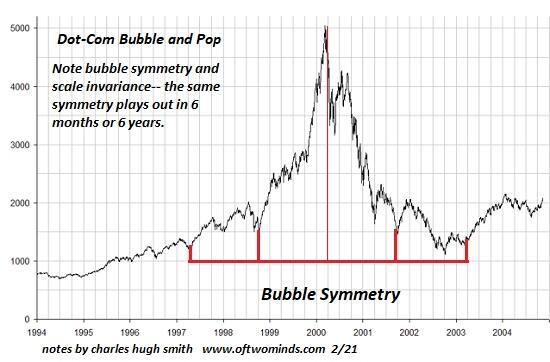
Bitcoin has a way of faking its own death, and this past week delivered another such instance with theatrical flair. After flirting with the once-unthinkable level of $120,000, the world’s most famous digital asset promptly face-planted to around $62,000 at its recent lows on Thursday.

Even for crypto, a 50% drawdown in months isn’t just a bad couple weeks. In a nascent asset like Bitcoin it’s always a bit of a spiritual test. More than that, this drawdown looks and feels like yet another Bitcoin “moment of truth,” the kind that forces believers and skeptics alike to confront what this asset really is—and what it isn’t.

For veterans of Bitcoin, the pattern is familiar. Exuberance builds. Headlines turn breathless. Group chats fill with laser-eye emojis. Then, without warning, gravity reasserts itself. Prices collapse. Influencers go quiet or get ornery on social media. Everyone suddenly remembers that “number go up” is not, in fact, a law of physics. But then Bitcoin always does — back to new highs over and over.

These moments of truth are supposed to be Bitcoin’s specialty. The “maxis,” sometimes proudly, sometimes ironically—have spent more than a decade preaching the same sermon. Volatility is not a bug, it’s a feature. Pain is purification. Weak hands must be shaken out. Michael Saylor once famously framed volatility as “Satoshi’s gift,” a kind of built-in psychological stress test designed to separate true believers from tourists. If you can’t stomach 50% drawdowns, you don’t deserve the upside. That’s the doctrine. Eat a dick, Sharpe ratio.

This time, though, the crash is being framed slightly differently by skeptics. Peter Schiff, Bitcoin’s longtime nemesis and professional eye-roller, has been quick to argue that this is not just another routine purge. In his view, this is not another dress rehearsal. He thinks it is the bubble finally popping after years of supposedly “mass” adoption.

Sure, he’s said this a lot over the years but unlike previous cycles, Bitcoin hasn’t been lurking in the shadows of Reddit forums and obscure exchanges. Over the past two years, it has marched directly into the mainstream. ETFs, retirement accounts, major banks, payment platforms, corporate treasuries, political campaigns—crypto didn’t just knock on the front door of the U.S. financial system. It moved in and started rearranging the furniture.

Which brings us to why “it’s different this time”.

Under Donald Trump, the United States has effectively gone all-in on crypto in ways that would have seemed absurd not long ago. Trump has openly branded himself as the “crypto president.” His campaign accepted crypto donations. Pro-crypto advisors and donors gained influence. Regulatory agencies softened their tone. Enforcement actions slowed. Bitcoin and digital assets were reframed less as speculative toys and more as strategic financial technologies.

At the same time, Wall Street embraced Bitcoin. Spot ETFs opened the floodgates for institutional money. Pension funds dipped their toes. Wealth managers added “digital assets” to client portfolios. CNBC began treating Bitcoin price movements like weather reports. You didn’t need to be edgy or rebellious to own BTC anymore. You just needed a brokerage account. Even Vanguard caved…

So if adoption was the rocket fuel, a fair question now is: how much is left in the tank?

That’s the core of the bearish argument. If nearly everyone who wants Bitcoin in the United States already has easy access to it, then where does the next wave of buyers come from? When your barber, your dentist, and your aunt’s financial advisor all know how to buy BTC, you’re not early anymore. You’re late-stage. If demand has peaked, then the recent crash isn’t just noise. It’s the market quietly admitting that the story may be running out of new chapters.

In that scenario, the downside could be ugly. Not just another dip-and-rip cycle, but something more structural. A slow bleed. A loss of cultural relevance. A gradual realization that Bitcoin might survive, but mostly as a niche asset rather than a world-changing revolution. Gold bugs would feel vindicated. Crypto Twitter would feel tired. Venture capital would move on to the next shiny thing…probably some AI-related bullshit.

Yet the bulls are not packing up.

As I ridiculed wrote last week, recurring financial media rash Tom Lee continues to argue that Bitcoin is still in the early innings of global monetization. My buddy Larry Lepard has also talked up targets in the $200,000 to $250,000 range, suggesting that monetary debasement, debt crises, and currency instability will eventually funnel massive capital into scarce digital assets. From this perspective, the recent collapse is just another pothole on a very long highway. Adoption in the US may be maturing, but the rest of the world is still warming up. Sovereign debt problems, geopolitical tensions, and distrust in central banks aren’t going away. If anything, they’re multiplying.


🔥 50% OFF FOR LIFE: Using this coupon entitles you to 50% off an annual subscription to Fringe Finance for life: Get 50% off forever


In this telling, the current selloff is simply another rehearsal in Bitcoin’s long-running play: “How Many Times Can We Kill It Before It Actually Dies?” So far, the answer is “a lot.”

Still, even optimists are starting to acknowledge an uncomfortable reality. There doesn’t seem to be much untapped mainstream adoption left in America. The regulatory environment is friendlier than it’s ever been. The political branding is pro-crypto. The financial infrastructure is built. If Bitcoin can’t thrive in this environment, it’s hard to argue that a better one is just around the corner. When the so-called “crypto president” presides over a 50% drawdown, it raises questions.

Which brings us back, once again, to Bitcoin’s moment of truth.

From here, the paths diverge sharply. One possibility is a serious crash with no meaningful recovery, a slow deflation of the crypto dream that leaves Bitcoin alive but diminished. Another is a long, grinding crypto winter—years of sideways trading, fading hype, shrinking communities, and endless “this is accumulation” posts that age poorly. The third is the familiar miracle: confidence returns, liquidity floods in, narratives reboot, and Bitcoin charges back through old highs like nothing happened, leaving doubters to explain why they sold at $62,000.

History suggests Bitcoin is very good at humiliating both its critics and its fans, often in alternating cycles. Right now, it’s humiliating the optimists. In a year, it might be mocking the skeptics. Or it might finally decide to grow up and become boring, which would be the most shocking outcome of all.

For now, the only certainty is this: this really does feel like another defining moment of truth for Bitcoin. The volatility that maxis call a gift is still very much in circulation. And like most gifts that arrive wrapped in panic and red candles, it’s not entirely clear whether anyone actually wants it.

QTR’s Disclaimer: Please read my full legal disclaimer on my About page hereThis post represents my opinions only. In addition, please understand I am an idiot and often get things wrong and lose money. I may own or transact in any names mentioned in this piece at any time without warning. Contributor posts and aggregated posts have been hand selected by me, have not been fact checked and are the opinions of their authors. They are either submitted to QTR by their author, reprinted under a Creative Commons license with my best effort to uphold what the license asks, or with the permission of the author.

This is not a recommendation to buy or sell any stocks or securities, just my opinions. I often lose money on positions I trade/invest in. I may add any name mentioned in this article and sell any name mentioned in this piece at any time, without further warning. None of this is a solicitation to buy or sell securities. I may or may not own names I write about and are watching. Sometimes I’m bullish without owning things, sometimes I’m bearish and do own things. Just assume my positions could be exactly the opposite of what you think they are just in case. If I’m long I could quickly be short and vice versa. I won’t update my positions. All positions can change immediately as soon as I publish this, with or without notice and at any point I can be long, short or neutral on any position. You are on your own. Do not make decisions based on my blog. I exist on the fringe. If you see numbers and calculations of any sort, assume they are wrong and double check them. I failed Algebra in 8th grade and topped off my high school math accolades by getting a D- in remedial Calculus my senior year, before becoming an English major in college so I could bullshit my way through things easier. I am an investor in Mark’s fund.

The publisher does not guarantee the accuracy or completeness of the information provided in this page. These are not the opinions of any of my employers, partners, or associates. I did my best to be honest about my disclosures but can’t guarantee I am right; I write these posts after a couple beers sometimes. I edit after my posts are published because I’m impatient and lazy, so if you see a typo, check back in a half hour. Also, I just straight up get shit wrong a lot. I mention it twice because it’s that important.

Tyler Durden
Sat, 02/07/2026 – 18:40

Young America’s Affordability Crisis Has Political Consequences

0
Young America’s Affordability Crisis Has Political Consequences

Authored by Micky Horstman via RealClearPolitics,

One and a half million more young adults live with their parents today than a decade ago. They’re losers … economically. 

Since the pandemic, fair market rents have increased as much as 40% in Chicago, the cost of owning a car is up more than 40%, and car insurance and health care prices have spiked. Student loan debt has quadrupled since 2000, and entry-level wages haven’t kept pace with inflation.

For young people without financial or family support, it’s an affordability crisis that feels insurmountable. Cost of living was Gen Z’s top political issue in 2024; they feel the “American Dream” slipping farther away.

And it’s driving them to the extremes. While political pundits insist Gen Z is “more well-off,” than other generations, and reporters write about “the big myth of zoomers’ economic conditions” – pointing to rising wealth and low unemployment compared to previous generations – political extremists from Democratic Socialist Hasan Piker to far-right nationalist Nick Fuentes are validating the distressed generation narrative.

As Gen Z flocks to the fringes, it’s on lawmakers to bring them back and renew their belief in the American Dream. They can do this by repairing the systems holding young people back, not pushing populist quick fixes or pretending these lived experiences aren’t real.

Wealth rises when you’re living in your childhood bedroom. Low unemployment doesn’t matter if jobs on the market are temporary, low-wage, or evaporate the moment the economy hiccups or AI replaces you. The kids are scared.

The far right blames immigrants. The far left blames billionaires. Leaders propose handing out $25,000 in down-payment support or mass deportations to solve the youth’s housing problems. These extremes are wrong.

The reality is: Government regulations have spiked costs and killed opportunities for young people.

For years, lawmakers infused aspects of left- and right-wing populism into the economy through government mandates, zoning hurdles, rent regulations, and most recently, tariffs. Then they acted surprised when prices climbed and jobs plummeted.

These policies don’t work, regardless of which party implements them, and they are especially harmful for younger generations. Whether it’s California’s disastrous Prop 13, which has kept property taxes locked while home prices skyrocketed, or Florida’s plan to eliminate property taxes for retirees, these policies limit housing supply and raise costs for young and first-time homebuyers.

In New York City, voters were swayed by a Socialist candidate who promised to solve the affordability crisis and make billionaires pay their “fair share.” Zohran Mamdani’s housing platform calls for rent stabilization efforts and expanding government-funded affordable housing development. Ultimately, rent control measures will drive up the cost of housing, and public sector development will come at a high cost for taxpayers – as seen in Chicago where similar “affordable” units cost taxpayers as much as $700,000 each.

Cities such as Austin and Minneapolis, which are becoming havens for Gen Z, prove what happens when free-market barriers come down: Buildings go up, rents drop, and jobs appear.

Minneapolis voters rejected a far-left Socialist candidate for mayor who ran on a similar platform to Mamdani. Populism isn’t attractive to voters when rent is cheap. The secret to affordable living, as it turns out, is removing barriers that restrict housing supply, such as zoning, permitting, and aesthetic requirements.

On the labor front, the progressive push for a $15 minimum wage has put businesses in a chokehold for a decade. In Chicago, Mayor Brandon Johnson removed the subminimum wage, forcing restaurants to pay employees a staggering new hourly rate. As a result, restaurants closed and businesses fled. When the incentives for hiring youth and tipped employees vanished, wages began to slow and youth employment declined. Instead of creating new incentives for businesses to hire young workers, the progressive solution has been calls to “tax the rich” and pour taxpayer dollars into city-run youth job programs.

On the other side, Nalin Haley, political commentator and son of Nikki Haley, and Jarrod Wright, host of an America First-themed podcast called “The Wright Wing,” have advanced anti-immigration talking points and convinced Gen Z that workers with H-1B visas will ruin the economy, encouraging an end to the program. Now, Texas is launching investigations to evaluate the program and curbing new applicants. Meanwhile, President Trump’s tariffs are raising costs on everyday items and essentials for the “American dream” including cars and housing. Immigration crackdowns have created only political unrest, not economic security for Americans.

Cost reduction, job creation and wage growth won’t be found in government mandates or in eliminating who comes into the country.

Gen Z needs policies that increase opportunities and lower the regulatory and tax burdens. Lawmakers must reform barriers to work, such as occupational licensing and degree requirements, to expand opportunities for young workers.

Only when the American Dream feels within reach will leaders be able to pull Gen Z back from the extremes.

Tyler Durden
Sat, 02/07/2026 – 17:30