60.9 F
Chicago
Monday, September 21, 2026
Home Blog Page 2632

US Suspends EcoHealth Funding Over Wuhan Lab Compliance

US Suspends EcoHealth Funding Over Wuhan Lab Compliance

Authored by Zachary Stieber via The Epoch Times (emphasis ours),

U.S. officials have cut off funding to a nonprofit that funneled government money to a laboratory in China located in the same city where the first COVID-19 cases appeared.

Peter Daszak, president of the EcoHealth Alliance, testifies before the Select Subcommittee on the Coronavirus Pandemic in Washington, on May 1, 2024. (Madalina Vasiliu/The Epoch Times)

EcoHealth Alliance (EHA), the nonprofit, “did not adequately monitor” compliance from the Wuhan lab with the terms and conditions of a grant from the U.S. National Institutes of Health (NIH), Henrietta Brisbon, a deputy assistant secretary at the U.S. Department of Health and Human Services, the NIH’s parent agency, said in a May 15 letter to EcoHealth President Peter Daszak. Officials also found that the subaward to Wuhan lacked requirements that would make the grant in compliance with federal law and regulations.

“Given the issues regarding the management of EHA’s grant awards and subawards, I have determined that the immediate suspension of EHA is necessary to protect the public interest,” Ms. Brisbon added later.

EcoHealth, which is based in the United States, passed more than $1 million to the Wuhan lab, the Wuhan Institute of Virology, over the years to study bat coronaviruses.

In 2019, the experiments yielded a more virulent version of a bat virus in mice, according to an annual report for 2019 that was not conveyed to the U.S. government by EcoHealth until 2021.

U.S. officials then asked for laboratory notebooks and other files regarding the testing. EcoHealth officials said they did not have the files, but had forwarded the request to the Wuhan lab. Wuhan officials never provided the files, according to U.S. and EcoHealth officials.

EcoHealth facilitated gain-of-function research in Wuhan, China without proper oversight, willingly violated multiple requirements of its multimillion-dollar National Institutes of Health grant, and apparently made false statements to the NIH,” Rep. Brad Wenstrup (R-Ohio) said in a statement. “These actions are wholly abhorrent, indefensible, and must be addressed with swift action. EcoHealth’s immediate funding suspension and future debarment is not only a victory for the U.S. taxpayer, but also for American national security and the safety of citizens worldwide.”

Dr. Wenstrup, chairman of the House Select Subcommittee on the Coronavirus Pandemic, released a report on May 1 recommending federal prosecutors investigate Mr. Daszak over violations of the grant terms.

Dr. Wenstrup, for instance, noted that EcoHealth blamed the delay in providing the annual report on being “locked out” of the NIH’s system, but that a forensic audit by the government uncovered no evidence supporting that claim.

Rep. Raul Ruiz (D-Calif.), the ranking member of the subcommittee, said in a statement that he welcomed the suspension of funding to EcoHealth.

“Every recipient of federal taxpayer funding has an obligation to meet the utmost standards of transparency and accountability to the American public,” he said. “EcoHealth Alliance’s failure to do so is a departure from the longstanding legacy of good faith partnerships between NIH and federal grantees to advance science and the public interest, which remains essential for the continued work of preventing and preparing for future threats to our nation’s public health.”

Mr. Daszak, who holds a doctorate in parasitic infectious diseases, told the subcommmittee in a recent hearing that “in all of our federally funded projects, we have maintained an open, transparent communication with agency staff” and “rapidly provided information critical to public health and agriculture.”

EcoHealth currently has three grants being funded by the U.S. National Institutes of Health, including a grant to experiment on bats with antibodies against the Nipah virus could be re-infected in lab experiments.

The Department of Health and Human Services (HHS) is suspending all funding to EcoHealth and proposing the nonprofit be debarred, or unable to receive funding for a period of time that could last years or even decades.

“The length of debarment, if ultimately imposed, will be based on the seriousness of the cause for debarment,” Ms. Brisbon said.

EcoHealth has 30 days to contest the findings from the HHS.

“EcoHealth Alliance is disappointed by HHS’ decision today and we will be contesting the proposed debarment,” a spokesperson for the organization told The Epoch Times in an email. “We disagree strongly with the decision and will present evidence to refute each of these allegations and to show that NIH’s continued support of EcoHealth Alliance is in the public interest.”

The HHS inspector general said previously that both NIH and EcoHealth officials failed to properly monitor experiments done under the grant.

The NIH, for example, did not make sure the annual report was submitted in a timely manner, the watchdog said.

EcoHealth, the watchdog added, should have submitted the report by the end of September 2019 but did not do so until August 2021.

The HHS previously debarred the Wuhan Institute of Virology (WIV) from receiving U.S. taxpayer funds over its failure to provide the requested materials.

The debarment, announced in September 2023, is for 10 years.

The NIH determined that WIV may have conducted an experiment yielding a level of viral activity which was greater than permitted under the terms of the grant,” Ms. Brisbon said in a letter to the lab’s director at the time.

The lab’s refusal to hand over notebooks and other materials means the determination is undisputed, she said. “As such,” she wrote, “there is risk that WIV not only previously violated, but is currently violating, and will continue to violate, protocols of the NIH on biosafety.”

Tyler Durden
Wed, 05/15/2024 – 19:00

Slovak PM Robert Fico Expected To Survive; UK Media Appears To Justify Assassination Attempt

Slovak PM Robert Fico Expected To Survive; UK Media Appears To Justify Assassination Attempt

Update(1840ET): Prime Minister Fico is said to be improving, following reports that he was in surgery due to several gunshot wounds from the Wednesday assassination attempt. Deputy Prime Minister Tomas Taraba has told the BBC he “is not in a life-threatening situation at this moment.” 

“Fortunately, as far as I know, the operation went well – and I guess in the end he will survive,” the statement indicated.

Deputy Prime Minister Robert Kalinak has told reporters in a briefing that “there is no doubt” that the attack was a politically motivated assassination attempt. “The inability to accept the will of some part of the public, which some group does not like, is the result that they have worked towards today,” he said in reference to Fico’s political opponents. A video is widely circulated of the detained suspect’s interrogation wherein the man, identified as Juraj Cintula, confesses to saying he “disagreed” with his government’s policies. 

Western media coverage of the attempted killing has been interesting to say the least. Fico was alongside Viktor Orban a dissenter when it comes to the NATO line on Ukraine.

Journalist Glenn Greenwald has commented, for example, “Listen to this Sky News report on the shooting of Robert Fico. Not only do they come close to justifying it because he opposes aid to Ukraine, but they also casually imply that he’s being paid by the Kremlin. This casual accusation is so prevalent in the West, and toxic.” The Sky segment in question which calls Fico “very pro-Russian” and that it’s “not surprising” that the attack took place is below:

Update(1220ET): The identity of the shooter has been revealed in national media, and video of the actual moment the shots range out and PM Fico went down has emerged on some social media platforms.

Several local media reports, citing visuals and witnesses at the scene, report that the man who shot the Slovak PM is a writer and activist named Juraj Cintula.

While a clear motive has yet to be established, Cintula is said to be part of the pro-West and socially liberal “Progressive Slovakia” party.

Statements have poured in from Western leaders: “Shocked and appalled by the shooting of Prime Minister Robert Fico. I wish him strength for a speedy recovery. My thoughts are with Robert Fico, his loved ones, and the people of Slovakia,” NATO chief Jens Stoltenberg said on X.

Photographs have emerged of the shooter being taken into custody. He also appears to be wounded or have suffered injury after being swiftly taken down by security…

And from Hungary’s Orban:

Hungarian Prime Minister Viktor Orban on Wednesday expressed “deep shock” over the “heinous attack against my friend” Slovakia’s premier Robert Fico, who was reportedly shot and hospitalised after a cabinet meeting.

“I was deeply shocked by the heinous attack against my friend, Prime Minister Robert Fico. We pray for his health and quick recovery! God bless him and his country!,” the nationalist fellow EU leader wrote on X.

Meanwhile, Russian media and others have pointed out that Fico’s most controversial stance concerned Ukraine and NATO funding. Sputnik has the below partial list of recent controversies centering on the Slovak PM:

  • Fico earned NATO’s ire after vowing to block the delivery of weapons to Ukraine during his latest run for office. Fico has also expressed dissatisfaction with Bratislava’s defense pact with Washington, promising to review it.
  • Fico has expressed fervent opposition to Ukraine’s membership in NATO, and said he believes Russia began its military operation as a result of neo-Nazis running rampant in Ukraine.
  • Fico has warned that Western military assistance to Ukraine will only prolong the crisis and increase the number of victims, and has accused foreign forces of meddling in the conflict, which “could have been extinguished at the very beginning.”
  • Fico believes anti-Russian sanctions have “negatively affected” the lives of ordinary Slovaks.
  • Fico has been bashed by European legacy media as a left-wing populist analogue of Hungarian right-wing populist Viktor Orban, with outlets pulling out all the stops to accuse him of “democratic backsliding” and “flouting European norms,” including over his push to reform the criminal code.
  • The Slovak PM has also made enemies with powerful European political and business interests, promising to launch an independent inquiry into the EU’s authoritarian pandemic-era policies.

* * *

Slovakia’s populist prime minister Robert Fico has been shot, according to breaking news reports, after which he was rushed to the hospital and appears to be alive according to early reports. But some reports have listed his condition as “very serious” and that he had to be airlifted.

According to emerging details in The Associated Press, Fico “was injured in a shooting and taken to hospital. The incident took place in the town of Handlova, some 150 kilometers northeast of the capital, according to the news television station TA3.”

Slovakia’s prime minister Robert Fico, file image

Local authorities say that a suspect is in custody. The shooting happened in front of the House of Culture where a government meeting was taking place.

One eyewitness “saw the prime minister being lifted from the ground by security guards and loaded into a car and driven away.”

Several people were greeting Fico and the moment the shots rang out, after which the prime minister fell to the ground. The would-be assassin was then taken by police. No details have been released as to the extent of his injuries.

Unconfirmed video of the immediate aftermath:

He has been outspoken against deepening Western involvement in the Ukraine war, for which he’s made many enemies and critics among Western allies, and of course within Ukraine itself.

For example, here’s how CNN last October described his ascendancy to prime minister and leader of the small NATO member state… “A party headed by a pro-Kremlin figure came out top after securing more votes than expected in an election in Slovakia, official results show, in what could pose a challenge to NATO and EU unity on Ukraine.”

However, at this early point a motive is unknown.

A national outlet in Slovakia has reported the following unconfirmed details of his condition (machine translation):

According to the available information, which immediately began to spread, Prime Minister Robert Fico was hit by 2-3 wounds, allegedly in the limb, chest and abdomen. It is said that up to 4-5 shots should have been fired. According to information from the PLUS 7 DAYS weekly , someone from the crowd called out “Robo, come here” and the shooting started.

It’s a gunshot wound to the abdomen and arm. He’s currently out of danger. They’re going to operate on him,” our well-informed source told us at 3:30 p.m.

Some conflicting reports say he may have been shot in the head.

Meanwhile, there is growing speculation that this could be connected to Fico’s contrarian stance on Ukraine against the hawks in NATO, where he has only one other prominent ally…

developing…

Tyler Durden
Wed, 05/15/2024 – 18:40

Tyson Foods CEO Unsure When Nation’s Collapsing Beef Herd Will Reverse

Tyson Foods CEO Unsure When Nation’s Collapsing Beef Herd Will Reverse

Tyson Foods CEO Donnie King spoke at the BMO Global Farm to Market Conference in Toronto on Wednesday, expressing much uncertainty about when US ranchers will rebuild tight cattle herds meaningfully. 

Reuters was the first to report King’s comments at BMO’s farm conference. He stated ranchers had been pressured in recent years to offload cattle due to high grain costs and drought, which, in return, sent the nation’s beef cattle herd plunging to the lowest in more than half a century. 

King provided some encouraging news, citing slightly lower grain costs and improved grazing conditions in the Midwest as factors in increasing the US herd. However, he noted that a high-interest rate environment is a significant headwind. 

All in all, King’s comments did not provide confidence that the nation’s beef cattle herd would reverse from seven-decade lows as ranches continue offloading cows to slaughterhouses. The latest figures from the US Department of Agriculture show that the nation’s cattle herd is 87.2 million head (as of Jan. 1), the lowest level since 1951. Data from USDA in the chart below only goes back to 1974. 

Shrinking herds means fewer cows, as the latest slaughter price per 100 pounds is around $186, the highest ever and in breakout territory. 

We have explained that ranches have been culling more cows for several years because of droughts, surging feed costs, and high interest rates. 

This perfect storm has sent beef prices at the supermarket to record highs. 

Lane Broadbent, president of KIS Futures Inc. in Oklahoma City, told Bloomberg earlier this year that herds aren’t expected to rebound before at least 2026. 

We suspect retail prices will go higher until demand destruction is achieved. Seasonally, outdoor cookouts ignite an upswing in beef demand in the coming weeks. 

Can the Fed just print more beef? Oh wait, no, but you know who can: Bill Gates.

Tyler Durden
Wed, 05/15/2024 – 18:40

Diesel Takes Another Hit And May Be Driving Down Broader Oil Market

Diesel Takes Another Hit And May Be Driving Down Broader Oil Market

By John Kingston of FreightWaves

With the benchmark diesel price used for most fuel surcharges down for the fifth week in a row, diesel consumers should be reveling in the fact that market trends appear to have completely thrown out concerns about the Middle East conflict and are focused on the markets for both diesel and gasoline as primary drivers.

The Department of Energy/Energy Information Administration average weekly retail diesel price fell 4.6 cents Monday to $3.848 a gallon. The five consecutive declines have taken that price down 21.3 cents a gallon during, and the price is now at a level not seen since the end of January.

Whatever impact that oil markets may have felt from the conflict in Gaza, the Iran-Israel back-and-forth and the diversions of shipping away from the Red Sea (which may have faded from the news but continue) are apparently having no impact on oil prices. A reaction to those developments would tend to be macro in nature and would generally impact crude more than products.

But market weakness continues to show up in products markets, including diesel. And diesel in particular is getting a great deal of focus of late. 

Diesel is increasingly being viewed as one of the primary reasons for the gradual fall in oil markets that has been occurring since early to mid-April. Whereas a few months ago, the rising price of oil was primarily attributed to a tight market for gasoline, the more recent weakness in oil overall is being laid firmly at the feet of the diesel market.

In his weekly report released Sunday, energy economist Philip Verleger noted that diesel weakness is becoming more structural because of the growing role of renewable diesel, which is made not from petroleum but from feedstocks such as plant oils and animal fats, including those captured in grease traps at restaurants.

In the report, Verleger noted that weekly EIA data on distillate consumption in the U.S., which is about 90% diesel, has been running anywhere from 400,000 to 600,000 barrels per day less than pre-pandemic levels. While some analysts are looking at that and concluding it is the function of a slow trucking market, Verleger’s report cited the fact that the data isn’t capturing the consumption of renewable diesel. 

“Taxes and regulations promulgated by the US Environmental Protection Agency have prompted refiners to convert crude oil processing facilities to produce renewable diesel, making more renewable fuel available,” Verleger wrote. “The higher renewable diesel use will cut US petroleum consumption. At this juncture, it seems that none of the … most-quoted forecasts of global oil demand have been adjusted to account for this replacement.”

Refining company earnings calls with analysts often feature management discussion of renewable diesel and its impact on the refiners’ bottom line. For example, on the latest Phillips 66 call, CEO Mark Lashier reviewed the company’s expanding renewable diesel operations and said that as a result of them, “we have gained valuable operational experience and market knowledge that positions us for success in our expanding renewable fuels business.”

But on the latest round of calls, talk about the weak diesel market — its crack spread against Brent crude is down about 20 cents a gallon in two months — did arise. 

The view that diesel demand is weak was rejected by Gary Simmons, the executive vice president and chief operating officer at Valero. He said on the company’s first-quarter earnings calls that diesel sales at Valero are about 2% higher than those of a year ago. 

But he added that he expects diesel demand will be “flat to slightly down compared to last year.” “However, some of the freight indices appear to be turning, and indicate we could start seeing better demand,” Simmons said. 

Brian Mandell, executive vice president of marketing and commercial for Phillips 66 (NYSE: PSX) said on the company’s call that even though Ukraine’s attacks on Russian refining capacity have probably taken about 200,000 barrels per day of Russian diesel supplies off the market, diesel prices have been suppressed by the warm winter in the northeastern U.S. — where heating oil, a distillate, is heavily used for home warmth — and by refiners coming out of maintenance season strong.

But the result has been reduction in refinery operating rates in Europe and Asia because of refining margins for distillates, which he said are around breakeven.

The weak market for products relative to crude is most visible in the 3-2-1 crack spread, a basic indicator of refinery probability. It is calculated by taking the price of two barrels of gasoline plus one barrel of diesel, converting it to a price per barrel and subtracting the price of crude, either Brent or West Texas Intermediate.

The Brent 3-2-1 on Monday, based on CME prices, fell to close to $21 a barrel. Two months ago, in mid-March, it was approximately $29.

Tyler Durden
Wed, 05/15/2024 – 18:20

Crypto-Libertarian Erik Voorhees Warns Your Chatbot Queries Are Not Safe 

Crypto-Libertarian Erik Voorhees Warns Your Chatbot Queries Are Not Safe 

Crypto-libertarian Erik Voorhees, fresh off his passionate defense of crypto in the ‘Gold vs. Bitcoin’ debate recently hosted by ZeroHedge, spoke with crypto news site Unchained’s Laura Shin and Venice’s COO Teana Baker-Taylor about the alarming honeypots of user search history data on AI chatbot platforms that could potentially be harvested. 

Venice is one of Voorhees’ latest crypto ventures. It is a private, uncensorable, open-source competitor to OpenAI’s ChatGPT, powered by a decentralized crypto network.

Around the 25-minute mark, Shin asked Voorhees about the risks that OpenAI, Anthropic, and or other big AI companies could be doing with user search data. 

Voorhees responded: 

“Great question that’s really like the most important question. So status quo today is you’re using anthropic or OpenAI chat – you send in your question and it goes to that company and they store it forever and it’s attached to your identity – right so they know that Lura Shin asked this question – um and they know that the AI responded back to you and they know what that is – and not only do they know that that question that conversation but they know your entire history of all conversations that you asked yesterday last year tomorrow and 10 years from now. All of it is associated with your identity. 

“In the best case that’s not that big of a deal, but in reality, what it means is – all your information – and essentially like parts of your mind like think your intellectual inquiries that you pursue – the things you think – the things you want to debate – the questions you have about life – and like big topics um can be known by Third parties.” 

“Advertisers for example, like that’s not a huge deal if an advertiser knows something about you. But what if like uh a government knows something about you. What if um what if the Biden Administration learns that you are like uh you know orchestrating uh Trump’s re-election campaign. What is what is the pressure on uh Biden Administration and OpenAI to use that information for something that people would consider corrupt and dangerous.”

“These are very slippery slope arguments, um and it does not really matter what, like you know Anthropic’s privacy policy says. If they have your information it will be shared with other parties today or tomorrow and probably both. And you can never get it back. So um that’s the status quo – uh for people that are comfortable with that like keep using those services. that’s okay.”

Voorhees then explained how Venice AI prides itself in user sovereignty: “But like Venice was like well, um let’s make a service that’s just as easy” OpenAI and others, “but instead of like spying on you and recording all your information and attaching it to your identity forever let’s just not do that.” 

*   *   * 

Here’s the full interview:

Tyler Durden
Wed, 05/15/2024 – 16:40

Peter Schiff: Biden Lies Again On Inflation

Peter Schiff: Biden Lies Again On Inflation

Via SchiffGold.com,

This week on the Peter Schiff Show, Peter covers a week of dismal economic reports. Both jobless claims and consumer sentiment came in worse than expected last week, with both figures missing predictions by a wide margin. Peter also discusses public statements made by both Joe Biden and Donald Trump on the nature and origin of inflation.

The Fed faces a difficult choice. Does it prioritize fighting inflation or keep rates low for consumers?

“If Powell looks at these numbers and decides we need to raise rates because consumers are worried and they’re pessimistic about inflation, that’s going to make the high-interest rate problem worse. Consumers are upset about both high inflation and high interest rates. So how is the Fed going to do something about that? Because if it raises interest rates, it’s going to make that problem worse. And if it doesn’t raise interest rates, or cuts interest rates, it’s going to make the inflation problem worse.”

In a recent interview, President Biden took to blaming private companies for inflation. Peter explains how absurd this explanation is:

He immediately changed the subject to shrinkflation and then started blaming greedy corporations. And he said, ‘We have a problem of corporate greed. That’s why everything is so expensive now.’ As if corporations weren’t greedy until Joe Biden became president. All of a sudden, Biden’s president and these corporations decide, ‘You know, let’s stick it to the consumer. We can make some extra money if we really jack up the price of food.’ Where were all these greedy corporate officers a few years back?”

Peter rebuts Biden further. If anything, corporations initially took losses in the hopes that inflation was temporary:

Inflation is driving up the cost of doing business, and so to stay in business, companies have no choice but to raise prices. And they’re all raising prices because they’re all facing rising costs. So it’s not greed. It’s got nothing to do with greed! In fact, and I’ve pointed this out from the beginning, corporations were reluctant to raise prices originally because they were hoping it was transitory. They were being told it was transitory. … That’s why a lot of those consumer type companies were originally taking some earnings hits— because their costs were going up and they weren’t raising prices.”

He also gives his thoughts on a recently viral clip of Jared Bernstein, chairman of the Council of Economic Advisors, bumbling through an explanation of government debt. Such a council is completely unnecessary and arguably harmful to the economy:

If I was ever to be president of the United States, I would fire all of the economic advisors. I wouldn’t even want any. I would just save the taxpayers the money and get rid of them all. We didn’t even have the Presidential Council of Economic Advisors until 1946. … You may want to ask yourself, well, how did America make it for over 150 years? That we had 32 presidents who didn’t have any economic advisors. Yet we did fine! We got to 1946. We went through the Second World War. I would argue that the economy did much better before presidents had any economic advice.”

Biden and Bernstein are clueless when it comes to monetary policy, but Trump isn’t perfect either:

“He’s blaming [inflation] all on Biden. It’s not all Biden. A lot of the inflation that we’re dealing with has its origins in Trump because huge deficit spending happened. All of the COVID stimulus money, the whole idea that people should stop working but spend more—that started with Trump, it just was expanded with Biden. And all of this operates with a lag. So there was a huge inflation tax when Trump was president. You know, he was bragging during this speech about his huge tax cuts that were bigger than Ronald Reagan’s. But the problem with these huge tax cuts is that they didn’t come with huge spending cuts. They came with spending increases. … So Donald Trump imposed an inflation tax.”

There aren’t any major politicians who take inflation and government debt seriously enough:

You can’t talk about inflation and be critical of inflation unless you’re going to propose real solutions. Now, I guess Donald Trump is a better politician than to want to propose real solutions because that’s going to piss somebody off. No, he’d rather say, ‘Social Security is not going to get touched. Medicare is not going to get touched. And I’m going to cut your taxes.’ Well, that just means we’re going to have a lot more inflation. And that’s what I’ve been saying. Doesn’t matter!”

For more of Peter’s commentary, check out a recent debate he had with Steve Hanke on inflation and de-dollarization.

Tyler Durden
Wed, 05/15/2024 – 16:20

Soft CPI & Sloppy Sales Spark Run To Record Highs For Stocks; Bonds, Bullion, & Bitcoin All Bid

Soft CPI & Sloppy Sales Spark Run To Record Highs For Stocks; Bonds, Bullion, & Bitcoin All Bid

Nothing good – all bad… and new record highs for stocks.

SuperCore CPI hotter than expected (but headline and core CPI in-line/small miss), Retail sales way uglier than expected (but gas station spending surged), homebuilder sentiment slumped, and Empire Fed Manufacturing ugly…

Source: Bloomberg

Both ‘soft’ and ‘hard’ data is now falling…

Source: Bloomberg

…and the stagflationary threat continues to grow…

Source: Bloomberg

…but the market doesn’t care about growth – it spiked rate-cut expectations on the ‘cool’ CPI (two cuts fully priced in for 2024 and three more cuts – at least – in 2025)…

Source: Bloomberg

And that lifted stonks across the board with Nasdaq leading the way to new record highs (Dow & S&P first new record close since March)

Market volumes were dramatically elevated today, according to Goldman’s trading desk (+45% vs the trailing 20 days), as hedge funds (on an illustrative basis) recovered half the losses from the last two nasty days…

Source: Bloomberg

Goldman trader John Flood highlighted the fact that it feels like sentiment during the last  “meme” craze was one of confusion and bewilderment where some funds were willing to hold on and trying to wait out the retail crowd. This time around, HFs collectively are just not nearly as exposed to high SI/float stocks as they used to be, so the risk is a lot more manageable, and funds tend to react much more quickly given past lessons.

Source: Goldman Sachs

‘Most Shorted’ stocks dumped back yesterday’s gains today as the meme-stock mania stalled…

Source: Bloomberg

VIX plunged back to a 12 handle today…

Source: Bloomberg

Treasuries were bid today with yields down 8-10bps across the curve (with the belly slightly outperforming the wings)…

Source: Bloomberg

With the swing lower in 10Y yields erasing all the increase in yields since April’s CPI print…

Source: Bloomberg

The dollar followed a similar pattern to yields, erasing all of the post-April CPI gains…

Source: Bloomberg

Gold surged back near record closing highs ($2392).  Interestingly, gold was trading at exactly the same level it was before April’s CPI ahead of today’s CPI…

Source: Bloomberg

Bitcoin soared back above $66,000 – this was Bitcoin’s best day since March 2023!…

Source: Bloomberg

Crude prices rebounded strongly today after early weakness (following inventory draws). The 100DMA once again acted as support with WTI closing back above it…

Source: Bloomberg

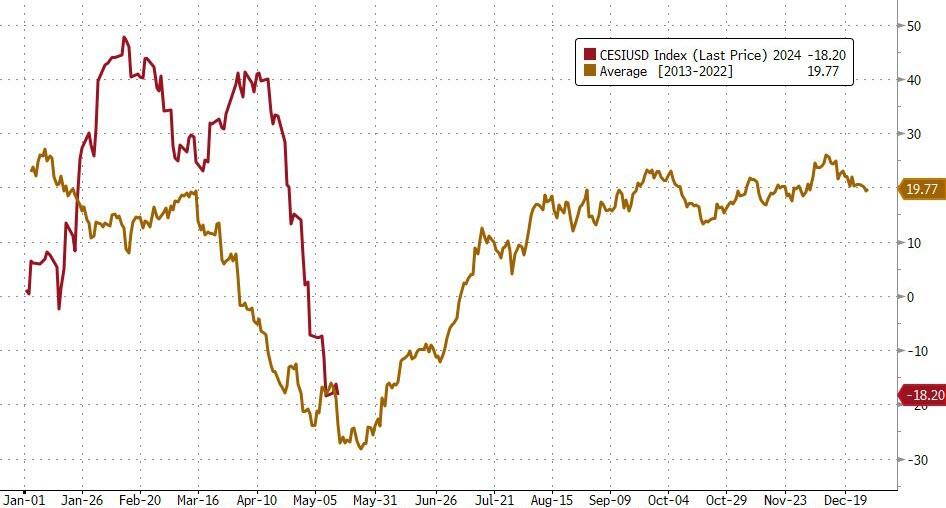
Finally, we noted at the start how ugly the US Macro data was, but there is a potential silver lining…

Source: Bloomberg

The Citi US Macro Surprise Index has a very regular seasonal pattern and 2024 is following it closely… with the positive surprises set to come from here as fiscal year-end looms. Is the ‘no landing’ narrative about to be realized?

Tyler Durden
Wed, 05/15/2024 – 16:00

Large Barge Slams Into Galveston Bridge, Stranding Thousands On Pelican Island

Large Barge Slams Into Galveston Bridge, Stranding Thousands On Pelican Island

As the Biden administration continues funneling billions of dollars to Ukraine and with Secretary of Transportation Pete Buttigieg nowhere to be found, America’s infrastructure continues deteriorating. Earlier today, a large barge crashed into a bridge in Galveston, Texas, causing a partial collapse. 

Fox 7 Austin reports that a barge crashed into the Pelican Island Bridge, causing a section to collapse. There were no reports of injuries. However, it’s the only bridge in and out of the island. 

The island is home to approximately 9,000 people, along with the campus of Texas A&M University at Galveston. 

The university told students that “all vehicular traffic” is closed on the bridge. 

Engineers from the Texas Department of Transportation have been dispatched to the bridge and will “inspect the roadway and determine if there is damage.”

The incident comes nearly two months after a massive container ship lost power and rammed the Francis Scott Key Bridge in the Port of Baltimore, paralyzing the entire port. The vessel has yet to be removed. 

The footage on X shows that the bridge connecting Pelican Island to Galveston did not have timber shields or any bumper system to deflect a direct blow from a vessel. The New York Times recently reported that dozens of bridges across the nation are vulnerable to ship strikes. After today, that threat remains clear. 

Here’s a map of America’s vulnerable bridges via NYTimes. 

America’s foreign enemies are getting a lot of ideas from these bridge strikes. It’s time for taxpayers to demand the government protect critical infrastructure instead of squandering the nation’s wealth in foreign lands. 

Tyler Durden
Wed, 05/15/2024 – 15:38

April Cass Data Shows No Improvement In Freight Demand

April Cass Data Shows No Improvement In Freight Demand

By Todd Maiden of FreightWaves

Another month passed without signs a recovery in the freight cycle was on the horizon. “Still waiting for it,” Cass’ April update on volumes and pricing stated.

The shipments component of the Cass Freight Index fell again in the month, down 1.6% seasonally adjusted from March and 4% lower year over year (y/y). The Tuesday data showed volumes were hovering around the late 2023-January 2024 cycle trough. The April reading was the lowest since January, which is typically the slowest part of the year and weaker than normal this year due to severe winter storms.

A later Lunar New Year and the Baltimore bridge collapse were cited as detractors to demand during the month. The report also said additions to private fleets are negatively impacting results at the for-hire fleets.

“Private fleets are now more actively competing for spot freight to fill empty backhauls, lengthening below-trend for-hire demand levels,” the report said.

The y/y comparisons for the shipments index get easier in the coming months. The forecast is for the data set to decline 3% y/y in May. A prior forecast called for the index to turn positive by June, but that appears in jeopardy now.

Cass’ expenditures index, which measures all dollars spent on freight including fuel surcharges and accessorial charges, fell 16.8% y/y in April and 1.9% from March on a seasonally adjusted basis. Backing out the decline in shipments implies rates were off 13% y/y in the month, which was the smallest decline in implied rates since last May.

The y/y comps also get easier this summer. The index is expected to decline 16% y/y in the first half of 2024 and 10% for the full year.

The Truckload Linehaul Index, which excludes changes in fuel and accessorial charges, declined 3.8% y/y but ticked 0.1% higher than the March reading.

The TL rate index includes both spot and contract freight. It has largely been flat for the past year.

“With spot rates steady over the past several months, downward pressure on the larger contract market is lessening, with some instances of contract rate increases bucking the downtrend recently,” the report said.

Schneider Nationalwas the lone carrier to report improvement in contractual rate negotiations during the first-quarter earnings season. It said contract renewals turned positive in the period for the first time in six quarters, with pricing up by a low-single-digit percentage. However, it was also quick to say that it’s “not calling an inflection in the market” yet.

The linehaul index’s two-year-stacked comp (to April 2022) was down more than 15%, which was the biggest decline ever recorded in the data set.

“Goldilocks economic conditions of strong growth and disinflation are largely holding, a rising tide which eventually should lift all boats,” the report said. “But at the moment, the freight growth being generated by the economy is being handled by railroads and private fleets.”

Data used in the indexes is derived from freight bills paid by Cass Information Systems, a provider of payment management solutions. Cass processes roughly $40 billion in freight payables annually on behalf of customers.

Tyler Durden
Wed, 05/15/2024 – 15:25

Goldman Warns Copper “Is Having A Cocoa Moment” 

Goldman Warns Copper “Is Having A Cocoa Moment” 

In a Goldman Materials note this morning covering China and copper, analyst James McGeoch pointed out that the base metal is “having a Cocoa moment.” 

Comex copper futures for July delivery jumped nearly 5% to $5.12 a pound, exceeding an earlier record for the most active contract set in March 2022. According to Bloomberg, the short squeeze “prompted a scramble to divert metal in other regions to US shores.”  

Comex copper futures are breaking out

Comex copper futures are in one of the biggest-ever backwardation periods – a clear indication of severely tight supply. 

“Short spread and futures holders are being squeezed,” Michael Cuoco, head of hedge fund sales for metals and bulk materials at StoneX Group, told Bloomberg

Here’s more commentary on the copper squeeze in the US via McGeoch: 

Copper got funky on LME close, the …Copper we see arb positions driving  (short CMX/long LME basis producer hedges and other factors) and have seen big unwinds on this, the spread got to +$900 (o’night it got to 1200t….saw people shorting it at $600 and getting stopped out literally hours later). There is also a seemingly large Chinese/Asian position (the arb CMX/SHFE getting bought again over night). The financial flows are typically more CMX heavy (options and outrights) and the change in liquidity. mkt structure is compromised as there is not that much Copper available on CMX to be delivered. For the next two weeks its likely to stay unhinged, as the positions are all against July expiry and we are unsure how it solves ahead of that, ie the delivery mechanism to solve.

Short-squeeze in commodities markets occurs when traders are forced to exit positions due to increasing margin calls or the threat of having to deliver physical material. 

Jia Zheng, head of trading at Shanghai Dongwu Jiuying Investment Management, explained that the surge in the July contract was partly driven by a squeeze on traders involved in reverse arbitrage, where they short Comex and go long on Shanghai copper.

This coincides with dwindling copper mining supplies and a surge in AI data center investments across the US. Additionally, the US and UK have banned Russian aluminum, copper, and nickel.

ZH’s The Market Ear penned a note earlier indicating the parabolic price action in copper is getting overextended

Tyler Durden
Wed, 05/15/2024 – 13:45