60.9 F
Chicago
Monday, September 21, 2026
Home Blog Page 2634

Russia Is About To Overrun Ukraine’s Defenses – Why Are There No Peace Negotiations?

Russia Is About To Overrun Ukraine’s Defenses – Why Are There No Peace Negotiations?

Authored by Brandon Smith via Alt-Market.us,

There are two classic propaganda narratives used by governments when it comes to keeping the public invested in any war campaign that does nothing to advance their national interests:

  • First, there’s the “commitment” lie, which says that once you step in to support a war effort you then must stay exponentially committed, even if that war effort is exposed as pointless. Anytime the public pulls back from that war in a bid to reconsider what purpose it serves they are ridiculed for potentially “risking lives” and setting the stage for defeat. In other words, you must support the effort blindly. You’re not allowed to examine the conflict rationally, because who wants to be blamed for losing a war?

  • Second, there’s the “domino effect” lie, which says that if you allow a particular “enemy” to win in one conflict, they will automatically be emboldened to invade other countries until they own the entire planet. It’s the same claim used to trick the American populace into supporting the war in Vietnam and it rarely turns out to be true. In fact, nations that engage in regional wars tend to be so weakened by the fighting that they don’t have the means to move on to another country even if they wanted to.

In the US we heard both of these narratives heading into the recent congressional vote for billions more in monetary and logistical aid to Ukraine. Neocons and Democrats worked together to force the bill through with a percentage of true conservatives fighting to stop it. Those conservatives were attacked relentlessly by the media for “helping the Russians”, but the reality that no one in the mainstream wants to talk about is that Ukraine has already lost the war.

No amount of additional funding or arms shipments are going to help them, and it has nothing to do with conservatives questioning the validity of war spending. Anyone who has a basic understanding of military strategy knows that the key to winning is ALWAYS manpower first, logistics second. Not superior technology or armaments, not superior cash and certainly not popular support from foreign interests.

This is especially true in a war of attrition, and attrition is in fact the method being used by Russia to systematically whittle down Ukraine’s forces. However, the western media refuses to discuss what’s really happening and has been acting as a hype machine for Ukraine instead.

In September of 2022 I noted that the Russian pullback to the Donbas was not the “retreat” the western media made it out to be. Many establishment talking heads claimed that this was the beginning of the end for Vladimir Putin and that Ukrainian forces would be taking Crimea in the near future.

I argued that Russia was likely trying to consolidate its position as western artillery and tanks flooded into Ukraine. I also suggested that Russia wanted to avoid urban combat in major cities while tens-of-thousands of seasoned mercenaries were rushing to the front from the US and Europe. I predicted that the Russian pullback was in preparation for surgical strikes on western Ukraine’s resources and grid infrastructure.

With Ukraine’s grid heavily damaged, a large portion of the population would leave the cities and head for Europe until the war played out. Putin has specifically avoided major fighting within larger urban centers for a reason. Driving civilians out of metropolitan areas would make it easier for Russia to strike Ukraine in a secondary offensive without risking extensive collateral damage in the form of civilian casualties. This is exactly what has happened.

Almost 7 million Ukrainians left the country outright in the past 2 years, with another 6 million displaced (mostly from larger cities). Currently, Russia is moving to push civilians out of Kharkiv, Ukraine’s second biggest city, and they will probably be successful given their momentum and the destruction of water and power resources. With civilians out of the way a more aggressive attack can then be initiated.

Russia has been using an “artillery bubble” as a tool to protect ground forces as they push an advance. Meaning, troops will only attack as far as the artillery can reach. Artillery is vital to a large scale offensive. Coincidentally, Russia doubled its importation of explosive materials commonly used for artillery in the past several months. They are now reportedly producing triple the amount of artillery that NATO is providing to Ukraine.

Mainstream analysts claim the push towards Kharkiv move might be a feint, allowing Russia to increase the size of its buffer zone. They continue to assert that Russia doesn’t have the forces necessary for a major offensive. I would say it depends on how weak Ukraine’s defensive lines actually are. Russia has been consistently using large scale Pincer movements to envelop defensive positions and destroy them.

In the past two weeks alone Russia has gained considerable ground. Russian troops recently made confirmed advances northwest of Svatove (Luhansk Oblast), near Avdiivka (Donetsk Oblast), in Robotyne (Zaporizhzhya Oblast), and in east (left) bank Kherson Oblast, U.S.-based think tank Institute for the Study of War reported on May 6th. The reason for this is relatively simple – Ukraine lacks the manpower to effectively establish defense in-depth. All the reports coming from the front support this theory.

That is to say, Ukraine’s defensive lines are a facade with no secondary positions or trenches to stall Russian breakthroughs. Once the Russians cut the main line there’s nothing much stopping them from gaining large stretches of ground. Some analysts have blamed this development on a lack of Ukrainian foresight or strategic preparedness, but I would argue that they just don’t have enough people to defend more than a single forward line.

My position is backed by numerous reports of the government’s desperate struggles with conscription. For the past six months the average age of Ukraine recruits is 43 years old. Meaning, youth recruitment is waning, either because younger people don’t want to fight and are avoiding the draft by leaving the country, or too many have died.

The conscription problem has been hidden by the western media for many months now, but even corporate news platforms are starting to admit that there is a severe lack of new recruits. Front line fighters have been complaining for months that they need to be cycled away from the trenches and given rest.

Another bad sign is the fact that Ukraine has been using Special Forces soldiers for trench duty. These units are trained specifically for asymmetric hit-and-run warfare, not sitting in mud holes waiting for artillery strikes to rain down on their fixed and exposed positions. It seems like pure stupidity, but it makes sense if Ukraine is actually running out of people to hold their only defensive line.

The cover-up of massive casualties is something I mentioned in past articles on the war and I think it bears repeating: Western warhawks continue to claim that it will be “cheaper” to use Ukrainian soldiers to fight Russia than to fight a larger war down the road with American and European lives.

The sociopathy behind this rationale is disturbing. The lack of manpower in Ukraine cannot be solved. It is a product of endless death paid for with our tax dollars. NATO has prolonged the fighting with funding and arms, but not to win, only to sacrifice more people in a bloody conflict Ukraine is destined to lose.

Their argument also assumes that Americans and Europeans are going to jump blindly into military service in a war against Russia. I don’t know about Europeans, but I do know for a fact that most Americans are not going to buy in and will refuse a draft. The majority of the US public doesn’t even want to send further aid to Ukraine; they certainly aren’t going to go die for Ukraine. The arrogance of the warhawks is mind boggling.

The bottom line is this: Ukraine is about to be overrun. They didn’t have the manpower to effectively launch a counteroffensive. They don’t have the manpower to establish defense in-depth. And, they are using their most seasoned soldiers as cannon fodder in the trenches.

This dynamic demands that diplomatic solutions be entertained, but no one seems to be talking about that. Why?

As I theorized in my article ‘World War III Is Now Inevitable – Here’s Why It Can’t Be Avoided’, the underlying plan may very well be to try to force Americans and Europeans to accept an expanding war with Russia. The western public has been bombarded with lies about Ukraine’s ability to win; when they lose people will be shocked and incensed by the outcome.

Maybe the elites hope that the populace will be so angry about the loss that they will rally around a larger war effort by NATO? The French government has already asserted that they are willing to send troops to Ukraine in direct confrontation with Russia, while Lithuania and Poland have said they will not rule out the possibility.

Now is the time for peace negotiations, BEFORE Ukraine is overrun. Will this happen? Probably not. But when diplomacy is removed from the table completely the only conclusion we can come to is that a greater war is desired. And when greater war is desired, we also have to conclude that our leadership has something substantial to gain by putting the world at risk.

You might be on the side of Ukraine, you might be on the side of Russia, you might not care about either side, but there’s no denying that this war is being escalated by special interests and we need to ask why?

*  *  *

If you would like to support the work that Alt-Market does while also receiving content on advanced tactics for defeating the globalist agenda, subscribe to our exclusive newsletter The Wild Bunch Dispatch.  Learn more about it HERE.

Tyler Durden
Wed, 05/15/2024 – 07:20

Fiscal Bazooka: China Considers Buying Millions Of Homes To Save Property Market

Fiscal Bazooka: China Considers Buying Millions Of Homes To Save Property Market

In April’s politburo meeting, the Chinese government’s newfound focus on an oversupplied housing market was setting the stage to usher in new rescue policies to stabilize the economy. Weeks later, Bloomberg reported that the government was considering a plan for local governments to purchase millions of unsold homes to clear the excess supply. 

According to sources familiar with government discussions, the State Council requests feedback from various provinces and government entities on the home-buying plan.

Here’s more color on the plan via Bloomberg: 

Local state-owned enterprises would be asked to help purchase unsold homes from distressed developers at steep discounts using loans provided by state banks, according to two of the people. Many of the properties would then be converted into affordable housing.

Officials are still debating details of the plan and its feasibility, the people said, adding that it could take months to be finalized if China’s leaders decide to go ahead. The housing ministry didn’t respond to a request for comment.

In a note earlier, Goldman’s Peter Sheren told clients that this news is nothing new and “has been speculated for 3-4 weeks.” 

“This was one of the initial catalysts for the China Property Sector (GSXACNRE) to rally 21% in the past month,” Sheren said. 

Housing prices in China have already fallen 25-30% from the peak and presented a dark cloud of economic uncertainty over China’s financial system stability and continued risk for China’s macroeconomic backdrop. If authorities do proceed with the plan, in a separate note, Goldman’s Wang Yi believes “this new initiative might help to stabilize housing prices.” 

Here’s more commentary from Goldamn’s Sheren this morning: 

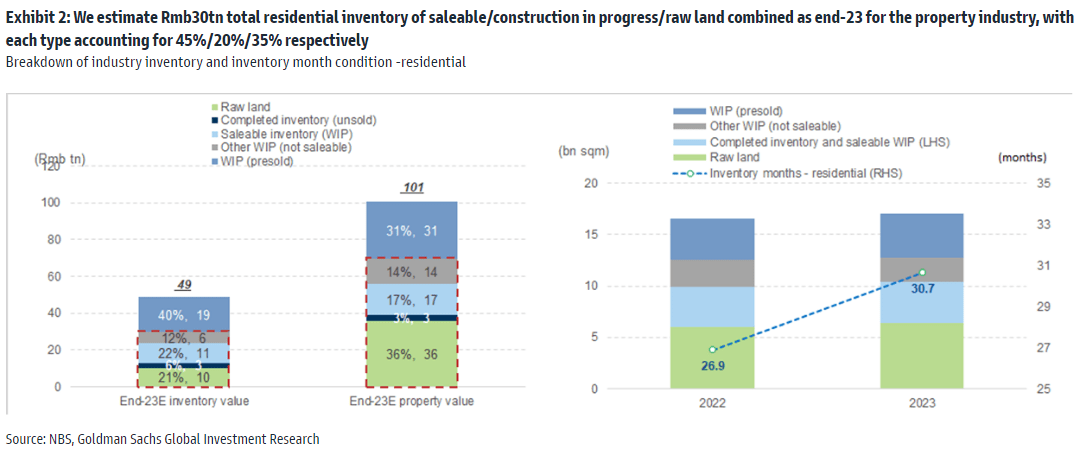
“Wang Yi and team think if the coming measures focus on clearing “saleable inventory” (which includes both completed and uncompleted but unsold units, and that are less than 3 years of last year sales volume) or about 1/4 of the entire inventory backlog, property price stabilization might be achievable.

“Wang Yi estimates that there was Rmb30tn (US$4tn) in residential inventory by end-2023. If fully built-up, this will be about 10X what the market sold in 2023, or 1/4 of total housing stock as of end-2023. The required capital investment for completing such inventory could be 5X the construction CAPEX in 2023.”

In terms of what’s needed in this fiscal bazooka to bottom China’s ailing residential housing market, Shujin Chen, head of China financial and property research at Jefferies Financial Group, estimated at least 2 trillion yuan ($277 billion). 

Bloomberg Economics pointed out that the property sector “is unlikely to stabilize until the gap between housing supply and demand closes.” 

Government data shows that about 3.6 billion square feet of unsold housing inventory linger on the market, the highest level since 2016.

Meanwhile, Tianfeng Securities estimates the new plan could cost 7 trillion yuan to absorb the inventory in 18 months. 

One major problem local governments face in reducing the housing surplus is the need to increase debt levels. Banks would also face mounting pressure as rising bad loans and contracting margins have weakened their balance sheets.

From a market perspective, this is terrific news, as the CSI 300 Real Estate Index initially jumped 5% after the report. 

However, deep, alarming structural problems persist in the world’s second-largest economy. 

Tyler Durden
Wed, 05/15/2024 – 06:55

“They Left Us No Choice”: Woman With Vaccine Injury In Clinical Trial Sues AstraZeneca

“They Left Us No Choice”: Woman With Vaccine Injury In Clinical Trial Sues AstraZeneca

Authored by Zachary Stieber via The Epoch Times (emphasis ours),

A vial of AstraZeneca vaccine is seen at a mass COVID-19 vaccination clinic in Calgary, Alta., on April 22, 2021. (The Canadian Press/Jeff McIntosh)

An American woman who suffered an injury from AstraZeneca’s COVID-19 vaccine sued the company on May 13, alleging the company breached a contract by not paying for the medical care she requires to deal with the injury.

They left us no choice,” Brianne Dressen, a preschool teacher in Utah, told The Epoch Times in an email.

Ms. Dressen has paid tens of thousands of dollars to drugs to treat the nervous system disorder and other issues she’s experiencing, according to the complaint, filed in federal court in her home state.

Ms. Dressen chose to participate in AstraZeneca’s clinical trial in 2020 because she wanted to help the company develop its COVID-19 vaccine. The consent form she signed stated in part that AstraZeneca would “cover the costs of research injuries” and “pay the costs of medical treatment.”

With these reassurances should something go wrong, Bri signed the form, rolled up her sleeve, and let the drug company inject the experimental product into her arm. Her mind was at peace, as Bri believed she was doing the right thing for her country, her students, and her family,” the suit states.

Ms. Dressen soon started experiencing problems, including blurred vision, tinnitus, and vomiting. She later became extremely sensitive to light and suffered spikes in her heart rate.

Ms. Dressen went to see numerous doctors as she attempted to figure out what was wrong with her, and seek treatment.

In 2021, U.S. National Institutes of Health doctors diagnosed Ms. Dressen as having “post-vaccine neuropathy,” according to records reviewed by The Epoch Times.

Bills for the doctors’ visits and drugs they prescribed began piling up quickly. The immunoglobulin recommended by government doctors alone costs $9,909.82 a month.

Ms. Dressen and her husband, a chemist with the U.S. Army, kept AstraZeneca and Velocity, which ran the trial for the company, apprised of the accumulating costs, according to the suit.

The family messaged Velocity on Jan. 15, 2021, with the first set of payment records for treatment but received no response, according to the suit. “Checking on updates for this. . . . When may we expect payment?” Brian Dressen, Ms. Dressen’s husband, wrote several weeks later.

I am sorry you have not heard anything as of yet. Hopefully I get an answers [sic] soon. I will reach out again today,” a Velocity official responded.

No funds came to the family, forcing them to refinance their home.

“I’d like to know when we can expect the first payment on Brianne Dressen’s medical bills? Two months since submitting…“ Mr. Dressen wrote on March 18, 2021. The Velocity official said that she was ”forwarding on” the payment records.

“Hey this is Brianne Dressen. Can you advocate a bit for us here help us get a timeline for payment? I am still not doing well, we have had to hire for after school childcare. We really need this money,“ Ms. Dressen wrote on March 24, 2021. The official said the following day she would be escalating the issue and did not understand ”why it is taking so long.”

The back-and-forth continued for months with no reimbursement paid to Ms. Dressen.

Brianne Dressen in New York on Jan. 6, 2023. (Jack Wang/The Epoch Times)

After a local television station reported on Ms. Dressen’s case on July 13, 2021, Velocity contacted the Dressens and said a payment of $590.20 was forthcoming.

The company issued the payment and said it was in touch with AstraZeneca regarding the approval of additional funds.

In December 2021, the official sent a statement for Ms. Dressen to sign that said in part that Ms. Dressen would accept $1,243 in exchange for dropping any additional claims to payment.

The Dressens declined the offer, describing it as insulting.

In March 2022, AstraZeneca representatives began directly contacting the Dressens, requesting billing and medical records.

One representative wrote on Aug. 12, 2022, that the company was waiting on medical records from providers to assess the claims. The representative said on Sept. 26, 2022, that all of the medical records had been received.

AstraZeneca and Velocity never contacted the Dressens again, according to the suit.

“I did everything they asked of me. I honored my obligations to them. They have not honored any. When they needed me, I was there, I cooperated. When I needed them, they were nowhere to be found,” Ms. Dressen said in a statement.

The suit acknowledges that COVID-19 vaccines are and were covered by the Public Readiness and Emergency Preparedness Act, which gives manufacturers immunity to liability in most cases. The suit accuses the companies of breach of contract and breach of duty. It asks for damages for medical expenses, emotional fallout, loss of income, and other expenses, as well as attorney fees and prejudgment interest.

Ms. Dressen is seeking a jury trial.

Velocity did not respond to a request for comment. AstraZeneca did not return an inquiry.

AstraZeneca’s vaccine was never cleared for use outside clinical trials in the United States.

The UK-based company announced earlier this month it is withdrawing the vaccine, citing limited demand. The announcement came several months after it acknowledged the shot can cause blood clots and low levels of platelets, a combination known as thrombosis with thrombocytopenia syndrome.

Johnson & Johnson’s shot, which was cleared in the United States and also causes the syndrome, was pulled from the market in 2023.

Tyler Durden
Wed, 05/15/2024 – 06:30

Should You Believe Faulty U.S. Crime Stats Or Your Own Lying Eyes?

Should You Believe Faulty U.S. Crime Stats Or Your Own Lying Eyes?

Authored by James Varney via RealClearInvestigations,

Americans can be forgiven for suffering from whiplash regarding law and order. 

In recent weeks the Biden administration and many news outlets, including USA Today and The Hill, have touted declines in violent crime statistics to argue that America is becoming a safer place. 

“Right now, with 2023 figures and early 2024, the trends are all pointing down, in a positive direction,” Jeff Asher, whose New Orleans-based AH Datalytics is developing his own “Real-Time Crime Index,” told RealClearInvestigations. 

Conservative outlets, including City Journal and the editorial page of the Wall Street Journal, assert that minor declines in headline grabbers like homicides fail to capture what is really happening in the U.S. 

From 2017 to 2019, the U.S. had an average of 16,641 homicides a year. In 2021 and 2022, however, the country saw considerably more bloodshed, with an average of more than 22,000 annual homicides. Even if the 2023 number drops slightly, it will still represent a large increase over the recent past, before the pandemic and racial upheaval set in motion in 2020.

Many criminologists say this illlustrates one of the problems with the official numbers that are at the center of public debate: They give a distorted impression of true levels of crime. They note that crime stats have become notoriously incomplete in recent years. In some years many big cities did not report their numbers to the FBI, and there are such wide discrepancies in these tallies that the picture they provide has more blur than clarity.

Declining arrest rates and slowing police response times to 911 calls also help explain why polls show Americans believe crime is rising. The experts say the numbers only give some sense of lawbreaking, while most Americans – the vast majority of whom are not crime victims in a given year – are influenced by their largely media-driven perception of whether society feels orderly. 

“There are social media videos of people walking into a CVS and walking out with a shopping cart full and there seems to be no consequences – that’s part of the problem,” said Jay Town, former U.S. Attorney for the Northern District of Alabama. “And then you have people arrested a dozen times and they’re out with no bail. There are no consequences, and thus there are more criminals in the street.”

Americans may fall back on such perceptions in part because the official reports are incomplete and rife with error. “I don’t think with any crime statistics we can ever be precise,” said Asher.

For decades, the traditional gold standard for criminologists was the FBI’s Uniform Crime Reports, annual compilations by the Bureau of stats provided to it by state and local law enforcement agencies. The FBI’s data, which currently show declines in several criminal categories, especially homicide, provide the basis for many of the stories arguing that, in terms of crime, the U.S. situation is improving.

But the FBI statistics aren’t what they used to be, according to several criminologists who pointed to gaps in coverage and apparent errors. The problem began in 1988 when the bureau began to move toward a complex new system of reporting – the National Incident-Based Reporting System (NIBRS). It promised to provide more comprehensive detail and enable authorities to pinpoint high-crime areas, criminals, and victims more accurately.

But the transition proved to be a herculean task, so much so that the FBI allowed departments to delay their full adherence to the program even after the feds doled out $120 million to agencies to assist with compliance. Still, in 2020, 2021 and 2022, either all or some of the biggest police forces in the U.S. — New York City, Chicago and Los Angeles — did not provide data.

There have also been problems with the data that was submitted, including the news in 2022 of major problems with the St. Louis Police Department data, and more recent revelations that figures for sexual crimes provided by the New Orleans Police Department were wrong.

In Baltimore, the Police Department and various news reports put the total for 2022 homicides between 332 and 336, but the FBI’s dataset puts the number at 272. Baltimore police officials did not reply to RCI’s inquiries about the wide spread in the reported numbers, and if anyone in the city’s police department had brought the matter to the FBI’s attention.

The Baltimore department acknowledges its numbers may not be the same as those it submits to the FBI, but states on its website that “any comparisons are strictly prohibited.” 

Similarly, the police departments in Milwaukee and Nashville did not respond to questions about divergences between their stats on robberies and those from the federal bureau. Milwaukee police reported a 7 percent increase in robberies in 2023, but the FBI recorded a 13 percent decline. 

An FBI spokesperson told RCI, “It is the responsibility of each state UCR [Uniform Crime Reports] program or contributing law enforcement agency to submit accurate statistics and correct existing data that are in error.”

Criminologists cite other discrepancies in the official measurements they use to assess the situation. While FBI stats show declines in violent categories, the Department of Justice’s survey reports more people saying they have been victims of such crimes. The Centers for Disease Control figures for homicides, which have long moved in the same direction as the FBI’s, started exceeding the FBI’s in 2020 and the gap has widened since then.

“I wouldn’t say the FBI is cooking the books, but that the data they are putting out is half-baked,” said Sean Kennedy, the executive director of the Coalition for Law, Order and Security, which has pushed back against recent media reports that crime is falling noticeably in the U.S. 

So it’s not a conspiracy but a rush job, and it’s giving people a false picture,” he told RCI. “They infer something is true, and then because it’s politically expedient they don’t bother correcting it.”

A Sharp Decline in Arrests

Some criminologists say there is another, hidden dynamic within the crime statistics that helps explain why most Americans think crime is on the rise – the dramatic decline in arrests. Scouring FBI data, John Lott, the founder of the Crime Prevention Research Center, found that arrests for reported violent crimes in major cities fell 20 percent in 2022, from 42.5 percent in 2019 – the year before the COVID pandemic and BLM protests in response to George Floyd’s death while in police custody. 

The percentage of murder and rapes cleared by arrests fell to 40.6 percent from 67.3 percent in those years; for rapes from 33.8 percent to 17.4 percent, and arrests for reported property crimes in major cities dropped to 4.5 percent in 2022 from 11.6 percent in 2019.

It is not clear how much of this decline is due to reductions in the size of many departments – New Orleans, for example, reportedly lost 20% of its force between 2020 and 2022.

“There are lots of issues here, and I’m in disbelief about some of them,” said Lott. “It’s mind-boggling to me – we already know many crimes have always been underreported and now it seems to be, ‘Why bother reporting a property crime’ to the police? The bottom line is our law enforcement system seems in some ways to be falling apart, especially in the big cities.”

Calling the Cops … and Then Waiting  

The plummeting arrest rates contribute to the general sense of lawlessness, a feeling compounded by surging increases in response times to calls. Comparing data for 15 law enforcement agencies from 2019-2022, Asher found only one city – Cincinnati – that reduced its response time, and that by 0.7 minutes. In New Orleans, the average response time nearly doubled, from 50.8 to 145.8 minutes, while Nashville saw a rise from 44.2 minutes to 73.8 minutes and New York City a 33-minute increase.

Some cities are even worse.

“If it’s not a shooting or a stabbing we’re up to about two hours for responding to property calls,” Jared Wilson, president of the San Diego Police Officers Association, told RCI. “As a result, we’ve seen a significant problem with reporting of crime right now.

Wilson said auto thefts better capture the state of crime and perceptions of it: As thefts of essential registered property, they tend to be reported. In San Diego, Wilson said, those have risen year-to-year, with a whopping 27% jump in 2021, all of which contribute to people’s perception of increased criminal activity.

Betsy Branter Smith, a retired cop and spokeswoman for the National Police Association, said such issues contribute to a deteriorating relationship between citizens and the police. That unraveling, along with increasing hostility between police departments and district attorneys in some big cities like Philadelphia and Los Angeles, has made some cops less pro-active on the job.

 “It’s not so much hostility’’ toward cops, but frustration and resignation,” she said. “It’s time-consuming to be a crime victim, and if prosecutors aren’t going to do anything, why report it?”

Smith said many police officers, in turn, are frustrated by bail reform and other efforts that put many alleged lawbreakers back on the streets quickly. Yes, she said , many officers have almost certainly become less pro-active. “We know it, we see it. It’s a sad state of affairs for law enforcement. Cops represent the government, basically, and we’re losing faith in the government we’re supposed to represent.”

Then there is media coverage. Although “if it bleeds, it leads” journalism is not new, the steady flow of stories in traditional and social media of mass shootings, smash-and-grab crime sprees, cops beaten on the streets of Manhattan and young women punched in the face for no apparent reason spawn a sense of disorder. So too do migrants pouring across the southern border, students taking over campus quads, squatters commandeering other people’s homes, the rise of homeless encampments and open-air drug use in several major cities. 

“There is this tension there – this reality of visible signs of lawlessness and disorder that generate a feeling of unease,” said Rafael Mangual, a fellow at the Manhattan Institute of Policy Research.

Asher agreed: “People are inundated by pictures of lawlessness and there’s no doubt that contributes to a lack of a full awareness among Americans about what might actually be happening.

Tyler Durden
Wed, 05/15/2024 – 05:45

Emergency Blackouts Introduced Across Ukraine As Temperatures Dip

Emergency Blackouts Introduced Across Ukraine As Temperatures Dip

Following several weeks of stepped-up Russian aerial attacks which have pummeled Ukraine’s energy and electrical grid, state power operator Ukrenergo on Tuesday announced that rolling emergency blackouts have gone into effect across the country.

It comes amid a drop in temperatures which has served to further strain the grid. “From 21:00 to 24:00 (1800-2100 GMT), Ukrenergo is forced to introduce controlled emergency shutdowns in all regions of Ukraine,” it stated on Telegram.

“The reason for this is a significant shortage of electricity in the system as a result of Russian strikes and increased consumption due to a cold snap,” Ukrenergo added. 

The Kiev region has for example seen the temperature drop into the 40s this week, and during the day has been in the 50s.

While likely there’s been greater impact in harder hit parts of the war-ravaged country, especially in the east and south, the capital of Kiev saw at least 10% of households get disconnected Tuesday.

Reuters described that “Footage shared on social media from the western city of Lviv showed buildings in complete darkness in the city center and street lights switched off.”

International report have further indicated blackouts hit Kharkiv and Donetsk and many other places, with predictions of increased disruptions throughout the late evening hours. Currently fighting is heaviest in these oblasts, and Russian forces are trying to establish a 10km deep buffer zone along the border in Kharkiv region.

The below video shows an area of Lviv in complete darkness as cars travel through the city center…

Authorities are scrambling to find any way possible to meet demand:

Ukraine plans record electricity imports from five European countries on Monday after reporting significant energy infrastructure damage from Russian strikes, the energy ministry said.

Imports are expected to rise to 19,484 megawatt hours (Mwh), beating the record of 18,649 Mwh at the end of March after the first wave of Russian attacks on Ukraine’s energy sector.

Ukraine forces have been keeping up their cross-border mortar and drone attacks, especially targeting Russia’s own energy depots and oil facilities. Putin has vowed to hit back, and Russian strikes on Ukrainian cities have increased over the last month.

Tyler Durden
Wed, 05/15/2024 – 04:15

NATO’s Newest Member Open To Hosting Nuclear Weapons

NATO’s Newest Member Open To Hosting Nuclear Weapons

Via The Libertarian Institute

The Swedish Prime Minister has said his country would be willing to host nuclear weapons during a war. The North Atlantic Alliance has a nuclear sharing program that has US nuclear weapons deployed in five countries. The Polish leader recently said he hopes Warsaw can one day join the program. 

Swedish Prime Minister Ulf Kristersson said on Swedish public radio that Stockholm would be willing to do this only during wartime. “In a war situation it’s a completely different matter. It would depend entirely on what would happen,” he explained “In the absolute worst-case scenario, the democratic countries in our part of the world must ultimately be able to defend themselves against countries that could threaten us with nuclear weapons.”

Kristersson’s remarks came as Sweden hosted the leaders of Germany, Denmark, Finland, Norway, and Iceland to discuss deepening military ties.

“For decades, we have lived very peacefully and without very big threats to Europe. Personally, I think these times are over,” Danish Prime Minister Mette Frederiksen said during the summit. “With all that we see from the Russian side, we are at the beginning of a new era. It would be wrong if we, as a government, said that you don’t have to deal with this in your everyday life.”

Sweden is the newest member of NATO. When Stockholm first requested NATO membership, Russian President Vladimir Putin said Russia would not object to the move unless more weapons were deployed to Swedish territory. 

“We do not have such problems with Sweden and Finland, which, unfortunately, we have with Ukraine. We have no territorial issues… no disputes… we have nothing that could bother us from the point of view of Finland’s or Sweden’s membership in NATO.” Putin continued, “Only they should plainly and clearly realize that there were no threats before, now, if military contingents and infrastructure are deployed there, we will have to respond in a mirror manner and create the same threats to the territories from which threats are created to us.”

The alliance has three nuclear weapon states, and the US stores weapons in five additional countries, including Italy, Turkey, Germany, Belgium, and the Netherlands. President Andrzej Duda expressed his willingness to make Poland the sixth country to host nuclear weapons.

“I must admit that when asked about [hosting nuclear weapons], I declared our readiness. Recently, [Russia] has been relocating its nuclear weapons to Belarus,” he said. “If our allies decide to deploy nuclear weapons as part of nuclear-sharing also on our territory to strengthen the security of NATO’s eastern flank, we are ready for it.”

You will find more infographics at Statista

At the time, a Russian government spokesman said the Kremlin would respond if NATO moved forward with Duda’s proposal. “The military will, of course, analyze the situation if such plans are implemented, and in any case will do everything necessary, [will take] all the necessary retaliatory steps to guarantee our safety,” Dmitry Peskov explained. 

Tyler Durden
Wed, 05/15/2024 – 03:30

Where Wealth Is Concentrated In Africa

Where Wealth Is Concentrated In Africa

56 percent of Africa’s millionaires and over 90 percent of its billionaires lived in just five countries in 2023 – South Africa, Egypt, Nigeria, Kenya, and Morocco, according to The Africa Wealth Report 2024 published by Henley & Partners and New World Wealth. There were 135,200 people who owned wealth of 1 million U.S. dollars or more living in the continent that year, as well as 342 centi-millionaires worth $100 million or more and 21 billionaires.

As Statista’s Anna Fleck shows in the following chart, South Africa had the highest number of so-called high net worth individuals (HNWIs) with 37,400 millionaires, 102 centi-millionaires and 5 billionaires. It was followed by Egypt with 15,600 millionaires, 52 centi-millionaires, and 7 billionaires, while Nigeria placed 3rd on the continent with 8,200 HNWIs. Rounding up the top ten were Kenya (7,200 millionaires), Morocco (6,800), Mauritius (5,100), Algeria (2,800), Ethiopia (2,700), Ghana (2,700), and Namibia (2,300).

Infographic: Where Wealth is Concentrated in Africa | Statista

You will find more infographics at Statista

Looking at the data in terms of cities, then South Africa’s Johannesburg comes first as the place with most HNWIs in Africa, with 12,300 millionaires, 25 centi-millionaires, and 2 billionaires, followed by Cape Town with 7,400 millionaires, 28 centi-millionaires, and 1 billionaire. Cairo in Egypt (7,200 millionaires), Nairobi in Kenya (4,400), and Lagos in Nigeria (4,200) also rank high on this basis.

According to Andrew Amoils, Head of Research at New World Wealth, another pattern in recent years is that a large number of high net worth individuals are moving abroad.

According to our latest figures, approximately 18,700 high-net-worth individuals have left Africa over the past decade (2013 to 2023). There are currently 54 African born billionaires in the world, including one of the world’s richest, Elon Musk, but only 21 of them still live on the continent”, he said.

“Most of these individuals have relocated to the UK, the USA, Australia, and the UAE. Significant numbers have also moved to France, Switzerland, Monaco, Portugal, Canada, New Zealand, and Israel.”

Despite this, the report writers state that Mauritius, Namibia, Morocco, Zambia, Kenya, Uganda, and Rwanda are all expected to experience 80 percent millionaire growth, if not more, in the coming decade.

Tyler Durden
Wed, 05/15/2024 – 02:45

7 In 10 Europeans Say Governments Allowing Too Much Immigration

7 In 10 Europeans Say Governments Allowing Too Much Immigration

Authored by Steve Watson via Modernity.news,

A survey encompassing all 27 countries in the European Union has found that most citizens believe their countries are taking in too many foreign migrants.

The poll conducted by BVA Xsight for ARTE Europe Weekly, a project led by the French-German TV channel ARTE GEIE, has found that seventy one percent say there is too much unchecked immigration.

The survey also discovered that 85% of respondents believe governments need to do more to combat irregular migration

Just 39% said they believe that Europe needs migrants coming in from elsewhere.

The countries where most people said immigration is too much include Greece (90 percent of respondents), Cyprus (84 percent), Ireland (78 percent), Austria (77 percent), Germany (77 percent), and Bulgaria (76 percent).

The findings dovetail with a stunning poll out of Germany that finds widespread opposition to mass migration across the board.

Recent German government statistics show that 41 percent of all crime suspects are foreigners, despite them making up a much smaller percentage of the population.

As we highlighted last week, a German politician was found guilty of ‘incitement’ by a district court and fined $6000 after she posted a link to the same government statistics on crimes committed by migrants, specifically rape, and asked why they are so disproportionately high.

X posts highlighting the stats, including our own, were also temporarily limited without explanation.

*  *  *

Your support is crucial in helping us defeat mass censorship. Please consider donating via Locals or check out our unique merch. Follow us on X @ModernityNews.

Tyler Durden
Wed, 05/15/2024 – 02:00

Mass Starvation: Here’s Why Most Of America Is Completely Unprepared

Mass Starvation: Here’s Why Most Of America Is Completely Unprepared

Authored by Brandon Smith via Alt-Market.us,

The concept of mass starvation has not been in the forefront of American society for a very long time. Even during the Great Depression the US was majority agrarian and most people knew how to live off the land. In fact, the US has never suffered a true national famine. There have been smaller regional instances of famine (such as during the Dust Bowl in the 1930s), but nothing coming remotely close to the kinds of famines we have seen in Asia, the Eastern Bloc, Africa or the Middle East in the past 100 years.

Even Western Europeans dealt with major famines during the World Wars (like the Dutch Famine) and that experience has left an imprint on their collective consciousness. Most Americans, on the other hand, don’t get it. Because we have lived in relative security and economic affluence for so long the idea of ever having to go without food seems “laughable” to many people. When the notion of economic collapse is brought up they jeer and call it “conspiracy theory.”

Compared to the Great Depression, the US population today is completely removed from agriculture and has no idea what living off the land means. These are not things that can be learned in a few months from books and YouTube videos; they require years of experience to master.

I will say that things have changed dramatically in the past two decades I have been writing for the liberty media. When I started back in 2006 the preparedness movement was incredibly small and often people were afraid to broach such topics in public forums.

In the past several years preparedness culture has EXPLODED in popularity. Millions of Americans are now dedicated survival experts with extensive preps and firearms training. Prepping and shooting is no longer the realm of tinfoil hat “crazies”, now it’s considered cool.

The credit crash of 2008-2009 certainly helped wake people up to the reality of economic instability in the US. Then the covid pandemic, the lockdowns and the attempts at medical tyranny really shocked Americans out of their stupor. Everything we “conspiracy theorists” have been warning about was suddenly confirmed in the span of a couple of years. Every time globalists and governments create a crisis they only inspire more preppers.

The greater problem in terms of famine is not that individual Americans are not aware of the threat; many of them are. The problem is that our infrastructure and logistical systems are designed to fail and there’s not much the average citizen can do about it.

The just-in-time freight system is perhaps one of the worst ever devised in terms of community redundancy. Any disruption no matter how minor could cut off supplies to a town or city for days or weeks. Then there’s the interdependency that comes with food being produced outside most states. If your state does not have a solid agricultural base then it will be reliant on outside food sources during a crisis. What guarantees are there that your region will be able to secure food from elsewhere?

Furthermore, most of the populace, even those that are preparing, have never experienced large scale starvation events before. It’s difficult to adapt mentally to a threat that one has never seen.

I suggest people who want to know what starvation feels like practice it from time to time. Try fasting for 24 hours, then try fasting for 48 hours. See how many days you can go without eating (just be sure to drink plenty of water). My maximum was seven days (after months of practice), and what I found was that after day three the hunger pangs actually stop altogether. You don’t go crazy, you don’t get violent; at most you might get tired, but you will also be surprised at how heightened your thinking becomes and how much energy you still have.

The human body can survive for three weeks or more without a single bite of food. My suspicion is that initial panic over potential hunger is the thing that causes the most violence during famines. People encounter starvation and lose their minds within the first three days. First-stage stomach pains and fogginess causes them to react without thinking and this leads to the widespread riots and other crisis events we are used to seeing in history during food shortages.

Fasting is a way to educate yourself on what it means to starve; it’s not as bad as it seems as long as you have some fat stores in your body. When you hit the point of muscle loss and organ deprivation, that’s when things change and the possibility of death arises. Having some familiarity with the feeling of true hunger will help you to avoid panic should the real thing ever occur in the future.

The greater problem is not what you can endure, though. Watching people you care about starve is much more difficult. This is not something you can practice for and it could be a far more powerful motivator when it comes to looting and crime during a crash.

The goal of course is to avoid famine altogether. Food storage is the foundation of any survival plan. Anyone who claims that jumping right into agriculture and hunting and wild edibles is the solution has never actually had to survive off the land in their lives. The reality is, finding enough food and growing enough food to live on is difficult for most people even in normal times.

During collapse, crops are often difficult to plant safely. They can be stolen or destroyed easily and require large communities of people to maintain and protect. Even smaller gardens can draw attention from undesirables and are hard to hide.

Hunting might be useful initially if you live in a rural area, but you won’t be the only person with the same idea and animals will move out of a region quickly if they are being hunted on a daily basis. You’ll have to go further and further out to find them and that’s risky during a crisis.

Wild edibles are nice in spring and summer when they are plentiful, but then again, if you’re hiking around expending more calories that you can get from these plants then the entire exercise is pointless. I tend to find that wild edibles proponents are the most delusional when it comes to the logistics of survival. Survivalists who think they’re going to run to the woods and live off of the random plants they find will probably die.

Growing food, hunting food and foraging food are all supplemental measures, especially in the first years of any crisis event. Without a primary emergency supply most people will not make it. Food storage has been a mainstay of civilization for thousands of years for a reason – It works. When larger secure communities are established then agriculture can return and self sustaining production makes food storage less important. Until then, what you have in your basement or your garage is the only thing that’s going to keep you alive.

Unfortunately, there are some people out there who think they don’t need to store supplies because they plan to take from other people. Firstly, anyone who makes this their Plan A is probably a psychopath and I have zero empathy for them. Secondly, such people won’t stay alive very long. With every violent encounter the risk of injury or death increases; looters and raiders will be whittled down rather quickly as they get picked off by people defending their resources.

It’s not like the movies, folks; marauders will disappear swiftly during a crash. After the first year I would be surprised if any of these individuals or groups still exist.

In the meantime, the initial stages of collapse are going to be a shock for many Americans. It could be a grid down event, an economic collapse, a supply chain collapse, etc., but the panic associated with hunger will be ever present. People who understand the nature of famine can avoid panic and organize for safety. They will survive and thrive. People who don’t understand famine will freak out in the first week without food and make detrimental mistakes.

Mental preparedness is just as important as physical preparedness. Keep that in mind as we move forward into uncertain times.

*  *  *

One survival food company, Prepper All-Naturals, has proactively dropped prices to allow Americans to stock up ahead of projected hikes in beef prices. Their 25-year shelf life steaks currently come at a 25% discount with promo code “invest25”.

Tyler Durden
Tue, 05/14/2024 – 23:40

Samsung Tops Apple In Q1 Global Smartphone Shipments

Samsung Tops Apple In Q1 Global Smartphone Shipments

While not quite a duopoly, Apple and Samsung have long been known to produce the most popular smartphones from a global perspective. Over the past years, however, Chinese tech companies have started catching up and, at times, even overtaking Apple’s iPhone product lines.

In the following chart, based on data from the IDC Quarterly Mobile Phone Tracker,  Statista’s Florian Zandt shows that between January and March 2024, roughly one out of five of the 289 million smartphones shipped were Samsung devices, while Apple commanded a market share of 17.3 percent. Xiaomi, however, wasn’t far behind with a 14.1 percent share in the market translating to around 41 million smartphones shipped in the first quarter of the year.

Infographic: Samsung, Apple and Xiaomi Command Half of the Global Smartphone Market in Q1 2024 | Statista

You will find more infographics at Statista

Rounding out the four smartphone vendors with the highest amount of devices shipped is Transsion, which produced every tenth smartphone sold in the first three months of 2024. Although the Chinese company entered IDC’s top 5 for the first time in the second quarter of 2023, it’s been around since 2006. Its devices have become increasingly popular in emerging markets like the African continent.

Looking at smartphone vendor market share over time, Apple and Samsung have been on top for most of the first quarters since 2014. The notable exception is Huawei, which rose to prominence in the latter half of the 2010s and even managed to overtake Samsung for the best-selling smartphone brand worldwide in the second quarter of 2020 after already coming within 3.3 percentage points in the three months prior.

Huawei’s rise was abruptly halted by the end of 2020, reportedly due to the increasing pressure of U.S. sanctions on the company. Its shoes were quickly filled by its Chinese competitors Xiaomi and Oppo, which had combined market shares ranging from 22 to 25 percent in the first quarters of 2021, 2022, 2023 and 2024.

Tyler Durden
Tue, 05/14/2024 – 23:20