60.9 F
Chicago
Monday, September 21, 2026
Home Blog Page 2640

Even If Powell “Can’t See The Stag And Can’t See The Flation”, Consumers Can

Even If Powell “Can’t See The Stag And Can’t See The Flation”, Consumers Can

By Benjamin Picton, Senior Macro Strategist at Rabobank

Bumps and Potholes

UK Q1 GDP surprised to the upside at the end of last week to print at +0.6%, rather than the more modest 0.4% that market economists had been expecting. That means that Britain is officially out of recession. Perhaps even more importantly for Prime Minister Rishi Sunak, GDP per capita grew for the first time in two years and the Governor of the Bank of England has been talking about rate cuts. The FT reports that corporate takeover activity for UK companies has hit the highest level since 2018 as international capital managers realise that UK stocks are comparatively cheap. Suddenly, everything is coming up Rishi, but that’s unlikely to save him from an electoral drubbing later in the year.

Of course, faster economic growth can in some ways be a double-edged sword. If the economy is turning over more quickly, it raises questions about inflationary pressures – which might delay those rate cuts that Governor Bailey was hinting at. In the case of the UK this might not be an issue because the stronger GDP result was driven by fixed capital formation – suggesting that businesses are investing to raise the speed limit of the economy – while households seem to have taken Huw Pill’s advice to accept that they are poorer and kept a lid on their own spending.

Over in Canada it might be a different story. Labour market figures for April showed employment growth of 90,000 in the month. That’s a mighty bounce back from the loss of 2,200 jobs in March, and well above the consensus estimate of +20,000 jobs. The unemployment rate duly fell (despite a 1-tick climb in the participation rate) to a still high 6.1%, and hourly wages growth also came in firmer than expected at 4.8% y-o-y (albeit down on March’s 5% figure).

Consequently, the 65% probability of a June rate cut that the OIS futures were suggesting last Thursday has suddenly fallen to a 45% probability. The market is still fully-priced for a cut by July, but only just.

There were further bumps in the road for the global crusade against inflation last Friday when the latest iteration of the University of Michigan consumer sentiment report was released. Consumer confidence dropped like a rock, all the way from 77.2 in April to 67.4 in May. Both ‘current conditions’ and ‘future expectations’ looked grim, which perhaps suggests a “plague on both your houses” attitude to the two leading contenders for the Presidency. Crucially, 1-year inflation expectations leapt from 3.2% to 3.5%, and 5-10 year expectations (generally a low volatility number) edged higher from 3% to 3.1%. Even if Jerome Powell “can’t see the stag and can’t see the flation”, it appears that consumers can.

Powell is scheduled to speak tomorrow, but the timing presents a few potential landmines for the Fed Chief. Powell’s remarks will come after the release of April PPI figures, but ahead of the CPI report. CPI is likely to be the key point of interest for financial markets this week, but there’s also the not-insignificant issue of big new tariffs on Chinese EVs (amongst other things) expected to be announced tomorrow. The CPI numbers are expected to print at +0.4% m-o-m, as they did in March. Unfortunately, 0.4% m-o-m is incompatible with 2% annual inflation, so Powell might still be a little cagey on there whereabouts of the stag and the ‘flation.

Japan, China and Australia have lately thrown up some potholes in the road back to at-target inflation. Japanese March labour cash earning figures reported last week showed year-on-year growth of less than half the expected number. China PPI slipped further into deflation at -2.5% in April (although CPI nudged up slightly to 0.3%) and aggregate financing actually fell for the first time since 2005.

China’s housing woes are clearly ongoing, and it appears that this has started to worry Xi Jinping, who is reportedly looking at ways to protect state-owned developers that may also help to staunch the balance sheet recession being experienced by Chinese households. The long-awaited stimulus bazooka might be on the way (of sorts), but almost certainly not for private sector developers who might be too close to decadent Western-style capitalists for Xi’s liking.

The fortunes of Chinese real estate developers are of particular interest to Australia, since bulk commodities used in the production of steel and concrete (iron ore, coking coal) sit atop the list of Australia’s major exports.

The Australian Government will deliver a budget tomorrow night – Treasurer Jim Chalmers’ third, and likely his second successive surplus. The now traditional pre-budget leaks to the media suggest a more growth-oriented fiscal impulse which would ordinarily be a concern for the RBA – who inexplicably maintained their neutral outlook on interest rates last week, despite big upward revisions in their inflation forecasts and downward revisions to unemployment forecasts.

One suspects that the RBA dead-batted the strong Q1 inflation print of a week earlier with the benefit of advance warning from Treasury that budget initiatives would substantially reduce measured CPI. Treasury is reportedly expecting CPI to be back below 3% by the end of the year as new subsidies for electricity bills, rent assistance and childcare shift the burden of payment from households to government. Those increased subsidies will mechanically reduce measured CPI, but they won’t reduce underlying cost pressures, which will instead be paid through the tax system. Happily, the budget will also include income tax cuts.

So, there have been a few bumps to inflation here, and a few unanticipated drops there. Ultimately the US CPI report will be the main game of the week as markets look for continued signs of an upward trend in price pressures.

Tyler Durden
Mon, 05/13/2024 – 11:30

Household Finance Fears Worst Since COVID As Inflation Expectations Surged In April, NY Fed Survey Finds

Household Finance Fears Worst Since COVID As Inflation Expectations Surged In April, NY Fed Survey Finds

Well if Fed Chair Powell couldn’t see the ‘flation’ before, perhaps he can now…

After flatlining around 3.,0% for the last four months the median one-year-ahead inflation expectations increased to 3.3%, according to The New York Fed’s April Survey of Consumer Expectations.

They also increased to 2.8 percent from 2.6 percent at the five-year-ahead horizon, while decreasing to 2.8 percent from 2.9 percent at the three-year horizon.

Home price expectations ticked up to 3.3 percent after seven consecutive months at 3.0 percent, reaching their highest level since July 2022.

Consumers also anticipated faster price growth for gasoline, food, medical care, a college education and rents, according to the New York Fed survey.

The data follow a string of reports that have indicated sticky inflation and a relentless run-up in home prices.

Data out this week is projected to show US consumer prices still rose at stubborn pace last month, and shelter has been consistently responsible for boosting measures of inflation.

All of which is hammering household budgets as the share of consumers that expect they’ll miss a minimum debt payment over the next three months is at the highest since the onset of the pandemic.

Finally, views of the labor market worsened, with earnings growth expectations decreasing and the probability of higher unemployment rising.

Respondents were also less confident in their ability to find a new job if they lost their current one, falling to the lowest reading in three years.

So – all things considered – not the shiny basket of awesomeness that ‘Bidenomics’ keeps being promoted as eh?

Tyler Durden
Mon, 05/13/2024 – 11:19

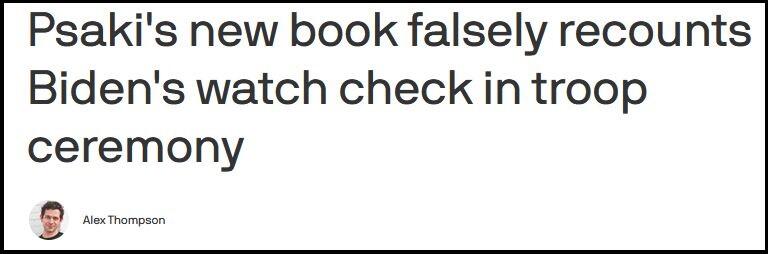
Jen Psaki Claims Biden Never Looked At Watch, Suggests Gold Star Parents Lied

Jen Psaki Claims Biden Never Looked At Watch, Suggests Gold Star Parents Lied

You know it’s bad when Axios is calling out Jen Psaki for lying about President Biden checking his watch during a ceremony for soldiers killed during the botched 2021 Afghanistan withdrawal.

In her new book, “Say More,” the former White House press secretary claims that Biden looked at his watch only after the ceremony had ended, contradicting fact-checks (even Snopes) and on-the-record statements from Gold Star families who were there.

Psaki says Biden critics were engaged in “misinformation” and used the image to make “him appear insensitive, concerned only about how much time had passed.”

The Associated Press photographer on the tarmac snapped two photos of Biden looking at his watch twice and 10 minutes apart, as fact-checkers at USA Today and Snopes noted soon afterward. –Axios

Psaki also ‘mistakenly cited’ a passage from the Washington Post to reinforce her lie – when what she quoted was actually from USA Today‘s fact check article, not the post. The fact check noted that Biden looked at his watch at the end of the ceremony, but also concluded that “photos and video show [Biden] also checked his watch during the ceremony.”

More via Axios:

Many family members of the 13 soldiers killed during the explosion at the Abbey Gate base in Kabul have consistently said in interviews and appearances before Congress that Biden checked his watch as the caskets went by.

  • Mark Schmitz, the father of Marine Lance Cpl. Jared Schmitz, told Congress in August of 2023 that “while I stood there on the tarmac watching you check your watch over and over again, all I wanted to do was shout out, ‘It’s two f***ing thirty, asshole.’ “
  • The day after the ceremony on Aug. 29, 2021, Shana Chappell, the mother of Marine Lance Cpl. Kareem Nikoui, wrote on Facebook: “I watched you disrespect us all 5 different times by checking your watch!!! What the f*** was so important that you had to keep looking at your watch????

Psaki Responds

While initially declining to comment, Psaki told Axios that the “detail in a few lines of the book about the exact number of times he looked at his watch will be removed in future reprints and the ebook,” adding “The story on Afghanistan is really about the importance of delivering feedback even when it is difficult told through my own experience of telling President Biden that his own story of loss was not well received by the families who were grieving their sons and daughters.”

Tyler Durden
Mon, 05/13/2024 – 11:00

Lindsey Graham Suggests Nuking Iran And Hamas

Lindsey Graham Suggests Nuking Iran And Hamas

Authored by Steve Watson via Modernity.news,

Warmonger in chief Lindsey Graham suggested Sunday that Israel, with the help of the US, should use nuclear weapons on Iran and Hamas fighters in Palestinian territories.

Appearing on NBC News’ “Meet the Press,” the Republican Senator asked “Why did we drop two bombs, nuclear bombs on Hiroshima and Nagasaki?”

“To end a war that we couldn’t afford to lose,” Graham continued, adding “You don’t understand, apparently, what Israel is facing. They’re facing three groups: Iran, who has received $80 billion in aid… They’re taking that money to kill all the Jews.”

Graham claimed that Israel is facing a significant threat to its existence, and therefore should do whatever it takes, just as the US did in World War Two.

“Why is it okay for America to drop two nuclear bombs on Hiroshima and Nagasaki to end their existential threat war?”

Graham continued, adding “Why was it okay for us to do that? I thought it was okay. To Israel, do whatever you have to do to survive as a Jewish state.”

“Give Israel the bombs they need to end the war they can’t afford to lose and work with them to minimise casualties,” Graham urged.

Host Kristen Welker provided some pushback, noting that there are now more advanced weapons that could be deployed, rather than just dropping a big fat nuke, and that there might be an alternative to all out war.

But Graham wasn’t having it, stating “When you’re telling the world you’re going to restrict weapons delivery to the Jewish state who is fighting a three-front war for their survival, it emboldens Iran, it emboldens Hamas.”

It’s hardly surprising coming from Graham, who has been calling for wiping Iran off the face of the Earth for years now. But how exactly is Israel going to nuke Hamas without causing more untold carnage to millions of innocent people, including those in its own country?

*  *  *

Your support is crucial in helping us defeat mass censorship. Please consider donating via Locals or check out our unique merch. Follow us on X @ModernityNews.

Tyler Durden
Mon, 05/13/2024 – 10:40

Market Manipulation Trial Over Bill Hwang’s Spectacular $36 Billion Implosion Begins This Week

Market Manipulation Trial Over Bill Hwang’s Spectacular $36 Billion Implosion Begins This Week

The trial over Bill Hwang’s Archegos Capital Management begins this week.

The charges in Hwang’s trial come from the 2021 collapse of the $36 billion dollar Archegos and Reuters has said that testimony could last up to 8 weeks. Prosecutors have said that Archegos’ collapse led to $100 billion in shareholder losses at companies he held.

The trial is set to shed a light on how major Wall Street players accommodated, and potentially turned a blind eye, to risky tactics from a wealthy client. Hwang is being accused of using total return swaps to take massive positions in companies without holding their underlying stock. 

As Reuters notes, the company faced crippling margin calls in March 2021 due to falling stock prices. This, in turn, led to significant losses for Archegos and its lenders, including Credit Suisse and Nomura Holdings.

Archegos founder Bill Hwang and CFO Patrick Halligan, charged with racketeering conspiracy and multiple counts of fraud and market manipulation, have pleaded not guilty.

They contest the prosecutors’ claims of market manipulation, which some legal experts view as a challenging case for the government. The trial is expected to feature testimony from Archegos’s guilty-pleading head trader and Chief Risk Officer, alongside potential appearances from bank executives.

Hwang was arrested in April 2022 and charged with racketeering conspiracy, securities fraud and wire fraud in connection with a scheme to manipulate the share prices of public companies in order to boost profits. He was then released on $100 million bail. At the time, he told authorities that he had “lost his passport” and so his wife surrendered hers instead. As we noted, he also lived just minutes from Teterboro airport in New Jersey. 

Chief Financial Officer Patrick Halligan, also pleaded not guilty and was freed on $1 million bail and had his travel limited.

According to the 40-page indictment, Hwang engaged in a “fraudulent scheme” that included “interlocking deceptive acts and misconduct, through false and misleading statements to security-based swap (“SBS”) counterparties and prime brokers and manipulative trading designed to artificially move the market, which, in tandem, increased Archegos’s assets under management from around $4 billion to over $36 billion in just under six months.”

In order to overcome this issue, Archegos “chose not to rely on ordinary market forces,” and instead “engaged in a brazen scheme to manipulate the market for the securities of the issuers that represented Archegos’s top 10 holdings” by purchasing both securities and SBSs related to those issuers.

Archegos, through Hwang and Tomita, effected this scheme by dominating the market for its Top 10 Holdings, as well as by “setting the tone” (i.e., engaging in large pre-market trading), bidding up prices by entering incrementally higher limit orders throughout the trading day, and “marking the close” (i.e., engaging in large trading in the last 30 minutes of the trading day) and by other non-economic trading, all with the goal of artificially inflating the share prices of its Top 10 Holdings.

To fuel the alleged manipulation, Archegos used margin extended by counterparties – which Hwang and crew ‘deliberately misled’, because had they answered truthfully after they began asking questions, it “would have led Archegos to exhaust the finite trading resource that its Counterparties provided.”

As a reminder, Archegos amassed a concentrated portfolio of stocks well in excess of $100 billion by using borrowed money in the form of TRS, which kept the exposure on the books of the various prime brokers working with Archegos, thus allowing Hwang to hide his full exposure.

Hwang is a former protégé of hedge-fund titan Julian Robertson, who founded Tiger Management in 1980, which as the Wall Street Journal reports, turned $8.8 million into nearly $22 billion. Several investors trained by Robertson became known as the “Tiger cubs.”

Tyler Durden
Mon, 05/13/2024 – 10:20

Musk Wins Latest Censorship Battle In Australia As High Court Rules Against eSafety Commissioner

Musk Wins Latest Censorship Battle In Australia As High Court Rules Against eSafety Commissioner

Authored by Rebekah Barnett via ‘Dystopian Down Under’ blog,

Can Australia’s eSafety Commissioner block content globally on demand? Not today, ruled the Australian Federal Court, in a win for Elon Musk’s social media platform X.

US billionaire Elon Musk (left), Australian eSafety Commissioner Julie Inman Grant (right)

In a decision this morning, Justice Geoffrey Kennett refused to extend a temporary injunction obtained by eSafety last month, which forced X to remove footage of the Wakeley church stabbing, an alleged religiously motivated terror attack.

Under the Online Safety Act (2021), the eSafety Commissioner, Julie Inman Grant, has the authority to order removal of such ‘class 1 material’ within Australia under threat of hefty fines.

eSafety argued that X had not gone far enough to block the content from Australians, as a geo-block can be circumvented by a VPN. X argued that eSafety was effectively seeking a global ban on content, straying outside of the Australian online harm regulator’s jurisdiction.

eSafety applied to the Federal Court to extend its temporary injunction against X, with a hearing taking place on Friday 10 May. The temporary injunction was due to expire at 5pm on Friday, but was extended to 5pm today, presumably to allow time for Justice Kennett to deliver a decision on the matter.

This morning, Justice Kennett determined that, “The orders of the court will be that the application to extend … is refused,” meaning that at the time of publishing, the injunction is no longer effective. A written decision with the Judge’s reasoning is yet to be published.

In a statement on the Federal Court decision, eSafety said that the matter will return to Court for a case management hearing on Wednesday, 15 May.

Source: X

“The application for this injunction should have never been brought,” said Dr Reuben Kirkham, Co-Director of the Free Speech Union of Australia (FSU) in a statement today, questioning the validity of the Commissioner’s bid to enact a global content ban on X.

“The eSafety Commissioner is overreaching and behaving more like an activist than a responsible public servant.”

Dr Kirkham, who was present for the hearing on Friday, told Dystopian Down Under that he counted 12 lawyers present (seven for X, five for eSafety), which, if eSafety is ordered to pay costs, will lump tax payers with “a considerable amount of unnecessary legal costs.”

Digital civil liberties nonprofit the Electronic Frontier Foundation (EFF) echoes FSU Australia’s position, stating that, “no single country should be able to restrict speech across the entire internet,” and likening the Commissioner’s actions to “[using] a sledgehammer to crack a nut.”

An affidavit submitted by the EFF to the eSafety vs. X proceedings last week called for the Court to consider the international impact that a ruling in eSafety’s favour would have in setting a precedent for allowing one country to enforce content bans on citizens of other countries.

“If one court can impose speech-restrictive rules on the entire Internet—despite direct conflicts with laws [in] a foreign jurisdiction as well as international human rights principles—the norms of expectations of all internet users are at risk,” stated the EFF in an article summarising the affidavit.

X’s Global Government Affairs posted about the hearing, stating, “We’re glad X is fighting back, and we hope the judge will recognize the eSafety regulator’s demand for what it is—a big step toward unchecked global censorship—and refuse to let Australia set another dangerous precedent.” At the time of publishing, no updated statement on the Judge’s decision had been issued.

Source: X

Dr Kirkham calls the Commissioner’s application to extend her injunction against X “part of a pattern where the eSafety Commissioner’s office seemingly engages in gamesmanship rather than respecting the rule of law or acting as a model litigant.”

Indeed, today’s ruling in X’s favour comes amidst mounting controversy over the eSafety Commissioner’s ongoing stoush with X, which appears to be driven partly by Julie Inman Grant’s global censorship ambitions, and partly by personal feelings.

Inman Grant, who formerly directed Twitter’s Public Policy (Australia and Southeast Asia), has repeatedly criticised Elon Musk since his purchase of the Twitter platform in 2022.

Moreover, Musks’s advocacy for a broad interpretation of free speech on the internet conflicts with Inman Grant’s professed view of free speech as a right that needs to be “recalibrated” for online spaces.

For its part, X has failed to comply with routine reporting to the eSafety Commissioner’s satisfaction, leading eSafety to initiate civil penalty proceedings against X in December last year. If found non-compliant, X could be fined up to AUD $780,000 per day, backdated to March 2023, when the determination of non-compliance was made.

Perhaps the biggest controversy between X and eSafety centres on the highly charged and subective issue of gender ideology.

Inman Grant has enforced removal of a string of posts on X questioning gender ideology, including one suggesting that men can’t breastfeed, and another about a trans-identified male who allegedly injured female players during a women’s football game in NSW.

In an internationally high-profile case, the Commissioner recently issued a removal notice over an acerbic gender-critical post by Canadian activist Billboard Chris, raising questions over whether the Government should be able to police opinions and censor statements of biological fact on the internet.

FSU Australia is currently involved in Administrative Appeal Tribunal proceedings on behalf of Billboard Chris (real name Chris Elston) against the eSafety Commissioner. Additionally, X has threatened to sue eSafety over the matter.

Source: X

Returning to the issue of the Wakeley stabbing footage, Inman Grant’s attempt to globally ban the content has been supported by the Australian Government, which leveraged the incident to call for more censorship, including the reintroduction of an unpopular misinformation bill.

Prime Minister Anthony Albanese has also responded to calls to address violence against women by proposing to further expand eSafety’s budget and remit, which could see deep fake pornography and “other misogynistic material” censored by the regulator.

No one will argue against explicit pornography being blocked from children’s view, but it is around the grey edges of definition creep on terms like ‘harm’, ‘adult cyber abuse’ and ‘misogynistic material’ where disagreements will undoubtedly kick-off.

In a move of ‘no confidence’ against eSafety, FSU Australia has launched a petition to abolish the office of the eSafety Commissioner altogether, arguing that a combination of parental controls and platform incentives will suffice in keeping children safe on the internet.

A more moderate approach may be to curtail eSafety’s remit to its original function of dealing with child abuse content (as in 2015), and revenge porn (as in 2017), before the regulator’s purview and powers were significantly expanded with the introduction of the Online Safety Act in 2021.

However, in the media and political conversation, there is little appetite for a moderate approach, as conveyed in a viral guest appearance by media personality Tracey Holmes on a recent episode of the ABC’s failing show Q+A.

Calling out the double standard in the censorship conversation, Holmes told the studio audience,

“I don’t agree with any kind of censorship in a general sense. I don’t think Elon Musk is contributing to any social cohesion split inside this country. I think our mainstream media is doing enough of that. I think our politicians do enough of that…

“Of course there are fault lines everywhere, but there’s only one way you can stop those fault lines from getting bigger, and that is to have the ability to have the town square to hear different points of view…

“And I think unfortunately we’ve been fed ‘this side or that side’ for so long, people are giving up on mainstream media, that’s why they’re tuning out. That’s why they’re going to YouTube… we have let them down.”

Hopefully, some higher-ups in the corporate media tuned to hear what Holmes had to say.

*  *  *

To support Rebekah’s work, share, subscribe, and/or make a one-off contribution to DDU via my Kofi account. Thanks! Follow her on X

Tyler Durden
Mon, 05/13/2024 – 10:00

Key Events This Week: All Eyes On CPI As Fed Speakers Galore

Key Events This Week: All Eyes On CPI As Fed Speakers Galore

After a very slow week, the key event for markets this week will be US inflation data with April’s PPI (Tuesday) and CPI (Wednesday) the highlights. We’ll see if the higher-than-expected US inflation seen in Q1 extends into Q2 or not. Markets will also hear from Powell (tomorrow) and Vice Chair Jefferson (today) as the highlights of a busy Fedspeak calendar that are included in the day-by-day list at the end. The next most important US data release is Retail Sales on Wednesday.

Elsewhere China’s monthly activity numbers (Friday) are important, and staying in Asia, we also have Japanese PPI (tomorrow) and Q1 GDP (Thursday). In Europe tomorrow’s ZEW survey in Germany and UK labor market stats are highlights. Swedish CPI (Wednesday) may get a little extra attention after last week’s Riksbank cut, only the second G10 currency to ease this cycle after Switzerland earlier in the year. Earnings season quietens with only 7 S&P 500 companies and 69 Stoxx 600 companies reporting.

Previewing the main events now and let’s start chronologically with regards to US inflation. For PPI tomorrow, the headline (+0.3% consensus, vs. +0.2% previously) and core (+0.2% consensus vs. +0.2% last month) are always less important than the key components that feed into the core PCE deflator – namely, health care services, portfolio management and domestic airfares. As DB economists point out, whilst the March health care services print was relatively soft (+0.1%), the six-month annualized growth rate of 3.5% was still higher than at any point in the decade prior to the pandemic. They also highlight that with respect to portfolio management, the strength in asset market performance leading up to March should result in a strong print for April, given the typical lags.

With regards to CPI, DB economists think that given the 3% rise in seasonally adjusted gas prices, headline CPI (+0.37% forecast vs. +0.38% previously) should grow faster than core (+0.29% vs. +0.36%). This would lead to core YoY CPI falling two-tenths to 3.6%, and headline falling a tenth to 3.4%, both in-line with consensus. The three-month annualized rate under this scenario would fall by four-tenths to 4.1%, but the six-month annualized rate would tick up a tenth to 4.0%. As ever all eyes will be on whether rents finally respond more in keeping to the numerous models that have suggested they should already be well below where they currently are.

For Wednesday’s US Retail Sales, DB’s headline (+0.5% vs. +0.7% previously), ex-autos (+0.4% vs. +1.1%) and retail control (+0.3% vs. +1.1%) forecasts suggest some payback from a strong March release. There will be a few extra eyes on initial jobless claims this week given the spike to +231k last week after months of relative stability around the +210k level. DB economists think the spike could have been mostly due to NY school holiday dates having been shifted and would therefore expect much of the spike to reverse. We also have US housing starts and permits on Thursday which include a 2019-2024 seasonal revision which could be of note. Various regional factory surveys are out which will help fine tune PMI forecasts.

Courtesy of DB, here is a day-by-day calendar of events

Monday May 13

  • Data: US April NY Fed 1-yr inflation expectations, Japan April M2, M3, Germany March current account balance, Canada March building permits
  • Central banks: Fed’s Mester and Jefferson speak
  • Earnings: SoftBank, Tencent Music, Petrobras

Tuesday May 14

  • Data: US April PPI, NFIB small business optimism, UK Q1 output per hour, March weekly earnings, employment change, April jobless claims change, Japan April PPI, machine tool orders, Germany and Eurozone May Zew survey
  • Central banks: Fed’s Powell speaks, ECB’s Knot speaks, BoE’s Pill speaks
  • Earnings: Alibaba, Tencent, Rheinmetall, Home Depot, Vodafone, Sony, Bayer

Wednesday May 15  

  • Data: US April CPI, retail sales, May NAHB housing market index, Empire manufacturing index, March total net TIC flows, business inventories, Italy March general government debt, Eurozone Q1 GDP, employment, March industrial production, Canada March manufacturing sales, April housing starts, existing  home sales, Sweden April CPI
  • Central banks: Fed’s Kashkari speaks, ECB’s Villeroy speaks, China 1-yr MLF rate
  • Earnings: Cisco, Allianz, Burberry, RWE

Thursday May 16

  • Data: US April industrial production, import and export price indices, housing starts, capacity utilization, building permits, May Philadelphia Fed business outlook, New York Fed services business activity, initial jobless claims, Japan Q1 GDP, March capacity utilization, Italy March trade balance, Norway Q1 GDP
  • Central banks: Fed’s Harker, Bostic and Mester speak, ECB’s financial stability review, Panetta, De Cos, Nagel and Villeroy speak, BoE’s Greene speaks
  • Earnings: Walmart, Baidu, JD.com, Applied Materials, Deere, Siemens, Take-Two, Deutsche Telekom, BT

Friday May 17

  • Data: US April leading index, China April retail sales, industrial production, new home prices, property investment, France Q1 ilo unemployment rate, Canada March international securities transactions
  • Central banks: ECB’s Vasle, Guindos, Vujcic, Holzmann and Kazaks speak, BoE’s Mann speaks

* * *

Focusing on just the US, Goldman writes that the key economic data releases this week are the CPI and retail sales reports on Wednesday and the Philadelphia Fed Manufacturing Index on Thursday. There are several speaking engagements from Fed officials this week, including an event with Vice Chair Jefferson and Cleveland Fed President Mester on Monday and an event with Chair Powell on Tuesday.

Monday, May 13

  • No major economic data releases scheduled.
  • 09:00 AM Fed Vice Chair Jefferson and Cleveland Fed President Mester (FOMC voter) speak: Fed Vice Chair Phillip Jefferson and Cleveland Fed President Loretta Mester will take part in a discussion on central bank communications at an event hosted by the Cleveland Fed. Q&A is expected. On April 16th, Vice Chair Jefferson noted that his baseline “continues to be that inflation will decline further with the policy rate held steady at its current level, and that the labor market will remain strong, with labor demand and supply continuing to rebalance.” Vice Chair Jefferson also said that “if incoming data suggest that inflation is more persistent than I currently expect it to be, it will be appropriate to hold in place the current restrictive stance of policy for longer.” On April 17th, President Mester noted that she was still “expecting inflation to come down,” but that she thought the FOMC needed “to be watching and gathering more information before we take action.” President Mester will retire from the FOMC in June.

Tuesday, May 14

  • 06:00 AM NFIB Small business optimism, April (consensus 88.1, last 88.5)
  • 08:30 AM PPI final demand, April (GS +0.3%, consensus +0.3%, last +0.2%); PPI ex-food and energy, April (GS +0.2%, consensus +0.2%, last +0.2%); PPI ex-food, energy, and trade, April (GS +0.2%, last +0.2%)
  • 09:10 AM Fed Governor Cook speaks: Fed Governor Lisa Cook will deliver a speech at an event hosted by the New York Fed. Text is expected. On March 25th, Governor Cook noted that while disinflation “has been bumpy and uneven,” “a careful approach to further policy adjustments can ensure that inflation will return sustainably to 2% while striving to maintain the strong labor market.”
  • 10:00 AM Fed Chair Powell speaks: Fed Chair Jerome Powell will take part in an event with European Central Bank Governing Council member Klaas Knot hosted by Netherlands’ Foreign Bankers’ Association. Q&A is expected. At the press conference following the FOMC’s May meeting, Chair Powell pushed back strongly against the possibility of rate hikes, saying that he thinks “it’s unlikely that the next policy rate move will be a hike.” He added that the FOMC would need to see evidence that policy is not sufficiently restrictive in order to hike but is not seeing that. Chair Powell also suggested that he did not take much signal from the inflation uptick in Q1, emphasized the “lag structures built into the inflation process,” and noted that he expected sequential inflation to slow this year.

Wednesday, May 15

  • 08:30 AM Empire State manufacturing survey, April (consensus -10.3, last -14.3)
  • 08:30 AM CPI (mom), April (GS +0.37%, consensus +0.4%, last +0.4%); Core CPI (mom), April (GS +0.28%, consensus +0.3%, last +0.4%); CPI (yoy), April (GS +3.42%, consensus +3.4%, last +3.5%); Core CPI (yoy), April (GS +3.61%, consensus +3.6%, last +3.8%): We estimate a 0.28% increase in April core CPI (mom sa), which would lower the year-on-year rate by two tenths to 3.6%. Our forecast reflects a 2.5% pullback in airfares and net declines in auto prices (used -0.8%, new unchanged) based on rising inventories, mixed auction prices, and a pullback in incentives. We also assume another decline in communication prices (-0.25%) now that post-holiday price normalization has run its course; Adobe data also indicates falling prices for consumer electronics. We estimate a further slowdown in the primary rent measure (+0.37% vs. +0.41% in March) reflecting the continued softness in apartment inflation, but we assume continued strength in OER (+0.45% vs. +0.44% in March) given the resilience of the single-family segment. On the positive side, we forecast another large gain in car insurance rates (+1.6% vs. +2.6% in March) based on online price data, and we assume a 2bp boost to core CPI from this year’s tax preparation price hikes (within financial services CPI). We estimate a 0.37% rise in headline CPI, reflecting higher energy (+1.7%) and food (+0.3%) prices. Our forecast is consistent with a 22bp increase in core PCE in April.
  • 08:30 AM Retail sales, April (GS flat, consensus +0.4%, last +0.7%); Retail sales ex-auto, April (GS -0.2%, consensus +0.2%, last +1.1%); Retail sales ex-auto & gas, April (GS -0.4%, consensus +0.1%, last +1.0%); Core retail sales, April (GS -0.4%, consensus +0.1%, last +1.1%)… We estimate core retail sales fell 0.4% in April (ex-autos, gasoline, and building materials; mom sa). Our forecast reflects payback from strong Easter spending in March, as well as sequential softness in credit card spending across retailers and restaurants. We estimate unchanged headline retail sales, reflecting higher auto sales and gasoline prices. 10:00 AM Business inventories, March (consensus flat, last +0.4%) 10:00 AM NAHB housing market index, May (consensus 51, last 51)
  • 12:00 PM Minneapolis Fed President Kashkari (FOMC non-voter) speaks: Minneapolis Fed President Neel Kashkari will take part in a fireside chat at the 2024 Williston Basin Petroleum Conference. Q&A is expected. On May 7th, President Kashkari said that he thought “the most likely scenario is we sit here [at the current fed funds rate] for an extended period of time.” President Kashkari noted that the FOMC could cut rates “if inflation starts to tick back down or we saw more marked weakening in the labor market,” but that “if we get convinced eventually that inflation is embedded or entrenched now at 3% and that we need to go higher, we would do that.”:
  • 03:20 PM Fed Governor Bowman speaks: Fed Governor Michelle Bowman will speak at the DC Blockchain Summit 2024 in Washington D.C. Q&A is expected. On May 10th, Governor Bowman said that she had “not written in any cuts” for 2024 in the FOMC’s latest Summary of Economic Projections. Governor Bowman noted that her “expectation would be a number of months of progress, … and a number of probably meetings as well before I might be comfortable with” interest rate cuts.

Thursday, May 16

  • 08:30 AM Philadelphia Fed manufacturing index, May (GS 9.0, consensus 7.5, last 15.5); We estimate that the Philadelphia Fed mane the economy and eventually get us to 2%,” but that he was not “in a mad-dash hurry to get there if all these other good things are happening.” President Bostic also emphasized that if “inflation starts moving in the opposite direction away from our target, I don’t think we’ll have any other option but to respond to that,” noting that he would “have to be open to increasing rates.”

Friday, May 17

  • There are no major economic data releases scheduled.
  • 10:15 AM Fed Governor Waller speaks: Fed Governor Christopher Waller will deliver a speech on the payments system at the International Organization for Standardization Technical Committee. Text is expected. On March 27th, Governor Waller noted that he continued to “believe that further progress will make it appropriate for the FOMC to begin reducing the target range for the fed funds rate this year. But until that progress materializes, I am not ready to take that step.” Governor Waller also emphasized that “the strength of the US economy and resilience of the labor market mean the risk of waiting a little longer to ease policy is small and significantly lower than acting too soon and possibly squandering our progress on inflation.”
  • 12:15 PM San Francisco Fed President Daly (FOMC voter) speaks: San Francisco Fed President Mary Daly will deliver a commencement address at the University of San Francisco School of Management. Text is expected. On May 9th, President Daly noted that the policy rate was “restrictive, but it might take more time to just bring inflation down.” She also emphasized that “it’s far too early to declare that the labor market is fragile or faltering.”
  • 05:45 PM Fed Governor Kugler speaks: Fed Governor Adriana Kugler will deliver a commencement address at the Frank Batten School of Leadership and Public Policy at the University of Virginia. Text is expected. On April 3rd, Governor Kugler noted that her “baseline expectation is that further disinflation can be accomplished without a significant rise in unemployment,” and that “if disinflation and labor market conditions proceed as I am currently expecting, then some lowering of the policy rate this year would be appropriate.”

Data Sourced from DB, Meta and GS

Tyler Durden
Mon, 05/13/2024 – 09:40

“I See Dead People”: Bragg’s Case Against Trump Goes Paranormal

“I See Dead People”: Bragg’s Case Against Trump Goes Paranormal

Authored by Jonathan Turley,

Below is my column on the completion of the testimony of Stormy Daniels and the start of the testimony of Michael Cohen. With a dubious legal theory, the testimony has only magnified the criticism of the prosecution as parading sensational rather than material evidence before the jury and the public. Manhattan District Attorney Alvin Bragg is losing even CNN hosts and legal analysts. Fareed Zakaria noted “I doubt the New York indictment would have been brought against a defendant whose name was not Donald Trump” Elie Honig has observed that, if brought in a less democratic district, “I would say there’s no chance of a conviction.” The Bragg case was never “normal” but last week it seemed to go paranormal.

Here is the column:

“I see dead people.” Before this week, that claim was most associated with the nine-year-old character Cole Sear from the 1999 film “The Sixth Sense.” But now it is one of the talents claimed by former adult film actress Stormy Daniels in her bizarre testimony in Manhattan during former President Donald Trump’s trial.

It turns out that speaking to the dead was one of the few relevant things Daniels had to offer in the case, which is now on a collision course with a motion for acquittal before the case even goes to the jury.

The Daniels testimony will live in infamy in the annals of criminal justice. For two days, she offered lurid and completely irrelevant details whose only possible purpose was to humiliate Trump. Admitting that she was coached by the prosecution in her testimony, it was clear that she was there not to win a case but to win an election. Judge Juan Merchan allowed this legal burlesque to unfold in his courtroom, later blaming defense counsel who had vociferously objected to her appearance and the scope of the examination.

The cross examination was devastating.

It shattered her laughable claim that she had not really been seeking money in shaking Trump down for a non-disclosure agreement, a claim contradicted by her own former lawyer. Daniels also revealed that she had spoken with the dead, and that a ghost had once held her boyfriend under water in a bathtub. She also said that she lived in a haunted house, only to discover later that the spirit haunting it was actually a large possum.

In a case based on a dead misdemeanor and a rapidly falling heart rate on the manufactured felony, one can understand the appeal of witnesses who can speak for the dead.

Indeed, Daniels’s graphic testimony may prove the moral high point of this trial, since serial perjurer and disbarred attorney Michael Cohen is scheduled to testify Monday.

Cohen recently broke his pledge, midway through the trial, to stop attacking and taunting Trump. Cohen has insisted that he deserves the protection of the gag order by Judge Merchan as a witness, despite serious constitutional concerns. Merchan continues to threaten Trump with jail if he responds to Cohen’s unrelenting attacks. Merchan waited for the weekend before his testimony to suggest that the prosecutors tell Cohen to stop the public antics.

But it remains unclear what the order is protecting Cohen from. Not only is he trolling for money on social media with reference to the trial, but he is also widely being attacked by others. It is only Trump who cannot address his attacks, including political opposition to his campaign.

Cohen’s testimony will be the culmination of this travesty of a trial. But Bragg already jumped the shark with Daniels. After three weeks, legal experts are still debating what the crime was that Trump was seeking to conceal by recording payments for a standard non-disclosure agreement as a legal expense.

(That is the same characterization used by Hillary Clinton’s campaign for its funding for the infamous Steele dossier.)

It is still unclear that Trump even knew how the payments were characterized, and the alleged false record was not even created until after the election was over. Yet he stands accused of using the “false business records” to somehow steal or rig an election that was already over.

After this circus with Cohen is complete, Trump will be allowed to testify.

He would be insane to do so. Merchan has already said that he will allow a broad scope to cross-examination, making any appearance unlikely.

That is when Merchan will face a key test of judicial ethics.

He has failed to protect the rights of the defendant from a baseless, politically motivated prosecution. He could insist that he simply felt Bragg had a right to present his case. He will soon be done and, as expected, it is entirely based on Cohen, a disbarred perjurer who will ask for his former client to be sent to prison for following his own legal advice.

After Bragg closes the prosecution’s case, the defense will make a standard motion for dismissal. Merchan should grant that motion.

There has been no showing of an actual crime, let alone a clear record tying Trump to key decisions or actions.

Merchan will then have to decide whether he has the courage that Bragg lacked. Bragg knew that this case was ridiculous. The Justice Department had declined any prosecution for a federal campaign finance violation, the theory referenced in the case. Indeed, it did not even seek a civil fine over the payments. Bragg’s predecessor had also rejected the prosecution.

When Bragg took over, he similarly balked and stopped the move toward an indictment. But two prosecutors in his office, Carey R. Dunne and Mark F. Pomerantz, then resigned and started a public pressure campaign to get New Yorkers to demand prosecution.

Pomerantz went even further and took an action that some of us viewed as deeply unethical and unprofessional. Over the objections of his own former office and colleagues, he published a book on the case against Trump — then still under investigation and not charged, let alone convicted. It was a pressure campaign directed at Bragg. In New York, Bragg knew that he would either have to indict Trump or forget about reelection.

Merchan will now have to make the same choice in yielding to politics or principle…or to the paranormal.

He has already allowed every effort to bring this dead misdemeanor back to life.

But even Stormy Daniels may not be able to serve as  Merchan’s medium in reaching back eight years.

Tyler Durden
Mon, 05/13/2024 – 09:20

Orange Juice Prices Primed For Breakout After Forecast Warns Brazil Set For Worst Harvest In Decades 

Orange Juice Prices Primed For Breakout After Forecast Warns Brazil Set For Worst Harvest In Decades 

Breakfast lovers are in for another jolt as orange juice prices surge to near-record levels. A new report released on Friday indicates that Brazil, the leading global exporter of OJ, is facing its worst harvest in over three decades. This alarming development compounds existing issues in Florida’s citrus groves, which have been plagued by disease and are experiencing collapsing production levels to the lowest in decades. 

Fundecitrus wrote in a note that Brazil will produce 232.4 million boxes—each weighing about 90 pounds—for the growing season this year. That’s a 24% collapse from a year earlier and the lowest production levels in 36 years.

“Excessive heat brought stress to orange trees during a crucial period of flowering and early fruit formation between September and November last year. Further hurting output is an increase in citrus greening, a disease that causes fruit to prematurely drop from trees,” Bloomberg wrote, commenting on the report. 

The report sparked additional fears about a worsening global OJ shortage. 

In markets, prices of concentrated OJ futures in New York surged as much as 5% on Friday, closing up about 3% to $394 and only 8% off the record high of $425. 

Sliding production in Brazil could soon impact US retail prices at the supermarket, considering Florida has yet to stage a significant comeback in production.

In the last year, the US has ramped up imports of OJ from Brazil to mitigate losses in Florida. 

Don’t worry. Federal Reserve Chair Jerome Powell has everything under control on the food inflation front, as the prices of OJ, coffee, eggs, and cocoa have hyperinflated

Watch OJ futs in NY into next week. 

Tyler Durden
Mon, 05/13/2024 – 06:55

Who Are We Protecting, And From What?

Who Are We Protecting, And From What?

Authored by Omid Malekan via Medium.com,

Gambling is increasingly legal in the US: Casinos, sports betting, the lottery, and so on. The economic benefits of most forms of gambling are limited. There is some job creation and collection of additional taxes, but these benefits come at the expense of players.

Put differently: Casinos are highly profitable and the lottery helps fund the government because players are guaranteed to lose in the long run. Incentives are misaligned.

Like gambling, investing in startups and “alternatives” like venture capital or hedge funds is also risky. But unlike gambling, this type of risk is economically productive. It provides capital to entrepreneurs and liquidity to markets.

A big part of America’s economic success is our ability to finance startups and our efficient capital markets, often described as “the envy of the world.”

Just as importantly, the incentives from this kind of risk taking are aligned. If a startup founder makes money, so do his investors. If a VC fund manager collects carry, it’s because she made her LPs a profit.

Except for certain age restrictions, gambling in the U.S. is open to the general public. There are no tests for the “sophistication” of a blackjack player or the annual income of a sports bettor.

The most popular form of gambling is the lottery. It has the worst odds because it is a government monopoly. It’s popular because it is heavily marketed, particularly to poor people. That’s why economists call it a regressive tax.

Except for certain hard to satisfy (and economically unfeasible) exemptions, investing in startups or alternative investments is restricted to the wealthy. Accredited investor laws require startup founders and fund managers to only accept money from so-called “sophisticated” investors.

But they don’t require prospective investors to take a test or demonstrate experience, they simply ask how rich they are. Accredited investor laws are based on the classist assumption that rich people are smart and poor people are stupid.

Never mind the history of Enron, Lehman, Madoff, SVB, and every other major collapse in recent memory, all of which featured one group of affluent people interacting with others.

The U.S. government assumes that a billionaire boomer who inherited all his wealth is more “sophisticated” when investing in AI startups than a 23 year old with a degree in machine learning.

That same government has no problem with the 24 year old blowing all his money on fantasy football or the Powerball. There’s now even a lotto app.

Less than 20% of Americans can qualify as accredited investors, but over 60% of Americans have gambled in the past year.

Wealth disparity has grown significantly in the past 20 years, in part because investments have outperformed income. Put differently: those who derive their wealth from their assets have outperformed those who do so from their labor.

Within the investment landscape, so-called “private markets” have outperformed public ones, in part because different government regulations like Sarbanes Oxley incentivized successful startups like Facebook (which 80% of people couldn’t invest in at the outset) to go public later than their predecessors.

This phenomenon was aided by the growth of venture capital and growth equity funds (which 80% of people can’t become LPs for) and the rise of secondary trading platforms for private shares (which only 20% of people can use).

Given the demographic breakdown of wealth in America — now skewing in favor of older people — this phenomenon also has an intergenerational component.

Like most demographic trends, the rise of economic inequality has many contributing factors. But government policy clearly plays a role.

The U.S. government wants ordinary (and younger) Americans to do risky things that are guaranteed to lose money while simultaneously barring them from doing risky things that may generate a positive return.

This is not an accident. Everything that I’ve argued here is easy to verify and regularly discussed in policy circles. That makes it a deliberate choice.

Ironically, the one exception to this phenomenon has been crypto, at least until recently. Coins like Bitcoin and Ether are the only risk assets that were available to the general public and outperformed over the past decade.

Their orthogonal arrival, technical complexity, and niche communities made them a far more likely investment for a smart 24 year old than a billionaire boomer. Their decentralized nature also meant that access was generally ungated.

The data shows that younger people — who own disproportionately less equity and real estate — own disproportionately more crypto. The same goes for minorities like blacks.

The U.S. government is now trying to put an end to all of this. Agencies like the Securities and Exchange Commission, which is led by a 66-year old centi-millionaire, are trying to force crypto into the same accredited investor laws that held back a generation.

Mr. Gensler made most of his wealth becoming a partner at Goldman Sachs at a time when it was a private company. He’s the prototypical winner of the status quo.

Today, thanks to the SEC’s crackdown, virtually all crypto projects either restrict early investments to accredited investors or exclude Americans altogether.

Some don’t even let American’s collect airdrops, free money that could make a major difference in the financial life of a young American who is sophisticated enough to deposit Lido staked ETH into EingenLayer, but not Sophisticated enough to be rich.

This too is by design.

America’s current disposition towards gambling, investing, and crypto is a socioeconomic disaster. It’s bad economic policy and deeply immoral.

Tyler Durden
Mon, 05/13/2024 – 06:30