Seattle Could Shutter 20 Elementary Schools Due To Budget Constraints
When happens when your city pisses away all of your tax revenue on trying to feed, shelter and coddle activists and homeless people? You wind up having to make budget cuts. And, in Seattle, those cuts could be coming in the form of closing up to 20 elementary schools.
The district’s budget deficit has reached more than $100 million, according to new reporting from MYNorthwest.
And Superintendent Brent Jones’ proposal for ‘Well-Resourced Schools’ might lead to the shutdown of over a quarter of the district’s 73 elementary schools, the report says.
According to the Seattle Public Schools, 29 of these schools have fewer than 300 students each, and are considered under-enrolled. The district warns that keeping these schools open may necessitate cuts or the elimination of preschool programs, a reduction in core staff, larger class sizes, and fewer curriculum offerings.
The plan has been met with considerable opposition from both parents and teachers, who expressed their concerns at Wednesday’s meeting.
Ben Gitenstein, a parent of a student in the SPS district commented: “It’s not 20 schools, it’s 20 communities. All the kids who thought they knew who their next year’s teacher would be. All the local mom-and-pop stores that sell ice cream to the kids after school, they’re all going to be seriously impacted.”
He continued: “Closing neighborhood schools is really bad for neighborhoods and it’s really bad for all of us because, at the end of the day, the real problem here is enrollment.”
Superintendent Brent Jones commented: “We’re trying to make sure we’re focused on the students’ experience and not just a building.”
The report concluded stating that, at the meeting, Jones reflected on his own experiences as a student within SPS, noting that he attended four different elementary schools. He described each transition as a positive experience.
School closures, under his plan, would not take place until the 2025-2026 school year at the earliest. He is scheduled to present an initial recommendation at a school board meeting on June 10.
Newsom Forced To Slash California Budget, Blames Crippling Deficit On “Rain Bombs” And Tax Shortfalls
In the course of two years, California has turned a $100 billion surplus into a $73 billion deficit, forcing governor Gavin Newson (D) to propose painful (token) spending cuts on Friday while announcing his revised state budget.
When asked how the state was able to achieve such a monumental fail, Newsom – who claims the deficit is actually $27.6 billion (to which even AP called him out) – blamed a reduction in taxes from capital gains income, which surged in 2021 amid a raging stock market and plummeted in 2022. Then, in 2023, the state ‘continued to collect less tax revenue than projected’ due to capital loss carryovers. He also blamed “unexpected rain bombs” – which caused the IRS to extend the tax filing deadline for most California taxpayers in 2023 following severe winter storms. When those taxes were eventually collected, they were 22% below expectations, according to the Governor’s office.
Watch:
According to AP, Newsom will cut $6.7 billion set aside for doctors who treat Medicaid patients, cut off healthcare to 14,000 disabled migrants in their home, saving $94.7 million, and slashed $550 million that was headed towards state schools in order to build new facilities.
Republican State Senator Brian Dahle called the cuts a “hollow gesture, at best,” adding “The governor’s national ambitions have triggered a massive exodus of people and businesses creating an enormous revenue shortfall of personal and corporate income taxes.”
“You can’t have a good government without a strong private sector. Plain and simple, people are being priced out of California from bad policies and mismanagement,” Dahle continued.
In total, Newsom is proposing $32.8 billion in cuts over two years – including an 8% cut to state operations, which he says will shore things up.
Of course, we know that’s bullshit.
Refreshing your memory from early April, Mike Shedlock gave a sobering view into reality;
While finalizing the upcoming fiscal year’s state budget back in May 2022, California governor Gavin Newsom boasted of an extraordinary projected surplus: $97 billion. The governor immediately collaborated with an enthusiastic state legislature to spend it all. Of course, new spending on new programs and benefits tends to become permanent.
This has happened repeatedly in California. Between fiscal year 2012–13 and fiscal year 2022–23 (the year with the projected $97 billion surplus), per capita general-fund spending doubled, from just over $3,000 per resident to just under $6,000. (All figures are in 2022 inflation-adjusted dollars.)
The State Office of Legislative Analyst’s latest report projects a $73 billion dollar deficit for the next fiscal year. It won’t be easy to paper over this debt, but the state may use its opaque accounting system to hide the ball.
California’s general-fund budgets are reported on a cash basis. The state’s balance sheet, however, uses “accrual-based accounting.” Without getting too far into the weeds, this is an apples v. oranges situation. Instead of the algebraic perfection of private-sector income statements, balance sheets, and cash flows, government accounting provides no easy way to reconcile what you see on the budget.
Some watchdogs, however, have succeeded in cracking the code. John Moorlach, one of the only certified public accountants to serve in the California State Senate, just published a review of the state’s fiscal health, focusing on the balance sheet. According to Moorlach, California’s balance sheet is in trouble.
Moorlach declared in a March California Insider interview that the state “now has the largest unrestricted net deficit in the US: $222 Billion.” In plain English, Moorlach is saying that California’s state government accounts have liabilities that exceed assets by $222 billion. No matter how creative Newsom and his financial wizards may be, someday that money will have to be paid.
A remedy that California has turned to over the years and will undoubtedly turn to now is to accumulate additional long-term debt. Emulating the federal government, but lacking its dollar-printing ability, California’s state and local governments and agencies have racked up over a trillion dollars in debt, primarily in bonds and unfunded pension liabilities. These liabilities, too, must be paid. Since that’s all but impossible, the liabilities must be serviced with payments that, just as at the federal level, will eat up more and more of the operating budgets.
California’s total state and local government debt now stands at almost $1.6 trillion, or about half the state’s GDP.
That isn’t an alarming ratio when compared to the national debt, which has now soared to 128 percent of U.S. GDP with no end in sight. But Californians carry this $1.6 trillion state and local debt ($40,000 per capita) in addition to their share of the national debt (about $90,000 per capita).
That article was from February of 2022. I suspect the liabilities are now close to $2 trillion.
Unsurprisingly, California has the highest unemployment rate in the nation at 5.7 percent vs. 4.1 percent nationally.
A Booming Economy?
California has massive problems although the stock market is at a record high and the economy is allegedly booming. The next recession will hit California exceptionally hard, and it’s not too far off.
Kansas Gov. Laura Kelly vetoed a bill on Friday that aimed to prevent companies of China and other “foreign adversaries” from acquiring real property near military installations in the state.
Senate Bill 172 aims to block individuals or companies from “countries of concern” from owning any interest in land located within a 100-mile radius of a military installation in Kansas.
Under the bill, any foreign principal that owns or acquires any interest in real property in Kansas would be required to file registration with the attorney general and divest of the property.
The Democratic governor has vetoed the proposed legislation, saying that the bill contains provisions that are “overly broad” and “not narrowly tailored” to protect the state from foreign adversaries.
“While I agree that it is important for our state to implement stronger protections against foreign adversaries, this legislation contains multiple provisions that are likely unconstitutional and cause unintended consequences,” Ms. Kelly said in a statement.
“Additionally, the retroactive nature of this legislation raises further serious constitutional concerns,” she added.
Ms. Kelly said the legislature should consider proposals that protect Kansas from “bad actors” without affecting the state’s legitimate business relationships with potential trading partners and small businesses.
“I am not willing to sign a bill that has the potential to hurt the state’s future prosperity and economic development,” the governor stated.
According to a report by Kansas State University, foreign investors from China own a single acre of privately held agricultural land in the state. China is among the countries listed as U.S. foreign adversaries.
As of 2021, China ranked as the third-largest export market for Kansas, trailing behind Mexico and Canada, according to a Kansas Export Statistics Executive Summary.
Republicans Voice Disappointment
Kansas Republicans have criticized Ms. Kelly’s decision to veto the bill. House Speaker Dan Hawkins, Majority Leader Chris Croft, and Speaker Pro Tempore Blake Carpenter issued a joint statement saying that the governor is putting military installations in Kansas at risk.
“Foreign adversaries, such as China, have made their intentions toward the U.S. and our democracy abundantly clear,” Mr. Hawkins said in the statement.
“It’s shameful that our governor has chosen not to take those threats seriously, leaving Kansas’ critical infrastructure and military installments exposed,” he added.
Mr. Croft described the governor’s veto as “beyond disappointing,” saying that it leaves the state’s military bases and other critical infrastructure “wide open for adversarial foreign governments.”
“The assets of this state are too important for us to sit on our hands and wait until it’s too late,” he stated. “This bill was carefully designed with input from everyone who wanted a say on how we should move forward.”
Mr. Carpenter said he remains committed to protecting the military installations in Kansas and “ensuring that the Chinese Communist Party and other foreign adversaries do not compromise Kansas’s safety.”
Similar Legislation in Other States
Similar legislation has been introduced in several states, including Georgia, Iowa, Utah, and Oklahoma. The South Carolina Senate passed a bill in March that will partly ban companies or citizens of foreign adversaries from acquiring real property in the state.
Stop AAPI Hate, a coalition aimed at ending discrimination against Asian Americans and Pacific Islanders, has condemned the measure and said it could stoke “xenophobia” among Asian American communities.
“These land ban laws label our communities as untrustworthy, blame them for the actions of another country’s government, and stoke the flames of racism, xenophobia, and hate,” Cynthia Choi, co-founder of Stop AAPI Hate, said in a statement after Georgia’s passage of the bill.
As of December 2021, China accounted for 383,935 acres of the 40 million acres of U.S. agricultural land owned by foreign investors, according to a report by the U.S. Department of Agriculture (USDA).
While the acreage under Chinese ownership is slightly less than 1 percent of all foreign-held agricultural land, it represents a nearly 30-fold leap from 13,720 acres in 2010, according to a U.S.-China Economic and Security Review Commission report.
Ukraine Warns Against Questioning Zelensky’s Legitimacy Due To Wartime Suspension Of Elections
The end of Volodymyr Zelensky’s five year term as president of Ukraine is set to end by the close of May, at least according to what was stipulated upon his getting elected, however, the government has made it clear there will be no new election.
Officials have cited martial law due to the Russian invasion to say that after his five-year term ends on May 21, there won’t be a new election until after martial law and wartime regulations are lifted.
Ukraine’s Minister of Justice, Denys Malyuska, confirmed this in a fresh weekend interview with BBC News Ukraine. “The president’s powers endure until the election of his successor. However, certain provisions of the Constitution are open to interpretation, inviting speculation or conspiracy theories,” Malyuska said when asked about ongoing speculation over what happens after May 21st.
He explained, “There may be considerable debate and criticism, particularly considering that the Constitution’s framers may not have fully anticipated the possibility of Ukraine being embroiled in a large-scale conflict, leading to some provisions being inadequately formulated.”
When asked about appealing to a Constitutional Court in order to seek clarification, Malyuska said that it is ill-timed. Or in essence he said it won’t happen and warned against such an effort.
“Such an appeal would imply legitimate questions and doubts, warranting resolution by the Constitutional Court. Given the country’s communication and security challenges, openly questioning the president’s legitimacy would be a grave error.”
“Therefore, I see no merit in approaching the Constitutional Court presently. Perhaps, in the future, under different circumstances, it could be considered, but not at this juncture,” Malyuska followed with.
Meanwhile, at a moment that Russia’s new cross-border Kharkiv offensive is in full swing, President Zelensky is telling the nation not to panic:
Ukraine’s leader Volodymyr Zelenskiy called on his people not to panic amid Russia’s ongoing advance in the Kharkiv region that’s jeopardizing a local city.
Ukrainians should trust in their army defending the country’s northeastern border area and not “yield to emotions” despite the fierce fight there and the “extremely difficult” situation on the outskirts of Vovchansk, Zelenskiy said in his regular evening statement on Sunday.
“The advance in the Kharkiv region aims to stretch our forces and undermine their morale and motivation,” Zelensky said. “Defense battles have never been simple, and they become even more challenging when an enemy manages to instill fear.”
There are reports that Russian forces have been rapidly advancing in the north this weekend…
#BREAKING Russia is unexpectedly opening a new front in northern Ukraine – Sky News
The Russian army has taken control of Strelche, Krasnoe, Pilna, and Borisovka in the Kharkiv region. pic.twitter.com/2DEMYUWbuk
Russia is said to be seeking to create a 10km deep ‘buffer zone’ inside Ukrainian territory in order to better deter against cross-border mortar and drone attacks on the Belgorod region. According to the latest Sunday headlines:
RUSSIA CLAIMS CAPTURE OF MULTIPLE VILLAGES IN KHARKIV REGION, INCLUDING VOVCHANSK, PROMPTING MASS EVACUATIONS – SOURCES
UKRAINIAN PRESIDENT ZELENSKIY URGES CALM AMIDST RUSSIAN ADVANCES IN KHARKIV, EMPHASIZING TRUST IN THE ARMY’S DEFENSE EFFORTS – SOURCES
DESPITE REPORTS OF RUSSIAN GAINS, UKRAINIAN FORCES RESIST AND ATTEMPT COUNTER-ATTACKS IN THE REGION – SOURCES
FOCUS OF RUSSIAN OFFENSIVE APPEARS TO BE ESTABLISHING A BUFFER ZONE RATHER THAN DIRECT ASSAULT ON KHARKIV CITY, ACCORDING TO ANALYSTS – SOURCES
UKRAINIAN FORCES RESIST AND ATTEMPTCOUNTER-ATTACKS IN THE REGION
Scores of Russian civilians have been killed and wounded over the last several months by such shelling. Moscow has warned it will punish Ukraine for such attacks directly on Russian territory.
On February 21st, Canadian Prime Minister Justin Trudeau gave a press conference in Edmonton, announcing his government’s decision to introduce the Online Harms Act, or Bill C-63. It was described in Canadian media as a “bill to protect kids” that would stop the “exploitation of children,” and Trudeau’s curt speech focused solely on minors. The scarf-clad PM angrily dismissed criticisms the bill might have a broader focus.
“I look forward to putting forward that Online Harms bill, which people will see is very, very specifically focused on protecting kids, and not on censoring the Internet,” he said sharply. “I think everyone, wherever they are in the political spectrum, can agree that protecting kids is something governments should be focused on doing.”
Soon after, on February 26th, Trudeau’s government introduced the bill. Canada’s stable of retreating, credulous on-air personalities announced its rollout like the arrival of penicillin. “Tonight, Web of Harm,” gushed CTV’s Omar Sachedina. “Tackling online dangers and safeguarding children… The long-awaited framework for protecting the vulnerable…”
There was little initial uproar. What could be wrong with increasing child safety, or “protecting the vulnerable”?
Then people read the bill.
“If you look at the purpose of this law, it’s actually quite noble and most lawyers would agree with it,” says Canadian attorney Dan Freiheit. “Online safety, protecting children’s physical and mental health.” But the actual text?
“It’s wild,” Freheit says.
Trudeau was lying when he said C-63 was “very, very specifically focused on correcting kids.” The purview of the Online Harms Act extends far beyond speech, reimagining society as a mandated social engineering project, creating transformational new procedures that would:
enlist Canada’s citizens in an ambitious social monitoring system, with rewards of up to $20,000 for anonymous “informants” of hateful behavior, with the guilty paying penalties up to $50,000, creating a self-funded national spying system;
introduce extraordinary criminal penalties, including life in prison not just for existing crimes like “advocating genocide,” but for any “offence motivated by hatred,” in theory any non-criminal offense, as tiny as littering, committed with hateful intent;
punish Minority Report pre-crime, where if an informant convinces a judge you “willcommit” a hate offense, you can be jailed up to a year, put under house arrest, have firearms seized, or be forced into drug/alcohol testing, all for things you haven’t done;
penalize past statements. The law gets around prohibitions against “retroactive” punishment by calling the offense “continuous communication” of hate, i.e. the crime is your failure to take down bad speech;
force corporate Internet platforms to remove “harmful content” virtually on demand (within 24 hours in some cases), the hammer being fines of “up to 6% of… gross global revenue.”
Things you’re saying, things you’ve already said, things an administrative judge thinks you might say, all barred, with neighbors deputized as enforcers? Good times. Leave it to Trudeau, a frequent trailblazer in new forms of illiberalism in the digital age, to come up with this quantum leap downward on the rights front. C-63 is a Frankenstein’s Monster combining the worst censorship ideas already deployed by supposed ally government-in-laws like Europe’s Digital Services Act, Australia’s updated Australian Communications and Media Authority Act (ACMA), and Scotland’s Hate Crime and Public Order Act, which saw 7,152 complaints in its first week when the law took effect last month.
Trudeau’s creation is a turbo-charged social surveillance law aimed first at forcing big platforms like Facebook and Twitter to “self-police,” but secondarily targeting individuals and doling out civil and criminal penalties for speech and thought on a scale not seen anywhere. What constitutes hateful conduct? While the bill newly defines hate speech as “likely to foment detestation or vilification” of Canada’s growing list of protected groups and individuals, Canadian lawyers interviewed were generally unsure of what the standard might look like in practice.
“It’s impossible to know what exactly it’s going to mean,” says Bruce Pardy, Executive Director of Rights Probe. “So you’re going to have to rely upon the court in a criminal prosecution, or the human rights tribunal in a human rights proceeding, to put their own interpretation on that, and figure out where the line is.”
Despite being split on how serious the immediate impact might be (“We’re not looking at prisons full of people doing life for misgendering” said one), most attorneys seemed to agree C-63 will be a game-changer if passed, aimed beyond speech at the very concept of individual rights, chipping away at ideas like the presumption of innocence and the right to face one’s accuser, and using traditionally dubious tools like ex post facto laws.
On one level, it’s not surprising, given Canada’s historically diffident attitude toward rights — the first section in the country’s Charter of Rights and Freedoms, ironically introduced when Trudeau’s father Pierre was Prime Minister, is essentially a giant loophole — but this Prime Minister appears determined to swap out Canada’s reputation for brotherhood, humor, and generosity for a new one based on rigidity and collective paranoia.
There’s a long backstory of important recent laws and Supreme Court cases that helped push Canada down a path toward C-63, but this bill still stands apart as a unique problem, and only a few domestic media outlets have been willing or able to criticize it. One of those is Rebel News, whose founder Ezra Levant says Canadians could really use America’s help in sounding the alarm. “Canadians need to fight for our own freedom, but the Canadian political and media establishment are obsessed by what U.S. journalists and politicians have to say about us,” Levant says. “So any attention Americans can bring to this civil liberties bonfire really makes a difference. Frankly, we need your help.”
How bad is C-63? See for yourself, in a tour through its key sections:
The biggest headline-grabber in C-63 involves new provisions for life imprisonment for speech offenses. There are really two. “Advocating genocide” is already a crime in Canada, but C-63 boosts its maximum penalty from five years to life. “Life sentences for sending out some words. That’s heavy,” Canada’s former Supreme Court Chief Justice, Beverley McLachlin, told journalist Edward Greenspon.
Andrea MacLean of the Calgary-based JSS Barristers is among the lawyers who don’t necessarily foresee an avalanche of life sentences for speech offenses, but does worry the draconian life sentence provisions might have serious downstream effects.
“They might encourage people to take plea deals they wouldn’t otherwise take,” MacLean says.
As bad as the “sending out some words” portion is, a more frightening provision prescribes potential life sentences for any “offence motivated by hatred.” This is a difficult concept, but what the law proscribes is any violation of any “Act of Parliament,” no matter how minor, combined with hateful motivation. One example given was crumpling up an anti-gay flier and throwing it out the window in a national park, which would combine a federal littering prohibition with hate speech. Another attorney suggested this could refer to something like denial of restaurant service, and marveled that “this takes civil offenses and makes them into crimes.”
I heard conflicting takes on this section, and it’s worth noting that Justice Minister Arif Virani has repeatedly described this “offence motivated by hatred” section as hateful intent mixed with a “criminal” offense like theft, assault, or murder. But the text reads like a parody of the American “hate crime enhancement” idea:
The “prior restraint” portion of C-63 describes the process by which a person can be punished preemptively if an informant convinces a judge that either a “hate propaganda offence” or the aforementioned “offence motivated by hatred” has a “reasonable” chance of occurring:
This clause might particularly affect a high-profile person like J.K. Rowling who’s already declared an intention to keep saying things deemed offensive to Canadians, who in 2017 passed a law (C-16) forbidding “gender identity” discrimination. Pardy, who described the 2017 measure as a “weaponization of human rights law,” says C-63 is like that act “on steroids.” This pre-crime provision includes a long list of potential punishments, ranging from house arrest, scheduled exit and entry from the home, ankle monitoring, and seizure of firearms. MacLean pointed out that this guts Canada’s Section 11 guarantee of presumption of innocence unless guilt is proven “beyond a reasonable doubt.” Again, a “reasonable” chance the crime will occur is sufficient to justify detention…
Israeli tanks have moved into eastern Jabalia in northern Gaza following a night of intense bombardment, which has killed some 19 Palestinians and flattened residential blocks, according to health officials.
Israeli fire targeted ambulances near the camp’s Unrwa clinic, Wafa news agency is reporting. The Israeli army said that the latest incursion on the camp was to prevent Hamas from “rehabilitating military capabilities” there.
In other areas of Gaza, Israeli air strikes reportedly killed some 27 Palestinians overnight. In Rafah, 18 Palestinians were killed in air strikes, including several children, according to Wafa.
Wafa is also reporting that the continuing air strikes have killed dozens more in the past few hours, with 12 bodies arriving at Kamal Adwan Hospital in Beit Lahiya, in northern Gaza.
The director of the UN agency for Palestinian refugees, Sam Rose, has warned that Palestinians in Rafah are being instructed to evacuate to a nearby “expanded humanitarian area” which is already overcrowded and lacking in essential services.
In an interview with BBC news, Sam Rose explained that al-Mawasi is “essentially sand dunes on the Mediterranean coast that are crowded with hundreds of thousands of people” who have already been displaced.
“There is no water network, there is no infrastructure, sewage, sanitation,” he said.
— Sam Heller | سام هيلر (@AbuJamajem) May 10, 2024
Here are some of the latest updates:
The Israeli military has intensified attacks across Gaza in the past 24 hours, with 27 Palestinians killed overnight, including several children in southern Rafah.
Israeli forces “carpet-bombed” Jabalia refugee camp in northern Gaza, killing and wounding several Palestinians, Wafa news agency is reporting. Residential houses and evacuation centres have been flattened. The death toll is currently unknown.
In the West Bank, Israeli forces have raided the Arroub refugee camp near Hebron on Sunday, Wafa is reporting.
UN Secretary-General Antonio Guterres renewed calls for an “immediate ceasefire”.
UN agencies have warned that food supplies for distribution in southern Gaza will run out today.
Unrwa estimates that 300,000 Palestinians have fled Rafah in the last week, emphasising that displaced people have “nowhere safe to go”.
Watch: Pelosi Dismantled In Real Time In Masterclass On Populism
Two weeks ago, former House Speaker Nancy Pelosi was thoroughly savaged during a debate at Oxford University over the question of whether populism is a “threat to democracy.” In case you missed it, read on as it’s making the rounds. If you have 14 minutes to spare, jump right in:
Opening the case for the left was Rachel Haddad, Secretary of the Oxford Union. She argued that populist leaders like Donald Trump and Nigel Farage pose a threat to democracy, and are not a “new generation of geniuses” who can find simple solutions to longstanding, complex problems.
Pelosi closed the debate for the proposition, defining populism as an “ethno-nationalist populism, generated by an ethnic negativity to immigrants, people who are different from them and the rest” (so, ‘they’re racists!’).
Speaking against the motion were Union committee members Sultan Kokhar (Chair of Consultative Committee) and Oscar Whittle (Director of Research), as well as former Mumford & Sons lead guitarist, Winston Marshall – now a podcaster for The Spectator – who got into an exchange with Pelosi during parts of his speech.
Marshall started out by saying:
“Words have a tendency to change meaning when I was a boy, “woman” meant “someone who didn’t have a cock.”
Populism has become a word used synonymously with “racists.” We’ve heard “ethno-nationalist,” with “bigot,” with “hillbilly,” “redneck,” with “deplorables.”
Elites use it to show their contempt for ordinary people.”
He then noted that Barack Obama, while still president, tried to frame he and Bernie Sanders as actual populists vs. Donald Trump, who ‘doesn’t care about working people.’
But then, “If you watch Obama’s speeches after that point, more and more recently, he uses the word “populist” interchangeably with “strong man,” with “authoritarian.” The word changes meaning, it becomes a negative, a pejorative, a slur.”
“To me, populism is not a dirty word. Since the 2008 crash and specifically the trillion-dollar Wall Street bailout, we are in the populist age, and for good reason. The elites have failed,” Marshall continued.
He then got into it with Pelosi after drawing a parallel between January 6th and June 2020, saying: “I’m sure Congresswoman Pelosi will agree that the entire month of June 2020, when the federal courthouse in Portland, Oregon was under siege, and under insurrection by radical progressives, those too were dark days for America.”
To which Pelosi shot back, “You are not. There is no equivalence there,” adding “It is not like what happened on January 6, which was an insurrection incited by the president of the United States.”
Read on for Marshall’s complete masterclass in populism (transcript courtesy of RealClear Politics).
My point, though is that all political movements are susceptible to violence, and indeed insurrection. And if we were arguing that fascism was a threat to democracy, I’d be on that side of the House.
Indeed, the current populist age is a movement against fascism. I’ve got quite a lot to get through.
Populism as you know, is the politics of the ordinary people against an elite, populism is not a threat to democracy. Populism is democracy, and why else have universal suffrage, if not to keep elites in check?
Ladies and gentlemen, given the success of Trump, and more recently, Javier Milei taking a chainsaw to the state behemoth of Argentina’s bureaucratic monster, you’d be mistaken for thinking this was a right-wing populist age, but that would be ignoring Occupy Wall Street. That would be ignoring Jeremy Corbyn’s “for the many, not the few,” that would be ignoring Bernie against the billionaires, RFK Jr. against Big Pharma, and more recently, George Galloway against his better judgment. Now all of them, including Galloway, recognize genuine concerns of ordinary people being otherwise ignored by the establishment.
I’m actually rather surprised that our esteemed opposition, Congressman Pelosi, is on that side of the motion. I thought the left was supposed to be anti-elite. I thought the left was supposed to be anti-establishment today, particularly in America, the globalist left have become the establishment. I suppose for Miss Pelosi to have taken this side of the motion, she’d be arguing herself out of a job.
But it’s here in Britain, where right and left populists united for the supreme act of democracy, Brexit. Polls have showed the number one reason people voted for Brexit was sovereignty, for more democracy.
What was the response of the Brussels elite? They did everything in their power to undermine the Democratic will of the British people and the Westminster elite were just as disgraceful. As we’ve heard, David Cameron called the voters “fruitcakes, loonies and closet racists.” The liberal Democrats did everything they could to overturn a democratic vote. Keir Starmer campaigned for a second referendum. Elites would have had us voting and voting and voting until we voted their way. Indeed, that’s what happened in Ireland and in Denmark.
Let’s look at some of the other populist movements. The Hong Konger populist revolt is literally called the Pro-Democracy Movement. In the Farmer revolts from the Netherlands to Germany, France, Greece, to Sri Lanka, farmers are taking their tractors to the road to protest ESG policy that’s floated down to us from those all-knowing, infallible elites of Davos. The trucker movement in Canada became anti-elitist when petty tyrant Prime Minister Justin Trudeau froze their bank accounts, not the behavior of a democratic head of state. The Gilets Jaunes France, ULEZ in London, working people protesting policy that hurt them. And how are they treated? They’re called conspiracy theorists. They’re called far-right, by the mayor as well.
Ladies and gentlemen, populism is the voice of the voiceless. The real threat to democracy is from the elites. Now don’t get me wrong, we need elites. If President Biden has shown us anything, we need someone to run the countries. When the president has severe dementia, it is not just America that crumbles, the whole world burns.
But let’s examine the elites. European corporations spend over €1 billion a year lobbying Brussels, U.S. corporations spend over $2 billion a year lobbying in DC, and two-thirds of Congress receive funding from pharmaceutical companies. Pfizer alone spent $11 million in 2021. They made over $10 billion in profit. No wonder then that 66% of Americans think the is rigged against them for the rich and the powerful.
And by the way, we used to have a word for when big business and big government were in cahoots. And I think any students here of early 20th-century Italian history will know what I’m talking about.
What about Big Tech? Throughout the pandemic, Biden’s team, the FBI, and the Department of Homeland Security colluded with Big Tech in censoring dissenting voices. Not kooky conspiracy theorists, people like Dr. Jay Bhattacharya, the Stanford epidemiologist, people like Harvard scientist Martin Kulldorf, people spreading true information, not misinformation, true information at odds with the government narrative.
Need I remind you, democracy without free speech is not democracy.
This was a direct breach by the way of the First Amendment. Before COVID, Intelligence services colluded with Big Tech to have Trump suspended off Twitter. Yes, the same platform which hosted the Taliban and Ayatollah “Death To Israel” Khomeini. They thought the president crossed the line when he tweeted on Jan 6 quote, “Remain peaceful. No violence! Respect the law and our great men and women in blue.” That’s a quote.
You may be thinking now that Trump is a populist. You are right. He didn’t accept the 2020 elections and he should have. So should Hillary in 2016. So should Brussels, and so should Westminster in 2016. And so too should Congresswoman Pelosi, instead of saying the 2016 election was quote, “hijacked.”
PELOSI: That doesn’t mean we don’t accept the results, though!
WINSTON MARSHALL: What about the mainstream media? Let me read you some mainstream media headlines. The New Yorker the day before the 2016 election, “The Case Against Democracy.” The Washington Post, the day after the election, “The Problem With Our Government Is Democracy.” The LA Times, June 2017, “The British Election Is A Reminder Of The Perils Of Too Much Democracy.” Vox, June 2017, “Two eminent political scientists say the problem with democracy is voters.” New York Times, June 2017, “The Problem With Participatory Democracy Is The Participants.”
Mainstream media elites are part of a class who don’t just disdain populism, they disdain the people. If the Democrats had put half their energy into delivering for the people, Trump wouldn’t even have a chance in 2024. He shouldn’t, he shouldn’t have a chance. You’ve had power for four years. From the fabricated Steele dossier, to trying to take him off the ballot in both Maine and Colorado, the Democrats are the anti-Democrat party. All we need now is the Republicans to come out as the pro-Monarchist party.
Ladies and gentlemen, populism is not a threat to democracy, but I’ll tell you what is. It is elites ordering social media to censor political opponents. It’s police shutting down dissenters, be it anti-monarchists in this country or gender-critical voices here, or last week in Brussels, the National Conservative Movement.
I’ll tell you what is a threat to democracy. It’s Brussels, DC, Westminster, the mainstream media, big tech, big Pharma, corporate collusion and the Davos cronies. The threat to democracy comes from those who write off ordinary people as “deplorable.” The threat to democracy comes from those who smear working people as “racists.” The threat to democracy comes from those who write off working people as “populists.”
And I’ll say one last thing. This populist age can be brought to an end at the snap of a finger. All that needs to be done is for elites to start listening to, respecting, and God forbid, working for ordinary people. Thank you.
And of course, being Oxford, the Union voted for ‘populism bad’ – with 177 members voting for the motion, and 68 voting against.
Nobel Prize–winning economist Esther Duflo thinks rich countries should pay poor countries $500 billion in compensation each year for climate-change damages. It is our “moral debt.” She proposes an international 2-percent wealth tax on the ultra-rich and an increase in the global minimum corporate tax rate to fund this $500 billion transfer.
You and I may be shocked by such a suggestion but don’t worry: “It’s really necessary. And it’s reasonable. It’s not that hard.” Only someone in an elite, progressive bubble could say something like that. Let’s check her reasoning.
Duflo claims that climate change creates costs, specifically through “excess” deaths due to excessive heat. Poorer countries from the global south near the equator will see more days of extreme heat, and so will see a disproportionate increase in excess deaths.
Other economists translated those deaths into an externality cost of $37 per ton of CO2. Multiply that by the roughly fourteen billion tons of CO2 emitted by the US and Europe and voila, wealthy countries generate $500 billion in externality costs per year.
She proposes paying for this by increasing the global minimum corporate tax rate from 15 percent to 18 percent and introducing an international 2-percent wealth tax on the ultra-rich, which she defines as the 3000 richest billionaires. We can’t go into the many problems and obstacles to such funding mechanisms here — suffice it to say such ideas will be nearly impossible to implement.
But Duflo’s back-of-the-envelope calculations, besides missing the bigger picture, are so speculative as to require playing make-believe. Let’s play along for a moment to see why. We’ll start by reverse-engineering her $500 billion number into a measure of harm.
Regulatory agencies and insurance companies use the concepts of “statistical value of life” or the “statistical value of a life-year” to do cost-benefit analysis on risk and the monetary value of life. These concepts are slippery, however, and calculated in a variety of ways with a wide range of estimates.
To keep things simple, let’s assume that the value of one life-year is $200,000. The $500 billion number proposed by Duflo suggests that the cost imposed by wealthy countries burning fossil fuels is the loss of roughly 2.5 million life-year” in poor countries per year.
That sounds like a staggering number!
But what about the benefits that have accrued to developing countries from activities that generate CO2 emissions? Important advances in medicine, such as antibiotics and vaccines, were developed in modern industrialized countries. So, too, were refrigeration, cars, the internet, smart phones, radar; modern agricultural methods with herbicides, pesticides, and fertilizers; improvements in plumbing, building materials, manufacturing, and much more. “Polluting” activities in industrialized countries improved nutrition and safety around the world. These advances, and many others, significantly increased people’s life expectancies — especially in poor countries.
Surely the value of these improvements should weight the opposite side of the scale from the expected harm of climate change — especially since the crusade against fossil fuels and carbon emissions will assuredly slow economic growth and innovation. Let’s consider the case of India for a moment.
Life expectancy in India has basically doubled from about 35 years in 1950 to about 70 years in 2024. If you consider that India has just over a billion people living in it, modern technology developed by rich CO2-emitting countries has added 35 billion life-years in India alone.
Translating life-years back into dollars, 35 billion life-years times $200,000 per life-year means that the benefits from greater life expectancy in India over the past 75 years is the equivalent of $7 quadrillion dollars — or in annualized terms, an annual benefit of about $93 trillion dollars. In other words, the benefits to India alone are over a hundred times larger than Duflo’s estimate of costs!
Nor is India cherry-picked. China has a similar story with life expectancy rising from 43.45 years to 77.64 years. Similar improvements in life expectancy occur across the global south.
Of course, one could argue that developed industrial countries are not solely responsible for increases in life expectancy around the world. But one could just as easily say the same about whether developed industrial countries are solely responsible for global CO2 emissions, climate change, or harm to people in the global south due to hotter weather. Connecting these two issues makes perfect philosophical sense, because the production of CO2 has historically been directly associated with increases in economic growth; which in turn is necessary for all the developments increasing longevity around the world.
Even if we massage the assumptions in Duflo’s favor, the results remain favorable to industrialization. Suppose western technology and industrial activities contribute 50 percent to improvements in life expectancy. That’s still a $46 trillion annualized benefit to India. Reduce the value of a statistical life-year to $100,000 — that’s still a $23 trillion/year benefit from industrialization in the west. Exclude India from the analysis and cut the population we focus on down to 500 million people — that’s still over $12 trillion/year in benefits. Reduce the improvement in life-expectancy by six years — that still leaves about $10 trillion/year in benefits.
So, even after making tons of assumptions to reduce their size, the estimated benefits of industrialization are still about twenty times larger than Duflo’s estimate of its costs.
Worrying about hypothetical, indirect costs of CO2 emissions when it comes to human well-being is like scrounging for pennies while ignoring $100 bills lying on the sidewalk. Actually, it is worse than that. It is like lighting $100 bills on fire to help you search a dark alley for some pocket change of human welfare.
Economic development, driven largely by Adam Smith’s dictum “peace, easy taxes, and a tolerable administration of justice” which includes strong private property rights and limited government intervention, has improved human living standards in unprecedented ways over the past 300 years. These remarkable improvements in human welfare are not limited to wealthy, developed economies but are enjoyed around the world.
Duflo talks about the (external) costs of industrialization on certain countries without considering the truly massive (external) benefits of industrialization to those same countries.
If anything, with a proper accounting, developing countries owe rich countries gratitude for the benefits they have received from industrialization and the corresponding CO2 emissions.
Paul Mueller is a Senior Research Fellow at the American Institute for Economic Research. He received his PhD in economics from George Mason University. Previously, Dr. Mueller taught at The King’s College in New York City.
Citadel Ken Griffin Rises Up Against Left’s “Cultural Revolution,” Says Time To Embrace “Western Values”
The woke takeover of America’s higher education system, transforming classrooms into woke indoctrination camps, has been on full display over the last several years. More recently, the pro-Palestinian protests on campuses have been a shocking eye-opener for many, which only reveal America’s future leaders are being transformed into toxic, leftist creatures, used as ‘useful idiots’ by leftist-funded non-governmental organizations (funded by you know who), in a sinister plan masqueraded underneath social justice movements to start an actual revolution, destroy capitalism, and ultimately, conquer America.
If you don’t believe us, we’ve got some news that might change your mind.
Late last month, one very outspoken speaker at a pro-Palestinian campus protest said the quiet part out loud:
“There’s only one solution, intifada revolution. We must have a revolution so we can have a socialist reconstruction of the USA.”
An extremist on the mic says: “There’s only one solution, intifada revolution. We must have a revolution so we can have a socialist reconstruction of the USA.”
This isn’t just about Israel/Palestine. It’s an attempt of the Marxist takeover of America. Our colleges have become… pic.twitter.com/2IEqRyuorB
The question law-abiding Americans need to ask is why leftist radicals in the Biden administration, who quite honestly hate America, allow toxic woke ideologies to flow through the education system, promoting hate and violence at colleges and universities.
Entire education curriculums have been infected with Marxist teachings, and purple-haired folks who are confused about their gender are infecting the vulnerable minds of youngsters with woke ideologies such as diversity, equity and inclusion, and queer theory.
With some calling for the federal government to intervene and save the republic from this chaos, the most unlikely heroes of our time are the billionaires, such as Elon Musk, Bill Ackman, and Ken Griffin, who are stepping up to the plate to defend Old Glory and the nation.
Musk is on X, awakening the world’s population to various forms of Marxism, pushed by dark money-funded NGOs, which is spreading across governments and society like stage four cancer. On the other hand, Ackman and Griffin have denounced woke Ivy League schools, such as Harvard, in very public ways.
The latest is Griffin, who founded the $63 billion hedge fund Citadel. In an interview Saturday, Griffin told the Financial Times that Harvard needs to embrace “Western values.” The school’s major donor said the campus crisis is a byproduct of a “cultural revolution.”
He said the US had “lost sight of education as the means of pursuing truth and acquiring knowledge” over the past decade.
“The narrative on some of our college campuses has devolved to the level that the system is rigged and unfair, and that America is plagued by systemic racism and systemic injustice,” he noted.
Griffin continued, “What you’re seeing now is the end-product of this cultural revolution in American education playing out on American campuses, in particular, using the paradigm of the oppressor and the oppressed.”
“The protests on college campuses are almost like performative art, and we’re not actually helping Palestinians or Israelis with these surreal protests,” the billionaire said, adding that in previous humanitarian crises, Americans would focus on practical aid.
The woke cult has been activated and unleashed in the US, as its objective is to scream racism over and over until communism is installed. If that’s the solution to their alleged problems – well – this should be a wakeup call – that communism has yet to work in the world – killing more than 100 million people and counting.
FT asked Griffin on how to fix Harvard, and his response:
“Harvard should put front and centre [that it] stands for meritocracy in America and will educate the next generation of leaders in American business, government, healthcare, and the philanthropic community. Harvard will embrace our Western values that have built one of the greatest nations in the world, foster those values with students, and ask them to manifest these values throughout the rest of their life.”
The billionaire added: “Freedom of speech does not give you the right to storm a building or vandalize it. That’s not freedom of speech. That’s just anarchy.”
So again, the unlikely heroes of our time are an elite class of billionaires; they’re strapping on their combat shoes in this culture war and are signaling enough is enough.
Perhaps it’s time to upload antivirus woke software in America’s schools, not just higher education but the entire damn system in a major overhaul – we suspect the Trump admin team will do that.
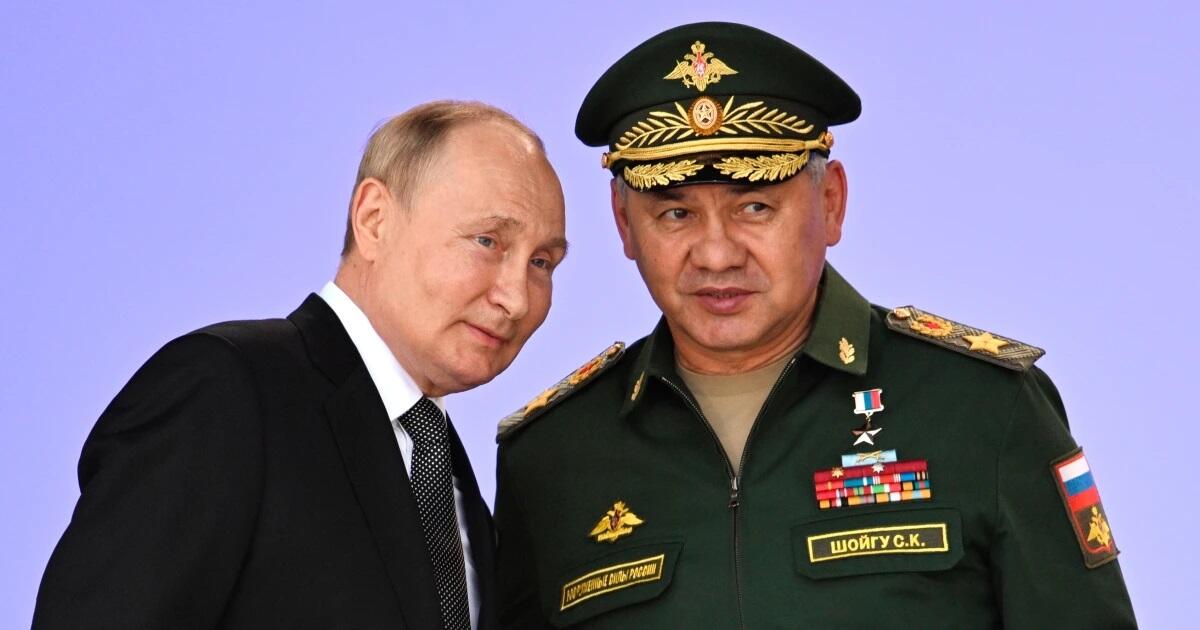
Putin Unveils Dramatic Reshuffling Of Closest Advisors: Shoigu Out As Defense Minister
Russian state media is confirming a huge breaking development that President Putin has removed his longtime Defense Minister and personal friend Sergei Shoigu as defense chief, who has overseen the Ukraine war since its beginning in Feb. 2022. He will now serve as head of the nation’s security council.
“Sergei Shoigu is likely to lose the post of Minister of Defense of Russia to acting First Deputy Prime Minister Andrei Belousov,” English-language RT is reporting. “His candidacy was proposed by President Vladimir Putin, the Federation Council announced on Sunday.”
Putin has also reportedly dismissed Secretary of the Security Council Nikolai Patrushev, according to Interfax.
This appears in order to shuffle Shoigu into that position. Putin has now appointed Shoigu as new Secretary of the Russian Security Council. Likely Patrushev is also being moved to another position too.
Wow, indeed. Looks like Putin is pushing out his long-time Defense Minister and Siberian forest hiking partner Sergei Shoigu. https://t.co/XUYoKmR1UO
— Christopher Miller (@ChristopherJM) May 12, 2024
The proposed candidate for new defense chief, Belousov, has a background in Russia’s central bank and economics and finance…
Russian President Vladimir Putin has proposed former First Deputy Prime Minister Andrey Belousov as candidate for Defense Minister, Tass reports https://t.co/jLuFF5g6b8
Below is some background on Belousov and his last two decades of government experience, though specific military decision-making or army experience on a strategic level appears to be absent, interestingly:
2000‒2006: General Director, Centre for Macroeconomic Analysis and Short-Term Forecasting.
2000‒2006: External adviser to the Prime Minister of the Russian Federation.
2006‒2008: Deputy Minister of Economic Development and Trade, Deputy Minister of Economic Development.
2008‒2012: Director, Government Department of Economy and Finance.
2012‒2013: Minister of Economic Development of the Russian Federation.
2013‒2020: Presidential Aide.
21 January 2020: First Deputy Prime Minister of the Russian Federation, appointed by executive order of the President of Russia.
Putin spokesman Dmitry Peskov addressed this lack of military experience as follows in a late Sunday press briefing:
Explaining Shoigu’s replacement with a non-military official, Kremlin spokesman Dmitry Peskov said it was “natural” for Putin to decide that a civilian official to head the Defense Ministry.
“The Defense Ministry must be absolutely open to innovation, to introduce advanced ideas and to create conditions for economic competitiveness — that’s why the president chose the candidacy of Andrei Removich Belousov,” Peskov told reporters.
According to more details of Putin’s big reshuffling via RT:
Senators are scheduled to engage in consultations regarding the nominees put forth by the president during committee sessions on May 13 and during a Federation Council meeting on May 14, as announced by the upper house of the Russian parliament.
No further alterations have been made to the roster of candidates Putin has submitted for cabinet positions. His nominations include Vladimir Kolokoltsev for the position of interior minister, Alexander Kurenkov for minister of emergency situations, Sergey Lavrov for foreign minister, and Konstantin Chuichenko for justice minister.
Denis Manturov, who served as deputy prime minister and head of the Ministry of Industry and Trade during Putin’s last term in office, has been nominated for the position of first deputy prime minister.
Dmitry Peskov, Putin’s spokesman, says the Kremlin wanted to appoint an economic official to run the defense ministry after Russia’s security budget ballooned to 6.6 per cent of gross domestic product.
“This demands special attention,” he told reporters.
“Russian President Vladimir Putin proposed the candidacy of Andrei Belousov for the post of Minister of Defense, which was previously held by Sergei Shoigu. This is stated in a message on the Telegram channel of the Federation Council. In the previous government, Belousov worked as first deputy prime minister.”
“65-year-old Belousov at various times held the positions of assistant to the head of state Vladimir Putin on economic issues, Minister of Economic Development of the Russian Federation, director of the Department of Economics and Finance of the Government of the Russian Federation, general director of the Center for Macroeconomic Analysis and Short-Term Forecasting, and worked at the Russian Academy in 1981-2006 Sciences (until 1991 – USSR Academy of Sciences). From April 30 to May 19, 2020, during Mishustin’s hospitalization with coronavirus infection, Belousov served as acting head of the Cabinet.”