60.9 F
Chicago
Monday, September 21, 2026
Home Blog Page 2645

Average Credit Card Debt In US Now Soaring Past $6,500

Average Credit Card Debt In US Now Soaring Past $6,500

Authored by Mary Prenon via The Epoch Times (emphasis ours),

This illustration picture shows debit and credit cards arranged on a desk in Arlington, Va., on April 6, 2020. (Olivier Douliery/AFP via Getty Images)

A just-released report from Scholaroo indicates that the U.S. national average for credit card debt has escalated to $6,555, with New Jersey residents leading the nation with an average debt of $8,155 per credit card. Scholaroo, a national firm matching college students with potential scholarships, surveyed more than 2,000 people across the United States during the final quarter of 2023.

Coming in at a close second is Connecticut, with an average debt of $8,011 per credit card, followed by Maryland, New York, and Alaska—all with average credit card debts of more than $7,600 per card. Rounding out the top 10 states are Colorado, California, Massachusetts, Florida, and Hawaii, all with average credit card debts in excess of $7,400.

“New Jersey residents’ debt surpasses the national average by 24 percent, while Mississippi has the lowest average credit card debt, with debtors owing just $5,186—20 percent less than the national average,” the report states.

Kentucky and Indiana also fell on the lower side, with an average of $5,295.

(Source: Scholaroo)

Bruce McClary, senior vice president of membership and media relations for the National Foundation for Credit Counseling (NFCC), told The Epoch Times that amount of debt is not surprising as many people are forced to use their credit cards just to stay afloat. “Things are so much more expensive than they were three years ago,” he said. “The runaway inflation is affecting grocery prices, and we’ve seen a roller-coaster ride for gasoline prices. Many people don’t have the money in their budgets for these added expenses and so they’re using credit cards and making minimum payments each month.”

Based in Washington, the NFCC was founded in 1998 as a nonprofit credit-counseling source for people who need help in managing their debts. Its recently released Harris poll also surveyed 2,000 adults nationwide and found similar outstanding debt values. But the overall results were even more surprising: Nearly 32 percent of Americans are just getting by financially, while 62 percent fear that government instability will hurt their finances in the next 12 months.

The biggest concern is that if people continue to carry that much debt from month to month, making only the minimum payments required, it could take years to pay it off, and they’ll find it extremely difficult to save any money,” Mr. McClary said.

The Harris poll also indicated that 31 percent of Americans don’t pay all their bills on time and that only 42 percent have a budget and keep track of spending. Almost 40 percent of those surveyed are concerned that the money they have or will save won’t last.

The poll found that the most affected groups are people who are single, rent instead of own, are parents of children under 18, and have incomes of $50,000 or less.

“Today’s higher rents may also be responsible for this credit card debt situation,” Mr. McClary said. “Most are paying way more than the recommended percent of their income toward rent, so now they’re faced with managing the rest of their expenses like groceries, utilities, gas, medical bills, and more. They’re finding they have to rely on the credit cards to help make ends meet.”

As a result, many have already been priced out of the ever-skyrocketing housing market.

“Ten years ago, Seattle was one of those cities considered to be affordable, but there’s been such a tremendous increase in rents there that many people are no longer able to afford buying or even renting there,” Mr. McClary said.

The Federal Trade Commission’s (FTC’s) Consumer Advice Department recommends that those having difficulty making even the minimum monthly credit card payments first talk with the company to ask for its help.

“Your goal is to work out a modified payment plan that lowers your payments to a level you can manage,” the FTC’s website states. “Creditors may be willing to negotiate with you even after they write your debt off as a loss, as you will still owe that debt.”

The NFCC also provides renegotiation services with credit card companies to reduce the monthly interest rates, which can sometimes be as high as 20 percent.

“What we try to do is help people regain control of their unmanageable debt by looking at their income and financial obligations and work out a livable budget,” Mr. McClary said. “It’s like a tire finally getting some traction after spinning in the mud for so long.”

(Source: Scholaroo)

There seems to be no slowdown in Americans’ love of credit cards. According to the Scholaroo report, last year, almost 45.5 percent of the U.S. population opened at least one new credit card account, resulting in some 542.6 million new accounts by the end of 2023. While more than 50 percent of Americans prefer using debit cards for their day-to-day expenses, credit cards stand as the second most favored choice, with 36 percent of the population using them for their daily transactions.

Tyler Durden
Sat, 05/11/2024 – 15:50

First F-16s To Arrive In Ukraine ‘Within Weeks’ From West, But Will It Matter?

First F-16s To Arrive In Ukraine ‘Within Weeks’ From West, But Will It Matter?

A high-ranking UK military source has told London’s daily Evening Standard newspaper that F-16 fighters will be delivered by the Western allies to Ukraine “within weeks”

The official indicated that the aircraft are due to arrive by June, or at least July at the latest. The US previously authorized NATO countries to supply the US-made fighters to Kiev, at a moment Russia still controls the skies and has been degrading the country’s energy infrastructure via frequent attacks. Zelensky previously called the decision by the Biden administration “a breakthrough”. 

Even small NATO states like Denmark are reportedly involved in handing over a few of its F-16s. Others in the program include the Netherlands, Norway and Belgium. Some of the planes are currently reported to be at a training facility in Romania, as efforts to prepare Ukrainian pilots for aerial combat in the Western fighters appear in their final phases.

Romanian F-16 file image

The Dutch especially are playing a big part, having committed to delivering a total of 24 F-16s for Ukraine’s armed forces.

But a big question remains at a moment it’s been widely acknowledged that Ukraine is losing the conflict: will the US-made fighter jets make an actual difference at this late stage where Moscow is clearly dominant? The Evening Standard bluntly admits the following:

But US officials have privately said the jets will not be a game changer when they eventually arrive after months of training, given the strength of the Russian air force and its defense systems.

So essentially, aircraft worth multiple tens of millions of dollars each are being primed to get shot down in what will likely prove a major humiliation for the West. 

Putin has already vowed that his forces will prioritize taking out Western-supplied fighter jets. In March, the Russian leader said during an address to pilots, “We will destroy their warplanes just as we destroy their tanks, armored vehicles and other equipment, including multiple rocket launchers.”

Significantly, he warned at the time that even bases in Western countries could be targeted if Ukraine flies sorties from them. “Of course, if they are used from airfields of third countries, they become a legitimate target for us, wherever they are located,” Putin had said.

Beginning last summer the Kremlin began highlighting that F-16 fighter jets are capable of carrying tactical nukes which are in select NATO countries’ possession. Russian Foreign Minister Sergey Lavrov for example at that time explained, “Moscow can’t ignore the nuclear capability of US-designed F-16 fighter jets that may be supplied to Ukraine by its Western backers. He went so far as to say that it will be seen as a threat from the West “in the nuclear domain.”

Tyler Durden
Sat, 05/11/2024 – 15:10

Over 124 Pounds Of Cocaine And Fentanyl Seized In El Paso In 1 Week

Over 124 Pounds Of Cocaine And Fentanyl Seized In El Paso In 1 Week

Authored by Naveen Athrappully via The Epoch Times (emphasis ours),

U.S. Customs and Border Protection (CBP) officials in the El Paso region seized more than 124 pounds of fentanyl and cocaine last week in four separate incidents, amid criticism of lax border policies.

On April 30, officers working at the Bridge of the Americas seized cocaine totaling 42.5 pounds, according to a May 3 press release from the CBP.  The drugs were found to be concealed inside a Hyundai Elantra vehicle allegedly driven by a 48-year-old American citizen. “The seizure was made when CBP officers monitoring the Low Energy Portal inspection system spotted anomalies in the appearance of the vehicle and advised primary CBP officers,” the release noted.

A canine sweep of the car was positive and a Z-Portal (X-ray) scan of the car also revealed anomalies. CBP officers removed 18 cocaine-filled bundles from the rocker panels of the car.”

On May 1, CBP officers at the El Paso Ysleta Port of Entry captured 11.2 pounds of fentanyl that were concealed in a Seat Ibiza vehicle. The drugs were allegedly being transported by a 26-year-old Mexican national. CBP seized the fentanyl during an enforcement operation.

The vehicle in question was selected for a secondary exam, following which bundles of fentanyl were discovered in the central console area. In total, 15 packages were removed from the compartment, according to CBP.

Last week, two more cocaine seizures were made by El Paso CBP officers totaling 70.8 pounds. The arrested individuals were handed over to federal authorities.

“The drugs seized by our CBP workforce will not cause harm in the communities we share,” Hector A. Mancha, CBP El Paso’s director of field operations, said. “We are hard at work every day utilizing multiple tools to identify and stop those who attempt to circumvent our inspection process.”

The CBP’s drug seizures come as former President Donald Trump blamed the Biden administration’s open border policies for fueling fatal drug overdoses in the United States.

“This is country-changing, it’s country-threatening, and it’s country-wrecking,” he said during an event last month. “They have wrecked our country. But I stand before you today to declare that Joe Biden’s border bloodbath … it’s going to end on the day that I take office.”

On his campaign website, President Trump said he marshaled the full power of government during his administration to prevent the inflow of drugs into the country, driving down drug overdose deaths for the first time in three decades.

The former president “will impose a total naval embargo on cartels, order the Department of Defense to inflict maximum damage on cartel leadership and operations, designate cartels as Foreign Terrorist Organizations, and choke off their access to the global financial system,” the Trump campaign said.

“President Trump will get the full cooperation of neighboring governments to dismantle the cartels, or else expose every bribe and kickback that allows these criminal networks to preserve their brutal reign. He will ask Congress to ensure that drug smugglers and traffickers can receive the Death Penalty.”

The Biden administration said it was taking steps to counter the drug issue. In February, two senior administration officials said the United States and Mexico will boost data sharing to curb the inflow of synthetic drugs into America.

The agreements are part of a wide effort “to facilitate action against criminal organizations that traffic people, guns, and illicit drugs, including fentanyl into our communities.”

In a factsheet released last November, the White House said, ”The U.S. government, alongside our partners, will continue our efforts to prevent the production and trafficking of illicit synthetic drugs through multiple efforts, including the Global Coalition to Address Synthetic Drug Threats, which has brought together over 100 countries to collectively address the scourge of fentanyl.”

Fentanyl, China

The fentanyl crisis facing the United States is problematic since it is not solely a drug issue but a geopolitical concern as well. Much of the fentanyl entering the United States comes from China. The U.S. Drug Enforcement Administration (DEA) attributes 97 percent of illicit fentanyl coming into the United States to entities operating in China.

In April, the House Select Committee on the Strategic Competition Between the United States and the Chinese Communist Party published a report detailing how China is fueling the fentanyl crisis in the United States.

China “directly subsidizes the manufacturing and export of illicit fentanyl materials and other synthetic narcotics through tax rebates,” it said. Beijing even gave “monetary grants and awards to companies openly trafficking” such drugs.

“There are even examples of some of these companies enjoying site visits from provincial PRC (People’s Republic of China) government officials who complimented them for their impact on the provincial economy.”

A review of seven Chinese e-commerce sites found more than 31,000 instances of Chinese firms selling illicit chemicals. China censors content about domestic drug sales “but leaves export-focused narcotics content untouched.”

“The fentanyl crisis has helped CCP-tied Chinese organized criminal groups become the world’s premier money launderers, enriched the PRC’s chemical industry, and had a devastating impact on Americans.”

According to the U.S. Centers for Disease Control and Prevention (CDC), synthetic opioids like fentanyl are the primary driver of overdose deaths in the United States.

Most of the illicit fentanyl in the United States is manufactured in Mexico from precursors bought from China, highlighting the importance of having full control over the border.

In an interview with The Epoch Times last year, Sen. Ted Cruz (R-Texas) said that Mexican cartels “have 100 percent operational control over our southern border.”

This month, Senator Joe Manchin (D-W.Va.) wrote a letter to President Biden asking him to use his executive authority to shut down the southern border to deal with the issue of illegal immigrants and drugs.

“To fight the drug smugglers and the individuals deliberately avoiding Border Patrol detection, you should prohibit Border Patrol agents from performing non-mission humanitarian duties so they can do their jobs,” said the senator.

Tyler Durden
Sat, 05/11/2024 – 13:10

Watch: Bill Maher Upends Stormy Daniels’ Testimony With 2018 Footage

Watch: Bill Maher Upends Stormy Daniels’ Testimony With 2018 Footage

Comedian Bill Maher just used footage from a 2018 interview with Stormy Daniels to reveal that she completely contradicted her own testimony in the Trump ‘hush-money’ trial last week.

After laying out how the Democrats have fumbled the ball on virtually every case against Trump, Maher turned his attention to Daniels, who he called a “bad witness.”

“Because, let me show you a little video. This is when I had Stormy on in 2018, and first I asked her why she had sex with Trump… listen to that, and then listen to what she says after that.”

Maher, in 2018, asked her: “Why did you fuck Donald Trump?” saying moments later “but you say it’s not a ‘me-too’ case,” referring to the flood of rape accusations against various men in the wake of the Harvey Weinstein scandal.

To which Daniels replies: “It is not a ‘me-too’ case. I mean I wasn’t assaulted, I wasn’t attacked or raped or coerced or blackmailed. They tried to shove me in the ‘me-too’ box as part of their own agenda, and first of all I didn’t want to be part of that because it’s not the truth and I’m not a victim in that regard.”

Maher then contrasts that statement with Daniels’ testimony last week, saying “she’s talking about he was ‘bigger and blocking the way,’ – it’s all the me-too buzzwords.

During her testimony last week, Daniels claimed “There was an imbalance of power, for sure. He was bigger and blocking the way, but I was not threatened either verbally or physically,” she said, also claiming that she ‘blacked out.’

“She said there was an imbalance of power, for sure. My hands were shaking so hard. She said she blacked out. Blacked out? She’s a porn star. You really think she blacked out? A porn star is used to having sex with people she does not know. That’s the job. It’s kinda like ‘stormy, Bob, Bob, stormy, fuck!’ So I just think she’s not a good witness.”

Watch:

As an aside, comedian and commentator @EricAbbenante of immunetothesystem.com has been on fire with great X threads of late. You may want to give him a follow.

Tyler Durden
Sat, 05/11/2024 – 12:30

U.S. Representative Introduces Bill To End Federal Taxation On Gold And Silver

U.S. Representative Introduces Bill To End Federal Taxation On Gold And Silver

Via Money Metals,

Rep. Alex Mooney (R-W.Va.) is seen at a campaign rally at the Westmoreland Fair Grounds in Greensburg, Pa., on May 6, 2022. | Gene J. Puskar/AP

U.S. Representative Alex Mooney (R-WV) has re-introduced sound money legislation to remove all federal income taxation from gold and silver coins and bullion.

The Monetary Metals Tax Neutrality Act (H.R. 8279) backed by the Sound Money Defense League, Money Metals Exchange, and free-market activists – would clarify that the sale or exchange of precious metals bullion and coins are not to be included in capital gains, losses, or any other type of federal income calculation. Gold and silver would be treated as a non-entity for tax purposes, putting it on par with the U.S. dollar.

Reps. Scott Perry (R-PA) and Randy Weber (R-TX) joined as original cosponsors.

My view, which is backed up by language in the U.S. Constitution, is that gold and silver coins are money and are legal tender,” Rep. Mooney said.

“If they’re indeed U.S. money, it seems there should be no taxes on them at all. So, why are we taxing these coins as collectibles?”

Acting unilaterally, Internal Revenue Service bureaucrats have placed gold and silver in the same “collectibles” category as artwork, Beanie Babies, and baseball cards – a classification that subjects the monetary metals to a discriminatorily high long-term capital gains tax rate of 28%.

Sound money activists have long pointed out it is inappropriate to apply any federal income tax, regardless of the rate, against the only kind of money named in the U.S. Constitution. And the IRS has never defended how its position squares up with current law.

Furthermore, the U.S. Mint continuously mints coins of gold, silver, platinum, and palladium and gives each of these coins a legal tender value denominated in U.S. dollars. This formal status as U.S. money further underscores the peculiarity of the IRS’s tax treatment.

A tax-neutral measure, the Monetary Metals Tax Neutrality Act states that “no gain or loss shall be recognized on the sale or exchange of (1) gold, silver, platinum, or palladium minted and issued by the Secretary at any time or (2), refined gold or silver bullion, coins, bars, rounds, or ingots which are valued primarily based on their metal content and not their form.”

Under current IRS policy, a taxpayer who sells his precious metals may end up with a capital “gain” in terms of Federal Reserve Notes and must pay federal income taxes on this “gain.”

But the capital “gain” is not necessarily a real gain. It is often a nominal gain that simply results from the inflation created by the Federal Reserve and the attendant decline in the Federal Reserve Note dollar’s purchasing power.

Under Rep. Mooney’s bill, precious metals gains and losses would not be included in any calculations of a taxpayer’s federal taxable income.

“U.S. inflation is not caused by CEOs of grocery stores or by outside world leaders, it is caused by the Federal Reserve and federal policy,” said Jp Cortez, executive director of the Sound Money Defense League. “The federal government has a responsibility to remove disincentives for people seeking alternatives to the Federal Reserve note dollar to protect their savings.”

The IRS does not let taxpayers deduct the staggering capital losses they suffer when holding Federal Reserve notes over time,” said Stefan Gleason, president of Money Metals Exchange, the U.S. company named Best Overall Precious Metals Dealer by Investopedia.com. “So it’s grossly unfair for the IRS to assess a capital gains tax when citizens hold gold and silver to protect them from the Fed’s policy of currency debasement.

The Monetary Metals Tax Neutrality Act aligns with a broader national trend. With most states having already eliminated sales tax on the purchase of precious metals, state legislatures are increasingly introducing and approving measures to eliminate state income taxation of gold and silver.

Alabama and Nebraska each passed their version of this policy this year. Arizona, Arkansas, and Utah approved similar measures in recent years. And Iowa, Georgia, Oklahoma, Missouri, and Kansas also considered income tax exemptions in 2024, with several approving the bill across multiple committees and chambers.

The text of the H.R. 8279 can be found here and additional information on its current status is located here.

Tyler Durden
Sat, 05/11/2024 – 11:50

Ackman Badgered By Rich Wokes At Closed-Door Milken Session

Ackman Badgered By Rich Wokes At Closed-Door Milken Session

At this week’s Milken Institute Global Conference in Beverly Hills, while the financial elite discussed artificial intelligence and Elon Musk’s latest ventures, a crucial and fiery debate on diversity unfolded behind closed doors. About 40 attendees, including influential Wall Street figures and senior executives of color, engaged in a heated discussion with hedge fund manager Bill Ackman over his controversial stance on diversity, equity, and inclusion (DEI).

In a private, invitation-only panel, Ackman – who’s come under intense fire from the woke-industrial-complex, faced criticism for his public denunciation of DEI initiatives, which he has labeled as “inherently racist and illegal.” The dialogue, which lasted about an hour, saw attendees harangue Ackman’s over his views, accusing him of attacking women’s rights (as opposed to the trans movement?) and people of color in the U.S., Bloomberg reports. The panel included notable figures such as Jarvis V. Hollingsworth of the $200 billion Teacher Retirement System of Texas, and Dina DiLorenzo of Guggenheim Investments – which manages over $300 billion, among others.

Ackman’s comments at the panel echoed his previous criticisms, where he accused DEI staff at universities, including Harvard, his alma mater, of promoting divisive concepts. His views, articulated in a post on social media platform X, argue that DEI represents a political movement rather than genuine diversity efforts.

Ackman, the billionaire founder of activist investment firm Pershing Square Capital Management, began his high-profile assault against DEI initiatives last year after accusing elite colleges, including his alma mater Harvard University, of failing to respond to allegations of antisemitism on campus. At the panel this week, Ackman blamed DEI staff members for fostering ideas that deem some “oppressed” and others, including Jewish people, as “oppressors,” according to the attendees. -Bloomberg

Ackman joins notables such as Elon Musk, Florida Governor Ron DeSantis, and former President Donald Trump in their criticism of DEI initiatives – which shred the concept of meritocracy and competitive results – a sentiment echoed by Argentine President Javier Milei and Citadel founder Ken Griffin at the conference – the latter of whom said he would continue withholding funds from Harvard until the school “recommits itself to meritocracy in a very public and profound way.”

Pushing on Bill

According to the report, Most who spoke pushed the money manager to recast his attack on DEI, arguing that his message threatens to undercut diversity programs across America, the people said. At least one speaker said his attack on DEI reflected a poor understanding of the Civil Rights movement, including the Jewish community’s role in it, the people said. Others said they’d witnessed his previous efforts to support diverse talent and businesses, but that his message on DEI is being co-opted by those who seek to diminish opportunities for people from disadvantaged backgrounds.’

Tyler Durden
Sat, 05/11/2024 – 11:10

Week 3: Trump On Trial, And What To Expect On Monday

Week 3: Trump On Trial, And What To Expect On Monday

Authored by Techno Fog via The Reactionary,

This week of The State of New York v. Donald Trump began with Judge Juan Merchan’s threat to imprison Trump for his social media posts. Again, at the insistence of the State, Judge Merchan leveled monetary penalties against Trump for the remarks he has made outside the Court.

Voicing his frustration with Trump, Judge Merchan reminded the Republican candidate for president that jailtime is a very real option:

“Your continued violations of this Court’s lawful Order threaten to interfere with the administration of justice in constant attacks which constitute a direct attack on the rule of law. I cannot allow that to continue.

So, as much as I do not want to impose a jail sanction, and I have done everything I can to avoid doing so, I want you to understand that I will, if necessary and appropriate.”

This third week of evidence in the Trump trial started with the State continuing to lay the foundation for the Stormy Daniels non-disclosure agreement (NDA), Michael Cohen’s involvement in that deal, and how Cohen was compensated after that deal took place.

Witness: Jeffrey McConney

It began with the testimony of Jeffrey McConney, the former corporate controller of the Trump Organization. He was a longtime employee who started with the company in 1987. He has since retired.

After some description of the Trump Organization’s corporate structure, McConney detailed the payments to Michael Cohen that are alleged to be related to the Stormy Daniels payoff. McConney oversaw the company’s accounting department, which included accounts payable and the company’s general ledger, and he explained the process used by the company to issue checks.

His former boss, Allen Weisselberg (the company’s former chief financial officer) directed McConney to issue montlhy payments to Michael Cohen. Here are McConney’s notes from his meeting with Weisselberg:

McConney said the checks to Cohen were to start in early 2017 and were to be wired monthly from President’ Trump’s personal bank account. (Some of the payments were also issued from the Donald J. Trump Revocable Trust account.) In total, 9 of the 11 checks issued to Cohen were sent to the White House for Trump’s signature. The prosecutors walked through McConney through each invoice from Cohen, each check issued to Cohen, and each ledger entry issued to Cohen. On direct, McConney also discussed a conflict of interest document signed by then-President Trump which listed his financial obligations to Michael Cohen.

Cross Examination

Importantly, it was McConney who instructed a colleague in the accounting department to record the payments to Cohen as “legal expenses.” This was apparently standard protocol at the Trump Organization. The defense extracted these key points from McConney during cross:

Q: In that timeframe, 2017, Michael Cohen was a lawyer, right?

A: Okay.

Q: Right?

A: Sure, yes.

Q: And payments to lawyers by the Trump Organization are legal expenses, right?

A: Yes, sir.

Q: And you booked those payments on the General Ledger as legal expenses, correct?

A: Yes.

McConney testified that he never talked with Trump about any matter relating to the Cohen payments. He never received directions from Trump about the Cohen payments or how to classify those payments. McConney would also state that he had “very few” conversations with President Trump, and none about the company’s accounting system. Furthermore, Weisselberg never told him that these payments or issues with accounting were made at Trump’s direction.

McConney also had no knowledge as to whether Cohen did any legal work for Trump or Trump’s family in 2017. In fact, e-mails dated 2017, from Michael Cohen to Weiselberg suggested to McConney that there were legal matters Cohen was handling.

Trump’s attorneys also scored points when discussing the company’s accounting system. McConney agreed the system was “antiquated” – dating back to 1991 – and was a “rigid” system where “legal expenses” were part of a drop down menu. This is how payments to attorneys were to be classified within the system, seemingly because there was a lack of better options.

McConney would further explain that all the payments were disclosed to the IRS and to Office of Government Ethics, undercutting any argument from the State that the checks to Cohen were purposefully concealed.  

Witness: Stormy Daniels

Direct Examination

The long-anticipated testimony of Stormy Daniels began on Tuesday morning. Prosecutors walked her through her upbringing: raised by a poor single mom in Louisiana before she left home at the age of 17. She discussed her career, from dancing in Baton Rouge to venturing into adult entertainment.

Eventually, they reached her July 2006 encounter with Donald Trump. Daniels described meeting Trump at a celebrity golf tournament in Lake Tahoe, where she eventually agreed to have dinner with Trump after her publicist said “what could go wrong.” Judge Merchan, in large part, allowed the State to ask Daniels questions about their “encounter” in Trump’s hotel suite. Daniels said they discussed the business side of the adult industry, the WWE and Vince McMahon, and magazine covers – and had a brief conversation about Melania – before Daniels excused herself to the bathroom.

Daniels stated she exited the bathroom and Trump had entered the bedroom wearing boxers. When asked what happened next, Daniels described the sexual encounter – a brief time in which she “blacked out,” though she admitted to not having any drugs or alcohol. Daniels admitted she didn’t recall certain parts about the “encounter” until “some years” later.

Trump was understandably frustrated with this line of questioning, and in Judge Merchan for allowing the salacious testimony. (Judge Merchan would later warn Trump’s attorneys about this.)

In the years that would follow, Daniels would have interactions with Trump in New York and DC. She testified about an alleged encounter in Las Vegas, where a mystery man approached her in a parking lot and told her to essentially stay quiet about her encounter with Trump. Daniels also described her attorney’s efforts to take down a story about the alleged relationship on the blog The Dirty.

Now, you might be asking why Judge Merchan would allow Daniels’s testimony when Trump is only charged with falsifying business records. Before trial started, Judge Merchan ruled that Daniels’ testimony could generally be allowed because her testimony regarding Trump, et al. is “inextricably intertwined with the narrative of events and is necessary background for the jury.” And before Daniels testified, Judge Merchan denied the defense objection to Daniels’s testimony about the alleged affair.

Of course, whatever occurred in Trump’s hotel room is not relevant or material to the business records at issue. And the details of the encounter, as described by Daniels, have little probative value – especially considering the potential for prejudicing Trump. In New York, relevant evidence may be “excluded in the exercise of the trial court’s discretion if its probative value is substantially outweighed by the potential for” unfair or undue prejudice. People v. Frumusa, 29 N.Y.3d 364, 372, 79 N.E.3d 495 (2017). But Judge Merchan observed that Daniels’s credibility was at issue, given her differing stories and previous denials of the affair, and held that the state would be allowed to “establish her credibility by eliciting certain background information about the events that led to the encounter.” This ruling was made with the State’s promise that there would be “very brief” details about the “sexual act.”

But, under Judge Merchan’s oversight, the prosecutors went too far. During a brief recess during her testimony, Judge Merchan instructed the prosecutors that they’re going into details that are “unnecessary.” This was a bit too late – Daniels, being led by the prosecutors, has already damaged Trump.

Prosecutors repeatedly asked Daniels for details about the alleged sexual encounter. Though many of the objections from Trump’s lawyers on that topic were sustained, these questions can’t be unheard by the jury. Judge Merchan should have shut down that line of questioning and ordered prosecutors to move on.

Continuing with direct examination, Daniels was informed she could sell her story for more money after Trump secured the Republican nomination for president in 2016. She believed that both Trump and Michael Cohen wanted to purchase her story as the election neared, and for her it was the best-case scenario because she would get paid and because the story would remain secret (she was married at the time).

After the lunch recess, Trump’s attorneys moved for a mistrial based on Daniels’s testimony, stating it was unfairly prejudicial and irrelevant to the case. Judge Merchan disagreed and denied their request, though he conceded there were some parts of her testimony that would have been better left unsaid. He did allow for a limiting instruction as to the 2011 parking lot encounter

Continuing with direct, Daniels explained the process of signing the NDA, how her life changed for the worse after the story of the affair was reported by the Wall Street Journal, how she sued Trump for defamation (with her then-attorney Michael Avenatti) and how Trump was awarded attorney’s fees, and being paid $100,000 for the licensing rights to her book.

Cross Examination

Cross examination of Daniels was conducted by Susan Necheles. It was, at times, brutal for Daniels, who was portrayed as a vitriolic, money-hungry liar who was determined to send Trump to prison – all of which was supported by her own words and actions. Here are some excerpts:

Q: That motivates you a lot in life, making more money; right?

A: Well, it is the United [States] – that’s what we do here.

Q: Am I correct that you hate President Trump?

A: Yes.

Q: You want him to go to jail; am I correct?

A: If he is found guilty, absolutely.

Daniels was presented with a series of tweets she posted, where she hoped for Trump to go to prison and said she would never pay over $660,000 in legal fees she owed Trump for filing a frivolous case, despite a court order. Here’s what she had to say about that:

Q: Well, you’ve chosen to disobey the Court Order; right?

A: I have chosen not to make a payment while it’s still pending, yes.

Q: You have announced publicly that you will never pay President Trump the money that you owe him; right?

A: Right.

Necheles showed Daniels an assets form (relating to a case in Florida where Trump is trying to collect the fees) – submitted under penalty of perjury – where she refused to document the cars she owned, her husband’s income, and failing to disclosure her bank accounts. She was shown a tweet where she lied about purchasing a home. And she was confronted with how she has monetized her allegations:

Q: Now, while you’ve been refusing to pay President Trump the money that you owe him, you’ve also been making money by claiming that you had sex with President Trump; right?

A: Are you talking about the book? Yes.

Q: You’ve been making money by claiming to have had sex with President Trump for more than a decade; right?

A: I have been making money by telling my story about what happened to me.

Q: And that story, in essence, is that you say you had sex with President Trump; right?

A: Yes.

She was presented with an excerpt of her book, which indicated she never told Gloria Allred (with whom she consulted for potential representation) that she had sex with Trump. Daniels would testify that she later told Allred they had sex.

Necheles effectively seized on Daniels’s inconsistent stories – not just with the alleged Trump affair, but with the “threat” in Las Vegas, which she first shared publicly in 2018. In her testimony, as Necheles observed, Daniels offered new variations to the “threat” story: that she didn’t attend the exercise class (her book says she did) after the incident and that she cried in the bathroom (a new fact never alleged). Daniels would also admit to never telling anyone of the threat – not even the father of her baby. (The baby was allegedly with her at the time.)

When asked whether Daniels vehemently denied the affair story to E!, Daniels said that was false. This contradicts E!’s reporting, which stated “Daniels herself told E! News that she is not commenting but the story is bullshit.” She also denied having anything to do with taking down the affair allegations published in The Dirty, saying her attorney Keith Davidson handled that. Yet, at the same time, she admitted denying “having had sex with President Trump.”

Necheles then shifted her focus to portraying Daniels as an extortionist. Texts between AMI’s Dylan Howard and her publicist, Gina Rodriguez, showed that Daniels wanted $100,000 to tell her story through a “source.” This would allow Daniels to maintain plausible deniability while making a sizeable profit. Here’s what Daniels had to say about these texts:

Q: [Discussing texts about Daniels giving her story] “She will do it under two conditions.” … “She doesn’t want to go on record about it, but will tell her story through a source.” It says “she had sex with him. She wants $100,000.” Do you see that?

A: I do.

Q: And you had authorized Gina Rodriguez to try to sell your story; right?

A: Correct.

As cross examination continued, Daniels denied she had a desire to sell her story to President Trump. She claimed she wanted to sell her story to the “media” and to “get it out” – an explanation at odds with the deal with Michael Cohen and her decision to sign the non-disclosure agreement (NDA). She even told a reporter from Slate that she wanted to be paid for her story, not to be paid for her silence. Daniels also conceded that she signed a statement in January 2018 that denied allegations of the affair. And in response to her claims that she wasn’t trying to make money from her story (after it was publicized), she admitted to selling a book with her story for $800,000 and appearing on the Surreal Life for $200,000.

Subscribers to The Reactionary can click here for the rest, including what to expect next week…

Tyler Durden
Sat, 05/11/2024 – 10:30

Why We Are At The Start Of A Multi-Year Gold Bull Market

Why We Are At The Start Of A Multi-Year Gold Bull Market

By Jan Nieuwenhuijs of Gainesvillecoins.com

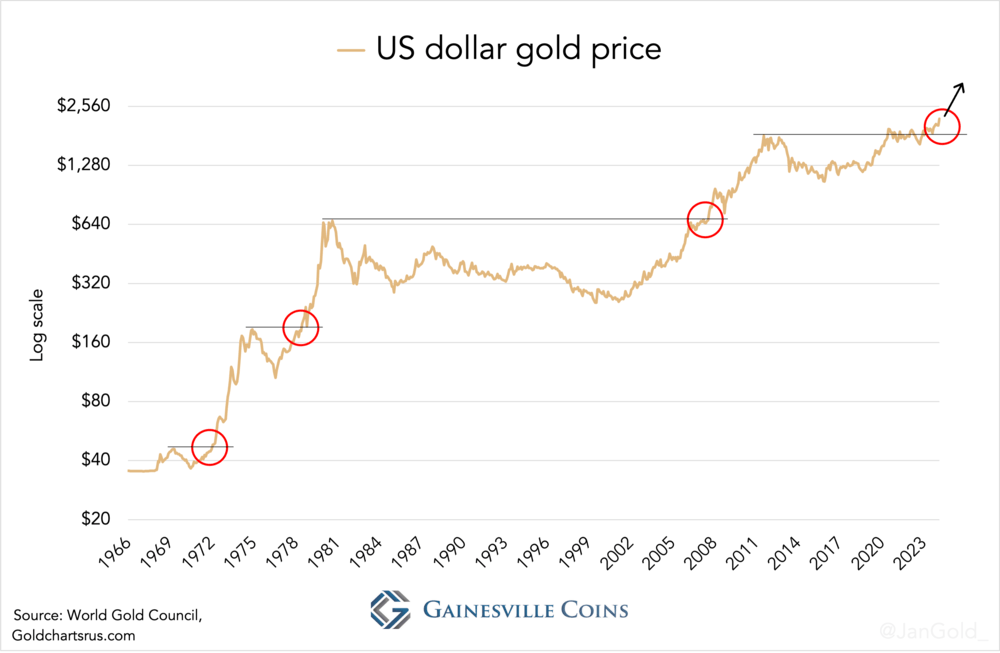
Recently the dollar gold price aggressively broke a multiyear resistance level on the back of escalating wars, worrying asset bubbles, and sticky inflation. Long term indicators show gold is undervalued under these circumstances and can easily double in price over the coming years.

The past decades have been characterized by an elevated trust in credit instruments that blew the global financial system to colossal proportions. Now tensions between East and West, debt saturation and inflation are chipping away this trust, the balance between financial instruments with counterparty risk (credit) and without counterparty risk (gold) will go through a process of adjustment in favor of the gold price.

The Theory of Money and Exter’s Inverse Pyramid

“Money is gold, and nothing else.”

J.P. Morgan testimony before Congress 1912 (page 5)

Philosophically speaking all moneys are backed by trust. Because money is a social agreement it can be whatever we think it is—tobacco, salt, paper slips, silver, book entries, and so forth. Money functions as long as it is accepted by market participants.

But not all moneys are equal. Some moneys—for example tobacco and salt—are inconvenient in the modern age. Other moneys are issued by banks and therefor carry counterparty risk. Since the late 19th century gold is “officially” the only form of money that is universally accepted, has no counterparty risk, and therefore underpins the global financial system.

In previous articles we talked about Perry Mehrling’s hierarchy of money, Exter’s inverse pyramid, and the order in which the International Monetary Fund (IMF) lists financial assets. All three have in common that they pose gold as the ultimate money, followed by national currencies, debt securities, equity, and then derivatives. This sequence of financial assets reflects if assets are more money or credit like.

Below is a visualization of Exter’s inverse pyramid, whereby gold sits at the bottom, ultimately “backing” all forms of credit resting on top of it and providing indispensable trust to the financial system.

In moderation, credit is beneficial to a capitalist economy—too much credit (debt) results in lower growth, too little means foregone opportunities. But in general, and especially during a crisis, people have more trust in gold than credit.

Because everything above gold can be created out of thin air, the top of the pyramid can be easily widened. Throughout the business cycle balance sheets are extended—credit is created, the crown of the pyramid is enlarged—causing an economic boom. During a recession balance sheets shrink, the gold price increases, and the shape of the pyramid is remodeled. The overall size of the pyramid grows over time, while the pyramid’s form changes simultaneous with debt cycles.

Ratios between gold and credit assets can tell us where we are in a debt cycle. At the time of writing, we are in a boom as:

  • Gold as a share of global financial assets is low.
  • The US broad money supply relative to the gold “backing” it is overstretched.
  • Gold’s share of central banks’ international reserves is low.
  • Equity market valuations are high.

All the while trust in credit is waning, suggesting the gold price will rise (policy makers will avert outright defaults inducing a deflationary collapse).

New Multi-Year Gold Bull Market Has Begun

Let us first define what has recently happened to the gold price. From a technical perspective, as you can see in the chart below, the price of gold has broken out from a multi-year consolidation phase. If we may use history as our guide, we are now entering a multi-year bull market.

Chart 1. Gold price in US dollars from the 1960s until March 2024.

Next, we will examine the long-term fundamental indicators that display gold is undervalued under the conditions of declining trust in credit.

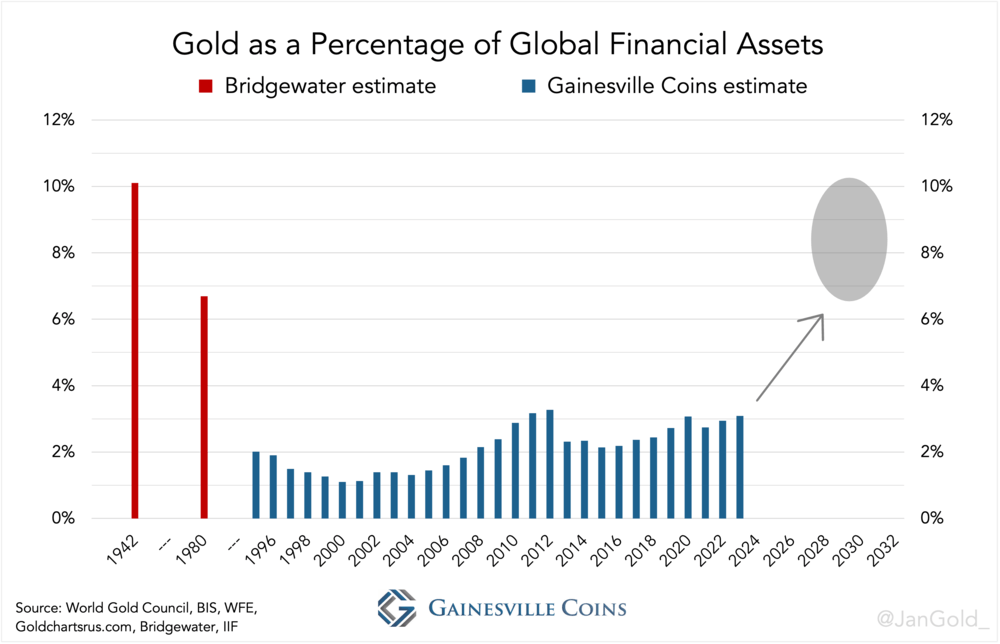
Unfortunately, it’s impossible to find global data on all financial assets going back 150 years to compare the value of all credit to that of gold. Though I did find estimates by Bridgewater Associates on the ratio between gold and “financial assets” (in this case gold, debt, and equity) from 1924 until 2020. I was able to roughly mimic Bridgewater’s methodology for the last two decades and could thus extend their data series.

Chart 2. Above ground gold as a percentage of global financial assets (gold, debt, and equity).

As we can see, during periods when trust in credit is poor, in the Second World War and at the end of the 1970s, gold’s value relative to financial assets was in between 7 and 10%. Currently gold is worth 3%, which goes to show there is ample upside for gold this bull run.

Let’s also have a look at the value of the monetary gold supporting the US dollar broad money supply. What currency is more appropriate for assessing this ratio than the world reserve currency?

Chart 3. Value US monetary gold divided by the broad money supply (M2), versus the dollar gold price. For the sake of simplicity, I have left out Eurodollars.

The value of the US monetary gold ultimately underpinning the dollars in circulation is rising from a near historic low. The two previous lows were in 1971 and 2000, after which multi-year gold bull markets followed. So, most likely a new bull market is upon us.

Making matters worse is that the dollar’s reserve currency status is slowly declining at the moment. My next measurement, therefor, is the relationship between gold and credit in the form of foreign exchange.

On the classical gold standard in the 19th century, it was mainly gold that underpinned confidence in central banks. Most of their reserves consisted of gold that literally backed the monetary base as currency could be redeemed for physical metal at a fixed parity. In the Interbellum it was agreed that foreign exchange (sterling and dollars) could substitute gold on central banks’ balance sheets to allow monetary expansion beyond the growth of the above ground stock of gold. This came to be known as the gold exchange standard. After the Second World War the US pushed the world to save in dollars and gold’s share of global international reserves declined sharply. Especially in the 1980s trust in dollars boomed.

Chart 4. Gold as a percentage of global international reserves. Gold’s increasing share of reserves is a form of de-dollarization.

But gold’s share of total reserves is presently on the rise, for one because trust in dollars is eroding due to the freezing of Russian assets worth $300 billion since the war in Ukraine that started in 2022. Second, the United States’ public debt is spiraling out of control while the Federal Reserve can’t get inflation tamed. Central banks are currently buying record amounts of gold and drive up the price.

For our final data series, we will look at the size of the US equity market versus the size of the economy (GDP) going back 120 years. Equity can be seen as a form of debt with no maturity. What the data reveals is that over time there have been cycles of easy money (credit) blowing equity bubbles, followed by the debasement of currency, reflected in a higher gold price.

Chart 5. US equity market capitalization to GDP and the dollar gold price. The chart suggests being overweight in gold.

The cycles can be best explained as follows: once a bubble pops, central banks ease monetary policy to stimulate the economy, but they often overshoot and plant the seeds for the next bubble—national currency (fiat) is the air that bubbles are commonly made of. This leads to a vicious cycle of bubbles and ever-easier money in which the value of currency incrementally declines, and the gold price appreciates. Cycles reminiscent of Exter’s pyramid widening (credit expands) and reshaping (gold price goes up). Time and again.

Currently the equity market (relative to GDP) is probably close to its peak, suggesting the gold price will see a significant rise in the coming years.

Conclusion

The West not only froze dollar assets owned by the Russian central bank early 2022 at the start of the war, but Congress just approved a bill to confiscate such assets and give them to Ukraine. What could speed up “de-dollarization” by BRICS members and other countries faster than this? Tensions between East and West will not be resolved quickly, telling us the gold price will continue to march higher and gold’s share of global international reserves will rise to the detriment of the dollar.

It should be noted that the Chinese central bank was a buyer of gold in the 1960s and 1990s before gold made substantial moves to the upside (see chart 1). Timothy Green writes in The World of Gold Today (1973):

In 1965 …., China bought 100 tonnes of gold … in the London market; the following year she came back for another 30 tonnes. Two years later China topped up with another 60 tonnes. The main reason behind these forays into the gold market appears to have been to divest itself of sterling [the second world reserve currency at the time]. Although no official figures of China’s reserve are available, it is likely that she substituted a good part of her holdings of sterling for gold before [the sterling] devaluation in 1967.

Dutch Newspaper NRC Handelsblad reported in 1993 that the People’s Bank of China (PBoC) was one of the buyers of a massive sale by the central bank of the Netherlands. As other European central banks sold heavily during the 1990s as well, we may assume the PBoC bought some more of that and reaped the benefits when the dollar gold price began its ascent around 2000.

As I have reported repeatedly since 2022, the PBoC is presently buying gold hand over fist. Do the Chinese have a sixth sense for sniffing out currency devaluations?

The gold price can be used as an inflation expectations indicator. In the chart below one can see that a turnaround in the price of gold is often followed by surging inflation within two years. To me it would only make sense if this time around it’s no different.

Chart 6. US consumer price inflation versus the gold price.

As global debt levels are near record highs and have become unsustainable, the most expedient, least well-understood, and common way of restructuring debt (credit) is inflation, according to former hedge fund manager Ray Dalio. Indeed, global debt stands at $313 trillion dollars (330% of GDP) and there are few other options to lower the debt burden. Inflation and a higher gold price would deleverage the system and restore the pyramid.

Chart 7. Global debt as measured by the Institute of International Finance (IIF). Debt to GDP figures are my personal estimates.

All in all, it sure looks if we are at the tipping point of rebalancing credit assets compared to gold. Signs of stress in the system are real estate sectors collapsing, banks failing, and central banks making losses. Credit booms are inevitably followed by busts.

Not only are central banks buying gold because “it may play a stabilizing role … in times of structural changes in the international financial system,” (central bank of Hungary) investment funds are slowly doing the same. The Bangkokpost wrote last April that “the Thai Government Pension Fund is reducing investments in assets that may be affected by war and increasing investments in gold and oil to mitigate risk.”

In 2023 I speculated the gold price could reach $8,000 dollars an ounce in the decade ahead. Based on all the data I came across in writing this article I still think that is a reasonable number that would stabilize the financial system by adding more trust to it.

Tyler Durden
Sat, 05/11/2024 – 09:30

Watch: The Insane Flip-Flops Over Vaccines, Masks And Ivermectin

Watch: The Insane Flip-Flops Over Vaccines, Masks And Ivermectin

This week AstraZeneca recalled its COVID-19 vaccine after admitting that it caused a ‘rare but serious’ clotting.

Then we find that former CNN host Chris Cuomo has been taking Ivermectin, after mocking people for taking ‘dewoming medication,’ leading one to wonder how many dead Americans were dissuaded from taking it during the pandemic.

And in the fullness of time, we’ve learned that vaccine maker Moderna employed a former FBI analyst to secretly police ‘vaccine misinformation,’ while the Biden White House directed virtually every social media platform to censor those questioning vaccinations. Hell, the NY Times suggested ZeroHedge was spreading misinformation for suggesting, in December of 2020, that vaccine cards would be used to track people and limit their freedom.

And now people like former NY Governor Andrew Cuomo (D) are playing the whole thing off like he wasn’t a complete iron-fisted authoritarian during the pandemic – suggesting that masks were optional.

Or Deborah Birx, who admitted she and Dr. Anthony Fauci pulled all sorts of pandemic-era lockdown protocols out of their asses, and has now remade herself into some sort of vaccine freedom advocate.

And so, while there are a plethora of examples out there – and these barely scratch the surface, it’s worth watching a montage of authoritarians and their propagandists in the corporate media peddling lockdown hysteria, only to flip-flop with nary a mea culpa (Chris Cuomo blames ‘bad information’ – not his fault!).

Watch:

These people…

Tyler Durden
Sat, 05/11/2024 – 09:00

Embracing Communist China Was Washington’s Greatest Strategic Failure

Embracing Communist China Was Washington’s Greatest Strategic Failure

Authored by James E. Fanell and Bradley A. Thayer via RealClearPolitics.com,

From the war in Ukraine to the horrific terror attack on Oct. 7 and the subsequent conflict in the Middle East to the roiling waters of the South China Sea, the world today is in crisis. The causes are not found in Moscow or Tehran alone, but primarily in Washington and Beijing.

They are the consequence of two fundamental and interrelated grand strategic mistakes made by the U.S.

First, the failure to understand the threat from the People’s Republic of China.

Second, the failure to balance against it. As a result, the U.S. is at risk of losing its dominant position to an emboldened PRC working in cooperation with Vladimir Putin’s Russia and the mullahs in Iran.

Surveying the global unrest, Americans must comprehend three reasons why they face this dire strategic landscape.

First, U.S. elites did not perceive the threat due to the triumphalism of the “End of History” – the false assertion that modernizing nations like China were on the path to democratization and free market economics.

Great power conflict was seen as an artifact of the past. This hubris contributed to what we term “threat deflation,” where year after year U.S. decision-makers consistently dismissed or underestimated the threat from the PRC.

Second, U.S. business interests and financiers indefatigably sought economic gain from cooperation with Beijing. This facilitated China’s rise as it entered the West’s economic ecosystem, as did its admission to the World Trade Organization.

Their influence on the major U.S. political parties and at the highest levels of U.S. politics hindered the U.S. response and promoted the conceit of globalization. Thus emerged an “engagement school,” which asserted that by engaging the PRC, it would become wealthy, a “responsible stakeholder” in the international order, and even democratic. In essence, the U.S. willingly and enthusiastically taught, trained, and even equipped, its mortal enemy. Business interests and financiers funded our national security think tanks which contributed to a bias towards the engagement school, and thus to the threat deflation of the PRC.

Third, Deng Xiaoping, arguably one of the greatest strategists of the 20th century, advanced a brilliant political warfare strategy to promote threat deflation.

Deng’s strategy focused on U.S. and other Western elites, enriching them, and shaping their perception of the PRC and of the Chinese Communist Party, while using the enticement of a growing market to influence their behavior. For a generation, Chinese leaders masked their intentions and framed their expansion as economic, for the good of all, rather than strategic and for the benefit of the CCP.

Consequently, the PRC has risen and now employs its power to the detriment of U.S. national security through its worldwide actions, especially in the East and South China Seas and Taiwan, as well as through its proxies in Iran and Russia.

To meet this threat, Washington first needs to see the Communist China for what it is: an aggressive great power which seeks the overthrow of the U.S.

Second, the U.S. must support the education of strategists so younger generations may understand how to defeat the PRC. Education in the principles of power politics and the CCP’s ideology are essential to achieve victory.

Third, there must be sustained presidential leadership to define the enemy, educate the American people, and generate the necessary whole-of-government response.

Fourth, the failure of the intelligence community to identify China as an existential threat greatly weakened the ability of American national security decision-makers to identify and act against the threat. The fundamental assumptions regarding China’s behavior were informed by the engagement school of thought. Ultimately, and perversely, the intelligence community was aiding threat deflation for a generation. This must be reversed.

Fifth, U.S. military leadership did not recognize and prepare for China’s emergence as a formidable military power. It must also be held accountable for the current state of unpreparedness. Specifically, the failure of the U.S. Navy’s leadership to recognize the centrality of the maritime domain to the PRC’s grand strategy and its naval modernization efforts stands in stark contrast to pro-active performance of prior generations of admirals from World War II through the Cold War with the Soviet Union. Leadership needs to prioritize rebuilding the U.S. Navy to meet the PRC threat.

The U.S. aided the rise of its enemy. Now the Kremlin and Iran are operating in the strategic space that the PRC provides them. That space and Beijing’s aggression will only increase if the U.S. does not act to end its threat deflation, break the chokehold of the engagement school on the U.S. foreign policy establishment, and defeat the CCP by evicting it from power.

Tyler Durden
Sat, 05/11/2024 – 08:30