Video that emerged over the weekend from the pro-Palestinian occupation encampment at George Washington University shows some students gleefully cheering for their campus leaders to be executed on guillotines.
The footage was captured by a citizen journalist named “Stu” who recorded the group’s so-called “People’s Tribunal” livestreamed on Instagram.
“At the George Washington University Gaza Solidarity Encampment today, the protesters held a ‘People’s Tribunal’ where they put President Ellen Granberg, Provost Christopher Bracey, the Board of Trustees, @GWPolice, and many others on trial,” Stu posted on X on May 3.
“Is it normal for students to want to hang their provost and chop the heads off of the Board of Trustees,” Stu asked. “When will [George Washington University leaders] finally do something? If the students hurt any of these people in any way, the university will be completely at fault.”
At the George Washington University Gaza Solidarity Encampment today, the protesters held a “People’s Tribunal” where they put President Ellen Granberg, Provost Christopher Bracey, the Board of Trustees, @GWPolice, and many others on trial.
The video is one of several extreme scenes that have been captured at the encampment on the Washington D.C. campus. Another includes the removal of the American flag and a Palestinian one hoisted in its place.
Now in its 11th day, “University President Ellen Granberg said GW is unequipped to manage the pro-Palestinian encampment in University Yard and called on GW’s partners, including D.C. officials, for their ‘full support’ on Sunday,” the GW Hatchet student newspaper reported.
“In the message to community members at about 2:30 p.m., Granberg said all of the University’s efforts to end the encampment or deter protesters from escalation have failed, including discussions with students, the assistance of local police and administrative consequences. She said the encampment is ‘potentially dangerous’ and no longer qualifies as a student demonstration,” the Hatchet reported.
Granberg’s memo stated in part that “when protesters overrun barriers established to protect the community, vandalize a university statue and flag, surround and intimidate GW students with antisemitic images and hateful rhetoric, chase people out of a public yard based on their perceived beliefs, and ignore, degrade, and push GW Police Officers and university maintenance staff, the protest ceases to be peaceful or productive. All of these things have happened at GW in the last five days.”
Daily Reminder that the American flag is not being flown at George Washington University pic.twitter.com/KpCoYkWleQ
As for the guillotine video, the Post Millennial reported that “a woman leads the activists in chants to chop the heads off the Board of Trustees, GWU President Ellen Grandberg, and Provost Christopher Bracey,” adding:
In the mock tribunal, the woman asks “How do the people find you?”
The crowd shouts, “Guilty!” then “Guillotine! Guillotine! Guillotine!”
“Bracey, Bracey, we see you! You assault students too. Off to the motherf*cking gallows with you,” the woman chants, along with the gleeful activists.
Moving on to the Board of Trustees, she states “On the charges of having a vested interest in the genocide of Palestinian people as they profit off Zionist weapons and purchases that you refuse to divest the apartheid as they line their pockets. The people find you.”
“Guilty!” The crowd screams with a mix of mob rage and joy.
“To the Guillotine!” the girl yells. “Board of Trustees, we charge you with genocide. I hope all that money is gonna save you when you’re rotting in jail.”
The crowd calls out President Grandberg, as well. “On the charges of using our tuition dollars to fund genocide, and selling out students to Zionist interest, the people find you?”
“Guilty!” The crowd yells.
“As you already know where I am sending her,” she adds, referring to the guillotine. “Her and her f*ck *ss bob.”
Writing on PJ Media, Grayson Bakich argued the tribunal takes crazy to a whole new level.
“Stu Stu Studios also posted a longer version, but the fact that these kids are openly and publicly calling for the deaths of specific people who can very likely hear them just underscores how insane these ‘protests’ really are,” Bakich wrote.
“After all, these are the same students who vandalized the statue of George Washington on campus with a keffiyeh, Palestinian flags, and anti-Israel stickers, as my friend Catherine Salgado wrote about earlier this week.”
In a sea of lurid, stupid headlines today, it was billionaire investor Stanley Druckenmiller who arguably dropped the biggest F bombs via a TV interview.
First: “Bidenomics, If I was a professor, I’d give him an ‘F’. Basically, they misdiagnosed Covid and thought [the economy] was going into a depression… Treasury is still acting like we’re in a depression. They’ve spent and spent and spent, and my new fear now is that spending and the resulting interest rates on the debt that’s been created are going to crowd out some of the innovation that otherwise would have taken place…. Everybody seems to get it but Yellen, who just keeps spending and spending. I think it’s dumb politically because it’s causing inflation and it doesn’t take a genius to figure out that the average American is getting hurt by the inflation.”
Investor Stanley Druckenmiller on Bidenomics: “If I were a professor, I’d give them an ‘F’.” pic.twitter.com/WfsU4ecO6y
As an aside, one of the reasons the White House is able to get away with this fiscal splurge is not just that ‘the US is the US’, which is true, but rather that 24/7 markets don’t have an easy spoon-fed monthly number for the US fiscal deficit as a percentage of GDP on a Bloomberg screen like CPI or GDP. What is the US fiscal deficit now and compared to cycles where unemployment was below 4%? If you know off the top of your head, I’m impressed: and you’re depressed (ZH:here is the answer).
Fiscal stimulus is off the charts: 6.5% budget deficit implies 8% unemployment (instead of 3.8%). Very soon this fiscal turbo boost will be handed over to monetary stimulus pic.twitter.com/U5TRyijf1K
Looking ahead to the post-2024 landscape, Druckenmiller stated:
“With Biden, I’m more worried about stagflation, with all the government spending, with all the tricks that Yellen has been using to manipulate yield curve, with the way the Fed seems to have reignited financial conditions. I think the inflationary outcome could be there. But I also fear regulation and everything else preventing productivity.”
However, he didn’t have much nice to say about Trump either and noted that inflation was likely to be even higher under his presidency, particularly if he interferes with the Fed’s independence and raises tariffs, as pledged. (Perhaps Stanley reads the work of our own Philip Marey, who has been arguing the same? It’s a small world, after all.) So that’s a pre-emptive F for Trump as well.
He therefore bewailed, “I’m basically a guy without a candidate. I’m an old-style Reagan, free markets, pro-immigration, and anti-tariff Republican.” Which would explain why he’s so unhappy. Because as I had argued before it started happening, that “The 1980s called, they want their economic policy back” recipe is being repeatedly given an F by both realpolitik and voters. That fact was just underlined by the latest US restrictions on chip sales to Huawei, TikTok’s decision to fight divest-or-close legislation in court, and any dozen other headlines from around the world.
Druckenmiller was equally acerbic about the Fed’s December pivot, where markets were suddenly led to believe that rates were going to fall rapidly again, and we were heading back to the New Normal, as if the world had not changed: as I have put it before, the Pavlov’s dogs on Wall Street started to surf a wave of their own saliva. He argued, “It seemed to me the Fed was in a perfect position. Inflation was coming down, financial conditions were tightening. To some extent, I feel like they fumbled on the five-yard line.” And this is coming from someone who is a self-proclaimed “major beneficiary” of this alleged policy error.
So, what we have now is stagflationary.
What we may have next is inflationary.
And the time-machine policy some want to see is delusionary.
Oil has been on a downtrend since early April, posting losses in three of the past four weeks, with weakness not just in timespreads but in processing margins too.
That decline has come as much of the geopolitical premium from tensions in the Middle East has unwound, bringing traders’ focus back to a cooling market.
OPEC is due to meet next month to assess supply policy after implementing production cuts over the first half of the year to support prices. Most traders expect that the curbs will be extended, possibly to the year-end
For now, the next leg will be decided by the official supply/demand data…
API
Crude +509k (-1.40mm exp)
Cushing +1.339mm
Gasoline +1.46mm
Distillates +1.713mm
DOE
Crude -1.36mm (-1.40mm exp)
Cushing +1.88mm
Gasoline +915k
Distillates +560k
After last week’s large crude build (and the API report overnight), expectations remained for a small draw… and the official data confirmed exactly that (opposing what API reported). Stocks at the Cushing Hub rose considerably and products also saw builds…
Source: Bloomberg
The Biden admin added 947k barrels to the SPR – the most since Dec 2023
Source: Bloomberg
US Crude production was flat near record highs at 13.1mm b/d…
Source: Bloomberg
WTI was trading around $78 ahead of the official data, just below its 100DMA…
…and WTI extended gains after the ‘surprise’ draw…
Overall, “oil is lower because a renewed battle between Israel and Hamas, in isolation, does not really affect oil-producing nations,” Stewart Glickman, energy equity analyst at CFRA Research, told MarketWatch.
If Iran is “subsequently encouraged to do more direct attacks on Israel, it may be different,” he said, but the market is “discounting this possibility.”
Finally, President Biden will use crude oil from the strategic petroleum reserve should the need arise, energy adviser Amos Hochstein has said, noting there was enough oil in the reserve.
“We have been replenishing into the SPR for the last several months. I think we have sufficient supply in the SPR to address any kind of concern in the economy if we need it,” Hochstein said, speaking at the Milken Institute Global Conference, as quoted by Reuters.
Another Trump Trial Derailed: Fani-Donating Judge’s Decision To Keep Her On RICO Trial Under Scrutiny By Appeals Court
One day after former President Donald Trump’s classified documents trial was postponed indefinitely after we learned that the DOJ mishandled evidence in the case (with Judge Aileen M. Cannon citing a mountain of ‘outstanding’ pre-trial matters that would make a May 20 trial ‘imprudent’), another Trump case appears to have no chance of going to trial before the 2024 election.
On Wednesday, a Georgia appeals court agreed to review a lower court ruling which allowed Fulton County District Attorney Fani Willis to remain on the Trump RICO prosecution despite being highly conflicted.
To review, Atlanta Judge Scott McAfee of Fulton Superior Court, who donated to Fani Willis when she was running for office, ruled in March that the Fani simply had to kick her lover, Nathan Wade, off the case after she paid him more than $600,000. The two notoriously took several lavish vacations together on Wade’s dime (which Fani swears she repaid in cash).
According to McAfee, while he found the “appearance of impropriety,” no “disqualification of a constitutional officer necessary when a less drastic and sufficiently remedial option is available,” adding “that the prosecution of this case cannot proceed until the State selects one of two options.”
And now, the Atlanta Court of Appeals has agreed to hear an appeal from the defendants over whether McAfee erred in his decision.
The Georgia Court of Appeals has agreed to hear an appeal from defendants over whether the judge erred when he ruled that Fani Willis could remain on the Trump RICO prosecution in Fulton County. This pushes that trial further off, likely beyond the election. pic.twitter.com/F1gXIfwI5E
Willis indicted Trump and 18 other defendants last August, accusing them of a wide-ranging scheme to attempt to overturn the results of the 2020 presidential election in the state. All of the defendants were charged under Georgia’s Racketeer Influenced and Corrupt Organizations, or RICO, law. Trump and most of the other defendants have pleaded not guilty.
In their appeal application, Trump and other defendants argued that McAfee was wrong not to remove both WIllis and Wade, writing that “providing DA Willis with the option to simply remove Wade confounds logic and is contrary to Georgia law.“
Most recently, Willis has defiantly refused to appear before a Georgia Senate Investigative Committee, telling reporters earlier this week (via RedState):
REPORTER: Would you appear before a Georgia Senate committee without a subpoena?
WILLIS: Well first of all I don’t even think they have the authority to subpoena me, but they didn’t learn the law.
REPORTER: Will you appear, yes or no?
WILLIS: I will not appear to anything that is unlawful. I have not broken the law in any way. I’ve said it, you know, I’ll say it amongst these leaders—I’m sorry folks get p***ed off that everybody gets treated even.
FAITH LEADER STANDING NEXT TO HER: I think she answered that very well.
The Georgia Court of Appeals has agreed to hear an appeal from defendants over whether the judge erred when he ruled that Fani Willis could remain on the Trump RICO prosecution in Fulton County. This pushes that trial further off, likely beyond the election. pic.twitter.com/F1gXIfwI5E
I’ve been perplexed about the unwavering focus the Fed has had on cuts for a six month period. … Did cuts make sense the whole time?
Druckenmiller:
I was perplexed with the December pivot. …
To some extent it seems they fumbled on the 5-yard line with the game on the line. I remember saying to some of my partners, that’s the speech I thought we might hear in March.
… Instead they set financial conditions on fire. …
And once financial conditions took off, it became very clear this thing could go either way. More curiously, why they and others continued to talk about, well, it’s not going to be six cuts it’s only going to be three cuts or four cuts.
I’m going, why are we even talking about cuts?
Because inflation, if you remember, we did trillions of dollars of QE because it was 1.7 percent instead of 2! But somehow now that we are at 3 vs 2 we’ve got to start cutting rates to bring in a smooth landing. Huge mistake. It goes back to Kevin Warsh, when he was in the running for the Fed job, used to talk about reforming the Fed.
And I go Kevin, what is the major reform that we do? He says we’ve got to get rid of forward guidance.
When you put forward guidance out, unlike me when I am wrong, I tend to change my mind very rapidly, they get trapped in the forward guidance, stuck in it. … Bizarrely, at the last press conference, the Fed seems to still be hanging on to this asymmetric directive of we are not going to hike and we expect to cut but we are going to wait for the data.
… I don’t know where inflation is going to be in a year, Powell doesn’t know. I don’t think anybody knows.
Squawk Box:
You think a hike is off the table? Definitely?
Druckenmiller:
No, because there’s not a zero percent chance inflation has bottomed. I don’t know. What I would do is just say nothing, and do what a Fed chair used to do: When you need to raise rates, raise them; when you need to cut rates, cut them.
Don’t go on 60 Minutes.
You are not a rock star. You’re the Fed chair.
You are supposed to be running monetary policy.
Bernanke did a lot of things I don’t feel good about. One of the worst was forward guidance.
You have a bunch of academics talking about sending a message to the markets.
I would rather they get rid of forward guidance and just do their job.
The Fed is Uncertain About Uncertainty, So Why the Forward Guidance?
The key words at the FOMC press conference is “uncertain” for good reason. The Fed doesn’t know what it’s doing.
Here is the image I posted then.
Image from the Fed FOMC projection materials.
Hoot of the Day
Actually, it’s good that the Fed is uncertain because their expectations have not been close to the mark for a decade.
The above chart is particularly amusing. The Fed has only a 70 percent confidence level that interest rates three years from now will be in the range of of 0 to 5.5 percent.
That means the Fed expects that 30 percent of the time, rates will be outside that range.
From 2012 to 2019 the Fed kept producing interest rate charts showing hikes that never happened.
Then the Fed decided it was necessary to make up for lack of inflation.
— Rudy Havenstein, Senior Markets Commentator. (@RudyHavenstein) July 24, 2021
I’ve been discussing this for going on two decades.
Fed Uncertainty Principle
Flashback April 3, 2008 before the collapse of Lehman and Bear Stearns, to one of my all time favorite posts: Fed Uncertainty Principle
Most think the Fed follows market expectations.
However, this creates what would appear at first glance to be a major paradox: If the Fed is simply following market expectations, can the Fed be to blame for the consequences? More pointedly, why isn’t the market to blame if the Fed is simply following market expectations?
This is a very interesting theoretical question. While it’s true the Fed typically only does what is expected, those expectations become distorted over time by observations of Fed actions.
For example: If market participants are expecting the Fed to cut on weakness and the Fed does, market participants get into a psychology of expecting more cuts on more weakness. Here is another example: If market participants expect the Fed to cut rates when economic stress occurs, they will take positions based on those expectations. These expectation cycles can be self-reinforcing.
The Observer Affects The Observed
The Fed, in conjunction with all the players watching the Fed, distorts the economic picture. I liken this to Heisenberg’s Uncertainty Principle where observation of a subatomic particle changes the ability to measure it accurately.
The Fed, by its very existence, alters the economic horizon. Compounding the problem are all the eyes on the Fed attempting to game the system.
Fed Uncertainty Principle Recap
Fed Uncertainty Basis Principle:
The fed, by its very existence, has completely distorted the market via self-reinforcing observer/participant feedback loops. Thus, it is fatally flawed logic to suggest the Fed is simply following the market, therefore the market is to blame for the Fed’s actions. There would not be a Fed in a free market, and by implication, there would not be observer/participant feedback loops either.
Corollary Number One:
The Fed has no idea where interest rates should be. Only a free market does. The Fed will be disingenuous about what it knows (nothing of use) and doesn’t know (much more than it wants to admit), particularly in times of economic stress.
Corollary Number Two: The government/quasi-government body most responsible for creating this mess (the Fed), will attempt a big power grab, purportedly to fix whatever problems it creates. The bigger the mess it creates, the more power it will attempt to grab. Over time this leads to dangerously concentrated power into the hands of those who have already proven they do not know what they are doing.
Corollary Number Three:
Don’t expect the Fed to learn from past mistakes. Instead, expect the Fed to repeat them with bigger and bigger doses of exactly what created the initial problem.
Corollary Number Four:
The Fed simply does not care whether its actions are illegal or not. The Fed is operating under the principle that it’s easier to get forgiveness than permission. And forgiveness is just another means to the desired power grab it is seeking.
And so here we are. Still discussing the same things, with the Fed making the same mistakes.
The Fed’s Big Problem
On average, the economy looks OK. But averages are misleading. Several large groups of people are struggling. They all have one thing in common.
Case-Shiller home price index, CPI rent index, and the index of hourly earnings for production and nonsupervisory workers.
The Fed is now trapped in a box of its own making. Everyone who is priced out of a home is very unhappy with soaring rent, soaring home prices.
If the Fed cuts rates prematurely, what does that do to housing prices?
Singapore Air Force Says F-16 Fighter Jet Crashed At Air Base
A Republic of Singapore Air Force (RSAF) General Dynamics F-16 Fighting Falcon jet crashed on Wednesday after experiencing an “issue” during take-off.
The Ministry of Defence said, “The pilot successfully ejected and the plane crashed thereafter within Tengah Air Base. The pilot is conscious and able to walk. He is receiving medical attention and no other personnel are hurt.”
Here’s ForeFlight data on Tengah Air Base.
“Full investigations are underway to make sure all factors are identified and rectified decisively,” Minister for Defense Ng Eng Hen said in a Facebook post.
The RSAF did not elaborate on what caused the downing of the US-made fighter jet, which was the RSAF’s first incident with the fighter in two decades.
Stateside, on Monday, a Lockheed Martin F-22 stealth fighter experienced a “mishap” during landing at Savannah/Hilton Head International Airport.
Simultaneously, in a significant development for the ongoing war in Eastern Europe, Belgium, Denmark, Norway, and the Netherlands have committed to providing F-16s to Ukraine. In response, Russia issued a warning on Monday, stating that the deployment of F-16s in Ukraine would be viewed as an escalation.
At a time when two big economies, the US and India, are attracting a lot of hype for their enduring strength, it is worth looking at nations that not too long ago were billed as star performers but are now breaking down. All are among the world’s 50 largest economies and, so far this decade, have suffered both a sharp decline in real per capita income growth, and a fall in their share of global gross domestic product.
Led by Canada, Chile, Germany, South Africa and Thailand, these “breakdown nations” carry a lesson. Growth is hard, sustaining it even harder, so the stars of today are not necessarily the stars of tomorrow.
Take Canada first. Widely admired for how it weathered the global financial crisis of 2008, it missed the boat when the world moved on, driven by big tech instead of commodities. Canada’s per capita GDP has been shrinking 0.4 per cent a year since 2020 — the worst rate for any developed economy in the top 50. New investment and job growth is being driven mainly by the government.
Private-sector action is confined largely to the property market, which does little for productivity and prosperity. Many young people can’t afford to buy in one of the world’s most expensive housing markets. Pressed to name a digital success, Canadians cite Shopify — but the online store is the only tech name among the country’s 10 largest companies, and its shares are trading at half their 2021 peak.
Then there’s Chile. Hailed in the 1990s as a model of deft, East-Asian style government in Latin America, its halo has since vanished. The country now makes headlines for political strife over its constitution. Anaemic tax collection has gutted public services, triggering violent street protests. Red tape has spread — the time required to get new investments approved doubled to nearly 20 months — chasing off investors.
As a result, manufacturing industries remain small compared with emerging world peers, including neighbouring Argentina. Mining products such as copper still account for most of its exports and billionaire wealth, making Chile look more like an old-fashioned commodity economy than an East Asian star.
No developed economy has seen a more dramatic turn for the worse thanGermany. Its per capita income growth fell from 1.6 per cent in the past decade to less than zero in the past few years. During the pandemic Germany looked flush and flexible, poised to excel in the post-Covid world. Now it looks undone by its heavy dependence on exports to China and energy imports from Russia. Investment has contributed nothing to growth in recent years, industrial productivity is declining at a shocking annual pace of 5 per cent. Suddenly, the future of the Mittelstand — the network of manufacturers that has long been the engine of German growth — looks murky.
South Africa, meanwhile, was added to an acronym for big, fast-growing emerging markets led by Brazil, Russia, India and China back in 2010, when Bric became Brics. The largest economy in Africa, resource-rich South Africa was powered by a commodity boom that then went bust, exposing the country’s many faultlines.
The African National Congress has held power for 30 years yet presides over the same dogged set of failures: youth unemployment above 50 per cent, a shocking share of the population on welfare, weak investment, rolling power outages. While voters could oust the ANC next month, the malaise looks too deep to end soon. The IMF predicts negative per capita GDP growth over the next five years in only one top 50 economy: South Africa.
Finally, Thailand. A leader of the “Asian Tigers” before debts tripped them up in the crisis of 1998, it is now the runt of the lot, the only former Tiger to see its per capita GDP decline in this decade. It has one of the world’s highest inequality rates with 79 per cent of the poor living in rural areas. A running political battle between the rural poor and the Bangkok elite focuses public debate on how to distribute — not expand — the economic pie. Despite efforts to turn its location on global trade routes into a factory hub, productivity growth is stagnating and Thailand is losing out to manufacturing rivals like Vietnam.
The takeaway here is not that smart countries somehow turned stupid. It is that hidden traps line the path of development and can spring on nations at every income level from the middle to the rich. One basic mistake or miss, and any country can find itself stuck — until it finds the leadership and vision to chart a way out. For current stars, the message is a warning: don’t take growth for granted.
Apple iPhone Shipments In China Jump 12% After Discounts
New data shows iPhone shipments in China surged in March, reversing a previous multi-month decline. This increase comes after Apple discounted handset prices throughout the first quarter, mostly in response to waning demand due to unofficial bans on the device by government agencies and competition from local brands.
Bloomberg cites official data from a new monthly report by the China Academy of Information and Communications Technology showing iPhone shipments in China bounced 12% in March.
Shipments of foreign-branded smartphones—most of which are Apple iPhones—increased to 3.75 million units in March from a year earlier. This follows a 37% decline in the first two months of the year.
A report from the beginning of the year showed Apple offered an ‘ultra-rare’ iPhone discount of up to 500 yuan ($70)
At the time, Apple’s website stated, “Discounts this year encompass everything from the iPhone 13 to the iPhone 15 Pro Max.”
The rare discount was made shortly after analysts from Piper Sandler and Barclays downgraded Apple due to slumping iPhone demand.
Currently, analysts tracked by Bloomberg show Apple has 35 “buys,” 18 “holds,” and 4 “sells.”
The discounts early this year were the highest on record, according to analysts from Jefferies.
At the time, we noted the two main drivers driving iPhone sales lower in the world’s largest handset market:
We suspect the made-in-China Mate 60 Pro, which defied Western tech sanctions and has a top-of-the-line processor, has spurred patriotic fervor among Mainland consumers for domestic handsets.
Last week, Apple CEO Tim Cook addressed an analyst’s question about the March quarter. He said iPhone revenue in mainland China increased “on a reported basis” before adjustments for Covid-related supply chain disruptions in 2022.
Cook did not provide further details on this metric but reiterated Apple’s commitment to the Chinese market, which, despite its contraction, still represents 18% of the company’s net sales.
According to Statista data, China is very important to Apple, accounting for nearly 20% of the company’s total sales.
This is why analysts and investors closely watch iPhone demand trends in the world’s second-largest economy.
Stablecoins have been in the news lately, thanks to another round of failed legislation, a well-intentioned but poorly-designed analytics dashboard compliments of Visa, and false equivocation by a columnist at the FT.
Meet the wire transfer
Nic Carter just published an epic review of the evolution of academic viewpoints on this topic, demonstrating how things are trending in the right direction. I consider Nic’s essay as a sort of realpolitik of acceptance: places where the industry is making progress because those who thought these coins could never work now concede that they can, and those who’ve been arguing they are dangerous are starting to see the benefits.
I, on the other hand, am as confident as ever that eventually all currencies will be digital and ride some kind of blockchain infrastructure, by which point we’ll just call them…money. The whole “stablecoin” moniker will be forgotten, in the same way that we no longer distinguish between electronic markets and markets. (People used to debate this distinction too).
A lot has changed since I first started making my “stablecoins will take over” argument 6 years ago. As Nic points out, even the skeptics have evolved their thinking. But most people haven’t gone far enough because most people can’t imagine the world being fundamentally different than it is today. Alas, swans required neither permission nor comprehension to be black.
Here are four reasons why a total transformation of money, payments, and banking is inevitable:
1- Tokens are a superior form factor over accounts for a digital economy. Accounts have served us well for millennia but we don’t write things down in physical ledgers anymore and the telegraph is now 200 years old. Tokens offer greater privacy, are more inclusive, can be programmed, and are more functional for machines.
TLDR: You can’t KYC a web server or an AI agent.
2- On a risk-adjusted basis, narrow banking is better for society as the primary saving and payment mechanism than fractional-reserve banking. Maturity transformation was a useful practice for primitive financial systems that didn’t have mature capital markets or other sources of wholesale funding. But it have outlived its usefulness. There are many ways to create credit in a modern economy and traditional banking is but one, the most fragile and dangerous one.
TLDR: An industry that needs to be bailed out regularly is trying to tell you something.
3- The bundling of payments and credit was always a marriage of necessity, not love. People opened checking accounts because they wanted to pay their bills, not to finance somebody else’s mortgage. But they were forced to play that role because levered banking was the only option.
If savers could pay each other with T-bills or shares in a money market fund, they would. Now they can, so they should. Those who argue the unbundling of payments from lending is somehow bad for the economy don’t understand where credit actually comes from. Banks don’t create loans, they intermediate between savers and borrowers. They will always have access to an infinite amount of deposits, at the right price.
TLDR: A financial system designed to benefit one group is unfairly harming another.
4- Money that doesn’t ride the same infrastructure as the things it is traded against is inferior. Today, our money moves via one set of pipes, and literally everything else, from securities to commodities to real estate moves in another. This is a source of risk throughout the economy. It requires large (often too big to fail) intermediaries to connect the plumbing and strong-armed regulators to watch them. Tokenization lets us put the money on the same infrastructure as every other asset and use code to guarantee outcomes.
TLDR: We no longer use copper wires to talk and radio waves to watch video, all media has converged to a single network. Value will too.
One of the topics I discussed with Matt Taibbi during my interview with him this weekend was the palpable loss of soul that has taken place on the Democratic side of the political aisle. And, as Matt Damon reminded us in Good Will Hunting whilst quoting Henry Ward Beecher:
“Liberty is the soul’s right to breathe, and when it cannot take a long breath laws are girded too tight.”
In my interview with Matt Taibbi, I told him that I used to read him when he wrote for Rolling Stone decades ago and admitted that I often wondered if the 20 year old version of me then would loathe the 40 year old version of me I’ve become.
I brought this question up because I find it important to keep myself in check. Is the world really changing and becoming so radical that it’s on the verge of breaking, or have I just grown older and become as allergic to “normal” progressive causes as the people I routinely dismissed as racist, homophobic, conspiratorial right-wing sh*theads when I was in a touring band with leopard print hair in my early 20s?
My discussion with Matt also touched on the topic of the arts. He pointed out that nowadays there really isn’t any great new music, art, poetry, or film that feels like it moves the needle in the way that classics of the last four or five decades used to.
During the course of our discussion, I remarked to Matt that I thought George Carlin was probably the last great left-wing comedian, even though he may have described himself as an independent.
And then, as if the universe heard me wondering aloud and wanted to offer up an answer, I woke up yesterday morning, and my entire Twitter feed was clips from the roast of Tom Brady.
For those unfamiliar with the format, roasts, as made famous by Comedy Central over the last decade or two, are widely accepted “safe spaces”… for comedians. This means it’s widely accepted that people are allowed to say whatever the f*ck they want and that no joke crosses the line. The roasts of the last two decades have been extraordinarily successful because of this. When comedians are unleashed to take digs at one another and there is nothing off-limits, genuine comedy and laughs happen.
The roast of Tom Brady was so popular on the internet yesterday morning because the content—including jokes about Tom Brady’s wife leaving him and the now-dead former Patriots tight end Aaron Hernandez—truly was as ‘on the edge’ as it could get.
Yet, despite the fire breathing comedians that pierced the membrane of the PC bubble repeatedly, there was nary a Karen to be found, nary a censorship report being sent to a censor, and nary a protester to be seen. For an hour or so, the soul of the nation was allowed to breathe, and people were too busy cracking the f*ck up to be offended or care, even when the crudest and meanest things were said.
It’s moments like these, Ricky Gervais hosting an award show or a Dave Chappelle “controversial” Netflix special that now serve as the reminders of what made the nation great to begin with: free speech.
During my conversation with Matt Taibbi, we examined how free speech used to be the hill that Democrats would die on. As Matt told me, it was the one issue that was non-negotiable. Matt and I both believe vehemently in free speech and I still consider myself to be liberal in the classic sense. As a self-described libertarian, the prefix lib- puts me almost all the way there already. They both come from the idea of liberty, meaning “the state of being free within society from oppressive restrictions imposed by authority on one’s way of life, behavior, or political views.”
As Matt and I continued with our Socratic analysis, desperate to figure out whose brains have been broken, us or everybody in the Democratic Party, we arrived at one key point: neither one of us could believe that censorship had become a key issue for Democrats.
And not a key issue to fight against…a key issue to fight for.
Yes, that’s right. The party that once dominated Woodstock and advocated for peace, civil rights, race relations, freedom of expression and freedom of…well, anything you wanted to do…has now become the party segregating college campuses, censoring speech and meticulously micromanaging what they perceive to be misinformation about vaccines being hurriedly forced onto the public by giant pharmaceutical companies. What happened?
As Matt and I discussed, the Democrats have somehow become the party of the know-it-all snobs, societal elites and the wealthy, whereas Republicans now seem to be the party of the working man. This wasn’t always the case, but as we said on the podcast, the entire party appears to have had some type of bizarre ideological aneurysm simply as a result of Donald Trump existing, and the magnetic poles of both parties have apparently flipped.
🔥 40% off FOR LIFE: Use this special coupon link and get 40% off an annual subscription, good for as long as you wish to remain a subscriber.
For example, while Gavin Newsom was dining out maskless at a Michelin star restaurant called French Laundry in the middle of Covid, the rest of us peons were at home, triple masked, surviving off of French dressing and doing laundry.
Decades ago, the Republicans used to be the fat cats. You know — war mongers, oil companies, the whole litany. Now the Democrats are the Martha’s Vineyard-living, limousine-riding, gated community-living insider traders.
Democrats have become the party George Carlin is railing against instead of for. They’re the big club that you’re not in.
“They own all the big media companies,” he exclaims. “They don’t want a population of citizens capable of critical thinking.”
Another glaring example of how the left has inadvertently become what they once hated are the ongoing protests on collage campuses. Unlike days of yonder, students now cloak themselves in masks to avoid being “doxxed” — oddly hilarious for a group so obsessed with embracing their own particular identities.
And while many of the students choosing to partake in these protests are doing nothing but fairly exercising their right to free speech, which I support, there have been innumerable examples of how these “activists” are devoid of understanding what they are fighting for to begin with.
Instead, it’s an exercise in entitlement and groupthink. What kind of a “revolutionary” protester demands that gluten-free bread be delivered to them?
Real revolutionaries fight the power and don’t give a f*ck about what they eat!
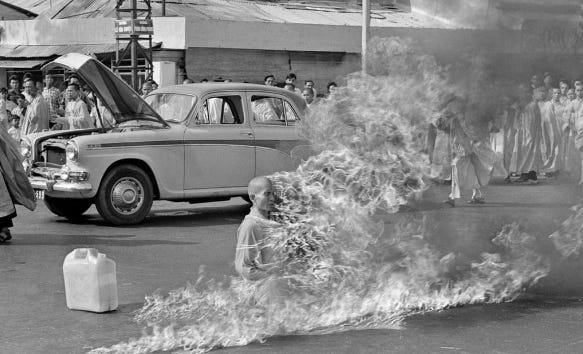
And if there’s nothing left to eat — f*ck it! They go on a hunger strike god damn it, and they do it happily because it’ll draw more attention to the cause they are genuinely standing for! Real revolutionaries put the cause far ahead of themselves — something the coddled narcissism of today’s left wing “activist” would never let them do. Here’s what actually having the balls to stand by your convictions looks like:
Forgive me for not being intimately familiar with the details, but I’d bet my life savings that Thích Quảng Đức (Vietnamese: man on fire in photo) never requested a gluten free bagel before self-immolating.
And look — it’s not especially surprising when you think about it. Over long periods of time, tendencies change, and preferences whipsaw back-and-forth. That’s human nature. At some point, the Democrats will once again be the party supporting actual free speech, and Republicans will be the ones that want to curb “misinformation”. It’s only a matter of time before preferences once again change.
During the days of Woodstock and the feminist movement, people on the left were the ones pushing the edge of what outlandish was to put forth big ideas like fighting inequality and discrimination. The collateral damage of them “fighting the cause”, gifted us with music like Lennon and Dylan, the poetry of Ginsburg and the comedy of Richard Pryor. Riding the edge of what is socially acceptable while making coherent, ideological arguments and observations in favor of liberty and freedom has been a surefire recipe for creating some of the most beautiful art that the world has ever seen.
As was demonstrated by the roast of Tom Brady the other night, continuing to push that envelope still breathes moments of beauty and unity into our country.
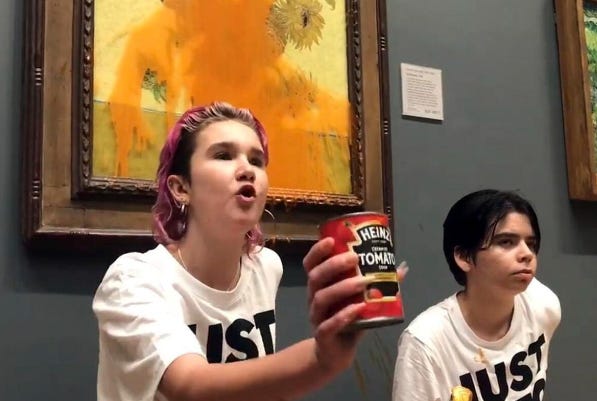
But going back to my line of questioning with Matt — sadly, I do think it is the world that has changed, and not us. For instance, I made the point to Matt that “activists” on the left nowadays have devolved into engaging in petulant “protests” like throwing soup on priceless works of art, instead of coherent and impactful action.
It’s only after thinking about why Sunday night’s roast of Tom Brady was so successful that it became crystal clear to me: the same “liberals” who used to stand for liberty and free speech and, as a result, make beautiful art — now stand for nothing coherent and resort to temper tantrums where they destroy the very same art their party’s causes once birthed.
And even though it feels like there’s nothing to look forward to, I will say this: there will be no crueler or more deserved irony than the day that today’s self-absorbed, traffic-blocking, soup-throwing activists realize they’re not revolutionaries — but rather the same authoritarian, censorship-wielding, group-thinking, malleable automatons they once thought they were fighting against.
And that sounds like the makings of a roast I’d love to attend.
QTR’s Disclaimer:I am an idiot and often get things wrong and lose money. I may own or transact in any names mentioned in this piece at any time without warning. Contributor posts and aggregated posts have not been fact checked and are the opinions of their authors. They are either submitted to QTR, reprinted under a Creative Commons license or with the permission of the author. This is not a recommendation to buy or sell any stocks or securities, just my opinions. I often lose money on positions I trade/invest in. I may add any name mentioned in this article and sell any name mentioned in this piece at any time, without further warning. None of this is a solicitation to buy or sell securities. These positions can change immediately as soon as I publish this, with or without notice. You are on your own. Do not make decisions based on my blog. I exist on the fringe. The publisher does not guarantee the accuracy or completeness of the information provided in this page. These are not the opinions of any of my employers, partners, or associates. I did my best to be honest about my disclosures but can’t guarantee I am right; I write these posts after a couple beers sometimes. Also, I just straight up get sh*t wrong a lot. I mention it twice because it’s that important.