62.8 F
Chicago
Monday, September 21, 2026
Home Blog Page 2666

Open The Overton Window

Open The Overton Window

Authored by Jeffrey Tucker via DailyReckoning.com,

You may have heard of the “Overton window.”

The concept of the Overton window caught on in professional culture, particularly those seeking to nudge public opinion, because it taps into a certain sense that we all know is there.

There are things you can say and things you cannot say, not because there are speech controls (though there are) but because holding certain views makes you anathema and dismissable. This leads to less influence and effectiveness.

The Overton window is a way of mapping sayable opinions.

The goal of advocacy is to stay within the window while moving it just ever so much. For example, if you’re writing about monetary policy, you should say that the Fed should not immediately reduce rates for fear of igniting inflation.

You can really think that the Fed should be abolished but saying that is inconsistent with the demands of polite society. That’s only one example of a million.

To notice and comply with the Overton window is not the same as merely favoring incremental change over dramatic reform. There is not and should never be an issue with marginal change.

That’s not what’s at stake.

To be aware of the Overton window, and fit within it, means to curate your own advocacy. You should do so in a way that’s designed to comply with a structure of opinion that’s pre-existing as a kind of template we’re all given.

It means to craft a strategy specifically designed to game the system, which is said to operate according to acceptable and unacceptable opinionizing.

In every area of social, economic and political life, we find a form of compliance with strategic considerations seemingly dictated by this window. There’s no sense in spouting off opinions that offend or trigger people because they’ll just dismiss you as not credible.

But if you keep your eye on the window — as if you can know it, see it, manage it — you might succeed in expanding it a bit here and there and thereby achieve your goals eventually.

The mission here is always to let considerations of strategy run alongside — perhaps even ultimately prevail in the short run — over issues of principle and truth, all in the interest of being not merely right but also effective.

Everyone in the business of affecting public opinion does this, all in compliance with the perception of the existence of this window.

It’s how ideas move from unthinkable to radical to acceptable to sensible to popular to become policy.

The concept was named for Joseph Overton, who worked at the Mackinac Center for Public Policy in Michigan. He found that it was useless in his work to advocate for positions that he could not recruit politicians to say from the legislative floor or on the campaign trail.

By crafting policy ideas that fit within the prevailing media and political culture, however, he saw some successes about which he and his team could brag to the donor base. A wise intellectual shepherd will manage this transition carefully from one stage to the next until victory and then take on a new issue.

The core intuition here is rather obvious. It probably achieves little in life to go around screaming some radical slogan about what all politicians should do if there is no practical means to achieve it and zero chance of it happening.

But writing well-thought-out position papers with citations backed by large books by Ivy League authors and pushing for changes on the margin that keep politicians out of trouble with the media might move the window slightly and eventually enough to make a difference.

Beyond that example, which surely does tap into some evidence in this or that case, how true is this analysis?

Read on for the answer.

Is the Overton Window Real?

First, the theory of the Overton window presumes a smooth connection between public opinion and political outcomes. During most of my life, that seemed to be the case or, at least, we imagined it to be the case. Today this is gravely in question.

Politicians do things daily and hourly that are opposed by their constituents — fund foreign aid and wars for example — but they do it anyway due to well-organized pressure groups that operate outside public awareness. That’s true many times over with the administrative and deep layers of the state.

In most countries, states and elites that run them operate without the consent of the governed. No one likes the surveillance and censorial state but they are growing regardless, and nothing about shifts in public opinion seem to make any difference.

It’s surely true that there comes a point when state managers pull back on their schemes for fear of public backlash but when that happens or where, or when and how, wholly depends on the circumstances of time and place.

Second, the Overton window presumes there’s something organic about the way the window is shaped and moves. That is probably not entirely true either. Revelations of our own time show just how involved are major state actors in media and tech, even to the point of dictating the structure and parameters of opinions held in the public, all in the interest of controlling the culture of belief in the population.

I had read Manufacturing Consent by Noam Chomsky and Edward Herman when it came out in 1988 and found it compelling. It was entirely believable that deep ruling-class interests were more involved than we know about what we are supposed to think about foreign-policy matters and national emergencies, and, further, entirely plausible that major media outlets would reflect these views as a matter of seeking to fit in and ride the wave of change.

What I had not understood was just how far-reaching this effort to manufacture consent is in real life.

What illustrates this perfectly has been media and censorship over the pandemic years in which nearly all official channels of opinion have very strictly reflected and enforced the cranky views of a tiny elite. Honestly, how many actual people in the U.S. were behind the lockdowns policy in terms of theory and action? Probably fewer than 1,000. Probably closer to 100.

But thanks to the work of the Censorship Industrial Complex, an industry built of dozens of agencies and thousands of third-party cutouts including universities, we were led to believe that lockdowns and closures were just the way things are done. Vast amounts of the propaganda we endured was top down and wholly manufactured.

Third, the lockdown experience demonstrates that there is nothing necessarily slow and evolutionary about the movement of the window. In February 2020, mainstream public health was warning against travel restrictions, quarantines, business closures and the stigmatization of the sick. A mere 30 days later, all these policies became acceptable and even mandatory belief.

Not even Orwell imagined such a dramatic and sudden shift was possible!

The window didn’t just move. It dramatically shifted from one side of the room to the other, with all the top players against saying the right thing at the right time, and then finding themselves in the awkward position of having to publicly contradict what they had said only weeks earlier.

The excuse was that “the science changed” but that is completely untrue and an obvious cover for what was really just a craven attempt to chase what the powerful were saying and doing.

It was the same with the vaccine, which major media voices opposed so long as Trump was president and then favored once the election was declared for Biden. Are we really supposed to believe that this massive switch came about because of some mystical window shift or does the change have a more direct explanation?

Fourth, the entire model is wildly presumptuous. It is built by intuition, not data, of course. And it presumes that we can know the parameters of its existence and manage how it is gradually manipulated over time.

None of this is true. In the end, an agenda based on acting on this supposed window involves deferring to the intuitions of some manager who decides that this or that statement or agenda is “good optics” or “bad optics,” to deploy the fashionable language of our time.

The right response to all such claims is: You don’t know that. You are only pretending to know but you don’t actually know. What your seemingly perfect discernment of strategy is really about concerns your own personal taste for the fight, for controversy, for argument, and your willingness to stand up publicly for a principle you believe will very likely run counter to elite priorities. That’s perfectly fine, but don’t mask your taste for public engagement in the garb of fake management theory.

It’s precisely for this reason that so many intellectuals and institutions stayed completely silent during lockdowns when everyone was being treated so brutally by public health. Many people knew the truth — that everyone would get this bug, most would shake it off just fine and then it would become endemic — but were simply afraid to say it. Cite the Overton window all you want but what is really at issue is one’s willingness to exercise moral courage.

The relationship between public opinion, cultural feeling and state policy has always been complex, opaque and beyond the capacity of empirical methods to model. It’s for this reason that there is such a vast literature on social change.

We live in times in which most of what we thought we knew about the strategies for social and political change have been blown up. That’s simply because the normal world we knew only five years ago — or thought we knew — no longer exists. Everything is broken, including whatever imaginings we had about the existence of this Overton window.

What to do about it? I would suggest a simple answer.

Forget the model, which might be completely misconstrued in any case. Just say what is true, with sincerity, without malice, without convoluted hopes of manipulating others. It’s a time for truth, which earns trust.

Only that will blow the window wide open and finally demolish it forever.

Tyler Durden
Sun, 05/05/2024 – 16:20

Cognitive Decline: Biden Campaign Says They Will Shorten His Speeches

Cognitive Decline: Biden Campaign Says They Will Shorten His Speeches

Who is actually running the country?

The Biden campaign team has admitted that they are seeking to shorten his speeches, claiming that they are seeking “quality over quantity,” but leading many to presume it is because he can barely talk.

Modernity.news’ Steve Watson reports that Biden Deputy Campaign manager Quentin Fulks told MSBNC:

“Our campaign believes in quality over quantity. We believe that these touches, these smaller things that are getting to the point about what is going on in the stakes of this election are gonna be easier for the voters to tap into.”

The announcement led many to ask, how much shorter can his speeches get?

At the moment he can barely manage three minutes without slurring and losing a battle with the teleprompter.

The campaign like to air pre recorded speeches, that have scores of edits and cuts in them, blatantly because he struggles to speak more than one sentence at a time.

And when Biden goes off script, he does something idiotic like calling Japan a Xenophobic country:

They are already hiding him from the press after failing to disguise that he can barely walk.

Probably because when he does encounter the press, he freezes and looks like he’s crapping himself:

Is it any wonder he is less popular than any other president in modern history:

*  * *

Your support is crucial in helping us defeat mass censorship. Please consider donating via Locals or check out our unique merch. Follow us on X @ModernityNews.

Tyler Durden
Sun, 05/05/2024 – 15:45

US Covert Missile Launcher Touted As Game Changer In Future Taiwan War

US Covert Missile Launcher Touted As Game Changer In Future Taiwan War

Authored by Kyle Anzalone via AntiWar.com,

After the US withdrew from a major nuclear arms treaty with Russia in 2019, the Pentagon began to develop weapons that would have violated that agreement. Such a covert missile has now been deployed to the Philippines as part of the US military buildup surrounding China. The New York Times reports this system to be a covert missile launcher that Washington believes could jeopardize Xi Jinping’s position as president of China.

Capable of firing Tomahawks and other munitions, the Typhon launcher is concealed in a 40-foot shipping container and can hold up to four missiles. The Defense Department first deployed the launchers to the Philippines during war games late last month, after which China accused the US of “stoking military confrontation.”

Typhoon system, via US Army

According to the Times, Washington hopes to use the Typhon launchers to protect Taiwan from a Chinese attack. Sources who spoke with the outlet believe that Typhon’s strike power is enough to thwart an invasion of Taiwan and even force Xi from power in Beijing if an invasion fails.

Below is a section of the NYT report which sets a dramatic scene:

Setting squadrons of Chinese amphibious ships packed with troops ablaze in the Taiwan Strait, Pentagon officials believed, would not only protect the de facto independent island but may also make Mr. Xi’s own grip on power within the Communist Party untenable.

Without the legal restrictions of the I.N.F. Treaty, the Pentagon began experimenting with existing assets.

The Typhon launcher would have been banned under the Intermediate-Range Nuclear Forces Treaty (INF). Signed near the end of the Cold War, the treaty outlawed land-based missiles and launchers with a range between 500 and 5,500 kilometers.

Tomahawks have carried nuclear payloads in the past, although the US retired that variant of the missile in compliance with the INF Treaty.

The Times’ Pentagon reporter also notes that the Typhon system could be deployed to the southwestern Philippines for a potential conflict in the South China Sea. Tensions between Beijing and Manila have been rising for several months over dueling claims about sovereignty over reefs in the sea.

The White House has reaffirmed its mutual defense pact with the Philippines, suggesting the Biden administration is ready to go to war with China over territorial claims in the South China Sea.

Washington and Manila are additionally working on an intelligence-sharing agreement that is expected to be finalized this year. This pact, and a raft of other partnerships Washington has formed in the Indo-Pacific, are aimed at fighting a future war with Beijing.

Tyler Durden
Sun, 05/05/2024 – 15:10

Biden Boosts Student Dem Leader Warning Of “Dictator Trump” On PBS

Biden Boosts Student Dem Leader Warning Of “Dictator Trump” On PBS

Days after OnlyFans & TikTok star Farha Khalidi revealed the Biden administration paid her to push “full-on political propaganda” while asking her not to disclose that she was part of a covert propaganda strategy, the Biden-Harris campaign reposted on X a video of Gen-Zers regurgitating Democrat talking points, such as ‘Trump is a threat to Democracy.’ 

The PBS News Hour roundtable discussion with Michigan students appeared loaded and staged. The left-wing media outlet tried to create the vibe that Gen-Zers are voting for President Biden in November because they’re afraid of losing Democracy if former President Trump is reelected.

This is yet another example of Democrats brainwashing the youth into believing the biggest threat to America right now is the reelection of Trump. Under Biden, in just a few short years, the administration facilitated the greatest illegal alien invasion this nation has ever seen, now risking a major national security threat as unvetted migrants roam the nation, causing crime and chaos. Then there’s horrendous foreign policy in Eastern Europe and the Middle East, which risks pushing the world closer to World War III. Yet these kids, infected with the woke mind virus, are having trouble seeing reality. 

Biden-Harris campaign reposted the video on X, saying, “Gen Z voter: The biggest issue for me is Democracy. We saw January 6. Now Trump is admitting he’ll be a dictator on day one. That’s not just rhetoric, that’s an admission.” 

However, as X users pointed out, how can there be a fair and balanced discussion when the Gen-Zer speaking in the video is the co-chair of College Democrats at the University of Michigan? 

Here’s what others said: 

So why would the Biden-Harris campaign be focused on attempting to deceive youngsters into believing the cool thing in November is to vote for someone who could honestly be their elderly grandpa in a retirement home? 

The reason is straightforward. A recent Bloomberg News/Morning Consult poll found that Trump leads Biden 47% to 40% among voters 18-34 in swing states. This is a significant shift from the last presidential cycle when Biden won 61% of voters under 30. 

The Biden administration understands they desperately need Gen-Z and millennial support to win in November, hence why they were paying at least one OnlyFans creator to spew propaganda. And why they pushed for an illegal alien invasion. 

Meanwhile, youngsters are coming to age in one of the worst economic periods this nation has seen in a generation. Elevated inflation is crushing household finances. Thanks to Fed chair Powell & out-of-control fiscal spending by Democrats. 

Youngsters are pissed about disastrous Bidenomics. 

Plus, on campus – there’s been a surge in Gen-Zers stepping up to protect the flag and the nation against Marxist radicals. 

We’ll leave you with this. 

Biden camp is in trouble. 

Tyler Durden
Sun, 05/05/2024 – 14:35

Change Of S&P Leadership Suggests Bottom Is Near

Change Of S&P Leadership Suggests Bottom Is Near

Authored by Simon White, Bloomberg macro strategist,

A change in sector leadership in US stocks suggests the correction might soon be over and a bottom is not too far away.

The tech sector has led the recent advance in the US stock-market (i.e. the sector with the highest three-month return on a three-month smoothed basis), but in the last two weeks it lost that mantle to the communication services sector.

(Tech stocks are leading today after the payrolls miss, but on a three-month return on a three-month smoothed basis communication services are still ahead.)

As the chart shows, the two previous market corrections were accompanied by a change of leadership. But that change came near the bottom and ahead of the next advance.

The tech sector is lagging as its main constituents, Microsoft, Apple and Nvidia, have been lagging, while the communication services sector, predominately Meta and Google, went into the lead, driven the latter’s positive earnings surprise last week.

Further confidence that the current fall in prices is just a correction is given by buoyant excess liquidity that continues to be supportive for stocks and relatively low near-term recession risk (although that is always subject to changes based on the data).

Also the primary bull trend in the stock market remains intact. The 13 versus 26-week moving average crossover signal for the S&P was one of the earliest signs that the market’s nascent advance in early 2023 was durable. The positive stock-market regime that began late last year remains in place.

Tyler Durden
Sun, 05/05/2024 – 14:00

Watch: Senator Eviscerates Biden Official Over “Dark Money Meetings”

Watch: Senator Eviscerates Biden Official Over “Dark Money Meetings”

Authored by Steve Watson via Modernity.news,

During a Senate Energy and National Resources Committee hearing this week, Republican Senator Josh Hawley exposed a Biden official as having no clue what is going on in her own department.

Hawley grilled Secretary of the Interior Deb Haaland regarding alleged shady meetings with foreign “dark-money groups” that actively fund radical left-wing environmental initiatives. 

“Is it common practice at your department to meet with dark money groups off the books and conceal it from the public?” Hawley probed.

Haaland Replied “Senator, thank you for the question, and of course, I can’t answer to, uh, if you’re referring to our former deputy secretary. He’s no longer at the department.”

“Who worked for you,” Hawley fired back.

“He worked for the president. He was appointed by the president,” Haaland said, attempting to to deflect responsibility.

“He’s your deputy secretary,” Hawley said, adding “Are you the secretary of the Department of the Interior? I thought that’s why you were here.”

Hawley then asked “Are you the secretary?” Scolding Haarland for attempting to look to colleagues for assistance. 

“Don’t look at her, look at me. Are you the secretary?” he repeated.

“I am,” Haaland responded.

Hawley further asked “Do these people who are sitting here today answering most of your questions, do they work for you? Do they report for you? You’re not in charge?”

“They work with me,” Haaland answered.

“They work with you. So you’re not in charge of the department?” An exasperated Hawley asserted, adding “Oh my gosh, I thought you were in charge! I thought that was why you were here!”

“We work as a team,” Haaland responded, 

“Oh, okay. So who’s in charge then?” Hawley demanded.

“Uh, I, I provide the vision, I provide the overall direction and —” Haaland stuttered. 

“But you’re not in charge,” Hawley proclaimed, asking “Do you take responsibility for what happens at the Department of the Interior?”

“I take responsibility,” Haaland said.

“Good, then why are your leadership meeting with dark money groups and concealing it from the public? Why are they doing it off the books? How many times did this happen?” Hawley asked, returning to the original question. 

“Senator, this is the first I’m hearing of this,” Haaland claimed, adding “I don’t, I didn’t … my deputy secretary is no longer there, and, um, I can’t answer to what he did when he was there.”

Hawley again accused Haaland of refusing to take responsibility again, and charging that Haaland’s Department has “a corruption problem.”

“We have foreign billionaires, who are funding dark-money groups, coming to meet with your leadership, concealing it from the public, while they are filing lawsuits adverse to the department,” Hawley urged, concluding “The American people should be charge—not the foreign billionaires.”

The full exchange is below:

*  *  *

Your support is crucial in helping us defeat mass censorship. Please consider donating via Locals or check out our unique merch. Follow us on X @ModernityNews.

Tyler Durden
Sun, 05/05/2024 – 12:50

Trump Leads Biden By 10 Points In Latest Election Poll: Rasmussen Reports

Trump Leads Biden By 10 Points In Latest Election Poll: Rasmussen Reports

Despite the ‘betting’ odds still favoring President Biden in November (according to PredictIt)…

…Former President Donald Trump has boosted his lead over President Joe Biden to ten percentage points ahead of the upcoming elections, according to a recent poll.

In a three-way contest between President Trump, President Biden, and Robert F. Kennedy Jr., the former president gets the backing of 46 percent of likely U.S. voters, according to results of an April 29–May 1 survey conducted by Rasmussen Reports. This is a 10 percentage point lead over President Biden who only received 36 percent support. Nine percent backed RFK Jr. The 10-point lead is an improvement from the six points President Trump had in April.

Additionally, as Naveen Athrappully reports at The Epoch Times, the incumbent president is not faring well in terms of his popularity. His job approval rating for the 13th quarter of his presidency is the lowest of his term and is the worst among all presidents in modern history, according to a recent Gallup poll.

According to an April 29 update from Morning Consult, both President Trump and President Biden were tied with 43 percent support of voters. However, President Trump had an advantage among Independents where he netted a two percentage point lead over President Biden.

In addition, 88 percent of Trump 2020 voters said they would vote for him once again. This is four percentage points higher than the 84 percent of Biden 2020 voters who said they will support President Biden in 2024.

The poll also found that President Trump’s popularity has increased.

“Trump’s net favorability rating – the share of voters with a favorable view minus the share with an unfavorable view – ticked up to minus 2 points, the highest since early December. His rating has increased 11 points since a 2024 low reached in January,” Morning Consult stated.

An April 30 survey from Emerson College Polling/The Hill found that President Trump was leading President Biden in all seven swing states.

President Trump had a lead of four percentage points in Arizona, three in Georgia, one percentage point in Michigan and Nevada, five percentage points in North Carolina, and two in Pennsylvania and Wisconsin.

The state of the presidential election in swing states has remained relatively consistent since Emerson and The Hill started tracking them last November,” said Spencer Kimball, executive director of Emerson College Polling.

“The share of undecided voters has reduced and Biden gained ground in Georgia and Nevada, narrowing the gap, while Trump has maintained a slight edge on Biden in Pennsylvania and Wisconsin.”

However, when third-party candidates were included in the ballot, support was found to have withdrawn more from President Biden than President Trump in five states—Georgia, Nevada, North Carolina, Pennsylvania, and Wisconsin.

“Independent voters break for Trump over Biden in Arizona (48 percent–38 percent), Michigan (44 percent–35 percent), Nevada (43 percent–37 percent), Pennsylvania (49 percent–33 percent), and North Carolina (41 percent–38 percent). However they break for Biden over Trump in Georgia (42 percent–38 percent) and Wisconsin (44 percent–41 percent),” Mr. Kimball said.

Trump Advantage Over Biden

President Trump’s lead over President Biden comes as the GOP candidate is currently caught up in multiple indictments. In total, the former president is facing four indictments—one each in New York, the Southern District of Florida, the District of Columbia, and Fulton County, Georgia.

The New York trial is ongoing. Meanwhile, the U.S. Supreme Court is hearing President Trump’s immunity appeal as part of an indictment alleging the former president attempted to subvert the transfer of presidential power following the 2020 election.

While some Democrats calculate that the trials against the former president could work in favor of President Biden, a recent survey says otherwise.

An April 29 survey by market research firm Leger shows that 46 percent of likely voters supported President Trump compared to 45 percent who backed President Biden. If the former president were found “guilty and imprisoned,” President Trump’s support would fall to 37 percent. However, this decline won’t benefit President Biden whose backing continued to remain 45 percent.

If President Trump is found to be “guilty without imprisonment,” his support declines to a slightly better 39 percent. In this instance, President Biden’s backing drops one percentage point to 44 percent.

And if the former president were deemed “not guilty,” his backing would remain at 46 percent while President Biden’s support declines to 44 percent.

Meanwhile, an April 12 Pew Research poll showed that only 22 percent of American adults polled in December had a favorable opinion of the Biden administration’s third year in power, which is a ten percent decline from August 2019 when the Trump administration was in its third year.

President Biden continued to have a high approval rating of 83 percent among Democrats. However, he had a rating of only 2 percent from Republicans. His rating from independents was also weak at 33 percent.

“In this election year, when Biden is hoping U.S. voters reward him with a second term, he is needing some positive momentum to put him in a stronger position to be reelected,” Gallup stated.

However, that didn’t occur during the past three months, with Americans no more positive about how Biden is doing his job than they were in his prior quarter, or for most of the past three years.”

Tyler Durden
Sun, 05/05/2024 – 12:15

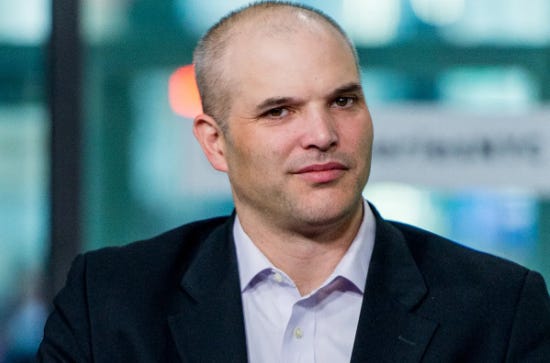
Matt Taibbi Uncensored: Finance Nothing More Than A ‘Street Scam’

Matt Taibbi Uncensored: Finance Nothing More Than A ‘Street Scam’

Submitted by QTR’s Fringe Finance

The opportunity to secure an exclusive interview with Matt Taibbi is something I thought I’d never get…but alas, here we are.

Taibbi is the head of Racket News and his reputation as a fearless investigative journalist precedes him. From his groundbreaking coverage of the 2008 financial crisis to his more recent explorations of censorship with the Twitter Files, politics, systemic inequality and the inner workings of Congress, Taibbi’s body of work reflects a deep commitment to uncovering truths and challenging conventional narratives.

To have the opportunity to pick his brain is a rare privilege that I’m happy to bring my readers.

First, I asked Matt about why more people on main street don’t know about how the Fed works. He told me: “They also do a tremendous job of keeping people like Nomi Prins or whoever else who might be trying to explain some of these issues, keeping them from the public. It was very frustrating after 2008 trying to get anyone at all to comment on, you know, what exactly QE was, you know, or give an explanation that would make sense to an ordinary person.”

He added: “You just, it’s almost like there’s been a proclamation that these issues are sort of out of bounds for the ordinary person, which is unfortunate because they have critical importance for every single person on the planet, which, I mean, as you know, it’s just very frustrating, that dichotomy.”

“And I think that’s true of a lot of sort of high finance stories. I was originally supposed to do just one story about the 2008 crash and what happened and to try to translate that for presumably a young college audience. And at first it was very difficult because I had no experience in dealing with mortgage-backed securities,” he told me. “I didn’t know what they were. I didn’t know how they worked. But once you get into it, it’s really just – it was just a ripoff. I mean it’s not – it’s like a street scam.”

Matt continued, talking about 2008: “They were selling something that wasn’t as valuable as they claimed. It’s like when you look outside and you see somebody selling a phony Prada bag on the street or whatever. Like it was that. It was just dressed up in a lot of jargon and a lot of acronyms. I think that’s true of a lot of these issues. But they, they, I think they intentionally, don’t you think they intentionally keep it sort of shrouded in a lot of jargon and difficult language so that people don’t understand it, yeah they have to.”

Taibbi then railed on Paul Krugman: “So I first noticed this, I guess I was reading Paul Krugman last fall. He did like a whole series. He’s done probably a dozen of these articles, maybe a half dozen, where the substance of it is people are saying they don’t feel positively about the economy, but they’re wrong. Here’s why they’re wrong. And even when the question was phrased as how do you feel about the economy, here’s Paul Krugman who’s, like, living somewhere in the Caribbean.”

I asked Matt about articles like the one from The Atlantic that I skewered last year, blaming regular everyday people for inflation. He responded: “Well, I think the public is much more skeptical of, you know, pronouncements about the economy that they hear from politicians from Wall Street. They, you know, the much maligned act of doing your own research, people actually do that. One of the reasons there was such a violent reaction to the whole meme stock ape movement was because some of these people were actually realizing that it doesn’t take a whole lot of work to be as good at this as anybody who makes a gazillion dollars at a hedge fund.”

“And people did build up some literacy about this, and I think that’s been really helpful. And they’ve also become better informed about how some of the financial subsidies and scams work, monetary theory right like that was something that wasn’t on anybody’s radar until at least in this generation until 2008 so I think those are all good things you know but the basic problem of widening inequality widening unfairness I don’t think there has been a ton of progress there.”

When I asked Matt about the danger of blaming capitalism for these problems, when QE is more like socialism for the rich, he said: “When I started writing about high finance in 2008, the first articles I did were very popular among people on the left. And I think a lot of people misunderstood some of the things that I was writing about to be, you know, sort of unvarnished indictments of capitalism when it wasn’t really that.”

“The story, the reason I was getting all these calls about banks like Goldman Sachs was that there were smaller players who were mad that there was this implicit bailout for these big players who had screwed up worse than everybody else and were being rewarded for it. I mean, there was a lot of anger among people on Wall Street that, you know, at the Bob Rubin types who made terrible decisions, mismanaged their companies or people at Lehman Brothers, right, who didn’t who made these gigantic idiotic bets on subprime way past any rational, you know, the time when it was rational to do so, right. And they get bailed out for it. Meanwhile, everybody else gets left holding the bag. And that’s not fair.”


🔥 40% off FOR LIFE: Use this special coupon link and get 40% off an annual subscription, good for as long as you wish to remain a subscriber.


From there we talked about how inept and generally lobotomized and useless most of Congress is, especially when it comes to matters of finance. Matt agreed, stating: “Most of the members, if you’ve ever been around a member of Congress or a senator, their schedules are so crazy that even if they had the intellectual capacity or the interests in the topic, they wouldn’t have time to delve into most of the legislation that they’re voting on. The way the Congress works, half the time when they get a bill it’s 10 hours after it’s out of the rules committee and nobody knows what’s in it and they’re voting on it, you know, those.”

“So most of what they do, as you say, it’s a public relations thing where the whole goal of the day is to get 30 seconds of video that they can use for a fundraising campaign on an email. And they do that by having the member read something off a script that was written by somebody on whatever committee or even a communications person. And nine times out of ten, that person doesn’t really know anything about the issue or has predetermined what they’re going to say based on some other political consideration that has nothing to do with it. It was really frustrating during the Dodd-Frank Act because one of the unreported stories of that whole thing was that there were only like four or five members in the entire Congress who had anybody in their shops who knew anything about, for instance, clearing.”

Matt continued, railing on Congress: “Congress is a kind of a weirdly dysfunctional universe where the only time anything really interesting happens, it tends to happen because there’s someone who’s been there for a really long time and has had the time to dig in to one subject. Like, for instance, Chuck Grassley has been in the Senate forever and has a couple of staffers who are really good at knowing how the Pentagon budget works. And so they’ve, you know, managed to get through some things that save taxpayers some money. But it took like 20 years to get there, you know what I mean? And it doesn’t work like that with finance.”

You can listen to our full hour long interview at this link.

QTR’s Disclaimer: I am an idiot and often get things wrong and lose money. I may own or transact in any names mentioned in this piece at any time without warning. Contributor posts and aggregated posts have not been fact checked and are the opinions of their authors. They are either submitted to QTR, reprinted under a Creative Commons license or with the permission of the author. This is not a recommendation to buy or sell any stocks or securities, just my opinions. I often lose money on positions I trade/invest in. I may add any name mentioned in this article and sell any name mentioned in this piece at any time, without further warning. None of this is a solicitation to buy or sell securities. These positions can change immediately as soon as I publish this, with or without notice. You are on your own. Do not make decisions based on my blog. I exist on the fringe. The publisher does not guarantee the accuracy or completeness of the information provided in this page. These are not the opinions of any of my employers, partners, or associates. I did my best to be honest about my disclosures but can’t guarantee I am right; I write these posts after a couple beers sometimes. Also, I just straight up get shit wrong a lot. I mention it twice because it’s that important.

Tyler Durden
Sun, 05/05/2024 – 11:40

US Pushing G-7 To Accept Long-Term $50 Billion Aid Package For Ukraine

US Pushing G-7 To Accept Long-Term $50 Billion Aid Package For Ukraine

As part of the latest in the Western allies’ (some of them at least) controversial push to confiscate Russian sovereign assets and give them to Ukraine, the Biden administration is leading talks among G7 nations to commit to a new military aid package for Kiev worth up to $50 billion.

“Ideally, this is something we would like the entire G7 to participate in, be part of, not just have the United States doing it alone,” US Treasury Secretary Janet Yellen told Bloomberg. She further confirmed that Group of Seven countries are currently “discussing” the plan.

Image via Yahoo News

The package would be funded from interest accrued via investments utilizing the some $300 billion in Russian assets currently frozen in Western banks. The bulk of the frozen funds are in European banks, and some EU leaders fear devastating backlash and global distrust in its banking system would be the end result.

These frozen assets within the European Union (some $280 billion) are currently said to generate about 5 billion euros ($5.3 billion) in windfall profits annually. 

According to more details via Bloomberg:

Some €159 billion of frozen Russian assets have generated net profit of €557 million ($601 million) from Feb. 15, according to Euroclear’s first quarter financial results. Since last year, the assets have generated about €3.9 billion in net profit.

Russian sovereign assets held by the company could grow to as much as €190 billion by 2028 as they mature into cash, one of the people said. 

The US is hoping that consensus agreement can be achieved for its plan by the time of the G7 June meeting in Italy, where it could be signed off on. Biden officials have recently floated concepts like “freedom bonds” to sell the idea among allies.

In response, the Kremlin has vowed to be “extremely tough” on “thieves” who appropriate what belongs to Russia. “Considering that our country has qualified this as theft, the attitude will be towards thieves,” Foreign Ministry Spokeswoman Maria Zakharova earlier stated. “Not as political manipulators, not as overplayed technologists, but as thieves,” she emphasized.

The Western allies have out of recent desperation over Ukraine’s diminished ammo been getting creative, and seeking to find loopholes in order to free up extra funds that could be used in the war effort.

Which Russian assets are sanctioned and where are they held… (click image for bigger):

Via Financial Crime News

Britain has meanwhile been at the forefront of countries arguing that the total of all underlying Russian assets should be fully confiscated and used for Ukraine.

“Our view is simple: One day, Russia will have to pay reparations and it doesn’t make sense to wait for those reparations. It makes better sense to use the frozen assets and to make that money available now,” UK Foreign Secretary David Cameron said in March. The UK has since stuck by the position, also jumping on board with Washington’s ambitious asset seizure plan.

Tyler Durden
Sun, 05/05/2024 – 11:05

University Of California Now Discriminates Based On Parental Income, Education

University Of California Now Discriminates Based On Parental Income, Education

Authored by James Breslo via The Epoch Times,

In 1996, Californians voted, 55 to 45 percent, to ban the use of affirmative action in admissions to state schools and in state employment. In 2020, Californians voted to maintain the ban by an even wider margin, 57 to 43 percent.

Last year, the United States Supreme Court struck down college affirmative action policies on the grounds they violate the Fourteenth Amendment’s Equal Protection Clause.

The clear message from the people and the Court is that admission should be based upon merit. But those running the University of California (UC) maintain their obsession with race and “diversity, equity, and inclusion” (DEI). They are undeterred in their mission to enforce equity via affirmative action. Rather than complying with the law and the will of the people, they search for loopholes to achieve the racial balancing they deem ideal for the shaping of society.

The most recent example comes from its San Diego campus (UCSD) which implemented a rule that discriminates against students whose parents make more than a certain amount of money or who went to college. It just so happens that this rule greatly advantages black and Latino students. In a nice side benefit for the administrators, it hurts Asians, who are already overrepresented at the UCs (as well as most universities, as addressed in the Supreme Court case, Students for Fair Admissions v. Harvard, which specifically addressed discrimination against Asian students.)

Beginning next year, certain “selective” majors (such as biology and most engineering degrees, including computer science) will have a special selection criteria at UCSD. “The selection criteria for entry to the major will consider academic achievement in the specified screening courses and will also be aligned with UC San Diego’s priorities of serving California residents, first-generation college students, and students from low-income families.” Thus, UCSD, without any direction from its constituents, has decided that it should prioritize students based on the status of their parents.

Here is how it works. There is a new point system “that awards one point each for having a 3.0 GPA or higher in the major screening courses; California residency; Pell Grant eligibility [i.e. parental income]; and first-generation college status.” Thus, half of the criteria is based upon the student’s parents. And since the majority of UC students are from California, and a 3.0 GPA is pretty easy, it really means that the primary determiner will be the status of the children’s parents.

The reason for the new policy is pretty obvious: It will advantage black and Latino students, and disadvantage white and Asian. It is unique, however, in that it is using old-school class warfare to achieve it.

Many have noted that the left has typically substituted race for class as a means of implementing socialism in the United States. Due to the U.S.’s strong middle class and upward mobility, class warfare has not worked as a means of implementing socialism here. But with courts striking down admissions policies based upon race, the left is now going back to old-fashioned class conflict. Will it work, or is it also illegal to discriminate based upon parental income or education?

If a court determines that the intent of the policy is to discriminate based upon race, then it will apply a “strict scrutiny” test to the policy. This is the standard the Supreme Court used in striking down affirmative action in the Harvard case. The UCSD policy, in fact, appears to be thinly disguised discrimination.

It is well-known that the average income of black and Hispanic people is below that of white and Asian, as is the percentage with a college degree. Thus, a court should hold the policy to the same standard as the ones struck down in the Harvard case. Justice John Roberts wrote that the Equal Protection Clause applies “without regard to any difference of race, of color, or of nationality” and thus must apply to every person. As such, “Eliminating racial discrimination means eliminating all of it,” adding that “For ‘[t]he guarantee of equal protection cannot mean one thing when applied to one individual and something else when applied to a person of another color.’”

It is interesting that the policy, for now, appears to only apply to currently enrolled students attempting to transfer into these majors, not upon admission. Perhaps recognizing that the policy will have a discriminatory effect and thus subject to challenge, UCSD limited it to leave open the argument that it is not denying anyone an education, simply the major of their choice. But this is unlikely to fly, considering that the two most important elements of a quality education is the school and the major. If you cannot get a degree in engineering, you cannot become an engineer, while a biology degree is the natural feeder to medical school.

The UCSD policy is not the first time the UC has attacked students based upon their parent’s income. It used the same rationale to dump the SAT test. It argued that the test benefits children from wealthier families who can afford SAT prep courses. They now rely exclusively on high school grade point averages to determine scholarly merit. This allows them to easily create the racial balance they desire. They treat all high schools the same, whether it be the best private high school or the worst public school. We know that finishing in the top ten percent of your school is much easier to do at a public school than a private one, but that does not matter to UC. Achieving the desired racial makeup is more important to them than the merit of the individual.

The UC faculty, through the “Academic Senate,” oversees the admissions process. It explained getting rid of the SAT test: “This decision, which is part of the ongoing effort by the university to advance educational opportunity and equity, was based on the view that these tests are biased because they systematically and unfairly reduce the likelihood that underrepresented and low-income high school students will be accepted to the university.”

I have lots of stories from friends whose children could not get into a single one of the nine UC campuses across the state, but were accepted by the University of Michigan and University of Wisconsin, two of the best public universities in the country. That’s a nice consolation prize, except for the price, which is about five times more due to out-of-state tuition.

It is really incredible and the height of arrogance that California’s preeminent public university continues to fight against the will of its people. The Academic Senate asserts that “as a state public institution, the UC is obliged to create a student body that is representative of the demographic profile of California.” UC has even placed a Vice Chancellor of Diversity, Equity & Inclusion, overseeing an entire department, at each campus to ensure this.

That sounds nice, the only problem is Californians have twice voted against it, and the discrimination required to achieve it is unconstitutional. But when you are on a cultish mission to create your utopian vision, those are minor inconveniences.

Tyler Durden
Sun, 05/05/2024 – 10:30