62.8 F
Chicago
Monday, September 21, 2026
Home Blog Page 2672

Republicans Move To Prevent Biden Resettling Palestinian Refugees In The US

Republicans Move To Prevent Biden Resettling Palestinian Refugees In The US

Authored by Paul Joseph Watson via Modernity.news

Republican lawmakers are moving to prevent the Biden administration resettling Palestinian refugees in the United States, asserting that it represents a “national security threat” since large numbers of them support Hamas.

Earlier this week, it was revealed that the White House is considering using the United States Refugee Admissions Program to hand Palestinians permanent residency and “resettlement benefits like housing assistance and a path to American citizenship.”

Although CBS News reported that the “eligible population is expected to be relatively small,” European natives were given similar assurances before the 2015 refugee crisis that ended up with millions of migrants flooding the continent.

In a letter to House Appropriators, Reps. Andy Ogles (R-TN), Tom Tiffany (R-WI), and Scott Perry (R-PA) have asked that a provision be included in the Fiscal Year 2025 spending bill that prevents expenditures “of any funds to issue a visa or grant parole to any alien holding a passport issued by the Palestinian Authority.”

“Whatever fanciful leftist notion to the contrary, the United States of America cannot be expected to absorb the rest of the world’s problems. It would make much more sense for states in the region to take in those in need. If the administration is indeed working in concert with our allies in the region to pave the way for peace, that should come with the expectation that those allies are working in good faith to “do their part,” states the letter.

35 Senate Republicans are also demanding more specifics on the resettlement program, asserting that it represents “a national security risk to the United States.”

“With more than a third of Gazans supporting the Hamas militants, we are not confident that your administration can adequately vet this high-risk population for terrorist ties and sympathies before admitting them into the United States,” said the Senators.

A leaked Israeli intelligence document revealed in late October last year revealed a plan to ‘expel’ 2.2 million Palestinian refugees and send them to Europe, Canada and the United States.

The document, produced by Israel’s Intelligence Ministry, stated that one of the goals of the war with Gaza was to encourage western countries to facilitate the “absorption and settlement” of Gazan refugees.

Back in March, Jared Kushner said it was “unfortunate” that Europe isn’t taking in more Palestinian refugees, suggesting that the “cleaning up” of Palestinians from the Gaza Strip should be accelerated.

Meanwhile, as we highlight in the video below, while Americans could be set to see yet another influx of migrants thanks to Israel’s destruction of Gaza, criticizing the Middle Eastern country could technically become illegal under the draconian Antisemitism Awareness Act.

*  *  *

Your support is crucial in helping us defeat mass censorship. Please consider donating via Locals or check out our unique merch. Follow us on X @ModernityNews.

Tyler Durden
Fri, 05/03/2024 – 12:15

Here Comes Obesity Drug Competition: Amgen Shares Soar On “Very Encouraging” Clinical Trial Update

Here Comes Obesity Drug Competition: Amgen Shares Soar On “Very Encouraging” Clinical Trial Update

Amgen’s shares soared in premarket trading in New York following the drug maker’s announcement of “very encouraging” clinical trial results for its new injectable weight-loss drug, “MariTide.”

Amgen’s MariTide is poised to compete with Eli Lilly & Co’s Zepbound and Novo Nordisk A/S’ Wegovy, both blockbuster drugs in the weight-loss market.

Bloomberg Intelligence published a recent note that estimated the weight-loss drug market will exceed $80 billion in annual sales by 2030. 

On Thursday evening, Amgen CEO Robert Bradway told investors during an earning call, “We recognize the significant interest in obesity.” 

“We are confident in MariTide’s differentiated profile and believe it will address important unmet medical needs,” Bradway said. 

Amgen expects data from the ongoing Phase 2 study to be released later this year and plans a “comprehensive” Phase 3 trial next. 

If MariTide is approved, the pharmaceutical company expects patients to inject themselves with the medication once a month, or possibly even less frequently than current weight-loss drugs on the market. It discarded plans to develop an oral form of the weight-loss drug. 

Shares of Amgen jumped nearly 15% to $319 – near a record high – in premarket trading. 

If the premarket gains hold during the cash session, a 15% increase would mark the largest intra-day move since the 15.10% rise on July 20, 2005. If the gains exceed this level, it would become the largest single-day gain since October 30, 1987.

Meanwhile, Barclays Plc analyst Emily Field said it’s too early to judge the competitive threat between Eli Lilly and Novo. 

However, traders dumped Novo shares in Copenhagen, down 4% on Friday. 

“As of today, we see no cause for concern regarding the competitive dynamics versus the market leaders,” Field wrote in a note. “We really will need to see the data,” Field wrote in a note. 

Tyler Durden
Fri, 05/03/2024 – 11:55

April Payrolls Debacle: Biggest Miss Since 2021 As Unemployment Rate Rises

April Payrolls Debacle: Biggest Miss Since 2021 As Unemployment Rate Rises

Ahead of today’s payrolls report, in our preview we said that while we knew we would get a slowdown, the question was how big it would be (and before that we also asked if Yellen had leaked the weaker number to Japan ahead of their multiple interventions this week to prevent them from wasting tens of billions in intervention dry capital for nothing).

We got the answer moments ago when the BLS reported that in April the US added just 175K jobs, a nearly 50% drop from the upward revised 315K (was 303K), the lowest print since October 2023…

and a two-sigma miss to estimates of 240K.

In fact, as shown below, this was the biggest miss since Dec 2021 

As usual, prior data was net revised lower, with the change in total nonfarm payroll employment for February revised down by 34,000, from +270,000 to +236,000, and the change for March was revised up by 12,000, from +303,000 to +315,000. With these revisions, employment in February and March combined is 22,000 lower than previously reported. 

What was behind the unexpected payrolls plunge? Blame government, which added just 8,000 jobs in April the least since Dec 2021, almost as if the government itself was goalseeking the final result.

Remarkably the result would have been even worse had it not been for a massive 363K addition from the birth death model.

It wasn’t just the Establishment survey: the Household survey showed that in April, the US added just 25K jobs, a huge drop from the 498K in March…

… which means that the already record divergence between the number of people employed and those who have jobs expanded by another 150K.

The weakness was pervasive, and while payrolls were a huge miss, the unemployment rate also rose more than expected, from 3.8% to 3.9%, – the highest since January 2022 – versus estimates of an unchanged print.

The unemployment rate for Blacks (5.6 percent) decreased, offsetting an increase in the prior month. The jobless rates for adult women (3.5 percent), teenagers (11.7 percent), Whites (3.5 percent), Asians (2.8 percent), and Hispanics (4.8 percent) showed little change over the month

Despite the increase in unemployment, the participation rate was unchanged at 62.7%

Wages also eased back with average hourly earnings rising 0.2% MoM, below the expected 0.3% increase and down from last month’s 0.3% print. On an annual basis, earnings rose 3.9%, down from 4.1% last month and below the 4.0% estimate.

Looking at the composition of the April job gains, the BLS notes that job gains occurred in health care, in
social assistance, and in transportation and warehousing, offset by a big slowdown in government hiring.

  • Health care added 56,000 jobs in April, in line with the average monthly gain of 63,000 over the prior 12 months. In April, employment continued to increase in ambulatory health care services (+33,000), hospitals (+14,000), and nursing and residential care facilities (+9,000). 
  • Employment in social assistance increased by 31,000 in April, led by a gain in individual and family services (+23,000). Social assistance had added an average of 21,000 jobs per month over the prior 12 months.
  • In April, transportation and warehousing added 22,000 jobs, with gains in couriers and  messengers (+8,000) and warehousing and storage (+8,000). Over the prior 12 months, employment in transportation and warehousing had shown little net change.
  • Employment in retail trade continued to trend up in April (+20,000). Over the prior 12 months, the industry had added an average of 7,000 jobs per month. In April, employment increased in general merchandise retailers (+10,000), building material and garden equipment and supplies dealers (+7,000), and health and personal care retailers (+5,000). Electronics and appliance retailers lost 3,000 jobs. 
  • Construction employment changed little in April (+9,000), following an increase of 40,000 in March. Over the prior 12 months, construction had added an average of 22,000 jobs per month. 
  • Employment in government changed little in April (+8,000). Over the prior 12 months, government had added an average of 55,000 jobs per month. In April, local government employment was  unchanged, following an increase of 51,000 in March. 

And visually:


Tyler Durden
Fri, 05/03/2024 – 11:46

There’s ‘Widespread’ Belief Among US Officials Israel Can’t Eradicate Hamas

There’s ‘Widespread’ Belief Among US Officials Israel Can’t Eradicate Hamas

Authored by Dave DeCamp via AntiWar.com,

There is a “widespread belief” among US officials that Israeli Prime Minister Benjamin Netanyahu’s goal of “eradicating” Hamas in Gaza is unattainableThe New York Times reported on Thursday.

Throughout the past seven months, there have been multiple signs that the US doesn’t believe Israel could achieve its goals in Gaza, yet the Biden administration has continued to support the slaughter of Palestinians in the Strip.

via Reuters

In March, the US intelligence agencies released their annual “threat assessment,” and it said Israel will face “lingering armed resistance” for “years to come” and that the Israeli military would struggle to destroy Hamas’s underground infrastructure.

The Washington Post also reported in March that the US didn’t think Israel had clear or attainable goals as far back as October. “We never had a clear sense that the Israelis had a definable and achievable military objective,” a source familiar with an October 27 Biden administration meeting on the situation in Gaza told the Post.

“From the very beginning, there’s been a sense of us not knowing how the Israelis were going to do what they said they were going to do.”

The Times report focused on Secretary of State Antony Blinken’s visit to Israel and the difference in messaging from the administration and Netanyahu. Blinken said the US was still opposed to Israel invading Rafah without a clear plan for civilians, but Netanyahu’s message was that an invasion will happen no matter what.

Blinken also called on Hamas to accept Israel’s latest proposal for a hostage deal and temporary ceasefire, but Netanyahu signaled that he wasn’t interested. The Israeli leader vowed to invade Rafah “with or without” a deal with Hamas.

The Times report said US officials were “taken aback” by the timing of Netanyahu’s comment because they think Hamas would only accept a deal if they believed releasing hostages could lead to a permanent ceasefire, which has been the Palestinian group’s demand for months. Netanyahu also told Blinken that he wouldn’t agree to end military operations in Gaza for a hostage deal.

Despite the difference in public messaging, there’s no sign the Biden administration is putting any real pressure on Netanyahu to prevent an invasion of Rafah as US military aid continues to flow. So far, the US-backed Israeli slaughter has reportedly killed 34,596 people, including over 14,000 children, according to the latest numbers from Gaza’s Health Ministry.

Tyler Durden
Fri, 05/03/2024 – 11:35

Apple Soars After iPhone, China Sales Drop Less Than Feared; Unveils Record-Breaking $110 Billion Buyback

Apple Soars After iPhone, China Sales Drop Less Than Feared; Unveils Record-Breaking $110 Billion Buyback

With most of the megatechs having already released earnings, all eyes were on the last Mag7 to report during the heart of earnings season (there is still Nvidia, but due to a calendar quirk that’s not for a month) which is also the company which until recently was the undisputed market cap world champion until it was overtaken by the mAIcrosoft juggernaut: Apple. Having failed to enjoy the same AI-driven euphoria some of its giga cap peers, Apple stock had languished for months and was in fact relegated by Goldman recently to the Meh 3 (AAPL, GOOGL, TSLA) and away from the Fab 4 (META, NVDA, MSFT, AMZN). But much of that was recovered after hours when AAPL not only reported blowout earnings but unveiled a massive, record-breaking $110 billion stock buyback program (because when your best product is the 5 pound neck brace known as the Vision Pro you have no choice but to buy your own stock since nobody else will do it for you) which sent the stock soaring after hours.

Here is what AAPL reported for the quarter ended March 31:

  • EPS $1.53 vs. $1.52 y/y, and beating the estimate $1.50
  • Revenue $90.75 billion, down 4.3% y/y primarily on China weakness, but beating the recently lowered estimate of $90.33 billion
    • Products revenue $66.89 billion, -9.5% y/y, just missing the estimate $66.95 billion
      • IPhone revenue $45.96 billion, -10% y/y, beating estimate $45.76 billion
      • Mac revenue $7.45 billion, +3.9% y/y, beating the estimate $6.79 billion
      • IPad revenue $5.56 billion, -17% y/y, missing estimate of $5.91 billion
      • Wearables, home and accessories $7.91 billion, down 9.6% y/y, and badly missing estimate $8.29 billion now that the Vision Pro is a confirmed flop
    • Service revenue $23.87 billion, +14% y/y, beating the estimate $23.28 billion
    • Greater China rev. $16.37 billion, -8.1% y/y, beating the estimate $15.87 billion. This was probably the one item everyone was closely watching due to the big swing impact the recent plunge in China sales would have on the company. It ended up being not as bad as feared.

Going down the line:

  • Total operating expenses $14.37 billion, higher than the estimate $14.33 billion
  • Gross margin $42.27 billion, +0.7% y/y, higher than the estimate $42.01 billion
  • Cash and cash equivalents $32.70 billion, below the estimate $36.83 billion

And so on.

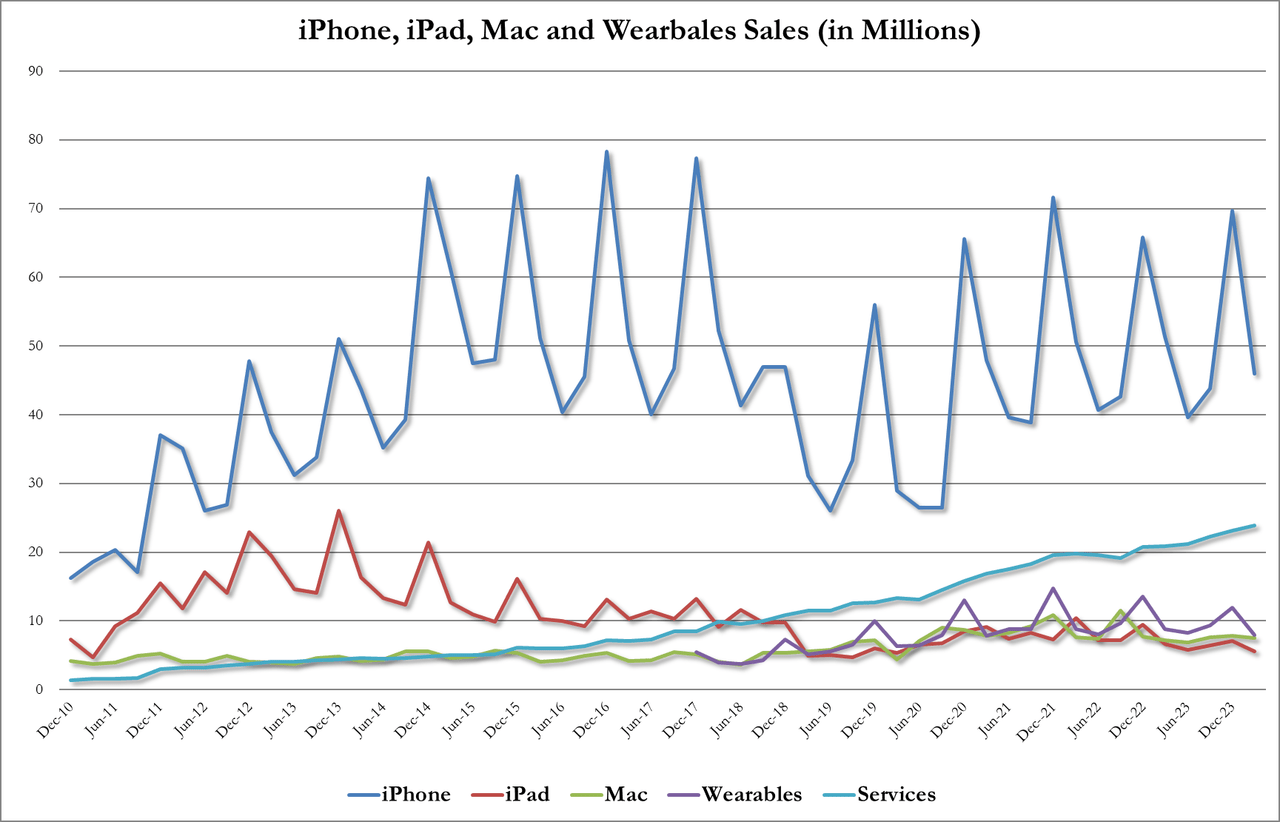
Looking at a breakdown of sales by product category we find that, as expected, iphone sales dropped 10% in a quarter which most knew would be ugly for the iphone maker, but at $46bn they just barely beat expectations of $45.8 billion. The rest of the product suite was mixed with Macs surprisingly beating estimates while both iPads and wearables missed. In any case the trend is clear: while sales may not be plunging, they have certainly topped out and the only ting that is still rising is Services.

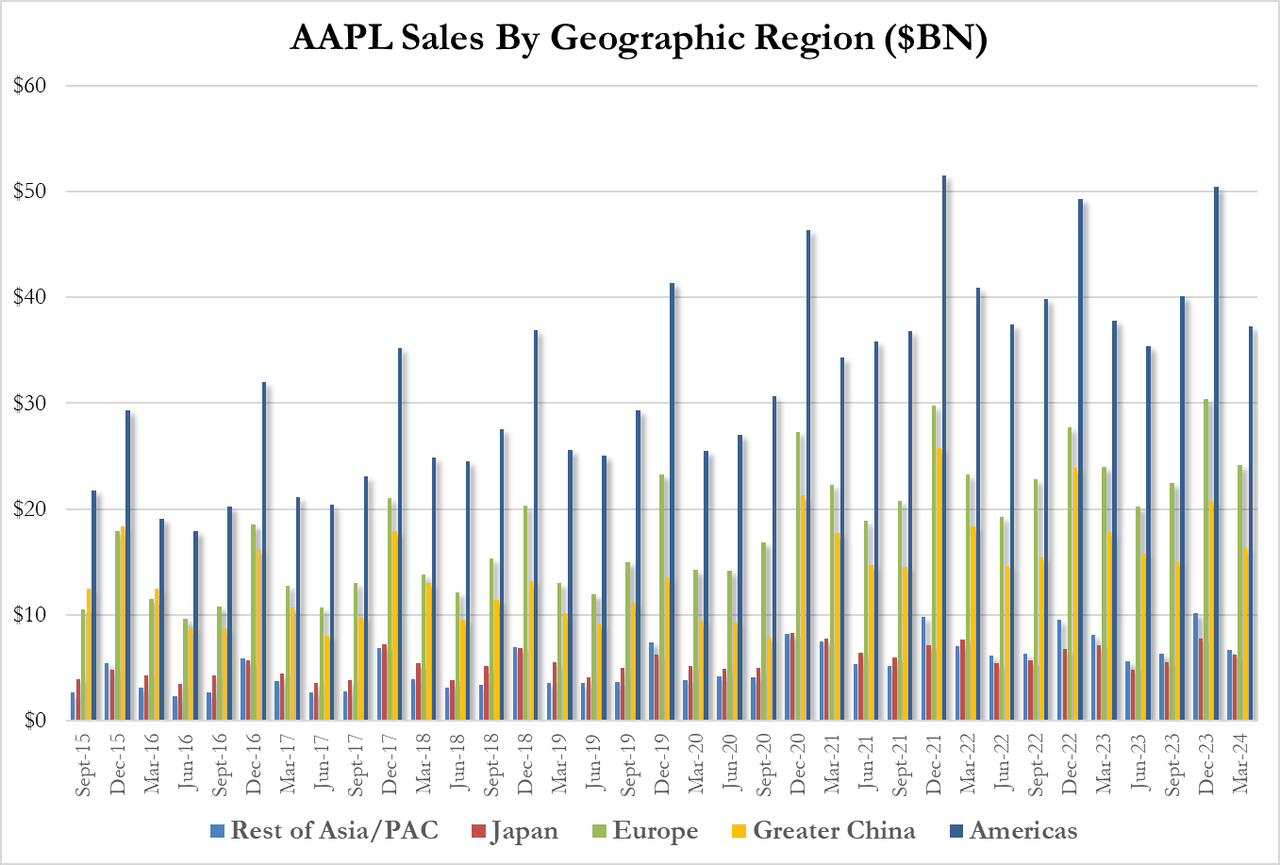
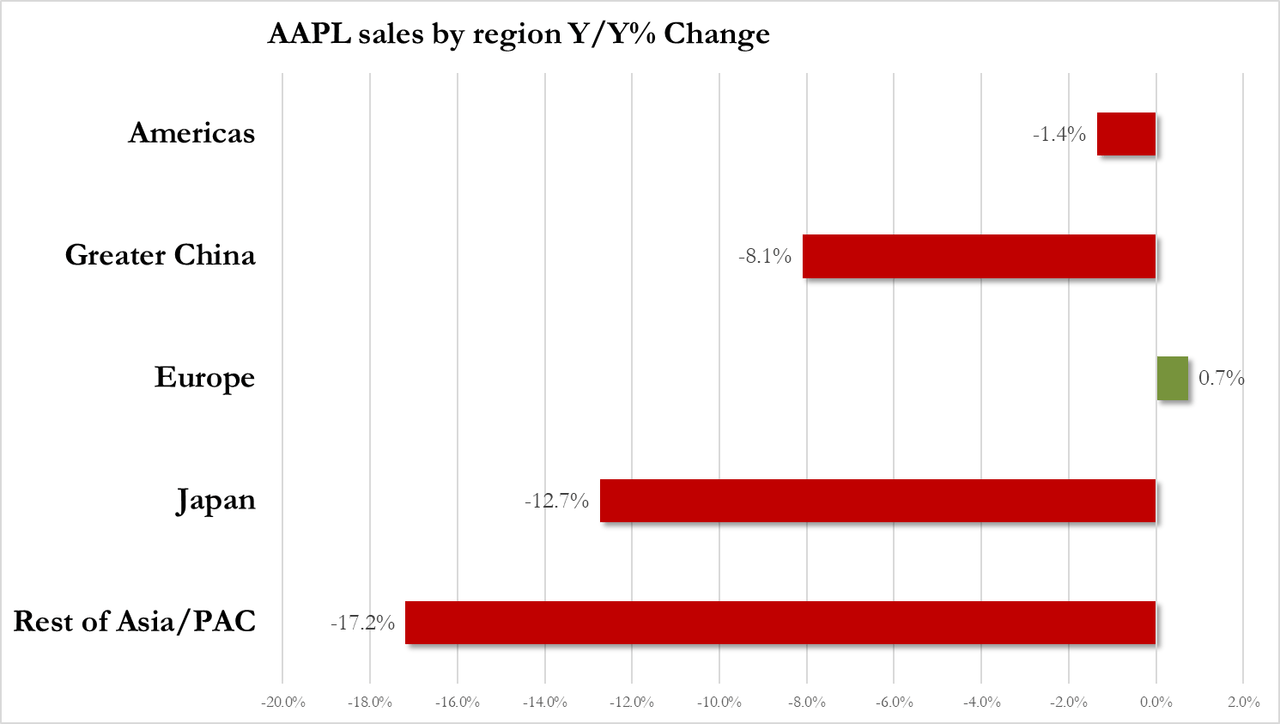
Looking at a geographic breakdown we find that while sales declined across almost every region, with the notable exception of Europe…

… the 8.1% drop in China sales was not nearly as bad as consensus expected, which fear a double digit drop was coming.

CFO Maestri said that the China concerns were overblown. “We were happy with our results in China,” he said. “The reality is different from maybe what you read at times.”

CEO Cook also pushed back on the idea that the iPhone was suffering in the country, saying that revenue from the device actually grew in mainland China. The weakness stemmed from other parts of the business, he said.

“Other products didn’t fare as well,” he said on a conference call. “And so we clearly have work there to do.”

At the same time, Bloomberg notes that Apple hasn’t shown that new product categories can reinvigorate growth. It canceled work on a self-driving car in February, eliminating a project that some had hoped could become one of its famous “next big things.”

Services were a relative bright spot, growing 14% to $23.9 billion in revenue. That topped Wall Street expectations of $23.3 billion: the category includes Apple Music, the TV+ streaming platform and iCloud subscriptions, but its revenue primarily comes from the App Store. But that business is under pressure from regulators, with Apple being forced to allow third-party marketplaces and payment services in the European Union. Depending on how Apple fares in a legal battle with the Justice Department, it may have to make changes in the US as well.

The company did push into the mixed-reality headset market this year, with the Feb. 2 debut of the Vision Pro. But that product is off to a slow start and could take years before it adds meaningfully to Apple’s revenue. Apple didn’t disclose Vision Pro sales figures on Thursday, but said that the device is generating interest among corporate customers.

But while the results were solid, and beat reduced estimates it’s what was not part of the income statement that stunned investors: the company announced a mind-blowing new stock buyback program, of $110 billion, beating the previous record set by – who else – Apple, and which itself is bigger than the market cap of Boeing (although now that all Boeing whistleblowers have died, expect BA to soar), and also bigger than both GM and Ford combined!

If that wasn’t enough, AAPL also predicted a return to growth in the current period, sparking optimism that a slowdown is easing. A lack of innovative new devices has contributed to slow sales at Apple, but the company looks to begin fixing that on May 7. That’s when it plans to unveil new iPads — the first updates to its tablet line in 1 1/2 years.

The results came as a relief to investors, who have been waiting for the iPhone maker to pull out of a long slump. Apple has posted sales declines in five of the past six quarters, hurt by a sluggish smartphone market and headwinds in China. The company had warned analysts in February that revenue in the latest period would be down about 5% from a year earlier.

In the current period, Apple expects sales to climb by a percentage in the low single digits. The company predicted that both its iPad and services business would grow by a rate in the double digits, but declined to give a forecast for the iPhone — its flagship product.

But wait there’s more: the iphone maker also is planning a long-awaited push into generative artificial intelligence. In June, Chief Executive Officer Tim Cook is expected to lay out Apple’s AI strategy at its annual Worldwide Developers Conference.

“We are making significant investments in the space,” Chief Financial Officer Luca Maestri told Bloomberg Television’s Emily Chang. “We believe we are well-positioned.” Cook said Thursday that Apple will stand out from its AI rivals by tightly integrating hardware and software, using in-house chips, and making privacy and security a priority.

AAPL shares soared as much as 7.9% in extended trading Thursday before easing back a bit. Apple had been down 10% to $173.03 this year through the close, and is now still down modestly for the year.

Tyler Durden
Thu, 05/02/2024 – 19:23

Hamas Praises Colombia’s Breaking Relations With Israel, Urges All Of Latin America To Follow

Hamas Praises Colombia’s Breaking Relations With Israel, Urges All Of Latin America To Follow

Hamas is praising the government of Colombia and its leftist president Gustavo Petro for on Thursday formally cutting diplomatic ties with Israel after accusing its military of genocide against the Palestinian people. 

A Hamas statement the same day hailed it as a “recognition of the suffering of Palestinian people” and further urged more Latin American countries to follow suit. Bolivia was the first to do so earlier in the nearly 7-month long conflict.

The Hamas statement said countries around the globe must cut ties with “a rogue and fascist entity that is continuing its crimes against our people.” Interestingly the language seems geared toward appealing to Global South countries who have long struggled against colonial powers.

Colombia’s President Gustavo Petro, Getty Images

Petro was elected in 2022, and that’s when the country’s relations to Israel dramatically shifted. He is Colombia’s first Left-wing president in its history, and before that Tel Aviv and Bogota enjoyed strong, positive relations.

In a Wednesday speech before a May Day rally in the capital, Petro said,”Tomorrow (Thursday) diplomatic relations with the state of Israel will be severed… for having a genocidal president.” 

“If Palestine dies, humanity dies, and we will not let it die,” he said at one point in the speech. He proclaimed that “democratic peoples cannot allow Nazism to reestablish itself in international politics.”

However, Bloomberg has noted that his motives could partly be to distract from the ongoing economic crisis in the country:

Petro is looking to counter large anti-government rallies that took place on April 21 and said his administration will send a package of bills to congress meant to boost economic growth.

The package will include measures that force the financial sector to provide cheap financing to productive sectors, Petro said.

“It will consist of bills that generate forced investment in the Colombian private financial system aimed at credits for small, medium, and large industries, agriculture, and tourism in Colombia, to reactivate the country,” he said.

Petro has for months been a fiery vocal critic of Israel, having first threatened to sever relations with Israel back in March. Late last year he also announced plans to open an embassy in the Palestinian West Bank city of Ramallah. Israel’s foreign ministry has slammed the “antisemitic” move to sever official relations.

“Relations between Israel and Colombia always were warm and no antisemitic and hate-filled president will succeed in changing that,” Katz wrote on X. “The state of Israel will continue to defend its citizens without worry and without fear.”

It remains to be seen whether other Left-leaning governments in the region follow Colombia and Bolivia. Already Chile has recalled its ambassador from Israel. 

Tyler Durden
Thu, 05/02/2024 – 19:20

Paul Krugman’s Magical Thinking: Taibbi

Paul Krugman’s Magical Thinking: Taibbi

Authored by Matt Taibbi via Racket News,

Last week, in “It’s Not Me, It’s You,’” I wrote about a booming new op-ed genre, the editorial that bashes hick voters for their incorrect “Perception of the Economy.” Pundits attack voters’ “stubbornly low” assessments, producing poll numbers that leave experts “baffled” and wondering when people will catch up to “reality.”

In a bit of Racket malpractice, the article didn’t mention Paul Krugman of the New York Times, who’s written a collection of those articles and become the unofficial tribune of the “Perception of the Economy” movement. As scientists in classical times believed the sun revolved around the earth, Krugman believes all things revolve around Donald Trump, the subject of this recent piece of wizardry:

Krugman’s “quack economics” fears are prompted by a Wall Street Journal report claiming Trump advisers are “quietly drafting proposals that would attempt to erode the Federal Reserve’s independence” if Trump wins in November. As the Times “Dealbook” page surmised, “The overall goal is to give Trump what he wants: more say on interest rates,” with those unnamed sources claiming Trump aides discussed requiring Fed officials to consult with the president before raising or lowering rates.

Krugman spins a series of elaborate nightmare hypotheticals on the basis of this one piece of information, concluding:

How would Trump respond if things went wrong? Remember, he suggested we look into fighting Covid by injecting disinfectant. Why expect him to be any less inclined to magical thinking in dealing with, say, a new surge in inflation?

Paul Krugman, worried about a magical thinking response to a “surge in inflation.” Why would that be funny? Let’s review:

Six months ago, Krugman made an announcement on Twitter. “The war on inflation is over,” he declared. “We won, at very little cost.” The pronouncement stood like the Colossus of Rhodes over a heroic graph:

This was the economic equivalent of George Bush’s “Mission Accomplished” stunt. Krugman graphed the Consumer Price Index excluding “shelter, food, and used cars.” The CPI, which ostensibly tracks changes in the price of consumer goods, is already a quasi-bogus number whose quirky methodology allows government to make prices seem lower. That wasn’t enough for Krugman, who simply removed three of the biggest household spending variables to take the real CPI of 3.7% and jam it below 2%, creating his own bespoke inflation monitor.

Krugman was instantly mocked, even by other mainstream outlets. “Nobel Economist Paul Krugman Mocked For Saying Inflation is Over if You Exclude Most of What People Buy,” was the take in Business Insider. “Inflation is not a problem if you don’t buy anything,” added TalkMarkets. The funniest response showed Krugman had zoomed past The Onion and become a Babylon Bee headline:

Krugman backpedaled slightly, but couldn’t help himself and went back month after month to argue the numbers were better than they seemed. In January, he posted the “NY Fed measure of underlying inflation” to confirm “the war is over, and we won.” In February, for instance, he posted a chart reminding us that “if it weren’t for owners’ equivalent rent, a price nobody pays, nobody would be talking about inflation.”

All this came a year after he had to write a column called “I Was Wrong About Inflation,” admitting to being on “Team Relaxed” when it came to the potential downside impact of a massive monetary rescue plan. One of the reasons for his miscalculation? “A big piece of the plan was one-time checks to taxpayers, which we argued would be largely saved rather than spent.”

Krugman calculates consumer prices without housing or food and assumes people in the middle of an economic crisis won’t spend six hundred bucks, but thinks other people are guilty of magical thinking on inflation?

Putting a bow on all this, in the “magical thinking” piece Krugman indulged in a catastrophic fantasy about Trump potentially devaluing the dollar to stimulate exports, an idea he ripped as “clearly inflationary — raising import prices and overheating a U.S. economy that is already running hot.” One can only assume he means hot in the Goldilocks sense, i.e. not too much inflation, and not too little, but just hot enough.

One last note. Krugman rails against Trump’s reported plans to expand tariffs. This is interesting because when Joe Biden told the World Trade Organization to shove it a year and a half ago after the WTO declared Trump’s last tariff regime (which Biden was continuing) illegitimate, Krugman declared, “It’s up to America to determine whether its trade actions are necessary for national security,” and “an international organization has no right to second-guess that judgment.” This came in an article showing Biden speaking sternly into a microphone with a big ‘Murican flag in the background, titled, “Why America is Getting Tough on Trade.”

I’m not endorsing any of Trump’s economic ideas, but the issue here is the naked partisanship of Krugman’s act. When Trump was in office, he was writing articles like “Why is Trump a Tariff man?” and declaring that his tariffs were about “rewarding his friends,” “power,” and “cronyism,” rather than any kind of populist policy (because Trump voters are “driven more by animosity toward immigrants and the sense that snooty liberals look down on them than by trade policy”). When Biden’s in office, extending the exact same tariffs, Krugman waves the flag and hums Lee Greenwood for his “tough America” columns. Now we’re back to worrying about Trump’s “magical thinking” and “petty strongman” tendencies.

This is worth pointing out only because partisan pettiness has become the default explanation for those “perception of the economy” pieces I wrote about last week. Krugman has hit this theme countless times, most recently in early April:

Quoting the Wall Street Journal in saying, “When it comes to the economy, the vibes are at war with the facts,” Krugman adds:

The elephant in the room — and it is mainly an elephant, although there’s a bit of donkey too — is partisanship. These days, Americans’ views of the economy tend to be determined by political affiliation rather than the other way around… Republican politicians and media are united in trashing the Biden economy… Democrats, on the other hand, are divided, with some progressives talking down the economy because they fear that acknowledging the good news might undermine the case for strengthening that weak social safety net.

Got that? Ordinary people don’t have honest opinions about the economy, just partisan reactions, and when progressives say negative things, it’s only because they’re lying for a good cause, i.e. stumping for a wider safety net. Everybody is dishonest except the experts like Krugman, who have facts where the volk only have vibes, and wrong ones at that.

What’s so irritating about the “partisan divide in economic perceptions” becoming the reigning explanation for negative public attitudes about the economy is that they’re such obvious projection. With Trump on the ballot this November, no mainstream pundit will dare speak ill of Joe Biden’s economy, whether it deserves it or not, which is both confusing and galling to audiences, and almost certainly adds to the hesitancy reflected in the polls. How can anyone feel good about things if they sense the “experts” wouldn’t tell them even if they saw a crash coming?

It’s one thing to be called stupid and partisan, but having Paul Krugman do it is almost a compliment. Almost.

Tyler Durden
Thu, 05/02/2024 – 18:55

North Carolina Shooting: Democrats Blame Guns While Letting Repeat Offenders Run Free

North Carolina Shooting: Democrats Blame Guns While Letting Repeat Offenders Run Free

Whatever happened to the media coverage of the mass shooting of police officers in Charlotte, NC this week?  Only moments after the attack which took the lives of four law enforcement officers and injured four others, mainstream news feeds and social media sites were flooded with calls from journalists as well as Democrat politicians demanding that “something be done” about assault weapons and high capacity magazines.  Joe Biden quickly issued a White House statement calling for swift gun control measures and (ironically) more funding for police.

Then, suddenly, everything went quiet.  Why?

We all know why; because this has happened so many times in the past and the outcome is now laughably predictable.  The eventual reveal of the alleged assailant’s identity derailed progressive gun control efforts.  His race and background did not fit the narrative mold that Democrats are looking for (the unhinged white male gun nut, preferably conservative).  

Terry Clark Hughes Jr. already had a long rap sheet in North Carolina well before he killed four police officers this past week in Charlotte.  With multiple warrants spanning several years as well as being involved in a high speed chase in January of 2024, Hughes should have been buried in the prison system for a very long time.  Sadly, this was not the case – North Carolina is a blue state and Charlotte is a Democrat run city notorious for its soft treatment of repeat criminals.  

Vi Lyles, the Mayor of Charlotte since 2017, is the city’s first black female mayor and a Democrat.  The city council is predominantly progressive and has been pursuing “defund the police” measures since 2020.  And this is the kind of political environment that you will consistently find in nearly every city in the US with high crime rates and mass shootings.  It’s not a theory, it’s a rule.

Since at least 2017 Charlotte has been suffering from what many residents call a “revolving door” when it comes to prosecutions and prisons.  Critics have accused the city leadership of engaging in “high profile arrests and low profile releases” in order to keep crime stats down.  This includes a myriad of sex offenders and violent criminals set free in the past few years, only to have them victimize even more people not long after.

For example, only two weeks ago Shareef Sudan Thompson, 36, was released from jail on bond despite facing charges in a violent stabbing last week in Uptown Charlotte.  Local journalists discovered he has an extensive criminal history and police continue to question why extremely dangerous offenders are treated with such accommodations.  City officials offer no clear answers, except to suggest that the bond system is to blame.


After the election of Vi Lyles, Charlotte soon rose through the ranks of most violent cities in the nation.  It recently jumped to a list of the top 15 cities in the US with the fastest growing homicide rates

Leftists and gun control advocates blame guns every time there’s a high profile shooting, yet they conveniently ignore the history of the shooters and who is in charge of the cities and criminal policies the shootings take place in.  The Democrat policy of catch and release when it comes to the worst possible criminals is the biggest contributor by far to violent assaults and murders across the country. 

Roughly half of all crimes in the US are perpetrated by a small percentage of offenders with pervasive criminal histories.  Locking these people up for extended sentences should be the primary solution to the problem, but progressives absolutely refuse.  Most likely, these releases are designed to obscure a growing crime epidemic in blue cities across the country.  Meaning, if we want shootings like the one in Charlotte, NC to stop, Democrat officials must be removed from power first. 

Tyler Durden
Thu, 05/02/2024 – 18:30

Renewed Regulatory Pressure On Bitcoin Is No Surprise

Renewed Regulatory Pressure On Bitcoin Is No Surprise

Authored by Mark E. Jeftovic via bombthrower.com,

Nor will it change anything over the long haul…

We’ve always said that the rise of Bitcoin and non-state fintech was a monetary regime change, and that it would be naive to expect the entrenched “powers that be” and incumbent establishment to go down without a fight.

After all, the Cantillionaire class has had monopoly control over a magic lever that surreptitiously transferred everybody else’s wealth to themselves for over a century.

Now, suddenly Prometheus shows up – in the form of Satoshi – and gifts humanity with a new magic lever, called asymmetric public-key cryptography. It’s really just math. But it enables every individual on earth to just as magically shield themselves from this embezzlement

Even worse for those elites, is that their mechanism for leeching wealth from society accrues to them in fiat currency units that lose their value over time, while all the unwashed plebes making use of this fancy new system are finding their purchasing power increasing over time.

The Cantillionaires are fighting the inexorable cannibalization of their own purchasing power, owing to the pernicious effects of using debt for money – while the rising system is being impelled by network effects, power laws, and good ole-fashioned incentives.

For the establishment, the central bankers, career politicians and fiat financiers, it probably all seems a little… unfair.

Which makes it completely unsurprising that whoever among them sees the writing on the wall and refuses to allow themselves to be “orange pilled”, as it were, will dig in and muster all the power, influence and institutionalized corruption at their disposal to try and forestall the prospect of hyper-Bitcoinization.

Chokepoint 1.0 was an Obama-era initiative, launched in 2013, that set the table for freezing unsanctioned financial players out of the legacy banking system: payday loans, money transfer networks – and possibly most notably because it ended an industry overnight: online gambling.

Chokepoint 2.0 happened in the wake of the 2021-2022 crypto winter, the fallout from the FTX bankruptcy (along with Celsius, Terra/Luna, and all that).

We saw SEC Chairman Gary Gensler fighting off Bitcoin ETFs, the formation of Liz Warren’s “anti-crypto army”, and a coordinated hitjob on crypto-friendly banks – among them our own Silvergate Bank, which was going swimmingly well until then, but ultimately succumbed. Silvergate was our first, and remains our only total wash-out over the course of The Bitcoin Capitalist.

One of the chief architects of Chokepoint 2.0, Bharat Ramamurti, was now heading up the CFTC (and we outlined the numerous connections in the June ‘23 portfolio update – which we actually titled “Are We Into Chokepoint 3.0” at the time).

Chokepoint 3.0 began to be recognizable in mid-2023; the first time I heard it referenced by name this year was from Riot Blockchain back in February, in response to the US government’s planned “survey” of Bitcoin miners’ electricity usage.

Since the SEC suffered its humiliating loss against Bitcoin in approving spot ETFs, it seems like the tempo of regulatory FUD in the US has increased and is now coming from all sides:

    • We reported last edition that the SEC served a Wells notice on Uniswap.
    • They’ve since accused Metamask – the near ubiquitous Web3 browser wallet – of being an unlicensed securities broker (Consensys, Metamask’s parent company, is now suing the SEC alleging “unlawful seizure of authority”.)
    • The founders, CEO and CTO of the Samourai Wallet – a self-custody wallet with a built-in coin mixer/anonymizer – were arrested and charged “with money laundering and unlicenced money transferring offences”, according to the release issued by the US Department of Justice.
    • The FBI just issued a warning to consumers to avoid using KYC-free exchanges:

“The FBI warns Americans against using cryptocurrency money transmitting services that are not registered as Money Services Businesses (MSB)… avoid cryptocurrency money transmitting services that do not collect know your customer (KYC) information from customers when required.”

Adding that:

“Using a service that does not comply with its legal obligations may put you at risk of losing access to funds after law enforcement operations target those businesses.”

Which is FBI-speak for saying, “Not your keys = not your coins”.

    • On April 26th, The Depository Trust and Clearing Corporation (DTCC) announced they were cutting the collateral value of ETFs with Bitcoin or crypto exposure to zero, effective April 30th. They also decreased the value of B1-B3  junk bonds (pushing the “haircut value” from 50% to 70%)

The list goes on, but we’ll expand on a couple more beyond a bullet-point:

US Treasury Department’s Deputy Secretary Wally Adeyemo warned that ”terrorist groups will increase their use of virtual currencies and other digital assets”, even though:

“While we continue to assess that terrorists prefer to use traditional financial products and services, we fear that without congressional action to provide us with the necessary tools, the use of virtual assets by these actors will only grow…”

Said differently, and echoing what other US law enforcement agencies and government ministries have been repeatedly saying in their own studies: criminals and terrorists still prefer using fiat money – namely US dollars – to carry out their activities.

And yet – new constitutional powers are somehow necessary to solve a problem that admittedly doesn’t exist.

Toward those ends we’ve gotten a preview of possible forthcoming tax disclosures regarding digital assets via the US IRS:

The proposed new 1099-DA tax form to report “Digital Asset Proceeds From Broker Transactions” was released via the IRS website:

Conspicuous by its presence is the checkbox option for “unhosted wallet provider” and we can see it asking for transfer-in wallet addresses and even transaction IDs.

This is the format of the proposed form, with public comments invited via IRS.gov/FormsComments; include “NTF 1099-DA” in your response so they know it’s about this – I encourage our US readers to do so.

Again, none of this should be any surprise, and we’ve never advocated the use of Bitcoin and crypto to engage in tax evasion. We’ve expected increasing regulations and identity verification on all roads into or out of the crypto-economy.

When it’s time to take chips off the table (should you choose to do so), you factor in your tax hit and report that accordingly (here in Canada, the Liberal government just hiked the capital gains inclusion rate from 50% to 66.6% – taking the effective tax hit on cap gains from 25% to 33%: this becomes effective June 27th and absolutely covers Bitcoin and cryptos).

Also bear in mind that one of our core premises is that wealth is increasingly on a one-way trip into the crypto-economy, and has no intention of ever returning to the fiat system – which we think has limited timespan. This means the global financial system will inevitably bifurcate into two separate monetary systems:

A UBI/welfare system running on CBDCs where money is replaced by social credit scores; under which neo-Feudal serfs plod through lives of quiet desperation, their day-to-day regimens being gamified and optimized for collectivist, “degrowth” objectives. “Emergency socialism” to use George Gilder’s term for it.

And a network of Crypto-anarchy – marbled throughout this global, neo-Marxist utopia, will be numerous enclaves, micro-sovereignties, city states and even castes where real wealth is held by market participants who are comparatively free to exercise free-will. It’s “The Sovereign Invidividual” scenario, writ large.

Which side of The Great Bifurcation you’re going to be on is basically up for grabs right now. As we’ve been reporting in the newsletter (and outlined in my book, when I finally get out this year), retail facing CBDCs are still a ways off – measured in terms of years.

There is still time to get on the right side of the coming Monetary Apartheid.

Today’s post was a small excerpt from the May edition of The Bitcoin Capitalist Letter.

My forthcoming ebook The CBDC Survival Guide will give you the tools and the knowledge to navigate coming era of Monetary Apartheid. Bombthrower subscribers will get free when it drops (and The Crypto Capitalist Manifesto while you wait), sign up today.

Follow me on Nostr, or Twitter.

Tyler Durden
Thu, 05/02/2024 – 18:05

Markets Chop As Wall Street Awaits Apple Earnings After Bell, NFP Friday For Market Direction 

Markets Chop As Wall Street Awaits Apple Earnings After Bell, NFP Friday For Market Direction 

US equities ended their two-day slide as tech companies surged late in the session. The trading day has been choppy, with Wall Street now turning its attention to Apple’s earnings after the bell. Some analysts anticipate Apple will reveal a major buyback program to offset potentially disappointing earnings amid countless reports from research firms in recent months about slumping iPhone sales overseas

Let’s begin with the choppy session in main equity index futures. Futs tumbled at the start of the cash session and caught a bid about 30 minutes later, or around 1000 ET. Since then, price action has been mostly higher into the late afternoon trade. 

Despite the chop, Goldman’s Most Shorted index (GSCBMAL) surged higher, up 4% on the session. Names like Carvana Co. were up 32% late in the session after a better-than-expected first-quarter earnings release. The company is heavily shorted, with about 27.6% of the float short, contributing to the surge in price. 

Within the S&P500, consumer discretionary and technology stocks were up 1.49% and 1.39%, respectively. Almost green across the board. 

Regarding the chop, most S&P500 sectors are still below levels after Wednesday’s late session pump and dump. 

NYSE TICK data shows that most buy programs were out ahead of Apple’s earnings. 

Again, more chop with individual names in the tech sector & Mag7. 

Ahead of Apple earnings, here’s Goldman’s preview: 

All eyes on AAPL tonight. We have positioning at a 7 out of 10, with a recent uptick in interest in the name (altho remains a BM underweight). Focus commentary 1) China trends in March qtr (cons has China revs -11% y/y in March vs the -13% y/y last qtr) .. 2) commentary on AI.. 3) Services visibility (including TAC + App Store)

In the macro world, Wall Street traders are preparing for Friday’s announcement of March non-farm payrolls data. The median estimate tracked by Bloomberg is 240k. 

22V Research polled investors and found that 30% of respondents believe Friday’s jobs report will be “risk-on,” 27% expect a “risk-off” reaction, and 43% said “mixed/negligible.”

Meanwhile, the S&P500 is wedged between the 100-day Simple Moving Average (4979) and the 50-day Simple Moving Average (5129). A combination of Apple earnings (after the bell) and jobs data (Friday) could determine the next direction in price action. 

One day after the Federal Reserve kept the target range for the benchmark rate at 5.25% to 5.5%—after serious concern that the US is headed for stagflation—bond yields across the curve leaked lower late in the session. 

In FX, the greenback is on pace for its biggest drop this year as yields continue sliding. Cryptos, such as Bitcoin and Ethereum, trade mainly in chop. BTC/USD is trying to recover the $60k handle late in the cash session. 

We noted early that BlackRock’s ETF saw around $37 million in outflows for the first time, while the remaining spot Bitcoin ETFs collectively notched over $526.8 million in outflows.

Rate traders have priced in about 1.6 cuts this year—up from 1.15 yesterday—but down from nearly 7 earlier this year. There has been dramatic repricing in Fed cuts due to sticky inflation. 

On inflation, using Bloomberg data, the number of mentions in earnings calls for “sticky inflation” surged to record highs in this earnings season. Several mega-corporations like Starbucks and McDonald’s have warned about struggling working poor consumers. 

Here’s the recap of some of today’s top corporate news (courtesy of Bloomberg): 

  • Peloton Interactive Inc. said Chief Executive Officer Barry McCarthy is stepping down as the company undergoes a major restructuring that will reduce its global workforce by 15% in an effort to slash costs.

  • MGM Resorts International reported first-quarter sales and earnings that beat analysts’ projections, benefiting from the post-pandemic recovery in Macau and a new partnership with Marriott International Inc. that helped fill hotel rooms.

  • Carvana Co. reported stronger earnings with revenue topping expectations as the company digs into its restructuring plan and regains sales momentum.

  • DoorDash Inc., the largest food delivery service in the US, offered a disappointing profit forecast for the current quarter as the company invests in expanding its list of non-restaurant partners and improving efficiency.

  • Moderna Inc. reported a narrower first-quarter loss than Wall Street had expected, as the biotech giant’s cost-cutting helped offset a steep decline in its Covid business.

  • Apollo Global Management Inc. reported higher first-quarter profit as the firm raked in more management fees and originated a record $40 billion of private credit, a key area of growth.

By the way, Boeing shares continued to surge even after another Boeing whistleblower died. 

A recap of this morning’s macro data:

…. and it’s an election year – remember that… We cited a note from Goldman’s Adam Crook that points out the Fed and US Treasury are in ‘full-blown stock support mode’… Powell can’t let Biden’s stock market crash… Pro subs read here.  

Anyways, all eyes are on Apple after the bell. 

Tyler Durden
Thu, 05/02/2024 – 16:00