62.6 F
Chicago
Monday, September 21, 2026
Home Blog Page 2677

Watch Live: Fed Chair Powell Walk The ‘Asymmetric’ Tight-Rope At Today’s Presser?

Watch Live: Fed Chair Powell Walk The ‘Asymmetric’ Tight-Rope At Today’s Presser?

As expected, no change in rates from The Fed, and a hawkish bias to the language changes in the FOMC statement.

The bigger than expected QT taper news is noteworthy and Powell will have to explain why they are ‘easing’ this policy more than expected while inflation remains ‘out of control’… and they are not ready to cut rates.

So now it’s down to Powell to avoid a faux pas (as we detailed below) over shifts in The Fed’s ‘asymmetric’ response function.

Watch Powell walk that tightrope live here (due to start at 1430ET):

*  *  *

As we detailed earlier, today’s Fed meeting had the market feeling (and positioned for) “HAWKISHNESS,” especially after the ECI pile-on yesterday, which didn’t simply “upside surprise,” but re-accelerated to 1.2% after ending 2023 at 0.9%, and showing that persistent wage pressures further add to the risk of keeping inflation “too elevated” for the Fed.

However, according to Nomura MD Charlie McElligott, the largest risk with the Fed today is that there will be no summary of economic projections / no dot plots…

…meaning that outside of the usual statement, it will be Powell’s press conference alone that dictates market behavior… and the backtest on that is a bit dicey, with some historic faux pas in-sample.

He’s gotta find a way to “keep it in the pocket,” where his language simply must message “balance of risks”…

…which means (as we detailed earlier) that he dangerously must “toe the line” on widening out the Fed path away from currently asymmetric “when cut?”-messaging dating back to Dec ’23…

…and instead back to a two-way distribution with both ‘cut’ and honest-to-God ‘hike’ –optionality.

Nomura’s rates guru Jonathan Cohn details just how narrow a path it is for Powell:

Powell’s FOMC presser and, in particular, his answer to the inevitable question around potential hikes represents a key risk.

Following meaningful policy path repricing since CPI and reorientation of Fedspeak, the bar for Powell to exceed market hawkishness is high.

Powell, pricing, positioning

What to expect

Statement:

Our economists expect two hawkish changes (see their preview here)

  1. Change “inflation has eased over the past year, but remains elevated” to “inflation remains elevated”

  2. Removal of “greater” in the Fed’s expectation that it would not ease rates “until it has greater confidence that inflation is moving sustainably toward 2%”

Presser:

  • Powell’s FOMC presser will again be highly scrutinized, particularly his answer on whether hikes are in play. Bostic and Bowman flagged hikes as a risk and Williams did not rule them out, inviting a reassessment of two-way risk. Though Powell will likely maintain that policy is restrictive, he will also likely want to retain optionality amid high uncertainty around neutral. The phrasing of that optionality sentiment will be critical.

Is the market ready / priced?

  • How much is priced: The market has repriced a lot, going from 63bp of cuts in 2024 pre-CPI to 28bp currently. Market-implied year-end rates for 2024 and 2025 are well above the median dots, granted the March dot plot had some ‘cuspy’ medians. The repricing owes primarily to sticky inflation arresting progress through H2 last year, though there has also clearly been a reduced ‘recession’ premium as well. In terms of hike appreciation, the market-implied probability of a hike by year-end is now around 15%, double what it was pre-CPI. Given the reorientation of Fedspeak amid this sticky inflation (i.e., less emphasis on cuts this year), there is a higher bar for Powell to exceed market hawkishness.

  • Repositioning: At the front-end, there have been a couple waves of washouts in ‘sell hike’ trades like 1×2 payer spreads in the sell-off. An examination of open interest changes coupled with insights from our futures desk suggests a good deal of positioning post-CPI was rolled into lower strikes, not simply taken off. And with the increase in put OI in 94.625 (no cut) strike largely a function of buyers, those combining with sales in lower strikes (short skew) seem prepared for something like no cut or one hike scenario. Of course, the risk is that if Powell rhetoric around potential hikes is seen as hawkish and followed by strong NFP and CPI, we move quickly toward the low strikes as the market prices in a higher probability of multiple hikes and we get another positioning flush. I do think that if the Fed feels the need to change its directional bias and hike (not just stay on hold), one has to price in a high probability of multiple hikes, not a one and done. However, I still think there’s a very high bar for the Fed to pay more than lip service to open-mindedness.

QT slowdown

  • The Fed is expected to announce a reduction in the pace of QT, likely to $30bn per month for UST. I wouldn’t expect much guidance on an end date. Slowing runoff should theoretically allow for a longer period of QT and lower ultimate level of reserves (thanks to more time for an efficient redistribution of liquidity) – a level around which uncertainty bands are very large.

Putting it together suggests a ‘middle of the road’ Powell can give way to a temporary relief rally, while a blundered characterization of hike optionality could lead to another position flush out and bear-flattening of the yield curve.

Hence, McElligott warns that with all this HAWKISH mentality / sentiment / positioning, the risk is that any surprisingly dovish Fed speak or Data (e.g. NFP Friday), you COULD see potential for an outsized SHORT SQUEEZE / RALLY RISK on stops.

Tyler Durden
Wed, 05/01/2024 – 14:25

Robert Mueller’s Right Hand Man Warns SCOTUS: You’re “One Vote Away From… The End Of Democracy”

Robert Mueller’s Right Hand Man Warns SCOTUS: You’re “One Vote Away From… The End Of Democracy”

Authored by Jonathan Turley,

When Robert Mueller appointed Andrew Weissmann as one of his top advisers, many of us warned that it was a poor choice. Weissmann seemed intent to prove those objections correct in increasingly unhinged and partisan statements.

This week, he ratcheted up the rhetoric even further in claiming that the nation is “one vote away” from the end of democracy if the Supreme Court does not embrace the sweeping claims of Special Counsel Jack Smith.

At the time of his appointment, many Republicans objected to Weissmann’s status as a democratic donor, including his reported attendance of the election night party for Hillary Clinton in 2016. My objection was not to his political affiliations but to his professional history, which included extreme interpretations that were ultimately rejected by courts. Weissmann was responsible for the overextension of an obstruction provision in a jury instruction that led the Supreme Court to reverse the conviction in the Arthur Andersen case in 2005.

Weissmann then became a MSNBC analyst and a professor at New York University. In his book, he attacked prosecutors for refusing to take on his extreme views. Weissmann called on prosecutors to refuse to assist John Durham in his investigation.

Now he is predicting the end of democracy if the Court remand the immunity case for further proceedings.

Weissmann told MSNBC anchor Jen Psaki on Sunday:

I think that it’s important to remember that at the outset, the court had already given Donald Trump the win that he was seeking, which is the delay of the DC trial.

So going into this, this was all upside for him. I mean, I think he had to be thinking, I’m making this really outlandish argument, with ramifications that couldn’t possibly be squared with the text and history. The text of the Constitution or the history of the presidency? So it’s all upside if the court would actually bite on this. And so what was surprising is that there were justices who actually were taking this seriously. And it just was, frankly, shocking.

Remember, going into this, the given was that private conduct was certainly not, immunized from criminal liability. What everyone’s talking about now is, hey, maybe they think that some of this is private and they can go forward, but that was what was given going into this. And the reason people are thinking that is because there seem to be four justices who were really taking Donald Trump’s claim of criminal immunity seriously. And we are.

I mean, I know it sounds like hyperbole, but I think your opening is so correct that we are essentially, as Neil put it, one vote away from sort of the end of democracy as we know it with checks and balances. And to say it’s an imperial presidency that would be created is, it’s frankly saying it would be a king, he would be criminally immune. And that that is what is so shocking is how close we are.

And we are really on the razor’s edge of that kind of result. But for the chief justice.

Just for the record, it sounds less “like hyperbole” than hysteria. The justices were exploring the implications of the sweeping arguments on both sides of the immunity question. What they were not willing to do (as does Weissmann) is simply dismiss any arguments of official status on the part of the accused.  That would establish a dangerous ambiguity for the future as prosecutors claim that political statements are private matters for the purpose of prosecution.

Ironically, Weissmann’s lack of concern for the implications of such an interpretation is reminiscent of his prior sweeping arguments as a prosecutor that led to the stinging defeat in the Anderson case.

Of course, there is another possibility is that the justices were not seeking the end of democracy. The Court was honestly trying to get this standard correct not just for this case but future cases. To do so, it will require a record on the underlying actions rather than the categorical threshold judgment made by the district court. The argument showed justices exploring how to avoid a parade of horribles on either extreme with a more moderate approach.

As I previously noted, it has been almost 50 years since the high court ruled presidents have absolute immunity from civil lawsuits in Nixon v. Fitzgerald. That protection applied to acts taken “within the ‘outer perimeter’ of his official responsibility.”

Apparently, that immunity did not endanger democracy.

In United States v. Nixon, the court also ruled a president is not immune from a criminal subpoena. Nixon was forced to comply with a subpoena for his White House tapes in the Watergate scandal from special counsel Leon Jaworski.

Since then, the court has avoided any significant ruling on the extension of immunity to a criminal case — until now.

There are cliffs on both sides of this case. If the court were to embrace special counsel Jack Smith’s arguments, a president would have no immunity from criminal charges, even for official acts taken in his presidency.

It would leave a president without protection from endless charges from politically motivated prosecutors.

If the court were to embrace Trump counsel’s arguments, a president would have complete immunity. It would leave a president largely unaccountable under the criminal code for any criminal acts.

The first cliff is made obvious by the lower-court opinion. While the media have largely focused on extreme examples of president-ordered assassinations and coups, the justices are clearly as concerned with the sweeping implications of the DC Circuit opinion.

Chief Justice John Roberts noted the DC Circuit failed to make any “focused” analysis of the underlying acts, instead offering little more than a judicial shrug.

Roberts read its statement that “a former president can be prosecuted for his official acts because the fact of the prosecution means that the former president has acted in defiance of the laws” and noted it sounds like “a former president can be prosecuted because he is being prosecuted.”

The other cliff is more than obvious from the other proceedings occurring as these arguments were made. Trump’s best attorney proved to be Manhattan District Attorney Alvin Bragg — the very personification of the danger immunity is meant to avoid..

Weissmann is not concerned with the clear politicization of the criminal justice system by Bragg just before one of the most consequential elections in our history.

No, the threat is that justices may want to balance the interests over immunity by rejecting the extreme arguments on both sides. They may try to pursue a course that allows for immunity for official acts or functions while rejecting immunity for non-official acts. Some or all of Trump’s actions or statements could well fall into the unprotected category.

The sense of alarm expressed by legal experts is that the Court would not simply sign off on the absolutist arguments of Smith and, most importantly, allow for a trial before the election.

So how will democracy end if the Court adopts a middle road on immunity? It appears to come down to the loss of a possible conviction to influence the outcome of the election.

At the same time, MSNBC guests are also calling, again, for the packing of the Supreme Court. While conservative justices have repeatedly voted with the Biden Administration, it does not matter. They want the Court packed to guarantee outcomes with the appointment of reliable liberal justices. All of this is being defended in the name of democracy, as was ballot cleansing.

The problem with the escalating rhetoric is that there is not much room for further hysterics. Where does Weissmann and others go from here after predicting the imminent death of democracy?

Pundits have now predicted the creation of camps for democrats, killing journalists and homosexuals, the death of the free press, and tyranny. That leaves only systemic mutilations and Roman decimation.

For lawyers to fuel this hysteria is a sad commentary on the state of our country. Whether a true crisis of faith or simple opportunism, it disregards centuries of constitutional history in overcoming every threat and obstacle. We have the oldest and most stable constitutional system in the world. To suddenly embrace tyranny would require all three branches, and the citizens as a whole, to shred an elaborate system of checks and balances.

We are better than that . . . and these inflammatory predictions.

Tyler Durden
Wed, 05/01/2024 – 13:25

Israel Won’t End War On Hamas As Part Of Hostage Deal, Bibi Tells Blinken

Israel Won’t End War On Hamas As Part Of Hostage Deal, Bibi Tells Blinken

It seems like once again that the Biden White House has almost zero sway, and that Israel is going to do whatever it is going to do, despite continued Washington pressure to halt and avoid the planned Rafah ground assault, with over a million refugees in harm’s way.

A deal is still reportedly on the table, with with no breakthrough being reported amid negotiations mediated by Qatar and Egypt. The deal would reportedly see less than 40 Israeli hostages freed but Hamas wants a permanent, lasting truce that would involve an IDF troop withdrawal from Gaza while Tel Aviv only envisions a temporary pause in fighting.

US Secretary of State Antony Blinken has blamed Hamas for lack of a breakthrough in achieving a deal, saying alongside Israeli President Isaac Herzog in Jerusalem on Wednesday, “No delays, no excuses.” He added: “The time is now.”

File image: this week marks Blinken’s seventh trip to Israel since the war began.

Gaza’s terror group is “the only reason that that wouldn’t be achieved,” he emphasized. It may not happen “because of Hamas” Blinken stressed. However, Axios’ Israel correspondent Barak Ravid has reported that Blinken has conveyed to Israeli PM Benjamin Netanyahu that the US still stands against an IDF operation in Rafah “without a credible plan for protecting civilians.”

Axios cited Blinken further as saying the Biden administration “thinks there are a better options to deal with the Hamas battalions in the city other than a full scale military operation,” according to a US diplomatic source.

But importantly Netanyahu responded in the Wednesday meeting that he does not intend to accept any deal that includes ending the war. “He said if Hamas doesn’t drop this demand there will be no deal and Israel will invade Rafah, per Israeli and U.S. officials,” Ravid reports.

This is similar to what Netanyahu said the day prior: “We will enter Rafah and we will eliminate the Hamas battalions there – with or without a deal, in order to achieve the total victory.” Blinken is likely trying to get him to backdown from this hardline stance. But even as diplomacy and negotiations intensify, it could yet take several more days to reach a truce or ceasefire deal:

Suhail al-Hindi, a senior Hamas official, has told the AFP by phone that the group will issue a clear response to Israel’s ceasefire proposal “within a very short period”.

Al-Hindi did not provide a specific timeline for Hamas’s response, but another source told the AFP a reply is anticipated within the next day or two.

According to the source, Israel’s proposal includes “real concessions”, yet the question of its complete withdrawal from the Strip remains a likely sticking point.

Complicating things for Israel is the International Criminal Court (ICC) case hanging over Netanyahu and top Israeli officials. 

Herzog addressed the potential for arrest warrants to be issued from the Hague-based court: “Our enemies and other elements are trying to undermine the entire process by using international legal forums that were established in order to have a world order that pursues peace, and pursues the values and norms that we all believe in in the modern world.” said the Israeli president. “Especially the efforts done at the International Criminal Court.”

“Israel has a very strong legal system, very strong adjudication and law enforcement system, and it has pursued legal steps from the highest authorities in this land [against] any other citizen,” said Herzog.

Netanyahu the day prior issued a video address condemning the action. While it would be largely symbolic, as the World Court doesn’t have an enforcement arm, it would be a reputational black eye for Israel at a sensitive moment it faces immense criticism on a global stage for the soaring Gaza death toll and reports of famine. 

As for the impending Rafah operation, Netanyahu has been consistent for the past two months that Israel will go into the southern city “no matter what the US says.” There’s been no wavering on this point, however there does appear to have been a delay.

Tyler Durden
Wed, 05/01/2024 – 12:45

If Treasury Bonds Hit 5%, You’re Gonna See Some Serious Sh*t

If Treasury Bonds Hit 5%, You’re Gonna See Some Serious Sh*t

Submitted by QTR’s Fringe Finance

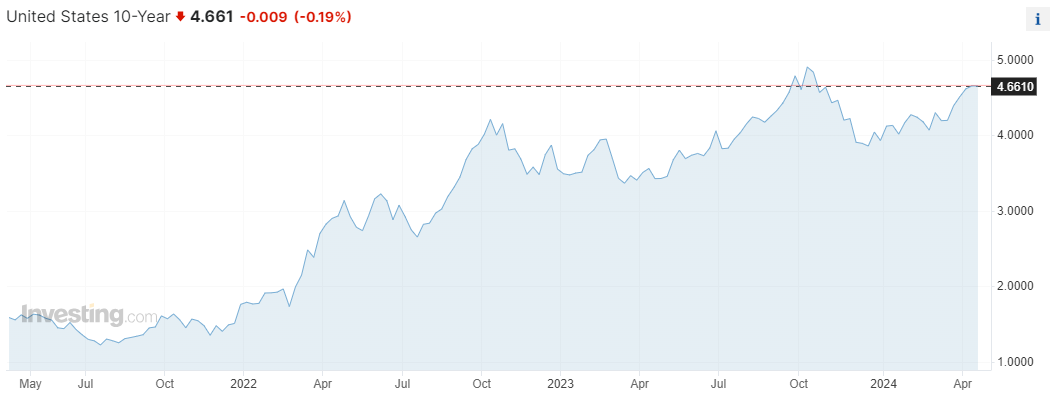
Almost as if all of us Austrian Economists (read: any carbon based life form using common sense when it comes to finance) live in an echo chamber together, a third expert I respect came out over the last few days and has warned that 5% on the 10 year treasury would be the breaking point for markets and the economy.

If my calculations are correct, when this thing hits 5%…you’re going to see some serious sh*t.

Peter Schiff now argues that the Federal Reserve and US Treasury are being forced to confront the reality that inflation is persistent, which has led to an increase in yields, recently reaching 4.7% on the 10 year, the highest since November.

The thought process, for financial neophytes, is that bond traders will continue to sell bonds, driving yields up, in order to make it difficult for the Fed to cut rates — and essentially forcing the Fed to fight inflation head-on instead of capitulating to the economy and markets (should they crash).

This follows Jack Boroudjian’s analysis from last week, stating that rates will keep drifting higher and that 5% to 5.5% is the danger zone: Yields To Trigger “Serious Earthquakes” Across Economy: Jack Boroudjian

It also follows Harris Kupperman’s similar take: Bond Market About To Have An “Aneurism”: Harris Kupperman

Put simply, the Fed faces a dilemma: it needs to raise rates to combat inflation and make Treasuries more appealing, but higher rates would exacerbate the already burdensome debt servicing costs and threaten industries reliant on borrowing. Or, to use the parlance of my recent interview with Matt Taibbi, higher rates simply serve up another day of “sh*t burgers” to the economy, whereas lower rates act as rocket fuel for economic activity (and market confidence).

Schiff warned last week that once the 10-year Treasury yield surpasses 5%, it enters perilous territory for debt-dependent sectors like automotive and commercial real estate. He writes:

The only way the Fed can possibly tame inflation is with interest rates so high that everything collapses. Jamie Dimon himself sees 8% interest rates being needed to tame America’s Fed-fueled inflation beast — but with an economy addicted to a low cost of borrowing, this would make loans unaffordable for entire sectors of the economy that can’t do without.

A serious implosion in commercial real estate would certainly bleed into the banking sector, beginning a chain reaction. Meanwhile, with no chance of the US reigning in spending and getting its fiscal house in order, interest on the US debt can already only be paid with even more borrowed money.

And that chain reaction may already be in the works, as yet another bank failed last week when state regulators shut down Republic First Bank in Philadelphia on Friday evening, transferring its assets to the Federal Deposit Insurance Corp. (FDIC):

As of January 31, 2024, Republic Bank had approximately $6 billion in total assets and $4 billion in total deposits.  The FDIC estimates that the cost to the Deposit Insurance Fund (DIF) related to the failure of Republic Bank will be $667 million. The FDIC determined that compared to other alternatives, Fulton Bank’s acquisition of Republic Bank is the least costly resolution for the DIF, an insurance fund created by Congress in 1933 and managed by the FDIC to protect the deposits at the nation’s banks.  Republic Bank is the first U.S. bank failure this year; the last failure was Citizens Bank, Sac City, Iowa on November 3, 2023.

Even more concerning is that some of the usual suspects who defend the Fed or the Keynesian line — like Art Laffer, who claimed in 2006 that the impending housing crisis was going to be nothing more than a “nice slow down” — also agrees.

Laffer, president of Laffer Tengler Investments and usually a foil to Schiff’s analysis, told Reuters last week: “Inflation is not coming down like the Fed thought it was. You’re not getting paid to take risk in the bond market right now.”

What’s next — Paul “CPI ex-everything you can possible buy doesn’t look too bad and we should claim victory over inflation” Krugman having a reality check, too?

I won’t hold my breath.


🔥 40% off FOR LIFE: Use this special coupon link and get 40% off an annual subscription, good for as long as you wish to remain a subscriber.


“The fiscal conditions of the U.S. are starting to matter, and it can put tremendous pressure on yields and push down on equity valuations in a very short period of time if the market starts to worry more,” said another analyst, Bryant VanCronkhite, who put a little Wall Street jargon lipstick on the pig of his broader point: markets could fucking crash.

I think Schiff is dead on — with limited options and banks now failing, the Fed may even try to resort to rate cuts or quantitative easing to avert a bond market collapse and stimulate borrowing while rates are high. If this happens, and the Fed prioritizes short-term stability over long-term consequences, it would be like dousing the pilot light of inflation with a 55 gallon barrel of naphtha — which is, to say the least, an explosion. The price of everything that isn’t bolted to the ground will soar: the good (financial assets, gold, etc.), the bad (everyday consumer items), and the ugly (costs of running a business, which will lop on more pressure to raise wages).

“This is especially true now, as the Fed doesn’t want to anger the incumbent during an election year,” Schiff writes, “giving it further impetus to make the economy look as rosy as possible, at least until the start of the next presidential cycle.”

And I’m inclined to side with the Austrians on this one — without gold or other hard assets and sound money in this situation, you risk becoming a case study in what inflation can do to purchasing power in the worst type of way. Personally, I’m partial to gold miners and the GDX still, but hey — read the below disclaimer carefully.

QTR’s Disclaimer: I am an idiot and often get things wrong and lose money. I may own or transact in any names mentioned in this piece at any time without warning. Contributor posts and aggregated posts have not been fact checked and are the opinions of their authors. They are either submitted to QTR, reprinted under a Creative Commons license or with the permission of the author. This is not a recommendation to buy or sell any stocks or securities, just my opinions. I often lose money on positions I trade/invest in. I may add any name mentioned in this article and sell any name mentioned in this piece at any time, without further warning. None of this is a solicitation to buy or sell securities. These positions can change immediately as soon as I publish this, with or without notice. You are on your own. Do not make decisions based on my blog. I exist on the fringe. The publisher does not guarantee the accuracy or completeness of the information provided in this page. These are not the opinions of any of my employers, partners, or associates. I did my best to be honest about my disclosures but can’t guarantee I am right; I write these posts after a couple beers sometimes. Also, I just straight up get shit wrong a lot. I mention it twice because it’s that important.

Tyler Durden
Wed, 05/01/2024 – 12:25

The Great Gold Vs Bitcoin Debate: ZeroHedge Presents Roubini And Schiff Against Scaramucci And Voorhees

The Great Gold Vs Bitcoin Debate: ZeroHedge Presents Roubini And Schiff Against Scaramucci And Voorhees

Proponents of gold and bitcoin often hail from the same ideological background: Austrian economists, dollar bears, Libertarians tired of State manipulation of fiat currencies and, generally, the anti-Fed crowd. Yet shared principles have not eased the age-old rivalry between the two assets.

Relative to Bitcoin, gold lost considerable value last year as an ounce of gold fell from 0.11 BTC to almost 0.03 BTC, a historically important level. The last month has seen the precious metal rebound somewhat relative to ‘digital gold’:

However, as Benjamin Graham said: “In the short run, the market is a voting machine, but in the long run, it is a weighing machine.” So we are more interested in the fundamentals:

  • Does Bitcoin’s instant transferability and infinite portability make it the superior asset/security? Or is it a worthless string of numbers with infinite substitutes?

  • Will gold’s thousand-year history as the preferred monetary commodity continue in the digital age? Or does its reliance on third-party custodians (at least at scale), and significant bulk, make it inferior to BTC?

We’ll answer these questions – and more – this Friday.

On May 3 at 7pm ET, ZeroHedge is partnering with Crypto Banter to bring together top macroeconomic minds to debate.

In the anti-crypto corner is the man whose name is synonymous with “gold”, infamous crypto bear Peter Schiff. Alongside Schiff will be “Dr. Doom”, renowned economist Nouriel Roubini.

Arguing in favor of crypto will be Anthony Scaramucci – wealth manager with over $10 billion in AUM – as well as day-one crypto veteran Erik Voorhees, founder of ShapeShift and torch-bearer for the asset class’ libertarian roots.

The debate will be moderated by Ran Neuner, founder and host of Crypto Banter, one of the largest digital asset news channels on YouTube.

Learn more about our VIP ticket offering to attend the debate in person and grab dinner with the participants here.

ZeroHedge would also like to thank our sponsors for this debate: Preserve Gold and BITLAYER — “Layer 2. The future of Bitcoin.” Whether you’re a fan of gold or Bitcoin, you probably see the wisdom in diversifying away from U.S. dollars. Do so by visiting their websites and checking out their products.

ZeroHedge Goldbugs can access a special offer from Preserve Gold by texting “ZERO” to 50505.

Tyler Durden
Wed, 05/01/2024 – 12:10

Feds Scrutinizing Block’s Square And Cash App, Eyeing If Transactions Funded Terror And Skirted Sanctions

Feds Scrutinizing Block’s Square And Cash App, Eyeing If Transactions Funded Terror And Skirted Sanctions

Federal prosecutors are investigating compliance issues at Block, the fintech firm co-founded by Jack Dorsey, according to a new report from NBC, citing “two people with direct knowledge”. 

Questions about the company started swirling back in March 2023 when short seller Hindenburg Research released a report called “Block: How Inflated User Metrics and “Frictionless” Fraud Facilitation Enabled Insiders To Cash Out Over $1 Billion”. 

In it, they concluded that “the ‘magic’ behind Block’s business has not been disruptive innovation, but rather the company’s willingness to facilitate fraud against consumers and the government, avoid regulation, dress up predatory loans and fees as revolutionary technology, and mislead investors with inflated metrics.”

Now, a former employee has shared documents revealing insufficient customer information collection, transactions involving sanctioned countries, and cryptocurrency dealings with terrorist groups, the latest report from NBC says.

The employee claims many transactions weren’t reported as required, and Block failed to address the breaches despite being notified. The documents detail transactions with entities in sanctioned countries, including Cuba, Iran, Russia, and Venezuela, as recent as last year.

One former told NBC: “From the ground up, everything in the compliance section was flawed. It is led by people who should not be in charge of a regulated compliance program.”

“It’s my understanding from the documents that compliance lapses were known to Block leadership and the board in recent years,” Edward Siedle, a former Securities and Exchange Commission lawyer who represents the former employee and participated in the discussions with prosecutors told NBC

Cash App, a mobile payment platform under Block’s ownership, faced allegations of compliance failures from two other whistleblowers in mid-February. Introduced in 2013, Cash App enables instant money transfers and stock and Bitcoin purchases. By December, it boasted 56 million active transacting accounts and $248 billion in inflows over the previous four quarters.

Block commented to NBC: “Block has a responsible and extensive compliance program and we regularly adapt our practices to meet emerging threats and an evolving sanctions regulatory environment. Our compliance program includes systems, tools, and processes for sanctions screening, as well as investigating and reporting on sanctions issues in accordance with our regulatory obligations.”

They continued: “Continually improving the safety and security of our ecosystem is a top priority for Block. We have been and remain committed to building upon this work, as well as continuing to invest significantly in our compliance program.”

Federal prosecutors are also examining Square, another key component of Block’s operations, which serves millions of merchants. According to documents provided to prosecutors and reviewed by NBC News, Square allegedly failed in basic customer due diligence on international merchant sellers and mistakenly reimbursed some merchants’ funds frozen for sanctions violations.

The documents also reveal that new customers triggering sanctions alerts were allowed to conduct transactions before resolution, with instances of inadequate screening against sanctions keyword lists, the report adds.

Cash App, due to its design, also apparently heightened compliance risks, NBC wrote. A document highlighted the challenge, stating that stored balances in Cash App are typically depleted by the time of review, limiting the platform’s ability to block or reject funds.

The former employee also informed prosecutors of findings from an external consultant hired by Block, which identified nearly 50 deficiencies in monitoring suspicious activities and screening for sanctions violations.

Board members including Lawrence Summers and Sharon Rothstein have also recently departed the company.

Tyler Durden
Wed, 05/01/2024 – 11:50

Job Openings Tumble, Quits Plunge, Hires Unexpectedly Crater To January 2018 Levels

Job Openings Tumble, Quits Plunge, Hires Unexpectedly Crater To January 2018 Levels

After several months of relatively boring JOLTS prints, this morning Janet Yellen’s favorite labor market indicator once again got exciting, and not in a good way.

Starting at the top, according to the March JOLTS reported, job openings unexpectedly tumbled by 325K – the biggest drop since October 2023 – from an upward revised 8.813 million in February to just 8.488 million, far below the 8.690 million expected – and the lowest number since February 2021 when it last printed below 8 million.

The 192K miss to estimates of 8.690 million, was the biggest since last October.

According to the DOL, in March job openings decreased in construction (-182,000) and in finance and insurance (-158,000), but increased in state and local government education (+68,000) because when all else fails, just “hire” more government zombies, ideally in the form of unionized illegal aliens to boost wages and inflation.

The kicker: construction jobs openings plunged from 456K to 274K, a 182K one-month drop and the biggest on record!

In the context of the broader jobs report, in March the number of job openings was 2.059 million more than the number of unemployed workers (which the BLS reported was 6.429 million), down significantly from last month’s 2.355 million and the lowest since June 2021.

Said otherwise, in March the number of job openings to unemployed dropped to 1.32, a sharp slide from the February print of 1.36, matching the lowest level since August 2021 and almost back to pre-covid levels of 1.3.

But even more interesting than the drop in job openings was the number of quits: here we find that the number of people quitting their jobs, an indicator closely associated with labor market strength as it shows workers are confident they can find a better wage elsewhere – unexpectedly plunged by 198K, the biggest montyly drop since last June, to just 3.329 million the lowest number since January 2021!

But perhaps the most notable twist, is that amid the stagnant level of job openings, not only did the number of quits plunge – as workers no longer expect to find better paying jobs elsewhere – but so did the number of hires, which cratered by 281K to just 5.500 million – the lowest since Jan 2018 (excluding the record one-month plunge due to covid), and is now well below pre-covid levels.

Needless to say, a freeze in hiring is always the precursor to a wholesale collapse in the labor market, which we expect will materialize in 2-3 months, but since the election  will determine what econ data is published, expect the US economy to be in freefall the moment Trump wins the election.

It’s not just us warning on this metric: the chief economist as Glassdoor, Daniel Zhao, echoes our warning that “employers are hesitant to hire & workers are hesitant to switch to a new job”

His conclusion: “low hires, quits and layoffs are an unusual combination that points to a certain “lock-in” in the job market. For the Fed, that is likely to tamp down wage growth driven by job switchers even if it doesn’t slow net jobs growth.”

Finally, no matter what the “data” shows, let’s not forget that it is all just estimated, and it is safe to say that the real number of job openings remains still far lower since half of it – or some 70% to be specific – is guesswork. As the BLS itself admits, while the response rate to most of its various labor (and other) surveys has collapsed in recent years, nothing is as bad as the JOLTS report where the actual response rate remains near a record low 33%

In other words, more than two thirds, or 70% of the final number of job openings, is estimated!

And at a time when it is critical for Biden to still maintain the illusion that at least the labor market remains strong when everything else in Biden’s economy is crashing and burning, we’ll let readers decide if the admin’s Labor Department is plugging the estimate gap with numbers that are stronger or weaker (we already know that they always get revised lower next month).

Tyler Durden
Wed, 05/01/2024 – 10:39

WTI Extends Losses After Bigger Than Expected Crude Build

WTI Extends Losses After Bigger Than Expected Crude Build

Oil prices extended losses overnight (3rd day lower in a row) following API’s report showing an unexpected crude build. Rising stocks would add to bearish headwinds for prices driven by hopes that peace (or some such variant of it) may break out in the Middle East.

“The potential for a cease-fire agreement between Israel and Hamas has eased concerns of an escalation of the conflict and any possible disruptions to supply,” ANZ Banking Group Ltd. analysts Brian Martin and Daniel Hynes said in a note.

“Continued signs of inflation also raised concerns about demand for crude oil” ahead of the US driving season, when gasoline consumption rises.

Additionally, OPEC’s crude production stayed steady last month, leaving the group’s latest cutbacks incomplete.

The Organization of Petroleum Exporting Countries pumped 26.81 million barrels a day in April, about 50,000 a day less than the previous month, according to a Bloomberg survey. Minor increases by Libya and Iraq were offset by reductions in Iran and Nigeria.

As a result, supply curbs agreed by the group and its allies at the start of the year to avert a surplus are still unfinished

Will the official data confirm API’s unexpected build…

API

  • Crude +4.91mm (-1.5mm exp)

  • Cushing +1.48mm

  • Gasoline -1.48mm (-1.2mm exp)

  • Distillates -2.19mm (+400k exp)

DOE

  • Crude +7.265mm (-1.5mm exp)

  • Cushing -1.089mm

  • Gasoline +344k (-1.2mm exp)

  • Distillates -732k (+400k exp)

The official data showed an even bigger crude build than API (and stocks at Cushing also rose significantly)…

Source: Bloomberg

The Biden admin added another 594k barrels to the SPR last week…

Source: Bloomberg

US Crude production was flat at 13.1mm b/d…

Source: Bloomberg

WTI was hovering around $81.25 (off the morning lows) ahead of the official data and extended losses after the big build…

Finally, we note that oil options are signaling that traders are becoming less worried about conflict in the Middle East driving crude prices higher.

About 1,000 more Brent put options – which give the holder the right to sell at a pre-determined price and time – changed hands than bullish calls on Tuesday. That’s the first time put volumes have outnumbered calls since late March.

Puts are trading at their biggest premium to calls since the end of March.

Tyler Durden
Wed, 05/01/2024 – 10:36

Whoopi Goldberg “Enraged” By Donald Trump Saying There Is An “Anti-White Feeling” In America

Whoopi Goldberg “Enraged” By Donald Trump Saying There Is An “Anti-White Feeling” In America

Authored by Paul Joseph Watson via modernity.news,

The View host Whoopi Goldberg said she was “enraged” over Donald Trump asserting that there is “an anti-white feeling in America.”

Goldberg made the remarks as she angrily glared at the camera.

“This is my favorite, and I’m gonna tell you before I say it that it enraged me,” she said before going on to quote Trump, who said, “There is a definite anti-white feeling in the country right now.”

Apparently, Trump pointing out a manifestly factual phenomenon is enough alone to infuriate Goldberg and the audience, which murmured with sanctimonious discontent.

That’s what he said!” continued Goldberg, before going on to suggest that there can’t be any “anti-white feeling” until white people are literally being lynched.

“Yeah, Sir. Nobody in your family was hung. Nobody in your family was chased because of the color of their skin. How dare you? There’s no anti-white issue here. You are perpetrating anti-humanist issues here,” she said.

One respondent on X provided a comprehensive response cataloguing dozens of examples of where the media, academia and major institutions have engaged in deliberate anti-white sentiment.

Another warned that Goldberg’s rage is another example of how “they’re saying the quiet part out loud.”

Others noted how absolutely nobody in Goldberg’s family was hanged, rendering her entire argument obsolete.

As we previously highlighted, Goldberg’s co-host Sunny Hostin faced embarrassment when it was revealed that her ancestors were actually white European slave owners.

Your support is crucial in helping us defeat mass censorship. Please consider donating via Locals or check out our unique merch. Follow us on X @ModernityNews.

Tyler Durden
Wed, 05/01/2024 – 10:15

More Stagflation Signals As Manufacturing Surveys Show Soaring Prices, Orders Tumble

More Stagflation Signals As Manufacturing Surveys Show Soaring Prices, Orders Tumble

While ‘hard’ data has been improving recently (albeit then downwardly revised a month later), it is the ‘soft’ survey data that has collapsed amid Bidenomics.

Source: Bloomberg

And this morning continued that trend as S&P Global’s US Manufacturing PMI (survey) fell from 51.9 in March to 50.0 as the final print for April (49.9 flash). ISM’s Manufacturing survey also missed, dropping from 50.3 to 49.2 (contraction).

Source: Bloomberg

Chris Williamson, Chief Business Economist at S&P Global Market Intelligence, said:

Business conditions stagnated in April, failing to improve for the first time in four months and pointing to a weak start to the second quarter for manufacturers. Order inflows into factories fell for the first time since December, meaning producers had to rely on orders placed in prior months to keep busy.

However, there are some encouraging signs. The drop in orders appears to have been largely driven by reduced demand for semi-manufactured goods – inputs produced for other firms – as factories adjust their inventories of inputs. In contrast, consumer goods producers reported a further strengthening of demand, hinting that the broader consumer-driven economic upturn remains intact.

Producers on the whole also seem confident enough in the business outlook to continue adding to payroll numbers at a pace that compares well with the average seen over the past two years, investing further in operating capacity.

But, under the hood it was not pretty – ISM New Orders tumbled, Employment rose modestly, but Prices Paid soared (to their highest since June 2022)

Source: Bloomberg

Prices charged for goods rose at a slower rate than the 11-month high seen in March. But, as S&P Global notes, the rate of increase nevertheless remains elevated by historical standards – and well above the average seen in the decade prior to the pandemic – as firms continued to pass higher commodity prices on to customers.

However, input costs increased sharply, with the rate of inflation quickening for the second consecutive month. Higher prices for oil and metals were mentioned in particular.

So, stagnating growth and sharply rising input costs… Stagflation signals everywhere.

Tyler Durden
Wed, 05/01/2024 – 10:07