62.3 F
Chicago
Monday, September 21, 2026
Home Blog Page 2707

Congress Passes New Iran Oil Sanctions But Biden Unlikely To Enforce Them

Congress Passes New Iran Oil Sanctions But Biden Unlikely To Enforce Them

Over the weekend, as part of the $95 billion package providing funding for aiding Ukraine, Israel and Taiwan which passed by a vote of 360-58 on Saturday, the US House also passed new sanctions on Iran’s oil sector set to become part of a foreign-aid package, putting the measure on track to pass the Senate within days.

The legislation, as Bloomberg reports, would broaden sanctions against Iran to include foreign ports, vessels, and refineries that knowingly process or ship Iranian crude in violation of existing US sanctions. It would also would expand so-called secondary sanctions to cover all transactions between Chinese financial institutions and sanctioned Iranian banks used to purchase petroleum and oil-derived products.

About 80% of Iran’s roughly 1.5 million barrels of daily oil exports are shipped to independent refineries in China known as “teapots,” according to a summary of similar legislation.

Yet while the sanctions could impact Iranian petroleum exports – and add as much as $8.40 to the price of a barrel of crude – they also include presidential waiver authorities, according to ClearView Energy Partners, a Washington-based consulting firm.

“President Joe Biden might opt to invoke these authorities, vitiating the sanctions’ price impact; a second Trump Administration might not,” ClearView wrote in a note to clients.

Amrita Sen, founder and research director of Energy Aspects, agreed and told Bloomberg Television in an interview that Biden’s Administration is unlikely to “strongly enforce” the restrictions in an election year.

“I think all sanctions are sanctions on paper, with anything that remotely causes oil prices to go up, I don’t believe they will enforce it strongly,” the research analyst told Bloomberg.   

“What I really want to highlight is this is a US election year, so let’s not kid ourselves,” the analyst noted.

By not kidding ourselves, he meant that when it comes to democratic, liberal ideals, it’s all bullshit when they conflict with self-serving interests of the demented deep state puppet roaming the halls of the White House.

Moreover, China is buying most of Iran’s crude oil exports, and the majority of buyers in the world’s top crude oil importer are the independent refiners, the so-called ‘teapots’ in the Shandong province, which are not connected with the U.S. financial system in any way.

Therefore, the U.S. doesn’t have any means to enforce sanctions on China’s independent refiners for buying Iranian crude oil, Sen told Bloomberg. The teapots will continue to import Iran’s crude, while any new restrictions could take up to 500,000 barrels per day (bpd) of Iranian oil off the market, she added.

Crude oil exports from Iran hit the highest level in six years during the first quarter of the year, data from Goldman recently showed.

The daily average over the period stood at 1.56 million barrels, almost all of which was sent to China, earning the Islamic Republic some $35 billion.

“The Iranians have mastered the art of sanctions circumvention,” Fernando Ferreira, head of geopolitical risk service at Rapidan Energy Group, told the FT. “If the Biden administration is really going to have an impact, it has to shift the focus to China.”

Tyler Durden
Mon, 04/22/2024 – 18:00

The Bad Faith Olympics

The Bad Faith Olympics

Authored by James Howard Kunstler via Kunstler.com,

“This is the weirdest era in human history. By far. Nothing else even comes close. Billionaires trying to kill everyone. Civil society unable to form a coherent thought. Institutions lie in smoldering ruins. Poisons handed out like candy. We are Neanderthals with iPhones.”

– Dr. Toby Rogers

Did it warm your heart to see all those blue and yellow Ukrainian flags waved by our elected officials in Congress Saturday night with the passage of the $60-plus-billion aid bill to the Palookaville of Europe?

You realize, don’t you, that the tiny fraction of that hypothetical “money” – from our country’s empty treasury – that ever reaches Ukraine will rebound on the instant into Mr. Zelensky’s Cayman Islands bank account.

The rest of the dough enters the recursive shell-game between US weapons-makers and the very hometown folks in Congress waving those blue and yellow flags, who will receive great greasy gobs of fresh “campaign donations” from the grateful bomb and missile producers.

No wonder they’re cheering.

What the $60-plus-billion won’t do is provide any fresh arms and equipment to Ukraine’s sad-sack army soon enough to prevent Russia from bringing this cruel, stupid, and unnecessary war, which we started, to a close. Yes, we started it, not Russia, in 2014 with our Intel blob overthrowing elected President Viktor Yanukovych in the so-called “Maidan Revolution of Dignity” (what Wikipedia calls it). And for what reason? To jam Ukraine into NATO as a prelude to “weakening” Russia sufficient to bust it up and gain control over Russian oil, ores, and grain.

Yes, that was actually the neocon’s game, equal parts megalomania and hubris, a fiasco as strategically ill-fated as Hitler’s push to gain control of Russia’s oil fields via Stalingrad in 1942-3. With failure and humiliation looming in Ukraine, the blob’s objective for now, in theory, is the vain hope of prolonging the hostilities just long enough to get its hologram president, “Joe Biden” re-elected, so that said blob can continue its amoebic digestion of what’s left uneaten by it in our sore-beset republic. You’ve got to wonder, of course, what this blob thinks will remain to rule over when it’s done gobbling up everything and jailing everyone from sea to shining sea who objects.

You tell me what conceivable way Ukraine can prevail in this proxy war now without just tripping off the civilization-ending nuke exchange? America does not have enough tactical missiles and artillery shells at hand to send over there. What we did have is gone. NATO never had much to begin with. Ukraine has run out of available cannon-fodder to conscript from its dwindling population. Despite Mr. Macron’s recent bluster, NATO can’t raise a credible army, or even agree on which country would send what. Nobody is riding to the rescue. Instead, Russia is fortifying its home-grown armaments industry and its military while systematically turning off the electricity all over Ukraine by blowing up the power stations. Very soon, Ukraine will be reduced to medieval living conditions — no lights, no phones, no Internet, no shopping, no ability to conduct modern warfare. End. . . of. . . story.

This is apt to play out much faster than America’s blob-controlled news media will be able to lie about. I’d guess it can be functionally over before mid-summer. The result will be yet another humiliation on the “Joe Biden” scorecard. When it’s over, you can be sure the Russians will abstain from an end-zone dance so as not to provoke America’s genius-losers into some final petty grand act of requital. Russia will just soberly declare what is self-evident: that for centuries Ukraine has been in its sphere-of-influence, as Mexico is in ours, and that they have reestablished the natural order of things in that corner of the world.

After that, America and the rest of Western Civ can get on with the collapse of their financial system and very likely a period of profound political and economic chaos in which governments fall, nations change boundaries and shapes, and their populations suffer dramatically from an imploded standard of living. That process may actually play out somewhat slower than the end of the Ukraine war over the coming years. It will look like a combined game of musical chairs and hot potato, with the opportunities to get a seat steadily fading, and the losers left holding things they can’t handle.

In the meantime, our country — remember it, the USA, when it had its once-enviable mojo working? — is busy being insane and finding sixty ways to Sunday to commit suicide.

How do you suppose the Democratic Party will actually pretend to put up “Joe Biden” for re-election when the Ukraine failure is completed? Answer: they can’t.

This dumbshow of the old gaffer hiding at his beach house and avoiding direct engagement with reality is also drawing to a close. Instead of calling “a lid” on “JB’s” activities, some humid morning in the swamp his handlers will call in “a medical alert” instead, and that will be the last we see of that dreadful apparition.

It’s also looking more and more as though the Republican Party faces its own civil war, especially after Speaker Mike Johnson’s perplexing flipperooski on the Ukraine aid vote. You recall, just weeks ago he said no dice to such a deal without a stop to the invasion coming across our Mexican border. Then, the intel blob boys lured him into a SCIF (Sensitive Compartmented Information Facility) where they showed him . . . something. . . ! Everyone’s dying to know what. A secret signed agreement making Ukraine our 51st State? Photographs of Mike engaged in unwholesome recreations with Gawd knows who or what? Or did they just have a little talk with him about how stuff is supposed to work? Whatever it was has made Mike Johnson untenable in his position. And he has explained nothing. He’s got to go.

At the other end of all that stands — or, rather, sits at a defense table — Donald Trump, the seemingly inevitable leader of a party seeking to cough him up like a hairball stuck in its craw. And yet, every week that passes, the various lawfare traps set up to snare him to look more amateurish and gauche — while the Golden Golem of Greatness somehow manages to power through all that adversity. A big faction of the party he leads is in on that nefarious game.

The wild card is the increasingly inflamed mood of the American people, in whose name the game is supposedly being played.

With absolutely everyone lying to them about everything, it’s turned into some kind of bad faith olympics.

*  *  *

Support his blog by visiting Jim’s Patreon Page or Substack

Tyler Durden
Mon, 04/22/2024 – 16:20

Gold Hammered As Short-Squeeze Saves Stocks Ahead Of Micro/Macro Storm This Week

Gold Hammered As Short-Squeeze Saves Stocks Ahead Of Micro/Macro Storm This Week

The “calm before the storm” of earnings and big macro this week (and no WW3 this weekend) was all the algos needed to ramp stocks during the US cash session after being reminded that the buyback-blackout period is almost over…

Stocks had fallen from up around 0.6% at the cash open to unchanged by the European close… and then the algos all remembered, buybacks are coming back soon to save the world and stocks went vertical… together… with everything up 1.5% at the highs before the 1430ET margin-calls and the squeeze ammo ran out, leaving stocks fading into the close (but still a solid green day after some recent pain).

…as a basket of the ‘most shorted’ stocks exploded higher (biggest short squeeze in a month). We not note that the squeeze stalled at an interesting level…

Source: Bloomberg

0-DTE traders were active today. Buying straddles/strangles early on, then call-buyers pounced in size, inevitably prompting early put-buyers to unwind (back to net zero delta – which seemed to end the ramp), before the straddles were unwound into the close…

Source: SpotGamma

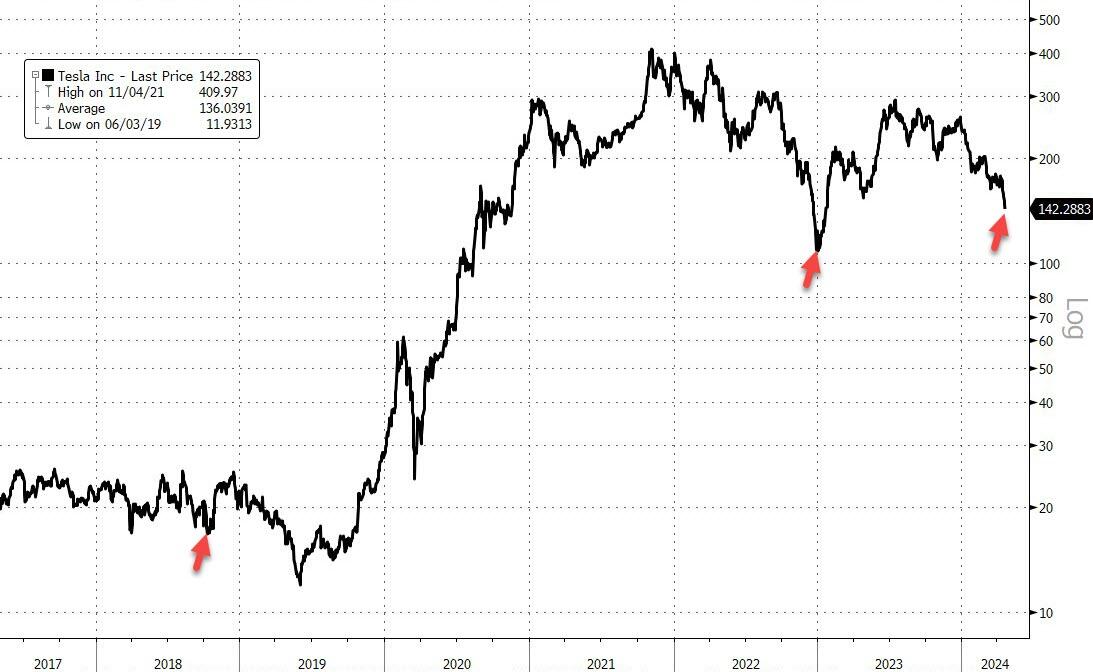
TSLA was twatted again – seventh straight down-day (equal longest-losing-streak ever). The last two times it dropped seven straight days, it ripped back (Sep 2018, +50% in next two months; Dec 2022, +100% in next two months)…

Source: Bloomberg

Interestingly Goldman’s trading desk noted overall activity levels are flat vs. the trailing 2wk avg, with mkt volumes down -8% vs. the 10dma

  • For the 2nd straight session we lean better to buy at +6.5% overall – this is our highest buy skew since 3/1/24

  • HFs are a massive driver of that demand tilting +22% better to buy, this ranks 98th %-ile & backs up last week’s PB report highlighting single stocks saw the largest notional long buying in over a year.  HF demand tils towards Fins, Cons Disc, Indust, Info Tech & HCare with modest supply in Materials, Comm Svcs, Staples & REITs.

  • LOs are -5% better for sale which continues their theme from Friday.  Supply is most concentrated in Info Tech, Fins & Industrials with modest demand for Staples, REITs & Cons Disc. 

Equity vol markets are primed for the next week’s action though…

Source: Bloomberg

Treasuries were relatively quiet with an overnight sell-off but bid during the day session with the short-end outperforming (2Y -2bps, 30Y unch)…

Source: Bloomberg

Once again, 5.00% was resistance for the 2Y yield…

Source: Bloomberg

The dollar roller-coastered a little today ended unch…

Source: Bloomberg

Bitcoin extended the weekend’s rebound (post-halving), testing back up towards $67,000…

Source: Bloomberg

Gold, on the other hand, was clubbed like a baby seal – after rising for 13 of the last 17 days, today saw its biggest daily loss since June 2022. But that drop only pulled it back to one-week lows…

Source: Bloomberg

Oil prices chopped around all day with WTI hovering at $82 and ended unchanged…

Source: Bloomberg

Finally, there’s this… market liquidity in stocks…

…and bonds…

…is dismal – and in a week full of major macro catalysts (e.g. PCE) and massive micro events (MAG7 earnings), that will likely mean some serious gaps (and with gamma so negative, things could get violent, one way or another).

Tyler Durden
Mon, 04/22/2024 – 16:00

Here Comes The Cavalry?

Here Comes The Cavalry?

By Benjamin Picton of Rabobank

Here Comes The Cavalry?

The risk of imminent hot war between Israel and Iran seems to have dissipated for the time being. Israel on Friday delivered its promised response to the Iranian strike of the weekend before by hitting targets in Syria and the Iranian city of Isfahan. Reporting of the strikes has stressed that they were ‘modest’, while Israeli Minister of the Interior Ben Gvir tweeted “weak!” in Hebrew at the time of the attacks. The Israeli response appears to have been carefully calibrated to de-escalate, while also sending a message to Iran. Iran has played-down the Israeli attack, which suggests that the promised 10x escalation is not going to be immediately forthcoming.

According to the New York Times, the strike on an Iranian airbase outside Isfahan was designed to demonstrate to the Iranian regime that Israel had the capability to hit key Iranian infrastructure if it wanted to. The attack, reportedly using a sophisticated two-stage air to surface missile, damaged Russian-made air defence systems and, critically, landed adjacent to Iranian nuclear assets. The very clear message to Iran being that “we can hurt you if we want to.”

Following the attacks, initial strong rallies in gold and crude oil prices have receded, and both are trading well back from the highs. Gold is back below $2,400/oz, while Brent crude is well under the $90/bbl psychological level, and remains under selling pressure early this morning. Markets might have relaxed slightly, but we should be under no illusion that the conflict is over. Gideon Rachman opines in the FT over the weekend that Russia, Iran, North Korea and China constitute an “axis of adversaries” that are working together in opposition to the West. Indeed, that Iranian nuclear enrichment site outside of Isfahan utilizes Chinese-supplied reactor technology. Regular readers of this Daily will be unsurprised by claims of cooperation among autocratic states as our Global Strategist, Michael Every, has been pointing this out for several years now.

Equity markets on Friday seemed to be pricing the view that “it ain’t over yet”, although possibly for the wrong reasons. The NASDAQ fell by 2%, the S&P500 was down by 0.88% and market darling NVDA fell by 10% following unconfirmed rumours circulating on X that Stanley Druckenmiller has sold down his position.

There’s some logic to be found duration-sensitive equities being hurt most. The Treasuries curve has parallel-shifted 40bps higher since the end of March, despite the sighs of relief heard in dealing rooms on Friday once it became clear that war wasn’t about to break out. The 2-year Treasury is currently dealing on a yield of 5%; Janet Yellen and Co will be hoping that the 10-year doesn’t join it at that level.

Traders aren’t the only ones picking up on the meme of conflict being the new normal. The US House of Representatives came to agreement over the weekend on a $61bn aid bill for Ukraine, Israel and Taiwan. The bill will be debated in the Senate this week before being sent to Joe Biden’s desk for signing (assuming it clears the Senate). The prospect of fresh lethal aid will be welcomed by Ukrainian troops, who have been on the backfoot as shortages of arms, ammunition and manpower prevent them from challenging Russian air superiority, or counterattacking Russian positions.

Ukraine’s leadership will be hoping that the passage of the US aid bill will buy some time for the European military industrial complex to spool-up arms supplies. European aid had recently overtaken aid from the United States, but is more heavily skewed toward financial assistance (rather than armaments). The spectre of a second Trump presidency (and a consequent redirection of US arms and funding) looms large over the conflict in Ukraine. As described by this Daily previously, Emmanuel Macron sees the Ukraine war as vital to the security interests of the European Union, even to the extent that he has not explicitly ruled out deploying French troops in the defence of Ukraine.

Meanwhile, the Japan Times reports that Xi Jinping has ordered the largest reorganisation of China’s military since 2015. Special attention is paid to a reorganisation of China’s cyber and space capabilities into a new branch, in echoes of Donald Trump’s establishment of the US Space Force. With US GDP figures for March due to be released later this week, it will be interesting to see whether the economic and military heavyweight of the Western sphere can replicate the upside growth surprise that its main challenger posted just last week.

With yields having settled at a higher level despite the events of the last two weeks suggesting that ‘risk off’ might be the trade, could another US growth beat be the catalyst for 10y Treasury yields to make a stretch toward that 5% level?

If that proves to be the case, light a candle for the central bankers of the high beta FX world, and for USDJPY.

Tyler Durden
Mon, 04/22/2024 – 15:45

NATO Member Rolls Out Red Carpet For Hamas Chief

NATO Member Rolls Out Red Carpet For Hamas Chief

As head of NATO’s second largest military, Turkish President Recep Tayyip Erdogan has continued to stir controversy among allies by his Hamas-sympathetic stance. As early as last October, just on the heels of the Oct.7 Hamas terror attack, he was bluntly expressing that “Hamas is not a terror organization” but is a “liberation group” rightfully fighting to protect Palestinian lands.

But this weekend he went far beyond mere verbal praise as Turkey’s president played official host to Hamas Political Bureau Chief Ismail Haniyeh in Istanbul.

Turkish Presidency via Anadolu

The Saturday meeting saw Erdogan vow to the Hamas chief that Turkey is committed to raising awareness of the plight of the Palestinians on a global stage. He said Turkey will lead the way toward seeing an independent State of Palestine achieved.

“The strongest response to Israel and the path to victory lie in unity and integrity,” Erdoğan said, referencing Palestinian political unity at this sensitive moment.

Hamas is the main political rival to Fatah – which is the faction that forms the core of the Palestinian Authority (PA) overseeing the West Bank. While the secular-leaning PA is favored as the Palestinians’ representative in the West (and at the UN), Hamas is a designated terror organization in the United States and European Union. So in essence Erdogan just held a state visit for a US-designated terrorist.

Last Wednesday upon officially announcing the Hamas leader’s visit, Erdogan had said, “Even if only I, Tayyip Erdogan, remain, I will continue as long as God gives me my life, to defend the Palestinian struggle and to be the voice of the oppressed Palestinian people.”

From Tel Aviv’s perspective, Erdogan’s ratcheting rhetoric in denouncing Israeli ‘genocidal’ actions will likely been seen as unforgiveable, even after this current crisis is over. Turkey and Israel have long clashed over the Palestinian issue, and these tensions have exploded back into full force. Ties between the two countries are at a historical low point, and have even led to Turkey imposing an export ban on key products for Israel.

Erdogan has all along continued seeking to get Israel branded as a “war criminal” state on the world stage, and is pursuing a case submitted before the the Hague-based International Criminal Court (ICC).

On Saturday Hamas’ Haniyeh said Israel is solely to blame for the near collapse of Qatar-mediated truce talks…

In October, as the Gaza war kicked off, Erdogan confirmed he had canceled a planned trip to Israel where he was expected to meet with his Israeli counterpart. This was part of a normalization and restoration of ties effort, which is clearly now indefinitely on ice. It could be years or even decades before ties are healed between the two countries.

Tyler Durden
Mon, 04/22/2024 – 15:25

Trump Lawyer Rages At “Waste Of Taxpayers’ Dollars” As Judge Approves Trump’s $175 Million Bond In New York Civil Case

Trump Lawyer Rages At “Waste Of Taxpayers’ Dollars” As Judge Approves Trump’s $175 Million Bond In New York Civil Case

Authored by Sam Dorman, Catherine Yang, and Juliette Fairley via The Epoch Times,

Former President Donald Trump and New York Attorney General Letitia James reached an agreement on April 22 regarding his $175 million bond in his New York civil case, imposing additional restrictions while resolving concerns about the funds’ security.

The attorney general argued that Knight Specialty Insurance Company (KSIC) lacked a “certificate of qualification,” and that President Trump still had access to the Charles Schwab account pledged to the insurer as collateral.

Judge Arthur Engoron accepted the April 22 agreement, which gave KSIC exclusive control over the account. The state made the offer after Chris Kise, President Trump’s attorney, provided oral argument.

The attorney general established five bond conditions this morning that allow former President Trump to use a non-New York company as a traditional license surety to cover the $175 million he was ordered to pay.

KSIC is unauthorized by the New York Department of Financial Services, which bond experts see as a victory for Mr. Trump.

“[The company] is probably charging Trump less and they accepted a pledge rather than actually receiving $175 million in cash,” said Bruce Lederman, a commercial and real estate litigator who has dealt in bonds for more than 40 years.

All of Mr. Trump’s attorneys agreed to the settlement stipulations, which are expected to be memorialized by the end of the week.

The five bond conditions include retaining the collateral in a Schwab account and restricting KSIC from trading or withdrawing any of the funds for anything other than payment of the bond.

“The state was not looking to be vindictive,” Mr. Lederman told The Epoch Times.

“They are looking simply to be guaranteed that they are getting paid if they win the appeal and they were sufficiently satisfied that if these five conditions were met, they would get paid.”

Another settlement condition is that KSIC must provide the state with monthly statements and the pledge agreement cannot be amended without court approval.

The fifth condition of the settlement is requires a point of contact for service outside of KSIC. The parties agreed the surety’s lawyer would be the point of service. Mr. Lederman noted that KSIC “is not a New York company. So if they don’t pay, they need someone other than KCIS to sue.”

He added that “the attorney for the surety will accept the lawsuit if Trump loses on appeal and doesn’t pay.”

James’ Criticism

The bond issued by KSIC is meant to secure President Trump’s compliance with a $454.2 million judgment won by Ms. James.

Ms. James had challenged the sufficiency of President Trump’s bond and cast doubt on the stability of the insurance company.

Amit Shah, president of the insurance company, demanded the court compel the attorney general to show cause, or prove the allegation that the insurance company is not sufficient.

Mr. Shah submitted a sworn affidavit explaining that KSIC now has control over a bank account of President Trump’s that will maintain $175 million cash for the duration of the appeal. The insurance company entered into a collateral agreement with the Donald J. Trump Revocable Trust. Mr. Shah submitted documents establishing that his company is in “good standing” and was approved for excess line eligibility in New York in June 2021.

KSIC is under The Hankey Group of financial companies, which includes the affiliate Westlake Financial Services LLC. The attorney general argued that Westlake was found to have “violated numerous federal laws by pressuring borrowers through the use of illegal debt collection tactics, including using phony caller ID information, falsely threatening to refer borrowers for investigation or criminal prosecution” in 2015 by the U.S. Consumer Financial Protection Bureau. The company was fined and provided $44 million in restitution to consumers.

President Trump defended the bond outside the courtroom at his criminal trial.

“We put up cash and the number is 175,” President Trump said.

“She shouldn’t be complaining about the bonding company. The bonding company would be good for it because I put up the money. I have plenty of money to put up.”

After the hearing, President Trump’s lawyer in the case, Alina Habba, fumed at the judge’s incompetence, “he doesn’t even understand basic principles of finance,” and at AG James’ “this is where your taxpayer dollars are going America…witch hunt after witch hunt after witch hunt…”

Habba continued to excoriate the whole farce:

“…in one hour, that judge and the attorney general realized they had no idea what they were talking about… and we came to an agreement that everything would be the same…”

Tyler Durden
Mon, 04/22/2024 – 15:05

“Reality Check” – JP Morgan Warns Of Delay To Global Energy Transition

“Reality Check” – JP Morgan Warns Of Delay To Global Energy Transition

Authored by Irina Slav via OilPrice.com,

Inflation, interest rates, and wars may well delay the energy transition by quite a long time, JP Morgan has warned in a call for “a reality check” on its shift from hydrocarbons to alternatives.

“While the target to net zero is still some time away, we have to face up to the reality that the variables have changed,” the bank’s head of global energy strategy, Christyan Malek, told the Financial Times.

Malek was the lead author of a new report by JP Morgan focusing on energy.

The report noted higher interest rates, inflation, and the wars in Ukraine and the Middle East were all factors acting as setbacks for the transition.

The report—and Malek’s FT interview—coincided with another report, by Reuters, quoting Rystad Energy analysts as warning about the negative effects of higher interest rates on wind and solar energy developers.

“Owing to the capital-intensive (Capex) nature of renewable energy…they are inherently more susceptible to high-interest rates,” Rystad Energy’s head of renewables and power, Vegard Wiik Vollset, said.

Wood Mackenzie has also warned that higher rates are having a negative effect on the economics of wind and solar, as a 2% rate increase can push the levelized cost of electricity for these two sources as much as 20% higher.

“Interest rates are much higher,” JP Morgan’s Malek also said, speaking to the Financial Times.

“Government debt is significantly greater and the geopolitical landscape is structurally different. The $3tn to $4tn it will cost each year come in a different macro environment.”

Because of these challenges, Malek forecasts that governments will dial down the push to transition from oil and gas to wind and solar as their financial resources dwindle.

The FT noted as an example the Scottish parliament’s recent decision to abandon a 75% emission reduction target by 2030 admitting it could not be achieved.

Tyler Durden
Mon, 04/22/2024 – 11:45

US Poised To Send 60 Additional ‘Military Advisers’ To Ukraine

US Poised To Send 60 Additional ‘Military Advisers’ To Ukraine

Authored by Dave DeCamp via AntiWar.com,

The US is considering increasing its small military presence in Ukraine by sending up to 60 additional military advisers, POLITICO reported on Saturday, the same day the House approved $61 billion in spending for the proxy war.

Four unnamed US officials told POLITICO that the additional troops would “support logistics and oversight efforts for the weapons the US is sending Ukraine.”

Joint Multinational Training Group-Ukraine, just prior to the Feb. 2022 Russian invasion.

Pentagon spokesman Brig. Gen. Pat Ryder said the potential deployment would augment US personnel based at the US Embassy in Kyiv.

“Throughout this conflict, the DOD has reviewed and adjusted our presence in-country as security conditions have evolved. Currently, we are considering sending several additional advisers to augment the Office of Defense Cooperation (ODC) at the Embassy,” Ryder said.

Back in October 2022, the Pentagon announced that ODC and defense attaché personnel were back in Ukraine after being absent for the first few months of Russia’s invasion.

The Pentagon said at the time that the personnel were conducting “onsite” inspections of US-provided weapons.

Ryder said the ODC “performs a variety of advisory and support missions (non-combat), and while it is staffed exclusively by DOD personnel, it is embedded within the US Embassy, under Chief of Mission authority like the rest of the Embassy.”

Ryder said the advisers would serve in a non-combat role, but the deployment would still mark an escalation of US involvement in the war and reflect the US’s long-term plans for the conflict. The US has sought to emphasize that they will not participate in battles.

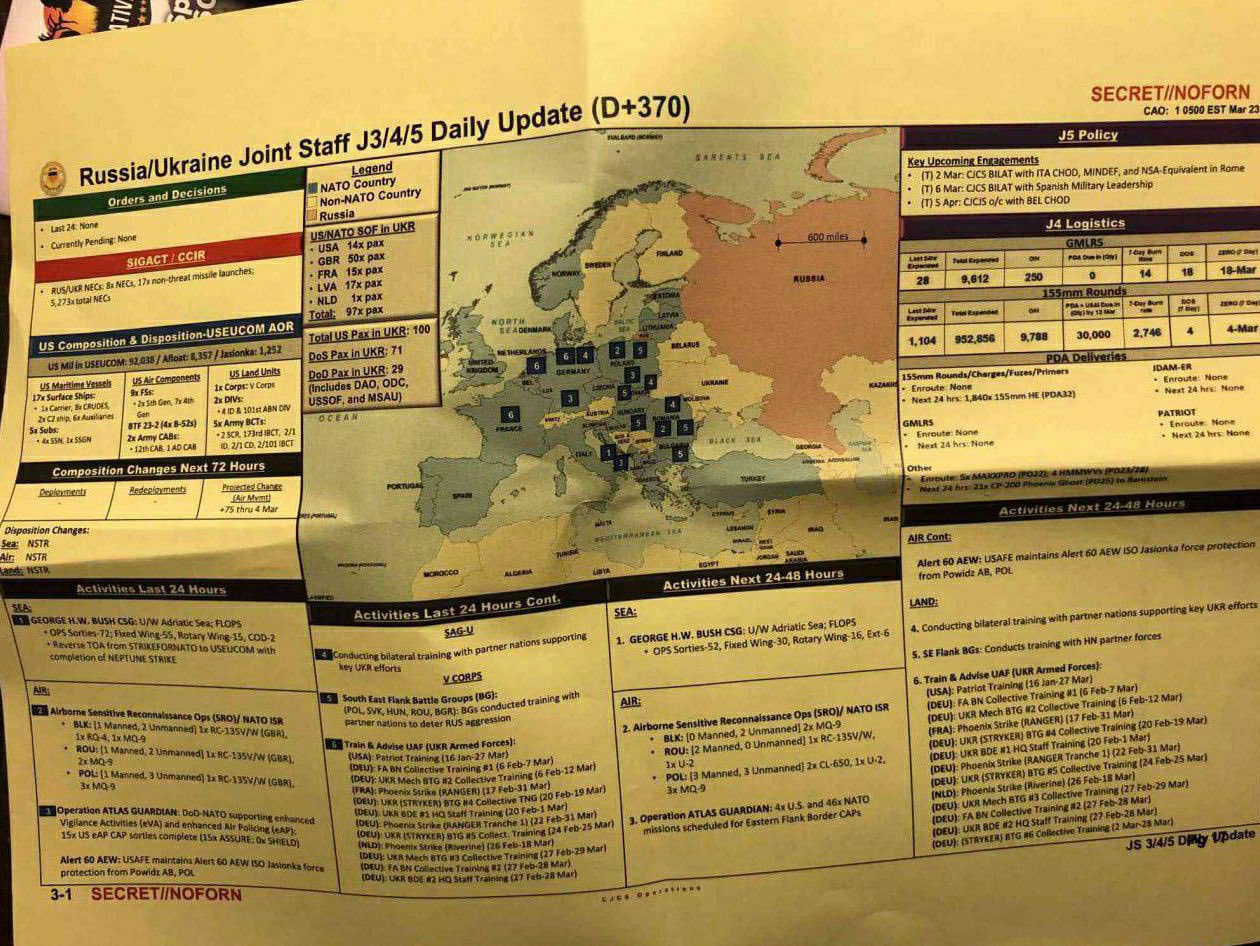
Besides the ODC and defense attaché, the US also has a small number of special operations forces in Ukraine. The Discord leaks revealed last year that as of March 2023, 14 US special operations troops were in Ukraine. 

Tyler Durden
Mon, 04/22/2024 – 11:05

Former Obama White House Senior Policy Advisor Charged With ‘Child Sex Offenses’

Former Obama White House Senior Policy Advisor Charged With ‘Child Sex Offenses’

A 46-year-old former senior policy advisor the Obama administration appeared in a UK court over child sex offense charges.

Rahamim ‘Rami’ Shy, who worked for the White House under both President Barack Obama and Secretary of State Hillary Clinton, is accused of arranging the commission of a child sex offense, possessing two ‘category C indecent images of children, and ‘possessing a prohibited image of a child,’ the Daily Mail reports.

Shy, a US citizen who lives in New Jersey, was arrested in late February by Bedfordshire police and charged the next day. On Friday, he appeared at Luton Crown Court via video-link from Bedford prison wearing a gray prison-issue tracksuit, and will remain in custody ahead of a June hearing.

Most recently employed as an executive at banking group Citi, Shy worked in a senior role at the US Treasury department from 2008 to 2014, advising officials on countering the financing of terrorism and assisting foreign governments to impose sanctions on hostile regimes. As well as working as a senior adviser to the late US diplomat Richard Holbrooke, who served under the last three Democrat presidents, Shy provided strategic policy analysis to chiefs of staff at the US Department of Defence.

He was deployed to Afghanistan to provide expertise to the Nato-led International Security Assistance Force (ISAF), which was set up to maintain stability following the America-led invasion of the country. -Daily Mail

According to Holbrooke, Hillary Clinton personally knew Shy (6:45 mark), who spoke along John Podesta and other notables at a 2009 Center for American Progress discussion about security challenges in Afghanistan and Pakistan.

Shy appears to have deleted his X and LinkedIn accounts.

Shy poses during Army ROTC Commissioning Ceremony at Columbia University

Tyler Durden
Mon, 04/22/2024 – 10:45

REPO Act Passage Has Authorized Biden To Confiscate Russian Assets & Transfer To Ukraine

REPO Act Passage Has Authorized Biden To Confiscate Russian Assets & Transfer To Ukraine

When the House voted to pass Biden’s long sought after foreign aid package Saturday, which will deliver over $60 billion to Ukraine, included in this was passage of the REPO Act, which paves the way for the Biden administration confiscate billions in Russian sovereign assets which sit in US banks.

The US administration has been pursuing a controversial plan to transfer frozen Russian assets to Ukraine for reconstruction, and has been aggressively lobbying G7 countries to jump on board, also given most of the $300 billion in Russian assets are held in Europe – particularly France, Germany, and Belgium.

A summary of the REPO Act – H.R.4175 – on the Congressional website, reads: “This bill requires or authorizes various actions related to the confiscation and disposition of Russian sovereign assets (which include funds and other property of Russia’s central bank, direct investment fund, or ministry of finance).”

Image: EPA/Shutterstock

“Under the bill, the President must require U.S. financial institutions to notify the Department of the Treasury of any Russian sovereign assets located at such institutions. The President may confiscate any such assets subject to U.S. jurisdiction,” it continues. “Confiscated funds and the proceeds of liquidated property must be deposited into the Ukraine Support Fund established by the bill.”

The now approved bill further specifies:

The Ukraine Support Fund shall be used by the Department of State to compensate Ukraine for damages caused by the Russian invasion. The Ukraine Support Fund may also support an international body or mechanism for (1) reconstruction and rebuilding efforts in Ukraine, (2) humanitarian assistance to the Ukrainian people, or (3) other purposes which support the recovery of Ukraine and the welfare of the Ukrainian people.

Importantly, it seeks to bring in international partners toward establishing a mechanism which would tap Russian assets in Europe. “The bill also directs the President to seek to establish, with foreign partners, an international mechanism to provide compensation to Ukraine using the Ukraine Support Fund and Russian sovereign assets confiscated by foreign partners,” the legislation summary says.

But some EU leaders have expressed anxiety over the plan and have thus far resisted, mainly on concerns that it would undermine global trust and confidence in Western banks. Moscow could also see what it deems theft of its sovereign funds as essentially an act of war.

On Monday, the Kremlin reacted to the weekend passage of the REPO Act, vowing to fight and inflict corresponding punishment on the US and West. Putin Spokesman Dmitry Peskov told reporters:

“We are very skeptical about this, because this is essentially the destruction of all the foundations of the economic system. This is an encroachment on state property, on state assets and on private property. By no means should this be perceived as legal action – it is illegal. And accordingly, it will be subject to retaliatory actions and legal proceedings,” the Kremlin official said.

“If such measures are implemented, of course, many investors will think ten times before making any investments in the American economy or storing their assets there,” Peskov added, noting there’s still a long, complex road ahead if Washington ultimately seeks to pull the trigger on stealing Russia’s assets. “This is a very dangerous precedent,” Peskov underscored.

Below: an interesting take from Sen. J.D. Vance…

Starting in February, US Treasury Secretary Janet Yellen began getting more vocal on the “moral case” for using Russian assets to aid Ukraine, telling allies they must find a way to “unlock the value” of the hundreds of billions in immobilized Russian assets, also with an eye towards Ukraine’s post-war reconstruction.

Previously some Ukrainian officials floated the idea of “reparation bonds” backed by future claims for war damages against Moscow, and utilizing frozen Russian assets. These initiatives have gained steam under US leadership.

Tyler Durden
Mon, 04/22/2024 – 10:25