65.9 F
Chicago
Sunday, September 20, 2026
Home Blog Page 2738

Fauci Adviser Secretly Messaged Zoologist Who Funneled Money to Chinese Lab: Emails

Fauci Adviser Secretly Messaged Zoologist Who Funneled Money to Chinese Lab: Emails

Authored by Zachary Stieber via The Epoch Times,

A top adviser to Dr. Anthony Fauci secretly messaged a zoologist who funneled money from Dr. Fauci’s agency to a laboratory in the Chinese city where the first COVID-19 cases appeared, according to newly disclosed emails.

Peter Daszak speaks to media upon arriving at the Wuhan Institute of Virology in China’s central Hubei province, on Feb. 3, 2021. (Hector Retamal/AFP via Getty Images)

Dr. David Morens, the adviser, sent at least four messages to Peter Daszak, the zoologist, the emails show. Images of the email headers were obtained and released by the U.S. House of Representatives Select Subcommittee on the Coronavirus Pandemic.

Dr. Morens, who was messaging from his personal email, wrote to Mr. Daszak, the president of EcoHealth Alliance, and others on April 26, 2020; July 13, 2020; and Feb. 20, 2022. At least three of the messages were about a grant from the U.S. National Institute of Allergy and Infectious Diseases (NIAID) to EcoHealth to study bat coronaviruses. Money from that grant was funneled by EcoHealth to the Wuhan Institute of Virology.

“Please read and acknowledge receipt — Actions needed regarding 2R01AI110964-06,” the subject line of one message stated.

In another, Dr. Morens was responding after Mr. Daszak told him an NIAID grant officer said “he’s unable to talk with me anymore about our suspended [grant].”

The grant was suspended on April 24, 2020, by former President Donald Trump’s administration after the COVID-19 pandemic started. President Joe Biden’s administration restored funding in 2023, although it suspended and later banned the Wuhan lab from receiving money.

An inspector general determined in a 2023 report that EcoHealth and the National Institutes of Health (NIH) failed to properly monitor research being done in Wuhan. EcoHealth also failed to obtain documents the NIH requested following the emergence of COVID-19, which EcoHealth blamed on a lack of cooperation from Chinese officials. The NIH is the NIAID’s parent agency.

Dr. Morens in a previously released email said that he “retained very few emails or documents” on the origins of COVID-19 “and continue to request that correspondence on sensitive issues be sent to me at my gmail address.”

He said in another email that “I try to always communicate on gmail because my NIH email is FOIA’d constantly“ and that ”I will delete anything I don’t want to see in the New York Times.”

The newly acquired emails, sourced from a whistleblower, show “further attempts by Dr. Morens to subvert public transparency,” Rep. Brad Wenstrup (R-Ohio), chairman of the subcommittee, said on April 1

He was writing to Dr. Gerald Keusch, director of the National Emerging Infectious Diseases Laboratory Institute at Boston University.

Dr. Keusch was part of the emails between Dr. Morens and Mr. Daszak.

Dr. Wenstrup asked Dr. Keusch to provide all communications between Dr. Keusch and Dr. Morens about the origins of COVID-19, EcoHealth, or the Wuhan lab, in addition to communications between Dr. Keusch and government agencies on the same topics.

Dr. Keusch, Dr. Morens, and EcoHealth did not respond to requests for comment.

Some experts and government agencies believe that COVID-19 originated at the Wuhan lab, which was conducting risky experiments on coronaviruses. Some others favor the natural origin theory. No animal intermediary has been identified as of yet.

Dr. Morens answered questions from the House subcommittee in January. According to a readout of the interview, Dr. Morens said Mr. Daszak is a close friend. He said that he “stood with 100% certainty behind the zoonotic origin of COVID-19, ”even though he acknowledged not exploring any evidence supporting the lab theory. Dr. Morens also denied deleting material on the origins of COVID-19 or making attempts to skirt the Freedom of Information Act.

“The select subcommittee has serious questions about the legitimacy of these claims,” the panel said at the time. “Chairman Wenstrup plans to receive access to Dr. Morens’s personal email account.”

Tyler Durden
Fri, 04/12/2024 – 13:20

FISA Reauthorization Passes In House Despite GOP ‘Revolt’

FISA Reauthorization Passes In House Despite GOP ‘Revolt’

Update (1310ET): The FISA bill has passed by a vote of 273-147 without the Biggs amendment which would have required the federal government to obtain warrants.

As noted earlier, all of the initial holdouts flipped their vote to move the bill forward this morning – after the length of reauthorization was shortened from five years to two, and an agreement to bring Rep. Warren Davidson’s (R-OH) Fourth Amendment is Not For Sale Act to the floor sometime next week in a stand-alone vote – which would require the government to obtain a warrant before purchasing information about US citizens from data brokers (but not in general).

“The two-year timeframe is a much better landing spot because it gives us two years to see if any of this works rather than kicking it out five years,” said Rep. Chip Roy (R-TX). “They say these reforms are going to work. Well, I guess we’ll find out.”

Ahem:

*  *  *

Update (1245ET): The ‘Biggs’ amendment, which would have required warrants as part of FISA, has failed following a tiedvote of 212-212.

As Edward Snowden said earlier in the day, “𝗜𝗙 𝗧𝗛𝗘 𝗕𝗜𝗚𝗚𝗦 𝗔𝗠𝗘𝗡𝗗𝗠𝗘𝗡𝗧 𝗙𝗔𝗜𝗟𝗦, they must VOTE DOWN the whole bill (“Let 702 lapse”).”

Meanwhile, the White House…

*  *  *

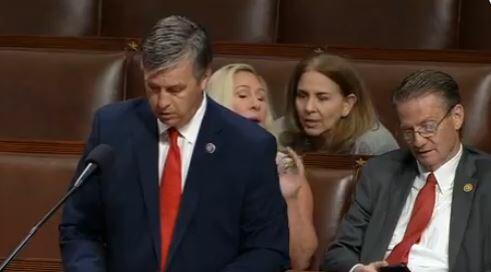
The House advanced a new version of a bill to reauthorize American’s use of warrantless surveillance, opening the measure up for debate, amendments, and a final floor vote after a previous iteration of the bill was blocked Republicans.

Rep. Barry Moore (D-AL) advocates for warrants as part of FISA.

On Friday, House lawmakers voted 213-208 to advance the modified legislation, just days after 19 Republicans joined all Democrats in voting against advancing the original version of the bill to the floor.

Now, all of the initial holdouts flipped their vote to move the bill forward – after the length of reauthorization was shortened from five years to two, and an agreement to bring Rep. Warren Davidson’s (R-OH) Fourth Amendment is Not For Sale Act to the floor sometime next week in a stand-alone vote – which would require the government to obtain a warrant before purchasing information about US citizens from data brokers.

Edward Snowden also encouraged followers to vote for the “Biggs Amendment,” which requires the government to obtain a warrant in general (not just when purchasing from data brokers), and against the “HSPCI Amendments,” which “EXPAND mass surveillance instead of reforming it.”

Rep. Andy Biggs (R-Ariz.) speaks to reporters as he arrives for the House Republican Leadership Elections on Tuesday, November 15, 2022.

Snowden says that if the Biggs amendment fails, the whole thing needs to be killed with fire.

And of course, the White House is against the Biggs amendment to force the government to obtain a warrant…

Section 702 of FISA allows for the warrantless surveillance of foreigners outside of the US – which allows the government to sweep up communications from Americans who are interacting with individuals who are being spied on.

The ‘Biggs Amendment’ would add a warrant requirement before the government can review information collected on Americans.

Biggs and Rep. Dan Crenshaw (R-TX) got into a massive battle over the bill on X, with Biggs accusing Crenshaw of having “aligned yourself with the DC Cartel that insists on spying on Americans and violating the Bill of Rights.”

Check back for updates…

Tyler Durden
Fri, 04/12/2024 – 13:09

China Exports Collapse, Prompting Yuan Devaluation Fears

China Exports Collapse, Prompting Yuan Devaluation Fears

China’s export growth tumbled in March compared to last year, sparking questions about a possible yuan devaluation at a time when China’s biggest mercantilist competitor in Asia – Japan – has intentionally cratered its currency. 

Chinese Exports declined by 7.5% from a year earlier in March to $279.7 billion, far was than the median estimate of a 1.9% drop and was in sharp contrast to the 7.1% growth in combined figures for January and February. It was dragged down due to a higher base in the same period last year, when China reported robust growth of 14.8% at $315.6 billion. Imports also slumped, sliding -1.9% yoy in March, and far below the Bloomberg consensus of a +1.0% increase.

In sequential terms, exports increased by +1.2% in March (vs. +3.5% in January-February), while imports decreased by 1.4% in March (vs. +0.8% in January-February).

With exports collapsing, China’s trade balance also slumped, dropping to just $58.6BN in March, far worse than the Bloomberg consensus of $69.1BN, and down from January-February average balance at US$62.6bn. Today’s release of trade data only covers major trading partners and products. The detailed breakdown of trade by country and by product will be released on April 20.

Some more highlights:

  • By major destination, export value fell sequentially across major trading partners except for ASEAN. The high bases last March drove year-over-year export growth deeply negative. Among major DM countries, exports to the US dropped by 15.9% yoy in March (vs. +2.6% yoy in January-February), and exports to the European Union declined by 14.9% yoy in March (vs. -2.3% yoy in January-February). Among major EM economies, exports to ASEAN fell by 6.3% yoy in March (vs. +0.1% yoy in January-February).

  • By major category and in sequential terms, exports of automobiles rose notably in March while exports of fertilizer and cellphones declined. On a year-over-year basis, export growth of tech-related products remained strong. Export of chips increased by 11.5% yoy in March (vs. +21.4% yoy in January-February) with +7.0% sequential growth (mom non-annualized sa). Export growth of housing-related products moderated notably in March: for example, exports of furniture dropped by 12.3% yoy in March (vs. +28.7% yoy in January-February).

  • Among major categories and in sequential terms, imports of natural gas and refined petrol rose in March while imports of machine tools and iron ore declined. For major commodities and on a year-over-year basis, import growth of metal ores remained solid in March while import growth of energy-related goods moderated. Specifically, import value of crude oil declined by 3.5% yoy in March (vs. +3.6% yoy in January-February) with import volume down 6.2% yoy (vs. +5.0% yoy in January-February). Import value of iron ore rose 7.5% yoy in March (vs. 33.0% yoy in January-February) with import volume up 0.5% yoy (vs. 7.9% yoy in January-February). On tech-related products, import growth of chips moderated significantly in March (+2.0% yoy in March vs. +14.4% yoy in January-February).

Last year, China experienced its first decline in export growth in seven years, with shipments dropping by 4.6% due to weak external demand. It created additional challenges amid Beijing’s efforts to revive the post-pandemic economy, as it was also grappling with an exodus of foreign investment, waning market confidence and potential trade barriers.

Meanwhile, as Bloomberg notes, the dismal trade numbers will only add to the worries over the world’s second-biggest economy, which bodes poorly for a yuan that’s been in retreat this year, which incidentally is just what Beijing wants since China desperately needs a weak currency to make its exports cheaper, which however is proving very difficult with the yen not only sliding to a record low against the yuan, but dropping below a key support level.

Dollar-yuan is being driven by the contrasting outlooks for central bank policy, along with the direction of USD/JPY.

Bloomberg’s conclusion here is that until there is official support for the yen – which seems unlikely even as the Japanese currency crater to a new record low every single day –  or a shift back to expectations for early Fed interest rate cuts, “there isn’t much Chinese authorities can do about an outperforming US dollar. Especially as the PBOC is seen easing monetary policy again this year.” We disagree, especially because the PBOC is seen easing monetary policy: China can – and at this rate will have no choice but to – devalue the currency, and while so far it has been doing everything in its power to telegraph that it will defend the yuan and avoid a repeat of the record capital outflows from 2015, one day Beijing will shock everyone when it announced that the Yuan has lost 10% of its value overnight, and which point the surge in crypto and gold will truly shine.

The bottom line is that Beijing continues to be trapped: either keep the currency artificially “stable” and suffer continued trade loss to competitor Japan which is crushing its currency, or devalue the yuan and regain the mercantilist throne, however at the expense of massive capital outflows.

Tyler Durden
Fri, 04/12/2024 – 13:00

The Secular Trend In Treasuries Is Breaking Down

The Secular Trend In Treasuries Is Breaking Down

Authored by Simon White, Bloomberg macro strategist,

For all of the risk aversion boosting Treasuries today, the 40-year bond bull market is receding further into history as the bear market tightens its grip

The mean growth rate in USTs is falling, leaving bonds still overbought and therefore subject to more downside.

Bond prices have trended upwards for most of past 45 years in one of the longest bull markets in history.

But the shift to an inflationary regime has wiped 15% from Treasuries since their 2020 peak in one of the worst drawdowns in their history.

Not only have prices been breaking down, so has the growth rate. The annual change in USTs is mean reverting, but as the chart below shows that mean has clearly been falling. That leaves Treasuries more likely to rebound less than before, and thus start to sell off earlier.

The current rebound off the very oversold conditions in late 2022 already looks to have faded.

We are now back in a selling-off phase as the growth rate oscillates around a lower mean (as low as 0%, from over 5% before).

That makes owning Treasuries a grim prospect, exacerbated by the still-low chance of a near-term recession in the US, and resurgent inflation.

Tyler Durden
Fri, 04/12/2024 – 12:40

Moscow Calls Switzerland’s Ukraine Conference A ‘Road To Nowhere’

Moscow Calls Switzerland’s Ukraine Conference A ‘Road To Nowhere’

The Kremlin has issued a comprehensive response to the planned Switzerland-hosted international Ukraine peace conference which the Swiss government formally announced Wednesday as set for June 15-16 at the lakeside Bürgenstock resort near Lucerne.

As we underscored previously, while over 100 nations are to be invited, the one country that can determine the final outcome of the war has not been invited: Russia. “Switzerland’s government said Wednesday it will host a high-level international conference in June to help chart a path toward peace in Ukraine after more than two years of war, in hopes that Russia might join in the peace process one day,” The Associated Press reported.

The Russian embassy in Bern has since confirmed in a statement that “the Swiss authorities have not sent Russia an invitation to the conference in Burgenstock.”

Via Reuters

Because of this, Russian Foreign Minister Sergey Lavrov has characterized the conference as a “road to nowhere” and a sign that the West is not sincere about a willingness to pursue real peace negotiations.

“That this is a road to nowhere, to put it mildly, is obvious to any normal political observer. Yesterday, Russian President Vladimir Vladimirovich Putin once again made our position clear and understandable during the meeting with Alexander Grigoryevich Lukashenko,” Lavrov explained.

“I have nothing to add. We do not see any desire in Kiev or on the part of its masters to conduct business in a fair way,” the top diplomat added while speaking at a press conference in Minsk. 

Instead of direct dialogue without any ultimatums, the West is imposing the so-called Copenhagen process, planning a conference in Switzerland, where, it is explicitly stated, they want to formulate, finalize the infamous 10 points of Zelensky’s peace formula and then present it to Russia,” the foreign minister said.

Interestingly, he also charged that the Swiss are simply following Washington’s orders

Lavrov pointed out that Switzerland was simply following orders from the United States and its allies.

“I don’t see how it is possible to put a timid deer and a hedgehog in the same cart. It’s hard to imagine,” the Russian minister said.

Zelensky has previously laid out Ukraine’s “10-point peace plan” which was first presented in 2022. Russia has repeatedly rejected it as a non-starter, given especially it calls for all Russian troops to leave Ukraine and the cede back captured territory. Zelensky has in the past even pressed the ‘return of Crimea’ issue – which is another impossibility from the Kremlin’s point of view.

In February, President Vladimir Putin told American journalist Tucker Carlson that Ukraine Western supporters must understand it is “impossible” to defeat Russia in Ukraine. “Up until now, there has been the uproar and screaming about inflicting a strategic defeat to Russia on the battlefield. But now they are apparently coming to realize that it is difficult to achieve, if possible, at all. In my opinion, it is impossible by definition,” he said according to the transcript. 

One key country that Switzerland and the Ukrainian government want to see present for the June peace conference is China. Zelensky officials have voiced a desire to see China intervene with Russia to get it to exit Ukraine. If China refuses to attend in June, there can be little hope that the conference will actually produce anything beneficial. But Lavrov in is Friday comments also underscored that China’s vision for peace and Ukraine’s formula are incompatible.

Tyler Durden
Fri, 04/12/2024 – 12:20

16 GOP Attorneys General Challenge Garland’s Comments On Voting Laws

16 GOP Attorneys General Challenge Garland’s Comments On Voting Laws

Authored by Matt McGregor via The Epoch Times (emphasis ours),

A group of Republican state attorneys general are pushing back against U.S. Attorney General Merrick Garland’s comments made in March at a church in Selma, Alabama, where he discussed using the Department of Justice (DOJ) to interfere in state voting laws.

Attorney General Merrick Garland testifies before the House Judiciary Committee in Congress in Washington on Sept. 20, 2023. (Madalina Vasiliu/The Epoch Times)

Indiana Attorney General Todd Rokita, in a letter supported by 15 other GOP prosecutors, including Ken Paxton in Texas and Liz Murrill in Louisiana, stated that Mr. Garland’s comments are “concerning.”

In your speech, you claimed that democracy is under attack by ‘discriminatory, burdensome, and unnecessary restrictions on access to the ballot,’” Mr. Rokita wrote. “In response to these allegations, you announced that you ‘double[d] the number of lawyers in the civil rights division’ and ‘launched the Justice Department’s Election Threats Task Force,’ signaling your intent to intrude on our states’ authority.”

Mr. Rokita called this a “weaponization of the DOJ” fueled by Mr. Garland’s personal views, which he called a “serious threat to the principles of federalism and separation of powers, but also to democracy and the rule of law.”

In the letter, Mr. Rokita said the U.S. Constitution is clear in its direction to leave state elections up to the elected representatives of those states.

“Any subversion of these clear mandates would be undermining our Constitution and law and order,” he wrote. “And we think your remarks undermine these principles in a few ways.”

Mr. Garland told the audience at the Tabernacle Baptist Church that his DOJ is challenging state laws that he said are placing unneeded restrictions on black voters. He said black voters are disenfranchised by these restrictions on mail-in voting, the use of drop boxes, and voter ID.

That is why we are working to block the adoption of discriminatory redistricting plans that dilute the vote of Black voters and other voters of color,” Mr. Garland said. “We are holding accountable jurisdictions that fail to provide accessible vote centers for voters with disabilities. We are defending the ability of private individuals—not just the government—to bring lawsuits under the key provisions of the Voting Rights Act and the Civil Rights Act of 1964.”

Voter Fraud: ‘Very Real’

Mr. Rokita addressed Mr. Garland’s statement on voter ID laws, stating that contrary to Mr. Garland’s claiming they are discriminatory, they prohibit voter fraud, which he called “very real,” and referenced several occurrences.

“With these repeated instances of voter fraud, the DOJ should be championing these laws and encouraging enforcement of them,” Mr. Rokita said. “Individuals are required to use an ID to prove identity when driving a car, boarding an airline, buying cigarettes, or purchasing alcohol, and none of these identification requirements are considered ‘discriminatory’  or ‘burdensome.’ Requiring an ID to vote in an election is no different.”

He then called out Mr. Garland’s claim that states imposed “unnecessary restrictions” on mail-in voting and drop boxes.

Numerous security risks exist with mail-in voting and drop boxes, and these methods of voting have led to the proliferation of election fraud,” he said, citing multiple instances.

He then referenced Mr. Garland’s comment in which he said the Voting Rights Act (VRA) has been weakened by legislation.

“This statement is factually incorrect,” he said. “When the VRA was enacted in 1965, a limited number of jurisdictions required federal oversight over its state election laws to combat discrimination. The original intent of the VRA was to ensure that the rights of Americans were not infringed upon at the ballot box based on their race.”

The law justifiably singled out states that were restricting the right to vote but had always meant to be “temporary legislation.”

“The Voting Rights Act is not under attack,” Mr. Rokita said. “Election security measures passed by state governments do not ‘make voting more difficult,’ nor are they dismantling the right to vote. Instead, common sense election laws strengthen our electoral process to ensure free and fair elections are conducted among the states; especially since voter fraud does exist.”

However, the right to vote is under attack by progressive elected officials, he said, who are allowing illegal aliens to vote in elections.

In some cases, courts found these laws unconstitutional, and rightly so,” he said.

State attorney generals must defend their laws, he said, most importantly during a time when the Biden administration’s border policy has made them vulnerable to intrusions and violations of sovereignty. 

“Finally, as you mention, the Department of Justice is ‘fighting back’ against these commonsense election security measures passed by the states in numerous ways,” he said.

The expansion of federal attorneys in the DOJ’s Voting Section of the Civil Rights Division and the election task force suggests a federal interference that goes against what a constitutional republic is supposed to be about, he wrote.

The DOJ’s expansion serves as a direct attack on the states’ role in regulating elections,” he said. “Instead of working with the states to secure elections, you suggest weaponizing the DOJ through the civil rights division to undermine anything that you subjectively believe is a ‘threat [to] democracy.’”

Mr. Rokita said Mr. Garland is only concerned with using the DOJ to build up the vote of the Democratic party.

And by using the justice system in this way, you diminish any democratic principles you claim to defend,” he said.

The Epoch Times contacted the DOJ for comment.

Tyler Durden
Fri, 04/12/2024 – 10:20

UMich Inflation Expectations Jump Higher At Start Of April, Sentiment Sinks But Democrats Happy

UMich Inflation Expectations Jump Higher At Start Of April, Sentiment Sinks But Democrats Happy

CPI is resurgent, PPI’s trend is no longer lower, and this morning we saw import and export prices rising (or not falling) at their fastest pace in a year…

Source: Bloomberg

We say all that because this morning, we are told by UMich that in preliminary April data, Americans’ expectations for inflation jumped higher…

Source: Bloomberg

“These increases in inflation expectations are modest enough that consumers do not appear worried that high inflation will come roaring back,’’ Joanne Hsu, director of the survey, said in a statement.

However, “while consumers are fully aware that inflation has come down substantially since 2022, they are not satisfied by the current pace of disinflation.”

The headline UMich sentiment index declined, led by a drop in ‘current conditions’…

Source: Bloomberg

“Expectations over personal finances, business conditions, and labor markets have all been stable over the last four months,” according to UMich.

“However, a slight uptick in inflation expectations in April reflects some frustration that the inflation slowdown may have stalled.”

Democrats appear the most confident, with their sentiment pushing to its highest since June 2021. This as both Republicans and Independents saw confidence decline…

Source: Bloomberg

Finally, it appears all those illegal immigrants that are stuffing the payrolls prints are not buying large household durables…

Source: Bloomberg

Overall, UMich notes, that consumers are reserving judgment about the economy in light of the upcoming election, which, in the view of many consumers, could have a substantial impact on the trajectory of the economy.

Tyler Durden
Fri, 04/12/2024 – 10:08

How Taxpayers Will Heavily Subsidize Democrat Boots On The Ground This Election

How Taxpayers Will Heavily Subsidize Democrat Boots On The Ground This Election

Authored by Ben Weingarten via RealClear Wire,

Progressives are using legal loopholes and the power of the federal government to maximize Democrat votes in the 2024 election at taxpayers’ expense, RealClearInvestigations has found.

The methods include voter registration and mobilization campaigns by ostensibly nonpartisan charities that target Democrats using demographic data as proxies, and the Biden administration’s unprecedented demand that every federal agency “consider ways to expand citizens’ opportunities to register to vote and to obtain information about, and participate in, the electoral process.”

A dizzying array of overwhelmingly “democracy-focused” entities with ties to the Democratic Party operating as charities and funded with hundreds of millions of dollars from major liberal “dark money” vehicles are engaged in a sprawling campaign to register the voters, deliver them the ballots, and figuratively and sometimes literally harvest the votes necessary to defeat Donald Trump.

These efforts, now buttressed by the federal government, amplify and extend what Time magazine described  as a “well-funded cabal of powerful people ranging across industries and ideologies,” who had worked behind the scenes in 2020 “to influence perceptions, change rules and laws, steer media coverage and control the flow of information” to defeat Trump and other Republicans. The “shadow campaigners,” Time declared, “were not rigging the election; they were fortifying it.”

Heading into 2024, “there is not a ‘shadow’ campaign,” said Mike Howell, executive director of the Heritage Foundation’s Oversight Project. “There is an overt assault on President Trump and those who wish to vote for him occurring at every level of government and with the support of all major institutions.”

By contrast, Republican Party stalwarts lament that no comparable effort exists on their side. The GOP’s turnout and messaging efforts seek to thread a difficult needle by encouraging early and absentee voting and ballot-harvesting – pandemic-era measures that Trump and supporters blame for his 2020 electoral defeat – while the party simultaneously fights the mainly blue-state laws that made the practices possible. The party’s position is further complicated by its standard-bearer’s warnings of a rigged election bigger than in 2020, which some speculate could turn off moderate swing voters.

Electioneering ‘Super-Weapons’

The IRS permits tax-exempt nonprofit groups to engage in voter registration and get-out-the-vote drives so long as they do not “refer to any candidate or political party” nor conduct their activities “in a biased manner that favors (or opposes) one or more candidates prohibited.”

These entities have become magnets for funds not only from wealthy donors, who can contribute without traditional campaign finance limits – and get a tax break to boot – but also abundantly endowed private foundations that are prohibited from engaging in partisan activities.

In recent years, dozens of progressive-oriented 501(c)(3)s, now pulling in upwards of $500 million annually, have engaged in purportedly neutral efforts to impact elections, according to Hayden Ludwig, director of Policy Research at the election integrity-focused advocacy group, Restoration of America.

In practice, critics like Ludwig argue, left-leaning charities flout the law by registering and mobilizing demographics that tend to vote disproportionately Democratic behind a veil of non-partisan democracy promotion.

During the 2020 election, for example, the Voter Participation Center solicited millions of ballot applications in swing states – many of them prefilled for respondents. This nonprofit, like its peers, is clear that it isn’t targeting just any voters, but what it and progressive activists have dubbed a “New American Majority” of “young people, people of color and unmarried women.”

Tom Lopach, a longtime Democratic Party operative and the center’s president and CEO, told RCI in a statement: “We do the work that state election officials typically do not do – seeking out underrepresented voting-eligible Americans Tom Lopach … This is difficult but necessary work that brings democracy to eligible Americans’ doorsteps.”

In 2020, Facebook founder Mark Zuckerberg and his wife Priscilla Chan showed how supposedly neutral efforts can have a partisan impact when they funneled some $400 million through two progressiveled but purportedly nonpartisan nonprofits into election offices across the country.

That money disproportionately went to jurisdictions that Joe Biden won in the pivotal battleground states that delivered his victory, often flowing to left-leaning nonprofits to whom election offices outsourced the administration of sometimes critical functions.

In April 2022, a primary conduit of these so-called “Zuckerbucks,” the Center for Tech and Civic Life, announced the launch of a successor to the 2020 effort – the U.S. Alliance for Election Excellence, a five-year $80 million program “to envision, support, and celebrate excellence in U.S. election administration.”

“The left has assembled an impressive ‘election-industrial’ complex of non-profit organizations that is constantly working towards goals like ‘promoting participation’ targeting ‘underrepresented minorities,’” said Jason Snead, executive director of the conservative Honest Elections Project. Such terms, Snead says, “are code for identifying and mobilizing liberal voters.”

Election experts view such activities as potentially decisive. 

“‘Nonpartisan’ and ‘charitable’ voter registration and get-out-the-vote groups” are the Democratic Party’s “electioneering super-weapon[s],” said Parker Thayer, an analyst with the conservative-oriented Capital Research Center in Washington, D.C.

‘Everybody Votes’ – But for Whom?

Of these, Thayer sees the Everybody Votes Campaign as of paramount importance.

Born of a plan “commissioned by [Hillary] Clinton campaign chairman John Podesta, funded by the Democratic Party’s biggest donors, and coordinated with cut-throat Democratic consultants,” Thayer writes in an extensive analysis of the group’s efforts, “the Everybody Votes campaign [has] used the guise of civic-minded charity to selectively register millions of ‘non-white’ swing-state voters in the hopes of getting out the Democratic vote.”

It does so by funding and training over 50 community groups to register voters to close “the voter registration gap in communities of color,” which it attributes to “modern forms of Jim Crow laws,” such as voter ID requirements, the group’s executive director, Nellie Sires, said in a January 2024 interview.

From 2016-2021, the Everybody Votes Campaign, doing business as three entities, collected over $190 million from major Democratic Party donors, unions, and environmental activists. Some of the largest donors include the League of Conservation Voters Education Fund; the New Venture and Hopewell Funds, managed by for-profit consulting firm Arabella Advisors; and the George Soros-funded Foundation to Promote Open Society – all 501(c)(3) public charities or private foundations forbidden from supporting “voter education or registration activities with evidence of bias.”

The Everybody Votes Campaign distributed the funds to a slew of left-leaning state-based voter registration organizations largely in eight pivotal states from 2016 to 2019 – Arizona, Colorado, Florida, Georgia, Ohio, North Carolina, Virginia, and Nevada – and then to Pennsylvania, Michigan, and Wisconsin in 2021.

According to Thayer’s analysis, the Everybody Votes Campaign’s voter registration push “would have provided Democrats more votes than the total margins of victory in Arizona, Georgia, Nevada, and Pennsylvania,” securing Joe Biden’s victory in the 2020 election.

‘4 to 10 Times More Cost-Effective’

One notable backer of the Everybody Votes Campaign is Mind the Gap, a “Moneyball-style” Silicon Valley Democratic Super PAC founded by Stanford law professor Barbara Fried, and connected to the political activities of her convicted crypto-fraudster son, Sam Bankman-Fried.

The analytics-focused outfit prepared a confidential strategy memo leaked in advance of the 2020 election, noting that “501(c)(3) voter registration focused on underrepresented groups in the electorate” would be the “single most effective tactic for ensuring Democratic victories” – “4 to 10 times more cost-effective” on after-tax basis at “garnering additional Democratic votes” relative to alternatives like “broadcast media and digital buys.”

Mind the Gap recommended that donors contribute to three organizations: the Voter Participation Center and its sister organization, the Center for Voter Information for mail-based registration efforts, and Everybody Votes for site-based registration efforts.

The largest grant recipient, receiving $24 million during the 2016-21 period, was State Voices, which describes itself as a “nonpartisan network of 25 state-based coalitions … that collectively partner with over 1,200 organizations” consisting of “advocates, organizers, and activists … work[ing] together to fight for a healthy democracy and political power for Black, Indigenous, Latinx, Asian American and Pacific Islander (AAPI), and all people of color (BIPOC).”

Another top recipient, raking in over $10 million, was the Voter Participation Center.

According to the Capital Research Center, the Everybody Votes Campaign would collect and spend over $50 million in connection with the 2022 midterm elections – the most recent period for which financials are available. All told, since its founding in 2015, the Campaign says, its network has registered 5.1 million voters, of whom 76% are people of color; 56% are women; and 47% are under the age of 35.

Last November, the news outlet Puck reported on a secret memo circulated by Mind the Gap regarding its plans for 2024. “Our strategy early in the 2024 presidential race will be to massively scale high-performing voter registration and mobilization programs,” the memo read. The PAC again specifically directed donors to the Everybody Votes Campaign, which did not respond to requests for comment.

Lopach, who has worked in Democratic Party politics his entire career, bristled at RCI’s questions regarding critics’ claims of a partisan bent to its work. “The presumptions baked into the questions … emailed to us are inaccurate and reveal the reporter’s own biases,” he responded, while emphasizing the organization’s targeting of “underrepresented voting-eligible Americans.”

Thayer has dubbed Everybody Votes the “largest and most corrupt ‘charitable’ voter registration drive in American history.”

Of such organizations’ claims of nonpartisanship, Howell told RCI: “If they were truly interested in an informed participatory constitutional Republic, they would have an even-handed approach to registering voters.”

“Call me when they show up to a NASCAR race, Daughters of the American Revolution event, or a gun show,” Howell added. “Then we can pretend for a minute that these are beyond just facial efforts to appear somewhat neutral.”

Challenges for GOP

But NASCAR races have not been hubs for GOP-led voter registration efforts either. Restoration of America’s Ludwig estimates that the right may spend as little as 1% of what the left spends on voter registration efforts.

A recent memo from the Sentinel Action Fund, a super PAC that aims to elect conservatives, noted that in the 2022 election cycle, while $8.9 billion was spent on federal elections, there were zero large independent expenditure organizations on the right focused on get-out-the-vote efforts or “ballot chasing.”

Republican Party vehicles and conservative outfits like grassroots-oriented Turning Point Action, a 501(c)(4), are engaged in such efforts in the 2024 cycle, but the scale and sophistication of their political counterparts’ efforts would appear unrivaled at this point.

Election experts attribute this gap to several factors beyond the GOP’s focus on other tactics to win elections, or ineffectiveness. They note that Democratic voters tend to be more concentrated in urban areas and college campuses, making it easier to run efficient registration drives. As regards early and absentee voting and ballot harvesting, it is not clear if these efforts will substantially grow the pool of Republican voters versus merely enabling the party to “bank” votes earlier.

With respect to the use of 501(c)(3)s to conduct such activities, Ludwig said some conservatives may still be fearful of running afoul of the IRS – through exploiting tax laws to pursue efforts perceived to be partisan effectively on the taxpayers’ dime – in the wake of its targeting of Tea Party groups for extreme scrutiny during the Obama years.

‘Bidenbucks’: ‘Zuckerbucks’ on Steroids

Since the 2020 election, Democrats have opened a second apparent electioneering front that Republicans could not match even if they wanted to: The rise of so-called “Bidenbucks,” which uses the “unlimited funding, resources, and reach” of the federal government and agency offices located nationwide,” to turn out favored voters, according to Stewart Whitson, legal director of the conservative Foundation for Government Accountability.

In March 2021, President Biden introduced Executive Order 14019. The directive on “promoting access to voting” orders every federal agency, more than 600 in all, to register and mobilize voters – particularly “people of color” and others the White House says face “challenges to exercise their fundamental right to vote.” It further directs the agencies to collaborate with ostensibly nonpartisan nonprofits in pursuit of its goals.

As RCI has previously reported, EO 14019 appears to have been designed by left-leaning think tank Demos and implemented in consultation and sometimes coordination with a slew of progressive, labor, and identity-focused groups with the goal of generating up to 3.5 million new or updated voter registrations annually.

The ACLU and Demos have reportedly helped execute the order. RCI additionally found that at least two recipients of grants under the Everybody Votes Campaign, the NAACP and UnidosUS – formerly the National Council of Raza – were also listed on an email as participants in a July 2021 listening session on the executive order convened by the White House and agency officials.

Whitson, whose organization unearthed that email in its fight to expose details about the order, emphasized that “[U]nlike 2020 wherein the shadow campaign was conducted by private citizens seeking to influence government election operations from the outside, the threat we face in 2024 is being launched from within the government itself.”

Facing both congressional scrutiny and litigation, the administration has closely guarded the strategic plans agencies were to develop to carry out the order, how they are implementing them, to what end, and with whom.

Perfunctory press releases, reports from groups supportive of the order, and documents slowly ferreted out via FOIA requests and litigation, however, demonstrate that relevant agencies have sought to drive voter registration via public housing authorities, child nutrition programs, and voluntary tax preparation clinics.

In August 2023, U.S. Citizenship and Immigration Services issued updated guidance calling for the agency to register voters at naturalization ceremonies.

More recently, the Department of Education did the same, blessing the use of federal work-study funds to pay students for “supporting broad-based get-out-the-vote activities, voter registration,” and other activities. Scott Walter, president of the Capital Research Center, recently told the Epoch Times that the Department had previously threatened schools “that you better be registering students or you could lose your federal funds.”

When asked by RCI to respond to Walter’s claim, the Department of Education would not. Over two dozen Pennsylvania state legislators challenged the order via a lawsuit in January. Citing alleged unlawful attempts by several agencies to register Keystone state voters, the lawmakers asserted:

“By engaging in a targeted voter registration effort of this magnitude, focused specifically on these agencies and the groups of potential voters they interact with, leveraging the resources and reach of the federal government, this effort appears to be a taxpayer-funded get-out-the-vote effort designed to benefit the current President’s political party.”

Echoing this view, Whitson’s Foundation for Government Accountability submitted an amicus brief noting that “all of the federal agencies FGA has identified as taking active steps to carry out EO 14019 have one thing in common: They provide government welfare benefits and other services to groups of voters the vast majority of which have historically voted Democrat.”

The plaintiffs alleged the executive order violated both Pennsylvania law limiting voter registration efforts to non-federal actors, and constitutional provisions reserving election laws to the states. On March 26, a district court dismissed the case, claiming the plaintiffs lacked standing. Whitson told RCI that others would likely lodge similar lawsuits, building on the Pennsylvania legislators’ case in the wake of the dismissal. Days later, The Federalist reported that the plaintiffs intended to appeal their case to the U.S. Supreme Court. A White House spokesperson did not reply to RCI’s inquiries regarding the executive order.

Opposition and Circumvention

Republicans have had more success opposing the use of Zuckerbucks and other private monies used to finance public elections. More than two dozen states would move to ban or restrict such grants in response to the activities observed during the 2020 election.

Most recently, Wisconsin, where some of the most controversial Zuckerbucks-related efforts took place, was added to that list when, on April 2, voters approved a constitutional amendment barring the private funding of elections.

Despite this crackdown and the feds seemingly stepping into the breach, efforts to privately finance election administration persist. The U.S. Alliance for Election Excellence bills itself as an initiative to bolster “woefully unsupported” election offices to “revitalize American democracy.”

The organization says it services jurisdictions – 11 listed on its website, ranging across states from Arizona to California and Wisconsin – with “training, mentorship, and resources.” Alliance officials did not respond to RCI’s inquiry about whether it would be terminating the relationship with the city of Madison, Wisconsin., in light of the passage of the recent ballot measure that would seem to have barred it. Nor did it respond to RCI’s other inquiries in connection with this article.

Most of these partnerships were initiated with jurisdictions in states that have not banned Zuckerbucks, though it has sought to circumvent such prohibitions in Georgia and Utah. The stated goal of the Alliance for Election Excellence is to support voters via measures like assisting participating centers in “redesigning” forms to make them more intuitive and purchasing infrastructure “to improve election security and accessibility.”

Alliance launch partners include entities such as:

  • The Center for Civic Design, which works with election offices “using research, design, accessibility, and plain language to remove barriers in the voter journey and invite participation in democracy;”
  • The Elections Group, to “implement new programs or improve processes for voters and stakeholders”; and
  • The Center for Secure and Modern Elections to “modernize the voting system, making elections more efficient and secure.”

Critics argue this seemingly more modest effort is, in reality, an ambitious Zuckerbucks rebrand.

Snead’s Honest Elections Project published a report in April 2023, based in part on documents received from FOIA requests, indicating “that the Alliance is a reinvention of CTCL’s scheme to use private funding to strongarm election policy nationwide.”

Among other takeaways, it found that:

  • The Alliance offers services that touch every aspect of election administration, ranging from “legal” and “political” consultation to public relations, guidance, and assistance with recruitment and training.
  • The Alliance is gathering detailed information on the inner workings of participating election offices and developing “improvement plans” to reshape the way they operate.

The report shows that many of the alliance’s launch partners, starting with the Center for Tech and Civic Life and the Center for Civic Design, are funded by major Democrat-tied, so-called “dark money” groups such as the Democracy Fund and Arabella Advisors’ New Venture Fund and Hopewell Fund.

The Democracy Fund is led by Democrat tech billionaire Pierre Omidyar, which has granted some $275 million to like-minded organizations from publications like Mother Jones and ProPublica to the Voter Registration Project since its founding.

The District of Columbia recently closed a criminal investigation into Arabella, whose fund network reportedly spent nearly $1.2 billion in 2020 alone, after probing it over allegations its funds were pursuing political ends in violation of their tax-exempt statuses. The Center for Secure and Modern Elections, the Honest Elections Project says, pushes “left-wing priorities like automatic voter registration” and is run by the New Venture Fund. The Elections Group’s CEO and co-founder, Jennifer Morrell, previously served as a consultant at the Democracy Fund.

The Capital Research Center’s Walter uses a football analogy to explain why he sees these efforts as untoward. He told RCI:

“Election offices are the refs in elections; the parties are teams trying to score. You’d be puzzled if you heard Super Bowl refs say they’re trying to boost points scored. You’d be outraged if you learned those refs had received money and training from people who previously worked for one team’s offensive coaching staff. That’s what left-wing political operatives, using left-wing money, are doing, and it’s clearly unfair.”

Non-Trump Lawfare

Democrat-aligned groups continue to engage in litigation, like that brought by chief election lawyer Marc Elias, aimed at loosening election laws to their benefit. Snead told RCI, “There are more than 70 active lawsuits right now targeting voter ID laws, anti-ballot harvesting laws, signature verification, drop box regulations, and more.”

After securing victory in a lawsuit requiring signature verification for mail voting in Pennsylvania, the RNC touted its engagement as well in 81 election integrity cases this cycle. Swing-state Wisconsin is another major battleground for such efforts.

There, Elias’ legal team has challenged witness signature requirements and bans on election clerks filling address information on mail-in ballots. It and others are also working to overturn a state Supreme Court decision finding drop boxes illegal. The Badger State’s now liberal-majority Supreme Court announced in March it would take up the case.

Cutting against these efforts are not only the state’s citizen-approved Zuckerbucks ban, but another Badger-passed April 2 ballot measure amending the state’s constitution to prohibit those other than “an election official designated by law” from carrying out election-related tasks.

Watchdogs like Howell are concerned that left-leaning electioneers and lawfare forces collectively are pursuing an “election ‘dis-integrity’ strategy … to greatly expand the universe of ballots while limiting any ability to ensure that they are fairly cast and counted.”

“It’s a basic recipe for fraud.”

Elias says those seeking to combat such efforts are engaged in “voter suppression and election subversion.”

Democrats also have the federal government working on their side on the litigation front – and in ways extending beyond the veritable lawfare barrage the Biden Justice Department has leveled at Donald Trump.

Speaking in Selma, Ala., on the 59th anniversary of Bloody Sunday, the 1965 police assault on civil rights marchers, Attorney General Merrick Garland declared that “the right to vote is still under attack.”

Garland vowed the Department of Justice was punching back, including “challenging efforts by states and jurisdictions to implement discriminatory, burdensome, and unnecessary restrictions on access to the ballot, including those related to mail-in voting, the use of drop boxes, and voter ID requirements.”


Tyler Durden
Fri, 04/12/2024 – 09:50

US Restricts Diplomats’ Travel In Israel, Bracing For Iran Attack By Week’s End

US Restricts Diplomats’ Travel In Israel, Bracing For Iran Attack By Week’s End

Iran is expected to attack Israel by week’s end, or at least within the coming days. However, the degree of telegraphing has almost taken the teeth out of the threat and what Iran hopes to accomplish in its retaliation.

“Iran is calibrating its plans for a major retaliatory strike against Israel to send a messagebut not spark a regional war that compels Washington to respond, the U.S. assesses,” Politico reports of what’s expected. “Biden administration officials judge that Iran is planning a larger-than-usual aerial attack on Israel in the coming days, one that will likely feature a mix of missiles and drone strikes, said two U.S. officials who were granted anonymity to detail sensitive intelligence assessments.”

US Embassy in Israel, Getty Images

The Pentagon has apparently moved naval assets closer to Israel in expectation of Iranian strikes (or else major attacks from their proxies like Hezbollah or the Houthis), including the USS Eisenhower aircraft carrier which is patrolling the Red Sea. Israel’s Channel 14 also reports, “The US military deployed a missile ship with advanced defense capabilities near the shores of Israel.”

The US has said it is ready to coordinate a response with Israel if it is hit; however, the defense consensus is that Iran is unlikely to send missiles and drones directly from its soil. CBS has newly cited two US officials who say that “a major Iranian attack against Israel was expected as soon as Friday, possibly to include more than 100 drones and dozens of missiles aimed at military targets inside the country.”

But so far the past days have been a constant avalanche of speculation as an attack remains ‘imminent’. The US State Department is taking action, issuing a security warning to all government employees and their families for the US Embassy in Jerusalem. Travel restrictions have been placed on their movements, after the embassy has been on edge ever since Israel’s unprecedented April 1st attack on the Iranian consulate in Damascus.

“Out of an abundance of caution, U.S. government employees and their family members are restricted from personal travel outside the greater Tel Aviv, … Jerusalem, and Be’er Sheva areas until further notice,” US Embassy security alert, issued Thursday says.

“The U.S. Embassy in Jerusalem reminds U.S. citizens of the continued need for caution and increased personal security awareness as security incidents often take place without warning,” the alert continued. “The security environment remains complex and can change quickly depending on the political situation and recent events.”

Several other countries have issued travel warnings to their citizens, while bracing for a possible bigger war in the Middle East, including Russia and India of late. The UK and France have reportedly called on their citizens to leave immediately, citing an inevitable attack from Iran.

Meanwhile the speculation continues as to the timing, with The Wall Street Journal on Friday reporting that “Israel is preparing for a direct attack from Iran on southern or northern Israel as soon as Friday or Saturday, according to a person familiar with the matter.”

However, even US intelligence doesn’t have a crystal ball. The WSJ follows with this caveat: “A person briefed by the Iranian leadership, however, said that while plans to attack are being discussed, no final decision has been made.”

Starting Thursday, Gen. Michael Erik Kurilla, commander of U.S. Central Command (CENTCOM), arrived in Israel amid reports that the US and Israel could respond jointly to any imminent Iranian attack on Israel. Alarmingly, Ynet reports Friday that “The IDF and Mossad approved plans for an attack on Iran in the event that Israel would come under attack from Iranian territory. Additionally, the coordination between the U.S. and Israeli militaries, has increased.”

Below are the morning’s geopolitical headlines via Newsquawk:

* * *

MIDDLE EAST – EUROPEAN MORNING

  • “The (Israeli) army and the Mossad approved plans to target the heart of Iran if Israel (is) bombed from inside Iranian territory”, via Al Jazeera citing Yedioth Ahronoth.
  • Hamas sources: “The organization’s leadership informed the mediators that it is not interested in further discussions about the deal, as long as there is no progress in its demands…”, according to journalist Kais citing Hezbollah-affiliated press.
  • “US official to Al-Arabiya: We will participate in the response if Iran escalates with an appropriate response”, according to Al Arabiya

MIDDLE EAST

  • Israel is prepared for an Iranian strike from its territory in the next 48 hours, according to WSJ. Israeli army said Iran is preparing its proxies in the region to attack them, according to Al Arabiya.
  • Israeli Defence Minister Gallant told US Defense Secretary Austin that a direct Iranian attack on Israeli territory would compel Israel to respond in an appropriate way against Iran, according to Axios.
  • Iran reportedly signalled to Washington it will respond to Israel’s attack on its Syrian embassy in a way that aims to avoid major escalation and it will not act hastily, according to Reuters citing Iranian sources. Furthermore, a source familiar with US intelligence was not aware of the message conveyed but said Iran has been very clear its response would be controlled and non-escalatory, and planned to use regional proxies to launch a number of attacks on Israel.
  • US President Biden’s administration officials judge that Iran is planning a larger-than-usual aerial attack on Israel in the coming days which will likely feature a mix of missiles and drone strikes, according to two US officials cited by Politico.
  • US official said the US expects an attack by Iran against Israel which they think will be calibrated to be bigger than usual but not so big it would draw the US into war, while US officials have also been in touch with regional partners to discuss efforts to manage and ultimately reduce further risks of escalation.
  • US said it had restricted its employees in Israel and their family members from personal travel outside the greater Tel Aviv, Jerusalem and Be’er Sheva areas amid Iran’s threats of retaliation against Israel.
  • US State Department senior official said a robust conversation with Iraq is likely to lead to a second US-Iraq joint security cooperation dialogue later this year.

OTHER

  • US President Biden warned that any attack on Philippine vessels in the South China Sea would invoke their mutual defence treaty.
  • China’s top legislator Zhao Leji and North Korean counterpart discussed promoting exchange and cooperation in all fields, according to KCNA.
  • Four drones shot down overnight near Russia’s Novoshakhtinsk in a town in near proximity to an oil refinery

    Tyler Durden
    Fri, 04/12/2024 – 09:30

    Central Banks Are Buying The Gold Top

    Central Banks Are Buying The Gold Top

    Via SchiffGold.com,

    In investing, “Buy low, sell high” is among the most well-known sayings, and generally, it’s good advice. But with gold still holding near its historic all-time highs, central banks led by China are bucking the classic adage and smash-buying more, buying the top to fortify themselves against a global monetary and financial blow-up.

    Last month marked the 17th in a row that the People’s Bank of China (PBOC) continued stacking gold. Notably, the bank typically reports lower numbers than its actual buying volume and is now also introducing a digital yuan to facilitate cross-border gold settlements.

    Russia is also doubling its reserves of gold and foreign currencies on its de-dollarization path, further detaching Russia from the petrodollar empire as it reacts to wartime sanctions from the US and EU. There are other blips on the de-dollarization map as well: though much smaller than Russia and China, Zimbabwe has a new gold-backed currency that lets them dump the USD for trade with China and other countries.

    Chinese citizens are trying to divest as well, but from their economy — Chinese buying has become so blistering that gold ETFs have gone haywire, with China repeatedly halting trading as ETFs rocket upward at a gobsmackingly-high premium against physical bullion. It has become increasingly difficult for the Chinese to invest outside of China, due to attempts by the regime to keep investments within the country. Citizens are trying to make moves to protect themselves against their perceptions of domestic economic uncertainty.

    Meanwhile, expectations that the Fed and other Western central banks will be cutting rates this year amidst continuing wars in Ukraine and the Middle East provide further rocket fuel for the gold price, with central bank buying helping it hold its new levels despite whatever else seems to be going on in global markets.

    A Year of Central Bank Buying: Gold vs USD April 2023 – April 2024

    Source: Bloomberg

    While shorter-term corrections are always to be expected, the macro factors support the view that, despite its awe-inspiring path upward in the past few months, the rally for gold hasn’t finished. While inflation isn’t contained, the Fed is expected to stay the course with planned 2024 rate cuts that will make dollar weakness even worse. This can only mean higher prices for gold against USD.

    Reacting to warnings from Bloomerberg about ballooning debt and the powder keg of inflationary pressure, Peter Schiff said:

    “We have a much bigger problem than they acknowledge — that’s why the price of gold is at a record high, that’s why it’s going to keep going up.”

    With the overstretched and over-indebted American empire increasingly in a state of potentially terminal decline, BRICS countries are stacking hard assets with the hopes of overtaking the West as the next economic superpowers in the coming decades. While they have fiat currencies of their own, none have anything resembling the world reserve currency status enjoyed by the USD. Buying the top even as gold continues upward tells a story of their future visions of US dollar chaos.

    Besides, if you expect the dollar to fail, as dominant fiat currencies historically have, then “the top” doesn’t matter — if the bottom for fiat is zero, then there’s no meaningful top for hard assets like gold in fiat terms. And just as you didn’t want to be the last schmo holding seashells when no sane person would give you even the tiniest sliver of gold in exchange, it’s wise of central banks to avoid being the last ones trying to trade worthless paper for gold that, when fiat is functionally dead, will be infinitely more valuable.

    Because when you zoom out far enough, the exchange price of fiat currencies always reverts to its true value of zero.

    Tyler Durden
    Fri, 04/12/2024 – 09:15