In a bizarre news segment, a transgender person who used to refer to himself as the “human Ken doll” attempted to lecture JK Rowling on what a woman really is, declaring that the author should “stick to what she knows.”
The Brazilian-British OnlyFans ‘personality’ born Rodrigo Alves, now known as ‘Jessica Alves’, has undergone so much plastic surgery that he can barely speak or move, including implants and ‘enhancements’ resulting in an appearance that resembles cartoon-like spoof of a woman.
Yet in a clip from an interview on GB News, Alves claimed “I don’t believe that I am a woman, I AM a woman,” adding “even my birth certificate has been changed to ‘born a female.’”
In a bizarre segment, a transgender ‘personality’ who previously wanted to be a “human Ken doll” before deciding to become a ‘woman’, lectured JK Rowling on what being female really means, declaring that the author should “stick to what she knows.” Report: https://t.co/K06cu2wjbTpic.twitter.com/fHcFCrS9sY
“I never felt like a man, therefore I am a woman,” Alves further declared before going on to claim “it’s very sad to read the headlines lately about JK Rowling.”
“She’s doesn’t understand anything of what she is talking about,” Alves proclaimed, adding “she’s not a trained doctor, she’s a book writer.”
The host responded, “she might argue that she’s a woman though,” to which Alves responded “I’m also a woman.”
“Her remarks are not necessary, they are very indelicate, they are very hurtful,” Alves further suggested, going on to call Rowling “transphobic.”
“You do not comment on people’s race, you do not comment on people’s gender, those are subjects that you don’t point out and talk about,” Alves further decreed.
This person is clearly mentally ill, having previously undergone countless surgeries in an effort to look like a plastic doll.
When you firmly believe you are something which you are not it is called a mental illness.
That’s a man and that man should stick to what he knows.
— Aja the Empress ♀️🇬🇧🇯🇲 (@Aja02537920) April 6, 2024
FACTS matter!
Getting c@rved up, pumped up, plumped up, and changing a birth certificate does not erase the DNA. He was born male and is male.
— The Real Parents of Loudoun County (@RealLOCOParents) April 6, 2024
He said he has “the feelings, the emotions” of a woman. He does not know what those feelings like, & he never will, because he was born a man & will die a man. His skeleton will be male in the dirt yrs from now. Man.
As we highlighted yesterday, Rowling was widely praised for posting a lengthy explanation of what a woman is, as she continues to be outspoken in defence of women’s rights.
* * *
Your support is crucial in helping us defeat mass censorship. Please consider donating via Locals or check out our unique merch. Follow us on X @ModernityNews.
‘Brazil’s Darth Vader’ Orders Investigation Into Elon Musk After Defying X Court Order
Brazil’s activist Supreme Court justice Alexandre de Moraes hasordered an investigation into Elon Musk, after the billionaire vowed to defy a court order as part of an ongoing probe into social media accounts allegedly spreading misinformation and ‘hate’ speech.
“The flagrant conduct of obstruction of Brazilian justice, incitement of crime, the public threat of disobedience of court orders and future lack of cooperation from the platform are facts that disrespect the sovereignty of Brazil,” wrote de Moraes – who Musk called “Brazil’s Darth Vader” over the weekend.
While X initially said in a Saturday post that they would comply, blocking certain popular accounts in Brazil – Musk said an hour later, after the release of the “TWITTER FILES BRAZIL,” that they would not, noting that “As a result, we will probably lose all revenue in Brazil and have to shut down our office there.”
in a Sunday post, Musk said that Supreme Court Justice Alexandre de Moraes had “brazenly and repeatedly betrayed the constitution and people of Brazil,” and should “resign or be impeached.”
De Moraes said that as part of his decision to open an inquiry, that “X shall refrain from disobeying any court order already issued, including performing any profile reactivation that has been blocked by this Supreme Court,” Reuters reports.
The justice said that Musk would face a fine that equates to approximately $20,000 each time an account is reactivated on X.
For an overview:
BRAZIL IS ON THE BRINK
I’m reporting to you from Brazil, where a dramatic series of events are underway.
At 5:52 pm Eastern Time, today, April 6, 2024, X corporation, formerly known as Twitter, announced that a Brazilian court had forced it to “block certain popular accounts in… pic.twitter.com/GjdAgmkCBo
— Michael Shellenberger (@shellenberger) April 7, 2024
The TWITTER FILES BRAZIL, reported by investigative journalist Michael Shellenberger, and colleagues David Ágape and Eli Vieira, reveal that “Brazil is engaged in a sweeping crackdown on free speech led by a Supreme Court justice.”
Sitting members of Brazil’s Congress and journalists were among those named by Brazil’s highest court for censoring, Mr. Shellenberger said of his findings, which he has shared on X.
He named lower house members Carla Zambelli of former President Jair Bolsonaro’s Liberal Party and Marcel van Hattem of the NOVO party as targets of orders targeting posts the court deemed misinformation.
According to the internal files Mr. Shellenberger shared, Twitter in Brazil was threatened with a $30,000 fine. The company had one hour to remove the Congress members’ posts or pay the court for noncompliance.
The article reports that the justice had even been jailing individuals without trial for things posted on social media.
According to Mr. Shellenberger, Supreme Court Justice Alexandre de Moraes allegedly made demands to Twitter to allow access to its internal data, in violation of Twitter’s own policies on the handling of user data. –Epoch Times
The “Twitter Files” also show that the justice “sought to weaponize Twitter’s content moderation policies against supporters of then-president @jairbolsonaro,” Mr. Shellenberger said—a similar trend to what the “Twitter files” revealed was happening to former President Donald Trump and conservative voices in the United States.
The origin of the order to censor Brazilians’ posts was also revealed in the internal Twitter files, Mr. Shellenberger said.
Brazilian Attorney General Jorge Messias backed de Moraes, saying in a post on X: “We cannot live in a society in which billionaires domiciled abroad have control of social networks and put themselves in a position to violate the rule of law, failing to comply with court orders and threatening our authorities.”
In a Sunday evening post, Musk told users in Brazil that they can use a VPN to access X.
To ensure that you can still access the 𝕏 platform, download a virtual private network (VPN) app https://t.co/ui55eq2KKp
We’re entering very interesting territory where non-state foreign actors can challenge state sovereignty in very direct ways 👇🧵/1 pic.twitter.com/NITERV9cij
This power has been available for a while of course, the GAE (Global American Empire) used it to manipulate many different color revolutions and the Arab spring, but that power has always been wielded by regime-aligned actors.
With Elon’s purchase of Twitter we see the possibility of a rogue elite who could deploy this power without prior regime approval. An information autocracy wielding its power independent from the GAE in the name of free speech
The GAE has been terrified of this possibility which is why it has been using all of the tricks it learned abroad to shutdown free speech at home @MikeBenzCyberhas already done a great job laying this out on @TuckerCarlson.
No elite class worth its salt simply hands over power due to something ridiculous like an election so the name of the game in a liberal democracy where popular sovereignty is the legitimating mechanism of power is information control.
It’s impossible for voters to actually know everything they need to know to make an informed decision first hand so they rely on the media
If you control the information people receive you effectively control democracy.
Elon’s ability to unilaterally defy foreign governments in the name of a people he doesn’t know or represent is a huge threat to the sovereignty of the state.
This isn’t a knock on Elon, the Brazilian government seems horrible and I’m sure many people there support Elon’s actions.
But when analyzing the situation purely from a position of power politics it becomes clear what a threat this posses.
Modern states that want to continue to exist as a sovereign power can’t allow this.
Again many organizations aligned with the GAE got away with it because they were essentially protected by the might of the empire.
They were unofficial arms of the global hegemon.
Now many people believe Elon is in the tank with the regime and is only ever acting in their interests. I’m doubtful but that possibility can’t be dismissed.
But if he is willing to defy the GAE then Elon’s status as an unaccountable information autocrat actually makes him a big danger to the soft managerial oligarchies that operate the nations of the GAE.
In a world of democracies ruled by oligarchs skilled in information manipulation the greatest danger may be an unelected (corporate) dictator who is dedicated to free speech.
Key Events This Week: CPI, FOMC Minutes, Q1 Earnings Kick Off And Fed Speakers Galore
As DB’s Henry Allen writes, markets had a rough start to Q2 last week, with the S&P 500 (-0.95%) posting its worst weekly performance in 3 months, whilst the US 30yr yield (+21.0bps) saw its biggest weekly rise since October, with yields extending gains again this morning. Several factors were driving the selloff, but geopolitical tensions played a key role, as fears mounted about some sort of escalation in the Middle East. That meant Brent crude oil prices rose for a 4th consecutive week, surpassing $90/bbl for the first time since October. That in turn led to growing concern about inflation, with investors continuing to price out the chance of rate cuts from the Fed. Indeed, as of this morning, just 62bps of rate cuts are priced in by the December meeting, which is a long way from the 158bps expected at the start of the year.
Those questions about rate cuts gathered pace on Friday, as the US jobs report showed nonfarm payrolls grew by +303k in March (vs. +214k expected), although as we showed, all the gain was thanks to low-quality and low-paid part-time jobs.
Unlike the previous month, the upside surprise didn’t come with sharp downward revisions. In fact, the January and February prints were revised up by a total of +22k. So even though futures are still pricing a rate cut by June as the most likely outcome, it was down to just a 54% chance by the close on Friday. That also meant that Treasury yields have reached new highs for the year, with the 10yr yield trading this morning as high as 4.46%, and the 10yr real yield rising to 2.08%, a staggering disconnect with the price of gold, something BofA’s Mike Hartnett says is a harbinger of major pain.
Looking forward, that question on the timing of rate cuts will be on the agenda this week, as the US CPI release for March is out on Wednesday. So far this year, core CPI has proven stronger than expected, with the January and February prints both at a monthly +0.4%. But for now at least, the Fed hasn’t been too alarmed, and Chair Powell said last week that “ it is too soon to say whether the recent readings represent more than just a bump.” So this week’s releases will be in focus, as a third month of stronger inflation would make it harder to dismiss as a temporary move higher.
In terms of what to expect, DB’s US economists think that monthly headline CPI will be at +0.27%, in line with consensus, which would see the year-on-year measure pick up two-tenths to +3.4%. But for core CPI, they see the monthly number slowing down to +0.24%, which would push the year-on-year measure down a tenth to +3.7%. In the meantime, it’s clear that markets are becoming more concerned about the issue, and last week saw the US 2yr inflation swap close at its highest since October, at 2.54%.
Over in Europe, the main event this week is likely to be the ECB’s policy decision on Thursday. It’s widely expected they’ll leave rates unchanged at this meeting, including by market pricing and the consensus of economists. So the big question is likely to be what they signal about the subsequent meeting in June, which investors are pricing in as a very strong probability for an initial rate cut. Indeed, we found out last week that Euro Area core inflation fell to a two-year low in March of +2.9%, and the account of the last ECB meeting said that “the case for considering rate cuts was strengthening.” DB’s European economists think that the ECB needs additional data over the next couple of months to underpin its confidence in price stability and open the door for a June rate cut. But they think it should be clear that a June cut is the working assumption, barring a significant shock.
This week ahead also marks the start of the Q1 earnings season, with several US financials reporting on Friday, before the number of releases starts to pick up over the subsequent couple of weeks. Friday’s reports include JPMorgan, Citigroup, Wells Fargo and BlackRock.
Rounding up the week ahead, there are monetary policy decisions from both the Bank of Canada and the Reserve Bank of New Zealand on Wednesday, along with the Bank of Korea on Friday. Separately on Wednesday, there’s the release of the FOMC minutes from the March meeting. And on Friday, the Bank of England will publish the Bernanke Review into its forecasts. When it comes to data, we’ll also get China’s CPI and PPI reading for March on Thursday, and on Friday’s there’s the UK’s monthly GDP reading for February.
Here is a day-by-day calendar of events courtesy of DB
Monday April 8
Data: US March NY Fed 1-yr inflation expectations, Japan March Economy Watchers survey, February trade balance, current account balance, labor cash earnings, Germany February trade balance, industrial production
Central banks: ECB’s Stournaras speaks, BoE’s Breeden speaks
Tuesday April 9
Data: US March NFIB small business optimism, Japan March machine tool orders, consumer confidence index, France February trade balance, current account balance
Central banks: Fed’s Kashkari speaks, ECB’s bank lending survey
Auctions: US 3-yr Notes
Wednesday April 10
Data: US March CPI, monthly budget statement, February wholesale trade sales, Japan March PPI, bank lending, Italy February retail sales, Canada February building permits, Denmark March CPI , Norway March CPI, PPI , Sweden February GDP
Central banks: March FOMC meeting minutes, Fed’s Goolsbee and Bowman speak, BoC decision, RBNZ decision
Earnings: Tesco
Auctions: US 10-yr Notes
Thursday April 11
Data: US March PPI, initial jobless claims, UK March RICS house price balance, China March CPI, PPI, Japan March M2, M3, Italy February industrial production, Germany February current account balance, Norway February GDP
Central banks: Fed’s Williams, Bostic and Collins speak, ECB decision, BoE’s Greene speaks, BoE’s credit conditions survey
Auctions: US 30-yr Bond
Friday April 12
Data: US April University of Michigan consumer survey, March export and import price index, UK February monthly GDP, trade balance, industrial production, index of services, construction output, China March trade balance, Japan February capacity utilization, Italy January industrial sales, Canada March existing home sales, Sweden March CPI
Central banks : Fed’s Daly and Bostic speak, ECB’s survey of professional forecasters, BoE’s Bernanke report
Finally, looking at just the US, Goldman notes that the key economic data releases this week are the CPI report on Wednesday and the University of Michigan report on Friday. The minutes from the March FOMC meeting will also be released on Wednesday. There are several speaking engagements from Fed officials this week, including remarks from governor Bowman and presidents Williams, Goolsbee, Kashkari, Collins, Bostic, and Daly.
Monday, April 8
11:00 AM NY Fed 1-year inflation expectations, March (last +3.04%)
01:00 PM Chicago Fed President Goolsbee (FOMC non-voter) speaks: Chicago Fed President Austan Goolsbee will appear on local Chicago radio station WBEZ-FM. On April 4, Goolsbee said, “The biggest danger to the inflation picture in my view…[is] the continued high inflation in housing services…I have been expecting it to come down more quickly than it has. If it does not come down, we will have a very difficult time getting overall inflation back to the 2% target.” He added, “If we stay restrictive for too long, we will likely see the employment side of the mandate begin to deteriorate.”
07:00 PM Minneapolis Fed President Kashkari (FOMC non-voter) speaks: Minneapolis Fed President Neel Kashkari will join a town hall discussion at the University of Montana in Missoula. A Q&A is expected. On April 4, Kashkari said, “In March I had jotted down two rate cuts this year if inflation continues to fall back towards our 2% target. If we continue to see inflation moving sideways, then that would make me question whether we needed to do those rate cuts at all.” He added, the January and February inflation data was “a little bit concerning.”
Tuesday, April 9
06:00 AM NFIB small business optimism, March (consensus 89.9, last 89.4)
Wednesday, April 10
08:30 AM CPI (mom), March (GS +0.29%, consensus +0.3%, last +0.4%); Core CPI (mom), March (GS +0.27%, consensus +0.3%, last +0.4%); CPI (yoy), March (GS +3.37%, consensus +3.4%, last +3.2%); Core CPI (yoy), March (GS +3.70%, consensus +3.7%, last +3.8%); We estimate a 0.27% increase in March core CPI (mom sa), which would lower the year-on-year rate by one tenth to 3.7%. Our forecast reflects a 0.3% pullback in apparel prices, a return to a negative trend for communication prices (-0.3%), and a 3% drop in airfares. We also assume small declines in new (-0.3%) and used (-0.5%) car prices, reflecting higher incentives and declines in auction prices during the winter. We estimate a slowdown in the primary rent measure (+0.37% vs. +0.44% in February) reflecting the continued softness in apartment inflation, and we assume a similar pace for OER (+0.45% vs. +0.44% in February) given continued single-family outperformance. On the positive side, we assume a strong gain in car insurance rates (+1.4%) based on online price data and a boost to hotel lodging (+1.0%) from residual seasonality. We estimate a 0.29% rise in headline CPI, reflecting higher energy (+0.7%) and food (+0.2%) prices.
08:45 AM Fed Governor Bowman speaks: Fed Governor Michelle Bowman will discuss the Basel capital requirements at the European Bank Executive Forum. A Q&A is expected. On April 5, Bowman said, “While it is not my baseline outlook, I continue to see the risk that at a future meeting we may need to increase the policy rate further should progress on inflation stall or even reverse…Reducing our policy rate too soon or too quickly could result in a rebound in inflation, requiring further future policy rate increases to return inflation to 2% over the longer run.”
10:00 AM Wholesale inventories, February final (consensus +0.5%, last +0.5%)
12:45 PM Chicago Fed President Goolsbee (FOMC non-voter) speaks: Chicago Fed President Austan Goolsbee will participate in a panel discussion for the Social Finance Institute. A Q&A is expected.
02:00 PM FOMC meeting minutes, March 19-20 meeting: At the March FOMC meeting, the median FOMC participant continued to project three rate cuts in 2024 despite a 0.2pp increase in the median 2024 core PCE inflation projection to 2.6%. We saw three takeaways from Chair Powell’s press conference. First, Powell was not concerned by the firmer January and February inflation data. Second, Powell noted that, while the FOMC raised its 2024 GDP growth forecast meaningfully, stronger growth has been made possible recently by faster growth of labor supply and is therefore not an argument against rate cuts. Third, FOMC participants think it will be appropriate to slow the pace of balance sheet runoff “fairly soon.” We continue to expect three 25bp cuts in the Fed funds rate this year, with the first at the June meeting.
Thursday, April 11
08:30 AM PPI final demand, March (GS +0.3%, consensus +0.3%, last +0.6%); PPI ex-food and energy, March (GS +0.3%, consensus +0.2%, last +0.3%); PPI ex-food, energy, and trade, March (GS +0.3%, consensus +0.2%, last +0.4%); 08:30 AM Initial jobless claims, week ended April 6 (GS 215k, consensus 215k, last 221k); Continuing jobless claims, week ended March 30 (consensus 1,800k, last 1,791k)
08:45 AM New York Fed President Williams (FOMC voter) speaks: New York Fed President Williams will deliver keynote remarks at the FHLBNY 2024 Member Symposium. Speech text and a Q&A are expected. On February 28, Williams said, “While the economy has come a long way toward achieving better balance and reaching our 2% inflation goal, we are not there yet. I am committed to fully restoring price stability in the context of a strong economy and labor market.” He added, “my view is that something like the three-rate-cuts-this-year projection from December is a reasonable kind of starting point” and that rate cuts could come “later this year.”
12:00 PM Boston Fed Susan Collins (FOMC non-voter) speaks: Boston Fed President Susan Collins will speak at the Economic Club of New York. Speech text and a Q&A are expected. On February 28, Collins said, “I believe it will likely become appropriate to begin easing policy later this year. When this happens, a methodical, forward-looking approach to reducing rates gradually should provide the necessary flexibility to manage risks, while promoting stable prices and maximum employment…If that trajectory slows down, in terms of inflation, then we are going to have to be more patient than I think many had expected.”
01:30 PM Atlanta Fed President Bostic (FOMC voter) speaks: Atlanta Fed President Raphael Bostic will participate in a moderated conversation on leadership in financial services. A Q&A is expected. On April 3, Bostic said, “We’ve seen inflation kind of become much more bumpy. If the economy evolves as I expect and that’s going to be seeing continued robustness in GDP and employment, and a slow decline in inflation over the course of the year, I think it will be appropriate for us to start moving down at the end of this year, the fourth quarter.”
Friday, April 12
08:30 AM Import price index, March (consensus +0.3%, last +0.3%): Export price index, March (consensus +0.3%, last +0.8%)
10:00 AM University of Michigan consumer sentiment, April preliminary (GS 79.0, consensus 79.0, last 79.4); University of Michigan 5-10-year inflation expectations, April preliminary (GS 3.0%, consensus 2.9%, last 2.8%): We expect the University of Michigan consumer sentiment index decreased to 79.0 in the preliminary April reading. The University of Michigan is transitioning from phone interviews to web-based interviews over the next four months. We have adjusted our estimate of consumer sentiment down slightly since web-based responses tend to be more pessimistic than phone-based responses for the consumer sentiment measure. We estimate the report’s measure of long-term inflation expectations rose 0.2pp to 3.0%, reflecting higher gasoline prices and the higher-than-expected price data reported so far in 2024.
02:30 PM Atlanta Fed President Bostic (FOMC voter) speaks: Atlanta Fed President Raphael Bostic will give a speech and participate in a moderated conversation on housing at the Confronting America’s Housing Crisis: Solutions for the 21st Century. Speech text and a Q&A are expected.
03:30 PM San Francisco Fed President Daly (FOMC voter) speaks: San Francisco Fed President Mary Daly will participate in fireside chat at the 2024 Fintech Conference: The Evolution of Fintech – AI, Payments and Financial Inclusion. A moderated Q&A is expected. On April 2, Daly said, “I think that [three rate cuts this year] is a very reasonable baseline. Growth is going strong, so there’s really no urgency to adjust the rate.” She added “it’s a close call” on whether fewer cuts will be needed.
Hardly Anyone Is Short Treasuries; Perhaps They Should Be
Authored by Simon White, Bloomberg macro strategist,
Survey data shows that outright shorts in US Treasuries are near lows. But investors are missing a trick as inflation risks point to higher bond volatility and yields.
JP Morgan’s Treasury Survey tracks their clients’ positioning in Treasuries, asking them whether they are long, neutral or short. The net of the positions is close to flat, but outright shorts are unusually low, with the number of clients saying they are positioned that way near the nadir for the 20-year history of the survey.
The Commodity Futures Trading Commission’s Commitment of Traders data has speculators net short Treasuries, but this is hugely distorted by basis trading (i.e. cash bonds versus futures). However, a position proxy for bond futures (see here) shows positioning is falling but is still net long.
(This proxy, whose methodology is explained in the chart, circumvents the distortion to Commitment of Traders data from the basis trade, i.e. trading the cash bond versus the future.)
The survey rings true in that traders are reducing long Treasury bets as recession risks have receded, but are still reluctant to go outright short.
But bond yields look to be coiling for a larger move.
Bond volatility has been falling, despite upside growth and inflation risks.
There is a yawning disconnect between inflation volatility and bond volatility. Uncertainty in inflation has been rising, and that typically means more volatile yields.
The gap is likely to be closed by rising bond volatility, and given the inflation backdrop, yields are poised to remain elevated.
The few bond shorts that are out there look to be in good shape.
Southwest Shares Fall After FAA Launches Investigation Into Engine Cover Ripping Off Its Boeing Jet
Southwest Airlines shares are down around 1% in premarket trading in New York after the Federal Aviation Administration announced on Sunday that it was investigating a Houston-bound Boeing plane operated by the low-budget carrier that lost an engine cover and struck the wing flap during takeoff.
On Sunday morning, Flight 3695, a Boeing 737-800 aircraft operated by Southwest, was taking off from Denver International Airport to Houston when passengers heard a loud bang and recorded the moment the engine cowling ripped off the plane.
Scary moments for passengers on a Southwest flight from Denver to Houston when the engine cover ripped off during flight , forcing the plane to return to Denver Sunday morning. pic.twitter.com/BBpCBXpTsl
Part of the engine cover “peeled off within the first 10 minutes” of the flight, Lisa C. told ABC News, adding, “We all felt kind of a bump, a jolt, and I looked out the window because I love window seats, and there it was.”
The FAA told ABC News and other corporate media outlets that it’s investigating the incident involving Flight 3695.
Another passenger told ABC: “People in the exit row across from me started yelling up to the flight attendants and showed them the damage.”
Southwest Airlines told Business Insider in a statement that Flight 3695 experienced a “mechanical issue,” and its maintenance team was inspecting the aircraft Sunday afternoon.
“Our Customers will arrive at Houston Hobby on another aircraft, approximately three hours behind schedule,” the budget carrier said in a statement.
Not a week goes by that some major incident involving Boeing planes, whether it is a tire falling off, runway excursions, engine fires, hydraulic leaks, pilot seats flailing around the cockpit and slamming the yoke, and or external panels ripping off.
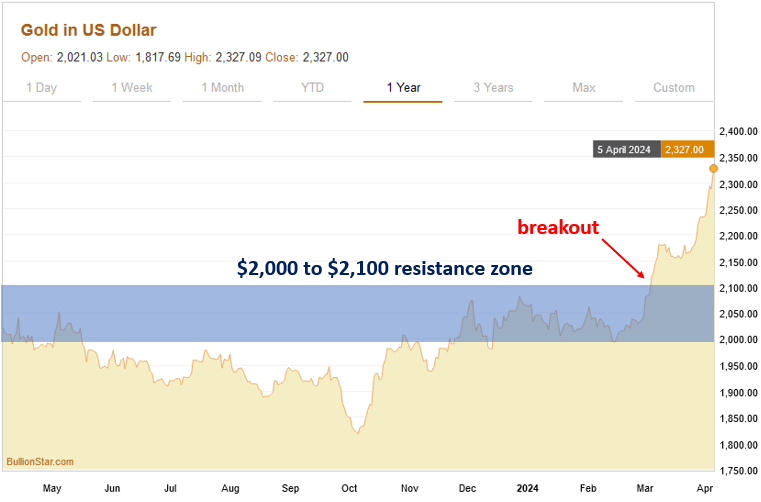
After more than three years of stagnation, gold has awakened with a vengeance since early-March and has promptly surged by nearly $300 an ounce or 14% to an all-time high $2,330 — a sharp move for a safe-haven asset that has a reputation for its slow and steady trends. Gold’s powerful rally came seemingly out of the blue and has confounded the majority of investors and commentators who have been much more focused on trendy speculative stocks and cryptocurrencies as of late. In this piece, I will explain several of the technical and fundamental factors that are driving gold to all-time highs, what is likely ahead for gold, and how investors can best take advantage of the yellow metal’s resurgence.
A Look at the Technicals
The chart of gold over the past year shows how it suddenly sprang to life over the past month. As I had explained in my last blog post on March 1st, there was an important technical resistance zone from $2,000 to $2,100 that had been acting as a price ceiling for gold since the middle of 2020. Gold’s successful close above that zone signified that a new rally had begun even though the fundamental drivers of it weren’t exactly apparent just yet.
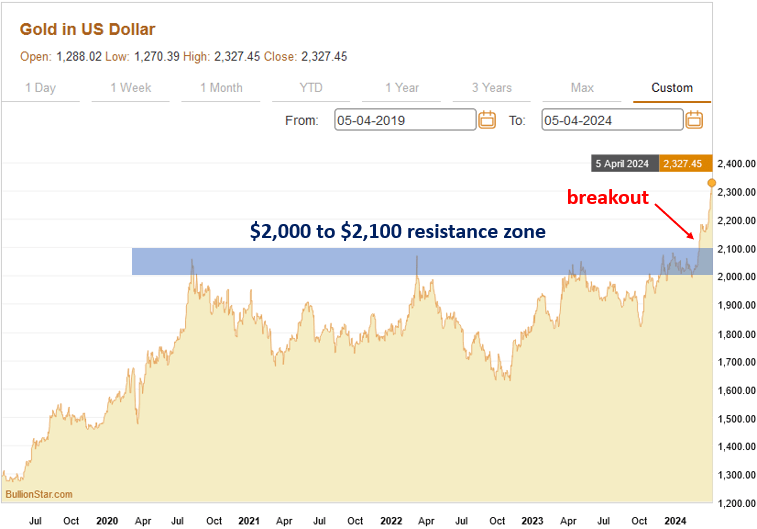
The multi-year gold chart shows the significance of the $2,000 to $2,100 resistance zone and how gold kept bumping its head at that level until it finally pushed through in the past month:
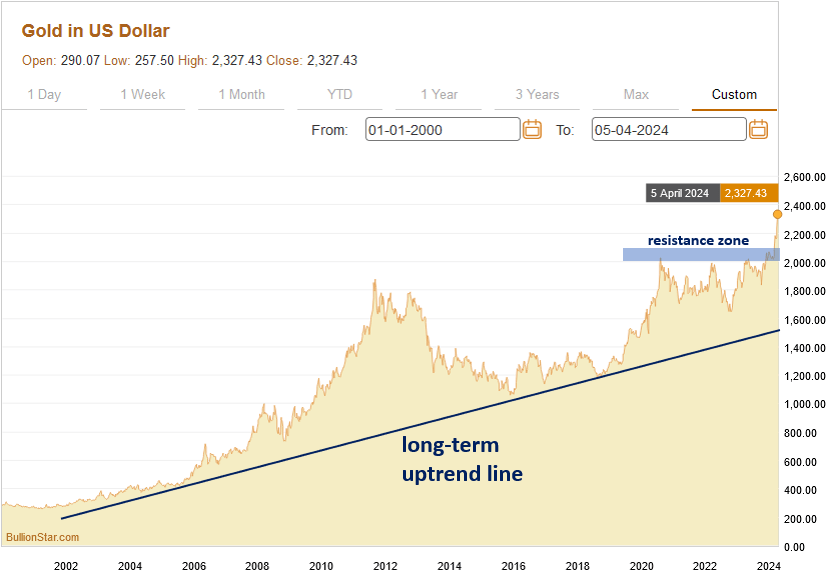
Gold’s multi-decade chart shows that it has been steadily climbing an uptrend line that began in the early-2000s as the U.S. and other countries kicked off an unprecedented debt binge that shows no signs of stopping whatsoever:
What’s particularly interesting and notable about gold’s surge over the past month is how it has occurred independently of the action in the U.S. dollar. Gold and the U.S. dollar have a long-established inverse relationship, which means that strength in the dollar typically causes weakness in gold, while dollar weakness typically causes the price of gold to rise.
The chart below compares gold (the top chart) to the U.S. Dollar Index (the bottom chart) and shows how action in the dollar often causes an opposite trend in gold. Gold’s recent surge took place while the dollar was trending slightly higher, which is a sign of gold’s strength due to its ability to buck the negative influence of the strengthening dollar.
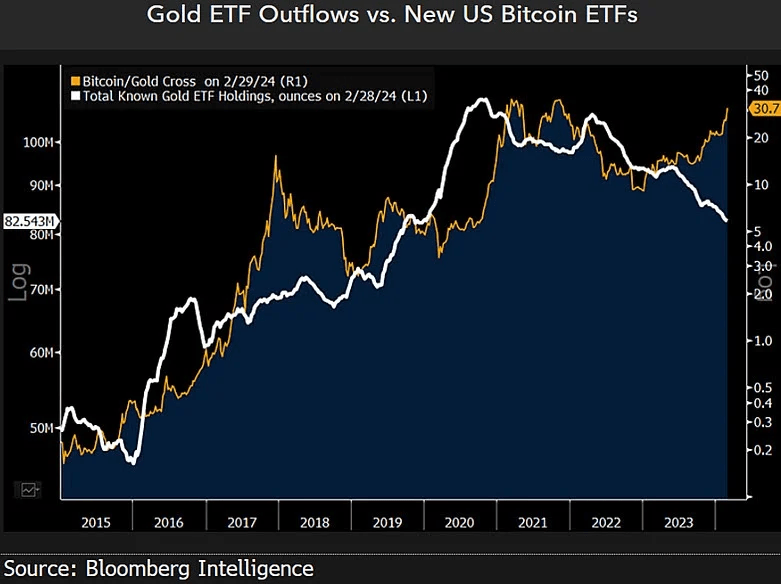
What is also worth noting is how gold’s surprising recent rally has received very little mainstream attention by a press that is much more enamored with hot AI stocks as well as Bitcoin and other cryptocurrencies that have recently benefited from the U.S. government’s approval of a number of Bitcoin exchange-traded funds (ETFs), which has resulted in tremendous inflows from institutional investors and retail investors alike.
As the chart below shows, investors have pulled billions of dollars worth of funds from gold ETFs in order to re-invest in Bitcoin ETFs, which is ironic considering its timing shortly before gold’s liftoff (and is confirmation of contrarian investing principles). The continuation of gold’s bull market will likely lead to funds flowing back into gold ETFs, providing additional fuel for the rally.
Central Banks Are Steadily Accumulating Gold
Though Western retail investors (who are often considered to be the “dumb money” in the market) have been sleeping on gold before and even during its surge of the past month, central banks — particularly those in Russia, China, Turkey, and India — have been steadily accumulating practically all of the gold that they can get their hands on. According to the World Gold Council, central banks purchased a healthy 1,037.4 metric tons of gold in 2023 in an effort to diversify out of the U.S. dollar and other fiat currencies that are being debased at an alarming rate and into a hard asset with a six-thousand year history as sound money that cannot be printed.
Though virtually all of the world’s currencies have been downgraded to pure fiat or paper currencies that are not backed by gold since 1971, many of those currencies are indirectly and implicitly backstopped by gold due to the held by many countries. For example, the U.S. officially holds 8,133 metric tons of gold, Germany holds 3,353 metric tons, Italy holds 2,452 metric tons, France holds 2,437 metric tons, Russia holds 2,333 metric tons, and China holds 2,192 metric tons of gold. In a serious currency crisis, a country’s gold reserves is likely to be one of its only saving graces, which is why many countries are accumulating gold at such a rapid pace.
Chinese investors who are seeking refuge from the country’s sinking property and stock markets are another important driver of gold’s nascent rally. Starting in the mid-2000s, China’s property and stock markets embarked on a seemingly unstoppable bull market as the country’s economy grew rapidly and the country began to increasingly flex its economic and geopolitical muscles on the world stage. Unfortunately, like Japan in the 1980s and US in the mid-2000s, China’s asset boom was actually an unsustainable bubble that was driven by copious amounts of debt and reckless speculation.
As all bubbles eventually do, China’s property and stock market bubbles have burst over the past year causing at least hundreds of billions of dollars worth of losses — including $100 billion alone from the country’s property tycoons. As faith in China’s economy and financial markets sinks, investors are turning to the old standby, gold, which has thousands of years of history in China as a superb store of value in good and bad times alike. When complex financial systems and products fail, as they currently are in China, savers and investors appreciate the simplicity and straightforward nature of physical gold. As the famous financier J. P. Morgan once said, “Gold is money. Everything else is credit.”
According to the World Gold Council, consumer demand for gold in China increased by a stout 16% in 2023, while demand for gold bars and coins rose by an even more impressive 27%. Retail gold buying in China has been dominated by the younger generations who face a difficult job market and are largely priced out of the country’s unaffordable housing market but find physical gold to be attainable — even if it means buying tiny amounts of it at a time as funds allow. Indeed, one of the most popular gold bullion products among young Chinese are gold beans that weigh as little as one gram and cost approximately 600 yuan (USD$83).
How Inflation is Contributing to Gold’s Recent Rise
Another important factor driving gold’s recent rally is stubbornly high inflation that is not easing as quickly as economists had hoped and may instead be on the verge of a resurgence. Gold is traditionally seen as a hedge against inflation and is very adept at sniffing out rising future inflation rates. U.S. year-over-year inflation — as measured by personal consumption expenditures — increased at a 2.5% rate in February, which caused traders to slightly dial back their expectations for Federal Funds Rate cuts this year.
Though U.S. inflation is still elevated, there is good reason to believe that the Fed will still go through with their plans to cut rates this year, which should prove to be beneficial for the price of gold. According to Bank of America’s commodities strategist Micheal Widmer, “The market is interpreting that the Fed is willing to accommodate higher inflation as it cuts rates.”
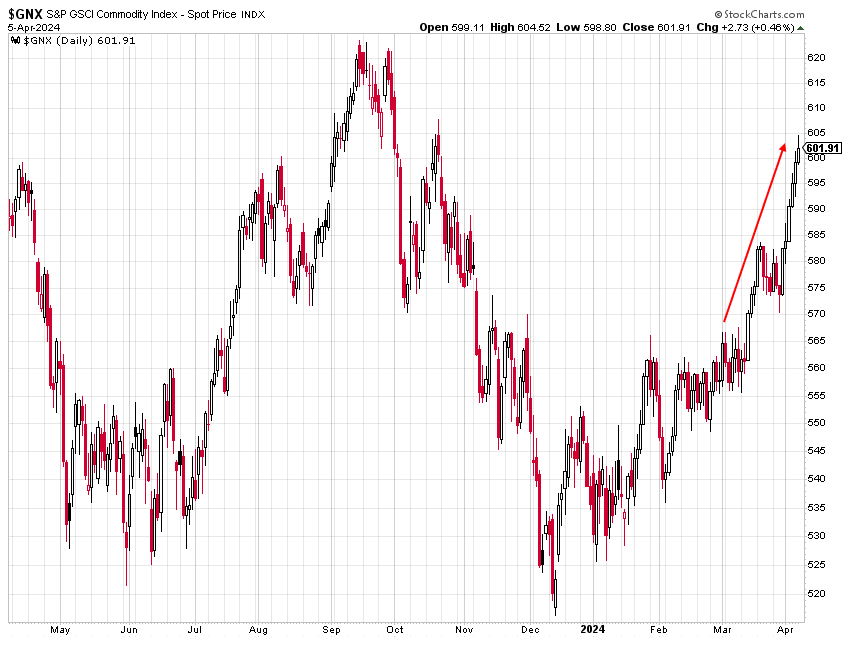
What is worth paying attention to in particular is the sharp surge in commodities prices over the past month, which is likely an indication of higher rates of inflation in the future:
Similarly, crude oil increased by 10% over the past few weeks:
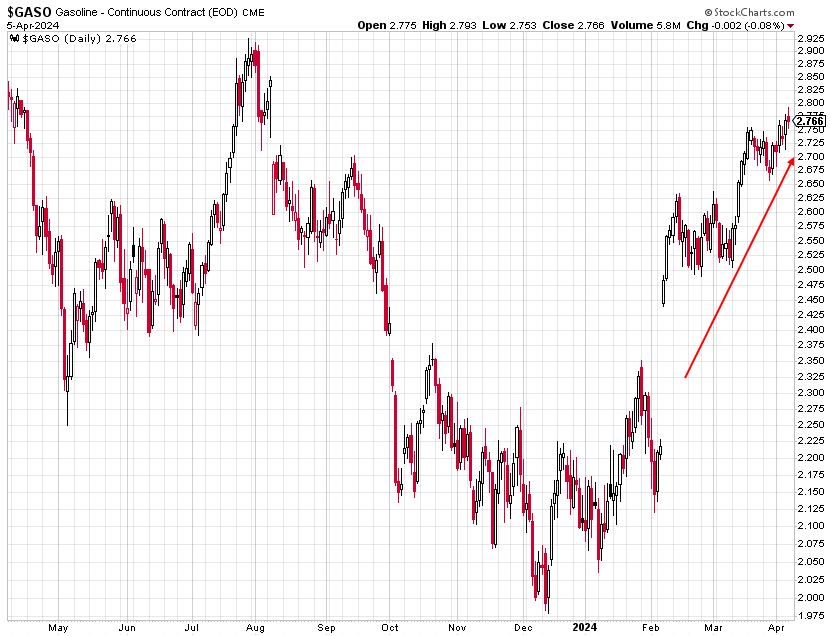
U.S. wholesale gasoline prices have spiked by approximately 30% in the past two months and are one of the most psychologically important and visible indicators of inflation in the minds of everyday consumers:
Gold is Benefiting From Political Uncertainty
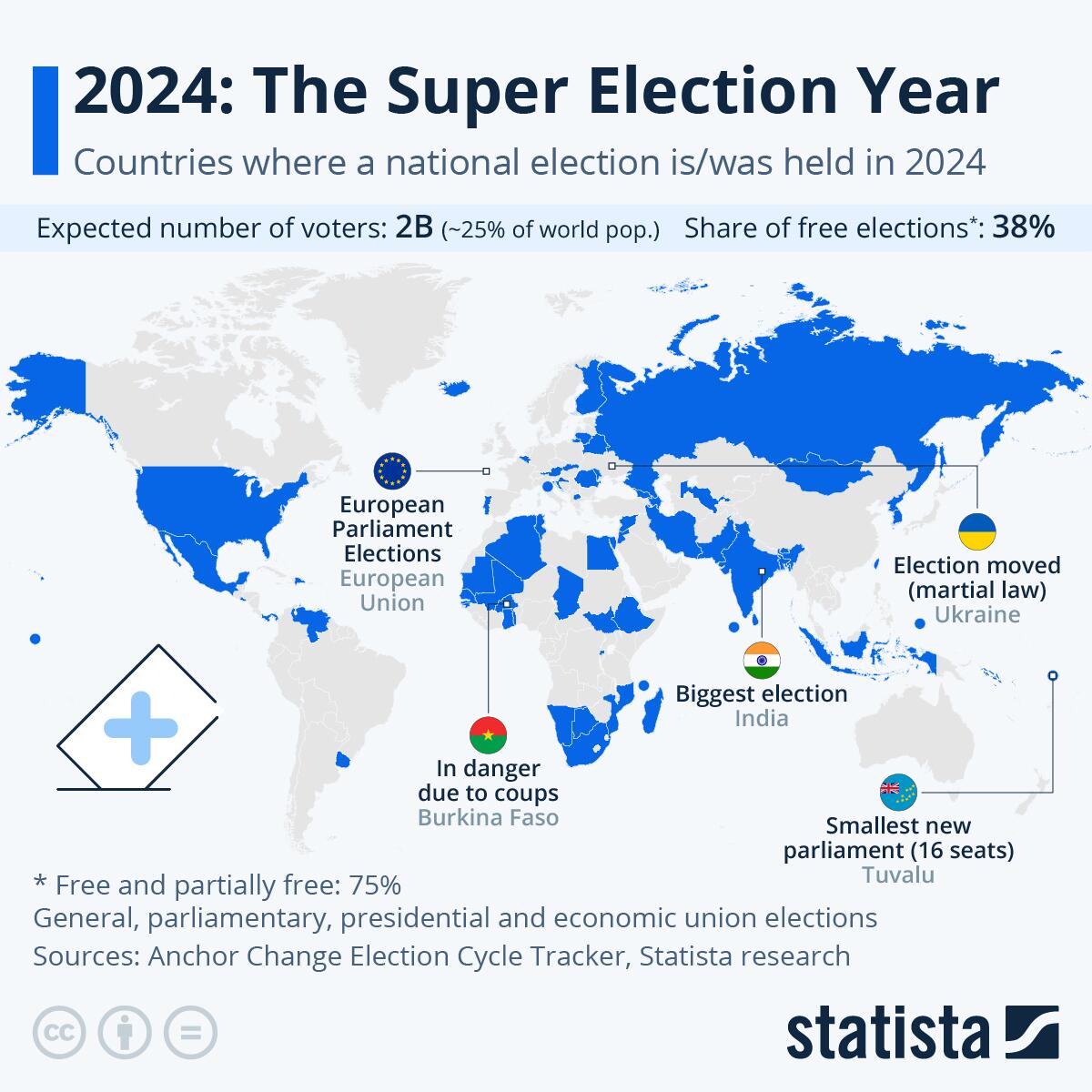
In addition to being a hedge against inflation, gold is also a hedge against economic and political uncertainty. In 2024, more than 60 countries are set to hold national elections, which makes it one of the most active global election years in a very long time, earning it the moniker “The Super Election Year.” The United States, Mexico, India and Indonesia are just some of the countries that are holding national elections this year.
Economic issues, including inflation, are the top concern for Americans who will most likely choose either President Joe Biden or former President Donald Trump to be the next U.S. president in a redux of the hotly-contested 2020 presidential election. President Joe Biden and the Democratic Party have earned a reputation for heavy spending and racking up the national debt, which are major reasons why they are blamed for the United States’ inflation problem. Based on that view, a potential Biden win would be beneficial for the price of gold.
How Geopolitical Tensions Are Helping Gold
As if there were not enough uncertainty and confusing cross-currents in the world already, rising geopolitical tensions in a number of hot-spots are also helping to boost the price of gold. The Russia-Ukraine war has taken a turn for the worse recently after Russia shot down 53 Ukrainian drones and the Kremlin warned that Russia and NATO are now in “direct confrontation.” Ukraine claimed that it destroyed least 6 Russian fighter jets, damaged eight more, and killed or injured 20 service personnel.
In addition, the Israel-Hamas war has now reached the six-month mark and shows no signs of de-escalation. On the contrary, Iran is now increasingly involved in the fray after Israel struck, numerous Iran-backed targets in Syria, which has now resulted in Iran vowing to retaliate, which is putting the world on edge and supporting the price of gold and crude oil.
How Declining Production Supports the Price of Gold
Another factor that is supporting the price of gold is the stagnating and declining production of gold from mines around the world. After rising steadily each year since 2010, global gold production peaked in 2019 at 3,300 metric tons and has since been declining even as the price of gold rocketed 66% from $1,200 to roughly $2,000 in 2023. Many experts believe that the world reached “peak gold” in 2018, which means that the amount of economically viable gold deposits around the world has peaked and entered into a terminal decline. Supporting that theory is the US Geological Survey’s alarming estimate that all known gold reserves could be depleted in just seventeen years.
Why You Should Invest in Gold
As I’ve discussed in this piece, gold is in a confirmed uptrend and there are numerous factors that are driving that uptrend. To learn more about the additional monetary and fiscal factors that are driving gold’s bull market, I recommend taking a look at my other recent piece, “What you need to know about gold’s long-term bull market.” To summarize, gold is rising in response to the alarming debasement of paper currencies and the ballooning global debt burden that guarantees a serious currency crisis in the not-too-distant future.
While many of today’s most popular financial products are only a few decades old at most and the average lifespan of a fiat currency is measured in mere decades, gold has helped humans preserve their wealth from all sorts of fiscal and monetary shenanigans perpetrated by governments for at least six-thousand years. Though we live in a highly complex world that is increasingly dependent on technology (and likely too dependent on technology), the simplicity of physical gold is one of its many strong points — especially when complex systems experience upheaval and failure.
There are countless modern investment products that aim to help investors gain exposure to gold, but most of those are “fool’s gold” rather than the real deal. There are gold exchange-traded funds (ETFs), gold futures and options, contract for differences (CFDs), other derivatives, and gold mining shares, but those are just paper claims on gold instead of actual gold that you hold free and clear. In times of serious crisis and chaos, as I expect we are heading into, there is no substitute for physical gold bullion that is in your possession and completely unencumbered by any other claims.
How Much Money Do You Need To Join The Top ‘1 Percent’?
A recent report by real estate consultancy Knight Frank details how much money a person needs to possess to be considered part of the 1 percent of the richest people in their respective country – and the results differ significantly.
Despite China making big steps towards leadership in several business sectors and transforming its economy toward higher value-creating industries, being a millionaire was pretty much enough to place a person in the upper 1 percent of China’s richest. A Chinese resident with assets of just under $1.1 million were considered part of the 1 percent in 2023, according to the report. As recent as 2020, even $850,000 would have been considered enough to be part of the 1 percent in China.
As Statista’s Katharina Buchholz details below, this is far from the case in other economies, for example notoriously wealthy Switzerland, where only those with a wealth of $8.5 million or more would be considered part of the 1 percent. In tiny and exclusive Monaco, one’s net worth would have to have eight digits, as only $12.9 million is enough to join the 1-percent club in the European micronation. In the United States, this number stood at $5.8 million last year.
While Knight Frank did not publish this numbers again for 2023, India in 2020 counted everyone who possessed the equivalent of $60,000 or more in the top 1 percent of the wealthiest residents. But this does not necessarily mean that India is more egalitarian when it comes to wealth distribution. With a population of around 1.4 billion people, India’s 1 percent is still 14 million people strong.
This means extreme wealth concentrates in the wealthiest 0.1 percent rather than the richest 1 percent, making the division of wealth even starker.A recent report on the country details that on a per-adult, pre-tax basis, India’s top 1 percent earned around 40 percent of the nation’s income while almost 30 percent of that was attributable to just the 0.1 percent.
Despite the lower profile of India’s 1 percent internationally, the group is still wealthier than its counterparts in the United States or European countries when comparing to the wealth of the rest of the nation. Credit Suisse found that in 2022, India’s 1 percent held around 40 percent of the country’s wealth, compared to 34 percent in the United States and 36 percent in Sweden, for example. In China, the number stood at 31 percent.
A secretive project conducted from the deck of an aircraft carrier in the San Francisco Bay will shoot trillions of aerosol particles into the sky to increase cloud cover in the name of preventing global warming, and details have been held back to “avoid (a) public backlash.”
The experiment is being dubbed America’s “first outdoor test to limit global warming.”
“The Coastal Atmospheric Aerosol Research and Engagement, or CAARE, project is using specially built sprayers to shoot trillions of sea salt particles into the sky in an effort to increase the density — and reflective capacity — of marine clouds,” reports Scientific American.
“The experiment is taking place, when conditions permit, atop the USS Hornet Sea, Air & Space Museum in Alameda, California, and will run through the end of May, according to a weather modification form the team filed with federal regulators.”
A solar geoengineering experiment in San Francisco could lead to brighter clouds that reflect sunlight. The risks are numerous https://t.co/53pbUSolxi
The report notes that there is little data on the potential negative effects of such geoengineering projects and that they “could also harm communities and ecosystems in unexpected ways.”
Shuchi Talati, the executive director of the Alliance for Just Deliberation on Solar Geoengineering, remarked how the test had been “kept under wraps” with little public engagement whatsoever.
A similar experiment that was set to be conducted over Sweden by Harvard University and had previously received funding from Bill Gates was cancelled last month after opposition from campaigners and Indigenous groups.
The Scientific American report warns that artificially creating cloud cover “could alter weather patterns in unclear ways and potentially limit the productivity of fisheries and farms.”
But they’re just going to go ahead and do it anyway.
Participants in the project declined to answer emailed questions or interview requests about the experiment in San Francisco.
According to a report by the New York Times, the secrecy is based on concerns that if the public knew the full scope of what was happening, “critics would try to stop them.”
“History has shown us that when we insert ourselves into modification of nature, there are always very serious unintended consequences,” said Greg Goldsmith, the associate dean for research and development at Chapman University.
Conspiracy theorists have long claimed that such experiments have been taking place for years, even decades, with some even asserting that weather modification has been conducted via “chemtrails” released from military and commercial aircraft.
The chemtrail conspiracy theory, which has been around since the early 90’s at least, is based around claims that contrails released from the jet engines of aircraft linger around in the sky for hours and produce de facto cloud cover to block out the sun.
* * *
Your support is crucial in helping us defeat mass censorship. Please consider donating via Locals or check out our unique merch. Follow us on X @ModernityNews.
The Europeans will never be able to replicate the time-tested Hegemon money laundering machine…
The awful shadow of some unseen Power Floats tho’ unseen amongst us, -visiting This various world with as inconstant wing As summer winds that creep from flower to flower.- Like moonbeams that behind some piny mountain shower, It visits with inconstant glance Each human heart and countenance; Like hues and harmonies of evening,- Like clouds in starlight widely spread,- Like memory of music fled,- Like aught that for its grace may be Dear, and yet dearer for its mystery.
– Shelley, Hymn to Intellectual Beauty
As the de facto North Atlantic Terror Organization celebrates its 75th birthday, taking Lord Ismay’s motto to ever soaring heights (“keep the Americans in, the Russians out, and the Germans down”), that thick slab of Norwegian wood posing as Secretary-General came up with a merry “initiative” to create a 100 billion euro fund to weaponize Ukraine for the next five years.
Translation, regarding the crucial money front in the NATO-Russia clash: partial exit of the Hegemon – already obsessing with The Next Forever War, against China; enter the motley crew of ragged, de-industrialized European chihuahuas, all in deep debt and most mired in recession.
A few IQs over average room temperature at NATO’s HQ in Haren, in Brussels, had the temerity to wonder how to come up with such a fortune, as NATO has zero leverage to raise money among member states.
After all, the Europeans will never be able to replicate the time-tested Hegemon money laundering machine. For instance, assuming the White House-proposed $60 billion package to Ukraine would be approved by the U.S. Congress – and it won’t – no less than 64% of the total will never reach Kiev: it will be laundered within the industrial-military complex.
Yet it gets even more dystopic: Norwegian Wood, robotic stare, arms flailing, actually believes his proposed move will not imply a direct NATO military presence in Ukraine – or country 404; something that is already a fact on the ground for quite a while, irrespective of the warmongering hissy fits by Le Petit Roi in Paris (Peskov: “Russia-NATO relations have descended into direct confrontation”).
Now couple the Lethal Looney Tunes spectacle along the NATOstan front with the Hegemon’s aircraft carrier performance in West Asia, consistently taking its industrial-scale slaughter/starvation Genocide Project in Gaza to indescribable heights – the meticulously documented holocaust watched in contorted silence by the “leaders” of the Global North.
UN Special Rapporteur Francesca Albanese correctly summed it all up: the biblical psychopathology entity “intentionally killed the WCK workers so that donors would pull out and civilians in Gaza could continue to be starved quietly. Israel knows Western countries and most Arab countries won’t move a finger for the Palestinians.”
The “logic” behind the deliberate three tap strike on the clearly signed humanitarian convoy of famine-alleviating workers in Gaza was to eviscerate from the news an even more horrendous episode: the genocide-within-a-genocide of al-Shifa hospital, responsible for at least 30% of all health services in Gaza. Al-Shifa was bombed, incinerated and had over 400 civilians killed in cold blood, in several cases literally smashed by bulldozers, including medical doctors, patients and dozens of children.
Nearly simultaneously, the biblical psychopathology gang completely eviscerated the Vienna convention – something that even the historical Nazis never did – striking Iran’s consular mission/ambassador’s residence in Damascus.
This was a missile attack on a diplomatic mission, enjoying immunity, on the territory of a third country, against which the gang is not at war. And on top of it, killing General Mohammad Reza Zahedi, commander of the IRGC’s Quds Force in Syria and Lebanon, his deputy Mohammad Hadi Hajizadeh, another five officers, and a total of 10 people.
Translation: an act of terror, against two sovereign states, Syria and Iran. Equivalent to the recent terror attack on Crocus City Hall in Moscow.
The inevitable question rings around all corners of the lands of the Global Majority: how can these de facto terrorists possibly get away with all this, over and over again?
The sinews of Liberal Totalitarianism
Four years ago, at the start of what I later qualified as the Raging Twenties, we were beginning to watch the consolidation of an intertwined series of concepts defining a new paradigm. We were becoming familiar with notions such as circuit breaker; negative feedback loop; state of exception; necropolitics; and hybrid neofascism.
As the decade marches on, our plight may at least have been alleviated by a twin glimmer of hope: the drive towards multipolarity, led by the Russia-China strategic partnership, with Iran playing a key part, and all that coupled with the total breakdown, live, of the “rules-based international order”.
Yet to affirm there will be a long and winding road ahead is the Mother of All Euphemisms.
So, to quote Bowie, the ultimate late, great aesthete: Where Are We Now? Let’s take this very sharp analysis by the always engaging Fabio Vighi at Cardiff University and tweak it a little further.
Anyone applying critical thinking to the world around us can feel the collapse of the system. It’s a closed system alright, easily definable as Liberal Totalitarianism. Cui bono? The 0.0001%.
Nothing ideological about that. Follow the money. The defining negative feedback loop is actually the debt loop. A criminally anti-social mechanism kept in place by – what else – a psychopathology, as acute as the one exhibited by the biblical genocidals in West Asia.
The Mechanism is enforced by a triad.
1.The transnational financial elite, the superstars of the 0.0001%.
2.Right beneath it, the politico-institutional layer, from the U.S. Congress to the European Commission (EC) in Brussels, as well as comprador elite “leaders” across the Global North and South.
3.The former “intelligentsia”, now essentially hacks for hire from media to academia.
This institutionalized hyper-mediatization of reality is (italics mine), in fact, The Mechanism.
It’s this mechanism that controlled the merging of the pre-fabricated “pandemic” – complete with hardcore social engineering sold as “humanitarian lockdowns” – into, once again, Forever Wars, from Project Genocide in Gaza to the Russophobia/cancel culture obsession inbuilt in Project Proxy War in Ukraine.
That’s the essence of Totalitarian Normality: the Project for Humanity by the appallingly mediocre, self-appointed Great Reset “elites” of the collective West.
Killing them softly with AI
A key vector of the whole mechanism is the direct, vicious interconnection between a tecno-military euphoria and the hyper-inflationary financial sector, now in thrall with AI.
Enter, for instance, AI models such as ‘Lavender’, tested on the ground in the Gaza killing field lab. Literally: artificial intelligence programming the extermination of humans. And it’s happening, in real time. Call it Project AI Genocide.
Another vector, already experimented, is inbuilt in the indirect assertion by toxic EC Medusa Ursula von der Lugen: essentially, the need to produce weapons as Covid vaccines.
That’s at the core of a plan to use funding of the EU by European taxpayers to “increase financing” of “joint contracts for weapons”. That’s an offspring of von der Lugen’s push to roll out Covid vaccines – a gigantic Pfizer-linked scam for which she is about to be investigated and arguably exposed by the EU’s Public Prosecutor Office. In her own words, addressing the proposed weapons scam: “We did this for vaccines and gas.”
Call it Weaponization of Social Engineering 2.0.
Amidst all the action in this vast corruption swamp, the Hegemon agenda remains quite blatant: to keep its – dwindling – predominantly thalassocratic, military hegemony, no matter what, as the basis for its financial hegemony; protect the U.S. dollar; and protect those unmeasurable, unpayable debts in U.S. dollars.
And that brings us to the tawdry economic model of turbo-capitalism, as sold by collective West media hacks: the debt loop, virtual money, borrowed non-stop to deal with “autocrat” Putin and “Russian aggression”. That’s a key by-product of Michael Hudson’s searing analysis of the FIRE (Finance-Insurance-Real Estate) syndrome.
Ouroboros intervenes: the serpent bites its own tail. Now the inherent folly of The Mechanism is inevitably leading casino capitalism to resort to barbarism. Undiluted savagery – of the Crocus City Hall kind and of the Project Gaza Genocide kind.
And that’s how The Mechanism engenders institutions – from Washington to Brussels to hubs across the Global North to genocidal Tel Aviv – stripped down to the status of psychotic killers, at the mercy of Big Finance/FIRE (oh, such fabulous seafront real estate opportunities available in “vacant” Gaza.)
How can we possibly escape such folly? Will we have the will and the discipline to follow Shelley’s vision and, in “this dim vast vale of tears”, summon the transcending Spirit of Beauty – and harmony, equanimity and justice?
* * *
The views of individual contributors do not necessarily represent those of ZeroHedge.
Much has been written about the best countries in Europe to visit, sight-see at, or vacation in.
But the economic powerhouse of a continent also has eight of the top 20 largest economies, the biggest single-market area, and some of the richest countries in the world.
How does all of that translate into how much people earn across the continent?
Data for this visualization comes from Eurostat and is current up to 2023.
Ranked: European Countries By Average Hourly Salaries
Luxembourg, Europe’s financial services capital, has the highest average salary (€47/hour) across the continent. The country also has the highest per capita GDP in the world.
Scandinavia’s Denmark and Norway also pay higher (€42/hour) though Sweden (€26/hour) falls more in the middle of the pack.
Rank
Country
Average Salary (€/hour)
1
🇱🇺 Luxembourg
€47.2
2
🇩🇰 Denmark
€42.0
3
🇳🇴 Norway
€41.7
4
🇮🇸 Iceland
€39.5
5
🇧🇪 Belgium
€36.3
6
🇮🇪 Ireland
€33.3
7
🇳🇱 Netherlands
€33.0
8
🇩🇪 Germany
€31.6
9
🇫🇮 Finland
€30.5
10
🇦🇹 Austria
€30.0
11
🇫🇷 France
€28.7
12
🇸🇪 Sweden
€26.3
13
🇸🇮 Slovenia
€21.9
14
🇮🇹 Italy
€21.5
15
🇪🇸 Spain
€18.2
16
🇨🇾 Cyprus
€16.3
17
🇱🇹 Lithuania
€14.0
18
🇲🇹 Malta
€14.0
19
🇵🇹 Portugal
€13.7
20
🇨🇿 Czechia
€13.6
21
🇪🇪 Estonia
€13.6
22
🇭🇷 Croatia
€12.7
23
🇬🇷 Greece
€12.6
24
🇸🇰 Slovakia
€12.5
25
🇵🇱 Poland
€11.9
26
🇭🇺 Hungary
€11.0
27
🇱🇻 Latvia
€10.7
28
🇷🇴 Romania
€10.4
29
🇧🇬 Bulgaria
€8.1
N/A
🇪🇺 EU
€24.0
Note: The source has not provided data for Russia, the UK, Switzerland, Serbia, Bosnia & Herzegovina, Liechtenstein, Andorra, San Marino, Monaco, and Vatican City.
Bulgaria records the lowest average salary in this dataset at €8/hour.
The map indicates Northern and Western Europe have higher average wages than Southern and Eastern Europe, reflecting the differences in economic development and wealth.
However, this split has not always been present. In fact, the reverse was true for many centuries. Mediterranean-based civilizations used to be some of the wealthiest in the world, benefiting greatly from the sea’s access across to Northern Africa and the Levant.
But by the 16th and 17th centuries, Atlantic Ocean trade opened up access to far bigger markets, driving up economic growth and wealth accumulation for the western half of Europe.
Naturally, the map of average salaries is also a reflection of the cost of living as well, influencing purchasing power, lifestyle choices, and overall economic conditions for individuals and families.