65.8 F
Chicago
Sunday, September 20, 2026
Home Blog Page 2767

China’s Plunge Protection Team Bought $6.8 Billion In Stocks In The Second Half Of 2023

China’s Plunge Protection Team Bought $6.8 Billion In Stocks In The Second Half Of 2023

By John Liu and April Ma, Bloomberg Markets Live reporters and strategists

A new dataset is giving China investors a peek into stock purchases by state-backed funds, promising to offer some clarity on the role played by them in supporting the world’s second-largest equity market in times of panic.

The so-called National Team bought at least 49 billion yuan ($6.8 billion) worth of onshore exchange-traded funds in the six months through Dec. 31, according to Bloomberg calculations based on the latest filings made available for the first time since state-backed funds announced the purchases last year. The amount exceeds an estimate of 28 billion yuan by Bloomberg Intelligence for such purchases.

While the data is available with a lag, it is seen giving investors a sense of Beijing’s resolve in aiding the market amid a selloff besides helping set future expectations. Analysts at Bloomberg Intelligence forecast China’s sovereign wealth funds and state insurance firms to buy about $100 billion in ETFs in 2024 after the CSI 300 Index, a benchmark of onshore equities, capped an unprecedented third straight annual loss last year.

Note: Data compiled from semi-annual and annual filings for 2023; semi annual data for China Southern Guoxin is an approximate based on listing filing

“The figure serves as a reference as to what they did to try and prop up stocks last year,” said Wu Xuan, fund manager at Borui Funds Management. It’s clear that the role of the national team is not to drive large rallies or systematically building stock positions, but to instead prevent steep plunges, he added. Hence, “plunge protection.”

Purchases by state institutions such as sovereign wealth fund Central Huijin Investment and Guoxin Investment, which were active in the early part of 2024, slowed in March as the market rebounded. The CSI 300 ended the month little changed after a 9.4% surge in February that was the biggest since November 2022.

The ETFs that saw the biggest state buying in the second half were the Huatai-Pinebridge CSI 300 ETF and China AMC SSE 50 ETF, at nearly 13 billion yuan each, based on their lowest closing price during the period. That took Huijin’s holdings in the pair to 17% and 36%, respectively.

Meanwhile, Guoxin, a unit of China Reform Holdings, also added at least 831 million yuan of the China Southern CSI Guoxin Central-SOEs Technology Lead ETF, while also appearing as the second largest top holder of the Bosera CSI Central-SOEs’ Innovation Driven ETF.

“While normally there shouldn’t be intervention in the market, we will not hesitate to act when the market is severely divorced from its fundamentals and there is volatility driven by irrationality,” China’s top securities regulator Wu Qing said last month.

Tyler Durden
Wed, 04/03/2024 – 17:20

“I Cannot Call Evacuation A Success”: New Details Emerge Of Afghanistan-Exit Chaos

“I Cannot Call Evacuation A Success”: New Details Emerge Of Afghanistan-Exit Chaos

Authored by Philip Wegmann via RealClear Wire,

New testimony from those who witnessed firsthand the confusion and chaos of the Afghanistan withdrawal further contradicts President Biden’s assertion that the hurried and violent end to the longest war in American history was an “extraordinary success.”

In a transcribed interview before the House Foreign Affairs Committee, former Foreign Service officer Samuel Aronson said the very opposite in living, harrowing color. “Let me be clear,” he told lawmakers behind closed doors, “I cannot call this evacuation a success.”

The questions and answers from Aronson, who received a State Department commendation for his heroism during the evacuation, as well as Ambassador Ross Wilson, the last U.S. diplomat to leave Afghanistan, were obtained by RealClearPolitics and have not been published previously.

Aronson recounted how American citizens, including children, were beaten by the Taliban, how U.S. passports were burned in a moment of panic when it seemed that Hamid Karzai International Airport in Kabul was about to be overrun, and how he delivered “a horrible choice” to a young Afghan mother.

Get on the airplane and never see your husband again or exit the airport and lose your only chance at freedom,” Aronson told her, recalling for lawmakers the bleak exchange that summarized the mismanagement, and at times bureaucratic incompetence, of an evacuation that Biden himself had vowed would not be “at all comparable” to how the U.S. left Vietnam.

There’s going to be no circumstance where you see people being lifted off the roof of an embassy,” Biden told reporters in July 2021 as American forces began their withdrawal. The president insisted that after two decades of U.S. support, the Afghan army was well-equipped, well-trained, and capable of prosecuting their own war. They were not.

Kabul fell to the Taliban on Aug. 15, the day the U.S. Embassy was evacuated. Emergency operations subsequently shifted to HKIA. What some call chaos followed.

Aronson recalled hotwiring buses to ferry the massive crush of humanity that descended on the airport and the sometimes impossible task of determining who should and should not be allowed inside the gates. He rejected the characterization later offered by State that the Taliban, whom the U.S. relied on at times to facilitate the departure of American citizens, was “businesslike and professional.”

The transcripts come nearly one year after the White House released a short summary of the “hotwash” review of U.S. Afghanistan policy. The administration took little responsibility for its actions, arguing instead in that document that Biden was “severely constrained” by decisions made by President Trump, specifically the U.S.-Taliban Doha agreement.  

“For all this talk of chaos, I just didn’t see it, not from my perch,” National Security Council spokesman John Kirby said as he argued back and forth with reporters when that document was released. Kirby served as Pentagon spokesman during the withdrawal and noted that flights left the airport “every 48 minutes” during the evacuation. “So I’m sorry,” he concluded, “I just won’t buy the whole argument of chaos.”

Managing the situation on the ground fell to Wilson, acting ambassador to Afghanistan. He testified that planning for a noncombatant evacuation operation (also known as an “NEO”) began in the spring of that year, and that Secretary of State Antony Blinken ordered the evacuation at his recommendation after the Taliban entered Kabul.

Wilson told lawmakers, however, that he was not directly involved in planning the operation. He also appeared unaware more than two years later that, per Department of Defense policy, he bore ultimate responsibility for the evacuation. “I believe that it was the responsibility of the chief of mission to call for an evacuation,” he testified, adding later that the operation itself would be carried out by “combatant command personnel who were not going to take orders from me.”

The generals in charge during the withdrawal have subsequently slammed the State Department for not ordering an evacuation sooner. “It is my assessment that that decision came too late,” retired Gen. Mark Milley, former Joint Chiefs chairman, said in committee earlier this month. Retired Gen. Kenneth F. McKenzie, former commander of U.S. Central Command, added that the subsequent disorder was “the direct result of delaying the initiation of the NEO for several months” until the Taliban were overrunning the country.

After the last U.S. flight left Kabul, Biden defiantly rejected any suggestion that an earlier evacuation order could have prevented more loss of life or allowed for “a more orderly” departure. Even if his administration evacuated just a month or two earlier, the president argued, “there still would have been a rush to the airport” and “a breakdown in confidence.”

There was just no easy way to end the decades-long land war, the president said, especially after the Afghan army unexpectedly folded and after his predecessor reached an agreement to pull out by May of that year. “The bottom line,” he insisted, “is there is no evacuation from the end of a war that you can run without the kinds of complexities, challenges and threats we faced. None.”

From what he saw sorting through a sea of humanity at the airport gates, Aronson testified that “it is clear to me that we should’ve started this evacuation and withdrawal sooner.” Because of the delay, he told lawmakers, those on the ground “had to really put our lives and our careers on the line, which we did.” Extending the timeline, a delay that almost certainly would have invited Taliban reprisals, would have allowed for more Afghans to escape, he added. The diplomat told lawmakers it “would have been tremendously helpful to have even five more minutes.”

His mission in Afghanistan began when a C-17 cargo plane carrying him and other officials, made a combat landing at HKAI to avoid potential groundfire. Though away on leave, Aronson had volunteered. There was no official call for help. He testified instead that he had navigated an ad-hoc, “word of mouth” network to find a way to aid in the evacuation, an effort made harder by COVID protocols and “significant resistance” from State’s Bureau of Human Resources. He did not receive any briefings or guidance before arriving in Kabul. The only preparation Aronson told lawmakers he received, “if you’d even call it that,” was during a layover in Doha, Qatar. A security officer fitted him with body armor.

While Wilson remained chief of mission, it was John Bass, who had served as U.S. ambassador to Afghanistan, who assumed responsibility for the work of day-to-day evacuations. Aronson would both be detailed to Bass as head of evacuations and do consular work screening thousands of Afghans desperate for a flight out of the country. From his limited interactions with the head of mission, he told lawmakers that Wilson “seemed overwhelmed” and that his physical health “did not seem great.”

Regardless of leadership, the system thrown into place lacked the precision that would have accompanied any kind of pre-planning, Aronson testified.

There was a lack of proper procedure. In the final days of the withdrawal, for instance, State rushed to notify Afghan allies who had worked with coalition forces that they had been approved for Special Application Visas (SIV) to resettle in the U.S. They sent the notice by email and directed SIV holders to present the document at the Kabul airport for entrance.

But the document that State forwarded had no name, serial number, or other identifying information, Aronson said. Afghans desperate to leave made thousands of copies of the notice, making it impossible to determine who had a legitimate visa and who had a forgery.

The emailed notice that had been “the sole mechanism” for confirming that an Afghan had SIV status and would therefore be allowed into the airport, he said, “became the least reliable mechanism to confirm somebody had an approved SIV.” Adding to the confusion, he told lawmakers the evacuation priority list changed “almost daily,” and that this information was seldom relayed in a timely fashion to the Marines guarding the airport gates.

There was also a lack of competent and appropriate personnel. Aronson testified that some overseas embassies tapped with reassigning staff to aid in the evacuation “may have sent their worst.” One consular officer, he recalled, weighed well over 300 pounds and was not “the right choice for such harsh, physical conditions.” Another civil service officer who he described as an otherwise “fantastically nice, competent, intelligent individual” was similarly ill-suited: The officer was deaf, a significant detriment in a combat environment.

The White House has long insisted that no amount of planning on paper, even with the proper personnel and procedures, could have accounted for the no-win scenario they inherited. Wilson backed up that sentiment, testifying that the Doha agreement, which Trump negotiated with the Taliban, and which set the initial timeline for the withdrawal, ensured that the Afghan government “lost leverage at almost every step along the way.”

There was still hope though, the ambassador told lawmakers, that the Afghan army could hold out, an optimism bolstered by faulty intelligence assessments.

The ambassador testified that, while there was no resistance within State to preparing for an evacuation in the spring and early summer, he wanted those preparations to remain classified to avoid the perception that the U.S. was “rushing for the exits.” A leak that the U.S. was planning an evacuation, he feared, could harm Afghan morale and possibly incite terror attacks amidst an ongoing civil war. “I didn’t want to set off a stampede that put at risk something that I think is intrinsically valuable, which is to have a U.S. mission,” Wilson told lawmakers.

But mayhem and stampedes followed anyway after the U.S. military footprint diminished from about 2,500 troops at the beginning of the Biden administration to about 650 troops on the eve of the evacuation. At the Kabul airport, State Department officials and 3,000 Marines later deployed to aid in the operation sorted through hundreds of thousands of Afghans, trying to determine who had a legitimate case for a ticket out of Afghanistan and who did not. In the process, some American citizens did not escape.

A “candid” retired Gen. Milley testified to that fact earlier this month, telling Congress, “I don’t know the exact number of Americans that were left behind because the starting number was never clear.”

As the evacuation was ongoing, Wilson was pressed during a CBS News interview about why more American citizens and Afghan allies hadn’t been evacuated before the fall of Kabul. He noted the series of serious warnings delivered by State to leave, saying that “never in my 40 years of working, since I began working at the State Department have I seen such strong language used.” Then the ambassador added, “People chose not to leave. That’s their business. That’s their right.”

Wilson told lawmakers he regrets “everything about that interview.” He confirmed reports that, in the confusion, the Taliban, “illiterate fighters who were now put in the role of access control,” turned away American passport holders.

Tyler Durden
Wed, 04/03/2024 – 17:00

Jeff Bezos Buys His Third Mansion On Florida’s Exclusive ‘Billionaire’ Bunker Island

Jeff Bezos Buys His Third Mansion On Florida’s Exclusive ‘Billionaire’ Bunker Island

Amazon founder Jeff Bezos just bought this third massive home on Florida’s exclusive Bunker Island, according to a new report from The Daily Mail.

Florida’s Bunker Island, officially known as Indian Creek Island, stands as one of the most exclusive and affluent communities in the United States. Often referred to as the ‘Billionaire Bunker,’ it is a haven for celebrities, business moguls, and the ultra-wealthy, prized for its exceptional privacy and security.

The island is accessible only via a guarded bridge, with its own private police force ensuring round-the-clock surveillance by land, sea, and air. Residents of this enclave enjoy access to an exclusive country club, a private 18-hole golf course, and the serene backdrop of Biscayne Bay, making it a coveted address among the world’s elite.

Jeff Bezos has made a significant addition to his real estate holdings by purchasing a third mansion there for $90 million.

The purchase increases his total investment in the area to $237 million. Bezos, ranked as the world’s third-richest billionaire by Forbes, has been expanding his property portfolio, which now includes this six-bedroom home situated in the exclusive isle near Miami.

This follows his purchase of two other mansions on the island last year for a combined nearly $150 million.

The Daily Mail reported that the new mansion, spanning 12,135 square feet, neighbors homes owned by notable figures like Jeff Soffer and NFL icon Tom Brady.

Bezos, who recently got engaged to Lauren Sanchez, plans to reside in the newly purchased home while demolishing the previous two. Bezos’ expansive real estate portfolio extends beyond Florida to include properties in New York, Washington D.C., Beverly Hills, West Texas, and a private estate in Hawaii, underscoring the billionaire’s lavish lifestyle and investment in luxury properties.

Recall we wrote late last year that Bezos had, however, given up on left-wing Seattle and was moving toward more red-friendly locales. 

Bezos wrote at the time: “Seattle has been my home since 1994 when I started Amazon out of my garage. That’s my dad behind the camera in this video, touring Amazon’s first “office.” My parents have always been my biggest supporters. They recently moved back to Miami, the place we lived when I was younger (Miami Palmetto High class of ’82 — GO Panthers!) I want to be close to my parents, and Lauren and I love Miami. Also, Blue Origin’s operations are increasingly shifting to Cape Canaveral. For all that, I’m planning to return to Miami, leaving the Pacific Northwest.

I’ve lived in Seattle longer than I’ve lived anywhere else and have so many amazing memories here. As exciting as the move is, it’s an emotional decision for me. Seattle, you will always have a piece of my heart.”

As we noted last year, Bezos stated in the post he wants to be closer to his parents and Blue Origin’s new operations at Cape Canaveral, but we suspect what spurred his exodus from the progressive state, like other wealthy folks, is the move from a high-tax state to a low-tax state. Florida does not impose a state income tax, estate tax, or inheritance tax.

In contrast, Washington state has a 7pc tax on capital gains, introduced in 2022, and officials have proposed a 1pc wealth tax on residents with over $250m in assets (which would mean Bezos paying $1.6 billion a year just to live there).

Tyler Durden
Wed, 04/03/2024 – 16:40

New York’s Election Year Anti-Crime Strategy Too-Little, Too-Late, Critics Say

New York’s Election Year Anti-Crime Strategy Too-Little, Too-Late, Critics Say

Authored by Michael Washburn via The Epoch Times,

Facing a critical election year and constant evidence of the progressive rollback of tough-on-crime policies, New York Gov. Kathy Hochul and other Democrat leaders are scrambling to counter the narrative that theirs is the party of lawlessness and disorder, some experts say.

In doing so, whether they wanted to or not, these politicians and officials have taken steps toward a more traditional approach to law enforcement.

Ms. Hochul’s abrupt deployment of 700 National Guard troops—along with additional New York State Police and Metropolitan Transit Authority (MTA) officers in the subways of the nation’s largest city—is one such example, in the view of Heather Mac Donald, a fellow at the Manhattan Institute think tank.

“Gov. Hochul is belatedly reacting to the crime and disorder that have plagued New York City since the George Floyd race riots,” Ms. Mac Donald told The Epoch Times.

“Why is she reacting now? Because the November elections loom and Democrats, from the president on down, are vulnerable to the charge that they have enabled a breakdown of law and order.”

Though the beefed-up security presence may have a short-term psychological impact on some commuters and residents, experts say it is unlikely to prove effective in an environment altered since the 2020 riots and defined by bail reform, heightened sensitivity to potential litigation, and the general demoralization of the law enforcement community.

Ms. Mac Donald cited figures that give a sense of the scope of the crisis that New York faces: Homicides rose 23 percent from 2019 to 2023, and shootings went up 27 percent during the same period. Petty larceny climbed 24 percent.

All told, major felonies have increased 33 percent during this period.

In New York, the Bail Elimination Act of 2019 was enacted at the beginning of 2020. The act ended the use of monetary bail and “unnecessary pre-trial incarceration,” all to promote “equity and fairness in the criminal justice system.”

Harvey Kushner, chair of the criminal justice department at Long Island University in Brookville, New York, largely blames the increase in crime on the above-mentioned bail reform law.

“If you take a look at who commits the crime in New York and on the subways, it’s the very same people, and they’re soon released,” Mr. Kushner said.

“A lot of it is a core group of 200 to 300 individuals. These people get arrested, and then they’re let out on the street immediately,”

“So let’s call this what it is.”

On Feb. 13, a woman, later identified in media reports as Amira Hunter, walked up behind a musician playing a cello in the Herald Square subway station and, seemingly without provocation, allegedly bashed him in the back of the head with a metal water bottle.

A video captured the incident.

It shocked and outraged citizens when the same attacker, released without bail despite the violent offense, allegedly stole clothing from a Nordstrom store just days later.

Many Gothamites still do not feel safe and some are taking matters into their own hands.

On March 14, a 36-year-old man on the train assaulted a 32-year-old stranger, who then wrested away the attacker’s gun and shot him with it. A video of the incident, a microcosm of the crisis in the Big Apple, went viral.

Then, on March 25, yet another incident made headlines.

A suspect identified as 34-year-old Guy Rivera, who was out on the street despite having a record with 21 prior arrests and five years in prison, shot and killed a young NYPD detective and father, Jonathan Diller, during a traffic stop in Queens.

At a wake for Officer Diller, a family member enraged at bail reform and the governor’s perceived lenience on the issue of public safety, confronted Gov. Hochul and said: “You have blood on your hands.”

Constant attacks on the integrity and fairness of policing have emboldened lawbreakers and made many people averse to even thinking about a career in law enforcement, Ms. Mac Donald and others have told The Epoch Times.

Recent weeks and months have seen images of mob attacks by illegal immigrants on hapless visitors in Times Square and of teens rioting in Chicago in the weeks immediately following the election of left-leaning mayor Brandon Johnson in the city’s April 2023 runoff election.

A group of illegal immigrants attacks two New York Police Department officers outside a migrant shelter near Times Square in New York on Jan. 27, 2024, in a still from video. (New York Police Department)

Other Democrat-led cities such as San Francisco, Los Angeles, and Washington, have also struggled with growing homelessness and crime.

With the November 2024 election on the horizon, Democrat leaders are eager to obfuscate or hide their role in allowing crime to spiral out of hand, lest their party pay a crippling price at the polls, Ms. Mac Donald and others say.

In New York City, the result is a public show of force with few parallels in recent urban history.

Hochul’s Order

While more than a few New Yorkers have been in dangerous situations before, incidents in the subways and on the streets of their city have captured headlines with regularity.

By the middle of February, violent and seemingly unprovoked attacks in public places began to happen in quick succession, leaving the city reeling. On Feb. 12, a gang shooting at a Bronx subway station left a 35-year-old bystander dead.

Lieutenant Jeffry Thoelen showcased jails at the Middletown Police Department to The Epoch Times on Sept. 9, 2022. He said cells were largely empty following the state bail reform. (Cara Ding/The Epoch Times)

The fact that New York’s controversial bail reform, which took effect Jan. 1, 2020, enabled a violent suspect to continue her crime spree strikes Mac Donald and others as a perfect example of what is wrong with the current system.

On Feb. 14, a homeless man physically assaulted an MTA worker who tried to wake him up on a subway platform and then attacked a bystander who intervened.

In another incident, a 16-year-old boy was left with a knife wound to the upper thigh in a Coney Island subway station.

Then, on the morning of Feb. 15, a young tourist from Brazil became a victim of random, unprovoked violence when a stranger slashed him in the neck in the Queens Plaza station.

On Feb. 17, an attacker repeatedly struck a stranger in the head with a metal pipe in a Queens subway station, placing the victim in the hospital with multiple cuts.

These incidents, and others, were the backdrop to Ms. Hochul’s March 6 announcement of a “five-point plan” to protect subway riders. Aside from the beefed-up police and National Guard presence at subways.

Ms. Hochul’s plan also calls for expanded surveillance and tighter coordination among law enforcement agencies.

Among the provisions of the plan are added personnel to conduct bag checks at crowded areas; a bill that will enable judges to ban people convicted of assaulting transit workers and riders from further use of public transportation in the city; stepped-up coordination among district attorneys, transit personnel, and police; the installation of cameras to monitor conductor cabins; and a $20 million investment in teams for intervention in cases involving mentally ill individuals.

Some observers have praised the governor’s move as a show of force wholly appropriate in a tense and fearful environment.

“As seen a few days ago [in the March 14 rush-hour incident], specific subway stations during congested times make all commuters and transit workers vulnerable to danger, criminal or not. Increased traffic demands increased awareness and teamwork,” David Carlucci, a former New York State senator and a commentator on the state’s political scene, told The Epoch Times.

“This is an all-hands-on deck scenario, and Gov. Kathy Hochul is using the tools and people at her disposal to ensure the safety of all. We cannot count on the great MTA staff to handle increasing traffic and incidents of violent crime.”

Mr. Carlucci acknowledged concerns about the militarization of the MTA as valid, but said the plan also includes mental health teams working alongside the National Guard.

“The National Guard often patrols major stations during social unrest and high traffic. No issues have arisen as a result of their presence,” Mr. Carlucci said.

Rudy Giuliani attends Republican presidential candidate and former President Donald J. Trump’s rally in Manchester, N.H., on Jan. 20, 2024. (Madalina Vasiliu/The Epoch Times)

‘Broken Windows’ Approach

The governor’s move marks a partial return to the strategy long associated with someone many progressives now despise: former New York City Mayor Rudy Giuliani, who served from 1994 to 2001.

During those years, New York City began to make a tentative comeback from the skyrocketing crime and rampant disorder of the administration of Democrat Mayor David Dinkins, whose tenure ran from 1990 through 1993.

One of the most traumatic events in modern urban history, the Crown Heights riot of August 1991, happened on Mr. Dinkins’s watch, as did the peak of the city’s homicide rate.

In the first year of his tenure, 1990, the city saw 2,245 killings.

One year into his tenure, Mr. Dinkins had failed to make good on his promises to get crime under control.

Between 2,180 and 2,224 murders occurred in New York City in 1991.

Mr Giuliani, and his police commissioner, William Bratton, sought to reverse the trend through the policy known as “broken windows.”

The theory was that acting vigilant toward minor offenses would lead to the snaring of criminals with outstanding warrants, who had committed or would soon commit more serious crimes.

The strategy met with marked success, with fewer than 700 murders recorded in each of Mr. Giuliani’s final two years in office and serious crime down significantly in all categories.

John DeCarlo, director of the master’s program in criminal justice at the University of New Haven, the theory that researcher George Kelling developed back in the 1980s was a sound one.

“Look back to 1994, when Bratton used the theory called ‘broken windows’ to address crime in the subway, on George Kelling’s theory that serious criminal offenders were committing minor crimes in the subways.

“That seems to have held true. They had buses outside the major subway stations and they would grab fare-jumpers, take them away, and many of them had pending warrants, so they would remove them from the system,” Mr. DeCarlo told The Epoch Times.

But progressive reforms worked directly against the aggressive stance that Mr. Giuliani, and to a lesser extent, his successor Michael Bloomberg, had followed.

A federal court ruling on Aug. 12, 2013, found that the policy of “stop-and-frisk” violated the constitutional rights of New Yorkers and disproportionately affected members of racial minorities.

Safety or Waste of Money?

Some observers believe that a strategy best described as police saturation will bear fruit, for the simple logistical reason that criminals will shy away from committing illegal acts when getting caught is a near certainty.

“You can put in surveillance, and try to have a well-maintained environment. But the biggest deterrent to crime are people, whether police or the National Guard or state cops.

“The 700-odd National Guardsmen will vet those coming into the system, doing the equivalent of watching for turnstile jumpers, as the police did in 1994,” Mr. DeCarlo said.

“It worked in 1994, and the technology that criminals are using now in the subways hasn’t advanced.”

Other experts are less sanguine about Ms. Hochul’s approach.

The crackdown is too little, too late, they say, and the political factors underpinning it are blatant.

Jeffrey Fagan, a criminologist who teaches at Columbia Law School, said the governor’s approach is not only arbitrary but will reignite many of the controversies that have dogged law enforcement in the recent past.

“Subway crime is like a needle in a haystack,” Mr. Fagan told The Epoch Times. He also provided research that formed part of the basis for the federal ruling prohibiting stop-and-frisk in 2013.

“Because of the demographics of the subway-riding population in the neighborhoods that the subways go through, the specter of enormous racial disparities looms.”

Mr. Fagan said Ms. Hochul’s five-point plan is a serious misallocation of resources that won’t improve public safety in any meaningful, long-term way.

“It’s taking both the National Guard and the state troopers away from otherwise valuable duties and putting them on a search for, essentially, people in a mental health crisis,” Mr. Fagan said.

“If you ask the NYPD, this is all about fare evasion, but that’s nonsense. Quite honestly, I can’t believe anybody is taking this seriously, and the theatrics will do little for public safety and a lot of damage to the state budget.”

Undermining Law Enforcement

The bail reform law and the demonization of police departments have so undermined policing and faith in law enforcement that people are fleeing the profession, and officers on the street are barely able to do their jobs, said Mr. Kushner.

He views Ms. Hochul’s five-point plan as a political maneuver that doesn’t make sense even from the point of view of commuters’ day-to-day safety. The plan’s architects misunderstand or deliberately ignore the nature of the problem.

Mr. Kushner blames bail reform and the Democrat administration’s failure to control the southern border, and says that his many sources in the law enforcement community affirm this view.

“Interviewing law enforcement, they’re telling me that they can’t do their job, they’re being controlled, they’re being manipulated, and this goes back to the war on cops that started with the George Floyd incident,” Mr. Kushner said.

New York Attorney General Letitia James during a press conference at the Office of the Attorney General in New York on Feb. 16, 2024. (Timothy A. Clary/AFP via Getty Images)

“The other aspect is George Soros and the hiring of district attorneys. Take a look at New York Attorney General Letitia James and what she’s done to law enforcement in New York.”

Mr. Kushner said that the phenomenon of Soros-funded groups spending millions to support the campaigns of progressive district attorneys is evident in cities across the country.

As a further example, he pointed to Larry Krasner, who successfully ran for attorney general in Philadelphia in 2017 on a platform that supported the end of cash bail and lighter penalties for various crimes.

Mr. Krasner has sued the city’s police department and was himself the target of an unsuccessful impeachment campaign by the Pennsylvania House of Representatives in 2022.

The efforts of Ms. James, Mr. Krasner, and other critics of law enforcement have bred an environment where police officers cannot do their jobs and, with the deck stacked against them, have shrunken their ranks.

By way of example, Mr. Kushner noted that an exam for prospective police officers in Nassau and Suffolk Counties on his native Long Island, New York, used to draw tens of thousands of applicants.

“Now, if we get a few thousand, it’s a lot. We still see candidates, but do they want to go into traditional areas such as corrections and law enforcement? No, they’re going into different fields, such as law. There is no interest in protecting the public,” Mr. Kushner said.

Mr. Kushner said he has received inquiries from police departments in places as far-flung as Texas, Vermont, and Washington, soliciting his help in recruitment efforts amid a candidate shortfall.

He recalled a recent occasion when the U.S. Secret Service came out to Long Island as part of a recruitment effort, offering a one-day seminar, and had to cancel the evening part of the event because only five people showed up.

Ms. Mac Donald concurs with Mr. Kushner about the effects of anti-police sentiment on recruitment and morale.

She cited a Minneapolis Star Tribune report finding that people have left the city’s police department at record levels over the past three years and the number of uniformed personnel hit its lowest level in four decades in August 2023.

Ms. Mac Donald also pointed to a Police Executive Research Forum survey of 182 police agencies in 38 states and the capital, finding that 66 percent of agencies surveyed experienced a jump in resignations from 2020 to 2022.

“Michigan’s chiefs of police have announced a recruiting crisis. Pittsburgh Academy classes are down by three-quarters,” she said.

Ironically, Mr. Kushner noted, the communities that suffer the most from the depletion of police forces and the watered-down approach to policing are those that progressives, in theory, most want to uplift.

“The argument has been about racial disparities. If you don’t meet bail, you go to jail. They felt it was driven by an economic variable based on race, and that by changing these bail laws, they would have a more equitable society. But, four years into it, its implementation didn’t have the effect that they wanted,” he said.

“Take a look at different cities. Whether it’s Philadelphia, Chicago, or New York, crime there is out of control.”

Though Chicago and other cities recorded slight dips last year, these statistical variations mean little in the larger context.

Murders in Chicago declined slightly from 709 in 2022 to 617 in 2023, but the total number of crimes in all major categories rose from 66,739 to 77,523 over the same period.

In 2023, Chicago stood out as the nation’s murder capital for the 12th year in a row.

The Epoch Times has reached out to Ms. Hochul’s office for comment.

Tyler Durden
Wed, 04/03/2024 – 16:20

Gold Closes At Record High For 5th Straight Day, Dollar Dumps As Bond Bloodbath Stalls

Gold Closes At Record High For 5th Straight Day, Dollar Dumps As Bond Bloodbath Stalls

Another mixed bag of data today – something for everyone – ADP showed better job gains than expected (but wage growth soared, re-igniting inflation fears). S&P Global’s Services PMI dropped (but prices paid soared) and ISM Services PMI also dropped (notably more than expected) while Manufacturing rose yesterday.

But the market only had eyes for one thing – the plunge in prices paid in ISM Services (which literally diverged from all other recent ‘prices paid’ surveys and the respondents’ comments)…

Source: Bloomberg

For context, that is the biggest two-month plunge in ISM Services Prices Paid since Dec 2008

Source: Bloomberg

That one datapoint was all the algos needed and stocks rallied, the dollar and bond yields dropped, gold spiked to new highs, bitcoin jumped higher, and even rate-cut hopes rose immediately (but still less than 3 total rate-cuts priced in for 2024)…

Source: Bloomberg

Small Cap stocks loved the ‘dovishness’ of lower prices paid (and Powell didn’t offer much either way) and along with Nasdaq and the S&P ended the day green.

“On inflation, it is too soon to say whether the recent readings represent more than just a bump,” Mr. Powell stated.

“We do not expect that it will be appropriate to lower our policy rate until we have greater confidence that inflation is moving sustainably down toward 2 percent.”

At the same time, he said that cuts to the benchmark federal funds rate are “likely to be appropriate at some point this year” as he does not believe “inflation is reversing higher.”

Then, at 1515ET, a huge sell program suddenly hit stocks out of nowhere…

Source: Bloomberg

It appeared to be triggered by this HL – *APPLE EXPLORES HOME ROBOTS AS ‘NEXT BIG THING’ AFTER CAR FAILS – which sent AAPL sharply lower immediately…

We guess the trading bots don’t like competition?

And that spoiled the party overall for stonks but they bounced back from that shock. Quite a crazy day – although small moves in the bigger picture. The Dow ended red and is on target for its worst week since October…

Notably, the S&P bounced perfectly at the lows from the 3/20 FOMC meeting spike…

While the broad market was up today, Disney was not – after Iger won in the fight against Trian…

Treasury yields were higher once again overnight but the ISM prices paid data sent them back down to basically end the day unch-ish (2Y -1bp, 30Y +1bp)…

Source: Bloomberg

The yield curve (2s30s) continues to steepen…

Source: Bloomberg

The dollar dived back to one-week lows…

Source: Bloomberg

And that helped send gold to its fifth record closing high in a row, within pennies of $2300 (spot)…

Source: Bloomberg

Crude prices rallied for the fifth day in a row, with WTI topping $86

Source: Bloomberg

Positioning is once again very long in Brent futures…

Source: Bloomberg

Finally, as gold pushes to record-er and record-er highs (in USD terms), Real yields refuse to play along…

Source: Bloomberg

Whatever gold is worrying about… is big.

Tyler Durden
Wed, 04/03/2024 – 16:00

Apple Developing Robot As “Next Big Thing” After Dumping Electric Car Project

Apple Developing Robot As “Next Big Thing” After Dumping Electric Car Project

After shocking its fans – and everyone else – with the recent decision to give up on developing an electric car after sinking billions of dollars into the now defunct project, Apple – perhaps deciding to quietly move on beyond the neck brace also known as the Vision Pro – has set its sights on a new “next big thing”: according to Bloomberg, Tim Cook’s company – which is currently being sued by the DOJ for being a monopolist – is pushing into personal robotics, a field with the potential to become one of the company’s ever-shifting “next big things,” according to people familiar with the situation.”

According to the report, Apple’s engineers have stolen Elon Musk’s Optimus concept come up entirely on their own with the truly original and unique idea of pursuing a mobile robot that can follow users around their homes. It wasn’t clear if the code name of the robot is iOptimus. The iPhone maker also has developed an advanced table-top home device that uses robotics to move a display around. We hope this won’t be called the iEchoShow.

Having been accused – accurately – by pretty much everyone that it hasn’t come up with an original idea since Steve Jobs died (sorry, but buybacks and moar buybacks doesn’t count), Apple is under growing pressure to find new sources of revenue, and while this effort is in its early stages – and it’s unclear if the products will ultimately be released – it seems that we now have a race on for the first company to release the real-world version of the T-800.

Apple scrapped its long-running electric vehicle project in February, and a push into mixed-reality goggles is expected to take years to become a major moneymaker, if ever.

With robotics, Apple could gain a bigger foothold in consumers’ homes and capitalize on advances in artificial intelligence. But it’s not yet clear what approach it might take; it is also not clear if Apple can catch up to other companies that have a substantial lead over it, like Tesla and Microsoft. Though the robotic smart display is much further along than the mobile bot, it has been added and removed from the company’s product road map over the years, according to the Bloomberg report.

Some more details:

The robotics work is happening within Apple’s hardware engineering division and its AI and machine-learning group, which is run by John Giannandrea. Matt Costello and Brian Lynch — two executives focused on home products — have overseen the hardware development. Still, Apple hasn’t committed to either project as a company, and the work is still considered to be in the early research phase. A spokeswoman declined to comment.

Before the car project was canceled, Apple told its top executives that the company’s future revolved around three areas: automotive, the home and mixed reality. But now the car isn’t happening and Apple has already released its first mixed-reality product, the Vision Pro headset, to – well – very mixed reviews.

So the focus has shifted to other future opportunities, including how Apple can better compete in the smart home market.

Ironically, after the report that Apple’s was betting its future on robots, the robots that trade stonks were not too happy, and sent AAPL stock tumbling, only to rebound as yet another group of robots rushed to BTFD.


Tyler Durden
Wed, 04/03/2024 – 15:53

Saturdays Only For “People Of Color” At UC Berkeley Farm; Report

Saturdays Only For “People Of Color” At UC Berkeley Farm; Report

Authored by Micaiah Bilger via The College Fix,

Federal complaint accuses university of racial discrimination…

A community farm run by the University of California at Berkeley only allows “people of color” to participate on Saturdays, according to a new federal complaint.

The report to the Department of Education accuses the Gill Tract Community Farm of racial discrimination in violation of Title VI.

Run by the public university, the farm is a research, education, and extension project “focused on ecological farming and food justice,” according to its website. It welcomes the public to harvest food if they “help with weeding, planting, and watering.”

However, the Mountain States Legal Foundation, which filed the complaint last week, said the program discriminates against white people.

“Saturdays are exclusively BIPOC,” a farm manager wrote in a series of text messages cited in the complaint. “Exceptions have only been made for events that are BIPOC-centered and with plenty of advance notice and planning.”

The manager also advocated for “upholding boundaries around that safe and sacred space,” according to the complaint.

University spokesperson Dan Mogulof told the New York Post he was unaware of the allegations. After reviewing the complaint, Mogulof said the university takes such matters “extremely seriously” and will investigate the situation.

“The anonymous texts attached to the complaint have no specific information about time or place. And, as you can see, the Gill Tract’s website and calendar make no mention whatsoever of any program or activity of the sort described in the complaint,” Mogulof said.

“Having said that … I will contact the appropriate people on campus in an effort to determine what the facts are,” he told the Post.

The complaint asks the university to publish a statement reminding the public that everyone is welcome at the farm. It also asks the university to require training for individuals who run the farm.

“While the farm purports to be a welcoming place, the staff running the farm seem to think that racial segregation should make a comeback,” Mountain States Legal Foundation stated on its website.

“… But neither the Constitution nor federal law permit public institutions like UC Berkeley to engage in racial segregation.”

Other universities also have incorporated racial issues into their agricultural programs in recent years.

In 2021, the University of Michigan hired a full-time diversity, equity, and inclusion manager for its Matthaei Botanical Gardens & Nichols Arboretum, The College Fix reported. The gardens also held workshops about “confronting racism.”

Meanwhile, San Diego State University spent a quarter of a million dollars to build a racial healing garden in 2019. Campus sources later told The Fix no one uses it.

And Cornell University’s agricultural program sponsored a “safer science” webinar in 2021 about “identity prejudice” and “safe fieldwork strategies for at-risk individuals.”

Some universities also employ DEI administrators in their agricultural programs.

Tyler Durden
Wed, 04/03/2024 – 15:25

Gold Vs. Bitcoin: The Winner Is…

Gold Vs. Bitcoin: The Winner Is…

Authored by Nick Giambruno via InternationalMan.com,

The ultimate competition to become the world’s dominant money will have only one winner.

Anything else would amount to an inefficient barter system, which is why international monetary networks tend to converge on one thing as dominant money at the base layer.

Previously, the dominant base layer money was gold. Today, it’s the US dollar and Treasuries. In the future, I think it will either be Bitcoin or gold.

Over the long term, billions of people through trillions of transactions—in other words, the free market—will ultimately decide whether gold or Bitcoin will win.

I am all for free-market competition in money.

I say let the best money win.

In a recent article, I analyzed the ten most decisive monetary attributes and examined whether gold or Bitcoin has an advantage. The table below summarizes the results.

Bitcoin wins in 6 out of the 10 categories, including hardness (resistance to debasement), which I believe will be the most decisive factor.

While gold has an advantage over Bitcoin in durability, that advantage will only be relevant in the case of an inescapable, global return to the Stone Age that lasts into eternity. Such an unlikely outcome is not relevant to investment decisions today.

Gold also has a fleeting advantage in liquidity, fungibility and privacy, and recognition. However, Bitcoin is eroding those advantages every day.

If current trends continue, I believe Bitcoin will overtake gold in these categories in the years ahead.

Putting it all together, gold’s advantages over Bitcoin are either irrelevant or melting away.

The inescapable conclusion is that Bitcoin has superior fundamental characteristics that make it a better tool for sending value through time and space.

Digital gold is better than analog gold.

In short, Bitcoin is likely to win the ultimate competition and become the world’s dominant money.

Allow me to explain how I see it playing out…

I am not saying it is 100% certain Bitcoin will demonetize gold.

What I am saying is this: over the long term—measured in years, likely decades—there is a good chance Bitcoin will demonetize gold because it has superior monetary properties.

However, the vast majority of humanity does not understand that Bitcoin has the potential to become the world’s dominant money… yet.

What we have here is an enormous information asymmetry.

With Bitcoin, it’s as if you discovered gold before most of the world understood that gold was useful as money.

Think about it.

You have the chance to front-run major investors, large multinational corporations, and even nation-states by getting in on this trend before they do.

Bitcoin’s potential ascent to the world’s dominant money—a megatrend I like to call The Bitcoin Supremacy—is an enormous once-in-a-lifetime opportunity and the biggest investment story I’ve ever seen.

There are a couple of necessary clarifications to this analysis.

Clarification #1: Black Swans

Any number of events with currently inconceivable and impossible-to-foresee effects—the arrival of quantum computing, asteroid mining, nanotechnology, etc.—could tip the scale in either direction.

Clarification #2: Timing

I do not believe Bitcoin is an immediate threat to gold.

Most likely, gold will be remonetized as the fiat currency system collapses, only to be demonetized by Bitcoin in the following years and decades.

Although Bitcoin has better monetary attributes than gold, it may take many years—potentially decades—for most people to recognize this.

A big factor in timing is how fast the fiat currency system collapses.

If I had to guess when that would happen, I would say the collapse of the fiat system should be evident by around 2030.

If the fiat currency system collapses faster than expected, it will likely benefit gold. Gold has better recognition, and more people will gravitate toward what they are familiar with. Bitcoin is novel and misunderstood.

If the collapse of the fiat currency system drags out longer, it could benefit Bitcoin. That’s because as time goes on and Bitcoin’s recognition grows, people become more comfortable with it as an alternative to fiat currency. They’ll skip gold and jump directly from fiat to Bitcoin.

In any case, I believe that Bitcoin won’t start to potentially demonetize gold in earnest until after the collapse of the fiat currency system is complete. My guess is that could happen around 2030, and then it could be many years—possibly decades—before Bitcoin fully demonetizes gold.

That said, a Bitcoin standard could spontaneously emerge faster than anyone expects. That’s a risk to gold and an excellent reason to have exposure to Bitcoin.

Clarification #3: Portfolio Allocation

I do not think it makes sense to go “all in” on Bitcoin… or anything.

100% exposure to any asset is not prudent risk management because nothing in life is 100% certain. With exponential increases in technology, not even death is certain, but that’s a story for another day.

What I can say with the highest confidence is that—for the first time in over 5,000 years—gold has a serious competitor that could demonetize it in the coming decades.

At a minimum, I view gold as a hedge if Bitcoin does not emerge as the world’s dominant money in the long term.

In the immediate future, gold is a superior monetary alternative to fiat currency. I believe it will be the primary beneficiary as the current fiat monetary system collapses in the years ahead.

In my opinion, the prudent thing to do is to allocate capital to gold and Bitcoin and update that allocation as time goes on and facts change.

In the short and medium term, I believe both gold and Bitcoin will do very well as the fiat currency system crumbles.

Right now, I want to have exposure to both, and the stocks of companies that benefit from higher gold and Bitcoin prices.

That’s why I’ve just released an urgent PDF report revealing three crucial Bitcoin techniques to ensure you avoid the most common—sometimes fatal—mistakes.

Check it out as soon as possible because it could soon be too late to take action. Click here to get it now.

Tyler Durden
Wed, 04/03/2024 – 12:45

Bloomberg Admits ‘10,000 Migrant Crossings A Day’ Has ‘Upended The Election’

Bloomberg Admits ‘10,000 Migrant Crossings A Day’ Has ‘Upended The Election’

While Paul ‘not my child porn‘ Krugman and other idiots want you to believe that illegal immigration is actually a good thing for America and will boost GDP by $7 trillion, Bloomberg is a bit more realistic…

Even worse for Joe Biden’s handlers (i.e. whoever’s running the government) is that Bloomberg wrote this up as a ‘human interest’ story:

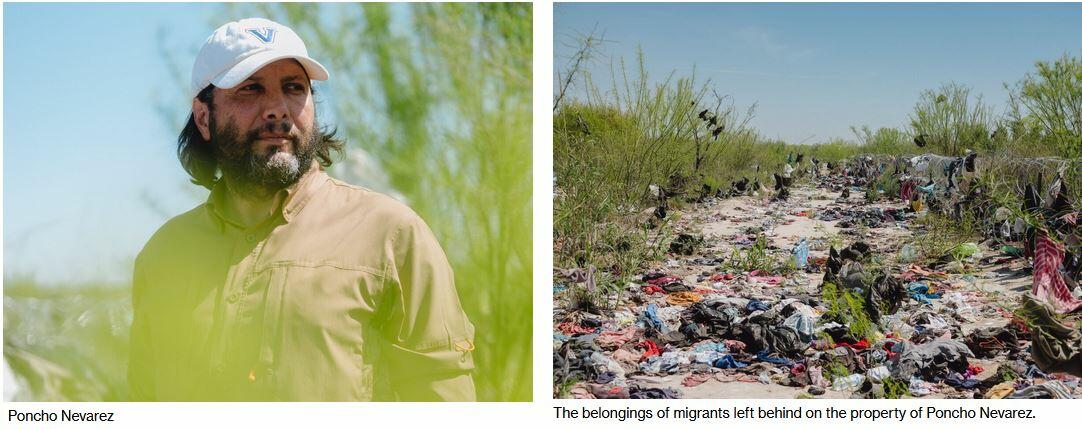
The coils of barbed wire at the edge of Poncho Nevarez’s ranch on the Rio Grande were meant as a deterrent. Instead, they just tore at the bodies and clothes of desperate migrants who clambered through to Eagle Pass, Texas.

The fence installed by the National Guard was, in Nevarez’s view, both horribly barbaric and largely ineffective, like so much of the border-enforcement push that’s popped up around his 500 acres—the state police, the helicopters, the drones and river buoys.

None of this stuff solves the problem,” said Nevarez, a former Democratic state lawmaker, as he stood next to a mound of discarded clothes, diapers and other detritus left behind by migrants on his land.

Here’s the crux of the argument:

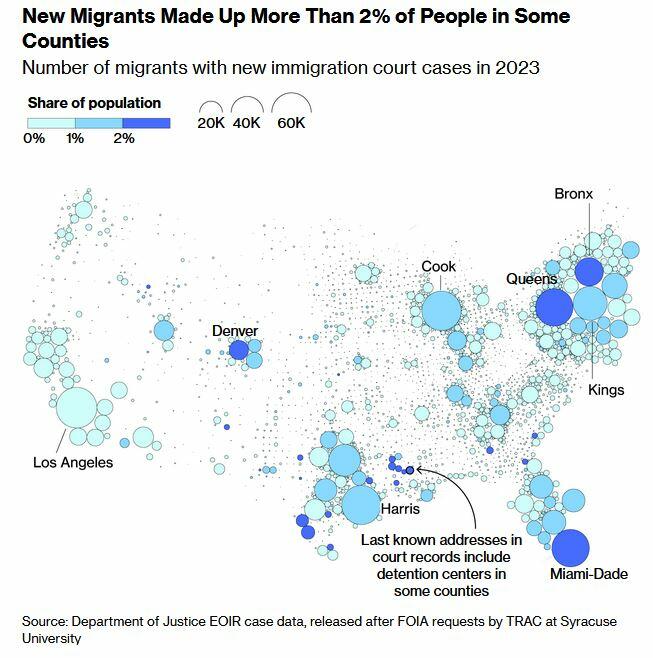
Immigration has erupted into a defining issue of the 2024 ballot, with a Bloomberg News/Morning Consult poll finding it second only to the economy as voters’ top concern. Courts are bogged down by unprecedented levels of cases—federal agents encountered 10,000 people a day crossing the southern border in December—and the tumult has exposed the US system as underfunded, opaque and bursting at the seams.

This is gonna decide who becomes the president, how it’s handled,” Nevarez said.

Meanwhile, Donald Trump has made the border his signature issue in his 2024 campaign – vowing to launch the largest deportation operation in US history if he’s reelected. Bloomberg would like you to know he’s also a racist, “sometimes borrowing rhetoric from White nationalist groups that warn about a “poisoning” of the nation’s blood.”

“This is a Joe Biden invasion,” Trump said during a February visit to Eagle Pass, Texas.

Meanwhile this Rhodes scholar…

As Bloomberg further notes, Biden has been ‘put on the defensive’ – and claims his hands are tied unless Congress gives roughly $60 billion more US tax dollars to Ukraine in order to defend its borders (as opposed to, say, more Executive Orders like Trump instituted).

How did this happen?

After Biden invited a sea of immigrants to America – tearing up Trump’s immigration Executive Orders on day one of his administration – more than 10 million of them did just that, quickly overloading border-state resources. The solution wasn’t Trump’s… it was Texas Governor Greg Abbott, who began bussing illegal immigrants to liberal ‘sanctuary cities’ around the country – which have been brought to the brink of financial ruin by the influx of ‘GDP boosters.’

What’s more, the ‘free ride’ buses appealed to some migrants arriving in Texas, according to Valeria Wheeler, executive director of  the Mission: Border Hope in Eagle Pass, which provides temporary shelter for migrants before they move on.

“Right when they enter our place, they’re like, ‘We want to go in the free buses,'” she said, adding that they “help a lot of asylum seekers to move forward and go to their final destination or other places.”

“They said they could not handle it anymore,” Abbott said in an interview, referring to Texas mayors, county judges and police chiefs about communities overrun with migrants dropped off by the Border Patrol.

So Abbott and his aides came up with a plan—which critics called politically motivated—to bus migrants to Democratic “sanctuary cities.” The first bus dropped migrants from Colombia, Cuba, Venezuela and Nicaragua near the Capitol. After that, others went to New York, Chicago, Philadelphia, Denver and Los Angeles.

Other border hawks, including the governors of Florida and Arizona, followed suit with similar moves. As of early March, Texas had bused out more than 105,000 people.

Every state is now a border state, every town is now a border town,” Trump said Tuesday during a campaign speech in Michigan. -Bloomberg

According to Illinois Comptroller Susana Mendoza, a Democrat, “From a political perspective, you have to look at his move as his genius,” she said, referring to Abbott – who responded to the surge in migration by sending state troopers and the National Guard to reinforce the area along the Rio Grande, which is now surrounded by barbed wire and shipping containers as camouflaged troops patrol the area with rifles.

Texas police and National Guard troops take over a city park on the Rio Grande, surrounding it with barbed wire and shipping containers (via Bloomberg)

Bloomberg reports that the crackdown is having an impact, citing Lieutenant Christopher Olivarez, a spokesman for the Department of Public Safety, who noted that arrivals in Eagle Pass, TX fell to an average of a few hundred per day vs. 2,000 per day at the end of last year.

Meanwhile, Texas border patrol has seized 469 million lethal doses of fentanyl, according to the governor’s office.

“When you do have an influx of people coming across, it’s gonna tie up every resource that we have along the border,” said Olivarez, so the cartels will “exploit more areas.”

Perhaps this galaxy brain Obama economist can explain why all the economy-boosting illegal immigrants aren’t translating to a slam-dunk win for Biden?

She’s also big mad, talking about ‘ringleaders‘ and other malarkey.

Maybe Bloomberg is in on it too?

Tyler Durden
Wed, 04/03/2024 – 12:25

What Will The Fed Do When Trump Wins And Slams China With 60% Tariffs

What Will The Fed Do When Trump Wins And Slams China With 60% Tariffs

By Michael Every of Rabobank

Have you got the energy?

Yesterday, Bloomberg noted ‘Fears of 5% Yields Are Back, Thanks to Oil’s Surge’. We are over a quarter into a year in which we were promised rapid, wall-to-wall rate cuts, but so far only the Swiss have proved punctual: now we are threatened with higher long yields to boot?

Yes, the Fed’s Daly underlined she still sees 3 cuts this year, even if “a projection is not a promise,” and the same tone has been struck by almost all central banks. Yet Mester raised her long-run Fed Funds forecast from a “long-time” view of 2.5% to 3.0% (and ruled out cutting in May, which the market wasn’t thinking about as odds of a June cut start to fall back).

In the US, we have persistently strong labour market data (for all the questions over it); sticky core CPI trending higher, not lower; PPI doing the same; and financial conditions that say ‘buy all the things’; and now ISM manufacturing back above 50, with new orders and prices paid not backing goods deflation. Let’s see what the services ISM employment index says today.

European and UK data are less ebullient, even if stocks aren’t, but today’s Eurozone CPI data will underline both goods deflation and services inflation far above the 2% CPI target level. How will the latter come down absent an economic downturn more dramatic than one requiring just a few rate cuts, which themselves should logically push it back up again?

Now back to Bloomberg’s “5%” headline as Brent sits at $89 this morning, the highest level since last October: is it really all about energy at the end of the day? There’s a scientific and philosophical case to be made that it is, even if it fuels resistance from everyone paid to look at everything but energy. However, it’s complicated. The Financial Times underlines that solar panels are now so cheap they are being used as fences in Europe… because the cost of labor has gone through the roof, so installing panels them there is uneconomic. In short, you have cheap energy *and* high inflation.

  • You don’t need to be an energy expert to see a cyclical manufacturing upturn would mean energy demand moves higher, while supply is being deliberately limited by OPEC+.

  • You don’t need to be a Middle-East expert to see geopolitical risks are high: and as that region sadly often proves, things can still get much worse.

  • You don’t need to be a Russia-Ukraine expert to see geopolitical risks are high: and, as we predicted, Ukraine has continued to use drone attacks against Russian oil refineries. The latest took out Russia’s third-largest facility 800km away in Tatarstan. While Russia says it doesn’t need to reduce diesel exports for now, how many more refineries need to be struck before that happens? Because, logistically and logically, refineries are going to keep being struck.

  • You don’t need to be a China expert to see the read-between-the-lines-out of the latest telephone call between Xi and Biden was focused on Taiwan, which is another geopolitical flashpoint (and a physical one given the earthquake and tsunami warning we just saw there). And is there is a link between that Xi-Biden call and US Treasury Secretary Yellen suddenly announcing she will be in China from April 4-9? Perhaps she’s just looking for more ‘shrooms?

Have you got the energy to keep tracking what you should be tracking in order to track what you think you should be tracking?

Next to Godleyness

Meanwhile, Bloomberg echoes our Fed Watcher Philip Marey in saying a 60% Trump China tariff and a 10% universal tariff could reduce US GDP by 0.5% and push the PCE deflator to 3.7% by end-2025. That should wake a few people in markets up.

Yet their static neoclassical model doesn’t consider Trump might also cut taxes on production to zero and introduce a federal sales tax, which could imply a very different dynamic outcome. Combined, that combination could theoretically shift the US economy away from imported consumption towards domestic production; and even if the US household consumption share of GDP goes down, GDP itself could go up by more as we see a domestic productive investment boom, so US consumers are still better off overall. In short, that would be inflationary growth for the US, and deflationary no-growth for exporters to it.

In short, these Godley balance-sheet ramifications matter as much as energy for markets. However, traditional economic analysis does not consider this approach, so keeps ending up in an unGodley mess that is now pushing us to conflated structural inflection points as the global system breaks down.

What’s the Fed supposed to do, if these Trump tariffs and tax cuts happen? And do other central banks celebrate their neoclassical deflation ‘win’? I don’t think so.

QE and negative rates were a first, doomed-to-fail response to our global problems, as Kalecki had said they would be in 1943. Now we may see the next logical step, flagged here in 2015: reflation behind trade barriers, with all the concomitant volatility and geopolitical tensions.

Indeed, please read ‘Car dealers will decide America’s future: The nation’s gentry could finish Trump’s revolution’. It underlines how the US political economy might work from the grassroots up to link back to the themes most only look at in silos: populism, trade imbalances, EVs/green, US-China relations, asset prices, and the US dollar’s role in our current and any new global paradigm.

If you thought QE moved markets, wait and see what happens if and when structural global imbalances built up over decades start to unwind. The best way to keep clean hands through that mess is to stand close to Godleyness.

Tyler Durden
Wed, 04/03/2024 – 12:05