Disinflation Narrative Dies As Manufacturing PMIs Show Prices Soaring Most In 20 Months
Update (1115ET): Treasury yields are exploding higher and rate-cuts odds tumbling after the resurgent ‘price’ data in today’s PMIs.
The odds of a June rate-cut has dropped to just 50% (from 75% last week)…
Source: Bloomberg
And amid the illiqidity of European market holidays, UST yields are exploding higher…
Source: Bloomberg
This is also putting pressure on stocks (for a change)…
As we detailed earlier, ‘Hard’ data has been soaring since the start of the year – as ‘soft’ data collapses – so all eyes are on this morning’s Manufacturing PMIs (surveys) for an end to that trend.
Source: Bloomberg
But, of course, there is normally something for everyone in this data as last month saw ISM’s data tumble while S&P Global’s soared. Both were expected to improve marginally in March final data today.
ISM’s Manufacturing PMI surprised to the upside, rising from 47.8 to 50.3, better than the 48.4 expected (breaking a 15-month streak below 50).
But, S&P Global’s US Manufacturing PMI disappointed, falling from its ‘flash’ print of 52.5 to 51.9 – also down from the final print of 52.2 in February.
Source: Bloomberg
However, a common theme from both surveys was that of soaring prices!!
S&P Global noted that higher oil and raw material costs, plus increased transportation rates, reportedly added to cost burdens at the end of the first quarter… and the impact of rising labor costs was mentioned as a factor pushing up selling prices at a number of manufacturers.
Employment remains in contraction for the sixth straight month and Prices Paid surged to its highest since July 2022…
“The final reading of the S&P Global Manufacturing PMI signaled a further encouraging improvement in business conditions in March, adding to signs that the US economy looks to have expanded at a solid pace again in the first quarter.
“A key development in recent months has been the broadening-out of the upturn from services to manufacturing, with reviving demand for goods driving the fastest increase in factory production since May 2022. Jobs growth has also picked up as firms boost capacity to meet demand. Rising capex spending has likewise buoyed orders for machinery and equipment, in a further sign of firms gaining confidence in the outlook.
But the ‘improvement’ comes at a cost:
“The upturn is, however, being accompanied by some strengthening of pricing power. Average selling prices charged by producers rose at the fastest rate for 11 months in March as factories passed higher costs on to customers, with the rate of inflation running well above the average recorded prior to the pandemic.
Most notable was an especially steep rise in prices charged for consumer goods, which rose at a pace not seen for 16 months, underscoring the likely bumpy path in bringing inflation down to the Fed’s 2% target.”
So slower growth and much faster inflation – that does not sound like a recipe for rate-cuts… in fact quite the opposite.
Stablecoin issuer Tether has significantly expanded its Bitcoin holdings, acquiring 8,888 BTC worth around $600 million.
This latest purchase was revealed through on-chain data rather than an official announcement.
Tether has not publicly disclosed its Bitcoin addresses. However, transactions tracked on the blockchain show 8,888 BTC were recently sent from the crypto exchange Bitfinex to an undisclosed Tether wallet.
The recipient address now holds over 75,000 BTC worth $5.3 billion.
In May 2023, Tether first revealed it was allocating a portion of its reserves to Bitcoin, with plans to invest up to 15% of quarterly profits.
“The decision to invest in bitcoin, the world’s first and largest cryptocurrency, is underpinned by its strength and potential as an investment asset,” Paolo Ardoino, CTO of Tether, said in the statement when they announced their Bitcoin strategy.
While unconfirmed, analysts believe the identified wallet likely belongs to Tether.
The amount perfectly matches its pledged buying strategy and claimed holdings in its latest financial reports.
Tether has emerged as a major player in Bitcoin markets and its accumulation race.
Its steady purchases, combined with those of institutional investors like MicroStrategy, tighten supply. Critics have raised concerns about Tether’s lack of transparency and the potential market risks of its growing bitcoin stash. However, its embrace of Bitcoin also shows the asset’s broadening mainstream acceptance. Tether aims to capitalize on Bitcoin’s growth while diversifying its reserves away from traditional assets like government debt.
Tether is one of the world’s largest holders of U.S. Treasuries.
This latest $600 million acquisition is unlikely to be Tether’s last.
The next buy (6/30) will be after the halving & 8,888 BTC will gobble up all new supply for 20 days 🧮
Left Livid Over Trump Ally Efforts To Eliminate Anti-White Policies
With Donald Trump’s popularity growing among black and latino voters, it’s only natural to assume that a revived effort to paint him as a racist would follow.
In a Monday ‘exclusive’ report, Axiosis absolutely beside themselves, writing “Trump allies plot anti-racism protections — for white people” (emphasis ours).
There’s a plot afoot!
Trump’s Justice Department would push to eliminate or upend programs in government and corporate America that are designed to counter racism that has favored whites.
Does racism still favor whites? Last we checked, white people, particularly white men – who ‘toxically mansplain’ everything, are the scourge of the universe.
Anyhow,Axios has presented quite the narrative; the Trump campaign’s longstanding promise to eliminate Biden DEI initatives + efforts by Trump allies to legally combat anti-white racism “with the Supreme Court’s turn to the right” = racism.
First, here’s what Trump said last year:
“Every institution in America is under attack from this Marxist concept of ‘equity,'” adding “I will get this extremism out of the White House, out of the military, out of the Justice Department, and out of our government.”
Trump campaign spox Steven Cheung told Axios: “As President Trump has said, all staff, offices, and initiatives connected to Biden’s un-American policy will be immediately terminated,” adding “President Trump is committed to weeding out discriminatory programs and racist ideologyacross the federal government.“
This is apparently a very bad thing.
Longtime aides and allies preparing for a potential second Trump administration have been laying legal groundwork with a flurry of lawsuits and legal complaints — some of which have been successful.
A central vehicle for the effort has been America First Legal, founded by former Trump aide Stephen Miller, who has called the group conservatives’ “long-awaited answer to the ACLU.”
America First cited the Civil Rights Act of 1964 in February in a lawsuit against CBS and Paramount Global for what the group argued was discrimination against a white, straight man who was a writer for the show “Seal Team” in 2017. -Axios
Axios then picks what we can assume they consider to be the most racist example – the February filing of a civil rights complaint against the NFL over the “Rooney Rule,” which America First says violates “Title VII of the Civil Rights Act of 1964 and engaging in race and sex discrimination,” as the purpose of the 2003 rule was “increas[ing] the number of minorities hired in head coach, general manager, and executive positions,” to address “the historically low number of minorities in head coaching positions.”
The Rooney Rule has been amended several times since its adoption and now requires teams to interview at least two external minority candidates for head coach and general manager vacancies, at least one external minority for a coordinator job, and at least one minority and/or female candidate for senior level positions, such as club president and senior executives.
Effectively, in the twenty years that the Rooney Rule has been in existence, all it has done – according to minority interviewees for head coaching positions and the former head of the NFL Players Association DeMaurice Smith – is result in member clubs engaging in sham interviews with minority candidates solely to check the Rooney Rule box. Given the limited timeframe to hire executives and coaches after the season, this results in fewer opportunities for similarly situated, well-qualified candidates who are not minorities. -America First Legal
Meanwhile, Axios notes that the Heritage Foundation’s “well-funded “Project 2025“” is “preparing for a future Trump Justice Department to implement — or challenge — policies on a broader scale.”
Part of the plan, written by former Trump DOJ official and America First’s general counsel Gene Hamilton, argues that “advancing the interests of certain segments of American society … comes at the expense of other Americans — and in nearly all cases violates longstanding federal law.“
Efforts to combat anti-white racism have been successful, because of, recall, the Supreme Court’s “turn to the right” – so extra racist.
Earlier this month, another federal judge ruled that the Commerce Department’s Minority Business Development Agency was discriminating against white people and that the program had to be open to everyone. -Axios
Heaven forbid people be judged by the content of their character.
Who do they think they’re fooling? Oh right.
Nah, they want to *expand it to* not focus on.
If you want a functional society, it should be illegal to discriminate against *any* skin color – including Whites.
If you’re confused, look at how universities changed the ‘DEI’ admissions policies to discriminate against Asians once the Woke left realized it’s not a “victim” class that needs socialist graft because they are achieving the American Dream through hard work and opportunity.
Your “EXCLUSIVE” actually talks about implementing a merit based system without regards to race. That’s a good thing. Nice April Fools’ Day post though.
Translation:
Republicans want to treat everyone equally regardless of the color of their skin and make promotions and pay based on merit instead government mandated quantities and prices (the definition of socialism)
Socialist price and quantity controls in the food industry…
Author JK Rowling could be prosecuted for “misgendering” trans people under Scotland’s odious new hate crime law that comes into force today, an SNP minister has admitted.
Senior police officers are expecting a deluge of complaints over online posts after the Hate Crime and Public Order (Scotland) Act 2021 created a new crime of “stirring up hatred” relating to age, disability, religion, sexual orientation, transgender identity or being intersex.
A person could now be imprisoned for up to seven years if they engage in “insulting” behaviour towards ‘protected’ groups, and the prosecution only needs to prove that the hatred was “likely” rather than “intended”.
Siobhian Brown, the SNP’s community safety minister, initially stated that calling a “trans woman” (a man) “he” would not be a crime.
However, after the law came into force, Brown stated, “It could be reported and it could be investigated. Whether or not the police would think it was criminal is up to Police Scotland for that.”
Rowling has vowed to continue calling biological males men and says she will now be targeted for telling the truth.
During their training program on enforcing the new law, police officers were taught that even the content of plays and comedy gigs should be considered as potential hate crimes.
Many have asserted that merely retweeting a Ricky Gervais joke about transgender people could amount to a hate crime in Scotland.
As we previously highlighted, authorities admit that dealing with the expected flood of hate crime reports would prevent them from investigating real crimes.
A Police Scotland pilot in Aberdeen which was deemed a “success” and is expected to be implemented means “more than 24,000 offences a year will no longer be allocated to a front-line officer.”
Been a victim of burglary? Tough, the police are too busy clamping down on tweets that offend transgender activists.
* * *
Your support is crucial in helping us defeat mass censorship. Please consider donating via Locals or check out our unique merch. Follow us on X @ModernityNews.
Manufacturing PMIs Mixed On Growth But Both See Prices Soaring
‘Hard’ data has been soaring since the start of the year – as ‘soft’ data collapses – so all eyes are on this morning’s Manufacturing PMIs (surveys) for an end to that trend.
Source: Bloomberg
But, of course, there is normally something for everyone in this data as last month saw ISM’s data tumble while S&P Global’s soared. Both were expected to improve marginally in March final data today.
ISM’s Manufacturing PMI surprised to the upside, rising from 47.8 to 50.3, better than the 48.4 expected (breaking a 15-month streak below 50).
But, S&P Global’s US Manufacturing PMI disappointed, falling from its ‘flash’ print of 52.5 to 51.9 – also down from the final print of 52.2 in February (with prices .
Source: Bloomberg
However, a common theme from both surveys was that of soaring prices!!
S&P Global noted that higher oil and raw material costs, plus increased transportation rates, reportedly added to cost burdens at the end of the first quarter… and the impact of rising labor costs was mentioned as a factor pushing up selling prices at a number of manufacturers.
Employment remains in contraction for the sixth straight month and Prices Paid surged to its highest since July 2022…
“The final reading of the S&P Global Manufacturing PMI signaled a further encouraging improvement in business conditions in March, adding to signs that the US economy looks to have expanded at a solid pace again in the first quarter.
“A key development in recent months has been the broadening-out of the upturn from services to manufacturing, with reviving demand for goods driving the fastest increase in factory production since May 2022. Jobs growth has also picked up as firms boost capacity to meet demand. Rising capex spending has likewise buoyed orders for machinery and equipment, in a further sign of firms gaining confidence in the outlook.
But the ‘improvement’ comes at a cost:
“The upturn is, however, being accompanied by some strengthening of pricing power. Average selling prices charged by producers rose at the fastest rate for 11 months in March as factories passed higher costs on to customers, with the rate of inflation running well above the average recorded prior to the pandemic.
Most notable was an especially steep rise in prices charged for consumer goods, which rose at a pace not seen for 16 months, underscoring the likely bumpy path in bringing inflation down to the Fed’s 2% target.”
So slower growth and much faster inflation – that does not sound like a recipe for rate-cuts… in fact quite the opposite.
A complex upcoming Supreme Court case could weaken a key tool the government uses in immigration law enforcement and throw the system into chaos, legal sources say.
The case at hand deals with the doctrine of “consular nonreviewability,” which is the legal principle that a consular official’s decision to refuse a visa to a foreigner is not subject to judicial review.
Cracking down on the doctrine would harm the immigration system and cripple its ability to conduct business, supporters of the nonreviewability principle say. Opponents, such as those who favor expanded immigration, say relaxing it respects constitutional rights and the institution of marriage.
The doctrine is a judge-made exception to the Administrative Procedure Act (APA), a federal statute enacted in 1946 that governs administrative law procedures for federal executive departments and independent agencies. The late U.S. Sen. Pat McCarran (D-Nev.) said the APA was “a bill of rights for the hundreds of thousands of Americans whose affairs are controlled or regulated in one way or another by agencies of the federal government.”
Decisions about who gets to enter the United States are vested in the legislative and the executive branches, not the judicial branch.
The U.S. Constitution gives Congress exclusive authority to create policies about the admissibility of individuals to the United States. At the same time, the legislative branch delegates the power to implement those policies to the executive branch.
On April 23, the Supreme Court will hear Department of State v. Munoz, which concerns spousal sponsorship.
Facts of the Case
Foreign citizens have minimal rights in the immigration process, so the Supreme Court is expected to focus on whether U.S. citizens have a constitutionally protected interest in visa petitions sponsoring their spouses.
The case is about Luis Asencio-Cordero, a Salvadoran citizen with no criminal record whose U.S. immigration visa was denied because a consular officer thought his tattoos indicated gang membership. His wife, U.S. citizen Sandra Munoz, challenged the consular decision in court, arguing that her rights as a citizen were violated.
The case goes back to 2005 when Mr. Asencio-Cordero first arrived in the United States. Ms. Munoz married him in 2010 and they had a child together who is a U.S. citizen. The husband was in the country illegally.
Ms. Munoz sponsored her husband for a U.S. immigration visa. In 2015 he returned to his native El Salvador to obtain the visa. At the initial interview at the U.S. consulate in San Salvador, he was subjected to a body search.
The officials photographed his tattoos and asked why he got them. They found a tattoo of comedy and tragedy theater masks, one of a pair of dice, and one of three ace cards. Other tattoos depicted the Virgin of Guadalupe, Sigmund Freud, and a tribal design featuring a paw print.
Officials asked Mr. Asencio-Cordero about his criminal record. He said he was arrested once when he got into a fight with a friend. They were held in jail for three days and released with no charges being laid.
After a significant delay, officials ruled that Mr. Asencio-Cordero could not be issued a visa because he was viewed as criminally inadmissible to the United States.
Officials didn’t elaborate other than to cite a passage in the Immigration and Nationality Act which states “[a]ny alien who a consular officer or the Attorney General knows, or has reasonable ground to believe, seeks to enter the United States to engage solely, principally, or incidentally in … any other unlawful activity” is inadmissible.
The government argues that under federal law the visa denial cannot be challenged in court.
Ms. Munoz sued. Three years after the denial, she learned during the discovery process in federal district court that the government deemed him inadmissible to the country because he was thought to be a member of the MS-13 criminal organization.
The consular official reached this conclusion based on “the in-person interview, a criminal review of Mr. Asencio-Cordero, and a review of [his] tattoo,” U.S. Solicitor General Elizabeth Prelogar wrote in the government’s petition to the Supreme Court.
She wrote in a footnote that the government also presented to the court “for in camera review, State Department documents containing sensitive information describing the basis for the consular officer’s belief that Asencio-Cordero was a member of MS-13.”
The district court ruled in favor of the government in March 2021 and noted the consular officer’s finding that Mr. Asencio-Cordero was a member of MS-13.
Because the denial was based on “a facially legitimate and bona fide reason, the court ruled that consular nonreviewability precludes respondents’ challenges to the Department decision,” Ms. Prelogar wrote.
Court of Appeals
A divided panel of the U.S. Court of Appeals for the 9th Circuit vacated the district court’s ruling and remanded the case to the lower court for reconsideration.
The 9th Circuit did not reject consular nonreviewability but held that, on the facts of the case, the application of the doctrine violated the Due Process Clause of the U.S. Constitution.
The circuit court affirmed the district court’s holding that Ms. Munoz’s due process rights had been violated because as a U.S. citizen, she had both “a fundamental liberty interest in their marriage” and “a liberty interest in residing in their country of citizenship.” The denial harmed her due process rights because its cumulative effect was “a direct restraint on [her] liberty interests.”
The court also held that because the government had waited three years after the denial of the visa to provide the married couple with the declaration about the tattoo “and did so only when prompted by judicial proceedings,” the explanation was deemed untimely.
The court concluded that the government had forfeited its claim of consular nonreviewability by failing to hand over a timely explanation to the couple. The visa decision cannot be “shield[ed] … from judicial review” and the district court “may ‘look behind’ the government’s decision[.]”
The full 9th Circuit denied a rehearing of the case in July 2023, upholding the panel’s ruling.
Judge Patrick Bumatay dissented from the denial of the rehearing, writing that the panel was wrong to find that Ms. Munoz had a “liberty interest” in the visa denial of her husband.
And this “novel ‘timeliness’ requirement has no basis in the law,” he wrote. Throughout the 100-year existence of consular nonreviewability “no court has invented the rule that the government must act within a certain timeframe[.]”
“Congress has explicitly said that the government has no duty to give timely notice to an alien excluded on security-related grounds,” the judge wrote.
Map Reveals ‘Great Migration’ Population Shift Over Last Three Years
The virus pandemic, the rise of remote and hybrid work, and a surge in violent crime across progressive cities have significantly influenced the migration patterns of Americans over the past several years.
A new report from real estate research firm ResiClub sheds more color on the migration trends, this time on a county-by-county basis. It reveals which counties in the US gained and or lost the most population between April 1, 2020, and July 1, 2023, citing data from the US Census Bureau.
ResiClub founder Lance Lambert wrote on X that the “US Southeast, Mountain West, East/central Texas” had counties with some of the largest population gains over the period. Conversely, the counties based in California, the North and South Great Plains, parts of the Inland Midwest, and the inland Northeast had some of the most significant outflows.
This map shows which counties have gained—and lost—population since 2020
Lambert posted a list of the top 40 counties with the largest population shifts over the period.
Top Three Counties With Largest Population Increase:
Collin, Texas
Wake County, North Carolina
Hillsborough, Florida
Top Three Counties With Largest Population Decrease:
Bronx County, New York
Kings County, New York
Queens County, New York
We assume this data has not captured the illegal migration shifts as millions of illegal aliens invade the US via open southern borders and flood progressive cities.
I wish we could call “April fool!” on the $20 minimum wage hitting California fast-food restaurants on April 1. But the wage hike signed into law last September by Gov. Gavin Newsom is really going to hit hard.
Last December, Pizza Hut announced it would lay off more than 1,200 delivery drivers across the state. It switched to independent deliver services for home delivery. On March 25, the Wall Street Journal reported on driver Michael Ojeda, 29, “who previously supported his mother and partner on his Pizza Hut delivery wages.” He told the paper, “Pizza Hut was my career for nearly a decade and with little to no notice it was taken away.”
Round Table Pizza also laid off 73 drivers. And, “In San Jose, Brian Hom, owner of two Vitality Bowls restaurants, now runs his stores with two employees, versus four workers that he typically used in the past. That means it takes longer to make customers’ açaí bowls and other orders, and Hom said he is also raising prices by around 10 percent to help cover the increased labor costs. ”
Mr. Hom said, “I’m definitely not going to hire anymore.”
The $20 wage increase affects only chains with 60 or more restaurants nationwide. One effect might be to discourage national chains from setting up here. If a chain has, for example, 55 restaurants outside California, it would be hesitant to establish five restaurants in the Golden State because that would impact its wage structure everywhere else.
The $7.25 federal minimum wage applies in 20 states with no higher state wage. If a restaurant company operating in those states expanded to California, the disparity between $7.25 and $20 would be a shock to the company.
Another big effect will be on all other California businesses, not just restaurants with fewer than 60 operations nationwide. The state minimum wage overall went up fifty cents to $16 an hour on Jan. 1. The best workers at $16 will gravitate to the $20 jobs, effectively putting pressure on companies to pay more than $16. Companies that can’t do so will go out of business.
We won’t know for a couple of months, but California’s unemployment rate could go much higher.According to the U.S. Bureau of Labor Statistics, the state’s unemployment already has risen from 5.0 percent last September to 5.3 percent in February, the highest in the nation. The next highest is Nevada at 5.2 percent. Rival Texas is 3.9 percent and Florida is 3.1 percent.
Higher unemployment also will raise costs for the state’s troubled Employment Development Department. Due to incompetence by the Newsom administration, massive fraud during COVID-19 left the state $20 billion in debt to the federal government. Worse, reported California Globe on Feb. 29, higher interest rates from the Federal Reserve Board mean “the state can expect to have to make an interest only payment of about $500 million dollars instead of the $330 million that was planned for in Gov. Gavin Newsom’s budget for fiscal 2024-25,” which begins on July 1. It must be paid in September.
Newsom’s Political Future
Mr. Newsom can be a savvy politician. But he has a problem with economic realities. For eight years as lieutenant governor, he sat at the feet of Gov. Jerry Brown, who demonstrated how to prevent a budget from getting out of control. Instead, as governor Mr. Newsom went on spending sprees with the $97 billion surplus, everyone, including him, said couldn’t last. It didn’t.
Now he’s staring down a $38 billion budget deficit, according to his Jan. 10 budget proposal; or $73 billion, according to the Legislative Analyst’s latest projection.
The $20 minimum wage will kill many thousands of jobs, canceling the taxes of those workers while they are unemployed, while increasing unemployment costs. Albeit the $20 wage will bring in higher taxes from the workers still employed.
Employers, commonly in the upper middle-class, will suffer fewer profits, cutting into the income taxes they pay. Many even will call it quits and fold up their businesses, or move to more reasonable states.
All this will hit this summer as Mr. Newsom’s presidential ambitions could still advance should President Joe Biden’s mental faculties decline much further. All that still is a long shot, of course. The PredictIt betting on Mr. Newsom gaining the nomination has been decreasing lately (middle line in the graph below), from 18 cents on Feb. 9 to 6 cents on March 29. Mr. Biden’s (top line) rose from 72 cents to 89 cents. Vice President Kamala Harris finished at 4 cents, below Mr. Newsom.
The point is it’s not impossible Mr. Newsom could get the nomination. If he does, California’s rising unemployment rate, the massive budget deficit, homelessness, high housing costs, and crime will be a target-rich environment for the Republicans’ presumptive nominee: former President Donald Trump.
Mr. Newsom could have avoided the unemployment crisis if he simply had pushed the $20 minimum wage into the future to 2027, when he will be out office. Then it would have been the next governor’s problem.
Conclusion: Expect More Joblessness
A higher minimum wage usually kills jobs, unless it is genuinely in line with an area’s cost of living. The current statewide $16 minimum wage is the second-highest of any state in the country, after Washington state’s $16.28. And Washington, D.C., not a state, is the highest at $17.00. All are areas with high expenses.
The biggest problem for California will be the $20 wage in rural areas. Although not as cheap to live in as Mississippi, it’s cheaper than living in San Francisco or Santa Monica. Which also means a lower minimum wage would be more sensible inland. Instead, the $20 wage will wipe out many more fast food jobs per capita inland than in the coastal areas.
The $20 wage is also going to increase prices for those still going to fast-food places. If inflation continues or gets worse, that will boost prices even more, leading to fewer customers, followed by even more layoffs.
Tinkering with the economy has consequences. Starting on April Fools’ Day, California will be finding out how an excessive minimum wage increase is one of the worst ones.
Views expressed in this article are opinions of the author and do not necessarily reflect the views of The Epoch Times or ZeroHedge.
Ranking The World’s Most Popular Beers, By Generation
What are the most popular beers by US generation? Visual Capitalist‘s Marcus Lu has delved into the data based on a consumer survey conducted by YouGov which looks at what Millennials, GenX, and Baby Boomers like to consume the most.
The “popularity” metric represents the % of people who had a positive opinion of that beer. Note that YouGov surveys are conducted with a representative sample of 1,500 respondents.
Overview: Millennials
U.S. millennials appear to favor foreign beers, with the top five spots taken by Dutch (Heineken) or Mexican beers (Modelo, Corona).
While not exactly a beer, White Claws (which have a similar alcohol content) claimed sixth place. Hard seltzers have become very popular in recent years due to their variety of flavors, attractive packaging, and relatively low amount of carbs and calories.
Overview: Gen X
Gen X also has a strong preference for foreign beers, particularly Guinness (fun fact: Over 31 million Americans claim to be of Irish descent).
Two American beers that weren’t on Millennials’ top 10 list are Samuel Adams and Blue Moon.
Samuel Adams is the flagship brand of the Boston Beer Company, named after U.S. Founding Father Samuel Adams. On the other hand, Blue Moon is a Belgian-style witbier brewed by Molson Coors.
Overview: Baby Boomers
Boomers’ top 10 favorite beers are similar to Gen X, with a few key differences. One is the absence of Modelo, which ranked second and fourth for Millennials and Gen X, respectively.
Modelo (which became America’s best-selling beer in 2023) has focused its advertising efforts on sports, which may not reach Boomers as effectively as younger generations.
An interesting pick for Boomers is Dos Equis, which is produced by Heineken-owned Cuauhtémoc Moctezuma Brewery. The brand gained popularity for its “most interesting man in the world” commercials, which ran from 2006 to 2018.
See More Beer Graphics 🍺
Be sure to check out this graphic which breaks down global beer consumption by country.
When unemployment and inflation cause skyrocketing incentives for thieves to steal industrial metals like copper, criminals rush for some of the biggest sources: critical infrastructure. That includes cell towers, water pipes, street lights, and rail lines. These copper heists threaten transportation, communication, municipal services, urban safety, and other essentials of modern life.
The chaos they can cause can cost lives, too — for example, copper heists from railways can cause warning lights, intersection gates, and turnouts that divert trains to other tracks to go offline.
World Bank analysts estimated that prices for base metals like copper and tin had peaked last year, and will decline further in 2024. Some reasons they cited included improving supply and decreasing demand due to widespread adoption of green energy initiatives, and a 52% reduction in the coal price in 2023 compared to the previous year. The report noted that high inflation will reduce demand, will it be enough to offset the speed at which fiat currencies are drained of their purchasing power? So far, the answer appears to be no.
If dollar inflation continues sufficiently unabated, the relative price of copper could continue to rise despite other factors. Other unexpected wrenches in the economy, like the recent closure of the Port of Baltimore, could also challenge the World Bank’s predictions. The Port of Baltimore was one of the US’s main exporters of coal, which could cause upward pressure on the global price of energy in an already-inflationary environment, and make metal smelting operations more expensive.
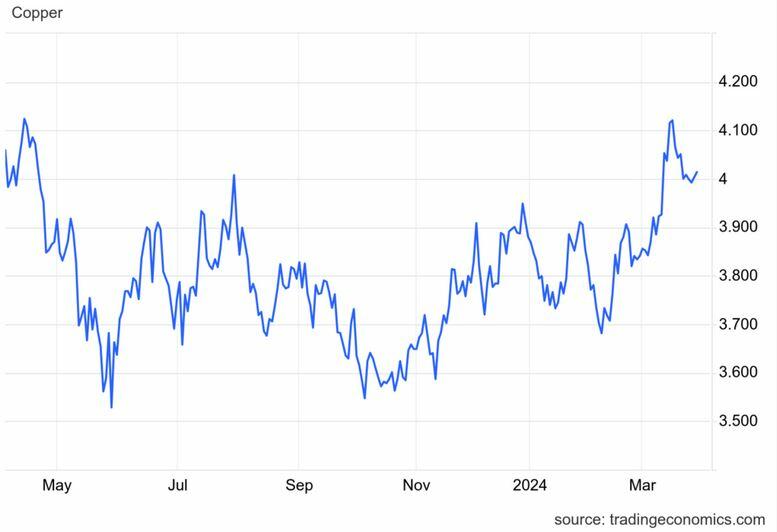
Copper futures dipped in May, after the World Bank released its report, but rose to a higher low in February, and have since been trending upward:
Copper Futures (USD/Lbs), April 2023 – March 2024
And as metal prices soar, so have incidents of theft that damage crucial infrastructure and multiply existing economic damage. Freight train accidents and delays, power and cellular blackouts, municipal sewer damage, and flooding and drainage issues from stolen gutters and pipes are just a few of the problems caused by 2024’s surging copper theft across America and the world.
Even real estate development projects can go over budget or become severely delayed when thieves snatch copper building materials from construction sites. The problem is so bad that in Los Angeles, a city councilmember declared the city is being “stripped” like an abandoned car:
Also at risk are electric vehicle charging stations, which have been proliferating around the country. Although they only contain a small amount of copper that can be extracted, meaning very little profit for thieves, their opportunistic mischief requires an expensive fix — especially for EV stations that are repeatedly targeted and need to be continually repaired or replaced.
One other underappreciated danger for copper when prices are skyrocketing due to economic uncertainty: inside jobs by bad apples at copper suppliers and storage facilities, which can lead to thefts on a grand enough scale that they affect the broader metals market. When they do, it helps incentivize further waves of small-time theft that damage infrastructure and victimize businesses that rely on the metal.
Angela Seidler is a PR representative for Europe’s number one copper producer in Germany which was caught in one such scandal. She explained to Bloomberg:
“What we currently know is that some of our recycling suppliers appear to have manipulated details about the raw materials they deliver to us, and they have been working with employees in our sampling department to hide the shortfall.”
And when thieves are desperate, nothing is sacred. Not even statues of civil rights leaders or copper headstones in graveyards are safe from the temptation of an easy flip when prices are too high for criminals to ignore. And while these sorts of thefts don’t endanger infrastructure, they’re a sign of the times and a unique indicator that the US dollar and economy are in troubled shape.