65.8 F
Chicago
Sunday, September 20, 2026
Home Blog Page 2783

“Huge Problem”: Pentagon’s Rapid Wartime Response Cargo Ships Trapped In Baltimore After Bridge Collapse

“Huge Problem”: Pentagon’s Rapid Wartime Response Cargo Ships Trapped In Baltimore After Bridge Collapse

Two high-speed military cargo ships are stuck in the Port of Baltimore following Tuesday morning’s collapse of the 1.6-mile-long Francis Scott Key Bridge. The major US East Coast port has been paralyzed for several days as the bridge collapse prevents inbound and outbound vessel traffic along the harbor’s channel. 

Using the automatic identification system, or AIS, data that tracks commercial vessels, three bulk carriers, two general cargo ships, one vehicle carrier, one tanker, and four Ready Reserve Force vessels (RRF), along with the container ship Dali that struck the bridge, are trapped in the harbor, according to the shipping blog gCaptain

The three bulk carriers include:

  • The Liberian-flagged JY River, owned by JIADE INTERNATIONAL SHIP and managed by WAH KWONG SHIP MANAGEMENT HK of Hong Kong.

  • The Thailand-flagged Phatra Naree, owned by PRECIOUS STONES SHIPPING LTD and managed by PRECIOUS SHIPPING PCL of Thailand.

  • The Portuguese-flagged Klara Oldendorff, owned and managed OLDENDORFF CARRIERS GMBH & CO of Germany.

The vehicle carrier is:

  • The Swedish-flagged Carmen, owned by WALL RO/RO AB and managed by WALLENIUS MARINE AB of Sweden.

The general cargo ships include:

  • The French-flagged Saimaagracht, owned by REDERIJ SAIMAAGRACHT and managed by SPLIETHOFF’S BEVRACHTINGS BV of the Netherlands.

  • The Panama-flagged Balsa 94, owned by EASTERN CAPITAL MARINE INC and managed by HIONG GUAN NAVEGACION CO LTD of Hong Kong.

The tanker is:

  • The Marshall Islands-flagged Palanca Rio, owned by MINSHENG RUIYANG TIANJIN SHPG and managed by PUMA ENERGY SUPPLY & TRADING of Singapore.

The US Maritime Administration (MARAD) Ready Reserve Force vessels include:

  • The Cape Washington, a Cape W Class roll-on/roll-off vessel.
  • The Gary I. Gordon, a Gordon-class roll-on/roll-off vessel.
  • The SS Antares (T-AKR-294), a Algol-class fast sealift vehicle cargo ship.
  • The SS Denebola (T-AKR-294), another Algol-class fast sealift vehicle cargo ship.

According to the military blog The War Zone (TWZ), Algol class vessels are “some of the fastest cargo vessels of their general size anywhere in the world.” These ships are part of the RRF, a subset of vessels within MARAD’s National Defense Reserve Fleet (NDRF) that provide surge sealift capability to the Pentagon for overseas conflicts.

TWZ said the activation process of RRF vessels takes about five to ten days. The vessels are operated with a skeleton crew until called upon. 

RRF are stationed at major marine ports around the US. 

TWZ noted the Algol class vessels have been called into action several times over the last three decades: 

Algol class have been called upon multiple times since they entered US service. Just five of these ships were responsible for transporting 20 percent of US cargo sent from the United States to Saudi Arabia during the first phase of Operation Desert Shield in the immediate run-up to the First Gulf War. The ships would go on to deliver 13 percent of all cargo that arrived in Saudi Arabia from the United States in the full course of that conflict. 

The US military subsequently used Algols to support operations in Somalia and the Balkans in the 1990s, as well as the opening phases of the wars in Afghanistan and Iraq in the early 2000s.

Breitbart News’ Kristina Wong reported on Thursday that “The Department of Transportation will not say how many National Defense Reserve Fleet Ships are Stuck” in the Baltimore harbor. 

Wong quoted John Konrad, CEO of gCaptain, who warned the stuck RRF vessels are a “huge problem if a war starts [but] not much of a problem if the next few months are peaceful.”  

The current readiness of the RRF fleet is unknown. And just like that, part of America’s RRF fleet was taken out not by a missile or suicide drone, but a container ship that allegedly suffered a catastrophic ‘electric issue’. America’s enemies are taking note. 

Tyler Durden
Fri, 03/29/2024 – 12:00

Sick Of It All

Sick Of It All

Submitted by QTR’s Fringe Finance

Every week, usually once or twice, I sit down to put onto paper my thoughts about the market. And every week, my disgust not only for the rigged system that encompasses our equity markets, but also for the sound of my own whining, grows exponentially.

When I sit down to perfunctorily prattle on about how nothing makes sense and how I constantly see things the polar opposite of 99% of everybody else in the world of finance every week, I usually wonder two things.

First, I wonder whether or not today will finally be the day that I capitulate, get bullish on the stock market, and start bowing religiously to a statue of Stephanie Kelton.

“I should know, I’ve followed a few!” – Arthur

After all, the incessant price moves higher in Bitcoin are part of what triggered me to eventually reassess my thought process on the cryptocurrency. And even though I got bullish for reasons other than price, why couldn’t the same happen with equities?

Second, I try to conceptualize exactly how fast the universe can, and will, make a total ass out of me by crashing markets 50% in 15 minutes in the days, hours, minutes, or probably even seconds after I’d have such a shift in sentiment.

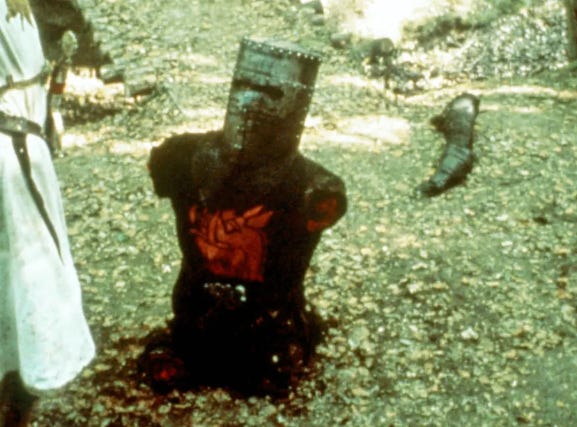
Which is why, like the Black Knight in Monty Python and the Holy Grail, I will continue to forge forward, exasperated, regardless of the inconvenient fact that I have no arms or legs left. But don’t let anybody ever tell you that my spirit was easy to break.

“The Black Knight always triumphs!”

I had my most recent bout of vomiting in my own mouth just thinking about how wrong I’ve been on macro analysis late on Wednesday, when, as if part of some ant-burning-under-a-magnifying-glass-type-cosmic-conspiracy to torture my psyche, the Fed’s Chris Waller came out and assured the public that he was in no rush to cut interest rates. Here’s a look at some of the headlines that came out of Waller’s speech in New York:

  • “There is no rush to cut the policy rate,” Waller said in a speech in New York.

  • The recent data “tells me that it is prudent to hold this rate at its current restrictive stance perhaps for longer than previously thought to help keep inflation on a sustainable trajectory toward 2%.”

  • Waller still expects to cut rates this year but isn’t ready to take that step without further evidence that inflation continues to drop.

  • Waller said analyzing three- and six-month measures of the Consumer Price Index, excluding volatile food and energy prices, tells him that progress on inflation has slowed and may have stalled.

  • “The risk of waiting a little longer to cut rates is significantly lower than acting too soon,” said Waller. “Cutting the policy rate too soon and risking a sustained rebound in inflation is something I want to avoid.”

  • Waller said that he is considering reducing the overall number of rate cuts this year or pushing them further into the future in response to the recent data if things don’t improve. But he also said he isn’t rushing to take that step yet.

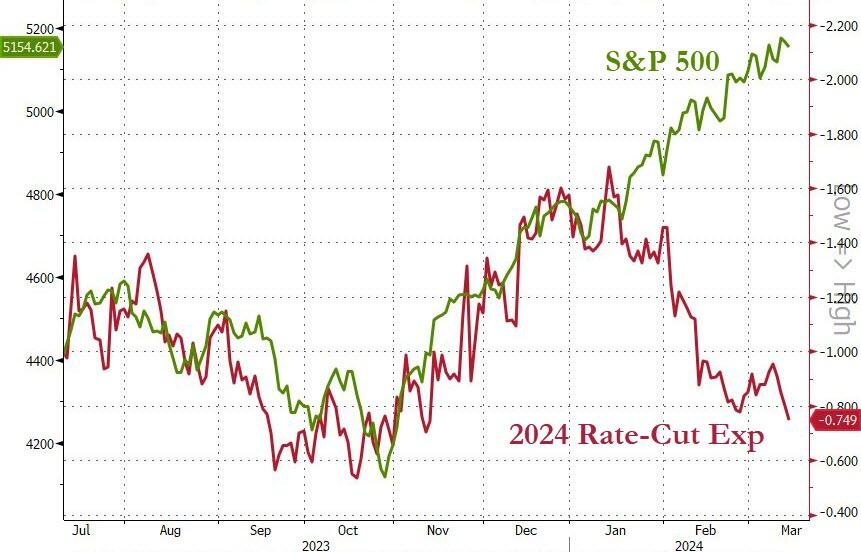
While I’m not sure how the market will receive this blindingly, exhaustively obvious negative news, my guess is by the time you read this at 4:45am EST on Thursday morning, futures will be raging higher and every index will be up in the pre-market session. After all, nothing says “bull case” like the Fed not being able to meet objectives in bringing down inflation and then a Fed governor telling the market not to expect the very same rate cut bonanza it has rallied more than 10% expecting this year alone, despite already being pornographically overvalued.

Not unlike how when Donald Trump said, “I could stand in the middle of Fifth Avenue and shoot somebody and I wouldn’t lose any voters,” I’m not sure there’s anything the Fed could do right now to stop the market’s pre-ordained ascent. As I said in last week’s totally non-award-winning analysis, I have no f*cking idea where the liquidity is coming from, no clue what the market is thinking, and pretty much don’t understand anything at all.

“Eat sh*t, Waller” — S&P 500 (probably) | Chart via Zero Hedge

I know what you’re thinking: “Why then, Chris, do you run a financial newsletter?”

That’s a great question. I wish I had a great answer for you other than it’s better than therapy for me and I get paid instead of having to pay someone else. But hey, 99% of “newsletter writers” don’t have any clue what they’re talking about — at least I admit it.

Look, it’s either me or lessons from Whitney Tilson’s fishing trip and ruminations about his colonoscopy. Choose wisely.

Whitney Tilson (@WhitneyTilson) / X

I’m breaking Whitney’s balls, of course. He’s a good dude and was one of the first people to be nice to me on Wall St. a decade ago.

Anyway, continuing the sick satire playing out on Wednesday, S&P came out after the bell on Wednesday and affirmed the United States’ credit rating and said things look stable, casually noting that debt to GDP and interest to revenue are out of f*cking control (my words, not S&P’s) before summing things up with a “stable” outlook despite the fact. Among other brain farts, including praising monetary policy execution, S&P concluded:

  • A diversified and resilient economy with solid growth, extensive monetary policy flexibility, and benefits associated with the unique status as the issuer of the world’s leading reserve currency underpin the U.S. sovereign rating.

  • A high debt burden, with net general government debt approaching 100% of GDP and interest to revenue over 10%, and difficulties garnering bipartisan cooperation to strengthen U.S. fiscal dynamics are credit weaknesses.

  • We affirmed our ‘AA+/A-1+’ sovereign credit ratings on the U.S.

  • The outlook remains stable, indicating our expectation of continued economic resiliency; proactive, effective monetary policy execution; and our view that government officials will continue to resolve near-term fiscal deadlines, such as addressing the debt ceiling, in a timely manner.

S&P said: “We could lower the rating over the next two to three years if unexpected negative political developments weigh on the strength of American institutions and the effectiveness of long-term policymaking, or jeopardize the dollar’s status as the world’s leading reserve currency.”

They continued: “The ratings could also come under pressure if already-high deficits were to rise, owing to political inability to contain rising spending or to manage revenue implications of future changes in the tax code.”

Is it me, or are both of these situations literally occurring already right now?

As if people in the world of economics pride themselves on analytical non sequiturs, S&P’s rating and reasoning for their rating stand at stark odds with reality.

But then again, who really knows what reality is anymore? Me? You? This certifiably insane old bird?


“I regret saying it was transitory.”

As many people know, Fitch downgraded the United States last year (my exceptional analysis here). They had it right. Whether we have the reserve currency or not, there are extraordinary, unprecedented risks facing the United States economy and the US dollar. Both S&P and Chris Waller came out and said today that the reserve currency status of the dollar gives the United States enormous flexibility.

But just because we have enormous flexibility doesn’t mean that we can bend and not eventually break. Does policy flexibility mean that we can literally do whatever we want and nothing matters at all? Have we replaced the natural laws of economics and rewritten the basics of mathematics and macroeconomics? We think we have, but we haven’t.

If you think of the basic immutable laws of macroeconomics and mathematics as a bathroom shower, every layer of bullsh*t, monetary policy, money printing, foreign war mongering slush fund, overspending, misuse, hubris, rewriting of the rules, and Stephanie Kelton book is like adding one of those Bath Fitter (TM) renovations to your shower. You’re not replacing the disgusting, mold-ridden, toxic equipment, you’re just covering it up with another layer of shiny-looking fiberglass.

Bathroom Remodeling Photo Gallery | Bath Fitter San Diego

Left: The “old school” laws of economics. Right: The trillion dollar coin idea.

The question then becomes: how many of these layers can we pile on top of one another before the room becomes so f*cking small that we can’t fit in the shower anymore?

And, then what? We just walk around stinking to high heaven?

I mean, for f*ck’s sake, we’ve got lifelong spend-ocrat Steve Liesman of all people breaking down on CNBC yesterday, openly worrying about how the United States is going to service its debt obligations and calling bullsh*t on the Inflation Reduction Act. Putting aside the insane irony that Steve Liesman has sat at Fed press conferences for the last decade and massaged the feet of whoever the Fed chair was at the time instead of asking them serious questions about accountability, when Liesman starts to worry, isn’t it time to take notice?

For the last decade, I have watched dozens of Fed press conferences (feels like trillions) where Liesman has done nothing but make excuses for central bankers and throw them softball questions, in between the time he takes to congratulate them on the great job they’re doing. Very few people on his network, with the exception of possibly Guy Adami and Rick Santelli (combined total airtime each day: 32 seconds), have raised any questions about the Fed’s trajectory. Most days on CNBC look like this:


Guests who are critical of the Federal Reserve, like Peter Schiff, have been blackballed from the network entirely. And now, all of a sudden, it’s time to panic? What’s next? Will Paul Krugman or Jeremy Siegel be taking to CNBC to all of a sudden “remember” the lessons of Milton Friedman and Thomas Sowell?

Waller’s remarks Wednesday wrap up what will be the remainder of any Fed commentary on this short week. The entire market has placed an “all-in” wager on rate cuts this year, and Waller has reiterated his position as “we need to wait and see what happens.” And while he said circumstances would need to be extenuating for it to occur, he even brought up the idea of hikes. Considering the market is a forward-looking indicator and it has already pulled in probably six months to a year of expectations of rates being lower (and Trump tax cuts again, and AI growth, and more money printing, and colonizing Mars, and Tesla robotaxis that double as laundry folding humanoid droids), rates staying the same for longer – or a hike – would be devastating.

And so, we sit and wait for the next bullsh*t CPI print to try and determine whether or not the government has figured out a new way to disguise the fact that prices have consistently been up at least 10% almost every year at any point in the past, especially these last three years.

Both Waller and S&P Global are leaning, one way or another, on the US dollar’s reserve currency status as the foundation and basis for their “everything isn’t totally screwed and backwards” outlook.

These conclusions by Waller and S&P are the latest in a long line of trillions of analyses and judgments that have relied on the US dollar remaining reserve currency for the time period of “forever times infinity” to be correct.

I think of each one of these analyses, which arrived daily by the hundreds across Wall Street, as sheets of paper being placed on the back of a donkey that is trying to scale Mount Everest. A couple of sheets of paper, the donkey doesn’t notice. When you have enough for a ream of paper, the donkey starts to notice a little weight. Approaching a century into the US dollar’s dominance, the donkey is carrying on its back a stack of papers that would puncture the ozone layer at this point.

It may not be Wednesday’s two additional sheets that cripple the donkey on its continued journey up the hill, but at some point, the weight is going to become unbearable. And watching it all play out, for me, already has.

If you enjoyed this QTR post, please take a moment to subscribe to my content here

QTR’s Disclaimer: I am an idiot and often get things wrong and lose money. I may own or transact in any names mentioned in this piece at any time without warning. I didn’t double check any numbers or figures in this piece and am generally lazy with my research. Contributor posts and aggregated posts have not been fact checked and are the opinions of their authors. Contributor posts and curated content are posted either with the author’s permission or under a Creative Commons license. This is not a recommendation or solicitation to buy or sell any stocks or securities, just my opinions. I often lose money on positions I trade/invest in. Sometimes I just lose money by misplacing it. I’m generally irresponsible. I may add any name mentioned in this article and sell any name mentioned in this piece at any time, without further warning. These positions can change immediately as soon as I publish this, with or without notice. You are on your own. Do not make decisions based on my blog. Do your research elsewhere. I exist on the fringe. The publisher does not guarantee the accuracy or completeness of the information provided in this page. These are not the opinions of any of my employers, partners, or associates. I did my best to be honest about my disclosures but can’t guarantee I am right; I write these posts after a couple beers sometimes. Also, I just straight up get sh*t wrong a lot. I mention it numerous times because it’s that important that you know.


Tyler Durden
Fri, 03/29/2024 – 11:30

Watch Live: Fed Chair Powell Speaks With Global Markets Closed

Watch Live: Fed Chair Powell Speaks With Global Markets Closed

With global capital market closed, crypto maybe the only price action to monitor to judge if Fed Chair Powell says anything new this morning.

Powell is due to participate in moderated discussion before the Federal Reserve Bank of San Francisco Macroeconomics and Monetary Policy Conference.

The market is still pricing in a just better than 50-50 chance of The Fed’s first cut coming in June, and the question is whether – like Waller earlier in the week – Powell will signal a longer pause…

Watch live here (due to start at 1130ET):

Tyler Durden
Fri, 03/29/2024 – 11:00

Viral Videos Appear To Show FBI Agents Visiting Homes Over Social Media Posts

Viral Videos Appear To Show FBI Agents Visiting Homes Over Social Media Posts

Authored by Paul Joseph Watson via Modernity.news,

Two videos have gone viral on X showing FBI agents visiting people’s houses to ask questions about offensive social media posts.

The first clip shows three people who claim to be FBI agents visiting a woman called Rolla Abdeljawad at her home in Stillwater, Oklahoma.

The woman asks them to identify themselves, but they refuse to do so while being filmed, before claiming they had already shown the woman their IDs.

“What we’d like to do is have a conversation with you about some social media posts that you’ve made, would you be willing to talk to us about that?” asks one of the agents.

The woman refuses to talk until she has a lawyer present, before the agent asks her for contact information.

“No, I’ll get back to you,” states Abdeljawad.

Another agent then asks the woman to have her attorney “contact the FBI office in Oklahoma City.”

Abdeljawad is told by one of the agents that “Facebook gave us a couple of screenshots of your accounts.”

“Well you can’t arrest me for freedom of speech, we live in America, so it’s kind of weird that you want to come talk to me about me exercising my freedom of speech,” responds the woman.

“We do this every day, all day long we talk to people, it’s just an effort to keep everybody safe, make sure that nobody has any ill will or bad intent or anything like that,” responds one of the agents.

After Abdeljawad asks if the FBI would question “all the citizens in America” who used Facebook, the agent responds, “We certainly would if we had any sort of concerns.”

The clip then shows the agents leaving the scene.

The woman later posted a message on her Facebook confirming that the individuals were FBI agents.

“Just verified with local law enforcement that, the indivs who came to my home, really were FBI per their license plate. My lawyer will contact the OKC field office. The lawyer did inform me that, these instances are now common but, the lawyer doesn’t believe that FB sent them the screenshots of my posts. Rather, it seems like a fishing expedition. I do not fear them. My only concern as, I told the cop is that, someone in my state will do something or that they would and then use my posts in a malicious attempt to “smear” me. Just *remember, I am a Muslim, an obligated protector of creation. I enjoin what is good and forbid what is wrong.”

Another X user called Kam St. Martin posted, “The FBI came to my house over a TWEET! Not cool. My pinned tweet that’s still up.”

The video she posted shows a man who introduces himself as an FBI special agent asking to speak to someone over a post which he subsequently explains is “about the Baton Rouge subject.”

The pinned tweet in question features an image of a black man who St. Martin claims killed her cousin.

“This monster drugged my 27 yr old cousin at the L’Auberge Casino in Baton Rouge last February. He dumped her half naked dead body like trash. Rap sheet a mile long. He walks today on PROBATION. Damion Matthews may you reap what you have sown,” it states.

The post has 39,000 likes.

Is the FBI really visiting private homes to police social media posts that criticize alleged murderers?

Your support is crucial in helping us defeat mass censorship. Please consider donating via Locals or check out our unique merch. Follow us on X @ModernityNews.

Tyler Durden
Fri, 03/29/2024 – 10:00

Improvement Of US-Russia Relations ‘Impossible’ Under Biden, Ambassador Says

Improvement Of US-Russia Relations ‘Impossible’ Under Biden, Ambassador Says

Russian ambassador to the US Anatoly Antonov has issued a dire assessment of the current state of US-Russia relations in an interview with Russia’s Channel One.

He said that no one should expect relations with Washington to improve at all under President Joe Biden, and at one point even called the prospect “impossible”

Russian embassy in Washington D.C., via AP

“Improvement of Russian-US relations seems to be impossible in the near future. What the current administration is focused on is how to stay in the Oval Office of the White House,” he said in the interview. This strongly suggests Moscow is hoping for a new US administration after November.

“They will not review their Russian policy, because it will make it look like this policy had failed,” Antonov added. His words come at a moment American public opinion is increasingly swaying against Biden’s push to sink tens of billions of dollars more in defense aid into Ukraine, which has been a noticeable shift since at least early last year.

Moscow has briefly held out hope that given some of the momentary goodwill shown by the West in the wake of last Friday’s Crocus City Hall terrorist attack which left at least 140 dead, there might be an improvement of ties – at least in terms of restoring cooperation on common interests like counterterrorism efforts.

“The United States strongly condemns yesterday’s deadly terrorist attack in Moscow,” Secretary of State Antony Blinken had said in a Saturday statement. “We condemn terrorism in all its forms and stand in solidarity with the people of Russia in grieving the loss of life from this horrific event.”

Ambassador Antonov explained that he had expected a senator or a congressman to at least pay a condolence visit to the Russian embassy given the enormity of last Friday’s terror attack, but “nothing like this happened”.

He then noted that “The State Department sent a minor official, who is not a foreign policy decision-maker.”

Antonov said in separate statements this week that since the Crocus Hall attack the Kremlin has only had “transitory” contacts with the US administration, but that next week there will be opportunity to discuss “bilateral relations, about how we can live on, and if there is any chance at all for Russian-American relations not to be completely destroyed.”

He previously described that “only crumbs” remain of US-Russian relations, and this includes mainly the deconfliction hotline in Syria, space exploration, and some contact groups that work on nuclear proliferation. Still, several end of Cold War era weapons treaties have collapsed, as Washington has ratcheted anti-Russian sanctions related to the Ukraine war. 

Tyler Durden
Fri, 03/29/2024 – 09:30

America’s Minsky Moment Approaches

America’s Minsky Moment Approaches

Authored by Michael Wilkerson via The Epoch Times,

Named after American economist Hyman Minsky, the idea behind a Minsky moment is that a financial markets crisis (especially in credit markets) is caused by a sudden and systemic collapse in asset prices, usually after a sustained period of speculative investment, excessive borrowing, and widespread financial risk taking.

In other words, it’s the moment when the music stops playing, investors stop buying, and the Ponzi game ends abruptly. It’s a hard crash.

America may be on the brink of its Minsky moment.

This process, which moves from slowly, slowly, to suddenly and now, goes back decades.

The confrontation with reality that was required to put America’s economic house back in order after the global financial crisis of 2008–09 was deferred to a later date by politicians, central bankers, and government officials alike, presumably when they would no longer be around.

Instead of taking the painful but necessary steps of liquidation—i.e., allowing more over-levered and risk-heavy banks and financial firms to fail, and for the economy to take the short-term pain, then move on—the U.S. government and the Federal Reserve kicked the can down the road by massive money-supply expansion and unproductive government spending.

The same playbook from the financial crisis (i.e., money printing and fiscal excess) was used again in 2020 in response to the pandemic. As the monetary authorities had but one instrument in their toolbox—the blunt-force cudgel of money-supply growth—it was the go-to solution.

As the saying goes, when the only tool available is a hammer, every problem looks like a nail. In both instances—the financial crisis and COVID periods), the U.S. Congress went on a massive spending spree, not realizing (or, as political animals with short time horizons, not caring) that excess and repeated deficit spending, and the debt creation needed to fund it, would eventually spiral out of control and doom future generations.

While a more serious collapse of the bubble—a monetary Great Reset—was avoided in 2008–09, the underlying conditions were not resolved.

The monetary and fiscal actions taken at the time only postponed the crisis and, worse, further inflated a massive bubble that is destined to eventually burst.

We are still living in this bubble, evidenced by all-time highs in equity and crypto markets, speculation in numerous asset classes from real estate to collectibles to memecoins, and “get what you can while you can” borrowing by governments, households, and corporates alike.

Given the increasing magnitude (in both nominal and real terms) of the debt problem, a financial crisis in 2024 or 2025 will have much worse consequences than anything that would have happened at the time of the financial crisis 15 years ago.

On the eve of the 2008 crisis, U.S. federal debt to GDP was around 64 percent, the same level as in 1995. This allowed some flexibility. As of the most recent quarter, the ratio of debt to GDP is now nearly double that, at 122 percent.

On this measure, the United States is now among the top 10 most indebted countries in the world, a peer group that includes economically hobbled nations such as Venezuela, Greece, Italy, and sclerotic Japan.

The level of U.S. national debt, quickly approaching $35 trillion in coming months, now requires more than $1.1 trillion in interest payments annually just to service it. And this number doesn’t include state and municipal debt or the unfunded liabilities and entitlements such as Medicare and Social Security that now comprise the substantial majority of the federal budget, limiting anyone’s ability to shrink the deficit through a reduction in discretionary spending.

The deficit for 2024 is tracking at $1.7 trillion, adding to the existing cumulative U.S. deficit of $22 trillion since 2001. The deficit matters in part because high deficits relative to GDP are strongly correlated with persistent inflation.

Since 2020, the United States has run the highest levels of deficits (as a percent of GDP) since World War II. Those deficits produced high inflation, but they also reversed and became budget surpluses shortly after the war ended. This was made possible because of the productivity miracle that was mid-twentieth century America.

The United States of 2024 has no equivalent productivity boost waiting in the wings. Artificial intelligence is one bright spot, but other tech (crypto in particular), energy, and mining industries are each being chased off-shore through regulatory interference.

Manufacturing is attempting a comeback, but only represents 11 percent of GDP. Bureaucratic, tax, monetary (the U.S. dollar remains too high to be competitive), and other barriers persist. The continued growth (as a percent of GDP) of financial advisors, personal injury attorneys, and tax accountants needed to navigate the impossible IRS tax code hardly comprise the revolutionary army needed to make the American economy great again.

When the Minsky moment arrives, the U.S. government will have no ability to confront it save for a resumption of quantitative easing and other forms of money printing.

With the bond markets in turmoil, investors will be increasingly reluctant to buy more U.S. debt. Foreign buyers have already begun reducing their exposure, and now account for only 30 percent by value of U.S. Treasurys held, compared with 45 percent in 2013.

If this divestment trend suddenly accelerates, the United States will be forced to monetize its debt through Federal Reserve purchases of U.S. Treasurys. This will be highly inflationary, even as economic conditions are weakening and unemployment is rising.

The U.S. Department of the Treasury and the Federal Reserve have already committed to a “whatever it takes” approach to crisis management. When the Minsky moment arrives, and the bond markets are in meltdown, the “whatever it takes” will primarily be a firehose of liquidity (more money created out of thin air) to the banking system with an alphabet soup of program names.

As a result, the United States will be forced to accept significantly higher levels of inflation. The alternatives are just too severe. The U.S. government, as the issuer of the world’s reserve currency, cannot default. There is a practical limit on how high it can take the visible tax rate. Its only alternative is the hidden tax of ever-higher inflation.

To avoid this outcome, U.S. productivity would have to dramatically increase such that the ratio of debt to GDP falls back in line. This seems an impossibility. The higher the ratio of debt to GDP, the greater the anchor-like drag on the national economic ship.

Tyler Durden
Fri, 03/29/2024 – 09:00

Disinflationary Path Stalls As Non-Durable Goods Prices Spike But Supercore PCE Slides

Disinflationary Path Stalls As Non-Durable Goods Prices Spike But Supercore PCE Slides

One of The Fed’s favorite inflation indicators – Core PCE Deflator – was flat at +2.8% YoY in February (as expected) – the lowest since March 2021.

However, the headline PCE Deflator stalled its disinflationary path, rising to +2.5% YoY (from +2.4%)…

Source: Bloomberg

Durable Goods deflation slowed and non-durable goods inflation picked up in February…

Source: Bloomberg

The so-called SuperCore – Services inflation ex-Shelter – remains stalled around +3.33% YoY (up 0.18% MoM)…

Source: Bloomberg

But SuperCore MoM tumbled significantly  (as Healthcare cost inflation fell and Other Services prices deflated)…

Source: Bloomberg

Income and Spending both rose in February with spending far outpacing income (+0.8% MoM vs +0.3% MoM respectively)…

Source: Bloomberg

On a YoY basis, spending is once again outpacing income growth…

Source: Bloomberg

Government workers’ record wage growth in January was revised lower (because we caught them)…

  • Govt wages grew 8.1% in Feb, up from a downward revised 7.9%  in Jan and below the record high of 8.9% in December

  • Private wages grew 5.4% in Feb, up from 5.3% in Jan and back to their pre-covid growth rates

As one would expect with that level of spending, the savings rate collapsed to its lowest since Dec 2022…

Source: Bloomberg

Here’s why – government handouts rose significantly once again (+$39BN MoM)…

Source: Bloomberg

Finally, while the markets are exuberant at the survey-based disinflation, we do note that it’s not all sunshine and unicorns. The vast majority of the reduction in inflation has been ‘cyclical’…

Source: Bloomberg

Acyclical Core PCE inflation remains extremely high, although it has fallen from its highs.

Is The (apolitical) Fed really going to cut rates 4 times this year with a background of strong growth (GDP) and still high Acyclical inflation?

Tyler Durden
Fri, 03/29/2024 – 08:47

Asian Stocks Gain With US and Europe Closed Ahead Of Core PCE Print, Powell Speech

Asian Stocks Gain With US and Europe Closed Ahead Of Core PCE Print, Powell Speech

With US futures and European markets closed for Good Friday, the only markets trading overnight were in Asia where stocks gained following another record close on Wall Street, with focus turning to key PCE data due later Friday as well as a speech by Fed chair Powell.

Benchmarks in Japan, South Korea and mainland China showed modest increases, after US stocks wrapped up the first quarter on a positive note, including the 5th monthly gain in a row and closing up 18 of the past 22 weeks – something markets haven’t done since 1989.

And while they won’t be able to trade it – except perhaps through crypto which never closes –  investors are bracing for a print of the Federal Reserve’s preferred consumer price reading for fresh clues about its policy outlook.

Several Asian markets, including Australia, Hong Kong and Singapore, are also closed Friday for a public holiday. The gains in the region came after traders sent the S&P 500 to its 22nd record this year on the back of data showing the US economy remained healthy. A $4 trillion surge in US equity values in just three months has startled doomsayers, while leaving a host of strategists scrambling to update their 2024 targets.

“Domestic events are driving the gains in China, Japan and South Korea with investor sentiment underpinned by the overnight gains in the US market,” said Seo Sang-Young, a market strategist at Mirae Asset Securities. End-of-quarter portfolio rebalancing also seems to be at play, Seo added.

Eslewhere, traders remain on alert for intervention in Japan’s currency after officials stepped up warnings this week to stem its slide. The yen’s weakness is not in line with economic fundamentals, Masato Kanda, vice finance minister for international affairs, said in an interview Friday. He also reaffirmed the commitment to act if needed to prevent excessive swings in the exchange rate.

There is a growing sense of wariness of intervention, said Taishi Fujita, associate in the global markets division for the Americas at MUFG Bank. “Even if you build a position selling the yen during a strong phase, you are likely to drop the position as it approaches 152.” He pointed out that the market may continue to hover in the low 151-yen per dollar range.

Latest data showed that consumer price growth in Tokyo moderated while staying well above the central bank’s inflation target. It may keep authorities on track to consider more rate increases after they hiked earlier this month for the first time since 2007.
On China’s corporate front, one of the nation’s biggest property firms delayed its earnings report while another posted a historic profit decline. Country Garden Holdings Co. announced late Thursday it will miss a deadline for reporting annual results, saying it needs more information. Developer China Vanke Co. said net profit tumbled 46% last year.

According to Bloomberg, swaps traders on Thursday slightly trimmed wagers that the Fed would cut rates as soon as June following Fed Governor Christopher Waller’s comments on Wednesday that there was no rush to lower interest rates. Two-year Treasury yields climbed five basis points to 4.62% in a shortened session ahead of the holiday, while the dollar extended its quarterly advance. Trading of cash Treasuries in Asia is closed due to the holiday.

With both GDP and consumer spending posting strong advances at the end of last year, consumer sentiment rose markedly toward the end of March, supported partly by the strong stock-market gains. In addition to the release of the PCE price index, the Fed’s preferred inflation gauge, traders will also closely monitor a speech by Fed Chairman Jerome Powell later Friday.

Elsewhere, gold hit a fresh all-time high, extending a weeks-long rally fueled by bets on Fed rate cuts and deepening geopolitical tensions. Oil scored a 16% quarterly gain in the latest sign that export curbs by OPEC and its allies are reining in global supplies.

Bitcoin eased Friday after climbing to $71,555 in the previous session, despite another session of strong inflows into ETFs, as bitcoin futures get slammed constantly, affording new spot buyers cheaper prices.

Fed Chair Jerome Powell is speaking at the San Francisco Federal Reserve Bank’s Macroeconomics and Monetary Policy Conference today. The conversation, moderated by Marketplace’s Kai Ryssdal, will start at 11:30 a.m. ET. It should cover several topics including inflation and interest rates.

Tyler Durden
Fri, 03/29/2024 – 08:16

What Will The Fed Do Next?

What Will The Fed Do Next?

Authored by Louis-Vincent Gave via Evergreen Gavekal blog,

So far this year, we have seen US inflation repeatedly beat expectations, US gasoline prices creep higher, gold break out to new all-time highs, feverish speculation in crypto and parts of the equity market, bonds sell off, and the US dollar roll over. Now copper has suddenly broken out of its recent trading range. And against this benign backdrop, US corporate bond spreads remain tight, despite fears of a US commercial real estate bust and its impact on US regional banks.

Outside the US, Japanese trade unions have secured their biggest pay rise in 33 years. Coming on top of a higher-than-expected PPI reading for February, this points to a more hawkish Bank of Japan and a stronger yen, which implies less deflation and less capital exports from Japan. Meanwhile India, Southeast Asia, Latin America and the Middle East are booming. And in spite of weak domestic economic data, European stock markets are chugging along nicely.

In short, over the past two months the case for Federal Reserve rate cuts has taken on some serious water. This leaves investors with an important question. What will the Fed do next? Will it try to get ahead of the curve and beat back the expectations of imminent rate cuts that it raised in December? Or will the Fed deliver on the promise of rate cuts, even though the macro backdrop is no longer so supportive of easier policy?

One added complication is the calendar. The Fed will be loath to start a new rate cut cycle in July, smack in between the Republican and Democratic conventions. It will also be loath to start a new cutting cycle in late October, days before the US presidential election. This means that the obvious times for the Fed to start a new rate cut cycle are either in June or in December (unless a Lehman-style or Covid-type crisis forces its hand).

Now, having said all that, one of the first things I was taught as a young cadet at officer school was that “doing nothing” is still “doing something.” In the heat of battle, the temptation is always to freeze and attempt to gather more information before making any decision that could potentially have dire consequences. But the decision to freeze and wait is still a decision—and one that itself can have dramatic implications.

  • If the Fed freezes and does nothing—does not cut rates and lets the reverse repo reservoir drain without adding fresh liquidity—we can probably expect a sell-off in long-dated bonds, especially considering the volume of rollovers and new issuance coming down the pipeline. Few equities, least of all the more richly valued, would respond well to higher bond yields. The US dollar would likely rally, and commodities would struggle.

  • If the Fed, despite the changed environment, goes ahead with rate cuts, precious metals will continue to rally; in the past few sessions, silver has started to show signs of life and seems to be joining gold in a new bull market. Emerging market debt and equities will rally hard. The US dollar will continue to weaken. And commodities will continue to rally.

So let’s weigh the odds, starting with the reasons for the Fed to go ahead and deliver on rate cuts, despite all the recent strong data.

1) Institutional bias. In meeting after meeting, the Fed has made clear its belief that fighting inflation is much easier than fighting deflation. This belief will tend to push the Fed to err on the side of reflation.

2) Credibility fears. After being caught out and changing course in 2019 and again in 2022, Jay Powell probably wants to avoid another flip-flop.

3) Politics. If Powell fails to deliver rate cuts, triggering a bond and equity market crash just before the presidential election, he will never be invited to a dinner party in Washington D.C. again.

4) Treasury capture. In the last couple of months, both Treasury Secretary Janet Yellen and President Joe Biden have gone on record to say that the Fed needs to cut rates. In fairness, it probably does need to cut rates if the US treasury is to roll over US$8trn in debt and add another US$2trn on top without difficulty.

5) China fears. The constant Western media drumbeat on China is that the Chinese economy is imploding, that the renminbi is about to devalue, and that China is set to release a deflationary wave around the world that will make the Asian crisis look like a mere ripple. With a backdrop of such fears, you can see why the Fed might want to get few “insurance” cuts under its belt.

Against all these possible reasons to cut, the main reason Fed policymakers might want to sit on their hands is that Powell has made it clear he does not want to be remembered as another Arthur Burns. That’s basically it: the fear of being remembered as Arthur Burns versus the fear of no longer getting invited to D.C. dinner parties.

Looking at copper, gold, bitcoin, the US dollar and others, it increasingly looks as if the market has already decided. The fear of losing the dinner party invites is stronger than the fear of getting a bad rap in the history books. In any case, over the last few years the new motto of public life in Western democracies seems to have become “Après moi, le déluge.” Why expect a change now? The market is likely right to expect an easy Fed—and to position itself for reflation.

Tyler Durden
Fri, 03/29/2024 – 07:30

10 Easter Traditions Around The World

10 Easter Traditions Around The World

It’s Easter this weekend and while many around the world will be celebrating by eating chocolate easter eggs and setting out on easter egg hunts, some communities will be marking the days from Good Friday through to Easter Monday in far more unique ways.

The following chart, via Statista’s Anna Fleck, depicts just a handful of the more “out there” traditions and rituals that will be taking place.

Infographic: 10 Easter Traditions Around the World | Statista

You will find more infographics at Statista

Certainly the most extreme of the ten selected traditions takes place in the Philippines. In the city of San Fernando, particularly devout Christian worshippers reenact the crucifixion and flagellation of Christ, culminating with a small number even being nailed to the cross.

The Easter egg is a central theme to a couple of the traditions that make it into this map, including the tradition of making a giant omelet on Easter Monday in Haux, Gironde of France, which feeds the 1,000 residents of the town and needs more than 15,000 eggs. Meanwhile, in Germany, trees are decorated with painted eggs and ornaments – a very different kind of decoration to that of Papua New Guinea, where cigarettes and tobacco packets are hidden in trees around the church and given out to the congregation after service.

Other traditions in Europe include huge bonfires in Germany, men and boys playfully whipping girls and women with willow branches in Slovakia and children doing a kind of trick-or-treating in Sweden, where they go from door-to-door and exchange drawings or paintings for sweet treats. In Greece, clay pot hurling has become a popular custom where residents throw clay pots, known as “Botides,” off balconies when the church bells ring to mark the end of mass on Easter Sunday to represent the casting away of evil spirits, while on the Greek island of Chios, two churches that sit atop two separate hills fire homemade rockets at one another and win points for hitting the bell towers.

In Guatemala, residents of Antigua create intricate carpets to line the streets, called alfombras, made out of sawdust, pine needles and flowers, showing images of flowers, religious symbols and birds. These routes are later marched along by processions of worshippers carrying religious statues and icons.

Easter is a Christian festival that marks the Resurrection of Jesus Christ on the third day after his Crucifixion.

Tyler Durden
Fri, 03/29/2024 – 06:45