67.2 F
Chicago
Sunday, September 20, 2026
Home Blog Page 2789

US, Japan To Initiate Huge Defense Treaty Upgrade With Eye On China

US, Japan To Initiate Huge Defense Treaty Upgrade With Eye On China

The United States and Japan are poised to unveil their largest defense treaty revision in decades. The FT has reported that President Joe Biden and Japanese Prime Minister Fumio Kishida are soon to “announce plans to reorganize the U.S. armed forces in Japan to strengthen the development of operational plans and training of the U.S.-Japan at the summit in Washington D.C. on the 10th of next month.”

Crucially the new agreement is expected to invest the three-star commander of the US Forces in Japan with more operational authority. As it currently stands, and following the development of the US-Japan Security Treaty first signed in 1960, the US commander is required to coordinate approval for operations with US Indo-Pacific Command based out of Hawaii. 

US Indo-Pacific Command/Flickr

All of this comes amid the backdrop of China-Taiwan tensions being continually on the rise, and as North Korea flexes its military might in response to joint US-South Korea drills on the peninsula.

Japan currently hosts an estimated 54,000 US military troops plus another at least 8,000 US civilian contractors. Recently there were fears that a Western troop presence would be expanded in Japan with the proposed opening of a NATO office there, but the plan was nixed after strong protestations from Beijing.

Analyzing the coming upgrade to the US-Japan defense treaty, one regional report explains: “This review responds to criticisms that it is inconvenient for rapid response in case of emergency because of the distance between the U.S. Indo-Pacific Command in Hawaii and the Japan Self-Defense Forces, which are 3850 miles away and have a 19-hour time difference.”

Prime Minister Kishida has made it a theme of the past couple years that Tokyo is committed to making great strides at becoming an unambiguous regional and “strategic leader” as a “security provider in the Indo-Pacific.” However, Japan officials have long emphasized a stronger armed forces primarily for the sake of ‘deterrence’ – something which Washington has encouraged. Naturally, China doesn’t see these developments as merely for deterrence.

The past two years has also witnessed a flurry of activity between the US and Japan at numerous levels of government especially focusing on an overhaul in the U.S.–Japan defense posture and strategy. There’s also been a plan in motion for a restructuring Marine Corps forces stationed on and around Okinawa.

Tyler Durden
Wed, 03/27/2024 – 18:40

Baltimore Coal Exports Blocked After Bridge Collapse

Baltimore Coal Exports Blocked After Bridge Collapse

By Tsvetana Paraskova of OilPrice.com

Baltimore Port’s coal exports are likely to be blocked for weeks after the collapse of the Francis Scott Key Bridge on Tuesday, according to a Pennsylvania coal trading firm.  

The bridge collapsed early on Tuesday after a cargo ship lost power and slammed into the construction, which crumbled within seconds and will disrupt navigation near the Baltimore port, which is one of the biggest coal export terminals in America.

Baltimore is the nation’s second-largest coal exporting port after Norfolk, Virginia, according to data from the U.S. Energy Information Administration (EIA). In 2022, about one-fifth of U.S. coal exports left through Baltimore.

The port of Baltimore is also one of the 20 largest ports in the U.S. and handles both coal and petroleum products.

Following the bridge collapse, up to 2.5 million tons of coal exports from Baltimore could be blocked for up to six weeks, Ernie Thrasher, CEO at Pennsylvania coal trading firm Xcoal Energy & Resources, told Bloomberg.

“You’ll see some diversion to other ports but the other ports are pretty busy,” Thrasher added. 

“There’s a limit on how much you can divert,” said the executive, whose firm works with several coal suppliers. 

Globally, the disrupted exports are unlikely to have a huge impact on coal prices, but many coal cargoes from Baltimore are typically headed for India, so there the impact could be felt along the supply chain, Thrasher told Bloomberg.

At any rate, the bridge collapse has already disrupted coal shipments and delivery times.

For example, rail company CSX, which owns the Curtis Bay coal pier in Baltimore, told Reuters on Tuesday that existing coal customers should expect “potential shipment delays.”

Coal producer CONSOL Energy said vessel access in and out of the CONSOL Marine Terminal, located in the Port of Baltimore, has been delayed. As of Tuesday morning, the company did not have a definitive timeline of when vessel access or normal operations will resume.

Tyler Durden
Wed, 03/27/2024 – 18:20

Ex-CBS Journo Catherine Herridge In Talks To Join X

Ex-CBS Journo Catherine Herridge In Talks To Join X

Award-winning journalist Catherine Herridge – whose controversial firing by CBS News in February made headlines over the fact that they confiscated her personal files amid an ongoing investigation onto the Hunter Biden laptop story, is in talks to join Elon Musk’s X, the NY Post reports, characterizing the talks as ‘preliminary.’

A potential deal could see Herridge — known for her aggressive reporting on the Hunter Biden laptop scandal — helm an investigative unit that she could help put together, according to a source close to the situation. -NY Post

“We are in discussions with many content creators who are interested in joining X in various ways. Catherine Herridge is a great journalist who strongly supports free speech,” X said in a statement to the outlet.

Wouldn’t it be hilarious if Musk gave Herridge the exact deal Don Lemon demanded? As a reminder, he wanted:

  • A $5 million up-front payment from X

  • An $8 million salary

  • Equity in X

  • The right to approve any changes in X policy related to news content

  • – A Tesla Cybertruck.

According to the report, joining X would allow Herridge the journalistic freedom to pursue a wide variety of stories.

X has been trying to build a high-profile roster of journalists to bring to its platform. It hired former Fox News anchor Tucker Carlson, and hired ex-CNN host Don Lemon. Lemon’s agreement with the platform was canceled by X boss Elon Musk, however, following a contentious interview with him earlier this month.

Lemon continues to post episodes of his show on X and YouTube, but viewership has cratered from his first buzzy interview with the Tesla CEO.

“Herridge is weighing a number of opportunities,” one source told The Post.

Meanwhile, the House Judiciary Committee is considering an investigation into CBS News for confiscating Herridge’s files, which the network called “nothing unusual.”

Tyler Durden
Wed, 03/27/2024 – 16:40

The Many Ways A Porous Border Means Crime Without Boundaries

The Many Ways A Porous Border Means Crime Without Boundaries

Authored by James Varney & Abigail Degnan via RealClear Politics,

When President Biden’s supporters attacked him for describing the man who allegedly murdered Georgia co-ed Laken Reilly as an “illegal,” they shined a light on one of the most contested words in American politics.

The progressive push to describe border crossers as undocumented or unauthorized can also serve to downplay and obscure the massive issue of crime perpetrated and spawned by the influx of millions of migrants since Biden was elected – often in ways that leave the migrants themselves as victims.

While migrant advocates argue that illegal arrivals commit crimes at lower rates than Americans, the claim is unverifiable because the federal government and most states do not break down crimes by immigration status.

Criminologists also note that it ignores the vast web of statutory crimes concurrent with illegal immigration – drug smuggling, human trafficking, child labor violations, prostitution, the black market in employment, and so on.

What remains undeniable by the law of averages is that the massive surge in immigration since the Biden administration relaxed border policies – a surge that it puts at more than 4 million people, but other sources millions more – has been accompanied by much more crime, however unquantifiable.

Millions of migrants, though not all, run afoul of laws by their situation more than by overtly malign criminal intent. But their first step across the border is a lawbreaking one, and it is often followed by life on the law’s margins: living in the U.S. without insurance or proper work papers, providing illicit labor for unscrupulous or blasé employers, turning to black markets for counterfeit Social Security cards, and often becoming targets for robbers or extortionists. Their desire to come to America creates a vast pool of criminality involving them or those illegally profiting from them.

“On some criminal matters, like homicides, we’ve got a good sense of the scale there whether we solve them all or not,” said Alex Nowrasteh, a vice president at the Cato Institute who studies the economic impact of immigration. “But some of this other stuff is like all black markets in that it is opaque behavior. We don’t know how much crime there might be and in a sense I think it’s sort of unknowable.”

An outer layer of this criminal onion is the so-called “coyotes” who smuggle migrants to the southern border. The United Nations Office on Drugs and Crime, which is sympathetic to the plight of refugees, paints a brutally stark picture of the  exploitive lawbreakers who lurk behind the caravans and trucks and trains heading north.

Some criminal groups view migrants as simply one of many commodities to be smuggled, alongside drugs and firearms,” it noted in a 2018 report. “Since the smuggling of migrants is a highly profitable illicit activity with a relatively low risk of detection, it is attractive to criminals.”

The United Nations also acknowledges the near impossibility of quantifying these criminal enterprises. “Assessing the real size of this crime is a complex matter, owing to its underground nature and the difficulty of identifying when irregular migration is being facilitated by smugglers,” it said.

In order to pay back these smugglers or the people willing to “host” them in the U.S., many migrants – no one knows how many – are often dragooned into illicit behavior.

“Even people who may come here with no criminal intent at all may find themselves involved in some sort of criminal activity because the cartels that control the immigration channels are going to get their money one way or another,” said Ira Mehlman, media director for the Federation of American Immigration Reform, which seeks policies to seal the border from illegal penetrations. “Going to work for the cartels is one way they can pay off their debts. Others may find themselves pressed into indentured servitude or, even worse, being trafficked in the sex trades.”

Although they gets little attention in the United States, the crimes associated with migration begin south of the border. Since Joe Biden sent a clear signal while running for president that he would welcome mass immigration, tens of thousands of people along the Central American isthmus have been inspired to migrate and have become victims too. Vulnerable and poor people making the more than 2,000-mile trek from the Darién Gap in Panama to the Texas border have been preyed upon physically and economically, contributing to the enormous human cost.

As millions of people have put themselves needlessly in the hands of cartels and smugglers to make the journey to the Southwest border, an untold number have suffered violence, degradation, and abuse at the hands of these ruthless organizations, while countless others have perished or simply been left to die in the jungles and deserts along the way,” according to the majority report from the House Committee on Homeland Security last October.

Todd Bensman, a writer with the conservative Center for Immigration Studies who has traveled extensively along the northward immigration routes, said travelers are frequently victimized and crime has exploded along with record increases in the numbers of people on the move.

“It’s not all about killings – they are getting raped and robbed, too,” Bensman said. “There are loan sharks who let victims know they know where family members are located – that’s a crime. And people are desperate, they are forced to steal food, there have been assaults on police, and recently a camp in Panama was burned down.”

Criminologists say part of the problem in measuring migrant-related crime in the United States is “sanctuary” jurisdictions that do not cooperate with federal immigration agencies. Sanctuary enforcement is also not a category traditionally tracked by law enforcement agencies. Nowrasteh said that several years ago he sent Freedom of Information Act requests to all 50 states seeking data on crime committed by or on immigrants and only Texas offered a response. Since then, he believes, Georgia has begun amassing statistics, but the state has not yet issued any public reports.

Grim arithmetic suggests the human costs of the unprecedented tide of illegal immigration under Biden, according to multiple reports and congressional testimony. A case in point is the hundreds of thousands of “unaccompanied alien children,” the innocuous-sounding phrase employed by a bureaucracy focused on avoiding the use of “illegals” who are newly arrived in the Biden years. Their oversight and handling has been mishandled, unintentionally or otherwise, by federal agencies, with the results of minors being trafficked and U.S. child labor laws being violated.

A 2023 report by the conservative Heritage Foundation found arrests for human trafficking rose by 50% and convictions for the crime by 80% in federal fiscal year 2022. Of those trafficked, 72% were immigrants, most here illegally, the report concluded. There was bipartisan outrage last July when the Labor Department revealed illegal child labor cases had risen by 44% in the last year.

The impacts are seen across the United States. The New York Post reports that “a street in Corona, Queens, has been transformed “into the city’s boldest open-air market for sex – one so popular with pervs that it’s advertised on YouTube. As police enforcement wanes and immigration surges nearly a dozen brothels have [also] set up shop along Roosevelt Avenue near Junction Boulevard.”

RealClearInvestigations has reported that many of the drug dealers who have turned San Francisco’s Tenderloin district into an open-air drug market are migrants connected to Mexico’s Sinaloa cartel. “The drug pushers are easy to spot: Unlike the users, they look healthy and wear clean clothes,” Leighton Woodhouse reported. “They’re almost universally young men, mostly Honduran (on the streets of San Francisco they’re called “Hondos”).”

Describing the plight of “twelve-year-old roofers in Florida and Tennessee,” “underage slaughterhouse workers in Delaware, Mississippi and North Carolina, and “children sawing planks of wood on overnight shifts in South Dakota,” the New York Times has reported that “migrant children, who have been coming into the United States without their parents in record numbers, are ending up in some of the most punishing jobs in the country.”

Millions of migrants working for legal businesses are also breaking the law. RCI has reported that “the historic surge of illegal immigrants across America’s southern border is fueling a hidden crime spree few in Washington seem willing or able to address: widespread identity theft victimizing unwitting Americans perpetrated by migrants who need U.S. credentials to work. … Federal authorities have found that well over 1 million are using Social Security numbers belonging to someone else – i.e. stolen or “shared” with a relative or acquaintance – or numbers that are fabricated.”

Such theft implicates many American citizens, who hire migrants with no such documents or who turn a blind eye to potentially stolen IDs.

Other Americans fall victim to crime connected to migration. For example, seizures of fentanyl, the synthetic painkiller the Centers for Disease Control blamed for a record 112,000 overdose deaths in 2023, have skyrocketed. In 2021, law enforcement agencies seized some 11.2 thousand pounds of the lethal drug, but in just two years the Chinese-abetted trade through Mexico has more than doubled, hitting 27,000 pounds last year, according to Customs and Border Patrol figures. Some immigration and drug experts believe the vast numbers of people crossing the border make it harder to interdict the flow of narcotics into the U.S.

Just two days before Biden used the description of “illegal” to describe Jose Antonio Ibarra, the 26-year-old suspected Venezuelan gang member accused of killing Laken Riley after entering the U.S. illegally in Texas in 2022, the Texas Department of Public Safety heralded the third anniversary of its “Operation Lone Star.” The figures offered a window into the law enforcement situation on what is something like Ground Zero of the illegal immigration to the U.S.

Texas Republican Gov. Greg Abbott described the operation as a direct consequence of the Biden administration’s deliberate failure to enforce existing U.S. immigration law. As of March, Operation Lone Star has resulted in “over 503,800 illegal immigrant apprehensions and more than 40,400 criminal arrests, with more than 36,100 felony charges,” the state’s Department of Public Safety said. In addition, authorities reported seizing “over 469 million lethal doses of fentanyl during this border mission.”

Disputed, and Elusive, Crime Stats

Despite all this, many immigration advocates continue to insist that immigrants tend to commit crimes at a lower rate than native-born Americans.

The news and social media may be filled with headline-grabbing incidents, such as the gang of migrants in New York City who beat police officers in Times Square. But Nan Wu, research director of the liberal American Immigration Council, told RCI the idea the U.S. is under some tidal crime wave due to the millions of illegal immigrants that have poured into the country during Biden’s first term is a sensationalist myth.

Perhaps the most widely cited study of this kind is one based on Texas statistics from 2012 to 2018 published by the Proceedings of the National Academy of Sciences (PNAS).

Relative to undocumented immigrants,” the study reported, “US-born citizens are over 2 times more likely to be arrested for violent crimes, 2.5 times more likely to be arrested for drug crimes, and over 4 times more likely to be arrested for property crimes.

But not all experts agree. Jason Richwine and Steven Caramota of CIS have criticized the PNAS study for failing to take into account further discoveries made by Texas authorities. “It is a misleading claim for several reasons,” the two claimed. “First, studies claiming it as fact are inescapably flawed, because most cities and states do not keep or publish data on criminals’ immigration status, rendering suspect any conclusions drawn from what data is available.”

Because the rates increase when the immigration status of people already serving time in Texas jails is taken into account, PNAS did not capture the full extent of the problem, Richwine told RCI.

“People have been way too hasty to draw firm conclusions because it’s not clear that Texas’ [statistics] are definitive – it’s not,” he said. “More states should do what Texas does and Texas should be more transparent about what they’re doing.”

The Department of Homeland Security did not respond to questions from RCI about migrant crime, nor did the Texas Department of Public Safety. But the dispute underscores the truth, acknowledged by all sides, that the paucity of reliable information leaves the only certain conclusion that there is more crime, regardless of perpetrator, because of the influx of more than 7 million people in three years.

With law enforcement agencies in some cases it is willful blindness because they refuse to cooperate in any meaningful way,” Mehlman said. “If they acknowledge the extent of the crime committed by illegal aliens, they would have to explain to the public why they continue to maintain sanctuary policies that shield criminal aliens.”

There are also other problems with the widely cited figures on crime rates. One that plagues all crime research, as Herrmann told RCI, is that crimes are under-reported. Experts must rely on available law enforcement data and it is understood that for various reasons such figures are not comprehensive.

‘Intellectual Fraud’

The numbers are misleading for another reason, too. Border Patrol agents told RCI that most people coming across illegally give themselves up quickly, knowing that current policies will allow them to be released into the U.S. with an expectation they appear for a court date years later. But the border crossers looking to stay in the shadows are more likely to be those with criminal pasts or inclinations, meaning a higher percentage of them would be among the at least 1.6 million “gotaways” Customs and Border Protection estimates have entered the U.S. illegally since 2021.

In fiscal 2023, it said in its most recent annual report, U.S. Enforcement and Removal Operations “removed 3,406 known or suspected gang members, an increase of 27.7% over FY2022, and 139 known or suspected terrorists, a 148.2% increase over FY2022.” It elaborated: “ERO officials made 170,590 administrative arrests, representing a 19.5% increase in overall arrests from FY2022. Of the total arrests ICE conducted in FY2023, 43% of those arrested had criminal convictions or pending criminal charges, up from 32.5% in FY2022.”

The House Committee on Homeland Security majority report in October said Border Patrol had “recorded 35,450 arrests of illegal aliens with criminal backgrounds, approximately 14,000 more total such arrests than the previous four fiscal years combined.”

Those apprehended with prior convictions had been found to have committed a wide range of crimes including assault, battery, domestic violence, and other sexual offenses, as well as driving under the influence, burglary, and theft, the report noted.

The committee’s Republican members were harshly critical of Homeland Security Secretary Alejandro Mayorkas’ handling of immigration, and their report was one more reason Mayorkas was impeached in February.

The harsh reality, one often voiced by survivors – Laken Riley’s parents among them – is that the horrific migrant crimes that draw national outrage might not have happened at all if laws were enforced.

“We have no idea if that would have changed anything, but he’s here illegally,” Laken Riley’s heartbroken father, Jason, said Mar. 18. “That he might not have been here had we had secure borders.”

In the aftermath of Riley’s shocking abduction and killing, her parents and others were incredulous that a man with prior arrests since his illegal entry to the U.S. and alleged ties to Venezuelan criminal gangs was in the country at all. The Border Patrol Union laid the blame squarely on Biden’s border policies.

Christopher Herrmann, a professor at John Jay College of Criminal Justice, said such anguish is understandable, and said that trying to view the incidents dispassionately offers “nothing that will be satisfying to any victim.” Yet he said the same argument could be extended to other horrible murders – gun crimes, for instance, in which so often the lethal weapon was illegally obtained and possessed. The crime should never have happened, in other words, if laws were properly observed.

But Bensman finds that logic unpersuasive. Because opening the border has been a deliberate, sustained policy of the Biden administration, it has introduced the criminal, rather than his tools, into the equation.

“You can’t compare ‘illegal crimes’ to crimes by illegals – it’s the wrong comparison because the second one is 100% preventable and unnecessary whereas we’re stuck, as it were, with U.S. crime. The whole ‘they’re not as bad’ argument about illegal immigrants is an intellectual fraud, it’s giving them an escape hatch when here it’s clear: the perpetrator should have been deported.”


Tyler Durden
Wed, 03/27/2024 – 16:20

Trump’n’Pump Continues As Massive Squeeze Lifts Small Caps Into Month-End; Gold Closes At Record High

Trump’n’Pump Continues As Massive Squeeze Lifts Small Caps Into Month-End; Gold Closes At Record High

The month-/quarter-end rebalance-fest continued with a giant short-squeeze offsetting the $32 billion in US equities to sell given the moves in stocks and bonds in Q1

Stocks up large (and non-stop in Q1) while bond (prices) drifted lower (yields higher)…

Source: Bloomberg

Which may explain why bonds were bid today (given the absence of macro data), with 10Y Yields back at their lowest in two weeks…

Source: Bloomberg

Nasdaq lagged again on the day (relabalancing) but Small Caps face-ripped higher on the day. Today saw a late-day buying panic (as opposed to the last two days of dumping in the last 30 minutes) which lifted nasdaq green and small caps to a giant day…

Sell, Sell, Sell, Buy!!!!

Thanks in large part to a gigantic short-squeeze – the biggest low-to-high rip for ‘most shorted’ stocks since the end of February…

Source: Bloomberg

Mag7 stocks staged a very late-day comeback today to close green barely…

Source: Bloomberg

And Trump-mania continued with DJT up another 15% today…

Yesterday saw a big resurgent net inflow (over $417mm) into BTC ETFs…

Source: Bloomberg

And that helped lift bitcoin early on but SEC vs COIN headlines prompted some selling which was immediately pounced upon by futures sellers, dragging bitcoin back below $69,000…

Source: Bloomberg

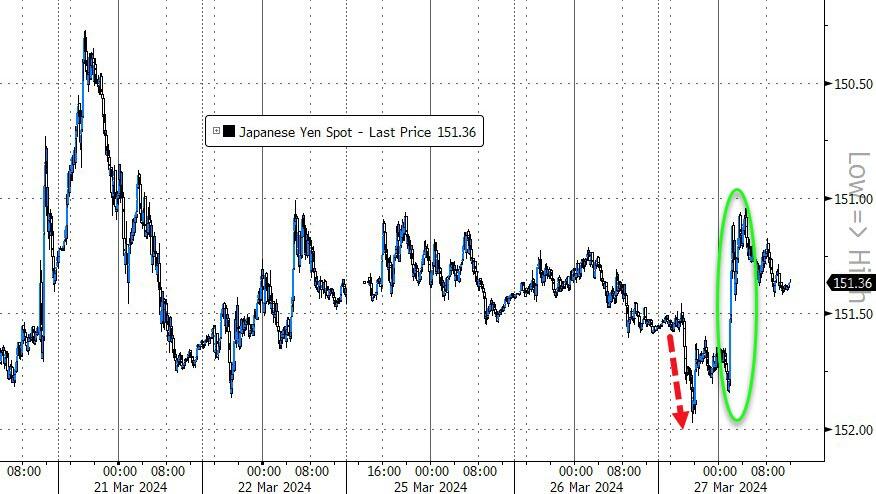
Away from the headlines that are usually front and center on CNBC, the FX market had quite a day as USDJPY tested a key level and was desperately jawboned by every Japanese official that could fog a mirror that “we’ll do something really big, don’t make us!!”.

152 is the weakest for the yen against the dollar since 1990… and is the same level that prompted intervention in 2022…

Source: Bloomberg

It may not look like much but that level is make or break and Tokyo knows it.

But the dollar looked like it did nothing on the day…


Source: Bloomberg

Oil prices rebounded on the day, erasing the post-API losses (as official data came in with a much smaller build)…

Source: Bloomberg

Gold continues to drift higher, testing back up towards $2200 today…

Source: Bloomberg

But closing at a record high in USD…

Source: Bloomberg

Finally, if you’re Japanese, gold has been a great bet…

Source: Bloomberg

…and so has bitcoin…

Source: Bloomberg

…protection from government incompetence.

Tyler Durden
Wed, 03/27/2024 – 16:00

US ‘Backed Itself Into Corner’ By Blaming ISIS For Moscow Attack As Fires Burned: Kremlin

US ‘Backed Itself Into Corner’ By Blaming ISIS For Moscow Attack As Fires Burned: Kremlin

Russian foreign ministry spokesperson Maria Zakharova on Wednesday gave an interview to Russian state-run English language media wherein she continued to advance the Kremlin’s claims that the Ukrainian government or its Western partners likely had something to do with the the Crocus City Hall terror attack.

She described that it was strange that a Western media narrative coalesced around ISIS being behind the attack even as the mall and concert hall was still on fire and emergency crews were still responding. She said the US government has backed itself “into a corner” given that officials made bold statements too quickly in the aftermath.

“The very fact that within the first 24 hours [after the attack], even before the fire was put out, the Americans started screaming that it wasn’t Ukraine, I think, is a piece of incriminating evidence. I can’t classify it otherwise; it is evidence in and of itself,” Zakharova told Sputnik

Moscow News Agency via AP

“The second fact to note concerns the clamor by the US that this assuredly was the work of ISIS,” Zakharova emphasized. “Of course, the speed with which they were able to [come to such forthright conclusions] is astonishing. It took them only a few hours to get to a microphone, turn on the lights, summon the press, and draw a conclusion about who is to blame for this horribly bloody terrorist attack.”

She underscored that all of this demonstrates that US officials “boxed themselves into a corner” because it allowed independent analysts to “[remind] everyone else what ISIS really is.” By that, she meant the recent history of the US/Gulf alliance in Syria having fueled the rise of ISIS:

“You are behind all those ISIS-type structures; you – the United States, Great Britain – yourselves brought them into being,” she concluded.

During the decade-long proxy war in Syria, the West backed the side that produced the Islamic State. In many instances, the US was even paying the salaries of “Free Syrian Army” (FSA) commanders who were openly cooperating and fighting alongside ISIS and Al-Qaeda terrorists.

Kremlin officials have strongly suggested that ISIS militants were used as proxies for the Friday attack in Moscow on behalf of the Ukrainian or possibly Western governments or intelligence agencies.

On Wednesday the official death toll from Russian authorities in the wake of the terror attack on the Moscow concert hall has reached 140 killed, after more people succumbed to their wounds in the hospital.

In the days following the Crocus City Hall attack, Russian state media has been featuring stories on the ‘rise of ISIS’ and the West-sponsored jihad in Syria:

President Vladimir Putin in addressing the terror attack over the weekend vowed to hunt down and punish all perpetrators while also charging that Ukraine prepared a “window” to help the terrorists escape. Since then several more arrests of alleged collaborators and plotter have been made. As for the culprits possibly receiving assistance from Ukraine or Western governments, there’s as yet been no clear evidence presented that demonstrates a connection.

Tyler Durden
Wed, 03/27/2024 – 15:45

Baltimore Port Closure Puts Truck Drivers Who Haul Autos In A Bind

Baltimore Port Closure Puts Truck Drivers Who Haul Autos In A Bind

By John Kingston of FreightWaves

With the closure of the Port of Baltimore for the foreseeable future, the question of which truck drivers are most affected inevitably focuses first on drayage.

But Baltimore is not a major intermodal port, with estimates that its share of U.S. intermodal traffic is in the low single digits.

What the Port of Baltimore is, however, is a huge gateway for automobile imports and, to a lesser extent, car exports. And that fact is likely to shake up the niche truck segment of auto haulers.

Source: Bloomerg

Guy Young is the general manager of the Auto Haulers Association of America. Reached by phone Monday, the day of the Francis Scott Key Bridge collapse, he assessed his members’ industry as it suddenly deals with the loss of its biggest import point.

“What car haulers need that not necessarily any of the other types of container shippers need are places to store the cars until the auto haul trucks come in and pick them up,” Young said.

That means parking lots — big ones — and not every port has them. And if they do, there is not necessarily spare capacity beyond what they are utilizing now.

“Containers require a space to put them, too, but you can stack them,” Young said. That obviously isn’t possible with cars.

He noted that the East Coast also has a significant auto import site at the Port of Brunswick, Georgia, not far from Savannah.

In an article published in Forbes, Ken Roberts, who analyzes trade data, said he believed that the Georgia port would be the best location to take in auto carriers diverted from Baltimore. In the article, Roberts said the leading import partners at Brunswick “align most closely with those of the Port of Baltimore.”

Movin’ out?

But that raises a question. Drivers of auto haulers who are located in the Baltimore region to service that port would need to move their base of operations at least temporarily to Brunswick or other ports — Roberts and Young both mentioned Newark, New Jersey, and Jacksonville, Florida, as leading car import sites — to make the increased operations there work. Will they make that move?

Most auto haulers are home at night, Young said. Companies that specialize in auto hauling “probably have drivers that are based in Baltimore or live close by. You can’t necessarily just send them out anywhere because they don’t have a home to get back to.”

Auto hauling is “not really like over-the-road driving,” Young said. “It’s more regional.”

If the drivers who move autos out of Baltimore to the mid-Atlantic or Northeast are doing so in a day’s time, and now will have to tack on additional over-the-road hours to get cars out of a port like Brunswick, “that’s going to affect hours of service,” Young said.

Possible HOS waiver looms

And online chatter Monday was focusing on the possibility of a more generalized HOS waiver from the Federal Motor Carrier Safety Administration. 

Governors have the  power to declare states of emergency that include state waivers of HOS for a certain period of time, but ultimately, a federal waiver is needed. Maryland Gov. Wes Moore did declare a general state of emergency, but the wording has no specific reference to hours of service.

Auto import data for Baltimore is described in terms of tonnage. In January, according to Maryland data, auto imports were 56,332 tons. The monthly average for 2023 was 68,871 tons. A year earlier it was 71,332 tons. And in 2013, it was 91,191 tons. Specific port by port data was not immediately available, but Baltimore has been described as the largest auto port by several sources. 

Auto exports were 5,064 tons in January, averaged 8,883 tons per month in 2023 and averaged 19,783 tons in 2013. 

The impact on the number of drayage carriers now staring into a demand for their services is impossible to quantify precisely but is undoubtedly huge.

But Louis Campion, the president and CEO of the Maryland Motor Truck Association, told FreightWaves in an email that his organization has about 75 companies that provide intermodal services to Baltimore’s port.

Although the port is technically open to service freight on the docks and in the terminals, the collapsed bridge serves as a barrier for entry and exit from those facilities, which are all inside the site of the catastrophe.

Source: Bloomberg 

Campion noted that activity can continue at terminals. “However, unless the waterways are reopened, it will serve as a blockade to the Port and effectively choke off economic activity,” he said. “If the waterways are not cleared so that ships can continue to access the Port, we would see the impact in literally a few days.  It may already be difficult as some shippers will most certainly start to re-route to other ports.”

News reports have noted shipping officials who are already rerouting freight.

Drayage drivers would face the same dilemma as the auto haulers Young discussed: They can possibly move their trucks to other ports to service diverted freight, but what becomes their home base? 

Campion’s group issued a statement on the bridge collapse that discussed some of the numbers affected by its fallout.

“We know that the Port itself is responsible for 20,000 direct jobs, and thousands of other indirect jobs it creates in industries like trucking,” the statement said. “The Key Bridge is a critical route for trucking into and out of the Port of Baltimore. In 2022 the Bridge carried over 4,800 trucks per day.”

Traffic that had crossed the bridge has three alternative routes. Two are through tunnels that cross under the Port of Baltimore, one on Interstate 95 and the other on Interstate 895, but hazardous materials cannot travel through either tunnel.

Source: Bloomberg 

The second is the western side of the 695 loop around Baltimore. The eastern side of 695 includes the Key Bridge.

Limited intermodal impact

An irony in the bridge collapse is that it was caused by a container ship, though Baltimore is not a significant intermodal port.

In a commentary about the impact of the bridge collapse on East Coast railroad CSX, the transportation team at Deutsche Bank led by Amit Mehrotra said Baltimore last year handled about 300,000 inbound twenty-foot equivalent units, far fewer than New York/New Jersey (2.4 million) and more than 900,000 in Norfolk, Virginia. However, it was more than the 240,000 units handled in Philadelphia, which has been spoken of as a possible alternate destination for cargo routed away from Baltimore.

That small amount of intermodal service is one reason why the Key Bridge collapse is not viewed as a significant incident for the rail intermodal industry, though it could have more impact on coal traffic. Baltimore is a key export site for coal.

“The temporarily displaced imports should be able to easily reroute to nearby ports of entry,” Deutsche Bank wrote. “There is also plenty of available outbound capacity to divert the 200k+ loaded exports that leave Baltimore each year.”

The bank added that the coal slowdown could impact CSX. The Curtis Bay Coal Piers has export capacity of 14 million tons of coal. “At full capacity this would account for about one third of CSX’s annual export (metallurgical) coal volume (40 million tons), though we estimate the actual volume is much less than this,” Deutsche Bank wrote. “The bottom line is CSX’s weekly coal volumes are likely to be down a lot in the coming weeks; if we assume an impact for 2 months, we see max potential for about 30k lower coal carloads.”

On the energy front, recent records show Baltimore importing minor amounts of petroleum. In December, it was one shipment of asphalt and one shipment of biomass-based diesel, which could be either renewable diesel or biodiesel.

The liquefied natural gas export port at Cove Point, Maryland, is outside the port and is not affected by the collapse, according to a spokesman for the facility.

Tyler Durden
Wed, 03/27/2024 – 15:25

The Roberts Court May Force You To Drive An EV

The Roberts Court May Force You To Drive An EV

Authored by Thomas McArdle via The Epoch Times,

The Biden administration has just required that the majority of automotive vehicles manufactured be electric by 2032, inflicting upon the American people troublesome cars whose price is an exorbitant $53,500 on average and that cost a fortune to repair. House Speaker Mike Johnson warned that the move will “devastate auto manufacturers.”

While electric vehicles (EVs) totaled less than 8 percent of sales of new cars last year, the Biden rule demands they reach as much as 56 percent in less than a decade, and as much as 36 percent for plug-in hybrid vehicles. The regulatory method to be employed is mandating that automakers cut carbon dioxide emissions by more than half by eight years from now. Far sooner than that as a result, just several years down the road, Americans may no longer be able to afford an ordinary gasoline-powered vehicle.

The extremism of the new regulations is a direct result of something many Americans likely didn’t think had anything to do with revolutionizing and dictating the ways they get themselves from point A to point B—2022’s so-called Inflation Reduction Act (IRA).

While doing nothing to reduce inflation, the law acted as step one of the implementation of President Joe Biden’s Green New Deal, giving the Environmental Protection Agency (EPA) explicit powers regarding greenhouse gases and in forcing solar, wind, and other expensive alternatives to fossil fuels on the private sector. The IRA’s Title VI amended the Clean Air Act to identify by name pollutants, including CO2, so the EPA would have congressional authorization to regulate them and shift to pricier green forms of energy.

Overlaid on the new powers were massive amounts of new taxpayer cash, with the act spending approximately $370 billion in incentives for solar panels, EVs, and other environmentalist wares that can’t make it in the market. Demand for electric transportation, meanwhile, looks unpromising, with Ford reducing EV manufacturing to the tune of the withdrawal of $12 billion, and Toyota looking more to hybrids than EVs.

The Biden regs set the stage for a battle royale in the Supreme Court, but to know why, let’s back up.

Congress had in 2010 settled the issue of whether carbon emissions from coal plants could be capped, deciding in favor of coal and thus saving an industry that directly provides livelihoods for tens of thousands of Americans. President Barack Obama responded by issuing EPA regulations that imposed such a cap, his administration’s Clean Power Plan of 2015. This ended the constraint against the EPA’s imposing emission reduction methods that would put coal plants out of business.

In effect, President Obama took it upon himself to rewrite the 1970 Clean Air Act via the use of an obscure, vague provision within it and force coal plants that reached the carbon emissions cap to stop operations, finance new plants classified as clean, or buy their way out via emissions allowances—anesthetizingly referred to as “cap and trade.” His autocratic scheme had the obvious goal of shutting down the nation’s coal industry in stark defiance of Congress’s wishes, using established statutory language to exercise new powers not authorized or intended by those old laws.

Not surprisingly, coal industry states such as West Virginia sued the EPA. And in 2022 in a 6–3 decision, the Supreme Court issued a landmark ruling in favor of the Mountain State, and 19 others, against the environmental agency and its “expert” bureaucrats in exercising these powers not granted by lawmakers.

Quoting Justice Brett Kavanaugh’s statement in a 2017 case, Chief Justice John Roberts pointed out in the majority opinion that the justices “presume that ‘Congress intends to make major policy decisions itself, not leave those decisions to agencies.’”

“Thus, in certain extraordinary cases, both separation of powers principles and a practical understanding of legislative intent make us ‘reluctant to read into ambiguous statutory text’ the delegation claimed to be lurking there,” he wrote.

An agency such as the EPA “must point to ‘clear congressional authorization’ for the power it claims.”

The misnamed Inflation Reduction Act was written by Democrats to function as that clear legislative license the chief justice demanded; one Harvard law professor predicted it would strongly discourage future lawsuits against the EPA. But the new powers the IRA gives the EPA still do not go as far as President Obama’s Clean Power Plan, which imposed exacting carbon emission reductions upon individual states based on their various energy consumption levels, each state being required to submit a plan or have the EPA force its own plan on them.

Despite the Harvard professor’s soothsaying, litigation against the agency is sure to materialize. Will the West Virginia v. EPA majority hold and view President Biden’s new plan to wreck the American automotive industry as another executive branch power grab that extends beyond Congress’s intentions? Will Chief Justice Roberts be flattered that federal legislators provided the “clear congressional authorization” he suggested, if indeed he determines that is what it is? Or might others among the six SCOTUS conservatives making up the West Virginia majority peel away?

If Congress really does want to de-industrialize the United States of America in the name of global warming, it seems reasonable to insist that it does so in language that cannot be interpreted otherwise. Whether the Supreme Court chooses to demand that standard will determine whether auto transport is soon taken out of financial reach for millions of Americans.

Tyler Durden
Wed, 03/27/2024 – 13:25

Stellar 7Y Auction Sends Treasury Yields To Session Lows

Stellar 7Y Auction Sends Treasury Yields To Session Lows

After two solid, record-sized coupon auctions, moments ago the Treasury concluded the week’s scheduled issuance when it sold $43 billion in 7Y notes (which unlike the 2s and 5s previously, was not a record-large auction and has a ways to go to catch up to the $61BN 7Y auctions during the depths of the post-covid crisis).

The auction priced at a high yield of 4.185%, which was notably below last month’s4.327% and also stopped through the 4.193% When Issued by 0.8bps, the second consecutive stopping auction following three “tails.”

The bid to cover of 2.614 was above last month’s 2.577 and was the highest since October, naturally well above the six-auction average of 2.54.

The internals were also impressive, with Indirects awarded 69.7% which was also the highest since last October. And with Directs taking down 17.4%, up from 14.8% last month, Dealers were left holding on to 12.9%, the lowest since – you guessed it – October 23.

Overall, this was an impressive, “A+” rated auction, as the market reaction agreed by sending Treasury yields to session lows…

… and where every aspect of the sale came “above and beyond” and did not even hint at a possibility of demand drop at a time when US debt is growing by $1 trillion every 100 days. Then again, it’s only a matter of time before that does happen so for all those who bought paper today, enjoy it while you can.

Tyler Durden
Wed, 03/27/2024 – 13:20

Thailand And Philippines “Charging Ahead” With Plans To Embrace Nuclear Power

Thailand And Philippines “Charging Ahead” With Plans To Embrace Nuclear Power

Among the growing list of countries embracing nuclear are now both Thailand and the Philippines, both of whom are “charging ahead” with plans to start nuclear reactors, according to a new report from Nikkei

In September, Thailand plans to reveal a national energy strategy extending to 2037, featuring the deployment of small modular reactors (SMRs) with a combined capacity of 70 megawatts. Despite previous nuclear ambitions halted by the Fukushima disaster in 2011, SMRs have renewed Thailand’s interest due to their safety and smaller size. The same has been true in places like the U.S., U.K., and China.

Prime Minister Srettha Thavisin, discussing nuclear power prospects with U.S. Commerce Secretary Gina Raimondo, emphasized research into SMR safety and public consultation. Thailand is realizing what the rest of the world is starting to wake up to: that nuclear is the solution to the ‘green’ energy issue. Nikkei notes that as Thailand’s natural gas reserves dwindle and electricity demand surges, the move towards nuclear energy supports its 2050 carbon neutrality goal.

Similarly, the Philippines plans a nuclear facility by the early 2030s, bolstered by a U.S. civil nuclear agreement. This initiative revives ambitions from the era of Ferdinand Marcos Sr., aiming to fulfill a long-standing vision under President Ferdinand Marcos Jr.

Indonesia aims to add 1,000 to 2,000 MW of nuclear capacity by the 2030s, shifting from a coal-heavy energy mix towards a 2060 carbon neutrality target. Despite Southeast Asia’s renewable energy efforts, the region’s high energy costs and absence of operational nuclear plants underscore the challenges ahead. Business leaders like Dhanin Chearavanont advocate for nuclear energy as crucial for economic progress.

Safety concerns persist, highlighted by a 2023 incident involving lost radioactive material in Thailand. Additionally, Myanmar’s increasing nuclear collaboration with Russia amidst international isolation raises fears of military misuse of nuclear technology.

Kei Koga, associate professor at Singapore’s Nanyang Technological University, commented to Nikkei: “If Southeast Asia becomes involved in the competition between global powers to export nuclear technology, it could lead to fragmentation in the region.”

Nuclear, the oft-bastardized common sense solution to most of the world’s ‘green’ energy issues, is finally starting to see an uptick in adoption. Recall, days ago we wrote that uranium prices were set to jump once again after a small correction. 

Jonathan Hinze, president of UxC, a nuclear industry research firm told Bloomberg last week: “We have reached a bottom. The fundamentals are still strong, with increased demand and supply that hasn’t fully responded.”

According to Cantor Fitzgerald analyst Mike Kozak, there’s evidence to suggest that uranium prices have stabilized. Kozak forecasts a resurgence of fundamental buyers in the market, which is expected to propel prices upwards once more, Bloomberg wrote

Optimistic investors are focusing on uranium’s future, driven by an increasing supply shortage and higher demand, as nations (finally pull their heads out from their a** and) seek nuclear energy solutions for climate change.

This interest is highlighted amid supply warnings from Canada’s Cameco and Kazakhstan’s Kazatomprom, the leading producers responsible for half of the worldwide uranium supply. Kazatomprom forecasts a significant supply deficit escalating from 21 million pounds in 2030 to 147 million pounds by 2040.

Geopolitical tensions, including a U.S. proposal to ban Russian uranium imports, which are essential for nuclear power and weapons, add complexity to the supply scenario, the report says. However, the potential resurgence of dormant mining operations due to rising uranium prices poses a risk of dampening the market rally, reminiscent of the recent boom-to-bust cycle in battery metals.

“We have a number of geopolitical factors that have a really significant influence on buyer behavior, even though fundamentally nothing has changed. Buyers can use the spot to tell them the sentiment of the day, but must look at the long-term market to see that it is marching steadily up, it hasn’t taken a hiccup at all,” concluded Treva Klingbiel, president of uranium price provider TradeTech.

Tyler Durden
Wed, 03/27/2024 – 13:05