For €250, migrants can have the test results to the upcoming B1 German-language exam sent to them ahead of time, fradulently obtaining a key requirement for citizenship
A German public broadcaster has uncovered a “cash for test results” scam in which migrants can pay for the answers to a German-language test required to obtain citizenship in the country.
An undercover operation by an employee of the WDR broadcaster exposed the scheme in which those seeking to pass the B1 German-language exam could join a group on the end-to-end encrypted messaging app Telegram and obtain the test results just days before they sit the exam.
The broadcaster was initially tipped off about the scam by a woman who recently sat the exam and noticed that many of the other entrants were overly confident and finished the test unnaturally quickly. When she asked how they had finished so fast, she was told by one woman that their husband had purchased the test results for her in the lead-up to the exam.
“She told me that you can get the questions for the test in a Telegram group for money,” the woman, speaking on the condition of anonymity, told WDR.
With the assistance of an Arabic-speaking colleague, journalists at the broadcaster conducted their own investigations into the allegation and soon found a group on the messaging app advertising test results for the bi-weekly integration exam.
Upon paying €250, the WDR employee received the test results for the exam to be held two days later.
“Some questions only state which answer is correct. Others have additional explanations in Arabic,” the broadcaster reported.
The exam is regulated by the Federal Office for Migration and Refugees (BAMF) and is currently taken by around 20,000 people every two weeks. When questioned by the broadcaster as to how test results could be leaked to then be sold on the black market, BAMF’s head of the integration courses department, Benjamin Beckmann, suggested that someone at the test facility must be responsible.
“The most obvious thing is that a person at an exam center — probably with at least several people in the know — got the security envelope, in which the examination documents were sent, opened them improperly, and took photos of these documents,” he said.
Such an act would inevitably lead to an employee’s termination and the bringing of criminal charges, he added.
The small issue in ascertaining the leak, however, is the fact that the test questions are distributed to 1,467 course providers and then delivered to 4,000 test centers across the country.
Jörn Weingärtner, managing director of GAST eV which is commissioned by BAMF to conduct the tests in Bochum, told WDR that it was inevitable there would be weakness in the chain of delivery.
“Every other weekend, a lot of paper is sent through the Republic, which goes through a lot of hands. And it’s in the nature of things that there can be a weak point somewhere,” he said.
With 360,000 migrants passing the exam last year alone, questions are now being raised as to how many paid for the answers ahead of time and fraudulently achieved a false language grade that facilitated their naturalization in Germany.
Cocaine use tends to be higher in western and southern European cities, according to the database of the European Monitoring Centre for Drugs and Drug Addiction.
As Statista’s Anna Fleck reports, researchers analyzed the wastewater of 88 cities in 23 EU countries and Turkey for levels of a number of illicit drugs, including cocaine, MDMA and ketamine, in order to explore the drug-taking habits of their inhabitants.
They found that cities in Belgium, the Netherlands and Spain had the highest levels of cocaine in their water, while lower levels were found in most eastern European cities.
The Flemish city of Antwerp had 1,722 milligrams detected per 1,000 people flowing through its drains per day in 2023, making it the city with the highest levels of cocaine in their wastewater of the sites included in the study.
Other cities with notably high concentrations were the port cities of Tarragona, Spain (1,464mg) and the Netherlands’ Amsterdam (1,210), Leeuwarden (1,192mg) and Rotterdam (1,088mg).
According to the report, when looking at a number of cities outside of Europe, Brazil and the United States showed similar levels of cocaine use to the worst offending cities in Europe.
As it prepares to investigate every report it receives under the new Hate Crime Act, Police Scotland admits that a separate plan to stop investigating crimes like theft and criminal damage will help criminals.
A Police Scotland pilot in Aberdeen which was deemed a “success” means “more than 24,000 offences a year will no longer be allocated to a front-line officer.”
The body refused to tell the Telegraph which offences would not be investigated, asserting that it would provide criminals with a “tactical advantage”.
“Police Scotland refused to release the data, claiming that admitting which crimes the policy could apply to would risk handing “those with criminal intent” the opportunity to “plan and orchestrate their criminal activities with the aim to avoid detection,” reports the newspaper.
However, Chief Constable Jo Farrell told a meeting of the Scottish Police Authority that some forms of theft and criminal damage would not be investigated.
The new policy is designed to free up time for officers to focus on other crimes.
The absurdity of this plan is heightened by the fact that from April 1st, hate crime legislation comes into force in Scotland that will require additional resources to assess every single report.
Farrell admitted that the new law this could create “additional demand”and create a “resource implication” for police.
As we highlight in the video above, the bill is so broad that any speech whatsoever deemed to have caused offense could be reported and investigated.
During their training program on enforcing the new law, police officers were taught that even the content of plays and comedy gigs should be considered as potential hate crimes.
Many have asserted that merely retweeting a Ricky Gervais joke about transgender people could amount to a hate crime in Scotland.
Meanwhile, all the real criminals must be licking their lips in anticipation at being left alone to run rampant.
* * *
Your support is crucial in helping us defeat mass censorship. Please consider donating via Locals or check out our unique merch. Follow us on X @ModernityNews.
Sales of Rolex watches are believed to have surpassed 10 billion Swiss francs ($11.2 billion) for the first time in 2023, significantly outpacing rivals like Cartier CHF 3.1 billion ($3.5 billion) and Omega CHF 2.6 billion ($2.9 billion).
Additionally, Rolex has strengthened its dominant position in the market, capturing a remarkable 30.3% retail market share.
In 2023, the Swiss watch industry achieved record sales totaling CHF 26.7 billion ($30 billion). The “Big Four” watch brands—Rolex, Patek Philippe, Audemars Piguet, and Richard Mille—achieved a combined 43.9% market share last year, compared to a pre-Covid 2019 market share of 36.9%.
Also noteworthy is that Vacheron Constantin joined the billionaires’ club as the 8th brand to surpass CHF 1 billion in sales, reaching CHF 1.097 billion ($1.23 billion).
In conclusion, premium watches priced over CHF 25,000 ($28,000) drove 69% of the market’s growth in 2023, and constituted 44% of the total value of Swiss watch exports. Despite this significant value contribution, this segment represents only 2.5% of the total volume in terms of units sold.
Let’s start with the possible chain of events that may have led to the Crocus terror attack.
This is as explosive as it gets. Intel sources in Moscow discreetly confirm this is one of the FSB’s prime lines of investigation.
December 4, 2023. Former chairman of the Joint Chiefs of Staff, Gen Mark Milley, only 3 months after his retirement, tells CIA mouthpiece The Washington Post: “There should be no Russian who goes to sleep without wondering if they’re going to get their throat slit in the middle of the night (…) You gotta get back there and create a campaign behind the lines.”
January 31: Victoria Nuland travels to Kiev and meets Budanov. Then, in a dodgy press conference at night in the middle of an empty street, she promises “nasty surprises” to Putin: code for asymmetric war.
February 22: Nuland shows up at a Center for Strategic and International Studies (CSIS) event and doubles down on the “nasty surprises” and asymmetric war. That may be interpreted as the definitive signal for Budanov to start deploying dirty ops.
February 25: The New York Times publishes a story about CIA cells in Ukraine: nothing that Russian intel does not already know.
Then, a lull until March 5 – when crucial shadow play may have been in effect. Privileged scenario: Nuland was a key dirty ops plotter alongside the CIA and the Ukrainian GUR (Budanov). Rival Deep State factions got hold of it and maneuvered to “terminate” her one way or another – because Russian intel would have inevitably connected the dots.
Yet Nuland, in fact, is not “retired” yet; she’s still presented as Undersecretary of State for Political Affairs and showed up recently in Rome for a G7-related meeting, although her new job, in theory, seems to be at Columbia University (a Hillary Clinton maneuver).
Meanwhile, the assets for a major “nasty surprise” are already in place, in the dark, and totally off radar. The op cannot be called off.
March 5: Little Blinken formally announces Nuland’s “retirement”.
March 7: At least one Tajik among the four-member terror commando visits the Crocus venue and has his photo taken.
March 7-8 at night: U.S. and British embassies simultaneously announce a possible terror attack on Moscow, telling their nationals to avoid “concerts” and gatherings within the next two days.
March 9: Massively popular Russian patriotic singer Shaman performs at Crocus. That may have been the carefully chosen occasion targeted for the “nasty surprise” – as it falls only a few days before the presidential elections, from March 15 to 17. But security at Crocus was massive, so the op is postponed.
March 22: The Crocus City Hall terror attack.
ISIS-K: the ultimate can of worms
The Budanov connection is betrayed by the modus operandi – similar to previous Ukraine intel terror attacks against Daria Dugina and Vladimir Tatarsky: close reconnaissance for days, even weeks; the hit; and then a dash for the border.
And that brings us to the Tajik connection.
There seem to be holes aplenty in the narrative concocted by the ragged bunch turned mass killers: following an Islamist preacher on Telegram; offered what was later established as a puny 500 thousand rubles (roughly $4,500) for the four of them to shoot random people in a concert hall; sent half of the funds via Telegram; directed to a weapons cache where they find AK-12s and hand grenades.
The videos show that they used the machine guns like pros; shots were accurate, short bursts or single fire; no panic whatsoever; effective use of hand grenades; fleeing the scene in a flash, just melting away, almost in time to catch the “window” that would take them across the border to Ukraine.
All that takes training. And that also applies to facing nasty counter-interrogation. Still, the FSB seems to have broken them all – quite literally.
A potential handler has surfaced, named Abdullo Buriyev. Turkish intel had earlier identified him as a handler for ISIS-K, or Wilayat Khorasan in Afghanistan. One of the members of the Crocus commando told the FSB their “acquaintance” Abdullo helped them to buy the car for the op.
And that leads us to the massive can of worms to end them all: ISIS-K.
The alleged emir of ISIS-K, since 2020, is an Afghan Tajik, Sanaullah Ghafari. He was not killed in Afghanistan in June 2023, as the Americans were spinning: he may be currently holed up in Balochistan in Pakistan.
Yet the real person of interest here is not Tajik Ghafari but Chechen Abdul Hakim al-Shishani, the former leader of the jihadi outfit Ajnad al-Kavkaz (“Soldiers of the Caucasus”), who was fighting against the government in Damascus in Idlib and then escaped to Ukraine because of a crackdown by Hayat Tahrir al-Sham (HTS) – in another one of those classic inter-jihadi squabbles.
Shishani was spotted on the border near Belgorod during the recent attack concocted by Ukrainian intel inside Russia. Call it another vector of the “nasty surprises”.
Shishani had been in Ukraine for over two years and has acquired citizenship. He is in fact the sterling connection between the nasty motley crue Idlib gangs in Syria and GUR in Kiev – as his Chechens worked closely with Jabhat al-Nusra, which was virtually indistinguishable from ISIS.
Shishani, fiercely anti-Assad, anti-Putin and anti-Kadyrov, is the classic “moderate rebel” advertised for years as a “freedom fighter” by the CIA and the Pentagon.
Some of the four hapless Tajiks seem to have followed ideological/religious indoctrination on the internet dispensed by Wilayat Khorasan, or ISIS-K, in a chat room called Rahnamo ba Khuroson.
The indoctrination game happened to be supervised by a Tajik, Salmon Khurosoni. He’s the guy who made the first move to recruit the commando. Khurosoni is arguably a messenger between ISIS-K and the CIA.
The problem is the ISIS-K modus operandi for any attack never features a fistful of dollars: the promise is Paradise via martyrdom. Yet in this case it seems it’s Khurosoni himself who has approved the 500 thousand ruble reward.
After handler Buriyev relayed the instructions, the commando sent the bayat – the ISIS pledge of allegiance – to Khurosoni. Ukraine may not have been their final destination. Another foreign intel connection – not identified by FSB sources – would have sent them to Turkey, and then Afghanistan.
That’s exactly where Khurosoni is to be found. Khurosoni may have been the ideological mastermind of Crocus. But, crucially, he’s not the client.
The Ukrainian love affair with terror gangs
Ukrainian intel, SBU and GUR, have been using the “Islamic” terror galaxy as they please since the first Chechnya war in the mid-1990s. Milley and Nuland of course knew it, as there were serious rifts in the past, for instance, between GUR and the CIA.
Following the symbiosis of any Ukrainian government post-1991 with assorted terror/jihadi outfits, Kiev post-Maidan turbo-charged these connections especially with Idlib gangs, as well as north Caucasus outfits, from the Chechen Shishani to ISIS in Syria and then ISIS-K. GUR routinely aims to recruit ISIS and ISIS-K denizens via online chat rooms. Exactly the modus operandi that led to Crocus.
One “Azan” association, founded in 2017 by Anvar Derkach, a member of the Hizb ut-Tahrir, actually facilitates terrorist life in Ukraine, Tatars from Crimea included – from lodging to juridical assistance.
The FSB investigation is establishing a trail: Crocus was planned by pros – and certainly not by a bunch of low-IQ Tajik dregs. Not by ISIS-K, but by GUR. A classic false flag, with the clueless Tajiks under the impression that they were working for ISIS-K.
The FSB investigation is also unveiling the standard modus operandi of online terror, everywhere. A recruiter focuses on a specific profile; adapts himself to the candidate, especially his – low – IQ; provides him with the minimum necessary for a job; then the candidate/executor become disposable.
Everyone in Russia remembers that during the first attack on the Crimea bridge, the driver of the kamikaze truck was blissfully unaware of what he was carrying,
As for ISIS, everyone seriously following West Asia knows that’s a gigantic diversionist scam, complete with the Americans transferring ISIS operatives from the Al-Tanf base to the eastern Euphrates, and then to Afghanistan after the Hegemon’s humiliating “withdrawal”. Project ISIS-K actually started in 2021, after it became pointless to use ISIS goons imported from Syria to block the relentless progress of the Taliban.
Ace Russian war correspondent Marat Khairullin has added another juicy morsel to this funky salad: he convincingly unveils the MI6 angle in the Crocus City Hall terror attack (in English here, in two parts, posted by “S”).
The FSB is right in the middle of the painstaking process of cracking most, if not all ISIS-K-CIA/MI6 connections. Once it’s all established, there will be hell to pay.
But that won’t be the end of the story. Countless terror networks are not controlled by Western intel – although they will work with Western intel via middlemen, usually Salafist “preachers” who deal with Saudi/Gulf intel agencies.
The case of the CIA flying “black” helicopters to extract jihadists from Syria and drop them in Afghanistan is more like an exception – in terms of direct contact – than the norm. So the FSB and the Kremlin will be very careful when it comes to directly accusing the CIA and MI6 of managing these networks.
But even with plausible deniability, the Crocus investigation seems to be leading exactly to where Moscow wants it: uncovering the crucial middleman. And everything seems to be pointing to Budanov and his goons.
Ramzan Kadyrov dropped an extra clue. He said the Crocus “curators” chose on purpose to instrumentalize elements of an ethnic minority – Tajiks – who barely speak Russian to open up new wounds in a multinational nation where dozens of ethnicities live side by side for centuries.
In the end, it didn’t work. The Russian population has handed to the Kremlin total carte blanche to exercise brutal, maximum punishment – whatever and wherever it takes.
China-linked hackers appear to be looking to attack U.S. infrastructure, especially key components such as the electrical grid, water reservoirs and treatment plants, pipelines, and transportation and communications systems, among other targets.
The goal is seemingly to disrupt the U.S. everything critical to life – if you have no electricity, your cellphone will not work; no water will come out of the tap; gas pumps will not pump gas; flights and trains will stop, and disease from disabled sewage treatment plants will spread. There will be havoc and panic. The government and military will be unable to protect the nation. That is what is meant by “unrestricted warfare.” Not a bullet was fired. It did not have to be. According to Sun Tzu’s The Art of War, it is perfect.
What are some of the steps that should be taken?
The West has correctly identified the CCP as the malign threat that it is; now we have a responsibility to put into place the measures and deterrents to prevent it from attacking us through cyberspace or any other way. Let us not wait until we experience a 9/11-scale cyberattack that could be far more damaging to the U.S. than what took place on that dark day more than 20 years ago.
The West has correctly identified the Chinese Communist Party as the malign threat that it is; now we have a responsibility to put into place the measures and deterrents to prevent it from attacking us through cyberspace or any other way. Let us not wait until we experience a 9/11-scale cyberattack that could be far more damaging to the U.S. than what took place on that dark day more than 20 years ago. (Image source: iStock)
If there is one thing FBI Director Christopher Wray has been consistent on, it is the threat of Communist China across a wide range of fronts. At an unprecedented event on July 6, 2022, Wray and his British counterpart, MI5 Director General Ken McCallum, held a joint public appearance – the first ever — to discuss the growing security challenge posed by China. Evidently, they saw the matter as urgent.
In this joint appearance, the two men highlighted the threats posed by the Chinese Communist Party (CCP) and the CCP’s civil-military fusion state — specifically, that the CCP is intent on acquiring and stealing technology and business secrets from the West. Targeted areas include advanced materials, data and artificial intelligence (AI). China’s President Xi Jinping has made it clear that he intends China to not only catch-up to, but surpass, the West.
More recently, Wray highlighted how the CCP and those affiliated with it apparently plan to use its technological capabilities to target the West.
China-linked hackers appear to be looking to attack U.S. infrastructure, especially key components such as the electrical grid, water reservoirs and treatment plants, pipelines, and transportation and communications systems, among other targets.
The goal is seemingly to disrupt the U.S. everything critical to life – if you have no electricity, your cellphone will not work; no water will come out of the tap; gas pumps will not pump gas; flights and trains will stop, and disease from disabled sewage treatment plants will spread. There will be havoc and panic. The government and military will be unable to protect the nation. That is what is meant by “unrestricted warfare.” Not a bullet was fired. It did not have to be. According to Sun Tzu’s The Art of War, it is perfect.
Jen Easterly, Director of the Cybersecurity and Infrastructure Security Agency (CISA), testified before the House Select Committee on Strategic Competition Between the United States and the Chinese Communist Party that the threats posed by China are not imaginary: they are real. Her agency already has discovered CCP penetrations into the telecommunications industry, aviation, energy and water infrastructure. As the threat from China continues to grow, the global security environment requires the U.S. and our allies to act now to harden our infrastructure and systems to mitigate the threat.
The problem is one of supreme urgency.
No one knows who will win the U.S. presidential election on November 5. If I were head of the Chinese Communist Party, I would probably be saying to myself, “I am stuck with a weak economy, more than a billion people who will not be happy with that, and just more seven months with an American president who calls me a ‘competitor,’ as if the US-Chinese relationship were about EV car dealerships — although that, too. What are my choices? a) Use this opportunity, which will soon be closing, to choke off Taiwan and take over the world’s supply of semiconductor chips. If the U.S. tries to stop us, we could threaten them with mayhem or simply go ahead and make some. b) Instead of Taiwan, why not just go straight for the U.S. while it is bogged down in Ukraine, the Middle East and its election? Or c) We can wait and see who wins (with our help) and if it is the wrong person, we still have two-and-a-half months until the new president is inaugurated.”
What are some of the steps that should be taken?
First, stop all investments in China and reroute essentials, such as the manufacture of medicines, to other nations. Any investment, even in paper cocktail umbrellas, goes toward strengthening the People’s Liberation Army against us. We can hear the screeching of Wall Street and their Augustinian cry: “But not yet!” The threat, however, should be viewed in terms of national security. No one will ring a bell when the lights go out.
The U.S. will also need to impose secondary sanctions, so that any country preferring to do business with China is prohibited from doing business with the U.S.
In addition, China — for poisoning to death roughly 100,000 Americans each year with fentanyl and other opiates, a mass-murder equivalent to one large plane crash every day — should be designated as a state sponsor of terrorism. China should also be barred from using the international banking system, or SWIFT, “a secure network that allows more than 10,000 financial institutions in 212 different countries to send and receive information about financial transactions to each other.”
Second, companies and universities also need to get serious about their security systems to make the theft of intellectual property more difficult to perpetrate but easier to detect. We cannot allow our enemies to short-circuit the difficult and expensive process of technological innovation by simply walking out the door with the plans.
This precaution, sadly, would do well to include a moratorium, at least for the time being, on students from Communist China attending U.S. universities. Again, there will be more screeching from academic institutions that are fond of holding out their tin cups, but are we really interested in educating our “competitors” to take us over or kill us?
Third, the U.S. needs to cooperate with its allies to protect the intellectual property and technological advances of our countries’ respective corporations as a national security priority. One excellent example where this cooperation has been successful is between the U.S. and the Netherlands. The governments of the two countries have worked together closely to protect against technology transfer to the CCP. While each country has the decision as to its own trade policies, sharing intelligence and threat assessments enables both countries to make better decisions regarding joint security concerns.
Fourth, companies must be willing to notify the government if their systems have been attacked or compromised by outside entities. Under current law, publicly-traded companies have four days to report a cyber incident to regulators. Businesses sometimes have been understandably reluctant to acknowledge that their systems have been compromised: there is the risk of reputational damage and unpleasant repercussions. Organizations, however, need to be confident that sharing this information with the government will only be used to help address the specific incident. Tragically, our government has not quite been doing all it can to inspire trust. There might be some extremely unpleasant repercussions from that.
Finally, there must be a coordinated strategy between our national, state and local governments on the CCP threat, including prime examples of where this system has failed, as in the production of EV batteries in the U.S. by CCP firms; the CCP buying up American farmland, especially near military bases, and the government’s failure to hold the CCP to account for its lies about COVID’s human-to-human transmissibility, which caused the unnecessary deaths of more than a million Americans, and the CCP’s mass-poisoning of Americans with fentanyl, which in itself is an act of war.
While the federal government has warned “that Chinese EVs could collect your data and send it back to China,” states and local governments are welcoming Chinese EV battery manufacturing plants into their communities, frequently with massive government subsidies. This lack of coordination is a serious vulnerability in our national security posture.
Wray and McCallum were correct in highlighting the threat from the CCP in 2022. Wray has reemphasized the growing threat.
The evidence is clear, and the time has come for our elected leaders and public servants — at all levels of government — to respond in a coordinated fashion to this threat.
The West has correctly identified the CCP as the malign threat that it is; now we have a responsibility to put into place the measures and deterrents to prevent it from attacking us through cyberspace or any other way. Let us not wait until we experience a 9/11-scale cyberattack that could be far more damaging to the U.S. than what took place on that dark day more than 20 years ago.
Ranking countries by the size of their economies and their overall net wealth, the U.S. is usually at the top of the list, followed by countries like China, Japan or Germany.
Using the two metrics, Switzerland was the richest country in the world with the highest average per-capita wealth of around US$685,000 per adult.
Looking at median per-capita wealth – the wealth of the person that shares their country with an equal number of richer and poorer people – Iceland tops the ranking with around $413,000 in wealth being held by this (imaginary) person.
Per-capita assets arguably show a more balanced picture of a country’s wealth by acknowledging that smaller countries with less citizens will of course accumulate less wealth in total.
Yet, calculating averages does not take into account how wealth is distributed in a society.
Median wealth, on the other hand, increases the more equal a country’s assets are allocated. Iceland and other Scandinavian countries are known for their more equal wealth distribution and data by Credit Suisse reflects this to a degree. Denmark comes in rank 7 and Norway in rank 10 for per-capita median wealth.
The U.S. is the third-wealthiest country on a per-capita average basis, yet Americans are only in rank 15 for median wealth.
The situation in Belgium is the other way round: It is listed 13th for average wealth, but third for median wealth, showing that it is a more egalitarian country in terms of wealth distribution.
Looking at the size of the gap between mean and median wealth, the U.S. comes in rank 7 with an average wealth more than five times or 512% as high as the median wealth. This is exceeded by no major country in the world except Brazil, where this number stands at 517%.
Some of the smallest relative gaps between mean and median wealth were registered in the countries topping the median wealth list: Iceland, Luxembourg and Belgium. Other countries which might not have the highest mean wealth rates but do have some of the smallest gaps are Eastern European nations Slovakia and Slovenia. Poorer countries which nevertheless have big gaps between average and median wealth include the aforementioned Brazil as well as South Africa, Russia and Nigeria.
More details have since emerged, including that Ms. Chao was on the phone with a friend for eight minutes after her car hit the pond and was sinking, according to the Blanco County Sheriff’s incident report obtained by The Epoch Times.
The report also revealed Ms. Chao had a blood alcohol concentration of 0.233 percent, almost three times higher than the legal threshold of 0.08 percent for driving in Texas.
Ms. Chao, 50, was CEO of the U.S.-based family business, Foremost Group, and a previous top executive for a Chinese shipping giant and board member of China’s World Bank.
On February 10, Ms. Chao and seven female friends—many with home addresses in New York—had gathered for dinner and drinks at the guest lodge located on Ms. Chao’s private ranch, JW Ranch, in Blanco County, Texas.
“They had good conversation throughout the night and all were in good spirits,” the incident report states, according to statements from those present.
As the evening wrapped up, Ms. Chao decided to drive to the main lodge rather than take the short walk from the guest house.
Security cameras on the exterior of the lodge captured the moment Ms. Chao drove her car into the pond, according to two videos from different angles that were provided to investigators by the property manager.
The video from the south side camera shows Ms. Chao come into view alone at 11:37:02 p.m. as she “continues to walk unsteadily to her vehicle while continuing to hold her cellular phone in her right hand,” the police report states.
At 11:38:06 p.m. the vehicle lurches forward toward a wooden barrier, then reverses to the left and over the top of a limestone block wall, entering the water at 11:38:15 p.m.
The video from the west side camera showed the vehicle floating and spinning after entering water, at 11:41:52 pm the headlight disappears and reappears at 11:42:37 pm.
The report says at approximately 11:42 pm, Ms. Chao’s friend Amber Landeau-Keinan received a telephone call from Ms. Chao, who told her “in a calm voice” that she was in the “lake,” which was a stock tank, or pond, near the guest house.
Ms. Chao said she had put the car, a 2020 Tesla model X SUV, in reverse instead of drive while making a three-point turn.
At the time, Ms. Landeau-Keinan was in bed, and as she remained on the phone with Ms. Chao, she got dressed, and knocked on Heela Tsuzuki’s door who was in the next room, to inform her that Ms. Chao was in the pond, the report states.
The west side camera captures Ms. Landeau-Keinan rushing outside to look for the vehicle at 11:43:21 p.m., while on the phone with Ms. Chao.
She told Ms. Chao to get out of the vehicle after Ms. Chao said her feet were under water.
Ms. Chao informs Ms. Landeau-Keinan she’s not able to get out of the vehicle, the report states. Ms. Chao told Landeau-Keinan the water was rising and she was going to die and said “I love you” prior to the vehicle submerging, the report states.
Another friend, Victoria Garcia, got into the water and swam to the vehicle, while Ms. Landeau-Keinan got into a kayak and paddled toward the vehicle.
Ms. Tsuzuki notified others about the incident. She tried multiple times to find the ranch manager, Michael Galster and his wife Hill, for assistance, and called 911 but she couldn’t provide the exact location due to a poor carrier signal.
Call records from AT&T per a subpoena recorded the time of the first 911 call at 11:47:59 p.m., the police report notes.
The next 911 call, that provided the location, was made at 11:52:53 pm, and by this time Mr. Galster had been located.
Dispatch called a rescue team at 11:53.04 p.m., and two sheriff’s deputies arrived at the scene at 12:10 a.m.
When Blanco County Sheriff’s deputy Ryan Bible arrived, he saw the manager standing on top of the “fully submerged vehicle located in the [stock] tank about 25 yards from the north bank,” and “a female in a red dress on a kayak paddling toward the shore,” according to his statement.
When the medic team arrived at 12:12 a.m., Mr. Bible and deputy Randall Mathew entered the water trying to locate the entrapped Ms. Chao.
Mr. Galster told them the back passenger door of the vehicle was open, and the two deputies attempted multiple times to get to Ms. Chao through that door but were unable to.
“During our time in the water there were several females screaming at us frantically on the bank.” Mr. Bible wrote in his statement.
Mr. Bible swam back to shore to retrieve a breaker bar and tried to break the windshield but failed. With the help of two medics, he eventually broke the driver’s side window.
“Once the window was busted I swam down and felt a hand.” Mr. Bible said.
“Medic Ben Collie then was able to pull the hand out from the vehicle and we were then able to extract the female from the vehicle,” he wrote.
Ms. Chao was out of the water at 12:56 a.m., 1 hour and 8 minutes after the car plunged into the pond. She was pronounced dead at 1:40 a.m.
Lt. Adam Acosta, an investigator with the Sheriff’s Office, telephoned Ms. Chao’s husband, Jim Breyer, about the incident.
“Breyer informed me for religious reasons they didn’t want an autopsy conducted.” Mr. Acosta wrote.
“This is not an uncommon request from family.”
Texas Rangers and FBI agents met with the Blanco County Sheriff’s Office on February 15, according to the report.
“After viewing everything they [Texas Rangers and the FBI] felt this incident was nothing more than an unfortunate accident.” the report concluded.
However, the case remained open until the toxicology report and telephone records for Keinan and Tsuzuki were obtained, stated the report, which was released on March 20.
The vehicle was pulled from the pond the night of the accident and released back to the ranch manager later the same day.
About Angela Chao
Ms. Chao has five sisters, one of whom, Elaine Chao, is married to Mr. McConnell. Ms. Elaine Chao was Secretary of Transportation in the Trump administration.
Ms. Chao and her husband, who were married in 2012, both have extensive ties to China. Both are Harvard alumni and Mr. Breyer also attended Stanford.
Mr. Breyer is a venture capitalist and longtime investor in China via his company Breyer Capital and as the former co-chair of Beijing-based IDG Capital.
Ms. Chao was one of six independent board members of the Bank of China from Jan. 4, 2017, to June 30, 2022.
“The re-election of Chao as an independent non-executive board member of the bank will help the board to improve its ability to analyze and judge the international situation,” states a document from the bank’s 2018 shareholders meeting.
The Bank of China has 14 board members; Four executive members, four non-executive members, and six independent members, according to an official document.
The Bank of China is managed and controlled by the Chinese Communist Party (CCP), with most members on the board also members of the CCP. During her tenure, Ms. Chao was the only board member outside of China.
From May 2009 to June 2011, Ms. Chao was also a board member of state-owned China State Shipbuilding Corporation (CSSC), which builds ships for the People’s Liberation Army and Navy.
The United Steelworkers Union and several other unions filed a petition on March 12 with the United States Trade Representative to investigate China’s maritime, logistics, and shipbuilding sector, including CSSC.
Mr. Breyer has invested heavily in China for many years.
As co-chair of IDG Capital from 2005 to January 2019, Mr. Breyer helped expand the company and invest in significant Chinese companies.
IDG touts itself as “the first global investment firm to enter China” on LinkedIn. “IDG Capital has funded more than half of all Chinese unicorns in early rounds.”
A report from the U.S. China Commission calls IDG’s investment track record in China “legendary.”
According to the report, IDG’s China investments include Qihoo 360, which has been flagged by the U.S. Department of Commerce for “activities contrary to the national security or foreign policy interests of the United States.”
Other companies, such as ASR Microelectronics contribute to military-civil fusion programs in China.
According to the U.S. State Department, military-civil fusion is an aggressive strategy that the CCP uses to develop a first-class military by removing barriers between civilian and commercial sectors and its military. The State Department says the CCP gains ground in this strategy by also “acquiring and diverting the world’s cutting-edge technologies—including through theft—in order to achieve military dominance.”
Mr. Breyer also sits as a member of an independent task force sponsored by the Council on Foreign Relations, a New York-based think tank.
The task force is assembled to “assess issues of critical importance to U.S. foreign policy,” according to the website.
“Task Force members aim to reach a meaningful consensus on policy.”
In a 2022 interview with Techcrunch, Mr. Breyer said he has been very happy to invest in China over the past 16 years, “and I fully am passionate about continuing that for many years.”
Mr. Breyer was chairman of the advisory committee of Tsinghua University School of Economics and Management until 2021.
“I’m involved with the Tsinghua University School of Economics and Management Advisory Board, which is really a wonderful who’s-who list of American executives. I was the chair until a year ago, and Tim Cook is now the chair,” he told Techcrunch.
As I’ve watched some of President Donald Trump’s former appointees and allies say they can’t support him in 2024, I was reminded of a similar scenario in American history.
In 1936, Former New York Gov. Al Smith decided that he could not support President Franklin Delano Roosevelt’s re-election.
Smith was a popular reform Democrat who had been elected Governor of New York four times. In 1928, he became the first Catholic ever nominated for President by a major party. To strengthen his campaign, Smith convinced Roosevelt, who was then recovering from polio at Warm Springs, Georgia, to come back and run for governor. Smith lost the presidential race to Herbert Hoover, but Roosevelt became Governor of New York.
When Roosevelt’s New Deal embraced government activism, powerful measures of intervening in the economy, and creating government programs for the poor and unemployed, Smith was alienated. He had been part of the eastern conservative wing of the Democratic Party, which had fought against William Jennings Bryan and his western populism.
Gov. Smith was closer to the business establishment than to radical college professors.
Finally, Smith could no longer support the man he had previously recruited. On Jan. 26, 1936, Smith said at the American Liberty League Dinner:
“I must make a confession. It is not easy for me to stand up here tonight and talk to the American people against the Democratic administration. This is not easy. It hurts me. But I can call upon innumerable witnesses to testify to the fact that during my whole public life I put patriotism above partisanship. And when I see danger – I say ‘danger,’ that is, the ‘Stop, look, and listen’ to the fundamental principles upon which this government of ours was organized – it is difficult for me to refrain from speaking up.”
Despite Smith’s defection, the Roosevelt New Deal coalition was massive (Roosevelt defeated Republican Kansas Gov. Alf Landon by 523 electoral votes and received 60.8 percent of the vote). Landon carried only Maine and Vermont.
I tell that story to say this: The anti-Trump Republicans resemble the anti-Roosevelt Democrats of 1936. They yearn for a party which has disappeared. They advocate policies which are no longer realistic or viable. They are repelled by President Trump’s aggressive style and his dramatic shifts in policy.
They are rapidly becoming a fossilized reminder of a party which no longer exists – and wants to operate in a world which no longer exists.
Some have begun to harken back to the President Ronald Reagan years as a golden time. They wish the GOP could return to them. It is impossible to return to the 1980s, because the world has changed. The problems have changed. The politics have changed. And the institutions are sicker and more destructive than they were under Reagan.
I first spent time with then Gov. Reagan in 1974. I worked to create the first Capitol Steps event – and really the first Contract with America – for candidate Reagan in 1980. For eight years, I served in the House as an active ally of President Reagan on nearly every issue. President Reagan was bold in his visionary approach but careful and cautious in taking risks. While he said the ultimate outcome of the Cold War would be “we win they lose,” he did not risk military confrontation with the Soviet Union.
Reagan would have been appalled at a 22-year war in Afghanistan, which the former chairman of the Joint Chiefs admitted this week was a strategic defeat.
Reagan warned in his farewell address that we were losing ground to a cultural effort to undermine our history, destroy the spirit of patriotism and eliminate learning what it meant to be an American. He would be much bolder and more radical today – faced with collapsing inner-city schools and radical anti-Americanism on college campuses. The Gov. Reagan who took on the counterculture at Berkeley was a much tougher and more intense opponent than the Morning in America Reagan from the 1984 campaign.
People who object to President Trump’s aggressiveness and hide behind a sanitized, phony memory of Reagan forget that it was Governor Reagan who said of the Berkeley protests, “If it takes a bloodbath, let’s get it over with, no more appeasement.”
As Matthew Continetti recently wrote for the National Review, “If Donald Trump is elected president in November, he will have assembled a coalition unlike any Republican nominee in my lifetime.”
Citing research from the American Enterprise Institute, Continetti pointed out that President Trump’s favorability is growing. His popularity is now at the highest points since he left office, and he is making steady gains with white and black Americans – and big gains with Hispanic Americans.
Continetti captured the current challenge for the anti-Trump Republicans: “We aren’t used to a politics where the party of the ‘Left’ represents the establishment, and the party of the ‘Right’ represents an insurgent movement against the settled way of doing things.”
In short, traditional Republicans who wanted to be part of the establishment are being alienated by new Republicans who want to change that establishment.
The traditional Republican leadership (largely the Bush wing of the party) came from Yale, Harvard, Princeton, and had similar pedigrees. They see themselves as governing within the right wing of the old order. They are naturally repelled by the boisterous, noisy emergence of a working-class Republican movement which includes Latinos, African Americans, and blue collar whites. It doesn’t help that the new Republicans want to shatter the old order – not join it.
Think of the anti-Trump Republicans as the Al Smith branch of the GOP. Their complaints will tell you more about them than President Trump – and they will also lose.
Team Of Chinese Engineers Targeted By Suicide Bomber In Pakistan
Separatist Islamic insurgents in Pakistan appear to be engaging in all-out war with the government and its Chinese partners who are building Belt and Road Initiative projects in the south Asian country. Beijing has been investing billions into Pakistan, but some regions are very high-risk in terms of the security situation.
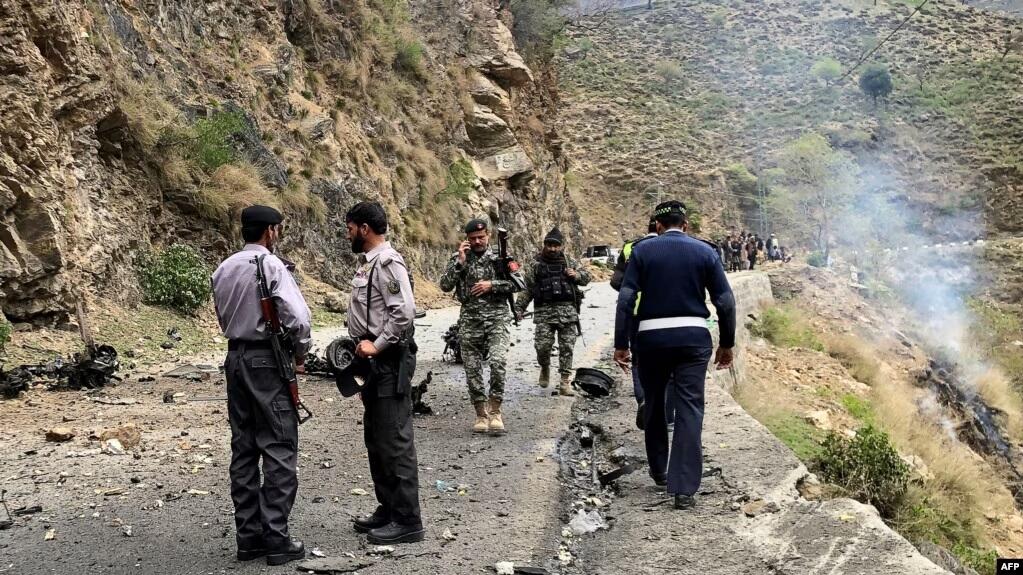
After a string of attacks on locations hosting major Chinese infrastructure projects, there’s been a fresh suicide attack which killed five Chinese nationals Tuesday. A Pakistani driver was also killed when a suicide attacker crashed his explosive-laden vehicle into the group’s convoy, in northwest Pakistan’s Khyber Pakhtunkhwa province.
The Chinese nationals were engineers on their way from the capital of Islamabad to Dasu, which is the location of a new hydroelectric dam being constructed by a Chinese company.
The Baloch Liberation Army (BLA) and other similar ethnic separatist groups are an immediate suspect but no group has yet claimed responsibility for the suicide attack.
Making matters worse for rescue and recovery efforts, the Chinese convoy was attacked at the moment it traversed a mountainous area which has hard to access parts. According to Al Jazeera:
“Our rescue team has successfully retrieved bodies of four people whereas recovery of two more people is still ongoing,” Bilal Faizi, spokesman for Rescue 1122 group in Khyber Pakhtunkhwa, told Al Jazeera.
Rescue officials said the vehicle carrying the Chinese nationals fell in a gorge after the blast and at least two bodies were badly burnt, making their identification difficult.
Just a week ago there was a prior major terror attack at Pakistan’s strategic port city of Gwadar, which is crucial to the multi-billion dollar China-Pakistan Economic Corridor (CPEC). A group of heavily armed militants stormed the complex last Wednesday and engaged in a lengthy firefight with security forces.
Pakistan authorities identified the attackers as Baloch separatists, which had also been armed with bombs. At least seven of the militants were shot dead by security forces. The port has for more than the past decade been run by the China Overseas Port Holding Company.
Ethnic separatist and radical Islamic terrorist organizations have for years waged a long-running insurgency against the government and its foreign partners, accusing Islamabad of exploiting the population of the region.
These groups have especially sought to target infrastructure and projects of the CPEC, seeing in it further confirmation that the Pakistan government is stealing from locals and enriching itself off foreign investments.
China has long deployed security forces in order to protect these key economic corridors of the One Belt One Road Initiative, also commonly called the Silk Road Economic Belt.