68.3 F
Chicago
Sunday, September 20, 2026
Home Blog Page 2816

Don Lemon Claims Musk Interview ‘Suppressed’ On X – Except It Has 3x As Many Views As YouTube

Don Lemon Claims Musk Interview ‘Suppressed’ On X – Except It Has 3x As Many Views As YouTube

Don Lemon, a stupid asshole according to Elon Musk, is fighting tooth and nail to cling to relevance after he was unceremoniously ‘fired‘ by Musk for a duplicitous, CNN-style “gotcha” interview which aired on X and multiple other platforms. The interview has roughly 400,000 on Musk’s platform.

Lemon then threw a hissy-fit, suggesting Musk went “back on his word,” and insinuating that X doesn’t want “new and diverse voices.”

It then came out that Lemon had demanded a $5 million up-front payment from X, on top of an $8 million salary, equity in X, the right to approve any changes in X policy related to news content, and a Tesla Cybertruck.

Now, Lemon is claiming that X is suppressing his Musk interview.

“It would seem to defy credulity that if 21 million people engaged with my post on X announcing my new show, that only a few hundred thousand would be interested in the interview on X as of this afternoon,” Lemon told TheWrap, adding “It just doesn’t make sense.”

A Lemon rep told the outlet, “X is obviously suppressing free speech. Don’s interview was suppressed by X so less people view it.”

TheWrap then said they tried searching for the interview on X, and couldn’t find it without going directly to Lemon’s account.

Lemon, whose show was cancelled by Musk just 24 hours after it was taped, said he could not verify the claim. But searches for the interview on X — including the term “Don Lemon Elon Musk” — turned up a series of insults against the former CNN host. The only way to view the interview was to click on Lemon’s official account, which has 1.5 million followers. -TheWrap

Maybe it’s because the news has widely reported all the interesting parts, and people just aren’t into Don Lemon?

Except that’s bullshit…

The Lemon-Musk interview currently has 1.2 million views on X:

And 460,000 views on YouTube – which has roughly double the number of worldwide users as X.

Is Lemon engaging in a conspiracy theory?

Tyler Durden
Tue, 03/19/2024 – 13:45

Stellar 20Y Auction Sees Surge In Foreign Demand, Biggest Stop Through In More Than A Year

Stellar 20Y Auction Sees Surge In Foreign Demand, Biggest Stop Through In More Than A Year

After several mediocre coupon auctions, moments ago – with some worried that demand for US paper may flag just 24 hours before the Fed decision – the US Treasury sold $13 billion in a 20Y paper in what can only be described as a stellar auction.

The 19-Year, 11-Month reopening of cusip TZ1 priced at a high yield of 4.542% which was just over 1 basis point below last month’s 4.595%, and also stopped through the When Issued 4.562% by an impressive 2 basis points, the biggest stop through since Jan 2023.

The bid to cover jumped from 2.39 in February to 2.79, one of the highest on record, and far above the 2.56 six-auction average

The internals were also stellar with Indirects awarded 73.5%, a surge vs the 59.1% last month, and just shy of the highest on record. And with Directs awarded 17.2%, below last month’s 19.7% which also was the six-auction average, Dealers were left holding just 9.3%, one of the lowest Dealer awards on record.

Overall, this was a stellar auction, and news of the blowout demand helped send yields to session lows across the curve, which in turn also helped propel duration equivalents (read tech names) to session highs, with the S&P rising to session highs just as the auction broke for trading.

Tyler Durden
Tue, 03/19/2024 – 13:22

Ford’s Hands-Free Driving Under NTSB Investigation After Fatal February Crash

Ford’s Hands-Free Driving Under NTSB Investigation After Fatal February Crash

Move over Tesla and Cruise, it looks like Ford is now also under the “autonomous driving” microscope from regulators. 

It was reported this week by The Drive that the NTSB has declared its intention to examine a deadly collision possibly involving Ford’s advanced hands-free driving assistance technology, BlueCruise.

The crash occurred on February 24 in San Antonio, Texas, around 9:50PM. The driver of a Ford Mustang Mach-E, traveling east on Interstate 10, collided with a stationary Honda CR-V located in the center lane, which was without its lights on.

As the report says, the impact resulted in the hospitalization of the Honda’s driver, 56-year-old Jeffrey Allen Johnson from Austin, who subsequently succumbed to his injuries.

“The NTSB, in coordination with the San Antonio Police Department, has opened a safety investigation into the Feb. 24 collision between an electric powered Ford Mustang Mach-E sport utility vehicle and a Honda CR-V on Interstate Highway 10 in San Antonio, Bexar County, Texas,” the NTSB wrote on their X account

The NTSB then announced on Friday its plan to investigate the crash, potentially linked to BlueCruise, equipped in the Mach-E.

BlueCruise, ranked just behind GM’s Super Cruise, enables hands-free driving on designated highways but requires driver attentiveness, monitored through eye movement tracking. This incident stands out due to its sophisticated driver monitoring system, differentiating it from past investigations into Tesla Autopilot crashes, where insufficient driver monitoring contributed to accidents, according to The Drive.

The report noted that enhanced driver monitoring systems and safety features like automatic emergency braking are designed to avert such accidents.

However, it remains uncertain if BlueCruise was engaged at the time of the crash, potentially marking the first accident involving hands-free technology. The implications of this could extend beyond Ford, depending on the outcome. Yet, this assumes the incident wasn’t just another case of distracted driving.

Recall, GM is slashing investment in its Cruise self-driving unit after government scrutiny and Tesla has been under the consistent watchful eye of both the NTSB and the NHTSA for the last few years. 

“This has been a big theme this year in auto; everyone has had to step back from the euphoria,” Barclays auto analyst Dan Levy said last year. 

Tyler Durden
Tue, 03/19/2024 – 13:15

Junk Bond Default Surge Continues In 2024

Junk Bond Default Surge Continues In 2024

Via SchiffGold.com,

Consumers aren’t the only ones defaulting on their debts: Corporate bond defaults were up massively in 2023, especially for high-risk junk debt, and the trend is continuing this year at a pace not seen since the 2008 global financial crisis. Unsurprisingly, companies selling low-rated junk debt are being hit the worst.

Last year, according to S&P Global Ratings, corporate bond defaults increased by a disconcerting 80%. High interest rates coupled with high inflation have made it a struggle for companies to make good on their commitments even as waves of new bond buyers continue to arrive, eager to lock in higher yields before rates go down. Demand remains strong for junk bonds and hybrid debt, but for companies with poor liquidity, poor to negative cash flow, and/or an outsized existing debt burden, the result is a compelling setup for even more defaults in 2024.

For now, with rate cuts on the horizon, interest remains strong in junk bond debt even as effective yields have fallen from their 2023 highs, and yield spreads remain relatively low:

Junk Bond Effective Yields vs Ch.11 Bankruptcy Filings, Summer 2022 to Now

Meanwhile, debts that were financed in a low-interest rate environment are due to mature in the next few years, to the tune of over $1.8 trillion by 2028 according to the Fed. When those payments come due, more companies will fall to the default wave. And if the junk bond market goes off of a cliff, it could pop the broader $13.7 trillion corporate bond bubble and take the rest of the economy with it.

Even Bank of America is calling the overheated bond market “bubbly.” With no sign of a short-term slowdown in bond sales, the pressure on premiums is expected to keep increasing for high-risk debt as borrowers rush to fill the demand for high-yield offerings before the Fed cuts rates.

However, as quoted in Bloomberg, Band of America strategists said:

“The unusually supportive technicals currently are unlikely to be sustainable in the longer term.”

Last month, Moody’s changed their rating methodology to align with Fitch and S&P’s rules, making hybrid debt more attractive to overstretched companies in sectors like media, tech, and others. The rule change lets companies take on more hybrid debt to raise money without taking as much of a potential hit to their creditworthiness. As far as the next wave of defaults goes, Moody’s itself reported earlier this year that about 16% of speculative-grade companies are at high risk of defaulting on their obligations, including healthcare companies and airlines:

“Names added to the list last quarter include radio platform iHeart Communications and Spirit Airlines (SAVE.N), whose proposed merger with peer JetBlue (JBLU.O), was blocked on Tuesday…At the same time, as defaults have risen, the ratio of Moody’s downgrades to upgrades among speculative-grade companies grew to 1.8x in the fourth quarter of 2023, up from 1.3x in the previous quarter.”

The Fed hopes that its interest rate cuts will decrease the burden on indebted companies, but it will come at the cost of adding fuel to inflationary pressures that the higher-interest rate environment has failed to contain. Besides, a decrease in interest rates won’t be enough for many low-rated companies to successfully refinance their obligations or take on additional debt. If investors keep flocking to them in search of higher yield compared to Treasurys, that only makes a frothy market even frothier.

Either way, when the entire economy is addicted to an artificially low interest rate environment, the Fed constantly backs itself into a corner and turns to its only real policy tool: printing money. Feverish bond-buying inspired, in part, by artificially-induced interest rate changes is just one of the endless ways that the Fed’s meddling creates a zombie economy. This banker-run fantasyland acts not upon the laws of nature or the principles of sound economics, but the hubris-fueled whims of central bankers who eagerly play the roles of both pseudo-wizard and pseudo-scientist at the dire expense of the governed.

Tyler Durden
Tue, 03/19/2024 – 12:55

Crédit Agricole Doesn’t Expect Trump’s Mounting Legal Issues To Derail Campaign

Crédit Agricole Doesn’t Expect Trump’s Mounting Legal Issues To Derail Campaign

Former President Donald Trump and President Joe Biden clinched their parties’ nominations last Tuesday, cementing a general election rematch in November.

Looking ahead, Crédit Agricole analysts provided clients with a complete election timeline of critical dates ahead of the presidential elections on November 5. 

“The Republican convention takes place 15 – 18 July in Milwaukee and the Democratic convention 19 – 22 August in Chicago. While there is no official deadline to replace a candidate, if Trump’s legal trials or Biden’s health concerns were to catch up to them, the convention offers the last practical chance to switch to a different candidate, though our base case remains a Trump vs Biden rematch,” said Valentin Marinov, head of G-10 currency strategy at Credit Agricole.

Marinov outlines several of Trump’s mounting legal issues as Democrats weaponize the judicial system against their opponent: 

  1. Federal election interference;

  2. Mar – a – Lago cl classified documents;

  3. Stormy Daniels hush money; and

  4. Georgia election interference

“However, we do not expect these [court cases] to derail Trump’s campaign,” the analyst said, adding, “With the caveat that we are not lawyers, at least some aspects of certain cases look to be relatively weak and driven by partisanship, while some may end up being delayed to the point that they would have no impact on voting.” 

And wouldn’t this be wild, as Marinov noted: “Even if he were convicted before Election Day, nothing would prevent Trump from running from jail, so it would come down to a question of how severely that would erode his support.” 

Here are the key dates and timeline for the US election to keep an eye on:

Marinov said, “Betting markets see Trump as a slight favorite, and we concur given his advantage in polling, particularly in swing states.” 

Separately, Dr. Gad Saad, a marketing professor at the John Molson School of Business at Concordia University in Montreal, posted a list of tactics Democrats are employing to steal the election: 

  1. Engage in sham impeachments

  2. Suppress relevant information (Hunter’s laptop highlighting orgiastic Biden corruption) 

  3. Seek to stack the Supreme Court

  4. Change the Electoral College rules

  5. Allow ILLEGAL immigrants to vote 

  6. Refuse voter IDs because these are racist 

  7. Create a fake January 6 insurrection narrative where people have been imprisoned as though they were Genghis Khan

  8. Engage in astoundingly corrupt lawfare in order to ensure that the GOP candidate is mired in endless legal proceed

  9. Have state officials seek to remove the GOP candidate from the ballot box

  10. Engage in very dubious electoral procedures that permit for orgiastic cheating (many countries only allow same-day in-person voting)

And the plan by Democrats to usher in a communist single-party rule over America.

The election cycle is heating up. 

Tyler Durden
Tue, 03/19/2024 – 12:35

Wall Street Bonuses Fall For Second Year To 2019 Lows Amid Capital Markets Freeze

Wall Street Bonuses Fall For Second Year To 2019 Lows Amid Capital Markets Freeze

Wall Street bonuses have declined for two consecutive years, falling to levels last seen in 2019, according to the latest yearly figures released by New York State Comptroller Thomas P. DiNapoli. This trend is occurring amidst a multi-year downturn in capital markets due to the Federal Reserve’s interest rate hiking cycle.

According to the report, the average Wall Street cash bonus fell 2% to $176,500 in 2023, the lowest level since 2019. The drop was far less than the 25% plunge in 2022. Last year’s bonus pool was $33.8 billion, unchanged from the previous year but far less than the $42.7 billion during the stock market mania in 2021. 

Source: Bloomberg 

“Wall Street’s average cash bonuses dipped slightly from last year, with continued market volatility and more people joining the securities workforce,” DiNapoli said in a news release on Tuesday. 

He continued: “While these bonuses affect income tax revenues for the state and city, both budgeted for larger declines so the impact on projected revenues should be limited.” 

“The securities industry’s continued strength should not overshadow the broader economic picture in New York, where we need all sectors to enjoy full recovery from the pandemic,” he added.

Despite the slump, the report said Wall Street’s profits rose 1.8% last year, “but firms have taken a more cautious approach to compensation, and more employees have joined the securities industry, which accounts for the slight decline in the average bonus.” 

The report showed the industry employed 198,500 people in 2023, up from 191,600 the prior year. This expansion occurred during a period when US banks laid off 23,000 jobs. 

Given that swaps traders and economists at Goldman Sachs Group are forecasting fewer Fed interest-rate cuts this year, a higher-for-longer rates environment will continue to discourage capital-market activity. 

There’s about a 50% chance of a June cut. Over the last several months, the Fed’s interest-rate target implied by overnight index swaps and SOFR futures went from 700bps of cuts to currently 292bps of cuts for the full year. 

Any delay in the easing cycle will only mean another year of depressed bonuses for Wall Street. 

Tyler Durden
Tue, 03/19/2024 – 10:00

Three Fantasyland Budget Projections By The Fed, Biden, And Congress

Three Fantasyland Budget Projections By The Fed, Biden, And Congress

Authored by Mike Shedlock via MishTalk.com,

What’s the key item that’s wrong in the following table of GDP, inflation, unemployment, and interest rate projections?

Where’s a Recession?

Has the Fed, the nonpartisan Congressional Budget Office (CBO), or the White House Office of Management & Budget (OMB) ever forecast a recession?

The answers are no, no, and no.

Yet, for the next ten years, real GDP and the unemployment rate reflect the no recession idea without any discussion of recession by any of the above parties.

What About Inflation?

Since the Fed has a mandate on price stability, and the Fed ridiculously defines stability as 2.0 percent, the Fed predicts 2.0 percent.

What About Budget Deficits?

Without exception, budget deficits soar in recessions.

The Fed never predicts deficits but miraculously and arrogantly thinks no matter what they are, it can achieve a steady unemployment rate of 4.1 percent and inflation of 2.0 percent for a decade.

CBO Budget Deficit Projections

Please consider CBO Projections at a Glance

  • The deficit totals $1.6 trillion in fiscal year 2024, grows to $1.8 trillion in 2025, and then returns to $1.6 trillion by 2027. Thereafter, deficits steadily mount, reaching $2.6 trillion in 2034.

  • Debt held by the public increases from 99 percent of GDP at the end of 2024 to 116 percent of GDP—the highest level ever recorded—by the end of 2034. After 2034, debt would continue to grow if current laws generally remained unchanged.

  • Outlays in 2024 amount to 23.1 percent of GDP and stay close to that level through 2028. After 2028, growth in spending on programs for elderly people and rising net interest costs drive up outlays, which reach 24.1 percent of GDP by 2034.

  • Revenues amount to 17.5 percent of GDP in 2024, decline to 17.1 percent in 2025, and then climb to 17.9 percent of GDP by 2027 after certain provisions of the 2017 tax act expire. Revenues remain near that level through 2034.

Every one of those projections counts on there being no recession.

Federal Debt Held by the Public OMB

The only way to explain the above chart is the OMB projects no recession all the way to 2050.

Federal Debt Held By the Public 2023 Q4

Industrial Production Takes a Huge Revised Dive

Industrial production rose in February from huge negative revisions in January.

Industrial Production data from the Fed, chart by Mish.

For discussion of the above chart, please see Industrial Production Takes a Huge Revised Dive, the Fed Blames the Weather

Has Industrial Production peaked this cycle? Many charts suggest the answer is yes.

Has the US Consumer Finally Waved the White Flag on Spending?

The answer to the question appears to be yes, starting October of 2023.

For discussion, please see Has the US Consumer Finally Waved the White Flag on Spending?

Six pictures of real vs nominal advance retail sales tell the story.

More Fantasyland Projections on Wednesday

OK, I get it that it’s impossible to pencil in a recession date. But there has to be a better approach that forecast no recession until 2050.

Someone asked “What about GDP beating expectations like 2023?”

OK what about it? What did that do for deficits or debt, or interest on the debt?

With every recession, fiscal prudence goes further and further out the window.

The Fed will update its dot plot of expected economic conditions on Wednesday.

I can hardly wait.

Tyler Durden
Tue, 03/19/2024 – 09:40

World’s Largest Pension Fund To Diversify Into Bitcoin As BitMEX Sees Price Flash-Crash Below $9,000 Overnight

World’s Largest Pension Fund To Diversify Into Bitcoin As BitMEX Sees Price Flash-Crash Below $9,000 Overnight

Crypto exchange BitMEX is currently investigating “unusual activity” involving large sell orders on its BTC-USDT spot market overnight that sparked a flash-crash dragging the price of BTC (in USDT) down below $9,000 (while the price remained above $66,000 on other exchanges)…

Doesn’t seem like a very smart move for the ‘rogue seller’ to dump over 400 BTC at that time of day into an illiquid market – why not wait until the US BTC ETF market is running its magic and sell into that liqudity?

The USD price of BTC has been falling ever since…

A spokesperson for BitMEX said the company investigated the incident and found evidence of “aggressive selling behavior involving a very small number of accounts that exceeded expected market ranges,” adding that its systems had operated normally and all user funds are safe.

“We launched an investigation as soon as we noticed unusual activity on our BTC-USDT Spot Market. Despite all our systems operating normally, we identified aggressive selling behavior involving a very small number of accounts that exceeded expected market ranges. Our compliance is thoroughly investigating relevant individual accounts, and will keep our users appraised of any necessary measures in the future,” BitMEX spokesperson further told Cointelegraph.

“Someone just dumped 400+ BTC over 2 hours in 10-50 BTC clips on the XBTUSDT pair on Bitmex eating 30%+ slippage. They must’ve lost $4m+ at least,” pseudonymous crypto community member “syq” wrote.

“I’m guessing that they’re done (for now?). Total volume so far is just shy of 1,000 BTC over 3.5 hours with a low of $8,900. Now BitMEX have disabled withdrawals,” they added.

The exchange later posted on X:

“This does not affect any of our derivative markets, nor the index price for our popular XBT derivatives contracts.”.

Notably yesterday saw the biggest net outflows from the BTC ETF complex sincxe inception, dominated by GBTC liquidations…

Which is interesting given the timing of the flash crash and the fact that the former CEO of BitMEX, Arthur Hayes, previously opined that the spot Bitcoin exchange-traded funds (ETFs) could “completely destroy” Bitcoin if they are too successful.

According to Hayes, Bitcoin ETF issuers holding all the BTC would negatively impact the number of transactions on the Bitcoin network, and miners will lose any incentive to keep validating transactions.

“The end result is miners turn off their machines as they can no longer pay for the energy required to run them,” said Hayes.

“Without the miners, the network dies, and Bitcoin vanishes.”

But not everyone is buying that doom and gloom as MicroStrategy, one of the largest public holders of Bitcoin, has completed another convertible notes offering to increase its Bitcoin stash.

The notes sold in the offering amounted to $603.75 million, including $78.75 million aggregate principal amount of notes issued pursuant to an option to purchase.

“I’m going to be buying the top forever. Bitcoin is the exit strategy,” Saylor said after being asked if his firm would sell its stash counting 190,000 BTC at the time.

Additionally, as we noted last night, another potential source of bitcoin price upside: FX reserves, i.e., “another large sticky (potential) cash pool, which could follow in the footsteps of new US pension money.”

Specifically, Kendrick says that US and EU sanctions on Russia’s reserves “have structurally increased the appeal of non-standard reserve assets for FX reserve managers. The most obvious beneficiaries of this are gold and the CNY, but digital assets could also benefit” (as they already have in El Salvador where Nayib Bukele has previously purchased over 5,600 bitcoin). If they do, expect the largest and most liquid assets – such as Bitcoin – to receive most of the inflows. Which is why, the Standard Chartered analysts sees “a rising likelihood that large reserve managers may announce BTC buying in 2024.”

And sure enough, overnight we saw Japan’s Government Pension Investment Fund (GPIF), the world’s largest pension fund managing over $1.5 trillion in assets, has announced it will explore diversifying a portion of its portfolio into Bitcoin.

According to the announcement, the GPIF will solicit information on illiquid alternative assets like Bitcoin, gold, forests, and farmland as part of its diversification efforts.

While not currently invested in these assets, the move signals that the mega-fund is actively researching options beyond stocks and bonds.

The GPIF stated it seeks “basic knowledge about the assets targeted for information provision” and wants to understand “how overseas pension funds incorporate them into their portfolios.”

With over $1.5 trillion at its disposal, even a tiny allocation to Bitcoin by GPIF could significantly impact prices and further legitimize Bitcoin.

Tyler Durden
Tue, 03/19/2024 – 09:19

“I’ve Changed My Mind”: Swedish Open Borders MP Makes Complete U-Turn

“I’ve Changed My Mind”: Swedish Open Borders MP Makes Complete U-Turn

Authored by Paul Joseph Watson via Modernity.news,

A Swedish MP who advocated for open borders during the 2015 refugee crisis said she has completely changed her mind and now wants to see a significant number of deportations.

Louise Meijer, a lawmaker with the now-governing Moderate Party, previously “took a stand for openness” and supported the ‘Refugees Welcome’ mantra, but now wants to pull up the drawbridge completely.

“But I have changed my mind on the matter,” she told Expressen, adding she now supports “an even stricter migration policy than the one I opposed at the time.”

“The change that Sweden has undergone and is undergoing is fundamentally changing the country,” said Meijer, noting that “mass immigration has been followed by several major problems.”

Specifically, she pointed to the fact that “serious, organized crime is committed to a large extent by people with foreign assets,” that new arrivals are “not self-sufficient,” and that the “culture of honor, separatism, and Islamism is limiting and dangerous.”

Meijer asserted that integrating large numbers of migrants has been a total failure for Sweden and “for integration to work, people who both want to move here and who already live here need to adapt to Swedish society and our values.”

She is now calling for a strict limit on migration in the near future and dedicated herself to ensuring that the country begins a large deportation campaign.

“You need to work, speak Swedish, and do your duty before you demand your rights. Those who do not want to adapt and integrate should not stay in Sweden either. Deportation or repatriation should then be a real option,” said Meijer.

After being one of if not the safest country in Europe, Sweden now records the second most bombings out of any country not at war besides Mexico.

Violence and criminality caused by migrant gangland violence is so chronic, last year the Swedish Prime Minister met with the head of the military to try to formulate a plan to deal with it.

Riots and civil unrest have become commonplace, and in 2021, Germany’s Bild newspaper ran the headline: ‘Sweden is the most dangerous country in Europe.’

A 2018 report also found that 99 out of 112 gang rapists in Sweden had a foreign background.

When veteran Swedish police investigator Peter Springare was asked about the demographics of those responsible for violent crimes, he didn’t mince his words.

“Here we go; this is what I’ve handled from Monday-Friday this week: rape, rape, robbery, aggravated assault, rape-assault and rape, extortion, blackmail, assault, violence against police, threats to police, drug crime, drugs, crime, felony, attempted murder, rape again, extortion again and ill-treatment,” he wrote.

“Suspected perpetrators; Ali Mohammed, Mahmod, Mohammed, Mohammed Ali, again, again, again. Christopher… what, is it true? Yes, a Swedish name snuck in on the edges of a drug crime. Mohammed, Mahmod Ali, again and again,” he added.

Diversity proving to be “our greatest strength” yet again.

*  *  *

Your support is crucial in helping us defeat mass censorship. Please consider donating via Locals or check out our unique merch. Follow us on X @ModernityNews.

Tyler Durden
Tue, 03/19/2024 – 09:00

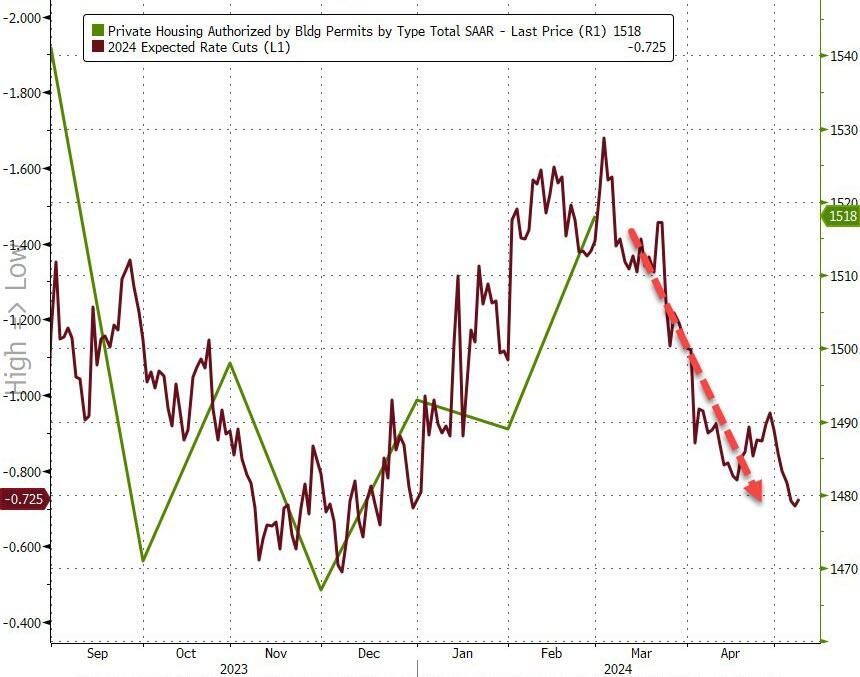
Housing Starts And Permits Surged In February (Despite Plunging Rate-Cut Odds)

Housing Starts And Permits Surged In February (Despite Plunging Rate-Cut Odds)

Housing Starts and Permits rebounded firmly in February from an ugly January.

Starts soared 10.7% MoM (+8.2% exp) recovering some of the 12.3% MoM decline in January and Permits jumped 1.9% (+0.5% exp) from the upwardly revised -0.3% MoM decline in January…

Source: Bloomberg

That was the biggest monthly jump in Starts since May and biggest permits rise since August.

With weather being blamed for January’s decline, February seems like a return to post-COVID lower norms…

Source: Bloomberg

Under the hood, rental unit housing permits outpaced single-family units

  • Single-Family: up 1.0% to 1.031MM from 1.021MM

  • Rentals: up 2.4% to 429K from a four year low of 419K

On the Housing Starts side, single-family units rose more (but both saw signifiant rises):

  • Single-Family: up 11.6% to 1.129MM, highest since April 2022, from 1.012MM

  • Rentals: up 8.6% to 377K from 347K

All good news for the meager supply out there. The question is – with rate-cut odds plummeting, has homebuilder confidence, which recently spiked back above 50, got too far over their skis on expectations of The Fed saving the day.

If they build it, will homebuyers come?

Tyler Durden
Tue, 03/19/2024 – 08:44