68.3 F
Chicago
Sunday, September 20, 2026
Home Blog Page 2826

Gen Z, The Most Pessimistic Generation In History, May Decide The Election

Gen Z, The Most Pessimistic Generation In History, May Decide The Election

Authored by Mike Shedlock via MishTalk.com,

Young adults are more skeptical of government and pessimistic about the future than any living generation before them.

This is with reason, and it’s likely to decide the election.

Rough Years and the Most Pessimism Ever

The Wall Street Journal has an interesting article on The Rough Years That Turned Gen Z Into America’s Most Disillusioned Voters.

Young adults in Generation Z—those born in 1997 or after—have emerged from the pandemic feeling more disillusioned than any living generation before them, according to long-running surveys and interviews with dozens of young people around the country. They worry they’ll never make enough money to attain the security previous generations have achieved, citing their delayed launch into adulthood, an impenetrable housing market and loads of student debt.

And they’re fed up with policymakers from both parties.

Washington is moving closer to passing legislation that would ban or force the sale of TikTok, a platform beloved by millions of young people in the U.S. Several young people interviewed by The Wall Street Journal said they spend hours each day on the app and use it as their main source of news.

“It’s funny how they quickly pass this bill about this TikTok situation. What about schools that are getting shot up? We’re not going to pass a bill about that?” Gaddie asked. “No, we’re going to worry about TikTok and that just shows you where their head is…. I feel like they don’t really care about what’s going on with humanity.”

Gen Z’s widespread gloominess is manifesting in unparalleled skepticism of Washington and a feeling of despair that leaders of either party can help. Young Americans’ entire political memories are subsumed by intense partisanship and warnings about the looming end of everything from U.S. democracy to the planet. When the darkest days of the pandemic started to end, inflation reached 40-year highs. The right to an abortion was overturned. Wars in Ukraine and the Middle East raged.

Dissatisfaction is pushing some young voters to third-party candidates in this year’s presidential race and causing others to consider staying home on Election Day or leaving the top of the ticket blank. While young people typically vote at lower rates, a small number of Gen Z voters could make the difference in the election, which four years ago was decided by tens of thousands of votes in several swing states.

Roughly 41 million Gen Z Americans—ages 18 to 27—will be eligible to vote this year, according to Tufts University.

Gen Z is among the most liberal segments of the electorate, according to surveys, but recent polling shows them favoring Biden by only a slim margin. Some are unmoved by those who warn that a vote against Biden is effectively a vote for Trump, arguing that isn’t enough to earn their support.

Confidence

When asked if they had confidence in a range of public institutions, Gen Z’s faith in them was generally below that of the older cohorts at the same point in their lives. 

One-third of Gen Z Americans described themselves as conservative, according to NORC’s 2022 General Social Survey. That is a larger share identifying as conservative than when millennials, Gen X and baby boomers took the survey when they were the same age, though some of the differences were small and within the survey’s margin of error.

More young people now say they find it hard to have hope for the world than at any time since at least 1976, according to a University of Michigan survey that has tracked public sentiment among 12th-graders for nearly five decades. Young people today are less optimistic than any generation in decades that they’ll get a professional job or surpass the success of their parents, the long-running survey has found. They increasingly believe the system is stacked against them and support major changes to the way the country operates.

Gen Z future Outcome

“It’s the starkest difference I’ve documented in 20 years of doing this research,” said Twenge, the author of the book “Generations.” The pandemic, she said, amplified trends among Gen Z that have existed for years: chronic isolation, a lack of social interaction and a propensity to spend large amounts of time online.

A 2020 study found past epidemics have left a lasting impression on young people around the world, creating a lack of confidence in political institutions and their leaders. The study, which analyzed decades of Gallup World polling from dozens of countries, found the decline in trust among young people typically persists for two decades.

Young people are more likely than older voters to have a pessimistic view of the economy and disapprove of Biden’s handling of inflation, according to the recent Journal poll. Among people under 30, Biden leads Trump by 3 percentage points, 35% to 32%, with 14% undecided and the remaining shares going to third-party candidates, including 10% to independent Robert F. Kennedy Jr.

Economic Reality

Gen Z may be the first generation in US history that is not better off than their parents.

Many have given up on the idea they will ever be able to afford a home.

The economy is allegedly booming (I disagree). Regardless, stress over debt is high with younger millennials and zoomers.

This has been a constant theme of mine for many months.

Credit Card and Auto Delinquencies Soar

Credit card debt surged to a record high in the fourth quarter. Even more troubling is a steep climb in 90 day or longer delinquencies.

Record High Credit Card Debt

Credit card debt rose to a new record high of $1.13 trillion, up $50 billion in the quarter. Even more troubling is the surge in serious delinquencies, defined as 90 days or more past due.

For nearly all age groups, serious delinquencies are the highest since 2011.

Auto Loan Delinquencies

Serious delinquencies on auto loans have jumped from under 3 percent in mid-2021 to to 5 percent at the end of 2023 for age group 18-29.Age group 30-39 is also troubling. Serious delinquencies for age groups 18-29 and 30-39 are at the highest levels since 2010.

For further discussion please see Credit Card and Auto Delinquencies Soar, Especially Age Group 18 to 39

Generational Homeownership Rates

Home ownership rates courtesy of Apartment List

The above chart is from the Apartment List’s 2023 Millennial Homeownership Report

Those struggling with rent are more likely to be Millennials and Zoomers than Generation X, Baby Boomers, or members of the Silent Generation.

The same age groups struggling with credit card and auto delinquencies.

On Average Everything is Great

Average it up, and things look pretty good. This is why we have seen countless stories attempting to explain why people should be happy.

Krugman Blames Partisanship

OK, there is a fair amount of partisanship in the polls.

However, Biden isn’t struggling from partisanship alone. If that was the reason, Biden would not be polling so miserably with Democrats in general, blacks, and younger voters.

OK, there is a fair amount of partisanship in the polls.

However, Biden isn’t struggling from partisanship alone. If that was the reason, Biden would not be polling so miserably with Democrats in general, blacks, and younger voters.

This allegedly booming economy left behind the renters and everyone under the age of 40 struggling to make ends meet.

Many Are Addicted to “Buy Now, Pay Later” Plans

Buy Now Pay Later, BNPL, plans are increasingly popular. It’s another sign of consumer credit stress.

For discussion, please see Many Are Addicted to “Buy Now, Pay Later” Plans, It’s a Big Trap

The study did not break things down by home owners vs renters, but I strongly suspect most of the BNPL use is by renters.

What About Jobs?

Another seemingly strong jobs headline falls apart on closer scrutiny. The massive divergence between jobs and employment continued into February.

Nonfarm payrolls and employment levels from the BLS, chart by Mish.

Payrolls vs Employment Gains Since March 2023

  • Nonfarm Payrolls: 2,602,000

  • Employment Level: +144,000

  • Full Time Employment: -284,000

For more details of the weakening labor markets, please see Jobs Up 275,000 Employment Down 184,000

CPI Hot Again

CPI Data from the BLS, chart by Mish.

For discussion of the CPI inflation data for February, please see CPI Hot Again, Rent Up at Least 0.4 Percent for 30 Straight Months

Also note the Producer Price Index (PPI) Much Hotter Than Expected in February

Major Economic Cracks

There are economic cracks in spending, cracks in employment, and cracks in delinquencies.

But there are no cracks in the CPI. It’s coming down much slower than expected. And the PPI appears to have bottomed.

Add it up: Inflation + Recession = Stagflation.

Election Impact

In 2020, younger voters turned out in the biggest wave in history. And they voted for Biden.

Younger voters are not as likely to vote in 2024, and they are less likely to vote for Biden.

Millions of voters will not vote for either Trump or Biden. Net, this will impact Biden more. The base will not decide the election, but the Trump base is far more energized than the Biden base.

If Biden signs a TikTok ban, that alone could tip the election.

If No Labels ever gets its act together, I suspect it will siphon more votes from Biden than Trump. But many will just sit it out.

“We’re just kind of over it,” Noemi Peña, 20, a Tucson, Ariz., resident who works in a juice bar, said of her generation’s attitude toward politics. “We don’t even want to hear about it anymore.” Peña said she might not vote because she thinks it won’t change anything and “there’s just gonna be more fighting.” Biden won Arizona in 2020 by just over 10,000 votes. 

The Journal noted nearly one-third of voters under 30 have an unfavorable view of both Biden and Trump, a higher number than all older voters. Sixty-three percent of young voters think neither party adequately represents them.

Young voters in 2020 were energized to vote against Trump. Now they have thrown in the towel.

And Biden telling everyone how great the economy is only rubs salt in the wound.

Tyler Durden
Sat, 03/16/2024 – 11:40

Europe Panics As Trump Rises From The Political Grave

Europe Panics As Trump Rises From The Political Grave

Authored by Tom Luongo via Gold, Goats, ‘n Guns blog,

So last week was fun.

It started with the US Supreme Court’s 9-0 beatdown of using the 14th Amendment to punish political opponents.

Then the Wicked Witch of Kiev, Vic(Toria) “Cookies” Nuland was forced out at the State Department after decades of torturing the world with her psychopathy.

Then Donald Trump pretty much sent Nikki Haley back to her Waffle House outside of Greenville.

It ended with French President Emmanuel Macron making “believe me” eyes at the world that NATO was ready and willing to send troops to Ukraine. Whose troops? Clearly not French troops, which are only good at this point for “going on safari in northern Africa,” according to Col. Doug MacGregor.

Also, clearly not British ships, which can’t seem to get out of port. I think I’m noting a kind of tit for tat going on between Boeing airline failures and British naval ones… but I could just be conspiratorial like that.

*bong*

No, the answer has always been that it would be US troops in Europe fighting Europe’s war that everyone — The UK, Davos and their EU apparatchiks, and the US Neocons — thought would be a slam dunk to bleed Russia out.

And I’m sure that’s exactly the way they plotted it out in their Microsoft Project file over at Globalist Central.

That has obviously not taken place and it is Ukraine that is now in serious trouble. Truth be told, which has been in very short supply since the war started two years ago, Ukraine has always been in serious trouble.

And that has led, predictably, to the situation we see now. US support for Project Ukraine is coming to an end, if it hasn’t ended already. And the panic in Europe is palpable.

This was all very predictable if you accepted the framework that there was a split at the top of the US hierarchy. One faction committed to the Davos vision of the future which implied a compliant, even beaten, US and another that looked up from their quote screens and said, “Uh… no.”

The handwriting was on the wall about eight months ago when the big NATO Summit in Vilnius ended with the whimper by then UK Defense Minister Ben Wallace. Wallace was supposed to replace Jens Stoltenberg as NATO General Secretary and was shot down by no less than Joe Biden (JOAH Bii-Den!).

After that, there was no more real talk of Ukraine joining NATO. Zelenskyy went back to Kiev with the big sads after Biden gave him nothing as well. Then, in October, US Speaker of the House Kevin McCarthy was ousted in a coup by Matt Gaetz and a handful of GOP fiscal hardliners.

They immediately got new Speaker Mike Johnson (R-LA) to tie all further foreign aid funding to as many spending cuts and dollars for border security as a slim majority in Congress would allow.

And since then Biden has been forced to look under the couches at the Pentagon for a few spare millions to send to Ukraine. He found 300 of them the other day As bad as things are, that the number starts with an ‘m’ rather than a ‘b’ has to be considered a victory.

The Senate tried to blackmail Johnson with their ridiculous $95 billion aid bill and Johnson just ‘boss moved’ Chuck Schumer by calling a two-week recess. Now, the best they can hope for a smaller bill with a lend/lease contingent with no money going to ‘humanitarian aid’ — a euphemism for pocket lining.

And despite his movement towards the Senate warhawks, Johnson is still using Ukraine aid as a means to push domestic funding reforms first. Every day these things are haggled over is another day which runs out the clock on Project Ukraine as Russian forces take towns and villages daily in the Western Donbass.

Again, not an ideal solution by any stretch of the imagination, but a Pyrrhic victory nonetheless.

But this is the state of play after last week and it’s far better than it was at the beginning of the year, since this money was already expected six months ago.

It’s put Europe in the position of finally removing the mask completely. Because as the US keeps slowly pulling away from Ukraine the calls from the EU for America to stay the course grow louder and more strident.

Remember, that in 2022-23 when it looked like the US was hellbent on going forward in Ukraine, European leaders like Macron and others were more circumspect. They wanted to virtue signal about the dangers of Ukraine escalating. They got to look like the moderates in the war room, while still sending billions in aid and weapons, arm-twisting everyone into compliance.

The real mask-off event for Europe’s real position on this war was their threatening Hungary’s Viktor Orban with complete economic devastation if he didn’t allow their $50 billion aid package to go through the European Council.

Now that all of Nuland’s military plans have failed, Ukraine’s army has been destroyed for the third time, and all of their attempts to undermine the US legally and economically (Powell must Pivot!) have fizzled, Europe finds itself in the blind panic.

Because as poll after poll suggests, Trump will return to the White House in January and has plans to end the killing and the other shenanigans in Ukraine quickly. Orban is acting as Trump’s voice of reason to both Eastern Europe as well as Russia itself.:

Orban, who spoke with Trump at the Mar-a-Lago estate in Florida on Friday, did not explain how exactly the American would do that, but said that cutting the flow of US aid was a crucial part of the plan.

”If the US will not provide the money, Europeans on their own will not be able to finance this war, and then the war will end,” Orban said in an interview with M1 broadcaster on Sunday.

During his presidency, Trump had shown himself to be “a man of peace,” the Hungarian leader claimed. That stance puts him in alignment with Hungary, unlike the administration of US President Joe Biden and many members of the EU, he added.

”The American Democratic government and the leadership of the EU, as well as the leadership of the largest EU member states are pro-war governments. Donald Trump is pro-peace, Hungary is pro-peace. At the bottom of everything lies this difference,” Orban declared.

Trump’s many things, but he is no dummy when it comes to money. Cut the flow of funds and you end the war. The wildcard is the seizure of Russia’s foreign exchange assets which would be the dumbest thing all these people could do. This is why they won’t shut up about it.

For his part, Putin is as done with the current regime in the EU as he is with the Biden junta in the US. He’s tried to reason with them, and all we hear is the most over-the-top vitriol from the usual suspects, like Macron.

Putin understands now that the only diplomacy will occur is at the point of his gun or not at all. And if Ukraine is going to escalate on behalf of Europe to attack critical infrastructure inside Russia he will take the gloves completely off, rather than just carpet bomb the line of contact.

I told you last year that no matter what the West thinks there will be “No Truce With the Heartland.” And the way for Russia to beat the west in Ukraine was to continue letting them think they had a chance to win by leaving just enough hope to have the West keep funneling billions into a slaughterhouse.

But, regardless of any of that, there will be no truce in the Heartland. Russia will not back down. China will back them to the end, as will OPEC+ and the rest of Central Asia. But they will not escalate one inch further than they need to. Allowing the West to keep thinking they can win is the ultimate form of grinding out a superior opponent.

And even if Ukraine winds up being a decade-long meat grinder with no clear victor, it will serve everyday as a warning to the rest of Asia that there is no going back and their future is better served with their neighbors than accepting bribes to remain viceroys on the West’s payroll.

Soulless ghouls like David Cameron and Lindsey Graham think this is the best money ever spent, killing Russians without any real European or American lives being spent.

I guess Slavs aren’t people too.

And I hate to be the bearer of bad news, but that’s exactly what has happened, Russia has led Europe into the ultimate cauldron, which now looks more like a political and economic black hole. And we’re far beyond the event horizon.

What it has done has left the world with no doubt what the real agenda behind this war, which really has very little to do with Russia itself.

The real agenda is preserving the colonialist business model of old Europe and Great Britain which the US was seduced into believing we were equal partners in. Clearly we aren’t in their minds.

If I’ve come to understand anything over the past few years of covering geopolitics it is that every time you think you understand the imperatives behind current events, another layer is peeled back to reveal an even deeper truth.

And today that deeper truth is that this is Europe’s war with Russia because with a Russian victory in Ukraine they are at the mercy of all the world’s major energy producers — the US, Russia, the Middle East.

This isn’t about Russia’s aggression, or the redrawing of borders through military means.

So, with their true face revealed and their quislings in the US Capitol calling in every marker, we’re going to watch this tragedy drawn out for another year or two in the hope that the US commits suicide on their behalf. For whatever reason actually motivates them, people like Mitch McConnell, Graham and John Cornyn will happily sell what’s left of the country out to salvage their own pathetic skins.

The fact that they’d do this for a bunch of equally pathetic Eurocrats is the most tragic part of this entire affair.

But this is how change ultimately has to occur, by pushing the real motivators to the front of the stage, shining the klieg lights on them and watching them squirm before unleashing another round of rotten food at them.

And what better humiliation for them than for Donald Trump to be the guy passing out tomatoes…

*  *  *

Join my Patreon if you like throwing fruit.

Tyler Durden
Sat, 03/16/2024 – 10:30

NY Subway Rider Who Shot Assailant With His Own Gun Won’t Face Charges

NY Subway Rider Who Shot Assailant With His Own Gun Won’t Face Charges

In a welcome departure from a pattern in which self-defenders and intervening good Samaritans are made into criminals, a man who disarmed his assailant on a New York subway train on Thursday and shot him in the head with his own gun isn’t facing any charges, the Brooklyn district attorney’s office has announced.   

“The investigation into this tragic incident is ongoing,” said DA spokesman Oren Yaniv on Friday, “but, at this stage, evidence of self-defense precludes us from filing any criminal charges against the shooter.”

Dajuan Robinson (left) was shot with his own gun by Younece Obuad in the latest episode of NYC subway bloodshed (via New York Post)

Thursday’s A-train mayhem — which also appears to include a stabbing of the assailant by a third-party — was captured on cell phone video. It shows 36-year-old Dajuan Robinson, a black man, standing and hovering menacingly over seated 32-year-old Younece Obuad, and issuing a stream of threats and racial hatred that spanned minutes… 

 “I’ll beat you up…fuck you…fuck your kind…fuck your race…do something about it…”

The tirade includes verbiage that indicates Robinson was motivated at least in part by anti-migrant bias. “You think you’re gonna beat up cops?” he asked repeatedly. As the New York Post notes, a woman in the video can be heard saying, “He thinks you’re a migrant, he thinks you’re an immigrant,” likely referring to the incident in which a migrant mob attacked two cops in Times Square in January. 

Eventually, Obuad stands up and takes a fighting stance as passengers start moving to another section of the moving subway car. He and Robinson trade blows, before the larger Robinson pins up to a seat. At that point, an unidentified woman appears to stab Robinson in the back…as blood can be seen starting to drench his shirt after she struck his lower back and withdrew. 

After another man breaks the two up and Obuad stands nearby, Robinson yells at him and the female intervener, says “I got you,” and retrieves a gun from his jacket. That sends the passengers — including the helpful videographer — into a panicked flight to the other end of the car. As the train reaches a station, a single shot rings out. After a brief pause — and as terrified riders race through the door — three more shots are heard.  

Police say Obuad disarmed Robinson and shot him in the head with his own gun, a .38-caliber Ruger. He’s now hospitalized in critical but stable condition, having received two stabs to the lower back and shots to the side of his neck, his right temple, and the side of his chest. His eye was ruptured by the temple shot. Police say the two didn’t know each other.

A review of subway system video shows Robinson entered the station without paying. “If you want to keep the system safe, the first thing you have to do is keep bad people out of the system who don’t pay — this is a perfect example to talk about it,’’ NYPD Deputy Inspector Tarik Sheppard said Friday.

Earlier this month, New York Governor Kathy Hochul announced that 1,000 National Guard troops would be deployed to the subway system. They’ve been used to check bags for weapons — an endeavor that did nothing to prevent Thursday’s violence.

The incident has prompted some to argue for a major crackdown on fare-beaters. In a Post op-ed, Nicole Gelinas harkens back to the 1990s…

Back then, transit-police chief Bill Bratton, to get people used to enforcement after years of laxity, arrested everyone caught beating the fare, even if it was a first offense, and detained the person while checking warrants

Meanwhile, Robinson’s estranged wife, Lisa Sweat, says she dumped him last year over his behavior. “The last couple of months, he just got aggressive with me, and I let him go.’’ Cops tell the Post that Robinson was accused of throwing an object at the couple’s television in 2022 when Sweat neglected to say hello upon his entrance. “He gets aggressive when he gets mad. It’s only when he’s drinking,” added Sweat. “That’s the only problem.’’

Now his behavior has given him problems in his lower back, neck, temple, eye and chest. And we’re happy to say the man who disarmed him and inflicted most of those problems is at home where he belongs. 

Tyler Durden
Sat, 03/16/2024 – 09:55

Peter Navarro Asks Supreme Court To Allow Him To Avoid Reporting To Prison Pending Appeal

Peter Navarro Asks Supreme Court To Allow Him To Avoid Reporting To Prison Pending Appeal

Former Trump White House aide Peter Navarro on March 15 asked the Supreme Court to allow him to avoid reporting to prison for a contempt of Congress conviction as the matter is being appealed.

Peter Navarro, a former advisor to former President Donald Trump, departs the E. Barrett Prettyman Courthouse in Washington on Jan. 25, 2024. (Anna Moneymaker/Getty Images)

The Epoch Times’ Sam Dorman reports that Navarro’s request came after the U.S. Court of Appeals for the DC Circuit denied his request for release from prison pending appeal. Mr. Navarro revealed on March 10 that he was ordered to report to a Miami prison on March 19 for a four-month sentence.

Mr. Navarro filed an emergency petition to Chief Justice John Roberts on Friday afternoon, arguing that his appeal “will raise a number of issues on appeal that he contends are likely to result in the reversal of his conviction, or a new trial.”

“For the first time in our nation’s history, a senior presidential advisor has been convicted of contempt of Congress after asserting executive privilege over a congressional subpoena,” Mr. Navarro’s lawyers wrote.

“Navarro is indisputably neither a flight risk nor a danger to public safety should he be released pending appeal,” they added.

As Zachary Stieber detailed earlier via The Epoch Times, former Trump White House aide Peter Navarro’s bid to delay his prison sentence as he appeals his conviction was rejected on March 14 by a federal court.

Mr. Navarro, who was convicted in 2023 of contempt of Congress for defying a subpoena from the House Jan. 6 select committee, is slated to report to prison on March 19.

His bid to stay out of prison while he appeals his conviction was turned down initially in February by U.S. District Judge Amit Mehta, who found that the trade adviser to former President Donald Trump failed to pose any substantial questions of law in his motion. Mr. Navarro then asked an appeals court to overturn Judge Mehta’s ruling.

In the decision on March 14, the U.S. Court of Appeals for the D.C. Circuit rejected the fresh bid.

Appellant has not shown that his appeal presents substantial questions of law or fact likely to result in reversal, new trial, a sentence that does not include a term of imprisonment, or a reduced sentence of imprisonment that is less than the amount of time already served plus the expected duration of the appeal process,” the court said.

The ruling from the three-judge panel, which included Circuit Judges Patricia Millett, Cornelia Pillard, and Robert Wilkins—all of whom were appointed by former President Barack Obama—was unanimous.

Federal law requires individuals seeking release pending an appeal to present a “substantial question of law or fact” that is likely to result in one of the outlined results.

According to circuit precedent, a substantial question is a question “that very well could be decided the other way.”

Mr. Navarro argued in filings to the appeals court that, as a senior presidential adviser, he was protected by executive privilege. He said the case presents questions that could be decided the other way and thus the appeals court should grant his motion.

“Because the congressional subpoena to Dr. Navarro implicated former President Trump’s privilege, it was incumbent upon Congress and/or the Department of Justice to confirm with the Judicial branch that the privilege could be overcome, and, having failed to do so, the indictment as against Dr. Navarro must be dismissed,” one filing stated. “At the very least, this issue presents a “close question” or a question, “that very well could be decided the other way,” and this court should order that Dr. Navarro be released pending his appeal.

Government officials in a brief to the court said that Mr. Navarro didn’t present any substantial questions. Government lawyers said that Mr. Navarro never established that President Trump invoked privilege and that President Joe Biden waived any privilege.

And even if President Trump had asserted executive privilege, Navarro still could not show a likelihood of reversal or a new trial, because it would not have justified his total noncompliance with the subpoena,” they said.

Mr. Navarro had said that even if there was no presumptive privilege, he “reasonably believed he was dutybound to assert former President Trump’s executive privilege,” which he said should preclude prosecution for contempt.

“Once an assertion of executive privilege had been made, it was incumbent upon the respective government branches to navigate its application,” one filing stated.

In another, his lawyers said that “the government blithely dismisses Dr. Navarro’s argument that requiring a formal invocation by a former president risks vitiating the privilege entirely insofar as to hold otherwise would preclude a former president unexpectedly suffering from disability or death to assert the privilege and enable the recalcitrant or disgruntled to affirmatively waive the privilege unbeknownst to the president.”

A lawyer for Mr. Navarro declined to comment on the new ruling.

Mr. Navarro was sentenced to four months in prison by Judge Mehta, another Obama appointee. Mr. Navarro was ordered by federal officials to report to the Bureau of Prisons in Miami for detention no later than 2 p.m. on March 19, according to his lawyers.

Tyler Durden
Sat, 03/16/2024 – 09:20

Macron Again Talks Up NATO Troops For Ukraine: ‘We Cannot Allow Russia To Win’

Macron Again Talks Up NATO Troops For Ukraine: ‘We Cannot Allow Russia To Win’

Even after his first round of comments resulted in significant pushback from among European allies, French President Emmanuel Macron has once again declared that NATO should not rule out sending troops to Ukraine, which would set the West on a path of direct nuclear-armed confrontation with Russia.

He said in a Thursday interview on French national television that while the “situation” is perhaps not ripe at the moment to deploy troops there, it remains that “all these options are possible.”

But perhaps more importantly, Macron framed Russia’s war in Ukraine as an “existential” threat for Europe and said that “if the situation should deteriorate, we would be ready to make sure that Russia never wins that war.”

He castigated allies for previously being slow to act: “Two years ago we said we would never send tanks. We did. Two years ago, we said we would never send medium-range missiles. We did,” the French leaders said. “Those who say ‘let’s not support Ukraine’ do not make the choice of peace, they make the choice of defeat.”

Ironically throughout the first year of the war, Macron was the only Western European leader to hold frequent phone calls with Russia’s President Putin in efforts to de-escalate and to get to the negotiating table. But now Macron has clearly moved into the hawkish camp which sees military solutions as the only viable way out:

“We have put too many limits in our vocabulary. We are not escalating. We are not at war with Russiabut we cannot allow it to win,” Macron said.

He continued on this theme in the following: “If war was to spread to Europe, it would be Russia’s sole choice and sole responsibility. But for us to decide today to be weak, to decide today that we would not respond, is being defeated already. And I don’t want that,” he said.

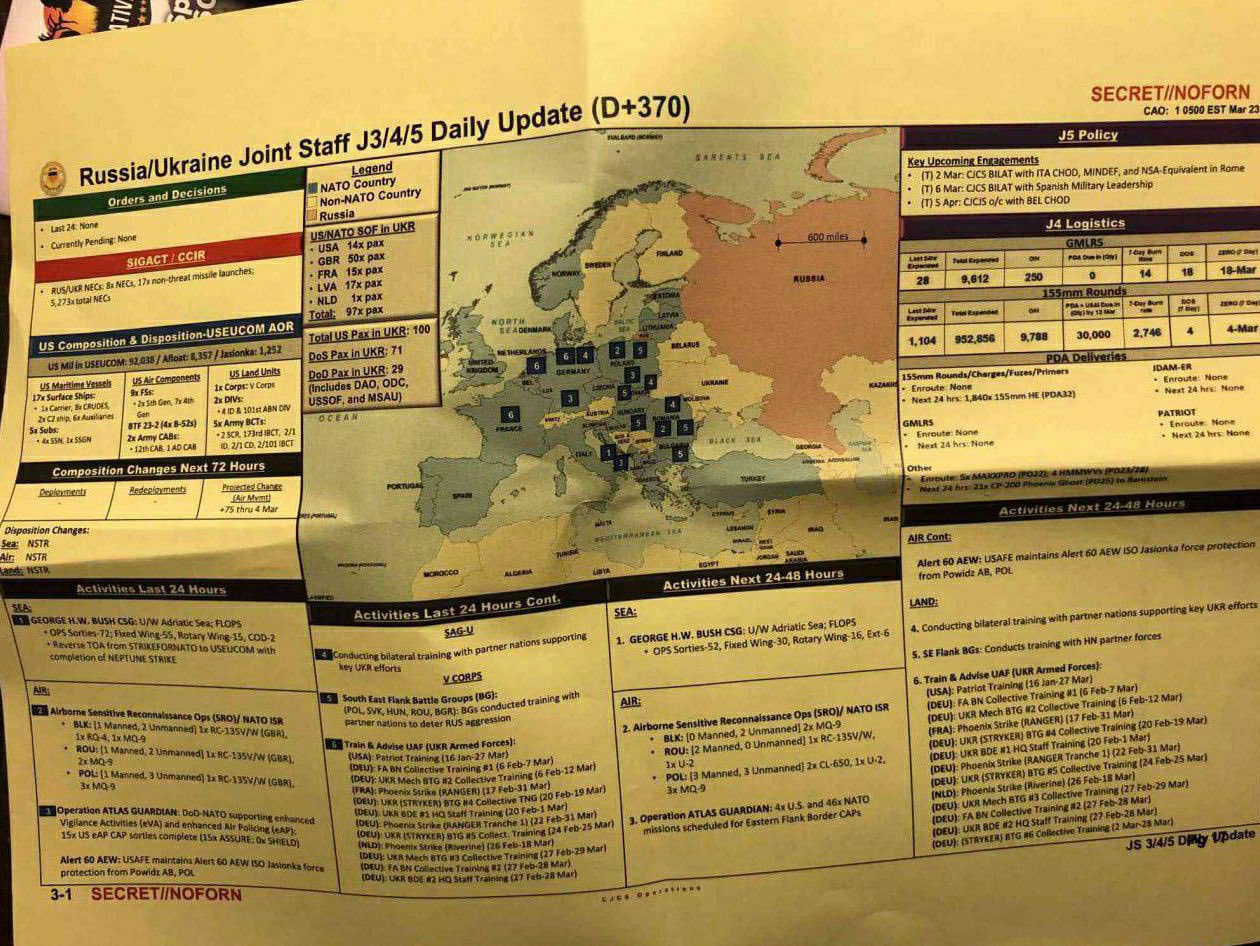
As for NATO boots on the ground, the reality is that this is already the case to some small degree, given the Discord of last year revealed that 97 NATO special operators were in Ukraine, among them 15 French soldiers. The Kremlin has of late suggested France has already become a party to the conflict given the presence of many French mercenaries and volunteers in the conflict.

The question remains: why Macron’s sudden willingness to escalate after he was seen as a dove? As a reminder, days ago the French magazine Marianne obtained leaked French defense documents assessing the situation in Ukraine. The publication issued a bombshell report in French and which remains paywalled, the title of which is machine translated: War in Ukraine: from caution to panic… What Macron’s shift hides.

Marianne says that the “several confidential defense reports” it obtained sheds light on Macron’s daring and provocative invocation of the idea of sending NATO troops. The report begins:

What happened to the president when he considered sending troops to Ukraine? Several confidential defense reports explain the “panic” at the Élysée, where party leaders are invited this Thursday, March 7, to discuss the issue. On the front, the Russians are in a position of strength. However, was it necessary, in the face of Putin, to brandish an untenable threat?

Among the leaked docs included a report underscoring that it would be the “gravest error” to continue seeking military solutions. The report said:

“To date, the Ukrainian general staff does not have a critical mass of land forces capable of inter-arms maneuver at the corps level capable of challenging their Russian counterparts to break through its defensive line,” concludes this confidential defense report, according to which “the gravest error of analysis and judgment would be to continue to seek exclusively military solutions to stop the hostilities“. A French officer summarizes: “It is clear, given the forces present, that Ukraine cannot win this war militarily.

Of course, this directly contradicts Macron’s current public stance wherein he’s saying NATO must act militarily now in order to prevent the war’s future spread. Our prior coverage of the leaked French defense docs is accessible for premium members here.

Tyler Durden
Sat, 03/16/2024 – 08:45

10-Year-Old Kids Denied Drinking Water In Class Because Of Three Muslims Observing Ramadan

10-Year-Old Kids Denied Drinking Water In Class Because Of Three Muslims Observing Ramadan

Authored by Steve Watson via Modernity.news,

Twenty Four children were told they could not drink water at a school in Germany because three other students in the class were Muslims observing Ramadan, according to a report.

The 10-year-old kids in Frankfurt were all denied drinking water due to the tiny minority fasting for the Islamic holy month.

German outlet NIUS, notes that the fifth graders informed their parents after two teachers at the school made the decision. 

One parent commented “At dinner, we always talk about how the day was. I asked my daughter what was new at school. She then told us that two teachers had forbidden the students from drinking in class because three of the 27 children were fasting.”

The teachers were reported to have prevented students from accessing the water dispenser in the hall or having water bottles on their desks.

But it gets weirder.

A father of one of the students noted “We found this announcement strange…the children in fifth grade are between 10 and 11 years old. Even for religious Muslims, the fasting requirement only applies from the age of 14.”

“The fact that 24 children have to take three children into consideration when it comes to basic physical needs, that’s a strange intervention,” he added.

The school has refused to comment on the claims, according to the report.

As Remix News notes, the incident occurred in the same German city, the only one, where Ramadan lights were installed last month.

“By decorating during Ramadan, the city of Frankfurt is sending an important signal to Muslims and appreciates the people of Muslim faith in this city,” the governing German Green Party wrote in an application to the city council last year.

“They are lights of togetherness, against reservations, against discrimination, against anti-Muslim racism, and also against anti-Semitism,” said Frankfurt Mayor Nargess Eskandari-Grünberg, of the same party.

*  *  *

Your support is crucial in helping us defeat mass censorship. Please consider donating via Locals or check out our unique merch. Follow us on X @ModernityNews.

Tyler Durden
Sat, 03/16/2024 – 08:10

Guinness: Well Known, But Not So Well Liked?

Guinness: Well Known, But Not So Well Liked?

Apart from Irish whiskeys, one of the most significant culinary exports and best-known brands from the independent part of the island is Guinness.

The characteristically dark dry stout might be an acquired taste due to its richness and malty flavor, but it’s nevertheless consumed in many countries around the world, especially on St. Patrick’s Day.

As Statista’s Florian Zandt reports, according to UN Comtrade statistics, the United States, most likely due to its large Irish diaspora, and the United Kingdom are the biggest importers of Irish beer, making up 63 percent of the total export value of $313 million in 2022. But how well-liked is the Irish mainstay really in those countries?

Infographic: How Popular Is Guinness in the U.S. and UK? | Statista

You will find more infographics at Statista

As a recent Statista Consumer Insights survey shows, 72 and 92 percent of the respondents from the U.S. and the U.K., respectively, know the brand. In the United Kingdom, 23 percent said they liked the brand and 19 percent claimed to have consumed a pint or more in the last 12 months.

16 percent of respondents from the United States were fond of the iconic drink, while only 13 percent attested to having drunk a Guinness in the past year.

The most popular beer brands in the country were Corona, Bud Light and Budweiser, with Guinness coming in seventh after Coors. The U.K. ranked the Irish beverage seventh in terms of popularity as well, with Budweiser, Corona and Stella Artois snagging the top spots.

Guinness originated in a Dublin brewery in 1759 and has been part of multi-national alcoholic beverage conglomerate Diageo after its merger with Grand Metropolitan in 1997. The brand is Diageo’s only foray into the beer market, with the rest of its portfolio including a variety of gin, whiskey, liqueur and rum.

The company does not disaggregate its sales by segment but has seen an overall uptick in revenue and profit in the past three fiscal years. In the twelve months from July 2022 to June 2023, Diageo generated 3.8 billion pounds net profit out of revenues of 23.5 billion pounds, which constitutes a year-over-year increase of 12.8 and 4.9 percent, respectively.

Tyler Durden
Sat, 03/16/2024 – 07:35

Ukraine Is Facing The Scenario Of Asymmetrical Partition

Ukraine Is Facing The Scenario Of Asymmetrical Partition

Submitted by Andrew Korybko

Asymmetrical partition between Ukraine’s western neighbors into “spheres of economic influence” alongside a de facto Korean-like partition between NATO and Russia is much more foreseeable than its western neighbors like Poland formally reincorporating their lost territory due to financial and political reasons.

Russian Foreign Ministry spokeswoman Maria Zakharova warned about the impending partition of Ukraine. According to her, “All these statements that Macron and other NATO politicians make, about the possibility of introducing contingents or some kind of paramilitary units into the territory of Ukraine, are related to the partition of what they see as the remnants of Ukraine…They are ready to occupy and partition Ukraine.” What she didn’t mention, however, is that this will likely be an asymmetrical partition.

Instead of Ukraine’s neighbors officially divvying it up like former President and incumbent Deputy Chairman of the Security Council Dmitry Medvedev suggested via the map that he recently spoke in front of, NATO states are unlikely to formally reincorporate their lost lands. Rather, what’s more likely to happen in the event that they form a “coalition of the willing” to conventionally intervene there is that they’ll carve out “spheres of influences” on the pretext of protecting their “strategic borders”.

Romanian President Klaus Iohannis revealed that while the bloc as a whole can’t intervene in Ukraine since it’s not a NATO ally, members could bilaterally do so on their own, which Poland might have sought America’s approval for during its President and Prime Minister’s meeting with Biden. It was argued here that this could even be partially motivated by domestic political factors, not to mention the West’s “worst-case scenario” of Russia achieving a military breakthrough that catalyzes Ukraine’s collapse.

France and by extension also the UK might be plotting a Ukrainian power play under Germany’s nose to prevent their historical rival from resuming its superpower trajectory with US backing as Washington empowers Berlin to contain Russia in Europe while America “Pivots (back) to Asia” to contain China. These rapid moves come amidst reports that the G7 is planning to appoint a special envoy to Ukraine, which this analysis here argued could be tasked with implementing the Davos agenda in that country.

Zelensky told the World Economic Forum in May 2022 that “we offer a special – historically significant – model of reconstruction. When each of the partner countries or partner cities or partner companies will have the opportunity – historical one – to take patronage over a particular region of Ukraine, city, community or industry. Britain, Denmark, the European Union and other leading international actors have already chosen a specific direction for patronage in reconstruction.”

It therefore makes sense that they’d want to safeguard the regions, cities, communities, and industries that Ukraine promised them patronage of so as to stop Russia from taking control of them in the event that it achieves a military breakthrough which catalyzes Ukraine’s collapse and leads to regime change. This analysis here, meanwhile, argued that formally reincorporating its western neighbors’ lost lands is unlikely due to how much their demographics have changed since the end of World War II.

Accordingly, “spheres of economic influence” are the most likely outcome if France’s talk of a conventional NATO intervention is implemented, after which the participants would be able to profit from their respective zones while carrying out military training and law enforcement activities there. These foreign troops could also prevent the state’s collapse in the areas under their control, repel uncontrollable refugee influxes, and combat weapons smuggling into the EU.

The end effect would be to formally preserve Ukrainian statehood per the West’s officially stated objective that “justifies” their proxy war against Russia through that former Soviet Republic while nevertheless asymmetrically partitioning it into “spheres of economic influence” per the Davos agenda. It’s also possible that with time some of Ukraine’s western neighbors like Poland might consider entering into a “confederation’ with the adjacent region under their control but that’s still a far-fetched scenario.

Their taxpayers could be stuck with the bill for reconstructing those formerly Ukrainian regions, plus the locals would become citizens with equal rights (including voting ones), which those countries’ people might firmly oppose and therefore potentially rebel against. It’s much less economically and politically costly to simply siphon wealth from those regions in exchange for limited security support than to constitutionally enshrine enduring economic, political, and security rights to their locals for prestige.  

For these reasons, while Zakharova is likely correct in assessing that plans are afoot for partitioning Ukraine depending on several situational variables (e.g. the conflict’s military-strategic dynamics and domestic politics like in Poland’s case), everything probably wouldn’t unfold like the public imagines. Asymmetrical partition between Ukraine’s western neighbors into “spheres of economic influence” alongside a de facto Korean-like partition between NATO and Russia is much more foreseeable.

Tyler Durden
Sat, 03/16/2024 – 07:00

‘Belt And Road’ Western Hemisphere Investments Has China Firmly Rooted In America’s Backyard

‘Belt And Road’ Western Hemisphere Investments Has China Firmly Rooted In America’s Backyard

Authored by John Haughey via The Epoch Times,

The United States has been so focused on global security concerns that it has overlooked investing in its own backyard’s economic and military needs for decades.

But China hasn’t. With its Belt and Road Initiative (BRI, also known as “One Belt, One Road”), China has become South America’s largest source of infrastructure investment and second-largest trading partner, increasing trade from $18 billion in 2002 to $450 billion in 2022.

Twenty-five of 31 Central and South American countries have negotiated infrastructure investments from China, and 22 of those nations, most recently Honduras, have formally signed onto the BRI program.

Chinese companies, either owned or subsidized by the Chinese Communist Party (CCP), operate mines in Mexico, Argentina, Peru, and Venezuela, electrical grids in Peru and Chile, 5G wireless systems in Costa Rica, Bolivia, Brazil, and Mexico—80 percent of Mexico’s telecommunications equipment is provided by Chinese companies—space launch and satellite tracking facilities in Argentina, and the world’s largest embassy in the Bahamas.

The U.S. State Department estimates China’s trade with Latin American nations and investments in sea, space, telecommunication, critical minerals, and energy will match the United States by 2035 in the region. China’s military ties with Venezuela, Cuba, Peru, and Chile—which now include port visits by Chinese warships and technical advisers—will mature into base agreements within a decade.

China has, or plans to build or improve, 40 ports across 16 Latin American and Caribbean countries without restrictions on military use, including on both ends of the Panama Canal, where CCP-sponsored companies are bidding with Panama to work on the U.S.-built canal.

Next fall, Chinese leader Xi Jinping will be in Peru to commemorate the completion of “a $3.6 billion ‘mega port’ that was financed by China, built by Chinese workers, and it will be owned and operated by a CCP-backed company,” House Armed Services Committee Chair Rep. Mike Rogers (R-Ala.) said.

“It will be used to ship South American copper, lithium, and other critical materials to China to further their military modernization,” he said during a House Armed Services Committee March 12 hearing on Western Hemisphere national security challenges.

Mr. Rogers called it “the latest effort of China’s efforts to displace American influence and build a strategic footprint in our backyard.”

‘Debt Traps’ and CCP Espionage

However, U.S. Southern Command Commander Army Gen. Laura Richardson said China’s increasing presence is a double-edged sword for countries that accept financing and other assistance from the CCP.

“The world is at an inflection point,” she said at the committee hearing.

“Our partners in the Western Hemisphere, with whom we are bonded by trade, shared values, democratic traditions, and family ties, are increasingly impacted by interference and coercion from [China.]

“The People’s Republic of China [PRC] has exploited the trust of democracies in this hemisphere, using that trust to steal national secrets, intellectual property, and research related to academia, agriculture, and health care,” she continued.

“The scope and scale of this espionage is unprecedented. Through the Belt and Road initiative, the PRC aims to amass power and influence at the expense of the world’s democracies,” she added.

Ms. Richardson said that while it’s true that Central and South America have not received the economic and national security attention other areas have, that is changing.

“I’ve learned that our presence absolutely matters,” she said, noting after nearly 20 years of “receiving less than 50 percent” of its Western Hemisphere security cooperation needs, the U.S. Southern Command was fully funded and received additional supplemental funding in the fiscal year 2024 defense budget.

Ms. Richardson said while the boost “was very, very helpful, we can’t just get one year of additional funding to meet the requirement, and I would say that our presence absolutely matters” and needs to be fully funded again in the fiscal year 2025 defense budget.

With the additional funding, she said, the United States has stepped up joint military and emergency response exercises with Chile, Argentina, and Paraguay with “more engagement other than just a visit once a year.”

“This has really made a huge difference in terms of the partnering, but we have to be there. We have to have good security cooperation programs; we have to have flexible authorities that [respond to] opportunities [as they] open because they’re only open for a short period of time,” she added.

(L-R) Costa Rican President Rodrigo Chaves Robles, U.S. President Joe Biden, Uruguayan President Luis Lacalle Pou, and other leaders attend the plenary session of the inaugural Americas Partnership For Economic Prosperity Leaders’ Summit in the East Room of the White House in Washington on Nov. 3, 2023. (Chip Somodevilla/Getty Images)

‘Put Our Money Where Our Mouth Is’

That money will be there, Assistant Secretary of Defense for Homeland Defense and Hemispheric Affairs Rebecca Zimmerman said at the committee hearing.

“We’re putting homeland defense and other interests across the hemisphere front and center,” she said.

“The department’s top priority is defense of the homeland [and countering] the growing multi-domain threat posed by the People’s Republic of China.”

Ms. Zimmerman said the United States is “deepening partnerships with Canada, Mexico, Brazil, Colombia, and Chile while reinforcing democratic institutions civilian control of the military and respect for human rights and the rule of law” across the hemisphere.

In February, Secretary of Defense Lloyd Austin participated in the North American Defense Ministerial with his counterparts from Mexico, Canada, and Latin American countries.

In November 2023, President Joe Biden welcomed leaders from the Western Hemisphere to the White House for the inaugural Americas Partnership for Economic Prosperity Leaders’ Summit to discuss migration, supply chains, and infrastructure investment.

Prime ministers, presidents, and foreign ministers from Canada, Barbados, Chile, Colombia, Costa Rica, the Dominican Republic, Ecuador, Peru, Uruguay, Mexico, and Panama attended.

The United States is developing a program with the Inter-American Development Bank to expand financing for infrastructure with the launch of an investment platform through the U.S. International Development Finance Corp. to invest billions in improving critical supply chains, modern ports, clean energy grids, and digital infrastructure.

The “Americas Partnership Accelerator” will assist entrepreneurs in developing and funding their business ideas and mobilize venture capital from around the world for startups in the region, the Biden administration maintains.

Rep. Jan Kiggins (R-Va.) said while “the defense budget is always inadequate” in addressing all needs, it is good “that we are again prioritizing that funding because it is so important that we can put our money where our mouth is.”

“The good news,” Ms. Richardson said, “is working with our very willing partners leads to the best defense.”

“We must use all available levers to strengthen our partnerships with the 28 like-minded democracies in this hemisphere who understand the power of working together to counter these shared threats,” she continued.

“The United States remains the preferred and most trusted security partner in the region.

“We build trust through investment and security cooperation programs that train and equip our partner militaries and security forces, a robust joint exercise program to build interoperability, and the development and employment of emerging technologies,” she added.

Tyler Durden
Fri, 03/15/2024 – 23:40

How Much Does The US Depend On Russian Uranium?

How Much Does The US Depend On Russian Uranium?

The U.S. House of Representatives recently passed a ban on imports of Russian uranium. The bill must pass the Senate before becoming law.

In this graphic, Visual Capitalist’s Bruno Venditti visualizes how much the U.S. relies on Russian uranium, based on data from the United States Energy Information Administration (EIA).

U.S. Suppliers of Enriched Uranium

After Russia invaded Ukraine, the U.S. imposed sanctions on Russian-produced oil and gas—yet Russian-enriched uranium is still being imported.

Currently, Russia is the largest foreign supplier of nuclear power fuel to the United States. In 2022, Russia supplied almost a quarter of the enriched uranium used to fuel America’s fleet of more than 90 commercial reactors.

SWU stands for “Separative Work Unit” in the uranium industry. It is a measure of the amount of work required to separate isotopes of uranium during the enrichment process. Source: U.S. Energy Information Administration

Most of the remaining uranium is imported from European countries, while another portion is produced by a British-Dutch-German consortium operating in the United States called Urenco.

Similarly, nearly a dozen countries around the world depend on Russia for more than half of their enriched uranium—and many of them are NATO-allied members and allies of Ukraine.

In 2023 alone, the U.S. nuclear industry paid over $800 million to Russia’s state-owned nuclear energy corporation, Rosatom, and its fuel subsidiaries.

It is important to note that 19% of electricity in the U.S. is powered by nuclear plants.

The dependency on Russian fuels dates back to the 1990s when the United States turned away from its own enrichment capabilities in favor of using down-blended stocks of Soviet-era weapons-grade uranium.

As part of the new uranium-ban bill, the Biden administration plans to allocate $2.2 billion for the expansion of uranium enrichment facilities in the United States.

Tyler Durden
Fri, 03/15/2024 – 23:20