68.3 F
Chicago
Sunday, September 20, 2026
Home Blog Page 2833

The Global North And South’s Fight For LNG Energy Security Is Set To Intensify

The Global North And South’s Fight For LNG Energy Security Is Set To Intensify

Authored by Simon Watkins via OilPrice.com,

  • Since the Russian invasion of Ukraine, LNG has become the swing emergency energy supply for many of the developed countries that comprise the Global North.

  • European LNG imports are still at similar levels to those throughout 2022 and 2023.

  • The already intense geopolitical struggle to secure these supplies will become even more of a dangerous zero-sum game between the Global North and the Global South.

Following the huge reduction in Russian pipelined gas to Europe following 24 February 2022’s invasion of Ukraine, liquefied natural gas (LNG) has become the swing emergency energy supply for many of the developed countries that comprise the Global North, led by the U.S. In fact, despite several new gas initiatives launched across Europe since then that have reduced overall gas demand from the continent, as analysed in full in my new book on the new global oil market order, European LNG imports are still at similar levels to those throughout 2022 and 2023.

This has resulted in a desperate ongoing search by those countries in the Global North to secure sufficient LNG well into the future. However, demand for LNG is set to intensify dramatically in many of the developing countries that constitute the Global South, led by China, both for their own energy security and as part of the transition to greener energy.

The net result of this is that global demand for LNG is projected to increase by more than 50 percent by 2040, according to oil and gas major Shell.

This means that the already intense geopolitical struggle to secure these supplies will become even more of a dangerous zero-sum game between the Global North and the Global South, and between their leaders, the U.S. and China.

LNG has become the global swing energy supply because, unlike pipelined gas, it does not require expensive and very time-consuming preparation before it can be used in its end markets. It can be bought straightforwardly either through long-term contracts or in the spot market, and shipped to wherever it is needed in a much quicker and cheaper process overall. As also detailed in my new book on the new global oil market order, one of the major signs that China knew in advance that Russia was going to invade Ukraine was that it had spent the previous year or so busily making big long-term contracts with major LNG suppliers, most notably Qatar. Beijing clearly suspected that Russian gas would be sanctioned and that, as a result, the U.S.’s key allies in Europe – enormously dependent on Russian pipelined gas – would need a lot of gas from anywhere else very quickly and whatever the price. China and Russia also knew that effectively taking all this LNG out of the market for years to come through 20-year and longer contracts had no downside for them.

On the one hand, they would benefit if Europe avoided Russian pipelined gas while struggling to find replacement sources of LNG that China had already largely sewn up. This would drive energy prices up, fuelling inflation, and pushing interest rates higher in order to combat this, bringing with this the very real spectre of economic recessions.

On the other hand, an unwillingness to go down this road by Europe would mean that Russia would be allowed to get away with its 2022 invasion of Ukraine, just as it had done in 2014 when it invaded and then annexed Ukraine’s vast Crimea region. Russia would then be free to push further westwards into Europe, tying up the military resources of the U.S. and its NATO allies on the continent, while China began its own ‘repatriation’ of Taiwan at the same time.

In the first few days after Russia moved into Ukraine in 2022, it appeared that Europe would do the same thing – that is, nothing much at all – to punish it for its new invasion. As also highlighted in my book, the principal concern of Germany – the de facto leader of the economic and political European Union (E.U.) of countries – was to ensure that Russia did not stop supplying it or other E.U. member countries with gas, due to their not being able to pay in the way Moscow preferred. This followed the 31 March 2022 decree signed by Russian President Vladimir Putin that required European buyers to pay in roubles for Russian gas via a new currency conversion mechanism or risk having supplies suspended. The official guidance document sent out to all 27 E.U. countries on 21 April 2022 by its executive branch, the European Commission (E.C.), simply stated:

“It appears possible [to pay for Russian gas after the adoption of the new decree without being in conflict with EU law],… EU companies can ask their Russian counterparts to fulfil their contractual obligations in the same manner as before the adoption of the decree, i.e. by depositing the due amount in euros or dollars.”

Indeed, 18 May 2022 saw Uniper – Germany’s largest importer of Russian gas – open a special account at Gazprombank to enable rouble payments, in accordance with Putin’s wishes.

What prevented Russia from going unpunished for yet another invasion of a European sovereign state – Ukraine in 2014, and Georgia in 2008 – was the leader of the Global North, the U.S., arranging emergency supplies of LNG for Europe very quickly. As also as analysed in full in my new book on the new global oil market order, the U.S. strategy for replacing Russian gas supplies at that point was twofold. First, to increase its own gas deliveries to Europe. Second, to pressure other gas suppliers to do the same. On the first point, from zero LNG exports before 2016, the U.S. quickly became the world’s biggest exporter, with around 86 million metric tonnes of LNG shipped in 2022. And around two-thirds of all the U.S.’s LNG exports since Russia invaded Ukraine have gone to Europe. On the second point, the U.S. leveraged every proverbial carrot and stick available to it to pressure Qatar, for one, to stop signing LNG supply deals one after another with China. Given this, May 2022 saw Qatar signed a declaration of intent on energy cooperation with Germany aimed at becoming its key supplier of LNG into the future. These new supplies of LNG from Qatar would come into Germany through existing importation routes augmented by new infrastructure approved by the German Bundestag on 19 May. The plans would run in parallel with, but were likely to be finished significantly sooner than, the plans for Qatar to also make available to Germany sizeable supplies of LNG from the Golden Pass terminal on the Gulf Coast of Texas. QatarEnergy holds a 70 percent stake in the project, with the U.S.’s ExxonMobil holding the remainder.

The securing of these first replacement supplies of LNG from Qatar – followed by new gas supply deals by NATO countries from Australia, Egypt, Oman, and Libya, among others – shifted the Emirate out of China’s grip and towards what the U.S. has called being a “major non-NATO ally”. And it is here that a microcosm of the intensified war for emergency energy supplies – focused on LNG – will be fought between the Global North and the Global South up to 2040. Qatar has plans to put its long-term rivalry with Australia for the top LNG exporter spot behind it by increasing its LNG production by around 85 percent more than was previously planned. According to QatarEnergy at the end of February, a new LNG expansion project – North Field West – will raise the Emirate’s LNG output to 142 million metric tonnes per annum (mtpa) before the end of this decade. This compares to the 404 million mtpa of LNG traded globally in 2023 and to industry estimates that this figure will reach around 625-685 million mtpa in 2040.

By that point, some of the big contracts signed between Qatar and China in the lead-up to Russia’s 2022 invasion of Ukraine will be winding down, so the shape of the global LNG landscape after that will be indicated by whether companies from the Global North or Global South dominate the routing of Qatar’s gas flows by then.

Tyler Durden
Thu, 03/14/2024 – 07:20

South Africa Says Its Citizens Serving In Israel’s Military Will Be Arrested

South Africa Says Its Citizens Serving In Israel’s Military Will Be Arrested

Many American, British, European and other foreign-born men and women have long served in the Israel Defense Forces (IDF), and often they are dual citizens. As an example, earlier this week Israel announced the death of 19-year old Sgt. Itay Chen, a dual US-Israeli citizen who had been serving in the IDF, at the hands of Hamas.

But South Africa, which brought an International Criminal Court (ICC) case against Israel over allegations of genocide against Palestinians, has issued a new declaration forbidding its citizens from joining or assisting in any way with the Israeli military.

Via Reuters

South Africa’s foreign minister Naledi Pandor has said South Africans face arrest upon their return home of they fight in the IDF or assist as part of a paramilitary unit.

“I have already issued a statement alerting those who are South African and are fighting alongside or in the [Israeli military]: We are ready. When you come home, we are going to arrest you,” Pandor said at a pro-Palestine event attended by the country’s governing African National Congress (ANC) party.

South Africa has also previously warned that soldiers with dual South African-Israeli citizenship could be stripped of their South African citizenship if caught fighting for the IDF. 

Pandor went so far as to positively recall that ANC militants were trained by Palestinians to resist the prior apartheid government. “We didn’t meet the Palestinian people on October 8th, we’ve been together in the struggle for many decades,” she said.

“The people of Palestine trained the freedom fighters of the liberation movement,” the South African foreign minister added. “This is a relationship of freedom fighters, of activists, of nations that share a history. A history of struggle for justice and freedom.”

Since Israel’s retaliatory operation began in Gaza in the wake of the Oct.7 Hamas terror attack, Israel-South Africa relations have reached a historic low point and are even on the verge of breaking completely.

Currently, South Africa’s foreign ministry is calling on global protests in front of embassies of any country supporting or weaponizing Israel. South Africa is also urging the international boycotting of Israeli goods over alleged war crimes and acts of genocide. Already, months ago the South African government had recalled its ambassadors from Tel Aviv in order to assess future relations.

Tyler Durden
Thu, 03/14/2024 – 06:55

“She Thought She Was Going To Die” – French Stars And Wealthy Terrorized In Wave Of Violent Home-jackings

“She Thought She Was Going To Die” – French Stars And Wealthy Terrorized In Wave Of Violent Home-jackings

By John Cody of RemixNews

Celebrities are being targeted across France in an unprecedented wave of “home-jackings,” which are burglaries accompanied by violence and kidnapping. The cases often involve “youths” recruited by experienced ringleaders, such as Kamel Z., who keep their distance from their criminal underlings to insulate themselves from any prosecution.

The country has a history of these violent home invasions, but recent months have seen an explosion of such cases, including well-known French figures, such as Vitaa, Bruno Guillon, Jean-François Piège, Anne-Sophie Lapix, and Nikos Aliagas.

2023 marks a new milestone

In a special television report by BFMTV, the French news outlet reviewed the most recent cases. On July 21, 2023, a gang broke into the Paris home of PSG’s Italian goalkeeper Gianluigi Donnarumma and his partner, with the perpetrators tying up and stripping both victims. Then, on Sept. 27, the same type of home invasion, with the victims also being stripped, occurred against Bruno Guillon in the Paris region. Guillon, a host on French TV, was threatened with a handgun while his wife was tied up, gagged, and threatened with a hammer. Their 14-year-old son was also tied up inside his room and clamped in place.

On Dec. 18, the home of Alexandre Letelier, who serves as the backup goalkeeper for PSG, was invaded. Both he and his partner were threatened with death in front of their two children, aged two and six. Just two days later, on Dec. 20, the singer Vitaa was kidnapped, along with her husband and three children, after being targeted inside their home in Rueil-Malmaison.

Just a few weeks later, on Feb. 6, 2024, a team broke into Aya Nakumra’s home in Seine-Saint-Denis in Paris. They beat him to the point of hospitalization and robbed his residence.

Other celebrities, such as Nikos Alliagas, a Greek-French entertainer and journalist, as well as journalist Anne-Sophie Lapix, have also been targeted by burglary teams, but those attempts were foiled.

As BMFTV reports, many of these celebrities are targeted due to their presence on social media, where they show off their luxury watches, handbags, and other items.

“They are known for having money and property,” said Laurent Nuñez, the Paris police chief. “You just have to follow certain Facebook or Instagram profiles. We find a lot of information, both about the property held by future victims, and then obviously on their addresses and lifestyle.”

Once the information has been collected, the criminals can take action. In most cases, they “pose as a fake deliveryman, from La Poste or Amazon (…) with a parcel in hand,” explains Djassim Belkourchia, a delegate of the Alliance Police Nationale union.

“Committing a home-jacking in the presence of the occupants often allows them to ask for information on the whereabouts of the goods that are sought, jewelry, luxury watches or computer equipment,” estimates Laurent Nuñez.

France powerless to stop the crimes

Although these crimes have picked up steam in recent months, they have long plagued France. In July 2021, Guillaume Pley, a television presenter, learned that his wife and son, along with their nanny, had been victims of a violent house-jacking while he was flying to the Cannes Film Festival.

In that case, three men barged into the house when the mother, Agathe, had opened the door expecting the nanny.

They pointed a gun at her son’s head, and told Agathe, “If you make any noise, you know what will happen.”

“It’s difficult for a mother, it’s a scene that she won’t forget,” he said about the incident.

The burglars were looking for a luxury watch they had seen the French host wearing on social media, but he had the watch on him during his flight.

“She thought she was going to die because they were very hard on her when they couldn’t find the safe. It made them a little crazy,” he said.

The burglars fled with a counterfeit version of the watch worth a few hundred euros.

Most of the criminals are minors

Following the home invasion of Guillon, two minors and two others who were barely adults were arrested.

“What characterizes the profile of these young perpetrators is that they are essentially all minors. They are perfectly known to the police and justice for acts of violence (…) sometimes even violence with drug trafficking weapons, and they have already been condemned by the judicial authorities,” said Philippe Franchet, the commissioner of the Versailles banditry repression police unit.

However, despite participating in these high-profile crimes, many of these youths have little experience with home-jackings. In most cases, they are recruited by professionals, such as the 27-year-old Kamel Z., who is well known to police and has seven convictions.

He is accused of recruiting young men across Paris, and in many cases, he pays them just a few thousand euros. These underlings do not know each other and often know very little about their targets.

“They already have some experience in the world of banditry and police techniques. They think they will protect themselves from investigations and criminal liability by using young people who are a little less experienced,” explains Philippe Franchet.

Kamel Z. has been indicted for home-jacking at Bruno Guillon’s house, but investigators are also exploring his role in other violent house-jackings.

The BFMTV report notes that these home-jackings are not just targeting celebrities, but also families with no public-facing role. The Merlin family, for instance, was targeted in Calais in April 2023. The mother, Aurelie, was confronted while sleeping on the sofa by a man wearing a white mask and a black hood.

“He started hitting me in the face. I was so paralyzed that I didn’t even feel the blows. I was not in pain, but I could feel the blood starting to flow down my cheek. He hit me again, he asked me for money and he ran away,” says the mother.

She described it as a traumatic event that has left her checking her windows every night out of fear someone could slip into the house.

One psychologist described these home-jackings as one of the most traumatic crimes anyone can experience.

“It’s someone who enters into their private space… The victim is marked in her mind, she knows that this is where the trauma took place and for her, to go back to rebuild herself, she needs to turn the page and therefore change homes very often,” said Marjorie Sueur, a psychologist.

In many cases, the victims are advised to change their homes and start over someplace else.

Continue reading at rmxnews.com

Tyler Durden
Thu, 03/14/2024 – 06:30

Visualizing All Of The US Currency In Circulation

Visualizing All Of The US Currency In Circulation

Have you ever wondered how much U.S. currency is in circulation?

Every year, the U.S. Federal Reserve submits a print order for U.S. currency to the Treasury Department’s Bureau of Engraving and Printing (BEP). The BEP will then print billions of notes in various denominations, from $1 bills to $100 bills.

In this graphic, Visual Capitalist’s Marcus Lu used the latest Federal Reserve data to visualize the approximate number of bills for each denomination globally, as of Dec. 31, 2022.

Breakdown of U.S. Currency in Circulation

The following table lists all of the data we used to create the visualization above. Note that value figures were rounded for simplicity.

*$500-10,000 bills are listed as a range, and a total circulation of 0.0004 billion. Not included in graphic.

From these numbers, we can see that $100 bills are the most common bill in circulation, even ahead of $1 bills.

One reason for this is $100 bills have a longer lifespan than smaller denominations, due to people using $100 bills less often for transactions. Some businesses may also decline $100 bills as payment.

Based on 2018 estimates from the Federal Reserve, a $100 bill has a lifespan of over 20 years, which is significantly higher than $1 bills (7 years) and $5 bills (5 years).

If you’re interested in more visualizations on the U.S. dollar, consider this animated chart which shows how the dollar overtook the British pound as the world’s most prominent reserve currency.

Tyler Durden
Thu, 03/14/2024 – 05:45

A Matter Of Faith

A Matter Of Faith

For many people around the world, religion plays a prominent role in their everyday lives, while others embrace secular ideas

As Katharina Buchholz reports, according to a Statista Consumer Insights survey, carried out between April 2022 and March 2023, many of the most religious countries in the world can be found in Africa and the Middle East. Yet, for the countries included in the survey, Asian nations Pakistan and Indonesia together with Egypt scored highest with 99 percent of all adults in the surveyed age group professing to a religion.

Infographic: A Matter of Faith | Statista

You will find more infographics at Statista

The most secular country in the survey was China, with only 22 percent of the adult population saying that they followed a religion.

The number is not surprising given the fact that religious faith was marginalized under Communism in the country. Other relatively secular places in Asia included Vietnam, Japan, South Korea and Hong Kong.

In Europe, the Czech Republic (27 percent follow a religion) is the country with the fewest people who declare themselves believers – a fact that is in part also tied to the country’s communist past. Further East in Europe, religion has not been stifled as much despite a socialist past – for example in Romania, Serbia or Lithuania and also in Russia.

Poland, the home of famous pope John Paul II, also showed more religious tendencies than many of its Western European neighbors.

In the West of the continent, Ireland was the most religious, while in Southern Europe, religion was most widespread in Greece, Italy and Portugal.

Peru was the only country surveyed on the American continent with more than 80 percent saying they followed a religion.

Most other countries here – with the exception of Canada – did nevertheless score consistently high on religious faith with little difference between North and South.

Tyler Durden
Thu, 03/14/2024 – 04:15

Young French Voters Are Flocking To The Right Ahead Of EU Elections

Young French Voters Are Flocking To The Right Ahead Of EU Elections

By Thomas Brooke of Remix News

An increasing number of young French voters are preparing to vote for right-wing parties in the upcoming European Parliament elections in June, the latest polling has revealed.

According to an Ipsos survey published on Tuesday, 31 percent of 18 to 24-year-olds in France are lending their vote to Jordan Bardella’s National Rally (RN) — the anti-immigration party still heavily influenced by nationalist firebrand and former presidential candidate Marine Le Pen.

A further 3 percent of young people in France are backing Éric Zemmour’s hard-right Reconquête, for whom Marion Maréchal, the niece of Le Pen, is the party’s lead candidate.

National Rally’s popularity among young voters has risen considerably since the previous polling from December, with the party up 9 percentage points, while Reconquête has fallen from 8 percent to 3 percent.

Bardella’s RN currently sits with the Identity & Democracy (ID) parliamentary grouping, which is made up of conservative parties across Europe including Geert Wilders’ Party for Freedom (PVV) in the Netherlands, Matteo Salvini’s Lega party in Italy, the Alternative for Germany (AfD), and Herbert Kickl’s Freedom Party of Austria (FPÖ).

The key takeaway from the current polling is the disillusionment with establishment parties felt among French youth as young voters drift towards both the left and right of the political spectrum.

French President Emmanuel Macron’s Renaissance party is expected to attain just 4 percent of the vote — a clear rejection of the governing centrists — while 41 percent continue to support the long-held tradition of young voters being left-wing by backing far-left parties such as the Greens, LFI, and the Communists.

Among the electorate as a whole, RN continues to enjoy mass support and remains the frontrunner as it successfully taps into wider concerns about mass immigration, economic woes, and the culture wars. At 31 percent among all French voters, Bardella’s party is 13 percentage points ahead of Macron’s coalition parties, which have fallen by 4 percentage points in the last three months.

Continue reading at rmxnews.com


Tyler Durden
Thu, 03/14/2024 – 03:30

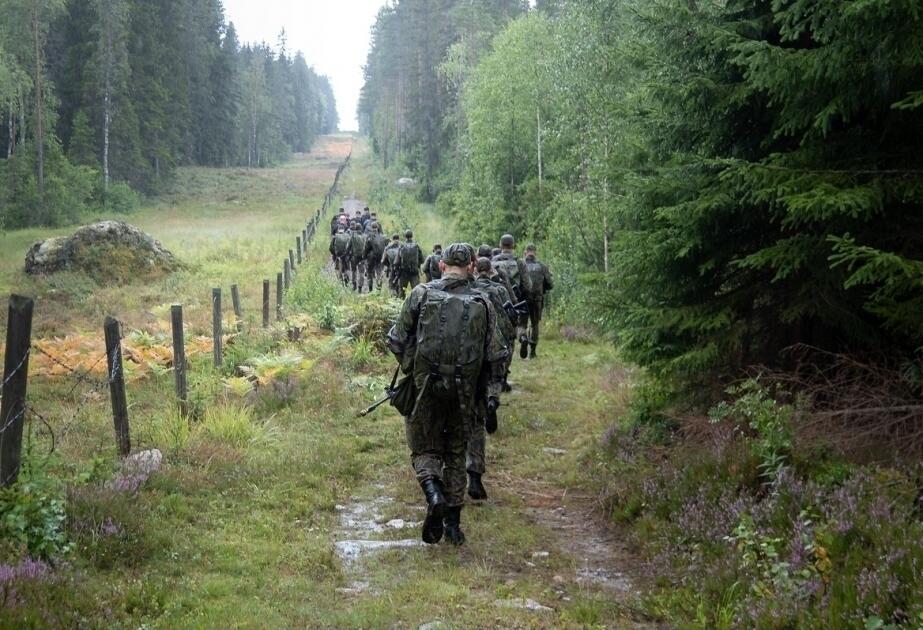
Putin Deploys Troops Along Finland Border In Response To NATO Accession

Putin Deploys Troops Along Finland Border In Response To NATO Accession

Russian President Vladimir Putin has said in fresh remarks that Finland and Sweden’s entry into NATO are “a meaningless step” but that in response Moscow will still deploy troops and “systems of destruction” to the Finnish border after Finland joined the alliance.

“Frankly speaking, I don’t understand why they need this. This is an absolutely meaningless step from the point of view of ensuring their own national interests,” Putin said.

“We generally had ideal relations with Finland, simply ideal. We did not have a single claim against each other, especially territorial ones,” Putin continued, before saying that Finland’s NATO accession was really born out of a desire to “join the Western club”.

“We didn’t even have troops; we removed all the troops from there, from the Russian-Finnish border,” he said. “However, it is up to them to decide. That’s what they decided. But we didn’t have troops there, now we will.”

Finland became the 31st member of the alliance last April, but it was on Monday that Sweden formally became the 32nd at a flag raising ceremony at NATO headquarters in Brussels.

Swedish Prime Minister Ulf Kristersson said expressly at the ceremony that his country abandoned historic neutrality as a result of Russia’s invasion of Ukraine.

“The Russian, brutal, full-scale invasion against Ukraine united Sweden behind the conclusion that a full-fledged NATO membership is the only reasonable choice,” Kristersson said.

On Wednesday soaring tensions between Russia and Nordic countries were on display during new remarks of Finnish Prime Minister Petteri Orpo.

He claimed in a speech before European Parliament that Moscow is preparing for a “long conflict with the West” and “represents a permanent and essential military threat to Europe.”

“If we, as a united Europe, fail to respond sufficiently to this challenge, the coming years will be filled with danger and the looming threat of attack,” he said, before adding: “Russia is not invincible.”

Denmark too is among those calling for increased defense spending and greater coordination on European defense. This has been a persistent talking point over the last months as Ukraine forces are not fairing well on the battlefield, and as Washington funds have dried up. European leaders are urgently trying to fill the gap of stalled US funds to Kiev.

Tyler Durden
Thu, 03/14/2024 – 02:45

Net Zero, The Digital Panopticon, & The Future Of Food

Net Zero, The Digital Panopticon, & The Future Of Food

Authored by Colin Todhunter via Off-Guardian.org,

The food transition, the energy transition, net-zero ideology, programmable central bank digital currencies, the censorship of free speech and clampdowns on protest. What’s it all about? To understand these processes, we need to first locate what is essentially a social and economic reset within the context of a collapsing financial system.

Writer Ted Reece notes that the general rate of profit has trended downwards from an estimated 43% in the 1870s to 17% in the 2000s. By late 2019, many companies could not generate enough profit. Falling turnover, squeezed margins, limited cashflows and highly leveraged balance sheets were prevalent.

Professor Fabio Vighi of Cardiff University has described how closing down the global economy in early 2020 under the guise of fighting a supposedly new and novel pathogen allowed the US Federal Reserve to flood collapsing financial markets (COVID relief) with freshly printed money without causing hyperinflation. Lockdowns curtailed economic activity, thereby removing demand for the newly printed money (credit) in the physical economy and preventing ‘contagion’.

According to investigative journalist Michael Byrant, €1.5 trillion was needed to deal with the crisis in Europe alone. The financial collapse staring European central bankers in the face came to a head in 2019. The appearance of a ‘novel virus’ provided a convenient cover story.

The European Central Bank agreed to a €1.31 trillion bailout of banks followed by the EU agreeing to a €750 billion recovery fund for European states and corporations. This package of long-term, ultra-cheap credit to hundreds of banks was sold to the public as a necessary programme to cushion the impact of the pandemic on businesses and workers.

In response to a collapsing neoliberalism, we are now seeing the rollout of an authoritarian great reset — an agenda that intends to reshape the economy and change how we live.

SHIFT TO AUTHORITARIANISM

The new economy is to be dominated by a handful of tech giants, global conglomerates and e-commerce platforms, and new markets will also be created through the financialisation of nature, which is to be colonised, commodified and traded under the notion of protecting the environment.

In recent years, we have witnessed an overaccumulation of capital, and the creation of such markets will provide fresh investment opportunities (including dodgy carbon offsetting Ponzi schemes)  for the super-rich to park their wealth and prosper.

This great reset envisages a transformation of Western societies, resulting in permanent restrictions on fundamental liberties and mass surveillance. Being rolled out under the benign term of a ‘Fourth Industrial Revolution’, the World Economic Forum (WEF) says the public will eventually ‘rent’ everything they require (remember the WEF video ‘you will own nothing and be happy’?): stripping the right of ownership under the guise of a ‘green economy’ and underpinned by the rhetoric of ‘sustainable consumption’ and ‘climate emergency’.

Climate alarmism and the mantra of sustainability are about promoting money-making schemes. But they also serve another purpose: social control.

Neoliberalism has run its course, resulting in the impoverishment of large sections of the population. But to dampen dissent and lower expectations, the levels of personal freedom we have been used to will not be tolerated. This means that the wider population will be subjected to the discipline of an emerging surveillance state.

To push back against any dissent, ordinary people are being told that they must sacrifice personal liberty in order to protect public health, societal security (those terrible Russians, Islamic extremists or that Sunak-designated bogeyman George Galloway) or the climate. Unlike in the old normal of neoliberalism, an ideological shift is occurring whereby personal freedoms are increasingly depicted as being dangerous because they run counter to the collective good.

The real reason for this ideological shift is to ensure that the masses get used to lower living standards and accept them. Consider, for instance, the Bank of England’s chief economist Huw Pill saying that people should ‘accept’ being poorer. And then there is Rob Kapito of the world’s biggest asset management firm BlackRock, who says that a “very entitled” generation must deal with scarcity for the first time in their lives.

At the same time, to muddy the waters, the message is that lower living standards are the result of the conflict in Ukraine and supply shocks that both the war and ‘the virus’ have caused.

The net-zero carbon emissions agenda will help legitimise lower living standards (reducing your carbon footprint) while reinforcing the notion that our rights must be sacrificed for the greater good. You will own nothing, not because the rich and their neoliberal agenda made you poor but because you will be instructed to stop being irresponsible and must act to protect the planet.

NET-ZERO AGENDA

But what of this shift towards net-zero greenhouse gas emissions and the plan to slash our carbon footprints? Is it even feasible or necessary?

Gordon Hughes, a former World Bank economist and current professor of economics at the University of Edinburgh, says in a new report that current UK and European net-zero policies will likely lead to further economic ruin.

Apparently, the only viable way to raise the cash for sufficient new capital expenditure (on wind and solar infrastructure) would be a two decades-long reduction in private consumption of up to 10 per cent. Such a shock has never occurred in the last century outside war; even then, never for more than a decade.

But this agenda will also cause serious environmental degradation. So says Andrew Nikiforuk in the article The Rising Chorus of Renewable Energy Skeptics, which outlines how the green techno-dream is vastly destructive.

He lists the devastating environmental impacts of an even more mineral-intensive system based on renewables and warns:

“The whole process of replacing a declining system with a more complex mining-based enterprise is now supposed to take place with a fragile banking system, dysfunctional democracies, broken supply chains, critical mineral shortages and hostile geopolitics.”

All of this assumes that global warming is real and anthropogenic. Not everyone agrees. In the article Global warming and the confrontation between the West and the rest of the world, journalist Thierry Meyssan argues that net zero is based on political ideology rather than science. But to state such things has become heresy in the Western countries and shouted down with accusations of ‘climate science denial’.

Regardless of such concerns, the march towards net zero continues, and key to this is the United Nations Agenda 2030 for Sustainable Development Goals.

Today, almost every business or corporate report, website or brochure includes a multitude of references to ‘carbon footprints’, ‘sustainability’, ‘net zero’ or ‘climate neutrality’ and how a company or organisation intends to achieve its sustainability targets. Green profiling, green bonds and green investments go hand in hand with displaying ‘green’ credentials and ambitions wherever and whenever possible.

It seems anyone and everyone in business is planting their corporate flag on the summit of sustainability. Take Sainsbury’s, for instance. It is one of the ‘big six’ food retail supermarkets in the UK and has a vision for the future of food that it published in 2019.

Here’s a quote from it:

“Personalised Optimisation is a trend that could see people chipped and connected like never before. A significant step on from wearable tech used today, the advent of personal microchips and neural laces has the potential to see all of our genetic, health and situational data recorded, stored and analysed by algorithms which could work out exactly what we need to support us at a particular time in our life. Retailers, such as Sainsbury’s could play a critical role to support this, arranging delivery of the needed food within thirty minutes — perhaps by drone.”

Tracked, traced and chipped — for your own benefit. Corporations accessing all of our personal data, right down to our DNA. The report is littered with references to sustainability and the climate or environment, and it is difficult not to get the impression that it is written so as to leave the reader awestruck by the technological possibilities.

However, the promotion of a brave new world of technological innovation that has nothing to say about power — who determines policies that have led to massive inequalities, poverty, malnutrition, food insecurity and hunger and who is responsible for the degradation of the environment in the first place — is nothing new.

The essence of power is conveniently glossed over, not least because those behind the prevailing food regime are also shaping the techno-utopian fairytale where everyone lives happily ever after eating bugs and synthetic food while living in a digital panopticon.

FAKE GREEN

The type of ‘green’ agenda being pushed is a multi-trillion market opportunity for lining the pockets of rich investors and subsidy-sucking green infrastructure firms and also part of a strategy required to secure compliance required for the ‘new normal’.

It is, furthermore, a type of green that plans to cover much of the countryside with wind farms and solar panels with most farmers no longer farming. A recipe for food insecurity.

Those investing in the ‘green’ agenda care first and foremost about profit. The supremely influential BlackRock invests in the current food system that is responsible for polluted waterways, degraded soils, the displacement of smallholder farmers, a spiralling public health crisis, malnutrition and much more.

It also invests in healthcare — an industry that thrives on the illnesses and conditions created by eating the substandard food that the current system produces. Did Larry Fink, the top man at BlackRock, suddenly develop a conscience and become an environmentalist who cares about the planet and ordinary people? Of course not.

Any serious deliberations on the future of food would surely consider issues like food sovereignty, the role of agroecology and the strengthening of family farms — the backbone of current global food production.

The aforementioned article by Andrew Nikiforuk concludes that, if we are really serious about our impacts on the environment, we must scale back our needs and simplify society.

In terms of food, the solution rests on a low-input approach that strengthens rural communities and local markets and prioritises smallholder farms and small independent enterprises and retailers, localised democratic food systems and a concept of food sovereignty based on self-sufficiency, agroecological principles and regenerative agriculture.

It would involve facilitating the right to culturally appropriate food that is nutritionally dense due to diverse cropping patterns and free from toxic chemicals while ensuring local ownership and stewardship of common resources like land, water, soil and seeds.

That’s where genuine environmentalism and the future of food begins.

Tyler Durden
Thu, 03/14/2024 – 02:00

Escobar: Confident Dragon Lays Out Modernization Roadmap

Escobar: Confident Dragon Lays Out Modernization Roadmap

Authored by Pepe Escobar,

This is the Year of the Wooden Dragon, according to China’s classic wuxing (“five elements”) culture. The dragon, one of the 12 signs of the Chinese zodiac, is a symbol of power, nobility and intelligence. Wood adds growth, development and prosperity.

Call it a summary of where China is heading in 2024.

The second session of the 14th National Committee of the Chinese People’s Political Consultative Conference (CPPCC) was finalized on Sunday in Beijing.

The wider world should know that within the framework of grassroots democracy with Chinese characteristics, an extremely complex – and fascinating – phenomenon, the importance of the CPPCC is paramount.

The CPPCC channels wide-ranging expectations of the average Chinese to the decision level, and actually advises the central government on a vast range of issues – from everyday living to high-quality development strategies.

This year, most of the discussion focused on how to drive China’s modernization even faster. This being China, concepts – like flowers – were blooming all around the spectrum, such as “new quality productive forces, “deepening reform,” “high-standard opening-up,” and a fabulous new one, “major-country diplomacy with Chinese characteristics.”

As the Global Times emphasized, “2024 is not only a critical year for achieving the goals of the ‘14th Five-Year Plan’ but also a key year for achieving the transition to high-quality development of the economy.”

Betting on strategic investment

So let’s start with Chinese Premier Li Qiang’s first “work report” delivered a week ago, which opened the annual session of the National People’s Congress. The key takeaway: Beijing will be pursuing the same economic targets as in 2023. That translates as 5% annual growth.

Of course deflationary risks, a downturn in the real estate market and somewhat shaky business confidence simply won’t vanish. Li was quite realistic, emphasizing Beijing is “keenly aware” of the challenges ahead: “Achieving this year’s targets will not be easy.” And he added: “Global economic growth lacks steam and the regional hotspot issues keep erupting. This has made China’s external environment more complex, severe and uncertain.”

Beijing’s strategy remains focused on a “proactive fiscal policy and prudent monetary policy”. In a nutshell: the song remains the same. There won’t be a “stimulus” of any kind.

Deeper answers should be found in the work report/budget released by the National Development and Reform Commission: the focus will be on structural change, via extra funds to science, technology, education, national defense, agriculture. Translation: China bets on strategic investment, the key for a high-quality economic transition.

In practice, Beijing will be heavily invested in modernizing industry and developing “new quality productive forces” such as new-energy vehicles, biomanufacturing and commercial space flight.

Science Minister Yin Hejun made it clear: there was an 8.1% increase in national investment in research and development in 2023. He wants more – and he will get it: R&D spending will grow by 10% to a total of 370.8 billion yuan.

The mantra is “self-reliance”. On all fronts – from chipmaking to AI. A no holds barred tech war is on – and China is totally focused to counter “tech containment” from the Hegemon as much as its ultimate goal is to wrest tech supremacy from its prime competitor. Beijing simply cannot allow itself to be vulnerable to U.S.-imposed tech choke points and supply chain disruptions.

So short-term economic problems will not be causing sleepless nights. The Beijing leadership is always looking ahead – focusing on long-term challenges.

Learning lessons from the Donbass battlefield

Beijing will continue to steer the economic development of Hong Kong and Macau, and invest even more in the crucial Greater Bay Area, which is the premier southern China high tech, services and finance hub.

Taiwan of course was central to the work report; Beijing fiercely opposes “external interference” – code for Hegemon tactics. That will become even trickier in May, when William Lai Ching-te, who flirts with independence, becomes president.

On defense, there will be only a 7.2% increase in 2024, which is peanuts compared to the Hegemon’s defense budget now approaching $900 billion: China’s stands as $238 billion, even as China’s nominal GDP is approaching the U.S.

A great deal of China’s defense budget will go for emerging tech – considering the immensely valuables lessons the PLA is learning out of the Donbass battlefield, as well as the deep interactions part of the Russia-China strategic partnership.

And that brings us to diplomacy. China will continue to be firmly positioned as a champion of the Global South. That was made explicit by Foreign Minister Wang Yi in a press conference on the sidelines of the National People’s Congress.

Wang Yi’s priorities: to “maintain stable relations with major powers; join hands with its neighbouring countries for progress; and strive for revitalisation with the Global South”.

Wang Yi once again stressed that Beijing favors an “equal and orderly” multipolar world and “inclusive economic globalization”.

And of course he could not allow U.S. Secretary of State Little Blinken – always out of his depth – to get away with his latest “recipe”: “It is impermissible that those with the bigger fist have the final say, and it is definitely unacceptable that certain countries must be at the table while others can only be on the menu.”

BRI as a global accelerator

Crucially, Wang Yi re-emphasized the drive for “high-quality” cooperation within the Belt and Road Initiative (BRI) framework. He defined BRI as “an engine for the common development of all countries and an accelerator for the modernisation of the whole world”. Wang Yi actually said he’s hopeful about the emergence of a “Global South moment in global governance” – in which China and BRI play an essential part.

Li Qiang’s work report, incidentally, had only one paragraph on BRI. But then we find this nugget as Li refers to the New International Land-Sea Trade Corridor – which links China’s landlocked southwest with the eastern seaboard, via Guangxi province.

Translation: BRI will be focusing on opening new economic roads for China’s less developed regions, diversifying from the previous emphasis on Xinjiang.

Dr Wei Yuansong is a member of the CPPCC and also the Chinese Peasants’ and Workers’ Democratic Party – which happens to be one of the eight non-CCP parties in Chinese politics (very few outside of China know about this).

He offered some fascinating comments on BRI to Fengmian News and also stressed the need to “tell China’s story well” to avoid “conflict and incidents” along the BRI road. For that, Wei suggests the need to use an “international language” in telling these stories; that implies using English.

As for what Wang Yi said in his press conference, in fact that was discussed in detail at the closed-door Central Conference on Foreign Affairs Work in late 2023, where it was established that China faced “strategic opportunities” to raise its “international influence, appeal and power” despite “high winds and choppy waters”.

The key takeaway: the narrative war between China and the Hegemon will be pitiless. Beijing is confident it’s capable of offering stability, investment, connectivity and sound diplomacy to the whole Global South, instead of Forever Wars.

That is reflected, for instance, by Ma Xinmin, the Chinese Foreign Ministry’s legal advisor, telling the International Court of Justice that the Palestinians have the right to armed resistance  when it comes to fighting the colonialist, racist, apartheid state of Israel. Therefore, Hamas cannot be defined as a terrorist organization.

This is the overwhelming position across the lands of Islam and across the majority of the Global South – linking Beijing with fellow BRICS member Brazil and President Lula, who compared the genocide in Gaza to the Nazi genocide in WWII.

How to resist collective West sanctions

The Two Sessions did reflect Beijing’s full understanding that Hegemon containment and destabilization tactics remain the biggest challenge to China’s peaceful rise. But simultaneously it reflected Chinese confidence on its global diplomatic clout as a force for peace, stability and economic development. It’s an extremely sensitive balance that only the Middle Kingdom seems capable of pulling off.

Then there’s the Trump factor.

Economist Ding Yifan, a former deputy director of the World Development Institute, part of the State Council’s Development Research Centre, is one among those who’s aware China is learning key lessons from Russia on how to resist collective West sanctions – which will be inevitable against China especially if Trump is back at the White House.

And that brings us to the absolute key issue being currently discussed in Moscow, within the Russia-China partnership, and soon among the BRICS: alternative settlement payments to the U.S. dollar, increasing trade among “friendly nations”, and controls on capital flight.

Nearly all Russia-China trade is now in yuan and rubles. As much as Russian trade with the EU fell by 68% in 2023, trade with Asia rose by 5.6% – with new landmarks reached with China ($240 billion) and India ($65 billion) – and 84% of

Russia’s total energy exports going to “friendly countries”.

The Two Sessions did not get into detail on some extremely thorny geopolitical issues. For instance, India’s version of multipolarity – considering New Delhi’s unresolved love affair with Washington – is quite different from China’s. Everyone knows – and no one more than the Russians – that within BRICS 10 the biggest strategic issue is how to accommodate the perpetual tension between India and China.

What’s clear even behind the fog of goodwill enveloping the Two Sessions is that Beijing is fully aware of how the Hegemon is – deliberately – already crossing a key Chinese red line, officially stationing “permanent troops” in Taiwan.

Since last year U.S. Special Forces have been training Taiwanese in operating Black Hornet nano microdrones. In 2024 U.S. military advisers are deployed full time at army bases on Kinmen and Penghu islands.

Those actually driving U.S. foreign policy behind the Crash Test Dummy at the White House believe that even as they are powerless to handle the Houthi Ansarallah in the Red Sea, they are capable of poking the Dragon.

No posturing will alter the Dragon’s roadmap. The CPPCC’s political resolution on Taiwan calls for uniting “all patriotic forces”, “deepen integration and development in various fields across the Taiwan Straits”, and go all out on “peaceful reunification”. That will translate in practice into increased economic/trade cooperation, more direct flights, more cargo ports and logistics bases.

As Project Ukraine goes down the drain of history, Project Taiwan will go on overdrive. Forever Wars never die. Bring it on. The Dragon is ready.

Tyler Durden
Wed, 03/13/2024 – 23:40

The World’s Most Valuable Sports Teams In 2024

The World’s Most Valuable Sports Teams In 2024

Worth more than $5 billion, the world’s most valuable sports teams in 2024 can be found in baseball, basketball, and soccer leagues, but American football’s NFL reigns supreme.

This chart, via Visual Capitalist’s Marcus Lu, highlights the 15 sports teams with the highest value in the world, according to Forbes data published late last year.

Ranked: Top 15 Sports Teams by Value

The NFL’s Dallas Cowboys are the most valuable team in the world with a $9.0 billion valuation.

The team was purchased in 1989 for $150M by Jerry Jones. Its growth in value was slower at first, but over the past five years, the Cowboys’ valuation appreciated by 80%.

Here are the 15 most valuable sports teams around the world:

Other NFL teams including the New England Patriots at $7.0 billion and the Los Angeles Rams at $6.9 billion are amongst the world’s top five most valuable sports teams.

Indeed, NFL teams account for nine out of the top 15 most valuable sports teams today.

The MLB’s New York Yankees are the second-most valuable sports team with a valuation of $7.1 billion, but is the only representative from Major League Baseball on the ranking. Meanwhile, the NBA has three teams in the top 15, with the Golden State Warriors ranking the highest with a $7.0 billion valuation.

Only two teams from outside of America feature in the top 15 sports teams by value, and both are internationally-renowned soccer teams: Real Madrid of Spain’s La Liga at $6.1 billion, and Manchester United of England’s Premier League at $6.0 billion.

Tyler Durden
Wed, 03/13/2024 – 23:20