68.4 F
Chicago
Sunday, September 20, 2026
Home Blog Page 2857

Europe Is Alarmed Enough To Begin Wargaming A Food Crisis

Europe Is Alarmed Enough To Begin Wargaming A Food Crisis

Governments of the European Union are engaged in wargames which simulate and foresee a global food crisis. A mix of major factors including the Russia-Ukraine war and impact on grain supplies there, as well as weather events like El Niño and La Niña and their impact on Latin American soy output, and the anti-EU farmers’ protests which have disrupted supermarket supply chains, have been cause for alarm, European officials say. Of course there’s also the example of how drastically a pandemic can interfere with supply chains. Panic buying was a trend and constant fear within the early months of the coronavirus crisis.

Bloomberg details of a conference held in Brussels last month that envisioned a 2024 to 2025 food shortage in Europe: “…over two days in central Brussels last month, some 60 European Union and government officials, food security experts, industry representatives and a few journalists gathered to confront the possibility of something barely on the radar a few years ago: a full-blown food crisis.”

Getty Images

Piotr Magnuszewski, a systems modeler and game designer who helped put the conference gaming scenario together told participants to “Expect a level of chaos” and cautioned, “You may be confused at times and not have enough information.”

As the report underscores, what’s remarkable about this is the fact that a continent which stands out as among the best-fed regions in the world is now busy stress testing its food system.

Below are some of the scenarios put before participants in the wargaming event last month:

* * * 

Harvest failures:

“And so, it’s 2025 and there are more harvest failures. They impact animal feed prices, which curbs livestock and fish production. Some ships carrying crops turn away from Europe to cater to higher bidders elsewhere.”

Palm oil exports cut:

“Asia’s palm oil export limits are now reducing supplies of daily staples from margarine to bread. Allegations of corporate greed, disinformation and conspiracy theories are spreading.”

Fertilizer crisis:

“The cost of fertilizers and energy needed to grow crops and keep glasshouses running soared in the wake of Russia’s invasion of Ukraine.”

Unrest in the street as shortages hit locally:

“Things unravel further later in 2025. Thieves are looting supermarkets. Police struggle to contain riots spreading in cities. People in Germany can’t find fish and meat at grocery stores. Livestock farmers are going bankrupt.”

Popular anger targets elites & corporations

“Meanwhile, the public’s focus shifts to profiteering by commodity traders. Small farms fall like dominos, while attacks on immigrants begin to become more widespread. Is the EU a sinking ship, someone asks in the video?”

As for “solutions” – interestingly conference participants were told (or rather took it as an assumption) that populations would have to be weaned off meat. Let them eat bugs?  

“Day two started with a mindfulness session before focusing on policy proposals and any conclusions,” the Bloomberg journalist in attendance wrote. “There was little objection to the idea that diets need to shift toward healthier options and away from meat. Questions loomed over how best to manage food reserves and monitor the level of stockpiles.”

Just who it is that will “manage” food reserves is an interesting, and possibly scary, scenario to imagine as well. Read the rest of the full report “Europe is Wargaming a Food Crisis” here.

Tyler Durden
Thu, 03/07/2024 – 02:45

‘Orbán’s Revenge’ – Hungary Rejects Dutch PM Rutte’s Candidacy To Head NATO

‘Orbán’s Revenge’ – Hungary Rejects Dutch PM Rutte’s Candidacy To Head NATO

Authored by Denes Albert via ReMix News,

Rutte once said that Hungary “no longer has a place in the EU” and that he wanted to bring the country “to its knees”…

Mark Rutte and Viktor Orbán at the European Council roundtable in Brussels, June 30, 2023. (Credit: European Union/ European Council)

Hungary does not support Dutch Prime Minister Mark Rutte’s candidacy for NATO secretary-general, said Minister of Foreign Affairs and Trade Péter Szijjártó. Given his history of threats against Hungary, there is little surprise from analysts about Hungary’s stance.

Commenting on the possible election of Rutte as the new head of NATO, Szijjártó said that the government could certainly not support the election of someone who “wanted to bring Hungary to its knees in the past.”

In this photo provided by the Ukrainian Presidential Press Office, Ukrainian President Volodymyr Zelensky, right, and Prime Minister of the Netherlands Mark Rutte pose for a photo after signing documents in Kharkiv, Ukraine, Friday, March 1, 2024. (Ukrainian Presidential Press Office via AP)

“It would be very strange if the Hungarian government were to support the candidacy of such a person,” he said.

Current NATO head Jens Stoltenberg’s second mandate — extended twice by one year due to the war in Ukraine — will expire in October, and most NATO member states want to have a new person in the position before the EU elections. To be elected, a candidate needs the vote of all member states.

German magazine Der Spiegel wrote in a recent opinion piece that “Rutte has strong opponents, especially in the eastern part of NATO territory, above all (Hungarian Prime Minister) Viktor Orbán.”

That is why Spiegel columnist Marlus Becker wrote that the military alliance is threatened by a nasty row over the next secretary-general. Last week, NATO’s four major member states backed Rutte in a coordinated action. According to several diplomats, Rutte has the backing of about two-thirds of the 31 NATO members, but the eastern members are resisting, according to the German magazine.

The magazine claims that the unanimous election of the new secretary-general could be a problem for “Hungary’s autocratic prime minister” Viktor Orbán, among others. However, Rutte is not innocent either, the article adds, as in 2021, Rutte said that Hungary “no longer has a place in the EU.”

Rutte also said, “We want to bring Hungary to its knees.” Now, Becker writes that Rutte has to fear “Orbán’s revenge,” and this time Orbán is not isolated. Becker argues that other states in the eastern part of NATO feel they have been deceived by the West.

Orbán has commented on Rutte’s offensive comments in the past, saying in 2020: “I don’t know what’s the personal reason for the Dutch prime minister to hate me or Hungary, but he is attacking us so harshly and making very clear that because Hungary, in his opinion, does not respect the rule of law, it must be punished financially. That’s his position. Which is not acceptable, because there is no decision about what is the rule of law situation in Hungary.”

Read more here…

Tyler Durden
Thu, 03/07/2024 – 02:00

Escobar: The Global South Converges To Multipolar Moscow

Escobar: The Global South Converges To Multipolar Moscow

Authored by Pepe Escobar,

Here’s the key takeaway of these frantic days in Moscow: Normal-o-philes of the world, unite.

These have been frantic multipolar days at the capital of the multipolar world. I had the honor to personally tell Russian Foreign Minister Sergey Lavrov that virtually the whole Global South seemed to be represented in an auditorium of the Lomonosov innovation cluster on a Monday afternoon – a sort of informal UN and in several aspects way more effective when it comes to respecting the UN charter. His eyes gleamed. Lavrov, more than most, understands the true power of the Global Majority.

Moscow hosted a back-to-back multipolar conference plus the second meeting of the International Russophiles Movement (MIR, in its French acronym, which means “world” in Russian). Taken together, the discussions and networking have offered auspicious hints on the building of a truly representative international order – away from the agenda-imposed doom and gloom of single unipolar culture and Forever Wars.

The opening plenary session in the first day fell under the star power of Foreign Ministry spokeswoman Maria Zakharova – whose main message was crystal clear: “There can’t be freedom without free will”, which could easily become the new collective Global South motto. “Civilization-states” set the tone of the overall discussion – as they are meticulously designing the blueprints of economic, technological and cultural development in the post-Western hegemonic world.

Professor of International Relations Zhang Weiwei at Fudan University’s China Institute in Shanghai summarized the four crucial points when it comes to Beijing propelling its role as a “new independent pole.” That reads like a concise marker of where we are now:

  1. 1.Under the unipolar order, everything from dollars to computer chips can be weaponized. Wars and color revolutions are the norm.

  2. China has become the largest economy in the world by PPP; the largest trade and industrial economy; and it is currently at the forefront of the Fourth Industrial Revolution.

  3. China proposes a model of “Unite and Prosper” instead of a Western model of “Divide and Rule”.

  4. The West tried to isolate Russia, but the Global Majority sympathizes with Russia. Thus, the Collective West has been isolated by the Global Rest.

Fighting the “theo-political war”

“Global Rest”, incidentally, is a misnomer: Global Majority is the name of the game. The same applies to “golden billion”; those that profit from the unipolar moment, mostly across the collective West and as comprador elites in the satraps, are at best 200 million or so.

Monday afternoon in Moscow featured three parallel sessions: on China and the multipolar world, where the star was Professor Weiwei; on the post-hegemony West, under the title “Is it possible to save the European civilization?” – attended by several dissident Europeans, academics, think tankers, activists; and the main treat – featuring the frontline actors of multipolarity.

I had the honor to moderate the awesome Global South session, which ran for over three hours – it could have been the whole day, actually – and featured several stunning presentations by a stellar cast of Africans, Latin Americans and Asians, from Palestine to Venezuela, including Nelson Mandela’s grandson, Mandla.

That was the multipolar Global South in full flight – as my imperative was to open the floor to as many people as possible. Were the organizers to release a Greatest Hits of the presentations, that could easily become a global hit.

Mandla Mandela emphasized how it’s about time to move away from the unipolar system dominated by the Hegemon, “which continues to support Israel”.

That complemented Benin’s charismatic activist Kemi Seba – who brilliantly personifies the African leadership of the future. In the plenary session, Seba introduced a key concept – which begs to be developed around the world: we are living under a “theo-political war”.

That neatly summarizes the Western simultaneous Hybrid War on Islam, Shi’ism, Christian Orthodoxy, in fact every religion, apart from the Woke Cult.

The next day, the second congress of the International Russophiles movement offered three debate sessions: the most relevant was on – what else – “Informational and Hybrid Warfare”.

I had the honor to share the stage with Maria Zakharova – and after my free jazz-style presentation, focused on over 40 years of practicing journalism across the planet and watching first-hand the utter degradation of the industry, we carried a hopefully useful dialogue on media and soft power.

My suggestion not only to the Russian Foreign Ministry but to everyone all across the Global South was straightforward: forget about oligarchy-controlled legacy/mainstream media, it is already dead. They have nothing relevant to say. The present and the future rely on social media; “alternative” – which is not alternative anymore, on the contrary; and citizen media, to all of which, of course, the highest standards of journalism should be applied.

In the evening, before everyone got down to party hard, a few of us were invited for an open, frank and enlightening working dinner with Foreign Minister Lavrov in one of the magnificent frescoed rooms of the Metropol Hotel, one the grand hotels of Europe since 1905.

A legend with a wicked sense of humor

Lavrov was relaxed, among friends; after an initial, stunning diplomatic tour de force which covered quite a few highlights of the recent decades all the way to the current gloom and doom, he opened the table to our questions, taking notes and answering each one of them in detail.

What’s so striking when you are face to face with the most legendary diplomat in the world for quite some time, in a relaxed setting, is his genuine sadness when faced with the rage, intolerance and total absence of critical thought exhibited especially by the Europeans. That was much more relevant throughout our conversation than the fact that U.S.-Russia relations are at an all-time low.

Lavrov though remains highly driven because of the Global South/Global Majority – and the Russian presidency of the BRICS this year. He hugely praised Indian FM Jaishankar, and the comprehensive relations with China. He suggested the Russophiles Movement should take a global role, playfully suggesting we should all be part of a “Normal-o-philes” movement.

Well, Lavrov The Legend is also known for his wicked sense of humor. And humor is most effective when it is deadly serious. So here’s the key takeaway of these frantic days in Moscow: Normal-o-philes of the world, unite.

Tyler Durden
Wed, 03/06/2024 – 23:40

10% Of Biden 2020 Voters Say They’re Switching To Trump

10% Of Biden 2020 Voters Say They’re Switching To Trump

Last weekend, newly-based, former Democrat darling pollster Nate Silver (who recently vanquished a lying leftist academic for spreading misinformation) penned a Saturday blog post in which he noted that President Biden has a huge problem with swing voters.

US President Joe Biden speaks to reporters before boarding Air Force One at Hagerstown Regional Airport in Hagerstown, Maryland, on March 5, 2024. (Photo by MANDEL NGAN/AFP via Getty Images)

While Silver acknowledges that there are “relatively few swing voters” in the US, there are some – “and with the country divided roughly 50/50, they usually determine who wins.”

What’s more, the composition of the electorate has shifted – with a dropoff in those IDing as Democrats loosely corresponding to a rise in those claiming to be independent voters, according to Gallup.

Silver’s point? “something has changed over the past decade or so. The Democratic Party brand no longer has an edge on the Republican brand; voters don’t like either one very much.”

Biden loses 10%

Silver then brings our attention to a tweet from pundit Matt Yglesias – who highlights a NY Times poll that reveals 10% of 2020 Biden voters are now saying they back Trump.

While Yglesias frames it as “insanely banal swing voter stuff,” Silver sees it as far more serious for Democrats.

Via natesilver.net:

I’m a big Yglesias fan, but I’m not sure this take is so boring or so obvious. Here’s a slightly spicy argument, in fact: I suspect that some of the reason that pundits don’t like this take is because the media has become considerably more partisan. In contrast a couple of decades ago, punditry was dominated by newspaper columnists who were milquetoast centrists and TV panelists who were scrupulously nonpartisan. Now, people who comment about politics on blogs and social media tend to be loyal, reliable partisans, aligning with either Democrats or Republicans on nearly every issue. That sort of consistent partisanship is much less common among the broader electorate, although it’s becoming more so.

My theory is that this more partisan species of pundit often implicitly or explicitly advocates for focusing on base turnout because it suits their ideological interests.. These pundits tend to be strong progressives (or conservatives) themselves, and the base-turnout theory implies there’s no trade-off between ideologically-charged policy goals and electoral ones. Read progressive media, for instance, and you’ll often hear that Biden was wise to cancel student loan repayments1 because it would excite young voters, even though student loan relief polls questionably with the electorate overall. I’m not sure I want to get too far into the weeds on Biden’s stance toward the Middle East, but you’ll often hear this argument on Gaza, too. It’s often just assumed (despite poor results for the “uncommitted” protest vote in the Michigan primary on Tuesday) that it would be electorally advantageous for Biden to move to the left by becoming more hawkish toward Bibi Netanyahu, even though Americans overall are still more sympathetic to Israel than Palestine.

The Times/Siena poll that Yglesias alluded to speaks to the potential dangers for Democrats of the base-turnout focus. The poll asked voters who they voted for in 2020 as well as who they plan to vote for in November. This produced a big gap; Biden actually led by 12 points in the recalled 2020 vote, but he trails Trump by 5 points in 2024 voter preferences:

  • 2020 recalled vote (excluding nonvoters): Biden 53%, Trump 41%

  • 2024 vote (including learners): Trump 48%, Biden 43%

Now, this is a weird result – Biden actually won in 2020 by 4.5 percentage points, not 12. It may reflect the fact that voters sometimes incorrectly recall their previous votes and there can be a bias toward the candidate who won the prior election (in this case, Biden). Nevertheless, this is a bad data point for White House. In the poll, only 83 percent of voters who say they chose Biden in 2020 plan to vote for him this year, whereas 97 percent who voted for Trump plan to vote for Trump again.

These are swing voters, in other words — people who are explicitly stating to pollsters that they are switching their vote from 2020. There are a substantial number of them.

*  *  *

Not everyone, including Fast Company contributor James Surowiecki, can accept reality:

Of course, the 2024 election will ultimately come down to whether Trump voters can overcome “the Democrats fraudulent voting scheme,” according to the former president.

Tyler Durden
Wed, 03/06/2024 – 23:20

Alarm Bells For The US Food Supply

Alarm Bells For The US Food Supply

Authored by Michael Snyder via The End of The American Dream blog,

How much more are you spending on food each month compared to two or three years ago?  In recent years, our leaders have been flooding the system with money at the same time that global supplies of food have been getting tighter and tighter.  On the other side of the world, hundreds of millions of people do not have enough food to eat on a regular basis and children are literally dropping dead from starvation.  Here in the United States, nobody is dropping dead from starvation, but demand at food banks is absolutely exploding as U.S. households struggle to deal with how oppressively expensive groceries have become.  Unfortunately, things are about to get even worse.

Right now, the largest fire in the entire history of Texas continues to rage out of control

The biggest inferno in Texas history is being fueled by winds and high temperatures as it rages Sunday, threatening to incinerate more buildings, cattle and livelihoods across the Texas Panhandle while residents sift through ashes of what used to be homes.

Critical fire weather conditions were expected to continue Sunday in the area, with strengthening winds gusting to 50 mph and dry conditions combining to set the stage for rapid wildfire spread, the National Weather Service warned.

The Smokehouse Creek Fire has been burning for nearly a week and has torched more than 1 million acres in Texas alone, making it the largest fire on record in the state – and it is only 15% contained.

With each passing hour, even more cattle are being engulfed by the fires.

Nobody knows for sure how many have been killed so far.

Most news reports that I have seen say that it is “thousands”

The largest wildfire in Texas history has devastated the state’s agriculture, blazing through more than 1 million acres of land in the Panhandle, killing thousands of livestock, destroying crops and gutting infrastructure.

The agriculture industry, a big driver of the state’s economy, was already facing pressures from prolonged and widespread drought that forced ranchers to manage smaller herds, contributing to a decrease in beef production nationally. The series of wildfires in the Panhandle this week is another blow as many ranchers tried to rebuild their herds and operations during the cooler months of the year.

What will the final death toll be?

According to Agriculture Commissioner Sid Miller, there are more than 10 million head of livestock in the region…

State Agriculture Commissioner Sid Miller told The New York Times that the Panhandle is home to roughly 85% of Texas’s cattle herds.

The region supports over 10 million head of livestock. Most of the cattle are kept in feedlots and dairy farms as farmers and ranchers attempt to shield their herds from the wildfires, Miller said.

“There are millions of cattle out there, with some towns comprising more cattle than people,” Miller told The Wall Street Journal.

Even before this disaster erupted, supplies of beef were really tight.

At this point, the size of the U.S. cattle herd is the smallest since 1951, and the size of the Canadian cattle herd is the smallest in 30 years

Canada is the next nation to report a multi-decade low cattle herd.

At the beginning of the year, the USDA reported the lowest total U.S. head since 1951 at a little more than 87 million.

Now, Statistics Canada is reporting the Canadian cattle herd is at its lowest level in more than 30 years, totaling just 11 million cattle and calves on farms.

And even without the tragedy in Texas, we were already being warned that the U.S. cattle herd would get even smaller this year because we are looking at the “smallest beef calf crop since 1948”

But that supply of feeder cattle will likely tighten during the rest of this year. The smallest beef calf crop since 1948, brought on by drought and high feed prices and the contraction of the beef cow herd, along with a significant decrease in replacement beef heifers, means that there won’t be as many cattle to put in feedlots to replace those going out.

Beef is now considered to be a “luxury meat”, and prices are only going to go higher throughout the remainder of 2024.

So if you enjoy beef, I would stock up now.

Of course it isn’t just beef that is going to become more expensive.

All over the western world, “green policies” are making things extremely challenging for farmers and ranchers.

During a recent appearance on Fox News, one industry insider warned that more U.S. farmers are going out of business “every day”

While nationwide organizations like the FFA are going strong and statewide affairs like the annual Pennsylvania Farm Show and Iowa State Fair continue to draw exhibitors and guests alike, beneath the surface are troubling signs, two guests on “The Ingraham Angle” warned this week.

Globalist “green” policies as well as inflation and rising costs have led to thinner herds, and in some instances, foreclosure or shuttering of farms altogether, bringing with them a potential domestic food crisis, they said.

“Farmers are going out of business every day,” said John Boyd Jr., founder of the Black Farmers of America.

We have already seen farmers engage in wild protests all over Europe, and it is probably just a matter of time before we see similar protests here in the United States.

But even if government control freaks left our farmers alone, they would still have to deal with weather patterns that have gone completely nuts.

For example, this weekend an absolutely massive blizzard dumped up to 12 feet of snow on some parts of California, and wind gusts in some areas actually reached 190 miles per hour

Hundreds of miles of California highways remained shut down Sunday as a powerful blizzard pounded parts of the Golden State and Mountain West with snow totals that could reach 12 feet amid howling winds with gusts that hit 190 mph − well above the 157 mph threshold for a Category 5 hurricane.

National Weather Service meteorologist William Churchill warned of “life-threatening concern” for residents near Lake Tahoe, calling the storm, now in its third day, an “extreme blizzard.” Areas of Nevada, Utah and Colorado were also affected.

“Moderate to heavy snow has persisted overnight across the northern Sierra Nevada,” the National Weather Service in Sacramento said in a social media post Sunday. “Wind gusts … are continuing to result in blizzard conditions.”

As I sit here, I am having a hard time even imagining what a blizzard with 190 mph winds would look like.

I cannot remember anything like this ever happening before.

But the truth is that weird storms like this will be the new normal.

Weather patterns all over the globe are breaking records, and that is making it really difficult for farmers and ranchers to do their jobs.

We have entered a time when a confluence of factors is creating a “perfect storm” for global food production, and global hunger has been steadily on the rise since 2015.

Sadly, the outlook for the years ahead is exceedingly bleak.  The amount of food that will be produced won’t even be close to what is needed to feed everyone on the planet, and so there will be a mad scramble for whatever is available.

*  *  *

Michael’s new book entitled “Chaos” is available in paperback and for the Kindle on Amazon.com, and you can check out his new Substack newsletter right here.

Tyler Durden
Wed, 03/06/2024 – 23:00

Snow Roaches? US State-Sponsored News Exec On Paid Leave Over Anti-White Social Media Posts

Snow Roaches? US State-Sponsored News Exec On Paid Leave Over Anti-White Social Media Posts

The United States Agency for Global Media – a state sponsored news operation, has placed a top executive on leave after he referred to white people as “snow roaches” on social media.

James “J.R.” Reeves, who serves as the USAGM Chief Information Officer (CIO) and Director of IT Operations, was busted after a conservative X account End Wokeness dropped receipts showing Reeves’ racism. The USAGM, which includes Voice of America among six state-owned entities, quickly addressed the post – saying it “does not condone intolerance in any form,” and would investigate the claims – and placed Reeves was on paid administrative leave.

According to the report, Reeves recently wrote: “Cry about it, snow roaches” in support of a meme which stated “Keep the Immigrants, Deport the Racists.”

The account also responded to several other messages by calling a user a “snow roach” and suggesting they are uneducated or racist.

“Last time I checked it’s the snow roaches that are mad about immigrants,” Reeves’ alleged account wrote on Feb. 12, while another message posted the same day read, “Like the other snow roaches, resort to racist tropes when you can’t construct a logical argument. Clearly uneducated. Stat triggered.”

Another post from the account said, “You believe all the talking points from the ‘Republicans.’ Plus you’re a racist t–t. Immigrants to not have more rights. But just to help I’ve taken in multiple immigrant families to help! Now stay triggered! #snowroach.” 

The account also wrote, “By 2045 Snow roaches will be a minority. That scares you… #welfarequeens,” according to End Wokeness, with a snapshot of a Pew Research Center finding about the White population in the U.S. shrinking in the last decade. –Fox News

The account believed to belong to Reeves, @devast8nSigma, was locked following the End Wokeness post went viral.

According to End Wokeness, “Reeves posted pictures of himself on this account multiple times throughout the years,” and “used this account to demonize White people, label them snow roaches, and celebrate their demographic decline.”

Tyler Durden
Wed, 03/06/2024 – 22:40

Alteration Of Gut Microbiota Affects The Severity And Complications Of COVID-19

Alteration Of Gut Microbiota Affects The Severity And Complications Of COVID-19

Authored by Elllen Wan via The Epoch Times (emphasis ours),

Increasing evidence suggests that alterations in the gut microbiota are associated with the development, severity, and sequelae of COVID-19 infection.

In the adult digestive tract, there are approximately 100 trillion microbes, 10 times the number of human cells, and they weigh about 4.41 pounds. These organisms are immune system guardians and can help remove viruses.

(Alpha Tauri 3D Graphics/Shutterstock)

Certain Gut Bacteria Can Inactivate COVID-19 Virus

In a new study published in Cell Host & Microbe, researchers evaluated the impact of gut microbiota composition on respiratory viral infections through animal experiments. The results showed that segmented filamentous bacteria (SFB) in the gut could protect mice from viral influenza, respiratory syncytial virus (RSV), and the COVID-19 virus.

Studies have indicated that SFB, whether naturally present or acquired, can combat viral infections with the help of alveolar macrophages in the lungs.

Alveolar macrophages serve as the first line of defense against respiratory pathogens.

In mice that don’t have SFB, these immune cells were rapidly depleted as infection progressed. Conversely, in mice with SFB in the gut, these immune cells underwent alterations to resist the inflammatory signaling induced by the influenza virus. Moreover, alveolar macrophages directly disabled the influenza virus.

Gut-Lung Axis

While the functions of the gut and lungs are different, they share common structural features, as they both develop from the same embryonic tissue. Both the gut and lungs are covered with mucous membranes. These membranes secrete mucin and collectively form a mucosal immune system that defends against pathogens.

As research on COVID-19 progresses, some researchers have noted the bidirectional and complex relationship of the gut-lung axis. Microbiota-derived metabolic pathways can function distally and play a vital role in anti-inflammatory responses in the airways.

The SFB are unlikely to be the only kind of gut microbe capable of affecting the immune cells in the lungs, said Dr. Andrew Gewirtz, a co-senior study author, in a press release.

Dr. Richard Plemper, a co-senior author of the paper, said that among the thousands of microbial species inhabiting the mouse gut, a common commensal microbe significantly impacted respiratory virus infections. He further stated that if these findings apply to human infections, they could have substantial implications for the risk assessment of disease progression in patients.

Research has shown that alterations in the gut microbiota, including changes in specific microbiota species and microbial-derived metabolites, play an important role in regulating the severity and progression of COVID-19 infection and post-recovery complications.

Viral Respiratory Tract Infection Affects the Gut Microbiota

An analysis of fecal samples from 102 patients with severe COVID-19 infection following ICU admission found that decreased concentrations of gut microbiome metabolite—secondary bile acids and desaminotyrosine—were associated with an increased risk of respiratory failure and mortality.

Another study revealed that patients infected with COVID-19 showed a decrease or depletion of bacteria with immune-regulating capabilities in the body, such as Faecalibacterium prausnitzii, as well as some bacteria from the Lactobacillus and Bifidobacterium families.

Additionally, respiratory virus infections are often observed in patients undergoing hematopoietic stem cell transplantation. Microbiota analysis of these patients showed that those with reduced levels of commensal bacterial species producing butyrate had a fivefold increase in the progression of viral respiratory tract infections.

Enhancing Gut Health to Build Robust Immunity

The intestinal tract, the largest immune organ in the human body, plays a crucial role in establishing and maintaining a robust immune system, and gut immunity is closely linked to our diet.

Probiotics are beneficial bacteria for the gut and are relatively safe health supplements. A retrospective cohort study showed that COVID-19 patients treated with probiotics had a shorter time to clinical improvement, including reduced fever, hospital stays, and viral shedding. Another study also indicated that probiotic treatment significantly shortened the duration of diarrhea in critically ill COVID-19 patients.

BMJ Nutrition, Prevention & Health published a study in 2021 analyzing the effects of dietary habits on COVID-19 infection, severity of symptoms, and duration of the illness.

The study covered 2,884 frontline health care workers from six different countries, investigating their dietary habits and the severity of COVID-19 infection. The results showed that participants who followed either a plant-based or pescatarian diet (where a person doesn’t eat meat but eats fish) had a 59 percent lower odds of developing moderate to severe COVID-19 than those who did not.

Tyler Durden
Wed, 03/06/2024 – 22:20

Terror Threat? NYC Mobilizing 1,000 National Guard Troops In Subways 

Terror Threat? NYC Mobilizing 1,000 National Guard Troops In Subways 

New York Governor Kathy Hochul is mobilizing 1,000 National Guard troops and State Police officers across New York City’s subway system in a show of force meant as a warning to criminals who have been terrorizing passengers. 

Gov. Hochul announced earlier today that 750 guardsmen and 250 law enforcement officers would be deployed across “the city’s busiest transit stations” amid out-of-control violent crime. 

“These brazen heinous attacks on our subway system will not be tolerated,” the governor said, adding the Guardsmen are part of a new five-point plan to crack down on the city’s crime wave. 

She continued: “No one heading to their job or to visit family or go to a doctor appointment should worry that the person sitting next to them possesses a deadly weapon. They shouldn’t worry about whether someone’s going to brandish a knife or gun. That’s what we’re going to do with these checkpoints.” 

What’s puzzling – is if the only threats were violent criminals and migrants, why deploy the National Guard? The NYPD is fully capable of increasing its presence and flooding subway stations with officers. This raises the possibility that the threat is more significant than just migrants, potentially hinting at terrorism-related concerns.

It was only days ago when the Federal Bureau of Investigation released new information about a rogue Iranian intelligence officer planning assassination attempts on former and current US government officials.

Calling in the National Guard for civil disturbance doesn’t make sense. This also suggests that whatever threat has spooked NY and NYC officials could be much greater than what the NYPD can handle.

The threat could be related to Iran and a possible upsurge in attack vectors during the US presidential election. 

Tyler Durden
Wed, 03/06/2024 – 21:20

Why China’s Strong Commodity Imports Defy Weak Economic Data

Why China’s Strong Commodity Imports Defy Weak Economic Data

By Tsvetana Paraskova of OilPrice.com

Despite continued weak economic performance, China’s imports of major commodities in the first two months of 2024 held strong and exceeded last year’s levels.

Imports of crude oil, LNG, coal, and iron ore were all higher at the start of the year compared to the same period of 2023, although China’s economic data still shows a weak recovery, problems in several key sectors, and low consumer confidence.

There’s a reason behind the robust commodity imports, and it’s not Chinese economic growth. Rather, it is the market dynamics for each major commodity, Reuters columnist Clyde Russell notes.

Strong Commodity Imports

Crude oil imports into China, the world’s top crude importer, increased to 11.73 million barrels per day (bpd) in February, higher than the 11.31 million bpd imports in January, per LSEG data cited by Russell.

China’s customs office doesn’t report separate data for January and February to avoid distortion due to the Lunar New Year holiday, which typically begins at the end of January or early February.

According to LSEG estimates, China imported 11.51 million bpd of crude for January and February on average, up by more than 1 million bpd compared to the official Chinese data for January-February crude oil imports last year.

Despite possible distortion due to the Lunar New Year holiday period, which this year was in February, a large part of the rise in crude imports was due to higher demand compared to January 2023, when China was reopening from the COVID lockdowns, and because of lower commodity prices at the time the orders were placed in the fourth quarter of 2023.

Oil prices declined in the last quarter of last year after hitting a 2023 high of over $95 per barrel in September.

Considering the time lag of around two months between crude purchases and nominations and the arrival of the crude in China, it could be concluded that Chinese refiners have continued to buy more oil when prices were falling.

In January 2024, China’s crude oil imports held up at a robust rate of 11.31 million bpd, per estimates from LSEG Oil Research. Low oil prices in November and December 2023 have been driving higher Chinese crude imports early this year.

China also allocated in January a massive batch of crude oil import quotas to refiners, raising the allowances from early last year by around 60% and allocating full-year quotas to some. The early allocation of a large volume of import allowances will help refiners better plan their crude purchases in 2024, according to analysts.

Despite weak manufacturing and the ongoing property crisis, crude oil imports are estimated to have held strong at much higher levels compared to the first two months of 2023.

That’s also because China took advantage of the slide in oil prices, which began in October, to ramp up its stockpiling of cheaper crude in December and January. 

In the liquefied natural gas market, China imported in February a record volume of LNG for the month, as buyers took advantage of plummeting spot prices in Asia amid ample inventories and tepid demand.  

Chinese LNG imports last month – the highest-ever for February – topped 5.5 million tons, rising by 15% compared to February last year, ship-tracking data compiled by Bloomberg showed last week.

In February 2024, Chinese LNG importers were on the lookout for cheaper supply of liquefied natural gas on the spot market as prices in North Asia halved from October levels and slid to a nearly three-year low by the middle of the month. 

Last week, the average LNG price for April delivery into north-east Asia was unchanged from the previous week, at $8.30 per million British thermal units (MMBtu), which was the lowest level since April 2021.

China’s coal imports were also robust in early 2024 amid high power demand and low hydropower output.

Despite the property sector crisis, Chinese imports of iron ore were also strong at the start of 2024.

Steel mills have increased inventories of iron ore in recent weeks, which could be in anticipation of authorities rolling out measures to boost the sector and the overall economy, Reuters’ Russell notes.

Underwhelming Economy

Chinese imports of major commodities defy the weak economic performance, which has plagued the world’s second-largest economy since the reopening from the Covid restrictions early last year.

Manufacturing activity remains in contraction territory, shrinking for a fifth consecutive month in February.

Consumer prices are falling, and deflationary pressure risks becoming an entrenched behavior of lower spending among consumers, some analysts warned last month.  

Despite China touting record travel during the Lunar New Year holiday in February, consumer spending was lower than pre-pandemic levels, according to CNN estimates, amid weak consumer confidence in a deflationary environment.

On Tuesday, China set a target of around 5% economic growth for 2024, which is in line with expectations. Premier Li Qiang told the National People’s Congress that China would be looking to “transform” the economic growth model and implement measures to reduce industrial overcapacity and defuse property sector and debt risks.

Restoring confidence will likely take some time, and the process will likely be uneven, Lynn Song, Chief Economist, Greater China, at ING said, commenting on China’s economic growth targets. The policies that will be announced in the coming weeks and months will play a large role in whether or not consumer and business sentiment will bottom out this year, the economist added.

Tyler Durden
Wed, 03/06/2024 – 21:00

“Notable Milestone”: American FICO Credit Scores Decline First Time In Decade

“Notable Milestone”: American FICO Credit Scores Decline First Time In Decade

Although the Biden administration claims that the American consumer is humming on all cylinders, the Federal Reserve’s Beige Book in March painted a much different story in the report released on Wednesday. It showed consumers are cutting back on spending and becoming more cost-conscious due to the increasing pressures of elevated inflation.

A new report by Fair Isaac Corp., the Montana-based creator of the FICO credit score, shows consumers missing more credit card payments and taking on more debt. This has led to the average consumer credit score reversing for the first time in a decade.

Blomberg first reported that the average FICO credit score for Americans fell by one point in October to 717 from 718 in July. Despite being a minor change, this marks the first decline in a decade.

Source: Bloomberg

“It’s a notable milestone that we’ve seen the average score decrease,” said Ethan Dornhelm, vice president of scores and predictive analytics at FICO, adding, “This isn’t a blinking red light, but it certainly is a yellow light.”

According to Bloomberg, the 30-day-or-more delinquency rate increased to 18% of the population – up about 4% since April – and comes in an environment of rising delinquencies for credit cards, auto loans, and mortgages. Credit card utilization also rose higher in October, up to 35% from 34% in April, while the average credit card balance in October jumped 5.9% to $7,306. 

A separate report showed how non-revolving credit growth stumbled under high interest rates in early February.

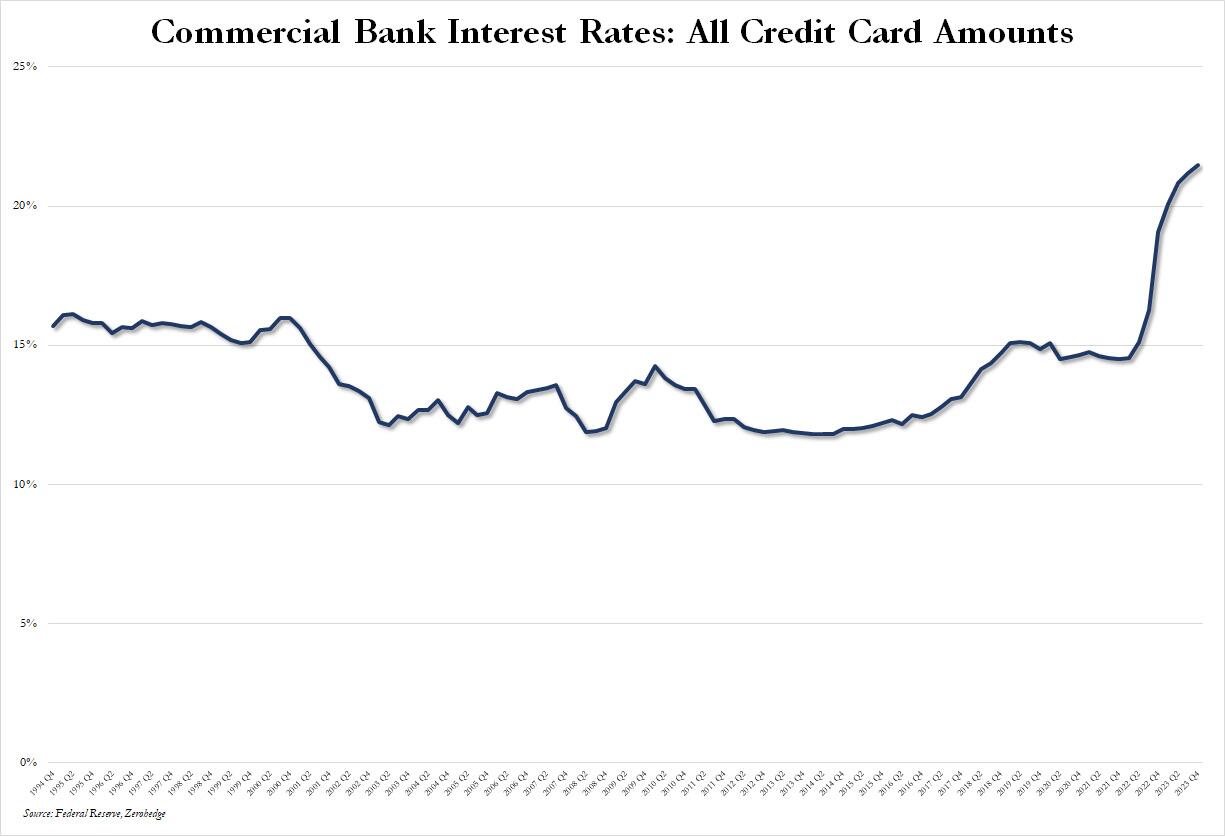
The average rate across all commercial banks on all credit card amounts hit a new record high of 21.47% in the fourth quarter of 2023.

Meanwhile, the personal savings rate has collapsed. 

Another concerning piece of consumer data comes from Credit Managers’ survey that shows the rate of rejections for credit applications and the number of accounts moved to ‘collections’ is surging back to near GFC levels.

… and about that ‘strong consumer’ narrative the Biden administration keeps pushing in corporate media. 

Tyler Durden
Wed, 03/06/2024 – 20:40