Russia is considering a nuclear power plant installation on the moon starting between 2033 and 2035, according to the head of Russia’s space agency Roscosmos.
Russia—along with China—is considering the idea of placing a nuclear power plant on the moon over the next decade or so, and the two countries have been working together on a lunar program for nuclear space energy.
“Today we are seriously considering a project—somewhere at the turn of 2033-2035—to deliver and install a power unit on the lunar surface together with our Chinese colleagues,” Yuri Borisov, head of Roscosmos said on Tuesday.
According to Borisov, solar panels would provide an insufficient amount of electricity to power future lunar settlements. Nuclear power, on the other hand, would be sufficient.
Russia also has plans to build a nuclear-powered cargo spaceship—most of which had already been mapped out, although the one remaining question in the project was how to cool the nuclear reactor.
The cargo spacecraft would be able to transport large cargoes from one orbit to another, Borisov said.
Moscow will need to launch additional lunar missions first, before fully exploring the idea of a Russian/China crewed mission or a lunar base.
In February, Russian President Vladimir Putin spoke out against the United States, who accused Moscow of planning to put nuclear weapons in space.
Last year, Russia suffered a significant defeat when its Luna-25 mission failed nine days after launch when it collided with the lunar surface. At the time, analysts spoke out against Russia’s space prowess, accusing it of yet another indicator of how the Russian space program had deteriorated in recent years.
Luna 25 would have been Russia’s first probe on the moon’s surface since the Soviet collapse and the first since 1976.
ADP Employment Report Sees Wage-Growth Re-Accelerating In Feb
Expectations were for a modest bounce in ADP’s Employment report data in February from +107k in January to +150k, but the data disappointed at +140k (from an upwardly revised +111k)…
Source: Bloomberg
“Job gains remain solid. Pay gains are trending lower but are still above inflation,” said Nela Richardson, ADP Chief Economist.
“In short, the labor market is dynamic, but doesn’t tip the scales in terms of a Fed rate decision this year.”
Job gains in Services once again dominated Goods-Producing firms, but both saw increases in February…
Source: Bloomberg
Mining and Information Services sectors saw job losses…
For job-changers, year-over-year pay gains were 7.6 percent, up from the prior month and the first increase since November 2022.
Pay gains for job-stayers continued to decelerate, reaching 5.1 percent, the smallest gain since August 2021.
Finally, we note that ADP has under-estimated BLS’s version of the truth for the last six months…and it’s getting worse.
Source: Bloomberg
So, with this kind of labor market, can The Fed maintain the illusion of rate-cuts at some point this year? What will Powell say today?
EU Pushing Arms Industry To ‘War Economy Mode’ While Seeking To Trump-Proof Itself
Russia’s war in Ukraine, which at the moment is going very badly for the Ukrainians and their NATO backers in what by now can more appropriately be called a proxy war, is causing Europe to shift to a “war economy mode”.
Urgent preparation for such a shift is precisely what’s being proposed by the European Commission on Tuesday, as several European Union countries are desperately seeking to revive and boost their arms production industry, also at a moment the Zelensky government is begging for more weapons and artillery shells to hold off the steady Russian advance in the east.
“We need to change the paradigm and move into war economy mode. This also means that the European defense industry must take more risks, with our support,” said Thierry Breton, the European industry commissioner who is pushing the proposal.
He’s laying out a package which promotes expanding arms production capacity and incentivizes countries to purchase more weapons from European companies.
Of course, European countries shouldering more of the defense spending burden for NATO, a role which has long disproportionately fallen on the United States, was long ago loudly called for by then President Trump. He was shunned and mocked at the time by European officials.
But it seems that now Europe is bracing for a possible Trump presidency after the November election. Reuterswrites:
Breton, a French former tech company CEO, has also said the possibility of another U.S. presidential term for Donald Trump – who has questioned Washington’s commitments to NATO – means Europe has to do more to protect itself.
“In the current geopolitical context, Europe must take greater responsibility for its own security, regardless of the outcome of our allies’ elections every four years,” Breton said.
This is likely also in expectation of a potential Republican administration in the White House which would ensure no more arms funding for Ukraine (or at least not the $60+ billion that Biden is still seeking). Trump on the campaign trail has promised to seek to negotiate a very swift end to the Russia-Ukraine conflict.
Europe is busy trying to “Trump-proof” itself, as officials indicated last month:
“If Trump were re-elected, we would face a situation in Europe that has not occurred since the end of the Second World War,” said Norbert Röttgen, a veteran German lawmaker and ex-chair of the Bundestag’s foreign affairs committee. “Europe would have to stand up for its own security in an unprecedented way.”
Reuters further details of the new “war economy” package, “But officials say the package will create a legal framework that would allow much greater coordinated spending in years to come, if the EU is willing to stump up the cash.” Breton wants a special 100 billion euro fund which can be coordinated for defense projects.
Hell of a stat. “Rheinmetall in Germany is producing way more 155 artillery shells than the entire US defense industry combined.” https://t.co/G2IXHJMCXd
Alarmingly, one official was cited in the report as saying, “Our mission here is to treat Ukraine as almost equivalent to a member state.” Very likely a potential future Trump administration will not see things this way.
VA Denies Removal Of Iconic WWII Kissing Photo After Rogue Woke Memo Circulates
The top official at the Department of Veterans Affairs (VA) has denied rumors that an iconic WWII of a US Navy Sailor kissing a woman in Times Square will be removed.
“Let me be clear: This image is not banned from VA facilities – and we will keep it in VA facilities,” wrote VA Secretary Denis McDonough in a post to X.
Let me be clear: This image is not banned from VA facilities – and we will keep it in VA facilities. pic.twitter.com/dYSikLxHAJ
— Secretary Denis McDonough (@SecVetAffairs) March 5, 2024
McDonough was responding to a memo written by RimaAnn Nelson, who serves as the assistant undersecretary for health for operations at the VA’s Health Network sub-agency, who – according to the maybe real memo, directed regional officials to remove teh photo from all health facilities “to foster a more trauma-informed environment.”
A screenshot obtained by the DCNF appears to show an email sent out by the Office of the Assistant Under Secretary of Health for Operations’ communications team to an listserv of Veterans Integrated Services Networks directors announcing the policy change.
The email’s subject line is “Operational memorandum: Removal and Replacement of ‘V-J Day in Times Square’ Photographs” and the email is dated Feb. 29, 2024.
“The Office of the Assistant Under Secretary of Health for Operations is sending the attached memorandum … on behalf of the VHA, Assault and Harassment Prevention Office,” the email states, directing recipients to share the memo with leaders of their respective VA medical centers. -Daily Caller
Nelson suggested that the kiss was ‘non-consensual,’ and violates the VA’s policies toward sexual harrassment and assault, she said in the memo. “However, perspectives on historical events and their representations evolve.”
EXCLUSIVE:
The Department Of Veterans Affairs just BANNED the V-J Day kiss photo from all department facilities.
“To promote a culture of inclusivity and awareness… your cooperation is vital.” pic.twitter.com/MZfNHbpV76
“The placement of this photograph in VA facilities was intended to celebrate and commemorate the end of World War II and the triumphant return of American soldiers,” wrote Nelson.
The photo was taken by Life magazine photographer Alfred Eisenstaedt, who captured the iconic photograph of sailer George Mendonsa kissing a nurse named Greta Zimmer Friedman on Aug. 14, 1945.
Here’s where it gets interesting – “A memo was sent out that should not have been, and it has been rescinded,” a VA official told the Daily Caller.
In short – a rogue woke sub-agency employee decreed that the photo be removed, never ran it up the flagpole, and was just shut down by leadership.
A survey highlighted by The Telegraph has found that only 58 percent of scientists at British universities believe that sex is binary.
The poll also found that most of the 200 scientists surveyed believe that gender is fluid.
Twenty-nine percent of respondents to the survey agreed with the statement that “sex is not binary,” while 13 percent of respondents did not share a view on the question or preferred not to give an opinion.
That means that 42 percent of the scientists would not classify sex as binary.
Wrong headline.
Sex is binary. That is a fact, not an opinion to be polled. The article gives us the alarming information that 29% of scientists (which sciences, I wonder?) deny something that is obviously, demonstrably, true. https://t.co/88aR7XdzdT
The poll, conducted by Censuswide, a market research consultancy, also found that 64 percent of scientists said gender is fluid, with only 22 percent saying the believe gender is binary, and a further 14 percent not providing an answer.
Commenting on the findings, Dr. Wolfgang Goymann, a professor of behavioral biology at the Max Planck Institute for Biological Intelligence, said “To me this just means that at least 29% of the academics that filled out this questionnaire do not understand the biological concept of sex, and at least 22% of them do not know what gender means.”
Goymann has noted that some scientists are now positing that sex is a graded spectrum rather than a binary trait.
“Leading science journals have been adopting this relativist view, thereby opposing fundamental biological facts,” he urged.
“While we fully endorse efforts to create a more inclusive environment for gender-diverse people, this does not require denying biological sex,” Goymann continued.
He added, “On the contrary, the rejection of biological sex seems to be based on a lack of knowledge about evolution and it champions species chauvinism, inasmuch as it imposes human identity notions on millions of other species.”
Helen Joyce, director of advocacy at Sex Matters, told The Telegraph “This survey has two remarkable findings. The first is that 29 per cent of academics are apparently unaware of the obvious fact that sex is binary. The second is that nearly two-thirds of academics say that ‘gender is fluid’. That is a strikingly confident statement about a nebulous concept.”
“This muddle feeds through into academic research and public policy. It’s concerning that people supposedly among our best and brightest are seemingly blind to this confusion,” Joyce further noted.
— Jennifer 🟥🔴🧙♀️🦉🐈⬛ 🦖 (@babybeginner) March 2, 2024
* * *
Your support is crucial in helping us defeat mass censorship. Please consider donating via Locals or check out our unique merch. Follow us on X @ModernityNews.
While 2022 had been heralded as a “possible turning point” as about as many countries showed improvements as marked declines, 2023 saw a new low of nations bettering their freedom prospects – only 21.
This number stands opposite 52 countries where political freedoms and civil liberties declined.
The report mentions Ecuador as an example of a country where elections were impacted negatively and downgraded the nation from designated as “free” to receiving the “partially free” label. In the South American country, criminal organizations had killed officials and candidates ahead of the general election that took place in August. In other countries it was incumbents who hindered the access of the population to a free election last year, including in Cambodia, Guatemala, Poland, Turkey and Zimbabwe.
Despite Thailand’s military Senate continuing to yield much power over the country’s legislative bodies, a more competitive election that saw a progressive party finish first earned Thailand a “partially free” designation, up from “not free”. Other nations improving their score were Fiji, Nepal, Liberia and Mauritania.
A total of 195 countries and 15 territories were analyzed on their levels of access to political rights and civil liberties, before being categorized as either “free”, “partly free” or “not free”. While democracy has been in decline for nearly two decades, the global landscape has improved since the report was first published 51 years ago. Back then, 44 out of 148 countries were counted as “free”, versus 83 out of 195 today.
The Wall Street Journal (WSJ) claimed to have viewed the 17-page draft Russian-Ukrainian peace treaty from spring 2022 that was sabotaged by former British Prime Minister Johnson and which President Putin waved around while speaking with African leaders last summer.
They dishonestly described the terms as “punishing” even though they can objectively be described as overly generous considering the previously unthinkable compromises that Moscow was willing to make at the time.
Ukraine would have restored its constitutional neutrality and the Russian language’s status, limited its armed forces, agreed not to use foreign arms, and recognized Russian influence in Crimea in exchange for the UNSC guaranteeing its security. Donbass’ status would be resolved via talks between their leaders, with the innuendo being that it might be reincorporated into Ukraine per the Minsk Accords, while it’s implied that Russia would have withdrawn from the rest of Ukraine’s pre-2022 borders.
Had these terms been accepted, then not only would Ukraine have averted destruction and the depopulation that came with it, but this former Soviet Republic could have then served as a bridge between China and the EU (which it would be allowed to join) exactly as Russia always envisaged. Even if Russian-NATO talks didn’t resume afterwards, their security dilemma that was exacerbated by the bloc’s clandestine expansion into Ukraine would have been much better managed to everyone’s benefit.
The reason why this never happened was because the West believed its own propaganda that Russia could be dealt a strategic defeat through economic sanctions and proxy warfare, both policies of which the New York Times admitted had failed by January 2023 and September of that year respectively. The conflict continued to drag on till today despite the failure of last summer’s counteroffensive because the West can’t admit that Russia was the one that ended up strategically defeating its opponent instead.
The opportunity cost of perpetuating this proxywar is that the West ran through all of its stockpiles, exposed the weakness of its military-industrial complex, and is now unable to adapt as flexibly as before to any major contingences in the Asia-Pacific like those that they expect might one day involve China. Clinging to false hopes of victory over Russia at all costs is also increasingly dangerous due to the chances that a potential NATO intervention in Ukraine could lead to World War III by miscalculation.
It’s amidst the growing awareness of these consequences that the WSJ reported on the entirety of spring 2022’s draft Russian-Ukrainian peace treaty, albeit while dishonestly describing the terms as “punishing” instead of overly generous as they objectively are. Their angle is disadvantageous to freezing this conflict like former Republican presidential candidate Ramaswamy, former NATO Supreme Commander Admiral Stavridis, and Senator Vance earlier proposed, but the substance is an altogether different story.
These details prove that President Putin was willing to make previously unthinkable compromises in order to obtain his strategic goals of restoring Ukrainian neutrality, denazifying it (with the restoration of the Russian language’s status playing the key role here), and demilitarizing that country. Donbass would likely be reincorporated into Ukraine, prior to which its residents could obtain Russian citizenship to relocate there if they wanted, and Russia would withdraw from everywhere except for Crimea.
Those territorial compromises are no longer in the cards after Donbass, Kherson, and Zaporozhye voted to join Russia in September 2022, which is why Kremlin spokesman Peskov just described the reported details about that spring’s draft Russian-Ukrainian peace treaty as outdated. Nevertheless, it’s still possible in theory for Russia to compromise on asserting its writ over the entirety of its new regions’ borders if their regional assembles voted to change them with parliamentary and presidential approval.
The Line of Contact (LOC) could therefore become the international frontier if the Constitutional Court rules that this doesn’t violate the 2020 constitutional amendment against surrendering Russian territory on the basis that Moscow hadn’t asserted any writ over those potentially “ceded” parts of its lands. President Putin has repeatedlysignaled that he’s willing to compromise on a political solution if Russia’s security interests are met, most recently during his interview with Tucker, so this scenario is possible.
The problem is that Ukraine legally forbade the resumption of peace talks with Russia, thus requiring the West to coerce it into repealing that legislation, which could happen if domestic pressure over Zelensky’s illegitimacy after his term ends on May 20 leads to him forming a “national unity government”. An expert from the powerful Atlantic Council think tank proposed this scenario in an article for Politico last winter, and it could represent a “face-saving” way to move everything forward if the political will exists.
The West knows that the only way to stop Russia from steamrolling through Ukraine in the event that it achieves a breakthrough across the LOC sometime this year is to risk World War III by miscalculation through a conventional NATO intervention aimed at drawing a red line as far east as possible. This sequence of events might be preemptively averted, however, by implementing the abovementioned proposal in order to freeze the conflict along the LOC and then turn that frontier into the new border.
To be absolutely clear so that nobody misunderstands what’s been written in this analysis, Lavrov confirmed as recently as Saturday that Russia hasn’t received any serious proposals for talks with Kiev, so it seems like the West’s ruling liberal–globalist elite isn’t yet comfortable with this end game. It’s also true that the way in which the WSJ dishonestly described the draft Russian-Ukrainian peace treaty’s overly generous terms as “punishing” could harden some policymakers’ resistance in this respect.
Even so, the actual details of those terms could convince some on-the-fence policymakers that President Putin is indeed willing to make previously unthinkable compromises, thus potentially increasing the number of them who’d support the scenario of freezing the conflict along the LOC. The WSJ’s report is therefore a double-edged sword for both camps since it works for and against each of their interests as explained, but the timing is no coincidence since it’s meant to shake up the balance between them.
It’s debatable which side this outlet really supports since one can argue that dishonestly describing the details as “punishing” favors those who want another “forever war” while reporting on their overly generous substance is tacitly intended to give an edge to those who want to resume peace talks.
The impact of their report will take some time to see, but the point is that it might make a difference at this pivotal moment in the proxy war, with it remaining to be seen whether it’d be for better or for worse.
Fear sells—the more existential the better, as with all the loose talk about the possible use of nuclear weapons by Vladimir Putin. While nuclear dread is good for “driving clicks,” it must not blind us to reality. The U.N. nuclear ban treaty will do nothing to reduce such nuclear dangers. How could it? None of the countries possessing nuclear weapons will have anything to do with it. Not unlike “The Emperor’s New Clothes,” proponents of the Treaty on Prohibition of Nuclear Weapons (TPNW) want us to believe in its magnificence, to go along with the pretense while it is plain to see that the treaty is stripped of any credibility.
The second gathering of signatories late last year revealed a host of treaty flaws. Any hope that member states and civil society would staunchly self-police the treaty were dashed. They all turned a blind eye to the involvement of Kazakhstan, a treaty member, in the testing of a Russian ICBM—a missile whose sole purpose is to deliver nuclear weapons.
When the test occurred in April last year, the International Campaign to Abolish Nuclear Weapons (ICAN) trumpeted that under the TPNW, it was “illegal” for Kazakhstan “to allow its territory to be used for testing of nuclear-capable missiles.”[i] Yet, ICAN and TPNW member states, including Kazakhstan, were silent about the ICBM test—at a meeting whose purpose is to assess the implementation of the ban treaty.
Evidently, because Kazakhstan is struggling with the legacy of Soviet nuclear tests on its territory and will host next year’s treaty review, it was given a “pass.” So much for the assertions of TPNW advocates that the treaty is non-discriminatory, a contrast they like to draw with the Nuclear Non-Proliferation Treaty (NPT) which recognized in 1968 the United States, the United Kingdom, France, Russia, and China as nuclear weapon states—and everyone else as non-nuclear weapon states.
Once again, TPNW member states failed to call out Russia by name for its irresponsible nuclear behavior, this time including de-ratifying the Comprehensive Nuclear Test Ban Treaty (CTBT) and moving to deploy tactical nuclear weapons in Belarus. Why? Because the diplomatic corps of the non-nuclear weapon states consider it impolite to call out bad actors by name.
How can a treaty that won’t call out malign behavior of even non-member states like Russia— or hold accountable one of its actual signatories like Kazakhstan—be expected to resolve disputes in the event the major powers somehow join its ranks and warily give up their nuclear bombs. The answer is plain, it cannot, which is why those powers boycott it.
They are not alone. NATO member states and U.S. allies in Asia also refuse to join the TPNW. Others have read the writing on the wall. Finland and Sweden, which attended the first meeting of TPNW states parties as observers in 2022, balked last year, preferring to join NATO rather than place their faith in the ban treaty. Other states that observed the first gathering but punted this time include the Netherlands, Burundi, Ghana, Mauritania, Niger, and Senegal. You wouldn’t know that, though, by reading any of the self-congratulatory statements issued after the meeting by TPNW member states and civil society.
It is a tough time for TPNW supporters. The initial euphoria of circumventing the major powers and rushing the treaty through is over. Now comes the more mundane work of implementing it, structurally weak as it is. That’s not helpful for ICAN and others who need to keep members motivated and attract donors. That’s become harder now that the MacArthur Foundation has pulled out of the nuclear disarmament field, seeing poor prospects ahead. Austria has a solution for that, however.
In a weak decision document, Austria has convinced TPNW member states that what they really need is better talking points about the so-called evils of nuclear deterrence. This is a hobby horse of a few individuals in the Austrian foreign ministry, somehow convinced that they can simply debate Western countries into surrendering their nuclear protection, even as their counterparts in the Austrian ministry of defense seek closer ties with NATO. This new initiative will fail—states under the nuclear umbrella are not under any obligation to engage in such theater.
The reality is, since the brutal 2022 Russian invasion of Ukraine and the rapid build-up of nuclear arms by such stalwarts of international law and human rights as China and North Korea, free people everywhere are rediscovering the value of nuclear deterrence over one-sided nuclear disarmament. There is a reason why ICAN has not published any polls since 2022 purporting to show vast public support for the TPNW and opposition to U.S. nuclear weapons forward deployed in Europe.
Surely, the TPNW must be good for something? The ban treaty is slowly carving out an important niche in assisting victims and remediating environments impacted by nuclear weapons use or testing. It also is promoting new standards of inclusivity and gender balance. But it has been divisive, too. Its insistence on nuclear disarmament irrespective of the security environment lacks realism and only deepens the chasm between nuclear weapons states and non-nuclear weapons states.
Let’s face it, progress on nuclear disarmament won’t be coming anytime soon. TPNW supporters can lament this and withhold cooperation from the nuclear weapons states, or they can apply their energy in a more promising area—non-proliferation. Surely, keeping nuclear weapons from spreading is just as important as easing the grip of those who already possess them. Making progress on the former should not be held hostage to progress on the latter—that would be a wasted opportunity indeed.
Gregory F. Giles is a Senior Director with Science Applications International Corporation (SAIC). For the past three decades, he has been advising U.S. government clients on issues related to deterrence and nonproliferation. Mr. Giles holds a B.A. from Dickinson College and an M.I.A. from Columbia University. His work has been published in War on the Rocks, Survival, Comparative Strategy, The Washington Quarterly, and elsewhere. The views expressed in this article represent the personal views of the author and are not necessarily the views of SAIC, Lawrence Livermore National Laboratory, the Department of Defense, or the U.S. Government.
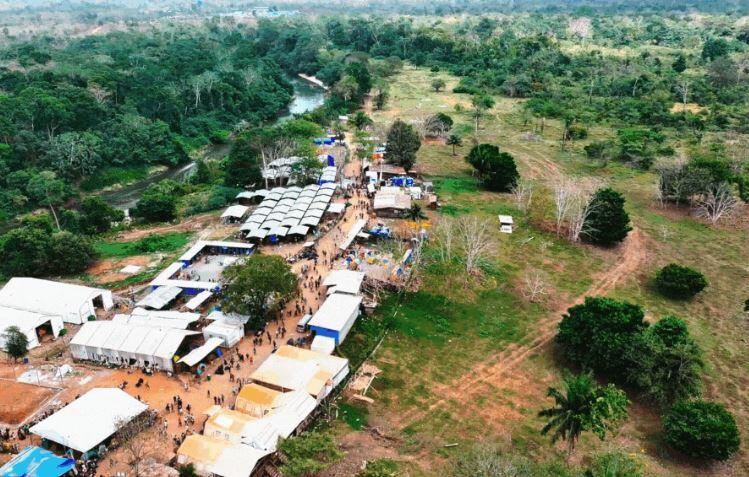
The ripe smell of garbage baking in the tropical sun mixed with the stench of human waste is one of the first things visitors notice at Bajo Chiquito, one of four large migrant camps in the Darién Gap.
The next is a sea of weary migrants, who hiked from Colombia along the infamous jungle trail, lined up to be processed by Panamanian officials.
One young boy in line with a furrowed brow seems worried. Others stare blankly at ramshackle buildings slapped together with wood, tin, and cinder blocks. They wait patiently in the brutal heat and humidity.
Most of them are coming to the United States aided by the United Nations, its nongovernmental partners, and regimes hostile to the United States.
Experts have said the migrants are being used as a weapon, just as deadly as a missile aimed straight at the United States.
Mass migration is being “weaponized” to overwhelm and destabilize the United States and ultimately break it apart, according to Joseph Humire, who studies unconventional warfare and is the executive director of the Center for a Secure Free Society.
“That’s why I think the term ‘invasion’ is appropriate,” Mr. Humire told The Epoch Times.
Migrant Pawns
Last year, a record 500,000 migrants traveled through the Darién Gap, documents show.
In February, The Epoch Times visited all four migrant camps in Panama: Lajas Blancas, Bajo Chiquito, San Vicente, and Canaán Membrillo.
The United Nations and related nongovernmental organizations (NGOs), which receive millions of U.S. taxpayer dollars, have made mass migration easier by facilitating and augmenting migrant movement with food, shelter, and water.
Reporters spoke with migrants from China, Somalia, Venezuela, Ecuador, and Colombia and others who hiked out of the treacherous jungle leading from Colombia into Panama.
Many at the camps suffered from injuries and illnesses such as trench foot and broken limbs. Several complained that the water was untreated at the camps run by the NGOs and that they lacked essential items such as diapers. One migrant told The Epoch Times that food supplied at the camps was stale or spoiled, so he spent $7 to buy a meal from a local vendor.
Others said they were stranded at the camps because they were robbed during their journey or couldn’t pay the $60 needed for the bus ride north.
The number of illegal immigrants entering the United States has surged under the Biden administration as policies from the Trump era have been reversed or eliminated.
Illegal immigrant encounters at U.S. borders in fiscal 2022 totaled more than 2.7 million nationwide, according to CBP data.
By 2023, that number topped 3.2 million.
The numbers also correspond with President Joe Biden’s renewed pledge to support the U.N.’s Global Compact for Safe, Orderly, and Regular Migration—a 2018 plan to manage global migration that was approved by 152 nations.
“The Biden–Harris Administration is committed to safe, orderly, and humane migration around the world, including to the United States,” a government statement in December 2021 read. The United States had voted against the compact under President Donald Trump.
Most migrants are oblivious to their role as human ammunition, according to Trevor Loudon, an expert on communist regimes and host of EpochTV’s “Counterpunch.”
The U.N. and NGO workers at the City of Knowledge in Panama—which was once part of the U.S. military base given to Panama—have exposed migrants to violence, injury, death, and disease, he said.
“These bureaucrats with fat salaries, eating at nice local restaurants, are having a great old time facilitating one of the biggest crimes against humanity that’s ever been perpetrated,” Mr. Loudon said.
Panama’s former border director Oriel Ortega told The Epoch Times the NGOs should be educating and helping migrants in their own countries instead of facilitating migration.
The Epoch Times knocked on multiple U.N. agency doors at the City of Knowledge complex while in Panama in an unsuccessful attempt to interview officials with the U.N. and HIAS, founded as the Hebrew Immigrant Aid Society.
At one U.N. office, reporters could see workers through blinds scrambling to hide after The Epoch Times knocked and rang the doorbell repeatedly.
Migrants said the trek through dense rainforest, steep mountains, thick mud, and swamps was exhausting and dangerous.
They told stories of murder, rape, and desperation.
Estimates of deaths reported by NGOs are probably low. The American Red Cross reported that 60 people died crossing the Darién Gap during the first half of 2023, but anecdotal information from people who have been in the jungle put that number in the hundreds or thousands each year.
Michael Yon, a war correspondent who has been reporting on the flood of migrants moving through the jungle into Panama, told The Epoch Times he estimates that about 1 percent of those making the journey die.
At the Bajo Chiquito camp on Feb. 18, one Venezuelan migrant sitting under the shade of a tin roof shelter counted himself as lucky.
He was only robbed during the journey through the Darién Gap that he described as “hell” through an interpreter.
He witnessed a man who was stoned and then shot in the head for trying to protect his wife from being gang raped, he said.
“He went to go defend the girl,” he said.
Close by, a Venezuelan woman, Fabiola Suarez, appeared despondent. She had hiked through the Darién Gap to reunite with her husband in Colorado.
She was almost raped by criminals preying on migrants, but there were enough people in her group to stave off an attack, she said.
“There was a lot in the group, so they didn’t,” she said through an interpreter.
Dripping with sweat, Gustavo Toala emerged from the Darién jungle trail on Feb. 17 with only the clothes on his back—and a cellphone in his hand.
Everyone had cellphones, a lifeline for many at the camps.
He and two companions from Ecuador trudged over a rudimentary bridge into Lajas Blancas camp, looking exhausted after a five-hour walk from camp Bajo Chiquito.
Mr. Toala said through an interpreter that he and his two companions started as a group of 12, but they got separated during the journey.
He had been traveling for almost two weeks, hoping for a better life in the United States.
He left because of the high crime rate in Ecuador and the inability of small business owners to make a living due to extortion, he said.
With no map and little water, he blindly followed other migrants through the Darién Gap, where robbery, rape, and death await many.
He hoped to catch a bus to Costa Rica next.
At Lajas Blancas, migrants have access to a number of large maps provided by NGOs that display detailed migration routes heading to the United States.
One map is from HIAS, which recently received $11 million from the U.S. in two grants awarded specifically to go to Latin American migrants.
One HIAS map shows the migration route from Colombia to Costa Rica, including detailed bus stops, temperatures, altitudes, and “migration kiosk” locations.
The top languages spoken in the world reflect economic trends, populated countries, and even colonial history.
In the image below, Visual Capitalist’s Marcus Lu visualizes the most spoken languages around the world as of 2023. These figures come from Ethnologue, which publishes a list of the largest languages every year.
The 12 Most Spoken Languages on Earth
English was born in the United Kingdom but today belongs to the modern world as the main international language of business and politics.
That’s why it’s not very surprising to find English as the world’s most spoken language, with 1.5 billion speakers as of 2023.
In second place is Mandarin, the most spoken Chinese language dialect with 1.1 billion speakers. Originating in North China, it has become the most spoken language in China and Taiwan, as well as having millions of speakers spread across Southeast Asia and the world.
India is also represented in this ranking, but despite being the world’s most populated country, its speakers are spread out over multiple different languages. Hindi is the main language spoken in North India and an official language of the government, but other languages like Bengali are widely spoken in other regions, in this case in East India (and neighboring Bangladesh).
It’s also notable how languages from former colonial powers – like English, Spanish, French, and Portuguese – all have hundreds of millions of speakers, despite their mother countries accounting for a fraction of that total.