69.5 F
Chicago
Sunday, September 20, 2026
Home Blog Page 2866

FAA Finds Non-Compliance Issues In Boeing’s 737 Max Manufacturing Program

FAA Finds Non-Compliance Issues In Boeing’s 737 Max Manufacturing Program

The Federal Aviation Administration’s six-week audit of the clowns running Boeing and Spirit AeroSystems has revealed “multiple instances where the companies allegedly failed to comply with manufacturing quality control requirements.”

The non-compliance issues were found in the Boeing 737 Max program’s manufacturing process control, parts handling and storage, and product control, the FAA said, adding these details have been released to the public as an investigation is ongoing following the near-catastrophic accident when a door plug ripped off an Alaska Airlines 737 Max 9 plane earlier this year. 

The audit is one of the immediate oversight actions the FAA took after a left mid-cabin door plug blew out of Alaska Airlines Flight 1282 on January 5 while in flight. At a meeting at FAA Headquarters in Washington, DC, last week, Administrator Mike Whitaker informed Boeing’s CEO and other senior leaders that the company must address the audit’s findings as part of its comprehensive corrective action plan to fix systemic quality-control issues. The plan must also address the findings from the expert review panel report that examined Boeing’s safety culture. The FAA has given Boeing 90 days to outline its action plan. -FAA

While Boeing is held accountable for quality control issues that led to the 737 Max 9 plug door mishap, the FAA has halted production expansion of the Max jet.

There is word that Boeing might hire a third party to conduct independent reviews of quality systems at its Renton, Washington plant and Spirit AeroSystems facilities in Wichita, Kansas. 

Meanwhile, European aerospace giant Airbus SE has been pulling ahead of Boeing regarding aircraft deliveries, soaking up an increasingly more significant market share of narrow-body planes. 

Wall Street thinks so… 

With Boeing remaining under FAA scrutiny, it was also announced Monday that three passengers on the Alaska Airlines flight in January have filed a billionaire dollar lawsuit against the planemaker. 

Tyler Durden
Mon, 03/04/2024 – 15:00

Good Story Versus Bad Valuations

Good Story Versus Bad Valuations

Authored by Will Denyer via Evergreen Gavekal blog,

In the run-up to Nvidia’s earnings release late Wednesday, there was a palpable concern in the market that the AI boom’s flagship would disappoint lofty expectations; what is now Wall Street’s most heavily traded stock traded -2% down during the afternoon session. And then Nvidia did it again, exceeding expectations in terms of revenue, earnings and forward guidance. The stock promptly jumped 9% in after-hours trading, which helped to lift Nasdaq futures by 1.5%. And the bullish sentiment spread to Asia Thursday morning, where after a 34-year wait Japan’s Nikkei 225 finally edged above its December 1989 record high.

With the terminals a sea of green, the obvious question for investors is the one Louis raised a couple of weeks ago—will markets in general, and US growth stocks in particular, continue to Party Like It’s 1999? Or are we heading for a 2000-style crunch?

Put differently, will a good story be overcome by bad valuations?

In the late 1990s, the story was that the internet was going to generate exceptional earnings growth for companies in tech, media, and telecoms. The TMT bubble inflated until by early 2000 the prospective earnings yield on US growth stocks was pitiful, both in absolute terms and when compared to the real yields in US fixed income (whether bonds or bills). Eventually, the valuation gap became too great and the market started to have doubts about when clicks would be converted into revenues, and the bubble burst. Investors fled growth stocks for fixed income, with growth stocks losing a quarter of their value in 2000, while bonds rallied. By the end of the year, risk-adjusted real yields on the two asset classes had largely converged (see the chart below). Meanwhile, value stocks, which never got anything like as overvalued, were flat for the year. It was not until the US recession began in March 2001 that value stocks joined the sell-off.

Fast forward to today and the relative valuation story is similar. Equities are generally expensive relative to fixed income. But the biggest gap is between growth stocks and short-term US treasuries.

Given this valuation spread, a continuation of the current rally in US growth stocks likely depends on one or both of the following:

(i) earnings continue to exceed expectations;

(ii) the Federal Reserve cuts rates and real bond yields fall—with no recession.

Either is possible.

On the earnings side, the strong recent economic data helps. January saw impressive payrolls growth and a pick-up in PMIs (February PMIs are out on Friday and will be worth monitoring). It is also encouraging that the leaders of this boom—Nvidia, Microsoft, Amazon, Meta etc.— have seen strong revenue and earnings growth, not just click growth. The balance sheets of these companies are also generally stronger than the balance sheets of the TMT bubble leaders, with less leverage and more cash. And as Louis has pointed out, unlike 1999-2000 there is little IPO activity today to leach away the liquidity supporting the stocks of the market leaders.

One big question is whether final demand for generative AI grows by as much as expected. Currently, Nvidia cannot make chips fast enough to meet the demand of its customers, and specifically of its four biggest customers— Amazon, Microsoft, Google and Meta—which account for 40% of its revenues. So long as final demand for generative AI continues to grow rapidly, these customers will likely continue to demand more chips from Nvidia and others, even as they are all developing their own AI chips. But if final demand for generative AI disappoints, today’s AI investment boom could result in overcapacity.

On the inflation front, the risk is that January’s uptick in US CPI and PPI inflation, along with the year-to-date rebound in oil prices, is not just noise but the start of a reversal from last year’s disinflationary trend. This is the subject of intense debate within Gavekal. From my perspective, I still believe the balance of evidence suggests inflation will remain benign.

But any more upside surprises in the inflation data will make the Fed more cautious about the timing and pace of rate cuts, because inflation remains the principal consideration determining Fed policy. If the Fed keeps short rates elevated while continuing quantitative tightening, the relatively high real yields on bonds and especially on bills could begin to weigh on US growth stocks. If inflation surprises on the upside, and the Fed confounds expectations for rate cuts, “T-bill and chill” will likely prove the investment strategy of choice.

The macro outlook for growth and inflation is always uncertain, and today is no exception. A continuation of the recent “soft landing” or “disinflationary boom” scenario is quite possible. The potential of generative AI appears great.

But given the extreme valuation gap between T-bills and growth stocks today, as in 2000 it is probably wise to take some profits on US growth stocks, and to buy more attractively-valued US value stocks, cheaper markets such as Brazil or China, or simply to load up on US T-bills.

Tyler Durden
Mon, 03/04/2024 – 14:20

House Dems Implode Over Supreme Court Decision; Raskin Crafting Legislation To Bar Trump From Ballot

House Dems Implode Over Supreme Court Decision; Raskin Crafting Legislation To Bar Trump From Ballot

Update (1400ET): Not satisfied to let the Supreme Court-enforced Democratic process play out, House Democrats are now preparing legislation to try and keep Trump off the ballot.

Rep. Jamie Raskin (D-MD) (we think? Not sure… Maybe not.)

“Congress will have to try and act,” said Rep. Jamie Raskin (D-MD), the ranking member of the House Oversight Committee, in a comment to creepy deep state mouthpiece Axios (which swears the border is extra-secure!).

Raskin, a former member of the Jan. 6 select committee, said he is already crafting the bill, telling Axios, “I’m working on it – today.”

  • Raskin pointed to legislation he introduced with Rep. Debbie Wasserman Schultz (D-Fla.) in 2022 creating a pathway for the Justice Department to sue to keep candidates off the ballot under the 14th Amendment.
  • “We are going to revise it in light of the Supreme Court’s decision,” Raskin said. –Axios

“I don’t have a lot of hope that Speaker [Mike] Johnson will allow us to bring enforcement legislation to the floor, but we have to try and do it,” said Raskin, who said he’ll ‘beseech’ Republicans to join the bill.

Very Democratic, Jamie.

*  *  *

Update (1320ET): Former President Trump has responded to the Supreme Court’s ruling keeping him on the ballot in Colorado (and therefore, everywhere else).

According to Trump, the decision was “very well crafted,” and “will go a long way toward bringing our country together.”

Trump also slammed Biden for ‘weaponizing’ prosecutors against him.

“President Biden… Fight your fight yourself. Don’t use prosecutors and judges to go after your opponent… our country is much bigger than that,” Trump said, speaking from Mar-a-Lago.

More:

*  *  *

The US Supreme Court has ruled in a unanimous decision that former President Donald Trump will be allowed to remain on primary and general ballots in the 2024 US election, after several states removed the former president under the 14th Amendment.

The decision comes after several states – kicked off by the Colorado Supreme Court – ruled that Trump was disqualified from appearing on ballots, citing an interpretation of the US Constitution’s 14th Amendment provision which stipulates that candidates who engaged in an “insurrection or rebellion” against the United States – which Trump has not been charged with or convicted of – should be prevented from holding office.

Maine’s Democratic secretary of state made a similar decision days later, and a judge in Illinois recently issued a similar ruling to prevent his appearance on ballots, according to the Epoch Times.

This is the first time in US history that the US Supreme Court has considered section 3 of the 14th Amendment. The decision comes after a Sunday announcement that the Court would come to a decision today.

And of course, the left is now trying to discredit the Supreme Court despite the fact that this was a unanimous decision.

CNN isn’t taking it so well…

Nor is Colorado’s Secretary of State…

As the Epoch Times notes further, Lawyers for the former president asked the nine justices to reverse the Colorado court decision because only Congress can make a determination as who can become president.

The Colorado court’s decision was “the first time in the history of the United States that the judiciary has prevented voters from casting ballots for the leading major-party presidential candidate,” his lawyers said, concluding that it “is not and cannot be correct.”

After the ruling, President Trump wrote on social media that he is “not an insurrectionist,” adding that President Joe Biden is one. He also noted that he told supporters to protest “peacefully and patriotically” during a rally on Jan. 6, 2021, before protesters and rioters entered the U.S. Capitol during the certification of electoral votes for the 2020 election, which forms the basis of the “insurrection” accusations against him.

Justices for the Colorado Supreme Court had argued that they believed President Trump engaged in an insurrection because of his activity before and on Jan. 6, 2021, during the breach of the U.S. Capitol building. The former president, however, was never charged or convicted of insurrection. He was charged by a federal special counsel in connection with the 2020 election, but not for insurrection, rebellion, or related charges.

“President Trump asks us to hold that Section Three disqualifies every oath-breaking insurrectionist except the most powerful one and that it bars oath-breakers from virtually every office, both state and federal, except the highest one in the land,” the majority for the Colorado Supreme Court wrote in its 4–3 ruling.

“Both results are inconsistent with the plain language and history of Section Three.”

Oral Arguments

During oral arguments in front of the justices in early February, at least six of the justices, including Chief Justice John Roberts, who was nominated by President George W. Bush, appeared to be at least skeptical of some of the claims made by the lawyer representing several Colorado voters who brought the lawsuit against the Republican front-runner.

“It’ll come down to just a handful of states that are going to decide the presidential election,” Chief Justice Roberts said, referring to the potential effect of the Colorado court’s ruling.

“That’s a pretty daunting consequence.”

Justice Clarence Thomas asked the lawyer, Jason Murray, why there weren’t many examples of individual states’ disqualifying candidates under the 14th Amendment after the Civil War.

“There were a plethora of confederates still around, there were any number of people who would continue to either run for state offices or national offices, so it would seem—that would suggest there would at least be a few examples of national candidates being disqualified,” Justice Thomas, a Bush appointee, said.

Justice Elena Kagan, considered a member of the court’s liberal wing, asked the attorney why one state would have power to determine which candidates should be on the ballot for a nationwide election.

“Why should a single state have the ability to make this determination not only for their own citizens but also for the nation?” she asked the attorney, adding the move would be “quite extraordinary.”


Tyler Durden
Mon, 03/04/2024 – 14:02

“We Remain Frustrated”: Investors Raise Buyout Bid For Macy’s After Board’s “Delay Tactics”

“We Remain Frustrated”: Investors Raise Buyout Bid For Macy’s After Board’s “Delay Tactics”

On Sunday, Arkhouse Management Co. and Brigade Capital Management raised their all-cash bid to purchase Macy’s at $24 per share, a 33% premium versus Friday’s closing price of $18.01. This comes a little more than a month after the retailer rejected a go-private bid from the group of investors. 

Arkhouse and Brigade disclosed Fortress Investment Group LLC and One Investment Management US as equity partners in the deal to acquire Macy’s. 

Arkhouse highlighted how they had revised the deal higher to entice Macy’s executives: 

  • A 51.3% premium to Macy’s unaffected share price on Nov. 30, 2023, the day prior to Arkhouse and Brigade submitting their original proposal on Dec. 1, 2023;

  • A 33.3% premium to where the Company’s shares closed on March 1, 2024; and

  • An increase of 14.3% from Arkhouse and Brigade’s previous offer of $21.00 per share that was submitted to the Company on Dec. 1, 2023.

Gavriel Kahane and Jonathon Blackwell of Arkhouse expressed their frustrations with Macy’s Board:

We remain frustrated by the delay tactics adopted by Macy’s Board of Directors (the “Board”) and its continued refusal to engage with our credible buyer group. Nonetheless, we are steadfast in our commitment to execute this transaction. In recent months, Macy’s has introduced two restructurings and a dividend hike. The stock price selloff following these announcements is a strong indication of shareholder concern about maintaining the status quo. We continue to offer the Company an attractive alternative solution through a sale of the Company at a substantial premium. This would provide Macy’s stockholders with significant value and immediate liquidity.

While the restructuring plan Macy’s unveiled last week failed to inspire investors, the fourth quarter earnings and year-end results have given us further confidence in the long-term prospects of the Company if redirected as a private company. After coordinating with our financing sources, we have increased our offer to $24.00 per share in cash. We remain open to increasing the purchase price further subject to the customary due diligence.

The notion that the plan we are proposing is not actionable is simply not true. We have tried repeatedly to address the concerns raised by the Company. We clarified the 50% equity contribution we laid out three months ago and disclosed our partnership with two highly regarded investors – Fortress and OneIM. With the help of our advisors, we have identified large global institutional financing sources for each debt component of the transaction with strong interest in finalizing commitments during a customary diligence process. These sources represent 100% of the capital required to buy the shares in Macy’s we do not already own at our proposed price of $24.00 per share in cash. We have struggled to understand what reservations the Board might have at this point and urge the Company to engage with us in good faith with the goal of reaching a transaction that would unlock significant value for all stockholders.

We sincerely hope the members of the Board are not so entrenched in their views about the future direction of the Company that they would ignore their fiduciary duties to explore a potential transaction with a credible buyer. We remain ready to proceed expeditiously with our due diligence toward a mutually agreeable transaction to acquire Macy’s at a substantial premium in cash.”

Shares of Macy’s jumped more than 17% in premarket trading in New York on the revised deal.

Two weeks ago, Arkhouse nominated nine people for Macy’s board of directors, igniting a proxy battle after the department store rejected a go-private bid in mid-January.

Last week, Macy’s announced “a bold new chapter” in the department store’s future, pivoting from catering to low-tier consumers to more affluent ones. In doing so, it will close 150 stores over the next few years while expanding Bloomingdale’s and Bluemercury stores.

Tyler Durden
Mon, 03/04/2024 – 14:00

Dispersion, Correlation, Volatility And The Stock Bubble

Dispersion, Correlation, Volatility And The Stock Bubble

Submitted by SpotGamma; Join the SpotGamma Volatility Challenge and get ready for 4 days of in-depth exploration into volatility, where traders of stocks, options, and futures will learn to track, assess, and trade with precision.

Dispersion, Correlation, Volatility and the Stock Bubble

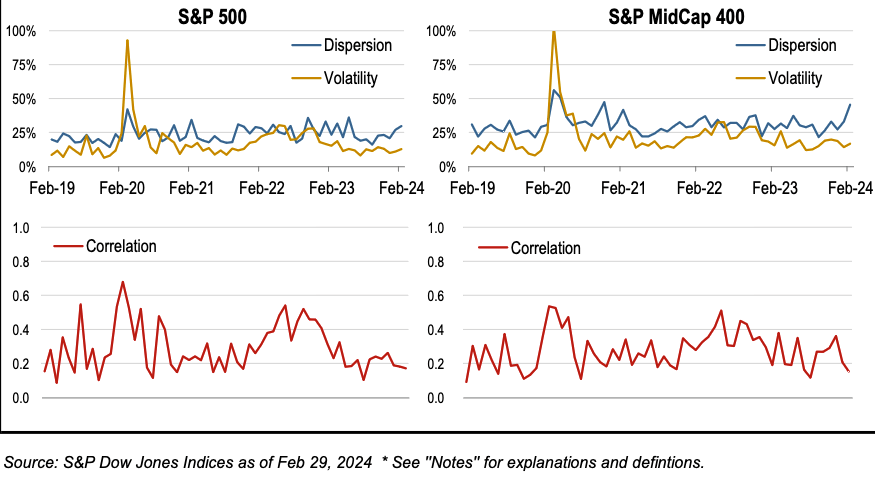
Dispersion readings are hitting highs per @SPGlobal, particularly in Mid Caps, while correlation is moving toward lows and volatility is flat.

What does that mean? Why does it matter?

High dispersion means individual components of an index are moving more than the whole, similar to the idea of market breadth. Traders have complained that the current market has “lacked breadth”. Low correlation tells us not all components are moving in the same direction.

Dispersion is measured by calculating the weighted average of the variances (i.e. movement) of individual stock returns relative to a stocks weighting in the index. This therefore reflects the performance of the individual stocks in the index vs the index’s overall performance. ex: “MSFT is +5% while vs SPX +1%, and MSFT is 7% weighting in the SPX” (it really is a 7% weighting).

This is where correlation comes in (chart above, red line plots). As noted, correlation is at lows (SP500 left, SP400 right in the chart above).

Correlation measures the degree to which stocks move in relation to each other, indicating how closely their returns are linked over a given period. Currently we see low correlation with high dispersion, which indicates that stocks are moving significantly but in different directions, highlighting a lack of a unified market trend and suggesting diverse individual stock performances independent of the overall market movement.

This also hearkens back to “lack of breadth” as a risk flag in this rally. ex: “Semi’s and crypto are crushing it, everything else is a drag.”

Conversely, when correlation is high with a high dispersion reading , it suggests that while individual stocks are moving significantly, they tend to move in the same direction as the overall market, indicating a broadly uniform market trend but with varying degrees of intensity.

The prime example of this this was the March Covid crash, where everything was going down, but some stuff crashed more than others. Lastly, note that SPGlobal includes a plot of index volatility (yellow) against dispersion (blue).

As you can see, dispersion is increasing with volatility stagnant (red box). Compare this to the Covid crash wherein vol went up with dispersion (blue box). This current reading is symptomatic of the “stock up, vol up” environment we’re in, wherein there is thematic chasing (i.e. semis gone wild), but other stuff is left more or less drifting.

What’s the significance of dispersion – volatility spread?

The argument is that one would normally view an increase in dispersion to current levels as a signal of volatility (i.e. more movement) more normally associated crashing markets. But the fact that index volatility is not going up is indicative of….bubbles?

SP Global highlights the period of 1999-2001 as showing: “a marked dispersion, driven by the deeply idiosyncratic behavior of the technology sector. But index volatility did not rise, as sectors other than technology performed more normally. Thus, dispersion can better capture periods were only a portion of the market either bubbles or crashes.”

That sounds pretty familiar, regardless of if you think current trading action is more warranted (i.e. the AI revolution is not the internet bubble). These trends can last for some time, as they did in 2001. The dispersion – vol spread started in late 1999 and didn’t close until early ’21. This was after the bubble popped in Q3 of ’20. So, what are some quicker signal that the party is over? For that you want to watch for signals that the “stock up, vol up” regime is stalling out, which should coincide with a reduction in call volumes. One way to catch this shifting behavior is through looking at skew. Consider the 1 month SMH (semi ETF) skew (green), which shows upside calls all with a higher IV than at-the-money IV. This is a signal of high demand. Conversely, put IV is depressed.

If & when the SMH upside demand stalls, we’d expect skew to shift back towards something like Oct ’23 (gray line), which results in call IV deflating, and put IV increasing.

* * *

Join the SpotGamma Volatility Challenge and get ready for 4 days of in-depth exploration into volatility, where traders of stocks, options, and futures will learn to track, assess, and trade with precision.

Tyler Durden
Mon, 03/04/2024 – 12:40

The End Of “Extend And Pretend”

The End Of “Extend And Pretend”

Authored by Daouglas French via The Mises Institute,

The number of U.S. commercial foreclosures spiked to 635 in January 2024 from a low of 141 in May 2020 reports real estate data firm ATTOM. The January count was up 17% from the previous month and roughly twice as many as in January 2023. 

“Commercial property deals in the US are picking back up at deep discounts—and forcing lenders to face just how far real estate prices have fallen,” notes Sarah Holder on Bloomberg’s “Big Take” podcast.

Bloomberg commercial real estate reporter Natalie Wong detailed a New York office building at 1740 Broadway purchased and renovated by Blackstone at considerable cost and the company has walked away with the debt that’s behind that building being marketed at a 50% discount. 

Ms. Wong said,

So you’re seeing these massive discounts on these prominent buildings start to show up in the market, and it’s a lot harder for, whether it’s the investor or the lender, to tell the regulators that the value of a lot of their buildings haven’t fallen greatly. And I—so I think this is starting to create more pressure. You know, a little bit of panic, too, from parts of, you know, the, the lenders that hold these loans. 

Pretending has become much harder. 

Problem real estate means problem banks. Bloomberg reporter Patrick Clark chimed in “we certainly hear people say over the next couple of years with commercial real estate debt as a catalyst, hundreds, if not thousands of banks are gonna go away, either because they go outta business or they need to be swallowed up or they need to join forces with another weak bank to survive.” (the combination of two weak banks does not make a strong on)

Real estate mogul Barry Sternlicht told Bloomberg “there’s a giant skeleton in the closet of the regional banks,” referring to commercial real estate loans. He made the point that “every piece of real estate is worth less when interest rates go up 500 basis points.”

Sternlicht stressed that there are no lenders for buyers who want to buy properties at deep discounts.

“Commercial banks are already nervous about their commercial office exposure,” he said. 

For some banks multifamily loans are the problem. Wolf Richter reports that 49 relatively small banks which average $1.3 billion in assets “had multifamily nonperforming loans (NPLs) that exceeded 5% of their total multifamily loans. At those 49 banks, the multifamily NPL ratio of 5% is far higher than the default rate [1.9%] of multifamily CMBS.”

CREDiQ reports commercial property distress is now 480% higher than in February last year.

“We are in a period of peak stress and expect the next two quarters to be challenging,” Arbor Chairman Ivan Kaufman told analysts on a call last week, reports Bloomberg.

The firm has “longstanding relationships with many quality sponsors that we’ve been working with to step in and take over assets that are underperforming and assume our debt and recap these transactions.”

Fitch Ratings doesn’t believe we are anywhere near peak stress. 

We expect any deterioration to play out for the banking sector over an extended period,” Fitch said.

“During the Global Financial Crisis, losses did not peak until almost two years after a peak in delinquencies, and problem loans have yet to peak for the sector.”

Extend and pretend may be coming to an end. 

Tyler Durden
Mon, 03/04/2024 – 12:22

China Panics As Bitcoin Nears Record High, Tops Meta’s Market-Cap; ETH ETF “Potential Isn’t Priced In”

China Panics As Bitcoin Nears Record High, Tops Meta’s Market-Cap; ETH ETF “Potential Isn’t Priced In”

Bitcoin has reached a new record high in over 30 currencies this week, including India and Japan (and the euro this morning), but the cryptocurrency’s nearing record highs in China has sparked renewed warnings from Chinese state media about the risks of investing in cryptocurrencies, as interest around digital assets remains strong in the country despite a sweeping ban on crypto mining and trading.

As SMCP reports, a rebound in bitcoin prices cannot “hide” the underlying risks of the digital asset, state-owned newspaper Economic Daily said on Sunday.

Wild fluctuations in bitcoin value remain the norm, and cryptocurrencies have yet to enter the mainstream, the article said, adding that regulatory scrutiny of the market remains tight.

Investors should maintain a “clear and rational” mindset, it said.

Bitcoin in Renminbi very close to record highs…

Chinese state media has persistently tried to dissuade people from engaging in cryptocurrency-related activities, as authorities cited risks of capital flight and financial instability.

In September 2021, 10 government bodies escalated the country’s crypto ban by jointly declaring a broad range of cryptocurrency-related activities as illegal financial activities.

In 2022, as cryptocurrency prices plunged following a series of company meltdowns, the Economic Daily warned that the prices of bitcoin, which the newspaper called “nothing more than a string of digital codes”, could head to its “original value” of zero.

In the same year, executives at Blockchain-based Service Network, a state-backed Chinese initiative pushing for the commercial adoption of blockchain technology, called cryptocurrencies “the biggest Ponzi scheme in human history”.

All that sounds very familiar to the narratives of Liz Warren, Jamie Dimon, and Gary Gensler (who of course have no dog in this fight at all).

In case you’re confused: yes, crypto trading and mining has been banned in China since 2021.

But, battered by a slumping stock market, Reuters reports that more and more Chinese investors are using creative ways to own bitcoin and other crypto assets that they believe are safer than investing in crumbling stock and property markets at home.

China’s economic downturn “has made investment on the mainland risky, uncertain and disappointing, so people are looking to allocate assets offshore“, said a senior executive of a Hong Kong-based cryptocurrency exchange, who declined to be identified due to sensitivity of the topic.

Bitcoin and crypto assets have attracted such investors, he said:

“Almost everyday, we see mainland investors coming into this market.”

The underground crypto market in China is thriving as many believe that Chinese officials are cognisant of how disruptive bitcoin can be and yet aware of its huge potential, and hence their endorsement of crypto trading in Hong Kong, to keep a toehold in the crypto business booming in financial centres such as Singapore and New York.

Dylan Run, a Shanghai-based finance sector executive, started moving a bit of his money into cryptocurrencies in early 2023, when he realized that the Chinese economy and its stock markets were going downhill.

“Bitcoin is a safe haven, like gold,” says Run.

Speaking of gold, it took the first Gold ETF over two years before its AUM hit $10BN, BlackRock’s iShares Bitcoin Trust (IBIT) has amassed $10 billion in assets under management in just seven weeks.

“Bitcoin ETF inflows have absolutely blown gold’s out of the water. Not even close, utterly dwarfed, decimated,” said Reflexivity Research co-founder Will Clemente on March 3.

But, notably, while Gold ETFs have seen outflows, the price of gold is breaking out to the upside also, near record highs.

Peter Schiff remains unimpressed. On March 2, he said CNBC was so fixated on the “sideshow going on with Bitcoin and the new Bitcoin ETFs, that they haven’t even reported on today’s $43 rise in the price of gold or the new record-high price in the gold ETF GLD.”

But Michael Saylor remains committed and believes that “we’re in the Bitcoin gold rush era. It started in January of 2024 and will run until about November of 2034.”

Specifically, he explained in a recent interview, institutions will compete to capture as much of Bitcoin’s ever-decreasing supply as possible until the end of 2034, as 99% of Bitcoin will have been mined by then.

As CoinTelegraph reports, Saylor also said the spot Bitcoin ETFs are currently only serving as a “distribution channel” to 10–20% of those interested at the moment, but he sees this rising upward to 100% once banks and institutional wirehouses start facilitating Bitcoin trades.

“When they can buy via their bank, their institutional wirehouse, their prime broker, they will make a $50 million decision in one hour.”

Saylor believes almost all banks will eventually be pressured into custodying Bitcoin because their largest clients demand it. “You’re going to see resistance drop,” he said, adding:

“There will be a day where Bitcoin blasts past gold [and] trade more than the S&P index ETFs.”

And, according to Goldman Sachs flows desk, there is a growing interest from institutional investors.

The GS ETF desk has been at the forefront of client conversations around these products, leveraging our broader digital assets team to tailor a suite of ETF-based BTC solutions.

Desk flows have been dominated by high net worth individuals and retail – the desk has been interacting with these requests via RFQ platforms and direct inquiries.

The products are starting to pick up with block volume

‘Block volume’ is usually associated with large institutional traders, not HNW or Retail.

The desk has also been fielding inquiries around products switches out of spot and into the ETFs given the product efficienciesas these ETFs continues to grow and institutional investors enter the space, would expect to see an uptick in this type of flow.

But bitcoin getting big again raises the specter of the kind of government intervention we have seen before (just as China did above).

Big? Bitcoin just overtook Meta in terms of market cap…

And how will governments intervene.

Well we have already seen some hints, with claims that crypto-mining is sucking the grid dry, killing the climate, and leaving us all cold and starving (ok some hyperbole offered there, but it’s coming). Michael Saylor has an answer for that canard too as he sees some of the heat coming off of Bitcoin when it comes to environmental concerns in the future, if not already.

He argued that as Bitcoin has become increasingly energy-efficient, politicians and environmental lobbyists are starting to shift their attention to AI’s energy demands.

“If you look at AI, a lot of these hyper scalers are looking to scale up 60 gigawatts this year, and they’re wanting to go to 600 gigawatts within a decade, so what’s going to happen is they’re going to inherit all of the energy FUD [fear, uncertainty and doubt] that we used to have.”

“So they will actually throw all their lobbyists at that.”

The other potential way for governments to intervene is directly.

As Landon Manning writes at Bitcoin Magazine, the US federal government has once again added to its substantial Bitcoin hoard, transferring $922 million worth from wallets associated with Bitfinex hackers in a seizure.

Over the course of a series of various seizures and other asset forfeitures, the United States federal government has accumulated and holds enough Bitcoin to unquestionably count as one of the largest whales.

Even though hundreds of millions of bitcoins from this source have already been sold at government auctions or through other means, there are still billions left to go. For their part, law enforcement agencies seem to be in no hurry to wash their hands of these assets.

Regardless of what the government’s plans are with this money, a seizure like this has once again highlighted the sheer size of the federal government’s Bitcoin reserve. Thankfully, the government’s dealings with these assets are all a matter of public record, and Bitcoin transactions themselves are all completely transparent on the blockchain

In fact, the government currently holds nearly 1% of all Bitcoin in circulation. Regardless of claims that prosecutors have no interest in maximizing profits when disposing of these assets, it’s undeniable that the government holds substantial leverage over the whole space.

These seizures are particularly interesting due to some recent comments made by exiled whistleblower Edward Snowden. Specifically, considering the rising global acceptance of Bitcoin in regulation and traditional finance, Snowden predicted that “A national government will be revealed this year to have been buying Bitcoin—the modern replacement for monetary gold—without having disclosed that fact publicly”.

The question is, of course, will they ‘sell’ or are they acquiring – If Bitcoin is the digital gold, after all, it would only make sense that powerful nations would want to build up reserves. 


But, it’s not all about Bitcoin, Ethereum has started the week strongly, topping $3500, just 9 days away from pushing the Dencun upgrade to mainnet on March 13.

As Decrypt reports, it’s long been said that the upgrade, which will introduce proto-danksharding to the network, will make transactions much faster and cheaper.

Additionally, as Jack Inabinet writes at Bankless.com, while Wall Street has no woken up to bitcoin ETFs’ potential, they have yet to price that into ETH’s future.


Mike Novogratz, CEO of crypto investment firm Galaxy Digital, made his opinions on the matter public this week, stating that he sees spot ETH ETFs receiving approval sometime this year in a Bloomberg interview.

There is a litany of reasons that Novogratz may be eyeing this year for approval, but chief among them is the SEC’s May 23 deadline to approve or deny VanEck’s spot ETH ETF application, the earliest final approval date among active proposals.

While the SEC has listed numerous crypto assets, including the tokens of alternative proof-of-stake blockchains like Solana, as potential securities in its lawsuits against crypto exchanges, not a single enforcement action has contemplated Ether as a potential security.

Further, the SEC appears to have already provided clarity on its decision to consider ETH as a non-security by voting to approve ETH ETFs that hold commodity futures last October!

Spot crypto ETFs provide a direct connection between TradFi capital stores and crypto markets; the extremely high likelihood that ETH ETFs receive approval from the SEC has some eyeing long ETH as one of the most obvious trades in crypto, especially when considering when you can have both ETH exposure and farm upcoming restaking airdrops…

As Bitcoin’s halving approaches this April, it’s equally important to pay attention to Ethereum’s ultra sound money properties and the accelerating pace of Ether deflation.

Should we merely be at the beginning stages of a bull market, it is probable that a future influx of users to Ethereum (and its L2s) will increase the rate of Ether burn, allowing the ecosystem’s monetary policy to shine through to external capital who can ape via spot ETF!

Finally, as CoinDesk reports, more than 97% of BTC addresses are now “in the money,” according to data tracked by analytics firm IntoTheBlock. That’s the highest proportion since November 2021, when the largest cryptocurrency by market value hit a record high around $69,000.

“Given the substantial percentage of addresses in profit, the selling pressure from users attempting to break even no longer has a significant effect,” IntoTheBlock said in a newsletter published Friday, when BTC traded near $62,000.

Judging by today’s price action…

…the gamma-squeeze we warned about is still in play.

Tyler Durden
Mon, 03/04/2024 – 12:00

Gangs Overrun Haiti’s Two Largest Prisons, Freeing Nearly 4,000 Criminals As US Urges All Americans Exit

Gangs Overrun Haiti’s Two Largest Prisons, Freeing Nearly 4,000 Criminals As US Urges All Americans Exit

Haiti’s problems just went from bad to worse, as the UN and embattled Haitian government of Ariel Henry (who is currently abroad as armed rebels seek his ouster) prepare a Kenyan peacekeeping force to intervene amid constant armed gang warfare which have taken over the streets of Port-au-Prince.

Despite for months not having had control of the capital city, authorities have ordered a nighttime curfew following gunmen overrunning the country’s two biggest prisons.

Emptied prison cells after gangs stormed them over the weekend.

“The police were ordered to use all legal means at their disposal to enforce the curfew and apprehend all offenders,” Finance Minister Patrick Boivert said of a new 72-hour curfew.

Local reports say that at least 12 people were killed and some 3,700 inmates escaped in the jailbreak. The prisons were stormed over the weekend, include a major facility in the capital and another in nearby Croix des Bouquet.’

About 80% of Port-au-Prince is already said to be under the control of the gangs, and the prison assaults started with armed groups staging a distraction by attacking police stations. The attack on the police stations then immediately followed with a coordinated assault on the prisons.

Given thousands of criminals just flooded the streets, the already bleak and lawless situation which has in many cases forced civilian residents out of their homes in the hardest hit neighborhoods, things are about to spiral further.

Reporters have in the aftermath witnessed bodies with bullet holes strewn about the prisons. According to the BBC, “Haiti’s police union had asked the military to help reinforce the capital’s main prison, but the compound was stormed late on Saturday.”

“On Sunday the doors of the prison were still open and there were no signs of officers, Reuters news agency reported,” the report continued. “Three inmates who tried to flee lay dead in the courtyard, the report said.”

A Haitian government statement said Sunday that those behind the attack were “heavily armed criminals wanting at all costs to free people in custody, particularly for kidnapping, murder and other serious offenses.” 

The US Embassy in Port-au-Prince is urging all American citizens still in the country to “leave as soon as possible” while other embassies are restricting services.

Haiti’s national police force has an estimated 9,000 officers, which has been unable to reign in the gang violence, given it also is responsible for the security and safety of the island’s 11 million people.

Tyler Durden
Mon, 03/04/2024 – 11:40

Biden’s Disapproval Rating Soars To 59%, Trump’s Lead Biggest Yet

Biden’s Disapproval Rating Soars To 59%, Trump’s Lead Biggest Yet

Authored by Mike Shedlock via MishTalk.com,

In the latest New York Times/Siena Poll Trump has his biggest lead over Biden ever. And Biden’s disapproval rating is a whopping 59 percent. I list 18 key points from the poll.

The Big Change

Nate Cohn, New York Times chief political analyst notes The Big Change Between the 2020 and 2024 Races: Biden Is Unpopular. That’s a free link for interested readers.

President Biden is not winning, at least not now. Polls show him trailing in states worth well over 270 electoral votes, and this morning he lags Donald J. Trump in our newest New York Times/Siena College national poll by five percentage points among registered voters, 48 percent to 43 percent.

That’s the largest lead Mr. Trump has ever had in a Times/Siena national poll. In fact, it’s the largest lead Mr. Trump has held in a Times/Siena or Times/CBS poll since first running for president in 2015.

Why is President Biden losing? There are many possible reasons, including his age, the war in Gaza, the border and lingering concerns over inflation. But ultimately, they add up to something very simple: Mr. Biden is very unpopular. He’s so unpopular that he’s now even less popular than Mr. Trump, who remains every bit as unpopular as he was four years ago.

Many voters will apparently agonize between two candidates they dislike. It’s exactly what Democrats sought to avoid when they nominated Mr. Biden in 2020. It’s what Democrats largely avoided in the 2018 and 2022 midterm elections, when they mostly nominated acceptable candidates or ran incumbents against right-wing opponents. And it’s exactly what led to the election of Mr. Trump in 2016.

Double Haters

Overall, 19 percent of registered voters in the Times/Siena survey have an unfavorable view of both candidates — a group sometimes referred to as “double haters.” These voters say they backed Mr. Biden by a three-to-one margin among those who voted in 2020, but now he holds the support of less than half. Every vote counts, but these voters will undoubtedly be pivotal in deciding the November election.

The double haters might ultimately return to Mr. Biden’s side. There are still eight months left until November, and it’s not as if these voters like Mr. Trump. If they do come back to Mr. Biden, perhaps their return will have seemed inevitable in retrospect.

Poll Results

In a second post, the New York Times goes over the Poll Results.

With eight months left until the November election, Mr. Biden’s 43 percent support lags behind Mr. Trump’s 48 percent in the national survey of registered voters.

Eighteen Key Points

  1. Only one in four voters think the country is moving in the right direction.

  2. More than twice as many voters believe Mr. Biden’s policies have personally hurt them as believe his policies have helped them.

  3. A majority of voters think the economy is in poor condition.

  4. The share of voters who strongly disapprove of Mr. Biden’s handling of his job has reached 47 percent, higher than in Times/Siena polls at any point in his presidency.

  5. About as many Democratic primary voters said Mr. Biden should not be the nominee in 2024 as said he should be — with opposition strongest among voters younger than 45 years old.

  6. Mr. Trump is winning 97 percent of those who say they voted for him four years ago, and virtually none of his past supporters said they are casting a ballot for Mr. Biden.

  7. Mr. Biden is winning only 83 percent of his 2020 voters, with 10 percent saying they now back Mr. Trump.

  8. Among the likely electorate, Mr. Trump currently leads by four percentage points.

  9. The historical edge Democrats have held with working-class voters of color who did not attend college continues to erode. Mr. Biden won 72 percent of those voters in 2020, according to exit polling, providing him with a nearly 50-point edge over Mr. Trump. Today, the Times/Siena poll showed Mr. Biden only narrowly leading among nonwhite voters who did not graduate from college: 47 percent to 41 percent.

  10. Only 23 percent of Democratic primary voters said they were enthusiastic about Mr. Biden — half the share of Republicans who said they were about Mr. Trump. Significantly more Democrats said they were either dissatisfied or angry at Mr. Biden being the leader of the party (32 percent) than Republicans who said the same about Mr. Trump (18 percent).

  11. Both Mr. Trump and Mr. Biden are unpopular. Mr. Trump had a weak 44 percent favorable rating; Mr. Biden fared even worse, at 38 percent. Among the 19 percent of voters who said they disapproved of both likely nominees — an unusually large cohort in 2024 that pollsters and political strategists sometimes call “double haters” — Mr. Biden actually led Mr. Trump, 45 percent to 33 percent. The candidate who had won such “double haters” was victorious in the elections in both 2016 and 2020.

  12. Unhappiness with the state of the country is plainly a drag on Mr. Biden’s prospects. Two-thirds of the country feels the nation is headed in the wrong direction — and Mr. Trump is winning 63 percent of those voters.

  13. Only 12 percent of independent voters said Mr. Biden’s policies had personally helped them, compared to 43 percent who said his policies had hurt them.

  14. Overall, Mr. Biden and Mr. Trump were dead even among prized independent voters, drawing 42 percent each.

  15. The gender gap is no longer benefiting Democrats. Women, who strongly favored Mr. Biden four years ago, are now equally split, while men gave Mr. Trump a nine-point edge.

  16. The poll showed Mr. Trump edging out Mr. Biden among Latinos, and Mr. Biden’s share of the Black vote is shrinking, too.

  17. The poll showed that 53 percent of voters currently believe Mr. Trump has committed serious federal crimes, down from 58 percent in December. But viewed another way, Mr. Trump’s current lead over Mr. Biden is built with a significant number of voters who believe he is a criminal.

  18. Nikki Haley, Mr. Trump’s Republican rival, who has made the case that he will lose in November, leads Mr. Biden by double the margin of the former president: a hypothetical 45 percent to 35 percent.

Quite a Set of Statistics

Wow, that’s quite the set of statistics. I emphasized the poll results I believe are most important.

In numerical order, not order of importance the key points are #s 2, 7, 9, 13, 15, 17, and 18.

The only negatives in the poll are #14 and #18.

Regarding point 14, Trump is still struggling with independents.

Regarding point 18, Haley would do better than Trump against Biden. That is believable given 19 percent of voters hate both Trump and Biden and would vote for someone else.

Who Would No Labels Help?

If the No Labels party fielded a candidate, it was draw in a lot of the independents, a lot of Haley supporters, and a lot of the people who dislike both Trump and Biden.

Given that support for Trump appears firmer, one should conclude that No Labels would hurt Biden more than Trump.

Trump Would Rather Win Adoration From the Base Than Win the Election

As expected I took a lot of flack from my post Trump Would Rather Win Adoration From the Base Than Win the Election

A couple of people labeled me a RINO (Republican in Name Only), which is amusing because I am not a Republican at all.

I am a Libertarian who is a believer in small government, free trade, and mind-your-own-business on foreign affairs and the bedroom.

Several people accused me of TDS despite the fact that I said “I would much rather have Trump win than Biden. I think Biden would economically destroy the nation.”

I also said “a big majority of the nation knows Biden is too senile to run again,” which of course got a lot catcalls from Biden lovers.

A few people viewed me as “Leftist”.

Once again this shows you cannot say anything bad about either Trump of Biden without being accused of being extreme the other.

In retrospect, this is now the 5th time I have been accused of being extreme left and right in the same day.

Can Anything Go Wrong for Trump?

The short answer: Yes, it’s possible. But that is a “can happen” not what I expect to happen.

The long answer: It’s only March. The election in 8 months away. Trump could easily get convicted. Biden might drop out due to health reasons. If that happened, could Trump easily beat Biden’s replacement?

This is why I keep repeating Trump cannot afford to ignore independents and Haley backers.

Calling Haley a “birdbrain” does not help. Nor does calling California Governor Gavin Newsom the name “New Scum.”

One of my readers, Jon, commented “That’s exactly why I will never vote for Donald Trump. He appeals to people’s basest nature instead of pushing them act on their best nature. I don’t belong in the same political party as those who cheer at national leaders being called bird brain and new scum

There are many thousands of people like Jon.

Enough to tip the election?

I don’t know. Nor does anyone else. Right now, the answer seems to be no. That’s how unpopular Biden is.

But the election is not right now. The election is in November.

Tyler Durden
Mon, 03/04/2024 – 11:20

Central Bank Gold Buying Expected To Remain Hot Over Next Several Years

Central Bank Gold Buying Expected To Remain Hot Over Next Several Years

Authored by Mike Maharrey via Money Metals,

Net central bank gold buying exceeded 1,000 tons two straight years, and commodity analysts at ANZ Bank expect central bank gold demand to continue hot for at least the next six years.

[Emerging market] central banks could purchase over 600 tons of gold annually until 2030, to take its share in their foreign reserves to 10 percent. China will likely occupy the lion’s share in global official gold demand.

Analysts at the Australian bank noted that annual central bank gold demand has nearly tripled and now makes up 25 to 30 percent of total global demand.

Central bank net gold purchases totaled 1,037 tons in 2023. That fell just 45 tons short of 2022’s multi-decade record.

China was the biggest buyer in 2023. The People’s Bank of China officially reported a 225-ton increase in its gold reserves.

Total central bank gold buying in 2022 came in at 1,136 tons. It was the highest level of net purchases on record dating back to 1950, including since the suspension of dollar convertibility into gold in 1971.

ANZ analysts say the recent bout of price inflation helped drive central bank gold demand.

Recent inflation shocks globally, aggressive policy rate hikes in the developed markets, and valuation losses on foreign currency reserves held by emerging market (EM) central banks have enhanced Gold’s appeal relative to bonds in their portfolios.

ANZ analysts also pinpoint declining faith in the bond market – particularly U.S. Treasuries – as another reason central banks are diversifying into gold.

Depleted trust in the US fixed-income assets and the rise of non-reserve currencies are other themes that could support central bank gold buying.

ANZ notes U.S. Treasuries represent approximately 59 percent of the total foreign currency reserves globally. But bond prices have dropped precipitously since the Fed embarked on its monetary tightening project to address hot price inflation.

Higher interest rates also led to dollar strength, making servicing dollar-denominated debt much more expensive.

According to ANZ, about 50 percent of the decline in Asian central bank FX reserves in 2022 was due to valuation losses.

This was quite large and has likely left a lasting sour taste. It is unsurprising, therefore, that central banks are diversifying their reserves away from bonds.

Financial analyst Jim Grant has warned about a “generational bear market” in bonds. In an interview on the Odd Lots Podcast last summer, Grant said he thinks we’re at the beginning of a long-term trend of a weak bond market with higher interest rates that could last decades.

I speculate that we are embarked on a long cycle of rising rates. And I say that first of all, for reasons of pattern recognition, there’s no theory behind it. But I observe that in 2020 and ‘21, some unimaginably large number of debt securities were priced to yield less than nothing. Bloomberg keeps this particular figure. And I bet still, perhaps you could check me on this, I bet still there’s like a hundred billion of bonds priced to yield less than nothing worldwide. But there were $18 trillion, I think at the peak.

[It was] the most extraordinary expression of unqualified bullishness on an asset class because it had the name of ‘bonds’ which had been falling in yield, rising in price. So no, it would not surprise me at all if we were embarked on something resembling a generation-length bear market in bonds, meaning rising yields and falling prices that would fit the form.

According to ANZ, the recent run of central bank gold buying could be part of a broader move away from the dollar.

The global monetary system is evolving, with EMs pushing their own currencies for international payments. China is reportedly settling trades with Russia in RMB and has made clear its intention to internationalize its currency. Other regional players, like India, are also pushing to settle foreign trade in their own currency. This evolving multi-currency system will see a gradual shift in foreign currency reserve portfolios, and gold is likely to play an important role as this develops.

Photo courtesy of the Bank of England used under Creative Commons license.

Tyler Durden
Mon, 03/04/2024 – 09:45