70.3 F
Chicago
Friday, September 18, 2026
Home Blog Page 2935

2024 Is The New 1984: Big Brother & The Rise Of The Security Industrial Complex

0
2024 Is The New 1984: Big Brother & The Rise Of The Security Industrial Complex

Authored by John & Nisha Whitehead via The Rutherford Institute,

“Big Brother is Watching You.”

– George Orwell, 1984

2024 is the new 1984.

Forty years past the time that George Orwell envisioned the stomping boot of Big Brother, the police state is about to pass off the baton to the surveillance state.

Fueled by a melding of government and corporate power—the rise of the security industrial complex—this watershed moment sounds a death knell for our privacy rights.

An unofficial fourth branch of government, the Surveillance State came into being without any electoral mandate or constitutional referendum, and yet it possesses superpowers, above and beyond those of any other government agency save the military.

It operates beyond the reach of the president, Congress and the courts, and it marches in lockstep with the corporate elite who really call the shots in Washington, DC.

This is the new face of tyranny in America: all-knowing, all-seeing and all-powerful.

Tread cautiously.

Empowered by advances in surveillance technology and emboldened by rapidly expanding public-private partnerships between law enforcement, the Intelligence Community, and the private sector, the Surveillance State is making the fictional world of 1984, Orwell’s dystopian nightmare, our looming reality.

1984 portrays a global society of total control in which people are not allowed to have thoughts that in any way disagree with the corporate state. There is no personal freedom, and advanced technology has become the driving force behind a surveillance-driven society. Snitches and cameras are everywhere. People are subject to the Thought Police, who deal with anyone guilty of thought crimes. The government, or “Party,” is headed by Big Brother who appears on posters everywhere with the words: “Big Brother is watching you.”

Indeed, in our present age of ubiquitous surveillance, there are no private lives.

Everything is increasingly public.

What we are witnessing, in the so-called name of security and efficiency, is the creation of a new class system comprised of the watched (average Americans such as you and me) and the watchers (government bureaucrats, technicians and private corporations).

We now find ourselves in the unenviable position of being monitored, managed and controlled by our technology, which answers not to us but to our government and corporate rulers.

This is the fact-is-stranger-than-fiction lesson that is being pounded into us on a daily basis.

In this way, 1984, which depicted the ominous rise of ubiquitous technology, fascism and totalitarianism, has become an operation manual for the omnipresent, modern-day surveillance state.

There are roughly one billion surveillance cameras worldwide and that number continues to grow, thanks to their wholehearted adoption by governments (especially law enforcement and military agencies), businesses, and individual consumers.

Surveillance cameras mounted on utility poles, traffic lights, businesses, and homes. Ring doorbells. GPS devices. Dash cameras. Drones. Store security cameras. Geofencing and geotracking. FitBits. Alexa. Internet-connected devices. 

Stingray devices, facial recognition technology, body cameras, automated license plate readers, gunshot detection, predictive policing software, AI-enhanced video analytics, real-time crime centers, fusion centers: all of these technologies and surveillance programs rely on public-private partnerships that together create a sticky spiderweb from which there is no escape.

With every new surveillance device we welcome into our lives, the government gains yet another toehold into our private worlds.

As the cost of these technologies becomes more affordable for the average consumer, an effort underwritten by the tech industry and encouraged by law enforcement agencies and local governing boards, which in turn benefit from access to surveillance they don’t need to include in their budgets, big cities, small towns, urban, suburban and rural communities alike are adding themselves to the surveillance state’s interconnected grid.

What this adds up to for government agencies (that is, FBI, NSA, DHS agents, etc., as well as local police) is a surveillance map that allows them to track someone’s movements over time and space, hopscotching from doorbell camera feeds and business security cameras to public cameras on utility poles, license plate readers, traffic cameras, drones, etc.

It has all but eliminated the notion of privacy enshrined in the  Fourth Amendment and radically re-drawn the line of demarcation between our public and private selves.

The police state has become particularly adept at sidestepping the Fourth Amendment, empowered by advances in surveillance technology and emboldened by rapidly expanding public-private partnerships between law enforcement, the Intelligence Community, and the private sector.

Over the past 50-plus years, surveillance has brought about a series of revolutions in how governments govern and populations are policed to the detriment of us all. Cybersecurity expert Adam Scott Wandt has identified three such revolutions.

The first surveillance revolution came about as a result of government video cameras being installed in public areas. There were a reported 51 million surveillance cameras blanketing the United States in 2022. It’s estimated that Americans are caught on camera an average of 238 times every week (160 times per week while driving; 40 times per week at work; 24 times per week while out running errands and shopping; and 14 times per week through various other channels and activities). That doesn’t even touch on the coverage by surveillance drones, which remain a relatively covert part of police spying operations.

The second revolution occurred when law enforcement agencies started forging public-private partnerships with commercial establishments like banks and drug stores and parking lots in order to gain access to their live surveillance feeds. The use of automatic license plate readers (manufactured and distributed by the likes of Flock Safety), once deployed exclusively by police and now spreading to home owners associations and gated communities, extends the reach of the surveillance state that much further afield. It’s a win-win for police budgets and local legislatures when they can persuade businesses and residential communities to shoulder the costs of the equipment and share the footage, and they can conscript the citizenry to spy on each other through crowdsourced surveillance.

The third revolution was ushered in with the growing popularity of doorbell cameras such as Ring, Amazon’s video surveillance doorbell, and Google’s Nest Cam.

Amazon has been particularly aggressive in its pursuit of a relationship with police, enlisting them in its marketing efforts, and going so far as to hosting parties for police, providing free Ring doorbells and deep discounts, sharing “active camera” maps of Ring owners, allowing access to the Law Enforcement Neighborhood Portal, which enables police to directly contact owners for access to their footage, and coaching police on how to obtain footage without a warrant.

Ring currently partners with upwards of 2,161 law enforcement agencies and 455 fire departments, and that number grows exponentially every year. As Vice reports, “Ring has also heavily pursued city discount programs and private alliances with neighborhood watch groups. When cities provide free or discounted Ring cameras, they sometimes create camera registries, and police sometimes order people to aim Ring cameras at their neighbors, or only give cameras to people surveilled by neighborhood watches.”

In November 2022, San Francisco police gained access to the live footage of privately owned internet cameras as opposed to merely being able to access recorded footage. No longer do police even have to request permission of homeowners for such access: increasingly, corporations have given police access to footage as part of their so-called criminal investigations with or without court orders.

The fourth revolutionary shift may well be the use of facial recognition software and artificial intelligence-powered programs that can track people by their biometrics, clothing, behavior and car, thereby synthesizing the many strands of surveillance video footage into one cohesive narrative, which privacy advocates refer to as 360 degree surveillance.

While the guarantee of safety afforded by these surveillance nerve centers remains dubious, at best, there is no disguising their contribution in effecting a sea change towards outright authoritarianism.

For instance, as an in-depth investigative report by the Associated Press concludes, the very same mass surveillance technologies that were supposedly so necessary to fight the spread of COVID-19 are now being used to stifle dissent, persecute activists, harass marginalized communities, and link people’s health information to other surveillance and law enforcement tools.

As the AP reports, federal officials have also been looking into how to add “‘identifiable patient data,’ such as mental health, substance use and behavioral health information from group homes, shelters, jails, detox facilities and schools,” to its surveillance toolkit.

These cameras—and the public-private eyes peering at us through them—are re-engineering a society structured around the aesthetic of fear and, in the process, empowering “people to not just watch their neighborhood, but to organize as watchers,” creating not just digital neighborhood watches but digital gated communities.

Finally, there is a repressive, suppressive effect to surveillance that not only acts as a potentially small deterrent on crime but serves to monitor and chill lawful First Amendment activity.

As Matthew Feeney warns in the New York Times, “In the past, Communists, civil rights leaders, feminists, Quakers, folk singers, war protesters and others have been on the receiving end of law enforcement surveillance. No one knows who the next target will be.

No one knows, but it’s a pretty good bet that the surveillance state will be keeping a close watch on anyone seen as a threat to the government’s chokehold on power.

After all, as I make clear in my book Battlefield America: The War on the American People and in its fictional counterpart The Erik Blair Diaries, the Surveillance State never sleeps.

Tyler Durden
Wed, 02/07/2024 – 23:55

Panama Canal Traffic By Shipment Category And Tonnage

0
Panama Canal Traffic By Shipment Category And Tonnage

Daily Panama Canal traffic has been steadily restricted to start the year, with an expected peak reduction of over 40% by February 2024 due to severe drought. The problem is already affecting supply chains for U.S. and Asian importers.

In the graphic below, Visual Capitalist’s Omri Wallach illustrates the number of shipping crossings by market segment at the Canal and the net tonnage carried during the Annual Fiscal 2023 (October 2022 to September 2023). Data is from the Panama Canal Authority.

About the Panama Canal

The Panama Canal is an artificial 82-kilometer (51-mile) waterway that connects the Pacific Ocean with the Atlantic Ocean, built between 1904 and 1914.

The Canal locks at each end lift ships to Gatun Lake, an artificial freshwater lake 26 meters (85 ft) above sea level. The shortcut dramatically reduces the time for ships to travel between the two oceans, enabling them to avoid the route around the southernmost tip of South America via the Drake Passage or Strait of Magellan.

The Panama Canal moves roughly $270 billion worth of cargo annually–it’s the trade route taken by 40% of all U.S. container traffic alone and handles about 5% of all global maritime trade.

The Driest October in 70 Years

Last October, however, Panama received 41% less rainfall than usual, leading to the driest October in 70 years in what was supposed to be Panama’s rainy season, bringing the level of the Gatun Lake almost six feet below where it was a year ago. Additionally, infrastructure constraints led the Panama Canal Authority to restrict the number of ships that could pass each day.

The principal commodity groups carried through the Canal are motor vehicles, petroleum products, grains, coal, and coke.

According to the Panama Canal Authority, most of its traffic came from containers and dry bulk like soybeans. The world’s largest operator of chemical tankers (Stolt-Nielsen) typically also uses the Canal. However, due to the drought and the backup at the crossing, the operator has decided to reroute its fleet to the Suez Canal.

Although representing the smaller number of crossings, the Canal is also an important route for passengers, with many ocean cruise lines offering popular Panama Canal itineraries that sail through the Canal in the approximately 8-hour passage to their next destination in the opposite ocean.

Tyler Durden
Wed, 02/07/2024 – 23:35

Matt Taibbi Warns ‘Financial Big Brother Is Watching You’

0
Matt Taibbi Warns ‘Financial Big Brother Is Watching You’

Authored by Matt Taibbi via Racket News substack,

A few weeks ago, Ohio congressman and Judiciary Committee chairman Jim Jordan’s office released a letter to Noah Bishoff, the former director of the Financial Crimes Enforcement Network, or FinCEN, an arm of the Treasury Department. Jordan’s team was asking Bishoff for answers about why FinCEN had “distributed slides, prepared by a financial institution,” detailing how other private companies might use MCC transaction codes to “detect customers whose transactions may reflect ‘potential active shooters.’”

The slide suggested the “financial company” was sorting for terms like “Trump” and “MAGA,” and watching for purchases of small arms and sporting goods, or purchases in places like pawn shops or Cabela’s, to identify financial threats.

Jordan’s letter to Bishoff went on:

According to this analysis, FinCEN warned financial institutions of “extremism” indicators that include “transportation charges, such as bus tickets, rental cars, or plane tickets, for travel to areas with no apparent purpose,” or “the purchase of books (including religious texts) and subscriptions to other media containing extremist views.”

During the Twitter Files, we searched for snapshots of the company’s denylist algorithms, i.e. whatever rules the platform was using to deamplify or remove users. We knew they had them, because they were alluded to often in documents (a report on the denylist is_Russian, which included Jill Stein and Julian Assange, was one example).

However, we never found anything like the snapshot Jordan’s team just published:

The highlighted portion shows how algorithmic analysis works in financial surveillance.

  • First compile a list of naughty behaviors, in the form of MCC codes for guns, sporting goods, and pawn shops.

  • Then, create rules: $2,500 worth of transactions in the forbidden codes, or a number showing that more than 50% of the customer’s transactions are the wrong kind, might trigger a response.

The Committee wasn’t able to specify what the responses were in this instance, but from previous experience covering anti-money-laundering (AML) techniques at banks like HSBC, a good guess would be generation of something like Suspcious Activity Reports, which can lead to a customer being debanked.

If Facebook, Twitter, and Google have already shown a tendency toward wide-scale monitoring of speech and the use of subtle levers to apply pressure on attitudes, financial companies can use records of transactions to penetrate individual behaviors far more deeply. Especially if enhanced by AI, a financial history can give almost any institution an immediate, unpleasantly accurate outline of anyone’s life, habits, and secrets. Worse, they can couple that picture with a powerful disciplinary lever, in the form of the threat of closed accounts or reduced access to payment services or credit. Jordan’s slide is a picture of the birth of the political credit score.

There’s more coming on this, and other articles forthcoming (readers who’ve noticed it’s been quiet around here will soon find out why). While the world falls to pieces over Tucker, Putin, and Ukraine, don’t overlook this horror movie. If banks and the Treasury are playing the same domestic spy game that Twitter and Facebook have been playing with the FBI, tales like the frozen finances of protesting Canadian truckers won’t be novelties for long. As is the case with speech, where huge populations have learned to internalize censorship rules almost overnight, we may soon have to learn the hard way that even though some behaviors aren’t illegal, they can still be punished with great effectiveness, in a Terminator-like world where computers won’t miss anything that moves.

The U.S. Treasury might be the state’s next major surveillance player.

What a crazy time we live in! See you from the Nevada caucus, and watch this space for other news soon.

Tyler Durden
Wed, 02/07/2024 – 23:15

5.5 Tons Of Radioactive Water Leaks Out Of Damaged Fukushima Nuclear Plant

0
5.5 Tons Of Radioactive Water Leaks Out Of Damaged Fukushima Nuclear Plant

Japan’s damaged Fukushima nuclear plant has been discharging batches of treated radioactive wastewater into the Pacific Ocean for six months. A new report, however, has brought to light a newly discovered leak that caused tons of contaminated water to seep into the ground. 

Local media Kyodo News reports that on Wednesday morning – at the Fukushima Dai-ichi Nuclear power plant – workers found water leaking from an exhaust port on the outer wall of a high-temperature incinerator building. 

According to the plant operator, TEPCO, the contaminated water treatment equipment connected to the exhaust vent inside the building was being cleaned, and water containing radioactive materials leaked out.

TEPCO estimates that 5.5 tons of water, with over 22 billion becquerels of radioactive material, leaked into the soil outside the building. 

The leak brings to mind the large amounts of radioactive wastewater accumulated at the facility since the plant was damaged in 2011 by a massive earthquake and tsunami. Since August, TEPCO has been releasing treated radioactive water into the ocean, which is expected to take decades. 

Local fishing groups and neighboring countries, including China, have been concerned about the dischargers. Beijing has banned all imports of Japanese seafood

Tyler Durden
Wed, 02/07/2024 – 22:55

Federal Judge Denies Jack Smith Request To Keep Officials’ Names, Departments Sealed

0
Federal Judge Denies Jack Smith Request To Keep Officials’ Names, Departments Sealed

Authored by Catherine Yang via The Epoch Times,

On Feb. 6, U.S. District Court Judge Aileen Cannon ordered the unsealing of some names and information about government officials, granting in part a motion by former President Donald Trump to unseal a partially redacted version of his motion to compel prosecutors to hand over evidence.

“The parties are reminded of the strong presumption of public access in criminal proceedings,” the judge wrote, ordering that no unclassified material in the case be filed under seal going forward.

All filings under full or partial seal will require approval from the judge in the future, unless there are “clear and supported cases of risk to personal safety or national security.”

The case, prosecuted by special counsel Jack Smith, has been dominated by a battle for documents, extending the pre-trial motions stage and delaying what would have been a May 20 trial. Last year, President Trump pleaded not guilty to 40 counts related to allegedly mishandling classified documents.

On Jan. 16, President Trump filed multiple motions to compel discovery and attached several exhibits under seal. Some of these were emails obtained through the Freedom of Information Act and containing names and identifying information about government officials, which defense attorneys argue show that the prosecution and the Biden administration have colluded to target President Trump.

The defense attorneys have asked to unseal this information, and a coalition of news media companies have sought to intervene to request the same, both arguing that court filings are “matters of public record.”

The special counsel’s office has opposed both requests, arguing that there are witness safety and intimidation concerns.

Referencing the First Amendment, Judge Cannon found that “the Special Counsel has not set forth a sufficient factual or legal basis warranting deviation from the strong presumption in favor of public access to the records at issue.”

She found the prosecutors’ arguments “sparse and undifferentiated” and lacking the facts she needed to weigh their arguments.

“The Special Counsel also alludes, again in general terms, to the concern that ‘public disclosure of witness identities or their statements in advance of trial also risks infecting the testimony of other witnesses or unnecessarily influencing the jury pool,’” she wrote. “Even accepting those rationales for sealing, the Special Counsel’s submission offers nothing in the form of concrete factual support for those rationales.”

“A party seeking to seal or redact court filings, including pretrial motions, carries a heavy burden,” the order reads.

The U.S. Supreme Court has established that the press and public have a right to access criminal trial proceedings, which include the court records.

The defense, prosecutors, and judge agreed that certain information should remain redacted, such as personal phone numbers and home addresses, birth dates, and Social Security numbers.

However, the judge decided that much of the remaining information could be released, sometimes in partially redacted form. For example, the full email address of an official would be redacted to show only the server address, which would identify the department.

The FBI code name of a separate investigation can also be unsealed, as the special counsel didn’t give a reason why it shouldn’t be, the judge ordered.

“The Special Counsel fails to identify the information at issue, provide any explanation about the nature of the investigation, or explain how disclosure of the code name would prejudice or jeopardize the integrity of the separate investigation (assuming it remains ongoing),” the order reads.

The media request to intervene was thus dismissed as moot, and the judge declined to weigh in on whether the press has legal standing.

On Feb. 7, attorneys for President Trump filed a separate motion to adjourn some upcoming motions deadlines, noting that the resolution of this motion to compel—which can now be unsealed, but is still being litigated—may inform several new motions they plan to file.

Defense attorneys revealed they plan to file motions, including to dismiss the indictment, relating to “presidential immunity, the Presidential Records Act, President Trump’s security clearances, the vagueness doctrine, impermissible preindictment delay, and selective and vindictive prosecution” on Feb. 22.

The public version of the Jan. 16 motion to compel discovery accused the special counsel of covering up cooperation between executive branch departments and staff leading up to the indictment of President Trump, but most of the 22 emails referenced were redacted or not included.

“Though the Special Counsel’s Office has suppressed these communications, we know from FOIA releases that NARA started to coordinate with the Inspector General of the Intelligence Community by Jan. 25, 2022,” the defense wrote.

Tyler Durden
Wed, 02/07/2024 – 22:35

NBC Gives ‘Libs of TikTok’ Free Advertising With Pretzel-Logic Hit-Piece

0
NBC Gives ‘Libs of TikTok’ Free Advertising With Pretzel-Logic Hit-Piece

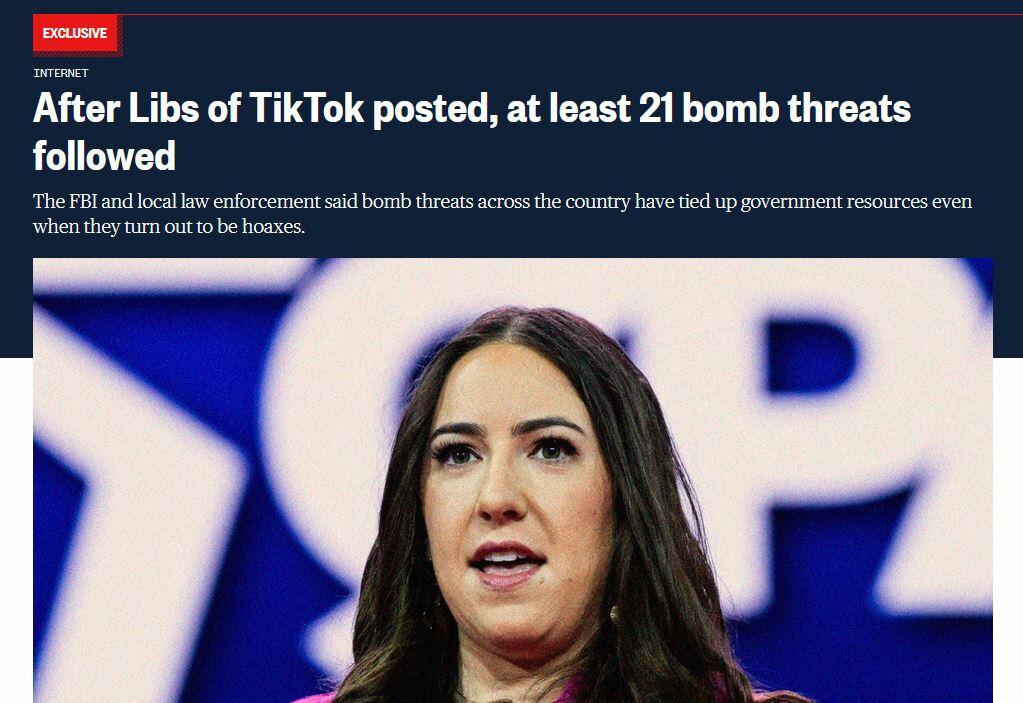
The absolute morons at NBC – specifically tech reporter David Ingram, has just given a massive boost to one of the largest conservative voices exposing leftist degeneracy. 

In a hit-piece divorced from logic, Ingram claims that hugely popular X influencer Chaya Raichik – aka Libs of TikTok, is responsible for 33 instances in which “people or institutions” she highlighted for mentally ill, abusive, disgusting, or otherwise abhorrent behavior, “later reported bomb threats or other violent intimidation.”

The threats, which on average came several days after tweets from Libs of TikTok, targeted schools, libraries, hospitals, small businesses and elected officials in 16 states, Washington, D.C., and the Canadian province of Ontario. Twenty-one of the 33 threats were bomb threats, which most commonly targeted schools and were made via email. –NBC News

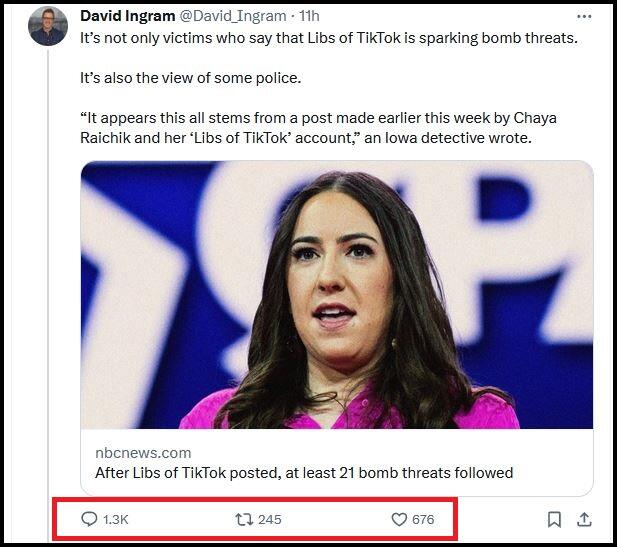
David, you idiot…

Oh…

Ingram earned quite the ‘ratio’ (more comments than ‘likes’, indicating a really stupid tweet).

The replies have been epic:

Tyler Durden
Wed, 02/07/2024 – 21:35

“Innovating Ways To Resist, Heal, & Liberate”: California Defends $250,000 Contract For ‘Woke Kindergarten’ Program

0
“Innovating Ways To Resist, Heal, & Liberate”: California Defends $250,000 Contract For ‘Woke Kindergarten’ Program

Authored by Tom Ozimek via The Epoch Times (emphasis ours),

A low-performing Bay Area elementary school introduced a “Woke Kindergarten” program centered on “abolitionist education” that instructs teachers how to remove barriers to learning by fighting racism and oppression—only to see children’s test scores drop.

Two years ago, Glassbrook Elementary School in Hayward entered into a three-year $250,000 contract with Woke Kindergarten to help kids perform better by teaching educators how to remove learning barriers like oppression, racism, and white supremacy, according to the San Francisco Chronicle.

Woke Kindergarten calls itself a “global, abolitionist early childhood ecosystem” that advocates “abolitionist early education and pro-black and queer and trans liberation” by training teachers how to use “abolitionist” educational concepts and curricula.

The for-profit company was founded by non-binary early educator Akiea Gross, who uses they/them pronouns and self-describes as “an abolitionist early educator, cultural organizer and creator currently innovating ways to resist, heal, liberate and create with their pedagogy, Woke Kindergarten.”

Gross has long been an advocate for extreme views. She has declared that “I believe the United States has no right to exist. I believe every settler colony who has committed genocide against native peoples, against Indigenous people, has no right to exist. Y’all the demons. Y’all are the villains. We’ve been trying to end y’all. Get free of y’all.”

A young boy plays with toys at a pre-school in this file photo. (Matt Cardy/Getty Images)

But two years into the Woke Kindergarten program, Glassbrook student’s test scores have not only failed to show much improvement—they’ve actually plummeted to new lows, per the Chronicle.

English and math scores each fell four percentage points to record lows as of last spring—with less than 4 percent of students proficient in math and less than 12 percent proficient at English.

The Hayward Unified School District did not immediately respond to a request for comment on whether it thinks the $250,000 on the program was money well spent.

Hayward Unified School District Superintendent Jason Reinmann told the Chronicle that the Woke Kindergarten program was backed by parents and teachers alike at the Bay Area school.

Mr. Reinmann added that the program raised classroom attendance by nearly 20 percent, which he suggested was more of a program aim than boosting test scores.

However, some Glassbrook teachers have expressed concern that the program is too progressive, with teacher Tiger Craven-Neeley telling the Chronicle that he was told a key objective of the program was to “disrupt whiteness” at the school.

‘Abolitionist Education’

Zeus Leonard, an education professor at UC Berkeley, told the Chronicle that Woke Kindergarten is based on a relatively new concept called “abolitionist education.”

In a podcast, Mr. Gholdy Muhammad, a professor at the University of Illinois, Chicago, described abolitionist education as a teaching approach centered on dismantling parts of the current educational system and moving towards “ideas and practices of equity and anti-racism, anti-oppression and love of humanity.”

Mr. Muhammad explained that there are five core pillars to abolitionist education: identity, skill development, intellectualism, criticality, and joyfulness.

Identity includes the basic categories of race, class, and “gender” but Mr. Muhammad said it should be seen more broadly from the abolitionist education lens, hinting at a kind of “intersectionality” associated with the oppressor-oppressed dynamic in social justice movements.

Criticality is helping your child to name, understand, and disrupt oppression, putting your learning in the context of the state of the world, social problems, to problem-solve, to understand issues of power, justice, and equity,” the professor explained.

This suggests a possible link to “critical theory,” which James Lindsay, author of “The Marxification of Education” and co-author of “Cynical Theories” described on an episode of Chris Williamson’s podcast as a way of viewing the world through the lens of power dynamics and the oppressed-oppressor dualism.

“At its very bottom, it’s a way to view the world where everything relevant in terms of at least social relations, has to do with the power dynamics that are in society between some group with power and other groups who don’t have as much power,” Mr. Lindsay explained.

“And the object of critical theory is to say that the groups that have power carry certain assumptions and biases and the likes, and they bake that into the systems that they create without realizing that they’re doing it,” he continued.

So the critical theorists job is to expose those biases and uncover those assumptions, so that they can be critiqued and re-examined and usually discarded, dismantled, subverted or otherwise overthrown,” he added.

Mr. Lindsay said there’s a potentially positive aspect to critical theory, in the sense that it can be helpful to adopt a “useful skepticism” regarding various phenomena and identify areas for improvement.

However, Mr. Lindsay said critical theory has been misused by the social justice movement to look for systemic injustices without any or much attempt to understand why certain differences in outcomes exist, reducing explanations to simplistic diagnoses like “systemic racism.”

Tyler Durden
Wed, 02/07/2024 – 21:15

1-In-7 Americans Have Unclaimed Money Or Financial Assets – Here’s How To Redeem

0
1-In-7 Americans Have Unclaimed Money Or Financial Assets – Here’s How To Redeem

Authored by Naveen Athrappully via The Epoch Times (emphasis ours),

Billions of dollars worth of unclaimed funds are being held by state departments across the United States which can be rightfully collected by their legal owners through a simple online process.

Gold ingots in an antique safe, about 100 years old, shown at the “History of Money” exhibition at the Hungarian National Bank in Budapest on Nov. 29, 2011. (Attila Kisbenedek /AFP via Getty Images)

Feb. 1 was Unclaimed Property Day. Unclaimed property refers to “accounts within financial institutions or companies in which there has been no activity generated (or contact with the owner) regarding the property for one year or a longer period,” according to the National Association of Unclaimed Property Administrators (NAUPA). By law, such properties are turned over to the state.

For instance, an individual may have rented a property in Texas by putting up a security deposit. If the person moves to New York and fails to collect back the deposit after a set dormancy period, the money becomes an unclaimed property and goes to the state.

NAUPA estimates that at least one in seven individuals in the United States have unclaimed funds, which at the current population count, comes to roughly 48 million Americans.

More than $5 billion worth of unclaimed property is returned by states annually, the organization stated. This includes bank accounts, safe deposit boxes, utility security deposits, stocks, uncashed dividends, refunds, trust distributions, traveler’s checks, customer overpayments, certificate of deposit, unredeemed gift certificates or money orders, insurance payments or refunds, life insurance policies, uncashed payroll checks, mineral royalty payments, and annuities.

NAUPA is a network managed by the bipartisan National Association of State Treasurers. The association has a dedicated webpage where Americans can search whether they have any unclaimed funds in their name.

Each state has its own database, and the NAUPA webpage gives direct links to state websites where individuals can conduct searches. In addition, NAUPA also maintains a missingmoney.com website.

Unclaimed property is reported to the state in which the company or organization resides. Therefore, it’s common to have unclaimed property in multiple states, especially if you have moved to another state,” NAUPA states.

According to Missing Money, 95 percent of all unclaimed property claims are filed online. The average value of a claim comes to $2,080.

Claiming Process

The claims process for getting back property varies by state. As a general first step, the individual should initiate the claim per instructions provided by the state holding the unclaimed property.

Next, the person will have to prove their ownership with relevant documents. For instance, someone seeking to reclaim a security deposit for a rental property may likely have to show the rent agreement.

The claimant will also have to provide proof of personal identity like a driver’s license, social security number, or passport. Some states allow citizens to submit documentation online while others require mail.

When all relevant documents have been submitted, the unclaimed property department of the state will seek to verify the individual’s right over the funds.

Once verified, the department will begin processing the claim. Certain states can complete the verification and processing steps in less than 30 days. Some states may keep a small amount of the unclaimed property as a holding fee.

If the claim is processed successfully, the state will return back unclaimed funds to the individual. Most states do not usually have a deadline for holding the unclaimed property.

However, the states could auction them off after a certain period of time. In such cases, the owners typically have a right to claim the value of auction from the state.

Unclaimed Properties

The National Association of State Treasurers recommends multiple ways to prevent financial assets from becoming unclaimed properties.

The easiest way to prevent unclaimed property is to maintain activity on all financial accounts. This includes accounts such as your checking, savings, and certificates of deposit. For these types of accounts, making a withdrawal or contribution every now and then is essential,” the association stated.

“Similar activity may be beneficial for brokerage accounts, IRAs, or employer-sponsored plans as well. Even the slightest activity can help keep an account active. This can eliminate the threat of an account becoming inactive and unclaimed.”

The association recommends that individuals keep their contact information with financial institutions updated at all times. If contact info is outdated, a financial institution may fail to get in touch with an individual regarding any unpaid funds and the amount could turn into an unclaimed property.

People should also keep in mind that they may have to pay taxes on assets claimed. Certain funds do not attract taxes, like a rental deposit, as the individual may have already paid taxes on their income which was likely the source of the deposit.

However, unclaimed property like unredeemed gift cards or life insurance policy beneficiary payments can attract taxes.

Tyler Durden
Wed, 02/07/2024 – 18:35

These Are The Most (And Least) Affordable US Cities For Renters On An Average Salary

0
These Are The Most (And Least) Affordable US Cities For Renters On An Average Salary

In 2023, 34% of the 131 million households in the U.S. lived in rented homes.

But which U.S. cities are the most affordable to rent in? The question isn’t just about cost, but about the average salary in each city, and some cities in expensive-seeming states turn out to be relatively affordable.

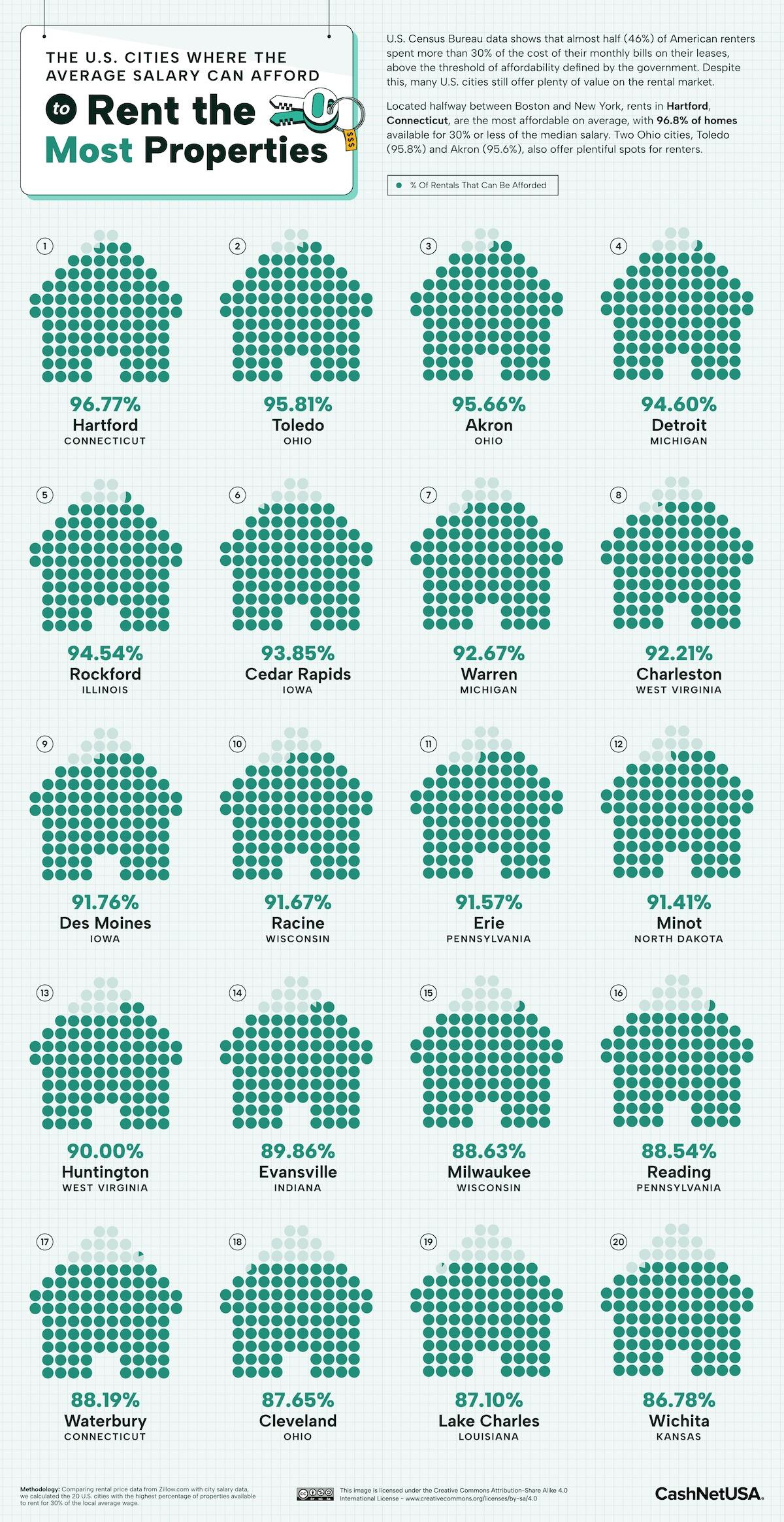
To answer the question, Visual Capitalist’s Pallavi Rao introduces the graphic below.

CashNetUSA found rental price data (as of August 2023) from Zillow.com and compared it to city salary data to calculate the percentage of properties available to rent for 30% or less of the local average income.

Ranked: Most Affordable American Cities for Renters

Ranked first, nearly 97% of the available rentals in Hartford can be rented for an affordable rate, based on average income.

This might be a surprising statistic. Connecticut was the richest U.S. state (by per capita income) for nearly three decades till 2019, and has one of the highest costs of living in the U.S.

However, it’s important to note that this data deals with averages instead of medians. For example, according to data from the Bureau of Labor Statistics, the average hourly wage for a Hartford resident—across all occupations—is slightly more than $33/hour, or close to $70,000 a year. Its median wage is almost $8/hour lower, which comes in at $53,000 a year.

Richer residents, with higher incomes might be skewing the apparent affordability of available rentals.

Note: Data current as of August, 2023.

Toledo and Akron, ranked second and third, have similar rates of affordability, with 95% of their available rentals falling within 30% of the city’s average wage. In fact Ohio has the most number of cities in the top 20, with Waterbury ranked 17th.

Detroit and Rockford round out the top five most affordable cities in the U.S. for renters. Both cities have affordable housing markets, after the Great Recession caused the local economies to tank, in turn causing an increase in crime and decline in population. Post-pandemic, however, both cities are on the rebound with an influx of industries, jobs, and people.

But which U.S. cities are the least affordable to rent in?

With runaway housing prices and local salaries struggling to keep up, some of America’s largest metros feel quite unaffordable.

To answer the question more concretely, CashNetUSA found rental price data (as of August 2023) from Zillow.com and compared it to city salary data to calculate the percentage of properties available to rent for 30% or less of the local average income.

It turns out that plenty of places are shockingly unaffordable for renters. In Miami, Cambridge, and Boston, fewer than 10% of the rental listings are affordable on a the average salary.

For context, Miami’s annual mean salary is close to $59,000, and the Boston-Cambridge area comes in at $80,000 a year. These places are also expensive for homeowners, with both Boston and Miami being in the 10 most expensive cities in the U.S. to buy a home in.

Joining Boston and Miami in the most unaffordable cities is Chula Vista in California, where exactly one in 10 the rental listings could be classified as affordable. That’s fewer than New York’s results (11.63%).

California has four of the top 20 most unaffordable cities for renters, and ranks fifth in the list of states by income inequality.

Tyler Durden
Wed, 02/07/2024 – 18:15

Nuclear Fusion Breakthrough Could Revolutionize Artificial Intelligence

0
Nuclear Fusion Breakthrough Could Revolutionize Artificial Intelligence

Authored by Tristan Greene via CoinTelegraph.com,

A recent physics breakthrough that could serve as a proof-of-concept for the development of nuclear fusion reactors capable of producing near-unlimited energy has finally passed its official peer-review successfully. 

On Dec. 5, 2022, a team of researchers at the United States National Ignition Facility (NIF) in California recorded data indicating that it had achieved a nuclear fusion reaction that created more energy than it took to produce. The reported results were the first of their kind.

In physics, this is sometimes colloquially referred to as a “free lunch,” meaning a nuclear fusion reactor could one day be scaled to the point where it is capable of producing near-unlimited energy.

If the NIF team’s reported results were correct, their breakthrough research could serve as a platform for the future technology that might help us eliminate our dependence on carbon energy and supercharge fields where energy scarcity presents as a roadblock, such as artificial intelligence (AI) and quantum computing.

But, as science communicator Carl Sagan put it, “Extraordinary claims require extraordinary evidence.” News of the breakthrough was taken with both a measure of optimism and a grain of salt by the physics community. The general consensus, at the time, was that people should wait until peer review before shouting “eureka!” at the findings.

Eureka time?

The peer review is in, and according to a report in the APA Physics journal, multiple teams have confirmed and replicated the results.

Recreating the experiment was no easy feat. To achieve the original fusion reaction, NIF scientists used a technique called inertial confinement fusion. This form of fusion involves bombarding heavy hydrogen atoms with nearly 200 lasers, causing them to superheat and, ultimately, fuse at pressures greater than those found within the sun.

While this early work has only just been confirmed through peer review, the NIF device could serve as a platform by which practical fusion reactors can be built. It’s currently too soon to predict when a viable fusion reactor might be achieved.

Next-generation energy

Once realized, however, the free availability of so-called next-generation energy sources could supercharge the engineering and development of adjacent technologies such as AI and quantum computing. 

Fields such as those, where energy bottlenecks at play are perceived to be the next great hurdle to scale, could see generational leaps in progress once those roadblocks are removed.

As Cointelegraph recently reported, OpenAI CEO Sam Altman said there’s no way to build the AI systems of the future until there’s a fusion energy breakthrough. It’s possible that this work from the NIF team could be the first confirmed step toward that breakthrough technology.

OpenAI might be in the best position to understand the energy requirements needed to train systems such as ChatGPT, but it bears mention that Altman is personally invested in a private company working on fusion.

Tyler Durden
Wed, 02/07/2024 – 17:55