66.2 F
Chicago
Friday, September 18, 2026
Home Blog Page 2950

Biden Administration Wants To Force Foster Parents To Sign LGBTQ Pledge

0
Biden Administration Wants To Force Foster Parents To Sign LGBTQ Pledge

Authored by Alice Giordano via The Epoch Times (emphasis ours),

Republican lawmakers and Christian organizations are reacting with outrage to a newly proposed policy by the  Biden administration that would force foster parents to sign a contract agreeing to promote gender ideology in their homes.

Some U.S. foster children are issued trash bags for their belongings when taken into state custody. (Hope in a Suitcase)

“The Safe & Appropriate Foster Care Placement Requirements” calls for states to ensure that LGBTQ children are placed in environments  “free from hostility or discrimination.”

It also requires potential foster parents to undergo training to develop “knowledge and skills to support the needs of LGBTQ children.”

The Notice of Proposed Rulemaking (NPRM) cites what it calls a “recent confidential survey” showing that 32 percent of foster children between the ages of 12 and 21 identify as having a diverse sexual orientation or gender identity.

The NPRM also cites a 2019 study by a group of psychology professors that found that LGBTQ+ youth are almost 2.5 times as likely as heterosexual youth to experience foster care placement.

The Biden administration also cites multiple recent surveys by The Trevor Project showing that foster children identifying as LGBTQ+ are 50 percent less likely to be suicidal, use drugs, or have mental health issues if they are allowed to talk openly about their sexual identity with caregivers.

Organizations like The Ethics & Religious Liberty Commission (ERLC) of the Southern Baptist Convention accuse the Biden administration of “cherry picking” evidence to create a “false assumption” that affirming a child’s LGBTQ sexuality is the only way to provide a safe foster home.

Contrary to such assertions by HHS, a foster family should not have to agree with every political, spiritual, and other belief of a child to be deemed “safe and proper,” the group wrote in a statement.

“A foster parent’s biblical belief regarding sexuality and gender identity does not detract from their ability to warmly welcome a vulnerable child into their home. Inevitably, there will be many beliefs on which the child and family disagree.”

The group predicts that if the mandate is implemented, it will cause a substantial reduction in the already deficient number of foster homes in the U.S.

Sam Whiting, a staff attorney at the Massachusetts Family Institute (MFI), told The Epoch Times that the mandate potentially puts foster parents who also have biological children in danger of being labeled abusive and could even lead to the state attempting to take custody of their children.

“If you have a foster family that doesn’t believe in teaching gender-affirming ideology to their own kid, the next step could be to refer them to CPS,” said Mr. Whiting.

Earlier this month, six Republican senators sent a letter to Department of Health and Human Services (HHS) Secretary Xavier Becerra expressing what they called “profound concerns” over the proposed policy.

All children in foster care, regardless of their sexual orientation or gender identity, deserve a safe and proper placement,” the senators wrote.

“However, this proposal goes beyond statutory requirements to force states to adopt extreme gender ideology in their placement decisions.”

Targeting ‘Faith-Based Child Welfare Providers’

The U.S. senators who sent the letter to Mr. Becerra are Roger Marshall (R-Kan.),  Tom Cotton (R-Ark.), John Barrasso (R-Wyo.),  Markwayne Mullin (R-Okla.), Michael Lee (R-Utah), and Cindy Hyde-Smith (R-Miss.).

They accused the Biden administration of using the LGBTQ+ foster care policy as part of a “campaign to undermine faith-based child welfare providers” under the guise of “advancing equity.”

This will “alienate, if not exclude” many families of faith that were considering fostering—a prediction that has already proven true in some states, the lawmakers warned.

According to a study by the Becket Fund For Religious Liberty, when the city of Boston stopped partnering with faith-based organizations to provide foster care for children, the number who aged out of the system rather than be placed in a home increased by a staggering 50 percent.

The study also showed that Christian homes are three times more likely to foster a child and two times more likely to adopt a foster child than non-Christian homes.

Attorneys general from 19 states also submitted letters of opposition to the policy. They called the proposal unconstitutional and potentially illegal, citing the Supreme Court landmark case Fulton v. City of Philadelphia. In that ruling, the Court determined that the government cannot prohibit a religious organization from excluding same-sex couples from becoming foster parents.

The Biden Administration is proposing a rule that is unconstitutional, without authority from Congress, and which almost certainly will drive parents of faith out of the foster care system,” Nebraska Attorney General Mike Hilgers wrote.

Opposition has come from child protection agencies including the Texas Department of Family Protective Services and the Utah Department of Health and Human Services. Both agencies said the rule would be a “further disincentive” to foster care providers.

The Biden administration did not respond to inquiries from The Epoch Times about the criticism.

Some states are already rejecting potential foster parents over their religious beliefs against LGBTQ ideology.

Adoptive Parents Being Rejected

Catholic World Report in August reported on an Oregon widowed mother of five who was prohibited from adopting two siblings from foster care because she did not support teaching alternative sexual orientation to children.

In Massachusetts, a Catholic couple has filed a lawsuit against the Department of Children and Families (DCF)  for rejecting their application after they passed a home study and underwent extensive training.

According to their lawsuit,  Mike and Kitty Burke were rejected because of answers they gave about gender dysphoria and a child’s sexual orientation. Mike, an Iraq War veteran, and Kitty, a special ed assistant, were denied even though they were willing to take hard-to-place children with special needs.

After months of interviews and training, and after years of heartbreak, we were on the verge of finally becoming parents,” the couple said in a statement.

“We were absolutely devastated to learn that Massachusetts would rather children sleep in the hallways of hospitals than let us welcome children in need into our home.”

A DCF spokesperson told The Epoch Times that the agency does not comment on pending litigation.

According to a 2022 DCF report, more than 10,000 children in Massachusetts are under the care of the DCF.

Tyler Durden
Fri, 02/02/2024 – 17:40

Bolton Goes On CNN To Rip Trump For Having ‘No Inclination’ To Support Ukraine

0
Bolton Goes On CNN To Rip Trump For Having ‘No Inclination’ To Support Ukraine

John Bolton went on CNN to raise the alarm over President Trump potentially taking office again and what this means for Ukraine policy. Trump’s former national security advisor expressed that he’s “very worried” for the future of Washington support to Ukraine’s military because Trump as the Republican frontrunner “doesn’t have any inclination” to support Kiev.

Already the past months have witnessed a string of setbacks and negative news for the Zelensky government. Most recently there’s an open conflict between the Ukrainian president and his Commander-in-Chief of Ukraine’s armed forces, Gen. Valerii Zaluzhny. Zaluzhny wrote in a new CNN op-ed, “We must contend with a reduction in military support from key allies, grappling with their own political tensions.”

So hawks like Bolton want to see the next president stay muscular on Ukraine support, but the fear is that Trump has essentially given up on the Ukrainians, given the battlefield situation is already clearly going Russia’s way, also given Ukraine’s well-known and widespread corruption. Trump on the campaign trail has vowed to negotiate an end to the war within “24 hours”. Watch Bolton rip his former boss in the below:

At one point in the segment Bolton says that President Joe Biden “had it pretty well nailed” when he called former President Donald Trump a “fucking asshole” in leaked private comments.

Below is a transcript of the segment’s introduction…

JOHN BERMAN: New reporting on how President Biden really feels about Donald Trump behind closed doors, Politico writes, quote, “the president has described Trump to longtime friends and close aides as a sick F who delights in other’s misfortunes, according to three people who have heard the president use the profane description. According to one of the people who has spoke with the president, Biden recently said of Trump, what a blinking blank hole the guy is.”.

I’m joined now by former national security adviser under then President Trump, Ambassador John Bolton, who has a new forward for his memoir, The Room Where It Happened. That forward, titled The Room Where It Will Happen Again in the first line, is “Donald Trump may well be reelected president this November, becoming only the second person to win nonconsecutive terms.”

Ambassador, thank you so much for being with us that Politico reporting on the choice words that President Biden uses to describe Donald Trump, how closely does that align with your view?

JOHN BOLTON: Well, I think in personality terms, I think that President Biden has it pretty well nailed.

But I would just say this. It’s not the personality of Donald Trump that’s the problem. It’s his lack of competence to do the job, the personalities unpleasant. But many people say, oh, we can we can deal with the personality. I like something else.

It’s not the personality that’s the problem. He doesn’t understand the job, particularly in the national security space. He didn’t learn much in the first four years. He certainly hasn’t learned anything since then.

* * *

We can only observe that Trump’s main mistake during his first tenure was bringing on fanatical Neocons like Bolton in the first place, who is one of the representatives of the very “swamp” that Trump hoped to drain.

Tyler Durden
Fri, 02/02/2024 – 17:20

Trump Election Case Now On Hold For 50 Days Amid Immunity Appeal

0
Trump Election Case Now On Hold For 50 Days Amid Immunity Appeal

Authored by Jack Phillips via The Epoch Times (emphasis ours),

Former President Donald Trump’s federal election case has been on hold for 50 days as he appeals to a higher court on grounds that he is immune from prosecution.

(Left) Special counsel Jack Smith in Washington on Aug. 1, 2023. (Right) Former President Donald Trump. (Drew Angerer/Getty Images; David Dee Delgado/Getty Images)

On Dec. 13, 2023, U.S. District Judge Tanya Chutkan issued a pause in the election case in Washington and has signaled, on at least two occasions, that the March trial date that was scheduled last year will likely not hold. The judge also halted the submission of any major motions by President Trump’s attorneys and federal prosecutors.

The case will not resume until the D.C. Circuit Court of Appeals resolves the question of whether the former president is immune from criminal prosecution. His attorneys have argued that this is because his activity after the 2020 election was part of his official duties.

When the appeals court, which hasn’t signaled when it will issue an order, renders its decision, President Trump will likely appeal the matter to the U.S. Supreme Court. If that happens, it’s not clear when the election case will resume.

The timing of a decision by the panel will indeed be a critical determinant of whether the case can go forward expeditiously, Daniel Richman, a Columbia University law professor, told Politico this week. “Quite a few stars would have to align before the trial can proceed,” he added.

Matthew Seligman, a former appeals court law clerk who filed a separate court motion in the immunity case, told the outlet that it’s not clear when the D.C. appeals court will issue a decision. There’s no sign that “we’re really close to a point where the judges in the majority would consider taking whatever measures they could … and it’s not clear what those are,” he said.

D.C. Appeals Court Judge Karen Henderson, the senior judge on the panel, has said she opposes taking the immunity case on an expedited timeline. She also has the right to write the majority opinion if she is part of the majority, as she is the most senior judge on the panel. If she dissents, the judge could also delay the ruling for weeks, the article noted.

Other Activity

In January, Judge Chutkan signaled for a second time that there is a good chance the Trump trial date will likely be postponed to a later date. In a case involving a Jan. 6 defendant, she scheduled a trial for that individual for early April.

Special prosecutor Jack Smith, who brought the charges against the former president, has said that President Trump’s trial will likely take four to six weeks to complete, meaning that the March 4 date will very likely push up against or even conflict with the Jan. 6 defendant’s trial.

Weeks before that order, the U.S. district judge wrote that the March 4 date was meant to provide both the Trump team and the Smith team with more time to prepare. She also adopted President Trump’s lawyers’ recommendations to prevent both the defense and prosecution from issuing new “further substantive pretrial motions without first seeking leave from the court” and that the former president “forfeits no arguments or rights by choosing not to respond at this time.”

Judge Chutkan wrote in January that the Trump team could file more objections to any recent court motions made by the special counsel, even if the D.C. Court of Appeals sends the case back to her jurisdiction.

Several weeks ago, multiple legal analysts said that the March 4 trial start appears to be unlikely at that point. One, a former federal prosecutor, has said it appears unlikely that the trial will start before the November 2024 election due to the appeals process.

“That process will take months, and unless Judge Chutkan lifts the stay, there is a possibility that Trump’s trial does not happen before the November election. The other trial scheduled in April is a reflection of that reality,” Neama Rahmani, the head of West Coast Trial Lawyers, said.

Prosecutors acknowledged in December that the case had been paused, but they said the government would “continue to meet its own deadlines as previously determined” by the court “to promote the prompt resumption of the pretrial schedule” if and when the case returns to Judge Chutkan.

President Trump is accused of conspiring to overturn the 2020 election, which he has vehemently denied. It is one of four criminal cases the Republican candidate is facing as he vies to return to the White House this year.

He has pleaded not guilty to the four cases against him, arguing that the charges were brought to denigrate him politically.

He also faces a civil lawsuit brought by New York Attorney General Letitia James and was recently ordered by a jury to pay writer E. Jean Carroll $83 million in a defamation case she brought against him. President Trump also denied the accusations made in that case.

The Associated Press contributed to this report.

Tyler Durden
Fri, 02/02/2024 – 15:45

Israel Launching Airstrikes In Eastern Syria: Reports

0
Israel Launching Airstrikes In Eastern Syria: Reports

Update(1535ET): It’s currently just after 11:30pm in the Middle East, and weather is clear. The Biden administration has begun its retaliatory strikes

FIRST US MILITARY RETALIATORY STRIKES UNDERWAY IN SYRIA: ABC

Regional analyst Kevork Almassian comments as this initial wave of attacks begins: “The US air force is bombing Eastern Syria near al-Mayadeen. Syria is a sovereign country which has not attacked the United States. A clear violation of international law.

The Department of Defense has since suggested these initial eastern Syria strikes might be the work of a partner air force, possibly Israel(?). Additionally:

SKY NEWS ARABIA REPORTING STRIKES ON EASTERN SYRIA WERE LAUNCHED BY ISRAEL NOT US

* * *

French container shipping giant CMA CGM has announced suspension of all its Red Sea transit due to security risks, Bloomberg has reported Friday, adding to a growing list of major firms now deeming the area too unsafe. 

The Bloomberg note additionally confirms that “CMA CGM will keep operating in the northern Red Sea but will not send its fleets through the southern part that is unavoidable for any vessel seeking to use Egypt’s Suez Canal to go between Europe and Asia.” With every addition of a shipping major, there’s yet further confirmation that the US-led ‘Operation Prosperity Guardian’ is failing

Via Reuters

“Hundreds of container ships and large numbers of oil tankers and commodity carriers have elected to avoid the area altogether,” Bloomberg underscores.

Until this week, CMA CGM had continued sending some vessels through the vital transit passage despite the almost daily Houthi missile and drone attacks, but which have been supported by French navy escort. But at this point it appears even the large Western warship presence isn’t enough.

This week, the US Navy saw its closest call yet when a Houthi-launched cruise missile came within a mere mile of the destroyer USS Gravely.

Details have only just emerged late in the week based on the accounts of several US defense officials. Presumably other longer range anti-air defenses failed as the missile was inbound close the ship. CNN describes:

In the past, these missiles have been intercepted by US destroyers in the area at a range of eight miles or more, the officials said. But the USS Gravely had to use its Close-In Weapon System (CIWS) for the first time since the US began intercepting the Houthi missiles late last year, which ultimately succeeded in downing the missile, officials said.

The CIWS, an automated machine gun designed for close-range intercepts, is one of the final defensive lines the ship has to shoot down an incoming missile when other layers of defense have failed to intercept it.

So this “last line of defense” which utilizes a 20 mm radar-guided canon had to be activated. The mounted weapon is a General Dynamics and Raytheon-produced ship defense system which engages closely inbound targets

Fox News’ Pentagon correspondent Lucas Tomlinson has said this week marks the “first time in history CIWS (‘sea-wiz’) has been used in combat from a warship to destroy an incoming cruise missile seconds away from impact.

What has been clear based on other recent incidents is that Houthi drones and missiles are in some instances slipping through the Western navel coalitions ‘defense umbrella’.

We detailed a week ago how the US Navy essentially “lost a battle at sea” given that a missile landed in the water very close to a commercial vessel which was being escorted by no less than three US warships. During that time two American merchantmen – the Maersk Detroit and the Maersk Chesapeake – had been attempting to run the Bab al-Mandeb from south to north while being covered by the USS Gravely. But as with this fresh incident of the Gravely’s CIWS system having to engage at close range, one missile apparently slipped through in that Jan.17 encounter.

Below is a very different ‘close call’…

Tyler Durden
Fri, 02/02/2024 – 15:35

Forget AI Bubble. A New One Emerges As Space Firms Prepare For IPO Launchpad

0
Forget AI Bubble. A New One Emerges As Space Firms Prepare For IPO Launchpad

The world’s first commercial spaceplane entered the final testing phase ahead of its first flight in 2024 in December. Now, the company behind the orbital-class spaceplane, Sierra Space Corp., is laying the groundwork for an initial public offering and possible acquisitions.

On Thursday, Sierra Space Chief Executive Officer Tom Vice spoke with Bloomberg about Sierra’s plans to tap public markets. Vice said IPO timing is uncertain but will take the leap “when the market looks like it’ll give us the right credit for valuation.”

“We want access to the public markets,” the exec said, adding, “We’ve been working for a year and a half to make sure that we are public company ready.”

When Powell starts cutting interest rates? 

Vice also said “inorganic add-ons” and “consolidation activity” – this is fancy CEO speak for mergers and acquisitions. 

Vice’s comments were ahead of a media event yesterday at NASA’s facility in Sandusky, Ohio. The space agency revealed Sierra’s Dream Chaser to the public, indicating it could resupply cargo to the International Space Station. 

At the event, Vice said, “The most significant industrial revolution is underway in space.” 

He continued: “The signs are all around us that we’re now living in the orbital age.”

Separately, a recent Bloomberg report indicated Elon Musk’s SpaceX company might spin off Starlink for an IPO later this year. 

So, forget the AI bubble. There’s a new one emerging: space. 

Tyler Durden
Fri, 02/02/2024 – 15:20

VIX – The Calm Before The Storm

0
VIX – The Calm Before The Storm

Via SchiffGold.com,

The VIX, often referred to as ‘Wall Street’s fear gauge,‘ is currently portraying a sense of calm among investors, registering well below the 20 level. 

For those not acquainted, the VIX draws its value from S&P index options with near-term expiration dates, providing a 30-day projection of volatility.

While the VIX isn’t a precision instrument, it serves as a barometer of market sentiment.

Presently, the VIX hovers near its lowest point since January 2020, a period preceding the upheaval caused by the COVID-19 pandemic. Investors, lifted by this low volatility, have been propelling the equity rally for a substantial eight to nine weeks.

In early January, investor Steve Eisman highlighted the excessive confidence that marked the end of 2023 in the markets. For those unfamiliar, Steve Eisman gained notable fame for his role in ‘The Big Short,’ portrayed by Steve Carell in the movie adaptation of Michael Lewis’ book, with the character’s name changed to Mark Baum.

In a CNBC appearance, Eisman expressed unease about the current year, stating, “Everybody’s just a little too fricking happy.”

Over the past year, the S&P 500 index has surged by 24%. There is a strong inverse correlation between the US equity markets and VIX. As the VIX declines, stocks typically rally, and vice versa. 

Eisman’s cautionary stance towards market hype resonates with the age-old trader axiom concerning the VIX: ‘When the VIX is high, it’s time to buy, when the VIX is low, it’s time to go.’

At present, the prevailing VIX levels reflect a naive yet robust risk appetite in the financial markets, spurred by discussions of rate cuts for 2024.

“The market scaled a wall of worry throughout the entire year [2023],” remarked Eisman, highlighting that the majority of investors currently harbor optimistic sentiments about the economy.

He added, “Everybody is entering the year so bullish that if there are any disappointments, what’s going to sustain the market?”

The clear message here is that investors currently feel at ease driving up equities, buoyed by higher returns from the Magnificent Seven and a more accommodating interest rate environment, with no significant market shocks in sight.

[ZH: And remember, the lagged yield curve is screaming for some serious volatility ahead…]

If the equity rally continues to gain momentum, there’s a potential for the rumored market melt-up. For the cautious observer, this raises sustainability concerns. Warren Buffett’s timeless advice resonates perfectly in this season of soaring equity prices: ‘When everyone else is scared, get greedy—and when everyone else is greedy, get scared.’

Tyler Durden
Fri, 02/02/2024 – 15:00

Exxon, Chevron Beat Estimates, Report Second-Biggest Annual Profits In Past Decade

0
Exxon, Chevron Beat Estimates, Report Second-Biggest Annual Profits In Past Decade

One wouldn’t know it from their stock price today, which has been slammed by tech bros shorting anything that does not mention AI at least 100 times in its press release/conference so they can fund their purchase of META 20% higher on the day, but in a time when two-thirds of US companies do not generate any GAAP profits, two of America’s cash flow titans – ExxonMobil and Chevron – reported their second-biggest annual profits in a decade thanks to surging oil production which offset a slide in prices that tempered earnings from the records hit in 2022.

At a time when OPEC+ and Saudi Arabia has been hurting due to a flood of oil by US companies, America’s oil supermajors increased output sharply in their own backyard in 2023, pursuing a strategy of doubling down on oil and gas that has prompted blowback over their commitment to cutting emissions .

Exxon posted full-year net income of $36bn, down from $55.7bn the previous year due to a $17.9BN drop in price/margin, but otherwise its biggest since 2012 as Exxon CFO Kathryn Mikells hailed a “great end to a great year”.

It also generated $55BN in cash from operations and returned $32.5BN to shareholders in the form of dividends and buybacks.

Also, as noted previously, Exxon’s nascent trading operation earned more than $1 billion in the last three months of 2023, an early sign the company’s expansion strategy is paying off. Exxon posted a $1.14 billion gain from trading for the fourth quarter, helping cushion the $410 million blow inflicted by lower oil prices and fuel production, the company said Friday. The company’s trading strategies were particularly successful in crude oil and refined-products markets, said Chief Financial Officer Kathy Mikells.

Exxon’s smaller peer, Chevron, reported net income of $21.4bn, down from $35.5bn the previous year, but otherwise its strongest since 2013.

Exxon’s net income for the fourth quarter was $7.6bn compared with $12.8bn the previous year. Chevron’s fell from $6.4bn to $2.3bn. Both companies were hit by writedowns flagged in January relating to paring back investment in California, where moronic regulators have taken a strong line against fossil fuel producers.

Bottom line: both companies beat earnings forecasts as bigger-than-expected oil output from shale fields helped cushion the blow from weakening crude prices.

Here are give key takeaways from Exxon’s earnings, courtesy of Bloomberg:

  1. Exxon is “well ahead” of its plan to double earnings-per-share from 2019 to 2027 at constant oil prices, CFO Kathy  Mikells said
  2. Executives pushed back on analysts’ concerns about Exxon’s high fourth-quarter capital spending. The company sometimes needs to front-load spending to take advantage of opportunities, with Guyana and the Permian benefiting from this approach, CEO Darren Woods said.
  3. Trading profits will be “embedded” into Exxon’s earnings going forward, but will bounce around quarter-to-quarter, Woods said. The company is still focused on trading around its assets rather than speculative bets
  4. Woods and Mikells highlighted Exxon’s strong project “execution,” which comes in marked contrast to peers that have struggled with major developments, like Chevron
  5. Chemicals will be “marginally better” this year than in 2023, but there won’t be a radical improvement, Woods said. Exxon’s new projects are both earnings and cash flow positive in the current environment, he said

And here is Chevron:

  1. No new delays at Tengiz, a critical megaproject in Kazakhstan; Chevron is on track for full startup in 2025, at which point it will “generate a lot of cash,” CFO Pierre Breber says
  2. Capital spending in the Permian Basin shouldn’t increase much more than the current $5 billion even as Chevron ramps from 867,000 barrels a day to 1 million barrels a day through next year
  3. The $10 billion to $15 billion of assets flagged for sale after the Hess transaction are more likely to come from Chevron’s legacy portfolio than the acquired company, CEO Mike Wirth said.
  4. Permian performance was much improved in the fourth quarter, especially drilling times, easing concerns from earlier in the year
  5. Chevron will continue to buy back shares consistently and not only when profits are healthy, CFO Breber says. The company bought back 5% of its outstanding stock last year, more than in 2022 when it had record profits.

While high commodity prices in the wake of Russia’s full-scale invasion of Ukraine pushed oil and gas companies globally to record profits in 2022 before receding last year, the steep drop in 2023 depressed revenues and profits, but in the end both US supermajors managed to more than offset what would have been a far worse outcome by increasing domestic production contributing to a boom in American output that took the market by surprise and helped keep a lid on prices even as the Opec+ group of oil exporters implemented substantial production cuts.

According to the DOE, the US pumped 13.3mn barrels of oil a day in November, more than any country in history and despite a sharp drop in operating wells. Much of the production growth has focused on the sprawling Permian Basin, which stretches across Texas and New Mexico, and where Exxon recently acquired giant shale driller, Pioneer Natural Resources which dominates the Midland Basin.

Exxon said combined 2023 output in the Permian and Guyana — where it has a stake in the biggest oil discovery of the past decade — was up 18%. Its overall US oil output rose to 851,000 barrels a day during the quarter from 789,000 b/d a year ago.

Chevron increased its Permian production by 10% in 2023, despite struggles with the productivity of ageing wells in the oilfield earlier in the year. It produced 1.16mn b/d in the US in the quarter versus 895,000 b/d previously, boosted in part by its acquisistion of PDC Energy.

“We had a strong quarter and it was really led by record production in the Permian,” Chevron’s chief financial officer Pierre Breber told the Financial Times. “There’s always things that are happening — it’s a big business — but we delivered on the plan.”

Unlike their woke, and increasingly more broke, European rivals which have idiotically shifted to renewable sources such as wind and solar, Exxon and Chevron have committed to increasing oil and gas production; to that end, both companies in October announced megadeals to acquire rivals, which are being reviewed by US regulators. Exxon announced it is buying Pioneer Natural Resources, the biggest producer in the Permian, for $60bn, while Chevron is paying $53bn for Hess, giving it access to the Guyana discovery as well as assets in the Bakken shale of North Dakota.

Sensing that the time of global ESG idiocy is over, Exxon recently took the unusual step of suing climate activists to block an emissions resolution from appearing at its annual meeting, arguing the regulators have been too lax in allowing repeat motions on to the ballot.

“We support the right of investors to bring proposals, but the process to get proxy proposals excluded is just flawed, with activists that are masquerading as investors who make the same proposals year after year that are garnering only minimal support along the way,” said Mikells.

Both companies ratcheted up capital expenditure during the year as Wall Street eased constraints on the industry’s ability to spend. Exxon’s outlay rose from $22.7bn to $26.3bn, while Chevron’s was up from $12bn to $15.8bn. They also ramped up share buybacks and dividends following last year’s profit haul, distributing $32.4bn and $26.3bn, respectively, to investors.

Shares in both companies rose about 2 initiall in pre-market trading, but have since dripped in the red as idiots short their stock to fund purchases of such AI bubbles as META and NVDA.

Tyler Durden
Fri, 02/02/2024 – 14:40

Retirement Savers Are Piling Into Stocks. Is That A Good Idea?

0
Retirement Savers Are Piling Into Stocks. Is That A Good Idea?

Authored by Lance Roberts via RealInvestmentAdvice.com,

As the financial markets grind higher, retirement savers have consciously decided to add more to equity risk. Such was the result of a recent Bloomberg survey.

“Retirement savers want more stocks in their portfolios as a hedge against inflation, potentially offering a long-term tailwind for equities as societies age, according to the latest Bloomberg Markets Live Pulse survey.

Almost half of the 252 respondents said they were putting more funds into stocks as a response to rising prices – far eclipsing the 6% who said they’d be adding the traditional inflation hedge, gold.” – Simon White

While the respondents said they were buying stocks as a hedge against inflation, which may be part of the answer, the reality is that a surging bull market over the last 14 years is more likely the real reason. The same psychology permeated into the next question, which asked which asset classes would do the best as society ages. Given the real-world experience of most individuals of skyrocketing home prices and stocks, it was not surprising to see both ranking as top answers.

Given the recency bias of most individuals, the responses were unsurprising given the outsized proportion of market gains relative to the long-term averages. Such was the recent topic of “Portfolio Return Expectations Are Too High.” To wit:

The chart shows the average annual inflation-adjusted total returns (dividends included) since 1928. I used the total return data from Aswath Damodaran, a Stern School of Business professor at New York University. The chart shows that from 1928 to 2023, the market returned 8.45% after inflation. However, after the financial crisis in 2008, returns jumped by nearly four percentage points for the various periods. After over a decade, many investors have become complacent in expecting elevated portfolio returns from the financial markets. However, can those expectations continue to be met in the future?”

That last sentence is critical.

A Staggering Shortfall

There are a couple of apparent reasons individuals are willing to take on increased risk in portfolios, the most obvious being the rather significant savings shortfall. For example, a previous survey by CNBC found that most Americans will need $1.3 million to retire comfortably.

“When it comes to how much they will need to retire comfortably, Americans have a “magic number” in mind — $1.27 million, according to new research from Northwestern Mutual.

The survey found that respondents in their 50s expected to need the most when they retire — more than $1.5 million. For those in their 60s and 70s, who are close to or in retirement, those expectations dropped to less than $1 million.”

The problem with that data is that most individuals are nowhere close to those levels of savings.

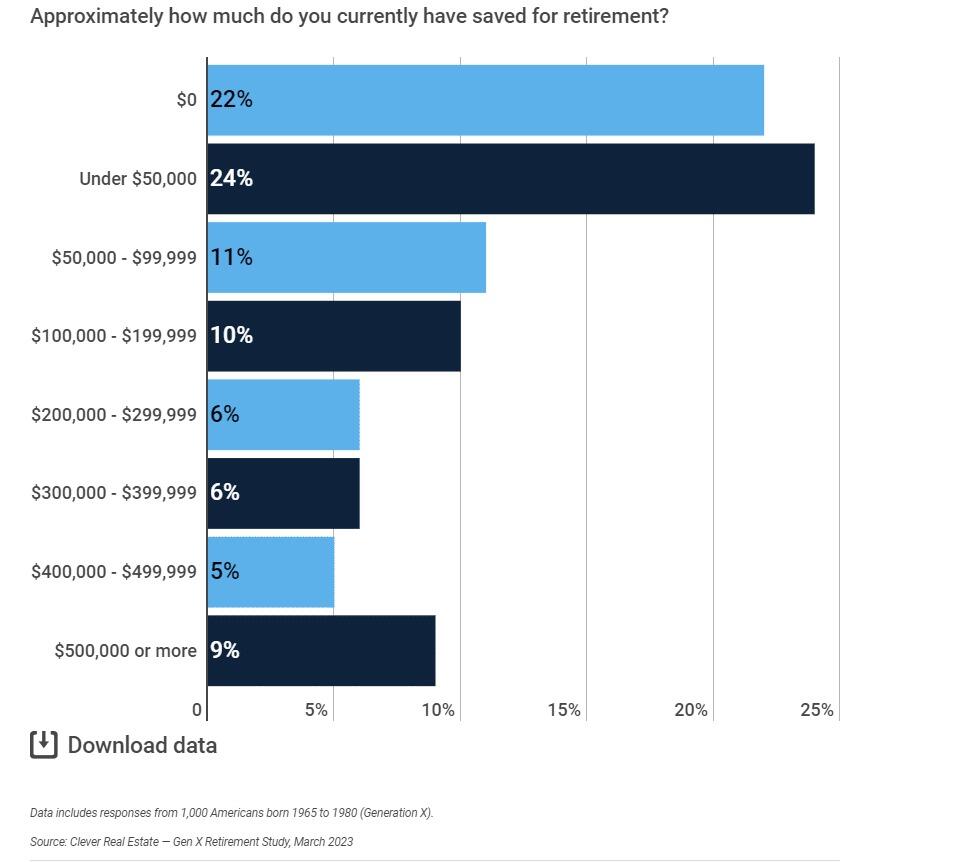
“A recent survey conducted by Clever Real Estate polled 1,000 Gen Xers born between 1965 and 1980 to find out how they fare regarding personal finances and the road to retirement. A staggering 56% of Gen Xers said they have less than $100,000 saved for retirement, and 22% said they have yet to save a single cent.

While the desire to retire may be there, the money just isn’t. A whopping 64% of respondents said they stopped saving for retirement not because they don’t want to but because they simply can’t afford to.

Furthermore, a LendingClub survey shows that 61% of U.S. consumers live paycheck to paycheck.

It’s a dire situation for most Americans, particularly those retirement savers. As such, it is unsurprising that more individuals are looking to the stock market as a solution to make up the shortfall.

However, therein lies the risk.

The Risk Of Risk

One of the incredible genetic traits of humans is the ability to forget pain. The trait is essential to the survival of the species. If cavemen clearly remembered the agonizing pain of being attacked by a predator, they would have likely never left their caves to hunt. If women vividly remembered the excruciating pain of childbirth, they would probably never have more than one. In the financial markets, investors all too soon forget the painful memories of bear markets, particularly when the bull is stampeding.

Currently, the bull market that began in 2009 remains firmly intact. Despite a mild stumble in 2022, the long-term trend remains higher, and investors feel confident that the trend will remain indefinitely. However, a risk has been overlooked amid above-average returns over the last decade. That risk is liquidity, which we discussed in more depth in “The Markets Are Frontrunning The Fed.” 

“The psychological change is a function of more than a decade of fiscal and monetary interventions that have separated the financial markets from economic fundamentals. Since 2007, the Federal Reserve and the Government have continuously injected roughly $43 Trillion in liquidity into the financial system and the economy to support growth. That support entered the financial system, lifting asset prices and boosting consumer confidence to support economic growth.”

The risk of reduced monetary liquidity may become problematic for stocks to sustain current returns. As shown below, nearly 100% of the index returns from 1900 to the present came during the 4-periods of multiple expansion. With valuations currently very elevated, the reduction of monetary liquidity may lead to the next secular period of “multiple contraction,” which would yield much lower rates of returns.

In other words, retirement savers currently allocating more savings to equity risk could well be setting themselves up for an extended period of higher volatility and lower expected rates of return.

Conclusion

As Jeremy Grantham previously noted:

“All 2-sigma equity bubbles in developed countries have broken back to trend. But before they did, a handful went on to become superbubbles of 3-sigma or greater: in the U.S. in 1929 and 2000 and in Japan in 1989. There were also superbubbles in housing in the U.S. in 2006 and Japan in 1989. All five of these superbubbles corrected all the way back to trend with much greater and longer pain than average.

Today in the U.S. we are in the fourth superbubble of the last hundred years.”

Therefore, unless the Federal Reverse is committed to a never-ending program of zero interest rates and quantitative easing, the eventual reversion of returns to their long-term means is inevitable.

It is hard to fathom how forward return rates will not be disappointing compared to the last decade. However, those excess returns were the result of a monetary illusion. The consequence of dispelling that illusion will be challenging for retirement savers.

However, throughout history, investors have repeatedly invested the most into equity risk and the worst possible times. For retirement savers, this time will likely be no different.

Tyler Durden
Fri, 02/02/2024 – 11:45

The Delaware Judge Who Nuked Elon Musk’s $55 Billion Package Is Steeped In Bidenworld

0
The Delaware Judge Who Nuked Elon Musk’s $55 Billion Package Is Steeped In Bidenworld

Earlier this week, a Delaware judge voided Elon Musk’s $55 billion pay package after a Tesla shareholder, who owned just 9 shares, filed a lawsuit claiming that the package was excessive and unfair – despite the fact that it was based on milestones which the board and 80% of shareholders agreed upon, and which Musk achieved.

The judge in the case, Kathleen McCormick of the Delaware Chancery Court (in which there is no jury), agreed with the shareholder, Richard Tornetta, that Tesla’s board lacked independence in crafting Musk’s pay – and will now have to go back to the drawing board to put together a new compensation plan.

So much for capitalism, right?

The move prompted Musk to create a poll asking if Tesla should move its state of incorporation from Delaware to Texas, which more than 87% of his 170 million followers agreed with.

So much for the judiciary…

After the shocking ruling, X user KanekoaTheGreat began digging into Judge McCormick’s past, revealing yet another partisan activist sitting on the bench.

Not only did she come from a Democrat-allied law firm, she was nominated to her position by Congressman John Carney, who held a gubernatorial campaign event with Biden at said firm.

Judge Kathleen McCormick doesn’t need to speak with no manager

From Kanekoa’s post on X:

Before becoming the head of the Delaware Chancery Court, McCormick worked at a Delaware law firm called Young Conaway.

This firm and its employees have been major donors to President Joe Biden for decades.

In 2016, Hunter Biden hosted a gubernatorial campaign event for Congressman John Carney, with then-Vice President Joe Biden as the guest speaker.

This event took place at the Law Offices of Young Conaway in Wilmington, Delaware.

Carney, a close friend of Joe Biden for the last four decades, later became governor and nominated Kathaleen McCormick, a partner at Young Conaway, to her position on the Delaware Chancery Court.

In a March 2018 email, Hunter Biden claimed to personally know every judge on the Delaware Chancery Court while threatening legal action against his Chinese business partners.

“I will bring the suit in the Chancery court in Delaware – which as you know is my home state and I am privileged to have worked with and know every judge on the chancery court.”

After Elon Musk purchased Twitter with the stated goal of restoring free-speech, President Biden called for a federal investigation into Musk on the podium at the White House.

Following this, the Biden Department of Justice, Securities and Exchange Commission, and Federal Trade Commission initiated legal actions and investigations against Tesla, SpaceX, and X.

And of course, receipts beyond her publicly available career path:

Meanwhile, X user ‘Teslanomics’ summed the situation up brilliantly;

Let me get this story straight.

So Elon’s 2018 compensation package was approved by ~80% of Tesla shareholders during a time the company’s valuation was ~$60B ($20 per share). The plan would require him to grow the market cap by $50B increments with the first milestone starting at a $100B valuation with the final milestone being $650B, in addition to aggressive revenue, pretax profit growth targets that many thought would be impossible, especially knowing the company was facing bankruptcy dead in the eyes during this time.

If Elon were to hit all the milestones, he would then be granted this full $55B compensation package that gave him stock options to purchase Tesla stock at a heavily discounted price and the stock could not be sold for another 5 yrs after exercising the options to prevent an “exercise & run”.

He hit all the milestones and created real value for the company & its shareholders (today, the valuation of Tesla sits at ~600B, a 10X from the year the comp package was approved, and a world class financial war chest). Also, btw, if Elon were to not hit these milestones, he would have been paid essentially nothing.

Then in 2019, a shareholder named Richard Tornetta (who held 9 shares of Tesla) filed a lawsuit claiming that the compensation package was excessive & unfair, claiming the board had not acted in the best interest of its shareholders.

Then today, the Delaware judge named Kathaleen St. Jude McCormick voided this compensation package claiming it was excessive and the process for coming up with Elon’s comp plan wasn’t independent bc he controlled the BOD and the directors who approved the plan weren’t truly independent. Further claiming that the shareholders who approved the comp plan weren’t made aware of this controlled relationship.

Wow… you really can’t make this stuff up, this is literally what just happened.

Personally, I’m not so concerned about Tesla bc I believe the board & shareholders will approve an even better & more aggressive compensation package for Elon (e.g. include the $55B 2018 comp that he deserves, give him 25% voting share, include milestones for Tesla to become the largest valued company in the world & more, etc.) which will ultimately keep Elon motivated to stay at Tesla and build the future of AI & robotics within the company.

However, my main concern here is the fundamental foundation of capitalism that America is built upon. The CEO of a company was incentivized with a compensation package & it was approved by its shareholders to create value and he did. He hit all the milestones that were laid out, it wasn’t a pump or dump, and he didn’t steal or deceive shareholders. He simply went all in, put his blood, sweat, and tears into building the best products to change the world for the better, which created tremendous value for the ones that believed, invested, and stuck through. And now a judge has retroactively removed the reward for the leader that got the company to where it is today.

Why would any CEO/founder in America want to work hard, when the result of his or her hard work can easily be taken away unfairly like this?

What happened today, is very wrong and if nothing is done to fix it, it will crush the entrepreneurial spirit & heartbeat that America was originally built upon.

Tyler Durden
Fri, 02/02/2024 – 11:25

China’s Private Refiners Struggle Amid Faltering Economy And High Oil Prices

0
China’s Private Refiners Struggle Amid Faltering Economy And High Oil Prices

By Tsvetana Paraskova of OilPrice.com

Many private refiners in China, often referred to as ‘teapots’, have started this year struggling, squeezed between higher prices for importing sanctioned oil and depressed refining margins amid sinking domestic diesel prices in the face of a faltering Chinese economy.

Chinese teapots

China’s economy has struggled to take off and now the coming Lunar New Year holiday later this month has had operators reduce industrial activity. These factors have led to a collapse in diesel prices in China, and as a result—a crash in diesel refining margins, which have been typically the pillar of profitability for the private Chinese refiners, Bloomberg reports.

The aggregate margin across various fuels of the private refiners has slumped by 50% over the past year. The margin last week fell to its lowest level since early November 2023, per data from Mysteel OilChem cited by Bloomberg.

Diesel prices have slumped to the lowest level in six months, after falling continuously for weeks, according to the data.

The double whammy– falling refining profits combined with higher crude prices – makes the start of the year a difficult one for China’s private refiners.

China’s independent refiners continue to delay purchases of crude from Iran for February as the Islamic Republic is now demanding higher prices and upfront payments before loading the cargoes, trading sources familiar with the matter told Reuters earlier this week.

The stand-off between Iran and the independent Chinese refiners began in the middle of December and has cooled the market for Iranian oil – under U.S. sanctions – with the private buyers in China, which have been Iran’s top customers since the U.S. re-imposed sanctions on Iranian oil in 2018.

Also in view of slowing activity ahead of and during the Lunar New Year for nearly two weeks in February, the private refiners in the Shandong province are expected to have lower refinery run rates this month and next. But they are expected to be able to avoid deep cuts to fuel production, analysts have told Bloomberg.

Tyler Durden
Fri, 02/02/2024 – 11:05