67 F
Chicago
Friday, September 18, 2026
Home Blog Page 2954

Rep Massie Hints At Impeachment If Biden Starts A War With Iran

0
Rep Massie Hints At Impeachment If Biden Starts A War With Iran

Authored by Dave DeCamp via AntiWar.com,

Rep. Thomas Massie (R-KY) on Wednesday appeared to threaten to pursue the impeachment of President Biden if he started a war with Iran. Massie posted a video from 2007 on X of then-Senator Biden threatening President George W. Bush with impeachment if he went to war with Iran without congressional approval.

“I made it clear to the president that if he takes this nation to war in Iran without congressional approval, I will make it my business to impeach him,” Biden said in the video.

In his post, Massie wrote: “In 2007, Sen. Biden put the President on notice that he would impeach him for going to war with Iran without Congressional approval. Consider this your notice [President Biden].”

Massie’s post came amid reports that President Biden is planning to launch a weeks-long bombing campaign that could target Iranian assets outside of Iran in response to the drone attack in Jordan that killed three US troops.

The Pentagon has admitted it has no evidence Iran was involved in the drone attack beyond its arming of the Shia militias the US believes was responsible.

Another comment Biden made during the Trump administration related to Iran has surfaced amid the tensions.

“Let’s be clear: Donald Trump does not have the authority to take us into war with Iran without Congressional approval. A president should never take this nation to war without the informed consent of the American people,” he tweeted on January 6, 2020, a few days after Trump killed Iranian Gen. Qasem Soleimani by drone strike in Baghdad.

Biden has come under criticism from some members of Congress for launching strikes against the Houthis in Yemen without congressional approval, but he has continued to bomb the country.

Tyler Durden
Thu, 02/01/2024 – 14:05

Mass Media Die-Off Continues As Ambitious ‘Non-Partisan’ Start-Up Suddenly Goes Dark

0
Mass Media Die-Off Continues As Ambitious ‘Non-Partisan’ Start-Up Suddenly Goes Dark

A news website launched just 8 months ago with $50 million and tall ambitions to rival the likes of the Los Angeles Times suddenly halted operations on Wednesday.  In so doing, The Messenger became the latest outlet to generate its own grim headlines about the financial state of journalism in the United States. 

“By closing less than a year after it launched, The Messenger will now be one of the biggest busts in the annals of online news,” writes Benjamin Mullin at The New York Times. By Wednesday evening, all content had been stripped from themessenger.com, which now only displays the outlet’s name and a general-contact email address. There are no severance packages for terminated employees, whose health insurance will come to a screeching halt

Messenger founder Jimmy Finkelstein (Evan Agostini/AP)

Founder Jimmy Finkelstein, who had envisioned that The Messenger would become an essential nonpartisan voice in an increasingly polarized media landscape, announced the move in an email to staff on Wednesday afternoon: 

“The industry has faced extraordinary challenges this past year. The economic headwinds have left many media companies fighting for survival. Unfortunately, as a new company, we encountered even more significant challenges than others and could not survive those headwinds.”

Messenger writer Jim LaPorta tweeted that Finkelstein was scooped by other outlets who contacted staff members asking about the outlet’s sudden failure: 

Another writer, Jordan Hoffman, suggested The Messenger was doomed by hubris

Right out of the gate, Finkelstein raced to build a large staff of journalists for a site that he hoped would rival 60 Minutes and Vanity Fair in the public eye. At the time, a media insider told the New York Post“Whenever a new website references an old magazine and TV show, you know they are not looking towards tomorrow.”

Finkelstein hired approximately 300 staffers, tapping people with experience at outlets that included Associated Press, Reuters, NBC News and Politico. He had a goal of surpassing 550, and his second-in-command, Richard Beckman, said the outlet aspired to hit $100 million of revenue in 2024 from “a mix of direct advertising, programmatic and sponsorship revenue across multiple platforms.” Those goals would have seen The Messenger zoom from zero to surpassing the reach of Conde Nast and the Post in under two years. It never came close.   

Beckman is said to have been a major part of the The Messenger‘s failure. Company insiders told The Daily Beast that the Conde Nast veteran spent like the startup had already reached its lofty goals, blowing money on expensive leases and a hundred grand on office snacks

There were also ongoing editorial controversies, with some editors bailing within mere days of the site going live, recoiling over clickbait headlines and aggregated news content. In late 2023, Finkelstein ruffled feathers by reportedly directing that articles about Donald Trump’s civil fraud trial were to be kept off The Messenger‘s homepage. The two are said to be friends. 

The Messenger‘s explosion adds another plume of smoke to the disastrous US media hellscape. In 2023, more than 20,000 media jobs vanished. Last week alone, the Los Angeles Times laid off 120 employees — equal to about 20% of its newsroom — while Time Magazine terminated about 30 workers.

Tyler Durden
Thu, 02/01/2024 – 13:45

Premature Reports Of ‘Positive’ Breakthrough On Israel-Hamas Ceasefire Deal

0
Premature Reports Of ‘Positive’ Breakthrough On Israel-Hamas Ceasefire Deal

Update(1335ET): Oil has reversed, and is now surging, with Bloomberg providing the following limited details of what appears to be positive momentum, but not yet a “done deal”…

The people, who asked not to be identified discussing private deliberations, said conversations are still in the early stages and a breakthrough isn’t expected in the coming days.

Qatar presented Hamas with a proposal that would see a 45-day pause and the release of some Palestinian prisoners in exchange for all the women, children and elderly Israeli hostages, according to one official briefed on the talks.

A now deleted Al Jazeera tweet triggered premature headlines moments ago, causing oil to briefly react and drop on the news. But now…

QATAR OFFICIAL: THERE IS NO CEASEFIRE DEAL YET FOR GAZA: RTRS

* * *

Qatar has announced Israel has agreed to the major ceasefire proposal which has been worked on intensely for over the past week. Qatar has also said Hamas has issued ‘positive confirmation’, according to Al Jazeera.

Oil plunged on the news, and amid the first hopeful sign in months that Gaza could witness a breakthrough ceasefire…

The negotiation efforts have involved not only Qatar but Egypt too, with the latest days of most intense talks happening in Paris, involving CIA Director William Burns.

“The proposed three-part deal, formulated during international intelligence chief meetings in Paris, includes a notable provision—Hamas’s demand for the release of 150 Palestinian prisoners for each female Israeli soldier set free,” Israeli media sources have noted.

Israel has sought the release of all prisoners held in Gaza by the end of a multi-phased plan, which could see a 2-month “pause” in fighting – though Netanyahu has still consistently expressed the goal of seeing Hamas totally eradicated.

developing…

Tyler Durden
Thu, 02/01/2024 – 13:35

Jimmy Kimmel Suggests Joe Biden Having Dementia Is A “Crazy Conspiracy Theory”

0
Jimmy Kimmel Suggests Joe Biden Having Dementia Is A “Crazy Conspiracy Theory”

Authored by Paul Joseph Watson via Modernity.news,

During a monologue about the Taylor Swift psyop, late night comedian Jimmy Kimmel suggested that it was a ‘crazy conspiracy theory’ to believe that Joe Biden might be suffering from dementia.

Kimmel weighed in on assertions by Trump supporters that the NFL might be involved in promoting Swift as part of a voter recruitment strategy to help the Biden campaign.

As we previously highlighted, the media has played up the NFL angle in a bid to dismiss the entire issue, attacking conservatives who talked about it as unhinged cranks.

This despite the fact that the New York Times reported the Biden campaign does have a Taylor Swift strategy that could involve Biden appearing at one of Swift’s concerts before the election.

Kimmel opened his monologue by calling Vivek Ramaswamy a “clown who ran for president” who then “added his nut voice to the chorus of cuckoos” surrounding the speculation over Swift being used as a Democrat operative.

He then characterized the belief that Joe Biden is suffering from early onset dementia as part of “some serious crazy talk” being circulated by Republicans.

“So let me get this straight,” said Kimmel.

The same people who believe Joe Biden has dementia and needs Kamala Harris to feed him butterscotch tapioca every night also believe that he has somehow planned and executed a diabolically brilliant scheme to fix the NFL playoffs so the biggest pop star in the world could pop up on the Jumbotron during the Super Bowl during a Kia and a Tostitos commercial to hypnotize her 11-year-old fans into voting for Joe Biden?”

“These people think football is fake and wrestling is real,” he added.

Kimmel’s attempt to throw in Biden’s very clear cognitive decline with the substantially more nebulous claim that NFL games are being rigged is an interesting way of trying to dismiss something real that is very much harming Biden’s poll numbers.

A CNN poll released last year found that 56 per cent Democrats and 73 percent of Americans are seriously concerned about Biden’s mental competence.

Those concerns are also evidently shared within the White House itself.

A top White House cybersecurity official told James O’Keefe that “they can’t say it publicly,” but the White House wants to replace Kamala Harris and “Biden is definitely slowing down”.

As we reported last week, Trump has challenged Biden to a cognitive test, although the likelihood of that happening is about as probable as Taylor Swift endorsing Trump 2024.

*  *  *

Your support is crucial in helping us defeat mass censorship. Please consider donating via Locals or check out our unique merch. Follow us on X @ModernityNews.

Tyler Durden
Thu, 02/01/2024 – 12:40

Regional Bank Stocks Are Crashing Again…

0
Regional Bank Stocks Are Crashing Again…

Yesterday it was NYCB that grabbed the headlines and spoiled Powell’s day.

As we detailed here (and here), the banking crisis never went away and it now appears the rest of the market realizes that too as Regional Bank shares are extending their losses significantly today…

This morning saw the US CRE crisis go global as Aozora Bank faced the music on its balance sheet folly.

NYCB is extending losses (well below SVB lows)…

Western Alliance Bancorp is getting clubbed like a baby seal today…

Shares of Zions Bancorp, Comerica and Webster Financial are also tumbling along with Citizens Financial, Regions Financial, SouthState, Prosperity Bancshares, Schwab, PacWest, and Huntington Bancshares…

The market appears to be finally pricing in the end of the BTFP, and all the chaos that will ensue from that, as the risk perception has spread to the whole sector. Regional bank shares are puking hard today…

But, but, but, it was all looking so good, right? Regional bank shares had risen excitedly as talking heads reassured them that the ‘mini-banking-crisis’ was extinguished magnificently by The Fed…

All of which leaves us wondering… is the market starting a bank-run to call Powell’s bluff?

We’re also seeing a safe-haven, flight-to-quality bid for bonds and bullion

As a reminder, billionaire Barry Sternlicht warned yesterday that he sees more than $1 trillion of losses for office real estate, calling the properties “one asset class that never recovered” from the pandemic.

“The office market has an existential crisis right now,” which is largely a US phenomenon because workers haven’t gone back to their desks, Sternlicht said Tuesday at the iConnections Global Alts conference in Miami Beach.

Once a $3 trillion asset class, offices now are “probably worth $1.8 trillion,” said Sternlicht, chief executive officer of Starwood Capital Group.

“There’s $1.2 trillion of losses spread somewhere, and nobody knows exactly where it all is.”

Which acronym will replace BTFP and how many trillions will it inject?

the Fed removed the following sentence from the FOMC statement: “The US banking system is sound and resilient.” Cynics asked why the Fed no longer sees “the US banking system is sound and resilient” – is it a signal of rumblings in the economy near-term, or was it just a lie before, and now that bank dominoes are again falling, will Powell be forced to trot it back out?

Tyler Durden
Thu, 02/01/2024 – 12:05

COVID Inquiry Finds Lockdowns Were Terrible, While Reporters Call Bull**it On Government’s Lead Academic Advisor

0
COVID Inquiry Finds Lockdowns Were Terrible, While Reporters Call Bull**it On Government’s Lead Academic Advisor

Authored by Paul D. Thacker via The Disinformation Chronicle,

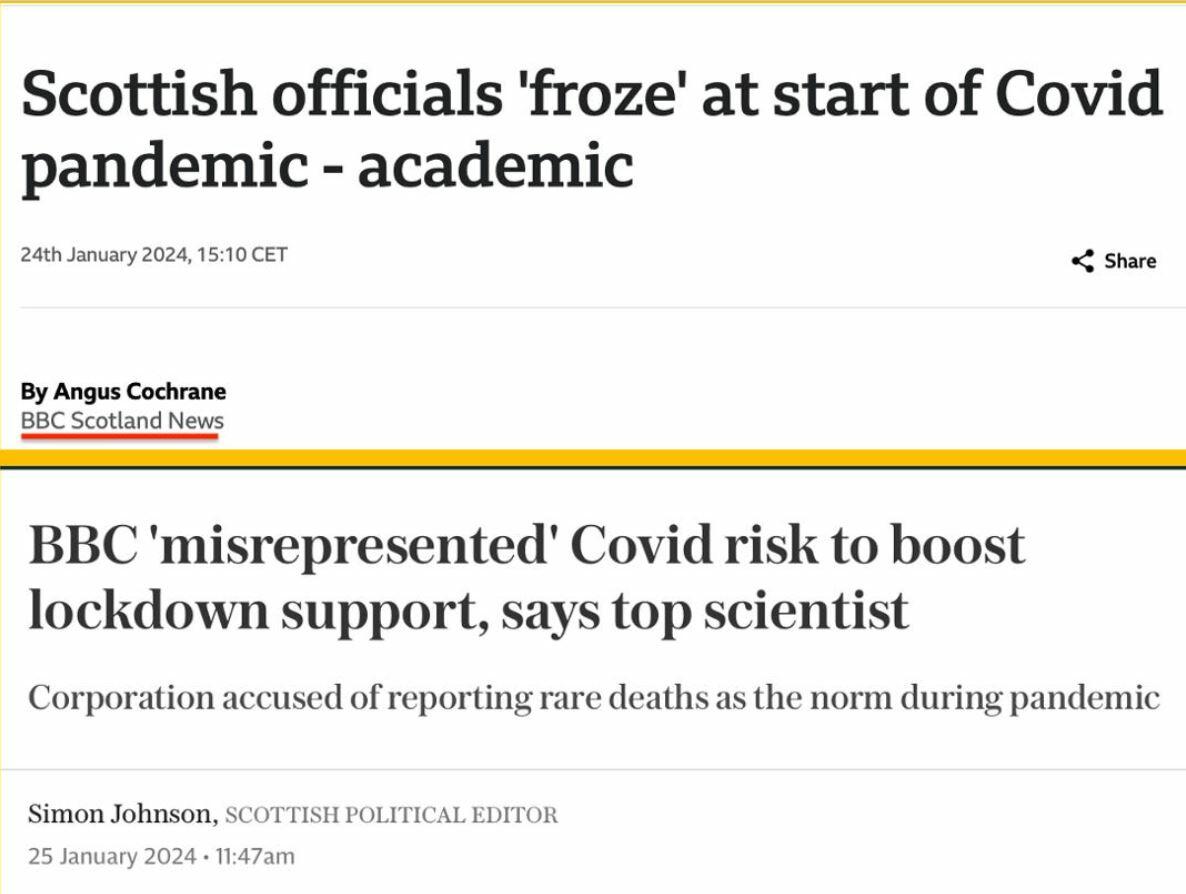
While America has chosen to ignore most COVID policy failures, unless they can be used to score partisan political points, the British government has been running a COVID Inquiry, examining mistakes the government made to better prepare for the next pandemic. The proceedings took an interesting turn in recent days, when top government advisor Mark Woolhouse at the University of Edinburgh lambasted the BBC for misrepresenting COVID risks to promote harmful lockdowns, while senior government advisor Devi Sridhar, also at the University of Edinburgh, kind of admitted that she maybe, perhaps gave poor advice—alerting several reporters who began calling her out on social media and documenting her blatant lies.

The statements by both academics underscore that lockdowns failed as a pandemic policy but were enforced with the help of media who, instead of challenging government policies, began promoting them.

I find it extraordinary that no formal assessment of the expected impact of lockdown was implemented,” testified Woolhouse, who studies infectious disease epidemiology, and advises the Scottish government on pandemics. “This despite it being obvious that lockdown was likely to cause severe harms to the economy, education, mental health, health care access and societal well-being … exacerbating inequalities.”

Government advice on pandemics did not “consider the wider harms caused by the response to the pandemic” such as government policies that led to school closures and the banning of outdoor activities, even though the virus did not transmit well outdoors, Woolhouse said. He added that the risk of a child dying from COVID was “about the same as the risk of that child being struck by lightning in the playground” causing the government to ignore that the virus was “ten thousand times” more deadly to the elderly.

“In the media, the BBC television news repeatedly reported rare deaths or illnesses among healthy adults as if they were the norm, again creating a misleading impression of who was at greater or lesser risk,” Woolhouse testified. “I suspect this misinformation was allowed to stand throughout 2020 because it provided a justification for locking down the entire population.

In fact, the BBC ran a fact check in early 2021 that promoted lockdowns, and the BBC’s much derided “disinformation reporter” Marianna Spring wrote an article months later that compared lockdown critics to climate denialists:

Anti-lockdown and anti-vaccine Telegram groups, which once focused exclusively on the pandemic, are now injecting the climate change debate with the same conspiratorial narratives they use to explain the pandemic.

The posts go far beyond political criticism and debate – they’re full of incorrect information, fake stories and pseudoscience.

Ignoring their complicity in promoting government mistakes, the BBC focused coverage on Woolhouse’s criticism of harmful policies such as school closures and lockdowns, while other outlets, such as The Telegraph, headlined barbs Woolhouse shot at the BBC.

Another high point of the government’s COVID inquiry involved Devi Sridhar, a professor of global health who closely advised Scotland’s leader during the pandemic. Sridhar now claims that she didn’t advise the government on “Zero COVID” policies to eliminate the virus—policies that all experts now agree were harmful.

In a rambling explanation that stretches on for several pages of transcript, Sridhar testified that she was for Zero COVID, but not really, but “yes” she was—confusing the inquiry counsel, who was forced to ask additional questions to get Sridhar to clarify her position. Several times.

“So your position—thank you for that,” said the inquiry counsel at one point. “Could I make another—repeat my plea on behalf of the stenographer?

Subscribers to The Disinformation Chronicle can read the rest here…

Tyler Durden
Thu, 02/01/2024 – 11:50

US To Launch Multi-Day Strikes Against ‘Iranian Targets’ Across Syria, Iraq

0
US To Launch Multi-Day Strikes Against ‘Iranian Targets’ Across Syria, Iraq

The Biden administration is planning to launch a days-long or even potentially weeks-long bombing campaign on Iranian assets across the Middle East, although there doesn’t appear to be plans to hit Iran directly, according to US officials speaking to NBC and CBS.

The attacks which will reportedly focus on ‘Iranian targets’ inside Syrian and Iraq are meant as retaliation and a supposed deterrent in response to the weekend drone attack which killed three American soldiers at a Jordanian base near the Syrian border. The attacks might extend to the Iranian navy as well, in addition to targeting Iranian personnel or ‘Iran-backed militias’ in Syria and Iraq.

While the Pentagon has said that said the Jordan base attack had the “footprints” of Kataib Hezbollah (or the Shia ‘resistance’ group of Iraq), no culprit has been definitively named, and US officials have also admitted they have not evidence Iran was behind it. But they are now reportedly saying the drone used in the attack was manufactured in Iran.

Via USA Today

The New York Times additionally has conceded that despite it being well-known that Tehran arms and funds the main Shia militias in Iraq, there remains no evidence that Tehran is “calling the shots” when it comes to events like attacks on US personnel out of Syria or Iraq.

The chorus of US officials now telegraphing the extent of the strikes to the media strongly suggests at least a days-long campaign of several waves of attacks. “The first thing you see won’t be the last thing,” national security council spokesman John Kirby has said. He added that the operation won’t be a “one-off” as such bombings have tended to go in the past.

However, the longer the bombing lasts, the greater the possibility for things spiraling out of control, possibly growing into a hot war with Iran and its assets. “The Islamic Republic would decisively respond to any attack on the county, its interests and nationals under any pretexts,” Iran’s ambassador to the UN Amir Saeid Iravani has responded.

According to more details via fresh CBS reporting Thursday:

U.S. officials have confirmed to CBS News that plans have been approved for a series of strikes over a number of days against targets — including Iranian personnel and facilities — inside Iraq and Syria. The strikes will come in response to drone and rocket attacks targeting U.S. forces in the region, including the drone attack on Sunday that killed three U.S. service members at the Tower 22 base inside Jordan, near the Syrian border.

Weather will be a major factor in the timing of the strikes, the officials told CBS News, as the U.S. has the capability to carry out strikes in bad weather but prefers to have better visibility of selected targets as a safeguard against inadvertently hitting civilians who might stray into the area at the last moment. 

As it became clear this week that the Pentagon is poised to respond in a big way, Kataib Hezbollah announced a suspension of its operations against US forces. The Pentagon has ignored this as essentially too late and irrelevant. 

But the Shia militia group’s ‘pause’ in operations appears to have held. “There have been no new attacks on U.S. troop locations in the region since the Iran-backed militia Kataib Hezbollah announced Wednesday that it was suspending military operations against American forces,” reports CBS. And yet, “There was no indication from U.S. officials that the group’s declared suspension was delaying the American military’s retaliatory strikes.”

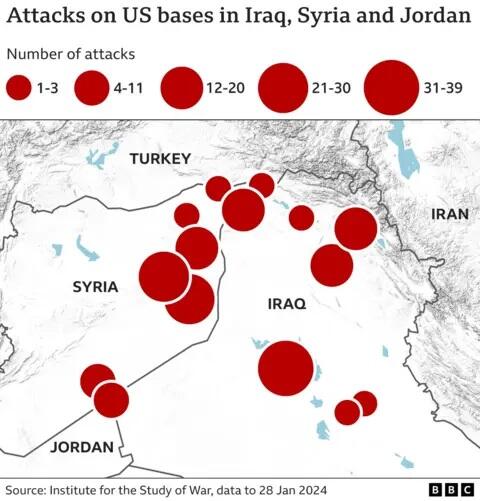
Western reports commonly estimate there’s been at least 140 rocket, mortar, and drone attacks targeting US personnel in Syrian and Iraq since mid-October, connected to events in Gaza…

For several weeks now, Israel has repeatedly bombed areas of Damascus in what have been reported as targeted strikes against Iranian personnel. It’s unclear whether the coming US strikes will also include targets in or near Syrian government centers. While US attacks have over the course of years sporadically hit militant groups in the northeast, especially in Deir Ezzor region, Washington has refrained from attacking Damascus directly over the past few years.

Another interesting question which remains is whether the Pentagon will tip off the Russian side in advance. Russia has a major military presence in Syria and actively monitors some airspace. In prior significant US attacks, the Pentagon has issued advanced warning to the Russians within moments before the launches, so as to avoid inadvertent military confrontation between the two superpowers.

Just out of the hospital and home recovery, Defense Secretary Lloyd Austin says the president “will not tolerate attacks on American troops” at this “dangerous moment in the Middle East.” He also asserted, “Our soldiers were killed by Iranian agents.” Austin at one point “apologized to the American people” for the way he handled his hospital stay, which included days of the White House being left in the dark.

This whole US ‘retaliatory’ exercise is likely to see most airstrikes focused on eastern Syria. Given the Pentagon has already repeatedly conducted operations in this area in the context of the years-long occupation of Syria’s oil and gas region, it seems Biden wants to show he’s “doing something” ahead of the election, but an operation which poses less risk for rapid direct escalation with Tehran. He’s going for the “easy” lay up of attacking Syria again. 

Tyler Durden
Thu, 02/01/2024 – 11:15

The Most Litigious Place On Earth: Disney Loses Major Challenge To Florida

0
The Most Litigious Place On Earth: Disney Loses Major Challenge To Florida

Authored by Jonathan Turley,

Last year, I criticized the lawsuit of Disney against Florida after losing its special status in the former Reedy Creek Improvement District. U.S. District Judge Allen Winsor in Tallahassee appears to view the matter as dimly as I did. He just dismissed the action in a major loss for the House of Mouse.

Disney decided to go public with a campaign against the popular parent rights legislation for Florida schools. Florida responded by removing the special status long enjoyed by the company. There is another lawsuit pending in state court.

Judge Winsor found that Disney lacked standing to sue DeSantis, the secretary of the Florida Department of Economic Opportunity and the new governing district. The separate lawsuit is still pending in state court in Orlando.

The court found that the law was constitutional on its face. As a result, it found no standing to challenge the law under the First Amendment. As I noted earlier, Disney was effectively saying that a state legislature could not remove special status and create greater uniformity with all companies under this law. Even if there were retaliatory purposes, there was clearly a public policy reason for seeking such uniformity. If the courts were to block it, it would invite a major intrusion of the courts into decisions on the priorities of legislatures. As the court noted, Disney is “not the district’s only landowner, and other landowners within the district are affected by the same laws.”

Disney seems to be doubling down and said it would “press forward with our case.” It insisted that “this is an important case with serious implications for the rule of law, and it will not end here.” So once again, what does the company hope to achieve? Is a court truly going to order Florida to maintain special status ad infinitum?

Judge Winsor noted:

“It is true that the laws did not affect all districts, and it is true (at least accepting Disney’s allegations) that Disney faces the brunt of the harm. But Disney offers no support for its argument that the court is to undertake line drawing to determine just how many others a law must cover to avoid ‘singling out’ those they affect most. Here, it is enough to say—as in Hobart—that the law ‘challenged in this case is not pinpointed against a named individual or group; it is general in its wording and impact.””

Disney’s lawyers seem to be pushing a legal claim with the same logic of many of the company’s new movies: waiting for the audience to change its mind rather than changing its strategy.

We have been discussing the shareholder revolt in some companies over social and political agendas that are suppressing profits at companies like Disney and BudLight. Recently, Disney admitted that it was driving away consumers with its controversial positions and Disney CEO Bob Iger has indicated that he wants to return to selling products and not social reforms. With Disney films cratering and the company losing its position as the top grossing film company, shareholders are threatening to take action.

The problem for Iger is turning a massive company around after years of reinforcing this role as a corporate culture warrior, including layers of hires over the years reinforcing this culture. It also needs to address damaging public comments from Disney figures.

Disney recently seemed to acknowledge that it is facing its own Bud Light moment. In its annual SEC report, Disney acknowledges that “we face risks relating to misalignment with public and consumer tastes and preferences for entertainment, travel and consumer products.” In an implied nod to Smith, the company observes that “the success of our businesses depends on our ability to consistently create compelling content,” and that “generally, our revenues and profitability are adversely impacted when our entertainment offerings and products, as well as our methods to make our offerings and products available to consumers, do not achieve sufficient consumer acceptance. Further, consumers’ perceptions of our position on matters of public interest, including our efforts to achieve certain of our environmental and social goals, often differ widely and present risks to our reputation and brands.”

Yet, the company is continuing to litigate against a popular parental rights law to demand a special status denied to other companies. That is unlikely to play any better in court than many of these films have played in theaters. What is not clear is whether shareholders support this ill-conceived legal effort. This week, Disney is hardly the happiest place on Earth but it certainly seems like the most litigious.

Here is the decision: Disney Dismissal-Order

Tyler Durden
Thu, 02/01/2024 – 10:55

$78 Billion Tax Package Passed By House Now Faces Roadblocks In The Senate

0
$78 Billion Tax Package Passed By House Now Faces Roadblocks In The Senate

On Wednesday, the House passed a $78 billion bipartisan tax package which revives various business tax breaks relat4ed to R&D and capital expenses, and expands the child tax credit.

While the package passed by a vote of 357-70, a major win for House Ways and Means Committee Chair Jason Smith (R-MO), and it handed Democrats a significant win on the child tax credit, it faces serious hurdles in the Senate.

Sen. Majority Leader Chuck Schumer (D-NY)

As Punchbowl News suggests: “This popular bipartisan tax bill is going to get caught up in a Senate legislative logjam over the next few weeks Just consider what’s on the agenda already for the World’s Greatest Deliberative Body”:

  • The Senate is currently in the middle of trying to craft a national defense supplemental, including border security money and aid to Israel, Ukraine and Taiwan. This is the chamber’s top priority right now. 

  • The federal government’s shutdown deadlines under the current continuing resolution are coming up very soon — March 1 and March 8. Each of these bills include hundreds of billions of dollars in spending, and party leaders will need plenty of time to get them across the floor.   

  • The FAA’s authority expires March 8. The Senate Commerce Committee has yet to mark up the upper chamber’s version of the FAA reauthorization. But March 8 is a hard deadline for the FAA to be reauthorized.   

  • Most importantly, if the House impeaches Homeland Security Secretary Alejandro Mayorkas — which could happen as soon as next week — the Senate will need to hold an impeachment trial immediately. Impeachment has the highest privilege in the Senate.

And after next week, the Senate will leave town for two weeks during the Presidents’ Day recess. According to the report, both the House and Senate will only be in session at the same time for just three days in February

That said, Senate Minority Whip John Thune said that part of the recess may be scrapped if the Senate addresses the border security-Ukraine bill by the end of next week. “I don’t know that you could let this thing hang out there much longer,” he told Punchbowl.

And even if Sen. Majority Leader Chuck Schumer tries to move the tax legislation as a standalone bill, it would likely take at least two weeks to process.

GOP is in no rush…

In the lead-up to the House vote, Republican Senators weren’t getting on board Wednesday – and have instead been pushing for changes to the tax bill. What’s more, they’ve been pushing for it to be marked up by the Senate Finance Committee, which could stall the entire effort.

The top Republican on the Finance panel, Sen. Mike Crapo of Idaho, has been in no rush to embrace it, and he’s pointed to concerns over the child tax credit expansion as the reason why.

“I look forward to working with my colleagues to vet the legislation, address concerns, and make the necessary changes to build support,” Crapo said in a statement.

Senate Republicans have picked at the child tax credit policy in the bill, the pay-for and the broader politics.

“I think passing a tax bill that makes the president look good, may allow checks before the election — means that [Joe Biden] could be reelected and then we won’t extend the 2017 tax bill,” Sen. Chuck Grassley (R-Iowa) told reporters. Those are the 2017 Trump tax cuts. -Punchbowl

The new tax plan would be financed by curbing the employee retention tax credit, a pandemic-era measure which was designed to keep workers on the payroll – but which as the NY Times notes, has become a magnet for fraud.

The Wednesday package that passed the house was brokered by the two top tax writers in Congress, Smith, and Sen. Ron Wyden (D-OR), Chairman of the Finance Committee, and has the support of the White House.

Republican proponents have held up the business tax breaks as a win, and have even framed the child tax credit as a victory.

“The child tax credit reforms in this bill are pro-family policies that maintain the child tax credit structure of the Trump-era G.O.P. tax reform,” Smith said in a statement. “The child tax credit provisions in this bill help families crushed by inflation, remove the penalty for families with multiple children and maintains work requirements.”

Tyler Durden
Thu, 02/01/2024 – 09:45

Bank-Stress Is Wake-Up Call For Goldilocks

0
Bank-Stress Is Wake-Up Call For Goldilocks

Authored by Simon White, Bloomberg macro strategist,

Banking sector problems are a prescient reminder that elevated rates are cumulatively inflicting mounting damage across the economy. Ironically, that ultimately means yields are heading higher.

The probability of deeper and perhaps sooner Federal Reserve rate-cuts and an earlier end to quantitative tightening has – even following Wednesday’s FOMC statement – risen at the margin after New York Community Bancorp’s dividend was cut and its equity fell by over a third. This will stoke already-burgeoning inflation pressures, ultimately leaving the US household sector as the buyer of last resort for Treasuries — and it will extract a much higher yield to do so.

Colonel Jessup in A Few Good Men complained that people couldn’t handle the truth. Well, neither can the heavily indebted US economy handle rates at 5.5%. NYCB may be a smaller bank saddled with commercial real estate losses and therefore prime facie facing different problems than Silicon Valley Bank last year, but the root cause is the same: elevated interest rates and too much duration.

Treasuries are thus becoming a shunned asset. The Fed has been reducing its holdings through its quantitative tightening program. But financials in the US (banks and non-banks) and the rest of the world and have not been buying.

Instead, between the first quarter of 2022 — when the Fed started hiking rates — until the latest data from the third quarter of last year, the household and corporate sector has on net absorbed all of the over $1.5 trillion Treasuries that had hitherto been accommodated on the Fed’s balance sheet.

Why have financials not jumped at the chance to buy government debt? Wariness of massive supply is the obvious answer. But it is more nuanced than that. And in explaining this, we can see an actual mechanism of how higher inflation leads to higher yields.

The financial industry has grown rich and complacent on 60/40 portfolios – 60% equities, 40% bonds – or variations on this theme such as risk parity. That worked well in a regime of low-and-stable inflation as stocks and bonds tended to move oppositely to one another, making the second an effective hedge for the first.

But in an elevated-inflation regime, a growth shock can be accompanied by an inflation shock, and stocks and bonds start to co-move more together. That means bonds no longer improve risk-adjusted returns in multi-asset portfolios, nor do they act as a recession hedge.

And in fact we find that the US non-bank financial sector – mutual funds, pension funds, hedge funds, etc – has on net been reducing its exposure to Treasuries as a percentage of the total outstanding as the stock-bond correlation has risen and moved into positive territory.

What’s more, who’s picked up the slack? The household sector, whose ownership of USTs rose from 2.4% to 8.3% of total Treasury debt from 1Q22 to 3Q23, while the non-bank financial sector’s fell from 34.7% to 27.3%.

Despite what plenty of backward-looking analysis says, inflation is not going anywhere, rather it is poised to re-accelerate this year. That means the stock-bond ratio is set to remain positive, massively challenging the shibboleth of 60/40 investing and making bonds a lot less desirable for anyone who doesn’t have liabilities they need to match (such holders currently account for a significant $6 trillion of UST holdings).

But it’s also from banks that the household sector has been absorbing Treasuries. They are more reactive than other holders of USTs, and they are typically quick to reduce their duration exposure when the Fed is raising rates.

They have reduced their UST and MBS holdings to just under 30% of assets, but that’s still historically high, and they have typically decreased their duration by more in previous rate-hiking cycles. (One caveat here is ongoing discussions about new US bank-capital requirements, which could eventually require them to hold more Treasuries, but this is not going to happen soon.)

There are therefore no imminent signs that banks and non-banks are about to backstop Treasury demand. The same goes for overseas buyers. There are many well-telegraphed reasons for foreign actors desiring to hold less US debt, such as America’s weaponization of its financial system, making return of capital no longer a sure-fire bet if you’re considered a wayward state.

But for more mundane reasons – real interest-rate differentials – overseas buyers have just not been that into owning more Treasuries lately. The largest recent buyers are developed-market based – Canada, the UK, Japan, Europe, etc.

If we compare the net yield pick-up of what investors from these countries would earn by buying a 10y UST and hedging the FX versus their domestic government bonds, it has risen in recent months, and at the margin may be attractive, say for e.g. Germany, with a positive pick-up between bunds and Treasuries.

But inflation matters now. Adjusting the pick-ups for domestic price growth to get them in real terms, they remain significantly negative, making it unlikely we should soon expect foreign buyers of Treasuries to rush into absorbing much new issuance.

Here’s the rub. If the household sector is on the hook, it doesn’t have as anodyne a view of inflation as the market. As with the dictum that it’s impossible to get someone to understand something whose job depends on not understanding it, the market is expecting a return to 2% inflation as it does not know how to function in any other way.

Households aren’t buying it though. The sector’s expectations of long-term price growth are notably higher than their market counterparts, such as forward inflation swaps. As the chart below shows, household inflation expectations have been persistently higher than swaps since the mid-2010s.

That may not have mattered much before, but if households are now the marginal buyer of US Treasuries, then they also set the price. They’re unlikely to want them until longer-term yields are about 50-75 basis points higher, or more if inflation sees a resurgence.

Yields are lower in the wake of NYCB’s troubles: not only does that make them even less attractive to households, it’s a manifestation of deeper Fed cuts that will ultimately reignite inflation and pave the way for a secular rise in longer-term yields.

The buyer is happy to beware if the buyer also gets a margin of safety.

Tyler Durden
Thu, 02/01/2024 – 09:25