73.7 F
Chicago
Thursday, September 17, 2026
Home Blog Page 2978

US Warship Intercepted Houthi Missiles Launched At US-Flagged Ship

0
US Warship Intercepted Houthi Missiles Launched At US-Flagged Ship

Update(1446ET): US Central Command has confirmed the attack incident on the US container ship, but has provided further key details saying that one of the no less than three Navy warships accompanying the US-flagged Maersk vessel intercepted most of the inbound anti-ship missiles fired from Yemen

The US Central Command has said that the Houthis launched three anti-ship ballistic missiles at a US-flagged container ship off the coast of Yemen earlier on Wednesday.

“One missile impacted in the sea. The two other missiles were successfully engaged and shot down by the USS Gravely (DDG 107),” CENTCOM said in a statement. “There were no reported injuries or damage to the ship.”

The fact that the Houthis launched the missiles despite the presence of a warship group is a testament to the fact that the Western naval coalition has not served as an effective deterrent.

* * *

Update(11:30ET): As we previously noted, earlier in the morning Sky News reported that Houthi forces fired at least two missiles from Al-Bayda towards the Gulf of Aden. Well, it seems they were targeting a US vessel, even despite it having a US Naval escort. Per the breaking details in Bloomberg:

Two Maersk vessels were targeted in attacks near the Red Sea on Wednesday, ShippingWatch reports, citing the Danish shipping company. The vessels, which belong to Maersk’s US subsidiary Maersk Line Ltd., were headed for the Bab el-Mandeb Strait, escorted by the US Navy, news website says.

ShippingWatch indicated that as a result of the attack, wherein all the crew and ships were unscathed, the ships have turned around. Maersk starting in early January suspended transit for all its ships, but the directive did not apply to its US subsidiary. 

This fresh incident is hugely significant given that after some eight or more rounds of US missile attacks and airstrikes on Houthi positions, the Iran-linked group remains undeterred, even with a US Navy escort seeking to protect an American container vessel. 

* * *

Two months of drone and missile attacks on commercial vessels, as well as hijackings, in the highly contested Red Sea region by Iran-backed Houthi rebels, have yet to abate as economic costs mount for shippers and increased risks of snarled global supply chains. 

The latest evidence that Red Sea disruptions will persist is a notice from the Department of Transportation informing commercial ship operators to avoid the “Southern Red Sea between 12N and 16N.” 

There continues to be a high degree of risk to commercial vessels transiting the Southern Red Sea between 12N and 16N. While the decision to transit remains at the discretion of individual vessels and companies, it is recommended that US flag and US-owned commercial vessels remain North of 18N in the Red Sea or East of 46E in the Gulf of Aden until further notice.

Besides Houthi attacks on Western vessels, the US and allies have ramped up attacks on the rebels in Yemen with repeated airstrikes. 

Bloomberg reported early Wednesday that one of the world’s largest shippers, Maersk, told clients in a notice to prepare for supply line disruptions as containerized vessels are rerouted to the Cape of Good Hope, which takes an extra 1-2 weeks for Asia to Europe shipping lanes.

“While we continue to hope for a sustainable resolution in the near-future and do all we can to contribute towards it, the situation currently remains untenable,” Maersk said. 

According to Flexport data, more than 500 container ships that would have sailed through the Red Sea have been rerouted to the Cape of Good Hope at the southern tip of Africa. This is about a quarter of all the container shipping capacity in the world. 

Meanwhile, a new report from the Financial Times, citing “American officials,” says the US has asked China to help rein in Houthi rebels. 

Officials have repeatedly raised the matter with top Chinese officials in the past three months, asking them to convey a warning to Iran not to inflame tensions in the Middle East after Hamas’s October 7 attack on Israel and the ensuing war. 

US national security adviser Jake Sullivan and his deputy, Jon Finer, discussed the issue in meetings this month in Washington with Liu Jianchao, head of the Chinese Communist party’s international department, according to US officials. Secretary of state Antony Blinken also raised it, said a state department official. -FT

In recent weeks, Red Sea diversions have tightened capacity and resulted in soaring container prices:

“We haven’t seen costs increase this quickly since the last crunch in the pandemic,” said Vincent Iacopella, a logistics expert at Alba Wheels Up, who spoke with Bloomberg. 

Iacopella said, “Many of the underlying bottlenecks in supply chains remain, even though prices dropped last year as the Covid-19 disruptions faded. 

The cost of shipping containers from China to the Mediterranean Sea has quadrupled since late November. 

We pointed out last week that executives and investors are becoming concerned about Red Sea disruptions in earnings calls. 

Using the Document Search function on Bloomberg, earnings-call mentions of “Red Sea” topped 41 last week, a record high. As the earning season progresses, the mentions will likely increase. 

And as of writing this note, Sky News reports Houthi forces “fire a second missile from Al-Bayda towards the Gulf of Aden.” 

President Biden’s Operation Prosperity Guardian faces severe hurdles as the West’s move to secure the critical waterway has failed so far

Tyler Durden
Wed, 01/24/2024 – 14:46

Mexico’s $10 Billion Lawsuit Against US Gun Manufacturers To Proceed, Appeals Court Rules

0
Mexico’s $10 Billion Lawsuit Against US Gun Manufacturers To Proceed, Appeals Court Rules

Authored by Naveen Athrapully via The Epoch Times,

A $10 billion lawsuit by Mexico against U.S. gunmakers, alleging that the companies “deliberately” enabled firearms trafficking into the country, can move forward, an appeals court has ruled.

The lawsuit, filed by the Mexican government against seven American manufacturers and a distributor in 2021, alleged that the companies “deliberately facilitate gun trafficking” into Mexico, according to the Jan. 22 ruling issued by the U.S. Court of Appeals for the 1st Circuit.

The complaint was initially filed at the federal district court in Massachusetts, which dismissed the lawsuit after deciding that U.S. gun companies were protected by the Protection of Lawful Commerce in Arms Act (PLCAA) against Mexican claims.

The PLCAA prohibits certain lawsuits against gun manufacturers and sellers in U.S. federal and state courts. The appeals court agreed that “PLCAA’s limitations on the types of lawsuits that may be maintained in the United States apply to lawsuits initiated by foreign governments for harm suffered outside the United States.”

However, the appeals court observed that Mexico’s complaint potentially alleges a type of claim that could be “statutorily exempt” from PLCAA rules.

“We therefore reverse the district court’s holding that the PLCAA bars Mexico’s common law claims, and we remand for further proceedings,” the court stated.

“We conclude that the complaint adequately alleges that defendants aided and abetted the knowingly unlawful downstream trafficking of their guns into Mexico.”

The lawsuit seeks $10 billion in compensation.

Jonathan Lowy, president of Global Action on Gun Violence and co-counsel for the Mexican government in the case, welcomed the appeals court decision.

“Today’s ruling is a huge step forward in holding the gun industry accountable for its contribution to gun violence, and in stopping the flood of trafficked guns to the cartels,” he said in a Jan. 22 statement.

“Not only did the Court recognize the right of another country to sue U.S. gun companies, it also pierced the unfair legal shield that gun companies have been hiding behind since 2005.”

Texas-based litigator Steve Shadowen said the court ruling “marks an important step forward in holding the gun industry accountable for its role in transnational arms trafficking and in obtaining justice for the victims of their unlawful business practices, the people of Mexico.”

‘Scapegoating’

Lawrence Keane, chief lobbyist and media spokesperson for the National Shooting Sports Foundation (NSSF), disagrees with the decision. The organization is “reviewing our legal options,” he said in a Jan. 23 post on the social media platform X, formerly known as Twitter.

“Mexico should spend its time enforcing its own laws & bring Mexican criminals to justice in Mexican courtrooms, instead of scapegoating the firearm industry for their unwillingness to protect Mexican citizens,” he wrote.

Kostas Moros, an attorney who represents the California Rifle & Pistol Association, called Mexico’s argument in the case “comical on its face,” according to an X post.

“The basic idea is US gun laws are causing violence in Mexico. But that country has six times our homicide rate. If some smuggled guns from here are the problem in Mexico, we’d have a much worse problem here,” he said.

“Mexico’s complete failure to bring cartels to heel is not the fault of the United States nor its Second Amendment.

“These cartels are extremely wealthy and would always be able to get a hold of firearms. They are billion-dollar sophisticated businesses, not random gangbangers. Plus, Mexico has long had very high homicide rates. This isn’t some new thing.

Focus on US Gun Industry

In its lawsuit, Mexico states that while having strict gun laws, the country has the third highest gun-related deaths globally. Mexico claims that it has just one gun store in the entire nation and issues fewer than 50 firearm permits annually.

“The number of gun-related homicides in Mexico grew from fewer than 2,500 in 2003 to approximately 23,000 in 2019. The percentage of homicides committed with a gun similarly rose from 15 percent in 1997 to 69 percent in 2021,” the appeals court ruling states.

Mexico insists that the increase in gun violence “correlates with the increase of gun production in the United States” since the end in 2004 of the U.S. ban on so-called assault weapons.

“Mexico claims that between 70 and 90 percent of the guns recovered at crime scenes in Mexico were trafficked into the country from the United States.”

Mexico’s claims have been opposed by a coalition of 20 state attorneys general who filed an amicus brief in the case seeking to protect U.S. firearms makers.

“Mexico claims that gun violence in its country increased because of the expiration of the U.S. assault weapons ban in 2004,” the brief said. “But homicide rates in Mexico declined in the three years after the assault-weapons ban ended and didn’t increase until Mexico declared war on its drug cartels in late 2006.”

It dismissed the argument that U.S. manufacturers are to blame for increased gun violence in Mexico.

This theory “rests entirely on the factual assertion that American gun manufacturers knowingly cause Mexican gun violence. But its theory falls apart under even cursory scrutiny.”

“Contrary to Mexico’s claims that American guns are ‘among the deadliest and most often recovered at crime scenes in Mexico,’ only a minority of guns recovered at crime scenes in Mexico can be traced back to the United States,” the states argued.

“Among the American guns recovered at crime scenes in Mexico, many were sold wholesale to the Mexican military and law enforcement and only ended up in cartel hands after soldiers or policemen deserted.”

Arkansas Attorney General Tim Griffin told The Epoch Times in May 2023 that the lawsuit was “part of a broad strategy by anti-gun activists to try to shut down firearms manufacturing” in the United States.

“Congress passed the Protection of Lawful Commerce in Arms Act to protect American businesses from these kinds of frivolous lawsuits.”

Tyler Durden
Wed, 01/24/2024 – 14:45

NATO Admits ‘No Direct Threat From Russia’ As UK Army Chief Tells Citizens Prepare For Massive War

0
NATO Admits ‘No Direct Threat From Russia’ As UK Army Chief Tells Citizens Prepare For Massive War

On Tuesday NATO Secretary General Jens Stoltenberg issued a surprising statement which drastically contradicted the anti-Moscow hawks in the US and UK, who have been claiming that Putin has his eyes set on expanding the war beyond Ukraine, potentially threatening the rest of Europe.

Stoltenberg told a press briefing when asked to assess the Russian threat against the Western military alliance that “we don’t see any direct or imminent threat against any NATO Ally.” The idea of an ‘imperial Russian expansionist war’ to gobble up territory into Europe has long been a mainstream talking point related to the Ukraine conflict.

UK MoD file image

The NATO chief continued, “And therefore, we, of course, monitor closely what Russia does, we have increased our vigilance, our presence in the eastern part of the Alliance, but the whole idea of that is to prevent an attack on a NATO Ally.”

His words were reported in both Russian and Ukrainian media sources. According to one Ukrainian source, “Stoltenberg recalled that in response to Russia’s full-scale invasion of Ukraine, NATO members increased defense production, not only to provide additional military assistance to Kyiv, but also to strengthen their own defense capabilities.”

Related to this, France and Germany in particular have been boosting their arms production, with France ramping up deliveries to Kiev too as Washington’s supplies are drying up

France announced more planned deliveries of its Caesar artillery system to Ukraine on Thursday and accelerating weapons manufacturing as it seeks to avoid depleting its own military stocks while continuing to support the war effort against Russia’s invasion.

“The logic of ceding materiel taken from the armies’ stocks is reaching its end,” the French defense minister, Sébastien Lecornu, said in an interview with Le Parisien. “From now on, the solution is to directly connect French defense industries with the Ukrainian army.”

Stoltenberg in his comments from Brussels said the alliance is taking additional measures to secure Europe’s defense “by deploying more combat troops to the eastern part of the Alliance, by further increasing our defence investments, and also by exercising more”.

“We will have the big exercise starting later this week, which will be the biggest exercise in decades for NATO, with 90,000 personnel participating,” he added.

“We do all of this to ensure that we have the readiness, the preparedness and the forces in place to remove any room for miscalculation or misunderstanding in Moscow about our readiness to protect every inch of NATO territory. And as long as we do that, there will be no attack against the NATO territory,” he concluded.

Stoltenberg’s asserting firmly that NATO does not see any “imminent threat” against NATO allies comes amid a backdrop of rising alarmism from leading Western countries. For example, earlier this moth Swedish Armed Forces Commander-in-Chief Micael Bydén and Minister for Civil Defence Carl-Oskar Bohlin urged all Swedish citizens to “prepare for war”. Sweden is soon to be admitted into NATO.

On Wednesday, the head of the British army went so far as to issue a call for the civilian public to prepare for potential massive war with Russia:

General Patrick Sanders on Wednesday called on the British authorities to “mobilize the nation” to prepare for a war with Russia, in a speech at the International Armoured Vehicles exhibition in London.

Although he does not support conscription, Sanders stressed the need for a “shift” in the minds of the British public to be mentally ready for a military conflict with Russia.

General Patrick Sanders, right, Getty Images

“Our predecessors failed to perceive the implications of the so-called July Crisis in 1914 and stumbled into the most ghastly of wars,” he said in an address before the International Armoured Vehicles exhibition in London. “We cannot afford to make the same mistake today. Ukraine really matters.”

“This war is not merely about the black soil of the Donbas, nor the re-establishment of a Russian empire, it’s about defeating our system and way of life politically, psychologically, and symbolically. How we respond as the pre-war generation will reverberate through history. Ukrainian bravery is buying time, for now.” Within the speech, he said that he supports a vast increase in armed forces manpower, urging a near-doubling in size of the British army.

* * *

As for Germany, there’s plenty of skeptics in the Bundestag (parliament) when it comes to the question of whether Russia really presents an imminent threat to German national security

“If you ask me, and if you ask most people in my party, the answer is unequivocally no,” Gunnar Beck, Member of the European Parliament for the Alternative for Germany (AfD) party who is currently Vice-President of the Identity & Democracy Group in the Parliament, told Sputnik. “Ever since 1990, at the end of the Soviet Union, the Russian government has gone out of its way to intensify economic relations between Russia and Germany. We had extremely favorable energy contracts with Russia. And Russia was a growing export market for our agricultural and industrial goods. It’s due to our government’s policy, vis-a-vis Ukraine conflict that relations with Russia are now almost at an all time low. So, on the one hand, I think, German policy and EU policy has been a provocation. Nonetheless, I think that the Russian reaction to the sanctions in particular has been tough, but at the same time measured. So in my view, Russia is no immediate security threat to Germany. Categorically not.”

Tyler Durden
Wed, 01/24/2024 – 14:25

‘Enabling Putler?’ – UK Firms Have Insured Over €120 Billion In Russian Oil

0
‘Enabling Putler?’ – UK Firms Have Insured Over €120 Billion In Russian Oil

Authored by Maria Ward–Brenna and Jessica Frank-Keyes via City A.M.,

A former Cabinet minister has called on the insurance industry to think on its obligations after it was revealed that UK firms have insured over €120bn worth of Russian oil.

From March 2022, just after Russia’s invasion of Ukraine, until the end of November 2023, the UK insured €120.6bn worth of Russian oil, according to an analysis by the Centre for Research on Energy and Clean Air (CREA).

The CREA analysis is focused on the months between March 2022 and November 2023. It is not illegal to transport Russian oil, or insure it, as long as the black gold is sold for less than $60 a barrel.

CREA revealed that 33 per cent of all Russian oil (by volume) was transported on tankers insured in the UK.

Of that, the majority of the Russian oil was crude oil (31 per cent worth €14.4bn), followed by diesel (22 per cent worth €10.3bn). 

Alun Cairns, the former Welsh secretary and still Tory MP, said firms must be alive to the possibility that the price cap could be abused.

The analysis noted that while there has been a decrease in insurance companies from the UK covering shipments of Russian crude, Russian oil transits still remain highly reliant on vessels insured in the UK for transport.

In the 12 months since the oil price cap was introduced in December 2022, €46.4bn of Russian oil has been transported on tankers using UK protection and indemnity (P&I) insurance. 

The West of England P&I Club covered the highest value of Russian oil products at €20.1bn, followed by NorthStandard at €17bn. North and Standard insurance merged to become NorthStandard in February 2023.

Source Centre for Research on Energy and Clean Air (CREA)

This comes after Kpler shared data with City A.M. earlier this month that shows that last year was the most active drilling year for Russia through the first 11 months, with a total depth of 28,100 km.

The CREA’s analysis stated that “Russia’s reliance on UK insurance to transport their oil provides the UK with significant leverage which they can use to lower the price cap, and implement better monitoring and enforcement that would considerably lower Russia’s oil export revenues.”

“It also shows the somewhat posturing nature of the support and aid that the UK provides to Ukraine, while at the same time supporting Russia’s ability to fund the invasion by conducting its oil trade easily and globally.”

Cairns has raised the issue of Russian oil shipping in Parliament several times.

He told City A.M., that it took the USA seven years to close all the loopholes on Iranian oil shipping after it instigated sanctions.

“I’m concerned that the same focus isn’t there from the international community when it comes to the Russian oil exports,” he said.

“[In the UK] there needs to be greater coordination between the Ministry of Defence, the Department of Business and Trade, the Treasury and the Cabinet Office.

“There’ll always be someone or an organisation seeking to exploit opportunities. I will be very disappointed if there are UK insurance companies participating in that illicit market,” he added.

West of England P&I Club and NorthStandard were contacted for comment.

Tyler Durden
Wed, 01/24/2024 – 12:45

Tesla Prepares For New Mass-Market EV Codenamed “Redwood”

0
Tesla Prepares For New Mass-Market EV Codenamed “Redwood”

At the opening of the US cash market, Tesla shares were marginally higher following a Reuters report that the company is in talks with suppliers regarding a mass-market electric vehicle, codenamed “Redwood,” set for a mid-2025 release. 

Sources familiar with the new mass-market EV said it’s described as a “compact crossover” and will compete with cheaper petrol-powered cars and inexpensive Chinese EVs, such as those made by BYD. 

Tesla founder Elon Musk has teased over the years with a $25,000 mass-market model. At the moment, the cheapest offering by Tesla is the base Model 3 sedan, starting at $38,990 in the US. 

Sources said Tesla engineers sent “requests for quotes” to suppliers for the Redwood last year. One weekly forecast shows production volumes of upwards of 10,000 vehicles per week. They noted production would begin as soon as June 2025. 

Timing of the mass market EV comes as BYD displaced Tesla as the world’s biggest maker of EVs in the fourth quarter. 

Sales of overall EVs are sliding due to elevated interest rates. Also, prices of used Teslas are plunging. 

Tesla is scheduled to report fourth-quarter earnings after hours today. Earnings estimates point to $25.8 billion in revenue and an Earnings Per Share of $0.74. Tesla’s gross margin rate is projected to be 18.1%, compared to 17.9% in the third quarter and 16.0% in the same period last year. The company’s free cash flow for the quarter is expected to be around $1.45 billion.

Ahead of earnings, Adam Sarhan, founder and CEO of 50 Park Investments, told Bloomberg:

“Tesla investors are looking for a bullish catalyst, but there isn’t one in sight. 

“Investors are going to pay these multiples for earnings for only so long, and if the fundamental story changes and earnings get compressed, then valuation gets compressed.”

The mass market electric vehicle might be the bullish catalyst for the market.

Tyler Durden
Wed, 01/24/2024 – 12:25

Ukraine Indirectly Admits It Shot Down Large Russian Transport Plane, Possibly With Own POWs On Board

0
Ukraine Indirectly Admits It Shot Down Large Russian Transport Plane, Possibly With Own POWs On Board

Update(12:10ET): The Kremlin is accusing Ukraine of shooting down the Russian Il-76 military transport plane that crashed in a border region near Ukraine. All 74 people aboard have been reported killed, including the 65 Ukrainian prisoners of war who were allegedly on board being transported.

The Kharkiv and Belgorod regions in particular have for months witnessed a huge uptick in aggressive Ukrainian military cross-border action, which has included use of missiles, mortars, and drones.

New reporting in The Associated Press suggests that Kiev has made an indirect admission of guilt, but there was no mention of Ukrainian POWs dying. “Hours after the crash, the General Staff of the Armed Forces of Ukraine made no mention of the crash in a statement,” writes AP. “But it added that Ukraine targets Russian military transport planes believed to be delivering missiles, especially near the border.”

This major incident not only points to more severe Russian escalation and retaliation on the horizon, but puts in peril any future Russia-Ukraine prisoner swaps, after a large recent one was successfully accomplished.

“Ukrainian military intelligence confirmed a swap was due to take place but said it had no information about who was on the crashed Russian plane,” the AP notes further. “Moscow did not ask for specific airspace to be kept safe for a certain length of time, as has happened in past exchanges, it said in a statement.”

Moments before the crash, Belgorod Gov. Vyacheslav Gladkov issued an emergency notification on his Telegram channel saying a “missile alert” had been triggered in the region. According to more from Russia’s direct accusation against Kiev:

The Russian Defense Ministry accused Ukrainian forces of shooting the plane down with air-defense missiles. “By committing this terrorist act, the Ukrainian leadership showed its true face, disregarding the lives of its citizens,” the ministry said.

The Ukrainian Defense Ministry initially refused to comment on the incident. Ukrainskaya Pravda, a Ukrainian newspaper, initially reported that the plane was indeed shot down by the country’s military, but edited its article on the incident shortly afterwards to remove this information.

Likely Ukrainian cities are bracing for more Russian drone and missile attacks, given this has typically followed any major event where Ukraine’s military strikes Russian territory or large military assets.

* * *

Update (0759 ET): The Russian Ministry of Defence claims Russian radar systems detected two Ukrainian missiles in the area before the Russian transport plane full of Ukrainian prisoners crashed. 

*   *   * 

A Russian military plane transporting dozens of Ukrainian prisoners, as well as nine crew and guards, crashed in the Belgorod region near the border with Ukraine. 

The Russian Ministry of Defence released a statement about the incident:

“An Il-76 plane crashed in the Belgorod region at around 11 a.m. on January 24 while on a scheduled flight. It was transporting 65 captive servicemen of the Ukrainian Armed Forces to the Belgorod region for an exchange, in addition to six crewmembers and three accompanying persons.” 

Bloomberg cited Andrey Kartapolov, head of the Defence Committee of the State Duma of Russia, who told the lower house of parliament that Ukraine downed the transport plane using either the US Patriot system or German-made IRIS-T.

The ministry also said the Russian Aerospace Forces is responding and has been sent to the incident area to investigate the cause of the crash. 

Russain news agency Interfax said President Vladimir Putin’s spokesman, Dmitry Peskov, declined to comment on the crash, telling journalists that the information was still “too fresh.”

This comes as Ukraine and Russia exchanged nearly 500 prisoners earlier this month, the largest swap since the early days of the war. 

There have also been reports Western allies have secretly met with Ukraine on a peace plan with Russia as the US presidential election cycle gears up. 

Tyler Durden
Wed, 01/24/2024 – 12:10

Wildest Inflation Red Flag: Vegas Table-Limits

0
Wildest Inflation Red Flag: Vegas Table-Limits

Via SchiffGold.com,

Anyone who has been to a restaurant, a grocery store, or the car lot during the Biden administration can’t deny the reality of inflation.

But despite what the federal government is saying about the success of its anti-inflation efforts red flags for inflation keep popping up in the strangest places.

Take the Las Vegas Strip. Casinos on the Strip, long known for trying to take the money of everyone from the highest high-rolling whale to the coupon-clipping low-roller camped out at Motel 6 or Excalibur Casino, are now finally admitting that some dollars aren’t worth the effort of taking.

In August, the Wall Street Journal reported on the declining number of tables where you could play blackjack in Las Vegas while the amount of revenue earned from blackjack stayed high even as casinos offered worse rules to players, such as paying out 6:5 when a player receives a “blackjack” rather than the traditional 3:2.

Strip casinos are also doing away with low table limits, meaning that players that want to risk $5 or $10 on a single hand of blackjack are struggling to find a game.

The optimistic interpretation offered by the article is that casinos on the strip are successfully pivoting to cater to a higher-end audience and are raising not just table limits for games like blackjack but also the price of hotel rooms. But the disappearance of low-priced gambling options is happening at places far from the glamorous Las Vegas Strip.

And it’s not just table game limits where casinos are desperate for more money.

Even classic games are seeing their rules rewritten to bring in more dollars per player. While the version of roulette familiar from Hollywood offers 18 red numbers, 18 black numbers, a single green zero where the house wins, Vegas casinos now commonly offer roulette wheels with three zeros, massively increasing the house edge. The Strip is not the only gambling destinations where dollars don’t go as far as they used to with many casinos even removing table games as a way to respond to high inflation and labor costs. (Vegas is a union townPass Casino in Henderson and many Caesars Entertainment properties are among those eliminating or scaling back table games.)

Even lotto tickets, perhaps the most affordable way to gamble, are seeing prices rise. The state of Texas is now selling a $100 scratch-off ticket and the Georgia Lottery is experimenting with discontinuing the selling of $1 lottery tickets and replacing them with with $2 or $5 tickets, a doubling or even “pentupling” the cost of tickets for gamblers looking for quick and cheap entertainment.  

When even purveyors of traditional vices start turning down dollars, it’s hard to feel bullish about the currency.

Is holding the US dollar turning into a gamble all on its own?

Tyler Durden
Wed, 01/24/2024 – 12:05

Tech Euphoria Sparked By ASML Surge To All-Time High On Flood Of Chinese Orders… There’s Just One Problem

0
Tech Euphoria Sparked By ASML Surge To All-Time High On Flood Of Chinese Orders… There’s Just One Problem

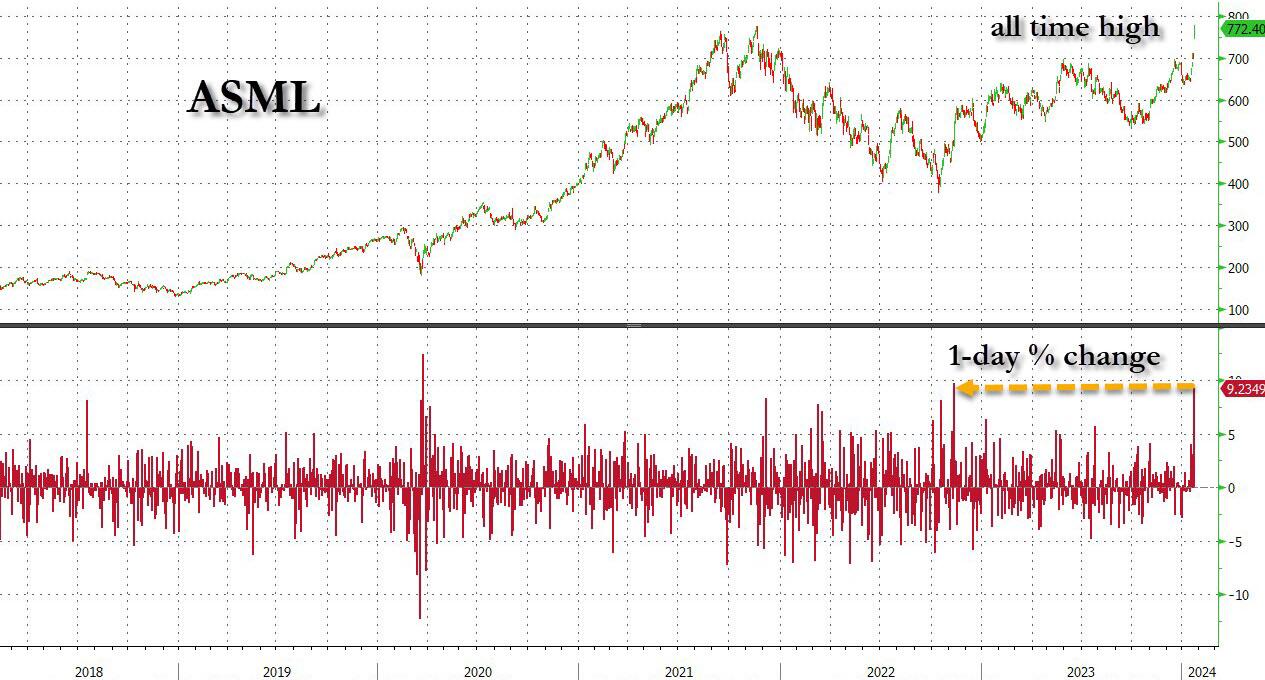
Tech stocks are soaring again today in a repeat of last Wednesday’s action, only instead of a stellar outlook from Taiwan Semi which was the catalyst for last week’s tech reversal, today it was Dutch chip giant ASML – Europe’s most valuable technology company said in a statement on Wednesday – which sparked the buying frenzy. And on the surface, the results were stellar: according to its earnings release this morning, ASML Holding NV said orders more than tripled last quarter from the previous three months, as the order backlog rose to a record €9.19 billion ($9.98 billion) in the fourth quarter from €2.6 billion in July to September, driven by demand for its most sophisticated machines which use deep-ultraviolet lithography (EUV) needed to make the most sophisticated semiconductors, where orders hit a record €5.6 billion.

The surging backlog reversed a trend of 4 quarters in declines, meanwhile the historical orderbook led to a surge in sales which rose 30% YoY to €27.6 billion in 2023, the company said.

“2023 was our top year,” Wennink said. “We won’t see another 30% growth in 2024.” ASML has previously forecast flat growth this year before a banner year in 2025.

That may well be, but one has doubts.

It is true that ASML is the only company that produces equipment needed to make the most sophisticated semiconductors, and demand for its products is a bellwether for the industry’s health. Record orders for its top-of-the-line extreme ultraviolet lithography machines show optimism among the biggest customers for the technology, including Intel Corp., Samsung Electronics and Taiwan Semiconductor. It’s also why the Biden admin has been explicitly targeting ASML exports to China, realizing that these are a backdoor way for Beijing to build it own latest generation of chips and bypass current chip sanctions.

The company was also happy to piggyback on all the AI euphoria that has gripped the market in the past year, and as CEO Peter Wennink told Bloomberg, Artificial intelligence, which requires massive amounts of computing power, is going to be a “big driver for our business and the business of our customers.” Unless, of course, it all proves to be a giant bubble.

But nobody is paid to worry – or think for that matter – when you have a historic bubble on your hands, which is what AI is, and analyst commentary took the results in stride to extrapolate the surge in backlog as virtually unlimited AI-driven demand. Indeed, in its commentary, Bloomberg said that the ASML results were “a sign that the semiconductor industry may be recovering” adding that “chipmakers are increasingly optimistic the sector’s outlook following a slump that dates back to the Covid-19 pandemic, with TSMC last week projecting strong revenue growth in 2024.”

Only, that’s not true as anyone who look at Texas Instruments’ dismal results last night realized (TXN shares tumbled after it gave a disappointing quarterly forecast, indicating that sales of chips for industrial and automotive uses haven’t recovered).  

Instead, what is happening as we explained in “Behind The Tech Meltup: A One-Time Chinese Chip Buying Frenzy To Frontrun Export Curbs“, is that China has been flooding the market with chip purchase orders, knowing that the door is closing amid a barrage of sanctions limiting exports of high tech chips – and chipmaking devices – and that it needs to buy today what it may need for the next few years, if not indefinitely.

And buy it did: China accounted for 39% of ASML’s sales in the fourth quarter and became the Veldhoven-based company’s largest market in 2023! Before speculation of chip sanctions, China accounted for only 8% in January to March.

The company was not shy about its biggest customer: “The business in 2023 with China was very, very strong,” said CFO Roger Dassen said.

Unfortunately, for ASML, that’s as good as it gets. As reported previously, ASML has been targeted by the US effort to curb exports of cutting-edge technology to China. Last year, US President Joe Biden’s administration urged the Dutch government to prevent ASML from shipping some immersion deep ultraviolet lithography machines, its second-most capable machinery, to China without a license. 

Then, a few weeks ago, Bloomberg reported that ASML exports to China have now effectively been halted, vaporizing whatever portion of the order backlog is thanks to China. ASML had licenses to ship three top-of-the-line DUV lithography machines to Chinese firms before this month, when the new restrictions took full effect. However, US officials reached out to ASML late last year to ask them to immediately halt scheduled shipments of some of the machines to Chinese customers, Bloomberg News reported previously, citing people familiar with the matter.

And so with China now scrubbed from the list of ASML clients – forget being its top customer – the question is who will fill the void. Luckily, demand for AI is keeping the chip sector afloat… or so the experts say, the same experts who fawned over ASML’s result today which sparked a buying frenzy in the shares, which soared over 9% today, the biggest increase since November 2022, and hitting an all time high.

Good luck keeping that all time high with your largest customer now barred from future purchases by the State Department. As for “record AI chip demand”, this quarter will prove very informative how much is real and how much is vapor once the volatility from China’s erratic orderflow is finally removed.

Tyler Durden
Wed, 01/24/2024 – 11:45

China Expands Tesla Bans From Military Bases To Other “Government Affiliated Venues”

0
China Expands Tesla Bans From Military Bases To Other “Government Affiliated Venues”

At what could be the worst time possible for Tesla, the company’s vehicles are facing additional entry bans in China at “government-affiliated venues”, which includes meeting halls and exhibition centers, Nikkei reported this week

The vehicles have been restricted by “government affiliates, local authority agencies, highway operators and even cultural and exhibition centers”, according to the report, which confirms that previously, the bans had only applied to military bases. 

One local, talking about the Grand Halls in the heart of the North Bund district in Shanghai, told Nikkei: “If you have a meeting there, the meeting organizer will actually give you notice ahead of time and ask that you don’t drive or hire a Tesla car. You cannot enter the venue with a Tesla car.”

Some Chinese cities hosting large sports events are also increasing restrictions on Tesla vehicles, Nikkei said. The vehicles were recently blocked on some roads in Chengdu, which hosted the World University Games last summer.

One Chongqing resident posted online that they had been targeted for their Tesla downtown: “We were asked not to turn left and told not to drive on the route we planned just because we were driving a Tesla car.”

Last summer, Tesla faced scrutiny in China over data security concerns, particularly with its “sentry mode” feature. This led to Tesla cars being banned from a Yueyang, Hunan province airport. To address these issues, Tesla established a local data center in China in August 2023, ensuring all vehicle data remains within the country. Additionally, Tesla clarified that the data collected by sentry mode is stored locally and cannot be accessed remotely.

Abhilash Gupta, an analyst with Counterpoint, told Nikkei: “While national security complexities persist, these issues are likely to have minimal impact on Tesla’s competition with local players, given the company’s established reputation and proactive approach in addressing security challenges.”

Despite this, Tesla looks to be forging forward in China. In late December we wrote that the EV-maker was launching a new mega factory project in Shanghai that would be designed to manufacture 10,000 megapacks per year. 

The packs are designed for large-scale energy storage and efficient renewable energy distribution, and will be available for global sales.10,000 Megapack units annually equates to about 40GWh of energy storage capacity.

Located in the Lingang area of the Shanghai Pilot Free Trade Zone, the facility is slated to begin construction early this year and commence operations by the end of that year, the report says. 

However, as we noted earlier this month, despite price cuts, competition globally and in China is ramping up: BYD has surpassed Tesla in full electric vehicle deliveries for the first time ever in Q1 2024. 

The company said it produced more than 3 million new energy vehicles for the year and it marks the second year that BYD has beat out Tesla in total production. BYD produced 1.6 million battery only vehicles, just slightly behind Tesla, and 1.4 million hybrids. 

Tyler Durden
Wed, 01/24/2024 – 09:35

“Rambling, Shambling Disaster Waiting To Happen” – Boeing, Not Spirit, Mis-Installed Door Plug That Blew Out; Insider Whistleblower Says

0
“Rambling, Shambling Disaster Waiting To Happen” – Boeing, Not Spirit, Mis-Installed Door Plug That Blew Out; Insider Whistleblower Says

…and the hits keep coming for Boeing.

An anonymous self-described Boeing insider told the Seattle Times that Boeing’s 737 production system is described as “a rambling, shambling, disaster waiting to happen.”

Specifically, the whistleblower said that the fuselage panel that blew off an Alaska Airlines jet earlier this month was removed for repair then reinstalled improperly by Boeing mechanics on the Renton final assembly line

“The reason the door blew off is stated in black and white in Boeing’s own records,” the whistleblower wrote. 

“It is also very, very stupid and speaks volumes about the quality culture at certain portions of the business.”

The insider said company records show four bolts that prevent the door plug from sliding up off the door frame stop pads that take the pressurization loads in flight, “were not installed when Boeing delivered the airplane.” the whistleblower stated.

“Our own records reflect this.”

The Seattle Times additionally notes that NTSB investigators already publicly raised the possibility that the bolts had not been installed.

If verified by the National Transportation Safety Board investigation, this would leave Boeing primarily at fault for the accident, rather than its supplier Spirit AeroSystems, which originally installed the panel into the 737 MAX 9 fuselage in Wichita, Kan.

Spirit Aerosystems shares are up over 5% in the pre-market…

This news follows reports overnight that in recent inspections of Boeing 737 Max 9 airplanes following an early January incident in which the door blew off of one mid-flight, Alaska Airlines CEO Ben Minicucci revealed that the airline had found “some loose bolts on many” of their Max 9s.

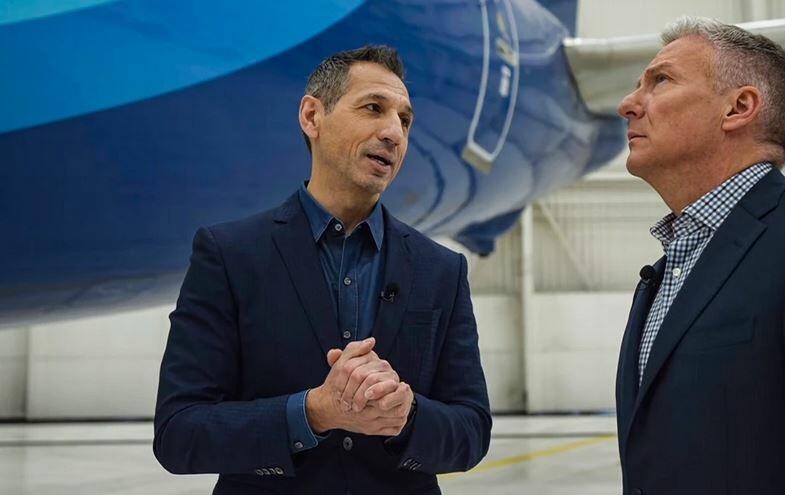
Alaska Airlines CEO Ben Minicucci speaks in an exclusive interview with NBC News senior correspondent Tom Costello.NBC News

When asked in an interview with NBC whether Boeing has a quality control problem, Minicucci said: “I think this is the issue that’s at question right here, which is what is Boeing going to do differently on their quality program, to make sure that when we get an airplane, it’s at the highest degree of excellence and that’s what’s got to be different going forward.”

“I’m more than frustrated and disappointed,” he said. “I am angry. This happened to Alaska Airlines. It happened to our guests and happened to our people. And — my demand on Boeing is what are they going to do to improve their quality programs in-house.”

After the door blew out on a 737 Max 9 a few minutes into a flight from Portland, Oregon to Ontario, California – forcing an emergency landing, the FAA ordered all Boeing Max 9 planes grounded for a safety investigation – and announced an audit of the Boeing Max 9 production line and suppliers “to evaluate Boeing’s compliance with its approved quality procedures.”

Boeing and its third-party suppliers will also face additional increased monitoring.

Wheel-y guys?

It gets worse for Boeing. On Saturday, a Delta 757 traveling from Atlanta lost a wheel as it attempted to take off from the Hartsfield-Jackson Atlanta International Airport.

The “nose wheel came off and rolled down the hill,” according to the incident report.

Get it together Boeing…

Tyler Durden
Wed, 01/24/2024 – 09:15