Actor Alec Baldwin was indicted by a New Mexico grand jury over the 2021 death of “Rust” cinematographer Halyna Hutchins after a prop gun fired a live round and struck her, according to court documents.
According to several media outlets, the move to indict Mr. Baldwin was confirmed Friday after the grand jury heard evidence presented by special prosecutors. He was charged with involuntary manslaughter.
Specifically, he was charged with involuntary manslaughter—negligent use of a firearm—or, in the alternative, involuntary manslaughter—without due caution or circumspection—reported ABC News. Both are fourth-degree felonies.
His lawyers suggested to several news outlets Friday that they would fight the charge. “We look forward to our day in court,” Baldwin lawyers Alex Spiro and Luke Nikas said in a statement.
The “30 Rock” actor’s initial involuntary manslaughter charges were dropped in April 2023. At the time, prosecutors said they could be brought again, however.
“Rust” armorer Hannah Gutierrez was charged with two counts of involuntary manslaughter as well. She faces an additional charge of evidence tampering.
The special prosecutors, Kari Morrissey and Jason Lewis sent the gun for more forensic testing several months ago. Experts who evaluated the firearm found that it could have only fired if the trigger was pulled.
“This fatal incident was the consequence of the hammer being manually retracted to its fully rearward and cocked position followed, at some point, by the pull or rearward depression of the trigger,” their report concluded. “Although Alec Baldwin repeatedly denies pulling the trigger, given the tests, findings and observations reported here, the trigger had to be pulled or depressed sufficiently to release the fully cocked or retracted hammer of the evidence revolver.”
While the proceeding is shrouded in secrecy, two of the witnesses seen at the courthouse included crew members—one who was present when the fatal shot was fired and another who had walked off the set the day before due to safety concerns.
Mr. Baldwin, the lead actor and a co-producer on the Western movie, was pointing a gun at Ms. Hutchins during a rehearsal on a movie set outside Santa Fe in October 2021 when the gun went off, killing her and wounding director Joel Souza. But Mr. Baldwin has said he pulled back the hammer but not the trigger, and the gun fired.
An earlier FBI report on the agency’s analysis of the gun found that, as is common with firearms of that design, it could go off without pulling the trigger if force was applied to an uncocked hammer, such as by dropping the weapon.
The only way the testers could get it to fire was by striking the gun with a mallet while the hammer was down and resting on the cartridge or by pulling the trigger while it was fully cocked. The gun eventually broke during testing.
The 2021 shooting resulted in a series of civil lawsuits, including wrongful death claims filed by members of Hutchins’ family, centered on accusations that the defendants were lax with safety standards. Mr. Baldwin and other defendants have disputed those allegations.
Ms. Hutchins’ widower, Matthew Hutchins, also filed a lawsuit after the incident, reaching a settlement in 2022. It allowed for insurance funds and a portion of “Rust’s” profits to help the couple’s child.
When the settlement was reached, Mr. Hutchins said he didn’t assign blame to Mr. Baldwin.
“I have no interest in engaging in recriminations or attribution of blame (to the producers or Mr. Baldwin),” he said at the time, according to reports. “All of us believe Halyna’s death was a terrible accident. I am grateful that the producers and the entertainment community have come together to pay tribute to Halyna’s final work.”
The Rust Movie Productions company has paid a $100,000 fine to state workplace safety regulators after a scathing narrative of failures in violation of standard industry protocols, including testimony that production managers took limited or no action to address two misfires on set before the fatal shooting.
The filming of “Rust” resumed last year in Montana under an agreement with the cinematographer’s widower, Matthew Hutchins, that made him an executive producer.
The movie’s assistant director, David Halls, was named as the individual who gave the firearm to Mr. Baldwin on the day of the shooting. Last year, he signed a plea deal for the “charge of negligent use of a deadly weapon” and received six months’ probation, according to prosecutors.
US Mulls More Aggressive, Stepped-Up Measures Against Houthis
On Saturday the Pentagon conducted yet another round of airstrikes on Houthi positions in Yemen, which marks likely the seventh round of such Western coalition attacks. It follows a round of strikes the day prior.
Even after this steady progression of escalation, which comes in response to near daily Houthi attacks on commercial ships transiting the Red Sea, the Pentagon still says the US government does not believe it is at war in Yemen. It was only on Thursday that President Biden issued a surprise admission, saying that the bombing is not working, yet it will continue anyway. The comments to the media included Biden responding when asked whether the strikes are deterring Houthi aggression: “Well, when you say ‘working’ — are they stopping the Houthis? No. Are they going to continue? Yes,” the president said.
And now the US administration is mulling bigger escalation, though it remains anything but clear whether the Houthis will actually halt their war on Red Sea shipping, given also Israel is persisting in its Gaza operation.
According to fresh reporting in Bloomberg, “The US and the UK are exploring ways to step up their campaign against Houthi militants in Yemen without provoking a broader war, with a focus on targeting Iranian resupplies and launching more aggressive pre-emptive strikes, people familiar with the matter said.”
But the fear is that it would put Washington on a collision course with Iran. Already there are widespread allegations that Iran has elite IRGC operatives on the ground advising the Houthis. The US has also accused Tehran of giving the Yemeni rebels intelligence information to help with targeting. The White House says it doesn’t want a wider war in the Middle East.
Bloomberg, based on administration sources, said that an internal debate is raging over the course of action:
The people familiar with the matter, who asked not to be identified discussing private deliberations, said the US and UK are examining ways to better disrupt Iranian efforts to resupply the Houthis at sea, especially given that it will be harder to sever land routes. A British official echoed that argument, saying officials are weighing various types of military operations to disrupt Iranian weapons flows to the Houthis.
Advocates for more aggressive action also argue that the time is ripe because of what they see as an emerging Iranian weakness. People familiar with the US stance say that the leadership in Iran may have overextended itself with its support for the Houthis along with launching attacks in Pakistan and Iraq, and may not respond to further escalation.
The US Navy last week intercepted a dhow in the Arabian Sea, off Somalia, that looked “suspicious”. It was found to have been transporting Iranian-made missile components, and was believed bound for Houthi territory.
Tragically, the operation wasn’t without a cost, as two Navy Seals were lost at sea, and are presumed dead, as search and rescue efforts have persisted for many days.
Iran’s allies in the Middle East are seeking to pressure US troops out of the region….
⚡️BREAKING
In an unprecedented move, Iraq has refused the entry of additional US forces into its territory.
The start of negotiations to remove US forces are imminent, says Iraqi army spokesman pic.twitter.com/XAp8iYxr88
Israel itself appears to be stepping up its anti-Iran intervention in Syria, on Saturday striking a Damascus suburb. Iran later confirmed that several high-ranking IRGC officers were killed. Tehran is vowing revenge, and things are set to get even more chaotic in the region in the coming days.
A coalition of 17 retired military officials led by retired U.S. Army Maj. Gen. James Marks have warned that President Joe Biden’s push for mass electric vehicle (EV) adoption is a threat to national security.
In a Jan. 17 letter to President Biden and Environmental Protection Agency (EPA) Administrator Michael Regan, the group of national security experts said they oppose the Biden administration’s aggressive EV push because Chinese dominance of EV supply chains poses national security risks for the United States.
In particular, regulatory initiatives meant to incentivize EV adoption “intensify America’s vulnerability to political interference by the Chinese Communist Party,” the experts wrote.
Since taking office, President Biden has signed a number of executive orders to boost the sales of EVs, while outlining a plan that seeks to have 50 percent of new vehicles be either plug-in hybrids or fully electric by 2030.
Further, the EPA in April 2023 proposed tough new vehicle standards that seek to reduce the number of cars that produce emissions by 2032.
The White House said at the time that the EPA’s strict emission standards are part of a “clear pathway for a continued rise in EV sales and protecting future generations from the impacts of climate change.”
This reflects the Biden administration’s often-repeated messaging that rapid electrification of transportation would lower greenhouse gases quickly and so reduce global warming, though this is a view that has been challenged,including by climate strategists who generally back climate action but warn that the dash to go electric could lead to unsustainable costs and needless damage to the environment.
EPA Rule In Focus
The retired military officials singled out EPA’s tailpipe emissions proposal for particular criticism because they say it would force up to two-thirds of new vehicles sold in America to be electric by 2032.
“At a nearly tenfold increase over current electric vehicle sales, this proposed rule is a clear example of tone-deaf policymaking that favors the geopolitical advantages currently held by China in this market,” the retired military officers wrote.
While the experts said that they believe EVs will play a significant role in diversifying America’s transportation systems, they believe the Biden administration’s various quick-adoption initiatives “will rush our transition to EVs before the infrastructure necessary to support it is in place.”
“This trajectory will only position the U.S. to become more reliant on China for critical minerals and manufacturing that are necessary for the rapid expansion of EV markets this administration envisions.”
“And even more concerning is the fact that this reliance hinges upon China’s goodwill to export those minerals and manufactured goods to the U.S. This will undoubtedly open the U.S. up to economic manipulations by China,” which poses a “major threat to our national security.”
“We do not believe now is the time to make ourselves vulnerable to such easy political pressures,” they added.
The EPA did not immediately respond to a request for comment on the letter.
Car Dealers Oppose Biden’s EV Push
There has been other notable opposition to the Biden administration’s EV push in general and the EPA’s strict new tailpipe emissions standard proposal.
Several thousand car dealership owners around the country in November signed an open letter to the Biden administration, saying they oppose its aggressive EV push.
More than 3,800 auto dealers wrote in the letter that EV demand isn’t sufficient, even though they said they believe that EVs “are ideal for many people” and that “their appeal will grow over time.”
“The reality, however, is that electric vehicle demand today is not keeping up with the large influx of BEVs [battery electric vehicles] arriving at our dealerships prompted by the current regulations,” the dealers said. “BEVs are stacking up on our lots.”
The dealers noted that enthusiasm for EVs “has stalled” and their supply is building “even with deep price cuts, manufacturer incentives, and generous government incentives.”
They said the EPA’s emissions goals are “unrealistic” and that EVs in general have major hurdles to overcome before adoption can ramp up widely, including a lack of EV charging infrastructure.
Range Anxiety
A major worry among Americans considering the wisdom of switching to an EV is range anxiety, which is the fear of driving an EV and running out of power without being able to find a charging port—and ending up stranded on the side of the road.
A recent study by the American Automobile Association (AAA) found that EV range can fall by up to a quarter when the vehicle is carrying heavy loads.
“Range anxiety remains a top reason consumers are hesitant to switch from gasoline-powered vehicles to EVs,” Adrienne Woodland, spokesperson for AAA, said in a statement.
Another recent study by consultancy Ernst & Young—in collaboration with European energy industry body Eurelectric—found that range anxiety is the second-most cited concern about switching to an EV, with a lack of public charging stations in the top spot.
The study points to an estimated need for 68.9 million chargers across the United States and Canada by 2035 to support the pace of the EV transition.
Earnings Call Sentiment: “Red Sea” Mentions Hit Record High As Fears Mount Of Snarled Supply Chains
Earnings-call mentions of “Red Sea” surged to record highs in recent weeks as the fourth-quarter earnings season kicks off.
Management teams and analysts are particularly worried about shipping disruptions as major shippers suspend sails through the critical waterway. At the same time, US and allied forces unleashed bombing raids on Iran-backed Houthis in Yemen. Still, the rebels have been able to strike commercial vessels with missiles and drones this past week, as the chaos in the region could last months.
Using the Document Search function on Bloomberg, earnings-call mentions of “Red Sea” topped 41 this week, a record high. As the earning season progresses, the mentions will likely increase.
Here’s a list of corporate executives discussing the Red Sea situtaion in the latest earnings calls.
In one earnings call, paint and coating company PPG Industries executives mentioned Red Sea disruptions could affect their raw material purchases.
An Indian executive at plastics company Supreme Industries warned that the Red Sea chaos “has disrupted the normal flow of business.”
“And just to build on that, zooming out a bit. Of course, if the conflict in the Red Sea were to escalate or to endure, it’s going to affect everybody,” the CEO of British electrical and telecommunications retailer and services company Currys plc said.
Faith leaders and religious liberty advocates are up in arms over news that the federal government encouraged banks and other financial institutions to search customers’ private accounts using the search term “religious texts.”
The “religious texts” search term was among those federal officials asked financial institutions to use following the Jan. 6, 2021, breach of the U.S. Capitol, a congressional source with direct knowledge confirmed to The Epoch Times on Jan. 18.
Other terms that banks, credit card companies, and financial firms were asked to use in the searches included “MAGA” and “Trump,” according to the House Judiciary Committee. Federal officials at the Department of Justice and the Treasury Department sought the data from such searches as part of their investigation of the events of Jan. 6, 2021.
Religious liberty advocates interviewed by The Epoch Times were unanimous in condemning the searches, which were conducted without judicially authorized search warrants.
“This is beyond alarming,” Family Research Council President Tony Perkins told The Epoch Times. “If we did a word search in history of the type of activities the Biden administration is engaged in, it would return words like ‘KGB,’ ’totalitarian,‘ ’repressive,’ ‘anti-democratic,’ and ‘grave threat to freedom.’”
Family Research Council is a Washington-based nonprofit advocacy group that works on behalf of traditional values, including and especially defense of the family and religious freedom.
“The last place you would anticipate this kind of government intrusion into freedom of speech is America and yet it is rife with this administration and with the ‘deep state,’” Liberty Counsel founder and Chairman Mat Staver told The Epoch Times.
“It is a very serious concern and it should be a serious concern, no matter your political beliefs because if this is permitted, then it just depends on who is in power. This is what despotic governments do to suppress people that they don’t agree with,” he said.
Mr. Staver’s organization, Liberty Counsel, is an Orlando, Florida-based nonprofit religious liberty defense foundation.
‘Mockery of Our Laws’
Kelly Shackelford, president, CEO, and chief counsel for the Plano, Texas-based First Liberty Institute, told The Epoch Times the searches exposed by the House panel represent a threat to religious freedom.
“It’s outrageous and frankly chilling that the federal government may be urging banks to monitor Americans for exercising their religious freedom by simply purchasing a Bible or other religious text,” Mr. Shackelford said.
“Weaponizing the federal government against religious Americans freely exercising their constitutionally protected freedom is outrageous and a danger to all our freedoms. It makes a mockery of our laws. When religious people are attacked and religious freedom is not upheld, all other civil liberties—including economic freedom—soon start crumbling.”
“This news should serve as a wake-up call for every American,“ warned Jeremy Tedesco, senior vice president of corporate engagement for Alliance Defending Freedom. ”The revelation that the government is working with financial institutions to flag everyday American citizens as ’threats’ because they shop at Cabelas, Dick’s Sporting Goods, or buy religious texts is terrifying.
“No one should live in fear that law enforcement or a financial service provider will flag their account based on the exercise of their constitutionally protected rights.”
House Judiciary Committee Chairman Jim Jordan (R-Ohio) said in a Jan. 17 statement that the searches were sought by the Department of the Treasury’s Office of Stakeholder Integration and Engagement in the Strategic Operations of the Financial Crimes Enforcement Network (FinCEN), in conjunction with the FBI.
Mr. Jordan wrote a Jan. 17 letter to Noah Bishoff, the former FinCEN director who is now the anti-money laundering officer for Plaid Inc., a San Francisco digital financial platform developer and marketer.
“According to this analysis, FinCEN warned financial institutions of ‘extremism’ indicators that include ‘transportation charges, such as bus tickets, rental cars, or plane tickets, for travel areas with no apparent purpose,’ or ‘the purchase of books (including religious texts) and subscriptions to other media containing extremist views,’” Mr. Jordan wrote.
“In other words, FinCEN used large financial institutions to comb through the private transactions of their customers for suspicious charges on the basis of protected political and religious expression.”
Officials’ Testimony Sought
Mr. Bishoff was asked to provide testimony to the House Judiciary panel about the searches, as was Peter Sullivan, senior private sector partner for outreach in the Strategic Partner Engagement Section of the FBI.
“Freedom of Religion is a fundamental right enshrined in the Constitution,” Mr. Jordan told The Epoch Times. “It should frighten every American that the federal government is watching people based on their purchases. This is as wrong as it gets and we will continue to expose this blatant attack on faith and civil liberties.”
In a Jan. 17 letter to FBI Director Christopher Wray, Mr. Jordan explained that Mr. Sullivan’s testimony “will help to inform the [House Judiciary] Committee and Select Subcommittee [on the Weaponization of the Federal Government] about the FBI’s mass accumulation and use of Americans’ private information without legal process; the FBI’s protocols, if any, to safeguard Americans’ privacy and constitutional rights in the receipt and use of such information; and the FBI’s general engagement with the private sector on law-enforcement matters.”
Congressional leaders also told The Epoch Times the searches warrant further investigation and corrective action.
House Majority Whip Tom Emmer (R-Minn.) also commented.
“The Biden administration is bringing back ‘Operation Chokepoint’ from the Obama-Biden era to weaponize our financial system against their political opponents. House Republicans, under the leadership of Chairman Jordan and the House Judiciary Committee, will not tolerate this un-American abuse of power.” Mr. Emmer said.
He was referring to a Department of Justice investigation in 2013 of firearms dealers, payday lenders, and other businesses thought to be vulnerable to money laundering.
Sen. Marco Rubio (R-Fla.) told The Epoch Times that “digging through American citizens’ private financial transactions, based on political phrases, is a clear weaponization of the federal government and those responsible must be held responsible.”
Sen. Ted Cruz (R-Texas) called the searches “outrageous” and claimed “the Biden administration is using federal law enforcement to engage in financial surveillance of Americans. … Shockingly, the government is even monitoring people for purchasing religious texts like the Bible. This is an Orwellian invasion of privacy, and it should have never happened in the United States. Biden’s bureaucrats running this horrendous financial surveillance system must be held accountable.”
Similarly, Sen. Ted Budd (R-N.C.) told The Epoch Times: “This is yet another example of the federal government being weaponized against Joe Biden’s political opposition, as well as people of faith. This sort of activity is highly concerning and warrants further investigation. I applaud the House Judiciary Committee for digging into this issue and I look forward to investigators exposing and rooting out this misconduct.”
Tactics of Marxism
Shea Bradley-Farrell is an international development professional and president of the Washington-based Counterpoint Institute for Policy, Research, and Education. She told The Epoch Times that the searches are typical of the control measures used by totalitarian regimes to counter dissidents and other groups not approved by the authorities.
“Weaponizing the federal government against private citizens for their political or religious beliefs is straight out of the playbook of Marxism, and was also used to identify, crush, and control the occupied peoples under the communist Soviet Union,” Ms. Bradley-Farrell said.
“As I explain in my book, ‘Last Warning to the West,’ these are totalitarian, police-state tactics used to impose ‘docility, discipline and controllability of subject populations. These are warrantless searches that violate the Fourth Amendment.”
A spokesman for Treasury Secretary Janet Yellen didn’t respond by press time to a request by The Epoch Times for comment.
Prediction Consensus: What The ‘Experts’ See Coming In 2024
As we look ahead to 2024, there is no shortage of expert forecasts and predictions for the world’s economy, markets, geopolitics, and technology to track in this new year.
In this now fifth year of our Prediction Consensus (part of our comprehensive 2024 Global Forecast Series), we’ve summarized 25 of the most common predictions and forecasts by experts into a single visual of what’s expected to happen in 2024.
Drawing from our predictions database of over 700 forecasts compiled from reports, interviews, podcasts, and more, Visual Capitalist’s Niccolo Conte created the Prediction Consensus “bingo card” and this article to offer an overview of the most cited trends and opportunities that experts are watching for the rest of the year.
Get full access to the series, which compiles insights from 700+ expert predictions for what will happen in 2024, by becoming a VC+ member today.
The Economy and Markets in 2024
Based on the hundreds of economic forecasts and predictions we’ve sifted through, many analysts and experts share similar views on what’s ahead for inflation, interest rates, and economic growth in 2024.
Inflation: After inflation’s steady decline across economies in 2023, many analysts see inflation continuing to cool off towards target levels. While some note that the last stretch to these targets could be the toughest, few foresee the possibility of inflation surging again like we saw in 2022.
Interest Rates: With inflation largely expected to be tamed in 2024, every major bank and institution forecasts interest rate cuts by the Federal Reserve, European Central Bank, and Bank of England by the middle of the year. Forecasts from analysts on how much rates will be cut vary between three and six cuts, with Federal Reserve board members themselves forecasting two to three cuts.
Markets: With interest rate cuts on the horizon, experts have echoed tentatively positive forecasts for both stocks and bonds in 2024. Falling rates should see bond yields fall as well, while equities should continue to benefit from the growing AI theme. Portfolio diversification is a common theme in the 2024 investment playbook, especially as geopolitical risks loom.
Real GDP Growth: The outlook for growth around the world is muted. Global GDP growth forecasts range from 2.5-3%, which is slightly lower than the 10-year average (2013-2022) of 3.1%. The U.S. is also forecasted to see slowing growth, with the IMF’s forecasts of 2.4% in 2023 moving down to 1.5% in 2024, while Europe is also expected to continue seeing slow growth at 0.9% in 2024.
When looking at other nations, many experts are predicting we’ll see India outpace China when it comes to real GDP growth this year, especially if the trend of manufacturing and foreign investment shifting away from China continues.
“The transition is two-sided: India is investing in infrastructure and courting foreign investment, while China is investing in aircraft carriers and turning its gaze inward to deal with youth unemployment and sectors crashing.”
After the past couple of years brought geopolitics back to the forefront with Russia’s invasion of Ukraine and Israel’s war with Hamas, experts don’t see global tensions cooling off anytime soon. In fact, many cite further geopolitical sparks and potential escalation as their top risk to watch out for in 2024, requiring diversified and nimble positioning.
With ongoing strikes from Yemen’s Houthi militants on container ships in the Red Sea resulting in marine shipping disruptions, retaliatory U.S. strikes are now likely cementing the potential for ongoing disruption for marine shipping around the world.
Outlooks for the Russia-Ukraine and Israel-Hamas wars are equally indecisive, with few to no experts foreseeing true resolutions for either conflict in 2024, and most citing further escalation and additional country involvement as the more likely scenarios.
Along with these ongoing geopolitical issues, 2024 is a key year for elections around the world. With the U.S., Russia, Ukraine, India, Mexico, and many other countries holding elections this year, there’s little stable ground in geopolitics without the potential for seismic shifts this year.
Further Boom or Regulatory Bust for AI in 2024?
After its breakout year in 2023, artificial intelligence faces new challenges in 2024 which is set to be another pivotal year for the technology.
While advances in the technology are inevitable, the less exciting reality of regulation and legal disputes around training data is already a key issue, as seen in the New York Times’ lawsuit against OpenAI. Along with this, the growing potential for malicious AI use around the many global elections this year could spur further calls for greater regulation.
Experts see these topics acting as a bit of a damper on another potentially explosive year for AI product growth and distribution. Many are expecting the EU to clamp down faster and harder than the U.S. when it comes to regulation.
2024 Forecasts: Everything is Connected
While the global economy, markets, geopolitics, and technological advancements have always affected each other in various ways, in 2024 these connections feel stronger than ever.
One such example is how escalating conflicts in the Middle East are affecting shipping insurance costs and routes, which could drive up inflation again and lead central banks to hold off on cutting interest rates this year, thus affecting myriad economic factors and markets around the world.
2024 feels full of both good and bad interconnected possibilities, from forecasts around AI advancements ushering in a new bull market and golden age of productivity to the potential job disruptions it could cause that our labor markets and society might not be ready for.
Despite the world growing more polarized and geopolitically fractured in the past couple of years, these predictions and forecasts remind us of how deeply dependent the health and future of the global economy is on the interconnected nature of these factors.
Millions of Americans are trapped in a maze of inflated hospital fees and opaque billing codes. Yet they either pay these crushing bills or watch their credit score plummet.
But what if patients could decode hospital charges and gain the upper hand? Armed with such knowledge, they may reveal errors, negotiate costs, access aid programs, and protect themselves from crippling medical debt.
Patients Pay the Price as Hospitals Fail Billing Standards
Recently published research in the Journal of the American Medical Association analyzed data from a 2022 survey by The Leapfrog Group. This nonprofit issues an annual review assessing the quality of care and billing accountability standards across U.S. hospitals.
The analysis focused on responses from 2,270 hospitals. It found that 754 facilities (33.2 percent) had taken legal action against patients who could not pay bills in full or on time. Additionally, over 1,000 hospitals failed to provide itemized bills within 30 days, possibly violating legal billing requirements.
The bill most patients get in the mail is usually a consolidated summary, “making it impossible to assess whether you’re charged correctly or not,” Patrick Haig, CEO and co-founder of Goodbill, a startup dedicated to making hospital bills transparent and affordable for patients, told The Epoch Times.
Furthermore, 125 hospitals (5.5 percent) lacked billing representatives who could investigate errors, offer price adjustments, or discuss payment plan options. In total, 1,415, or over 60 percent, of the facilities surveyed did not satisfy all three critical billing quality standards.
Over 50 percent of hospital bills reviewed by Goodbill contain inaccuracies, according to Mr. Haig. These range from coding mistakes to charges for unnecessary medical procedures.
“That’s kind of crazy when you think about it,” Mr. Haig said, “because so many people feel like they have no choice but to just pay their bills, or they go into debt because they can’t afford to pay their bills.”
If you have concerns regarding hospital charges, request an itemized bill within 30 days. This line-item invoice details all services and supplies involved in your care.
An accurate itemized bill includes standardized diagnosis, procedure, and billing codes that determine costs, Mr. Haig said—specifically, Current Procedural Terminology (CPT) codes, Healthcare Common Procedure Coding System (HCPCS) codes, and others. These codes clearly convey how insurance companies reimburse hospitals, enabling “apples-to-apples” charge comparisons with other providers, he added.
“For example, a charge for an acute emergency room visit might go by different names, depending on the hospital—like ‘Level 5 ED visit,’ or ‘ER visit Lvl 5,’ but universally has only one CPT code: 99285,” he said.
If the itemized bill lacks sufficient coding detail, request the UB-04 claim form submitted to insurers for payment. It contains the clearest procedure coding available, according to Mr. Haig. Simply requesting the hospital’s proprietary “itemized bill” could yield useless internal classifications rather than standardized descriptors.
“We’ve seen that hospitals sometimes have their own version of an ‘itemized bill’ with internal codes that aren’t helpful at all,” he said. “Requesting your UB-04 claim form is a much more specific ask that is difficult to misconstrue.”
Emergency Care Springboards People Into Debt
According to a nationwide poll by KFF, formerly known as the Kaiser Family Foundation, a nonprofit organization focusing on health care and health policy research and analysis, the medical debt crisis extends far beyond hospital bills alone. Factors like credit cards, personal loans, and borrowing from friends used to pay outstanding health care fees were also considered.
Key findings reveal that about 25 percent of adults with medical debt owe over $5,000. About 20 percent said they believe they’ll never pay it off. For many, the initial debt stems from one-time or short-term emergency care.
Additionally, nearly 50 percent of adults couldn’t afford an unexpected $500 medical bill without taking on debt. Over a third currently owe less than $1,000—an amount with serious financial consequences.
Up to 40 Percent Qualify for Hospital Aid, but It Goes Unused
However, up to 40 percent of the medical debt seen by Goodbill qualifies for hospital financial assistance, Mr. Haig said.
“Nonprofit hospitals, which comprise the majority of hospitals in the United States, are required by law to offer financial assistance to patients who fall below certain household income thresholds,” he added. “At some hospitals, that threshold can be well over $100,000.”
However, qualifications go widely unadvertised, and many patients don’t know to ask. “Patients can save up to 100 percent off their portion of the bill,” Mr. Haig said. “It’s one of the most underutilized benefits in health care.”
Other ways to protect yourself against inflated medical bills include the following:
Seeking pre-approvals for covered care.
Negotiating costs even if correctly billed.
Understanding new surprise billing guardrails.
The No Surprises Act shields insured patients from many unexpected medical bills. This includes bills sent by out-of-network providers that were beyond the patient’s control.
The new rules enable uninsured and cash-pay patients to access good-faith cost estimates before receiving care.
Finally, if you have a problem with debt collection due to surprise medical billing, you can submit a complaint online to the Consumer Finance Protection Bureau (CFPB) or call (855) 411-CFPB (2372).
Ballistic Missiles May Have Been Used In Huge Strike On US Base In Iraq
Update(1355ET): Details have continued trickling out and are scant, but by all accounts the Saturday attack on Al-Asad airbase in Western Iraq, which houses US forces, was a big one. Reuters cites an official who said “the base was hit by ballistic missiles but he left open the possibility it was struck by rockets.” This has led to some speculation that ballistic missiles could have been fired on the US outpost from Iranian territory.
But Reuters also notes, “Two security sources in Iraq and one government source said the base was hit by multiple rockets fired from inside Iraq.” One regional analyst has gathered sources to detail the following…
Some updates:
– Not rockets, but tactical ballistic missiles;
– U.S. injuries confirmed;
– 15+ U.S. Patriot missiles were launched to intercept, but some missiles still got through — meaning attack was BIG;
– #Iran-directed “Islamic Resistance in #Iraq” claimed responsibility. https://t.co/E858p7PNRz
This is the very same base that Iran retaliated against with ballistic missiles in January 2020, as revenge for the US assassination by drone strike of IRGC Quds Force General Qasem Soleimani.
* * *
A missile barrage has reportedly struck the Al-Asad Airbase — a U.S. military facility maintained in Iraq since 2003 — according to Reuters accompanied by videos on X alleging to show the missiles raining down:
🇮🇶🇺🇸BREAKING: ROCKET BARRAGE HITS U.S BASE IN IRAQ
Ain Al-Assad base in western Iraq, housing American forces, was reportedly hit by 20 rockets in a severe missile attack.
Hezbollah in Iraq has reportedly claimed responsibility, stating the attack targeted American troops.… pic.twitter.com/GokK35aNzk
The Al-Asad base is the same that suffered retaliatory strikes in January of 2020 after then-President Trump killed Iranian military officer Qasem Soleimani.
US defense officials at the time said just 10 missiles managed to make contact with the base. It appears fewer than 20 missiles were fired in Saturday’s attack — with an unknown number intercepted by missile defense systems — though the story continues to develop.
US personnel suffered minor injuries and a member of Iraq’s security forces was seriously wounded in an attack on Iraq’s Ain al-Asad air base on Saturday, a US official said, citing initial assessments, which are subject to change.
At least a dozen missiles were fired at a military base used by US-led coalition forces in western Iraq, a US defense source and Iraqi police told AFP.
Al-Asad was the second largest base constructed during George Bush’s “Operation Iraqi Freedom,” — wherein ‘freedom’ in Neocon-speak of course refers to 300,000 dead Iraqi civilians — an operation which ostensibly ended in December of 2011.
The Pentagon will use these strikes — on a base constructed for Bush’s Iraq war which ended in 2011 — to escalate US involvment in the ME.
The media will ignore all context of US funding Israel’s war and fail to ask any questions on why the base still operates 13 years later: https://t.co/kN02MdvVNA
The Iran Observer said to “expect US retaliatory strikes against Iraqi resistance forces.”
This follows an Iranian strike on what they deemed foreign “espionage centers” and “anti-Iranian terrorist gatherings in parts of the region” with ballistic missiles, killing four though no Americans.
One regional correspondent, Joyce Karam, pointed out that last Monday was an exceptional day in terms of the number of hugely escalatory events close in time.
She wrote that the “Middle East is imploding, in one day”…which has included the following:
Five members of the Iranian Revolutionary Guard (IRGC) serving in an advisory capacity were killed Saturday in the Syrian capital of Damascus when Israeli warplanes struck a residential building they were staying in. Iran confirmed the deaths of the Guard members.
Syrian state media reported that the attack was carried out against the Mazzeh neighborhood by planes operating in the Israeli-occupied Golan Heights. Israel has yet to comment on the incident. Some reports say ten people in total were killed in the attack.
Footage of Israeli strike in Mezzeh, heart of Syria’s capital Damascus today, killing IRGC Gen. Sadegh Omidzadeh,his deputy Haj Gholam and 3 others. Location, timing, tactic, all significant: pic.twitter.com/rseZpX1GDE
The slain reportedlyincluded a Quds force general, and the Revolutionary Guard identified the slain, but did not include their ranks or duties within Syria. Notably, the Guard’s names did not include the Quds force general, though it also did not deny he was killed. The Syrian Observatory for Human Rights reported five Iranians and an unidentified Syrian were amongst the slain.
Syrian state media identified the killed Iranians simply as advisers, and Iran followed up the incident with a statement condemning Israel for “organized terrorism,” and threatened retaliation at a time and place of their choosing.
A witness reported hearing at least five separate explosions during the attack, and saw bodies being taken away, including three surviving wounded. The media reports said the building was heavily guarded at the time.
Iran has had advisory forces in Syria since 2011, and played a big role in trying to help them organize the fight during the protracted civil war. Israel presented this as a threat along their border, and has regularly attacked Iranian targets within Syria when it has identified them.
Without knowing more about the victims, it is impossible to know how much of an impact this will have on the Iranian mission within Syria, though if history is any indicator, it will not mean any kind of ending to it.
With Israel escalating fighting in several border regions already and tensions soaring, Syria will no doubt hope for advice to continue apace.
Economic growth continues to defy expectations of a slowdown and recession due to continued increases in deficit spending. In fact, the U.S. Treasury recently reported the December budget deficit, which shows the U.S. collected $429 billion through various taxes while total outlays hit $559 billion.
As noted, the problem remains on how the economy has avoided a recession despite the Fed’s aggressive rate hiking campaign. Numerous indicators, from the leading economic index to the yield curve, suggest a high probability of an economic recession, but one has yet to occur. One explanation for this has been the surge in Federal expenditures since the end of 2022 stemming from the Inflation Reduction and CHIPs Acts. The second reason is that GDP was so grossly elevated from the $5 Trillion in previous fiscal policies that the lag effect is taking longer than historical norms to resolve.
However, that red line in the chart above is the most interesting. Notice that while Federal expenditures are rising, Federal tax receipts are falling. Such is why the national deficit is increasing. When we discussed this previously, many thought the shortfall was temporary. To wit:
“California’s tax payments are delayed due to the emergency declaration. However, that doesn’t account for the magnitude of the decline in filings. Secondly, given the shuttering of the entire economy in 2020, which also delayed filings nationwide, the extent of the current decrease seems more than just a single event.”
Given the length of time and the fact the collection rate fell further, it suggests there is more to the decline.
Tax Receipts Send A Warning
The change in Federal receipts is essential as the Government’s revenue is from the taxes on both corporate and individual incomes. Unsurprisingly, if revenues and incomes decline, such would reflect economic activity. As shown below, there is a very high correlation between the annual change in Federal receipts and economic growth. Historically, when the yearly change in Federal receipts falls below 2% annual growth, such has preceded economic recessions. Federal receipts’ yearly rate of change is currently a negative five percent (-5%).
We see the exact correlation by smoothing the data and using inflation-adjusted tax receipts on a 24-month rate of change. Again, a recession follows when tax receipts fall below 2% annual growth rates. I like this measure better as it accounts for the “lag effect” in the economy. The 2-year yearly change in receipts has fallen well below the 2% warning line and is currently at -5.77%.
While tax receipts suggest economic weakness is more pervasive than headlines suggest, the deficit spending flows keep economic growth from becoming recessionary.
The Frog And Deficit Spending
If we look at the current economy, there is no noticeable collapse in the dollar, private capital, rampant Inflation, or recession. However, like bringing the water to a slow boil, the frog doesn’t realize it is in trouble until it’s too late.
The government’s serious endeavors into deficit spending began with Ronald Reagan in 1980. Since then, politicians concluded that a lot should be better if a little deficit spending is good. For politicians, there are only positive benefits of deficit spending increases. More spending provides a short-term boost in economic activity, which gets them re-elected to office.
However, the water temperature is clearly rising in the longer term.
While the dollar hasn’t collapsed under the weight of deficit spending, the negative strength trend relative to other currencies is slowly rising in temperature.
Of course, as the dollar weakened and deficits grew, Inflation, for both producers and consumers, rose.
While deficits may not appear to crowd out private investment, the rise of behemoth companies like Apple, Google, and others do crowd out innovation and new company formations. Such activities require capital, and a reasonable correlation exists between the ebbs and flows of deficits and capital acquisition.
Not surprisingly, as the dollar weakens, the movement of capital slows, and Inflation rises, the economic growth rate slows. Such should not be surprising as debt used for non-productive purposes diverts money from productivity to interest service.
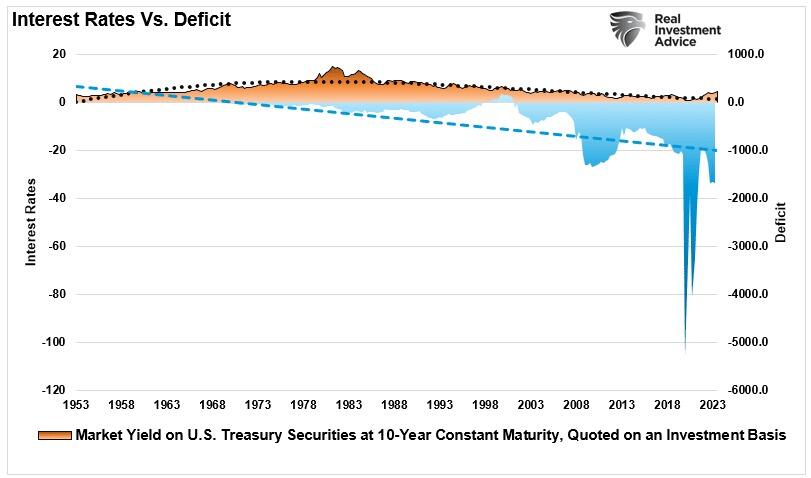
The one thing that deficits have not led to is surging interest rates and massive increases in borrowing costs.
However, that suppression of interest rates has come from two primary sources.
Slower rates of economic growth
Massive interventions by the Federal Government to suppress rates.
Given the sharp increases in Federal debt since 2008 to support economic growth, the economy can not sustain higher borrowing costs for long.
The Economy Is Close To Recession
While economic growth continues to defy expectations on the surface, if it weren’t for increases in deficit spending, economic growth would be flirting with recessionary levels at just 0.7% in Q3 rather than 6.21%
In GDP accounting, consumption is the most significant component. Since deficit spending doesn’t filter down into the average household, it is no wonder why Presidential approving ratings are so dismal.
Should governments use deficit spending for “productive investments” during economic downturns? That answer is clearly in the affirmative category.
However, once the economy returns to growth, the deficits should be reversed into surpluses to prepare for the next inevitable downturn. Such is the entire underlying premise of Keynesian economic theory. But, unfortunately, politicians, in their ongoing endeavor to get reelected, ignore the part about repaying debts.
Are all the problems in the U.S. solely the result of rampant deficit spending? Of coursenot. The U.S. has also spent four decades making poor political and economic choices.
Massive increases in consumer and corporate debt.
A shift from productive to non-productive labor.
Poor immigration policies.
The slow erosion of the rule of law; and,
An undermining of capitalism and a move to socialistic policies.
If you ignore all of the anecdotal evidence, an argument can be made for running continual economic deficits. However, suggesting “deficit spending” has no consequences is entirely wrong.
We can continue our path for quite some time, and probably longer than most imagine.
But, just because we haven’t realized it yet, it doesn’t mean we aren’t slowly being “boiled by deficits.”