67.6 F
Chicago
Thursday, September 17, 2026
Home Blog Page 2995

“We’ve Memory-Holed How Awful Things Were” – Axios Beclowns Itself In Anti-Trump Rant

0
“We’ve Memory-Holed How Awful Things Were” – Axios Beclowns Itself In Anti-Trump Rant

Establishment friendly news outlet Axios has gone full BuzzFeed in a ham-handed ‘gotcha’ – suggesting that Trump supporters are ‘selectively’ touting the former president’s pre-pandemic economic record, whilst ignoring a once-in-a-century exogenous event that no reasonable person would ever blame any sitting president for.

According to Axios, “[Trump’s] economic record is only good if you leave off what happened from March 2020 to the end of his administration.

Yes, idiots, and what could have happened during that time period that was completely outside of his control? Perhaps the same mysterious event that Biden ignores while taking credit for ‘record job creation’ since entering office?

Buried within the article, Axios notes that it was only after the pandemic hit that unemployment spiked to 14.8%. They also undermine themselves by citing Paul Krugman, who noted that giving Trump a pass on the pandemic economy is ‘understandable’ since “Countries around the world faced similar struggles to the U.S. at the time.”

“We may have memory-holed just how awful things were back in 2020,” Axios author Emily Peck writes.

No Emily, Trump supporters – well, any rational person – are giving Trump a pass on something that was completely outside of his control, and focusing on what he actually did before the pandemic.

The replies, as usual, are hilarious.

Tyler Durden
Thu, 01/18/2024 – 17:20

VDH: The Hysterical Style In American Politics

0
VDH: The Hysterical Style In American Politics

Authored by Victor Davis Hanson via American Greatness,

The post-Joe McCarthy era and the candidacy of Barry Goldwater once prompted liberal political scientist Richard Hofstadter to chronicle a supposedly long-standing right-wing “paranoid style” of conspiracy-fed extremism.

But far more common, especially in the 21st century, has been a left-wing, hysterical style of inventing scandals and manipulating perceived tensions for political advantage.

Or, in the immortal words of Barack Obama’s chief of staff, Rahm Emanuel, “Never let a serious crisis go to waste.”

The 2008 economic emergency crested on September 7, with the near collapse of the home mortgage industry.

Obama took office on January 20, 2009, more than four months after the meltdown. In that interim, the officials had finally restored financial confidence and plotted a course of economic recovery.

No matter.

The Obama administration never stopped hyping the financial meltdown as if it had just occurred. That way, it rammed through Obamacare, massive deficit spending, and the vast expansion of the federal government.

All that stymied economic growth and recovery for years.

In 2016, Donald Trump was declared Hitler-like and an existential threat to democracy.

Amid this derangement syndrome, any means necessary to stop him were justified: the Russian collusion hoax, impeachment over a phone call, or the Hunter laptop disinformation farce.

Eventually, the left sought to normalize the once unthinkable: removing the leading presidential candidate from state ballots and indicting him in state and local courts.

Nothing was off limits—not forging a federal court document, calling for a military coup, rioting on Inauguration Day, or radically changing the way Americans voted in presidential elections.

In October 2017, allegations surfaced about serial sexual predation by liberal cinema icon Harvey Weinstein.

The #MeToo furor immediately followed.

At first, accusers properly outed dozens of mostly liberal celebrities, actors, authors, and CEOs for their prior and mostly covered-up sexual harassment and often assault.

But soon, the once legitimate movement had morphed into general hysteria.

Thousands of men (and women) were persecuted for alleged offenses, often sexual banter or rude repartee, committed decades prior.

#MeToo jumped the shark with the left-wing effort to take down conservative Supreme Court nominee Brett Kavanaugh.

Would-be accusers surfaced from his high school days, 35 years earlier, but without any supporting evidence or witnesses for their wild, lurid charges.

#MeToo hysteria ended when too many liberal grandees were endangered.

Most dramatically, former Joe Biden senatorial aide Tara Reade came forward during the 2020 campaign cycle with charges that front-runner Joe Biden had once sexually assaulted her—and was trashed by the liberal media.

The outbreak of COVID-19 in the United States during the winter of 2020 prompted an even greater hysteria.

Without scientific evidence, federal health czars Anthony Fauci and Francis Collins were able to convince the Trump administration to shut down the economy in the country’s first national quarantine.

Suddenly, it became a thought crime to question the wisdom of six-foot social distancing, of mandatory mask wearing, of the Wuhan virology lab’s origin of the COVID virus, or of off-label use of prescription drugs.

Left-wing politicians and celebrities, from Hillary Clinton and Gavin Newsom to Jane Fonda, all blurted out the political advantages that the lockdowns offered—from recalibrating capitalism and health care to ensuring the 2020 defeat of Donald Trump.

The COVID hysteria magically ended when Joe Biden won the 2020 election. Suddenly, the lies about the bat or pangolin origins of the virus faded. The damage from the quarantines could no longer be repressed. And herd immunity gradually mitigated the epidemic.

The lockdown caused untold economic chaos, suicides, and health crises.

One result was the 120 days of looting, arson, death, destruction, and violence spawned by Antifa and Black Lives Matter in the aftermath of the tragic death of George Floyd while in police custody in May 2020.

Suddenly, a hysterical lie took hold: American police were waging war against black males.

The details around Floyd’s sudden death—he was in the act of committing a felony, resisting arrest, suffering from coronary artery disease and the after-effects of COVID, and being high on dangerous drugs—were off limits.

The riot toll reached $2 billion in property damage, over 35 deaths, and 1,500 injured law enforcement officers. A federal courthouse, a police precinct, and a historic church were torched.

Police forces were defunded.

Emboldened left-wing prosecutors nullified existing laws.

Diversity, equity, and inclusion commissars spread throughout American higher education as meritocracy came under assault.

Racial essentialism triumphed.

Racially segregated dorms, campus spaces, and graduations were normalized.

Everything from destroying the southern border to dropping SAT requirements for college admission followed.

Sometimes real, sometimes hyped crises lead to these contrived left-wing hysterias—like the January 6 violent “armed insurrection” or the “fascist” “ultra-MAGA” threat.

Otherwise, the progressive movement cannot enact its unpopular agendas. So it must scare the people silly and gin up chaos to destroy its perceived enemies—any crisis it can.

Tyler Durden
Thu, 01/18/2024 – 17:00

Regulator Readies For End Of Fed Bank Bailout Fund As ‘Arb’ Volumes Explode Higher

0
Regulator Readies For End Of Fed Bank Bailout Fund As ‘Arb’ Volumes Explode Higher

Money-market fund assets notched their first net weekly outflows in a month, led by declines in government funds as investors reallocated portfolios in the early days of the new year.  Total assets dropped $14.1BN to $5.961TN from $5.975TN the week prior, which was a record high…

Source: Bloomberg

Retail funds saw yet another inflow (of $1.6BN) while Institutional funds saw $15.8BN outflows…

Source: Bloomberg

In a breakdown for the week to Jan. 17, government funds – which invest primarily in securities like Treasury bills, repurchase agreements and agency debt  – saw assets fall to $4.862 trillion, a $15.7 billion decrease.

Prime funds, which tend to invest in higher-risk assets such as commercial paper, meanwhile, saw assets rise to $978.3 billion, a $5.2 billion increase.

After its biggest increase (+$5.7BN) since the SVB crisis last week, The Fed’s balance sheet shrank by $13BN last week to a new cycle low of $7.674TN (the lowest since March 2021)…

Source: Bloomberg

The Fed’s reverse repo facility continues to see drawdowns, pointing to the source of liquidity zero-ing out by March as we have warned about.

Bank reserves at The Fed continue to rebound strongly (helped by the drawdowns from RRP to their highest since April 2022), catching up to equity market cap’s recent gains…

Source: Bloomberg

Additionally, usage of The Fed’s bank bailout facility (BTFP) exploded higher by $14.3BN last week (presumably as everyone piled into the arb) to a new record high of $162BN…

That is the biggest weekly jump since the SVB crisis…

Source: Bloomberg

The Fed has totally lost control of its BTFP facility as it has risen by over $47BN since the arb existed.

And the Fed-BTFP Arb remains alive and well and offering 55bps of free money to every bank that qualifies…

Source: Bloomberg

And it appears our warnings that is becoming more likely that The Fed will be able to keep the bank bailout (BTFP) plan alive after its planned obsolescence in March have been proven right.

“In justifying the generous terms of the original program, the Fed cited the ‘unusual and exigent’ market conditions facing the banking industry following last spring’s deposit runs,” Wrightson ICAP economist Lou Crandall wrote in a note to clients.

“It would be difficult to defend a renewal in today’s more normal environment.”

Expanding on earlier plans that we detailed here to reduce banks’ ability to use FHLB as an implicit funding tool, Bloomberg reports today that US regulators are preparing to introduce a plan to require that banks tap the Federal Reserve’s discount window at least once a year to reduce the stigma and ensure lenders are ready for troubled times.

In an interview, Michael Hsu, the acting comptroller of the currency, said the changes regulators will propose aim to ensure banks are more prepared to respond to sudden flights of deposits.

“We want to make sure that banks have enough resources to meet any kind of outflows within five days—especially those related to uninsured deposits,” Hsu said.

He added that the plan will also seek to remove any stigma associated with borrowing from the Fed’s discount window.

Hsu is the latest top US regulator to flag the need for banks to be more comfortable using the discount window.

“Banks need to be ready and willing to use the discount window in good times and bad,” Michael Barr, the Fed’s vice chair for supervision, said in December.

Maybe banks are starting to realize this won’t be painless…

To make the discount window more attractive, the government is considering ways to make it cheaper for borrowers, according to a person familiar with the rule-writing effort.

The proposal could also affect how assets such as high-quality bonds and mutual funds, which are frequently held as collateral to gain discount-window access, can be counted on a bank’s balance sheet, said the person, who asked not to be identified as the plans haven’t been released.

Translation: all the “pay me at par” rules of the BTFP will now be applied to the discount window… but maybe not the arbitrage.

Well, now we know where the regional banks will be going for funding…

Can the discount window cope with the sudden need for over $147 Billion?

Last week saw usage of the discount window rise $189 Million to $2.295 Billion

What do you think?

It is clear that The Fed is well aware of the problem it faces on March (or sooner). As we noted previouslythe potential for this liquidity crisis created the possibility of a worrying chain reaction – from the Fed’s balance sheet, via the money market funds and the private repo market, through the basis trade and on to the demand for Treasuries, at a time when the US government is coming to market with massive amounts of issuance.

Instead of scarce bank reserves creating liquidity problems and forcing the Fed to stop QT, it may well be the exhaustion of the ON RRP and the upending of the hedge fund basis trade that causes problems in 2024. The worrying difference now is that there is no Fed backstop for hedge funds and the high degree of leverage used in the trade could lead to liquidity problems proliferating even more quickly through the financial system.

This may be too late to avert a severe bout of bond market volatility, though.

Either way, the Fed is on course to end QT and restart QE in the coming months, against a backdrop of loose fiscal policy and a still-resilient economy, opening the door to a reappearance of inflationary pressures that the Fed may have little appetite (or ability) to restrain.

And that’s why The Fed will cut rates no matter whether employment is at record highs or inflation is re-igniting.

Tyler Durden
Thu, 01/18/2024 – 16:45

Figuring It All Out

0
Figuring It All Out

Submitted by QTR’s Fringe Finance

For two years, the question has been the same: when is something going to give, and when are we going to see some real volatility in some market — any market — thanks to 5% interest rates?

The answer, it turns out, may be simpler than I thought.

I gave up a long time ago trying to figure out whether the market is going to flash crash or melt up as a result of aggressive further easing. If I had to handicap the situation today, I’d predict both are going to happen: we will see a sharp decline in the market, as a result of either a black swan event, disappearing liquidity, an unexpected blowoff valve (more on this in a bit) or all of the above, which would trigger margin calls and a deleveraging. Then, from there, I would predict an unprecedented response from the Fed, who would flood the system with money and easing in a way that was larger by any factor than how they have done it in the past.

Whatever outcome occurs should be irrelevant thanks to the way that I positioned myself heading into the year. I’m hedged and short the indexes and a couple of specific names that I believe would plunge in the event of a market pullback. At the same time, I will be ready to use any profit from a sharp downturn to purchase sound money assets – namely, gold and silver, miners, first and foremost, and maybe some real estate and bitcoin – should they also wind up selling off in any type of panic that encompasses all assets.

But for me the bizarre thing is how long it has taken for either of these situations to take place. For all intents and purposes, the market has been in a very relaxed, slow and steady melt-up over the last two years despite interest rates being hiked at a record pace, record levels of outstanding debt, and mounting geopolitical instability.

I was starting to feel like it was officially time to don my tinfoil hat and ask questions about whether or not the markets are being held up unnaturally by the plunge protection team. Well, to be honest, I always think they are, but I mean, asking questions about whether or not it’s happening more now than ever.

But then I came across a couple of interesting facts that made me once again believe that my thesis could be correct, but my timing could just be wrong. On this blog, I often reference a sign in my local Korean deli above the sandwich counter that says:

“You never need patience more than when you are about to lose it.”

The sign makes the point that when you feel like despair is setting in, you may be the closest you’ve ever been to what you’ve been waiting for.

So here are two new pieces of data to chew on that I found this weekend.

First is data that came out of the San Francisco Fed back in November indicating that household savings left over from the pandemic were actually running a bit higher than people had expected.

Those that read me regularly know my belief that diminishing personal savings and rising credit card debt will eventually lead to increased delinquencies and then economic and stock market volatility. It’s possible that the system was simply bombarded with so much excess cash as a result of COVID that it hasn’t run out yet. Here’s the San Francisco Fed:

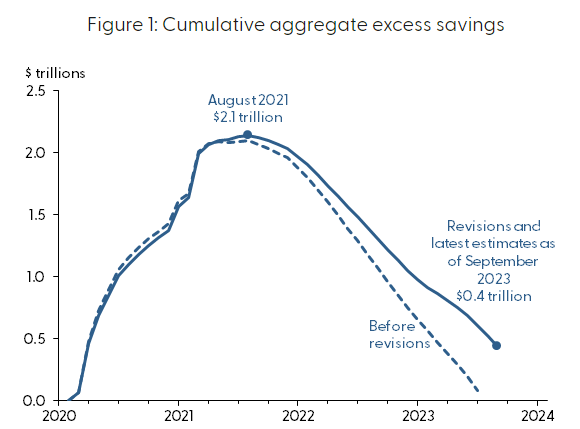
Figure 1 incorporates the recent data revisions to show how our updated estimate of cumulative excess savings in the aggregate economy changed following the BEA’s update. Figure 1 also incorporates the subsequent BEA data release for September 2023. Accumulated excess savings, estimated in nominal terms, totaled more than $2.1 trillion by August 2021 when it peaked. This is largely unchanged from the total pre-revision value.

Since then, the drawdown on household savings—that is, when aggregate personal savings dip below the pre-pandemic trend—has been slower than previously believed. The new estimates average about $75 billion per month, compared with $100 billion per month before the data revisions.

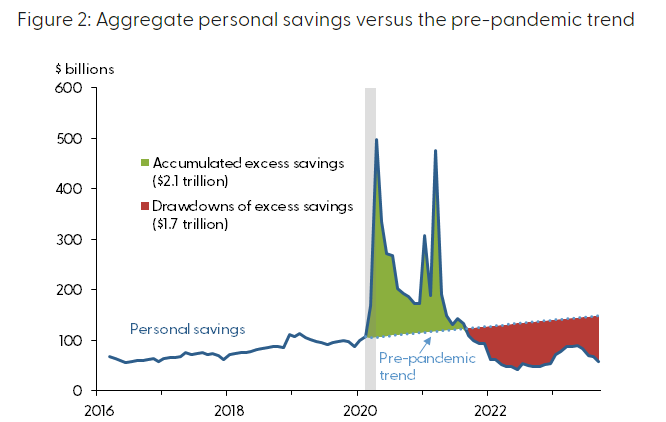
Figure 2 compares the latest post-revision measures of actual personal savings and the pre-pandemic savings trend. The red area shows our updated estimate for cumulative drawdowns. As of September 2023, this reached about $1.7 trillion of the $2.1 trillion in total accumulated excess savings (green area). This latest update implies that around $430 billion of excess savings remains in the aggregate economy.

They predict that excess savings will last until “sometime” in the first half of 2024:

If the recent pace of drawdowns persists—for example, at average rates from the past 3, 6, or 12 months—aggregate excess savings are likely to remain available in the overall economy until sometime in the first half of 2024.

And interestingly enough, this is similar to the thesis that Larry Lepard put forth on my podcast over the weekend.

Talking about why the market hasn’t crashed yet, Larry said: “I have a theory and I could be wrong, but it’s stunning to me. You know what’s happened to me, it’s been the most frustrating piece of the last year or two. I mean, I was, you know, if you’d asked me at the beginning of this year, ‘Will the stock market go back and revisit its old or exceed its old high?’ I’d have said there’s just no way. And of course, I was dead wrong.”


50% OFF ALL SUBSCRIPTIONS: Subscribe and get 50% off and no price hikes for as long as you wish to be a subscriber.


He added: “But I found a chart, it’s going to be in my most recent quarterly, which will be out in a few days, and it’s a very interesting chart. It talks about federal government spending and what it shows is that we were kind of ticking along in the $4 trillion range, then COVID came along and just blew things out. You know, we went to six, seven trillion in one year. And what’s amazing to me is COVID’s gone now, right, and yet the spending is still at that level. Chris, I mean, we’re at 6.1 [trillion] last year, and so, you know, it’s really kind of this Inflation Reduction Act, of course, which is just a sick joke, and the fact that the debt ceiling won’t be revisited until January of 2025, has just, you know, they’re spending like drunken sailors.”

“And this is further evidenced, if you look at the December number that just came out from the CBO, the Congressional Budget Office,” Larry said.

“I mean, the year-on-year deficit in December was up 20%. And so for the first quarter, the deficit was 500 plus [billion] dollars, and usually, the first quarter is one of the better quarters, implying that next year will be over $2 trillion. Last year we were at one. So, you know, I think what’s going on is just all this free money, and I shouldn’t say free money, all this aggressive spending by the federal government.”

You can listen to Larry’s full interview here:

Finally, everybody should watch Luke Gromen’s analysis of the situation from Palisades Gold Radio out just hours ago.

In it, he postulates that the treasury market is calling all of the shots and that the Fed will almost certainly devalue the dollar and sacrifice long-term debt in favor of keeping the system from crumbling. This would support a scenario where gold and other sound money assets moon and, importantly, Luke points out that this is why the price of gold may have separated from real rates for the first time in his career (i.e. money is starting to move out of the $150 trillion long term debt market as people figure this out, and is starting to trickle into sound money assets).

In the above chart, look at how the relationship between real 10Y rates and gold changed from Fall 2023 until now. Luke explains what the widening delta means and lays out in great detail how the treasury market is driving the bus here:

All of the above scenarios — even if we get a sharp downturn at some point — wind up with the dollar losing significantly more purchasing power heading forward. Almost every reasonable potential outcome fiscally and monetarily will eventually benefit sound money assets, in my opinion, making it easy to relax with gold miners my best idea for the new year.

And look, I don’t necessarily feel rushed for my thesis to play out, as long as it does play out over time. If we go the hyperinflation route without having a crash, I expect assets like gold to skyrocket in tandem. If we get the economic collapse, I expect to cash in on my hedges and put cash to work at points of peak panic, perhaps before the Fed steps in, or maybe even at the early stages of rate cuts. Either way, I would describe my strategy as being volatility-based, and not so much reliant on what direction the market goes. I’ve already written about dozens of different stock ideas that I find intriguing for the forthcoming year and I’ve got my shopping list ready if the market tanks.

But for those who know me, I still think miners are the absolute best bet to hedge against all different types of risk heading into this year.

And so this weekend I reminded myself that if Larry Lepard and the San Francisco Fed (and Luke Gromen) are right, and we are literally holding onto the last thread of personal savings before liquidity completely dries up, it could be sooner than we think before the only outcome I believe to be a mathematical certainty – volatility – takes hold.

Certainly, you can call me a cynic, but I feel like the louder the financial media celebrates a soft landing, the more likely we are, the closer we are to the edge of the volatility cliff. Either way, these perspectives make up important context as we make our way into the new year and I’d encourage you to listen to the above interviews and carefully continue to watch personal savings data.

Now read:

QTR’s Disclaimer: I am an idiot and often get things wrong and lose money. I may own or transact in any names mentioned in this piece at any time without warning. Contributor posts and aggregated posts have not been fact checked and are the opinions of their authors. They are either submitted to QTR, reprinted under a Creative Commons license or with the permission of the author. This is not a recommendation to buy or sell any stocks or securities, just my opinions. I often lose money on positions I trade/invest in. I may add any name mentioned in this article and sell any name mentioned in this piece at any time, without further warning. None of this is a solicitation to buy or sell securities. These positions can change immediately as soon as I publish this, with or without notice. You are on your own. Do not make decisions based on my blog. I exist on the fringe. The publisher does not guarantee the accuracy or completeness of the information provided in this page. These are not the opinions of any of my employers, partners, or associates. I did my best to be honest about my disclosures but can’t guarantee I am right; I write these posts after a couple beers sometimes. Also, I just straight up get shit wrong a lot. I mention it twice because it’s that important.

Tyler Durden
Thu, 01/18/2024 – 15:40

Ballooning Credit & Rate Cuts: A Perfect Storm For Default

0
Ballooning Credit & Rate Cuts: A Perfect Storm For Default

Via SchiffGold.com,

With consumer debt reaching record levels, the Federal Reserve contemplating rate cuts in 2024, and post-Covid inflation still yet to reach its peak, a storm is indeed brewing.

Price increases on essential goods like food, housing, and fuel are hitting hard for Average Americans. But in its policy to avoid economic reality as much as possible, the Fed’s CPI numbers don’t account for factors such as consumers buying cheap alternatives instead of the name brands that they used to easily afford.

Acting as de facto PR agencies for Federal Reserve monetary policy, some media outlets are claiming that Americans are making headway on their debts, it’s just that higher inflation is obscuring all their great progress.

 As described by WalletHub editor Christie Mathern:

“When you adjust for inflation to compare this number to past years, our current credit card debt total is actually 15% lower than the highest number in 2008.”

According to that analysis, crippling price increases are causing consumers to take on more loans, but the debt only seems too high because each dollar is worth so much less now than it was 15 years ago. Unfortunately, the economy is now so irreparably distorted that these perceptions of economic pseudo-reality have become the norm. Increasingly severe mental gymnastics are required to continue justifying the position that consumer debt has reached anything but utterly unsustainable levels.

Meanwhile, trillions printed during Covid are still in the economy, meaning inflation will only get worse as Powell waves his magic wand to cut rates in the hopes of “stimulating growth.” If you believe that more debt automatically equals more growth, then Powell might be right. But the real result will be higher prices at the store, more consumer debt, and more previous debts left unpaid. According to a Bankrate survey, over 50 million Americans are carrying credit card balances for an entire year and then some, and other numbers show that around half of consumers are carrying balances from month-to-month.

“Total credit card balances hit a high of $1.08 trillion in the third quarter of 2023, according to the Federal Reserve Bank of New York — a figure that is up $48 billion over the quarter and $154 billion over the year. Interest on this debt is also increasing, with the Federal Reserve reporting the average APR for revolving credit at 22.77 percent as of the third quarter.”

One has to wonder if maybe consumer defaults are the goal. Perhaps “economic growth,” in the Fed’s eyes, really means crashing it all so that more assets like real estate can be owned by parasitic megabanks. However, the simpler explanation is that backed into a corner with so few weapons in their arsenal to meaningfully stabilize prices or get debt under control, there isn’t much else that the Fed can do other than more of the same.

Delinquencies are already at their highest point in about a decade, and the notion that these debt-addicted spenders are going to borrow less rather than more appears quite unlikely in 2024. Lower interest rates will be too tempting when cash-strapped consumers are already struggling more than ever just to afford rice and beans:

As Peter Schiff tweeted on January 11th, there’s unfortunately no end in sight for consumers who are already borrowing just to finance basic needs.

As he said on last week’s The First TV with Jesse Kelly:

“Americans continue to borrow to buy things that they don’t earn enough money to afford, and all that means (is) more upward pressure on prices — the Fed has done too little, too late…we’re running a trillion dollars in debt every quarter.”

But if the job numbers pick up, maybe consumers can afford more expensive survival needs and finally start paying down those debts…right? Not so fast. 2023 was a big year for layoffs, especially in an overly-frothy tech industry suffering further disruption by AI. And ResumeBuilder.com’s recent survey found that almost half of companies are anticipating more job cuts in 2024.

Making matters worse, over 1 out of 4 debtors (especially Millennials and Gen Z) are already saying YOLO and “Doom Spending” their way into an even deeper hole. That’s more than 25% of American consumers throwing in the towel, borrowing like there’s no tomorrow, and all but guaranteeing default at one point or another.

The only question left is when we’ll reach the debt event horizon that sucks the economy into a black hole of runaway inflation and cascading defaults. If the Fed is good at one thing, it’s kicking the can down the road — but at some point, that road leads to a cliff, and from there, there’s nowhere left to go but into the void.

Tyler Durden
Thu, 01/18/2024 – 15:00

Senate Passes Stopgap, But House Freedom Caucus Insists On Border Measures

0
Senate Passes Stopgap, But House Freedom Caucus Insists On Border Measures

The Senate on Thursday passed a stopgap government funding bill by a vote of 77-18 that will extend a two-tiered shutdown from Jan. 19 and Feb 2, to March 1, and March 8.

The bill, which still has to pass the House, may be held up by demands from the House Freedom Caucus – which has made a last-minute appeal to Speaker Mike Johnson (R-LA) to add an amendment vote on border and migration policy measures.

The move could throw a wrench into plans to avoid the first phase of the shutdown on Friday, however a spokesperson for Johnson suggested there’s nothing to worry about (unless you care about unchecked illegal immigration).

“The plan has not changed. The House is voting on the stop gap measure tonight to keep the government open,” wrote Johnson spox Raj Shah on X in response to the Freedom Caucus’ demands.

Freedom Caucus chair Rep. Bob Good (R-VA) said on Thursday that “The Speaker is considering it, and he’s working through the mechanics to make sure that … we have the best path forward on how to do it within the legislative process.”

According to The Hill, Good and Johnson’s meeting came soon after word broke that the House would vote on a “clean” funding extension Thursday afternoon following the Senate vote.

The lower chamber canceled scheduled votes Friday — the day of the partial government shutdown deadline — ahead of expected snow that could complicate lawmakers’ travel plans.

It also comes as Johnson faces pressure from hard-line conservatives and former President Trump to reject a bipartisan package being crafted in the Senate that would pair some border and migration policy changes with aid to Ukraine. -The Hill

The proposed amendment would consist of the H.R. 2 Secure the Border Act which was passed by the House last year – which includes restrictions to the asylum process, and resumes construction of former President Donald Trump’s border wall on the US-Mexico border. The amendment does not include mandatory E-Verify provisions that moderates shied away from.

The current expectation is that Johnson will bring the “clean” bill up under a fast-track suspension of the rules process, which requires two-thirds of the House to pass, and does not allow for amendments. The process has been used in the past to force through funding measures that conservatives can’t block.

In order to consider the Freedom Caucus’ proposal, House Republicans would need to schedule an emergency House Rules Committee meeting – likely chewing up much more floor time.

“There’s bipartisan consensus in the House that the border invasion is a problem and the president’s policies are causing it and we [need] to change,” said Freedom Caucus member Rep. Andy Harris (R-MD), who noted that 14 Democrats supported a GOP-led resolution Wednesday denouncing Biden’s “open-border policies.”


Tyler Durden
Thu, 01/18/2024 – 14:42

Hunter Biden Not Protected From Gun Charges By 2nd Amendment: Federal Prosecutors

0
Hunter Biden Not Protected From Gun Charges By 2nd Amendment: Federal Prosecutors

Authored by Zachary Stieber via The Epoch Times (emphasis ours),

The U.S. Constitution’s Second Amendment does not protect President Joe Biden’s son from felony gun charges, federal prosecutors said in a new brief.

“Anglo-American law has long recognized that the government may disarm those who, by their conduct or characteristics, present an increased risk to public safety if they possess firearms,” prosecutors said in the Jan. 16 filing. That means a U.S. law against gun ownership by people who use or are addicted to drugs can still stand under the U.S. Supreme Court’s 2022 decision that struck down restrictions in New York, they added.

Hunter Biden in Washington on Dec. 19, 2023. (Drew Angerer/Getty Images)

Hunter Biden, 53, is facing three felony counts after certifying on a form in 2018 that he was not a user of or addicted to drugs. Mr. Biden later wrote in his memoir that he was using drugs at the time.

But lawyers for the defendant argued in late 2023 that the statute Mr. Biden was charged with violating is not constitutional under court precedent, including the Supreme Court decision in New York State Rifle & Pistol Association v. Bruen.

In truth, the statute is indefensible under the Bruen framework,” they wrote in a motion to dismiss.

Lawyers referenced a recent appeals court ruling in favor of Patrick Daniels Jr. from Mississippi. Mr. Daniels was convicted of violating the same law because he was a marijuana user who owned a gun.

Mr. Daniels challenged the law in question, 18 U.S.C. §922(g)(3), under the new Bruen framework, and the court said that the government failed to demonstrate the existence of laws from around the time of America’s founding that prohibited gun ownership for intoxicated individuals.

While several states passed similar laws after the Second Amendment was adopted, such a small number doesn’t support a tradition, the court said. “In short, neither the restrictions on the mentally ill nor the regulatory tradition surrounding intoxication can justify Daniels’s conviction,” the ruling stated.

But prosecutors said Tuesday that the case is nonbinding, noting that the Supreme Court has taken it up but has yet to rule on the matter.

They said that many laws throughout history barred gun ownership among people deemed to present a danger to the public and that the choice by Congress to prohibit ownership by drug users “falls firmly within longstanding historical traditions and accords with the Second Amendment.”

That includes the 1662 Militia Act, enacted by the English Parliament, and laws in the 1800s in the United States that prevented intoxicated people from carrying guns, prosecutors said.

“In short, the prohibitions contained in § 922(g) are simply the latest step in a lengthy history of firearm regulation aimed at addressing the threat to public safety by individuals whose conduct or characteristics present an increased risk of danger when possessing a firearm,” prosecutors said, making the law in question “relevantly similar” to the historical laws, a criteria outlined in Bruen.

Studies show that drugs impair physical and mental function and “it is practically beyond reasonable dispute that firearm possession while operating under significant cognitive impairment in critical areas like attention, speed of processing, emotional regulation, inhibition control, and the ability to prioritize negative long-term consequences—not to mention psychological and physiological effects like panic, paranoia, tremors, or muscle twitches—presents a significant public safety risk,” prosecutors added.

False Statements

Mr. Biden is accused of making several false statements related to the gun he bought and owned.

Mr. Biden bought a Colt Cobra 38SPL revolver on Oct. 12, 2018, from a store in Delaware.

He was presented with a form asking whether he used or was addicted to drugs. Despite his admission of drug use, he answered ‘no’. Had he answered ‘yes’, the store would have been legally prohibited from selling him the gun.

Eleven days later, Mr. Biden’s girlfriend found the weapon in his unlocked vehicle and threw the firearm and associated items into a trash can behind a grocery store in Wilmington. An elderly man discovered the items and police later obtained them from him. Authorities placed the items into “an evidence vault” and no charges were brought.

Searches of Mr. Biden’s account, undertaken as federal agents investigated him for tax crimes, uncovered evidence that led to the firearm charges. That included pictures showing drugs and texts relating to how Mr. Biden was using drugs. He later wrote in his memoir that he was addicted to drugs during the period he bought and owned the revolver.

If the gun law is struck down as unconstitutional, the false statement counts should also be dismissed, Mr. Biden has also argued through his lawyers.

“The charges for falsely checking a box on a form denying being a user of a controlled substance and causing the seller to retain that form with a falsely checked box both fall to the wayside, along with the charge for unlawful possession of a firearm, once Section 922(g)(3) is found unconstitutional,” they said.

Prosecutors urged the court to also reject that position.

They noted that earlier Supreme Court rulings have concluded that “a defendant cannot make a false statement to evade a statute the defendant believes is unconstitutional and escape criminal liability for the false statement by arguing the unconstitutionality voids his knowingly false statement.”

Tyler Durden
Thu, 01/18/2024 – 14:20

“We’re In The Middle Of A War” – Vivek Shoulder-To-Shoulder With Trump To Battle The Deep State

0
“We’re In The Middle Of A War” – Vivek Shoulder-To-Shoulder With Trump To Battle The Deep State

Vivek Ramaswamy knocked it out of the park in a Monday night speech. Standing shoulder-to-shoulder with Donald Trump (after Trump called him a scam artist 48 hours earlier – so, obviously water under the bridge), Ramaswamy kept his promise to campaign for the former president after dropping out of the race.

Photo via modernity.news

We are in the middle of a war in this country,” said Ramaswamy (via modernity.news), adding “That’s what this is. It’s not a war between black and white. It’s not between Democrat and Republican, even in a deeper sense, it’s between the permanent state and the everyday citizen, between those of us who love the United States of America and a fringe minority who hates this country and what we stand for.”

You gotta know you’re in a war to win one,” the 38-year-old biotech executive continued. “There is not a better choice left in this race than this man right here. And that is why I am asking you to do the right thing as New Hampshire and to vote for Donald J. Trump as your next president.”

“We’ve been celebrating our diversity and our differences for so long that we forgot all of the ways that we are the same as Americans bound by that common set of ideals that set this country into motion,” Ramaswamy continued. “We believe those ideals still exist. This man is gonna be your next president to revive them.”

Ramaswamy also called on Haley and DeSantis to drop out and support Trump.

“I think Ron DeSantis and Nikki Haley would actually, at this point, do this country and this party a service by stepping aside to make sure that we’re focused on not only nominating Donald Trump but getting this country back and reviving those founding revolutionary ideals,” he told Fox News on Tuesday.

“I do think that would be healthy for this country.”

Ramaswamy also told host Jesse Watters that Americans are now living in “the 1776” moment.

“It’s time to actually make sure we elect the right president, put America first. Take the America First agenda to the next level,” he said. “America First is not even about Trump. It didn’t start in 2016. It started in 1776.”

“Donald Trump will be the right person to take this forward for the next four years. But we need to start laying down the foundation for this to live another 250 years.”

More via the Epoch Times:

In February 2023, Mr. Ramaswamy entered the 2024 race with limited name recognition. He spent millions of dollars on his campaign and led over several prominent Republicans, including former Vice President Mike Pence and Senator Tim Scott of South Carolina.

Ramaswamy ‘Will be Working With us For a Long Time’

Just one day after dropping out of his presidential race, Mr. Ramaswamy appeared alongside the former president in New Hampshire.

“He’s a fantastic guy. He’s got something that’s very special … and he ended up very strong. He did a great job,” President Trump told his supporters at the rally. “It’s an honor to have his endorsement.”

He’s going to be working with us, and he’ll be working with us for a long time,” the 45th president added.

It’s unclear what position President Trump will offer Mr. Ramaswamy in his administration if elected.

During the Fox News interview, host Jesse Watters asked whether he wanted to be the vice president. “I want to serve this country in whatever way I can,” he replied.

‘Friendly Fire’

Mr. Ramaswamy has been a staunch defender of the former president. He vowed to withdraw his name from the primary ballots in Colorado and Maine in response to attempts by these states to remove President Trump’s name. He also appealed to the U.S. Supreme Court to overturn the Colorado Supreme Court’s ruling and keep the 45th president’s name on the state’s ballots.

However, one day before the Iowa Caucuses, President Trump went after the entrepreneur, accusing him of using deceitful campaign tricks“ and calling him ”not MAGA.”

In response, Mr. Ramaswamy still defended the 45th president and called him “the greatest president of the 21st century.” The biotech entrepreneur said it was “an unfortunate move by his campaign advisors” and “friendly fire” is not helpful.

Trump Campaign Calls on GOP Candidates to Drop out

Former President Donald Trump’s campaign and political action committee (PAC) MAGA Inc. called on his Republican presidential opponents to drop out of the race after he scored a major victory in Iowa’s caucuses on Monday.

The super PAC said in a statement that voters in Iowa sent a “clear message” about the presidential primary race and that it’s likely “Donald Trump will be the next Republican nominee for President. It’s now time to make him the next President of the United States.”

Joe Biden’s team just announced a massive war chest. Every dollar spent by President Trump’s primary losers is a dollar that could be fighting Joe Biden,” the statement read.

Trump campaign spokeswoman Karoline Leavitt told Newsmax that Mr. DeSantis and Ms. Haley are now “wasting their time” and “wasting money.”

Tyler Durden
Thu, 01/18/2024 – 14:15

Spirit Airlines Explores Restructuring Options After Fed Judge Kills JetBlue Deal

0
Spirit Airlines Explores Restructuring Options After Fed Judge Kills JetBlue Deal

Shares of Spirit Airlines tanked again, plunging another 24% around midday, in reaction to a Wall Street Journal article suggesting that the budget airline might explore restructuring.

This comes after a federal judge halted JetBlue Airways’ deal to merge with Spirit on Tuesday. 

People familiar with the situation said Spirit executives plan to meet with advisers about its future. The airline faces a massive wall of near-term debt maturities, upwards of $1.1 billion due September 2025. And a Fitch Ratings report on Wednesday warned the airline will have trouble refinancing the debt.

Spirit problems began on Tuesday when a federal judge in Boston blocked the $3.8 billion JetBlue deal. The judge sided with the Justice Department (Biden admin), indicating that the merger would have reduced competition and harmed travelers who rely on Spirit’s low fares. 

A spokesperson for Spirit told WSJ, “While we are disappointed with this outcome, we are confident in our strengths and strategy. Spirit has been taking, and will continue to take, prudent steps to ensure the strength of its balance sheet and ongoing operations.”

On Tuesday evening, TD Cowen analyst Helene Becker told Yahoo Finance Live in a TV interview that the “merger” story between the airlines was over. She said, “Spirit, however, we think they’ve got bigger issues … the airline is going into chapter 11 sooner rather than later if you’re going to provide your own debtor-in-possession financing, which is what we think Spirit will do.” 

In reaction to the WSJ report, Spirit shares are down 24% on the session. For the week, shares are down 68%. The company’s $1.1 billion 8% secured bond due 2025 trades around 52 cents. 

With Spirit effectively being forced into bankruptcy by the Feds, it’s only a matter of time before the company’s assets are bought in court for a hefty discount. So what’s next for Spirit’s 12,000 employees? …and what will happen to ticket prices after?

Tyler Durden
Thu, 01/18/2024 – 12:45

Nikki Haley Has Seven Weeks To Flip The Script

0
Nikki Haley Has Seven Weeks To Flip The Script

Authored by Philip Wegmann via RealClear Wire,

She didn’t rewrite the speech…

Nikki Haley finished third, then declared that the election was a “two-person race” after winning just one of the 99 counties in Iowa. Right before midnight, supporters cheered the former United Nations ambassador despite the results streaming across cable news in real-time. And the next day, Florida Gov. Ron DeSantis reiterated the obvious: He still exists and has no plans to exit the race.

She now has a seven-week window to flip the script, 49 days before Super Tuesday to set up a true one-on-one race with former President Donald Trump. It all starts in New Hampshire next week, where it could just as easily end.

Gov. Chris Sununu predicts that in his state, the former governor of South Carolina will deliver Trump his first loss. In a recent interview with RealClearPolitics, he declared that a win would be “a giant reset button on the entire election.”

Polling data underscores the optimism: Haley trails Trump 43.5% to 29.3% in the RealClearPolitics New Hampshire Average. Until recently, Chris Christie polled a distant third with 11.3%. But the former New Jersey governor is no more. He left the race last week, and if his more moderate supporters back Haley, as some analysts predict, she could pull within striking distance of Trump.

A win in the Granite State, according to Sununu, unlocks the entire thing. Follow that up with a victory in South Carolina, he told RCP, and the primary becomes “a one-on-one race with a lot of opportunity to beat Trump.”

Such is the theory for making the “two-person race” Haley described a reality. It leans heavily on an if-then formulation. But beating Trump was never going to be easy. And what’s more, only an unconventional victory will do, according to Republican pollster Frank Luntz.

She will not outdo Trump among Republicans,” Luntz told RCP, “but she can undo him among independents.” Thousands of unaffiliated voters are expected to participate in the New Hampshire primary. “If she can get independents to 40% of the electorate,” he said, then with that expanded voter pool Haley could “potentially win.”

The diplomat appears to be taking that tack. Her campaign was aggressively courting independents and moderates already, and Monday evening she pivoted to a bipartisan broadside, billing her campaign as “the last best hope of stopping the Trump-Biden nightmare.”

All the same, Luntz doubts that Haley will win South Carolina, “but you have to go one step at a time. And for her to have any chance, she has to win in New Hampshire. “Second place won’t unlock the race either,” he added. “It is not enough to come close to Trump. She actually has to beat him.”

Alex Stroman agrees with half of that analysis. For Haley, the GOP operative from South Carolina said, New Hampshire “is do or die.” If she can win up north, he believes she can win down south: “If Nikki Haley wins in New Hampshire, she can absolutely win in South Carolina.”

The Haley campaign said as much in a memo released late Monday night. Trump had predicted a win by as much as 60 points, campaign manager Betsy Ankney wrote. “He won by 30%. In a state in which caucus voters are among the most pro-Trump of any electorate in America, he got 51%, and 49% preferred someone else,” she added. “That’s far from the ringing endorsement of Trump that the media portrays.” 

“The race now moves to less Trump-friendly territory,” she continued. “And the field of candidates is effectively down to two, with only Trump and Nikki Haley having substantial support in both New Hampshire and South Carolina.”

Some cold water for that optimism: Trump already dominates in South Carolina in early polling. He leads her by more than 30 points in the RealClearPolitics Average. This puts Haley on a tight schedule. She has a week to pull off an upset in New Hampshire and then roughly a month to pull off another upset in South Carolina. But if Haley knows how to win anywhere, it is at home. She won two statewide races there before decamping from the governor’s mansion in Columbia to serve as Trump’s ambassador to the United Nations in New York.

And luckily for Haley, she has been preparing, and perhaps more importantly saving, for this exact moment. An accountant before politics, the candidate flew commercial during the earlier, leaner days of the campaign. She is known to dig through campaign budgets herself looking for pennies to pinch. It didn’t hurt either that, when DeSantis began to falter, Trump-weary donors migrated to Haley.

Ahead of New Hampshire, her campaign crowed that Haley “is the only Trump alternative with the resources and breadth of support to take the fight to Trump for the long haul.”

Careful preparation gives surrogates like South Carolina Rep. Ralph Norman confidence that Haley has built a resilient operation. All the same, even Norman was caught off guard when the diplomat abruptly withdrew from a scheduled debate with DeSantis, explaining in a statement shared to Twitter early Tuesday morning that “the next debate I do will either be with Donald Trump or with Joe Biden.”

“So that surprised me,” Norman admitted after learning the news during an interview with RCP, “but I think that’s a good move on her part.” She performed well in each debate, and while DeSantis would declare victory after each contest, Haley steadily rose in the standings. “She has answered every question,” Norman added, insisting that Haley already survived all the “attack modes” of the competition.

By walking away from the debates, Haley avoids unwanted on-stage attacks. It comes at a cost, though. Luntz said she essentially turned down what he calls “mega moments,” or opportunities to refocus the race in front of millions of voters in prime time. “Trump will not debate her, and she won’t debate DeSantis,” he said, and so she will miss out on “those critical moments that make or break candidates.”

This was an unforced error from a veteran player in his estimation. “She’s very good. She knows her stuff. And for her to give up those contests,” Luntz said, “I don’t think that helps her.”

Just give it time, Norman countered. He served with Haley in the South Carolina state house, and the congressman believes the race will narrow just as soon as voters meet the candidate. “I think what you’re gonna find is, the more they see of her,” he said, “they’re gonna say, ‘we cannot go with anybody but her. She gives us eight years. She can beat Biden, and what more do you want?’”

The other dynamic that will cut down the field: funding. Norman doesn’t believe DeSantis will get in the way of Haley the same way that Trump’s old rivals smashed into one another eight years ago. “The groups get behind whose message they like and then who they think can stop this assault on America that the Biden administration is doing,” Norman explained. “The money will do a lot of that, and it’s just a different day than it was in 2016.”

For his part, DeSantis doesn’t believe his supporters would ever make the jump to Haley even if she gets the two person-race she predicts. “Most of the people supporting me, if they had to choose between Trump and Haley,” he told RCP last month, “they would choose Trump because they may have misgivings about Trump’s electability or other things, but Haley on policy is just a no go for them.”

Regardless, if Haley is going to strike anywhere, it will be up north. Marc Short, former chief of staff to Vice President Mike Pence, told RCP he expects “Haley will compete well in New Hampshire” and turn in “a really good performance.” He has his doubts about South Carolina, though, where Gov. Henry McMaster and Sen. Lindsey Graham have already given their endorsement to Trump.

And Short doubts the conventional wisdom about a winnowing field. “The donor community has said, ‘we need to shorten the field and take on Trump,’” he told RCP. “Well, as each candidate has gotten out, Trump has only gotten stronger,” Short cautioned. “It’s like the reality is that each candidate dropping out is creating more of an inevitability of Trump as the nominee.”

And if DeSantis drops out early, he continued, it isn’t a given that his supporters would be up for grabs. “As he collapsed,” he said of the Florida governor, “his voters went back to Trump. Is that the same case with his remaining percentage of vote, or has the Trump vote already gone back and what’s left is anti-Trump? I just don’t know.”

Whether Haley gets her two-person race or not, the candidate who once polled at just 3% nationally in a crowded field has reason for hope. At least in New Hampshire, she has worked her way to the front of the line, and now she publicly dares opponents to write her off.

“Underestimate me because that’s always fun. I love you Iowa,” she told a crowd of supporters Monday, “but we’re on to New Hampshire.”


Tyler Durden
Thu, 01/18/2024 – 12:30