68.1 F
Chicago
Thursday, September 17, 2026
Home Blog Page 3005

Houthi Militants Attack US Container Ship With Ballistic Missiles Days After Biden Attack On Yemen

0
Houthi Militants Attack US Container Ship With Ballistic Missiles Days After Biden Attack On Yemen

So much for the billions in taxpayer funds spent on Operation “Prosperity Guardian“, the Biden admin’s brilliant plan to “protect” shipping through the Red Sea against Houthi attacks.

On Monday, Houthi militants struck another US-owned container ship with an anti-ship ballistic missile, underscoring how catastrophic Biden’s attempt to protect one of the world’s busiest shipping lanes has been, and that the world’s most important trade artery remains too risky for navigation despite explicit US guarantees for safe passage.

The Gibraltar Eagle, a Marshall Islands-flagged, U.S.-owned and operated container ship, was struck at about 4 p.m. local time in the Gulf of Aden, US Central Command said on X. Nobody was injured, the vessel avoided significant damage and was able continue its journey, it said.

Eagle Bulk Shipping, operator of Gibraltar Eagle, confirmed the ship was hit by a projectile and suffered limited damage to a cargo hold before sailing away from the area. It was carrying steel products.

The strike underscores warnings from the US, reported by a top industry trade group, that ships should steer clear of the Red Sea. Pete Buttigieg’s Department of Transportation also issued a warning to US merchant ships Monday telling them to avoid the area until further notice, thus confirming that Prosperity Guardian has been a total multi-billion dollar flop.

 2024-001B-Red Sea and Gulf of Aden-Potential Retaliatory Attacks by Houthi Forces

There continues to be a high degree of risk to commercial vessels transiting the Southern Red Sea between 12N and 16N. While the decision to transit remains at the discretion of individual vessels and companies, it is recommended that U.S. flag and U.S. owned commercial vessels remain North of 18N in the Red Sea or East of 46E in the Gulf of Aden until further notice. Additional updates will be provided when available. This alert will not automatically expire and will be updated or cancelled as needed. Any questions regarding this alert should be directed to U.S. Naval Forces NCAGS at +973-1785-0033 (Primary/Watch Desk), +973-3940-4523 (Alternate), m-ba-navcent-ncags@us.navy.mil

The latest attack on a US-owned and operated ship comes just days after US and UK forces had theatrically bombed targets in Yemen following months of attacks on commercial ships by Houthi militants, who had been targeting vessels with any kind of connection with Israel. The Houthis warned of reprisals against US and UK ships for the bombing, and sure enough, they did just that. Meanwhile, the Biden admin is keeping it “retaliatory” attacks to the barest optical minimum as it is terrified that if it strikes too hard at Iranian targets, some or all of Iran’s precious 4mmb/d in oil would be pulled from the market, leading to an explosion in oil prices and devastation for Biden in the Nov elections.

The DOT’s navigation warning, posted on LinkedIn by the world’s largest international shipping association Bimco, cited advice from the US Naval Forces Central Command. It warned the current instability could yet last for “some time.”

“Coalition forces and Bimco continue to recommend shipping companies to consider avoiding shipping operations in the area,” the trade group said, crushing any credibility the Biden admin may have had of preserving stability in the Red Sea, and making a mockery of US attempts to contain the Houthi rebels.

The maritime industry had already been warned on Friday to stay away from the region, but initial guidance suggested the pause might only last for three days. That was echoed by the Department of Transportation’s own 72-hour warning on Friday, which became on indefinite one on Monday. Unfortunately, due to the sheer incompetence of the US military, which is more concerned with being inclusive and equitably accepting of overweight trannies with blue hair than actually being in fighting shape, what was a 3-day lockdown is now indefinite.

The attacks are driving up shipping costs as vessels avoiding the area are forced to sail thousands of miles further around Africa instead. That’s raised the specter of a renewed wave of inflation and means delays to the delivery of every thing from commodities to manufactured goods.

Gas tankers from Qatar are among the latest vessels that have seemingly been forced the long way around but numerous shipowners have heeded the warnings. On Friday, multiple tanker companies said they were pausing transits through a stretch of water that’s vital for the shipment of everything from oil to manufactured goods.

Tyler Durden
Mon, 01/15/2024 – 15:00

Death, ‘Disease X’, & “Rebuilding Trust” With The Denizens Of Davos

0
Death, ‘Disease X’, & “Rebuilding Trust” With The Denizens Of Davos

Authored by James Howard Kunstler via Kunstler.com,

“I have decided to unilaterally rebrand Disease X! It is now Disease DIC! Debt Implosion Cover-up”

– Edward Dowd

The nabobs and panjandrums of the World Economic Forum (WEF) meet up at Davos, Switzerland, the next several days to lay plans for their latest assault on humanity.

This year’s theme is “Rebuilding Trust.”

Did you just blow your coffee through your nose?

The outfit that coordinated the world-wide Covid-19 response (that perhaps birthed the very concept of Covid-19 itself), and especially pushed mRNA vaccines on the credulous global public — this gang of super-wealthy, super-connected, super-important celebrity punks, poohbahs, pricks, and predators wants a cuddle.

This Davos crowd moiling around the opening soirée amid drool-worthy trays of crab puffs, asparagus gougères, lobster crostini, waygu morsels, Prosciutto-Fig bites, chickpea panisse, stuffed castelvetrano olives, wild boar and quinoa dolmas, fava bean puree toasts, pigeon pea fritters, and Nürnberger rostbratwurst pigs-in-a-blanket, all washed down by bottomless flutes of Roederer Cristal Millésime Brutcould not stop chattering about the debut of the latest viral confection, “Disease X”, said to be twenty times deadlier than Covid-19.

Imagine the opportunities this one will provide for the WEF’s Davos prom date, the World Health Organization (WHO). And just in time to create enough hysteria for the May vote on the new WHO treaty binding the world’s governments to its pandemic diktats. In that new disposition of things, whatever Tedros Adhanom Ghebreyesus says, goes! Lockdowns. Quarantine camps. Mandatory (improved) safe-and-effective vaccines. Nevermind what the actual citizens of Countries A, B, or C might otherwise decide for themselves under the obsolete system of national sovereignty. Follow the science, useless eaters of the world! (And please quit carping about it!)

Any resemblance of “Disease X” to the remaining global free speech platform (Elon Musk’s X, formerly Twitter), is just another bothersome conspiracy theory. Of course, theories imply the discovery of proofs, and it so happens that the unelected European Commission, under its Digital Services Act (passed in Nov., 2022), has already threatened Mr. Musk’s X to remove so-called hate speech, illegal content, and disinformation or face a fine amounting to 6-percent of its annual global revenue.

Hate speech and disinfo are whatever the EU says it is, including information that is true but disagreeable to the agenda of all supranational orgs such as the EU, the WEF, and the WHO. 

Reminds us of something Pete Hogwallop once said to Ulysses E, McGill:

Last time around, those mRNA vaccines made by Pfizer and Moderna proved to be super-effective at one thing: disordering all the cells and organs in the human body so as to produce a severe auto-immune reaction resulting in death and disability. The artificial spike protein replication induced by the vaxxes has a special yen for heart tissue, the linings of blood vessels, and the reproductive organs — thus, all those world-class soccer players dropping dead in mid-kick, all the massive clots the size of shipworms discovered by the morticians, and all the spontaneously aborted babies over the past three years.

By the way, having seen all this, the CDC Director, Mandy Cohen, is still pushing “updated” mRNA shots, down to six-month-old babies. No, I’m not making this up. Read the CDC’s latest recommendations, released five days ago:

It happens that Dutch virologist Geert Vanden Bossche warned a month ago that — per his earlier warnings about the dangers of vaccinating into the teeth of a pandemic — the world can expect a soon-to-come crisis of 30-to-40 percent mortality in highly vaccinated countries with the emergence of a new Covid variant that won’t be stopped by vaxx-damaged immune systems.

Let that sink in.

It means not just a bone-chilling, unprecedented mega-wave of deaths, but the likely dysfunction of every complex system that advanced nations depend on for normal operation as the people who know how to run them succumb. That is, farewell to normal modern life as we have known it. Geert’s just sayin’.

It’s even possible that some of the things that cease operation will include the WEF, the WHO, the EU, and the CDC, considering their presumably multi-vaxxed and boosted members.

Enjoy the scrumptious canapés while you. can, ladies and gentlemen of Davos. We’ll meet again, don’t know where, don’t know when.

*  *  *

Support his blog by visiting Jim’s Patreon Page or Substack

Tyler Durden
Mon, 01/15/2024 – 14:30

“It’s All Over”: Powell’s WSJ Mouthpiece And JPMorgan Confirm Imminent End Of QT

0
“It’s All Over”: Powell’s WSJ Mouthpiece And JPMorgan Confirm Imminent End Of QT

On December 13 the financial world was stunned when, just two weeks after Jerome Powell had said he it was “premature” to speculate on rate cuts, the Federal Reserve did a shocking U-turn and pivoted dovishly, ending the Fed’s hiking cycle with inflation still running at double the Fed’s target of 2%, and said that it had in fact discussed the start of rate cuts, contrary to what Powell said just two weeks earlier.

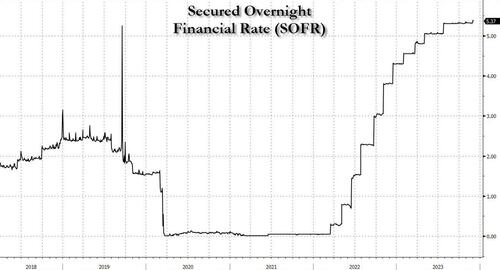
Or rather, we should say “the financial world that had not read Zero Hedge was stunned” because just one week ahead of the Fed’s December FOMC meeting, we correctly predicted the Fed’s pivot due to one simple reason: as we laid out in “The Canary Just Died: Sudden Spike In SOFR Hints At Mounting Reserve Shortage, Early Restart Of QE“, the Fed no longer had a choice and was forced to pursue a dovish pivot because the liquidity in the all-important systemic and interbank plumbing had hit dangerously low levels, resulting in the highest SOFR print on record, and the biggest spike since the last time there was a repo market crisis in March 2020.

As we said at the time, “the spike caught almost everyone by surprise, even such Fed-watching luminaries as BofA’s Marc Cabana because it was with “no new UST settlements, lower repo volumes, and lower sponsored bi-lateral volumes.”  And yet, the spike was clearly there and ominously it was consistent “with the slow theme of less cash & more collateral in the system”i.e., growing reserve scarcity –  and “may have been exacerbated by elevated dealer inventories, bi-lateral borrowing need, and limited excess cash to backstop repo.”

And the punchline:If funding pressure persists, it risks Fed re-assessment of ample banking system reserves & potential early end to QT“, and depending on how bad the funding shortage gets, an early restart of QE.

One week later, the Fed capitulated on tight monetary policy and ushered in the era of rate cuts, just as we said it would. But more importantly, one month later it was Dallas Fed president (and former head of the NY Fed’s plunge protection team) Lorie Logan who said the quiet part out loud when she confirmed our “canary in the coalmine” note, namely that the Fed’s QT is effectively over due to the sudden, unexpected slide in systemic liquidity, primarily due to the rapid drain in the reverse repo facility which now has just $600 million left and is set to be fully drained some time in March…

… and that by extension, another round of QE may be on deck.

Of course, it’s one thing for a regional Fed president to opine on such things, it’s something entirely different for Powell’s preferred media leak conduit to confirm it, and yet this morning that’s precisely what happened when Nick Timiraos, aka Nikileaks, aka Powell’s favorite media mouthpiece confirmed that QT’s days are now numbered writing that “Fed officials are to start deliberations on slowing, though not ending, that so-called quantitative tightening as soon as their policy meeting this month. It could have important implications for financial markets.

If that wasn’t enough, Nikileaks also confirms our suspicion about the driver behind said QT runoff: the financial plumbing is starting to clog up:

But whereas the Fed expects to cut short-term interest rates this year because inflation has fallen, its rationale for tapering bond runoff is different: to prevent disruption to an obscure yet critical corner of the financial markets.

Five years ago, balance-sheet runoff sparked upheaval in those markets, forcing a messy U-turn. Officials are determined not to do that again.

Several officials at the Fed’s policy meeting last month suggested beginning formal conversations soon, so as to communicate their plans to the public well before any changes take effect, according to minutes of the meeting. Officials have indicated that changes aren’t imminent and that they are focusing on slowing—not ending—the program.

As we first explained almost two months ago, the reason for the Fed’s panic is that the central bank wants to avoid the same repo market cataclysm that market both the liquidity drain in Sept 2019 and the violent eruption in basis trades that sparked bond market contagion in March 2020; here is Timiraos confirming as much:

… in September 2019, a sharp, unexpected spike in a key overnight lending rate suggested reserves had windled to the point they were either too scarce or difficult to redistribute across the financial system. The Fed began buying Treasury bills to add reserves back to the system and avoid further instability.

In 2020, the Covid-19 pandemic created a huge dash for dollars. To prevent markets from seizing up, the Fed resumed buying huge quantities of securities. It stopped buying in March 2022 and three months later set the process into reverse, once again shrinking the portfolio.

… which brings us to today, when the Fed did the math and realized that doing $60BN in QT per month once the reverse repo is fully drained will crash the market:

Policymakers have several reasons to consider slowing runoff. First, the Fed is shrinking its Treasury holdings by $60 billion a month—twice as fast it did five years ago. Continuing to run at this rate raises the risk that the Fed drains reserves so quickly that money-market rates jump as banks struggle to redistribute a dwindling supply of reserves.

Slowing the pace of the runoff later this year might allow the Fed to continue the program for longer than otherwise by “reducing the likelihood that we’d have to stop prematurely,” Dallas Fed President Lorie Logan said in a recent speech.

And by “stop prematurely” she of course means suffering a market crash in an election year, one which would drag the economy into a recession in days. And we all know by now (thanks to former NY president Bill Dudley) that is unacceptable, especially when the alternative is a Trump presidency.

Timiraos also confirms that we were right in cautioning that it’s all about the accelerating rate of decline in the reverse repo facility (see “How Treasury Averted A Bond Market “Earthquake” In The Last Second: What Everyone Missed In The TBAC’s Remarkable Refunding Presentation“):

there are signs that the cash surplus in money markets is rapidly diminishing. The Fed allows money-market firms and others to park extra cash that would otherwise end up in reserves in an overnight reverse repurchase facility. The facility has shrunk by around $1 trillion since late August to around $680 billion. Logan endorsed slowing runoff once that facility is nearly drained of cash because, after that, forecasting demand for bank reserves will be more uncertain.

This “faster-than-expected decline” in the overnight reverse repurchase facility’s balances is spurring the Fed’s movement toward contingency planning around how to slow runoff:

“It has been a surprise to everyone that overnight reverse repurchase balances have fallen this quickly and that reserves have actually increased over this period,” said Brian Sack, who managed the Fed’s Plunge Protection Team at the New York Fed from 2009 to 2012.

Actually Brian, you and others may have been surprised, but it certainly wasn’t “everyone”: we’ve been warning this would happen since the start of the year, and most recently one week before the Fed’s pivot.

There is another reason why the December SOFR spike freaked out the Fed: whereas previously the central bank was wrong repeatedly in estimating what level of reserves would be seen as “ample” by the market, this time around, officials told TImiraos they are going to rely more on market signals in identifying the right level of reserves.

“Last time, we had lots of estimates of where we thought that terminal level of reserves was, and our estimates were too low,” Philadelphia Fed President Patrick Harker said in an October interview. “At the end of the day, the market will dictate where we are.”

Indeed it will, and that’s precisely why our premium subscribers were fully aware that the “canary in the liquidity coalmine” died at the start of December, and the Fed’s dovish pivot, the end of QT, and the coming QE are now logically following just as we said they would.

And just in case Timiraos’ conveying Powell’s message that QT is effectively done wasn’t enough, here is JPM’s head of fixed income strategy with a note overnight admitting the same

This is how JPM sees the wind down of QT: “We now expect that the FOMC will have the outline of a timeline at the January meeting, communicated mid-February minutes to that meeting. We expect that this plan will be formally agreed to at the mid-March meeting and will be implemented beginning in April” at which point the monthly cap on the runoff of Treasury securities to be reduced to $30bn/mo, from $60bn/mo (full note available to professional subscribers in the usual place).

Bottom line: after several years of tightening, 2024 is when the liquidity floodgate reopen and not only does the Fed start to cut rates aggressively, but with QT tapering, we fully expect the next QE to be launched in the near future, sending the dollar into its next, and possibly final, reserve currency death spiral as printer goes BRRRR.

Tyler Durden
Mon, 01/15/2024 – 14:00

UC Davis Brags About “Advancing MLK’s Legacy” Through DEI Programs. Still Employs Prof After Homicidal, Anti-Semitic Rant

0
UC Davis Brags About “Advancing MLK’s Legacy” Through DEI Programs. Still Employs Prof After Homicidal, Anti-Semitic Rant

Via Campus Reform,

The University of California, Davis chose to frame a Martin Luther King Jr. Day communication as a celebration of both Dr. King and the university’s own DEI work.

A Tuesday message from the university’s Human Resources department boasted that the school is “consistently ranked by Forbes as a great employer for diversity,” adding that the ranking “is a result of the hard work Dr. King started and our workforce advances day in, day out.”

“While we have many dedicated team members throughout UC Davis engaged in DEI efforts, this work is not a stand-alone mission achieved by any one individual or team – it’s up to all of us to embed the principles of diversity, equity, and inclusion into everything we do,” it continued.

“It is only in this way that we create a space where we all want to work – a workplace where the principles of DEI are woven into the fiber of our being and part of our culture.

As recently as Dec. 22, UCSD confirmed to Campus Reform that assistant professor of American Studies Jemma Decristo was still employed at the university after threatening Jewish journalists with death, home invasion, and kidnapping via a social media post following the Oct. 7 Hamas terror attack on Israel.

”one group of ppl we have easy access to in the US is all these zionist journalists who spread propaganda & misinformation [sic],” Decristo posted to X.

“they have houses w addresses, kids in school”

”they can fear their bosses, but they should fear us more 🔪🪓🩸🩸🩸”

Descristo has appeared to set her X profile to private.

The university condemned Decristo’s statements, but stated that it was “carefully reviewing” the matter before making any changes to her employment status.

UC Davis Director of News and Media Relations James Nash has since repeatedly indicated to Campus Reform that there is no update to the situation. 

Tyler Durden
Mon, 01/15/2024 – 13:30

China Sidesteps Nvidia Chip Ban As Military, Government Acquire Powerful H100s

0
China Sidesteps Nvidia Chip Ban As Military, Government Acquire Powerful H100s

The Chinese military, state-run AI research institutes, and universities, have been buying the highest-end Nvidia semiconductors banned by the US from export to China in small batches, according to a Reuters review of tender documents.

The documents reveal dozens of transactions involving Nvidia’s A100, as well as the more potent H100 chips – both banned by the U.S. in 2022 – along with their less advanced counterparts, the A800 and H800, developed for but also barred from the Chinese market. The graphic processing units (GPUs) by Nvidia, vital for AI due to their efficiency in processing large data volumes for machine-learning tasks.

Purchasers included elite universities as well as two entities subject to U.S. export restrictions – the Harbin Institute of Technology and the University of Electronic Science and Technology of China, which have been accused of involvement in military matters or being affiliated to a military body contrary to U.S. national interest.

The former purchased six Nvidia A100 chips in May to train a deep-learning model. The latter purchased one A100 in December 2022. Its purpose was not identified. -Reuters

Interestingly, neither Nvidia nor its authorized retailers appear in these transactions – pointing directly to a burgeoning underground market thriving on excess stock from large shipments to U.S. firms or imports via third-party countries like India, Taiwan, and Singapore. This black-market ecosystem poses a formidable barrier to U.S. efforts in curbing the flow of these critical technologies.

Nvidia maintains that it has adhered to all applicable export control laws, and expects the same from its customers. While the company says it’s willing to take action against unlawful resale, their ability to do so is questionable.

The US Department of Commerce, meanwhile, continues to stress the importance of tightening export controls.

Chris Miller, a professor at Tufts University, says that while the goal is “to throw sand in the gears of China’s AI development,” enforcement is a pipe dream.

The Reuters review sheds light on over 100 tenders for the procurement of A100 chips by state entities, with post-ban tenders indicating purchases of the A800 model. Notable buyers include Tsinghua University, often likened to MIT, and various military entities, with the purposes of these acquisitions ranging from AI development to undisclosed military uses.

That said, China won’t be building GPT 5 anytime soon

The quantities of most purchases are, however, very small, far from what’s needed to build a sophisticated AI large language model from scratch.

A model similar to OpenAI’s GPT would require more than 30,000 Nvidia A100 cards, according to research firm TrendForce. But a handful can run complex machine-learning tasks and enhance existing AI models. -Reuters

The Reuters report comes days after the Wall Street Journal reported that Chinese customers don’t want nerf’d chips designed for export.

The U.S. tech company may have found some wiggle room, but it faces a bigger problem: Chinese cloud companies—some of Nvidia’s biggest customers globally—aren’t so keen on buying its lower-powered AI chips.

China’s largest cloud companies have been testing Nvidia samples since November. Alibaba Group and Tencent have indicated to Nvidia that they would order far fewer of its chips this year than they had originally planned to buy when it was offering its now-banned products, people familiar with the matter said.

Both Alibaba and Tencent are shifting some of their advanced semiconductor orders to Huwai and other domestic companies, and are relying more on chips they can develop in-house, according to the report.

Chinese cloud companies currently source around 80% of their high-end AI chips from Nvidia – a figure likely to fall to 50% – 60% over the next five years, according to TrendForce analyst, Frank Kung – who added that tightening US chip controls in the future would result in additional pressure on Nvidia’s China sales.

Tyler Durden
Mon, 01/15/2024 – 11:15

‘Miraculous’ Upward Revision Rescues Germany From Recession In Latest Data

0
‘Miraculous’ Upward Revision Rescues Germany From Recession In Latest Data

It appears Berlin has been taking notes from their compatriots in Beijing when it comes to macro-economic data goal-seeking.

Overnight saw preliminary reports that Germany’s GDP growth tumbled 0.3% in Q4.

But, do not worry good citizen, Europe’s largest economy is not in recession because – by the power of all things great and good – Q3’s -0.1% GDP growth print (which would have meant two quarters of GDP declines – or the classic marker for a recession), was revised up to unchanged (0.0%).

So, not a recession at all.

But, no matter how much lipstick you put on this pig, it was a dismal year: GDP also shrank 0.3% over the full 12 months – the first such downturn since the pandemic.

Additionally, factory output declined 0.3% from a month earlier in November after having slumped 0.7% in October.

Initial survey feedback “suggests that economic performance is likely to stall in 2024,” according to the industry lobby DIHK Chambers of Industry and Commerce.

“Even remaining in recession is still possible. The economic challenges remain great.”

Top officials including Finance Minister Christian Lindner and Bundesbank President Joachim Nagel have dismissed talk that Germany is once again turning into the “sick man” of Europe, insisting the country has proved it can adapt to a changing environment.

“Ich bin ein ‘Berliner'” indeed… do German officials think we’re all donuts?!

Or was this miraculous upward revision designed to lend some credence to The ECB’s claims that they are not considering rate-cuts anytime soon (because, hey, Germany’s not even close to recession, right?).

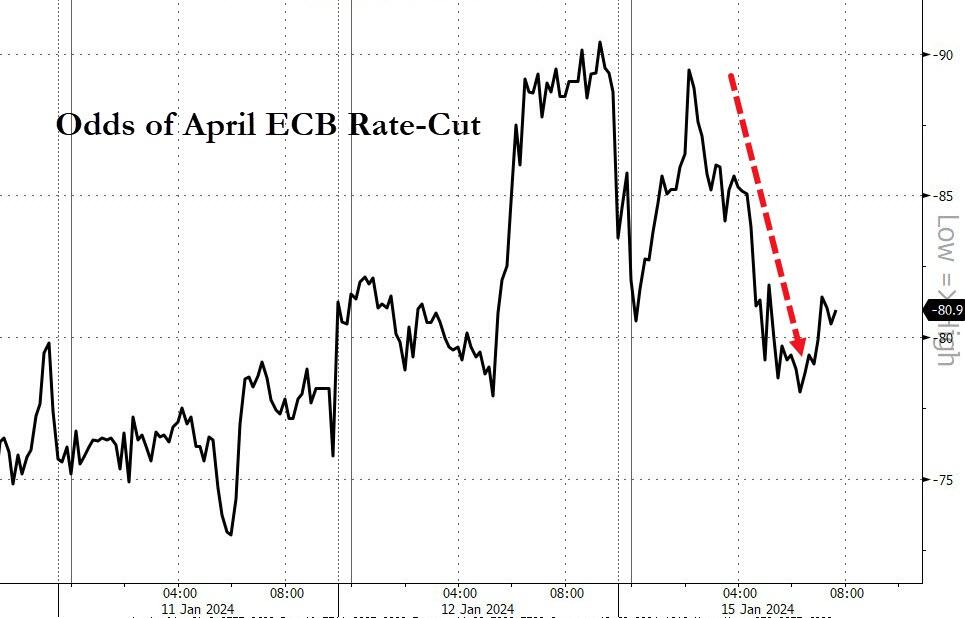
Rate-cut expectations for April 2024 declined on the GDP revision, but remain high at around 80%…

ECB’s Lane also jawboned that the central bank would have enough data by June to make a decision on rate-cut…

“The most complete dataset is in the Eurostat national accounts data — the data for the first quarter will not be available until the end of April. By our June meeting, we will have those important data.”

…obviously attempting to dampen the market’s spring-like enthusiasm for the dovish pivot.

Tyler Durden
Mon, 01/15/2024 – 10:55

Price Wars Spark Rout In China’s Consumer Sector

0
Price Wars Spark Rout In China’s Consumer Sector

By Charlotte Yang, Bloomberg Markets Live reporter and strategist

The seemingly relentless decline in prices of Chinese goods amid tepid consumer demand is denting expectations that corporate earnings can revive the flagging stock market.

From electric vehicles to fast food, companies are engaging in a battle of promotions aimed at luring customers who are spooked by dim job prospects and have seen a persistent property slump hurt wealth creation. Consumer prices fell for a third-straight month in December, the longest streak since 2009, deepening concerns about companies’ profits and share prices.

“That’s all symbolic of a very weak consumption environment that includes lack of consumer confidence and weak income growth,” said Xin-Yao Ng, an investment director for Asian equities at abrdn. “We are cautious on 4Q earnings across most sectors, and would assume that continues in 1Q unless the government starts doing something massive to support the economy.”

Gauges of consumer stocks have been the worst performers on the MSCI China Index since the end of September, after the real estate measure. The aggregate market value of companies included in the two consumer indexes has fallen by about $157 billion since. And the biggest drags on the MSCI benchmark in this span include e-commerce giant Alibaba Group Holding Ltd., restaurant operator Yum China Holdings Inc. and EV maker BYD Co. — which have all been offering big discounts.

The world’s second-largest stock market has started 2024 on a dismal note, with the MSCI China gauge already down more than 4% so far this year. It capped a third straight annual decline in 2023.

“The bigger picture is that the weak demand is leading to a deflationary environment, which particularly bodes ill for businesses that cannot achieve higher volumes with lower prices,” said Daisy Li, a fund manager at EFG Asset Management HK Ltd.

The EV industry has been among the worst hit by intense competition as growth slows, with Chinese makers following the lead of Tesla Inc. in lowering prices to boost sales. BYD and local peers including Xpeng Inc. and Li Auto Inc. have shed billions of dollars in market value in the past few months.

“Retail prices are falling fast,” Morgan Stanley analysts wrote in their 2024 outlook report for the Chinese EV sector. “While local brands, in general, have fared better than luxury and foreign brands in terms of widening discounts, we expect discounts to further widen into 1Q24 on the back of seasonality effects.”

Even China’s vaunted internet giants have been impacted, with Alibaba and JD.com Inc. seeing their stock prices tumble as they wage a fierce battle for market share. The price war has made US-listed PDD Holdings Inc., operator of discount site Temu, one of the rare bright spots in China’s e-commerce industry.

Many economy and market observers are hoping for interest-rate cuts and government spending to help prevent the nation from entering a deflationary spiral.

Fund managers say the next catalyst they are watching is pricing and sales data around Chinese New Year in February, which will offer more clues on consumer confidence. The next few weeks may also be key for policy action, given Chinese leaders will soon gear up for the National People’s Congress. That annual legislative session, held in March, is where the government is expected to announce its official growth target for 2024.

A Morgan Stanley survey conducted late last month suggests seasonally better consumer sentiment ahead of the holidays. However, “sustainability is in doubt amid slowing economic recovery,” analysts including Lillian Lou wrote in a note.
Salary cuts and job losses have remained among the top concerns of households, they wrote, adding that the number of consumers anticipating the economy to worsen ticked up by two percentage points from November to 13%.

In all, there is little hope for a quick fix. Citigroup Inc. expects consensus estimates to fall for Li Ning Co. and Anta Sports Products Ltd. around the upcoming results season, hurt by foreign competition and pushes into lower-tier cities with cheaper products.

Fast-food companies are still locked in a protracted fight for customers, with some offering full meals for around $3. It’s difficult to make money at such low prices.

“We expect industry margins to erode until the irrational price war ends,” Kevin Yin, an analyst at JPMorgan Chase & Co., wrote in a note while cutting estimates for Yum China. “No player is immune” to the headwinds created by the nation’s slowing demand growth, he added.

Tyler Durden
Mon, 01/15/2024 – 10:15

Qatar Pauses LNG Shipments In Red Sea After US Bombs Houthis

0
Qatar Pauses LNG Shipments In Red Sea After US Bombs Houthis

The US and British bombing campaigns of Iran-backed Houthis in Yemen marks a significant intensification of the Middle East crisis. This development comes as the region is already dealing with heightened tensions due to the three-month war between Israel and Hamas in Gaza, suggesting a move towards a broader regional conflict. 

Shipping disruptions across the Red Sea threaten global trade after major shippers, such as Maersk and others, have rerouted vessels to the Cape of Good Hope following a series of drone and missile attacks on commercial vessels by Houthi rebels. The attacks and resulting supply chain disruptions are what forced the US and allies last week to launch bombing raids on Houthi targets. 

With US and UK navies in the Red Sea advising commercial vessels to avoid the area, another top shipper has abandoned the critical waterway: The world’s second-largest LNG exporter, QatarEnergy, according to Reuters

LSEG shiptracking data showed that Qatar’s Al Ghariya, Al Huwaila and Al Nuaman vessels had loaded LNG at Ras Laffan and were heading to the Suez Canal before stopping off in Oman on Jan. 14. The Al Rekayyat, which was sailing back to Qatar, stopped along its route on Jan. 13 in the Red Sea.

“It is a pause to get security advice, if passing (through the) Red Sea remains unsafe we will go via the Cape,” the source told Reuters on Monday regarding QatarEnergy. -Reuters 

Qatar is a major supplier of liquefied natural gas to Europe after the US, and disruptions in shipments, or at least delays, due reouting efforts around the Cape of Good Hope might threaten the continent’s energy security. 

The good news for now is Europe’s natural gas inventories are about 79.74%, well above a ten-year average due to the warm start of the Northern Hemisphere winter. However, if cold weather persists… 

Front-month European benchmark gas prices on the Dutch TTF hub slid as much as 8.5% on Monday below 30 euros per megawatt-hour (MWh) on lower demand as supply concerns fade.

Possible delays or disruptions of LNG shipments from Qatar are not a concern to European traders (well, not yet). 

Tyler Durden
Mon, 01/15/2024 – 09:50

Massive Money-Printing Will Accelerate As Debt Soars

0
Massive Money-Printing Will Accelerate As Debt Soars

Authored by Daniel Lacalle,

The U.S. federal government published a December deficit of $129 billion, up 52% from the previous year. The private sector recession is clear as expenses continue to rise while tax receipts decline. If we look at the period between October and December 2023, the deficit ballooned to a staggering $510 billion.

You may remember that the Biden administration expected a significant deficit reduction from its tax increases and the expected benefits of its Inflation Reduction Act.

What Americans got was a massive deficit and persistent inflation.

According to Moody’s chief economist, Mark Zandi, the entire disinflation process seen in the past years comes from exogenous factors such as “fading fallout from the global pandemic on global supply chains and labor markets, and the Russian War in Ukraine and the impact on oil, food, and other commodity prices.” The complete disinflation trend follows the slump in money supply (M2), but the Consumer Price Index (CPI) should have fallen faster if deficit spending, which means more consumption of newly created currency, would have been under control. December was disappointing and higher than it should have been.

The United States annual CPI (+3.4%) came above estimates, proving that the recent bounce in money supply and rising deficit spending continue to erode the purchasing power of the currency and that the base effect generated too much optimism in the past two prints. Most prices rose in December, and only four items fell. In fact, despite a large decline in energy prices, annual services (+5.3%), shelter (+6.2%), and transportation services (+9.7%) continue to show the extent of the inflation problem.

The massive deficit means more taxes, more inflation, and lower growth in the future.

The Congressional Budget Office (CBO) expects an unsustainable path that still leaves a 5.0% deficit by 2027, growing every year to reach a massive 10.0% of GDP in 2053 due to a much faster growth in spending than in revenues. The enormous increase in debt will also lead to extremely poor growth, with real GDP rising much slower throughout the 2023–2053 period than it has, on average, “over the past 30 years.”

Deficits are not a tool for growth; they are tools for stagnation.

Deficits mean that the currency’s purchasing power will continue to vanish with money printing and that the real disposable income of Americans will be demolished with a combination of higher taxes and a weaker real value of their wages and deposit savings.

We must remember that, in Biden’s administration’s own estimates, the accumulated deficit will reach $14 trillion in the period to 2032.

This unsustainable level of fiscal irresponsibility will also lead to more massive money printing. The Federal Reserve will have to lead with larger federal fiscal imbalances than seen in crisis times, even considering estimates that assume no recession or crisis. So, if a crisis hits, the situation will simply explode.

Considering all these elements, it is not difficult to think of a Fed balance sheet that rockets from an already elevated 29% of GDP to fifty percent, and it will still be lower than the ECB’s balance sheet!

Readers may think that monetization of debt will be an uncomfortable but necessary measure to reduce indebtedness. However, we should have learned by now that Federal Reserve monetization only makes governments more fiscally imprudent. Public debt continues to reach new record highs both in periods of monetary expansion and in periods of alleged contraction.

2023 proved that central banks’ policy was only restrictive in name, as net liquidity injections and anti-fragmentation programs continued.

Policy was restrictive for the private sector, especially small and medium enterprises, and families, not for governments.

2024 will be even worse because the government will not count on rising receipts and a doped economic recovery.

Therefore, deficits are likely to surprise negatively again, which means more taxes and lower potential growth disguised with a new set of liquidity injections.

What does this mean for savers? Your US dollars will be worth less, real wages will continue to show poor growth, and, after tax, disposable income will decline.

The only way to protect yourself is to find alternative real reserves of value, from gold to bitcoin, which will offset the monetary destruction that is about to accelerate.

Tyler Durden
Mon, 01/15/2024 – 09:25

Illinois Governor Complains About Migrant Buses – Blames Republicans For Border Crisis

0
Illinois Governor Complains About Migrant Buses – Blames Republicans For Border Crisis

As the mass invasion of illegal immigrants grows under the Biden Administration, Democrat politicians are suddenly suffering from a convenient case of amnesia.  They have forgotten all about the fact that they invited this invasion by creating “sanctuary cities” designed to thwart any attempt by immigration officials to arrest migrants and send them back to their country of origin.  Not only that, but they also seem to have forgotten that they incentivized illegal immigration by offering subsidies and welfare handouts to non-citizens.  

There is only one group of people that has been fighting to keep the US borders wide open, and that is the political left.  But now that we’re entering an election year Democrats are trying to rewrite history again, claiming they are the good guys and conservatives are the villains.

This is Illinois Governor J.B. Pritzker’s argument in a recent interview where he claims that Republicans are the party that “wants to take your freedoms away” and that Republicans are responsible for the immigration crisis because they “refuse to come to the table” to make a deal with Democrats on reforms.

Pritzker launches into his well rehearsed propaganda spiel with a number of lies (perhaps the most egregious being that the Dems “defend freedom” after they spent the last few years trying to erase a number of constitutional rights in the name of covid).  But his most interesting exposition comes at the end of the interview when asked about the effects of the migrant crisis on Illinois and cities like Chicago.

Pritzker laments the Texas strategy of busing migrants to blue states and cities, pretending as if he doesn’t understand why they are being specifically targeted.  They are being targeted because a point is being made – If the political left is going to push policies that entice illegal immigrants to come here, then leftists should be the people that suffer the consequences.  Democrats barely acknowledged the existence of the immigration crisis until it was shipped to their doorstep, and now they cry victim.  

It would appear Governor Greg Abbott’s tactics are working.  Even Pritzker acknowledges that Joe Biden needs to do more to stop the flow of immigrants.    

The notion that leftists have been seeking to resolve the migrant issue is also a bizarre claim.  The Biden Administration has made it clear that they intend to obstruct any state effort to stop illegal immigrants from crossing into the US.  They have torn down border walls, cut down fences, sued Texas for staging buoy fences in the Rio Grande and deployed National Guardsmen with the mission of helping migrants into the country instead of stopping them.    

When Democrats make the argument that they want to fix the problem what they are usually referring to is “reform” legislation that gives sweeping amnesty or fast citizenship to illegals already in the US.  In other words, they suggest the solution is to reward illegal immigrants with citizenship while defending the border becomes a secondary issue.  In some cases, they assert that they will not support measures to protect the border unless Republicans accept amnesty. 

In other words, Democrats are holding the security of the country hostage until conservatives give them the means to expand their voting constituency – “Give us the migrant vote, give us a super-majority, or we will let the borders remain open indefinitely and blame you for the disaster that follows.”

It’s a racket akin to mobster intimidation.     

There are numerous logical reasons why Republicans should refuse to negotiate on the border.  First, the security of the country should not be subject to negotiation.  The law requires the government to defend our borders, and if they refuse as a means to leverage more power from the people then they are in dereliction of duty and should be removed.  

Second, giving amnesty to millions of illegals does not solve the threat of mass immigration.  In fact, it makes the threat worse because it encourages more migrants to cross the border in the assumption that they too will one day simply be made citizens by default and without any merit.  

Third, the US economy does not have the resources to sustain the tens of millions of illegals that are already here, let alone the millions that will try to get into the country before the next election.  Blue city infrastructures are being crushed by the presence of mere thousands.  The solution is to send them back to where they came from, not give them the ability to stay here forever.

Fourth, giving citizenship to millions of people coming primarily from more socialist countries will negatively change the cultural landscape of America for many generations to come.  If you thought the Democrats were emboldened to erase constitutional protections during the covid panic, just think of what they will do when they have almost 17 million new voters at their disposal who have no concept of individual freedom and no understanding of constitutional restrictions on government power. 

Tyler Durden
Mon, 01/15/2024 – 09:00