70.5 F
Chicago
Wednesday, September 16, 2026
Home Blog Page 3010

Taiwan Elects William Lai President In Snub To China, Beijing Responds By Stressing ‘Inevitable Reunification’

0
Taiwan Elects William Lai President In Snub To China, Beijing Responds By Stressing ‘Inevitable Reunification’

William Lai Ching-te from the governing Democratic Progressive Party (DPP) has emerged victorious in Saturday’s historic Taiwan presidential election, and Beijing is not happy, having immediately issued a rebuke after having urged the populace not the vote for him, saying the outcome “will not impede the inevitable trend of China’s reunification.”

Beijing further claimed that DPP doesn’t represent the mainstream public opinion on the island, despite that Lai, who serves as the current vice president, has just taken over 40% of votes cast – according to partial early results – in the three-way race with Hou Yu-ih from the conservative Kuomintang (KMT) and former Taipei Mayor Ko Wen-je from the Taiwan People’s Party (TPP). It was comfortable victory and resounding message to China.

Lai was ahead of his two opponents by a comfortable margin, Getty Images

In his victory speech Lai said, “I want to thank the Taiwanese people for writing a new chapter in our democracy.” And then he issued words widely seen as a direct jab at China: “We are telling the international community that between democracy and authoritarianism, we will stand on the side of democracy,” he declared.

But he also expressed hope that his administration will establish “healthy and orderly” based on parity and mutual respect. This was quickly met with Beijing’s Taiwan Affairs Office spokesperson Chen Binhua saying in a strong and terse statement that “Taiwan is China’s Taiwan,” according Xinhua.

Per Taiwan media, all polling stations have reported: 

  • TPP’s Ko Wen-je and Wu Hsin-ying 3,690,466 (26.46%)
  • DPP’s Lai Ching-te and Hsiao Bi-khim 5,586,019 (40.05%)
  • KMT’s Hou Yu-ih and Jaw Shaw-kong 4,671,021 (33.49%)

Turnout was strong, as expected given the shadow of Xi’s China is looming large over the comparatively tiny democratic island:

Lai, along with his running mate Hsiao Bi-khim – Taiwan’s former representative to the United States – won a total of more than 5.5 million votes. Taiwan’s electoral system is based on first-past-the-post voting, awarding the victory to the presidential-VP pairing with the highest percentage of votes. 

Turnout on the self-ruled island was put at more than 70 percent with some 19.5 million Taiwanese eligible to vote. 

Days before Saturday’s election, Liu Jianchao, head of international liaison for China’s ruling Communist Party, had a rare meeting and candid discussion with representatives of Biden’s national security council on Washington, both sides confirmed. This came just days ahead of presidential elections in Taiwan, which has temporarily grabbed the world’s attention as other global flashpoints sow unpredictability – specifically Ukraine, Gaza, and the Red Sea. Beijing is said to have relayed to the White House its ‘red line’ concerning Taiwan and “the importance of peace and stability across the Taiwan Strait and in the South China Sea.”

A Chinese readout of the meeting, wherein the US side was led by US deputy national security adviser Jonathan Finer, affirmed that Liu “stated China’s positions on issues like Taiwan and the South China Sea.” Important also concerning the timing is that he’s highest-ranking Chinese official to visit the US since the Xi-Biden summit. 

Per Finer and the US delegation, they talked about “challenges in the Middle East, Russia’s war against Ukraine, and cross-strait issues.”

Prior to this, just weeks ago, China warned of further trade sanctions on Taiwan in the event the ruling party “stubbornly” commits to supporting independence. Spokesman for China’s Taiwan Affairs Office Chen Binhua had addressed a message to the ruling Democratic Progressive Party (DPP), saying “If the DPP authorities are determined to persevere, continue to stubbornly adhere to their Taiwan independence position, and refuse to repent, we support the relevant departments taking further measures in accordance with the regulations.”

On December 27 Chinese leader Xi Jinping issued a rare, ultra-blunt warning against anyone “making Taiwan secede from China by any means,” given he said of the self-ruled island that “China’s complete reunification is an inevitable trend” and that reunification is “what the people desire.” He further urged that the Chinese Communist Party must set its sights of a grander policy of “resolving the Taiwan question in the new era.”

These somewhat fiery words from Xi loomed in the backdrop when Liu was in Washington this past week. The high-ranking diplomat presented similar words of warning to an event hosted by the Council on Foreign Relations wherein he again underscored the red line: “For China, the Taiwan question is at the very core of the core interests. It’s the red line that must never be crossed,” Liu said.

The Foreign Ministry then followed the next day (Thurs) by directly warning Washington that it must avoid sending the “wrong signals” to Taiwan. “We urge the US side … to stop interfering in the local elections in Taiwan in whatever ways, and stop sending wrong signals to ‘Taiwan independence’ separatist forces,” a spokesperson said.

According to a backgrounder from Nikkei

Taiwan’s president is its head of state and commander-in-chief of the armed forces. The president and the vice president are directly elected together.

The unicameral legislature, known as the Legislative Yuan, has 113 lawmakers. Seventy-three will be elected under a first-past-the-post system in single-member districts, 34 by party-list proportional representation voting, and six by single non-transferable votes in multimember districts exclusively for Indigenous people.

Presidents are in charge of defense and foreign affairs, including relations with China and the U.S., and appoint the premier, who forms his or her cabinet to run the government. In practice, the premier has much less political power than the president. Parliamentarians in the Legislative Yuan pass laws and decide on budgets, including defense allocations.

Whoever wins on Saturday will succeed current President Tsai Ing-wen on May 20. They will serve until May 2028.

As for what we can expect in the coming months and in this year, Foreign Policy’s 5 Predictions for China in 2024 laid out the below analysis of an expected “Taiwan Mini-crisis” sparked by election [emphasis ZH]…

“Taiwan holds a presidential election on Jan. 13, and the year could start with a small crisis in the straits. Current Taiwanese Vice President Lai Ching-te, who serves under President Tsai Ing-wen and is a member of the Democratic Progressive Party (DPP), holds a narrow lead in the polls. His election would ire Beijing; he is an advocate for a more independent Taiwan and strongly opposed to the Chinese Communist Party (CCP).

Although Lai has said he won’t call for formal Taiwanese independence or drop the Republic of China name—a red line for Beijing—he has also said that Taiwan’s sovereignty is “a fact” and reminded his fellow candidates that by Beijing’s standards, they are all pro-independence.

A Lai victory would likely prompt aggressive moves from Beijing, including naval maneuvers and airspace intrusionsReports last week about comments made by Xi  to U.S. President Joe Biden about reunification with Taiwan when they met in November stirred some panic in Washington, but an invasion remains highly unlikely. It would be risky and difficult, especially when China is struggling with other crises.

Even a victory for Taiwan’s opposition Kuomintang (KMT) on Jan. 13 may cause some problems. The KMT is more pro-China than the DPP, but it would hardly hand the keys to the island over to Beijing. Chinese officials might overestimate the significance of a KMT election win, seeing it as a sign of China’s influence in Taiwan. Although 17 percent of Taiwanese voters said in a recent survey that China is their main concern, more than twice that number picked the economy.”

Tyler Durden
Sat, 01/13/2024 – 11:05

2024: The Year Of Deepening Social Tensions – Anecdotal Evidence Of Three Worldviews

0
2024: The Year Of Deepening Social Tensions – Anecdotal Evidence Of Three Worldviews

Authored by Ronni Stoeferle via GoldSwitzerland.com,

In Europe, many countries have been seething since 2015, when the first major wave of refugees reached Germany and Austria in particular.

In the US, it was the election of Donald Trump as President in November 2016 that brought the deep divide between Republicans and Democrats to everyone’s attention.

A few months earlier, to the surprise of many, the UK had opted for Brexit, an exit from the EU.

Only a few years have passed since then, but the density of crises has increased rather than decreased: Covid-19, the climate crisis, inflation, the war in Ukraine, the energy crisis, and finally Hamas’ terrorist attack on Israel and its response.

2024 will see a number of important elections in these times of multiple crises:

  • presidential elections in the USA,

  • elections to the European Parliament,

  • and three state elections in eastern federal states in Germany(in each of which the AfD is leading in the polls by more than 30%).

2024 could be the year of major social and political upheavals.

Because business and investment always take place in a specific political and social environment, in this article we want to look at investment as a topic in a broader sense. Over the course of dozens of events and hundreds of client visits, we exchanged views with professional market participants such as asset managers, fund managers and private investors, as well as with private clients and representatives from a wide range of media. In the course of many discussions, we have been able to diagnose, roughly speaking, three different world views with regard to the assessment of the overall economic situation.

We want to outline these below and, based on this, the respective affinity for a gold investment:

1. “Believers in the system”

Among these are, for example, financial analysts and market commentators who believe that the interventionist Keynesian economic policy, which has been implemented in the wake of the global financial crisis, is in principle correct and necessary. According to their view, the economy is in a recovery process which, due to unforeseeable regional economic difficulties, such as the euro area debt crisis, slowing growth in China, the aftermath of the Covid-19 crisis, interest rate shock etc. has been developing at a slower pace than expected. All in all, the “patient” that is our global economy, is however on the way to regaining his health, and the financial markets are in the process of gradually sounding the “all clear”. The supervisory authorities have moreover learned much-needed lessons from the crisis and have lowered systemic risk by implementing better regulations.

Representatives of this camp are increasingly critical of the fact that expansive monetary policy has lately been “the only game in town”. According to believers in the system “secular stagnation” or the “new normal” are the paradigms which best describe the current phase of weak growth. This state of affairs is supposed to be countered by more stimulus, such as fiscal stimulus measures, and/or “helicopter money”. They also consider a rapid and radical energy transition to be indispensable, whatever it takes. Gold allocation in the portfolios of this group has been extremely low, effectively zero over the past decade. It could even happen that gold could get a public reputation problem from this group, who are very influential in state and public institutions, as gold could increasingly be branded as the asset of potentates and conspiracy theorists.

2. “The Sceptics”

This camp comprises people who harbor doubts about the sustainability of the extreme economic policy measures that have been taken and deemed necessary to overcome the global financial crisis, the sovereign debt crisis in the eurozone and the coronavirus pandemic. After these crises, many of them instinctively came to the conclusion that fighting a debt crisis with even more debt, and extravagant monetary policy measures, is probably not an appropriate therapy. This group includes, inter alia, hedge fund managers and traditional asset managers who are often unable or unwilling to communicate their critical assessments, especially publicly. Sometimes a schizophrenic situation arises in which fund managers position their private portfolios in a much more crisis-proof way, with a higher allocation to gold.

With respect to gold allocations within the portfolios managed by this group, many have acted in a pragmatic manner: In the years after the global financial crisis, they accumulated a lot of gold. But from 2013 onwards, these positions were reduced, and in some cases even sold in their entirety, often on account of performance pressures. From 2016 onwards, ETF inflows were on the rise again. This significant increase in ETF inflows indicate that, inter alia, these skeptical investors have partially returned to the market. ETF holdings more than doubled by October 2020. Since then, interest in Europe and the US has been on the decline, while demand from Asia has increased slightly.

In recent years, due to the current “investment emergency” and the pressures exerted by reporting structures and benchmarks, many sceptics have  joined the bandwagon in traditional “risk-on” asset classes like (technology) stocks, private equity, real estate, high yield bonds etc. However, in many cases this was done half-heartedly, in order to “ride the wave”.

It is remarkable how many market participants are questioning the sustainability of current economic and monetary policy measures behind closed doors. It is also worth noting that the group of sceptics has, in our assessment, gradually grown in recent years and has likely become the largest group.

We believe the sceptics could play a particularly important role as marginal buyers in driving the future gold price trend: Many of them have not yet invested in gold, but are keeping an eye on it from the side-lines. As soon as the “slow recovery of the economy” narrative no longer holds up, they will be among the first to shift portfolio allocations in favor of gold.

3. “Critics of the System”

Members of this group are convinced that the monetary architecture is systematically flawed. Criticism of the system can be formulated on the basis of several schools of thought, or at times even based on common sense. In our opinion, the most consistent critical assessment of the status quo can be performed by employing the analytical methods of the Austrian School of Economics. Austrian theory systematically explains why the forecasted economic mini-recovery is neither sustainable nor self-supporting. 

People who have come to adopt this critical stance have one thing in common: It is almost impossible for them to regain faith in the system. Thus, there is a one-way street into this camp, and the growth of this group is almost inevitable.

We are making no secret of the fact that we belong to the third group. We only regard criticism of the system as serious if it results from investigations free of value judgements. Our findings are based on the methodological framework of the Austrian School. We want to emphasize that we are opposed to system rejection, for mere ideological reasons. Simply being against the system is a childish attitude of defiance that will not improve anything.

The instability of credit expansion induced growth, which we routinely criticize, is impressively illustrated by the following chart. Since 1959, “total credit market debt” – the broadest debt aggregate in the US – has increased by 12,800%, bringing the annualized growth rate to 7.4%. In every decade, outstanding debt has – at least – doubled. In order to trigger credit-induced GDP growth again – after the volume of total outstanding debt dipped slightly for the first time in 2009 – the Fed implemented a series of never-before-seen monetary policy measures.

Currently, the US federal government, in particular, is piling up the debt burden through persistently high budget deficits. In the fiscal year 2023, which concluded in September 2023, the deficit reached 6.3%, compared to 5.4% in the fiscal year 2022. In the two pandemic years 2020 and 2021, the deficit even reached the double-digit percentage range, at 15.0% and 12.4% respectively. In the first quarter of the current fiscal year, there is no sign of a reduction in the spending orgy.

This inevitably leads to a rapid increase in US debt. This debt is now over USD 34 trillion and the latest trillion was added in only 14 weeks. As around a third of US debt has to be refinanced within a year, interest payments will continue to rise. More than a third of federal taxes already have to be spent on servicing interest alone.

There is no reverse gear that can be engaged in today’s monetary system – the money supply has to be increased incessantly – which in turn means that the amount of credit in the system continually rises as well.

Critics of the system know: The fact that the steady expansion in the volume of outstanding debt has run into snags in recent years, characterizes the current (critical) phase in the monetary system’s evolution. Over the medium-term, these record levels of debt will either be dealt with by defaults, financial repression, or a forceful reflation, possibly in the form of “helicopter money”.

Conclusion

In light of this critical assessment, we advocate more strongly than ever for a strategic allocation to physical gold in long-term investment portfolios. This is because one of the most important portfolio characteristics of gold is and remains that it has no counterparty risk.

Precisely because gold is such an important part of the financial safety net against severe systemic crises, any efforts by governments, authorities or interest groups to demonize gold as an asset of extremist groups or rogue states, and therefore to regulate it more strictly, should be resolutely opposed.

The current monetary system is not facing a crisis because citizens could switch to gold, but rather because citizens are increasingly switching to gold, precisely because the current monetary system is bound to face a crisis sooner or later. Bad-mouthing gold does not prevent a crisis, it exacerbates it, because it deprives the population of the golden safety net. Without a safety net, people are known to fall deeper and harder.

Tyler Durden
Sat, 01/13/2024 – 10:30

Airbus Jet Orders Hit Record As Boeing Plagued With Reputation Crisis Over Max Woes

0
Airbus Jet Orders Hit Record As Boeing Plagued With Reputation Crisis Over Max Woes

While Boeing deals with endless 737 Max jet problems, one which a Reuters report said in 2020 was an aircraft “designed by clowns who in turn are supervised by monkeys”… 

And this week, Elon Musk said: “Do you want to fly in an airplane where they prioritized DEI hiring over your safety? That is actually happening.” 

Competitor Airbus, now the world’s largest plane maker, booked 2,094 net jet orders last year (a new record high) and doubled the number of net orders in 2022. 

Airbus overtook Boeing in jet orders following the two crashes of Max jets, the first in October 2018 and the second in March 2019, which combined, killed 346 people. We noted shortly after the Max crashes, Boeing faced a reputation crisis as airlines ditched Max orders for A320 Neo.  

Shares of Airbus in Paris are up 2.5% on Friday, propelling the stock to new record highs. Meanwhile, shares of Boeing have been floundering for several years after countless Max jet problems. 

Here’s what Wall Street analysts (courtesy of Bloomberg) are saying about Airbus: 

Deutsche Bank (Christophe Menard, buy, PT €152)

  • Beat on deliveries potentially signals an improvement in the supply chain and bodes well for deliveries in 2024
  • Record order intake is “more striking” and bodes well for free cashflow generation in 2H thanks to higher-than-expected prepayments
  • Airbus is likely to beat its FY23 Ebit and free cashflow guidance when it reports on Feb. 15

Citi (Charles Armitage, buy)

  • Notes Airbus delivered 15 more planes than guided during the year; makes rough estimate that this could provide €225m tailwind to full year profit guidance 
  •  Airbus has a backlog of 8,593 aircraft; equivalent to 11.7 years based on 2023 delivery rate, but notes Airbus is ramping- up production

William Blair (Louie DiPalma) 

  • Airbus delivered 207 more aircraft in 2023 than US rival Boeing, and secured significantly more orders; adds Airbus will likely beat Boeing on orders in January in wake of the Alaska Airlines incident

Airlines are flocking to Airbus planes while Boeing battles a reputation crisis over quality control issues of its 737 Max.

Tyler Durden
Sat, 01/13/2024 – 09:55

All 50 US States Under ‘Active’ Federal Weather Alerts

0
All 50 US States Under ‘Active’ Federal Weather Alerts

Authored by Jack Phillips via The Epoch Times (emphasis ours),

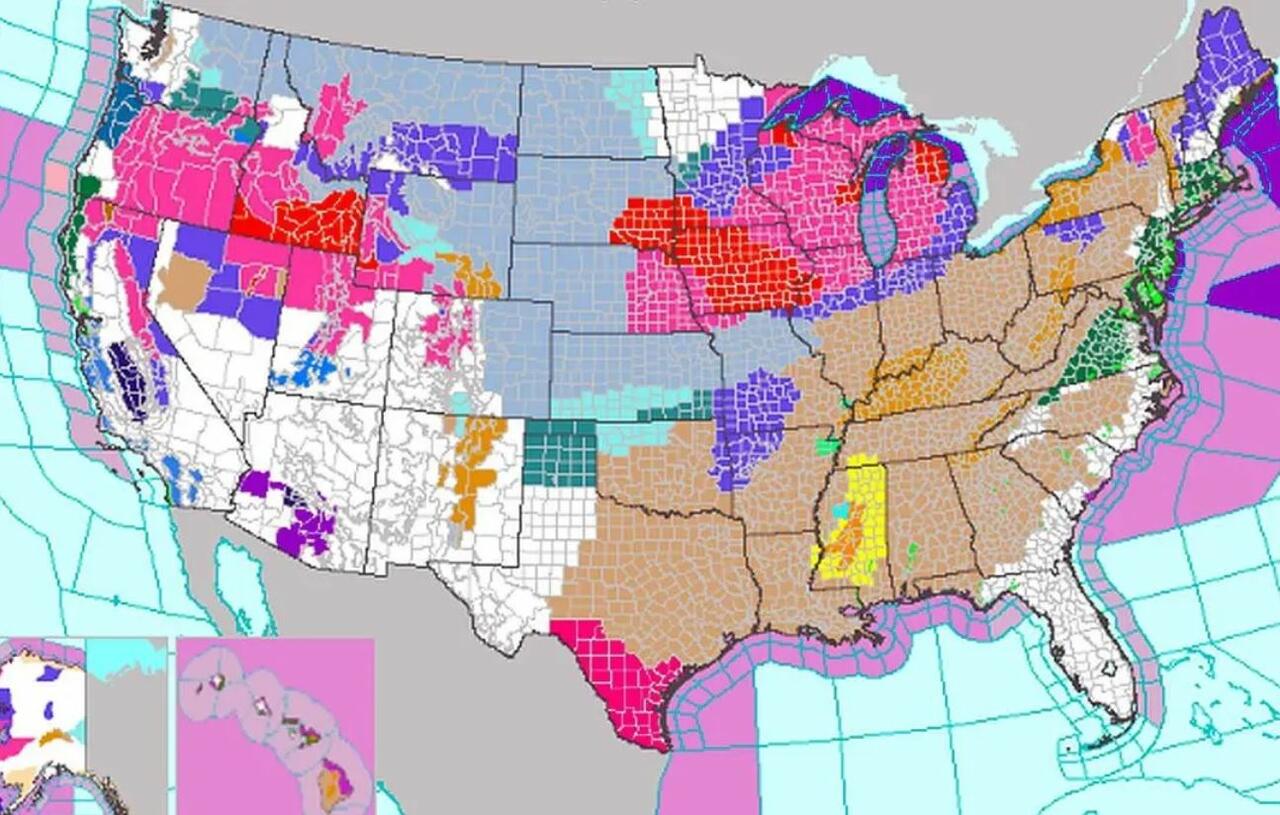
Multiple types of weather alerts were implemented in every U.S. state by the National Weather Service (NWS), warning that “powerful winter storms” are slated to hit much of the country.

In a statement posted to X, the NWS warned that “a VERY active weather pattern, and EVERY state in the US has an active NWS Watch, Warning, or Advisory.”

“A powerful winter storm will bring heavy snow, strong winds, and blizzard conditions from the mid-Missouri Valley, Midwest to the Great Lakes through Saturday,” another NWS alert said. “Behind this system, dangerous frigid temperatures are likely across the Rockies and Plains through this weekend. Severe thunderstorms are possible across the Southeast today, with strong winds, hail, and a few tornadoes possible.”

The agency said that “dangerously cold Arctic air” will then hit the U.S. heartland starting this weekend. Temperatures are expected to remain below zero for the northern Plains region starting Friday morning, while temperatures of minus-20 to minus-30 degrees F or more are slated to hit the Plains states on Saturday morning without factoring in wind chill.

With wind chills, temperatures may go as low as minus-35 to minus-50 degrees for parts of the Plains states, the agency said. It noted that such wind chills could lead to frostbite in a matter of only minutes.

Other than the NWS, several private forecasters such as AccuWeather warned that the upcoming frigid weather will be the “coldest air for the southern Plains” states since late 2022. “In addition to the cold, there is a risk of freezing rain, sleet and even snow in the region,” the forecaster said.

“The coldest air of the winter season thus far, transported directly from northwestern Canada, will surge across the northern Rockies and northern Plains by Saturday,” AccuWeather meteorologist Jon Porter wrote. “That air will then drive all the way south into Texas and other Southern states on Sunday.”

Before that, though, winter storm warnings are now in effect for Great Lakes and Midwest states due to a storm currently trekking across the United States. According to the NWS’s Des Moines office, “storms of this magnitude are fairly rare with recurrence around once or twice per decade.”

By Saturday morning, road crews in Iowa and Nebraska were struggling to keep ahead of the fast-falling snow.

The Iowa Department of Transportation’s road conditions map showed that virtually every major highway and interstate was partially or completely covered. The agency said driver visibility was “near zero” in some places, and wind-fueled drifts were quickly erasing the work of plow drivers.

The Iowa State Patrol posted photos of an icy wreck. “Please, don’t put yourself or others in danger,” the agency wrote. “The road conditions are extremely dangerous!” Blizzard warnings were issued in southwestern Minnesota on Friday.

In Kansas City, Missouri, black ice caused dozens of wrecks as freezing rain created any icy sheen over the roads. Temperatures in the mid-teens combined with wind of more than 20 mph created a bitterly cold wind chill of around 9 below zero.

As of Saturday morning, hundreds of major airlines canceled or delayed flights at several airports, likely due to the poor weather conditions, according to FlightAware’s data. Chicago’s O’Hare Airport and Midway Airport canceled a large number of flights as the region braces for snow. Flights were also canceled or delayed in Denver, Seattle, Milwaukee, Detroit, Kansas City, and many more.

Earlier this week, multiple forecasters noted that the frigid air is due to the return of the Arctic mass of air known as the “polar vortex.”

“The stratospheric polar vortex is now stretching down across North America,” National Oceanic and Atmospheric Administration scientist Amy Butler wrote on Tuesday afternoon.

The jet or Arctic air “will be pushed further south, and guess what that does? It opens up the freezer door,” said Fox Weather Meteorologist Kendall Smith. “All of that cold, arctic air that has been bottled up right over Canada, right over the Arctic, is going to be blasting its way right into the Lower 48.”

Frigid air is expected to inundate much of Texas and Oklahoma, too, starting this weekend and lasting into next week.

This week, the Electric Reliability Council of Texas (ERCOT) sent a warning from Jan. 15 to Jan. 17 due to “extreme cold weather” and elevated “electrical demand” could lower power reserves across Texas. ERCOT manages about 90 percent of the state’s power grid and has suffered energy shortfalls in recent years.

“ERCOT continues to closely monitor the winter weather moving in over the weekend and will deploy all available tools to reliably manage the grid,” ERCOT said in a Thursday post. “We will post daily updates to our social media channels during the ERCOT Weather Watch beginning Monday, January 15. At this time, grid conditions are expected to be normal, and there is not a current expectation of an energy emergency.”

Tyler Durden
Sat, 01/13/2024 – 09:20

Huawei Will Be The Next To Challenge Tesla In Autonomous Driving

0
Huawei Will Be The Next To Challenge Tesla In Autonomous Driving

The bad news keep stacking up for Tesla. This week it was announced the company was shuttering production at its Berlin plant and that Hertz, who once made headlines for massive EV purchases for its fleet, was selling much of its used EV fleet to re-adopt traditional ICE vehicles.

To cap off the week, Caixin also wrote about how Huawei is now aiming to pull ahead of Tesla in the race for autonomous vehicles. 

As the report notes, the pursuit of self-driving car technology is intensifying, with numerous players vying for a share in a potentially huge market. Huawei has joined the fray, announcing a venture focused on intelligent car systems and components, including a high-end electric SUV, aspiring to lead in intelligent driving.

Leading the charge is Tesla Inc., among other global carmakers, startups, and tech giants, all competing in the world’s largest auto market. Wu Gansha, co-founder and CEO of Uisee Technology Ltd., a driverless solutions startup, likened intelligent driving to the “pearl in the crown,” with a potential revenue of a trillion yuan, at a recent forum.

Autonomous vehicles have been in development since March 2004, Caixin notes, starting with DARPA’s $1 million challenge where 15 robotic vehicles attempted to navigate 142 miles of difficult California terrain, but none succeeded. Nearly two decades later, the vision of driverless cars remains somewhat futuristic, yet the commercial potential is too significant to overlook.

According to the report, by 2030, China could lead the global market for autonomous vehicles, with sales projected at $230 billion. Huawei’s entry intensifies competition, as success in the sector hinges on data, computing power, and significant resources.

While developers struggle to balance cost, performance, and safety, creating unique products is challenging. The industry is expected to consolidate, akin to the dominance of iOS and Android in mobile operating systems.

As the race escalates, companies face a choice: develop autonomous technology independently or collaborate. Initially, many, like SAIC Motor Corp., opted for in-house development. However, the high costs and technical demands have led others, such as Volkswagen AG, to reconsider.

Huawei’s dual expertise in software and hardware, including smart driving chips and sensors, positions it well for partnerships, offering a viable R&D platform for carmakers lacking resources. This trend toward collaboration reflects the industry’s shifting dynamics and the growing importance of alliances in achieving autonomous driving advancements.

So while Tesla is looking out for BYD in one rear-view mirror, they’ll have to be checking the other for Huawei…

Tyler Durden
Sat, 01/13/2024 – 08:45

Macleod On The Geopolitical Year-Ahead: BRICS, Gold, & Israel Gone Rogue

0
Macleod On The Geopolitical Year-Ahead: BRICS, Gold, & Israel Gone Rogue

Authored by Alasdair Macleod via GoldMoney.com,

2024 will see a quickening pace for geopolitical developments, with the influence of the US waning while that of China and Russia waxes. 

As a lost cause, the war in Ukraine will be abandoned by America and NATO in the next few months. The dangers in the Gaza situation are likely to escalate, with the US being played by Iran acting in collusion with Russia through the Houthis. 

The days of US divide and rule over Middle Eastern states are over. And if Israel thinks it can simply drag America into the Gaza horror story it has badly miscalculated. 

Russia has taken over the presidency of BRICS, and in his New Year speech President Putin stated there will be over 200 meetings and events planned. The final definitive meeting will be in Kazan in October. It seems reasonable to assume that Russia will ensure that all current members will be educated towards the merits of adopting a gold-backed trade settlement arrangement instead of the dollar.

The new currency is likely to replace the dollar as the intermediate step between non-dollar currency transactions. And it also makes compelling sense for Russia to put the rouble on a gold exchange standard as well, because it is one of the few economies that won’t require cuts in public spending to facilitate it. And as the dollar slides, China must follow in order to prevent the yuan going down with it.

And finally, 2024 is the year of the presidential election in America, which means pork barrels for all. And with the debt limit in place until January 2025, it is in both parties’ interests to maximise spending before the new cap in spending is agreed.

Could this be the year the dollar dies? Read on!

The world is a’changing…

On British TV, the days between Christmas and New Year are a time of old films, and David Lean’s iconic Lawrence of Arabia was shown for the umpteenth time. Like all films based on true events, its connection with reality is somewhat elastic. But it did remind us of the duplicity and arrogance of Britain and France drawing the Sykes-Picot line to divide up the Ottoman lands in Palestine over the heads of the inhabiting tribes, without regard to their territorial rights and Lawrence’s successful Arab Revolt which united the Bedouin tribes for the first time.

That political reality notwithstanding, Lawrence’s legacy and his role in uniting Bedouin tribes into the Arab nations gave Britain enduring influence in the region, certainly until long after the Second World War. But the Sykes of Sykes-Picot wasn’t the only interfering busybody in London. Prime Minister Balfour with his Declaration in 1917 opened the Pandora’s box which today is the modern state of Israel. However, sense in Westminster did occasionally prevail.

When Harold Macmillan made his winds of change speech at Cape Town in 1960, Britain was acknowledging that it could no longer resist the rising tide of nationalism flooding into Africa and elsewhere. Months earlier, he had appointed my uncle, Iain Macleod, as Colonial Secretary to accelerate the transition to independence for many of Britain’s colonies. And later in the 1960s when Harold Wilson was Labour Prime Minister, he abandoned British military presence “East of Suez”. Britain’s politicians in both parties had accepted the reality of Britain’s declining influence. Today, America’s permanent establishment takes a different view, not prepared to even consider the decline in its influence. If only the US was more pragmatic, perhaps the world would have fewer wars.

Despite extremely costly post-war campaigns in Korea, Vietnam, and up to the present day America’s victories have only been pyrrhic in nature, ruinous to the nation and the dollar. And despite the decline of its fading empire, this statist version of Don Quixote is still tilting at imaginary Asian windmills. But pyrrhic victories are now turning into outright defeats. Afghanistan, and now Ukraine which is still a disaster in progress.

Recent intelligence is that Valery Zaluzhny, commander in chief of the Ukrainian army has been talking to Valery Gerasimov, chief of the general staff of Russia’s army, and Russia’s first deputy minister of defence about a truce/peace settlement.[i] Crucially, President Zelensky has been bypassed. In response he is redoubling his efforts to recruit more soldiers in a depleted male population. But he faces increasing apathy from his NATO backers. 

Seymour Hersh’s information is that while the White House is still against peace proposals, it will happen without Biden’s agreement. To summarise, the politicians in Ukraine and Washington are now out of the loop.

This is the second time we know of that the West has turned down peace talks, the first brokered by Turkey. Since then, it is reported in the West that there have been 70,000 needless Ukrainian military casualties. But these figures are based on government propaganda, so the true figure is almost certainly considerably higher.

It is against this background that the Russians are stepping up their missile attacks on public buildings as far west as L’viv close to the Polish border. They know that the Ukrainian army has had enough, and they know that Zelensky’s support is fading, both in Ukraine and NATO. It looks like Ukraine’s war will be abandoned by its own army and therefore its NATO backers in the coming months.

Israel goes rogue

The US and UK will struggle to hold the line on Ukraine. And now there is a far trickier problem to deal with in Israel. It has all the potential for the chaos that turned the assassination of Archduke Ferdinand into the First World War.

As far as Western media are concerned, it all started with Hamas’s raid into Southern Israel on 7 October when they killed a number of Israelis and took hostages. But from the Palestinian point of view, the justification for their raid against Israeli settlements was the desecration by Israelis of the Al Aqsa Mosque, Islam’s third holiest site, and increasing settler violence against the Palestinians. And Hama’s viewpoint is shared by two billion Muslims, one quarter of the world’s population. The Muslim world increasingly sees the Israelis as committing ethnic cleansing, taking historically owned Arab territory into their possession. And the existence of significant oil prospects off the Gaza shore is suspected of giving the Israelis a further reason to eliminate not just Hamas, but Gaza as well.

America’s initial reaction was to back the Israelis, and as the BBC continually reminds us, the UK government designates Hamas as a terrorist organisation. In the past, Israel’s actions would probably have had unqualified support from NATO members kowtowing to the American line. But that was before Arab unity lined up against Israel and its supporters — unity that now embraces the Saudis and Iran with her rebellious Houthis in Yemen. And that is a major difference today: American action in the region has always had Arab backing from at least some of the major players. The days of America’s divide and rule policies in the Middle East are now over.

With a divided Muslim world, two years ago the US Fleet could have attacked Iran under whatever pretext and probably got away with it. Instead, what is thought by many to be little more than a rag-bag army of Houthi tribesmen at the Bab El-Mandeb Red Sea pinch point opposite Djibouti, armed with some cheap drones and basic missiles are threatening the largest, most expensive fleet in the world. We are not sure yet whether the US Fleet has plucked up the courage to fully counter this outrage, given that its so-called Operation Prosperity Guardian has seen three of America’s European allies back out already — Spain, France, and Italy. 

It would be a grave mistake to underestimate the Houthis, who, it appears, can even pilot helicopters having been videoed landing them on oil tankers and container vessels entering the Red Sea. Yemen’s civil war and their subsequent attacks against the mighty Saudis appear to have melded them into a formidable guerrilla force. Now that Iran is driving them into peace talks with the Saudis, no doubt the Houthis are itching for a new cause. 

Anyway, it is Round One to the Houthis: Red Sea shipping transits are now uninsurable, which appears to be Iran’s objective-by-proxy.

There is little doubt that the Houthis will escalate their actions even further, despite the US, UK, Norway, Netherlands, Greece, Canada, and Australia sending warships to the area as their part in Operation Prosperity Guardian. Direct action against the Houthis is likely to inflame their anti-Israeli zeal even more. If words are followed by actions against the Houthis, we can be certain that the objective of protecting safe passage through the Red Sea will not be achieved and the Arab world will be further antagonised. Yet again, America could discover that deterrence becomes provocation.

The wider Middle East picture

While the Houthis are independent, like Hezbollah they are backed by Iran, dancing to the latter’s tune. But belying its extremist reputation, Iran is playing a calculated game, trying to put sufficient pressure on the Israelis to back down over Gaza. For now, they appear to be restraining Hezbollah to relatively minor attacks in Northern Israel, with the threat that Hezbollah’s involvement could increase if Israel doesn’t back down.

Meanwhile, the Israelis appear to be trying to provoke America into direct action against Iran. It could be that the Israelis fear that with the Arab world uniting, their very existence as a nation is more directly threatened and that drawing in American protection is their best option. But without Saudi, Egyptian, and Turkish support the Americans and her western alliance are understandably reluctant to be drawn into a new war. Arab/Iranian unity neutralises the possibility of a deal between Israel and America giving greater protection against Iranian hostility, which presumably involves not just eliminating Hamas but seizing control of Lebanon and/or Syria and eliminating Hezbollah as well.

Not only has the ground shifted for America, but it has for the Iranians as well. From being seen as an extreme theocracy issuing fatwas against westerners, Iran has become an integral part of the Asian hegemons’ plans. Russia has secured her partnership in energy, and China her access to the Persian Gulf. Through her membership of the Shanghai Cooperation Organisation — she became a full member last July — Iran is now directly involved in Asia’s wider future. Not only does she enjoy greater protection under the SCO umbrella, but her geopolitics have become aligned with its objectives as well.

This explains her tacit backing of Houthi action in the Red Sea, which is considerably more subtle than closing off Hormuz: that remains a backstop in event of a direct threat from America and her NATO partners. 

For the Gulf Cooperation Council, representing all the oil and gas producers in the Middle East, the West’s climate change agenda has eliminated itself as a source of long-term energy demand. The GCC’s future is now focusing on Asian markets, dominated by industrialising China and India, who pay lip service to saving the planet but show no signs of reducing demand for fossil fuels.

In partnership with China, Russia has played her energy cards well by reeling in the GCC to her sphere of influence. The reality so far as the western alliance is concerned is that the outcome of any action against the Houthis or in Lebanon and Syria to protect Israel’s northern flank will be determined by Russia and China, deploying regional support. It is no longer a matter confined to just the Middle East.

BRICS and Russia’s presidency

From this week, Russia takes over the BRICS presidency from South Africa and membership expands from five to ten. It was to be eleven. But having applied and been granted membership from 1 January, Argentina withdrew its application on 30 December, leaving a total of ten nations in the organisation whose combined population is estimated at 3.3 billion, about 44% of the world’s population. And of the 30 nations which have expressed an interest last year, a further 15 countries have formally applied to join BRICS. As pro tempore president, Russia will probably authorise further membership applications in a quest to expand BRICS and Russia’s own sphere of influence. My guess is that fossil fuel production and consumption will rank with respect to Putin’s selection.

President Putin in his New Year speech outlined Russia’s objectives for BRICS in the coming year. The following is extracted from the English translation:[ii]

“In general, Russia will continue to promote all aspects of the BRICS partnership in three key areas: politics and security, economy and finance, and cultural and humanitarian contacts.

“Naturally, we will focus on enhancing foreign policy coordination among the member countries and on jointly seeking effective responses to the challenges and threats to international and regional security and stability. We will contribute to the practical implementation of the Strategy for BRICS Economic Partnership 2025 and the Action Plan for BRICS Innovation Cooperation 2021–2024 for ensuring energy and food security, enhancing the role of BRICS in the international monetary system, expanding interbank cooperation, and expanding the use of national currencies in mutual trade.

“Our priorities include promoting cooperation in science, high technology, healthcare, environmental protection, culture, sports, youth exchanges, and civil society.

“In total, over 200 events of different levels and types will be held in many Russian cities as part of the chairmanship. We encourage representatives of all countries interested in cooperating with our organisation to take part in them. The BRICS Summit in Kazan in October will be the culmination of our chairmanship.”

With over five events planned on average every week, Russia has put considerable detail into her agenda for BRICS which will run alongside her military and energy strategies. Clearly, the objective must be to cement hard support from all current and future BRICS members for Russia’s strategic objectives, which must include isolating the dollar as the foreign exchange and trade settlement medium. 

Readers will recall that Russia wanted to put a gold backed trade settlement currency on the Johannesburg agenda but failed to secure the required unanimous backing of the then members. With the benefit of hindsight, we can view the early leaking of her proposal as a device to put pressure on the dissenters. But Keynesian India was dead against it, and China was lukewarm. But now Russia will have a more considered and timely opportunity to achieve her gold currency objectives, and the programme of over 200 events is likely to be heavily skewed to achieving this end.

BRICS and gold

Last year central banks around the world accumulated substantial quantities of gold. There are two obvious reasons for this development. The first is a realisation that reserves held in sovereign currencies bear increasing credit risk due to high government debt to GDP ratios and the threat of confiscation. And the second is an assessment of America’s geopolitical decline. While central bank gold reserves are reported by the IMF and distributed more widely by the World Gold Council, these statistics are only part of the total, with governments feeding bullion into national wealth funds and other accounts hidden from public view. Therefore, the IMF’s statistics are not the whole picture.

What we cannot know is how many central bankers truly understand the legal distinctions and differences between money and credit. One can only conclude that if they did the dollar would have already been widely rejected relative to gold, because the former is supported only by belief in it while the latter has proved to be constant over history, replacing fiat regimes every time they eventually fail.

Nevertheless, the strategic accumulation of bullion reserves by central banks has been quietly growing over the last decade. But with the US’s insistence that the dollar is money and gold is money no longer, any neutral nation which is probably indebted in dollars anyway is unlikely to provoke the Americans and the IMF into retaliatory action by publicly dumping dollars for gold. The only exceptions are powerful players, such as China and the Saudis, or those already sanctioned, like Russia and Iran. China has been selling US Treasuries and buying gold with the proceeds while Russia continues its anti-dollar rhetoric.

We don’t know what Russia was going to propose with respect to using gold in connection with trade settlement in Johannesburg, but the most likely plan would have been to replace the dollar as the common medium between foreign exchange settlements. Other than intergovernmental dealings, the normal procedure for trade settlement is for an importer to sell its national currency for dollars, and either pay dollars to the trade counterparty, or sell the dollars to buy the counterparty’s national currency in order to credit its bank. Assuming a trade deal is not settled in dollars but national currencies, the dollar is still involved. At any one time, outstanding foreign exchange transactions with the dollar on one leg amounts to about $85 trillion.

With a growing BRICS organisation together with members, associates, and dialog partners of the Shanghai Cooperation Organisation (SCO) we can see that the majority of the world by population in the Russia/China axis is tied through trade to the dollar because of foreign exchange market conventions. This gives the US a presence in the Russian/Chinese backyard, which is obviously undesirable to the Asian hegemons. Logically, the neutrality of gold is an attractive replacement for the dollar in these trade transactions, with a gold substitute fully redeemable in gold and commercial bank credit created in its denomination acting between currencies. Used for trade settlement, most credit created in the new currency becomes self-extinguishing. Furthermore, as a medium of exchange it can be trusted to hold its value better than an unstable fiat dollar.

Any move towards an official readoption of gold for the replacement of the dollar is bound to undermine the dollar’s credibility. It would amount to the greatest challenge to the post-Bretton Woods status quo. Understandably, there must be serious misgivings even within the BRICS camp about the likely consequences of such an important step. But over the course of 2024, the US Government’s debt trap will almost certainly lead to increasing uncertainty over the future value of dollar reserves and of the dollar’s suitability as a medium of exchange. A further consideration, likely to unfold over time, is of the debasement of dollar debt owed by emerging nations which will surely be welcomed by them, assuming they can stabilise their own currencies.

In other words, over the course of 2024 the conditions for the replacement of dollars with gold as the international measure of value will improve with the dollar’s decline. 

Russia is therefore likely to refine the proposals that failed to make the Johannesburg agenda before presenting them again next October at the meeting scheduled to be at Kazan, where they should have a better reception. It will have become obvious to delegates at that meeting that with the US Government entangled in a debt trap it will struggle to find buyers for US Treasuries other than for short-term T-bills. As I argue below, in the current fiscal year the budget deficit could top $3 trillion, half of which will be debt interest. And the dollar is already showing early signs of decline, reflected in both its trade weighted index and the dollar price of gold.

Gold adoption by Russia and China

As well as other members of BRICS and the SCO reviewing their relationship with the dollar, Russia and China will have to consider the relationship between a declining dollar and their own currencies. The Keynesian consensus on trade is that currency relationships for net exporting nations maximise trade benefits “when they are competitive”. It is an argument that favours a faster decline in purchasing power than that of the dollar. This line of reasoning is specious, to say the least. It highlights the logic of lower export prices promoting sales, with the less obvious: that a competitive currency policy erodes national wealth and fails to address the relationships between the trade balance, the government’s own accounts, and private sector savings which actually determine the balance of trade. 

Inevitably, there must come a point where this popular line of reasoning will be abandoned. Otherwise, the rouble and renminbi will go down with a sinking dollar ship. 

The benefits of putting the rouble on a gold standard are obvious and growing all the time. As a matter of fact, in its soviet days Russia was on a gold standard, separately from the Bretton Woods Agreement (which Stalin endorsed but didn’t join) until Khrushchev abandoned it in 1961. The lesson for critics of the rouble devaluation is that it cured nothing, with the decline in the soviet economy continuing, even accelerating. Tin view of this history, there is an appreciation in Russia at the highest levels of the benefits of securing the rouble’s value to gold, eloquently expressed by Sergei Glazyev, economic adviser to Putin in an article for the Moscow business magazine Vedomosti in December 2022.[iii]

The benefits are clear: a credible gold standard would allow interest rates to settle at a rate closer to the natural rate for gold, adjusted by the credibility of the arrangement. Instead of the central bank’s key interest rate of 16%, it would likely decline towards two or three per cent. The expansion of the central bank’s credit would be tied solely to its function as an issuer of roubles in return for gold coin and bullion, the expansion of commercial bank credit being driven by commercial demand, productive in nature and therefore non-inflationary.

With income tax at 13%—15%(maximum) and government debt estimated at only 22% of GDP, the underlying economic dynamics for the Russian economy do not face the painful readjustment of welfare-driven economies required to make a gold standard stick. The only credible reason Russia has not adopted the obvious gold policy outlined by Glazyev is that for Russia to do so would deliver a death blow to the dollar by comparison, an outcome for which China is not yet prepared. But with the dollar’s debt problem rapidly escalating, China will have to abandon the fallacy that her exports depend on the renminbi weakening with the dollar. 

We know from her policies towards gold following the Peoples Bank’s appointment as sole manager of the nation’s gold in 1983, together with global bullion flows into China that both the state and its peoples have accumulated the largest aboveground gold stocks on the planet. This policy would not have been implemented unless far-sighted officials had not foreseen the weaknesses in the dollar-based post-Bretton Woods currency system. The role of gold as money is clearly understood in China.

The gathering pace of the dollar’s problems suggests that the transition of the rouble and renminbi to gold standards further undermining the dollar’s credibility will happen sooner than might be expected — even before this year’s end. As to the timing, there are many variable factors, not just the success with which Russia persuades the BRICS membership under her presidency to do away with the dollar in favour of gold, but also her increasingly likely success at expelling US-led NATO from Ukraine and developments in the Israeli/Gaza conflict going Iran’s way. And then 2024 is also the year of political change in the West, which could have an enormous influence on outcomes.

US elections and borrowing costs

In 2024, the most important election of many will be that of US President on 5 November. Ahead of the US primaries which will determine the two principal contenders, it appears to be between Biden and Trump. In its global impact, it is this election which will matter more than any other.

Last June, Biden signed into law the suspension of the debt ceiling until 1 January 2025. Since then, the Federal Government’s debt has accelerated to $34 trillion, the overriding feature being debt interest, perhaps making up nearly half of the budget deficit in this fiscal year. The level of interest rates and therefore the cost of government funding has become a major issue for the Fed, which while notionally independent from the US Treasury in practice is not.

It is one of a series of issues which have been troubling markets in recent months. Following the last FOMC meeting, markets have taken the view that the Fed is pivoting from control of inflation to addressing a recessionary economy and the cost of government debt. Accordingly, as well as an ambition to reduce interest rates the next policy move is likely to be the abandoning of quantitative tightening in favour of QE. 

With the refunding of maturing debt, it will require over $10 trillion to be found. That’s bad enough. But being an election year, the haggling over spending (reductions are never in the frame) will almost certainly take the debt total to at least $37—$38 trillion at the end of the current fiscal year (to end-September) and possibly even within spitting distance of $40 trillion by the year-end.

The inducement to spend, spend, spend while there is no debt ceiling and before negotiations for a new one take place following the installation of the next President, the greater will be the likelihood of outstanding debt hitting $40 trillion before a new ceiling is negotiated. A recession, which is already the true condition, will reduce expected revenue and increase prospective liabilities, potentially driving the budget deficit even higher than $3 trillion. In which case debt hitting $40 trillion in twelve months’ time becomes even more likely.

The optics will not be good. Soaring government debt and subdued or contracting GDP will drive the ratio considerably higher. The pressure on the Fed to keep interest rates as low as possible is bound to increase. But the Fed is unlikely to have much control over interest rates anyway because they will be determined by the fate of the dollar’s purchasing power. The dollar’s exchange rate with other currencies will depend on the degree of foreign investment in the Federal Government’s new debt. But other than captive buyers in offshore centres, reserve demand from foreign central banks is already declining. In fact, the two largest holders, China and Japan have already turned net sellers. 

In recent months we have seen evidence of difficulties in longer maturity debt auctions and a growing reliance on short-term funding through the T-Bill market. Largely, this is due to banks adjusting their risk exposure away from corporate lending and longer bond maturities, a process which is time limited. Government funding has also absorbed most of the money market funds’ liquidity, which previously had been parked in the Fed’s reverse repo facility. The ease with which the US Treasury has funded the accelerating budget deficit will shortly come to an end, and a funding crisis is bound to ensue.

Under cover of a gathering recession, the Fed will face mounting pressure to monetise the debt problem as much as possible. For a fiat currency over-owned by foreign interests the inflationary implications are potentially catastrophic for the dollar. The dollar’s suitability as the international medium of exchange is already facing a challenge from gold, to which the Asian hegemons and their growing band of supporters in BRICS and the SCO are turning.

Consequently, with a failing dollar 2024 is set to see a significant decline in the US’s global influence. By wielded her power through the dollar she has created foreign resentment and enemies. This could be the year when America discovers that her grip on the world is ending, and that she should have learned from Britain’s experience and response to the reality of her decline in the 1960s.


Tyler Durden
Sat, 01/13/2024 – 08:10

British Troops In Ukraine Would Be ‘Declaration Of War’ Risking Nuclear Response: Medvedev 

0
British Troops In Ukraine Would Be ‘Declaration Of War’ Risking Nuclear Response: Medvedev 

Reacting to the ‘unprecedented’ military aid package just reached between Kiev and the United Kingdom, and with UK Prime Minister Rishi Sunak in the Ukrainian capital, the Kremlin has issued an urgent warning saying that any deployment of British troops to Ukraine as a “declaration of war.” 

The alarming and blistering words came from former Russian President Dmitry Medvedev upon Sunak’s arrival in Kiev for the unveiling of the $3+ billion defense aid package. The new security agreement has outraged Moscow.

Getty Images

While there’s been nothing in the official security deal which indicates UK troop deployment inside the war-ravaged country, apparently things like deepened intelligence-sharing has been enough to raise Kremlin suspicions of Western ‘boots in the ground’ escalation

The deal “formalizes a range of support the UK has been and will continue to provide for Ukraine’s security, including intelligence sharing, cyber security, medical and military training, and defense industrial cooperation,” Downing Street had announced. 

Medvedev posted his response to social media. Importantly, he currently serves as deputy chair of the Russian Security Council, and he said

“What does this mean? It means only one thing – they risk running into the action of paragraph 19 of the fundamentals of Russia’s state policy in the field of nuclear deterrence,” Medvedev wrote on the Telegram messaging app.

“This should be remembered,” Medvedev said.

According to more of the context from Reuters, he said that “some Ukrainian military commanders were considering hitting missile launch sites inside Russia with Western-supplied long-range missiles.”

The follows the Russian Defense Ministry having previously claimed UK troops already have a presence on the ground in Ukraine, certainly at least in an ‘advisory’ role.

While ultimately only President Putin is the final decision-maker on deployment of Russian nukes, Medvedev’s threat was ominous and gained the West’s attention at a moment of multiple conflict flashpoints across the globe chiefly because of the following

Paragraph nineteen of Russia’s 2020 nuclear doctrine sets out the conditions under which a Russian president would consider using a nuclear weapon: broadly as a response to an attack using nuclear or other weapons of mass destruction, or to the use of conventional weapons against Russia “when the very existence of the state is put under threat.”

Medvedev made specific mention of point “g” of paragraph nineteen which deals with the nuclear response to a conventional weapons attack.

Throughout the nearly two-year long war, former president Medvedev has been an outspoken hawk, engaging in nuclear saber-rattling on repeat occasions, especially when there’s an escalation perceived from Ukraine or its Western backers. Russia had previously positioned tactical nukes inside Belarus, which the West has seen as a significant escalation.

Tyler Durden
Sat, 01/13/2024 – 07:35

The EU Wants To Spy On Europeans’ Internet Use

0
The EU Wants To Spy On Europeans’ Internet Use

Authored by Robert Blumen via The Brownstone Institute,

The European Commission is an EU legislative body with regulatory authority over digital technology. The EC’s eIDAS Article 45, a proposed regulation, would deliberately weaken areas of internet security that the industry has carefully evolved and hardened for over 25 years. The Article would effectively grant the 27 EU governments vastly expanded surveillance powers over internet use. 

The rule would require all internet browsers to trust an additional root certificate from an agency (or a regulated entity) from each of the national governments of each one of the EU member states. For the non-technical readers, I will explain what a root certificate is, how internet trust has evolved, and what Article 45 does to this. And then I will highlight some of the commentary from the tech community on this matter. 

The next section of this article will explain how the trust infrastructure of the internet works. This background is necessary in order to understand how radical the proposed Article is. The explanation is intended to be accessible to a non-technical reader.

The regulation in question addresses internet security. Here, “internet” means, largely, browsers visiting websites. Internet security consists of many distinct aspects. Article 45 intends to modify public key infrastructure (PKI), a part of internet security since the mid-90s. PKI has been at first adopted, and then improved over a 25-year period, to give users and publishers the following assurances: 

  • Privacy of the conversation between the browser and the website: Browsers and websites converse over the internet, a network of networks operated by Internet Service Providers, and Tier 1 carriers; or cellular carriers if the device is mobile. The network itself is not inherently safe nor trustworthy. Your nosy home ISPa traveler in the airport lounge where you are waiting for your flight, or a data vendor looking to sell leads to advertisers might want to spy on you. Without any protection, a bad actor could view confidential data such as a password, credit card balance, or health information. 

  • Guarantee that you view the page exactly the way the website sent it to you: When you view a web page, could it have been tampered with between the publisher and your browser? A censor might want to remove content that they don’t want you to see. Content labeled as “misinformation” was widely suppressed during covid hysteria. A hacker who had stolen your credit card might want to remove evidence of their fraudulent charges. 

  • Guarantee that the website you see is really the one in the browser’s location bar: When you connect to a bank how do you know that you are seeing the website of that bank, not a fake version that looks identical? You check the location bar in your browser. Could your browser be tricked into showing you a fake website that appears identical to the real one? How does your browser know – for sure – that it is connected to the correct site? 

In the early days of the internet, none of these assurances existed. In 2010, a browser plugin available in the add-on store enabled the user to participate in someone else’s Facebook group chat in a cafe hotspot. Now – thanks to PKI, you can be pretty sure of these things. 

These security features are protected with a system based on digital certificates. Digital certificates are a form of ID – the internet version of a drivers’ license. When a browser connects to a site, the site presents a certificate to the browser. The certificate contains a cryptographic key. The browser and the website work together with a series of cryptographic calculations to set up secure communication.

Together, the browser and the website provide the three security guarantees:

  • privacy: by encrypting the conversation.

  • cryptographic digital signatures: to ensure that the content is not modified in flight

  • verification of the publisher: through the chain of trust provided by PKI, that I will explain in more detail below. 

A good identity should be difficult to counterfeit. In the ancient world, a wax casting of a seal served this purpose. Identities for humans have relied on biometrics. Your face is one of the oldest forms. In the non-digital world, when you need to access an age-restricted setting, such as ordering an alcoholic beverage, you will be asked for a photo ID.

Another biometric from before the digital era was to match your fresh pen-and-ink signature against your original signature on the back of your ID. As these older types of biometrics become easier to counterfeit, human identity verification has adapted. Now, it is common for a bank to send you a validation code on your mobile. The app requires you to pass a biometric identity check on your mobile phone to view the code such as face recognition or your fingerprint. 

In addition to a biometric, the second factor that makes an ID trustworthy is the issuer. IDs that are widely accepted depend on the ability of the issuer to verify that the person applying for an ID is who they say they are. Most of the more widely accepted forms of ID are issued by government agencies, such as the Department of Motor Vehicles. If the issuing agency has reliable means to track who and where its subjects are, such as tax payments, employment records, or the use of water utility services, then there is a good chance the agency can verify that the person named on the ID is that person.

In the online world, governments have, for the most part, not involved themselves in identity verification. Certificates are issued by private sector firms known as certificate authorities (CAs). While certificates used to be quite expensive, fees have come down considerably to the point where some are free. The best known CAs are Verisign, DigiCert and GoDaddy. Ryan Hurst shows the seven major CAs (ISRG, DigiCert, Sectigo, Google, GoDaddy, Microsoft, and IdenTrust) issue 99% of all certificates.

The browser will accept a certificate as proof of identity only if the name field on the certificate matches the domain name, which the browser shows in the location bar. Even if the names match, does that provide that a certificate saying “apple.com” belongs to the consumer electronics business known as Apple, Inc.? Identity systems are not bulletproof. Underage drinkers can get fake IDs. Like human IDs, digital certificates can also be fake, or invalid for other reasons. A software engineer using free open source tools can create a digital certificate named “apple.com” with a few Linux commands

The PKI system relies on CAs to issue any certificate only to the owner of the website. The workflow to acquire a certificate goes like this:

  1. The publisher of a website applies to their preferred CA for a certificate, for a domain. 

  2. The CA verifies that the certificate request comes from the actual owner of that site. How does the CA establish this? The CA demands that the entity making the request publish a specific piece of content on a specific URL. The ability to do this proves that the entity has control over the website.

  3. Once the website has proven ownership of the domain, the CA appends a cryptographic digital signature to the certificate usings its own private cryptographic key. The signature identifies the CA as the issuer. 

  4. The signed certificate is conveyed to the person or entity making the request. 

  5. The publisher installs their certificate on their website, so it may be presented to browsers. 

Cryptographic digital signatures are “a mathematical scheme for verifying the authenticity of digital messages or documents.” They are not the same thing as the online document signing provided by DocuSign and similar vendors. If the signature could be forged, then the certificates would not be trustworthy. Over time the size of the cryptographic keys has increased with the aim of making forgery more difficult. Cryptography researchers believe that current signatures, in practical terms, are impossible to forge. Another vulnerability is when the CA has its secret keys stolen. The thief could then produce valid signatures of that CA. 

Once the certificate has been installed, then it is used during the setup of a web conversation. The Register explains how that goes:

If the certificate was issued by a known good CA, and all the details are correct, then the site is trusted, and the browser will try to establish a secure, encrypted connection with the website so that your activity with the site isn’t visible to an eavesdropper on the network. If the cert was issued by a non-trusted CA, or the certificate doesn’t match the website’s address, or some details are wrong, the browser will reject the website out of a concern that it’s not connecting to the actual website the user wants, and may be talking to an impersonator.

We can trust the browser because the browser trusts the website. The browser trusts the website because the certificate was issued by a “known good” CA. But what is a “known good CA?” Most browsers rely on the CAs provided by the operating system. The list of trustworthy CAs is decided by device and software vendors. The major computer and device vendors – Microsoft, Apple, Android phone manufacturers, and the open source Linux distributors – preload the operating system on their devices with a set of root certificates.

These certificates identify the CAs they have vetted and consider to be reliable. This collection of root certificates is called the “trust store.” To take an example close to me, the Windows PC that I am using to write this piece has 70 root certificates in its Trusted Root Certificate Store. Apple’s support site lists all of the roots trusted by the Sierra version of MacOS

How do the computer and phone vendors decide which CAs are trustworthy? They have audit and compliance programs to evaluate the quality of CAs. Only the ones that pass are included. See for example, the Chrome browser (which provides its own trust store rather than using the one on the device). The EFF (which describes itself as “the leading nonprofit organization defending civil liberties in the digital world”explains:

Browsers operate “root programs” to monitor the security and trustworthiness of CAs they trust. Those root programs impose a number of requirements varying from “how must key material be secured” to “how must validation of domain name control be performed” to “what algorithms must be used for certificate signing.”

After a CA has been accepted by a vendor, the vendor continues to monitor it. Vendors will remove CAs from the trust store should the CA fail to uphold the necessary security standards. Certificate authorities can, and do, go rogue, or fail for other reasons. The Register reports:

Certificates and the CAs that issue them are not always trustworthy and browser makers over the years have removed CA root certificates from CAs based in Turkey, France, China, Kazakhstan, and elsewhere when the issuing entity or an associated party was found to be intercepting web traffic. 

In 2022, researcher Ian Carroll reported Security concerns with the e-Tugra certificate authority. Carroll “found a number of alarming issues that worry me as to the security practices inside their company,” such as weak credentials. Carroll’s reports were verified by the major software vendors. As a result, e-Tugra was removed from their trusted certificate stores

The Timeline of Certificate Authority Failures tells of other such incidents. 

There are still some known holes in PKI as it currently exists. Because one particular issue is important to an understanding of eIDAS Article 45, I will explain that next. A CA’s trust is not scoped to those websites that conduct their business with that CA. A browser will accept a certificate from any trusted CA for any website. There is nothing preventing the CA from issuing a website to a bad actor that was not requested by the owner of the site. Such a certificate would be fraudulent in the legal sense because of who it was issued to. But the contents of the certificate would be technically valid from the browser’s viewpoint. 

If there was a way to associate each website with its preferred CA, then any certificate for that site from any other CA would be immediately recognized as fraudulent. Certificate pinning is another standard that takes a step in this direction. But how would that association be published and how would that publisher be trusted? 

At each layer of this process, the technical solution relies on an external source of trust. But how is that trust established? By relying on an even more trusted source on the next higher plane? This question illustrates the “turtles, all the way down” nature of the problem. PKI does have a turtle at the bottom: the reputation, visibility, and transparency of the security industry and its customers. Trust is built at this level through constant monitoring, open standards, the software developers, and the CAs. 

Fraudulent certificates have been issued. In 2013, ArsTechnica reported French agency caught minting SSL certificates impersonating Google:

In 2011…security researchers spotted a bogus certificate for Google.com that gave attackers the ability to impersonate the website’s mail service and other offerings. The counterfeit certificate was minted after attackers pierced the security of Netherlands-based DigiNotar and gained control of its certificate-issuing systems.

The secure sockets layer (SSL) credentials were digitally signed by a valid certificate authority…In fact, the certificates were unauthorized duplicates that were issued in violation of rules established by browser manufacturers and certificate authority services.

Fraudulent certificate issuance can happen. A rogue CA can issue one, but they won’t get far. The bad certificate will be detected. The bad CA will fail compliance programs and be removed from trust stores. Without acceptance, the CA will go out of business. Certificate Transparency, a more recent standard, enables more rapid detection of fraudulent certificates. 

Why would a CA go rogue? What advantage can the bad guy gain from an unauthorized certificate? With the certificate alone, not much, even when signed by a trusted CA. But if the bad guy can team up with an ISP, or otherwise access the network that the browser uses, the certificate gives the bad actor the ability to break all of PKI’s security guarantees. 

The hacker could mount a man-in-the-middle attack (MITM) on the conversation. The attacker could insert himself in between the browser and the real website. In this scenario, the user would be talking directly to the attacker, and the attacker would relay the contents back and forth with the real website. The attacker would present the fraudulent certificate to the browser. Because it was signed by a trusted CA, the browser would accept it. The attacker could view and even modify what either party sent before the other side received it.

Now we come to the EU’s sinister eIDAS, Article 45. This proposed regulation requires all browsers to trust a basket of certificates from CAs designated by the EU. Twenty-seven to be exact: one for each member nation. These certificates are to be called Qualified Website Authentication Certificates. The acronym “QWAC” has an unfortunate homophone to quackery – or perhaps the EC is trolling us.

The QWACs would be issued either by either government agencies, or what Michael Rectenwald calls governmentalities: “corporations and companies and other adjuncts of the state who are otherwise called ‘private,’ but really are operating as state apparatuses, in that they’re enforcing state narratives and dictates.” 

This scheme would bring EU member governments one step closer to the point where they could man-in-the-middle attack against their own citizens. They would also need to access the networks. Governments are in a position to do that. If the ISP is run as a state-owned enterprise, then they would already have it. If ISPs are private firms, then local authorities could use police powers to gain access. 

One point which has not been emphasized in the public conversation is that a browser in any of the 27 EU member nations would be required to accept every single QWAC, one from each EU member. This means that a browser in, for example, Spain, would have to trust a QWAC from entities in Croatia, Finland, and Austria. The Spanish user visiting an Austrian website would have to transit over Austrian portions of the internet. The issues raised above would all apply across countries within the EU. 

The Register, in a piece titled Bad eIDAS: Europe ready to intercept, spy on your encrypted HTTPS connections explains one way this might work:

[T]hat government can ask its friendly CA for a copy of [the QWAC] certificate so that the government can impersonate the website – or ask for some other certificate browsers will trust and accept for the site. Thus, using a man-in-the-middle attack, that government can intercept and decrypt the encrypted HTTPS traffic between the website and its users, allowing the regime to monitor exactly what people are doing with that site at any time.

Having penetrated the shield of encryption, monitoring could include saving users’ passwords, and then using them at another time to access citizens’ email accounts. In addition to monitoring, governments could modify content inline. For example, they could remove the narratives they want to censor. They could attach annoying nanny state fact checks and content warnings to dissenting opinions.

As things currently stand, CAs must maintain the trust of the browser community. Browsers currently warn the user if a site presents an expired or otherwise untrusted certificate. Under Article 45, warnings or the ejection of trust abusers would be forbidden. Not only are browsers mandated to trust the QWACs, but Article 45 prohibits browsers from showing a warning that a certificate signed by a QWAC. 

Last Chance for eIDAS (a website displaying the Mozilla logo) advocates against Article 45: 

Any EU member state has the ability to designate cryptographic keys for distribution in web browsers and browsers are forbidden from revoking trust in these keys without government permission. 

…There is no independent check or balance on the decisions made by member states with respect to the keys they authorize and the use they put them to. This is particularly troubling given that adherence to the rule of law has not been uniform across all member states, with documented instances of coercion by secret police for political purposes.

In an open letter signed by several hundred security researchers and computer scientists:

Article 45 also bans security checks on EU web certificates unless expressly permitted by regulation when establishing encrypted web traffic connections. Instead of specifying a set of minimum security measures which must be enforced as a baseline, it effectively specifies an upper bound on the security measures which cannot be improved upon without the permission of ETSI. This runs counter to well established global norms where new cybersecurity technologies are developed and deployed in response to fast moving developments in technology. 

Most of us rely on our vendors to curate the list of trusted CAs. However, as a user, you may add or remove certificates as you please on your own devices. Microsoft Windows has a tool to do this. On Linux, the root certificates are files located in a single directory. A CA may be untrusted simply by deleting the file. Will this also be forbidden? Steve Gibson, noted security pundit, columnist, and host of the long-running Security Now podcast asks:

But the EU is stating that browsers will be required to honor these new, unproven and untested certificate authorities and thus any certificates they issue, without exception and without recourse. Does that mean that my instance of Firefox will be legally bound to refuse my attempt to remove those certificates?

Gibson notes that some corporations implement similar surveillance of their employees within their own private network. Whatever your opinion about those working conditions, some industries have legitimate audit and compliance reasons to track and record what their employees are doing with company resources. But, as Gibson continues,

The trouble is that the EU and its member nations are very different from the employees of a private organization. Any time an employee doesn’t want to be spied upon, they can use their own smartphone to circumvent their employer’s network. And of course an employer’s private network is just that, a private network. The EU wants to do this for the entire public Internet from which there would be no escape.

Now we have established the radical nature of this proposal. It is time to ask, what reasons does the EC offer to motivate this change? The EC says that identity verification under PKI is not adequate. And that these changes are needed to improve it. 

Is there any truth to the EC’s claims? Current PKI in most cases only requires the request to prove control of the website. While that is something, it does not guarantee, for example, that the web property “apple.com” is owned by the consumer electronics company known as Apple Inc, headquartered in Cupertino, California. A malicious user might obtain a valid certificate for a domain similar name to that of a well-known business. The valid certificate could be used in an attack that relied on some users not looking hard enough to notice that the name does not quite match. This happened to payment processor Stripe.

For publishers who would like to prove to the world that they are truly the same corporate entity, some CAs have offered Extended Validation (EV) Certificates. The “extended” part consists of additional validations against the business itself, such as the business address, a working phone number, a business license or incorporation, and other attributes typical of a going concern. EVs are listed at a higher price point because they require more work by the CA. 

Browsers used to show highlighted visual feedback for an EV, such as a different color or a more sturdy lock icon. In recent years, EVs have not been particularly popular in the marketplace. They have mostly died off. Many browsers no longer show the differential feedback. 

In spite of the weaknesses that still exist, PKI has improved markedly over time. As flaws have become understood, they have been addressed. Cryptographic algorithms have been strengthened, governance has improved, and vulnerabilities have been blocked. Governance by a consensus of industry players has worked quite well. The system will continue to evolve, both technologically and institutionally. Other than meddling by regulators, there is no reason to expect otherwise.

We have learned from the lackluster history of EVs that the marketplace does not care so much about corporate identity verification. However, if internet users did want that, it would not require breaking existing PKI to give it to them. Some small tweaks to existing workflows would suffice. Some commenters have proposed modifying the TLS handshake; the website would present one additional certificate. The primary certificate would work as it does now. The secondary certificate, signed by a QWAC, would implement the additional identity standards that the EC says it wants.

The EC’s purported reasons for eIDAS are simply not credible. Not only are the reasons given implausible, the EC does not even bother with the usual sanctimonious whining about how we must sacrifice important freedoms in the name of safety because we face the grave threat of [pick one] human trafficking, child safety, money laundering, tax evasion, or (my personal favorite) climate change. There is no denying that the EU is gaslighting us.

If the EC is not honest about their true motives, then what are they after?

Gibson sees a nefarious intent:

And there’s only one possible reason for them wanting [to enforce browsers to trust QWACs], which is to allow for on-the-fly Internet web traffic interception, exactly as happens inside of corporations. And that’s acknowledged. 

(What Gibson means by “web traffic interception” is the MITM attack described above.)Other commentary has highlighted the sinister implications for free speech and political protest. Hurst in a long-form essay makes a slippery slope argument:

When a liberal democracy establishes this kind of control over technology on the web, despite its consequences, it lays the groundwork for more authoritarian governments to follow suit with impunity.

Mozilla quoted in techdirt (with no link to the original) says more or less the same:

[F]orcing browsers to automatically trust government-backed certificate authorities is a key tactic used by authoritarian regimes, and these actors would be emboldened by the legitimising effect of the EU’s actions…

Gibson makes a similar observation:

And then there’s the very real specter of what other doors this opens: If the EU shows the rest of the world that it can successfully dictate the terms of trust for the independent web browsers used by its citizens, what other countries will follow with similar laws? Now everyone gets to simply require that their own country’s certificates get added. This takes us in exactly the wrong direction.

This proposed Article 45 is an attack on user privacy in the EU nations. If adopted, it would be a massive setback not only in internet security, but in the evolved system of governance. I agree with Steve Gibson that:

What’s completely unclear, and what I haven’t encountered anywhere, is an explanation of the authority by which the EU imagines it’s able to dictate the design of other organization’s software. Because that’s what this comes down to.

Response to the proposed Article 45 has been massively negative. The EFF in Article 45 Will Roll Back Web Security by 12 Years writes, “This is a catastrophe for the privacy of everyone who uses the internet, but particularly for those who use the internet in the EU.” 

The eIDAS effort is a four-alarm fire for the security community. Mozilla – maker of the open source Firefox web browser – posted an Industry Joint Statement opposing it. The statement is signed by an all-star roster of internet infrastructure companies including Mozilla itself, Cloudflare, Fastly, and the Linux Foundation. 

From the the open letter mentioned above: 

After reading the near-final text, we are deeply concerned by the proposed text for Article 45. The current proposal radically expands the ability of governments to surveil both their own citizens and residents across the EU by providing them with the technical means to intercept encrypted web traffic, as well as undermining the existing oversight mechanisms relied on by European citizens. 

Where does this go? The regulation has been proposed for some time. A final decision was scheduled for November of 2023. Web searches show no new information on this topic since that time. 

In these past few years, outright censorship in all its forms has increased. During the covid lunacy, government and industry partnered to create a censorship-industrial complex to more efficiently promote false narratives and suppress dissidents. In these past few years, skeptics and independent voices have fought back, in courts, and by creating viewpoint-neutral platforms. 

While censorship of speech continues to be a great danger, the rights of writers and journalists are better protected than many other rights. In the US, the First Amendment has an explicit protection of speech and the freedom to criticize the government. Courts may be of the opinion that any rights or freedoms not protected by highly specific statutory language is fair game. This may be the reason that the resistance has had more success on speech than other efforts to stop other abuses of power such as quarantines and population lockdowns. 

Rather than a well-defended foe, governments are shifting their attacks to other layers of the internet infrastructure. These services, such as domain registration, DNS, certificates, payment processors, hosting, and app stores, consist largely of private marketplace transactions. These services are much less well protected than speech because there is, for the most part, no right for anyone to purchase a specific service from a particular business. And the more technical services such as DNS and PKI are less well understood by the public than web publishing.

The PKI system is particularly vulnerable to attack because it works by reputation and consensus. There is no single authority that rules the entire system. The players must earn a reputation through transparency, compliance, and honest reporting of failures. And that makes it vulnerable to this type of disruptive attack. If EU PKI falls to the regulators, I expect other countries to follow. Not only is PKI at risk. Once proven that other layers of the stack can be attacked by regulators, they will be targeted as well. 

Tyler Durden
Sat, 01/13/2024 – 07:00

After 20 Years, It’s Time For American To Leave Iraq

0
After 20 Years, It’s Time For American To Leave Iraq

Authored by James Durso, op-ed via The Hill,

It seemed like a good idea at the time… 

On Jan. 4, 2024, the U.S. assassinated Mushtaq Jawad Kazim al-Jawari, a commander in an Iran-linked Iraqi militia. The Pentagon press release called the militia a “terrorist group” and claimed the strike was in “self-defense.” But it neglected to mention the militia was also part of the Popular Mobilization Forces (PMF), an Iraqi government body that falls under the Ministry of Defense.  

Iraq’s prime minister, Mohammed Shia al-Sudani, criticized the killing and announced that Iraqi and U.S. representatives would soon meet to discuss the departure of U.S. troops from Iraq, saying the justifications for the existence of the coalition “have ended.” 

In 2020, Iraq’s parliament passed a resolution demanding the expulsion of U.S. troops after the U.S. killed Iran Quds Force commander Qasem Soleimani and PMF leader Abu Mahdi al-Muhandis.  

In 2024, will Sudani deliver on that demand? 

Jawari’s death comes just weeks after Israel’s counterattack on Hamas forces in the Gaza Strip. The region is enraged over Israel’s treatment of Palestinian civilians; the killing of an Iraqi official, in the city of Baghdad, no less, will undoubtably worsen relations between Baghdad and Washington at a time when the U.S. is busy in Gaza and the Red Sea. 

U.S. bases in Iraq and Syria have been attacked over 100 times since October 2023. Retaliation by the Americans is fair enough, but killing a senior Iraqi commander near the anniversary of the assassinations of Soleimani and Muhandis is professional malpractice, as it looks like the killing was approved with no concern for the consequences (though some may think it was a clever warning to others). 

The Pentagon produced no “ticking bomb” rationale for the killing and would have shouted it from the rooftops if it existed. The Pentagon killed Jawari because it could. 

America’s action will increase pressure inside Iraq’s government, as it must deal with popular outrage over Israel’s destruction of the Gaza Strip and the afront to its sovereignty by the Jawari killing.  

So, will the Americans finally leave Iraq? 

If the two sides eventually do talk, the Americans will very likely delay and delay — and then threaten Baghdad by increasing restrictions on Iraq’s foreign currency reserves held by the U.S. Federal Reserve. The Iraqis may push past that and demand a publicly announced schedule, though Washington will want to keep the details secret for “operational security” (i.e., to avoid mocking TikTok videos of the evacuation).

Evacuating Iraq will threaten support for the U.S. troops in Syria, which the Pentagon claims are there to ensure the “enduring defeat” of the Islamic State of Iraq and Syria (ISIS). In reality, with ISIS being defeated in 2019, the troops are really there to someday support a coup against the Bashar al-Assad government in Damascus, and to provide security for the extraction of oil, natural gas and wheat from Syria’s northeast. The American looting of Syria’s wealth – what the Bolsheviks called “expropriation” – recalls Gen. Smedley Butler: “I was a racketeer; a gangster for capitalism.”  

Thank you for your service, indeed. 

If the Americans refuse to leave, the Iraqis cannot do much to force them out, other than declare the U.S. forces are in the country illegally and that it has no host nation obligation to protect them. The militias will attack the American bases, but the real threat may come from patriotic Iraqi truckers who will refuse to deliver food, water and fuel to the U.S. outposts. If the U.S. attempts resupply by air, Baghdad can close the airspace to foreign military aircraft. The Kurds may try to cooperate with the U.S., as there is an American facility at Erbil airport, but they were brought to heel by a previous airspace closure and will be again. 

If the supply line to the U.S. bases in Iraq is severed, the U.S. presence in Syria is threatened; this will please Damascus, Tehran and Baghdad, as the U.S. troops there are the cause of local instability, not a preventative. Washington will carp about increased Iranian influence in the region, but it was the U.S.-led 2003 invasion of Iraq that handed Iraq to Iran on a salver.  

U.S. restraint would have kept Jawari alive, and may have allowed troops to stay in the country a little longer, but his killing will likely strengthen Sudani, as he will claim he was the Iraqi leader who saw the Americans off. He won’t show any gratitude as he does so. 

Removing troops from Iraq won’t save much money but will reduce tensions, as they are there as justification for American intervention when they inevitably draw fire. Washington’s dream of a coup in Damascus will hopefully vanish; a coup would invite intervention by Russia, Turkey, Iran and Islamist forces, which would then increase pressure on Washington’s client, Israel.  

It has been 20 years since America disrupted the region by attacking Iraq based on lies: that Iraq had weapons of mass destruction, and that Iraq was cooperating with al-Qaeda. America is still respected in the region for its many achievements, even though it brings violence and chaos in its wake — but in this case, its absence may help local hearts grow fonder. 

Tyler Durden
Fri, 01/12/2024 – 23:40

These Are America’s Worst Drivers (By Car Brand)

0
These Are America’s Worst Drivers (By Car Brand)

Car insurance costs are up 30% since the pandemic but some drivers are getting hit with even higher premiums because of bad, or reckless, driving.

But who are America’s worst drivers? And what do they drive?

LendingTree analyzed “tens of millions” of insurance quotes between November 14, 2022 and 2023 in a bid to answer these polarizing questions.

As Visual Capitalist’s Marcus Lu shows below, the researchers calculated the number of driving incidents (accidents, speeding tickets, DUIs, citations) per 1,000 drivers sorted by vehicle brand in every state.

The Top Car Brands With America’s Worst Drivers

LendingTree’s logic is simple: The higher the incident count per brand, the more bad drivers behind the wheel of said brand.

At the top of the list, drivers of Rams (formerly Dodge Ram, spun off on its own since 2009) had 33 driving incidents per 1,000 drivers, making them the worst drivers in America.

A quick google search reveals the internet feels the same way, and LendingTree’s category analysis reveals that Ram drivers had the most speeding tickets, and second-most accidents and DUIs of all 30 brands in the dataset.

Here’s the full list of analyzed U.S. car brands, ranked from worst to best drivers.

Rank Car Brand Driving Incidents/
1,000 Drivers
1 Ram 33
2 Tesla 31
3 Subaru 30
4 Volkswagen 28
5 Mazda 28
6 BMW 27
7 Lexus 27
8 Infiniti 27
9 Hyundai 25
10 Toyota 25
11 Jeep 25
12 Kia 25
13 Honda 25
14 Audi 24
15 Nissan 24
16 Mercedes-Benz 24
17 Chevrolet 23
18 Ford 22
19 Mitsubishi 22
20 Volvo 22
21 GMC 22
22 Dodge 21
23 Acura 20
24 Chrysler 19
25 Lincoln 19
26 Buick 19
27 Cadillac 18
28 Saturn 17
29 Pontiac 16
30 Mercury 16

But what makes Ram drivers so bad? There’s a mix of factors here, which may not necessarily be the drivers themselves. Rams are the cheapest entry for pickup truck enthusiasts, and modern pickup trucks are one of the most dangerous vehicles to drive because of their design. They’re taller than most other vehicles on the road, creating blindspots for the driver, heavier, making them more likely to injure and kill, and generally bigger, making them harder to handle.

It is interesting to note however that drivers of other famous pickup truck brands, Chevrolet, Ford and GMC—which together with Rams, account for the best-selling vehicle in nearly every U.S. state—rank somewhere at the bottom of the top 20, far below Ram drivers.

Tesla and Subaru Also Have Some of America’s Worst Drivers

Only two other car brands, Tesla, and Subaru joined Ram in having 30 or more incidents per 1,000 drivers in the year.

Incidentally, Tesla drivers also had the highest accident rate (23.5/1000) in the analysis period. Last month the company announced a massive recall in the U.S. following a National Highway Traffic Safety Administration report that said the use of Autosteer, a driving assistance software, may lead to “increased risk of collision.”

Meanwhile, BMW drivers (6th in worst drivers overall) had the highest DUI count (3.13/1,000) amongst the lot.

On the other hand, Pontiac and Mercury drivers were some of the best on the road registering only 16 incidents per 1,000 drivers, about half of their Ram counterparts.

Tyler Durden
Fri, 01/12/2024 – 23:20