67.2 F
Chicago
Wednesday, September 16, 2026
Home Blog Page 3023

New Zealand Fudged The Data On How Kidneys Fare After COVID Vaccines

0
New Zealand Fudged The Data On How Kidneys Fare After COVID Vaccines

Authored by Colleen Huber via The Epoch Times (emphasis ours),

In a January 2023 preprint in The Lancet, the New Zealand government released a study showing a 70 percent increased rate of kidney injury following two doses of Pfizer mRNA vaccines. Even more telling of injury was the dose-dependent effect. That is, one dose of Pfizer showed a 60 percent increased rate of injury within three weeks post-injection, while two doses showed a 70 percent increased rate of injury three weeks post-injection. “Acute kidney injury” was not defined by the authors but is understood in a clinical setting to include measurable changes in lab results and/or serious signs and symptoms such as bleeding, pain with urination, kidney stones, nephritis, nephrotic syndrome, or other renal dysfunction.

(Flowersandtraveling/Shutterstock)

The data were drawn from a national database of over 4 million people over the age of 5 who had received the Pfizer vaccines. This number represented 95 percent of New Zealand adults and teenagers.

Compared to historical background rates of kidney injury, the following changes in acute kidney injuries were found in the original article, as shown in this screenshot.

These alarming results of vastly increased kidney injury were published in the abstract of the original article, and here are two screenshots from the January 2023 version of the abstract of that article:  [1]

Now let’s zoom in on the last two sentences:

None of the above is now available online anymore, except through web archives.

The full paper does not seem to be available anymore anywhere, just the abstract, and the following is what appears when you click on the link that worked back in January:

The original full article seems to no longer be available on the internet, but I still have the above screenshots. Journalist Alex Berenson wrote a summary of the original article. [2]

Hiding the Data in New Zealand

Then a strange thing happened to the New Zealand data. Not only did the above paper disappear, but the numbers of reported acute kidney injuries were cut nearly in half. Here is what the same table now shows, from the same-titled paper, by the same authors, since August 2023, [3] at this link:

Suddenly, from January to August 2023, the observed acute kidney injury (AKI) events now are only 57 percent and 58 percent, respectively, of the originally reported AKI events. As a result, the data shown in August look like the Pfizer vaccine made no difference or even implied a slight benefit, whereas the data published seven months earlier had shown an alarming increase in acute kidney injuries postvaccine.

Also, in the August 2023 revision, the reported number of those who had received the first dose was reduced by about 100,000, and the number of those receiving the second dose was reduced by over 200,000.

During the time period of the study, Feb. 19, 2021, to Feb. 10, 2022, New Zealand had relatively low rates of COVID-19, as seen in the chart below. [4] The curve below took a vertical turn on Feb. 11, 2022, which was the day after the New Zealand government authors of the paper stopped collecting data. Until that dramatic turn, daily new confirmed COVID cases in New Zealand remained near zero.

So it is not plausible to attribute the kidney injuries seen in New Zealand post-COVID vaccines to COVID-19 infection.

The following list of kidney injuries and disorders were observed in the Pfizer clinical trials. [5] Pfizer listed the following urinary tract injuries seen in the Pfizer clinical trials in its “Appendix 1: List of adverse events of special interest.”

From the Pfizer list of over 1,200 types of injuries, I pulled out the syndromes and injuries observed in the Pfizer trials that were specifically related to, or consequent to injuries to, the kidneys, and/or syndromes and injuries that affected the kidneys more than any other organ. I found 40 such disease conditions. They are as follows:

  1. 2-Hydroxyglutaric aciduria.
  2. Acute kidney injury.
  3. Anti-glomerular basement membrane antibody positive.
  4. Anti-glomerular basement membrane disease.
  5. Autoimmune nephritis.
  6. Bilirubin urine present.
  7. C1q nephropathy.
  8. Chronic autoimmune glomerulonephritis.
  9. Cryoglobulinaemia.
  10. Dialysis amyloidosis.
  11. Fibrillary glomerulonephritis.
  12. Glomerulonephritis.
  13. Glomerulonephritis membranoproliferative.
  14. Glomerulonephritis membranous.
  15. Glomerulonephritis rapidly progressive.
  16. Goodpasture syndrome.
  17. Henoch Schonlein purpura nephritis.
  18. IgA nephropathy.
  19. IgM nephropathy.
  20. Immune-mediated nephritis.
  21. Immune-mediated renal disorder.
  22. Lupus nephritis.
  23. Mesangioproliferative glomerulonephritis.
  24. Nephritis.
  25. Nephrogenic systemic fibrosis.
  26. Paroxysmal nocturnal hemoglobinuria.
  27. Renal amyloidosis.
  28. Renal arteritis.
  29. Renal artery thrombosis.
  30. Renal embolism.
  31. Renal failure.
  32. Renal vascular thrombosis.
  33. Renal vasculitis.
  34. Renal vein embolism.
  35. Renal vein thrombosis.
  36. Scleroderma renal crisis.
  37. Tubulointerstitial nephritis and uveitis syndrome.
  38. Urine bilirubin increased.
  39. Urobilinogen urine decreased.
  40. Urobilinogen urine increased.

Here is a list of 10 other injuries and syndromes observed postvaccine in the Pfizer trial that involve the kidneys but are not exclusive to them. These often affect and damage the kidneys, but I did not include them on the above list since they are not specific to the kidneys. They are as follows:

  1. ANCA vasculitis.
  2. Diffuse vasculitis.
  3. Disseminated intravascular coagulation.
  4. Granulomatosis with polyangiitis.
  5. Polyarteritis nodosa.
  6. Pulmonary renal syndrome.
  7. Systemic lupus erythematosus.
  8. Systemic scleroderma.
  9. Thrombotic microangiopathy.
  10. Type III immune complex-mediated hypersensitivity syndrome.

More than 1,200 different adverse events of special interest were observed and reported in the Pfizer clinical trials. Here is a screenshot of just those related to disorders of the glomeruli, the fine filtering units throughout the kidneys—over a half million in each kidney—that separate blood from urine:

Other Findings of Kidney Injury Post-COVID Vaccination

Post-COVID vaccine renal events were recorded in a study of 111 patients with previously biopsy-proven glomerulonephritis and two prior mRNA vaccine doses. [6]

The authors found that 22.5 percent of vaccinated patients experienced new-onset or relapse of glomerulonephritis or other renal events following COVID vaccination. Additionally, 10.8 percent had increased proteinuria, 12.6 percent had worsening hematuria, and 0.9 percent had creatinine values 150 times what is normal or worse.

No difference was found between the Pfizer-vaccinated and Moderna-vaccinated with respect to renal events.

The study found the following:

Graph: Y Ota, et al. Association between COVID-19 vaccination and relapse of glomerulonephritis. https://www.ncbi.nlm.nih.gov/pmc/articles/PMC9686234/

That study did not discuss the time elapsed from vaccination to glomerulonephritis pathology. This smaller study of 13 patients found that the median time of onset was one week after the first dose and four weeks after the second dose. [7] The patients typically presented with acute kidney injury, edema, and visible blood in the urine.

Several reports of minimal change disease appear in the peer-reviewed literature. [8] [9] [10] [11] [12] [13] [14] Most of those cases occurred within several days of receiving a mRNA COVID vaccine, usually after the second dose, sometimes after the third dose. [15] It has also been seen following the AstraZeneca COVID vaccine. [16]

Minimal change disease is not one of the conditions noted in the Pfizer adverse events list. It is an insidious kidney disorder that is so named for the very subtle changes in the glomeruli filtration, which leaves gaps in filtration. Nephrotic syndrome results, in which proteins leak through the gaps from the blood into the urine, and then systemic effects of hypoproteinemia result.

Other kidney diseases observed following COVID vaccination include the following:

  • Visible blood in the urine (hematuria) within hours after vaccination. [17]
  • Membranous nephropathy. [18]
  • Membranoproliferative glomerulonephritis. [19]
  • ANCA glomerulonephritis. [20]
  • ANCA vasculitis. [21]
  • IgA nephropathy in children. [22]

Magnetic resonance urography is shown below in an MRI image of the kidneys and proximal ureters (photo from OHSU).

https://www.ohsu.edu/school-of-medicine/diagnostic-radiology/body-imaging

We can appreciate in the above photo that the fan shape of a kidney allows lots of surface area peripherally for maximum fine filtration of blood to urine, and the collecting ducts gather centrally toward the minor calyces, major calyces, and then finally, the renal pelvis, to effectively drain off urine with downward flow, gravity-assisted. Hence the fanned “kidney bean” shape.

If You Think the Kidneys Were Hit Hard . . .

After an extensive review of the medical literature over the last three years, since the onset of mass COVID vaccination campaigns, I can say with confidence that the medical literature reveals many fewer victims of kidney injuries following these vaccines than of other types of bodily injuries. Other bodily organs have fared far worse than the kidneys for most of the victims. Most notable and now well-known are the myocarditis and other cardiovascular injuries, for which I described the mechanisms of injury and the ubiquity among the COVID-vaccinated population, [23] as well as brain injuries, [24] among others.

Future vaccines must be screened thoroughly for risk to kidneys and other organs before use in adults, and then only with fully detailed and uncoerced informed consent. Clearly, such toxic products as mRNA injections must never be used in children at all and must never be made a condition of work or study for anyone.

[2] A Berenson.  URGENT:  A big New Zealand study reveals high rates of kidney injury after the Pfizer jab.  Jan 26 2023.  Unreported Truths.

[3] M Walton, V Pletzer, et al.  Adverse events following the BNT162b2 mRNA COVID-19 vaccine (Pfizer-BioNTech) in Aotearoa New Zealand.  Aug 9 2023.  Drug Saf.  46 (9): 867-879.  https://www.ncbi.nlm.nih.gov/pmc/articles/PMC10442303/

[8] V D’Agati, S Kudose, et al.  Minimal change disease and acute kidney injury following the Pfizer-BioNTech COVID-19 vaccine. Kidney Int. May 15 2021. 100 (2). 461–463. doi: 10.1016/j.kint.2021.04.035.  https://www.ncbi.nlm.nih.gov/pmc/articles/PMC8123374/

[17] L Negrea, B Rovin.  Gross hematuria following vaccination for severe acute respiratory syndrome coronavirus 2 in 2 patients with IgA nephropathy.  Jun 2021.  Kidney Int.  99 (6).  1487.  https://www.ncbi.nlm.nih.gov/pmc/articles/PMC7987498/

[18] N Chavarot, M Padden, et al.  De novo posttransplant membranous nephropathy following BNT 162b2 COVID-19 vaccine in a kidney transplant recipient.  Dec 2022.  22 (12).  3188-3189.  https://www.ncbi.nlm.nih.gov/pmc/articles/PMC9537991/

[19] N Morimoto, T Mori, et al.  Rapidly progressive IgA nephropathy with membranoproliferative glomerulonephritis-like lesions in an elderly man following the third dose of an mRNA COVID-19 vaccine: a case report.  Apr 24 2023.  BMC Nephrol..  24 (1).  108.  https://pubmed.ncbi.nlm.nih.gov/37095451/

[21] M Shakoor, M Birkenbach, et al.  ANCA-Associated vasculitis following Pfizer BioNTech COVID-19 vaccine.  Oct 2021.  Am J Kidney Dis.  78 (4).  611-613.   https://pubmed.ncbi.nlm.nih.gov/34280507/

[22] C Hanna, L Herrera Hernandez, et al.  IgA nephropathy presenting as macroscopic hematuria in 2 pediatric patients after receiving the Pfizer COVID-19 vaccine.  Sep 2021.  Kidney Int.  https://www.ncbi.nlm.nih.gov/pmc/articles/PMC8256683/

Tyler Durden
Tue, 01/09/2024 – 02:00

CNN Admits All Gaza Coverage Is Run Past Team Under Israeli Military Censor

0
CNN Admits All Gaza Coverage Is Run Past Team Under Israeli Military Censor

Authored by Julia Conley via Common Dreams,

CNN has long been criticized by media analysts and journalists for its deference to the Israeli government and the Israel Defense Forces (IDF) in its coverage of the occupied Palestinian territories, and the cable network admitted days ago that it follows a protocol that could give Israeli censors influence over its stories.

A spokesperson for the network confirmed to The Intercept that its news coverage about Israel and Palestine is run through and reviewed by the CNN Jerusalem bureau—which is subject to the IDF’s censor.

The censor restricts foreign news outlets from reporting on certain subjects of its choosing and outright censors articles or news segments if they don’t meet its guidelines.

Other news organizations often avoid the censor by reporting certain stories about the region through their news desks outside of Israel, The Intercept reported.

“The policy of running stories about Israel or the Palestinians past the Jerusalem bureau has been in place for years,” the spokesperson told the outlet. “It is simply down to the fact that there are many unique and complex local nuances that warrant extra scrutiny to make sure our reporting is as precise and accurate as possible.”

The spokesperson added that CNN does not share news copy with the censor and called the network’s interactions with the IDF “minimal.” But James Zogby, founder of the Arab American Institute, said the IDF’s approach to censoring media outlets is “Israel’s way of intimidating and controlling news.”

A CNN staffer who spoke to The Intercept on condition of anonymity confirmed that the network’s longtime relationship with the censor has ensured CNN’s coverage of Israel’s bombardment of Gaza and attacks in the West Bank since October 7 favors Israel’s narratives.

Every single Israel-Palestine-related line for reporting must seek approval from the [Jerusalem] bureau—or, when the bureau is not staffed, from a select few handpicked by the bureau and senior management—from which lines are most often edited with a very specific nuance,” the staffer said.

Jerusalem bureau chief Richard Greene announced it had expanded its review team to include editors outside of Israel, calling the new policy “Jerusalem SecondEyes.” The expanded review process was ostensibly put in place to bring “more expert eyes” to CNN’s reporting particularly when the Jerusalem news desk is not staffed.

In practice, the staff member told The Intercept, “‘War-crime’ and ‘genocide’ are taboo words. Israeli bombings in Gaza will be reported as ‘blasts’ attributed to nobody, until the Israeli military weighs in to either accept or deny responsibility. Quotes and information provided by Israeli army and government officials tend to be approved quickly, while those from Palestinians tend to be heavily scrutinized and slowly processed.”

Meanwhile, reporters are under intensifying pressure to question anything they learn from Palestinian sources, including casualty statistics from the Palestinian Ministry of Health.

The Ministry of Health is run by Hamas, which controls Gaza’s government. The United Nations agency for Palestinian refugees said in October, as U.S. President Joe Biden was publicly questioning the accuracy of the ministry’s reporting on deaths and injuries, that its casualty statistics have “proven consistently credible in the past.”

Despite this, CNN’s senior director of news standards and practices, David Lindsey, told journalists in a November 2 memo that “Hamas representatives are engaging in inflammatory rhetoric and propaganda… We should be careful not to give it a platform.”

Another email sent in October suggested that the network aimed to present the Ministry of Health’s casualty figures as questionable, with the News Standards and Practices division telling staffers, “Hamas controls the government in Gaza and we should describe the Ministry of Health as ‘Hamas-controlled’ whenever we are referring to casualty statistics or other claims related to the present conflict.”

Newsroom employees were advised to “remind our audiences of the immediate cause of this current conflict, namely the Hamas attack and mass murder and kidnap of Israeli civilians” on October 7.

At least 22,600 people have been confirmed killed in Gaza and 57,910 have been wounded in Israeli attacks on Gaza since October 7. Thousands more are feared dead under the rubble left behind by airstrikes. In Israel, the death toll from Hamas’ attack stands at 1,139.

Jim Naureckas, editor of the watchdog group Fairness and Accuracy In Reporting, noted that the Israeli government is controlling journalists’ reporting on Gaza as it’s been “credibly accused of singling out journalists for violent attacks in order to suppress information.”

“To give that government a heightened role in deciding what is news and what isn’t news is really disturbing,” he told The Intercept. Meanwhile, pointed out author and academic Sunny Singh, even outside CNN, “every bit of reporting on Gaza in Western media outlets has been given unmerited weight which not granted to Palestinian reporters.”

“Western media—not just CNN—has been pushing Israeli propaganda all through” Israel’s attacks, said Singh.

Tyler Durden
Mon, 01/08/2024 – 23:40

Secretary Of Defense Lloyd Austin Must Resign

0
Secretary Of Defense Lloyd Austin Must Resign

Authored by Joe Buccino via RealClear Wire,

The news that the U.S. Department of Defense failed to inform the American public that its Secretary of Defense was hospitalized in Walter Reed for four days represents a stunning breach of transparency standards. It is also a measure of reputational damage from which Secretary Lloyd Austin will never recover. He must be forced to resign.

The original admission – dropped at the end of a Friday to minimize exposure – that the Secretary received multi-day treatment for an unidentified elective surgery introduced immediate and intense scrutiny from national security reporters. It drew a formal admonishment from the Pentagon press.

The issue may have died there, but the subterfuge further grew the story. Additional reporting revealed some critical details not released by the Pentagon in its Friday announcement: Austin was in in-patient intensive care, generally reserved for those in immediate danger. Meanwhile, his Deputy Secretary of Defense, Kathleen Hicks, was vacationing in Puerto Rico.

Many questions now must be answered: Who was adjudicating the Pentagon’s support for the war in Gaza? Who was coordinating with Israeli defense minister Yoav Gallant on behalf of the U.S. military? Who approved the Jan. 4 strike into Baghdad that killed a militia leader believed responsible for attacks on American troops? Who coordinated that strike and its aftermath with defense officials in the Middle East? These are the kinds of actions that require leadership from inside the Pentagon. Why did the Deputy Secretary of Defense remain on vacation with the Secretary incapacitated?

Further, still – what is the health status of our Secretary of Defense? Only a severe condition would introduce multi-day hospitalization amidst multiple crises in the Middle East, a log-jammed war in Ukraine, and new Chinese threats against Taiwan. The statement Austin released late Saturday in an attempt to tamp down the controversy reveals he is “on the mend” – whatever that means – and looks forward to “returning to the Pentagon soon.” How long is he out? This seems much more serious than elective surgery – the line the Pentagon press officers are sticking with. What is his medical status at age 70?

More questions still: What did the Pentagon press officers know, and when did they know it? Surely, they are aware of the protocol for publicly announcing medical procedures for cabinet officials. Who was in on the deception? The Secretary of Defense travels with an entire operations center around him at all times: note-takers, communications experts, and intelligence analysts. These people all report to defense officials, who report to other defense officials. It’s hard to believe the Pentagon’s press office was unaware that the Big Boss was in the hospital. In fact, hiding the Secretary of Defense during a tumultuous work week for the American military surely involved the collusion of multiple senior officials.

The Pentagon could have avoided all these questions and all of this controversy with a press statement upon Austin’s entering the hospital and updates throughout. U.S. Air Force Major General Pat Ryder held two press briefings during Austin’s hospital stay – he could have provided updates on his boss’ condition from behind the podium. More importantly, he should have told us who was running the Pentagon. It’s unclear how the nation is to believe anything coming out of the Pentagon press office in the coming months.

The American Secretary of Defense walks the earth with the most essential information any of us can have. He renders decisions on behalf of this country that kill many people in other countries. Lloyd Austin represents American power to much of the world. He runs an enterprise that costs American taxpayers north of $840 billion and employs more than three million workers. We get to know where our Secretary of Defense is at all times. We get to know when he’s on vacation. We get to know when he’s in the hospital.

Lloyd Austin cannot recover from this breach of trust. In fact, he cannot be trusted any longer. If he wants to keep his hospital visits private, he should be allowed to do so – as a private citizen.


Joe Buccino is a retired U.S. Army Colonel public affairs officer and the former communications director of U.S. Central Command. He also served as the spokesman for Acting Secretary of Defense Patrick M. Shanahan.

Tyler Durden
Mon, 01/08/2024 – 23:00

3-In-4 Asians Expect China To Keep Slowing, & An End To Japan’s NIRP In 2024

0
3-In-4 Asians Expect China To Keep Slowing, & An End To Japan’s NIRP In 2024

A survey among Nikkei Asia readers shows what events respondents from the region find most likely to occur in 2024.

As Statista’s Katharina Buchholz reports, in the eyes of three quarters of Asians, Indian Prime Minister Narendra Modi is sure to extend his time in office in a year that observers have called one of the most important for elections ever.

But respondents were even more sure that the Japanese leadership would be forced to abandon its zero interest policy after almost a decade of negative rates. While in Europe and the U.S., the legacy of the global financial crisis of 2008 has been left behind, Japan has refused to follow suit despite the global inflation crisis. The country might be an outlier in terms of consumer price increases – due to businesses’ timid growth strategies and companies and consumers rejecting price increases alike – but 2024 might be the year the facade finally cracks.

Another three quarters of respondents to the Nikkei survey see China’s GDP growth continuing to stay behind former boom years.

Less popular but still intriguing predictions for Asia’s 2024 include North Korea’s first nuclear test since 2017 and China debuting a 5-nanometer chip after August’s reveal of the Chinese 7-nanometer chip caused a sensation. Both events are thought likely by 57 percent of respondents.

Infographic: Asia's Predictions for 2024 | Statista

You will find more infographics at Statista

Around half of survey takers predict that Chinese electric car maker BYD will enter the U.S. market to challenge rival Tesla. In Q4 of 2023, the company shipped more EVs than Tesla for the first time – supporting the hunch of the respondents who answered the question in December before this information was revealed in early 2024.

Somewhat fewer – around 45 percent – of respondents expect 2024 to see more legalizations of same-sex marriage in Asia. Out of all that found this likely, half expect new laws to be passed in Thailand, while 20 percent thought they would be introduced in Japan.

Another prediction for outside of Asia was made on the re-election of former U.S. President Donald Trump in the super election year of 2024. More than 60 percent of Asian respondents believe Trump will prevail in November.

Tyler Durden
Mon, 01/08/2024 – 22:40

Did Loosening Gun Control Cause A Nationwide Drop In Homicides?

0
Did Loosening Gun Control Cause A Nationwide Drop In Homicides?

Submitted by Gun Owners of America,

According to a recent study, the homicide rate in the United States plummeted in 2023. The drop was so drastic in fact, the study’s author was quoted saying that this is likely one of the fastest declines in homicides ever recorded.

But is there a reason for the decline? We think so. It’s possible that the removal of gun control may have played a critical role in this decline.

In 2022, the Supreme Court issued a landmark decision in the case NYSRPA v. Bruen.

If you need to get more familiar with Bruen, the case focused on the petitioners’ struggle to obtain a concealed carry permit in New York. Obtaining a New York concealed carry permit was notoriously hard to achieve because of New York’s restrictive “may issue” system for permitting.

In the Bruen ruling, the Supreme Court removed the State’s power to refuse concealed firearm permits to law-abiding citizens. Following this ruling, there was a massive surge in concealed carry permit applications in states known for tight regulations, like Maryland, California, and New York.

With the increase in concealed carry permits, criminals no longer could have confidence that their victims would be unarmed. This may likely have contributed to the drop in homicides nationwide.

In addition, more states like Nebraska and Alabama adopted constitutional carry laws in 2023, while Florida passed a law allowing permitless carry. This all happened while the homicide rate nationwide drastically decreased.

Honestly, this goes to show how backwards gun control is in the first place. Violent crime fell even while gun control restrictions were being loosened!

In contrast, in areas with very strict gun control, like Washington, D.C., we’ve seen a different trend: the homicide rate went up by 36%. Perhaps it’s time for these places to rethink their laws and give citizens a better chance to defend themselves against criminals.

Meanwhile, California, the State that prides itself on being the most restrictive State for gun ownership in the country had the first mass shooting of 2024 according to the gun control group The Gun Violence Archive.

One of our cases, May v. Bonta, focuses on California’s efforts to further restrict concealed carry. The State argued that allowing concealed firearms endangers public safety. How could this be true with millions of Americans already armed and carrying every day?

Concealed Carry permit holders are some of the most law-abiding groups in the nation. The idea that those who have obtained government-issued permits to carry firearms would make the country less safe is not only misleading but lacks credibility.

Either way, we’re dedicated to ensuring that your Second Amendment right is unimpeded by the tyrants in governments like California and New York with our fights in the Courts and Congress.

Watch: More Guns, Less Crime

*   *   *

We’ll hold the line for you in Washington. We are No Compromise. Join the Fight Now.

Tyler Durden
Mon, 01/08/2024 – 22:20

IRS: Venmo, PayPal And CashApp Freelancers Face 2024 Reporting Requirements

0
IRS: Venmo, PayPal And CashApp Freelancers Face 2024 Reporting Requirements

After delaying for two years, the IRS is planning to finally start implementing its new 1099-K reporting requirement for anyone earning income via third-party payment apps such as PayPal, Venmo, Zelle or Cash App.

Tax forms from previous years are displayed at Latino Taxes in Oakland, Calif., on April 10, 2007. (Justin Sullivan/Getty Images)

The rule, which was originally slated to take effect in 2022 and was delayed for 2023, means that a 1099-K form “could be sent to anyone” using those services who makes over $600 per year, according to the agency.

“We spent many months gathering feedback from third-party groups and others, and it became increasingly clear we need additional time to effectively implement the new reporting requirements,” said IRS Commissioner Danny Werfel several weeks ago in delaying the rule again.

Prior to the rule, third-party apps only sent 1099-K forms to people who received $20,000 or more in commercial payments across more than 200 transactions.

The IRS has delayed this new reporting rule for two years in a row to give payment apps more time to prepare for the change. One sticking point: Distinguishing between taxable and nontaxable transactions through third-party apps isn’t always easy. For example, money your roommate sends you through Venmo for dinner is not taxable. Money received for graphic design work you tackled is. The IRS paused implementation to avoid confusion and incorrect earnings being reported. –CNET

The IRS will begin with a phased rollout, requiring payment apps to report income by freelancers and business owners with earnings over $5,000 vs. $600 in the hopes that raising the threshold will reduce ‘noise’ from inaccuracies, while eventually working towards the $600 minimum. 

“Taking this phased-in approach is the right thing to do for the purposes of tax administration, and it prevents unnecessary confusion,” said Werfel. “It’s clear that an additional delay for tax year 2023 will avoid problems for taxpayers, tax professionals and others in this area.”

As the Epoch Times notes further; A provision in the American Rescue Plan requires users to report transactions through payment apps, including Venmo, Cash App and others, for goods and services meeting or exceeding $600 in a calendar year. Before that provision—and now for this year—the reporting requirement applied only to selling goods and services to taxpayers who received over $20,000 and had over 200 transactions.

“The Form 1099-K could be sent to anyone who’s using payment apps or online marketplaces to accept payments for selling goods or providing services. This includes people with side hustles, small businesses, crafters and other sole proprietors,” the IRS said. “However, it could also include casual sellers who sold personal stuff like clothing, furniture and other household items that they paid more than they sold it for.”

Reporting requirements do not apply to personal transactions such as birthday or holiday gifts, sharing the cost of a car ride or meal, or paying a family member or another for a household bill. These payments are not taxable and should not be reported on Form 1099-K,” the agency added.

There has been confusion about what taxpayers should do if they sell an item at a loss. Those scenarios shouldn’t be taxed but may still generate forms to send to taxpayers.

Selling items at a loss is not actually taxable income but would have generated many Forms 1099-K for many people with the $600 threshold. This complexity contributed to the IRS decision to delay the additional year to provide the agency time to update its operations to make it easier for taxpayers to report the amounts on their forms,” the agency said.

Starting this month, the IRS will plan a phased rollout of the plan and will require third-party payment apps and services to report business and freelancer earnings of more than $5,000 rather than $600, according to the IRS.

“This means that for 2023 and prior years, payment apps and online marketplaces are only required to send out Forms 1099-K to taxpayers who receive over $20,000 and have over 200 transactions. For tax year 2024, the IRS plans for a threshold of $5,000 to phase in reporting requirements,” said the agency.

Tyler Durden
Mon, 01/08/2024 – 22:00

Family Of Ashli Babbitt Files $30 Million Wrongful-Death Action

0
Family Of Ashli Babbitt Files $30 Million Wrongful-Death Action

Authored by Jonathan Turley,

The long-awaited tort action from the family of Ashli Babbitt has now been filed in Southern California. Babbitt was shot and killed on Jan. 6th and her family is seeking $30 million in a wrongful death action.

Equally important, the lawsuit could force additional answers to why Capitol Police Lt. Michael Byrd shot and killed the unarmed protester as she attempted to climb through a window near the House Chamber.

I have previously raised concerns over the shooting as conflicting with governing standards on the use of lethal force.

I also noted contradictions in Byrd’s own statements and the government’s conclusion that this was a justified killing.

The complaint below adds some troubling facts to these prior concerns.

Babbitt, 35, was an Air Force veteran and Trump supporter who participated in the riot three years ago.

She was clearly committing criminal acts of trespass, property damage, and other offenses.  However, the question is whether an officer is justified in shooting a protester when he admits that he did not see any weapon before discharging his weapon.

Just to recap what we previously discussed in the earlier column:

When protesters rushed to the House chamber, police barricaded the chamber’s doors; Capitol Police were on both sides, with officers standing directly behind Babbitt. Babbitt and others began to force their way through, and Babbitt started to climb through a broken window. That is when Byrd killed her.

At the time, some of us familiar with the rules governing police use of force raised concerns over the shooting. Those concerns were heightened by the DOJ’s bizarre review and report, which stated the governing standards but then seemed to brush them aside to clear Byrd.

The DOJ report did not read like any post-shooting review I have read as a criminal defense attorney or law professor. The DOJ statement notably does not say that the shooting was clearly justified. Instead, it stressed that “prosecutors would have to prove not only that the officer used force that was constitutionally unreasonable, but that the officer did so ‘willfully.’” It seemed simply to shrug and say that the DOJ did not believe it could prove “a bad purpose to disregard the law” and that “evidence that an officer acted out of fear, mistake, panic, misperception, negligence, or even poor judgment cannot establish the high level of intent.”

While the Supreme Court, in cases such as Graham v. Connor, has said that courts must consider “the facts and circumstances of each particular case,” it has emphasized that lethal force must be used only against someone who is “an immediate threat to the safety of the officers or others, and … is actively resisting arrest or attempting to evade arrest by flight.” Particularly with armed assailants, the standard governing “imminent harm” recognizes that these decisions must often be made in the most chaotic and brief encounters.

Under these standards, police officers should not shoot unarmed suspects or rioters without a clear threat to themselves or fellow officers. That even applies to armed suspects who fail to obey orders. Indeed, Huntsville police officer William “Ben” Darby was convicted for killing a suicidal man holding a gun to his own head. Despite being cleared by a police review board, Darby was prosecuted, found guilty and sentenced to 25 years in prison, even though Darby said he feared for the safety of himself and fellow officers. Yet law professors and experts who have praised such prosecutions in the past have been conspicuously silent over the shooting of an unarmed woman who had officers in front of and behind her on Jan. 6.

Byrd went public soon after the Capitol Police declared “no further action will be taken” in the case. He proceeded to demolish the two official reviews that cleared him.

Byrd described how he was “trapped” with other officers as “the chants got louder” with what “sounded like hundreds of people outside of that door.” He said he yelled for all of the protesters to stop: “I tried to wait as long as I could. I hoped and prayed no one tried to enter through those doors. But their failure to comply required me to take the appropriate action to save the lives of members of Congress and myself and my fellow officers.”

Byrd could just as well have hit the officers behind Babbitt, who was shot while struggling to squeeze through the window.

Of all of the lines from Byrd, this one stands out: “I could not fully see her hands or what was in the backpack or what the intentions are.” So, Byrd admitted he did not see a weapon or an immediate threat from Babbitt beyond her trying to enter through the window. Nevertheless, Byrd boasted, “I know that day I saved countless lives.” He ignored that Babbitt was the one person killed during the riot. (Two protesters died of natural causes and a third from an amphetamine overdose; one police officer died the next day from natural causes, and four officers have committed suicide since then.) No other officers facing similar threats shot anyone in any other part of the Capitol, even those who were attacked by rioters armed with clubs or other objects.

The complaint below has some interesting additional facts. For example, it alleges that Babbitt’s hands were in plain sight and empty.

“Ashli could not have seen Lt. Byrd, who was positioned far to Ashli’s left and on the opposite side of the doors, near an opening to the Retiring Room, a distance of approximately 15 feet and an angle of approximately 160 degrees. Sgt. Timothy Lively, one of the armed officers guarding the lobby doors from the hallway, later told officials investigating the shooting, “I saw him . . . there was no way that woman would’ve seen that.” Lt. Byrd, who was not in uniform, did not identify himself as a police officer or otherwise make his presence known to Ashli. Lt. Byrd did not give Ashli any warnings or commands before shooting her dead.”

That is significant. There were officers in front, behind, and to the sides of Babbitt but she was given no warning and likely did not see Byrd pointing his weapon at her.

However, the most interesting allegation is this one:

“At 2:45 p.m., or within one minute after shooting Ashli, Lt. Byrd made the following radio call: 405B. We got shots fired in the lobby. We got shots shots fired in the lobby of the House chamber. Shots are being fired at us and we’re sh, uhh, prepared to fire back at them. We have guns drawn. Please don’t leave that end. Don’t leave that end. Approximately 35 seconds later, Lt. Byrd made another radio call, stating, “405B. We got an injured person. I believe that person was shot.” In fact, no shots were fired at Lt. Byrd or his fellow officers. The only shot fired was the single shot Lt. Byrd fired at Ashli. He heard the loud noise of the gunshot. He saw her fall backwards from the window frame.”

So Byrd allegedly gave a false report of shots being fired after he shot Babbitt.

Here are the seven counts (the second count on negligence is the most detailed and multifaceted):

COUNT I Assault and Battery (Intentional Shooting and Killing of Ashli by Lt. Byrd – ESTATE OF ASHLI BABBITT)

COUNT II Negligence (Lt. Byrd – ESTATE OF ASHLI BABBITT)

COUNT III Negligence (Timothy Lively, Kyle Yetter, Christopher Lanciano Steven Robbs, Don Smith, Brandon Sikes, Mike Brown Jason Gandolph – ESTATE OF ASHLI BABBITT)

COUNT IV Negligent Supervision, Discipline, and Retention of Lt. Byrd (Capitol Police, Capitol Police Board, et al. – ESTATE OF ASHLI BABBITT)

COUNT V Negligent Training (Capitol Police, Capitol Police Board, et al. – ESTATE OF ASHLI BABBITT)

COUNT VI Survival Action (Assault and Battery; Negligence; Negligent Supervision, Discipline, and Retention; Negligent Training – ESTATE OF ASHLI BABBITT)

COUNT VII Wrongful Death (Assault and Battery; Negligence; Negligent Supervision, Discipline, and Retention; Negligent Training – AARON BABBITT)

The complaint, in my view, raises credible allegations that warrant serious review. The Justice Department is likely to seek threshold grounds for dismissal, but the case could offer needed answers to a number of questions. Many of us were not satisfied with the review of the government of the shooting. Discovery would allow for a new review of the underlying record.

The family is being represented by Judicial Watch.

Here is the complaint: Babbitt v. United States

Tyler Durden
Mon, 01/08/2024 – 21:00

Parks Service Seeks To Remove William Penn Statue To Make Philadelphia More “Welcome And Inclusive”

0
Parks Service Seeks To Remove William Penn Statue To Make Philadelphia More “Welcome And Inclusive”

New mayor, same woke insanity. 

The National Park Service in Philadelphia is now looking for public comment on its plans to “rehabilitate” Welcome Park in the Old City section of Philadelphia by removing the park’s statue of William Penn. In other words, we’re back to tearing down statues again…

After all, why keep a racist, misogynistic, totally un-woke monument honoring the patriarchy of William Penn at……the park located at the site of of William Penn’s former home? It’s not like he founded the province of Pennsylvania or something…

The “Welcome Park” site was completed in its current form back in 1982, according to 6ABC, who says that park officials want to “reenvision the park and expand the interpretation of the Native American history of Philadelphia to make it more welcoming and inclusive for visitors.”

This initiative has involved consultation with representatives from various indigenous groups such as the Haudenosaunee, Delaware Nation, Delaware Tribe of Indians, Shawnee Tribe, and Eastern Shawnee Tribe of Oklahoma.

The NPS is seeking public comment on the proposed plan here. “The reimagined Welcome Park maintains certain aspects of the original design such as the street grid, the rivers and the east wall while adding a new planted buffer on three sides, and a ceremonial gathering space with circular benches,” their website says.

Most people just want to know when the insanity is going to stop…

…and why the National Park Service is spending and re-spending our tax money to build and then tear down statutes…

Perhaps its another job for the Italians in South Philly who took mattes into their own hands defending the Christopher Columbus statue at Marconi Plaza some years back. As a refresher, here’s how they handled the complaints of the woke:

Tyler Durden
Mon, 01/08/2024 – 20:40

Shale Tycoon Harold Hamm Wants To Lure Gen Z To The Oil Industry

0
Shale Tycoon Harold Hamm Wants To Lure Gen Z To The Oil Industry

By Charles Kennedy of OilPrice.com

Shale tycoon Harold Hamm and U.S. and European supermajors are looking to support university courses in petroleum engineering and related disciplines in a bid to attract young talent to the industry that’s not viewed favorably by Millennials and Generation Z.   

Harold Hamm, the U.S. shale pioneer who founded Continental Resources, has donated to establish the Hamm Institute for American Energy at Oklahoma State University. At the end of 2021, the Harold Hamm Foundation and Continental Resources announced a combined $50 million gift to create the Hamm Institute for American Energy.   

“We believe in a world where every person has access to the reliable, affordable and sustainable energy they need to thrive,” says Hamm, who is chairman of the Hamm Institute for American Energy.  

Speaking to the Financial Times last week, Hamm said that “We are going to be using oil for the next 50 years and ‘clean burning’ natural gas probably for the next 100 or 150 years.”

“We want to get the next generation of gamechangers involved,” Hamm told FT.

A shortage of skilled workers drove last year inflationary pressures on energy projects in the U.S. and in Texas, along with higher interest rates and higher costs of materials. Some major LNG projects in the Gulf area in Texas could struggle to find enough skilled workers to execute the projects on time and on budget.

“Labor availability is a big issue in blue-collar areas. It is hard to find employees, and wage rate requirements continue to increase,” one executive at an oil and gas support services firm said in comments in the Dallas Fed Energy Survey for the second quarter of 2023.  

Another executive, at an exploration and production (E&P) firm, commented,

“Labor is hard to find. Dirty-fossil-fuels stigma drives younger talent away.”

Some of those who are not driven away by the “dirty business” stigma are being poached by technology firms, data centers, Tesla, SpaceX, and other jobs in computing and engineering.

Tyler Durden
Mon, 01/08/2024 – 20:20

These Are The Best US Cities For Entry-Levels Jobs

0
These Are The Best US Cities For Entry-Levels Jobs

The anxieties around a first-job are immense: fear of the unknown, performance pressure, and the need to navigate new professional environments.

But good pay can help manage these worries. Lots and more has been written on which careers are the highest-paid, but how does geography factor into the equation?

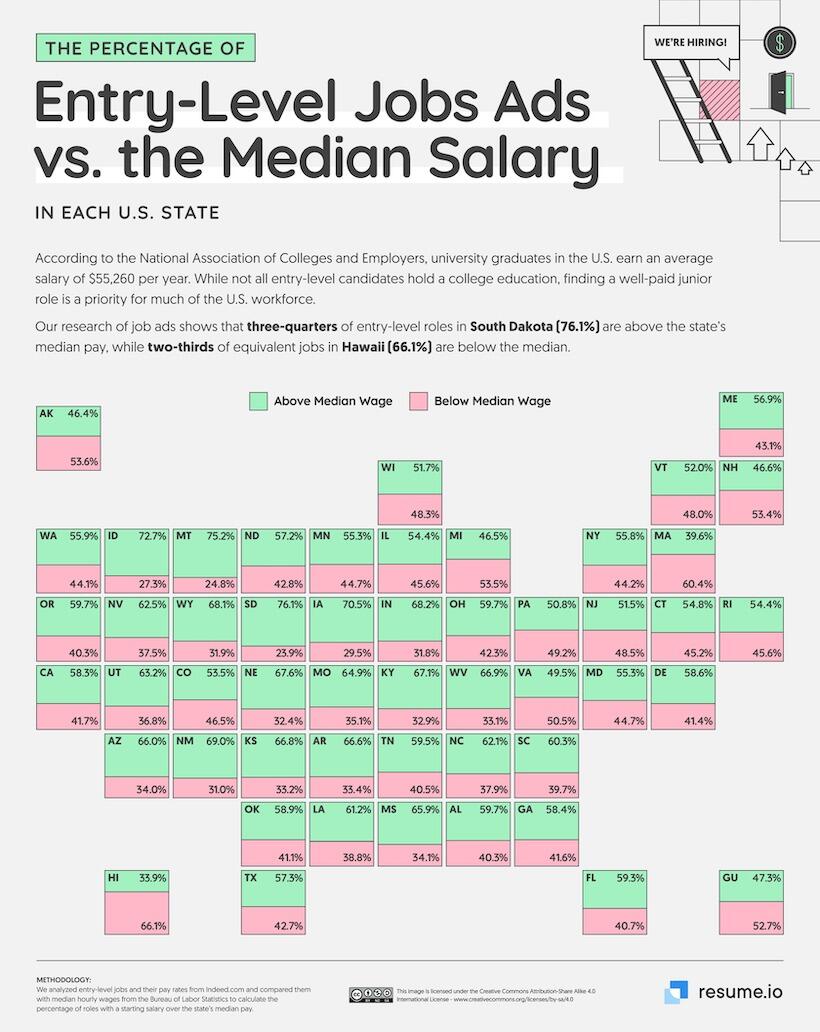
To find the best U.S. city and state for well-paid entry-level jobs, NeoMam Studios and Visual Capitalist’s Pallavi Rao visualize data from Resume.io showing the percentage of local entry-level job listings that offer a salary above (and below) a city or state’s median hourly wages.

Ranked: 50 U.S. Cities By Entry-Level Job Pay

This dataset covers each U.S. state, as well as Washington, D.C. and 50 major cities. Median wage data is sourced from the Bureau of Labor Statistics, and the number of entry-level jobs and their pay rates from Indeed.com.

Bozeman, Montana (nicknamed “Boz Angeles” for its constant stream of celebrity visitors) and Iowa City both have nearly 88% of their entry-level jobs promising above their state’s median pay.

For an apples-to-apples comparison however, Iowa City’s median wage comes in slightly higher at $22.52/hour compared to Bozeman’s $20.71/hour.

Note: Toggle the embedded table between U.S. cities and states ranked by best entry-level jobs.

Another Midwestern urban center, Kansas City, ranked fourth, promises a high likelihood of above-media pay for first-job hunters (83.1%).

Generally, the more populous the city, the more jobs, and the higher the likelihood of beating median pay. However larger cities that are not the state capital also seem to do well on this metric: Fort Smith, Arkansas (ranked 5th), Lexington, Kentucky (6th), New Haven, Connecticut (7th), and Oakland, California (8th).

Ranked: U.S. States By Entry-Level Job Pay

Click to view this graphic in a higher-resolution.

In South Dakota, and Montana, ranked first and second in the state by best entry-level pay ranks, more than three-quarters of junior role listings offer pay above the state’s median wage.

This works out more than $19.17/hour ($39,900/year) for South Dakota and $20.29/hour ($42,200/year) for Montana for their entry-level jobs.

In fact the first nine states on the ranks, where nearly 70% of the entry-level job listings offer above-state-median pay, are from the Midwest or West.

Kentucky, ranked 10th, has 67% of their starter job openings stating above median pay ($40,200/year), the highest from the American South.

Predictably, states with higher median pay (California, Connecticut, Massachusetts, Washington, New York) have lower numbers of entry-level job openings which promise pay above that level.

However, exceptions occur. For example, Wyoming’s median pay comes in around the same as Maine ($21.80/hour) but 68% of its entry-level job listings offer median-beating pay, compared to Maine’s 57%.

Hawaii is the worst state for a decent starting salary, with two-thirds of the analyzed listings offering below the median pay of $48,600/year. Most of the state’s jobs are concentrated in the tourism industry, part of the service sector, known for long hours, seasonal work, and low pay.

Tyler Durden
Mon, 01/08/2024 – 20:00