55 F
Chicago
Monday, September 14, 2026
Home Blog Page 3056

Spot Bitcoin ETF Inflows Could Dwarf All 150 Crypto ETPs Today

0
Spot Bitcoin ETF Inflows Could Dwarf All 150 Crypto ETPs Today

Authored by Tom Mitchelhill via CoinTelegraph.com,

Newly compiled data from BitMEX Research estimates there are 150 crypto ETPs available today, with $50.3 billion in assets under management…

United States-approved spot Bitcoin exchange-traded funds (ETFs) could end up dwarfing the entire $50 billion crypto-related ETF market today. 

According to new data from BitMEX research, the current global market for crypto exchange-traded products (ETPs) includes approximately 150 products totaling $50.3 billion in assets under management.

The list includes spot and futures funds, and typically track the performance of Bitcoin and Ethereum. The largest ETP on the list is Grayscale’s Bitcoin Trust — which is currently attempting to be converted into a spot ETF product.

Market commentators believe the approval of a spot Bitcoin ETF — widely pegged to be approved by the SEC as early as Jan. 10 — could eventually double the amount of money invested in crypto ETPs.

On Dec. 14, crypto investment fund Bitwise predicted that spot Bitcoin ETFs would be the most successful ETF product ever launched, expecting them to capture some $72 billion in assets under management within the next five years — more than doubling the current market.

Offering a more sober outlook, global fund manager Van Eck estimated that roughly $2.4 billion would flow into a spot Bitcoin products in the first quarter of 2024.

While a spot Bitcoin ETF has never been approved in the U.S., such a product is far from a brand-new development in a global context. Several countries including Canada, Australia, and Germany, already allow investors to buy shares in spot Bitcoin ETFs.

The optimism around spot Bitcoin ETF reflects a wider trend of institutional investment in crypto investment products over the past few months.

A Dec. 21 report from ETF research firm ETFGI revealed that crypto ETFs listed across the globe had attracted year-to-date net inflows of $1.6 billion, with $1.31 billion of that sum being added in November alone. This total investment is nearly double the $750 million net inflows into crypto ETPs in 2022.

$1.3 billion was added to crypto ETFs in November alone. Source: ETFGI

Of the 150 crypto funds, the top 20 ETFs attracted the largest volume of investment, with a total of $1.3 billion flowing into them over the course of 2023.

The ProShares Bitcoin Strategy ETF (BITO) — launched during a crypto bull market in October 2021 — witnessed the largest individual inflows, capturing an additional $278.7 million in 2023.

Tyler Durden
Tue, 12/26/2023 – 17:15

Netanyahu Urges Troops ‘Do Not Stop’ While Calling Biden’s Post-Hamas Plan “A Pipe Dream”

0
Netanyahu Urges Troops ‘Do Not Stop’ While Calling Biden’s Post-Hamas Plan “A Pipe Dream”

Israeli Prime Minister Benjamin Netanyahu in a Tuesday visit to troops fighting in Northern Gaza delivered a message of “do not stop” in their mission to eradicate Hamas. The past weekend was particularly bloody for the Israel Defense Forces, as at least 17 Israeli troops were killed. Some 250 Gazans have been killed in the last 24 hours, according to regional reports.

Netanyahu vowed to see the operation through “to the end” – at a moment there are still some 130 Israeli and foreign hostages that remain held in the Gaza Strip. Domestic pressure and pushback against his administration has only intensified, led by kidnap victims’ families, who are angry that more hasn’t been done to secure their release in a possible second-round ceasefire.

Egypt on Monday proposed the most comprehensive peace plan of the Gaza war yet; however, Netanyahu followed this by publishing an op-ed written in English in The Wall Street Journal wherein he rejected the prospect of achieving a permanent peace so long as Hamas remains intact.

Via AP.

In the op-ed, he laid out his three-fold plan for pacifying Gaza and bringing permanent peace, as Israel sees it. He said that for Israel to succeed: 1) Hamas must be destroyed, 2) Gaza must be demilitarized, and 3) Gaza must be ‘deradicalized’ and free of hardline Islam

All of this strongly suggests that not only has Israel rejected the Egypt-proposed peace plan, but is also still resisting the Biden administration’s calls to allow the Palestinian Authority (PA) to eventually govern Gaza after Hamas is defeated. The issue has remained an open point of contention, during which time Biden has issued some rare criticisms of Israel, including earlier this month highlighting the “indiscriminate” bombardment of civilian areas of Gaza.

In the WSJ op-ed, the Israeli leader is emphatic that the PA under Abbas will never be able to achieve demilitarization. Netanyahu wrote:

The expectation that the Palestinian Authority will demilitarize Gaza is a pipe dream. It currently funds and glorifies terrorism in Judea and Samaria and educates Palestinian children to seek the destruction of Israel. Not surprisingly it has shown neither the capability nor the will to demilitarize Gaza. It failed to do so before Hamas booted it out of the territory in 2007, and it has failed to do so in the territories under its control today. For the foreseeable future Israel will have to retain overriding security responsibility over Gaza.

Elsewhere in the op-ed Netanyahu appealed to Washington security concerns by underscoring that Hamas is a “key Iranian proxy.” This as Israel has just taken out an IRGC general in an airstrike on a Damascus suburb. Radhi Mousavi was reportedly assassinated in a Monday strike, and he was believed to be Iran’s top commander in Syria.

The prime minister explained that if Hamas survives, this will only empower Iran further, and “more war and more bloodshed” will be guaranteed

First, Hamas, a key Iranian proxy, must be destroyed. The U.S., U.K., France, Germany and many other countries support Israel’s intention to demolish the terror group. To achieve that goal, its military capabilities must be dismantled and its political rule over Gaza must end. Hamas’s leaders have vowed to repeat the Oct. 7 massacre “again and again.” That is why their destruction is the only proportional response to prevent the repeat of such horrific atrocities. Anything less guarantees more war and more bloodshed.

He also took the opportunity to address growing international pressure related to the soaring death toll in the Strip. Palestinian sources say that deaths have surpassed 20,000 – a horrific and tragic figure mostly comprised of civilians.

“Unjustly blaming Israel for these casualties will only encourage Hamas and other terror organizations around the world to use human shields,” the prime minister wrote. “To render this cruel and cynical strategy ineffective, the international community must place the blame for these casualties squarely on Hamas. It must recognize that Israel is fighting the bigger battle of the civilized world against barbarism.”

He vowed ultimately to press forward undeterred until Hamas is no more. “Once Hamas is destroyed, Gaza is demilitarized and Palestinian society begins a deradicalization process, Gaza can be rebuilt and the prospects of a broader peace in the Middle East will become a reality,” Netanyahu wrote. However, this could take months or more likely even years, given Hamas numbers in the tens of thousands, and can hide in the extensive tunnel network under Gaza while waging a guerrilla campaign above.

Tyler Durden
Tue, 12/26/2023 – 16:50

2024 – The Year Of Our Reckoning

0
2024 – The Year Of Our Reckoning

Authored by Victor Davis Hanson via American Greatness,

We should remember the now modern proverb of Nixon-era economic advisor Herb Stein to the effect that what cannot go on (without destroying the nation), simply will not go on.

In some sense, the country for recent years has been cruising on the fumes from prior and likely better wiser generations and institutions. In 2024, the tab for our current apathy, toxic politics, and incompetence will come due.

So next year we will likely see the climax to a number of current dangerous ideas, events, and forces, which finally will either overwhelm us or be addressed and remedied. We live in a Neronian age but can recover if we first understand how we got here and the nature of the suicide we are committing.

In 2023, it became clear, to even the most loyal supporters of the Biden administration, that the U.S. has simply lost or indeed forfeited American deterrence abroad. Our enemies do not fear us; our friends do not trust us; and neutrals do not care either way.

After the 2021 Kabul debacle, the 2022 Russian invasion of Ukraine, the 2023 brazen Chinese spy balloon’s uncontested trajectory over the United States, the recent Hamas invasion of Israel, the serial Iranian-fueled terrorist attacks on U.S. installations in the Middle East, and the terrorist Houthis’ veritable absorption of the Red Sea, many of America’s opportunistic enemies drew conclusions and adopted strategies that would have been previously unthinkable.

Either adversaries will be so emboldened to start regional wars—an impotent Iran now brags it will block the entire Mediterranean—or a United States will be shocked into action and have to deter Iran, the Houthis, and Islamic terrorism, while dealing with an opportunistic China eager to annex Taiwan, and Russia determined to finish off Ukraine.

Those challenges will force the military to staunch its recruitment hemorrhaging, rectify low morale, and rearm. Such rebooting in turn will require discarding the woke agenda, stopping the DEI proselytizing and virtue signaling, and returning to a meritocracy focused on military preparedness and battlefield efficacy.

Since January 2021, the Biden administration has flagrantly and unapologetically dismantled federal immigration law. It destroyed the border as we once knew it. It has already greenlighted more than 8 million illegal entrants—with another quarter-million entering each month.

No one in government has offered any projected costs to states and federal agencies of offering health, food, housing, legal, and education subsidies to millions—who broke the law by entering the U.S. and continue to do violate it while residing unlawfully here. Is that the sign of a promising American citizen—that the first thing he does upon entering America is to break his host’s law?

Incredibly, no one has even explained to Americans why millions of illegal aliens are exempt from the vaccine mandates, background checks, and adherence to the law that is demanded of U.S. citizens and legal immigrants. We will soon demand “real” IDs of American citizen airline travelers, while we fly illegal aliens all over the states without any identification?

In fact, those who blew up the border can’t honestly even explain to the American people why they did so. Was it to ensure future (or even present) political constituents? Cheap labor? To ensure higher taxes to pay for more government services and to “spread the wealth?” Obeyance to the diversity/equity/inclusion lobbies? To make up for fleeing blue-state population?

The United States has now exceeded, both in real numbers and in percentages, all past numbers of non-native born American residents—at a time when civic education, the idea of the melting pot, and adherence to assimilation have never been more under assault.

In 2024, either the border will close, or the United States will suffer radical political realignments, sheer chaos in our major cities, protests from Americans furious over the complete flaunting of federal law by their own elected officials, and a likely impeachment of Joe Biden for deliberately forsaking his oath to “faithfully execute the Office of President of the United States.”

The October 7 Hamas invasion of Israel and premodern massacring of nearly 1,200 Jews—and the virulent anti-Semitism that swept our elite campuses and big cities even before the October 27 Israeli Defense Forces’ retaliatory invasion of Gaza—was a wakeup call about the racialized hatred and anti-Semitism now endemic on the Left.

Campus protestors dropped the prior protestations that they were not anti-Semitic in their hatred of Israel. Instead, they now call out Jews by name. They disrupt their homes and businesses, regardless of their views on Zionism. Pro-Hamas protestors feel free to harass Jews, and with impunity and arrogance chant genocidal chants promising the destruction of Israel and its Jewish population.

The main campus culprits for these sudden unabashed hatreds are tripartite.

First, wealthy, mostly white leftist students – increasingly as ignorant of history as they are arrogant in their zealotry – feel it pays psychological and careerist dividends on campus to mouth orthodoxies of hating Israel and de facto siding with the Hamas killers.

Most have no idea of the Hamas charter, where flows the Jordan River, or what the British Mandate for Palestine or the Balfour Declaration were. Few of the loudest could never even find Jordan, Israel, the West Bank, or Gaza on a map. No matter: being heard and seen on campus hating Israel is considered a necessary fad like 1970s bellbottoms or pet rocks.

Second, huge numbers of full-tuition-paying Middle-Eastern visiting students and green-card holders, along with Gulf-fueled and endowed faculty, assume that they are exempt from any legal consequences.

So they often deface the federal monuments of their hosts, shut down traffic, swarm Jews on campus and in the street, break the law, and battle with police—with absolute impunity.

Third, just as startling are the undisguised hatreds emanating from radical diversity/equity/inclusion students and faculty. As the declared oppressed, they too feel exempt from any charge that they are mouthing racist and anti-Semitic venom, as they conflate Israel with the now maligned stereotyped “white” people.

The apogee of such extremism was evident in the congressional testimony of  three ethically challenged Ivy-League presidents. They reminded the nation that no campus president would unequivocally condemn, much less punish, any anti-Semites on a campus, who openly called for the destruction of Israel and its Jewish population. And they lied about “free speech” constraints on their punishment of mainstreaming anti-Semitic and genocidal threats—given they routinely expel, censure, and variously punish all sorts of “hate speech,” but only if it is directed against their own DEI constituencies.

All this is not tenable.

Our top universities are facing a perfect storm. Declining pools of students, crushing student loan debt, spiraling tuition and room and board costs, administrative bloat, defecting donors, and the public’s distrust of such people being entrusted with their children’s higher education, will all soon lead to a general reexamination of the very need of these universities in the first place, at least as they are presently constituted.

Their racialist admissions, hiring, retention, and promotion protocols are destroying meritocracy. Their mediocre curricula, grade inflation, and campus polarization have convinced the public that they are no longer deserving of the many taxpayer indulgences that shield campuses from market realities—such as massive federal research grants and subsidies, tax-free billions of dollars in private donations, tax-free endowment income in the tens of billions of dollars, and taxpayer subsidized $2 trillion in student loans.

So insulated are these atolls of privilege that they cannot recognize growing public anger over the damage they are doing to the country. Iconic Harvard University cannot even fire its DEI president Claudine Gay, despite serial instances in her own past of plagiarism (which prompted Harvard’s sycophantic board to defend her by embracing a new euphemism— “duplicative language” as if to signify the tiny clerical lapse of stealing the ideas and prose of others).

In 2024, radical changes in university administration and values will begin to be made, or higher education will face a reckoning from the public and a newly elected government.

Currently, Colorado has tentatively removed Donald Trump from its 2024 ballot on the specious grounds that he is an “insurrectionist.” Thus, the state insists that he is subject to the 14th Amendment, Section 3 clause of 1868, that calls for the disbarment from future government employment or service those former federal officials and employees who had joined the Confederacy.

Aside from the misapplication of the spirit and letter of that post-Civil War legislation, those responsible for erasing Trump know that he has never been charged with, much less convicted of “insurrection. And he never will be.

They understand that half the country knows the January 6 “riot” was the work of unarmed, overzealous, and buffoonish protestors, who broke the law by entering the Capitol, but otherwise had no master insurrectionary plan. And the majority surrounding the Capitol did in fact obey the president’s call to protest “peacefully” and “patriotically.”

The left privately understands that their latest weaponization of government follows their “Russian collusion hoax,” their “laptop disinformation” farce, their two politicized impeachments, their performance-art Mar-a-Lago documents raid, and thus are all part of a systematic degradation of our campaigns, elections, and political customs, tradition, and discourse.

A jaded public knows too well that such punitive measures never applied to the 2016 Hillary Clinton crimes of destroying subpoenaed emails and devices, or the FBI’s illegal alteration of FISA documents or its contracting out social media to suppress news stories, or its hiring of a foreign national Christopher Steele, who compiled a fake “dossier” to destroy the candidacy of Donald Trump.

A majority of Americans further know that had Donald Trump not chosen to run for office in 2024, state and federal prosecutors such as the publicity-seeking and partisan Alvin Bragg, Letitia James, Jack Smith, and Fani Willis would never have indicted him.

All privately know that the entire Biden family, including the President, could just as easily be indicted on state and local felonies, but the Biden consortium finds itself exempt both for its leftist ideology and its current control of the Department of Justice.

What then do the campaign and election of 2024 foreordain?

We will be in entirely new and completely dangerous territory. The likely Republican nominee who currently leads incumbent president Joe Biden will be for most of 2024 the constant target of a coordinated state and local Soviet-like effort to destroy his candidacy before the voters can even vote for or against him in the November election.

The United States 2023 annual budget deficit is about $1.7 trillion; the nation is burdened by a $34 trillion national debt—even though the federal government since 2021 has raised all sorts of new income and excise taxes.

The era of printing money, zero interest rates, “modern monetary theory,” and spending wildly is drawing to a close. The mounting interest on the national debt is now crowding out optional but soon essential annual federal spending. At some point soon, one generation of Americans is going to have to exercise spending restraint or accept a continuing decline in its living standards.

In sum, in 2024, we will either see the destruction of presidential electoral politics as we have known them or a complete repudiation of lawfare. The current new normal that the party in power indicts the leading candidate of the opposition is not sustainable or compatible with the idea of America.

Either the military will have to deter dramatically our growing number of opportunistic enemies, or it will descend into something like the French army between the world wars—plagued by ideology, ossified brass, corruption, mediocrity, misplaced investments, and bankrupt strategies.

If there are not radical changes in higher education, our Ivy League and self-identified elite campuses will go the way of Bud-Light, Disney, and Target—once premier brands reduced to red ink and laughing-stock caricatures.

The United States is cracking under 8 million illegal entries; it cannot sustain another year and 2 million more illegal entrants—or a total of 55-60 million foreign-born residents, with no idea of how many are U.S. citizens, illegal aliens, or green card holders–or how many are employable, or free of criminal records or in need of massive federal and state subsidies.

In 2024, the U.S. will begin to see that to meet its spiraling debt, it will either keep inflating its currency, or slash spending, or raise even further taxes to the degree that even the lower middle class will have to pay 50 percent of their income in state and federal taxes, or renounce its debt, and thus go full-Third World.

Will we meet these challenges or ensure the ongoing decline?

If what we saw after October 7, or the wild and out-of-control reign of weaponized local and state prosecutors, or what we watch nightly on television at the border, or the paralyses we witness abroad of our military, or the breezy way in which our officials promise groups here and abroad billions of dollars in easy money, continues into 2024, then the country as we knew it will become unrecognizable.


Tyler Durden
Tue, 12/26/2023 – 16:25

Another Container Ship Attacked In Red Sea As Houthis Act With Impunity

0
Another Container Ship Attacked In Red Sea As Houthis Act With Impunity

Another day, another tanker attack in the Red Sea, and Yemen’s Houthis are positively boasting about it as the Biden White House continues attempts to cobble together its much touted multi-national naval coalition, which is clearly taking some time getting off the ground.

“The naval forces of the Yemeni Armed Forces carried out a targeting operation against the commercial ship, ‘MSC UNITED’ with appropriate naval missiles,” according to a Houthi statement.

Illustrative file image, via EPA

The vessel was reportedly en route to Pakistan when it came under missile attack, however, there were no reported injuries to crew members, as damage is being assessed. The Houthis said the ship rejected three warning calls before it was fired upon.

Scant details have emerged, but Tuesday’s incident happened in parallel with a fresh Houthi missile attack on Israel. The Houthi military spokesman Yahya Sarea was cited in the following

Sarea also said the group carried out drone attacks on the southern Israeli city of Eilat “and other areas in occupied Palestine”.

In a statement, the group said they “carried out a targeting operation against a commercial ship” and launched a number of “drones against military targets” in southern Israel.

Even as Washington has threatened increased intervention in waters off Yemen, these Houthis attacks have only increased.

The Yemeni rebel group has declared war on any vessel linked to Israel, or bound for Israeli ports. Tuesday’s attack follows fresh weekend incidents as well, described in the WSJ as follows:

The U.S. Navy said late Saturday that two more vessels had been attacked that day by Iranian-backed Houthi forces in Yemen, bringing the number of commercial ships attacked near a crucial passageway between the Horn of Africa and the Middle East to 15. The Pentagon said earlier in the day that a chemical tanker in the Indian Ocean was struck by a drone launched directly from Iran, a claim Tehran denied.

The shipping attacks are part of a broader regional confrontation between Iran’s allies and the U.S. and Israel, and are increasing. A declassified document from the Defense Department shows Houthi attacks on ships escalated during the first half of December to eight incidents, compared with just three during the last half of November.

Several allies have meanwhile refused to join the US-led naval coalition…

US officials have long alleged that Iranian intelligence is complicit in these attacks. Both Israel and the US have said Tehran uses a spy ship which patrols the Red Sea to assist with Houthi targeting. Through this weekend, there have over a dozen confirmed attacks on commercial ships this month alone. The US has said more than 100 drones and rockets have been launched over the last two months in repeat incidents. 

However, Iran has rejected these allegations, but has still openly encouraged ‘resistance’ to what it calls the forces of “Zionism”. 

Tyler Durden
Tue, 12/26/2023 – 15:05

10 Improbable Energy Ideas For 2024

0
10 Improbable Energy Ideas For 2024

Authored by Leonard Hyman and William Tilles via OilPrice.com,

  • The market for Grid-scale nuclear will be dominated by 3 players.

  • This is the year we unofficially abandon climate targets because of the growing recognition they are unobtainable.

  • The world’s lightest element (hydrogen) replaces small modular reactors (SMRs) as the most over-hyped idea but we become more realistic about its appropriate industrial uses.

Nowadays, you have to prepare for the unexpected, for the event that seems barely plausible but happens. 

Such as the way Russia did not conquer Ukraine in a week. Or how the European economy survived without Russian gas. Or how quickly inflation subsided. Or how the Chinese foreign minister disappeared. Or water shortages develop in the Amazon Basin. So, we put together a list of ten events, all plausible, that could occur in the energy sector. A few, we think, are more than likely.

  1. NUCLEAR— Pick up in demand for grid scale reactors from foreign suppliers that can do the job at a lower cost, for a simple reason, they are cheaper, period. if you’re going to go nuclear, why do it in the more expensive way?  The market will be dominated by three players: Rosatom (Russia), KEPCO and associated firms (South. Korea)  and by the Westinghouse AP 1000 (Canadian). No new orders however will come from the US—at least for another year unless federal subsidies are increased.

  2. FOSSIL FUEL USE— Globally, fossil fuel usage including coal continues to increase. 2024 is the year oil and gas companies appear to win. Gas will be increasingly seen as the cleaner (ie lower CO2 emitting) alternative to coal for power plants including the US. The growth of LNG is unclear in part due to storage and refill limitations. One utility noted it would take a month to refill storage after only one unseasonably cold winter day.

  3. REGULATION— This year the term “regulatory capture” becomes more popular to describe regulators who function more as employees of the utilities they are supposed to regulate (see Georgia). And this points to a significant and largely unrecognized future risk we want to highlight. In states where one political party is dominant, like Republicans in Georgia or Democrats in NY, the prevailing regulatory regime is unlikely to change dramatically. But in states where political parties are more evenly balanced, like Wisconsin, a change in the governor could mean a change in regulatory personnel and a dramatic shift in policy. Utilities that were authorized to build new fossil-fired generation from supportive Republican regulators may be exposed to large stranded asset risk from less sympathetic Democrat’s appointees with a more climate-attuned agenda.

  4. CLIMATE— This is the year we unofficially abandon climate targets because of the growing recognition they are unobtainable. See # 2 above. Also, one of the US’s two main political parties claims climate change is a hoax with a goal of neutering related administrative agencies. As a popular idea, denying the worst impacts of climate change will get stronger, not weaker.

  5. RENEWABLES UNDERGROUND— Two developments change the concept of renewables. renewables: developments in geothermal drilling and confirmation of commercially viable reservoirs of renewable hydrogen underground. Drill baby drill could be the new mantra for the environmental movement as well. The quantity of energy that could be produced would make these developments game-changers.

  6. TRANSMISSION— Due to bottlenecks and 5+ year queues for access to the grid, coupled with limited new transmission construction, resource developers shift focus to distributed resources serving local load. Renewables and SMRs both benefit.

  7. HYDROGEN— The world’s lightest element replaces small modular reactors (SMRs) as the most over-hyped idea but we become more realistic about its appropriate industrial uses.  Then again, see #5 above, in which case the hype is more than justified.

  8. EXPROPRIATION OF UTILITIES —- The public votes in favor of takeovers of private utilities. Results from rising prices and poor service. Maine will be first. But the legal condemnation will take a long time, ending up with high price paid.

  9. INFRASTRUCTURE SITING— Those siting utility infrastructure will begin, in climate change acknowledging states, to consider potential sea level rise and possible coastal abandonment as a factors in the location of long lived assets like power stations. The insurance industry will play an increasingly large role in these decisions and investors will increasingly look to the insurance industry for clues as to climate-related asset risk.

  10. OBLIGATION TO SERVE— This year will see the beginning of the demise of the old-time utility obligation to serve, especially in deregulated states like Texas. This means the utility’s relationship with its customer is on a “we’ll sell it only if we have it” basis—after that you’re on your own. Power outage lengths will continue to increase. Responsibility for electric reliability increasingly shifts to the customer with immediate implications for diesel and propane generators, residential and commercial solar plus batteries, and large battery EVs.

No, we don’t have any improbable political events on the list. Sorry about that. 

Tyler Durden
Tue, 12/26/2023 – 14:45

‘Science’ Discovers That “Sex Matters” For Sports Performance, Not ‘Gender-Identity’

0
‘Science’ Discovers That “Sex Matters” For Sports Performance, Not ‘Gender-Identity’

In an earth-shattering, mind-blowing, narrative-destroying new scientific study from PhDs at King’s College, London, researchers found:

“…a sex gap in race times between athletes who identify as non-binary, and that there is no evidence that the gap between biological males and biological females is less for athletes who identify as non-binary.”

In other words – saying you’re a girl does not change the fact that you biologically a boy… and that’s science.

Dr John Armstrong, Reader in Financial Mathematics at King’s, said:

It is generally accepted that sports performance depends on a mixture of biological and social factors.

According to gender-identity theory, gender-identity is much more important than sex in determining almost all outcomes and this should include mass participation sport.

We did not find a reduction in sex differences in race times with the non-binary category.

Thus the data does not support gender-identity theory.

On the other hand, we did find that within the non-binary category sex was a powerful predictor of race times.

Thus the data supports the gender-critical theory that sex matters.

Even more remarkably, the study found that the trans-athletes were mediocre when considered against their biological sex cohort:

The results also indicate that non-binary athletes may have slower race times than other athletes once sex and age are controlled for.

The researchers conclude, callously disregarding non-PhDs expert feelings:

Given the lack of empirical evidence supporting gender-identity theory, one should not assume by default that gender-identity is a more powerful explanatory variable than sex.

Being an objectively measurable binary variable, sex has considerable explanatory advantages over gender identity.

Armstrong concluded:

 “Gender identity is clearly important to many people, but nevertheless sex matters.

The ‘experts’ at King’s College have a problem though – other ‘experts’ with ‘science’, believe otherwise…

“Settled science?”

This shocking revelation from ‘science’ sparked world-tilting prompted an avalanche of stunned responses on social media:

Ivermectin works? Sex matters? What next from science? ‘Diversity’ is not our strength? Socialism does not promote utopia? Guns don’t kill people?

Tyler Durden
Tue, 12/26/2023 – 14:25

2024’s Deficit Is Already On Track To Be The Worst Since COVID

0
2024’s Deficit Is Already On Track To Be The Worst Since COVID

Authored by Ryan McMaken via The Mises Institute,

Weakness in the US economy continues to hide behind surging debt levels and government spending. As noted last month by Daniel Lacalle

[A] large part of the growth in GDP came from bloated government spending financed with more debt and inventory revaluation, adding 0.8 and 1.4 percentage points to GDP growth. …

The increase in gross domestic product between the third quarter of 2022 and the same period of 2023 was a mere $414.3 billion, according to the Bureau of Economic Analysis, while the increase in public debt was $1.3 trillion ($32.3 to $33.6 trillion, according to the Treasury).

The United States is now in the worst year of growth, excluding public debt accumulation since the thirties.

This trend is continuing at least into the first quarter of the new fiscal year, as it is apparent that total public debt isn’t slowing down. 

According to the latest monthly statement from the Treasury Department, the total budget deficit for the 2024 fiscal year (which began October 1) has already risen above $380 billion. The new total, which includes the months of October and November, puts the US on track for a total annual deficit of more than $2 trillion by the end of the fiscal year. That would be an increase of more than 25 percent over 2023 fiscal year, which was itself a 23 percent increase over 2022. 

A 2024 annual deficit of $2 trillion would make 2024’s deficit the third-largest deficit ever, behind only 2020 and 2021 during which federal spending in covid-related social benefits were seemingly unlimited. 

Comparing the same two-month period over the previous decade, the totals also suggest deficit spending in 2024 will lag only the covid years of 2020 and 2021. During the first two months of fiscal year 2021, the deficit came in at more than $429 billion. 

The American debt train is not slowing down. After reaching $33.1 trillion at the end of the third quarter this year, the total federal debt will reach $34 trillion by the end of this month. The US will add more than $7 trillion to its debt since 2020. To put this in perspective, we can note that the total revenue for the US the 2023 fiscal year was $4.4 trillion. (Total debt in FY 2023 topped 38 percent of all federal receipts.)

Many Americans have become numb to these sorts of debt numbers because it has long felt like free money. From the early 2000’s to 2022, real interest rates were essentially zero which means the federal government could borrow money at rock-bottom rates. Since interest rates consistently trended downward in that period, maturing debt could always just be paid with new debt at even lower interest rates. 

That, however, came to an end in 2022. Since then, the interest paid on new federal debt has grown significantly, and the total amount of interest paid on the debt each year will double from 2019 to 2024. For example, the yield on 10-year Treasurys surged throughout 2022 and most of 2023, nearly reaching five percent in October 2023. On the other hand, for most of the decade from 2012 to 2022, the yield on the 10-year was between two and three percent. The 10-year yield has fallen since October, dropping below 4 percent. But that still puts it more than double of what has come to be regarded as “normal” over most of the past decade. 

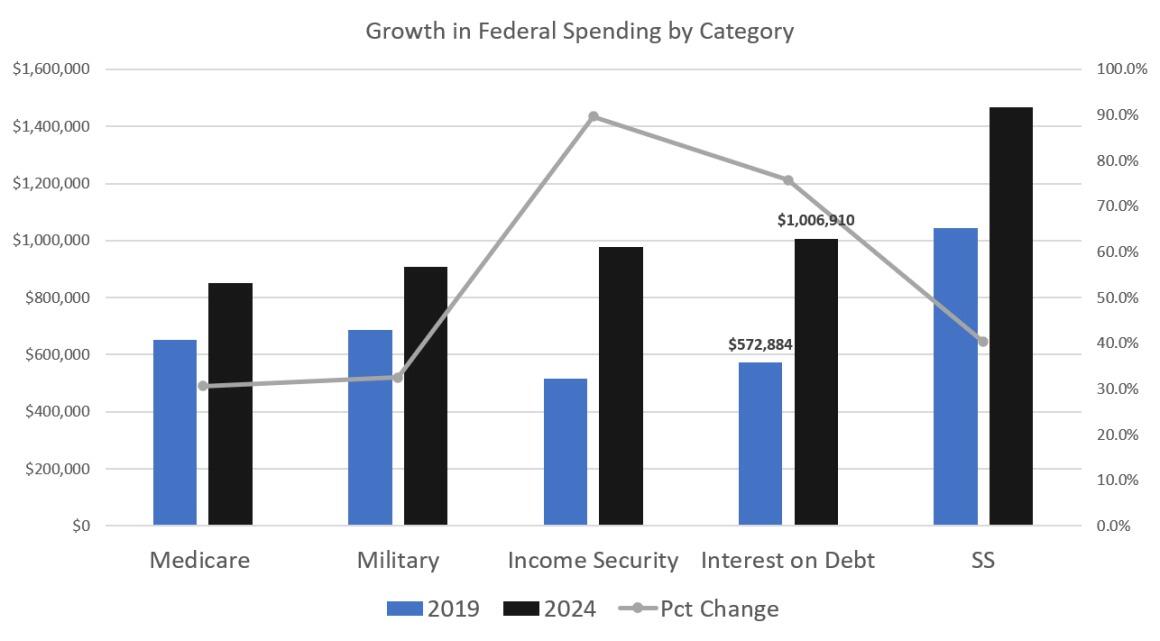
This has amplified the true cost of the rising national debt. Since 2019, the total national debt has increased by 25 percent, but interest paid on the debt has increased by 75 percent. More specifically, interest on the debt came in at nearly $573 billion in 2019, but it will top $1 trillion in 2024

This rate of increase has far surpassed every other major spending category except “income security” which includes much of the trillions of the covid-related panic spending of recent years. In contrast, Social Security increased 40 percent, and Medicare increased 30 percent. 

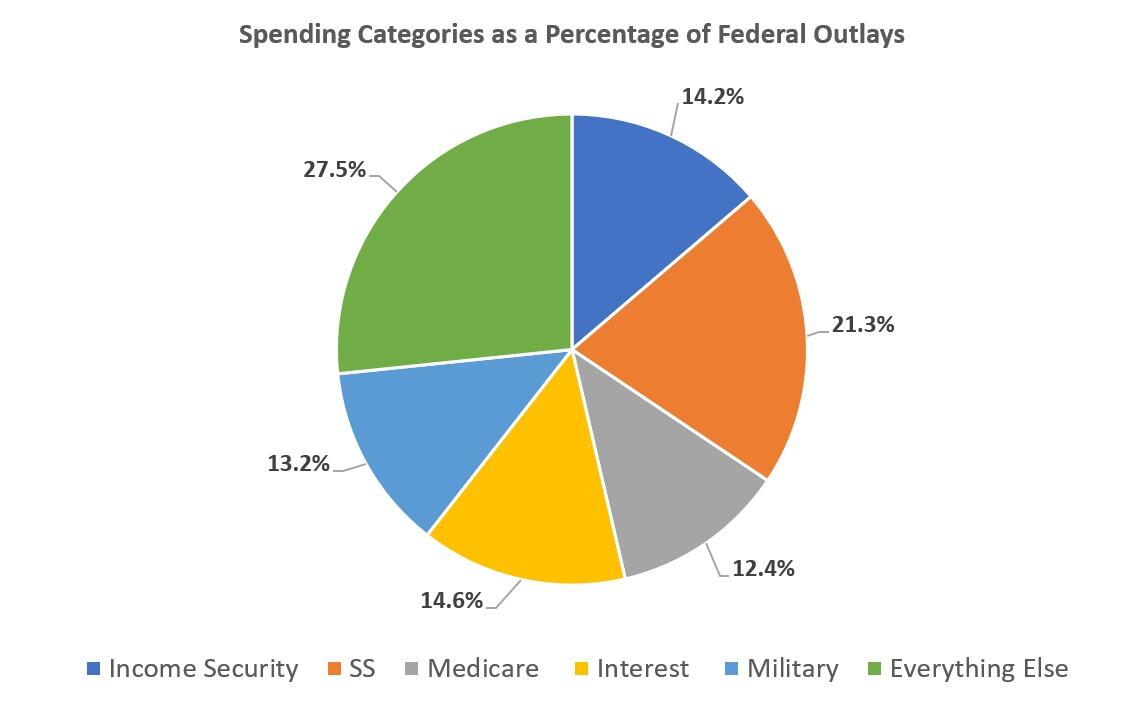
If the current trend in interest and debt continues, Congress is going to have to make some very unpopular spending decisions. Interest payments are now a larger portion of federal spending than military spending and Medicare. If debt continues to mount at the current rate, the requirements of debt service will eat up more and more of the federal budget requiring cuts for other areas of the budget to ensure bond holders get paid. 

It’s easy to imagine a full one-fifth of the budget going to paying for bonds in the not-too-distant future. That means that for every 100 dollars in taxes the US government steals from the taxpayer—mostly via income and payroll taxes—20 percent of it will go to pay interest which produces no benefit for ordinary people. Interest payments are just payments on old debts for lost wars, failed schools, retired government employees, and countless other grifts. 

And then there is the threat of a mounting debt spiral as the central bank prints dollars in an attempt to pay debts while avoiding the fiscal austerity needed to avoid disaster. 

The only possible silver lining here is that as it becomes more obvious that interest payments are fleecing today’s wage earners, it will make more political sense to simply repudiate the debt. As Murray Rothbard noted, the idea that the government has some sort of moral obligation to pay its debts has always been nonsense. Interest payments have always been paid for by tax dollars, and are thus nothing more than a forced wealth transfer from taxpayers to bond holders. Yet, bond holders voluntarily took on the risk of holding US debt. So, if the US defaults, well that’s tough luck and a risk investors adopted willingly. Taxpayers, on the other hand, are an involuntary party to the agreement. The moral thing to do in this case is to free taxpayers from the obligation. 

Tyler Durden
Tue, 12/26/2023 – 14:05

Egypt Proposes Most Detailed Gaza Peace Plan To Date As Netanyahu Presses On

0
Egypt Proposes Most Detailed Gaza Peace Plan To Date As Netanyahu Presses On

Via Middle East Eye

Egypt has proposed an extensive plan for a ceasefire and post-war situation in Gaza that includes the full withdrawal of Israeli forces from Gaza and a new technocratic government in both Gaza and the West Bank.

The proposal, reported by several news outlets, outlines a multi-stage cessation of hostilities that would eventually see the full withdrawal of Israeli forces from Gaza and a unified Palestinian government overseeing the enclave.

Image source: IDF

The plan includes several exchanges of captives. The first stage would see Hamas and armed Palestinian groups release all civilian captives being held in Gaza in exchange for a negotiated number of Palestinians being held in Israeli prisons. The result would then be a truce and pause in fighting of between seven and 10 days.

Then during the second stage, Hamas would free all female Israeli soldiers being held captive, and Israel would again free additional Palestinian prisoners. The second stage would include an additional pause in fighting of one week.

The last stage would include a final exchange of captives – Hamas would release the remaining captives and Israel would release more detained Palestinians. This would take place after “negotiations [are] held for a period of one month”, and this phase would also see Israel pulling its forces back to the Gaza border and also continue to cease all aerial campaigns on the Strip. Hamas would also cease any armed actions against Israel.

The plan was presented to Israel, Hamas and the US on Monday. Egypt’s proposal would also see Cairo, alongside Doha and Washington, engage in negotiations to create a technocratic government to head both occupied Gaza and the West Bank.

The proposal is the most extensive and detailed ceasefire plan since the war on Gaza began in October, however, it appears unlikely to gain traction from either of the warring parties.

Israel’s war cabinet was supposed to discuss the proposal on Monday evening, but a western diplomat told the Associated Press that Israeli Prime Minister Benjamin Netanyahu’s cabinet is not likely to accept the proposal in its entirety.

Netanyahu has also vowed to press on with the military campaign on Gaza, with the stated goal of eliminating Hamas. “We are expanding the fight in the coming days… this will be a long battle and it isn’t close to finished,” he said.

At the same time, several Egyptian officials told Reuters that both Hamas and Islamic Jihad rejected the proposal that they both relinquish their power in Gaza.

The news of the ceasefire plan comes as the death toll in Israel’s war on Gaza continues to surpass what was already an unprecedented height. As of the time of writing, the number of Palestinians killed in Gaza was 20,674, with more than 8,000 of those killed being children. An additional 54,536 have been wounded by Israeli attacks.

The death toll from Israel’s attack on the Maghazi refugee camp in central Gaza reached 106, Palestinian medics said on Monday. Survivors told Middle East Eye that the bombed house was full of displaced civilians and disabled people.

“Why did they bomb the house? Why did they bomb civilians and children, most of whom were disabled? All my siblings were killed in the house. Thanks to God for everything. We will stay steadfast and won’t leave this land,” Um Mohammed told MEE. Another eyewitness, Ashraf Alhaj Ahmed, said that most of the displaced people in the house had evacuated from al-Buriej to shelter in the Maghazi camp.

The Palestinian Ministry of Health said on Monday that over the past 24 hours, Israeli attacks on Gaza killed 250 Palestinians.

Israel dropped leaflets on Monday saying residents of Khan Younis should move to the Rafah neighbourhoods of al-Shaboora, al-Zahoor and Tal al-Sultan. Khan Younis was initially designated a “safe zone” by Israeli forces, and thousands of people left their homes to seek refuge and shelter there from Israeli bombardment, according to Ahmed, a 24-year-old from block 112 in Khan Younis. However, the area is being subjected to intense Israeli bombardment.

The instructions from Israel have created further anxiety and confusion as Palestinians in Gaza are now being forcibly displaced several times over.

The Israeli military has not provided any assistance or guidance on the “evacuation” from Khan Younis to Rafah, leaving people scrambling to find solutions to leave. “Moving to Rafah is very difficult and expensive for us. The cost of hiring a four-seat car is 500 shekels ($138), something we cannot afford. I will move to the al-Mawasi area, and I hope it is a safer place,” Ahmed said.

When Asmaa Sawalha, a mother of four who recently moved to the Deir al-Balah refugee camp from northern Gaza, was told by Israeli forces to move again, she broke down in tears. “When we saw the news, I started crying hysterically. Where would I go with these children?” Sawalha told MEE.

Meanwhile, an Israeli air strike outside the Syrian capital Damascus on Monday killed a senior adviser in Iran’s Islamic Revolutionary Guards Corps (IRGC), according to Iranian state media.

The adviser, Sayyed Razi Mousavi, was responsible for coordinating the military alliance between Syria and Iran. The IRGC said that Israel would pay for killing Mousavi. “Undoubtedly, the usurper and savage Zionist regime will pay for this crime,” the IRGC said in a statement read on state TV.

There was no immediate comment from Israel’s military. Iranian President Ebrahim Raisi said the assassination showed Israel’s weakness. “This act is a sign of the Zionist regime’s frustration and weakness in the region for which it will certainly pay the price,” he said, as reported by state media.

The killing is the latest regional escalation outside of Gaza since 7 October. Earlier this month, Iran said Israeli strikes had killed two IRGC members in Syria serving as military advisers there.

Across the United States, pro-Palestine activists mobilized during the Christmas holiday, organizing coordinated demonstrations that targeted major commercial centers as well as travel hubs.

On Monday, dozens of protesters showed up outside the homes of several top American leaders, including US Secretary of Defense Lloyd Austin and White House National Security Advisor Jake Sullivan, demanding a ceasefire and end to Washington’s support for Israel’s war on Gaza. “Austin: we are at your gate, justice is our only fate,” the protesters shouted outside the Pentagon chief’s residence.

The calls for a ceasefire were echoed by Pope Francis, who used his Christmas message to plead for the end to the war on Gaza. “I plead for an end to the military operations with their appalling harvest of innocent civilian victims, and call for a solution to the desperate humanitarian situation by an opening to the provision of humanitarian aid,” he told thousands of faithful gathered in Saint Peter’s Basilica in the Vatican.

“My heart grieves for the victims of the abominable attack of 7 October, and I reiterate my urgent appeal for the liberation of those still being held hostage,” the 86-year-old said in his Christmas Day message to the faithful.

Tyler Durden
Tue, 12/26/2023 – 13:45

Will The War On Coal Leave America In The Dark?

0
Will The War On Coal Leave America In The Dark?

Authored by Kevin Stocklin via The Epoch Times (emphasis ours),

As the Biden administration promises to eliminate coal power throughout the United States, energy experts are sounding the alarm about what will be left of U.S. energy infrastructure if these plans succeed.

(Illustration by The Epoch Times, Shutterstock)

U.S. climate envoy John Kerry said on Dec. 2 at the U.N. COP 28 global warming summit that the Biden administration “will be working to accelerate unabated coal phase-out across the world, building stronger economies and more resilient communities.”

President Joe Biden said recently of coal plants, “We’re going to be shutting these plants down all across America and having wind and solar power.”

To achieve its net-zero goals, the Biden administration has leveraged the Environmental Protection Agency (EPA) and its authority under the 1970 Clean Air Act to launch a fundamental restructuring of the U.S. electricity infrastructure.

In May, the EPA proposed new rules that set much stricter limits on carbon dioxide (CO2) emissions from coal and natural gas plants.

“EPA projects these proposals would cut 617 million metric tons of CO2 through 2042 along with tens of thousands of tons of … harmful air pollutants that are known to endanger public health,” the EPA stated.

Despite the unambiguous statements from the Biden administration that it’s ending coal production in the United States, supporters of the EPA’s new rules insist that coal plants will be able to comply and continue to operate.

Rep. Paul Tonko (D-N.Y.) said at a House Committee on Energy and Commerce hearing in June that the EPA’s new emission rules are “reasonable” and “a far cry from a government takeover of our power sector.”

This is ultimately a modest rule that builds upon the Inflation Reduction Act, which will further support cost-effective compliance with the proposed standards,” he said. “This proposal provides ample flexibility to entities [to comply].”

However, critics of the EPA’s new rules say limits are set so tight that coal plants will be forced to close.

“It’s death by a thousand paper cuts,” Michael Nasi, an environmental attorney who provided testimony at the congressional hearing, told The Epoch Times. “They’re putting out a slew of regs that are intended to basically eviscerate the remaining coal fleet.

A turbine from the Roth Rock wind farm spins over the ridge of Backbone Mountain behind the Mettiki Coal processing plant in Oakland, Md., on Aug. 23, 2022. (Chip Somodevilla/Getty Images)

This rule is not happening in isolation. We have three or four other major environmental rules that EPA is chasing.

They include the EPA’s ozone transport or “good neighbor” rule, a Mercury and Air Toxics Standards rule, Regional Haze programs, and others.

The net result is that many coal plants are simply surrendering and shutting down well before the end of their productive life. This includes the newer plants, which are among the cleanest-burning coal plants in the world.

“Everything that’s left in the U.S. fleet is not a bunch of dirty old coal plants; these are the plants that made the retrofits necessary to extend their lives,” Mr. Nasi said. “They are the newer plants, the ones that actually were so vital that more investment was made.”

A 2020 report by the U.S. Department of Energy states that “coal-fired electricity generation is cleaner than ever.”

The report cites research by the National Energy Technology Laboratory that shows “a new coal plant with pollution controls reduces nitrogen oxides by 83 percent, sulfur dioxide by 98 percent, and particulate matter by 99.8 percent compared to plants without controls.”

A man works in the control room of the East Kentucky Power Cooperative’s John Sherman Cooper power station near Somerset, Ky., on April 19, 2017. (Nicholas Kamm/AFP via Getty Images)

 Mr. Nasi said that’s what makes the EPA’s added regulations “even more offensive.”

“These units all made investments on the assumption that the EPA would stay within the Clear Air Act and that once they made those changes, they would be deemed to be in compliance,” he said. 

These coal plants acted in good faith … and now they’re being told that’s not good enough, and here’s some new regulations that you will not be able to comply with.

“What the EPA is doing is going well beyond the letter and intent of the law on several different pollutants, and carbon is, of course, the biggest of them all.”

Despite the coal industry’s progress in reducing pollution, the only solution that global warming activists appear willing to accept is the abolition of coal. 

A report by ODI, a proponent of wind and solar energy formerly known as the Overseas Development Institute, concedes that the thermal efficiency of burning coal to make electricity has increased to 50 percent from 30 percent, with the result being that 40 percent less CO2 is produced.

“This is impressive, but it’s not enough,” the ODI stated. “Even the most advanced coal plant produces around 30 times more CO2 than wind and hydro, 20 times more than solar and geothermal, and 50 percent more than natural gas.” 

Larry Fink, CEO of BlackRock, speaks at a roundtable discussion titled “Financing the New Climate Economy,” during which he described the urgent need for a “new financial landscape” for funding investments into the global energy transition at the United Nations COP 28 Climate Conference in Dubai, United Arab Emirates, on Dec. 4, 2023. (Sean Gallup/Getty Images)

‘Largely Uninvestable’

Global banks and asset managers have joined the fight against coal, working within the environmental, social, and governance (ESG) movement to cut off financing for the coal industry.

According to a report by InfluenceMap, a data analytics firm, more than 500 investment managers, with $1.4 trillion in assets under management, pledged to divest from coal, making coal plants “largely uninvestable.”

A report in May by the Institute for Energy Economics and Financial Analysis listed more than 200 international banks, insurance companies, export credit agencies, and development banks that are divesting from coal. The companies include global powerhouses such as AIG, Allianz, AXA, Bank of America, Barclays, BlackRock, Citibank, Fidelity, Goldman Sachs, JPMorgan Chase, and UBS.

Caught between the Biden administration and Wall Street, the U.S. coal industry is withering.

Nearly 13 gigawatts of coal generation capacity was shut down in 2022—double the amount of production that was shuttered in 2021, according to the American Public Power Association.

An additional 41 gigawatts of coal capacity is scheduled to be shut down by 2027.

Overall, 83 gigawatts of coal, gas, and nuclear power generation are scheduled to be shut down over the next decade as the United States embarks on what President Biden calls the “incredible transition” to wind and solar energy.

The United States currently has approximately 1.3 terawatts of electricity generation capacity in total.

Shutting Down Faster Than Replacing

Energy experts are sounding the alarm about the dangers of this transition, warning that the U.S. electric grid is becoming increasingly unstable as a result.

The North American Electric Reliability Corp. (NERC), an organization charged with monitoring the reliability of the U.S. grid, stated in its December report that there’s “clear evidence of growing resource adequacy concerns over the next 10 years,” because coal and gas plants are being eliminated faster than new capacity is being added.

The NERC’s risk assessment identifies a broad segment of the central United States, from Minnesota to Louisiana, as “high risk,” meaning that blackouts can occur under normal conditions.

All of the states to the west of this area, as well as all of the northeastern U.S. states, are identified as “elevated risk,” meaning that electricity shortages can occur during times of very high or low temperatures.

Read more here…

Tyler Durden
Tue, 12/26/2023 – 12:00

How Bankers Are Exploiting The Fed’s Bailout Program At Your Expense

0
How Bankers Are Exploiting The Fed’s Bailout Program At Your Expense

What’s going on with US banks?

After the rash of big bank failures in March, the Fed rolled out something called the Bank Term Funding Program (BTFP) to fill the void of FDIC’s coverage limitations.

What you need to know about the BTFP is that it’s code for socializing losses.

Over the last month, loans outstanding in the Federal Reserve bank bailout program increased by around $17.5BN. It was the second month we’ve seen borrowing from the Bank Term Funding Program (BTFP) surge. And the pace of borrowing is increasing.

Between December 13 and December 20, the balance in the BTFP grew by $7.6BN

As of Dec. 20, the balance in the BTFP stood at just over $131BN. It’s the largest balance since the program was created in March.

As SchiffGold’s Michael Maharrey notes, the increase in banks tapping into the BTFP started to re-accelerate in November. As you can see from the chart, borrowing had leveled off in August before the sudden spike in November. Keep in mind that banks were still tapping into the bailout even as the total balance in the program plateaued. Some banks were paying off loans as others borrowed.

This surge in bank bailout borrowing would seem to indicate more banks are struggling in this high interest rate environment, and the financial crisis that kicked off in March continues to boil under the surface.

But thanks to the Fed bailout, the crisis remains “out of sight, out of mind.”

But there’s more to this recent re-acceleration – which has occurred as rates have actually declined, inferring that losses on bank’s bond positions would have actually shrank.

As MN Gordon writes at EconomicPrism.com, like any ‘heads I win, tails you lose’ government program for the big banks, it is ripe for exploitation.

How Bankers are Exploiting the Fed’s BTFP at Your Expense

The BTFP offers loans up to one year to banks that pledge U.S. Treasuries and agency debt as collateral valued at par.  The rate for these loans is the one-year overnight index swap rate plus 10 basis points.

To be clear, the BTFP has nothing to do with free market capitalism.  It is an instrument of central planning, instituted by the Fed, to bail out the reckless decisions of its cohorts in the banking sector.

Yet rather than graciously accepting their gift, and the gift of forthcoming rate cuts, bankers are now exploiting the spread between the Fed’s overnight rate and the BTFP rate to line their pockets.

Expectations of a Powell pivot, and the recent decline in Treasury yields, have inadvertently delivered a unique arbitrage opportunity.  Lou Crandall, of Wrightson ICAP, recently detailed the scam in a note to clients:

“At first glance, that 10 basis point markup might appear to qualify as the kind of penalty rate typically associated with ‘lender of last resort’ facilities.  In practice, however, the BTFP pricing formula turns it into a subsidy rate when the yield curve is downward sloping.

“The drop in BTFP borrowing costs means that there’s a larger arbitrage for banks to take advantage of, where institutions borrow from the facility [BTFP] and then park the proceeds in their account at the Fed to earn interest on reserve balances – currently 5.40 percent.  That spread is currently 44 basis points after jumping to 51 basis points on Dec. 14.”

This rate-arbitrage subsidy for banks, made possible by playing Fed policy and Fed programs off of each other, is free money for bankers.

The current arb is at its highest at 56bps as The Fed’s jawboning pulls OIS lower.

The deadline for new BTFP loans expires on March 11, 2024.  But, alas, like the advent of quantitative easing in 2008, these programs – and the moral hazards they provoke – never go away.

The Fed’s future playbook has been revealed.  When the next liquidity crisis arrives in 2024, perhaps from the impending commercial real estate apocalypse, the Fed will be poised to deliver its next iteration of the BTFP.

And, once again, bankers will line their pockets at your expense.

Tyler Durden
Tue, 12/26/2023 – 11:40