58.9 F
Chicago
Monday, September 14, 2026
Home Blog Page 3058

Boris Was Right Not To Trust ‘COVID Panic-Purveyor’ Neil Ferguson

0
Boris Was Right Not To Trust ‘COVID Panic-Purveyor’ Neil Ferguson

Authored by Carl Heneghan and Tom Jefferson via he Brownstone Institute,

We have held the belief that no politician who has not experienced the bestiality of war should ever be elected Prime Minister of any state. Ours is a belief and an aspiration, as those who have been in action are nowadays thin on the ground. Enforcing such a belief would entail restricting democracy: only veterans, front-line media and humanitarian agencies could be elected. 

But this is the power of experience, as one of us has witnessed with his own eyes innocent Muslim villagers being forced at gunpoint to walk a minefield to ‘clear it’ by treading on death.

The mainstream media report Boris’s statements regarding the credibility of “reasonable worst-case scenarios” arising from models. Here is an excerpt of the Telegraph’s account:

The Government was slow to respond to Covid because worst-case scenario modelling for BSE (mad cow disease) and swine flu had turned out to be wrong in the past, Mr. Johnson said.

In the 2009 swine flu pandemic, it was predicted that up to 65,000 people might die. However, just 457 people succumbed to the virus. Likewise, only 178 people died from mad cow disease caused by infected beef, despite claims it could kill 136,000.

Asked by the inquiry counsel whether the scares had contributed to the Government’s hesitancy, Mr. Johnson said: “I do remember the BSE scare and I remember the immense destruction that it did to the agricultural sector in this country and the way that all turned out.”

For Boris, the power of experience was at work, too; he is a classics graduate, journalist, writer, and former politician; however, as an avid historian, he has a grasp of prior modelling mistakes.  

In 2001, Neil Ferguson and colleagues used modelling to make predictions about control strategies for the foot-and-mouth epidemic in Great Britain:

Hastening the slaughter of animals with suspected infection is predicted to slow the epidemic, but more drastic action, such as ‘ring’ culling or vaccination around infection foci, is necessary for more rapid control. Culling is predicted to be more effective than vaccination.

And what about Ferguson’s 2005 prediction for containing an emerging influenza pandemic in Southeast Asia, which influenced the stockpiling of modestly performing antivirals and helped focus on the only game in town (influenza), ignoring all other pathogens?

We predict that a stockpile of three million courses of antiviral drugs should be sufficient for elimination. Policy effectiveness depends critically on how quickly clinical cases are diagnosed and the speed with which antiviral drugs can be distributed.

These widely exaggerated claims contributed to the 2009 influenza and COVID-19 debacle: The ‘ring containment’ and ‘We must act now’ messages create the illusion of controlling both.

As for swine flu, Ferguson popped up again. Chief Medical Officer Liam Donaldson revealed the NHS was planning for a ‘worst case scenario’ of 65,000 deaths if the IFR was as high as 0.35% and 19,000 deaths if it was a rate of 0.1%. 

Based on Ferguson’s modelled worst-case estimates, the figures were considered unhelpful in Dame Deirdre Hind’s independent review of the UK’s response to the 2009 influenza pandemic. 

With such noble advisers who mocked him in writing, alongside the sublime fortune-telling skills of modellers, is it that surprising that Mr. Johnson did not know what to do? 

He should have sat on his hands until he was sure he was following the evidence, but pressure from media coverage of apocalyptical models, which he had good reason to distrust, was too much.

If we are to jump at every mystery bug, then with the latest fears of China’s ‘mystery’ pneumonia sweeping the world, we’ll be locking down near every year. 

In the 2020 death debacle, there are still a lot of unexplained features, which we will be exploring in future posts – if we are not culled before we get to it.

*  *  *

Republished from The Daily Sceptic

Tyler Durden
Tue, 12/26/2023 – 05:00

World’s Most Dangerous Combination: China And Russia

0
World’s Most Dangerous Combination: China And Russia

Authored by Gordon Chang via The Gatestone Institute,

Republican presidential hopeful Vivek Ramaswamy knows how to end the greatest threat to American national security.

That threat would be the combination of the world’s two most dangerous states: China and Russia.

“I would freeze the current lines of control,” the candidate told Fox News’s Jesse Watters during his prime time show, referring to the battlefields in Ukraine.

“I would further make a hard commitment that NATO will not admit Ukraine to NATO. That’s enough to get Putin to do the deal.”

“But I would require something even greater in return, Jesse,” Ramaswamy said. “Russia has to exit its military alliance with China.”

Putin will take the deal, the charismatic candidate assured Watters:

“He’s gonna say, ‘Ok’ because I’m going to say, ‘We’ll reopen our economic relations with Russia and further, we’ll end the Ukraine war and also make sure NATO never admits Ukraine.’ “

The interview occurred in late August, but these themes are often heard, in America and elsewhere. Is Ramaswamy on the right track?

In theory, it should be possible to separate Moscow from Beijing. After all, China and Russia have for centuries been competitors, adversaries, and even enemies. Take something as fundamental as their common border. After border skirmishes, they finally settled the boundary only in 2008, when Moscow formally transferred various parcels to China.

Vladimir Putin knows, however, that no border is ever finally fixed, and Chinese migrants are pouring into the sparsely populated Russian Far East. There, many of them hope to “retake” lands ceded by the Qing dynasty to Moscow in the 1850s and 1860s in what Chinese officials now call “unequal treaties.” Beijing has made no formal claim to Vladivostok and surrounding areas, but it has been continually pushing the idea nonetheless.

In short, China poses the greatest threat to Russia, at least over the long term.

The Ramaswamy proposal, however, ignores the reality that as long as Putin and Xi Jinping rule, there is no realistic possibility of breaking up the two states. Both dictators view the world in similar terms; believe that their short-term interests coincide; and identify the same adversary, the United States of America. As Xi said on December 20 as he welcomed Russian Prime Minister Mikhail Mishustin to Beijing, “Maintaining and developing China-Russia relations well is a strategic choice made by both sides based on the fundamental interests of the two peoples.”

The two regimes, Xi’s words reveal, have been on the same page for some time. They declared their closeness with the 5,300-word joint statement issued after Putin met Xi in Beijing on February 4 of last year, just 20 days before Russia’s attack on Ukraine. That is when they declared their “no-limits” partnership.

China and Russia are more than just working together. They are forming the core of a new axis. Around this core are proxies and proxies of proxies, such as Iran, North Korea, Algeria, and a host of terrorist groups.

The Chinese and Russian leaders are forming this grouping because they believe the United States, the final guarantor of the international system that frustrates them both, must be taken down. Xi, by, among other things, declaring a “people’s war” on America, has made it clear that the U.S. must be destroyed and Americans exterminated. Putin is less ambitious, only wanting the U.S. out of his way as he recreates the Russian Empire at its greatest extent.

Moreover, Xi and Putin believe that the United States is in terminal decline. “Change is coming that hasn’t happened in 100 years,” the Chinese dictator said on March 22 to the Russian dictator in Moscow while bidding farewell after their 40th in-person meeting. “And we are driving this change together.”

Even if Xi and Putin were not so confident there are reasons for the Russian leader to reject the overtures of a President Ramaswamy. “Washington has little leverage over Russia,” Rebekah Koffler, the author of Putin’s Playbook and former Defense Intelligence Agency analyst, told Gatestone. “There are no carrots to offer to Putin, and the sticks haven’t worked.”

Yes, the Biden administration could drop sanctions and abandon Ukraine, but even those actions, which would be deeply injurious to the U.S. and the international system, would not be enough to break Putin’s bond with Beijing. “Russia does not trust the U.S. and Europe,” Koffler says. “Russia believes the West will continue to try to weaken it economically and militarily. Moscow believes that regardless of who occupies the White House, a Democrat or a Republican, the U.S. will pursue an anti-Russia policy.”

Democrats and Republicans should pursue “anti-Russia” policies: Russia has refused to abide by the rules and norms of the international system. Russia is not only an aggressor state, but it is also engaging in barbaric acts in Ukraine, some of which constitute “genocide” as defined in Article II of the 1948 Genocide Convention.

Ramaswamy says “we have wrongfully cut off Russia from the West.” It is true that Americans and Western actions, as Koffler remarked, “hit the key revenue drivers of the Russian economy,” but how could any nation allow Putin to, among other things, use its banks and financial system while his soldiers were torturing, raping, and killing Ukrainian women and children; committing acts of mass murder in town after town; and abducting hundreds of thousands of Ukrainian children to Russia in an apparent attempt to eliminate Ukrainian identity?

To finance acts of aggression and barbarism in the face of sanctions, Putin has found support from China. By November, China-Russia trade hit $218.2 billion in 2023, exceeding their announced target of $200 billion by the end of 2024. Trade during the first 11 months of 2023 was double the volume in 2018 of $108.3 billion, which itself represented an increase of 24.5% over 2017. Putin will not break this established and fast-growing trade relationship for mere promises from a West he neither likes nor trusts.

China does not, as Ramaswamy tells us, have a “military alliance” with Russia—China has no formal alliances except the one with the Democratic People’s Republic of Korea—but the Chinese and Russian militaries are nonetheless close.

The two forces are worrying the commander of the U.S. Indo-Pacific Command, Admiral John Aquilino. This month in Tokyo, he publicly stated that he was “very concerned” about their joint exercises: “I view it as far beyond the marriage of convenience at this point in time.”

In other words, China and Russia are preparing to go to war together. As no country threatens either of them, they are undoubtedly thinking of perpetrating more acts of aggression.

Would Putin join Xi if China were to invade some neighbor? That is not clear, but it is highly likely that the Russian leader will help China. “Russia could conduct shows of force to stretch U.S. and allied surveillance,” Rebecca Grant of defense consultant IRIS Independent Research told Gatestone. “Posturing military moves by Russia could also make U.S. leadership balk.” She points out there could be, for instance, Russian bomber flights or even nuclear weapons exercises.

Russia could also help China by trying to grab even more of the Kuril Islands chain from Japan or moving against a NATO member, such as one of the three Baltic republics, engulfing the Eurasian landmass in conflict, from one end to the other.

Tyler Durden
Tue, 12/26/2023 – 00:00

Yuan Overtakes Yen For 4th Place In Global Payments

0
Yuan Overtakes Yen For 4th Place In Global Payments

China’s yuan has overtaken the Japanese yen to become the fourth-most used currency by value in global payments for the first time in almost two years, according to a monthly tracker of the Chinese currency released by the Society for Worldwide Interbank Financial Telecommunication (SWIFT).

The share of the yuan as a global payment currency climbed to 4.61% in November from 3.6% the previous month, according to data compiled by SWIFT and released on Thursday. According to Caixin, the redback surpassed the Japanese yen, whose share came in at 3.41% in November, down from 3.91% the month before.

Thanks to its sharp devaluation throughout 2023, the yuan has been on a steady march upward throughout 2023, having started the year with just a 1.91% share in January. The November reading for the yuan was the highest since SWIFT began compiling the data series in 2010.

Meanwhile, the U.S. dollar maintained its dominance in global payments with a share of 47.08% in November. It was trailed by the euro, which was used in 22.95% of global payments, and the British pound, which had a share of 7.15%.

While China has been ramping up efforts to expand use of the yuan in cross-border transactions as an alternative to the US dollar, it has so far achieved very limited success due to the country’s impenetrable capital account firewall which means the yuan can never truly float (and if it does, watch as tens of trillions in domestic savings promptly flood the rest of the world, after a massive devaluation of course). To overcome the yuan’s natural limitations, China has been encouraging other countries to settle trade and investment in the Chinese currency (something Russia has been pursuing in recent months), and setting up yuan clearing banks in offshore markets to cater to cross-border yuan settlements.

The yuan’s ranking in global payment currencies by value has been hovering around fifth for years, SWIFT data show. It temporarily captured the fourth spot for a two-month spell in December 2021 and January 2022, but dropped back to fifth the following month, where it had remained until last month.

In November, the yuan also unexpectedly surpassed the euro as the second-most used currency in the global trade finance market, SWIFT data show. It edged out the euro to occupy the No. 2 position in global trade finance for the first time in September — according to available data going back to 2017 — and then dipped to third place in October.

SWIFT’s tracker for the yuan counts data computed from certain message types and exchanged between financial institutions through its system, so it’s not a reflection of the entire financial market, the association noted in its report.

Tyler Durden
Mon, 12/25/2023 – 23:15

“Christmas Is Canceled”: Scuffles, Arrests In NYC As Pro-Palestinian Protesters Storm Manhattan

0
“Christmas Is Canceled”: Scuffles, Arrests In NYC As Pro-Palestinian Protesters Storm Manhattan

Pro-Palestinian protesters raged across New York City on Monday, apparently determined to piss Christians off on their most sacred holiday

“Christmas is canceled here,” they chanted, while parading a blood-red mock nativity scene through the streets, along with puppets of Israeli PM Bibi Netanyahu and US President Joe Biden.

“Long live the intifada,” the roughly 500 demonstrators yelled as they swarmed the Rockefeller Center Christmas Tree where people were trying to enjoy the day.

“While Ur Shopping Bombs are Dropping,” read one protester’s sign.

“No Joy In Genocide,” read the mock Nativity scene, the NY Post reports.

As night fell, the protest intensified. Near St. Patrick’s Cathedral, scuffles broke out, sending police officers dashing through the crowd in an effort to maintain order. Reports of arrests came from areas near Grand Central Station and Union Square, as tensions between protesters and law enforcement escalated.

The Christmas Day demonstration targeting the Manhattan area popular with holiday revelers and tourists prompted cops to go on alert outside the News Corp headquarters on Sixth Avenue.

The building is home to Fox News, The Post, the Wall Street Journal and other company holdings.

Protesters have targeted the media company in the past, including twice last month.

On Nov. 29, hundreds of demonstrators — at least one spotted carrying a swastika — stormed the Sixth Avenue building after police blocked them from Rockefeller Center during a well-organized “Flood the Tree Lighting for Gaza” protest. -NY Post

This demonstration was not an isolated incident but the latest in a series of anti-Israel marches that have swept through New York City.

 Maybe trying to ruin Christmas in New York isn’t the best way to garner sympathy for your cause?

Tyler Durden
Mon, 12/25/2023 – 22:55

The 4 Major Battlefronts In Trump’s Ongoing Ballot Dispute

0
The 4 Major Battlefronts In Trump’s Ongoing Ballot Dispute

Authored by Sam Dorman via The Epoch Times (emphasis ours),

A slew of lawsuits are seeking to disqualify President Donald Trump from running for office in 2024, creating an increasingly unstable presidential election season.

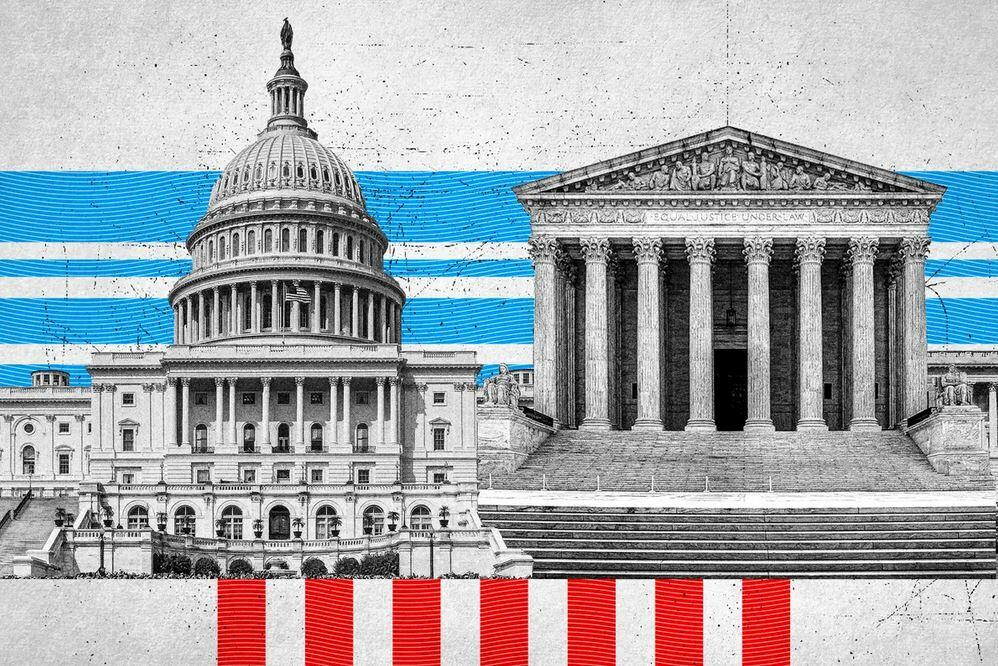
(Illustration by The Epoch Times, Freepik, Getty Images)

All of these attempts rest on an argument that the “insurrection” clause of the 14th Amendment bars the former president from appearing on the ballot.

The most significant decision was handed down on Dec. 21, when the Colorado Supreme Court ruled in a 4–3 decision that President Trump couldn’t appear on the state’s ballot because he had engaged in an insurrection on Jan. 6, 2021.

The Colorado ruling appears to be triggering and renewing efforts to kick the former president off the ballot in other blue-leaning states, including New York, California, and Pennsylvania.

A lower court in Colorado had similarly ruled that President Trump engaged in an insurrection but stopped short of disqualifying him after finding that the 14th Amendment doesn’t apply to presidents.

Enacted after the Civil War, the text of Section 3 of the 14th Amendment reads: “No person shall be a Senator or Representative in Congress, or elector of President and Vice-President, or hold any office, civil or military, under the United States, or under any State, who, having previously taken an oath, as a member of Congress, or as an officer of the United States, or as a member of any State legislature, or as an executive or judicial officer of any State, to support the Constitution of the United States, shall have engaged in insurrection or rebellion against the same, or given aid or comfort to the enemies thereof. But Congress may by a vote of two-thirds of each House, remove such disability.”

This relatively untested provision is now set to come before the nation’s highest court.

“This case is surely destined for the Supreme Court to interpret the 14th Amendment and resolve whether Trump is disqualified from the presidency,” said University of Michigan law professor Barbara McQuade, who left the Trump administration among a wave of resignations at the beginning of his term.

Who that section applies to, what constitutes an insurrection, and how the section is enforced have been the subject of vigorous debate.

Embedded within those questions are a series of others that could make deciding or enforcing ballot disqualification cases especially complicated.

Here are some of the major questions that courts and politicians may consider.

1. What Is an Insurrection?

Efforts to disqualify President Trump hinge partly on whether his actions surrounding the Jan. 6, 2021, riots qualify as engaging in the type of insurrection mentioned in Section 3.

To answer that question, observers have drawn from historical records, federal law, and evidence surrounding Jan. 6.

Supporters of President Donald Trump protest outside the U.S. Capitol in Washington on Jan. 6, 2021. (Alex Edelman/AFP via Getty Images)

According to Colorado District Judge Sarah Wallace’s reasoning, President Trump used language he knew would provoke violence on Jan. 6, 2021, but was vague enough to maintain plausible deniability. For her, that satisfied Section 3’s requirement that an individual “engaged in insurrection or rebellion.”

Some, however, have questioned that line of reasoning given that none of the Jan. 6 defendants, nor President Trump himself, have been charged with violating federal law regarding an insurrection.

South Texas College law professor Josh Blackman has said that “federal prosecutions for insurrection are extremely rare” and told Click2Houston that crimes such as “insurrection, treason, or sedition are very, very hard to prove.”

 They require basically an intent to try to frustrate or subvert the government,” he said.

There are additional questions as to whether the 14th Amendment defines insurrection the same way federal law does, or whether federal law and the 14th Amendment require the same level of proof to establish that individuals are guilty of insurrection.

Under the 14th Amendment, meeting the threshold of “insurrection” is “an extraordinarily high bar,” said Roger Severino, vice president of domestic policy at The Heritage Foundation. He also served in the Health and Human Services Department under President Trump.

I didn’t see anything sufficient to justify such an incendiary charge,” Mr. Severino told The Epoch Times.

He said the reference to insurrection in the 14th Amendment came about after invasions of the north during the Civil War.

During the Civil War, “you had armed invasions of the north … that’s what insurrection was referring to in the 14th Amendment,” he said.

The 14th Amendment of the United States Constitution. (National Archives of the United States)

Horace Cooper, senior fellow with the National Center for Public Policy Research, who formerly taught constitutional law at George Mason University, said that “their target was specifically the Confederacy.”

“Their target was not anyone who supported the French in the French–Indian War. Their target was not anyone who supported the British in the British–American War. Even though the language isn’t written in a way to limit those, the rationale was the Confederacy,” he said.

Still, some scholars say that President Trump has satisfied the 14th Amendment’s requirements for engaging in an insurrection.

Section Three covers a broad range of conduct against the authority of the constitutional order, including many instances of indirect participation or support as ‘aid or comfort,’” said University of Chicago law professor William Baude and University of St. Thomas law professor Michael Stokes Paulsen in a paper.

“It covers a broad range of former offices, including the presidency. And in particular, it disqualifies former President Donald Trump, and potentially many others, because of their participation in the attempted overthrow of the 2020 presidential election.”

2. Is Trump an ‘Officer of the United States’?

Judge Wallace’s opinion refrained from disqualifying President Trump because, she said, even if he committed an insurrection, she didn’t have enough evidence to definitively say he was the type of “officer” that the 14th Amendment prohibits from engaging in an insurrection.

Hans von Spakovsky, a former member of the Federal Election Commission, has argued that two prior Supreme Court decisions contain language indicating that “officers” of the United States don’t include presidents.

More specifically, both Free Enterprise Fund v. Public Company Accounting Oversight Board and United States v. Mouat define officers as appointees of the president and others.

Washington University law professor Andrea Katz disagrees.

You can find cases that have held certainly to the contrary,” she told The Epoch Times, pointing to Lucia v. Securities and Exchange Commission.

President Donald Trump at a Save America rally in Washington on Jan. 6, 2021. (Lisa Fan/The Epoch Times)

Quoting a prior court decision, Supreme Court Justice Elena Kagan said in 2018 that an officer “must occupy a ‘continuing’ position established by law, and must ‘exercis[e] significant authority pursuant to the laws of the United States.’”

Ms. Katz said that “it seems like both common understanding—the text of the Supreme Court, and the legislators’ understanding in drafting the 14th amendment—was that the president was going to be covered by this language.”

In its decision, the Colorado Supreme Court argued that the amendment’s drafters “understood the president as an officer of the United States” and that the Constitution as a whole supported that conclusion.

3. Can Courts Enforce Section 3?

Even if it was clear that Section 3 included President Trump’s conduct, questions remain as to whether courts can remove him from the ballot.

The answer to those questions could depend on how much authority state laws grant their secretaries of state. It could also depend on how Congress describes the events of Jan. 6, 2021.

Read more here…

Tyler Durden
Mon, 12/25/2023 – 22:30

Behind The Democrats’ Efforts To Regulate The Supreme Court

0
Behind The Democrats’ Efforts To Regulate The Supreme Court

Authored by Matthew Vadum via The Epoch Times (emphasis ours),

Democrats’ push to impose a code of conduct on the U.S. Supreme Court is driven by their desire to exert power over a court that hasn’t been ruling their way on key issues, legal experts say.

(Illustration by The Epoch Times, Getty Images, Shutterstock)

Democrats and their left-wing activist allies have been incensed over the past two years as the court sent abortion matters back to the states, axed affirmative action in college admissions, bolstered gun rights and public prayer, backed a website designer’s right not to promote a same-sex wedding, and strengthened private property rights while weakening the government’s regulatory powers over the environment.

Several experts told The Epoch Times that the left cannot accept the conservative majority on the Supreme Court, so it will keep agitating against it and try to undermine its legitimacy in the eyes of the public.

So far, the activism has propelled the court to adopt its first-ever formal code of conduct, issued on Nov. 13, but Democrats say it’s a toothless gesture and won’t fix what they say is a court that’s overly sympathetic to business interests and conservative causes.

“The court’s new code of conduct falls far short of what we would expect from the highest court in the land,” Senate Judiciary Committee Chairman Dick Durbin (D-Ill.) said.

“While the code of conduct prohibits the appearance of impropriety, it allows the justice to individually determine whether their own conduct creates such an appearance in the minds of ‘reasonable members of the public.’ This is something that justices have repeatedly failed to do over the last few years.”

To remedy the supposed crisis at the court, Mr. Durbin backs the proposed Supreme Court Ethics, Recusal, and Transparency (SCERT) Act of 2023, which his committee approved on a party-line vote in July.

The proposal, which Republicans have denounced as unconstitutional, would create a system allowing members of the public to file complaints against justices for violating the proposed code of conduct or for engaging “in conduct that undermines the integrity of the Supreme Court of the United States.”

Among other things, it would also impose mandatory recusal standards and create a panel of lower court judges to investigate complaints against the Supreme Court.

Democrats are proposing their code of conduct “so they can control the Supreme Court,” said Steven J. Allen, a distinguished senior fellow at Capital Research Center, a watchdog group.

They’re doing this to get rid of one or more Republican appointees so they can be replaced,” Mr. Allen said.

“That’s almost the definition of ‘lawfare’—using the legal system to wage war on your opponents. You pack the court by knocking off a Republican or two.”

Mr. Durbin, a longtime antagonist of Justice Clarence Thomas, who’s considered by many to be the court’s preeminent conservative jurist, has been particularly focused on the justice’s alleged transgressions.

Supreme Court Justice Clarence Thomas arrives for the ceremonial swearing in of Justice Brett Kavanaugh in the White House in Washington on Oct. 8, 2018. (Chip Somodevilla/Getty Images)

Justice Thomas has been a lightning rod for criticism from the left for a long time.

Mr. Allen predicts the “smear campaign” against Justice Thomas “will continue as long as he’s alive.”

Mr. Durbin and his committee colleagues issued a blizzard of public condemnations when earlier this year it was reported that billionaire Harlan Crow, a big Republican Party donor, gave Justice Thomas a series of luxurious vacations and tuition support for a grandnephew the latter raised and purchased real estate from the justice’s family.

Justice Thomas didn’t disclose the events at the time, saying he was advised that it wasn’t required, but he has vowed to disclose such events going forward.

No evidence has been uncovered to suggest that the justice’s vote in specific cases before the court was influenced by the gifts. Having wealthy friends isn’t against the law, the justice’s defenders say.

Justice Thomas is also routinely attacked by critics for the conservative activism of his wife, Ginni Thomas, a high-profile supporter of President Donald Trump.

Democrats, who have characterized Republican efforts to contest the 2020 presidential election after Election Day as an affront to democracy, were angered that Ms. Thomas reportedly signed form letters urging state lawmakers in Arizona and Wisconsin to overturn President Joe Biden’s election victory.

Ms. Thomas has also said she believes the 2020 election was rigged.

A video from Supreme Court Justice Clarence Thomas’ 1991 confirmation is played during a Senate Judiciary Committee hearing about Supreme Court ethics reform on Capitol Hill in Washington on May 2, 2023. (Chip Somodevilla/Getty Images)

Liberal groups have called upon Justice Thomas to recuse himself from a plethora of cases related to the election and to President Trump’s ongoing criminal prosecutions. They argue that Justice Thomas and his wife are too close to Republicans.

Veteran Supreme Court watcher Curt Levey, president of the conservative Committee for Justice, said it’s a one-way street.

What are the odds that Senate Democrats would call on one of the liberal justices to recuse if that justice’s spouse had expressed strong public opinions about the 2020 election being fair?” he said.

They would never demand that a liberal justice recuse “because a spouse had expressed political opinions about newsworthy events,” he said.

Pressure Campaign

Jim Burling, vice president of legal affairs for the Pacific Legal Foundation, a national nonprofit public interest law firm that challenges government abuses, said the Durbin-backed SCERT bill and his committee’s investigation of conservative justices is an effort “to try to limit the legitimacy of the court.”

“They don’t like the fact that we have a court nowadays that’s not doing what the progressives think that the court should be doing,” he said.

It bothers them that the court is “very different today” from the way it was under Chief Justice Earl Warren (1953 to 1969) and Chief Justice Warren Burger (1969 to 1986) when the court veered left, Mr. Burling said.

“It upsets them that they can’t win the case on the merits, so you just throw mud around instead and try to obfuscate what the real issue is here,” he said.

Demonstrators protest at the entrance of the gated community where Supreme Court Justice Thomas Clarence lives in Fairfax, Va., on June 24, 2022. (Roberto Schmidt/AFP via Getty Images)

Mr. Levey said Sen. Sheldon Whitehouse (D-R.I.), sponsor of the SCERT Act, has shown that he wants to keep putting pressure on the court’s conservative members.

The fact that the court adopted its own code shows that “even the Supreme Court, where they have lifetime tenure, can be pressured,” he said.

This is why the Democrats are constantly attacking the Supreme Court because it does have an effect and you see the effect here,” Mr. Levey said.

“This is just another form of trying to harass and intimidate the court. Democrats have discovered over the years that if you let the conservative justices know that you’re going to make life difficult for them … some of the center-right justices are fairly easily intimidated.”

Maybe about half of those justices will then “go out of their way not to anger the Democrats too much.” Mr. Levey said.

Politicians have been trying to manipulate the Supreme Court for a long time, Mr. Allen said, “by way of essentially harassing them.”

He pointed to the 2010 State of the Union address when President Barack Obama took the unusual step of chastising the robed Supreme Court justices seated before him for their ruling in the Citizens United case, which changed campaign finance restrictions.

“With all due deference to separation of powers,” he said, the Citizens United precedent “will open the floodgates for special interests—including foreign corporations—to spend without limit in our elections.”

Justice Samuel Alito shook his head in disagreement, appearing to mouth the words, “Not true.”

And in March 2020, at a pro-abortion rally outside the Supreme Court, Sen. Chuck Schumer (D-N.Y.) vowed unspecified retribution against conservative justices Neil Gorsuch and Brett Kavanaugh should they vote to uphold a Louisiana law that imposed abortion restrictions.

Read more here…

Tyler Durden
Mon, 12/25/2023 – 21:00

UK Deploys Warship To Guyana In Show Of Support Against Venezuela Territorial Claim

0
UK Deploys Warship To Guyana In Show Of Support Against Venezuela Territorial Claim

While the recent panic over the risk of a Venezuela invasion of its neighbor Guyana may have come and gone, some (former) global superpowers are not taking any chances, and according to the FT, the UK will deploy a naval patrol ship off the coast of the tiny but rich Latin American nation in a show of support for the former British colony as it faces a territorial claim from its more powerful if insolvent communist neighbor.

The deployment follows moves by Nicolás Maduro, Venezuela’s socialist president, to claim the vast, mineral-rich Essequibo region, which borders his country but has been part of Guyana – a member of the British Commonwealth and the only English-speaking nation in South America – for more than a century.

Britain’s decision to dispatch HMS Trent later this month is a significant show of support for the government in Guyana’s capital Georgetown.

The decision comes just days after the UK’s new foreign secretary, David Cameron, fresh from career exile after his catastrophic handling of Brexit, said the UK would “continue to work with partners in the region to ensure the territorial integrity of Guyana is upheld and prevent escalation”.

Meanwhile, UK foreign office minister David Rutley, visited Guyana last week to meet President Irfaan Ali and stress the UK government’s “unequivocal backing” for Guyana’s territorial integrity after the Venezuelan claim.

Yván Gil, Venezuela’s foreign minister, responded angrily on social media platform X to that visit, saying: “The former invading and enslaving empire, which illegally occupied the territory of [Essequibo] and acted in an skilful and sneaky manner against the interests of Venezuela, insists on intervening in a territorial controversy that they themselves generated.

“This controversy will be resolved directly between the parties . . . We will stop the new filibustering that seeks to destabilise the region.”

As reported earlier this month, Maduro held a referendum at the start of December, in which Caracas claimed that more than 95% supported proposals including that Essequibo, which makes up two-thirds of Guyana, should become a Venezuelan state.

Caracas subsequently authorised Venezuelan state-run companies to grant licences for exploration and exploitation in Essequibo and ordered new official maps including the territory, although the presidents of both countries agreed in a December 15 meeting not to use force in the dispute.

HMS Trent, which is armed with a cannon and machine guns, has a crew of 65 and a contingent of Royal Marines, and can deploy Merlin helicopters.

The vessel, which is mostly used for counter-terrorism exercises and tackling piracy and smuggling, is usually based around the Mediterranean. However, in early December it was deployed west to Barbados to clamp down on drug runners in the Caribbean.

UK officials told the FT that the ship would anchor off the coast of Georgetown and carry out visits, training and joint activities with the country’s navy.

Guyana’s defence force, with only 4,070 active personnel and reserves, is dwarfed by Venezuela’s 351,000-strong military which feels especially powerful now that Biden will do anything to appease dictator Maduro if it means a buffer of oil supply heading into the critical 2024 election year.

A Ministry of Defence spokesperson said: “HMS Trent will visit regional ally and Commonwealth partner Guyana later this month as part of a series of engagements in the region during her Atlantic patrol task deployment.”

Tyler Durden
Mon, 12/25/2023 – 20:15

Debt And Dopamine: The Ghosts Of Christmas Present

0
Debt And Dopamine: The Ghosts Of Christmas Present

Authored by Amy Denney via The Epoch Times (emphasis ours),

Most every Christmas growing up in the 1950s, Brad Harris got socks, a new pair of jeans, and—if he was fortunate—a new sweater.

(Jordi Mora igual/Getty Images)

He lived with his mom, who was a single parent, as well as his grandmother, great aunt, and younger brother. Finances were tight, but there was always food on the table, including a big dinner for Christmas.

“We never felt deprived, but we didn’t compare what we had with other folks,” Mr. Harris, 87, told The Epoch Times. “It was a wonderful time really. It was a lot less frivolous. I think it made a better generation of us.”

To help with family expenses, he usually held more than one job at a time—including delivering newspapers until he graduated high school. It was a big delight one year when he received a Hawthorne bicycle with a tank and headlight for Christmas.

“It was one of my prizes, and I rode that thing clear through high school,” Mr. Harris said. “I had probably worn out two or three bicycles carrying papers.”

Decorations were sparse—they couldn’t afford a tree so they usually cut down a fresh one from a friend’s property—yet the Harris brothers never forgot to buy something for mom. One year, it was a set of clear pink serving dishes for eight that cost no more than $3.

These days, Mr. Harris no longer tries to pick out meaningful gifts for each family member. He has 14 great-grandchildren. He makes homemade caramel and hands out cash.

There’s not much the kids want that they don’t already have, he said.

“We found a long time ago, 100-dollar bills fit everybody, and the color’s right,” Mr. Harris said. “I spend more on Christmas than my mother made in a year.”

Spending Obsession

Christmas gift giving in the United States has always been a big deal, but it seems to continue getting bigger. Data available for the past 20 years shows overall spending has nearly doubled since 2003, climbing every year except during the financial crisis in 2008. The National Retail Federation (NRF) predicts growth will be a bit lower—3 to 4 percent—in 2023 than in 2022.

(Illustration by The Epoch Times)

Total holiday spending this year in America is expected to be at least $937 billion, according to the NRF. Back in 1950, total holiday spending was $40.2 billion, but that’s without factoring in inflation and population growth.

Those were the days before credit cards, before storage units, before America’s massive rise in household debt. Those were the days when it was easy to buy a Christmas present because everybody needed something.

Americans have always spent a lot of money during Christmastime. What has changed dramatically is how much they spend the rest of the year and how much they borrow to maintain that spending.

Shoppers clog the aisles at Macy’s Department store on Black Friday in 2003 in New York City. Annual holiday spending has doubled to nearly a trillion dollars in the two decades since. (Stephen Chernin/Getty Images)

Shopping has become a year-round obsession, turning Christmas gift-giving into an obligation and sometimes even burden. Often our presents are just more clutter.

Remembering the value of more meaningful and necessary gifts of generations past could help us shift our focus from the materialism of gifts to the act of giving and the value of relationships.

When It All Changed

The Sears catalogs, including the once-annual Wish Book and Christmas catalogs, really took off as credit started to appear. Even back in 1956 the “Sears Christmas Book” was more than 450 pages of toys, tools, clothing, houseware, and more—all promoted as the perfect gifts for loved ones.

The catalogs provided inspiration for new Christmas gifts that weren’t so obvious as a needed sweater. Every American could imagine a new level of consumption, with items they never would have considered buying now displayed in enticing variety.

Of course, all that possibility meant little without the means to pay for it—and incomes were still limited just as they are today. However, Americans’ spending habits were suddenly no longer restrained by their pocketbook.

Whereas merchant credit had previously been associated with wealthier customers, the post-war years saw an explosion in consumer loans and credit cards for a rapidly growing middle class.

A telling statistic is the household debt to income ratio, which tells how much of a household’s monthly income goes towards debt payments. The higher the ratio, the more monthly income goes towards debt payments.

The Institute for New Economic Thinking thoroughly examined debt from the end of World War II, when the household debt-to-income ratio was 30 percent, to 2016, when that debt ratio hit 120 percent. In other words, by 2016 the average American household was going further into debt every month.

(Illustration by The Epoch Times)

The American household debt boom of the past decades was first and foremost a middle-class affair. Middle-class incomes grew by 20 percent since 1970, middle-class debt by 250 percent,” the institute report said. In other words, we now spend far more than we make, a dramatic shift from the 1950s.

Rachel Cruze, a financial expert at Ramsey Solutions, a firm that helps people reconcile debt and make better financial decisions, says Americans are spending themselves into excruciating debt.

“Credit card debt itself has reached over a trillion dollars, the highest in history,” Ms. Cruze told The Epoch Times.

Shoppers hunt for gifts and other items at a New York department store on December 11, 2023. With everyone’s homes filled with stuff, finding meaningful gifts has become a challenge. (Michael M. Santiago/Getty Images)

Our debts have become so great they could be considered a public health issue. One study published in 2018 in PNAS found “overspending and over-indebtedness … leads to social exclusion, feelings of loneliness, an unhealthy family environment, and suicidal thoughts, and it reduces social support. Also, one of the biggest problems with debts is that they often unleash a spiral of further debts. This spiral can ultimately bring people into poverty.”

The study found that when low-income families were given three times their monthly income for debt relief, those who used it to pay down their debts instead of making other purchases experienced a proportional improvement in cognitive function and reduced anxiety.

How the Glut Stole Christmas

One of the big lessons from the Grinch that has proven true over the past 20 years is that it isn’t a lack of presents that can ruin Christmas. In fact, presents can be the thing that buries our Christmas spirit.

Credit lit the fire of our current consumerism, but cheap Chinese goods added plenty of fuel.

Suddenly, everybody could have everything at cheap prices made all the cheaper by underpaid workers and poorly made products. Items that once lasted a lifetime now become obsolete, broken, or out of fashion within a few years.

Ms. Cruze shared her own struggles with purchasing on her radio show. Her new book, “I’m Glad for What I Have,” was inspired by an innocent but uncomfortable encounter with her youngest child that revealed her own consumption problems.

My 4-year-old said a few months ago, ‘Is the Amazon guy coming today, Mom?’” Ms. Cruze said.

Amazon delivery men have become the new Santa Clause, except they deliver all year long, making the prospect of presents far less meaningful. (EQRoy/Shutterstock)

While credit and cheap goods certainly enticed us to buy more, companies learned better how to hijack our own biology as well. Big Tech has made pervasive use of neuromarketing to figure out exactly how our brains work, and how to make us buy.

Read more here…

Tyler Durden
Mon, 12/25/2023 – 19:30

IRS Rakes In Record $4.9 Trillion In Taxes From Americans Amid Enforcement Crackdown

0
IRS Rakes In Record $4.9 Trillion In Taxes From Americans Amid Enforcement Crackdown

Authored by Tom Ozimek via The Epoch Times (emphasis ours),

The Internal Revenue Service (IRS) raked in a record $4.9 trillion in taxes from Americans in the last fiscal year, due in large part to automated collections processes and aggressive audits that saw taxpayers hit with billions in additional taxes after examination.

The Internal Revenue Service (IRS) building in Washington on June 28, 2023. (Madalina Vasiliu/The Epoch Times)

The Treasury Inspector General for Tax Administration (TIGTA), the watchdog that oversees the IRS, revealed in a Dec. 20 report on tax compliance activities that the agency collected a record-breaking amount of money in fiscal year 2022 from American taxpayers.

The $4.9 trillion the tax agency raked in last year was around $790 billion more than the prior year, thanks in large measure to a significant increase in enforcement revenue.

The IRS collected $72 billion in revenue from its enforcement activities in FY 2022, not far below the record-setting $75 billion in FY 2021 but well above the historical average of around $59 billion (from 2013-2020).

All those dollars rolling in from enforcement activities are likely to rise going forward, given that the IRS announced over the summer that, thanks to a new funding boost, it was launching a “sweeping, historic” tax enforcement initiative using artificial intelligence (AI) and other cutting edge technologies to crack down more effectively on non-compliant taxpayers.

But while AI and other advanced computer algorithms have yet to be deployed at the IRS on a large scale as the agency continues to modernize its systems, automation has already bolstered the agency’s ability to stuff the government’s coffers—even as the overall number of examinations declined, as did the number of enforcement agents.

“The revenue collection was driven substantially by automated collection processes,” the TIGTA report states. Roughly 74 percent of the IRS’ enforcement revenue was collected within the agency’s Collection notice stream and the Automated Collection System (ACS).

While the IRS is poised to continue increasing its reliance on automated systems to squeeze more tax dollars from taxpayers, it’s also looking to hire another 3,700 tax enforcers as it spends an extra $46 billion of the recent $80 billion (later reduced to $60 billion via debt ceiling negotiations) funding boost on enforcement.

Another important factor why the IRS managed to take in a record amount of tax revenue last year was hitting taxpayers with aggressive additional tax assessments after examinations.

Even More Taxes

The watchdog report shows that, after audits, the IRS levied an additional $30.2 billion in taxes on Americans last year, roughly 13 percent more than in 2021 and a whopping 75 percent more than in 2019.

When the IRS completes an examination, it can either leave the tax assessment “as is” or it can propose an adjustment (up or down) that increases or reduces the amount of tax owed.

“The general trend of proposed additional tax from FY 2019 to FY 2022 is over a 75 percent increase in the total proposed additional tax resulting from examinations, and the most significant increase (136 percent) was from correspondence examinations,” the watchdog said.

Over the past four years, the IRS’ examinations function proposed nearly $90 billion in additional taxes on U.S. taxpayers.

The watchdog said that the record tax collections were driven by individual income taxes, which increased by 47 percent since 2019, an increase of roughly $1 trillion.

More Audits of Those Earning Under $400,000?

The question of whether the IRS will use some of the $60 billion or so funding boost to increase tax enforcement of people making less than $400,000 has been a contentious issue.

IRS and Treasury Department officials have pledged not to increase audit rates for this group of Americans, while Republicans and others have argued that this pledge is either false or wishful thinking.

Treasury Secretary Janet Yellen has directed the IRS not to raise audit rates above historical levels for this group of taxpayers, while IRS Commissioner Danny Werfel has repeatedly made the same pledge.

But the IRS watchdog recently cast doubt on this promise, warning that Americans making less than $400,000 could inadvertently get caught in an enforcement dragnet because the IRS doesn’t clearly define “high-income” and its enforcers use an outdated $200,000 high-income threshold as their default.

During recent testimony on Capitol Hill, Mr. Werfel appeared to acknowledge the possibility that audit rates could rise for Americans making less than $400,000 per year.

During an Oct. 24 hearing, Rep. Virginia Foxx (R-N.C.) pressed the IRS chief to explicitly guarantee that the IRS wouldn’t raise audits on Americans making less than $400,000.

You are guaranteeing that you will not increase the number of audits of people making less than $400,000 a year?” Ms. Foxx asked.

“That is my marching order to the IRS,” Mr. Werfel replied before adding that “if we fall short of that, I will be held accountable for it,” hinting that, even with the best of intentions, there’s a chance that the IRS might fail to make good on this promise, much like the watchdog has warned.

“But we will publish those rates,” Mr. Werfel added, referring to tax audit rates for Americans earning less than $400,000, suggesting that time will tell how closely the agency’s growing army of tax enforcers will follow his orders.

“A little while ago, you said you had control of the IRS,” Ms. Foxx said. “So we’ll come back to you with that,” she added, suggesting that Republicans intend to hold Mr. Werfel’s feet to the fire if the $400,000 tax audit pledge is broken.

Tyler Durden
Mon, 12/25/2023 – 18:45

Frustrated Biden Demands Media To Start Reporting Good Economic News

0
Frustrated Biden Demands Media To Start Reporting Good Economic News

Dictator President Biden railed against corporate media before he and several family members headed by helicopter to Camp David, the presidential retreat in the mountains of western Maryland. 

Before boarding the presidential helicopter, Biden was asked by one reporter: “What’s your outlook on the economy next year?”

The president responded: “All good,” adding, “Take a look. Start reporting it the right way.”

Biden’s criticism comes as at least one progressive think tank warned White House aides in September and October that the ‘Bidenomics’ branding of the economy ahead of the 2024 presidential election cycle has failed. 

Democrats are hammering the American public with the economy being ‘great’ despite never mentioning inflation ran hot and wiped out real wages of workers for two years. This put a massive strain on the working poor, who had to drain personal savings and rack up insurmountable credit card debt to make ends meet. Many of these folks resort to ‘buy now, pay later’ loans to afford essential items. 

What’s important to note is that the White House began the Bidenomics media blitz in June, which was supposed to be an effort to lift dismal poll data. Which the campaign miserably failed. 

Maybe the Federal Reserve’s bizarre, unexpected pivot might help the president, who has the lowest approval rating than any of his seven predecessors at this point in the first term, according to a recent Gallup poll. 

Tyler Durden
Mon, 12/25/2023 – 18:00