58.9 F
Chicago
Monday, September 14, 2026
Home Blog Page 3065

Israel Fails To Prove Targeted Gaza Hospital Was Hamas Hub: Washington Post

0
Israel Fails To Prove Targeted Gaza Hospital Was Hamas Hub: Washington Post

For weeks, alternative news outlets like The Grayzone and The Intercept have cast major doubts on Israel’s claim that the al-Shifa Hospital in northern Gaza sat atop a major Hamas command center. Now, even an ultimate establishment outlet — the Washington Post — has likewise found that Israel’s claims about the hospital it besieged don’t stand up to scrutiny

Mistrust existed even before the Israeli Defense Forces first besieged the hospital before bombing a departing ambulance convoy, and then raiding the hospital in November. While those who reflexively back Israel at every turn may have been fooled, others rightly rolled their eyes as the Israeli government presented the world with a cartoon version of what was supposed to lie under the hospital, as if that was some kind of proof: 

After its Nov. 15 raid of the hospital, the IDF distributed videos and photographs to bolster Israel’s claims about the hospital, however the Post notes:

the evidence presented by the Israeli government falls short of showing that Hamas had been using the hospital as a command and control center, according to a Washington Post analysis of open-source visuals, satellite imagery and all of the publicly released IDF materials.

That raises critical questions, legal and humanitarian experts say, about whether the civilian harm caused by Israel’s military operations against the hospital — encircling, besieging and ultimately raiding the facility and the tunnel beneath it — were proportionate to the assessed threat. — Washington Post

The Post’s analysis refuted three cornerstone allegations that Israel had made. First, there is no compelling evidence of military use of the facility by Hamas. Second, contrary to pre-attack claims, the single tunnel under the hospital doesn’t connect to five other buildings on the hospital campus that were supposed Hamas operational hubs. Finally, the Post found no proof that hospital wards had tunnel access. 

Before attacking the hospital, the IDF said the five highlighted buildings were used by Hamas, and that the hospital sat on top of a major tunnel complex (Washington Post graphic)

After raiding the hospital, the IDF released footage alleging to have recovered a mere dozen AK-47 rifles and a handful of grenades.

They also shared images of a tunnel shaft which was in a single small building on the northeast corner of the hospital campus. The tunnel led to two small bathrooms and two empty rooms.

IDF spokesman Daniel Hagari claimed the mere presence of electrical wiring proved one of the chambers was an “operational room.” However, the Post notes that the rooms are remarkably pristine. Besides lacking any military flavor, they show “no signs of recent habitation, including litter, food containers, clothing or other personal items.” 

Note that, in a separate instance, Hagari has proven himself a highly undependable tour-guide — to the point of earning widespread ridicule. In a video shot at a children’s hospital, he claimed that papers on the wall showed the names of terrorists charged with guarding hostages. Arabic speakers were quick to note that the words he pointed to were simply the days of the week. 

Last month, former Israeli Prime Minister Ehud Barak threw CNN’s Christiane Amanpour for a loop when he said it was the Israelis who built bunkers under al-Shifa Hospital:

Another piece of supposed evidence of the hospital’s military use is also less than compelling. Security camera footage shows militants leading two Israeli hostages through the hospital on Oct. 7 — the day of the Hamas invasion of southern Israel. However, one of the hostages appears wounded and is being transported on a gurney, seemingly indicating the militants took the hostage to the hospital for treatment. 

The IDF said it destroyed the few tunnels it found under al-Shifa and then left the hospital, seemingly confirming that the cartoon version of the Israeli government’s claims was nowhere near the truth.  

Severely wounded children on hospital beds in the parking lot of the al-Shifa Hospital (Fadi Alwhidi/Anadolu Agency via Aljazeera

Beyond simple assurances from officials, the Biden White House has done nothing to bolster Israel’s claims about al Shifa — failing, for example, to produce any declassified intelligence of its own. Meanwhile, an anonymous “senior member of Congress” tells the Post that, though he was once confident in Israel’s claims about al-Shifa, he now needs more than animations, dubious photo “evidence” and “trust us” assurances: “I think there has to be a new level of demonstration. They should have more proof at this point.”

“The targeting by a U.S. ally of a compound housing hundreds of sick and dying patients and thousands of displaced people has no precedent in recent decades,” notes the Post.

The IDF siege of the hospital caused misery for thousands of Palestinians trapped in the medical facility and sheltering on its grounds. According to the United Nations, at least 40 Palestinians died while the hospital was besieged by the IDF — among them four premature infants.

Tyler Durden
Fri, 12/22/2023 – 21:00

‘Trump Derangement Syndrome Just Became Orwellian’; VDH

0
‘Trump Derangement Syndrome Just Became Orwellian’; VDH

Authored by Victor Davis Hanson via American Greatness,

Will Partisan Lawfare Destroy Trump?

Trump Derangement Syndrome became Orwellian with the recent ruling of the Colorado Supreme Court.

It approved the erasure of Trump from the Republican primary ballot in Colorado, by invoking Section 3 of the 14th Amendment.

That ossified clause was intended to bar any ante-bellum federal officials who joined the Confederacy from again holding federal offices after 1865.

In no way is Trump’s conduct on January 6 comparable to calling for secession, much less prompting a Civil War that cost the country 700,000 lives.

An “insurrectionist” president does not address unarmed protestors with qualifiers like, “I know that everyone here will soon be marching over to the Capitol building to peacefully and patriotically make your voices heard.”

How also can one be guilty of insurrection without ever being indicted for such a supposed crime, much less convicted of it? 

And the more we learn about January 6, all the more it appears to have been a spontaneous riot, more buffoonish in nature than conspiratorial.

No one has explained the mysterious, politicized January 6 refusal of the Speaker of the House to order a reinforcement of the Capitol police.

Or the FBI stonewalling about its informants in the crowd.

Or the revealing admissions of New York Times reporter Matthew Rosenberg (“a ton of FBI informants among the people who attacked the Capitol”).

Or the warped composition and conduct of the January 6 congressional committee.

Or the months-long official disinformation surrounding the number and circumstances of those who died that day.

That day’s illegality in terms of violence and death paled in comparison to the largely excused and exempted 120 days of summer violence in 2020, when Antifa and BLM engineered riots, arson, and death.

Their planned violence accounted for 35 or so killed, and more than 1,500 injured police officers.

Some $1-2 billion in property was destroyed.

A police precinct, federal courthouse, and iconic Washington, D.C. church were torched.

Mobs attempted to storm the White House grounds and sent the president into a secure underground bunker.

But if one really wishes to imagine genuine “insurrectionary “and actionable language, then recall current Vice President Kamala Harris’s 2020 de facto encouragement to the rioters,

But they’re not gonna stop. They’re not gonna stop, and this is a movement, I’m telling you. They’re not gonna stop, and everyone beware, because they’re not gonna stop. They’re not gonna stop before Election Day in November, and they’re not gonna stop after Election Day. Everyone should take note of that, on both levels, that they’re not going to let up — and they should not. And we should not.

Or remember this 2020 insurrectionary warning to two sitting Supreme Court Justices by then Senate Minority Leader Chuck Schumer.

At the very doors of the court, Schumer revved up an angry crowd with undisguised threats:

I want to tell you Gorsuch. I want to tell you Kavanaugh. You have released the whirlwind and you will pay the price. You won’t know what hit you if you go forward with these awful decisions.

The Colorado court ruling is sadly only the most recent in a long series of disastrous firsts that are slowly unwinding the republic and making a mockery of the rule of law.

Remember the Russian collusion hoax and the 2016 Clinton/Fusion GPS effort to destroy a presidential candidate?

Recall the 2020 Russian disinformation farcical claim concerning the genuine Hunter Biden laptop?

Do not forget the precedent of impeaching a president twice and then trying an ex-president and private citizen in the Senate.

Then there was another first of raiding an ex-president’s private home over disputes about the removal of presidential papers that are typically solved bureaucratically and as a civil matter.

We are also witnessing ongoing lawfare waged by state and local partisan prosecutors to destroy the current leading presidential candidate.

Their indictments either have no merit or would never have applied to liberal politicians or both.

What will be Colorado’s precedent?

Will red-state courts now respond by erasing Joe Biden from their ballots on grounds that he is “guilty” of insurrectionary activity—by deliberately destroying the southern border, undermining U.S. security, sabotaging federal immigration law, and violating his oath of office?

Will some states remove Vice President Kamala Harris from their 2024 ballots on grounds that in 2020 she deliberately incited insurrectionary protestors who had been engaged in riot, arson, looting, violent assaults on police, and attacks on federal properties?

So does the Left see where it is taking the country?

It is destroying all the old parameters of accepted politics in using any means necessary to deny millions of citizens the right to elect their own highest official.

We have never seen anything like this before in American history. But it is only the latest chapter of an ongoing travesty that will not end well.

Tyler Durden
Fri, 12/22/2023 – 20:30

Container Ships In Red Sea All But Disappear As Key Trade Route Freezes

0
Container Ships In Red Sea All But Disappear As Key Trade Route Freezes

Major shipping companies are rerouting vessels from the Red Sea to the Cape of Good Hope to avoid Houthi drone and missile attacks. New shipping data indicates a significant decrease in commercial vessel activity on the critical global trade corridor connecting to the Suez Canal, responsible for 12% of international trade and almost one-third of global container traffic. 

Bloomberg data shows only a handful of container ships with destinations in Europe or Asia are sailing through the once-busy Red Sea. These vessels are being rerouted around the Cape of Good Hope. 

New data from Clarkson Research Services Ltd. shows an 82% plunge in the gross tonnage of container ships arriving in the Gulf of Aden in the last four days, compared with the first half of December, according to Bloomberg. 

On Wednesday, logistics company Kuehne + Nagel International AG reported at least 100 container ships were rerouted around the Cape of Good Hope. That number is likely higher at the end of the week. 

Seven major shipping companies, including Taiwanese container shipping line Evergreen and Belgian tanker owner Euronav, halted all sails through the Red Sea earlier this week

While traders have been focused on rising Brent prices due to regional instability, CNBC learned this week that logistics managers were quoted $10,000 per 40-foot container from Shanghai to the UK. Just last week, the same rates were about $2,400. 

Extended travel times due to the 1 to 2-week detour have sparked supply chain chaos from retailer IKEA. 

“What we can share for now is that the situation in the Suez Canal will result in delays and may cause availability constraints for certain IKEA products.

 “This is our main priority. In the meantime, we are evaluating other supply options to secure the availability of our products, and we continue to monitor the situation closely going forward,” said an IKEA spokesman.

Meanwhile, the US and its allies are trying to restore order in the major maritime shipping lane via Operation Prosperity Guardian. 

Comments from the White House on Friday afternoon show things are heating up:

  • WHITE HOUSE ALLEGES IRAN WAS ‘DEEPLY INVOLVED’ IN PLANNING OPERATIONS AGAINST COMMERCIAL VESSELS IN THE RED SEA

The Red Sea appears to be entering a deep freeze. This could only mean global supply chain snarls will reemerge near term. 

Tyler Durden
Fri, 12/22/2023 – 20:00

After Telework Surge, Federal Buildings Remain Largely Empty

0
After Telework Surge, Federal Buildings Remain Largely Empty

Authored by Susan Crabtree via RealClear Wire,

More than two years after the Biden administration called on all federal agencies to create plans to bring employees who teleworked during the COVID pandemic back to the office, the vast majority of Washington, D.C.’s federal buildings are still sprawling expanses of empty, echoing hallways and offices. 

In fact, 17 of 24 federal agencies use an estimated 25% or less of their headquarters’ office capacity, according to an updated survey by the General Accounting Office, a government agency that provides auditing and investigative services for Congress. 

The survey showed that all federal buildings except the Treasury were operating at or below 31% office occupancy, with some far below that level, during the period surveyed. The Treasury Department has done better than most in seeing its employees return to work. Forty percent of the Treasury Department was back to work when the GAO survey was conducted. 

The Social Security Administration and the Housing and Urban Development offices were both at 7% occupancy; the Small Business Administration was at 9%; the Office of Personnel Management notched in at 12%; and the Transportation Department was at 14% occupancy. The General Services Administration, which manages all federal buildings, was operating at 11%, as was the Department of Agriculture. 

The U.S. Agency for International Development is located in the expansive Ronald Reagan Building, the second largest government building after the Pentagon, with 3.1 million square feet of office space on 11 acres. USAID’s occupancy was at 23%. The Department of Homeland Security, which under Secretary Alejandro Mayorkas’ leadership has come under fire from Republicans for failing to secure the southern border, was at 31% occupancy during the periods the GAO surveyed.

Although many private companies, which must answer to shareholders, have offloaded their pricey office space as many employees have shifted to telework, the U.S. government continues to pay a hefty price tag for office space while allowing liberal remote work. Federal agencies spend roughly $2 billion a year to operate and maintain federal office buildings and an additional $5 billion to lease office buildings, according to the GAO

The government auditing agency recently released its updated occupancy findings to Iowa Republican Sen. Joni Ernst. The report sampled federal agencies’ use of office space across a three-week period earlier this year. 

“This Christmas season, I’m calling on Biden’s bureaucrats to deck the agency halls with federal workers or sell off unused space,” Ernst told RealClearPolitics. 

“Four years have passed since COVID temporarily closed federal buildings, but bureaucrats are still failing to show up for work,” she said in a statement. 

Ernst called out a “naughty list of no-shows,” which have taxpayers “on the hook” for paying for their expensive office space. 

“No wonder [Transportation Secretary] Pete Buttigieg can’t address delays for Americans going home for the holidays if he can’t even get his employees to show up to work,” she said. “And while DHS headquarters remains nearly empty, illegal immigrants are filling up sanctuary cities. Ironically, instead of getting the homeless off the streets, no one is even home at HUD.” 

The COVID pandemic’s liberal telework policies have exacerbated low occupancy rates, though federal agencies have vastly underutilized their office space since the early 2000s. Based on its calculations for one of the federal headquarters buildings, the GAO estimated that only 67% of building capacity would be used even if all assigned staff entered the building on a single day. 

“As the country emerges from the pandemic and agencies continue to offer telework as an option, the federal government has a unique opportunity to reconsider how much and what type of office space it needs,” the GAO concluded in a July report. 

Although an official breakdown by agency of the number of workers working remotely at least part-time does not exist, far more government workers have been working remotely since the COVID pandemic. The liberal COVID telework policies have become a catalyst for the need to modernize and downsize the federal real estate portfolio, said Tom Schatz, president of Citizens Against Government Waste, a taxpayer watchdog group.

“Federal real property management has been on GAO’s high-risk list since 2003 because the government has had more space than it needs,” he said in an interview. “It’s a matter of establishing what the government needs and where they need to have these headquarters. It really could not be a simpler decision.” 

Schatz and other like-minded watchdogs support a campaign to move some federal office agencies out of D.C. and closer to the people most impacted by the agencies’ policies. Ernst, along with Ohio Republican Rep. Bill Johnson, sponsored a bill in 2022 that would distribute agency headquarters throughout the country and would, according to Ernst and Johnson, provide the added benefit of bringing stable jobs to other parts of the United States.

Schatz said the Biden administration hasn’t signaled whether it would support such a move but is pressing agencies to bring their employees back to work. 

Earlier this fall, facing large numbers of federal workers who were still not coming into the office, the White House privately pushed Cabinet secretaries to bring their employees back, Axios reported. Only about half of Cabinet agencies had achieved the White House’s goals of returning to office work by January. White House Chief of Staff Jeff Zients has made returning to the office a priority for both the White House and the broader executive branch and sent a Cabinet-wide memo over the summer urging an end to telework. 

We are running to in-person work because it is critical to the well-being of our teams and will enable us to deliver better results for the American people,” Zients wrote. 

During an early October Senate hearing, the billions of dollars spent for empty federal office space came under fire. Sen. Shelley Moore Capito, a West Virginia Republican, voiced deep concerns over wasted resources used to heat, cool, and maintain the underutilized buildings. 

“Each year, it costs billions of taxpayer dollars to operate and maintain these federal buildings, regardless of their utilization,” she said. “This is simply unacceptable.” 

Congress also has passed laws, including the Inflation Reduction Act, giving the General Services Administration, which runs the federal buildings, funds to make buildings more energy efficient and resilient to climate change and to promote the use of low-carbon materials.  

Half of the GSA-managed leases are set to expire by 2027, which Delaware Democratic Sen. Tom Carper said provides an opportunity to downsize the building space. Carper added that DHS is already working to reduce its office footprint in Washington, D.C., by more than 1.2 million square feet. That effort alone would save taxpayers an estimated $1.3 billion over the next 30 years, according to the GSA.

Susan Crabtree is RealClearPolitics’ national political correspondent.

Tyler Durden
Fri, 12/22/2023 – 19:30

Tesla Launches New Mega Factory Project In Shanghai, Designed To Manufacture 10,000 Megapacks Per Year

0
Tesla Launches New Mega Factory Project In Shanghai, Designed To Manufacture 10,000 Megapacks Per Year

Tesla has launched a new mega factory project in Shanghai, which will be capable of producing 10,000 Megapacks a year, according to multiple news sources including China’s Global Times.

The packs are designed for large-scale energy storage and efficient renewable energy distribution, and will be available for global sales.10,000 Megapack units annually equates to about 40GWh of energy storage capacity.

Located in the Lingang area of the Shanghai Pilot Free Trade Zone, the facility is slated to begin construction in early 2024 and commence operations by the end of that year, the report says. 

The signing ceremony for the project took place on Friday morning. 

“With Tesla’s efficient production and manufacturing capabilities, coupled with the high-quality business environment in Lingang, the mega factory project is expected to refresh the ‘Tesla speed,'” Tao Lin, vice president of Tesla, told Xinhua

Megapack at Tesla’s Shanghai Gigafactory

“China has been continuously improving its level of opening up in recent years, and Tesla is both a witness and a beneficiary.”

Tao raved about China, telling Xinhua that he had witnessed and benefited from the country’s ongoing expansion in its openness to international businesses. He emphasized that China’s progressive policies, advanced development strategies, and favorable business climate present vast opportunities for corporations.

Xinhua noted that from January to November of this year, the Shanghai Gigafactory has delivered over 850,000 vehicles, marking a 30% increase compared to the previous year. It has also become the primary global export hub for Tesla.

For Tesla, the Chinese market is an essential component of its growth strategy. Shanghai is a crucial production hub for Tesla, not only responsible for producing vehicles that are sold in China, but also Teslas that are eventually exported to other nations across Asia and Europe. 

Since 2019, Tesla has been working to expand its footprint in the area. 

Tyler Durden
Fri, 12/22/2023 – 18:15

Pentagon Alarmed Over Huge Price Tag Of Countering Cheap Yemeni Drones

0
Pentagon Alarmed Over Huge Price Tag Of Countering Cheap Yemeni Drones

Via The Cradle,

Concerns about the high cost of countering the threat posed by the Yemeni armed forces in the Red Sea are growing in the Pentagon, according to US defense officials who spoke with Politico.

Sanaa has reportedly fired at least 100 drones toward Israeli-linked commercial vessels for the past month in support of the Palestinian people. US estimates place the cost of the domestic-made drones at $2,000 each.

Houthi drone, via AP

In comparison, each munition used by US warships in the Red Sea cost between $1 million and $4.3 million. The US navy has reportedly shot down at least 38 of the drones fired by Yemen.

“[The high cost] quickly becomes a problem because the most benefit, even if we do shoot down their incoming missiles and drones, is in their favor,” Mick Mulroy, a former US defense official and CIA officer, told POLITICO. “We, the US, need to start looking at systems that can defeat these that are more in line with the costs they are expending to attack us.”

Complicating matters further for Washington, their warships cannot reload their munitions at sea.

On Monday, US Defense Secretary Lloyd Austin announced the formation of an international maritime task force to counter Yemeni attacks in the Red Sea.

Western media reports say that 19 nations have signed up to the task force, which is called Operation Prosperity Guardian. However, only the UK, Bahrain, Canada, France, Italy, the Netherlands, Norway, Seychelles, and Spain have been publicly announced as part of the US-led coalition.

“I advise all those countries that the US is trying to get involved for Israel not to take part in their military coalition, not to jeopardize the safety of their navigation lanes in favor of Israel and the US.  Why do you have to do that?” the leader of Yemen’s Ansarallah resistance movement, Abdul-Malik al-Houthi, said during a televised speech on 20 December.

He also confirmed that Washington “must know they are at war with the whole Yemeni nation,” stressing that such a battle “will be much harder than what they faced in Afghanistan and what they suffered in Vietnam.”

The Ansarallah leader further highlighted that only Israeli-linked ships face any danger in the Red Sea. “The exclusive entity targeted by Yemen is Israel […] Maritime navigation is all safe except for the Israeli ships. Our attitude is loud and clear. The misery in Gaza cannot be ignored.”

Yemen’s commitment to oppose Israel’s ethnic cleansing campaign in Gaza has led the group to seize an Israeli-linked ship and launch attacks on over a dozen others. The resistance group has also launched missiles at the Israeli port city of Eilat.

Their actions have forced at least six of the world’s largest shipping firms to stop operating in the Red

Tyler Durden
Fri, 12/22/2023 – 17:50

American Hostage Dies In Gaza – White House Silent, No Plan On Horizon

0
American Hostage Dies In Gaza – White House Silent, No Plan On Horizon

Israeli authorities have announced the death 73-year-old Gadi Haggai while in Hamas captivity, an Israeli-American dual national who had been kidnapped Kibbutz Nir Oz on October 7.

The kibbutz made the announcement Friday but without specifying how it came by the information. Israel’s Missing Persons Families Forum also issued statement while saying his body is still being held in the Gaza Strip. “Gadi was a man full of humor who knew how to make those around him laugh. A musician at heart, a gifted flautist, he played in the IDF Orchestra and was involved with music his whole life,” the statement said.

Judi Weinstein and Gadi Haggai, via Israeli media

The statement reviewed that on Oct. 7 he had been on a walk with his wife when he was shot and “critically injured”. His wife had also been taken captive, and she remains in Gaza, and is believed to be alive.

A paramedic responding to the Oct. 7 attack on the kibbutz was the last to see the pair. Gadi’s child, Iris Weinstein Haggai, referenced the paramedic’s account as follows: “She said they were shot by terrorists on a motorcycle and that my dad was wounded really bad.”

The statement also indicated that “Judi managed to notify friends that they had been shot and that Gadi was critically injured – it was the last contact with them.”

There are still some 130 captives in total being held in Gaza, though some might be feared dead – and of the remaining total six are American citizens and one is a US Green Card holder. The prior seven-day truce saw over 100 captives freed, including some Americans.

Last week, President Biden hosted family members of American kidnap victims at the White House, and he vowed to work tirelessly to secure their freedom. 

In the opening weeks of the Gaza War, the Pentagon confirmed it had dispatched a team of special forces to advise and assist the Israeli military concerning the hostages.

Alarmingly, Israeli officials confirmed recently the military has begun flooding Gaza’s tunnel system, hoping to flush out the Hamas militants who hide there. Critics of the high-risk plan warn this could kill any hostages potentially being held underground as well. Also, the White House at this crucial moment has little to say, and doesn’t appear to be offering much in the way of a plan or alternatives, including on the level of a new hostage deal…

Currently, it’s unlikely that Israeli or US intelligence has any idea where the remaining Americans are being kept inside the Gaza Strip, now a full besieged military zone. Little can be done, other than initiating a second temporary truce and hostage swap. Efforts to achieve this have so far failed, after Israel proposed a plan days ago that envisioned the release of 40 from Hamas captivity.

Tyler Durden
Fri, 12/22/2023 – 17:25

Majority Of San Franciscans Support Testing Cash-Assistance Recipients For Drug Use: Poll

0
Majority Of San Franciscans Support Testing Cash-Assistance Recipients For Drug Use: Poll

Authored by Travis Gillmore via The Epoch Times,

Nearly two-thirds of San Francisco voters surveyed say they would vote for a ballot measure that will require those suspected of suffering from substance abuse while receiving cash handouts from the city to submit to drug tests and accept treatment.

Introduced by San Francisco Mayor London Breed and slated for the March 5 primary ballot, Proposition F will ask voters if the city should change the rules for those receiving cash aid from the County Adult Assistance Program—serving adults under 65 years old with no dependents.

Conducted in November by EMC Research – a national opinion research firm – the survey asked 500 San Franciscans if they would vote for such a measure, with 66 percent saying yes and 31 percent saying no, according to Ruth Bernstein, the company’s president and CEO.

With decades of polling experience in the area, a strong majority in favor of the plan was not entirely unexpected by researchers.

“Given the amount of work we do in San Francisco … I was not really surprised to see that level of support,” Ms. Bernstein told The Epoch Times Dec. 21.

“Voters are concerned right now about crime, open-air drug use … substance abuse and people being able to get treatment.”

Criminal activity and drug abuse on the streets are impacting the quality of life for many residents, with the goal of the initiative to incentivize treatment options, according to the mayor.

“I realize these changes are a tad bit controversial, but we’re trying to get people into treatment,” Ms. Breed said during a press conference in September introducing the initiative. “This will not be easy, but it’s necessary.”

Approximately 5,700 individuals in San Francisco received monthly cash payments in fiscal year 2022–2023, according to the city data.

If the ballot measure is approved, those who refuse drug screenings or treatment would lose access to cash benefits. Housing assistance, including access to shelters or direct payments to landlords, would continue for at least 30 days, according to its text.

“We need to make sure that we are cutting off resources that allow this behavior to occur without accountability,” Ms. Breed said. “We can’t say we want to see change and not be willing to make the hard decisions to get there.”

Around 20 percent of those receiving cash assistance are homeless and qualify for about $100 per month plus food and shelter space. Those with housing receive around $700 monthly, including approximately 1,700 formerly homeless, according to Trent Rhorer, executive director of the city’s Human Services Agency.

Using the lure of cash payouts to urge individuals into mental health programs to address substance abuse disorders could prove beneficial, he said during the press conference.

“There are a significant number of people receiving $700 that are suffering from substance abuse disorders,” Mr. Rhorer said. “We have the treatment resources … and if they choose not to participate, they will no longer receive cash aid.”

The San Francisco Board of Supervisors convenes an outdoor meeting to address the open-air drug problem, in San Francisco, on May 23, 2023. (Lear Zhou/The Epoch Times)

Some supervisors took exception to the plan and suggested such would be detrimental to drug addicts.

“Do we really think the best way to get people better is by kicking them more when they’re down?” Supervisor Hillary Ronen asked during a September board meeting when the idea was introduced.

Another official suggested the plan is better suited for a county in Texas and said she was adamantly opposed.

“There is no reason we have to test people to get the help they need and deserve,” Supervisor Connie Chan said during the meeting. “It is just unacceptable.”

While the measure was met with stiff debate and opposition from some supervisors when introduced, in October the mayor added the proposal to the ballot, with one official saying he steadfastly supports the plan.

“It will better incentivize treatment for a population that is widely at risk of addiction and drug overdose fatalities,” Supervisor Matt Dorsey said during the press conference. “We’re facing an unprecedented loss of life in San Francisco, and we also know that coercive interventions work.”

Homeless people gather near drug dealers in the Tenderloin District of San Francisco on Feb. 22, 2023. (John Fredricks/The Epoch Times)

Citing evidence from the National Institute of Drug Abuse showing benefits of involuntary treatment programs, he said the measure could bring meaningful changes.

“This will not only save lives but give one a chance at a better life,” Mr. Dorsey said.

Before casting her vote in support, Supervisor Catherine Stefani said that city leaders need to be cognizant of the dangers associated with giving drug addicts access to easy money.

“Giving people money to do the drugs that might kill them might be a problem,” she said during the meeting.

In preparation for the coming election, city officials prepared cost estimates related to the issue including the number of people that will lose eligibility due to noncompliance.

The San Francisco controller’s forecast shows that the measure, if approved, would cost the city between $500,000 and $1.4 million annually for those who agree to drug treatment, which would be offset by estimated savings of between $100,000 and $2 million a year.

The numbers vary so widely, the controller said, because of the fluctuating nature of drug abuse and the unpredictability of users.

A controversial billboard that warns against fentanyl is posted on the side of a building near Union Square in San Francisco on April 4, 2022. The group Mothers Against Drug Deaths, comprised of mothers of children killed by fentanyl, launched the series of billboard advertisements intended to warn tourists against visiting the city of San Francisco due to rampant fentanyl use and deadly open-air drug markets. (Justin Sullivan/Getty Images)

Supporters of the initiative say costs should be measured against the number of lives impacted by the changes.

According to the city and county office of the medical examiner, there have been 752 overdose deaths in just the first 11 months of 2023—the most on record.

“Proposition F definitely comes with new costs for the city, but the savings in emergency care, not to mention the lives saved, could outweigh the costs,” Grow SF—a nonpartisan public policy advocacy group—wrote on its website regarding the measure. “If Proposition F can save even a fraction of those lives and prevent future drug-related expenses, it will be a good deal.”

Acknowledging the opposition and the difficult nature of the process, one supporter said it’s time for everyone to be held accountable, including voters, lawmakers, and those receiving aid.

“We’re doing this with love and kindness, but at some point, the people of San Francisco and on the streets have to take accountability for our actions and our consequences,” Cedric Akbar, co-founder of Positive Directions Equals Change—a local nonprofit focused on rehabilitation and recovery services—said during the September press conference.

Tyler Durden
Fri, 12/22/2023 – 17:00

Large Bank Deposits Rise As Money-Market Outflows Accelerate, Small Banks Still Stressed

0
Large Bank Deposits Rise As Money-Market Outflows Accelerate, Small Banks Still Stressed

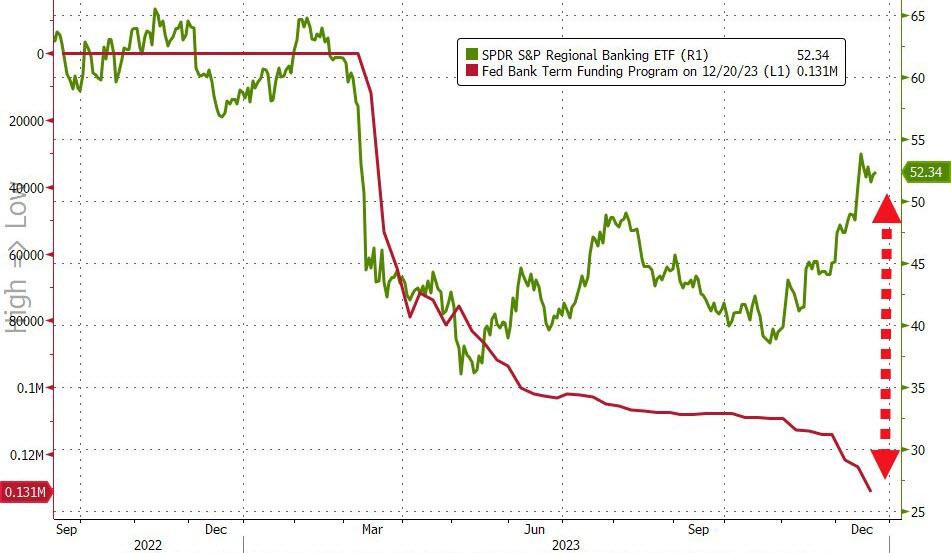
Yesterday we discovered that Regional bank shares have been soaring towards pre-SVB levels despite yet another huge increase to a new record high in the usage of The Fed’s bank bailout facility (now at $131BN)

Source: Bloomberg

We also highlighted the significant ‘arb’ trade available to banks able to use this facility.

However, what was most notable was that money-market funds saw another weekly outflow, potentially setting us up for more deposit inflows at the banks.

On a seasonally-adjusted basis. total bank deposits rose for the second straight week, up $11.4BN…

Source: Bloomberg

Even more impressively, non-seasonally-adjusted, total bank deposits soared by $76BN (the 3rd straight week of inflows), practically back to pre-SVB levels…

Source: Bloomberg

Excluding foreign banks, domestic bank deposits rose $73BN (NSA) and $14.4BN (SA)…

Source: Bloomberg

Excluding foreign bank deposits that means the US banking system is only down $82BN (NSA) from the start of the SVB crisis…

Source: Bloomberg

On a seasonally-adjusted basis, Small banks saw a small $0.4BN deposit outflow, while Large banks saw $14,8BN inflows

Source: Bloomberg

And while Small bank deposits have been rising (NSA), Large bank deposits are soaring (NSA)…

Source: Bloomberg

However, on a seasonally-adjusted basis, neither Small nor Large bank deposit bases have really moved for almost 5 months…

Source: Bloomberg

Are money-market outflows going to bank deposits…

Source: Bloomberg

On the other side of the ledger, Large bank loan volumes shrank for the second week in a row (-$7.5BN) while Small bank loan volumes rose by $5.5BN (5th week in a row of increased small bank loan volumes)…

Source: Bloomberg

As we warned last week, there is potential trouble brewing still as the key warning sign continues to trend ominously lower (Small Banks’ reserve constraint – blue line), supported above the critical level by The Fed’s emergency funds (for now)…

Source: Bloomberg

As the red line shows, without The Fed’s help, the crisis is back (and large bank cash needs a home – green line – like picking up a small bank from the FDIC).

All of which makes us wonder, are we setting up for another banking crisis in March as:

1) BTFP runs out (it was only a 12 month temporary program), and

2) RRP drains to zero, at which point reserves get yanked which means huge deposits flight.

Is that why The Fed needed to bring rates down massively and fast, to reduce the bond losses on banks’ books?

On that cheery note, Happy Christmas!

Tyler Durden
Fri, 12/22/2023 – 16:40

Passive Investing Has “Gone Too Far”, Elon Musk Tells Cathie Wood In Wide-Ranging Spaces Interview

0
Passive Investing Has “Gone Too Far”, Elon Musk Tells Cathie Wood In Wide-Ranging Spaces Interview

Potentially one of the biggest beneficiaries of indexing in public markets was railing against it yesterday when Elon Musk took to a Spaces conversation with ARK Investment Management’s Cathie Wood.

It was one of a number of topics that a wide-ranging discussion covered, including Twitter, the regulatory demands placed on public companies, shareholder scrutiny, artificial intelligence and Tesla.

Talking about public reporting, Musk told Wood: “There’s a lot of pressure, like immense pressure on a public company to not have a bad quarter. So this can actually result in a less efficient operation where you’re going to great lengths at the end of the quarter to not disappoint people.”

He added that the “time horizons do not match between investors versus a company’s long-term vision,” a Bloomberg recap of the call noted.

On the call Musk also advised Wood against companies going public unless it is absolutely necessary. Claiming that Tesla has “created more millionaires than any other company”, he also lamented the “millions of strings” that can be used by regulators to keep companies tied to the ground. 

Musk said that privatizing Twitter enabled him to implement significant alterations at the company, free from the scrutiny of public investors. Twitter’s co-founder, Jack Dorsey, had also consistently maintained that the company faced challenges due to its public investors and supported Musk’s decision to privatize it as a means to revitalize its operations, the report said.

Speaking about the future of X going forward, Musk told Wood he wanted to create a “giant brian”: “We want to create a group mind or collective consciousness where each person is reporting information to the system, and giving their opinion. Think of it as a giant brain.”

“Now, with the internet and a fast-moving platform like X, you can get all the people out there reporting information and distilling it down through the experts,” he said. 

From there, he talked called the media “desperate”, talking about how they are forced to create controversy: “They [the media] don’t have much of a choice. Any media not focused on controversy loses clicks in what is clearly a declining legacy market. Desperate times lead to desperate measures.”

“X is actually growing in traffic. Traditional media is down, but X is up. Of course, the media won’t write that. Instead, they say X is dying. That headline is a little tedious.”

Musk finally praised Jack Bogle for introducing the world to passive investing, but then also said the trend had “gone too far”.

He told Wood: “The percentage of the market that is passive is simply, is too great at this point. At the end of the day, somebody actually has to make an active decision. The passive investors are riding on the decisions of the active investors.

“You get essentially massive movements of the stock, based on the decisions of maybe four or five active major stock pickers,” he concluded. Tesla is an S&P 500 component. 

You can listen to the entire discussion here:

Tyler Durden
Fri, 12/22/2023 – 15:20