64.8 F
Chicago
Sunday, September 13, 2026
Home Blog Page 3073

Market Continues To Shrug Off Efforts By Fed Policymakers To Push Back On Rate Cut Expectations

0
Market Continues To Shrug Off Efforts By Fed Policymakers To Push Back On Rate Cut Expectations

By Jane Foley, Senior FX strategist at Rabobank

Donald Trump may be the front-runner for the Republican candidacy ahead of next year’s US presidential election, but his name cannot appear on the 2024 primary ballot in Colorado due to a ruling by the state’s highest court yesterday. The decision is based on a clause in the 14th Amendment which disqualifies those from public office who swore to defend the US constitution and then “engaged in insurrection or rebellion” against the US – this a reference to Trump’s part in the Capitol attack on January 6, 2020. Trump now has the opportunity to appeal.  The high court is also being asked to decide whether Trump could use presidential immunity from prosecution in regard to his actions in the attack. 

Meanwhile, in a rally in Iowa yesterday, Trump stepped up his verbal outbursts against immigrants accusing them of “destroying the blood of our country”. He used the rally to point out that he had not read Mein Kampt, and that Hitler has used language “in a much different way”. Trump has promised to push back against illegal immigration if elected back to the White House next year and also to restrict legal immigration. The anti-immigration stance chimes with sentiment in various countries in Europe.  Far-right political parties are now reported to be in the top three most popular in almost half the EU.

Yesterday’s remarks by ECB member Villeroy were probably intended to push back on early rate cut expectations. However, since he conceded that rates should probably come lower next year the market took his remarks as having a dovish edge even though he also talked about a plateau for rates and the need for patience. Yields across the German curve shifted lower yesterday even though Villeroy’s comments coincided with those from ECB member Kazaks who indicated that rates needed to stay at current levels for some time to ensure that wage growth slows and that new risks for inflation don’t arise. The release of final November Eurozone CPI inflation data confirmed that the headline rate dropped back to 2.4% y/y from 2.9% the previous month.  Although ECB officials clearly remain guarded about inflationary risks, on the back of Germany’s weak IFO survey results earlier this week and Friday’s dismal Eurozone December PMI data, the market is reluctant to embrace the central bank’s hawkishness. On a one month view the EUR is the second weakest performing G10 currency after the USD. 

The market is also continuing to shrug off efforts by Fed policymakers to push back on market rate cut expectations. Yesterday, Atlanta Fed president Bostic said that there was no urgency to lower rates.  Despite the warnings from Fed officials on policy, US stocks continued to push higher yesterday on rate cut hopes.

[ZH: Rate-cut expectations briefly declined after the initial Powell pivot plunge, but are now heading back to cycle lows, pricing in over 6 rate-cuts for next year]

Overnight, Asian stocks also pushed higher, except for China’s CSI 300.  As expected, no change in benchmark lending rates was forthcoming from the PBoC overnight, though speculation is rife that further easing will be announced in the New Year.

Yesterday morning it was the JPY that was falling hardest, though it has since pulled back from its lows. The sharpness of yesterday’s move illustrates that the market was expecting more hawkish rhetoric from the BoJ’s December policy meeting. Like other central banks BoJ Governor Ueda hinted that policymakers want to see more data before being convinced that a policy move is warranted. This left the market essentially without any firm forward guidance, though surveys indicate that April is currently the favoured months for a BoJ rate hike amongst BoJ watchers.  This would allow the central bank to digest the outcome of the 2024 spring wage talks. 

By contrast, in Canada data is suggesting that inflation is not moving down fast enough. The November headline CPI inflation rate remained at 3.1% y/y, counter to market expectations for a fall to 2.9%. A significant contributing factor was housing, with rents rising 7.4% y/y last month.  This follows separate data from Statistics Canada indicating that the population grew 1.1% in Q3, the highest rate in any quarter since 1957. Immigration may help with labor market shortages, but it also creates unintended consequences. Housing crises are now fairly commonplace in many cities across the developed world. These can be linked with voter dissatisfaction and in some cases the rise in the support for the far-right.

US data brought some comfort on this front. Housing starts grew by a stunning 14.8% m/m and looks set to expand by 25% in Q4, though this followed a 20% contraction in Q3. The bounce back suggests that confidence is returning to the sector, probably encouraged by the decline in mortgage rates. 

Oil is holding is recent gains on concerns over the safety of shipping in the Red Sea. So far, the impact on oil supply appears to have been limited, though the market will continue to monitor the situation.

German and French finance ministers were due to meet in Paris yesterday in an attempt to reach a agreement on the reform of the EU fiscal rules.  The two countries have differing views on how investment levels can be sustained if budget deficits move above target.  As yet, there is no news on a deal, meaning that the market will continue to keep watch today. 

Tyler Durden
Wed, 12/20/2023 – 12:10

And It’s Gone: “War In Ukraine” Quietly Scrubbed From WaPo Masthead

0
And It’s Gone: “War In Ukraine” Quietly Scrubbed From WaPo Masthead

“It’s over” – comments investigative journalist Kit Klarenberg after noticing that The Washington Post quietly deleted a prominent tab from its Masthead. 

What was a long featured “War in Ukraine” tab, which had been there from the start of the war going back to Feb. 2022 has disappeared…

An Internet Archive search and review of all Washington Post frontpages shows the tab was there throughout all of 2022. It was also present through most of 2023, until very recently.

Ironically just yesterday Ukraine’s President Zelensky again complained that the world’s focus has been taken off supporting his country’s struggle due in large part to the events in Israel and Gaza.

In an interview weeks ago, he had laid out that “We already can see the consequences of the international community shifting (attention) because of the tragedy in the Middle East. He added at the time: “Only the blind don’t recognize this.”

WaPo’s change in its frontpage is certainly emblematic of this trend, but also the war fatigue that has long gripped the American public, and the widespread acknowledgement that Ukrainian forces are losing. 

Still, readers can navigate the WaPo’s homepage and still eventually get to a “War in Ukraine” tab, by first clicking on the “World” tab located third from last on the masthead. Ukraine’s supporters are none too happy about this highly symbolic development…

Is it time for the Zelensky government and its external powerful backers to get serious about peace negotiations yet? While Zelensky still says no, it seems the rest of the world and Western public is long past ready.

Tyler Durden
Wed, 12/20/2023 – 11:50

X Marks The Spot: Social Media’s Last Stand

0
X Marks The Spot: Social Media’s Last Stand

Authored by Michael Rectenwald via The Mises Institute,

Ever since Elon Musk acquired Twitter, now X, the censorship regime has been hell-bent on harassing the company and Musk himself – with bad publicity, accusations of antisemitism, and advertiser boycotts. Musk struck back by threatening to sue the Anti-Defamation League, suing Media Matters for defamation, and famously telling fleeing advertisers “Go f*ck yourself.”

Musk’s X has the potential to weaken the Big Digital woke cartel, which censors content, censures and bans users, and serves as a propaganda arm of the globalist totalitarian statists whom the cartel so assiduously serves. I have argued that Musk’s X gambit would represent an important test case because it pits “the world’s richest man” against these woke cartel members and the state that benefits from their allegiance and compliance, demonstrating just how much they infringe on property rights by controlling what Musk can do with his own property.

Shortly after Musk moved to buy then-Twitter, several dozen countries and international governance bodies—including the United States and the European Union—announced the ratification of “A Declaration for the Future of the Internet,” which, among other things, aims to “bolster resilience to disinformation and misinformation, and increase participation in democratic processes.” Just two days after Musk announced that he was buying the company, the Biden administration announced the formation of a “Disinformation Governance Board,” which has since been scrapped, at least in name.

In October 2022, I noted that one of the major threats posed to Musk’s platform would come from the European Commission (EC)—with its new Digital Services Act (DSA), signed into law on November 16, 2022 and put into effect in August 2023. In fact, the EC began threatening Musk with control of his social media platform’s content from the moment he took over. After Musk posted, “the bird is freed,” EC chief Thierry Breton quote-posted: “In Europe, the bird will fly by our EU rules.” Breton no doubt referred to the EC’s DSA, which aims to ban “illegal and harmful content” across Europe.

Now, the EC is launching proceedings against X for alleged violations, including the “dissemination of illegal content in the context of Hamas terrorist attacks on Israel.” On Monday, December 18, 2023, Breton—the EC commissioner responsible for enforcing the DSA—posted a harrowing notice of the proceedings on X: “Today we open formal infringement proceedings against @X:/Suspected breach of obligations to counter #IllegalContent and #Disinformation/Suspected breach of #Transparency obligations/Suspected #DeceptiveDesign of user interface.” Unsurprisingly, X is the first social media company to face such scrutiny from the EC under its new law.

In fact, the DSA aims at universalizing content moderation by large-scale social media platforms and search engines, subjecting them to the EU’s stringent and anti-free-speech laws against “disinformation” and “hate speech,” which are not (yet) recognized legal categories in the United States. X is being compelled to abide by EU-enforced content moderation for its EU users. Otherwise, it could be fined 6 percent of its global income or be banned from operating across the EU if it is found to have breached the law. Banning EU users would mean that Europeans would not have access to X—unless, that is, they use a VPN. However, given that X will be forced to abide by EU content moderation, it’s very likely that X will simply be bound to apply the DSA’s rules to all content.

The censorship regime that has acted behind closed doors and through secret backchannels in the US—as revealed in the Twitter Files and Missouri v. Biden ruling—has now come out into the open with the EC’s policies and investigations. The shot across the bow fired by the EC represents the potential to ruin X entirely, either by forcing it to censor content more than before Musk bought the company or by fining and starving it of European users.

Should X be taken down by the EU and other statists or should speech be severely curtailed on the platform, the digital town square promised by Musk will simply not exist.

Users will be forced to self-censor, “violators” will be censored, and repeat “violators” will be banned.

That means that the regime’s narratives will go largely unchallenged, and counternarratives – which are often true or simply represent differing perspectives – will be exiled and driven underground. X may be the last stand for free speech on social media.

Tyler Durden
Wed, 12/20/2023 – 11:30

Cry Victim: Chicago Mayor Rages Over Buses Of Immigrants From Texas

0
Cry Victim: Chicago Mayor Rages Over Buses Of Immigrants From Texas

Leftists hate being exposed as hypocrites.  Much of their social influence depends on two false notions – That they are rebels against the establishment and that they are the victims of oppression.  In reality, the political left is the favored movement of the establishment and they are only ever victims of their own incompetence, lust for power and delusions of grandeur.  The humanitarian costume they wear is easy to tear away – All you have to do is demand they follow through on their “principles” instead of only serving their own interests.

This is how Texas Governor Greg Abbot (among others) has taken the legs out from under pro-sanctuary Democrats – By giving them exactly what they claimed they wanted.  

Tens of thousands of illegal migrants have now been bused to multiple sanctuary cities including Chicago, New York And Washington D.C. And needless to say, the progressives in these places are not happy.  Texas towns deal with millions of illegals every year due to the Biden Administration’s asylum policies and open border policies.  The issue is growing more out of control with each passing month and 2023 is set to become the worst year ever for migrant crossings.  Yet, a handful of the same migrants are now crippling the welfare apparatus of multiple blue cities.

The far-left Chicago Mayor Brandon Johnson is furious in the face of the overwhelming economic strain created by the influx of migrants.  The same mayor proudly declared Chicago a sanctuary city in May of this year:

“Chicago is a sanctuary city. As such, we must always resist attempts to pit communities against each other and extend this sanctuary promise to everyone who needs it in our city – both long-time residents and newcomers alike.”  

Today, Johnson is calling for a stop to the migrant buses, suggesting that Chicago cannot financially handle the population surge.  Furthermore, Johnson labeled Greg Abbott’s busing measures an “attack on the country.” 

The reasons for the progressive support of open borders and mass immigration are transparent:  They are luring in caravans of foreigners from mostly socialist leaning nations with the intent to eventually give them asylum and voting rights.  It is an attempt to upend the very fabric of US culture and secure a political majority forever.  It’s an immoral plan, but also an effective plan.  They are using our own tax dollars to entice migrants with welfare subsidies; they are using our money to buy a new voting block to tip the scales of power in their favor.  

This is not a theory, this is an agenda leftists admit to.  There are multiple states and cities in which Democrats have introduced measures to allow non-citizens to vote in elections.  Most of these actions have been implemented in the past year leading into 2024.  Then there is the always looming possibility that Democrats will force an amnesty bill into law, giving automatic citizenship to millions of foreigners without regard for economic concerns. There is a clear agenda to overwhelm America’s elections with foreign votes.   

The plan doesn’t really work, though, if all these illegals are bused out of red states or red counties and into predominantly blue regions of the nation.  If the Dems can’t destabilize red states or turn those states blue, then the immigrants are of no use to them.  In fact, the immigrants become a millstone dragging blue cities and states down into the economic depths.

Here we see the sudden and predictable disappearance of so-called “progressive empathy.”  They want open borders, but they want migrants to stay in conservative regions where they serve a political purpose.  They never intended for illegals to flood into their own blue neighborhoods.  The outrage that leftist mayors like Brandon Johnson are feeling right now is of their own making.  They did this to themselves.   

Tyler Durden
Wed, 12/20/2023 – 09:00

From Magnificent 7 To A New Team: Conquering Bandwagon Bias

0
From Magnificent 7 To A New Team: Conquering Bandwagon Bias

Authored by Michael Lebowitz via RealInvestmentAdvice.com,

As investors cheer on the Magnificent 7, some football fans are forging new allegiances in hopes of rooting for the coming Super Bowl champion. The task isn’t easy. Recent favorites like the Bills and Bengals are fighting to make the playoffs. Indeed, a few fans of those teams will jump on the recently popular Dolphins or Lions bandwagon. Others may stick with the dependable Eagles, Chiefs, and Forty Niners.

Stock market investors and football fans are not that different. As 2023 ends, professional and amateur investors start thinking about what stock or investment theme bandwagon to jump on for the coming year.

This year, the Magnificent 7 stocks are the odds-on favorites to win the stock market Super Bowl. While hats off to those profiting from the Magnificent 7, we must look ahead. To do so, we must appreciate the bandwagon bias harbored in our mindsets and not let it cloud our vision of the future.

Bandwagon Bias Of 2023

Bandwagon bias is a psychological phenomenon that happens when people do something because others are doing it already. Often called following the herd in market parlance, the bandwagon bias forces many investors into decisions they ultimately regret.

This year’s most popular investment bandwagon is the Magnificent 7, comprised of Apple, Microsoft, Google, Tesla, Nvidia, Amazon, and Meta. The graphs below, courtesy of Goldman Sachs, and our table show these 7 stocks gained 71% this year to date, while the remaining 493 stocks added a mere 6%. The outperformance pushed up their contribution to the S&P 500 to nearly 30%. Lastly, the sharp increase in stock prices led to even more extreme valuations for the group.

The Magnificent 7 are fundamentally stronger companies than the aggregate of the S&P 500. Per Goldman Sachs, revenues for the Magnificent 7 are expected to grow by 8% more than the S&P 500. At the same time, net margins are forecasted to be around 21% for the next two years. Such is double the S&P 500.  

Is their share price outperformance justified? Yes. However, if the prices outperformed their fundamentals, as may likely be the case, it will now be much harder for a repeat performance in 2024.

Nvidia Vs. Albemarle

To help appreciate what may lie ahead, we compare Nvidia to Albemarle. Nvidia is up 230% year to date. As a result of the stock surge, Nvidia’s investors are paying a 250% premium for Nvidia’s earnings versus those of the S&P 500. Nvidia’s earnings will undoubtedly grow faster than the market for a while, but by how much and for how long? Can they avoid competition and margin pressures while keeping sales elevated long enough to justify the premium?

The world’s largest lithium producer is in quite the opposite shoes. Despite strong demand for lithium from electric vehicles (EV) and a projected shortfall of lithium to meet growing EV needs, Albemarle investors only demand a price to earnings of five, about one-fifth of the S&P 500. Its shares are down about 30% year to date.

Despite the significant value in Albemarle compared to Nvidia, investors continue to chase Nvidia and sell Albemarle. Comparing them does not endorse owning Albemarle or selling Nvidia, but they show how markets can be very inefficient.

Narratives Drive Markets

As we highlight with Nvidia and Albemarle, in the short run, narratives and bandwagons of investors drive individual stocks and markets, regardless of whether the narrative makes sense.

Only a few months ago, the popular narrative in the bond market warned that massive U.S. Treasury issuance was responsible for pushing yields higher. Well, such issuance has continued unabated, but yields have fallen precipitously. Despite the reality of the situation, as outlined in Context and Facts Expose Bearish Narratives, the narrative reinforced a growing bandwagon, resulting in higher yields. Today, the narrative and bandwagon are limping along.

Such is the nature of bandwagons. This year, the Magnificent 7 was the bandwagon to be on. It’s easy to assume that what worked in 2023 will work in 2024. That may be the case. Or it may be the case for the first four months. While the narrative is strong, it can fade quickly, like the bond narrative.

Understanding our bias toward owning the Magnificent 7 allows us to make rational decisions when the narrative changes. Lingering on yesterday’s bandwagon can be dangerous. Just ask those short bonds on the Treasury issuance narrative.

Equally important, renting, not owning, a bandwagon allows us to shift to the winning theme more quickly.

For example, since early November, small-cap stocks have handily beat the S&P 500 and Magnificent 7. These stocks are interest rate sensitive. Ergo, the more dovish Fed stance should help these relatively beaten-down stocks more than the less interest rate-sensitive large-cap stocks. Small-cap stocks may or may not be the winning bandwagon for 2024.

Summary

The graphic below shows that the Super Bowl tends to have different teams vying for the trophy each year. Some helmets appear more often than others, but there are few consecutive champions.   

Such is like investing. The Callan Periodic Table of Investment Returns below ranks investment performance by year for key indices. As you will notice, there is no predominant winner year in and year out.

Bandwagon bias can be good as riding the hot theme or group of stocks helps investors grow their wealth. Unfortunately, jumping on a market bandwagon too late can come with steep costs.

As we enter 2024, be open to the possibility that last year’s winners will not take the crown this year.

We don’t know what will replace the Magnificent 7 or when, but we will be sure to keep our bias in check and stay open to new ideas.

Tyler Durden
Wed, 12/20/2023 – 08:41

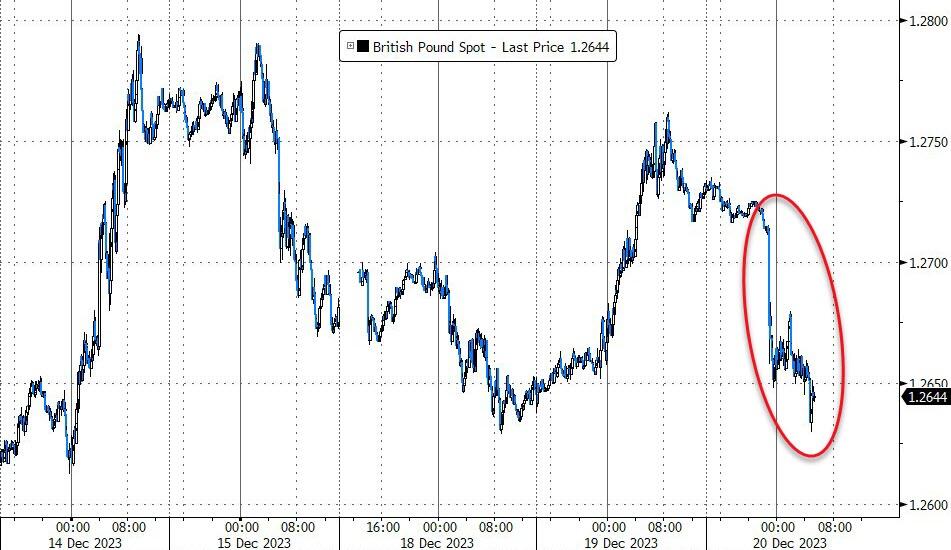
BoE Rate-Cut Odds Soar, Cable Tumbles After UK Inflation Slows Far More Than Expected

0
BoE Rate-Cut Odds Soar, Cable Tumbles After UK Inflation Slows Far More Than Expected

UK inflation slowed far more than economists forecast in November, prompting traders to increase bets that the Bank of England’s ‘higher for longer’ narrative will be discarded, just like The Fed’s.

The November inflation print showed services, core, and headline inflation surprising consensus and BoE expectations meaningfully to the downside.

  • Services inflation declined to 6.3%yoy in November (from 6.6%yoy in October), below both consensus expectations of 6.6%yoy and the BoE’s projection of 6.9%yoy.

  • Core CPI inflation moderated to 5.1%yoy in November (from 5.7%yoy in October), five-tenths below consensus expectations.

  • Headline CPI inflation to 3.9%yoy in November (from 4.6%yoy in October), also below consensus expectations of 4.3%yoy and the BoE’s projection of 4.6%yoy.

The results represented the third downward surprise in the past four months and the biggest since inflation concerns took hold in 2021.

The November data – the first time food inflation has been in single digits since June 2022 – will bolster Prime Minister Rishi Sunak, who has vowed to bring prices under control ahead of the election expected next year.

However, as Sandra Horsfield of Investec notes, it was not clear that the UK public would celebrate the fall in inflation as much as markets.

“Lower inflation only means a slower (and still above target) rate of price rises,” she said, arguing that the electoral benefit of meeting Sunak’s promise “may be limited”.

Chancellor Jeremy Hunt welcomed Wednesday’s data, saying it showed that “we are starting to remove inflationary pressures from the economy”.

“Many families are still struggling with high prices so we will continue to prioritise measures that help with cost of living pressures,” he added.

The surprisingly sharp fall sent BoE rate-cut odds soaring, with March odds jumping and May now pricing in a full cut…

“This startling fall in inflation will further reassure people and businesses that there is light at the end of the tunnel in the struggle against eye-watering price rises,” said Suren Thiru, economics director at accountancy trade body the ICAEW.

“These inflation numbers suggest that the Bank of England is too pessimistic in its rhetoric over when interest rates could start falling.”

Source: Bloomberg

“The surprisingly low reading in today’s UK CPI figures is questioning last week’s impression after the MPC meeting that the UK might be one of the slow movers when it comes to rate cuts in 2024 and beyond,” said Ulrich Leuchtmann, head of FX research at Commerzbank AG in Frankfurt.

Which also helped send cable lower…

Source: Bloomberg

Taken together with the sharp slowing in sequential wage growth observed last week, recent data on key indicators of inflation persistence have surprised the BoE’s projections meaningfully to the downside, and Goldman Sachs pulls forward their first BoE cut to May (vs June previously).

They continue to expect the MPC to cut at a 25bp per meeting pace until the policy rate reaches 3.0% in May 2025.

On a probability-weighted basis, their Bank Rate forecast remains significantly below market pricing in 2024H2 and into 2025.

Tyler Durden
Wed, 12/20/2023 – 08:32

Futures Slide, Brent Jumps Back Over $80 As Red Sea Woes Spread

0
Futures Slide, Brent Jumps Back Over $80 As Red Sea Woes Spread

US equity futures and global markets reversed their torrid rally as bonds rallied and the dollar gained after a fresh batch of soft inflation data in the UK boosted the likelihood of interest-rate cuts, but also underscored the risk of an economic downturn. As of 7:45am, S&P eminis dropped 0.2% after the index notched a record high for the third successive session, with European and Asian stocks in the red. Germany 10-year yields dropped below 2% for the first time in nine months after a report showed producer prices fell more than expected in November. Meanwhile, British 10-year borrowing costs slid as much as 11 basis points as slower-than-expected inflation boosted the case for multiple rate cuts next year. Treasury yields slid four basis points to 3.9%, down more than 40 this month. Brent jumped above $80 to a 3 week high after the US considered possible military strikes against Houthi rebels in Yemen, in a recognition that a newly announced maritime task force meant to protect commercial ships in the Red Sea may not be enough to eliminate the threat to the vital waterway. US economic data includes 3Q current account balance (8:30am), November existing home sales and December consumer confidence (10am).

In premarket trading, FedEx shares tumbled as 10% after the parcel company’s fiscal second-quarter profit came in below expectations, with analysts pointing to a particularly disappointing performance from the Express air-freight unit, which was hit by slowing volumes. Brokers added that the company’s outlook lacked visibility, with Citi calling it “vague.” Here are some other notable premarket movers:

  • Cinemark drops 3.5% in premarket trading as Wells Fargo downgrades the movie theater operator to underweight from equal-weight based on an unattractive box office outlook.
  • Clear Channel Outdoor Holdings rises 7.7% in premarket trading on Wednesday after Wells Fargo Securities raised the recommendation on the advertising company to overweight from equal-weight. The broker says the upgrade comes as the company returns to growth.
  • Coupang slides 1.6% in premarket trading as UBS downgrades its rating to neutral, awaiting greater clarity on the e-commerce company’s strategy.
  • Discover Financial shares rise as much as 1.4% in premarket trading Wednesday after the credit card issuer was upgraded to buy from neutral at Citigroup, which also opened a 90-day catalyst watch on the stock saying investors should get more insight about the scope of credit losses when it reports fourth-quarter results in January.
  • General Mills (GIS) slides 4.7% ahead of the bell after the packaged food company reported organic volume and sales for the second quarter that fell short of consensus estimates. GIS also cut its annual organic sales forecast, citing a slower-than-expected volume recovery amid a more cautious consumer economic outlook and a faster normalization of product availability from competitors. .
  • Kellanova, Kraft Heinz and Conagra fall premarket after General Mills reported sales and volumes that missed consensus estimates for the second quarter and cut its annual organic sales view. Kellanova -1.6%, Kraft -1.2%, Conagra -1%.

Markets have rallied hard in recent weeks after the Fed’s dovish pivot which helped put the tech-heavy Nasdaq 100 on course for its best year since 1999, while the S&P 500 is less than 1% off its record closing peak. Bulls got fresh encouragement Tuesday from Richmond Fed President Thomas Barkin, who suggested the US central bank would “respond appropriately” if recent progress on inflation continued. Money markets now price almost a 50% chance of an euro-area rate cut by next March, while seeing an even higher probability of a Fed cut that month. That said, even Powell’s unofficial mouthpiece, Nikileaks, aka Nick Timiraos is now warning that the market that it has gone up too far, too fast.

At the same time, investors are also having to balance rate-cut optimism against the risk of economic recession. Recent data has backed that view, especially in the euro area, with analysts surveyed by Bloomberg forecasting the first recession since the pandemic.

“It’s hard to see such a fast and deep rate-cutting cycle as the market appears to assume, unless the base case is a deep recession,” said Daniele Antonucci, chief investment officer at Quintet Private Bank.

Investors are also starting to weigh risks stemming from potential shipping delays and freight cost increases, as companies divert cargoes away from the Red Sea to avoid militant attacks. This rerouting will mean higher shipping costs and longer delivery time, and has helped push brent crude prices above $80 for the first time in 3 weeks.

The big econ news overnight was the latest confirmation that a global deflationary wave is being unleashed, with UK reporting inflation that came in below the lowest estimate.  The UK data “adds to the mounting evidence that global inflation has begun to crumble on a broader basis,” said Christoph Rieger, head of rates research at Commerzbank.

While the data initially boosted European stocks, gains on the Stoxx 600 index quickly evaporated, though London’s export-oriented FTSE 100 benchmark held its gains as the pound tumbled on the prospect of looser monetary policy. The telecom sector lead the advance, boosted by Spain’s Telefonica. The health-care sector underperforms, meanwhile, dragged lower by Argenx, which plunges after disappointing drug trial data. Among single stocks, shipping companies Hapag Lloyd AG and AP Moller-Maersk A/S rallied as militant attacks continued to disrupt Red Sea container traffic. Here are the biggest movers Wednesday:

  • Telefonica shares jump as much as 7.2% after the Spanish state unveiled a plan to buy up to 10% in the telecom operator to counter stakebuilding by Saudi Telecom Co.
  • Intertek gains as much as 3.7% after BNP Paribas Exane double-upgrades to outperform, saying in note that consensus is now overly bearish on margin outlook
  • Raiffeisen Bank surges 12%, the most since March 2022, following its deal to buy a stake in Austrian construction company Strabag, with Citi upgrading the stock to buy from neutral
  • British stocks rally as data showed inflation in the UK slowed far more than expectations, driving European stocks closer to early 2022 record, with landlords leading the advance
  • Indivior gains as much as 4.5% after settling a drug patent dispute with rival Actavis, which now is granted a license to the patent that would enable Actavis to launch a generic variant
  • Ionos gains for a ninth day as Morgan Stanley says the webhosting firm has delivered “two early Christmas presents” in strong guidance on Tuesday and last week’s debt refinancing.
  • Argenx shares plunge as much as 35% after its key drug Vyvgart (efgartigimod) failed another trial, a second setback in less than a month for the Brussels-listed biotech firm
  • DS Smith falls as much as 2.8% after UBS downgraded the paper and packaging company to neutral from buy, saying the downgrade reflects weaker containerboard prices
  • Inficon shares fell as much as 5.3%, the most in two months, after the Swiss vacuum instruments manufacturer was downgraded to reduce from add at Baader Helvea
  • Resurs Holding drops as much as 8.3% after SEB Equities downgrades the retail finance company to sell from hold, giving the stock its only negative analyst rating

Earlier in the session, Asian stocks rose for a second straight day, as Japanese shares extended gains following the Bank of Japan’s decision to stand pat on interest rates on Tuesday. The MSCI Asia Pacific Index advanced as much as 1% to its highest since Aug. 8, with Tencent and Samsung Electronics among the biggest contributors to the gauge’s rise. Exporter stocks led Japan’s benchmarks higher as the yen weakened after the country held on to the world’s last negative interest rate regime. Indexes across South Korea, Hong Kong and Southeast Asia also gained as traders looked past Federal Reserve officials’ pushback on aggressive interest rate-cut expectations. The gains across Asia follow two days of cautious trading during which investors assessed the path of US monetary policy in 2024.

  • Hang Seng and Shanghai Comp traded mixed with the former’s gains spearheaded by large caps with US listings, including Alibaba, JD.com, and Baidu. Mainland China was subdued after PBoC maintained its Loan Prime Rates as expected and despite more liquidity injections by the central bank.
  • Nikkei 225 surged as the index reacted to BoJ Governor Ueda’s dovish press conference following the unchanged announcement yesterday.
  • ASX 200 saw its upside supported by the Energy and Metals sectors, whilst Tech lagged with shallower gains.

In FX, GBP/USD falls as much as 0.7% to below $1.27 after UK CPI data, EUR/USD down 0.3%; the Bloomberg Dollar Spot Index is largely unchanged as the US currency’s gains versus European currencies are offset by its slide against the yen. The Japanese yen is the best performer among the G-10 currencies, rising 0.3% versus the greenback on false expectations that the BOJ will end its negative rate policy in the coming months which has supported the yen. The dollar has been struggling as investors seek more guidance from the Fed on how soon it will begin cutting rates next year as inflation slows; however Chicago Fed’s Goolsbee said on Tuesday that the market may be getting ahead of itself when it comes to rate cuts.

“Speculative bets on a BOJ policy change are likely to ease for now,” said Fukuhiro Ezawa, head of financial markets in Tokyo at Standard Chartered Bank. “Markets price in deep Fed rate cuts, weighing on the dollar” against peers including the yen, he said

In rates, the yield on the 10-year US Treasury slips 4bps to 3.88%, its lowest since late July. Traders are betting that the Fed will cut rates by 150bps by the end of 2024, compared with around 140 bps on Tuesday. UK gilts rallied while the pound drops after data showed UK inflation slowed more than expected in November, fueling bets on interest rate cuts by the Bank of England next year. UK two-year yields fall 15 basis points to 4.14%, a seven-month low.

In commodities, oil extended its recent rally amid prospects of more disruptions in the Red Sea, while the US weighs military strikes on Houthis. Brent jumped above $80 to a three week high. Brent March call options in the $90s were active again on Tuesday as traders continue to weigh the risks to traffic in the Red Sea. WTI’s second-month 25-delta put skew was the least bearish since mid-November. Brent’s prompt spread climbed to the strongest since Dec. 5, while its Dec.-Dec. spread was the firmest this month.

Bitcoin (+0.6%) and Ethereum (+1.2%) extended gains as BTC rose back over USD 43k. BlackRock, Nasdaq, SEC met regarding a Bitcoin (BTC) ETF, via CoinDesk

Looking to the day ahead now, and data releases from the US include the Conference Board’s consumer confidence for December, existing home sales for November, and the Q3 current account balance. In the Euro Area, there’s the European Commission’s preliminary consumer confidence indicator for December, and there’s also the UK CPI and German PPI readings for November. From central banks, we’ll hear from the Fed’s Goolsbee and the ECB’s Lane.


Market Snapshot

  • S&P 500 futures down 0.2% to 4,812.50
  • STOXX Europe 600 little changed at 476.63
  • MXAP up 0.5% to 165.32
  • MXAPJ up 0.2% to 515.45
  • Nikkei up 1.4% to 33,675.94
  • Topix up 0.7% to 2,349.38
  • Hang Seng Index up 0.7% to 16,613.81
  • Shanghai Composite down 1.0% to 2,902.11
  • Sensex down 1.1% to 70,636.67
  • Australia S&P/ASX 200 up 0.7% to 7,537.88
  • Kospi up 1.8% to 2,614.30
  • German 10Y yield little changed at 1.99%
  • Euro down 0.2% to $1.0961
  • Brent Futures up 0.8% to $79.87/bbl
  • Gold spot up 0.1% to $2,041.67
  • U.S. Dollar Index little changed at 102.26

Top Overnight News

  • Bond yields across the euro region fell on Wednesday as worsening economic data and slowing inflation underscored expectations for interest-rate cuts next year.
  • UK inflation slowed far more than economists forecast in November, a surprise that prompted traders to boost bets the Bank of England will soon have to abandon its higher-for-longer narrative on interest rates.
  • Attacks in the Red Sea linked to the Israel-Hamas war will cause shipping delays and drive up the price of goods, bringing a new inflation risk to the economy.
  • Jonathan Hoffman, John Bonello and Jonathan Tipermas share more than just similar first names. They’re the driving force behind a gigantic wager on government debt that’s been giving regulators sleepless nights.
  • Donald Trump is ineligible to serve as US president because of his actions inciting the Jan. 6, 2021 attack on the US Capitol, Colorado’s highest court found, in an unprecedented ruling that’s headed for the US Supreme Court.
  • Throngs of consultants wearing Western attire have become a common sight in the lobbies of Riyadh’s plushest hotels as Crown Prince Mohammed Bin Salman embarks on a multi-trillion dollar plan to wean Saudi Arabia off oil. In recent months they’ve been joined by another cohort of besuited individuals: fund managers, keen to get an early foothold in the next big emerging-market growth story.

A more detailed look at global markets courtesy of NEwsquawk

Asia-Pac stocks traded mostly positively following the tailwinds from Wall Street, although newsflow overnight was on the quieter side amid the pre-Christmas lull. ASX 200 saw its upside supported by the Energy and Metals sectors, whilst Tech lagged with shallower gains. Nikkei 225 surged as the index reacted to BoJ Governor Ueda’s dovish press conference following the unchanged announcement yesterday. Hang Seng and Shanghai Comp traded mixed with the former’s gains spearheaded by large caps with US listings, including Alibaba, JD.com, and Baidu. Mainland China was subdued after PBoC maintained its Loan Prime Rates as expected and despite more liquidity injections by the central bank.

Top Asian News

  • PBoC maintained its 1-year and 5-year LPRs at 3.45% and 4.20% respectively, as expected.
  • PBoC injected CNY 134bln through 7-day reverse repos at 1.80% and CNY 151bln via 14-day reverse repos at 1.95%; both rates maintained
  • The Japanese government is to raise its long-term interest rate estimate to 1.9% for FY24 from 1.1% in FY23, according to Nikkei.
  • Japanese Cabinet projects that income will increase more than prices in FY24, according to Nikkei.
  • State-backed developer China South City averts default on July 2024 note after consent from bondholders, according to SCMP.
  • RBNZ Governor Orr said interest rates are restricting spending and levels of core inflation remain too high, according to the Parliamentary hearing. He noted that Q3 GDP was surprisingly subdued, and inflation remains too high and the committee remains wary of ongoing inflationary surprises. He said the neutral interest rate is now 2.5%.
  • New Zealand DMO and fiscal update: gross bond issuance for four years to June 2027 now totals NZD 136bln, up from NZD 129bln in the budget. 2023/24 gross bond issuance increases to NZD 38bln from NZD 36bln in budget. Treasury sees GDP growth in Q4 23 and through 2024.
  • Japan is to draft an initial FY24 budget of JPY 112tln, via Kyodo News
  • Japanese government is to lower the scheduled sales of JGBs to market by 11.2% from FY23 plan to JPY 171tln in FY24/25, via Reuters citing a draft

European bourses, Eurostoxx50 (-0.2%), are marginally weaker having spent much of the morning the green; the FTSE 100 (+0.8%) outperforms post-UK CPI. European sectors are mixed with Energy outperforming lifted by gains in underlying Crude prices and Telefonica (+5%) helps lift Telecoms; Technology narrowly lags. US Equity Futures are lower across the board as the Santa Rally comes to a pause, ES (-0.2%); FedEx (-9.9%) extends losses in the pre-market post-earnings.

Top European News

  • ECB’s Nagel says there is a high probability that the interest rate peak has been reached, according to t-online; would say to everyone who is speculating on an imminent interest rate cut: be careful, some people have already speculated.
  • France and Germany see an EU deal on fiscal rules on Wednesday, according to Bloomberg.
  • Bank of France Survey: Expectations for inflation one year out ease to 3.5% in Q4 (prev. 4%); 3.5% increase in wages (prev. 3%)

FX

  • DXY propped up by the softer Pound and Euro, though with gains capped by upside in the Yen; within a 102.14-34 range.
  • The Pound is the G10 laggard post-CPI, falling to a session low of 1.2648.
  • EUR is weighed on by the firmer Dollar, with softer German PPI unhelpful for the Single-Currency while EUR/GBP action offers only marginal respite.
  • The Yen is the best performer amongst the G10s, paring back some of yesterday’s BoJ’s induced losses, but yet to test 143.00.
  • PBoC sets USD/CNY mid-point at 7.0966 vs exp. 7.1300 (prev. 7.0982)

Fixed Income

  • USTs are modestly higher in tandem with Gilts as markets await the US 20yr auction and further speak from Fed’s Goolsbee.
  • Gilts outperforms after cooler-than-expected UK CPI, adding to dovish expectations for 2024; gapped higher by almost 100 ticks and thereafter eclipsed 103.00.
  • Bunds are bid in conjunction with Gilts and after its own softer Producer Prices metrics; German 10yr yield sub-2.0% for the first time since March.

Commodities

  • WTI and Brent (+1.2%) are bid having spent the overnight session relatively indecisive; specifics have been light and largely led by geopolitical themes.
  • Spot Gold (-0.1%) resides on either side of the unchanged mark, holding on to the prior day’s gains; Base metals are generally in the green, though with gains capped amid poorer sentiment in China overnight.
  • Intensive talks are underway on a potential second Gaza truce, via Reuters citing sources; envoys looking at which hostages could go free.

Geopolitics

  • US reportedly weighs whether to attack Houthis beyond defensive task force and possible strikes on Houthis in Yemen considered, according to Bloomberg sources; no decision made yet on striking Houthis. The US and its allies are considering possible military strikes against Houthi rebels in Yemen, in recognition that a newly announced maritime task force meant to protect commercial ships in the Red Sea may not be enough to eliminate the threat to the vital waterway. Planning is underway for actions intended to cripple the Houthis’ ability to target commercial ships by hitting the militant group at the source.
  • Israel is offering to pause the fighting in Gaza for at least one week as part of a new deal to get Hamas to release more than three dozen hostages, according to Axios sources.
  • Malaysia bans Israeli-based shipping firm Zim from its ports, with the ban set to take effect immediately, according to the Malaysian PM.

US Event Calendar

  • 07:00: Dec. MBA Mortgage Applications -1.5%, prior 7.4%
  • 08:30: 3Q Current Account Balance, est. -$196b, prior -$212.1b
  • 10:00: Nov. Home Resales with Condos, est. 3.78m, prior 3.79m
    • Nov. Existing Home Sales MoM, est. -0.4%, prior -4.1%
  • 10:00: Dec. Conf. Board Consumer Confidence, est. 104.5, prior 102.0
    • Dec. Conf. Board Present Situation, prior 138.2
    • Dec. Conf. Board Expectations, prior 77.8

DB’s Henry Allen concludes the overnight wrap

The relentless market rally has continued over the last 24 hours, with investors remaining confident that central banks will soon pivot towards rate cuts, despite the pushback from several officials over recent days. In fact, yesterday saw the S&P 500 (+0.59%) hit another 23-month high, which leaves the index less than 1% beneath its all-time closing peak back in January 2022. That also means t he index has now risen by +15.8% in less than two months, and we haven’t seen an advance that fast since March-May 2020, back when the S&P 500 was recovering from the initial Covid selloff. At the same time, sovereign bonds have continued to rally, and overnight the 10yr Treasury yield has fallen to its lowest level since July, at 3.91% .

This growing anticipation of rate cuts was supported by Richmond Fed President Barkin, who said that “If you’re going to assume that inflation comes down nicely, of course we would respond appropriately”. That helped push Treasury yields lower, and offered support for the idea that the Fed would cut rates if inflation fell, since otherwise it would mean that policy was becoming more restrictive in real terms. But we also had a more hawkish take from Atlanta Fed President Bostic, who said that “there’s not going to be urgency for us to pull off our restrictive stance”, expecting only two rate cuts in 2024, rather than the three rate cuts that the median dot suggested. Both are voting members of the FOMC in 2024.

Against that backdrop, investors continued to price in a strong chance of a Fed rate cut by March, with the probability moving up from 75% to 83% yesterday. And it was the same story for the ECB, where the chance of a March cut rose from 35% to 49%, even as Latvia’s central bank governor said that “it is too early to declare victory over inflation” .

Those moves led to a s izeable rally in sovereign bonds in the European session. Yields on 10yr OATs (-8.5bps) fell to their lowest level since February, those on 10yr gilts (-4.3bps) fell to their lowest since April, and those on 10yr BTPs (-13.4bps) were at their lowest since December 2022. 10yr bund yields (-6.3bps) also fell back, although they were just above their closing level from Friday, at 2.01%. Over in the US, 10yr Treasury yields had traded nearly -4bps lower early on in the US session but were flat by the close (-0.1bps) at 3.93%, but overnight they’ve since fallen -2.4bps to 3.91%.

That growing conviction about rate cuts came despite some hawkish-leaning data that was released yesterday. For instance, Canada’s CPI print for November was stronger than expected, with headline CPI remaining at +3.1% (vs. +2.9% expected). Moreover, US housing starts also surprised on the upside, hitting a 6-month high in November as they rose to an annualised rate of 1.56m (vs. 1.36m expected). The release meant that the Atlanta Fed’s GDPNow estimate rose another tenth yesterday, and it now sees US Q4 GDP expanding at an annualised +2.7% pace .

The prospect of faster growth alongside rate cuts proved supportive for equities, and the S&P 500 (+0.59%) advanced for the 8th time in the last 9 sessions. It was a broad-based advance, with 23 of the 24 S&P 500 industry group up on the day and both the FANG+ index (+0.51%) and the Dow Jones (+0.68%) reaching all-time highs. Small-cap stocks did particularly well on the day, and the Russell 2000 (+1.94%) surpassed its recent peak in July to close at its highest level since August 2022. Meanwhile in Europe, the STOXX 600 (+0.36%) closed at a 22-month high, with its YTD gain now standing at +12.27%.

That optimism has been echoed in Asia overnight, where most indices have seen a decent rally. That includes the KOSPI (+1.65%), the Nikkei (+1.51%) and the Hang Seng (+1.08%), although the CSI 300 (-0.50%) and the Shanghai Comp (-0.42%) have seen an underperformance. That follows the move by Chinese banks to leave the 1yr and 5yr loan prime rate unchanged. Otherwise, US equity futures are broadly flat this morning, with those on the S&P 500 up +0.03%.

Meanwhile in Japan, sovereign bond yields have continued to fall after the BoJ’s decision to leave its policy unchanged yesterday, with the 10yr JGB yield down a further -6.4bps overnight to its lowest since July, at 0.55%. As we were going to press yesterday, Governor Ueda said in the press conference that there “isn’t much likelihood of us suddenly announcing that we’ll raise rates a month in advance”, so that’s a different approach to other central banks like the Fed, who tend to signal their moves in advance. Looking forward, investors still see a serious probability that the BoJ will move away from their negative interest rate policy over the months ahead, and currently they price in a 39% chance of a shift in January, and a 75% chance of a move by April. This morning, the Japanese yen has stabilised against the dollar, strengthening +0.10% to trade at 143.69 per dollar as we go to press. However, Japanese banks have continued to lose ground amidst the continuation of low borrowing costs, and the TOPIX Banks Index (-0.19%) is on track to lose ground for a 5th consecutive session, and is currently at its lowest level since July .

In the commodity space, oil prices advanced yesterday, with Brent crude up +1.64% to $79.23/bbl and WTI up +1.34% to $73.44/bbl. The two oil benchmarks have risen by +8.2% and +7.0% respectively over the past week, with the main driver being the pause of much commercial shipping via the Red Sea in response to recent attacks and rising perceptions of geopolitical risks.

To the day ahead now, and data releases from the US include the Conference Board’s consumer confidence for December, existing home sales for November, and the Q3 current account balance. In the Euro Area, there’s the European Commission’s preliminary consumer confidence indicator for December, and there’s also the UK CPI and German PPI readings for November. From central banks, we’ll hear from the Fed’s Goolsbee and the ECB’s Lane.

Tyler Durden
Wed, 12/20/2023 – 08:15

100 Container Ships Diverted, Insurance Surges As Red Sea Chaos Worsens

0
100 Container Ships Diverted, Insurance Surges As Red Sea Chaos Worsens

Global transport and logistics company Kuehne + Nagel International AG reports more than 100 container ships have been rerouted from the Red Sea around Africa to avoid Iran-backed Houthi militants in Yemen who attack commercial vessels with missiles and drones.

Bloomberg released two headlines early Wednesday detailing Kuehne + Nagel’s update on the Red Sea. The logistics firm said 103 container ships have detoured around the Cape of Good Hope, lengthening travel time by 1 to 2 weeks. It expects the number of detours to rise in the coming days.  

For commercial vessels still transiting the vital waterway that connects to the Suez Canal, Bloomberg noted in a separate report that the cost of insuring jumped this week from about .1% to .2% of the hull value to .5%. A $100 million vessel must pay about $500,000 per voyage. 

Increased insurance costs plus more extended travel around the Cape of Good Hope only suggest snarled supply chains and increased prices of goods

“Both options of increased premiums and rerouting around Africa will see a knock-on effect on the price of goods,” said Toby Vallance, Executive Committee Member of the London Forum of Insurance Lawyers.

Euronav NV Chief Executive Officer Alexander Saverys told Bloomberg TV that the disruption in the Red Sea “will slow down the trade because we will have to wait for a convoy to pass through.” The petroleum tanker giant halted shipments through the Red Sea early this week and won’t transit the region unless there are military escorts. Several other major shipping firms stopped traveling through the area this week (read: here). 

Called “Operation Prosperity Guardian,” the Pentagon hasn’t released exact details on how it plans to escort commercial vessels through the conflict region. Vincent Clerc, the chief executive of container shipping giant A.P. Moller-Maersk A/S, said it could take several weeks for the task force to become operational. 

Meanwhile, National Security Council spokesperson John Kirby said the Biden administration was considering re-designating Iran-backed Houthis as a “terrorist organization.” The administration is also considering possible military strikes but will try diplomacy first to thwart a regional conflict that would send energy prices through the roof into an election year. 

The need to quickly secure the vital waterway for global trade is underscored by logistics intelligence firm Project 44 data showing that 20% of containers passing through Suez are from Asia to European and Mediterranean nations. 

“The best the world can hope for may be a moderate risk scenario, in which shipping is diverted for at least several months until the security situation in the Red Sea stabilizes,” Bloomberg Economics analysts wrote in a report. 

Tyler Durden
Wed, 12/20/2023 – 07:45

The World Is Sitting On A Powder-Keg Of Debt

0
The World Is Sitting On A Powder-Keg Of Debt

Authored by Michael Maharrey via SchiffGold.com,

The Federal Reserve recently surrendered in its inflation fight. But price inflation is nowhere near the 2% target. Why did the Fed raise the white flag prematurely?

One of the major reasons is debt.

The world is buried under record debt levels and the global economy can’t function in a high interest rate environment.

Fed officials know that and it is certainly one of the reasons they don’t want to raise rates any higher and hope to bring them down as soon as possible.

Over a decade of easy money policies incentivized borrowing to “stimulate” the economy. As a result, governments, individuals, and corporations all borrowed to the hilt. That was all well and good when interest rates were hovering around zero, but when central banks had to hike rates to battle the inevitable price inflation, it pulled the rug out from under the borrow-and-spend economy.

Governments around the world are feeling the squeeze as they try to deal with trillions in debt in a rising interest rate environment.

According to projections by the International Monetary Fund (IMF) global government debt will hit $97.1 trillion in 2023. That represents a 40% increase since 2019.

By 2028, the IMF projects that global public debt will exceed 100% of global GDP. The only other time global debt-to-GDP was that high was at the height of the pandemic lockdowns.

Americans like to brag about being number one. Well, when it comes to debt, they’re right.

The US national debt makes up 32.4% of the total global government debt.

According to the IMF, America’s debt-to-GDP ratio stands at 123.3%.

This chart by Visual Capitalist captures the extent of the problem.

THE DEBT SPIRAL

Unless governments dramatically cut spending and/or raise taxes, this debt spiral will only get worse, especially if interest rates remain elevated.

The situation in the United States underscores the problem.

The national debt blew past $33 trillion on Sept. 15. Just 20 days later, it pushed about $33.5 trillion. It is now just a tick below $34 trillion.

Meanwhile, interest expense rose by 23% to $879 billion in fiscal 2023. Net interest, excluding intragovernmental transfers to trust funds, rose by 39% to $659 billion. Both of those numbers broke records.

Rising interest rates drove interest payments to over 35% as a percentage of total tax receipts in fiscal 2023. In other words, the government is already paying more than a third of the taxes it collects on interest expense.

The federal government spent $79.92 billion in interest expense to finance the national debt in November alone. That was more than national defense ($70 billion) and more than Medicare ($79 billion). The only higher spending category was Social Security.

Interest expense is only going to grow.

A lot of the debt currently on the books was financed at very low rates before the Federal Reserve started its hiking cycle. Every month, some of that super-low-yielding paper matures and has to be replaced by bonds yielding much higher rates. The weighted average interest rate on the government’s $26 trillion of outstanding Treasury securities rose to 3.10% in November. That compares with a weighted average rate of 2.22% in November 2022.

The bottom line is interest payments will continue to quickly climb much higher unless rates fall.

Financial analyst Jim Grant doesn’t think that will happen. He thinks we’re at the beginning of a generational bear market in bonds that will keep rates higher for the next several decades — no matter what the Federal Reserve does.

His analysis makes sense. As governments around the world struggle to finance more and more debt, the supply of government bonds in the market grows. That puts upward pressure on interest rates. Even if central banks try to push rates down, it will be a constant tug-o-war with the markets.

That means the only way out of this fiscal death spiral is significant spending cuts.

And we all know that the likelihood of significant government spending cuts is pretty close to zero.

The fuse is on a slow burn but at some point, the debt powder keg will blow. The results won’t be pretty.

Tyler Durden
Wed, 12/20/2023 – 06:30

Global M&A Deals Hit Lowest Level In Decade 

0
Global M&A Deals Hit Lowest Level In Decade 

Global mergers and acquisitions deals (covering a wide variety of transaction types) are at the lowest annual level in a decade as high interest rates, slowing economies, and geopolitical tensions challenge dealmakers. 

Data compiled by Bloomberg shows the value of M&A deals this year has reached $2.7 trillion so far – the lowest level since 2013. Compared with 2022 figures, there has been a quarter drop. 

“It has just been a lot harder to get things done this year and people have looked for reasons not to do deals. I don’t really see that changing very much right now,” Jay Hofmann, co-head of M&A for North America at JPMorgan Chase & Co., told Bloomberg, adding, “People aren’t inclined to look past challenging issues to get deals through.”

Melissa Sawyer, global head of law firm Sullivan & Cromwell LLP’s M&A group, said the steepest global tightening cycle in a generation complicated the M&A field. 

However, Sawyer pointed out that the Federal Reserve’s pivot from interest rate hikes to cuts next year could revive the dealmaking activity. 

“People are predicting that the central banks are not going to raise rates again so we seem to have reached the peak of the arc of rate increases. 

“As people have a sense that rates have stabilized, people will be ready to fire up the M&A engines again and get back to work.”

M&A Global Deal Values vs. Interest Rates 

“Private equity activity will pick up meaningfully once we have more alignment between buyers and sellers on valuation. That is starting to happen now but we think it will take another six months or so,” said Majid Ishaq, co-head of UK at Rothschild & Co.

Ishaq continued, “Buyout firms continue to look at take-private opportunities but they are difficult deals to execute, notwithstanding public market valuations having fallen, given that debt has become more expensive.”

Even with elevated borrowing costs, several mega deals have been announced late in the year, including Exxon Mobil Corp.’s nearly $60 billion purchase of Pioneer Natural Resources Co. and Chevron Corp.’s acquisition of Hess Corp. for $53 billion.

Depressed dealmaking activity this year guarantees bleak bonuses and more job cuts for Wall Street. But next year, a Fed pivot could spark new optimism in M&A.  

Sawyer added: “As people have a sense that rates have stabilized, people will be ready to fire up the M&A engines again and get back to work.”

Tyler Durden
Wed, 12/20/2023 – 05:45