Still Hungry? These Are The Fast-Food Brands With The Most US Locations
The fast food industry has become a behemoth in the U.S. from humble beginnings in Wichita a century ago, when the first White Castle store opened. Now, nearly 200,000 U.S. fast food brands make up an industry worth more than $300 billion.
Visual Capitalist’s Pallavi Rao provides an overview of America’s fast food landscape, visualizing the top 15 companies with the most stores in the country. In this graphic, we use data from QSR Magazine, an industry magazine that focuses on the quick-service segment of the restaurant industry.
Which Fast Food Brands Have the Most Stores?
Ranked first, Subway is the only fast food brand with over 20,000 locations, even after a net reduction of 576 stores in 2022.
The previously family-run business is now owned by Roark Capital (which has substantial stake in other familiar names on this list including Arby’s and Sonic), and is mid-transformation, with 3,600 stores being remodeled in 2023.
Here’s the full breakdown of the top 50 fast food brands by number of U.S. locations in 2022.
Rank
Company
Locations
Change in Locations (YoY)
1
Subway*
20,576
-571
2
Starbucks*
15,873
+429
3
McDonald’s
13,444
+6
4
Dunkin’
9,370
+126
5
Taco Bell
7,198
+196
6
Burger King
7,043
-61
7
Domino’s
6,686
+126
8
Pizza Hut
6,561
+13
9
Wendy’s
5,994
+56
10
Dairy Queen
4,307
-32
11
Little Caesars*
4,173
-14
12
KFC
3,918
-35
13
Sonic Drive-In
3,546
-6
14
Arby’s
3,415
+6
15
Papa Johns
3,376
+37
16
Chipotle
3,129
+211
17
Popeyes
Louisiana Kitchen
2,946
+169
18
Chick-fil-A*
2,837
+153
19
Jimmy John’s
2,637
-26
20
Jersey Mike’s
2,397
+297
21
Panda Express
2,393
+87
22
Baskin-Robbins
2,253
-54
23
Jack In The Box
2,180
-38
24
Panera Bread*
2,102
-33
25
Wingstop
1,721
+187
26
Hardee’s
1,707
+45
27
Five Guys
1,409
+19
28
Tropical
Smoothie Café
1,198
+159
29
Firehouse Subs
1,187
+23
30
Papa Murphy’s
1,168
-72
31
Carl’s Jr.
1,068
+1
32
Marco’s Pizza
1,067
+65
33
Whataburger
925
+52
34
Zaxby’s
922
+11
35
Culver’s
892
+56
36
Church’s Chicken
812
-91
37
Checkers/Rally’s
806
+28
38
Bojangles
788
+15
39
Qdoba
728
-11
40
Crumbl Cookies
688
+363
41
Dutch Bros
671
+133
42
Raising Cane’s
646
+79
43
Moe’s
637
-21
44
Del Taco
591
-9
45
McAlister’s Deli
525
+20
46
El Pollo Loco
490
+10
47
Freddy’s Frozen
Custard &
Steakburgers
456
+36
48
In-N-Out Burger*
379
+12
49
Krispy Kreme*
352
+44
50
Shake Shack*
287
+44
*Figures estimated by QSR and Circana.
At second place, Starbucks has nearly 16,000 locations around the country, with California alone accounting for nearly 3,000 of them. The coffee chain is also going through a major shift as a result of post-pandemic trends. This includes a greater focus on drive-thru locations and overall speed and efficiency.
Ranked third, McDonald’s, grew its U.S. footprint for the first time in eight years, after adding six new locations. The brand has grown its global sales by nearly $20 billion since the beginning of the pandemic, even after exiting Russia in 2022.
Dunkin’ (dropped the “Donuts” in 2019) and Taco Bell round out the top-five with more than 9,000 and 7,000 locations respectively.
Notably there was only one ranking shift in the top 20 since last year, with Jersey Mike’s, a sandwich chain, moving past Panda Express to claim 20th place.
However the same list looks a little different when ordering by revenue earned in 2022.
Ranked: Fast Food Brands by 2022 Revenue
The Golden Arches take the golden crown for most revenue earned in 2022, easily beating out the competition. McDonald’s made nearly $48 billion in sales last year, 74% more than the next big brand.
Here’s the full ranking of most revenue earned by fast food brands in 2022.
Revenue Rank
Company
Revenue (USD millions)
Change from
Locations Rank
1
McDonald’s
$48,734
+2
2
Starbucks*
$28,100
0
3
Chick-fil-A*
$18,814
+15
4
Taco Bell
$13,850
+1
5
Wendy’s
$11,694
+4
6
Dunkin’
$11,279
-2
7
Subway*
$10,372
-6
8
Burger King
$10,278
-2
9
Domino’s
$8,752
-2
10
Chipotle
$8,600
+6
11
Panera Bread*
$6,787
+13
12
Pizza Hut
$5,500
-4
13
Sonic Drive-In
$5,499
0
14
Panda Express
$5,149
+7
15
KFC
$5,100
-3
16
Popeyes
Louisiana Kitchen
$5,001
+1
17
Dairy Queen
$4,579
0
18
Arby’s
$4,535
-4
19
Jack in the Box
$4,111
+4
20
Papa John’s
$3,698
-5
21
Little Caesars*
$3,520
-10
22
Whataburger
$3,340
+11
23
Raising Cane’s
$3,118
+19
24
Culver’s
$2,830
+11
25
Jersey Mike’s
$2,680
-5
26
Wingstop
$2,382
-1
27
Zaxby’s
$2,380
+7
28
Jimmy John’s
$2,364
-9
29
Five Guys
$2,204
-2
30
Hardee’s
$2,020
-4
31
Bojangles
$1,600
+7
32
Carl’s Jr.
$1,555
-1
33
Dutch Bros
$1,163
+8
34
Firehouse Subs
$1,154
-5
35
In-N-Out Burger*
$1,125
+13
36
Tropical
Smoothie Café
$1,075
-8
37
El Pollo Loco
$1,039
+9
38
Crumbl Cookies
$1,004
+2
39
Qdoba
$1,002
0
40
Shake Shack*
$994
+10
41
Krispy Kreme*
$991
+8
42
Marco’s Pizza
$968
-10
43
Del Taco
$957
+1
44
McAlister’s Deli
$956
+1
45
Checkers/Rally’s
$858
-8
46
Freddy’s Frozen
Custard &
Steakburgers
$808
+1
47
Church’s Chicken
$765
-11
48
Papa Murphy’s
$753
-18
49
Moe’s
$705
-6
50
Baskin-Robbins
$685
-28
*Figures estimated by QSR and Circana.
Starbucks holds on to the second spot, but Chick-fil-A shoots up 18 positions to third place by revenue, despite being closed on Sundays.
Raising Cane’s, which specializes in chicken fingers and Panera Bread, a bakery competitor to Starbucks, see similar upward trajectories, climbing 19 and 13 spots respectively on the revenue rankings.
On the other hand, Papa Murphy’s and Baskin Robbins have seen a steep drop, making between $600–700 million in 2022, putting them at the bottom of the sales rankings.
What’s Next for Fast Food?
QSR Magazine signals that automation is transforming the restaurant industry as businesses leverage robotics to ease staffing challenges that surged during the pandemic.
Some changes—increasing drive-thrus and apps for example—have already become commonplace but robot cooks and automated delivery vans may also soon proliferate.
With nearly eight out of 100 people in the American workforce involved in the food industry, these changes may cause significant shifts in employment patterns, potentially requiring upskilling for workers in this evolving landscape.
Kim Jong Un Boasts He’s Reviewing Images Of US Bases In Guam After Spy Satellite Launch
On Tuesday the South Korean and other regional governments urgently reported that an unknown projectile had been launched from North Korea. Soon after, it emerged that this was the highly sanctioned country’s first ever successful launch of a military spy satellite into orbit.
North Korean leader Kim Jong Un is now hailing a “new era of a space power” with the Malligyong-1 now reportedly in orbit. Crucially, Pyongyang is claiming that within a mere hours after the launch, Kim was reviewing images of American military bases in Guam.
“During a visit to a satellite control center in Pyongyang, Kim observed satellite images of Andersen Air Force Base, Apra Harbor and other major U.S. military bases, reported the official Korean Central News Agency, or KCNA,” as cited in US-funded VOA News.
KCNA quoted Kim as saying the launch was a “full-fledged exercise of the right to self-defense” and which is necessary to protect North Korea from the “dangerous and aggressive moves of hostile forces.”
The DPRK is openly celebrating the launch, clearly meant as a thumb in the eye to the West and its far-reaching sanctions regimen:
The launch, banned under United Nations sanctions designed to rein in the nuclear-armed country’s ballistic missiles programme, has further ratcheted up tension on the peninsula with Seoul partially suspending and Pyongyang completely suspending the 2018 joint military agreement that was supposed to stabilize cross-border relations.
This marked the third launch this year, with the prior two having failed. But Kim now says he wants to see “many more” spy satellites, which he envisions will be placed on “on different orbits” for the purpose of better monitoring US and other foreign forces in the region.
Given the recent meeting in September of Kim and Russia’s President Vladimir Putin, and the series of top-level visits and exchanges of military delegations, there are suspicions that Pyongyang is receiving help from Moscow for its spy satellite program.
While the West has condemned North Korea’s several attempted satellite launches, Pyongyang has in turn been outraged at the US parking nuclear-powered naval assets in regional waters and in South Korean ports. For example, the US nuclear-powered submarine USS Santa Fe is currently docked at a South Korean port. And this week, the USS Carl Vinson aircraft carrier arrived at Busan.
“… this is not confined to the Right — popular sentiment in Israel is shifting from liberal-secular, to biblical-eschatological.”
– Alastair Crooke
If we can agree on nothing else, you must grant that Western Civ needs to have its head examined. The war of Israel upon Gaza springs from the vast limbic netherworld where all the phantoms, myths, gods, and devils abide. What’s going on in the Bible lands now is a demonstration that the wrath of Yahweh is a match for the wrath of Allah. The West appears to abhor this battle, as it derives from the deepest and darkest sector of the West’s own psychology – a place the West fears to go. Having spurned the Judeo-Christian God lo these many decades, the West is horrified to see that dreadful figure step back onstage hurling lightning bolts and roaring.
Western Civ is like a Sarah Lawrence grad with a nose-ring, trained up to despise her own history and culture, trafficking with the incubi of barbarism – the romance of “edginess” – while playing with razor blades in anticipation of her own glorious suicidal psychodrama. There, I have explained The New York Times and The New Yorker Magazine to you, and thus exactly what is wrong with them trying to explain the world to you.
There is, of course, endless and seemingly irreconcilable misunderstanding between Western Civ and its adversaries, but the salient point of the current world mess is a failure to comprehend the meaning of Never Again. And among the many ironies of recent years is that the state-of-mind calling itself Progressive Globalism is obsessed with eradicating boundaries while the two crisis points of the present moment broke out precisely because boundaries were violated.
Whatever you think of Mr. Putin — and I refuse to join the stupid ritual chorus of his supposed “thuggery” — he couldn’t have made it clearer to the USA and its Euroland sisters that Russia would not accept Ukraine as a NATO member, right up against its border — meaning that NATO would be able to base missiles, bombers, and troops there. You may have lost count of how many times Russia has been invaded across the vast plain of Ukraine, but the Russians have not forgotten and their attitude about it is synonymous with the phrase Never Again. What part of that did the USA, Germany, France, and the rest not understand?
Yet they undertook this deranged project to arm poor Ukraine to the teeth — a people who have shown no aptitude for war, historically trampled over, with deeply schizoid allegiances to whomever dominates them from one century to the next — and sent it on a suicide mission that is now nearly complete. You understand that the sacrificial suicide of Ukraine for no good reason is just an enactment of Western Civ’s own apparent suicidal wish fulfillment. Like I said: this is a dark and deep psychodrama.
Accordingly, the West affects to be chagrined by Israel’s refusal to join the West’s new gnostic suicide cult. Here, too, is a failure to comprehend the phrase Never Again. We know where that succinct slogan comes from — the West’s previous suicide attempt, 1939 to 1945, in the course of which the annihilation of Europe’s Jews was a featured set-piece. And when Western Civ finally woke from this nightmare war, all the contesting nations were mortified by what had happened, including especially Germany, the nation that perpetrated that particular enormity.
And so, the new supposedly world-saving organization, the United Nations, that cohered after that cataclysm — led, of course by the victors of the Second World War — felt obliged to create a State of Israel in the Bible lands where so long ago, past memory for many in the modern world, there was a place called Israel where the Jews once dwelt. That was Zion, Jerusalem and its precincts, and it was the long-held wish of the Jews scattered about the world to return to Zion, and that is all that the term Zionist means — despite the attempts of the many other Semitic tribes in the region, and their demented allies in the Ivy League — to color it as some sort of demonic host out to swindle the world.
Western Civ, driven by the Progressive Globalist suicide cult, wishes to dissociate itself from Israel now while jihadis seek mayhem and murder in the streets of Berlin, Paris, London, Milan, Amsterdam and even the little towns of the provinces. And in the USA, too. The governments of Western Civ refuse to stop the flood of migrants pouring out of North Africa, the Middle East, and myriad stans of the greater Asian Stans-land. The USA, too, with its long borders being violated at a fantastic scale with the consent of “Joe Biden” & Co. It’s as though they are intent on allowing Western Civ to be overrun and defeated.
Israel, being part of Western Civ, in some ways the beating heart of its heritage, is also deeply conflicted in its own politics. But Mr. Netanyahu refuses to join the suicide cult, to the great consternation of so many inside and outside Israel. He could not be more alone among all the other elected heads of Western Civ nations. Even “Joe Biden” is ragging on him. But hark, as it is said in Western Civ — especially this Christmas season — as in something momentous approacheth. Just in one week past, Argentina elected an anti-Globalist, Javier Milei, by a huge margin, and the Netherlands elected (surprise) a party led by Geert Wilders quite vocally disenchanted with Jihad in his country. Something is up. Mark my words: Germany is next. Western Civ is going to get its mind right after all.
America’s psychodrama has been equally deep and dreadful as Europe’s, but we are heading toward our own political reckoning, and many here have had enough of a life without boundaries in every sense of the word. “Joe Biden” has been the perfect embodiment of no boundaries. And his party is in the process of being destroyed by that before they can complete the destruction of our country. The battle is here, too. And it is joined. Stand back and watch.
Small Bank Deposit Outflows Continue As Fed Bailout Fund Usage Jumps To Another New Record High
Total domestic US banks saw inflows last week on a SA and NSA basis…
Source: Bloomberg
But, while large banks saw $16.5BN (SA) in deposit inflow, small banks suffered another weekly deposit outflow (of $3.3BN SA) last week…
Source: Bloomberg
This pulled total deposits down to their lowest since September after rising (on a Fed magically-adjusted basis) for six months…
Source: Bloomberg
And as deposits flow out of small banks, usage of The Fed’s emergency funding facility for the banks increased to a new record high again, above $114BN…
Source: Bloomberg
Meanwhile, the amount of money that investors are parking at The Fed’s reverse repo facility has accelerated since breaking below $1 trillion to its lowest since July 2021. Some 94 counterparties parked $865.9 billion at the Fed’s overnight reverse repo facility, the lowest since July 2021, from $931.6 billion the prior session. The roughly $66 billion decrease is the largest drop since Oct 12.
Source: Bloomberg
As we previously noted, this marks a steep decline from a record $2.554 trillion stashed on Dec. 30, and some are starting to worry about the consequences.
Wrightson ICAP economist Lou Crandall said in a note Monday that the Fed should stop paring its bond holdings before the facility is completely emptied to make sure that banks’ cash buffers don’t get too lean and increase pressure on short-term funding markets.
“We think banks should be encouraged to hold deep liquidity buffers, so our preference would be to adopt a generous definition of ‘ample,’” Crandall wrote.
“Surplus cash sitting in the RRP facility can be redeployed by money funds into the repo market in the event of a spike in financing needs.”
Reserve scarcity has caused overnight lending rates to jump in the past, notably in 2019, when the Treasury increased its borrowing and the Fed stopped buying as many Treasuries for its balance sheet.
The Fed’s balance sheet shrank very modestly last week, down by just $4.2BN
Source: Bloomberg
Loan volumes increased last week (after two weeks of declines) with large bank loans up $7.1BN and small bank loans up $9BN (odd given the deposit outflows)…
Source: Bloomberg
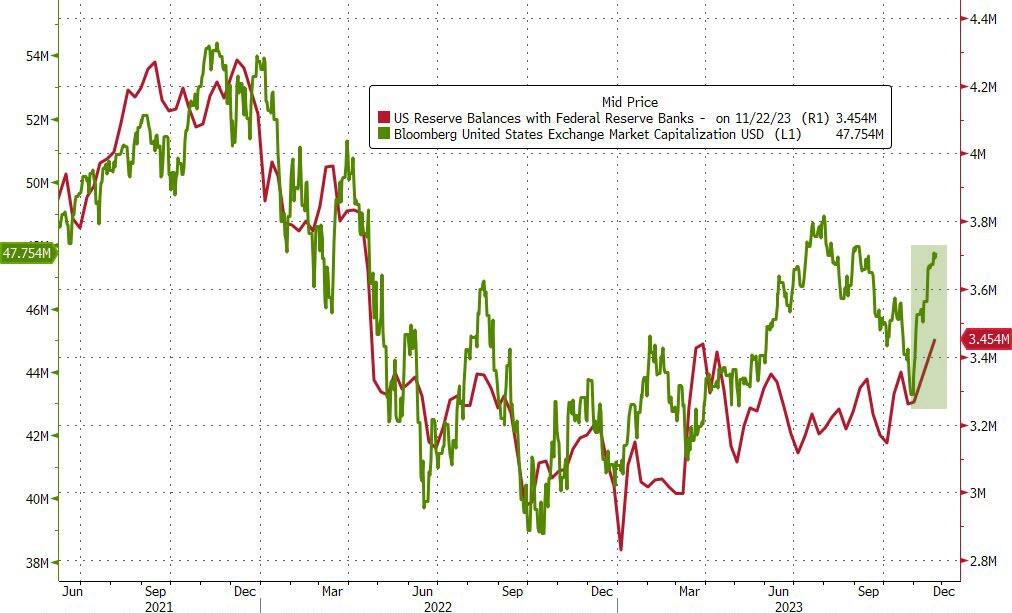
Equity market cap continued to bounce back along with an increase in bank reserves at The Fed…
Source: Bloomberg
All of which is a problem, as the key warning sign continues to trend ominously lower (Small Banks’ reserve constraint), supported above the critical level by The Fed’s emergency funds (for now)…
Source: Bloomberg
As the green line shows, without The Fed’s help, the crisis is back (and large bank cash needs a home – blue line – like picking up a small bank from the FDIC?).
In “The Indispensable Right,” I discuss how academics are now leading an anti-free speech movement on campuses that challenges the centrality (or even the necessity) of free speech protections in higher education. The latest such argument appeared this month in the Chronicle of Higher Education.
Two Arizona State University professors — Richard Amesbury and Catherine O’Donnell — wrote that free speech concerns yield too much to the “right wing” and that free speech should not be given the protection currently afforded by universities and colleges. Indeed, they argue that free speech may be harming higher education by fostering “unworthy” ideas.
Amesbury teaches religious studies and O’Donnell teaches history at ASU. They wrote an article titled “Dear Administrators: Enough with the Free Speech Rhetoric! It Concedes Too Much to the Right-Wing Agenda.”
The two academics challenge the long-held view of the centrality of free speech to higher education. Notably, many of us have been alarmed by the erosion of free speech on our campuses, but Amesbury and O’Donnell seem to worry that there is still too much protection for opposing views. Worse yet, they suggest that the free speech objections are often part of a right-wing funded agenda.
In fairness, to the two professors, they do not reject the overall value of free speech, but challenge “the assumptions that free speech is a cardinal virtue of higher education, and that colleges should aspire to a diversity of opinions.” They insist that higher education is about finding truth and that means that false ideas are inimical to our mission as educators. Indeed, they question the need for “intellectual diversity”:
Our contention is that calls for greater freedom of speech on campuses, however well-intentioned, risk undermining colleges’ central purpose, namely, the production of expert knowledge and understanding, in the sense of disciplinarily warranted opinion. Expertise requires freedom of speech, but it is the result of a process of winnowing and refinement that is premised on the understanding that not all opinions are equally valid. Efforts to “democratize” opinion are antithetical to the role colleges play in educating the public and informing democratic debate. We urge administrators toward caution before uncritically endorsing calls for intellectual diversity in place of academic expertise…
A diversity of opinion — “intellectual diversity” — isn’t itself the goal; rather, it is of value only insofar as it serves the goal of producing knowledge. On most unanswered questions, there is, at least initially, a range of plausible opinions, but answering questions requires the vetting of opinions. As some opinions are found wanting, the range of opinion deserving of continued consideration narrows.
As a threshold matter, what is so striking about this argument against intellectual diversity is that it is made at a time with little such diversity in most departments. Seeking a wider range of viewpoints on departments does not “concedes too much to the right-wing agenda.” It acknowledges a growing problem across higher education, It is an educational agenda that has prompted many of us to raise the reduction of intellectual diversity.
We have already seen faculties purged of conservative and libertarian colleagues. We previously discussed how surveys at universities show a virtual purging of conservative and Republican faculty members. For example, last year, the Harvard Crimson noted that the university had virtually eliminated Republicans from most departments but that the lack of diversity was not a problem. Now, a new survey conducted by the Harvard Crimson shows that more than three-quarters of Harvard Arts and Sciences and School of Engineering and Applied Sciences faculty respondents identify as “liberal” or “very liberal.” Only 2.5% identified as “conservative,” and only 0.4% as “very conservative.”
Likewise, a study by Georgetown University’s Kevin Tobia and MIT’s Eric Martinez found that only nine percent of law school professors identify as conservative at the top 50 law schools. Notably, a 2017 study found 15 percent of faculties were conservative. Another study found that 33 out of 65 departments lacked a single conservative faculty member.
Compare that to a recent Gallup poll stating, “roughly equal proportions of U.S. adults identified as conservative (36%) and moderate (35%) in Gallup polling throughout 2022, while about a quarter identified as liberal (26%).”
Even with this purging of departments, Amesbury and O’Donnell still worry that intellectual diversity could be maintained as a goal in higher education. They are not alone in this view. As we have previously discussed, some professors reject the notion that campuses should protect the free speech rights of those who are . . . well . . . wrong.
For example, after many of us expressed disgust at the treatment of a federal judge shouted down by Stanford law students, Professor Jennifer Ruth wrote a column in the Chronicle of Higher Education heralding their actions. It is an extension of her book It’s Not Free Speech: Race, Democracy, and the Future of Academic Freedom (with Penn State Music Professor Michael Bérubé) declaring certain views as advancing “theories of white supremacy” and thus having “no intellectual legitimacy whatsoever.” Once declared as harmful, it is no longer free speech and therefore worthy of censorship or cancellation. It is that easy.
These academics reject the long-held view that higher education rests on the preservation of intellectual diversity and free inquiry, as discussed in the famous Kalven Report.
In 1967, the University of Chicago assembled a committee to study academic freedom and free speech that would become one of the most important projects in modern higher education. It became known as the “Kalven Committee” after its chair, the great law scholar Harry Kalven, Jr. The report contained an eloquent and profound defense of diversity of thought and expression that seems utterly abandoned by many today. It was cited by the Stanford Law Dean in her letter to the law students and stated in part:
“From time to time instances will arise in which the society, or segments of it, threaten the very mission of the university and its values of free inquiry. In such a crisis, it becomes the obligation of the university as an institution to oppose such measures and actively to defend its interests and its values.”
Amesbury and O’Donnell reject the precept that departments should foster intellectual diversity since “accepting this role for the humanities and social sciences, however, means that their faculties risk losing the ability to judge any ideas (or proposed curricula or public programming) unworthy of sponsorship.”
It is a rationalization for the current echo chamber of higher education. Of course, many of these academics would be outraged if conservatives were to take hold of faculties and start to exclude their views as “unworthy.” Indeed, that was once the response to far left professors like critical legal scholars and socialists. Now, however, the left has control of these departments and has declared opposing views to be unworthy of protection.
One can certainly understand the appeal of this argument to many faculty and publications like the Journal of Higher Education. By simply declaring opposing views “unworthy” or wrong, you relieve yourself of any obligation to allow such opposing views on faculties or in publications.
We saw the impact of this orthodoxy during the pandemic.
For example, the media, academic departments, and government agencies allied to treat anyone raising a lab theory as one of three possibilities: conspiracy theorist or racists or racist conspiracy theorists. Academics joined this chorus in marginalizing anyone raising the theory. One study cited the theory as an example of “anti-Chinese racism” and “toxic white masculinity.”
As late as May 2021, the New York Times’ Science and Health reporter Apoorva Mandavilli was calling any mention of the lab theory as “racist.” Conversely, one former New York Times science editor Nicholas Wade chastised his former colleagues for ignoring the obvious evidence supporting a lab theory as well as Chinese efforts to arrest scientists and destroy evidence that could establish the origin.
Others in academia quickly joined the bandwagon to assure the public that there is no scientific basis for their theory, leaving only racism or politics as the motivation behind the theory. In early 2020, with little available evidence, two op-eds in The Lancetin February and Nature Medicine went all-in on the denial front.
The Lancet op-ed stated, “We stand together to strongly condemn conspiracy theories suggesting that Covid-19 does not have a natural origin.”
No reference to the lab theory was to be tolerated. When Sen. Tom Cotton (R., Ark.) merely mentioned the possibility in 2020, he was set upon by the usual flash media mob. The Washington Post ridiculed him for repeating a “debunked” coronavirus “conspiracy theory.”
In September 2020, Dr. Li-Meng Yan, a virologist and former postdoctoral fellow at the University of Hong Kong, dared to repeat the theory on Fox News, saying, “I can present solid scientific evidence . . . [that] it is a man-made virus created in the lab.” The left-leaning PolitiFact slammed her and gave her a “pants on fire rating.”
Academics were stripped of their positions on leading boards and suspended from social media, including professors who co-authored the Great Barrington Declaration. The Declaration advocated for a more focused Covid response that targeted the most vulnerable population rather than widespread lockdowns and mandates. Many are now recognizing the basis for those views and questioning the efficacy and cost of the massive lockdowns as well as the efficacy of masks or the rejection of natural immunities as an alternative to vaccination. Federal agencies now accept the lab origin theory. Yet, these experts and others were attacked for such views just a couple years ago and their views were deemed “unworthy” by many for schools or publications.
The problem with rejecting intellectual diversity is that it fosters orthodoxy and ignorance. Rejecting opposing views certainly can advance careers. There are more opportunities for the compliant or the orthodox. Professors face less challenge or contradiction in their own writings. Promotions, speaking engagements, and publishing opportunities are certainly enhanced with the elimination of colleagues with opposing views.
However, the result is the gradual death of higher education. It is evident in the rising intolerance shown on our campuses for opposing views and increasing demands for censorship and blacklisting. It is the triumph of the majority, but it looks more like an academic mob. Once all of the “unworthy” thoughts and faculty are purged, what is left appears more like indoctrination than education.
Update:
Professor O’Donnell has responded to this column and I appreciate her willingness engage us on the blog. I also wanted to share a response to her arguments.
Here is her comment:
“I appreciate your attention to the piece Richard and I recently wrote. Our argument is not that free speech is unimportant. Nor do we argue against a diversity of ideas. And we certainly never suggest that ideas should go unquestioned: to the contrary, we make the same point that you do, which is that ideas must face scrutiny, competition, and skepticism if knowledge is to advance. Our argument is two-fold. First, that universities should have a more modest sense of their role in society. Free speech is important, we argue, for a vibrant public sphere. The distinguishing value of higher education, however, is academic freedom – the freedom to participate without hindrance in the disciplinary processes by means of which knowledge can be sifted from mere opinion.
This means that rather than seeking to be an all-encompassing speech forum, universities should instead embrace their limited role as places of scholarship, learning, and teaching, with the pursuit of truth at their core. Second, we argue that “free speech” and “intellectual diversity” – exactly because one is so easily chastised for questioning them – have become gates through which unexamined orthodoxies, buoyed by government or donor influence, enter universities and take root. Imperfect as academia is, we’ve found that our critics come up with examples of how, when disciplinary processes are pursued, knowledge does advance. You observed that legal theories that were once absent from academia entered the mainstream; new legal theories will emerge to displace those now at center stage if disciplines undertake their role of questioning and vetting. That displacement can’t happen if their adherents can simply appeal to “intellectual diversity” for their protection. Another critic pointed out that eugenics was once important to some university departments. Precisely, we say. Scholarship informed by the tragic moral understanding that followed WWII, eventually displaced eugenic pseudoscience. Eugenics could now be reinserted into universities under the banner of free speech or intellectual diversity. We can all surely agree that this is not desirable. And if we agree to that, perhaps we can move past the assertion that the mere invocation of free speech and intellectual diversity must always capture the moral and intellectual high ground.”
I must confess that I remain skeptical. Professor O’Donnell explains that “[t]his means that rather than seeking to be an all-encompassing speech forum, universities should instead embrace their limited role as places of scholarship, learning, and teaching, with the pursuit of truth at their core.”
This is a common defense against academic diversity. No one is seriously questioning the role of universities as places of scholarship or learning. The issue is the dramatic reduction of conservative, libertarian, or even dissenting faculty at many schools. While raising such concerns can be dismissed as “a right-wing agenda,” there are a host of polls and surveys showing students and faculty are reporting a lack of tolerance or diversity of thought in classrooms. When these concerns are raised, the mantra is that we have not hired conservative or libertarian scholars because their views lack merit or intellectual vigor.
For example, Above the Law Senior Editor Joe Patrice ddefended “predominantly liberal faculties” and argued that hiring a conservative professor is akin to allowing a believer in geocentrism to teach.
Professor O’Donnell also notes that “we argue that ‘free speech’ and ‘intellectual diversity’ … have become gates through which unexamined orthodoxies, buoyed by government or donor influence, enter universities and take root.” The dominance of the left found in these surveys is not due to “unexamined orthodoxies.” It is due to the dismissal of opposing views as “unworthy” and not “intellectually rigorous.” That rationale has been used to purge faculties of most conservatives. Most faculties run from the left to the far left. There is no explanation other than to claim that no sufficiently qualified conservative, libertarian, or dissenting candidates applied. Years go by for many schools without a single qualified candidate with conservative or dissenting views on major issues. In the meantime, states are expected to continue to fund schools that often exclude the values and views of the majority of the taxpayers.
The disconnect defies logic. For example, half of the judges and roughly half of the populace hold fairly conservative views on constitutional issues. Half of Congress hold such views. However, only a small percentage of conservative faculty (if any) can be found at most law schools. That is not due to these views being “unexamined.” Likewise, it is relatively rare to have opposing views on gender identity, climate control, abortion, social justice issues found on many campuses. Indeed, faculty with such views have been subject to cancel campaigns and university investigations.
Professor O’Donnell adds that “You observed that legal theories that were once absent from academia entered the mainstream; new legal theories will emerge to displace those now at center stage if disciplines undertake their role of questioning and vetting.” However, this blog is full of accounts of dissenting faculty being removed from publications, societies, and faculties. The political orthodoxy that has taken hold of our campuses has made it far less likely that such views can be fairly presented.
None of this is, as claimed, is offered to use of free speech or intellectual diversity to push a “right-wing agenda.” These are questions that have long been raised and remain, even after this column, unanswered.
When Israel’s National Security Minister Itamir Ben-Gvir started handing out assault rifles to civilians last month, there was a swift reaction from Washington. Reportedly outraged, US officials were said to have threatened to halt arms shipments, including 24,000 new rifles that Ben-Gvir’s ministry had ordered from American companies.
The guns pictured at well-documented public events weren’t American or reportedly American-supplied. State Department officials and US lawmakers, however, were concerned that the new rifles could be given to settlers and used against Palestinians in the occupied West Bank where settler violence has jumped since 7 October from what were already record highs.
More than 200 Palestinians in the West Bank have been killed in that time by Israeli soldiers and settlers. Despite Israeli assurances that the guns would go to units under Israeli National Police control, inside the Green Line, the US has reportedly delayed the delivery of 4,500 M-16 rifles.
At least, this is what can be gleaned from Israeli and American media reports. The State Department on Thursday said it declined to comment on direct commercial sales and private diplomatic conversations.
But a former State Department official told Middle East Eye that it is “almost a certainty” that American guns are already being used by settlers in the West Bank. And even if the weapons aren’t in settler hands, US guns exported to Israel, either financed with US military aid or bought commercially, will have freed Israeli guns to be handed to them, arms control experts say.
“Some of the guns that the US will have exported will have gone through license to the Israeli Defense Forces and, of course, most military age settlers are reservists,” said Josh Paul, who was a director in the State Department’s Bureau of Political-Military Affairs until he resigned last month. “So they will have their guns from the IDF regardless of whether or not they are being handed out by Ben-Gvir in most cases.”
MEE asked the State Department if it shared Paul’s concern that US guns are likely already in the hands of settlers in the West Bank. A spokesperson did not directly answer the question but said that governments that received US arms are responsible for complying with the conditions of the transfers and obligations under international law, including those related to human rights.
The spokesperson also said that equal resources should be dedicated to preventing extremist violence and bringing those responsible to justice, including members of the IDF and security forces, such as the Israeli National Police, who stand by or fail to intervene.
How many and what types of American guns have made their way to Israel over the years are questions that stump even seasoned arms control experts. The most detailed publicly available information shows that US exports to Israel of revolvers, pistols and certain kinds of rifles have jumped significantly in the first nine months of this year compared to the previous three.
But without full public data, it is impossible for US taxpayers and even lawmakers to gauge the scale of US gun exports to Israel and, critically, how much of that is underwritten by the US government.
“If all of these sales were completely transparent to Congress and to the public especially, I think there would be a lot more outrage,” Lillian Mauldin, a founding board member of Women for Weapons Trade Transparency and a research fellow at the Center for International Policy, told MEE. “It’s in corporate interests for arms sales to be incredibly difficult to track down, even for people who have been in the arms control research field for decades.”
Meanwhile, experts say the US government programmes which monitor arms exports are not set up to track small arms after they are shipped. “Once they are gone, they are gone,” Paul said. This leaves Palestinians in the West Bank like Mohammed al-Huraini with questions.
‘Made in the USA’?
Al-Huraini is from Atuwani, a 500 or so-person village tucked between mountains in the south Hebron Hills, among a dozen in Masafer Yatta. Here residents have faced expulsion threats and demolition orders since the Israeli army designated their land as a firing zone in 1981.
As the Israel-Hamas war rages on in Gaza, settler violence is driving Palestinians in West Bank from their homes. pic.twitter.com/5LffN3SwqT
Now 19, Huraini has never known a time when he and his family weren’t under pressure to leave Atuwani. His grandmother, Fatemah, can’t see out of one eye after soldiers struck her during a protest in 2006. Last September, settlers broke both of his father Hafez’s arms.
But since 7 October, Huraini says the situation in the village, captured in footage seen by MEE and described to him by friends and family who remain there while he attends university in Ramallah, has noticeably shifted. Settlers have stepped up attacks on residents, raiding homes and threatening to kill anyone who doesn’t leave. They are wearing military uniforms and all of them are armed.
“It wasn’t like that before. The people now are afraid to confront [the settlers] because they don’t have anything in hand or anything to support them,” he said. His cousin, Zakaria al-Adra, was shot by settlers at close range on 12 October with exploding ammunition that ripped through his stomach. He has since had five operations.
The Huraini’s home was also raided and the family’s vegetable garden, which they had been growing for six years, was bulldozed and replaced with a tent. They are unable to move around on their property or travel to get groceries without being targeted, he said. “If you step 20 meters from my house, they will immediately start to shoot,” he said.
“Before at least you didn’t feel that you will be killed in cold blood. It’s easier now.” Last year, after a weeks-long attack by the Israeli military and settlers on his village, Huraini found a tear gas canister outside his house that said “Made in USA” on it.
It wasn’t the first time he had seen a canister like that, but it was the first time he’d clocked the writing on it. “We are being crushed under the power of US money and weapons,” he wrote at the time. “American citizens should know where their taxes go and what they fund.” Now he wonders if any of the guns that have proliferated in recent weeks are American too.
Leahy shortcomings
Any US guns financed with or given as US military aid should be subject to the Leahy Law, named for Patrick Leahy, the former Democratic senator from Vermont, who sponsored the legislation in 1997. Under the law, the US defense and state departments are prohibited from giving security assistance to foreign governments facing credible accusations of rights abuses.
But both Paul, the former State Department official in the bureau which oversees arms transfers, and Leahy himself have said the law has not been applied to Israel. “Over the years, I’ve complained to both Republican and Democratic administrations about the need to apply the law in Israel,” Leahy told the News & Citizen, a weekly newspaper in Vermont, last week.
“These administrations have argued that Israel has an independent judiciary, so it doesn’t really need to. We’ve seen the efforts recently to make the judiciary even less independent than it had been.”
Paul told MEE that inside the State Department, Israel is treated differently than “almost any other country in the world” when it comes to the Leahy Law. “Rather than pre-vetting units before they get this stuff, we send the stuff and then we look out for human rights violations,” Paul said.
He has previously said that the department has found “many” examples of Israeli units suspected of gross violations of human rights, but has never been able to come to any conclusions which require senior officials to sign off.
A State Department spokesperson did not comment directly on Paul and Leahy’s observations but told MEE that any country that receives US security assistance is expected to use it consistent with international humanitarian law and human rights law, and consistent with the agreements that govern its use. Israel, they said, is no exception.
Opaque details
The American public, meanwhile, has limited information about the types and volume of guns that are exported to Israel, either through military aid or commercial sales. The lack of transparency around US arms sales and military aid to Israel – the biggest recipient of US military aid worldwide – is well-documented.
The contrast between US government fact sheets on weapons it has given Ukraine, down to first aid kits and bandages, and the dearth of information about what is sent to Israel is stark. This opaqueness is also true about guns sent to Israel: US firearm export data, whatever country is at the receiving end, is notoriously hard to come by.
This is, in part, because there are legal restrictions, written by fee-funded regulators, on what information can be provided about certain sales. Congress, for example, is only told about arms sales valued above monetary thresholds which vary depending on sale type, but are higher for Nato countries and five others, including Israel.
This means that sales of small arms, which are less expensive relative to other weaponry, are particularly prone to flying under threshold and has left billions of dollars worth of sales “unreported to Congress and the American public”, Mauldin has said. Details are also regularly withheld by US government departments overseeing arms export licensing because they argue that it is proprietary information that could undermine US companies.
The most detailed information MEE was able to find were figures from the US Census Bureau which show that the total value of guns and related parts exported from the US to Israel have jumped in five different categories in the first nine months of this year alone compared to totals of the previous three.
The value of exported items that have increased significantly include revolvers and pistols, certain kinds of rifles, shotgun and rifle accessories and parts, and cartridges.
Seth Binder, director of advocacy with the Project on Middle East Democracy in Washington, DC, said the spike suggested by the data isn’t a huge surprise given the intensity of settler attacks in the West Bank and the loosening of laws in Israel in recent years to allow more gun licences to be granted.
“How much of that is coming from foreign military financing? It would be pretty interesting to know, but that information isn’t available,” Binder said. He’s right: US Census Bureau data doesn’t tell you whether US financing was provided to assist the Israeli government or companies with these purchases or if any were transferred without charge.
So while the figures show that there has been a steep increase in military weapon parts and ammunition this year, how much of that has been underwritten by the US government – or taxpayer – is unclear. But from bombs to guns, knowing the details matters, said Paul.
“There is an inherent US taxpayer interest here, first of all in how taxpayer dollars are being spent and whether the way they are being spent provides a net positive for US foreign policy,” he said. In Israel, where American weapons tip the balance of the conflict, this is especially true.
“Small arms and light weapons can cause more harm than people give them credit for, in a more under the radar way,” said Mauldin. “But the larger issue is that of course US funding will disproportionately affect the conflict when we give billions of dollars – basically a grant for Israel to buy whatever they would like from the US, including those small arms and light weapons.”
Limitations on monitoring
And there is another mystery: where are the US guns and parts already in Israel? Neither the State Department, which monitors commercial sales, nor the Defense Department, which monitors military sales, are geared to track small arms.
The State Department’s Blue Lantern program does end checks on about 2 percent of arms export licenses annually, usually focusing on new entities that pop up in license requests or areas where there are specific intelligence-driven concerns. “So for firearms to Israel, they would be very unlikely to do any kind of end-use checks assuming it is to the Israeli government and via known logistics entities,” Paul said.
The Defense Department’s Golden Sentry programme typically focuses on much larger weapons and is more of a check that weapons are in the arsenal where a foreign military says they are located. Arm experts MEE spoke with in recent weeks have said the most straightforward way to trace US guns to the West Bank at this point would be through photo analysis.
But there’s also another way of looking at all of this: even if you can’t trace exactly where US firearms have ended up or that they are being used by settlers in the West Bank, the US is still implicated. “We are providing $3.8bn in military aid. That’s $3.8bn that the Israeli government doesn’t need to use on military equipment because we are providing it,” Binder said.
Giving American guns to Israel – through military aid or commercial sales approved by the US government – operates the same way. “Israel has its own domestic industry and so, as they are making guarantees that they are not going to provide US guns to Israeli settlers, it does, in fact, free up Israeli guns to go to settlers,” he said.
It would be important and troubling if US-made weapons were being used by settlers right now, he said. “Nonetheless, if the Israeli military or whoever inside Green Line Israel is using US weapons and suddenly settlers are using Israeli ones, does that really matter?”
Huraini, who is preparing to return home to visit his family in Atuwani, said he is no gun expert and can’t be sure whether settlers are using American firearms in the footage he has collected over recent weeks. But he finds it hard to understand how Americans would tolerate any spending. “The people are, in reality, supporting genocide, war crimes and violations of human rights by spending their money,” he said. “I don’t know where it went exactly, for what help. But in the end, it is supporting this apartheid regime that committed everything against the people.”
CNBC has ‘dismantled its climate desk’ and will no longer have staff dedicated to covering the topic – posing a potential blow to the Democrat party’s various ‘green’ schemes, including their so-called Green New Deal.
“CNBC has dismantled its climate desk and will no longer have staff dedicated to covering climate change,” wrote Bloomberg‘s Akshat Rathi, posting a link to now-former CNBC climate innovation and tech reporter’s announcement on X, which reads:
“Personal news, as they say: A layoff, heartbreak, and finding my truth wandering through the streets of Istanbul…”
CNBC has dismantled its climate desk and will no longer have staff dedicated to covering climate change. https://t.co/XXoc3HgsSD
“It is a sad day when a major news publication decides to cut jobs that provide essential coverage of a planetary crisis,” said Rathi, adding “The science is clear, the impacts are here, and many world leaders are taking it seriously. So why does a media publication not see a business case?”
Rathi suggested CNBC must be losing money, and therefore need to figure out how to ‘grow the number of users.’
Folks on the business side of journalism have their work cut out. If per user revenue is low, there are two solutions. Grow the number of users and grow how much each user is worth. On both those things readers who care can help!
Shoplifting in Los Angeles spiked 109 percent in the first half of 2023, according to a new study by the Council on Criminal Justice (CCJ), “Shoplifting Trends: What You Need to Know.” The CCJ is a nonpartisan and independent think tank supported by grants from philanthropies. That was the highest rise of any city, with Dallas in second place at 73 percent.
On the positive side, shoplifting dropped 35 percent in San Francisco, similar to a 31 percent drop in Seattle. Unfortunately, Los Angeles and San Francisco were the only two Golden State cities monitored of 24 nationwide. The study included several interactive graphs. This screenshot isolates the two California cities. Los Angeles is the black line, and San Francisco the brown one:
Notice San Francisco’s spike in late 2021 and early 2022, just before left-wing District Attorney Chesa Boudin was recalled by voters on June 7, 2022.
Then look at the black line for Los Angeles. The rise began in the middle of 2021, sparking another recall effort against another radical, District Attorney George Gascón. But that effort failed in August 2022 when proponents failed to gather enough signatures. After that, as the graph shows, shoplifting just kept going up and up to its current heights.
However, Mr. Gascón is facing a tough reelection bid next year. A poll released Nov. 6 by FM3 Research showed Mr. Gascón losing, 48 percent to 23 percent, to Eric Siddall, a career Los Angeles prosecutor. It concluded, “In sum, this survey shows Eric Siddall to be well-positioned for the LA County District Attorney March primary election. In a large field of candidates that includes an incumbent that most voters regard negatively and do not support, Siddall’s profile distinguishes him.”
A FiveThirtyEight survey of FM3’s polls found its forecasts for the 2022 election were 68 percent accurate, which is pretty good.
On his campaign website, Mr. Siddall pledges, “I’ll make it clear to any and all criminals that the George Gascón party is over. Too many working families, seniors, women, young people and marginalized communities are living in fear for their safety.”
Other Los Angeles Crime Rates
The CCJ study also produced this graph of five crime factors since 2018. Los Angeles is isolated from the other cities.
Again, shoplifting (green line) stands out for its sharp rise after the drop during the 2020 COVID-19 pandemic, when most stores were closed. Other larceny (black line) rose in the middle of 2021, but since has declined. Holding steady or declining a little during this period were vehicle theft (purple line), robbery (gold line), and burglary (gray line).
Here’s something else interesting the CCJ study found. In New York and other cities, there’s a seasonality to shoplifting. It rises in the spring and summer, I think because the weather becomes nice, then drops in the winter. Criminals don’t want to ply their trade any more than honest folks when it’s zero degrees outside and the wind is howling with a snowstorm.
“In Los Angeles, by contrast, there is no clear seasonality,” the study found. That also was true for another generally warm coastal city, “In Virginia Beach, there is also no clear seasonal pattern.”
What Causes Crime Increases?
As to causes, here’s what the study suggested: “Bail reform is one possible explanation, yet the timing of the reform (at least in New York) does not align with the shoplifting increase, and research suggests that bail reform likely has no association with increased larceny.
“Another possibility is a change in the rate at which stores report shoplifting to police. This analysis is based solely on reported shoplifting incidents; the underreporting of shoplifting has yet to be systematically analyzed. However, data from the Anaheim (California) Police Department indicate that a major retailer reported 8 percent of shoplifting incidents in 2022 and 20 percent in 2023. According to one report, a spike in San Francisco shoplifting may have resulted from increased reporting.”
That seems to me an inadequate explanation. If stores are closing, or locking up all their goods, then there’s not just a “reporting” problem, but a real problem.
Guns and Crime
I suggest a different reason, which needs more investigation: The lack of an increase in crime in some of these areas has something to do with America’s strong gun culture. Robbery and burglary involve violence, which can be thwarted by gun-wielding victims shooting the assailants. Criminals know this, and when gun ownership increases, they switch to easer crimes, such as looting drug and grocery stores.
The June 2022 Bruen decision by the U.S. Supreme Court upheld the personal right to carry a firearm. Since then, gun ownership has soared.
According to an NBC poll released Nov. 21, “More than half of American voters—52 percent—say they or someone in their household owns a gun, per the latest NBC News national poll.
That’s the highest share of voters who say that they or someone in their household owns a gun in the history of the NBC News poll, on a question dating back to 1999.” That’s up from 43 percent in 2013.
Gov. Gavin Newsom has been attacking Americans’ Second Amendment “right to keep and bear arms” during his five years in office. Despite the Bruen decision, he signed six more anti-gun bills on Sept. 26. And he has proposed a 28th Amendment to eviscerate the Second Amendment. He’s clearly out of step with Californians, and certainly with the national electorate.
Conclusion: Voters are Taking Action
Even in liberal California, voters don’t like getting mugged, or seeing their stores close from shoplifting. And they’re taking action. They’re arming themselves with guns. And they’re ousting district attorneys who tolerate lawlessness.
At the state level, Mr. Newsom is term limited and is now running a shadow campaign for president. So all his actions are directed there.
California crime goes in cycles. The “permissiveness,” as it was called, of the 1960s and 70s led to the crackdowns of the 1980s and 90s, especially 1994’s Proposition 184, the Three Strikes and You’re Out Law. That cut crime, but it also led to a large prison overpopulation problem, leading to the intervention of federal courts starting in 2009.
In the past decade, the state has passed such reforms as Proposition 47 in 2014, which reduced sentences for many crimes.
Currently, it seems the need is to get rid of the radical district attorneys, replacing them with officials who enforce the current laws. We’ll see in a few years how that works.
Views expressed in this article are opinions of the author and do not necessarily reflect the views of The Epoch Times or ZeroHedge.
Climate alarmists in corporate media pushed a disinformation campaign with sketchy climate math this past summer that even the National Oceanic and Atmospheric Administration had to run away from.
Remember the climate doom headlines in corporate media?
By late summer, 1,609 scientists and professionals worldwide had signed a declaration, including 321 from the United States, dismissing the existence of a climate crisis and insisting that carbon dioxide benefits Earth, contrary to the popular alarmist narrative.
Also, remember this idiot child making climate doom prophesies…
Climate change contrarian Tony Heller was the first to point out this inconvenient truth, indicating on social media platform X, “Burn acreage in the US this year was the lowest of the century. This will not be reported by the @nytimes , @CNN or @NPR – because it doesn’t suit their #ClimateScam agenda.”
TV host Mike Rowe said that eight years ago, he was switching the news channels on his television and saw several college students setting fire to the American flag and dancing around a pile of burning flags. They were telling reporters in interviews they were disgusted with Old Glory and “fearful” of the flag.
“It wasn’t lost on me in the moment that all of these events were happening at what is considered the best of the best elite universities across the country,” Rowe told me. Among supposedly non-elite students, though, the situation wasn’t and isn’t as bad.
Rowe said it didn’t take long for him to figure out why those “elite” students drew those conclusions about Old Glory: The idea of associating fear with the flag came from the very people who were supposed to be instructing these privileged students.
Rowe said the evidence was crystal clear when Jonathan Lash, then the president of Hampshire College, chose not to assure the students that no country offers more liberties to their people and therefore there was nothing to “fear” from the flag. Instead, he spoke up in ways they understood to validate their fears.
“Lash actually removed any traces of the American flag from the campus and said in a statement that removing the flag from the campus ‘will better enable us to focus our efforts on addressing racist, misogynistic, Islamophobic, anti-immigrant, antisemitic, anti-LGBTQ rhetoric and behaviors,’” Rowe explained.
Lash, a former Peace Corps volunteer, federal prosecutor, Harvard graduate, and president of a Washington-based environmental think tank, left the college in 2018. Hampshire College, under Lash in 2015, was one of the first elite schools in the United States not to accept SAT scores from applicants, in part because Lash said SATs were strongly biased against students of color.
Rowe said that if people are shocked by the blatant anti-Semitism among college students and by the students’ clear lack of understanding of history, they haven’t been paying attention to the ethos of (supposedly) elite universities for at least two generations.
Higher education, for decades, has been trending not liberal but radically left. Phillip Magness and David Waugh wrote earlier this year in the Independent Review that 60 percent of faculty in universities across this country identified as “hard left.”
Magness and Waugh wrote that while the modal college professor has been at the political left of the public since the 1960s, it wasn’t until very recently that this overall skew obscured an underlying stability in the political composition of faculty.
Their data showed it was in 2001 that faculty majorities went from liberal to hard left and now are nearing a supermajority in the academic world.
It is not lost on Rowe that the two places of higher education where you don’t see campuses erupting in violence and destroying the safety of Jewish students are trade schools and community colleges.
“In 2016, I was feeling very proud to have a scholarship fund that was earmarked for trade schools when everywhere I looked, I saw people burning the flag at elite universities,” Rowe said, adding, “Maybe it happened then, or maybe it is happening now, but I looked, and I couldn’t find a single incident of a trade school or community college burning the American flag.”
“These schools simply don’t go there,” he said of the trade schools and community colleges nationwide whose certificate programs and two-year degrees are designed around filling this country’s skills gap.
The typical financial aid package is huge at Harvard University, in which pro-Palestinian rallies have cost the school financial support from alumni. The total budget for a student this year is $80,600, with federal scholarship amounts set at $64,500.
Over 55 percent of the students attending Harvard received federal grants or loans.
Rowe said if you want to throw a little gas on the fire of the psyche of the American sitting at home, shaking her head, wondering what these students are up to, “Just remember you’re paying for it.”
The Department of Education tallies show there are nearly 4,000 colleges and universities across this country with 40 percent of their students holding some type of job while attending school.
In contrast, there are just a little over 1,000 community colleges and 7,407 trade and technical schools as of 2022 with 80 percent of those students employed while attending school in the former.
Rowe said that when the protests at the elite universities started to unfold after the Oct. 7 massacre, he wondered what seemed so familiar. “And the answer isn’t because it’s familiar in terms of bad behavior. It was familiar because it’s another thing that never happens at schools where people go to learn a skill.”
Views expressed in this article are opinions of the author and do not necessarily reflect the views of The Epoch Times or ZeroHedge.