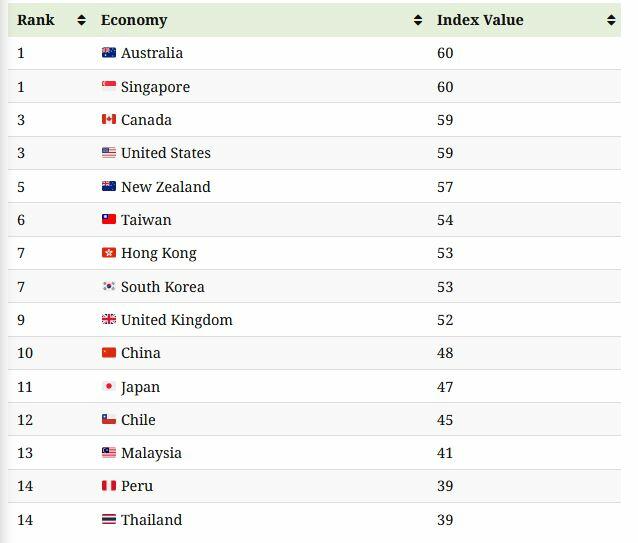
In the intricate landscape of global finance, where the credibility of nations is constantly under the microscope, credit ratings emerge as crucial indicators. These ratings, determined by the big three of the financial world – Standard & Poor’s (S&P), Moody’s, and Fitch Ratings – serve as a barometer for a country’s financial stability and its ability to repay debts.
In short, these ratings assess the probability of a nation defaulting on its financial obligations. A higher rating, a symbol of economic strength and stability, often translates into lower borrowing costs for a country. Conversely, a lower rating can be a red flag, leading to increased borrowing costs or, in more severe cases, restricted access to capital.
These rankings are illustrated below by The Hinrich Foundation via visualcapitalist.com, which analyzed the creditworthiness of 28 major economies. The graphic is an amalgamation of indices from the three juggernauts of the rating world (S&P, Moody’s, Fitch).
The data is drawn from the 2023 Sustainable Trade Index (STI), a collaborative effort between the Hinrich Foundation and the IMD World Competitiveness Center.
To produce the STI’s credit rating metric, ratings from S&P, Moody’s, and Fitch were converted to a numerical score and averaged for each economy, with a range of 0-60 (60 being the highest). All data are as of 2022. -Visual Capitalist
And while the STI obviously factors in ‘green’ initiatives, it’s useful to gauge who’s most able to ‘sustain’ various ‘green’ programs, whether they’re total boondoggles or not – given that most of the west is heavily committed to them.
Countries with advanced economies and stable political structures typically receive the highest credit ratings, but this is always subject to change. For example, in August 2023, Fitch Ratings announced it had downgraded the U.S. to an AA+ from AAA (the highest possible).
From Fitch’s press release:
The rating downgrade of the U.S. reflects the expected fiscal deterioration over the next three years, a high and growing general government debt burden, and the erosion of governance relative to ‘AA’ and ‘AAA’ rated peers over the last two decades that has manifested in repeated debt limit standoffs and last-minute resolutions.
Speaking of downgrades, one country that has received numerous in recent years is Russia, due to sanctions it faces as a result of the prolonged invasion of Ukraine. For example, S&P reduced Russia’s sovereign credit rating to a CCC-, which implies a default is imminent in the near future.
The International Monetary Fund (IMF) released a handbook for global central banks regarding the development and implementation of central bank digital currencies (CBDCs).
The IMF’s “Central Bank Digital Currency Virtual Handbook” published last week pointed out that the increased use of CBDCs can “reduce dollarization” of the global economy—a situation where countries move away from relying on the U.S. dollar as a reserve currency. De-dollarization would push up borrowing costs in the United States, making loans expensive for businesses and individuals, thus affecting economic growth. Stock market values can also crash, reducing the savings and investments of Americans.
In addition to de-dollarization, a CBDC “could increase risks of flight to safety from retail bank deposits in periods of market stress.” During times of market volatility, customers withdraw their deposits and move it into safe assets to avoid losing money in scenarios like bank collapses.
If CBDCs were available, pulling out funds from a bank and putting them in such assets will come across as a safe option for many people, thus triggering a bank run.
The organization pointed out that CBDCs could offer “a safe store of value and efficient means of payment, which can increase competition for deposit funding, raise banks’ share of wholesale funding, and lower bank profits.”
The IMF handbook was published as the organization’s Director Kristalina Georgieva promoted the use of CBDCs during the Singapore FinTech Festival on Nov. 15, arguing that such digital currencies could bring an end to the cash-based economy.
“CBDCs can replace cash, which is costly to distribute in island economies,” she said during a speech. “CBDCs would offer a safe and low-cost alternative to cash. They would also offer a bridge to go between private monies and a yardstick to measure their value, just like cash today, which we can withdraw from our banks.”
Back in May, Ms. Georgieva said that the world was heading towards widespread CBDC adoption without considering the risks involved in such a transition.
“What we are careful about is the choice between wholesale and retail CBDCs. We think that wholesale CBDCs can be put in place with fairly little space for undesirable surprises. Whereas retail CBDCs, they completely transform the financial system in a way that we don’t quite know what consequences it could bring,” she said during a discussion.
Wholesale CBDCs are meant to be used in interbank settlements as well as transactions between institutions and other market participants, while retail CBDCs are for use by the general population and other institutions.
A potential risk of retail CBDCs is that funds get pulled out from traditional commercial banks and deposited as CBDCs in central banks. The depletion of deposits will affect the lending ability of commercial banks, possibly worsening any banking crisis.
US Government CBDC
While the IMF pushes ahead with the promotion of CBDCs, Republican lawmakers are taking steps to prevent the U.S. government from issuing such digital currencies. In September, Rep. Tom Emmer (R-Minn.) reintroduced the CBDC Anti-Surveillance State Act.
In a Sept. 12 press release, Mr. Emmer pointed out that unlike decentralized cryptocurrencies like Bitcoin, CBDCs are designed and issued by a government “and [transact] on a digital ledger that is controlled by that government.” This could give the administration the power to “surveil Americans’ transactions and choke out politically unpopular activity.”
The bill imposes the following prohibitions:
It prevents the U.S. Federal Reserve from issuing a CBDC directly to individuals, thus making sure that the Fed cannot mobilize itself as a retail bank and collect personal data of Americans.
It prohibits the Fed from indirectly issuing a CBDC to individuals via an intermediary, thereby blocking the central bank from launching a retail digital currency through a two-tiered financial system.
It bans the Fed from using any CBDC to implement its monetary policy. This ensures that the central bank is not able to use these currencies as a “tool to control the American economy.”
In March 2022, President Joe Biden signed an executive order asking the Fed to continue its ongoing research and experimentation of CBDCs and to evaluate the benefits and risks of a digital dollar.
Talking about the issue, Mr. Emmer said that “agency reports to that executive order have made it clear that the Biden Administration is not only itching to create a CBDC, but they are willing to trade American’s right to financial privacy for a surveillance-style central bank digital currency.”
“We’re not going to let this happen,” he said. The CBDC Anti-Surveillance State Act “ensures the United States digital currency policy is in the hands of the American people—not the Administrative State—so that it reflects our American values of privacy, individual sovereignty, and free market competitiveness.”
On Sept. 20, the House Financial Services Committee passed the bill.
Back in April, Federal Reserve Board member Michelle Bowman warned in a speech that a CBDC may pose “significant risks, challenges, and tradeoffs.”
There is a “risk that a CBDC would provide not only a window into, but potentially an impediment to, the freedom Americans enjoy in choosing how money and resources are used and invested.”
A CBDC could also lead to the politicization of the payments system, potentially undermining the independence of the Fed, Ms. Bowman said.
In May, Florida’s House of Representatives passed a bill banning the use of CBDCs in the state. The bill defined money to exclude CBDC. Weeks before the bill was passed, Florida Gov. Ron DeSantis had pointed to China as a potential example of how CBDCs could negatively affect people.
“Look no further than China, in seeing the impact of centralized digital currency,” he said. “The People’s Bank of China uses its central bank to monitor citizen behavior, allowing for the surveillance of spending habits and to cut off access to goods and services.”
Finnish Military Bolsters Border Wall After Charging Russia With Weaponizing Migrants
Border tensions have heightened between Russian and the NATO alliance’s newest member Finland. Finland has lately accused Moscow of weaponizing migrants to create a crisis at border crossings.
Russia had vowed “countermeasures” after Finland was admitted into NATO last April. Finland’s Border Guard has since documented what it says is a serious uptick in undocumented migrants showing up at crossings, with most of them having originated in Africa and the Middle East.
The some 830+ mile Russian-Finnish border also serves as the external border of the European Union. EU President Ursula von der Leyen has recently joined Finnish Prime Minister Petteri Orpo in condemning what they called Russia’s “instrumentalization of migrants” – with von der Leyen calling it “shameful”.
Finland’s border authorities have said over 300 undocumented asylum seekers have recently arrived, mostly at four southern crossings which at this point have been closed. In some instances this has led to violence, with border guards having deployed riot control measures to keep migrant groups from breaching the border.
“We do not accept such accusations,” Kremlin spokesman Dmitry Peskov has said in response to Finnish and EU allegations. He slammed Helsinki’s accusations as “far-fetched”.
According to regional reports, Finland is moving to provide greater security with military help, which includes bolstering construction of the border fence in key spots:
The Finnish Defense Forces are helping the country’s Border Guard construct temporary fences on the Russian border after the Finnish government closed four border crossing points in response to an increased flow of third-country asylum seekers coming from Russia.
…Kainuu Border Guard deputy commander Tomi Tirkkonen told Finnish public broadcaster Yleisradio Oy that the Defense Forces were only helping with construction, not providing military assistance.
Finnish PM Orpo last week went so far as to allege that migrants are actually being transported to the Finnish border with the help of Russian authorities. “It is clear that these people are helped and they are also being escorted or transported to the border by border guards,” he said.
Russia previously warned its Arctic neighbor against militarizing the border in relation to the controversial prior NATO bid. The Kremlin further stated that NATO positioning military assets and weaponry there risked setting off a nuclear arms build-up in the Baltic region.
There is a danger that the new Polish government may just waive through this oppression policy…
The agreement between the European Parliament and the Council of the European Union on the EU Digital Identity Wallet is open to abuse and gives Brussels the ability to deny people rights and control them.
According to the new European legislation, the wallets, which are to be voluntary for the time being, will include digital versions of all ID cards, driving licenses, degree certificates, and medical documentation.
The European Commission insists that the system will be secure, and the current Spanish presidency of the EU is saying that this will make the EU a digital leader at a global level in protecting democratic values, but what has digitalization got to do with European values?
On the contrary, the move actually threatens European values as argued by 504 academics and experts from 39 countries who have signed an open letter warning of the dangers to people’s online security and freedom.
The pandemic moved us in this direction when the Covid-19 vaccine passports were introduced and limited the right to travel. The new wallet will move us much further in the direction of oppression.
Having all documents in one place means that they can be confiscated in one click. This was done by the Trudeau administration in Canada when, during Covid, it denied vaccine-refusers access to their accounts and later removed insurance rights from drivers participating in the protest blockade of the capital, Ottawa.
…
The head of Poland’s central bank Adam Glapiński, says consumers do not want their bank to know about all their transactions and full digital centralization of transactions removes that right to anonymity.
This latest EU move is also tied to the proposed treaty changes, which include the phasing out of all national currencies in favor of the euro. Not only would Poland be denied the right to conduct its own monetary policy, but the EU would also control the wallets of Polish citizens.
Banks in Canada and Australia have already begun to count the carbon footprints of their clients’ purchases. This is just one step away from stopping them from making some transactions if certain limits are exceeded.
…
There can be little doubt that Eurocrats want to create a liberal regime in which citizens are increasingly controlled by the authorities based in Brussels.
FBI Arrests Miami Police Officer Accused Of Stealing Cash, Drugs During Traffic Stops
A Miami cop was arrested by the FBI after being accused of stealing drugs and money from suspects during traffic stops – some of whom turned out to be undercover agents, according to NBC Miami.
Frenel Cenat, 40, was arrested on Thursday on charges which include attempted Hobbs Act extortion, theft of government funds, and attempted possession with intent to distribute cocaine, according to the report, citing jail and court records.
Cenat, a Miami Police officer since September 2008, had worked for the property and evidence unit since 2020. After a confidential source tipped off the FBI to Cenat’s behavior – conducting traffic stops of people known to have just engaged in drug transactions, and then stealing the money or drugs they were transporting, they launched an investigation.
Cenat would use his official police vehicle to conduct the traffic stops and would be in his police uniform, the affidavit said.
Cenat was recorded on video and audio “coordinating schemes and conducting traffic stops of two individuals who he was told had just engaged in drug transactions, with the intention of stealing the money and/or drugs involved in those illegal transactions,” the affidavit said. –NBC Miami
According to the affidavit, Cenat admitted that he would pull the schemes while off duty and outside his jurisdiction.
“On duty they (MPD) got computers on and can track you and s— like that…you know what I mean…ping your phone… what you are doing in this area,” he said, according to the affidavit. “You don’t wanna do that s— bro while you are on duty…If I work down there I will never f— down there bro.”
Cenat also described several prior incidents involving drug transactions in which he coerced individuals to give up their stash, money, or both in order to avoid going to jail.
In October, he discussed stopping a person who had just done a drug deal, from whom he stole $50,000 – saying “I just need bread now.”
Undercover agents
On Nov. 3, two undercover FBI agents bought 3 kg of cocaine for $52,000 in Miami Gardens, after Cenat arranged to steal from one of them, according to the affidavit.
As one left, Cenat followed and stopped them, identified himself as “Officer Martez” with “Miami PD – Dade County Narcotics Unit” and told them he’d witnessed the drug transaction, the affidavit said.
Cenat gave the undercover agent the choice of giving him a backpack containing the cash or going to jail, and the agent gave him the bag, the affidavit said.
After that incident, the informant and Cenat discussed another theft scheduled for Nov. 16 in which someone would be stopped with 6 or 7 kilos of cocaine and at least $30,000 in cash in Deerfield Beach, the affidavit said. -NBC Miami
According to the affidavit, Cenat said he would give the cocaine to the informant and his associate to sell, and they would split the money.
On Nov. 16, the FBI staged another fake drug transaction. Cenat took the bait, following an undercover agent and pulling them over. He introduced himself to the agent as “Officer Martez” with the “Broward County Sheriff’s Office Narcotics Unit,” then took a duffel bag containing $80,000 in cash and approximately 7 kilos of DEA prop drugs.
“You want to go home tonight or spend 30 years in …federal prison?” Cenat asked the officer, before demanding his phone number.
“You now work for me,” he continued. “When I call…you better answer.”
“If I call you and you don’t answer…I’m coming for you,” he continued.
Cenat later met wit the informant in Coral Springs to split the bounty, when the FBI appeared and arrested him.
“The Miami Police Department is committed to working with our law enforcement partners to ensure the integrity of our agency is beyond reproach. The arrest of Officer Cenat is the result of a joint operation focused on identifying corrupt cops, and it’s an example of the repercussions when one of our own betrays their oath of office and tarnishes their badge,” according to Miami Police Chief Manuel Morales.
“I stand firmly committed to transparency and ensuring the community’s trust is upheld throughout this investigation.”
China’s Share Of The Global Economy Is Shrinking At The Fastest Pace Since The Mao Era
By Ruchir Sharma, chair of Rockefeller International
In a historic turn, China’s rise as an economic superpower is reversing. The biggest global story of the past half century may be over.
After stagnating under Mao Zedong in the 1960s and 70s, China opened to the world in the 1980s — and took off in subsequent decades. Its share of the global economy rose nearly tenfold from below 2 per cent in 1990 to 18.4 per cent in 2021. No nation had ever risen so far, so fast.
Then the reversal began. In 2022, China’s share of the world economy shrank a bit. This year it will shrink more significantly, to 17 per cent. That two-year drop of 1.4 per cent is the largest since the 1960s.
These numbers are in “nominal” dollar terms — unadjusted for inflation — the measure that most accurately captures a nation’s relative economic strength. China aims to reclaim the imperial status it held from the 16th to early 19th centuries, when its share of world economic output peaked at one-third, but that goal may be slipping out of reach.
China’s decline could reorder the world. Since the 1990s, the country’s share of global GDP grew mainly at the expense of Europe and Japan, which have seen their shares hold more or less steady over the past two years. The gap left by China has been filled mainly by the US and by other emerging nations.
To put this in perspective, the world economy is expected to grow by $8tn in 2022 and 2023 to $105tn. China will account for none of that gain, the US will account for 45 per cent, and other emerging nations for 50 per cent. Half the gain for emerging nations will come from just five of these countries: India, Indonesia, Mexico, Brazil and Poland. That is a striking sign of possible power shifts to come.
Moreover, China’s slipping share of world GDP in nominal terms is not based on independent or foreign sources. The nominal figures are published as part of their official GDP data. So China’s rise is reversing by Beijing’s own account.
One reason this has gone largely unnoticed is that most analysts focus on real GDP growth, which is inflation-adjusted. And by adjusting creatively for inflation, Beijing has long managed to report that real growth is steadily hitting its official target, now around 5 per cent. This in turn appears to confirm, every quarter, the official story that “the east is rising.” But China’s real long-term potential growth rate — the sum of new workers entering the labour force and output per worker — is now more like 2.5 per cent.
The ongoing baby bust in China has already lowered its share of the world working age population from a peak of 24 per cent to 19 per cent, and it is expected to fall to 10 per cent over the next 35 years. With a shrinking share of the world’s workers, a smaller share of growth is almost certain.
Further, over the past decade, China’s government has grown more meddlesome, and its debts are historically high for a developing country. These forces are slowing growth in productivity, measured as output per worker. This combination — fewer workers, and anaemic growth in output per worker — will make it difficult in the extreme for China to start winning back share in the global economy.
In nominal dollar terms, China’s GDP is on track to decline in 2023, for the first time since a large devaluation of the renminbi in 1994. Given the constraints to real GDP growth, in the coming years Beijing can only regain global share with a spike in inflation or in the value of the renminbi — but neither is likely. China is one of the few economies suffering from deflation, and it also faces a debt-fuelled property bust, which typically leads to a devaluation of the local currency.
Investors are pulling money out of China at a record pace, adding to pressure on the renminbi. Foreigners cut investment in Chinese factories and other projects by $12bn in the third quarter — the first such drop since records began. Locals, who often flee a troubled market before foreigners do, are leaving too. Chinese investors are making outward investments at an unusually rapid pace and prowling the world for real estate deals.
China’s President Xi Jinping has in the past expressed supreme confidence that history is shifting in his country’s favour, and nothing can stop its rise. His meetings with Joe Biden and US chief executives at last week’s summit in San Francisco did hint at moderation, or at least a recognition that China still needs foreign business partners. But almost no matter what Xi does, his nation’s share in the global economy is likely to decline for the foreseeable future.
A growing number of Americans think that ivermectin is an effective COVID-19 treatment, according to a recent survey from a university.
About 26 percent of respondents believe that the drug—long used to treat parasites—can treat the virus,according to the University of Pennsylvania’s Annenberg Public Policy Center. That’s up from 10 percent who thought the same in September 2021.
The percentage of people who called that statement “false” also rose to 37 percent in November 2023, up from 27 percent in September 2021, the survey found. The overall number of people who aren’t sure declined, from 63 percent to 38 percent in the same time period.
Without elaborating, the survey’s authors said that the 26 percent “incorrectly” said that ivermectin is effective, while it has pointed to the Food and Drug Administration’s (FDA) statements saying the agency has not authorized or approved the drug for preventing or treating COVID-19, and it has claimed that data shows it isn’t effective against the virus. It has been approved to treat a variety of other illnesses, namely ones caused by parasites, while the World Health Organization (WHO) has regarded it as an essential medicine to treat a number of different ailments.
However, WHO issued a warning last week saying that it strongly recommends against giving ivermectin to patients with “non-severe” COVID-19 and advises against giving the drug to those with severe or critical COVID-19.
Notably, about half of the studies that the FDA has referenced in saying that it isn’t safe or effective support using ivermectin against COVID-19, according to a 2022 Epoch Times review.
In social media posts and in statements, the FDA has often said that ivermectin shouldn’t be used to treat the virus. Several of those comments triggered a lawsuit from doctors, who argued that the FDA shouldn’t be making recommendations and that its role is to approve drugs. Some individuals have also filed lawsuits against hospitals to force medical officials to allow its use for treating COVID-19.
Dr. Pierre Kory, who said he frequently prescribes ivermectin for COVID-19, told The Epoch Times that the FDA’s position on ivermectin “is one of the most glaring examples of the corruption of modern evidence-based medicine.”
“There’s one message they want everyone to understand, and that message is that ivermectin doesn’t work,” Dr. Kory said. “That’s not a scientific conclusion, that’s theirs. That’s their perverted and distorted interpretation of the data.”
The Annenberg Public Policy Center survey, which was conducted last month and polled 1,500 Americans, also found that fewer Americans believe that getting the COVID-19 vaccine is safer than contracting the virus itself. It showed that in April 2021, 75 percent shared that viewpoint, but by last month, only 63 percent believe that to be the case.
The survey also found that respondents increasingly believe that the COVID-19 shot isn’t safe, increasing to 24 percent last month from 18 percent in August 2022.
The public policy center argued that the rise in Americans’ wariness in COVID-19 vaccines and other vaccines is due to a “belief in health misinformation.”
Meanwhile, recent data provided by the U.S. Centers for Disease Control and Prevention (CDC) showed that about 14 percent of American adults and 5 percent of children have received one of the updated COVID-19 booster shots, coming about two months after they were authorized by the FDA. It means approximately 36 million adults and 3.5 million children have received the shot.
The prior updated COVID-19 vaccines that were available from the fall of 2022 were given to about 56.5 million people, or around 17 percent of the entire U.S. population.
In a poll released in September, about 23 percent of American adults said they would definitely get one of the new vaccines, while another 23 percent said they would likely receive one. About half of respondents, however, said they wouldn’t or probably wouldn’t get the shot.
The Internal Revenue Service (IRS) has revealed that some Americans who were eligible to receive pandemic-era stimulus checks didn’t apply for them—and that there’s a way they can still claim the money.
The IRS said in a Nov. 17 announcement that, according to its records, some eligible individuals and families didn’t end up collecting economic impact payments—also known as stimulus payments or stimulus checks—that were issued in 2020 and 2021.
Those who missed out can still collect the money. The way to do so is through the “recovery rebate credit.”
This is a refundable credit that either reduces the amount of taxes owed, is included in a tax refund, or is simply paid out by the IRS to eligible taxpayers if—after claiming the credit—it turns out they overpaid on their taxes.
The deadline to claim the 2020 credit is May 17, 2024, while the one for claiming the 2021 credit is April 15, 2025.
In 2020 and 2021, the federal government issued $931 billion in stimulus payments to Americans in order to help ease the financial stress due to the COVID-19 pandemic.
Some people never received those payments, even though they were eligible.
Who Is Eligible?
While the vast majority of those eligible for COVID-19-related relief have already received or claimed it, some people haven’t—even though they’re entitled to it.
Others may have received less than the full stimulus payment they were entitled to, and in their case, claiming a recovery rebate credit would top-up to the full stimulus payment amount they’re entitled to.
In order to claim the 2020 and 2021 recovery rebate credits, a taxpayer must meet several criteria.
For the 2020 credit, they must have been a citizen of the United States or a U.S. resident alien in 2020. Also, they must not have been a dependent of another taxpayer for 2020 and possess a valid Social Security number issued before the due date of the tax return that is valid for employment in the United States.
For the 2021 recovery rebate credit, eligibility criteria include being a U.S. citizen or U.S. resident alien in 2021, not being a dependent of another taxpayer for 2021, and having a Social Security number issued by the due date of the tax return.
Alternatively, for the 2021 credit, a person can claim a dependent with a Social Security number issued by the due date of the tax return or claim a dependent with an Adoption Taxpayer Identification Number.
Also, it’s noteworthy that the 2020 recovery rebate credit can be claimed for someone who passed away in 2020, while both the 2020 and 2021 credits can be claimed for someone who passed away in 2021 or later.
How to Apply?
In order to claim the recovery rebate credit, taxpayers must first file a tax return—even if they didn’t have any income from a job, business or other source.
To claim the 2020 recovery rebate credit, individuals must file a tax return (or amend one already filed) for the 2020 tax year. The deadline to do so is May 17, 2024.
For the 2021 recovery rebate credit, the deadline for filing (or amending) a tax return is April 15, 2025.
In order to figure the amount of the recovery rebate credit on a tax return, it’s necessary to know the amount of any stimulus payments received (if any), including plus-up payments.
People can use their IRS Online Account to see if they received any stimulus payments and, if they did, how much they received.
Some people received partial stimulus payments for the 2020 and 2021 tax years, and this will reduce the amount they’re now eligible to collect as part of the recovery rebate credit.
More details about how to calculate the credit for a 2020 tax return can be found here, while further information about calculating the credit for a 2021 tax return is here.
One thing to note is that money received as part of the recovery rebate credit can’t be counted as income when determining the ability of someone to be eligible for federal benefits like Supplemental Security Income (SSI), Supplemental Nutrition Assistance Program (SNAP), Temporary Assistance for Needy Families (TANF) and the Special Supplemental Nutrition Program for Women, Infants, and Children (WIC).
The Government Accountability Office (GAO) found thatpeople who don’t normally file tax returns, first-time filers, mixed immigrant status families, and those experiencing homelessness were among the most likely to have missed getting stimulus payments.
“Choiceful” Usage By CEOs Hits Record In Earnings Calls To Describe Consumer Slowdown
Corporate executives in the US, including those from Walmart to McDonald’s, have found a new favorite word to characterize the slowdown in consumer spending: “choiceful.”
Data from the Bloomberg Document Search function shows the number of times “choiceful” was mentioned in third-quarter earnings calls hit a record high of 22, nearly double from 12 in the second quarter.
CNBC first reported the word choice by corporate execs, pointing out how Walmart CEO Doug McMillon described consumers as “choiceful” when referring to their reduction in spending.
McMillon also spooked investors by warning, “In the US, we may be managing through a period of deflation in the months to come.”
Meanwhile, McDonald’s CEO Chris Kempczinski used the word to describe the pricing of menu items in these uncertain times:
“I think certainly, given the inflation that the market has experienced, that we’ve experienced over the last year, really more than a year, we’ve tried to be very choiceful and disciplined on how we have executed those price increases. And the good news is, we continue to lead on affordability. We continue to lead on value for money. We’ve seen no deterioration in our advantages there. We are holding those up.”
Meanwhile, Ralph Lauren CEO Patrice Louvet told investors earlier this month, “I think that’s what consumers are looking for right now as they are more choiceful.”
Corporate execs are concerned that the all-mighty consumer, whose spending drives the economy, is reaching a breaking point.
Longer COVID school closures were associated with more emergency department youth suicidality visits, a research letter found.
The report, published on JAMA Network Open on Nov. 10, was led by researchers from the University of Massachusetts Chan Medical School.
“This cohort study found an association between longer school closures in the public health response to the COVID-19 pandemic and increases in youth suicidality,” the authors wrote, adding that further investigation is needed so that “policy regarding school closures may better align with the mental health needs of youth.”
Comparing Texas Against Massachusetts
The authors compared emergency department visits for suspected suicide attempts in 12- to 17-year-olds in Texas and Massachusetts.
Texas, which had more in-person education from 2020 to 2022, had lower rates of emergency department youth suicidality visits than Massachusetts, a state that had more prolonged school closures, the authors found.
In 2020, Texas was ranked 8th out of 50 states for giving the most in-person education, while Massachusetts was ranked 39th, according to reports by Burbio, a media company that tracks school openings, enrollment, and budget.
Between March and August 2020, schools were universally closed. During this time, the authors observed a rise in emergency department cases for suspected suicide attempts in both states. Massachusetts reported 115 suicidality ED visits per month prior to school closures; this increased to 176 in 2020–21. Texas reported 505 cases of youth suicidality visits prior to the lockdowns, and this number increased to 756 in 2020–2021.
However, beginning in September 2020, both states started to reopen schools, though Texas was faster on the school reopening.
By September 2020, 40 to 60 percent of Texas public schools had returned to in-person education, while only 20 to 40 percent of schools in Massachusetts followed suit.
In January 2021, 80 to 100 percent of Texas schools were in-person while 20 to 40 percent of Massachusetts schools were in-person, according to Burbio.
The authors observed significant differences in emergency department youth suicidality rates in the two states in the 2021–22 academic year, with higher rates reported in Massachusetts.
School Closures and Mental Health Risks
Studies on school closures and mental health have rendered conflicting findings. A study that followed youths during the pandemic found that youth suicides tend to occur during school terms with a decline in the holidays.
Another study found a sudden decrease in teenage suicides during early lockdowns.
Nevertheless, most studies suggest a worsening of adolescent mental health and an increase in suicidality, Dr. Yael Dvir, the lead author and associate professor of psychiatry at the UMass Chan Medical School wrote to The Epoch Times.
“However, it is very possible that subgroups of teens responded differently to the pandemic and to school closures, so that some showed improvement,” she added.
Pediatricians not involved in the study reported similar observations of school closures being linked with rising mental illness.
“We definitely dealt with a significant rise in mental health concerns as a result of pandemic and school closures,” Dr. Derek Husmann, a Texas pediatrician, told The Epoch Times.
Dr. Renata Moon, previously an associate clinical professor of pediatrics at the University of Washington during the pandemic, echoed Dr. Husmann’s observations.
“We saw a tremendous increase in teenagers and even pre-teens seeking help for anxiety, depression and thoughts of self harm during pandemic related school closures,” she wrote.
“I was seeing 6-7 kids in my office each day with these complaints. Mental health counseling services were completely overwhelmed and couldn’t keep up with the volume of referrals.”
“Most of the time it was anxiety, with seemingly anxiety as a distant second, though they so often go hand in hand. My estimation is that the baseline stress level for almost all of us has gone up significantly since the pandemic, and for a whole host of reasons,” Dr. Husmann added.
Dr. Husmann said that none of his patients reported suicidality to him, though he was aware of a case where a child committed suicide after continuing schooling at home once lockdowns and school closures were over.
Reconsidering the School Closure Policy
The authors suggested that more investigation is needed to ensure that future policy on school closures would be in the interests of students’ mental health.
Dr. Moon, who believed the loss of her contract with the University of Washington was due to publicly voicing her concerns on the safety of the COVID vaccines, agreed.
“We needed to have discussions to consider focused protection for our vulnerable ‘at-risk’ members of society. Our children were essentially at zero risk of a fatality from Covid-19 infection. We had plenty of data to discuss yet public health authorities continued to push unnecessary and harmful lockdown measures and came after any physician who voiced concern.” Dr. Moon wrote.
“Teenagers rely on school not just for education but also socialization,” Dr. Dvir added. “Not having the opportunity for in-person social contact with peers created loneliness and disconnect for teenagers, an age group that, for developmental reasons, puts great importance on peer relationships.”