74.2 F
Chicago
Wednesday, September 9, 2026
Home Blog Page 3173

One In Four Young People In The World Feels Lonely

0
One In Four Young People In The World Feels Lonely

recent study by Gallup and Meta, “The Global State of Social Connections,” highlights just how prevalent loneliness is today.

The survey, which interviewed people aged 15+ in 142 countries from June 2022 to February 2023, provides insight on the prevalence of loneliness in different age groups.

As Statista’s Anna Fleck reports, the results show that, globally, 25 percent of respondents between 15 and 18 years old feel “very lonely” or “fairly lonely.”

This is even higher among those aged 19 to 29, with 27 percent of participants experiencing significant levels of loneliness. Respondents aged over 65 show a lower rate of loneliness, with only 17 percent reporting significant levels of isolation.

Infographic: One in Four Young People in the World Feels Lonely | Statista

You will find more infographics at Statista

While the coronavirus pandemic increased the feeling of isolation for many people, this data suggests that loneliness continues to afflict a high number of people, even now lockdowns have passed.

Loneliness can have serious health implications, with social isolation having been linked to an increased risk of several chronic diseases, such as diabetes and dementia, as well as mental health disorders including anxiety and depression.

Regarding the reasons why people may feel alone, the study clarifies that the data collected “contributes to explaining how people feel, but it is necessary to continue researching to find out why.”

Tyler Durden
Thu, 11/16/2023 – 04:15

Russia Claims It Will Continue To Adapt To Oil Sanctions

0
Russia Claims It Will Continue To Adapt To Oil Sanctions

By Tsvetana Paraskova of OilPrice.com

Russia is adapting to the increasingly stricter U.S. sanctions on trade with Russian oil and is acting in accordance with its own interests, Kremlin spokesman Dmitry Peskov said on Tuesday, commenting on reports that the United States was looking into punishing more vessels breaching the G7 price cap on Russia’s crude.

The price cap mechanism set by the G7 and the EU says that Russian crude shipments to third countries can use Western insurance and financing if cargoes are sold at or below the $60-a-barrel ceiling. The measure took effect at the end of 2022 when the EU imposed an embargo on imports of Russian crude oil.

But Western officials are reportedly increasingly concerned that Russia could be selling most of its crude above the price cap.

Last month, the United States took a tougher stance on the sanctions against Russia and sanctioned two vessels for violating the price cap.

The U.S. is also reportedly working to further clamp down on price cap evasion.

The U.S. Department of the Treasury has requested information from ship management companies about 100 tankers suspected of violating the sanctions on Russian oil, Reuters reported earlier this week, citing a source who has seen the notices the Treasury has sent. The tankers under scrutiny have loaded Russian crude from the Far Eastern port of Kozmino and from the port of Primorsk on the Baltic Sea, according to the source.

“While we do not confirm or comment on investigations or enforcement actions, Treasury is committed to enforcing the price cap and reducing Russia’s resources for its war against Ukraine,” a spokesperson for the Treasury told Reuters.  

Commenting on the report, the Kremlin spokesman said, as carried by Russian news agency TASS, “Sure, we understand that the American authorities continue to press for more sanctions in one form or another.”

“But we adapt to these conditions and act in a way that best suits our interests,” Peskov told reporters in Moscow on Tuesday.

Tyler Durden
Thu, 11/16/2023 – 03:30

NATO Member Turkey Ratchets Anti-Israel Rhetoric: “Terror State”

0
NATO Member Turkey Ratchets Anti-Israel Rhetoric: “Terror State”

Turkish President Recep Tayyip Erdogan has been very clear thus far in condemning Israel’s ongoing military operation in Gaza while progressively ratcheting his fiery rhetoric, and simultaneously Turkey-Israel ties are spiraling toward breaking point. 

Already, ambassadors have been recalled in tit-for-tat fashion, but Wednesday saw Erdogan escalate yet again by calling Israel a “terror state”He told members of his hardline Justice and Development Party (AK Party) in a speech before parliament: “I say clearly that Israel is a terror state.”

“While we curse the Israeli administration, we do not forget those who openly support these massacres and those who go out of their way to legitimize them,” he continued, in a clear reference to the United States and Western allies of Israel. And not for the first time, he denounced “genocide” unfolding.

“We are faced with a genocide,” Erdogan emphasized, perhaps in reference to the broader Muslim world. He also personally lashed out at Israeli Prime Minister Benjamin Netanyahu, saying he’ll soon be a “goner” from his office, amid growing Israeli domestic anger at his failure to protect citizens, in the wake of the Oct.7 terror attacks.

Erdogan also once again pressed Israel to formally declare its secret nuclear arsenal: “Your end is nigh, anyway, whether you have nuclear weapons or not” – and in response he drew loud applause.

That’s when he said: “We see Netanyahu flanked by ministers in his news conferences. He thinks these ministers will save him. Netanyahu is a goner.” The Turkish leader characterized Israel’s strategy as one of seeking to destroy “an entire city with its people”

And after France’s Macron recently began condemning the soaring Palestinian death toll, Erdogan commented

“The West, particularly the United States, unfortunately, exhibits a different stance (than others criticizing Israel). For instance, France changed its stand. They act differently one day and backtrack the following day. Be honest. Be like Türkiye.”

All of this comes after early in the crisis Erdogan had vowed to get the Jewish state branded a “war criminal” before the International Criminal Court (ICC). Likely this won’t happen, and is more symbolic than anything.

From Tel Aviv’s perspective, Erdogan’s ratcheting rhetoric in denouncing Israeli war crimes will likely been seen as unforgiveable, even after this current crisis is over. Turkey and Israel have long clashed over the Palestinian issue, and these tensions have now exploded back into full force. 

In an earlier speech late last month, Erdogan called Israel a “pawn” of Western powers. “Everyone knows that Israel is a pawn in the region that will be sacrificed when the time comes,” he said at the time. “I said in Davos, you know how to kill. They know well how to kill.”

Tyler Durden
Thu, 11/16/2023 – 02:45

Escobar: This Ain’t No “Stalemate” – Ukrainian Frontline Breakdown, Revisited

0
Escobar: This Ain’t No “Stalemate” – Ukrainian Frontline Breakdown, Revisited

Authored by Pepe Escobar,

Evidence keeps piling up, via leaked reports, of an across-the-board breakdown in the Ukrainian frontlines…

Previously, we focused on the southern Zaporozhye front.  Now let’s focus on Kharkov, in the northeast.

The attached document, fully verified for authenticity, is a July report to the Chief of Staff of the operational-tactical group “Sumy”.

The report essentially says that it’s impossible to withdraw two thirds of the A7383 unit from the battlefield to recover combat readiness because the remaining one third is incapable of holding the fort – which happens to extend along 55.5 km.

In parallel, recruiting was proceeding very slowly.

As of four months ago, the 127th separate territorial defense brigade in Kharkov was still equipped with 72% of personnel – 2,392 soldiers and 256 officers. Yet, crucially, the moral-psychological condition of the unit was critical – just as in the previous instance in Zaporozhye.

So forget about recovering combat readiness: this is yet another case of a brigade – now in Kharkov – that cannot fight properly. The previous case was far from being an exception to the current rule.

The conclusion is stark: with whole brigades in critical condition, the entire Ukrainian frontline may be about to fall.

The Hundred Days Debacle

Facts on the ground point to the Russian Armed Forces (RAF) taking the initiative all along the SMO frontlines. This is recognized even by Polish and Estonian intel. Main battles are being fought on the Avdeevka-Marinka line in the DPR and the Kupyansk-Svatovo line in the LPR.

RAF has enough manpower and weapons to keep the Ukrainians under a 24/7 state of despair. Objectives remain the same: to capture the whole of DPR and LPR within their administrative borders.

In parallel, the ever-unplugged Dmitri Medvedev, Deputy Chairman of the Russian Security Council, has announced a massive increase in the production of weapons and military equipment. Medvedev constantly stresses that the capabilities of the Russian defense industry have reached an unprecedented level – and much faster than expected.

Kremlin spokesman Dmitri Peskov, for his part, echoes what Foreign Minister Lavrov has been detailing for months now: Kiev – and its NATO handlers – better realize they cannot and won’t “win” in the battlefield.

Medvedev always relishes upping the ante: “The West must admit that not only Donbass and Crimea are not Ukraine, but also Odessa, Nikolaev, Kiev and practically everything else.”

That was a sharp response to former NATO Secretary- General Anders “Fogh of War” Rasmussen, who said that Kiev could be accepted into NATO “without lost territories,” referring to Crimea and Donbass.

That set Medvedev on a roll: “What then should we admit to NATO, you ask? Well, we can accept the city of Lemberg with its surroundings [the Lviv region] if they really insist there.”

This analysis focuses on “what the Russians are doing with their ongoing ‘mud season offensive’ in Ukraine, really a collection of local attacks across the length of the front line” – with the exception of Kherson.

Strategically, Russia has committed none of its own massive reserves while the Armed Forces of Ukraine (AFU) are pressured all along the frontlines – and the Russians silently prepare a surprise knockout blow elsewhere.

A Perfect Storm of dwindling financing, weaponizing and Western “support” has darkened Kiev’s horizon, while serial Ukrainian disasters on the ground are so obvious they are even being picked up by Western mainstream media.

This ain’t no “stalemate”.

The previous analysis is only one among many that matches the breakdown of Ukrainian brigades across the frontlines – consisting “largely of units already mauled in their disastrous Hundred Days Offensive.”

The Hundred Days Offensive should rather be qualified as NATO’s Hundred Days Debacle.

The debacle is the key reason why the “Biden combo” administration is now desperately trying to impose a ceasefire: a face-saving gambit as crucial as throwing the sweaty sweatshirt in Kiev under a double-decker bus.

Tyler Durden
Thu, 11/16/2023 – 02:00

US Will Not Restrain Israel In Gaza: Lavrov

0
US Will Not Restrain Israel In Gaza: Lavrov

Via The Cradle,

The US does not want to restrain Israel’s ongoing military campaign in Gaza, Russian Foreign Minister Sergey Lavrov said in an interview to RT on Wednesday. Russia has proposed several UN Security Council resolutions seeking a ceasefire to the all out conflict that erupted between the Israeli military and Hamas on October. 

When asked to comment on why he believed the US vetoed the resolutions, Lavrov suggested that Washington “is highly ideologized.” He said: “Anything coming from Russia is taken as a hostile act… But on substance, and on practical terms Washington does not want to tie Israel’s hands.”

After Israel had killed 7,028 Palestinians were killed, including 2,913 children, after just three weeks of fighting, Washington still insisted it was not trying to dictate limits to Tel Avis in its execution of the war. At the same time, the US continued to accelerate badly needed military aid to Israel. “We’re not drawing red lines for Israel,” White House national security spokesperson John Kirby said at the time.

Last week, as the death toll had reached over 10,000 Palestinians, Axios reported that under pressure from Washington, Israel agreed to begin “tactical, localized humanitarian pauses” but the US made it clear that the request was not intended to force the Israelis into a ceasefire.

During his interview with RT, Lavrov explained as well that Moscow does not believe that Hamas allies Iran and Hezbollah in Lebanon want the war in Gaza to escalate into a broader regional conflict.

Israeli Defense Minister Yoav Gallant has threatened to bomb Lebanese capital Beirut in a similar way to their campaign in Gaza, while some US hawks have called for an attack on Iran.

Moscow, however, believes there is “no appetite” for a major conflict in Lebanon or Iran, Lavrov stated, adding that neither country wants “any involvement in this crisis.” Lavrov claimed that recent televised remarks by Hezbollah leader Hassan Nasrallah show that it has “no appetite for a big war.”

Lavrov also argued that the Western allies “wanted and still want to ‘Ukrainize’ each and every agenda of each and every international forum.” But, he explained

“This was never going to fly… The countries of the global majority, of the Global South, don’t want to allow the West to continue to decide each and every issue on the planet on its own, in its own interests.”

Meanwhile, Hezbollah has exchange fire with Israel on the southern border since Oct. 8, losing some 60 fighters and inflicting damage on Israeli military bases and settlements. However, Hezbollah has not used its vast rocket and missile stocks, thought to number over 130,000, to launch a full scale war against Israel. 

Tyler Durden
Wed, 11/15/2023 – 23:40

Where Are The Landmines?

0
Where Are The Landmines?

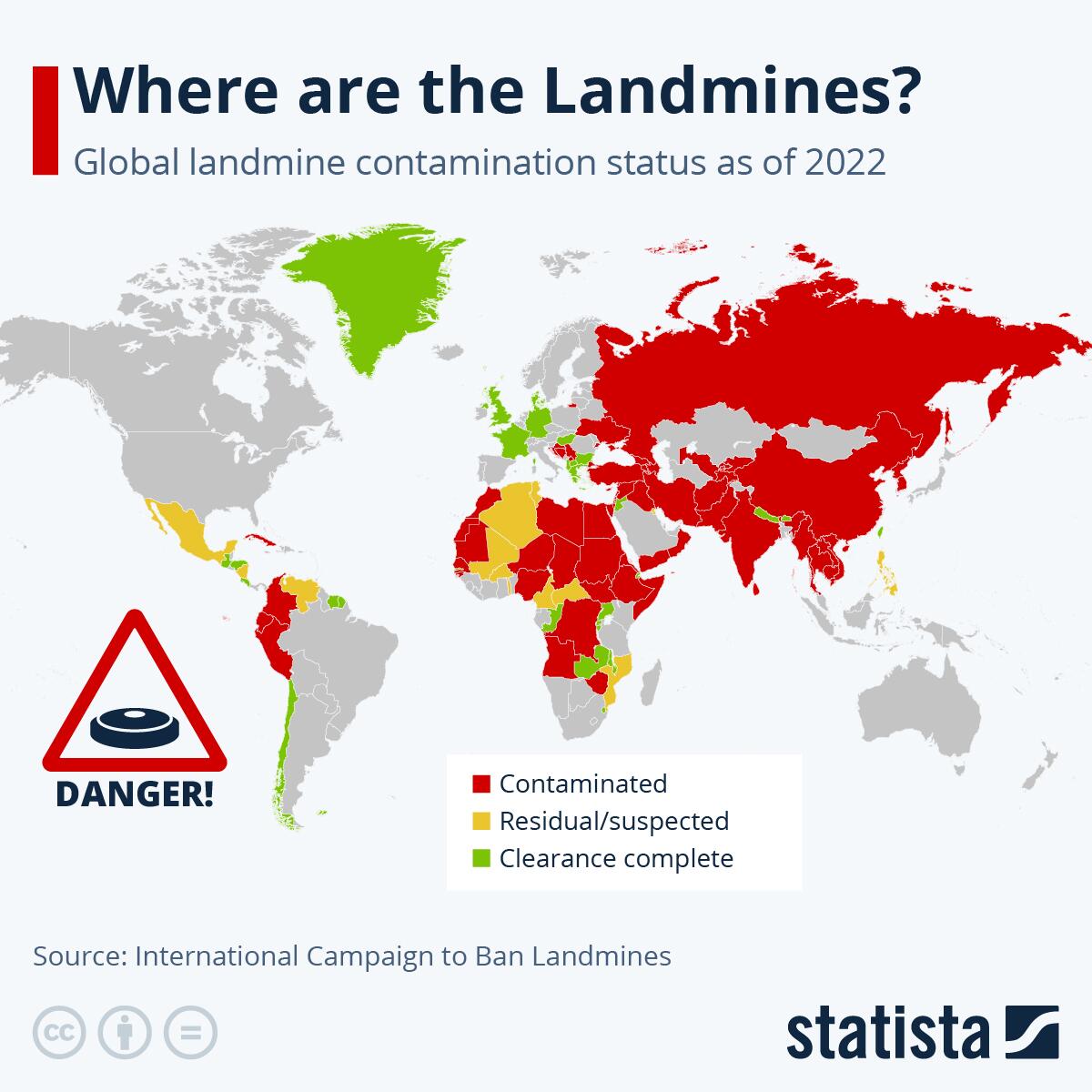
Since 1997, anti-personnel landmines have been prohibited by the United Nations via a treaty that was signed by more than 150 countries. Unfortunately there are a ton of them still active all over the world.

As Martin Armstrong of Statista reveals, Landmine and Cluster Munition Monitor classifies large swathes of the world as being contaminated to some degree with land mines. The negative effects of their presence can not be understated: “Both landmines and explosive remnants of war pose a serious and ongoing threat to civilians. These weapons can be found on roads, footpaths, farmers’ fields, forests, deserts, along borders, in and surrounding houses and schools, and in other places where people are carrying out their daily activities. They deny access to food, water, and other basic needs, and inhibit freedom of movement. They endanger the initial flight and prevent the repatriation of refugees and internally displaced persons (IDPs), and hamper the delivery of humanitarian aid.”

Tyler Durden
Wed, 11/15/2023 – 23:20

CDC Announces Expansion Of Airport Surveillance: What It Means For You

0
CDC Announces Expansion Of Airport Surveillance: What It Means For You

Authored by Jack Phillips via The Epoch Times (emphasis ours),

The Centers for Disease Control and Prevention (CDC) will increase its airport surveillance for respiratory infections, said statements from the federal agency and a private partner on Monday.

The Centers for Disease Control and Prevention (CDC) headquarters in Atlanta on April 23, 2020. (Tami Chappell/AFP via Getty Images)

What It Entails

The private firm, Ginkgo Bioworks, said that it is expanding its work with the CDC’s Traveler-based Genomic Surveillance program “to test for more than 30 additional priority pathogens, in addition to SARS-CoV-2,” the virus that causes COVID-19.

It then described the program as a “flexible, multimodal platform that consists of three complementary approaches of sample collection from arriving international travelers at U.S. airports, including voluntary nasal swabbing, aircraft wastewater, and airport wastewater sampling to enhance early detection of new SARS-CoV-2 variants and other pathogens, and fills gaps in global surveillance.”

What It Will Test

The other pathogens the company said it will test for include multiple influenza strains as well as respiratory syncytial virus (RSV). Neither it nor the CDC listed listed the others.

The expansion of the Traveler-based Genomic Surveillance program to flu, RSV, and other pathogens is essential as we head into fall respiratory season. The TGS program, which began during the COVID-19 pandemic, acted as an early warning system to detect new and rare variants of the SARS-CoV-2 virus and will do the same for other respiratory viruses going forward,” said Dr. Cindy Friedman, chief of the CDC’s Travelers’ Health Branch, in the statement.

The travelers program was introduced in the midst of the COVID-19 pandemic to detect COVID-19 variants and other pathogens via a nasal swab and wastewater collection sampling.

It allowed for the “early detection of the SARS-CoV-2 variant BA.2.86 entering the United States within days of its global identification,” the CDC said, referring to a COVID-19 variant that was found over the summer of 2023. “As the infected traveler had originated travel in Japan, this finding also informed the public health community that the new variant had also spread to Asia.”

‘Voluntary’ Program

The CDC’s program has “enrolled” more than 360,000 air travelers since it was implemented in late 2021, the agency said, adding that it is both “voluntary and anonymous.” It covers flights from more than 135 countries around the world, officials said.

It doesn’t only just rely on travelers volunteering. The agency also collects wastewater samples to evaluate pathogens.

Other than Gingko Bioworks, XpresCheck—a company that runs spa operations at airports—will also partake in the program, according to the CDC.

We have known that travelers are a very important population to consider for tracking new and emerging infections,” Dr. Friedman, with the CDC’s program, told CNN. “One sample from an aircraft coming from a geographic destination afar can give us information potentially about 200 to 300 people that were on that plane,” she added.

A CDC map shows the travelers program is being run at major airports in Seattle, San Francisco, Los Angeles, Boston, Washington D.C., New York City, Boston, and Newark in New Jersey.

Passengers line up at John F. Kennedy International Airport after airlines announced numerous flights were canceled during the spread of the Omicron COVID-19 variant in Queens, New York, on Dec. 24, 2021, Christmas Eve. (Dieu-Nalio Chery/Reuters)

Where?

Officials say the latest expansion will launch at New York’s John F. Kennedy International Airport, San Francisco International Airport, Boston Logan International Airport, and Washington Dulles International Airport.

Hospitalizations Down

According to data provided by the CDC, the rate of hospitalizations have declined in recent weeks since late summer. For the week ending Oct. 28, the hospitalization, death, and COVID-19 positivity rate have essentially remained steady, although emergency room visits have declined, the data shows.

In September, the agency said that for the fall and winter season, hospitalizations would rise for COVID-19, RSV, and influenza.

Both the U.S. Food and Drug Administration (FDA) and CDC signed off on three new updated COVID-19 booster vaccines, although federal data suggests that uptake is relatively slow. So far, only 7 percent of Americans have received the shot, according to the data, while polls suggest that more and more Americans are increasingly wary of the shots.

A poll from the the Annenberg Public Policy Center with the University of Pennsylvania found that about 63 percent of Americans think that getting the COVID-19 vaccine is safer than getting the virus itself—signaling a drop of 12 percentage points from April 2021 when 75 percent held that view.

That survey also found that Americans who view the shot as unsafe increased from 18 percent in August 2022 to 24 percent during last month’s poll.

Meanwhile, the percentage of Americans who back using ivermectin—a drug that was often demonized by media outlets and even some federal health officials—to treat COVID-19 has risen from 10 percent in September 2021 to 26 percent last month, the survey found.

Earlier this year, as the federal government lifted its three-year-long public health emergency over COVID-19, the CDC also lifted its rule that required non-U.S. citizens or permanent residents to show proof of COVID-19 vaccination. Before, any visitor to the United States had to receive the vaccine before getting on a flight to the United States and would have to be also tested for the virus beforehand.

Reuters contributed to this report.

Tyler Durden
Wed, 11/15/2023 – 23:00

SpaceX Prepares For Starlink IPO In 2024, Report Says

0
SpaceX Prepares For Starlink IPO In 2024, Report Says

Starlink, the satellite internet technology made possible by Elon Musk’s SpaceX company, is preparing for an initial public offering as soon as the second half of 2024, according to Bloomberg, citing sources familiar with the situation. 

SpaceX has been shifting Starlink’s assets to a wholly-owned subsidiary that would make it ripe for a spin-off ahead of the IPO, one person said, adding there is yet to be a concrete decision about going public. They said the upcoming listing could be postponed to 2025. 

News of a Starlink IPO follows Musk’s comment on social media platform X earlier this month: “Excited to announce that @SpaceX @Starlink has achieved breakeven cash flow!” 

He continued, “Excellent work by a great team. Starlink is also now a majority of all active satellites and will have launched a majority of all satellites cumulatively from Earth by next year.” 

Musk has commented on the prospect of a Starlink IPO for several years, but the timing remains unclear. However, in 2021, the billionaire said that once the company can “reasonably” forecast cash flow, that would be a sign that a listing to the public markets would be nearing. 

Last Friday, Billionaire investor Ron Baron told CNBC’s Andrew Ross Sorkin that he expects SpaceX to IPO its Starlink in 2027. 

Baron said, “We think that by the time they go public with SpaceX, with Starlink … in 2027 or so, four years, the company will be worth $250 billion to $300 billion.”

Tesla blogger Sawyer Merritt recently posted on X a graph that shows Starlink’s onboarding of new customers has been parabolic since June 2022. The service now has more than 2 million users worldwide

SpaceX currently has a $150 billion valuation. It has delivered 80% of all Earth’s payload mass to orbit this year. 

As we continue to point out, Musk is becoming the ‘uncancellable‘ billionaire while radical Democrats in Washington weaponize government agencies against his companies. 

In other news, SpaceX’s Starship launch could be as soon as this Friday. 

Tyler Durden
Wed, 11/15/2023 – 22:40

Campus Antisemitism Is Fueled By Woke Takeover Of Higher Education

0
Campus Antisemitism Is Fueled By Woke Takeover Of Higher Education

Authored by Jonathan Pidluzny via American Greatness,

“[T]here are moments in this life… when… pure, unadulterated evil is unleashed on this world.” That is how President Biden first described Hamas’s gruesome premeditated attack on Israeli civilians.

Compare the reaction on college campuses. In a “Day of Resistance” toolkit, National Students for Justice in Palestine, an organization with hundreds of campus chapters, called the slaughter of Israeli Jews “a historic win for the Palestinian resistance.” The toolkit went on to describe the “heightened stage of the Palestinian struggle” as a “resistance” that will “bring dignity and honor to the Palestinian people.”

In the weeks since, student groups on U.S. campuses have celebrated the atrocity — both in public statements and boisterous campus rallies. A statement endorsed by more than 30 student groups at Harvard University professing to hold “the Israeli regime entirely responsible for all unfolding violence” is only the highest profile among many examples. Two weeks ago, 57 people — many of them calling for Israel’s destruction — were arrested for trespassing at the University of Massachusetts, Amherst.

Faculty, too, are on record cheering Hamas. A Cornell professor called the slaughter “exhilarating,” while a professor of climate science at the School of the Art Institute of Chicago called Israelis “pigs” and “savages.” An American Studies professor at the University of California–Davis encouraged violence targeting “Zionist journalists” (and their families) in a public Tweet.

And yet, few university presidents have condemned expressions of hatred on their campuses with the moral clarity the moment demands. Many could not even muster the fortitude to condemn Hamas’s massacre without equivocating. Emboldened, pro-Hamas students are now crossing the line from protected (hateful) speech to harassment and violence. With menacing mobs chanting eliminationist slogans, how could a Jewish student feel truly safe on an elite campus?

All this against a backdrop that will sear October 7 into our historical memory for generations: more than 1,400 confirmed dead; thousands injured; more than 200 hostages taken by terrorists who fantasize about wiping Israel from the face of the Earth; ISIS-level displays of cruelty and barbarism; and dead children discovered in pieces.

What is going on? Why are privileged students on elite campuses, tomorrow’s public leaders, cheering evil and blaming the victims of a heinous terrorist attack? Why such cowardice from academic administrators?

Three aspects of the contemporary campus environment, trends that have been building for decades, help to explain a reaction that ordinary Americans rightly find appalling and incomprehensible.

First, today’s “social justice” movements crudely sort individuals into groups based on whether they can be viewed as oppressors or the oppressed. Jews are labeled oppressors by virtue of their political and economic success — even though their suffering, as a people, is unparalleled in modern history.

This lazy way of understanding the world — common to postcolonial studies, critical race theory, intersectionality, campus DEI, and a host of far-left intellectual frameworks — has rotted the academy. It teaches adherents to embrace primitive tribalism, one that sees the world exclusively in terms of virtuous victims and evil oppressors. And it teaches students to make simple, uncompromising judgments: Jews are oppressors in Israel. White interests systematically discriminate against minorities in this country.

As a result, students leave campus primed to judge others based on group identity or skin color, not individual character or merit. Thus, critical deliberation is sacrificed to a feverous, anti-intellectual imperative: cheer for the group the Left says is marginalized—and against Western Civilization, which is alleged to be inherently oppressive. This is how the new campus ideologies obliterate students’ capacity for moral judgment.

It also explains why campus activists can fly into an indignant rage over “microaggressions” — literally, an alleged harm that is microscopic — if the “victim” claims a favored group identity while at the same time, blaming Israel when barbaric Hamas terrorists burn Jewish babies to death. The mindset forged on campus migrates with graduates into our schools, the media, and the halls of Congress.

Second, it is possible to hold such a simplistic, fanatical worldview in part because students lack the historical understanding that would help them appreciate the magnitude and moral significance of October 7. It should be the role of universities to instill this.

Unfortunately, general education (the course of study common to all students at a university) has deteriorated beyond recognition. Instead of taking courses designed to acquaint students with their civilizational inheritance — courses in politics, history, foreign languages, philosophy, religion, etc. — students today choose from menus of disjointed electives, many of them designed to advance a social justice ideology.

As a result, few students learn much about the Middle East and its complicated history — or even their own country. It is easier to cling to a propagandistic distortion when you lack the perspective that would call it into question, for example, the reasons Israel’s borders changed after its 20th-century wars, the fact Israel unilaterally withdrew from Gaza in 2005, awareness that eradicating Israel is written into Hamas’s very charter, etc., etc., etc.

Third, elite university campuses are the one place in American society where making the intellectual case for antisemitism is fashionable. Faculty in radical “Studies” disciplines, some of them funded by federal tax dollars under Title VI of the Higher Education Act (others, by foreign gifts from Gulf states), run biased and imbalanced programs. Some even advocate for the abolition of Israel and platform the professors who have been cheering Hamas’s massacre. No university would hire faculty whose “academic research” made similar claims about any other people.

Antisemitic professors and student groups, even in small numbers, warp the campus conversation. Their presence conveys to students that this one hatred is respectable. Indeed, researchers have established that the presence on campus of faculty who express anti-Zionist views “is associated with a significant increase in…. incidents that target Jewish students for harm, including assault, harassment, destruction of property and suppression of speech.”

The result is a campus environment broadly hostile to Jewish students and is quickly getting worse. We knew this before Hamas’s killing spree. A 2022 survey found that 55% of Jewish students said that they have personally experienced antisemitism on their campus. Only 28% said they think that school administrators take antisemitism seriously.

The specter of students cheering an evil massacre at elite universities while cowardly administrators convey indifference reveals a profound sickness in the places that are supposed to preserve (and perpetuate) our civilizational inheritance.

Campus pathologies spread. Academic ideologies reshape society as they ripple beyond the university’s walls. That is what they are designed to do. Combating campus antisemitism is, therefore, not just a moral imperative. It is an urgent priority in the battle to save higher education, which will profoundly shape the society in which our children and grandchildren grow up.

Jonathan Pidluzny, Ph.D., is the Director of the Higher Education Reform Initiative at the America First Policy Institute.


Tyler Durden
Wed, 11/15/2023 – 22:20

Where America’s International Students Come From

0
Where America’s International Students Come From

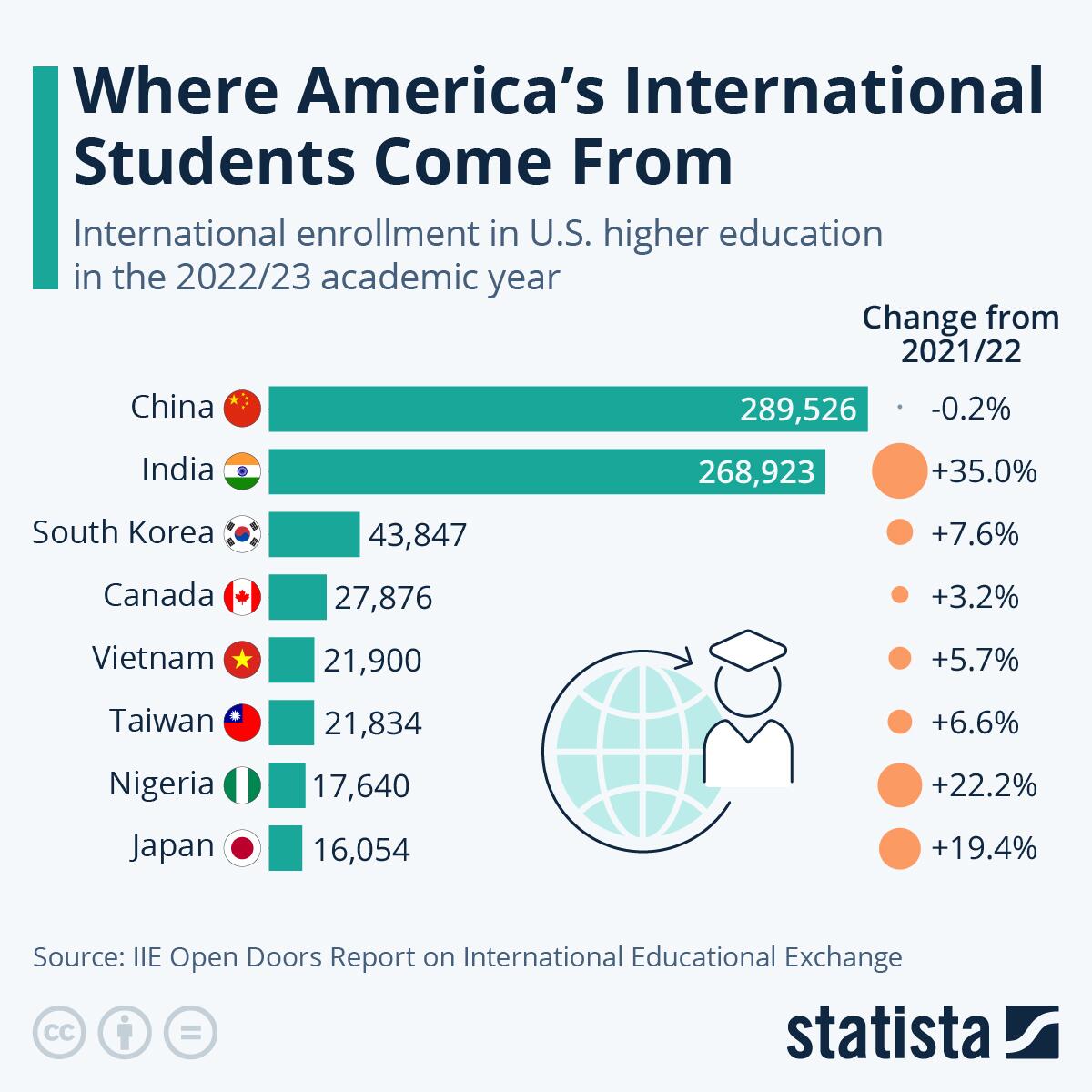
While enrollment at US higher education institutes saw a massive dip during the Covid-19 pandemic, the number of international students has bounced back in the 2022/2023 academic year, thanks to a huge influx from India.

And while still below pre-pandemic levels, 1.06 million international students came to the US in the past school year according to the Open Doors Report on International Education Exchange – a jump of 11.5% over 2021/2022 and 15% over 2020/2021.

As Katharina Buchholz of Statista further notes, International students make up 5.6 percent of the total U.S. student population, up from 4.6 percent one year prior. They contributed around $40 billion to the American economy in 2022/23.

China remained the largest source country for international students with a grand total of 289,526 enrolled in undergraduate, graduate, non-degree and optional practicing training programs. Their number has been decreasing for years however. India, on the other hand, came second with 268,923 students – a count that has been increasing, most recently by a whopping 35 percent. South Korea is in rank 3 with 43,847 international students in the past academic year, followed by Canada, Vietnam and Taiwan. Other countries where international enrollment at U.S. institutions grew quickly were Nigeria (up 22 percent) and Japan (up 19 percent).

Tyler Durden
Wed, 11/15/2023 – 21:20