TikTok Continues To Dominate The World’s Most Downloaded Apps
In a digital age where most people interact with the world through digital apps residing on smartphones, it’s helpful to break down the global addiction.
According to a treemap from Truman Du, TikTok took the crown in 2022, beating out notable contenders from social media giants, Visual Capitalist reports.
With a staggering 672 million downloads in just one year and its revenue doubling to an eye-watering $9.4 billion speaks volumes of its commercial success from the foreign app – a feat made even more remarkable considering the geopolitical hurdles it faces; being a rare Chinese export that has captivated international markets. Yet, despite its unprecedented global appeal, it remains barred in significant markets like India, and has even faced temporary bans in places like Pakistan – a testament to its disruptive impact in the tightly-contested digital arena.
Meanwhile, the other contenders in the top five most-downloaded apps of 2022 are dominated by the social media juggernauts of Meta, with Instagram, Facebook, and WhatsApp showing that old guards still hold significant sway in the digital domain. This dominance of social media platforms reflects a society ever-hungry for connectivity and digital interaction, a craving only intensified by the isolating clutches of the COVID-19 pandemic. Even Facebook Messenger, tying for the 10th spot with the shopping app Meesho, underscores the diverse digital appetites of today’s netizens – from socializing to shopping, the digital ecosystem is evolving rapidly. It’s a world where staying relevant means staying ahead, and only the apps that adapt to the relentless pace of change will survive in this cutthroat digital jungle.
More via Visual Capitalist:
Social media apps fill the remaining four of the top five most-downloaded spots. Meta is the most prominent there with Instagram, Facebook, and WhatsApp, while Facebook Messenger tied with the shopping app Meeshu for 10th place.
Meanwhile, Telegram, the cloud-based instant messaging service created with the intent of challenging Facebook Messenger, placed 5th with 310 million downloads.
AI Apps Are Gaining Popularity, Fast
In 2020 and 2021, many essential business apps including Zoom and Microsoft Teams grew quickly and saw massive success.
While downloads for these apps fell in 2022, many other travel, food, and shopping-centered apps including Google Maps, McDonald’s, and Shein helped fill the void.
However, it was artificial intelligence apps including Lensa AI and ChatGPT were the ones that saw the greatest spike towards the end of last year. Could these same AI-infused apps help lead the pack in terms of downloads for the most popular apps of 2023?
The only lessons the Old World offers to America these days are cautionary.
Ever since the earliest days of the Republic, American intellectuals, artists, and statesmen looked to Europe for models. Conservatives felt attracted to the continent’s sense of continuity and tradition, and as the base for Christianity. More recently, progressives saw in European social democracy and globalist pacifism a role model to be embraced.
A common theme in the early years of the millennium was that Europe was on the verge of global resurgence while America was in decline. Europe’s eventual stagnation, as many conservatives point out, can be in part traced to an ever expanding high-tax welfare state that generally absorbs roughly ten more percentage points of GDP than in the U.S. But this is not the only explanation. Some of the moderately better off European economies, like Denmark and Sweden, are welfare states but manage to outperform the rest.
The real problem is civilizational. Europeans are unwilling to preserve their industrial base and control their borders, leaving the continent increasingly weak and largely defenseless. The leaderless American empire may be creaking, but Europe is in worse shape, hemmed in by dismal demographics, high taxes, suffocating regulation, and an entrenched bureaucracy that makes California seem like a libertarian paradise.
Europe’s decline can be seen in its rapidly shrinking portion of the global economy. It is hard to find any indicator that the continent is gaining global market share as money continues to pour into the U.S. For the last 15 years, European wages have fallen while those in the U.S. have continued to rise; the eurozone economy grew about six percent, measured in dollars, compared with 82 percent for the U.S., according to International Monetary Fund data.
European quality of life is dropping, its industrial base eroding, and there seems little promise of future improvement. Europe now lags in virtually every major advanced industry, from software and space to automobiles. Of the top 50 tech firms only three are located in Europe; the list is dominated largely by the United States with China second. Foreign investment has plummeted and by 2022 accounted for $100 billion less than the U.S.
Much of this decline is self-inflicted, which suggests some valuable lessons for us. A critical problem lies in E.U. climate policy, which has tended to be more extreme, and widely implemented, than in a more divided, decentralized United States. These policies are already eroding food production and sparking higher prices. Developing nations need more food production from exporters, but by Europe’s banning or restricting critical fertilizers, or the enforced culling of herds, they will have to get it elsewhere. This comes at a time when Europe’s old African and South American colonies are losing interest in ties with France and Britain and increasingly look elsewhere, notably China and Russia, for capital, goods, and natural resource development.
Climate catastrophism has also cripped Europe’s energy supply. To meet utopian “net zero” standards, Europe seems, as one observer put it recently, on course for “energy suicide.” The effect of the Ukrainian war has already affected European natural gas prices, but the current conflict is adding more pain. The U.S. is now the world’s biggest liquid natural gas (LNG) exporter while green policies leave Europe ever more exposed. Since October 6, prices at the benchmark TTF gas hub in Holland have soared, selling for about $51 per million Btu. That same quantity of gas at Henry Hub in Louisiana sells for about $2.90. Where will Europe have to turn for future gas supplies? Some Europeans may prefer kowtowing to Qatar, the ally of Iran and Hamas, then bending down to unruly Texans.
The great bastion of European competence, Germany, is clearly unraveling. Germany’s strategy of dependence on U.S. military, Russian energy, and Chinese customers has blown up in their faces, as the U.S. faces defense overstretch, Russian gas heads to China and other more dynamic markets, and the Chinese, once seen as ideal customers for high-end German engineered products, are becoming both reluctant customers and stronger competitors. Germany is now on the verge of losing much of its industrial base, notably in chemicals and autos, including its vaunted mittlestand, in large part due to high energy prices and a diminishing workforce.
German industry must now cope with tech products and electric vehicles built in the world’s leading GHG producer. The power of technology to transform an economy—or leave it behind—also is apparent when comparing the trajectories of Germany and the U.S. over the past 15 years. During that period, the U.S. economy, driven by a boom in Silicon Valley, expanded by 76 percent to $25.5 trillion. Germany’s economy grew by 19 percent to $4.1 trillion. In dollar terms, the U.S. added the equivalent of nearly three Germanys to its economy over that period.
Yet perhaps even more troubling may prove Europe’s experience with immigration. Europe, like the U.S., is swamped with refugees, mainly from destitute countries. Opposition to this unregulated tide—what Le Figaro calls “Le menace islamiste”—is widely dismissed as racist and even criminal. Even before the outbreaks of pro-Hamas sentiment roiled Paris this month, violent protests already had become common and increasingly hostile to the secular state. It is now clear that some of these newcomers have brought with them a strain of Islamic fundamentalism and antisemitism that is far more threatening than anything experienced here.
In the short run, opposition to Israel from the Left, from neo-Marxists to Greens, seems likely to boost the political power of Islamism across Europe, notably in France, while further weakening national as well as European institutions. Across the continent, one sees the growth of ghettos that now contain a permanent underclass who embrace lawless nihilism, compounded by Islamist ideology. European cities were once largely safe and clean but are now dirty and graffiti-scarred, although still less lethally dangerous than their American counterparts. Some cities, like Marseilles, are now better known for random crime and decay than for their Mediterranean charm.
To a long-civilized people used to a degree of civility and respect for law, scenes of French off-duty cops being assaulted are an affront. The increased dominance of large cities by often violent, perennially angry youths, largely from Muslim countries, has the whole continent on edge. Even Sweden, long the Valhalla of progressive fantasies, has been forced to call out the army to tamp down violence in immigrant-dominated areas, where native Swedes are essentially barred.
The opposition to unrestrained immigration has terrible implications for the center-left, whose multicultural ideology in unraveling. The postwar dream that immigrants would relieve the continent of its labor shortages while gradually assimilating to local culture has not panned out. Immigrant workers either lack the skills or cannot penetrate the continent’s often difficult regulatory environment. Even famously liberal countries like Denmark are mandating integration, and openly seek to break up immigrant-dominated clusters by bulldozing social housing.
Immigration is also sparking a powerful right-wing resurgence. Victor Orban, the bete noire of progressive Europe, now has company in the form of Italy’s Giorgia Meloni and perhaps a future President Marine Le Pen. It has also nurtured an upsurge of far-right sentiment in Germany, where refugee populations are soaring.
The rise of the nationalist Right is widely denounced in the media, but it largely represents less expansive chauvinism than a last desperate attempt to restore a semblance of traditional values, notably belief in the past and religion. As the Guardian noted five years ago, a majority of young adults in 12 European countries have no faith; one scholar noted that many young Europeans “will have been baptized and then never darken the door of a church again. Cultural religious identities just aren’t being passed on from parents to children. It just washes straight off them.” According to Pew, for example, Christianity will be the minority faith across Britain and in some other European countries by 2050.
Far more than the U.S., Europe is ill-suited for diversity, as these countries are closely tied to their indigenous population and tradition. The “melting pot,” also under assault in the U.S, never really worked in Europe since the growth of Middle Eastern Muslim immigration. And with extraordinarily low birthrates among indigenous Europeans, these unintegrated populations—the drivers of the current upsurge in antisemitism—will surely grow as a percentage of the population.
Given the struggles in Europe with the consequences of contemporary progressivism, Americans should think twice about adopting their current “solutions.” Without some radical readjustment, Europeans face a dismal future, one that we should not want to replicate on this side of the Atlantic.
The American Mind presents a range of perspectives. Views are writers’ own and do not necessarily represent those of The Claremont Institute.
By Sebastian Boyd, Bloomberg markets live reporter and strategist
There’s a possibility the yen may have touched bottom for the current cycle, at least against the dollar, with measures of interest-rate differentials between the two currencies starting to narrow.
Colleague George Lei warns the yen is unlikely to outperform, though once-deeply negative six-month and 12-month yen forward points seem to have begun to turn a corner.
Traders in the US are now looking ahead for possible cuts, while those in Japan are thinking yields may be allowed to rise eventually.
That means that those two measures of interest-rate differential may start to rise and eventually start pulling the three-month points up with them. There’s a very strong correlation between six-month forward points and USD/JPY over the past five years, and it gets even better if with a lag.
Meanwhile, the gap between one-year rate swaps in dollars and yen fell to the narrowest since June. A big hawkish data surprise in the US would turn that around, but as long as we continue to see the labor market soften, the rate gap will continue to narrow.
It’s not obvious how long the yen’s recovery will last, but US consumer price data did Japanese authorities a huge favor on Tuesday. The yen had bumped up against 151.95 per dollar on Monday, the level that provoked intervention in October 2022. But when US CPI came in softer than expected a day later, yields tumbled and the dollar plunged.
The scale of the move was exaggerated and there’s obviously a likelihood it gets unwound. But fed funds rates are now pricing in no more hikes and brought the likelihood of a rate cut forward to May from June, pushing USD/JPY right back below 151 again.
Over the weekend, the United Kingdom’s paper of record, the Sunday Times, reported on how an influential organization called “Labour Together” failed to declare its funding, as required by law. The Times exclusive, “The secretive guru who plotted Keir Starmer’s path to power with undeclared cash,” has significance in the U.K. primarily because “Labour Together” is the organization that created and incubated the leadership campaign of Sir Keir Starmer, a favorite to oust current PM Rishi Sunak and become Britain’s next Prime Minister. The Times said he “appears destined for Downing Street.”
In this series, the controversial and problematic history of CCDH is revealed for the first time. This includes details of how CCDH was created discreetly by Labour Together, a small but influential group connected to Britain’s Labour Party, analogous to the Democratic Party in the U.S.
The primary mover behind the creation of CCDH is Imran Ahmed, described as the “Founder CEO” of the organization. He appears regularly on US media to discuss issues related to misinformation and “identity-based hate.” His current LinkedIn describes him as an “authority on social and psychological malignancies on social media, such as identity-based hate, extremism, disinformation, and conspiracy theories.”
However, these new documents show the concerning role that Ahmed played while working for the Labour Party, seeding news stories of dubious accuracy.
CCDH has grown into an organization with worldwide influence, frequently quoted in relentless, uncompromising campaigns to have figures removed from the Internet. Its most famous work in the States likely involves the so-called “Disinformation Dozen,” including Robert F. Kennedy, Jr. The CCDH was sued by X, formerly Twitter, for “a series of unlawful acts” designed to impact its advertising by “falsely” claiming “it had statistical support showing the platform is overwhelmed with harmful content.” The Washington Post described this suit (emphasis ours):
X also alleged, without offering evidence for its claims, that the CCDH operations were “activist organizations masquerading as research agencies, funded and supported by unknown organizations, individuals and potentially even foreign governments with ties to legacy media companies.”
The information below, developed independently of X, fills in some blanks about the CCDH. This is an “anti-disinformation” group, often called an “anti-hate” group by American media organizations, that rose to prominence as an activist arm of the centrist, anti-Corbynite wing of Britain’s Labour Party.
It didn’t always play fair.
CCDH grew from a little-known startup into one of the most influential organizations in the “anti-disinformation” space on both sides of the Atlantic in little more than three years.
In the UK, CCDH is at the forefront of driving and influencing a new legislative framework that envisages substantially increasing the levels of state intervention in controlling speech. It also boasts a range of influential figures, including a current Conservative Party MP, on its board.
“Our mission is to protect human rights and civil liberties online,” CCDH explains on its website. Those liberties, it says, are threatened because social media companies “erode basic rights and civil liberties by enabling the spread of online hate and disinformation.” It achieves this by conducting “innovative research, public campaigns and advocacy” aimed at influencing policy and legislation.
While X’s suit has been dismissed as groundless in U.S. media, a way of “suing its way out of accountability” or suing a “nonprofit that fights hate speech,” few stateside reporters have really looked into its claims.
According to a now-defunct personal blog he ran in 2010 and 2011, Imran Ahmed was born and raised in Manchester as one of seven children of Pashtun parents. Following his education at a Manchester Grammar School on scholarship, Ahmed received a grant to study medicine in London. Six months later, Ahmed gave up his medical degree and started working for a UK “financial institution,” later confirmed to be Merrill Lynch. In 1999, Ahmed left banking for a job in which he would “shadow” MPs, learning the nitty-gritty of British politics. Ahmed shadowed Simon Hughes, the Liberal Democratic MP and later President of the Party between 2005 and 2010.
Around 2010, Ahmed approached the Labour MP Andy Slaughter, the parliamentary representative for Hammersmith, in west London. Ahmed offered to work for Slaughter for free, assuming the role of Slaughter’s Head of Communications and Policy during Slaughter’s successful run in the 2010 General Election. He was appointed to Slaughter’s staff full-time thereafter, launching his Labour Party career.
Tory bloggers soon noted Ahmed was not particularly judicious about his tweeting style. In June 2011, for example, Ahmed tweeted “fun watching ‘Labour’ pols laud Blair today cos he won elections. Like watching a cat lick its asshole. Disgusting, but keeps em busy, eh.”
Subscribers to Racket News can read the rest here…
Knesset members on Monday discussed the potential ousting of Israeli Prime Minister Benjamin Netanyahu once the war between Palestinian resistance factions and Tel Aviv comes to an end.
Israel’s Channel 13 reports that ministers and members of the Knesset from Netanyahu’s own Likud party discussed impeaching the premier, saying that if he remains in the party and an election is held, most party members will give a vote of no confidence.
A reporter for the news channel said this motion against Netanyahu includes other parties who came together with Likud members to discuss plans for the end of the ground invasion after former war chief Benny Gantz leaves the emergency war cabinet.
Nonetheless, on Monday, people close to Gantz revealed he has rejected calls to replace Netanyahu, calling them “pure fantasy” and “nothing less than crazy.”
Current opinion polls show that two-thirds of Israelis want an election once the war ends, as hundreds of thousands had taken to the streets before October 7 to express dissatisfaction with Netanyahu’s rule.
The anger against the prime minister has only increased as the Hamas-led front launched the Al-Aqsa Flood Operation against Israel, with large protests being held in Tel Aviv calling for the Israeli government to secede and comply with Palestinian demands so that Israeli captives in Gaza may be released.
Al-Aqsa Flood Operation “crushed the façade” of safety created by “Mr. Security,” as former US ambassador to Egypt and Israel Daniel C. Kurtzer wrote in Foreign Policy.
Israelis continue to protest PM Netanyahu in Tel Aviv as they demand safe return of hostages in Gaza pic.twitter.com/MvPWH1ij69
Netanyahu tried to shrink responsibility several days ago by blaming the intelligence and military chiefs for the security failures that led to the Hamas attacks. “The angry backlash should have convinced him that Israelis will not let him off the hook,” Kurtzer wrote.
Writing that most Israelis trust the heads of the Israeli army than they do Netanyahu, Kurtzer continued that “having lost his aura as protector of Israel, and having failed thus far to define Israel’s war aims in Gaza beyond the hyperbole of destroying Hamas, Netanyahu is now clinging to power for the sake of power itself.”
Yesterday’s Knesset discussion wouldn’t be the first time impeaching the current Israeli prime minister was mentioned; sources recently told Rolling Stone that Donald Trump, the Republican frontrunner ahead of next year’s ballots in the US, held phone calls last month with multiple pro-Israel GOP allies and donors who wanted his thoughts on the current situation.
“[Trump] has expressed his strong desire for Netanyahu to be gone by the time Trump would potentially be back in office in 2025,” the sources told the magazine. “Trump has said Netanyahu should be ‘impeached’ by the Israeli Parliament because of the assault,” speaking about the Al-Aqsa Flood operation by Palestinian factions.
In recent days, two sources familiar with the matter tell Rolling Stone, Trump has had phone calls with various pro-Israel GOP allies and donors.
During these private conversations, Trump has spent an inordinate amount of time aggressively trashing Netanyahu.
As the war nears its 40th day, the Israeli army has been conducting a scorched earth policy on the Gaza Strip, for one, to cause as much destruction to Palestinian-controlled land by exposing the paper tiger that is the Israeli army, and on the other hand, so that Netanyahu can keep his seat as the head of the nation.
US Beef Prices Hit Record High As Nation’s Cattle Herd Expected To Shrink Through 2025
Brazilian processor Marfrig Global Foods SA warned the US cattle herd will continue shrinking through the midpoint of the decade. Less supplies will pressure meatpackers and keep the prices of steak and hamburgers at elevated levels.
During a conference call, Tim Klein, the head of Marfrig’s North American operation, explained the availability of fattened animals for meatpackers to slaughter and process should trough between 2025 and 2026. He said this is because ranchers have not yet started keeping cows for breeding.
As we’ve noted, years of drought and high feed costs forced ranchers across the Midwest to send the cows to slaughterhouses, leading to a sharp reduction in the nation’s overall herd size. In January, the beef cow herd size was the smallest since 1962.
Tight supplies of cattle have hurt the profits of meatpackers, including Tyson Foods Inc. and JBS SA:
National Beef Inc., Marfrig’s US unit, saw adjusted earnings before items such as taxes and interest more than halve in the third quarter from a year ago to $150 million, according to a statement from the company on Monday. Tyson Foods Inc. and JBS SA posted results earlier that were largely affected by lower profits in their US beef operations. -Bloomberg
Declining cattle numbers also sent US beef prices at the supermarket to record highs.
Also, US beef exports are forecasted to slide 14% this year from 2022 to 3 billion pounds, the lowest since the early days of the Covid pandemic when plant closures crushed meatpackers. The USDA warned US beef production is expected to decline further next year.
Last week, Pete Bonds, a Texas-based cattle producer, told Reuters, “The future of this industry is not here in the United States.”
Food inflation remains sticky. And soon, beef will be a luxury only the rich can afford. As for the working poor, Tyson plans to build a new insect plant in 2025.
What do you get after a decade of negative real rates and unlimited QE as monetary policy? Losing $227,000 per vehicle as an acceptable business model for an automobile company!
The California-based Lucid Motors, offers four electric vehicle (EV) models priced between $74,900 and $249,000 and reported a third-quarter net loss of $630.9 million, excluding overhead costs.
This amounts to over $227,000 in losses per car sold, the report says, citing its financial statements and calculations by The Wall Street Journal.
Despite having sold only 125 vehicles by November 2021, the company’s valuation peaked at $91 billion. However, its stock price has since dropped by approximately 93%.
Last week, Lucid Motors reduced its vehicle prices to boost demand, the report notes. All the while, the electric vehicle company’s primary investor is the Saudi Arabian public investment fund, ironically sustained by oil revenues.
The Saudi government plans to purchase 100,000 Lucid cars over ten years, with the fund investing heavily to support the struggling company, the report added.
Lucid is not alone in its financial struggles within the EV sector. Rivian, another upscale EV maker, faced a loss of $33,000 per vehicle sold in the second quarter. Meanwhile, Ford, a traditional automaker, anticipates over $4 billion in losses from its EV division this year.
All this completely rational, sensible behavior and market mechanics in the name of climate change…
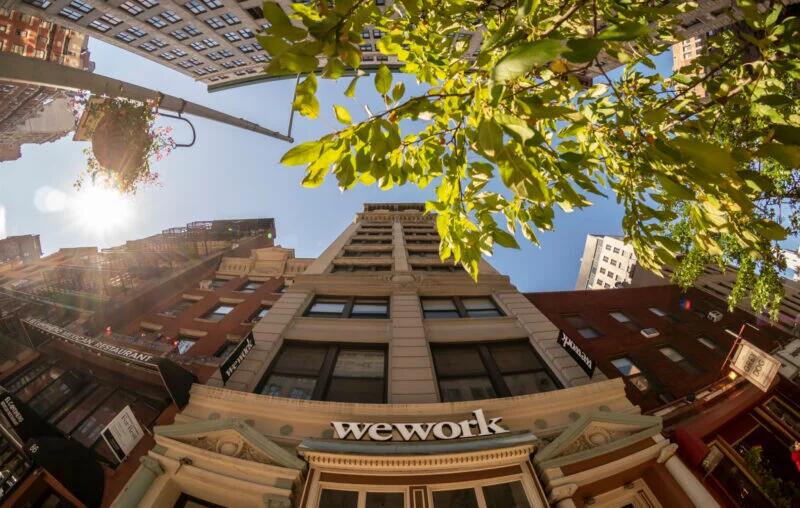
The bankruptcy filing of WeWork Inc. on November 6, 2023 came with neither a whimper nor a bang, but with a laconic shrug. Although the company has been around for 13 years, it has been defined more by successive flirtations with demise and unseemly corporate revelations than by innovative ideas for the second half of its life. Few were surprised when the latest, and possibly not the final, chapter arrived.
While some stories are better told starting at the end, the WeWork story is best told from the beginning: It started as a company that rents desks. That’s it. Yes, it has been described as an enterprise providing “flexible co-working spaces” with the value adds of “collaboration” and “community.” Over the years it has variously billed itself as a real estate company and a high-tech firm. It has dabbled in online events, run a design agency, owned a smartphone authentication startup, acquired an online facilities management platform, and stretched the We brand beyond recognition (WeLive, WeGrow, Rise by We, and others). At the root of all, though — buried deep under a morass of corporate mysticism, questionable business dealings, and most of all a penchant for squandering money at a Biblically diluvian rate — is a business of renting desks.
One can easily see how the sharing model employed by Uber, AirBNB, Turo, TaskRabbit, Spinlister, and other such firms would’ve found its way into the commercial real estate business. Yet subleasing as a business was not pioneered by WeWork. Large urban office buildings are frequently not fully occupied outside traditional business hours. And rarely are there office spaces small enough to both accommodate and justify the expense of one or two individuals, or for only a day or two per week, or other permutations thereof. And this is where economic calculation begins: If some smart person could figure out how to treat commercial space like a four-dimensional game of Tetris, cleverly fitting different occupancy needs of spaces and times together in ways that traditional building managers can’t or won’t, they might not only serve an unmet need, but eke out a profit in the process.
But landlords aren’t terribly interested in putting wild-eyed intermediaries between themselves and their earnings. So an entrepreneur interested in offering unique, customizable office spaces has to first rent out space, usually several floors or an entire building, only then dividing it into the unusual units for which there may be a market. While eventually WeWork did purchase and operate its own buildings, its basic business is that of a sublessor: renting space to rent back out at a slight premium with perks to enhance the marketability of spaces. Some of those amenities were subtle, like dartboards or Ping Pong tables. Others seemed out-of-place in a business context, like beer on tap and hammocks. A few, like administrative support, phone systems, and printers undoubtedly added value.
While there are many challenges to running that kind of business, several are immediately evident. First, margins are likely to be small — even before spending on inducements. Also, providing maximum permutability to would-be renters of various sizes and terms requires taking long-term leases. And it goes without saying that in order to make significant revenue and profits, the business — again, fundamentally, renting desks — would have to be scaled enormously. More floors, in more buildings, in more cities, with tireless marketing, sales, and development support.
If, sometime in 2019, you’d asked a major, international sublessor what the major threats to their business were, they’d probably have said a terror attack or serious recession. But both of those things have happened, and while they dampened economic growth, they weren’t long-lasting. Plus, international diversification provides a hedge, of sorts, to that kind of shock. What few, if any, would have guessed is that a pandemic would break out. Far fewer would have guessed that governments around the world, with few exceptions, would respond to a pandemic by ordering widespread business shutdowns, restrictions on in-person meetings, and other heedlessly destructive policies. And who, even when the word COVID became part of the 24-hour news cycle throughout 2020 and 2021, would have anticipated that the relaxation of non-pharmaceutical interventions would not be met by a surge back into office spaces, but by a vastly broader acceptance of remote work?
In the future, the many idiosyncrasies of founder Adam Neumann are likely to figure prominently in WeWork retellings. The explanation for the bankruptcy that is likely to prevail, however, is that WeWork was felled by COVID precautions. In fact, WeWork was conceived of and established during the Federal Reserve’s post-2008 collapse zero interest rate policy (ZIRP), at a time when credit was cheap and plentiful. And just as the company was facing calamity, historically expansive monetary and fiscal policy measures gave the long-ailing WeWork a reprieve before it ultimately succumbed to long-looming financial vulnerabilities.
Austrian Business Cycle Theory
It sometimes puzzles observers that scores of sound businesses humming along would suddenly collapse in large bunches as economic conditions begin to deteriorate. Or relatedly, that firms which are unprofitable can at times limp along for years on end. The Austrian Business Cycle Theory (ABCT) offers an explanation for these phenomena, by focusing upon the relationship between central bank policies, interest rates, and the allocation of resources within an economy.
ABCT designates the start of booms with a period of credit expansion by a central bank, which typically involves lowering interest rates and increasing the money supply. This expansion leads to a decrease in market interest rates, making borrowing cheaper and more attractive to businesses and investors. As a result of the lower interest rates, businesses and investors increase their borrowing and investment activities. This leads to an economic boom characterized by increased spending, investment in long-term projects, and a general sense of optimism in the economy.
Artificially low interest rates (rates set by policy, rather than set by market forces in lending markets) send misleading signals to entrepreneurs and investors. These low rates suggest that resources are more abundant than they actually are, and that the time preference for consumption, versus saving and investment, has changed. Entrepreneurs and businesses respond to the distorted interest rate signals by making investments in long-term and capital-intensive projects that may not be economically viable in the long run. They may engage in speculative ventures and allocate resources inefficiently. Owing to bountiful credit at negligible cost, business concepts which, in normal periods at market-determined rates, may never have gotten off the ground are not only established but gain initial traction.
The credit expansion can lead to the creation of asset bubbles in various sectors. These bubbles are unsustainable because they are driven by the artificial credit expansion rather than genuine economic fundamentals. Eventually, the unsustainable nature of the boom becomes evident. The central bank may start to raise interest rates or reduce monetary stimulus, leading to a contraction in credit and a shift in market sentiment. This triggers the “bust” phase. Malinvestments made during the boom become apparent. Businesses may find that their long-term projects are no longer profitable, leading to bankruptcies, layoffs, and a revaluation of asset prices.
The Federal Reserve began its first round of quantitative easing (QE1) in late 2008 in response to the global financial crisis. It was followed by QE2, which ran from November 2010 to September 2012 and QE3, which ended in October 2014. WeWork’s establishment in March 2010 places its corporate birth late within the first, most-expansionary phase of the post-2008-crisis monetary policy regimes.
When interest rates are driven to rock-bottom prices as a matter of policy, investors begin to seek higher-risk projects and vehicles to produce meaningful returns. This phenomenon is known as the “reach for yield,” which has been seen time and time again throughout boom and bust cycles. It may induce individual investors preparing for retirement to abandon investment grade bonds and stock indices in favor of riskier securities. And it may drive venture capital firms already in the business of taking on speculative ventures to ratchet up their exposure to uncertain and questionable ventures. This has been shown from one speculative bubbleto the next.
The peak of WeWork’s valuation was $47 billion in January 2019. At that point, an initial public offering of stock was considered, and in August 2019 a Form S-1 was filed with the United States Securities and Exchange Commission (SEC).
(It is instructive at this point to note that an initial public offering, while sometimes depicted as a magnanimous opportunity for retail investors, is in fact an exit strategy for founders and early-stage investors. Although most companies continue to generate positive returns after going public, IPOs are undertaken when the general consensus among insiders is that the explosive period of initial growth is over, nearly so, or that public equity valuations are high enough that they should be taken advantage of.)
In November, SoftBank Group disclosed a $9.2 billion loss in the value of its investments in WeWork, which amounted to approximately 90 percent of the $10.3 billion that SoftBank had previously invested in WeWork over the preceding years. Less than two weeks later, WeWork announced workforce reductions of roughly 20 percent of its global headcount. The firm was already struggling mightily before the pandemic struck.
With the onset of the pandemic came several rounds of massively expansionary monetary policy programs, as well as fiscal stimuli policies, on a global scale. A stock market crash in March 2020 — the first since 1987 — accompanied by several rounds of stimulus checks, rock-bottom interest rates, and collective ennui, drove investors into markets ranging from equities to cryptocurrencies and beyond. The coordinated short squeezes of a handful of distressed equity issues was emblematic of the effects of the massive credit boom.
Throughout 2020, WeWork liquidated some of its Chinese assets and engaged in several more rounds of layoffs. It also renegotiated certain lease agreements and deferments at many locations. Cheap money and seemingly insatiable risk appetites throughout the year led to a surge in Special Purpose Acquisition Company (SPAC) deals, which:
are also commonly referred to as blank check companies … [T]hrough a SPAC transaction, a private company can become a publicly traded company with more certainty as to pricing and control over deal terms as compared to traditional initial public offerings, or IPOs … Unlike an operating company that becomes public through a traditional IPO, however, a SPAC is a shell company when it becomes public. This means that it does not have an underlying operating business and does not have assets other than cash and limited investments, including the proceeds from the IPO.
This was the means by which WeWork ultimately became a publicly traded company on October 21, 2021. It ended its first trading day up 13 percent to $11.78 per share, for a valuation of $9 billion.
Fed Funds rate (red), WeWork stock price (black, w/first trading date green horizontal line
(Source: Bloomberg Finance, LP)
Less than six months later, in March 2022, the Federal Reserve began its most-aggressive contractionary policy campaign in four decades to arrest the surge of inflation in the United States. With higher interest rates and the contraction of the balance sheet, the size of the US money stock began contracting for the first time in decades. As the flow of credit slowed and became more expensive, the prospects of many SPACs dimmed, with their stock prices following.
Since 2008, some eleven years have seen policy rates set at one percent or less. In that time period, the year-over-year expansion of different monetary aggregates has varied greatly. From March 2020 to July 2022, the M2 money supply increased by almost $6 trillion, and has since been contracting at the fastest rate in decades.
Companies founded in easy money periods will tend to be the most vulnerable. Many firms will survive the credit crunch, but few will emerge unscathed. WeWork is only among the most prominent of countless firms which were carried aloft by expansionary policies, now feeling the effects of the severe contractionary reversal (see also Peloton, Beyond Meat, Zoom, Didi Global, and others).
Stock prices of Peloton (blue), Beyond Meat (green), Zoom (purple), and Didi Global ADR (red), M1 Money Supply Index (black dash), and M2 Money Supply M2 Index (black dots), 2020 – present
The liquidation of malinvestment is painful and takes time. There will be more layoffs, more breached contracts, and more fire sales. There is a chance that, greatly scaled down and highly focused, WeWork can emerge from bankruptcy and find some measure of commercial success. Or its assets may be acquired by other entrepreneurs and put to work profitably. One cannot and should not fault business visionaries for attempting to scale a niche, low-margin business into a global empire…even if that business is renting desks. Nor are they to be blamed for taking advantage of investor interest, expansive credit offers, or unconventional sources of financing. The cause ultimately lies not with them, and much less with a virus, but with the monetary interventionism that made both the attempt and the ensuing wreckage possible.
Peter C. Earle is an economist who joined AIER in 2018. Prior to that he spent over 20 years as a trader and analyst at a number of securities firms and hedge funds in the New York metropolitan area. His research focuses on financial markets, monetary policy, and problems in economic measurement. He has been quoted by the Wall Street Journal, Bloomberg, Reuters, CNBC, Grant’s Interest Rate Observer, NPR, and in numerous other media outlets and publications. Pete holds an MA in Applied Economics from American University, an MBA (Finance), and a BS in Engineering from the United States Military Academy at West Point.
Watch: Officials Grilled Over San Fran’s ‘Miraculously’ Spotless Streets For Xi Visit
With Chinese President Xi Jinping’s airplane having touched down in California Tuesday night, the Biden administration is facing questions over the now viral images coming out of San Francisco. As we and others have detailed, the feces-encrusted Golden City was miraculously able to clean itself up, seemingly overnight.
We previously pointed out that for decades, and with increasing severity, residents of San Francisco have been forced to navigate through shit-covered streets, drug dens and criminal elements, all while the city feigned the inability to do anything about it. On Monday, the White House was pressed on the growing and unavoidable public perception that the federal and local government in San Fran cares more about the soon to arrive Communist dictator than American citizens and civic life and public health.
But as the disturbing clip below from a yesterday afternoon press briefing shows, the administration could care less. Biden admin advisor Jake Sullivan was asked, “Does President Biden agree that it’s more important to impress the leader of China than the American people that live in San Francisco?” Watch Sullivan’s pathetic non-answer below…
“Does President Biden agree that it’s more important to impress the leader of China than the American people that live in San Francisco?”
As one online commenter has pointed out, “San Francisco’s homeless population was entirely cleared out for Xi Jinping” and took note that “The government can easily fix our cities overnight. It just doesn’t want to.”
And look who just basically admitted that this is precisely what’s going on…
“I know folks say, ‘Oh, they’re just cleaning up this place because all these fancy leaders are coming into town.’ That’s true because it’s true.”
Gavin Newsom admits San Francisco wiped its streets of filth and excrement for Xi Jinping but not Americans:
“I know folks say, ‘Oh, they’re just cleaning up this place because all these fancy leaders are coming into town.’ That’s true because it’s true.” pic.twitter.com/qF1NrfeNFz
And the reaction from San Francisco Mayor London Breed, who also skirted the relevant pointed question and gave a non-answer…
“We have been working on this now for a few years…
This is not an issue that we’ve been sitting around waiting to solve,” Mayor Breed said.
Wow. Journalist actually asked San Francisco mayor London Breed a real question:
“Why has it taken the visit of US President Biden and China’s President Xi for action on all of the problems that this city has been talking about for 4 years?” pic.twitter.com/QtqEyCVmaF
Harvard University’s graduate student union has voted to endorse the Boycott, Divestment, Sanctions (BDS) movement against Israel, a move that risks further ire from the Ivy League school’s Jewish affiliates who are threatening to withhold donations.
The roughly 600-member Harvard Graduate Student Union voted on Nov. 10 to support a BDS statement from some rank-and-file members of the United Auto Workers, the national union to which the Harvard group belongs, according to student newspaper The Harvard Crimson.
The BDS is a loose amalgam of organizations and individuals who call for economic pressure on Israel to change its Palestinian policies. While some merely see BDS activism as a way to express their solidarity with the Palestinians, others are convinced that it is a concrete strategy to isolate and delegitimize the state of Israel by inflicting real economic damage.
“As members of the labor movement, we call on U.S. labor unions to cut all ties with Israeli unions,” the UAW rank-and-file statement reads.
About 64 percent of Harvard grad union members voted in favor of the statement, representing the largest turnout for a non-contract vote in the union’s history, The Crimson reported.
Also approved at the Nov. 10 meeting was a separate statement calling for a ceasefire in Gaza. The statement, primarily signed by the United Electrical, Radio and Machine Workers of America, also calls for the release of Israeli civilians taken hostage by Hamas.
“The road to peace cannot be found through warfare,” it reads. “We commit ourselves to work in solidarity with the Palestinian and Israeli peoples to achieve peace and justice.”
The second statement passed with 69 percent of votes.
Shani Cohen, a former bargaining committee member who voted against the BDS endorsement but is in favor of the calling for a ceasefire, told The Crimson that she will resign from the union. She argued that the union’s actions are not helping to fix the hostile climate against Jewish and pro-Israel students on campus.
“The union kind of failed its basic role in protecting members and being in solidarity with members that are Israeli or Jewish,” she said.
‘Polarizing Rhetoric’
The union’s vote also comes as more than 1,600 Harvard alumni declared that they will close their checkbooks to the Cambridge, Massachusetts, school if it doesn’t take urgent action to crack down on anti-Semitism.
“We never thought that, at Harvard College, we would have to argue the point that terrorism against civilians demands immediate and unequivocal condemnation,” wrote members of the Harvard College Jewish Alumni Association (HCJAA) in an open letter to President Claudine Gay and Dean of Harvard College Rakesh Khurana. “We never thought we would have to argue for recognition of our own humanity.”
“We are calling on the University to meet its commitment to protecting all its students, not just those that shout the loudest or blare the most polarizing rhetoric.“
The HCJAA was formed last month in the aftermath of the university’s response to the Oct. 7 attacks. Organizers claim that this is the first Jewish alumni association in Harvard’s history.
In an interview with CNN, Rebecca Claire Brooks, a co-founder of the HCJAA, said many of the signatories of the letter are key donors to the university.
“This is a broad and growing intergenerational movement of alumni from many different sectors and industries,” she said. “Yes, some of them are very influential donors and some of them are sort of more normal-sized donors. But we’re speaking in one unified voice in response to this moment.”
Harvard, like every other Ivy League school, relies on donations and endowments for a significant proportion of its income. According to the university’s financial report for fiscal year 2022, donations generated total revenue of $5.8 billion. Only 55 percent of the university’s revenue was generated through education, research, and other means such as publications and royalties.
“As the University’s single largest contributor to revenue, 45 percent of this year’s income arose from philanthropy—9 percent from current use gifts, which have an immediate impact on operations, and 36 percent from the ongoing support of distributions from the endowment,” the report stated.
Several high-profile donors have already announced that they were cutting ties with Harvard. Israeli billionaire Idan Ofer and his wife, Batia, quit an executive board at the university in protest over the university leadership’s response to the Hamas attacks. Bill Ackman, founder of Pershing Square Capital Management; and Leslie Wexner, former chief executive Victoria’s Secret, have also joined the donor exodus.