

70.7 F
Chicago
Tuesday, September 8, 2026
Home Blog Page 3209

US Job Openings Unexpectedly Rose For A Second Month To 9.6 Million, Beating Estimates

0
US Job Openings Unexpectedly Rose For A Second Month To 9.6 Million, Beating Estimates

After today’s below-estimate ADP report, and the disappointing Manufacturing ISM index where the employment number tumbled into contraction from 51.2 to 46.8 – the second lowest since the covid crash – all eyes were on the September JOLTS report for additional insight into Friday’s jobs report. However, those expecting a big outlier print were to be disappointed after the BLS reported that in September, the number of job openings rose modestly by 56K, from a 9.497MM August print (which of course was revised lower from the original 9.610MM number, which as a reminder was driven by a staggering – and goalseeked0 – 35% increase in professional and business services job openings) to 9.553MM…

… above consensus estimates of a 9.4MM print.
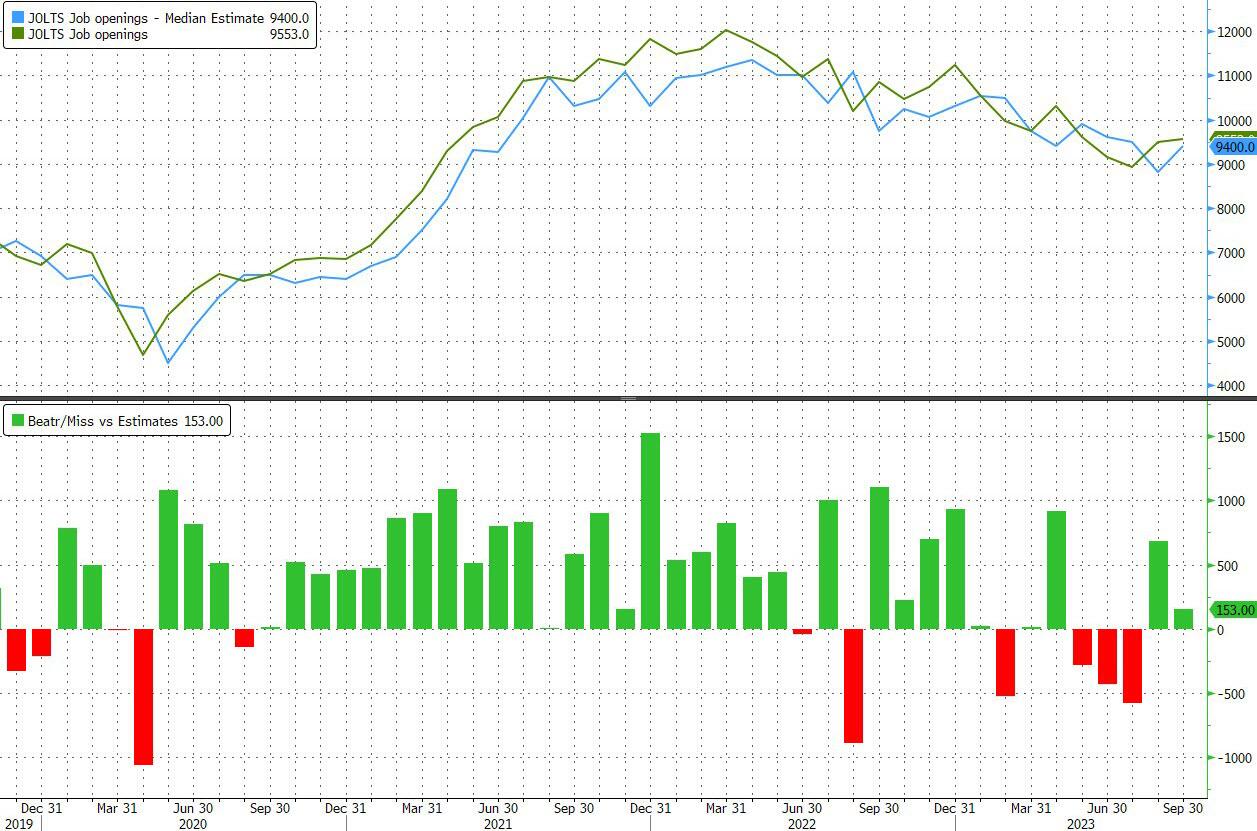
According to the BLS, job openings increased in accommodation and food services (+141,000) and in arts, entertainment, and recreation (+39,000); job openings decreased in other services (-124,000), federal government (-43,000), and information (-41,000).

The 2nd consecutive increase in the number of job openings meant that in September the number of job openings was 3.193 million more than the number of unemployed workers, the highest since June and reversing the last three months of normalization in the labor market.

Curiously, despite the recent surge in job openings, the concurrent increase in unemployed workers (which in September rose to 6.36 million), meant that the number of job openings for every unemployed worker was virtually unchanged for the 3rd month at 1.50.

And while the paradoxical continued increase in job openings at a time when even the ISM institute is saying that the latest Manufacturing print implied a -0.7% Q4 GDP, remained a head-scratcher one certainly could not see a similar euphoria in the other data points tracked by the JOLTS reported, starting with the number of quits, which dropped in September to 3.661 million, down from 3.663 million, and far below the quitting frenzy observed in late 2021/early 2022 when 4.5 million workers quit their jobs every month.

Furthermore, while the DOL goalseeked job openings higher, it forgot to do the same to not only quits but also hires; in fact, hires rose a tiny 21K to 5.5871 million, also just barely above the lowest level since March 2021.

And while we have previously discussed the chronic fabrication of job openings data by the BLS, which goes against all private surveys, we are confident that when the Biden admin finally falls and some enterprising forensic accountant digs to find out just where all these bullshit numbers came from, what they will find is some political hack at the BLS/DOL claiming that it’s not their fault, but rather that it’s the response rate. And indeed, as the BLS itself indicates, the response rate to most of its various labor (and other) surveys has collapsed in recent years, nothing is as bad as the JOLTS report where the actual response rate has tumbled to a record low 31%

In other words, more than two thirds, or 70% of the final number of job openings, is estimated!

And at a time when it is critical for Biden to still maintain the illusion that at least the labor market remains strong when everything else in Biden’s economy is crashing and burning (or soaring as is the case of inflation) we’ll let readers decide if the admin’s Labor Department is plugging the estimate gap with numbers that are stronger or weaker.

As for the market, it appears to also have given up on any signaling information from JOLTS because unlike last month when yields spiked on the JOLTS report, today’s increase in job openings had exactly zero impact on rates, which dropped to session lows, focusing far more on the ugly ISM employment number and the ADP miss, while completely ignoring the JOLTS data.


Tyler Durden
Wed, 11/01/2023 – 10:29

Bankman-Fried Admits To Wining And Dining With Bill Clinton, Tony Blair, In Last Day Of Testimony

0
Bankman-Fried Admits To Wining And Dining With Bill Clinton, Tony Blair, In Last Day Of Testimony

The end to Sam Bankman-Fried’s time on the witness stand at his own trial was, to say the least, unceremonious.

On the last day of his cross-examination, Tuesday, SBF testified that he was aware in 2020 that FTX’s customer funds were stored in a bank account managed by its affiliate, hedge fund Alameda Research, according to CNN. He also stated he doesn’t remember instructing Alameda staff to secure those funds.

US Assistant Attorney Danielle Sassoon also pointed out SBF’s hobnobbing with the political elite and members of the Bahamian government, CNN noted. 

In his testimony, Bankman-Fried said he dined with the prime minister of the island, as well as former U.S. President Bill Clinton and former UK Prime Minister Tony Blair.

After FTX temporarily halted customer withdrawals during a liquidity crisis last November, he testified that he briefly reinstated withdrawals for Bahamian customers. SBF also stated that he doesn’t remember instructing Alameda staff to avoid using FTX customer deposits.

Then, despite later finding out in fall 2022 that Alameda owed FTX $8 billion, no one was terminated as a result, he testified. 

Finally, on Tuesday, Mark Cohen, Bankman-Fried’s lawyer, allowed him to elaborate on the FTX-Alameda relationship. SBF stated that after stepping down as Alameda’s CEO, he reduced his involvement but remained engaged in its financial updates, venture investments, and crucial hedging decisions, which he viewed as vital for the firm’s survival.

“I was essentially uninvolved with those core operations,” he claimed. 

Judge Lewis Kaplan said at about lunchtime Tuesday: “That concludes the presentation of evidence in this case.”

Closing arguments are slated for Wednesday.


Tyler Durden
Wed, 11/01/2023 – 10:15

Manufacturing Surveys Scream Stagflation: Inflation Accelerated, Demand Muted, Jobs Cut For First Time Since COVID

0
Manufacturing Surveys Scream Stagflation: Inflation Accelerated, Demand Muted, Jobs Cut For First Time Since COVID

After the unexpected rise in September, expectations were for October’s Manufacturing surveys to hold their gains around 49-50 level – despite the recent collapse in ‘hard’ macro data.

Sure enough, S&P Global’s US Manufacturing PMI printed 50.0 final for October (in line with the flash print and expectations and up slightly from September’s 49.8). But, ISM’s Manufacturing survey printed well below expectations (46.7 vs 49.0 exp vs 49.0 exp)…

Source: Bloomberg

The PMI survey highlighted that demand conditions were historically muted overall, with firms downwardly adjusting their output expectations for the year ahead and cutting employment for the first time since July 2020.

ISM warns that “the October reading (46.7 percent) corresponds to a change of minus -0.7 percent in real gross domestic product (GDP) on an annualized basis.”

New orders and employment fell (second weakest since COVID lockdowns) as prices rose…

Siân Jones, Principal Economist at S&P Global Market Intelligence, said:

October PMI data signalled a stabilisation of US manufacturing conditions amid a renewed rise in new order inflows and firmer output growth. Demand conditions reportedly showed signs of improvement as customer interest revived, but this was once again largely focused on the domestic market as new export orders fell at a quicker rate.

However, it was not all good news at all – backlogs down, jobs down, output expectations down, inflation up:

“Of concern were reports of dwindling backlogs of work, previously used to help support production, as firms also revised down their expectations for future output to the lowest in 2023 so far.”

“At the same time, manufacturers cut employment for the first time in over three years as workloads were reportedly insufficient to warrant additional hiring or the replacement of voluntary leavers. “

On the price front, manufacturers saw sharper increases in costs and output charges, as inflation regained some momentum in the sector. Higher oil and oil-derived input prices again spurred hikes, as rates of inflation accelerated for the third month running.

Finally, we note that, with a 6-month lag or so, US Manufacturing surveys have been following the path of financial conditions. Six months after financial conditions began to ease late last year, US Manufacturing surveys started to pick up…

Source: Bloomberg

…but as the chart shows, the recent aggressive tightening of financial conditions suggest the sentiment surveys are about to run out of their upside steam.

Will that slower growth be accompanied by slowing inflation? For now, inflation expectations are on the rise once again…

Tyler Durden
Wed, 11/01/2023 – 10:05

Hundreds Of Foreigners, Including Americans, Allowed To Exit Gaza Into Egypt For 1st Time

0
Hundreds Of Foreigners, Including Americans, Allowed To Exit Gaza Into Egypt For 1st Time

The Israel Defense Forces has said it is in close quarters combat with Hamas as troops push further into Gaza, resulting in an announced Tuesday death toll of eleven. By early Wednesday that figure rose to 13 Israeli soldiers killed, after Israel’s defense minister warned of the “heavy toll” which would be paid by troops in the operation to eradicate Hamas.

As the death toll among Gazans approaches 9,000, the EU’s top diplomat Josep Borrell has lashed out at Israel’s airstrikes and massive civilian casualties. Borrel says he is “appalled by the high number of casualties following the bombing by Israel of the Jabalia refugee camp.” Jabalia camp has reportedly been struck again, a day after the initial massive attack which had killed at least 52 Palestinians, according to the Gaza Health Ministry.

IDF tanks inside Gaza, IDF handout/Reuters

But Israel’s military said that its Jabalia strike had taken out a top Hamas commander and other Hamas officers, and said Israeli decision-makers took into account the harm to civilians in the densely populated urban area.

On Wednesday Prime Minister Benjamin Netanyahu expressed condolences for the IDF’s fallen soldiers along side other leaders. He said “We are in a tough war. This will be a long war. We have important achievements, but also painful losses.”

According to more from his message: “We know that every one of our soldiers is an entire world. All of Israel embraces you, the families, from the bottom of our hearts. All of us are with you during this time of mourning. Our soldiers fell in a war where there was no justice, a war for our home,” he said. “I promise you, the citizens of Israel: we will complete the task – we will continue until victory.”

IDF troops have begun the slow process of going door to door as they search for the missing Israeli and foreign hostages, which is up to 240, according to new military statements. Hamas has issued new statements claiming Israeli airstrikes killed a group of hostages. “Seven detainees were killed in the Jabalia massacre yesterday, including three holders of foreign passports,” said a Hamas statement issued from its military wing.

But the “painful losses” are mounting in much greater numbers for the Palestinian side, and civilians are bearing the brunt of suffering. International outrage and pressure has mounted on Tel Aviv, which has voiced that has warned Gaza civilians they must move to the southern half of the Strip if they want to escape the bombs. According to a fresh Gaza health ministry update as republished in Al Jazeera:

  • The number of people killed in Israeli attacks on Gaza has gone up to 8,796, including 3,648 children and 2,290 women.
  • At least 22,219 people have been wounded.
  • There are 2,030 reports of people missing including 1,020 children buried under the rubble.
  • 130 paramedics and medical crew have been killed, 28 ambulances have been destroyed, and there have been more than 270 attacks on the healthcare system in Gaza.
  • 16 hospitals out of 35 are out of operation, and 51 out of 72 primary healthcare clinics have shut down.
  • In the occupied West Bank, 128 Palestinians have been killed and at least 1,980 have been wounded.

There has meanwhile been a rare positive development on the humanitarian front. For the first time since the start of the war, foreigners and wounded Palestinians have been allowed to exit Gaza through the Rafah crossing into Egypt. 

Some 500 foreign passport holders had reportedly been stuck at Rafah crossing for weeks since the start of the conflict after Oct.7. The area near the crossing had also been bombed by Israeli jets on several occasions. Ambulances have been observed Wednesday ferrying the wounded into Egypt. 

Hundreds are foreign passport holders are also belatedly being let through, among them Americans. “At least five NGO workers who have been confirmed as Americans are listed as approved to cross on Wednesday but it remains to be seen how many of at least 400 American citizens the U.S. State Department says are stuck in Gaza will be able to cross in coming days,” CBS News reports. Some have lashed out at Washington over the lack of serious evacuation efforts in place for those dual nationals stuck in Gaza: 

“They started letting foreigners out today but it’s not Americans because I guess we’re not as important as we thought,” Utah resident Susan Beseiso told CBS News on Wednesday.  

“The American Embassy and the State Department haven’t called us since the last time we went to the border and got bombed four times. They haven’t been communicating with us or doing anything to get us out,” Beseiso said.

“It’s like they’re holding us hostages — not Hamas holding us hostages — it’s the IDF soldiers, Egypt and America. They’re using us as a human shield in a way.”

The fresh evacuees are undergoing security checks on the Egyptian side. Among those exiting include Palestinians holding Austrian, Bulgarian, Indonesian, Japanese Jordanian, Italian, Greek, Australian and Czech citizenships, and many others. Various nationals working for several NGOs are also on the departure list.

According to The Times of Israel, “A source briefed on the development told Reuters that the evacuations were agreed on in a deal mediated by Qatar between Egypt, Israel and Hamas in coordination with the US.”

    Tyler Durden
    Wed, 11/01/2023 – 09:45

    Aston Martin Shares Crash Following Downward Revision Of Annual Delivery Forecast

    0
    Aston Martin Shares Crash Following Downward Revision Of Annual Delivery Forecast

    Shares of troubled luxury sports carmaker Aston Martin plunged as much as 20% in London, following the company’s downward revision of its yearly vehicle delivery forecast and supply chain snarls impacting the DB12 model for the third quarter.

    According to Bloomberg, Aston expects 6,700 deliveries this year, down from the previous forecast of 7,000. There was a noticeable slide in wholesales to China, down 57% in the first nine months of the year, while wholesales increased in the Americas and Europe. 

    “The DB12 production ramp-up was temporarily affected as supplier readiness and integration of the new EE platform that supports the fully redeveloped infotainment system was delayed,” Aston said in its earnings report on Wednesday. It added these supply chain woes are now fixed but have impacted third-quarter volumes and full-year production capacity. 

    Aston is in the midst of a turnaround effort led by Executive Chairman Lawrence Stroll and has completed numerous capital raises with Saudi Arabia’s Public Investment Fund and Geely Automobile Holdings Ltd. However, the sports carmaker still sits on a massive debt pile in a period where interest rates are sky-high. 

    “It is still sitting on a big pile of debt and continues the painful effort of deleveraging a strained balance sheet. Undoubtedly, progress has been made in fixing some of the problems faced by the business but it all feels a bit too little too late,” Russ Mould, investment director at British stockbroker AJ Bell, told CNBC. 

    Bell said, “The company is seeing strong demand but, with losses coming in ahead of expectations, there is little reason for the market to give Aston Martin the benefit of the doubt for even the smallest misstep.” 

    Here’s what other Wall Street analysts are saying about Aston’s earnings (list courtesy of Bloomberg): 

    Jefferies (buy, PT 420p)

    • Analysts Philippe Houchois and Owen Paterson say 3Q numbers came in slightly below consensus on volume and revenue

    • Note FY volume guidance revised down 300 units on DB12 ramp delays

    Barclays (overweight, PT 300p)

    • Analysts led by Henning Cosman say DB12 demand and ramp-up issues “don’t bode well” 

    • Lower their PT to 300p from 400p reflecting near-term negative earnings revisions and lower target multiples

    • Still, say continue to see an “increasingly plausible trajectory” to a sustainable and attractive business model

    Oddo (outperform, PT 460p)

    • Analyst Anthony Dick says the results are rather weak as expected ahead of new generation sports car ramp-up

    • Notes 4Q still expected to make up for the bulk of the FY results

    •  Says finds order book for new DB12 car “rather underwhelming” especially after management’s optimism during 2Q results 

    Aston Martin’s shares have been consistently heading in one direction: downward.

    Throughout its 110-year existence, Aston has faced bankruptcy seven times. The first time was in 1924, while the last was in 2007. 

    Aston will never be a Ferrari or Lamborghini… 

    Tyler Durden
    Wed, 11/01/2023 – 09:30

    Peter Schiff: A Crisis Is Already Playing Out Under The Radar

    0
    Peter Schiff: A Crisis Is Already Playing Out Under The Radar

    Via SchiffGold.com,

    The mainstream remains optimistic about the trajectory of the economy. Price inflation has supposedly been beaten down. GDP growth was even better than expected, and most economists have tabled their recession predictions. But in his podcast, Peter Schiff explained that it’s all an illusion. The financial crisis has already started, and it continues to play out beneath the radar.

    Nobody understands that this crisis has started. But believe me, it has. This was the way the 2008 financial crisis started. It didn’t just happen when Lehman Brothers went bankrupt.”

    By the time Lehman went under, everybody knew there was a crisis. But it was obvious long before that.

    That’s the reason it went under. It didn’t just go out of business out of the dark. It wasn’t just happenstance. The reason that Lehman Brothers, and Bear Sterns, and Fanny and Freddy, and AIG, and all these companies went under was their exposure to the mortgage market. That exposure was obvious to me for years, but particularly in 2007 when the subprime market blew up. That was the point where even the village idiot should have been able to figure out what was coming. The problem was most people on Wall Street weren’t even smart enough to qualify as the village idiot, so they still couldn’t figure it out.”

    They needed the proverbial anvil to fall on their head. That finally happened in 2008. But even in the summer of ’08, a lot of people were oblivious.

    So, if you’re wondering, ‘Peter, how can we be so close to this massive crisis, in fact, how could this crisis have already started if nobody is talking about it?’ Well, just go back to the summer of 2008. Nobody was talking about it.”

    Peter emphasized that this crisis is much bigger because the problems driving it are much bigger.

    They’re the same problems. They just dwarf the size of the problems we had before. Because instead of actually dealing with the problems, we kicked the can down the road and made the problems bigger. Now we have to deal with the consequences of that.”

    Fed officials keep saying that the banking system is “sound.” But Peter said all of the big banks are insolvent.

    Now, as long as they pretend that all their underwater assets, they’re going to hold them to maturity, well, they can pretend that they don’t have a problem. But eventually, they have to stop pretending because circumstances intervene, and they actually need to sell the securities that they had intended to hold to maturity.”

    Newsweek recently published an article titled “America Is Heading for an Interest Payment Crisis.” Peter noted that at least they’re writing about that, but they still miss the root of the problem. It’s not just the interest. It’s also the principal.

    A lot of people claim the principal doesn’t matter. As long as the US can make interest payments, everything is fine. But as Peter pointed out, the national debt wasn’t a gift. It’s debt. But it’s nature it has to be paid back.

    So, when they would say, ‘We don’t have to repay the debt,’ I would say, ‘Well, did you run that by the Chinese? Did you run it by the Japanese? Do they know that that’s the deal? Do they know that they’re loaning us money but they’re never going to get it back?’ Because that’s not a loan. That is a gift.”

    Of course, the response is always, “We can just borrow from somebody else to pay it back.”

    In other words, it’s a Ponzi scheme. So, Bernie Madoff never had to worry about paying back money because he would get it from the next sucker who didn’t realize it was a Ponzi scheme. But what happens when people realize it’s a Ponzi scheme? They don’t want to participate. And that’s what’s going on. Our creditors don’t want to loan us more money to pay back other creditors. That is what is happening. That is why bond yields are going up because the people who own the bonds want their money back as they mature and we can’t find new buyers.”

    Rising interest rates impede the solvency of the United States. As rates rise, the Treasury has to borrow even more to keep up with the interest payments. As debt goes up, the US becomes a bigger credit risk. It also becomes more likely that the government and central bank will have to create more inflation to service the debt.

    So, higher interest rates don’t actually make Treasuries more attractive. They make them less attractive. That is a problem. This is a bottomless pit. This is a self-perpetuating collapse that we are witnessing that is going to gather momentum.”

    During an interview, new House Speaker Mike Johnson claimed that during the Trump years, the US had the greatest economy ever. Peter called that “a lie.”

    We didn’t have the greatest economy in the history of the world. It wasn’t even close. We didn’t even have the greatest economy in the history of America. We didn’t have the greatest economy in the 21st century. We had a bubble under Trump. Trump didn’t create the bubble. He inherited the bubble, and he made it bigger. That bubble is now popped.”

    You can trace the origins of the bubble all the way back to the Bill Clinton era and the monetary policy initiated by Alan Greenspan. That bubble popped the first time under Bush 2, was reinflated, popped again in 2008, and then they managed to blow it back up again.

    The idea that people think everything was great just a few years ago and it’s all gone to hell — that’s wrong because it assumes that we could just fix it, really simple. We just have to go back to the Trump policies and we’re going to be great again. No! This problem is much bigger than just the bad things that Biden has done.”

    Peter explained how the Clinton administration started the trend of using shorter-term financing to lower interest payments. They could do that because rates were so low. Of course, that created more risk because rising rates can quickly make those payments skyrocket. That’s where we are today. Interest rates are soaring and all of that short-term debt is maturing. That means the Treasury has to borrow at a much higher rate to replace that debt.

    It’s going to escalate into this complete sovereign debt and currency crisis, which is already started, but it’s a long way from ending.”

    In this podcast, Peter also explains why the future of the US looks more like Argentina than Japan.

    Tyler Durden
    Wed, 11/01/2023 – 07:20

    Americans Panic Search “Give Car Back” As Subprime Auto Loan Delinquency Erupts

    0
    Americans Panic Search “Give Car Back” As Subprime Auto Loan Delinquency Erupts

    Recent data from Edmunds reveals that an unprecedented 17% of American car purchasers now have monthly car payments of $1,000, a significant increase from just 7% three years ago. This trend highlights the extent to which consumers, despite being financially stretched, are willing to take on massive auto debt in these uncertain economic times as macroeconomic headwinds pile up.

    New Google data, first revealed by X user CarDealershipGuy, shows Americans are searching “give car back” on the internet has soared to a record high. 

    CarDealershipGuy added, “For everyone DMing me: No, you can’t “give back” a car – That’s a repossession.”

    This year, we have been dutifully tracking the auto sector, considered a leading economic indicator, to pinpoint the arrival of the crushing auto loan crisis and even the possibility of the onset of the next recession.

    The latest sign of an auto crisis emerging materialized in recent weeks:

    The percent of subprime auto borrowers at least 60 days past due on their loans rose to 6.11% in September, the highest in data going back to 1994, according to Fitch Ratings. -Bloomberg

    Source: Bloomberg 

    What’s clear is the subprime borrower, who took out 84-month +$1,000 monthly car payments, is getting squeezed in the high-rate environment. 

    The auto loan crisis, something we called a “perfect storm” earlier this year, appears to be unfolding. 

    Tyler Durden
    Wed, 11/01/2023 – 06:55

    US Supreme Court Rejects Challenge To Trump’s Steel Import Tariffs

    0
    US Supreme Court Rejects Challenge To Trump’s Steel Import Tariffs

    Authored by Zachary Stieber via The Epoch Times (emphasis ours),

    The U.S. Supreme Court rejected a challenge from a manufacturer to tariffs on steel imports that were created by former President Donald Trump and have been kept in place by President Joe Biden.

    The U.S. Supreme Court in Washington on Oct. 16, 2023. (Madalina Vasiliu/The Epoch Times)

    The justices declined to hear PrimeSource Building Products’ appeal of a lower court decision that upheld a 25 percent tariff on imports of steel derivatives.

    The court did not explain its decision.

    PrimeSource’s lawyers did not immediately respond to a request for comment.

    President Trump in 2018 signed orders imposing tariffs on imported steel and aluminum, citing the results of an investigation carried out under the Trade Expansion Act. Officials found that the imports “threaten to impair national security” and had recommended action.

    The tariffs were adjusted in 2020 to include some steel derivatives, such as nails.

    The original orders followed the law because they came after officials found a threat to national security, but the expansion did not because it came years later without a fresh finding of a threat, Texas-based PrimeSource, a nail importer, has argued.

    “Two years later, without undertaking any of the statutory procedures, the president imposed tariffs on an assortment of steel derivatives as well,” PrimeSource told the Supreme Court.

    Tariff Laws

    Under the law, the president must decide within 90 days of receiving a report from the secretary of commerce whether he agrees with the recommendations and has another 15 days beyond that to impose tariffs.

    Then-Commerce Secretary Wilbur Ross found in a 2018 report that “domestic steel production is important for national security applications” and that steel imports were on track to account for more than 30 percent of domestic consumption. He also determined that “excessive quantities of imports has the effect of weakening the internal economy of the United States, threatening to impair the national security.”

    The New York-based U.S. Court of International Trade struck down the steel derivatives tariffs in 2021, saying the White House missed statutory deadlines to impose them.

    The expansion “does not comply with the limitation on the President’s authority imposed by the 105-day time limitation” of the law, U.S. trade Judge Timothy Stanceu, appointed under President George W. Bush, said in the ruling.

    But the Washington-based U.S. Court of Appeals for the Federal Circuit in February reversed that decision, citing its own 2022 ruling that presidents are authorized to impose “contingency-dependent” tariff increases to fulfill their original national security objectives, if those objectives remain valid.

    President Trump created the 2020 tariffs to “close a loophole exploited by steel-derivatives importers … to address a specific form of circumvention,” U.S. Circuit Judge Richard Taranto, appointed under President Barack Obama, wrote in the federal circuit’s decision.

    Surrounded by steel and aluminum workers, U.S. President Donald Trump signs a ‘Section 232 Proclamation’ on steel imports during a ceremony in Roosevelt Room at the White House in Washington on March 8, 2018. (Chip Somodevilla/Getty Images)

    PrimeSource was among the companies urging the Supreme Court to review the decision, saying the expansion of the tariffs implicated how Congress delegates power and warranted “special separation of powers scrutiny.”

    “One might think that courts would strictly construe the statutory conditions on such extraordinary delegations lest the judiciary permit an even greater injury to separation of powers than Congress intended,” the company said in a petition to the nation’s top court. “But the federal circuit applies the opposite rule, deferring to the executive’s view of the statutory limits on its own authority unless it is clearly wrong.”

    President Biden’s administration defended the tariffs, telling the Supreme Court a review was not necessary because the appeals court decision does not conflict with any decisions from another appeals court.

    Government lawyers pointed out that after then-President Dwight Eisenhower adjusted tariffs on oil imports in 1959 after receiving a report from the secretary of commerce, dozens of adjustments to the tariffs were made over the next 16 years without any new reports. The Office of the Attorney General has said in the past that Section 232 of the Trade Expansion Act “contemplate[s] a continuing course of action, with the possibility of future modifications.”

    “Section 232’s deadlines do not restrict the president’s power to adopt such amendments,” Biden administration attorneys said in a brief to the Supreme Court. “The relevant statutory provisions set deadlines for ‘the adoption and initiation of a plan of action or course of action,’ not for ‘each individual discrete imposition on imports.'”

    PrimeSource appealed to the Supreme Court in July. Oman Fasteners, another company challenging the tariffs, filed a separate appeal on Oct. 20 that is currently pending.

    The Supreme Court in March turned away a challenge to the 2018 tariffs by a group of U.S.-based steel importers. The justices in 2022 refused to hear a separate challenge by steel companies to President Trump’s 2018 decision to double tariffs on steel imports from Turkey, also on national security grounds.

    Matthew Vadum and Reuters contributed to this report.

    Tyler Durden
    Wed, 11/01/2023 – 06:30

    Watch: Pro-Palestinian Activists Throw Box Of Live Rats Into British McDonald’s

    0
    Watch: Pro-Palestinian Activists Throw Box Of Live Rats Into British McDonald’s

    Pro-Palestinian activists in the west (many of them far-leftists with no ties to Palestinians or Muslim culture) have called for boycotts and punishment directed at any major companies seen as providing aid to Israel. 

    McDonald’s angered the woke mob recently with its offer of free food to members of the Israeli military (McDonald’s also gave $1 million to the Red Cross and the World Food Program providing aid to Palestinians), while Starbucks and Google have triggered their wrath as well. 

    Given that woke activism has been on the decline in terms of effectiveness and many in the public have taken to ignoring their demands, protesters are changing their tactics in some bizarre ways.  

    Customers were waiting for meals at the McDonald’s branch at the Star City leisure complex in Birmingham as an activist threw a box of what appear to be rats into the building.

    The rats were spray painted the colors of the Palestinian flag…

    Actions like this might be sending a message that pro-Palestinians did not intend.

    Tyler Durden
    Wed, 11/01/2023 – 05:45

    Russia’s Oil Exports Climb Despite Its Commitment To Cut Supply

    0
    Russia’s Oil Exports Climb Despite Its Commitment To Cut Supply

    By Tsvetana Paraskova of OilPrice.com

    Russia’s crude oil exports by sea have been exceeding the country’s targeted export reductions as part of the OPEC+ pact for weeks, with the most recent week’s observed shipments as high as 360,000 barrels per day (bpd) above target, tanker-tracking data monitored by Bloomberg showed on Tuesday. Despite edging lower, four-week average volumes exceeded it by almost 200,000 barrels a day in the most recent period.

    In the week to October 29, Russia shipped around 3.64 million bpd of crude oil from its oil export terminals, up by 110,000 compared to the week prior, according to the data reported by Bloomberg’s Julian Lee. 

    Higher shipments out of the port of Novorossiysk in the Black Sea contributed to most of the gains in crude flows from Russia in the last week of October and were only partially offset by a lower number of crude oil tankers that left Russia’s ports in the Baltic Sea and on the Pacific.

    The four-week average crude oil shipments out of Russia were slightly lower at 3.48 million bpd in the week to October 29, a drop of around 20,000 bpd compared to the four-week average in the four weeks to October 22.

    Even this slightly lower 3.48 million bpd export volume for the average of the four weeks to October 29 was nearly 200,000 bpd higher than the exports Russia would have to ideally stick to in order to fulfill its pledge to cut exports by 300,000 bpd, Bloomberg notes.

    Russia has never been quite clear about what exports it is cutting and how it calculates those volumes.

    Russia’s commitment to reduce its oil exports by 300,000 bpd includes oil products, Russian Deputy Prime Minister Alexander Novak said earlier this month in remarks that sowed further confusion about how much oil supply Russia is really withholding from the market.

    Russia has pledged to reduce its oil exports by 300,000 bpd until the end of 2023, in a show of solidarity with its OPEC+ partner Saudi Arabia, which is voluntarily reducing its oil production by 1 million bpd until 2023.

    Tyler Durden
    Wed, 11/01/2023 – 05:00
