73.9 F
Chicago
Sunday, September 6, 2026
Home Blog Page 3240

NFLX Explodes Higher After Blowout Q3 Results, Hikes Prices After Best Subscriber Growth In Years

0
NFLX Explodes Higher After Blowout Q3 Results, Hikes Prices After Best Subscriber Growth In Years

After suffering a historic collapse at the end of 2021, when in the span of five months Netflix lost 75% of its value, the company has enjoyed a solid recovery over the past year when it rose by nearly 200%, from a low of $166 to a recent 52 week high of price of $481, which was the highest since January of 2022, before it lost 28% of its value in the past three months.

Curiously, the solid performance over the past year – which saw the stock down 41% from its pandemic-era all-time closing high of $610.34 on June 30, 2021 but also up 21% YTD vs the 14% increase in the S&P – continued despite several earnings reports that were at best mixed (two quarters ago NFLX not only missed on subs but also slashed guidance, last quarter the company’s guidance disappointed despite blowing away subscriber estimates) which brings us to today when the OG video streamer is again trading north of $150N in market cap despite an ongoing Hollywood strike that has mothballed the company’s movie and production pipeline for months.

With that in mind, bulls are are hoping for stronger revenue and subscriber growth and guidance than one quarter ago, including more than 6  million new streaming subs at a time when NFLX has cracked down aggressively on password sharing and is navigating a transition from focusing on subscriber growth to maximizing earnings through price hikes and an ad-supported service. It has little choice amid a torrent of competition from some of the world’s biggest media companies. Here’s what else to expect

  • Earnings: EPS is expected to print $3.49 a share, up from of $3.10 a share last year.
  • Revenue: Bloomberg revenue consensus is for $8.53 billion in revenue, up from $7.93 billion a year earlier.
  • Stock movement: Netflix shares typically see percentage swings ranging from the high single-digits to the mid-teens after the company posts results.
  • Q4 Projections: Revenue estimate $8.76 billion; EPS estimate $2.17; Operating margin estimate 14%
  • Full year projections: Free cash flow estimate $5.27 billion; Operating margin estimate 19.8%

What else analysts are watching for:

  • “We think Netflix is well-positioned in this murky environment as streamers are shifting strategy, and should be valued as an immensely profitable, slow-growth company,” Wedbush analysts said in an Oct. 6 note with an outperform rating and price target of $525. “Even while ads are not yet directly accretive (we think they will be accretive by year-end), the ad-tier should continue to reduce churn and draw new subscribers to the service.”
  • Meanwhile, TD Cowen analyst John Blackledge said that he expects paid net additions of 6.5 million subscribers versus a consensus of 6 million, but also sees gradual margin growth in the fourth quarter and beyond. He maintained an outperform rating but trimmed his Netflix price target to $500 from $515 in an Oct. 11 report.
  • Wells Fargo said that advertising is “off to a somewhat slow start” with pricing and audience delivery below initial advertiser expectations in the first half. The company recently shook up leadership of its ad sales business. “Investors have said to us, they would like to see a more aggressive push, such as automatically converting Basic subs to Basic with ads.”

With that in mind, and considering that options were pricing in a 7.6% swing after hours today, here is what NFLX reported for its third quarter:

  • EPS $3.73, beating estimates of $3.49, and above the $3.10 a year ago
  • Revenue $8.54 billion, +7.8% y/y, just barely beating estimates of $8.53 billion
  • Streaming paid net change +8.76 million vs. 2.41 million y/y, smashing estimates of +6.20 million
    • UCAN streaming paid net change +1.75 million vs. +100K y/y, beating estimate 1.22 million
    • EMEA streaming paid net change +3.95 million vs. +570K y/y, beating estimate +2.22 million
    • LATAM streaming paid net change +1.18 million vs. +310,000 y/y, beating estimate 1.15 million
    • APAC streaming paid net change +1.88 million, +31% y/y, beating estimate +1.41 million
  • Streaming paid memberships 247.15  million, +11% y/y, beating estimate 244.41 million
  • Operating margin 22.4% vs. 19.3% y/y, beating estimate 22.1%
  • Operating income $1.92 billion, +25% y/y, beating estimate $1.9 billion
  • Free cash flow $1.89 billion vs. $472 million y/y, beating estimate $1.27 billion

And visually:

And here is the regional detail: curiously the bulk of new subs in Q3 was in the EMEA region.

While the current quarter was stellar, the company’s Q4 guidance was curiously on the weak side, coming below consensus for both revenue, EPS and margins:

  • Sees revenue $8.69 billion, estimate $8.76 billion
  • Sees EPS $2.15, estimate $2.17
  • Sees operating margin 13.3%, estimate 14%

Some more details from the company:

  • For Q4’23 Netflix forecasts revenue of $8.7B, up 11% year-over-year, or 12% on an F/X neutral basis. For the fourth quarter, the company expects paid net additions will be similar to Q3’23 (+/- a few million). Global ARM in Q4 is expected to be roughly flat year-over-year, primarily due to limited price increases over the last eighteen months. In addition, over the past few months the US dollar strengthened versus other currencies, representing a roughly $200M expected drag on Q4 revenue and ARM.
  • In terms of profitability,

And here is full 2023: thank you striking workers:

  • Sees free cash flow $6.5 billion, saw at least $5 billion, and above the estimate $5.27 billion: We now expect FY23 free cash flow to be approximately $6.5B (+/- a few hundred million dollars), up from our prior forecast of at least $5B, and vs. $1.6B in 2022. This includes ~$1B in lower-than-planned cash content spend in 2023 due to the WGA and SAG-AFTRA strikes. As a result, we expect 2023 cash content spend of around $13B and, assuming the SAG-AFTRA strike is resolved in the near future, we are currently expecting cash content spend of up to ~$17B in 2024. As we said last quarter, the strikes will create some lumpiness in FCF over the 2023/2024 period, but we still plan to deliver very substantial positive FCF in 2024.”
  • Sees operating margin 20%, saw 18% to 20%, estimate 19.8%: Netflix is updating its FY23 operating margin guidance forecast to 20%, the high end of the prior 18% to 20% forecast (based on F/X rates as of 1/1/23). This would mean that the operating margin would increase approximately two percentage points from our 18% operating margin in FY22. Assuming no material swing in F/X rates, the company currently expect an operating margin in FY24 of 22% to 23%.

Yet we find it odd for the 2nd consecutive quarter that while the Hollywood strike is boosting free cash flow, it has no adverse impact on revenue…

Going back to the company’s results, free cash flow in Q3’23 amounted to a whopping $1.9B compared with $472MM in the year ago quarter; this was the second highest FCF quarter on record.

NFLX finished Q3 with gross debt of $14B (in-line with the company’s $10B-$15B targeted range) and cash and short term investments of $8B, leaving net debt at $6.5BN. During the quarter, NFLX repurchased 6M shares for $2.5BN. Since the inception of this authorization, NFLX has bought back $4.1B. In September, the board increased an additional $10BN stock repurchase authorization on top of the $1B remaining under the prior authorization.

And while the company’s Q4 guidance was just a touch on the light side, the market was more than happy with the surge in Q3 subs and the full year cash flow guidance, and sent the stock 11% higher; however when factoring the 2.7% drop during the regular session, it appears that most calls and puts will expire worthless: the market was pricing in a +/-8% change today and that may be precisely what it will get.

Tyler Durden
Wed, 10/18/2023 – 16:28

TSLA Shares Rise On AI & Cybertruck Optimism After Top- & Bottom-Line Miss

0
TSLA Shares Rise On AI & Cybertruck Optimism After Top- & Bottom-Line Miss

Tesla disappointed investors with its Q3 earnings report, missing on top-line, bottom-line, and margins as the company’s focus on reducing cost (and price) per vehicle impacted the numbers:

  • Tesla 3Q Adj EPS 66c, Est. 74c

  • Tesla 3Q Rev. $23.4B, Est. $24.06B

  • Tesla 3Q Gross Margin 17.9%, Est. 18%

Though arguably, maintaining margins amid this massive price war is noteworthy (though it was down from 25.1% a year ago). As the RHS chart below shows, Tesla still has considerable edge over the industry with regard to margins.

Revenue was impacted by the following items:

+ growth in vehicle deliveries
+ growth in other parts of the business
– reduced average selling price (ASP) YoY (excluding FX impact)
– negative FX impact of $0.4B

Free cash flow disappointed at $848 million, well below the estimate of $2.59 billion.

And Tesla still sees production 1.8 million vehicles this year (in line with the estimate of 1.82 million).

Tesla’s automotive gross margins ex-regulatory credits for the quarter was 16.3% (below expectations of 17.7%) and that was helped by a boost in regulatory credits

BUT, a positive spin was offered as Tesla said they had more than doubled the size of their AI-training compute.

We have more than doubled the size of our AI training compute to accommodate for our growing dataset as well as our Optimus robot project. Our humanoid robot is currently being trained for simple tasks through AI rather than hard-coded software, and its hardware is being further upgraded.

We have commissioned one of the world’s largest supercomputers to accelerate the pace of our AI development, with compute capacity more than doubling compared to Q2.

Our large installed base of vehicles continues to generate anonymized video and other data used to develop our FSD Capability features.

And an additional highlight is that Tesla says that “Cybertruck deliveries begin in November 2023” but without a lot of context as to what kind of volume we are talking about here.

Tesla is now tweeting that:

“Cybertruck production remains on track for later this year, with first deliveries scheduled for November 30th at Giga Texas.”

TSLA shares initially puked on the miss, but bounced back to unchanged from the close…

Though TSLA was down around 5% on the day amid an ugly market.

Tyler Durden
Wed, 10/18/2023 – 16:18

Stocks Purged As Bullion & Bond Yields Surge On Biden, Beijing, & Banks

0
Stocks Purged As Bullion & Bond Yields Surge On Biden, Beijing, & Banks

The Gaza hospital attack prompted ‘safety’ initially last night (oil, gold, & bonds higher in price), then China macro data’s upside surprise (on alcohol and tobacco sales) prompted some excitement but was offset by the property sector plunging even more as Xi addressed the BRI Forum.

Biden didn’t seem to calm things down at all in the MidEast as he stumbled through his address, and the China chip crackdown is becoming an issue.

Property was on Americans’ minds too as mortgage rates hit 8% (23 year highs), with housing data ugly (starts and rental-unit permits plunged) after homebuilder sentiment slumped.

FedSpeak was all aligned ahead of tomorrow’s speech by Powell. Waller will ‘watch and see’ if more rate-hikes needed; Williams says rates need to be more restrictive ‘for some time’. The Beige Book was ‘meh’.

Morgan Stanley (worst day since June 2020) upset the ‘banks are awesome’ narrative as credit loss reserves rose more than expected (and NIM did not rise as much as expected).

So with all that said, what did the market do?

Banks were not pretty…

Source: Bloomberg

The AI story is starting to show cracks, extending losses from the Biden chip crackdown and ASML comments…

Source: Bloomberg

As NVDA tumbled again today. Is that big head-and-shoulders pattern really going to play out again?

Source: Bloomberg

The GLP (Anti-Obesity) names dumped again…

Source: Bloomberg

‘Most Shorted’ stocks were clubbed like a baby seal, back to new cycle lows, erasing the squeeze of the last two days…

Source: Bloomberg

VIX topped 20 again intraday (but could not close above it for the 104th consecutive day)

All of which left all the majors down hard with Small Caps leading the slump…

Bonds were also dumped.

Comments from Fed’s Waller prompted a drop in the 2Y yield around 1245ET (but realistically his comments were more of the same – data-driven, inflation-fight not over, higher-for-longer, no cuts soon) with weight given to his comments on higher long-rates doing The Fed’s tightening job for them (which as we have noted previously is an idiotically reflexive argument). A strong 20Y auction extended those gains (and also pushed stocks higher) around 1300ET but that bump in stocks didn’t last. Overall, all yields were higher on the day led by the long-end (30Y +8bps, 2Y +1bps)…it’s been an ugly week so far with the belly underperforming…

Source: Bloomberg

30Y Yields topped 5.00% again (first time since Payrolls spike) but could not hold it…

Source: Bloomberg

Rate-cut expectations for next year continue to plunge (the last week has seen over 35bps of cuts removed from market expectations)…

Source: Bloomberg

There were some winners on the day…

Spot Gold topped $1960 – its highest since July…

Source: Bloomberg

Oil prices jumped again overnight after China and Gaza with WTI above $88.50 (in the front-month futs)

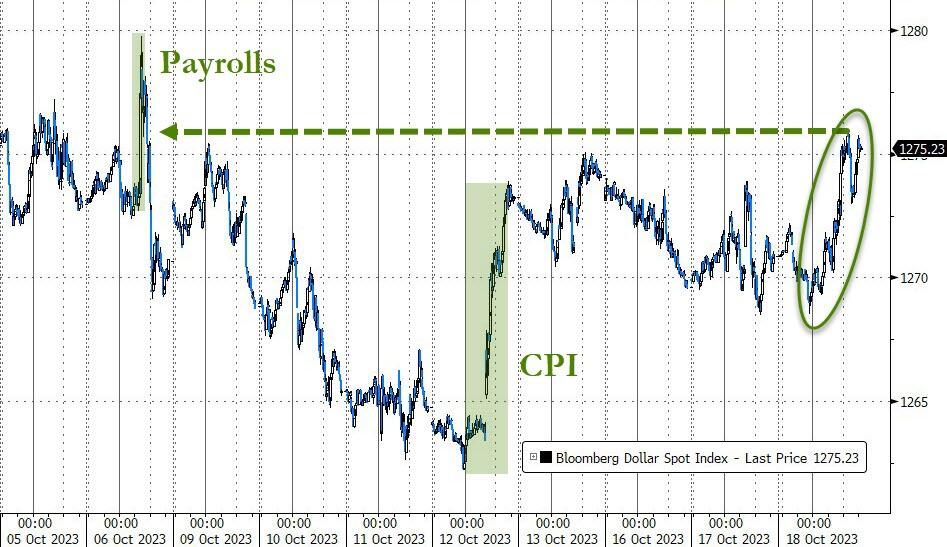
The dollar surged today, taking out last Friday’s highs, up to payrolls print levels…

Source: Bloomberg

And amid all this chaos, bitcoin was quiet with a failed test up to $29k…

Source: Bloomberg

Finally, is gold the new ‘fear index’?

Source: Bloomberg

It has systemically decoupled from real rates for sure. Have Central Banks lost control?

Tyler Durden
Wed, 10/18/2023 – 16:00

Sperry: Leaker Of Trump Taxes Worked For Biden Beltway Donor That Just Won Big New IRS Contract

0
Sperry: Leaker Of Trump Taxes Worked For Biden Beltway Donor That Just Won Big New IRS Contract

Authored by Paul Sperry via RealClear Wire,

The Internal Revenue Service recently awarded a lucrative contract to help modernize its computer databases to the same Washington firm, Booz Allen Hamilton, that employed the man who pleaded guilty last week to stealing and leaking thousands of private tax returns of wealthy Americans, including former President Trump, according to records reviewed by RealClearInvestigations. 

The massive IRS theft is the third major breach of confidential and classified government information by Booz Allen contractors over the last decade – including Edward Snowden’s 2013 leak exposing the National Security Agency’s worldwide anti-terror surveillance program.

Cyber-thief Charles “Chaz” Littlejohn was working on an IRS contract for Booz Allen in 2018 when he stole more than two decades of Trump’s personal tax records from IRS computers. He later leaked them to the New York Times, which published negative stories on Trump’s long-sought returns several weeks before the 2020 election, which Trump narrowly lost in a handful of battleground states.

After the election, Littlejohn leaked a trove of sensitive IRS data on Elon Musk, Michael Bloomberg and other billionaires – including major conservative donors – to ProPublica. The left-leaning news site used them to write a series, “The Secret IRS Files,” about how the rich use loopholes and tricks to avoid paying taxes. Congressional Democrats cited the series in their push for higher taxes on the wealthy.

Trump lawyer Alina Habba said she suspects Littlejohn was an operative in a broader political conspiracy to sabotage the former president before the 2020 election.

What Mr. Littlejohn did, I do not believe he did alone,” she said last week at the Washington courthouse where he pleaded guilty. Habba added that the leak probably “cost my client thousands of votes and was all by design.”

A Democrat donor, Littlejohn struck a deal with federal prosecutors in which he copped to a single count of disclosing tax information without authorization. Though facing a maximum of five years, his plea deal calls for an estimated range of eight to 14 months when he is scheduled to be sentenced on Jan. 29.

“That looked more like a Hunter Biden plea deal,” Habba said. House Ways and Means Committee Chairman Jason Smith (R-Mo.) agreed, saying Littlejohn is getting a “slap on the wrist.” 

Booz Allen’s Name Kept Out of Court Papers, Press

The most profitable government contractor in the world, Booz Allen has been connected to a number of high-profile Democrats over the years, including former employee James Clapper, who served as President Obama’s intelligence czar. Clapper was involved in an intelligence community operation just weeks before the 2020 election to suppress information about Biden foreign influence-peddling found on his son’s laptop.

At least two Obama administration alumni sit on Booz Allen’s board. President Clinton’s IRS commissioner also holds a seat. In the 2020 election cycle, federal records show Booz Allen contributed a total of $238,776 to Joe Biden versus $85,657 to Trump. The company also gave almost four times more money to the Democratic National Committee than to the Repubican National Committee. 

Federal investigators were closing in on the 38-year-old Littlejohn this summer when the Biden administration decided to rehire his former employer, Booz Allen, through a contract with a ceiling value  of $2.6 billion to help overhaul the IRS’ IT operations. 

The massive new IRS contract may explain why the Biden administration won’t identify Littlejohn’s employer by name in court papers and press releases about the case. 

The Justice Department would only say that Littlejohn “served as a contractor to Company A, a consulting firm that serviced public and private clients.” The Treasury Department, which oversees the IRS and also investigated Littlejohn, has not identified Booz Allen as the firm, either. Nor have Littlejohn’s lawyers, who declined comment.

The Washington media have gone along with the blackout describing Littlejohn as an “IRS Contractor.” Even as they have reported in some detail on the mechanics of Littlejohn’s thievery – he uploaded data to a private server instead of downloading it to a flash drive which might set off IRS alarms – news outlets never explained the key question of how he had access to the tax returns in the first place: because he was working for Booz Allen. The New York Times reported that Littlejohn “was working for a company contracted by the IRS. The company that employed the contractor was not named.” The Washington Post described Littlejohn as a “financial consultant” and left it at that. Meanwhile, Politico has published at least three stories on Littlejohn without naming Booz Allen as his employer.  

The identity of his former employer is not difficult to find on the internet. A Pew Charitable Trust bulletin dated Feb. 26, 2018 describes Littlejohn as “an associate with Booz Allen Hamilton’s finance and economic development practice.” 

In a 2008 blurb Littlejohn wrote for the University of North Carolina alumni newsletter, he stated: “Upon graduating from Carolina in 2007, I went to work for the strategy and technology consulting firm Booz Allen Hamilton in their civil finance division. The civil finance team works with the IRS … In my time at Booz Allen, I have had the opportunity to work on a workload transition project at the IRS.” 
 
The dates track with the employment record prosecutors laid out in their charging document: “From 2008 to 2010, from 2012 to 2013, and from 2017 to 2021, Littlejohn served as a contractor to Company A.” 
 
Asked if Booz Allen terminated Littlejohn in 2021, or if he left on his own, company spokeswoman Jessica Klenk said, “We’re not in a position to speak to that at this point.”

The massive IRS breach raises new questions about Booz Allen’s ability to protect sensitive government information.  

In 2013, Booz Allen put Edward Snowden to work at the National Security Agency. That May, Snowden left the country with thousands of top-secret documents that he soon leaked to journalists, exposing the agency’s  worldwide anti-terror surveillance program. Snowden fled to Russia and in 2022 was granted Russian citizenship by President Vladimir Putin. At the time of the breach, Booz Allen condemned it as “a grave violation of the code of conduct and core values of our firm” and vowed to investigate the matter.

But another rogue employee soon put the top Beltway contractor back in the spotlight. In 2016, Booz Allen computer analyst Harold Martin III was arrested for stealing other data from the NSA. To address the fallout, the company hired former FBI Director Robert Mueller to conduct an external review of its security procedures, including how it screens employees. “We are committed to doing our part to detect potential insider threats,” the company stated. Mueller presented his findings and recommendations around June 2017 – the year before Littlejohn stole thousands of private tax returns. In an interview with RealClearInvestigations, Booz Allen spokeswoman Klenk declined to say what reforms it implemented, if any, to safeguard such information. The McLean, Va.-based company employs more than 20,000 consultants with government security clearances handling some of the nation’s most confidential data. 

Despite this track record of breaches, the IRS has trusted Booz Allen to help modernize its computer system. In late June, the IRS awarded the company part of a multibillion-dollar contract to update its databases, which involves consolidating roughly 400 different systems into a new, cloud-based architecture. “Booz Allen is committed to supporting IRS’ modernization and tax administration efforts for years to come,” the company said in a statement touting the awarding of the seven-year contract under the headline, “Applying IT modernization to enhance taxpayer experience.” 

The IRS did not respond to requests for comment about Booz Allen. In a press statement following Littlejohn’s arrest, Commissioner Danny Werfel said the agency has “tightened security” in the wake of the leaks. In a separate public statement, a Treasury official added that “the American people have every right to expect the utmost integrity from those who are granted access to sensitive taxpayer information through their employment with the IRS.” Treasury’s inspector general is “still investigating” the case, according to a Department of Justice press release. Prosecutors have not offered a motive for Littlejohn’s crime. If they know why he leaked Trump’s tax information to the media, they’re not saying. 
 
A search of Federal Election Commission records turns up small-dollar donations Littlejohn made to Democrats through ActBlue, a liberal fundraising platform. When he first started working for Booz Allen in 2008, he said he shared the firm’s “social mission” and that it gave him the “flexibility” to pursue “research I started as an undergraduate on agricultural markets in Uganda.” 

A Pro-Democrat Family

Littlejohn was raised in an affluent Democrat household in St. Louis. He is the son of retired PR executive Steve Littlejohn and attorney Stefanie London, both of whom are Biden donors, according to the Federal Election Commission database. 
 
His father, who also gave $900 to Barack Obama, has posted a number of anti-Trump tweets. Steve Littlejohn, who began his career in Wilmington, Del., is a fan of MSNBC’s Rachel Maddow. In 2017, he retweeted the liberal host’s false conspiracy theories about Trump’s “coordination” with the Russians to rig the 2016 election in his favor. The next year, his son stole Trump’s tax filings. 

Littlejohn’s mother, who specialized in document retention and intellectual property protection during her law practice, previously clerked for the late federal judge Theodore McMillian, a Jimmy Carter appointee. She is the daughter of famed St. Louis public defense attorney and self-described “social liberal” Norm London. Records show Stefanie London, who started her education at the University of Pennsylvania, also supported the Senate campaign of liberal Democrat Beto O’Rourke. 

Court filings reveal Littlejohn didn’t just steal Trump’s tax filings but also those of “entities and individuals” related to him. It’s not clear if the tax returns of Trump’s family members were also leaked. But investigators have the evidence. As part of his plea deal, Littlejohn agreed to forfeit to investigators his interest in about a dozen electronic devices and private web accounts. Investigators found one of the flash drives he used to store the purloined data hidden inside the lining of a wood and leather box that contained “an ornamental camel.” 

Biden-appointed U.S. District Judge Ana Reyes invited Trump to deliver a statement at Littlejohn’s sentencing, which she set for Jan. 29. It is not immediately known if Trump will take her up on the offer. But after the New York Times published his tax records just five weeks before the 2020 election – in a story headlined, “Long-concealed records show Trump’s chronic losses and years of tax avoidance” – he railed against what he called the “fake news” media. Now the GOP’s 2024 frontrunner, Trump explained that he was “entitled, like everyone else” to take write-offs against income, such as “depreciation [deductions] and tax credits.” 

DOJ has notified only 152 victims of Littlejohn’s crime. Thousands more high-net-worth taxpayers remain in the dark about whether the rogue Booz Allen contractor shared their most private financial data with the media, which still possess the confidential information. DOJ said it is working to identify additional victims, but rather than notifying them, it plans to set up a website where taxpayers can check to see if their tax filings were breached.  

Tyler Durden
Wed, 10/18/2023 – 15:45

US Vetoes UN Resolution For Gaza Ceasefire As Biden Visit Fails To Calm Fears Of Wider War

0
US Vetoes UN Resolution For Gaza Ceasefire As Biden Visit Fails To Calm Fears Of Wider War

Update(1535ET): The big controversy out of the UN Security Council on Wednesday is that the US vetoed a draft resolution calling for a humanitarian pause in Gaza, as Israeli airstrikes continue and ground forces are reportedly still staging for an invasion.

The draft resolution was proposed by Brazil and condemned “the terrorist attacks by Hamas,” urged the release of hostages, while calling for a “humanitarian pause” or ceasefire. 12 members approved the draft Wednesday, the UK and Russia abstained, but the United States shot it down.

US ambassador to the UN Linda Thomas-Greenfield said she wanted US diplomacy to “play out” first, but also criticized the resolution text for not expressly upholding Israel’s right to self defense. Thomas-Greenfield slammed this aspect, saying in her explanation before the council:

“Colleagues, the United States is disappointed this resolution made no mention of Israel’s right of self-defense. Like every nation in the world, Israel has the inherent right of self-defense, as reflected in Article 51 of the UN Charter. Following previous terrorist attacks by groups such as al-Qaida and ISIS, this Council reaffirmed that right. This text should have done the same.”

In Tel Aviv, Biden was asked in follow-up to his speech earlier in the day why he is backing Israel’s denial of being behind the hospital bombing. Biden responded that it was due to “the data I was shown by my Defense Department.” And the White House national security spokesperson additionally issued the following statement:

Bloomberg, meanwhile at the conclusion of Biden’s time in Tel Aviv issued the headline, Biden Fails to Calm Fears of Wider War in 7.5-Hour Visit

Now that Biden is flying out of Israel, that “imminent” ground invasion might take place after all. All eyes will also be on the northern border to see what Hezbollah does (and by extension Iran) in response.

* * *

At a moment the whole region threatens to erupt, and as mass protests have continued across Arab capitals and in many other parts of the world, President Joe Biden arrived in Israel Wednesday pledging unwavering US support for Israel.

Breaking from other allies like France’s Macron (and some Europeans), who appeared to condemn Israel for the deadly al-Ahli Baptist Hospital bombing, Biden instead during his first meeting with Netanyahu since the crisis began sided with Israel’s narrative of events. “Based on what I have seen, it was done by the other team, not you,” Biden said.

But there’s a lot of people out there who are not sure. So we’ve got to overcome a lot of things,” he added. The Israelis had the day prior emphasized they had shared their case, including intelligence they say they possess, with the Americans as Biden was en route in Air Force One to Tel Aviv.

AFP via Getty Images

Likely Biden’s comments were enough for now to satisfy the Israelis, who are under growing international pressure given the massive death toll of at least 200-300 Gazans at the hospital, many of them women and children; however, the “other team” reference is somewhat awkward a response – as it doesn’t directly name Palestinian Islamic Jihad (PIJ) or Hamas.

Later in the day, in a meeting with Netanyahu which also included members of his war cabinet in Tel Aviv, Biden as expected pledged that “We will continue to have Israel’s back as you work to defend your people.”

“We’ll continue to work with you and partners across the region to prevent more tragedy to innocent civilians,” said, and described the Oct.7 Hamas cross-border raid as “brutal, inhuman, almost beyond belief.”

BIDEN: “I asked the secretary of state when he and I were working in the Senate to write something for me and he said he wrote a line that I think is appropriate. He said, ‘It’s not we lead, it’s not just…’ Well, I won’t go into it, I’ll wait ’til later, taking too much time.”

Netanyahu then spoke of “this terrible, double-war crime against humanity” — in reference Israel’s claims that Gaza’s militant factions killed the hundreds of Palestinians at the hospital. Israel’s version of events is that an errant missile fired by the PIJ faction struck the hospital.

“While Israel seeks to minimize civilian casualties, Hamas seeks to maximize civilian casualties,” Netanyahu said. “Hamas wants to kill as many Israelis as possible and has no regard whatsoever to Palestinian lives – every day they perpetrate a double war crime, targeting our civilians while hiding behind their civilians, embedding themselves in the civilian population and using them as human shields.”

The Israel Defense Forces (IDF) has released what it says is evidence, in the form of intercepted communications, that it wasn’t Israel behind the attack:

“We saw the cost of this terrible war crime yesterday, when a rocket fired by Palestinian terrorists misfired and landed on a Palestinian hospital,” Netanayahu continued in his meeting with Biden. “The entire world was rightfully outraged – but this outrage should be directed not at Israel, but at the terrorists. As we proceed in this war, Israel will do everything it can to keep civilians out of harm’s way.”

Netanyahu further said “the civilized world must unite to defeat Hamas” and that “we will defeat Hamas and remove this terrible threat from our lives.”

After Arab leaders, including King Abdullah and Egypt’s Sisi, canceled planned meetings with Biden, US Secretary of State Antony Blinken held a phone call with Palestinian Authority President Mahmoud Abbas – who had also refused to meet with Biden. A readout said Blinken called “to express profound condolences for the civilian lives lost in the explosion at the Al-Ahli Anglican hospital in Gaza City.”

“The Secretary expressed continuing U.S. support for the Palestinian people, stressing that Hamas terrorists do not represent Palestinians or their legitimate aspirations for self-determination and equal measures of dignity, freedom, security, and justice,” the readout published Wednesday said.

As for the hospital massacre, it remains that no foreign investigators or even for the most part foreign journalists have access to the site at this point. Some mainstream media reports in the West have highlighted this fact…

German Chancellor Olaf Scholz while in Egypt meeting with Sisi has called for a “thorough investigation” into the attack, saying “we still do not know exactly what happened.” Anger continues to explode on the Arab street, after overnight fires were reported at the entrance of the US Embassy complex in Beirut.

Tyler Durden
Wed, 10/18/2023 – 15:35

As Mortgage Rates Hit 8%, US Housing Affordability At Lowest Level Since The ’80s

0
As Mortgage Rates Hit 8%, US Housing Affordability At Lowest Level Since The ’80s

Update (1320ET): The average rate on the popular 30-year fixed mortgage rate hit 8% Wednesday morning, according to Mortgage News Daily. 

That is the highest level since mid-2000.

“Here’s another milestone that seemed extreme several short months ago,” said Matthew Graham, chief operating officer of Mortgage News Daily.

“The fact is that many borrowers have already seen rates over 8%. That said, many borrowers are still seeing rates in the 7s due to buydowns and discount points.”

As CNBC reports, to put it in perspective, a buyer purchasing a $400,000 home with a 20% down payment would have a monthly payment today of nearly $1,000 more than it would have been two years ago.

*  *  *

As Andrew Moran detailed earlier via The Epoch Times, the U.S. housing market has witnessed a slowdown in activity this year due to tighter supply, says Thomas Barkin, the president of the Federal Reserve Bank of Richmond.

Speaking at a Real Estate Roundtable event in Washington, D.C., Mr. Barkin explained that home prices have remained strong in an environment of higher interest rates and slowing sales volumes.

But the industry has been pining for lower rates, he noted.

“You may know that the last time the Fed tackled high inflation, in the ’80s, homebuilders sent Paul Volcker two-by-fours inscribed with the message: Lower interest rates,” he said.

In a letter to Fed Chair Jerome Powell by the National Association of Home Builders, the Mortgage Bankers Association, and the National Association of Realtors, the central bank was urged not to pull the trigger on more rate hikes.

“Further rate increases and a persistently wide spread pose broader risks to economic growth, heightening the likelihood and magnitude of a recession,” the letter stated.

A treasure trove of data and research shows that further Fed tightening could exacerbate current conditions in the real estate sector, especially regarding affordability.

Housing Affordability Challenges

With supply failing to keep up with demand and mortgage rates marching toward 8 percent, housing affordability deteriorated to a fresh all-time low in August, new industry data show.

The NAR Housing Affordability Index clocked in at 91.7 in August, down from 93.9 in July – anything below 100 indicates a household with a median income does not earn enough to be approved for a mortgage on a median-priced home. This was the lowest reading since at least the early 1980s.

NAR figures highlighted that the typical family needed to earn $107,232 in August to qualify for a mortgage, based on a 20 percent downpayment. It was the third consecutive month of a six-figure headline number.

Meanwhile, the organization reported that the average family spent more than one-quarter (27 percent) of their income on annual mortgage payments.

Housing inventories have worsened over the past year. Existing home sales have declined in 13 of the last 15 months, including a 0.7 percent drop in August.

The challenge faced by the U.S. real estate market today is that homeowners are not erecting for-sale signs on their front lawns.

When the Federal Reserve slashed interest rates to nearly zero during the coronavirus pandemic, mortgage rates crashed to their lowest levels on record.

According to the Freddie Mac Primary Mortgage Market Survey (PMMS), the 30-year fixed-rate mortgage collapsed to 2.77 percent in August 2021. For the week ending Oct. 12, 2023, it is close to a 23-year high of 7.6 percent.

Home prices have also surged since the public health crisis, rising nearly 30 percent to a median sales price of $416,100.

The mix of high mortgages and prices has prevented the new generation of homebuyers from achieving the American dream of homeownership. However, anyone who purchased a home before the U.S. central bank launched its quantitative tightening cycle is in good shape: a 2 to 4 percent 30-year mortgage rate and a residential property that has accumulated plenty of equity.

This past summer, a Redfin analysis revealed that 92 percent of homeowners enjoyed a mortgage rate below 6 percent, offering minimal incentive for owners to sell their properties and move to another home with a higher rate. Nearly one-quarter (24 percent) maintain a rate below 3 percent, close to a record high achieved in the first quarter of 2022.

Ultimately, it could be a tale of two housing market participants.

Andy Walden, the ICE vice president of enterprise research, warned that incomes would have to spike 55 percent or home prices would have to collapse 35 percent to restore affordability.

“Those are massive movements we’re talking about, and none of them are going to happen in a vacuum, and none of those one single factors are going to make the move,” Mr. Walden told CNBC earlier this month.

Mortgage Rates Now and Beyond

The National Association of Home Builders (NAHB)/Wells Fargo Housing Market Index (HMI) found that builder confidence in the real estate market for newly constructed single-family homes slumped for the third consecutive month in October. They are seeing lower levels of buyer traffic as some buyers, including the younger families, are “priced out of the market because of higher interest rates,” says NAHB Chairman Alicia Huey, a custom home builder and developer.

“Higher rates are also increasing the cost and availability of builder development and construction loans, which harms supply and contributes to lower housing affordability,” Ms. Huey added.

A construction worker carries materials as he works on a home under construction at a housing development in Petaluma, Calif., on March 23, 2022. (Justin Sullivan/Getty Images)

NAHB Chief Economist Robert Dietz noted that one of the primary tools available to solve the housing affordability crisis is contributing “attainable, affordably supply.”

“Boosting housing production would help reduce the shelter inflation component that was responsible for more than half of the overall Consumer Price Index increase in September and aid the Fed’s mission to bring inflation back down to 2%,” he said. “However, uncertainty regarding monetary policy is contributing to affordability challenges in the market.”

The September consumer price index (CPI) shelter index is up 7.2 percent compared to a year ago.

While the futures market is pricing in the Fed, keeping rates unchanged at the November and December Federal Open Market Committee (FOMC) policy meetings, the central bank’s Summary of Economic Projections suggests officials are planning one more rate hike this year.

In addition, Treasury yields have been accelerating, with the 2-, 10-, and 30-year yields touching their highest levels in 16 years. The volatility in the bond market has played a critical role in the housing market because mortgage lenders tie their interest rates closely to Treasury bond rates.

As a result, Fannie Mae projects that mortgage rates will hover in the 7 percent range for most of next year before sliding to 6.7 percent by the end of 2024.

“In many ways, the housing market experienced four years of business in a two-year period between mid-2020 and mid-2022,” said Doug Duncan, Fannie Mae Senior Vice President and Chief Economist.

“With ongoing affordability constraints and rising mortgage rates, much of that activity has essentially been given back. We expect the higher mortgage rate environment to continue to dampen housing activity and further complicate housing affordability into 2024.”

The FOMC will hold its next two-day policy meeting on Oct. 31 and Nov. 1.

Tyler Durden
Wed, 10/18/2023 – 13:40

Jordan Falls Short Once Again After House Holds Second Speaker Vote

0
Jordan Falls Short Once Again After House Holds Second Speaker Vote

Jim Jordan lost the second round of voting for speaker, as 22 Republicans voted against him, two more than Tuesday’s initial vote. The final vote count was 212 for Hakeem Jeffries (D), 199 for Jordan (R) and 22 for ‘others’ (Scalise, etc.).

Jordan says he’s not dropping out…

On Tuesday, Jordan lost the vote after 20 Republican holdouts voted ‘no’, putting the Ohio lawmaker far short of the 217 votes needed to become speaker.

Due to Republicans’ thin majority, Jordan can only lose four votes.

According to Punchbowl News‘ Jake Sherman, House Republicans are now waiting on Jordan to decide his next move, and the House has gone into recess.

On to the next vote…


Tyler Durden
Wed, 10/18/2023 – 13:23

Market Rejoices After Solid, Stopping Through 20Y Auction Isn’t A Disaster

0
Market Rejoices After Solid, Stopping Through 20Y Auction Isn’t A Disaster

After last week’s catastrophic 3/10/30 year auction and following today’s latest blow out in yields that pushed the 10Y to 4.92%, it’s safe to say that not many were looking with much excitement to today’s 20Y auction. Well, they should have been because moments ago the Treasury sold $13 billion in a 20 year reopening (19-Year 10-month) which saw stellar demand for the hunchback outlier…

… of the Treasury’s “camelback” curve.

The details: the high yield of 5.24% was of course the highest on record for the tenor that was launched in May 2020 when the US needed to rapidly issue trillions in new debt… and still does. The yield was a whopping 64bps higher than September’s 4.592% but it stopped through the When Issued 5.257% by 1.2bps, the biggest stop through since June.

The bid to cover of 2.59 was subpar, below last month’s 2.74 and below the recent average of 2.68, so nothing to write home about.

The internals were decidedly better with Indirects taking down 72.9%, the highest since February and well above the six-auction average of 69.4%; and with Directs awarded 15.2%, the lowest since July 2022, Dealers were left with 11.9%, just above the recent average of 10.2%.

The stronger than expected auction is just what the jittery market needed, and it sent 10Y yields – which had been on the verge of exploding toward 5% – sliding…

…and S&P spiking sharply higher and erasing almost all of the losses since the cash open.

Tyler Durden
Wed, 10/18/2023 – 13:20

About That Time SBF Accidentally Gave Beto O’Rourke $1 Million In Stolen Customer Funds…

0
About That Time SBF Accidentally Gave Beto O’Rourke $1 Million In Stolen Customer Funds…

On Monday, former FTX engineering chief Nishad Singh testified that FTX had used stolen customer money from Alameda Research to make political donations, even after learning it owed $13 billion to customers. In short, Sam Bankman-Fried was using customer funds to make political donations to Democrats, according to Singh’s testimony.

One of those Democrats was failed Texas gubernatorial candidate Beto O’Rourke, who in November of last year reported returning a $1 million donation from SBF just four days before the November election because he was ‘uncomfortable receiving such a large, unsolicited donation.’

In truth, the adderall-addicted SBF (or one of his employees) fat-fingered what was supposed to be a $100,000 donation, and instead ended up being $1 million.

In January, the Washington Free Beacon reported that O’Rourke kept the $100,000.

As journalist Molly White (@molly0xFFF), who has provided amazing SBF trial coverage, noted on Tuesday via “X,” they FTX was able to get $900,000 back “through the application of social, political, and legal pressure,” according to SBF adviser Keenan Lantz, a top executive at “Guarding Against Pandemics” who helped handle paperwork for political donations and other operational matters.

They’ll hang onto it until 11/4 – at which point the refund won’t be reported until January,” Lantz added.

…which brings up an interesting question posed by Twitter user Matt Beebe, who noted that O’Rourke’s fraud – secretly agreeing to hold the funds until November 4, allowed them to lie about how much money the campaign had raised headed into the election.

Note that O’Rourke bragged about raising $25.18 million in the latest period vs. Greg Abbott (R), who had raised ‘nearly $25 million.’

Some have even suggested it was money laundering.


Tyler Durden
Wed, 10/18/2023 – 13:00

The “Exhilaration” Of Massacre: Russell Rickford & The Radical Chic Of Higher Education

0
The “Exhilaration” Of Massacre: Russell Rickford & The Radical Chic Of Higher Education

Authored by Jonathan Turley,

Below is a slightly expanded version of my column in The Messenger on the recent controversy over Cornell Professor Russell Rickford and his celebration of the massacre in Israel. I have opposed calls to censor or fire Rickford. However, this controversy should highlight a more troubling trend in academia in the hiring of extremists as a type of radical chic. 

The problem is not that we have radical left voices on the faculty. The problem is the lack of intellectual diversity left after decades of purging conservative, libertarian, and dissenting faculty members from many universities.

Here is the column:

Cornell University Professor Russell Rickford is much in the news this week with his celebration of the Hamas attack on Israel.

While insisting he does not condone the targeting of civilians, he heralded as “exhilarating” an attack that led to the massacre of civilians, the raping of women, and the taking of hostages.

As some in the media and academia now distance themselves from Rickford, they ignore their past support for him and others with the same radical agenda in academia.

At Stanford, Ameer Hasan Loggins was suspended after telling a small number of Jewish students to collect their things and stand in the corner.

“This is what Israel does to the Palestinians,” Greenberg reportedly said,

“How many people died in the Holocaust?… Six million. Colonizers killed more than 6 million. Israel is a colonizer.”

These academics were well-known by their schools for their extreme views and advocacy in classrooms.

They are part of an academia that now runs largely from the left to the far left.

I have previously opposed efforts to censor academics or students based on their controversial viewpoints. What is ironic is that many of the figures who have led past cancel campaigns are now the subject of the same calls after supporting Hamas’ attack.

The greater concern should be that Rickford is not the exception but the rule for many faculties in a shift to the far left. Many schools have purged Republicans, conservatives and libertarians over the last two decades. In that sense, Rickford is the norm, part of academia’s radical chic.

Rickford made news in Ithaca when he worked a crowd with his joy over the Hamas attack. In the wake of clear atrocities, Rickford was ecstatic: “Hamas has punctured the illusion of invincibility.  … Nothing will be the same again … It was exhilarating. It was exhilarating, it was energizing. And if they weren’t exhilarated by this challenge to the monopoly of violence, by this shifting of the balance of power, then they would not be human. I was exhilarated.”

A member of the Democratic Socialists of America, Rickford has long been a favorite of some media, including the Washington Post which has run his columns. Citing struggles from Black Lives Matter to the Palestinian cause in one Post column, Rickford insisted that Blacks need to reclaim the radical image of Martin Luther King and realize that true solutions will not be found through the government but “from the unruly and subversive elements that lie below.”

Cornell was enthusiastic in adding him to its faculty ranks as it has other militant far-left faculty. At the same time, it has gradually eliminated the conservative voices that Rickford has denounced.

Even Cornell’s director of “diversity and inclusion” at the School of Management  called the massacre an act of “resistance” in an Instagram post and told those traumatized by the terrorism to “F–k your fake outrage at Palestine.”

Recently, the Harvard Crimson found that the university had effectively eliminated conservatives from most departments. One survey revealed that more than three-quarters of Harvard Arts and Sciences and School of Engineering and Applied Sciences faculty respondents identify as “liberal” or “very liberal.” Only 2.5% identified as “conservative,” and only 0.4% as “very conservative.”

study by Georgetown University’s Kevin Tobia and MIT’s Eric Martinez found that only 9% of law school professors identify as conservative at the top 50 law schools. A 2017 study found that 15% of faculties were conservative, and another study found that 33 out of 65 departments lacked a single conservative faculty member.

Keep in mind that, according to Gallup, “37% of Americans described their political views as moderate, 36% as conservative” in 2022. Only a quarter identified as liberal (25%) — yet that segment of our society occupies the vast majority of university faculty positions.

Nevertheless, Rickford and others on campuses have been widely cited as describing such bias and the dominance of liberal values as a myth.

Academics like Asheesh Kapur Siddique, an assistant professor of history at the University of Massachusetts Amherst, have written columns that the dominance of the left on campuses is a pure myth, as is the “alleged lack of ideological diversity on American college campuses.”

In reality, Siddique insisted, the “modern American university is a right-wing institution” and the “right’s dominance of academia and its reign over universities is destroying higher education, and the only way to save the American university is for students and professors to take back control of campuses.”

At the same time, Rickman and others have railed against whites on campuses — racist attacks that would never be tolerated if directed at other groups. Rickman has said that only a “sliver” of whites actually want equality. He insists that, for most whites, “deep in their heart, they despise your blackness more than anything else.” He called for an “antiracist movement to defeat capitalism altogether and it’s not going to happen at the ballot box.”

Many academic leaders seem desperate to prove they are part of that “sliver” of the enlightened, by hiring far-left advocates like Rickman. They nod in agreement or remain silent in the face of racist, inflammatory rhetoric.

For many professors, the risk is simply too great when they could be the next target of a cancel campaign. Now, those same long-silent academic voices are being raised in shock at Rickman’s latest rhetoric. Yet, in fairness to Rickman, he has hardly been subtle or restrained; he simply directed his hate-spewed rhetoric against others in the past.

After years of calling upon donors to respond to this academic echo chamber, a few are finally waking up after the rationalizations of Hamas’ terror attack. That response is a couple decades late, given the support of universities and colleges for years as they adopted increasingly intolerant and orthodox environments.

The solution, again, is not greater censorship but greater diversity on faculties. Donors and alumni need to demand a reversal of the elimination of conservative, libertarian, and dissenting voices on faculties.

Such reforms will occur only after they recognize that Rickford has long been the ideal, not the aberration, in academia.

Tyler Durden
Wed, 10/18/2023 – 12:40