The oil market is on edge over the escalation of geopolitical risk in the Middle East after this weekend’s attack by Hamas on Israel, with uncertainties about how events will unfold or how far the conflict could spread, the International Energy Agency (IEA) said on Thursday.
“A sharp escalation in geopolitical risk in the Middle East, a region accounting for more than one-third of the world’s seaborne oil trade, has markets on edge,” the IEA said in its closely-watched Oil Market Report for October published today.
Oil prices surged on Monday after the weekend attack by Hamas on Israel rekindled tensions in the Middle East and the war premium in the market returned.
“While there has been no direct impact on physical supply, markets will remain on tenterhooks as the crisis unfolds,” the IEA said in the report.
Amid many uncertainties in the conflict, and “Against a backdrop of tightly balanced oil markets anticipated by the IEA for some time, the international community will remain laser-focused on risks to the region’s oil flows,” the Paris-based international agency said.
While warning that the heightened tensions in the Middle East could pose risks to the oil market, the IEA raised slightly its 2023 oil demand growth estimate to 2.3 million barrels per day (bpd), up from 2.2 million bpd growth expected in the September report.
However, the agency lowered its demand growth estimate for 2024 by around 100,000 bpd, due to expectations of slowing economies and energy efficiency weighing on oil consumption. The IEA sees next year’s oil demand growth at 900,000 bpd now, down from the 990,000 bpd increase expected in last month’s report.
“Global oil demand growth is set to slow to 900 kb/d in 2024 as the post-Covid rebound runs out of steam while the economic expansion slows and energy efficiency improvements weigh on oil use,” the IEA said.
Stocks Plunge, Yields Soar After Horrific 30Y Auction Tails Most In Two Years
After two ugly, Dealer-heavy auctions, moments ago the Treasury concluded the week’s coupon issuance with the sale of $20 billion in 30Y paper, and boy was it ugly.
The auction, a reopening of 29-Year 10-month cusip TT5, priced at a high yield of 4.837%, which was almost 50bps higher than just last month’s 30Y auction (which priced at 4.345%). This was not only the highest stop on a 30Y auction since August 2007, but it tailed the When Issued 4.800% by 3.7bps, the 4th consecutive tail and the biggest since Nov 2021 when we saw a record 5.1bps tail, and the 3rd biggest tail on record.
The bid to cover was ugly, coming at 2.349, the lowest since February. and well below the six-auction average of 2.44%.
The internals were also ugly, with Indirects awarded 65.125%, up modestly from last month’s 64.487%. But since Directs dipped down to 16.7%, the lowest since January, Dealers were left holding a whopping 18.2%, the most since Dec 2021. As a reminder, the last time Dealers saw such a build-up in unwanted duration “awards” was right before the Fed’s “NOT QE” started, so look for an “credit event” in the next few days.
Bottom line, this was the ugliest 30Y auction in years, and the market reacted accordingly with yields surging to session highs, 10Y surging almost 20bps from session lows to 4.70%…
Some analysis is painfully hard. Some analysis is easy, but looking at related facts is painful.
Before the Iraq War in 2003 it was easy to predict Saddam didn’t have WMD. You just needed to see if he did, he would display them so the US wouldn’t attack him, like North Korea does.
Before 2008 it was easy to predict a devastating Global Financial Crisis. You just had to read Minsky or Austrian theory, not neoclassical economic nonsense.
Before Brexit and Trump it was easy to predict both populist victories. You just needed to listen to people outside metropolitan bubbles who didn’t read the same nonsense as above.
Before the start of the US-China Trade and Cold War it was easy to predict them. You just needed to use logic, history, ideology,… and listen to Donald Trump and Xi Jinping.
Before inflation returned, it was easy to see it wouldn’t be “transitory”. You just needed to look at vast fiscal deficits boosting demand into Covid lockdowns and supply chains that didn’t supply. On that note, yesterday’s US headline PPI was hotter than expected at 0.5% m-o-m. Let’s see what US CPI says today, as the latest set of Fed minutes underline “the Fed is not only data-dependent, but also market-dependent,” i.e., if bond yields go up, they don’t need to hike, but if yields go down on the view the Fed won’t hike, then they will ironically have to.
Before the Ukraine War, it was easy to predict it: Russia had put 250,000 troops on the border and said it would assimilate Ukraine into a “New Russia” – all you had to do was believe them.
Before Hamas’s 10/7 attack on Israel, such a tragedy was easy to predict. Not the date; not the shocking intelligence failure; but the deadly intent when given an opportunity.
After being formed in 1987, Hamas spent 30 years openly saying it wanted jihad to wipe out Israel in favour of an Islamic state. In 2017, as Al-Jazeera and Western liberals enthused, it then accepted the formation of a Palestinian state along the 1967 borders and said the conflict was not religious. A senior political analyst gushed: “[Hamas leader] Meshaal made it clear that the new Hamas, if you will, is dynamic and open-minded… they will continue to resist occupation by all means necessary. But on the other hand, they will be an open and moderate political group.”
Yes, Hamas seems open to ideas… from ISIS. After all, Meshaal just asked Muslims to show their rage globally this Friday, and to carry out jihad for Al-Aqsa, while testimony now speaks of the rape, torture, then burning alive of young children. Things like that don’t belong in this Daily: but they don’t belong anywhere, ever. I told you easy analysis can be painful.
Here’s more. Hamas states it does not aim to kill civilians(!) but that it differentiates between civilians and “settlers”, who are valid targets. Yet every victim of 10/7 livedinside 1967 Israel, not in the West Bank, and most would have been vociferous opponents of the far-right Israeli government (now expanded to an emergency war one) and for a two-state solution. Are all Israelis “settlers”, which means no recognition of it? If so, how exactly is peace to be achieved? Or is it just that all Israelis are targets, even left-wing dancers at a rave for peace, as long as settlers exist?
Some “open and moderate” groups in the West backing “decolonisation”, which we liked to think stopped at literature, now quibble Hamas didn’t decapitate *all* the 40 dead babies on one kibbutz; say Germany’s Shani Louk isn’t dead, and is being treated in a Gaza hospital; and Hamas didn’t kill anyone at the rave, the Israeli army did via friendly fire. Others who think language is literal violence say appalling violence is social justice, refuse to condemn it, or blame Israel *entirely* for all of it. There are painful historic echoes in that victim blaming.
We are all aware of the appeal of fake news, but add that to ends-justifies-the-means violence, moral relativism, and ‘they made me do it’ thinking, and imagine what this implies for socio-political stability in a West wracked with inequality due to decades of idiotic neoliberal economic policy. Is that painful outcome hard to predict? The scales seem to be falling from some eyes at least, given comments from Jake Tapper, Bill Ackman, Larry Summers, and David Frum, to name just four.
Meanwhile, analysis of the geopolitical fallout from 10/7 is both painfully simple and painfully hard.
The simple part is that this war is going to get much worse, fast. Israel is now blockading Gaza of fuel, food, and water, and vowing to destroy every Hamas member globally. Last night saw a false alarm of Hezbollah opening a second front, sparking more chaos in northern Israel. False though it was, Israel is already exchanging fire with South Lebanon and with Syrian militias. When the ground war starts, imminently, so will regional escalation. We fleshed out the circles that the war is likely to expand to encompass in ‘From Ukraine War to Middle East War to…’ yesterday.
However, harder to analyze is the US claiming its intelligence now thinks Iran was “surprised” by the Hamas attack, rather than being the puppet master of it, even as the EU’s Von der Leyen was explicit in mentioning Iran in her public comments. Sadly, one has to note US intelligence agencies will say whatever is politically convenient in an election year where it helps the White House to be able to say there is no need to strike Iran even while backing Israel. What that means in terms of deterrent, or lack of it, remains to be seen.
Equally hard to parse is Saudi Arabia’s Crown Prince Mohammad Bin Salman phoning Iranian President Raisi for 45 minutes to pledge joint support for the Palestinians against Israel, mirroring what some other observers are seeing in social media posts across the Gulf. Does this herald a decisive geopolitical shift by Riyadh away from Israel and the West towards the BRICS11, with enormous global implications, or is this just an attempt to ensure Iran does not strike Saudi should the US strike Iran? That is hard to call, but I lean towards the latter for now.
So, another tense day of war looms ahead of an even tenser Friday. That analysis is easy. And painful.
France Bans All Pro-Palestinian Protests In Drastic Crackdown
In a surprise move which is sure to be widely condemned as brazen and massive overreach stomping on free speech, the French government of Emmanuel Macron has just announced it is banning pro-Palestinian protests. Paris says it’s necessary to maintain national security and prevent anti-semitic attacks.
Interior Minister Gerald Darmanin announced Thursday in a letter to law enforcement across the country that they are “likely to generate disturbances to public order.”
Presumably demonstrators might not be able to not so much as fly a Palestinian flag. But this crackdown itself sets the stage for rioting (given that’s what the French are already good at).
More importantly, the Arab/North African population of France is already at a staggering 5-6 million people, or at around 10% of the total population, according to some estimates. Major cities of the last couple years have already been beset by migrant-fueled riots and unrest. Huge numbers of the French Arab community were also born in France.
It seems this is a preemptive effort of government authorities to halt any kind of Islamic ‘day of rage’ which Hamas leadership had publicly called for earlier in the week.
What’s more is that this dramatic move is being framed as part of thwarting antisemitic attacks:
In a statement, Gérald Darmanin ordered foreign nationals who break the rules to be “systematically deported”.
The move comes as European governments fear a rise in antisemitism triggered by the Israel-Hamas war.
On Thursday, German police broke up a pro-Palestinian demonstration in Berlin.
France has a Jewish community of almost 500,000, the biggest in Europe. France’s Muslim community is also among Europe’s largest – an estimated five million.
Mr Darmanin told regional prefects that Jewish schools and synagogues should be protected by a visible police presence.
🇫🇷🇵🇸 BREAKING: France has just banned pro-Palestinian protests.
President Macron has confirmed that at least 12 French citizens died in the Saturday Hamas attack, while 17 more are missing, among them four children.
Given this new ban on pro-Palestinian protests, and given tensions are already rising across Europe as more and more competing pro- and anti-Israel demonstrations pop up, Friday is going to be interesting to say the least. French police are bracing themselves for likely major unrest.
Shares of Hormel Foods plunged the most since the fall of 2008, following concerns among investors about a new labor contract the company ratified with a union on Thursday. Simultaneously, the company held an investor presentation where at least one analyst was spooked by executives’ comments on ‘investments.’
On Thursday morning, the United Food Commercial Workers International Union (UFCW) announced workers at Hormel Foods locations in Minnesota, Georgia, Wisconsin, and Iowa voted to ratify a contract that includes the largest wage increase in the company’s history
UFCW announces unionized Hormel workers ratified a new four-year contract at four facilities — in Minnesota, Wisconsin, Iowa and Georgia — with the “largest wage increase in the company’s history” pic.twitter.com/c9RPBxuJg0
Workers are expected to gain an extra $3-$6 an hour, increases in pension and 401k benefits, enhanced healthcare coverage, and a doubling of bereavement leave.
Hormel shares have been sliding since May 2022, down nearly 40% to the $33 handle. Earnings have deteriorated due to a recent acquisition and inflationary pressure, forcing the company to slash full-year earnings guidance.
Shares plunged 9.45% in the early US cash session, the most since October 2008.
Hormel’s investor day began earlier this morning. The company outlined its long-term financial targets.
Bloomberg released a headline, “Hormel Foods Tumbles as Analyst Flags Investment Commentary,” pointing out Vital Knowledge’s Adam Crisafulli’s concern about the company’s “year of significant investment” in 2024.
Regardless of the underlying reason, investors are panic-dumping shares and asking questions later.
There has never been a point in history like the one we stand on the edge of today.
It’s a simple concept: the unprecedented combination of geopolitical volatility and flawed monetary policy, combined with domestic division, has never happened in the past the way that it is happening now.
Ergo, while it may sound sensational, it’s actually a relatively common sense point: People should expect the world—and with it, financial markets—to be on the edge of volatility like never before.
“Really, Chris. More fear-mongering?” you’ll say. “Isn’t this just another sensational blog post to try to justify your bullishness on gold and bearishness on risk assets?”
You’re welcome to think that way if you’d like, but I believe you’ll be doing yourself a big disservice.
Right off the bat, let’s examine monetary policy. Sure, rates have been at 5% before, but they haven’t been there with $33 trillion in debt outstanding.
In other words, while interest rates aren’t at historical highs, as many of my readers pointed out in the comments of my last article, they are the highest they’ve been with the largest amount of debt outstanding we’ve ever had. This chart of U.S. debt-to-GDP helps make the point of where we stand:
And it isn’t enough that we face an unprecedented amount of debt-service obligations; both our monetary and fiscal policies continue to exacerbate the problem. Our government has proven it absolutely cannot cut spending and has no regard for what can only be described as its toxic and debilitating deficit, even when the nation’s finances are at their most precarious.
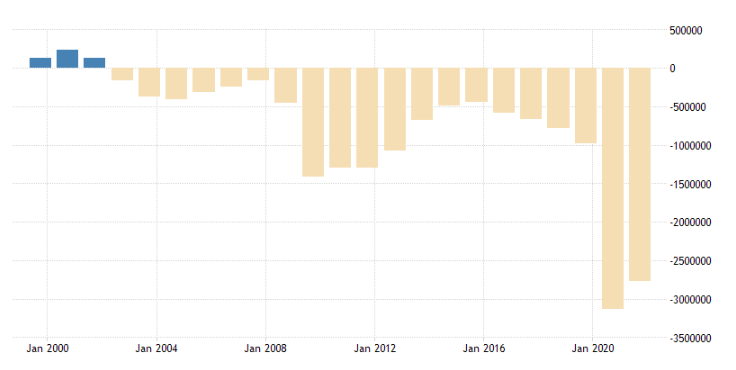
This shot of our surplus/deficit is, to use financial jargon, f**king insane.
On top of that, we have a market that has been artificially and exponentially pumped higher through passive ETF investments, trillions of dollars of COVID liquidity, and the weaponization of the options market (Tesla, in my opinion, will be the poster boy for this assertion, if I’m correct, when the company first encounters an unavoidable piece of negative fundamental news that outruns mysterious options players constantly buying calls in the name.)
I mean, the market closed up for the 4th straight day on Wednesday, after inflation data came in above estimates (which should signal the Fed isn’t doing enough to beat inflation), after a war in the Middle East broke out (essentially doubling the potential geopolitical volatility on the horizon for the time being) and while valuations (market cap/GDP, P/E, throw a dart and pick one) remain near historic highs.
You don’t think that’s the normal “market stairs up” led by legitimate bids for stocks, do you? Doesn’t something feel…off…about that?
The old adage used to be that the stock market takes the stairs up and the elevator down. Now, with the increased liquidity, the market has taken a rocket ship up—meaning that when the elevator comes down, it won’t be an orderly ride down 5 floors on Central Park West. It’ll be like when that Red Bull guy did the 71,500 foot jump from the stratosphere.
We’ve overclocked the market, monetary policy, and investor psychology in a way that we never have before. It’s not just the stock market that’s going parabolic; investor sentiment and the mechanics of the market that drive prices higher are, too. Both the stock market and our national debt are on the last legs of a 4 a.m. Las Vegas bender. And for those who have been in that situation (not saying that I have) you know there are only hours, if not minutes, left before you have to pay the piper.
As if this horrifying setup weren’t bad enough, there are also unprecedented geopolitical headwinds. Russia and China have paired up with nations like India and South Africa to start building a consortium seeking to do business outside the Western banking system. This ball is already rolling. That should be enough to give investors concern and encourage a risk-off climate by itself. When tacked onto our current fiscal and monetary disaster, it makes the situation truly unprecedented.
Today’s article is too important to keep behind a paywall. For those who want to support my work, I’d be humbled if you subscribed. You can take 50% off for life using the coupon below: Get 50% off forever
And in the words of the Flex Tape guy, “But wait, there’s more.”
The world today seems closer to a third World War than at any time in recent memory, save perhaps for the Cuban Missile Crisis. Russia continues its invasion of Ukraine, creating a stark divide between Ukraine’s Western allies and Russia’s supporters. This isn’t merely straining the United States militarily; it’s exacerbating our fiscal recklessness as we funnel hundreds of billions of dollars in aid to Ukraine. The conflict is stretching both our military and financial resources thinner than they already were. It has also helped oil prices rise, which has prompted President Numbnuts to empty the nation’s Strategic Petroleum Reserve – our nation’s stockpile of oil generally kept around for shortages and military purposes.
As if these challenges weren’t enough to give one extreme pause, another war is erupting in the Middle East between Israel and Hamas. It’s yet another global conflict that the United States and its allies seem hell-bent on supporting through financial and military aid. This conflict further dilutes our resources and intensifies the pressure on our already precarious fiscal situation. Saudi Arabia, who President Magoo believes is some kind of ally (see the famous photo below), has officially lent its support for Hamas.
That’s right: two conflicts, both alike in dignity, both dealing in or around oil hotbeds. One with Russia, a massive exporter of oil, and another that has prompted some U.S. Senators to strike Iran’s oil refineries (after President I-Can’t-Even-Hear-The-Dinner-Bell has effectively put a lid on drilling for oil here in the U.S. while at the same time trying to make nice with Saudi Arabia’s Mohammed Bin Salman, best known for executing his nation’s own journalists and opposing gay rights).
Additionally, the Israel-Hamas conflict contributes to rising divisiveness in the United States. As we approach the 2024 election, the nation is arguably as divided as it has ever been. With the far-left “woke” crowd on one side and the “Make America Great Again” right on the other, the schism in our country seems to be approaching a breaking point.
Movements like Black Lives Matter have been openly standing with Palestine following recent attacks on Israel, introducing an unexpected variable and causing many liberal Jewish people who once supported the Black Lives Matter cause to rethink their allegiance. Pro-Palestinian rallies have also unfolded across the United States.
Even U.S. Congresswoman Rashida Tlaib chose to fly the Palestinian flag outside her office after the recent events. While one can understand the idea that not all Palestinians are terrorists, one is likely to question the wisdom (or total lack thereof) of such a gesture given its timing.
Stepping back, the country appears mired in a level of social unrest I can’t recall witnessing recently. While I’d like to be optimistic and believe that things will eventually improve, I can’t shake the feeling that we’re headed toward darker days before a reversion to equilibrium. I would love nothing more than to be utterly wrong in this assessment.
My October 2023 portfolio review lays out my reasoning for owning miners, along with most of the other stocks/positions I find interesting and that I own personally.
It perplexes me that people continue to conduct their personal and financial planning as though the world isn’t on the cusp of dramatic change. While I hope for a return to normalcy, the setup for sweeping changes and volatile shifts seems as palpable as it has ever been in my investing career:
U.S. monetary policy is as broken as it has ever been, swinging wildly from near negative rates and unlimited quantitative easing for nearly 20 years to raising rates at the fastest clip in recent history
Fiscal policy has done nothing to address the nation’s debt load, which is resulting in unheard of debt service obligations. In fact, our deficits appear to be accelerating as the U.S. spends wildly
The U.S. has effectively lowered its backup oil supply in the strategic petroleum reserve to the lowest levels in decades, increasing the risk of an oil shortage or rising prices, while encouraging military conflict with both Russia and Iran, who represent two of the world’s largest oil exporters. At the same time, the U.S. has put a lid on oil production domestically and has discouraged drilling.
The U.S. is now lending military aid to both Ukraine and Israel in conflicts that both have legitimate chances of spreading to other parts of the world — aid that is paid for with defense spending with cash we don’t have an need to borrow from the Chinese.
The U.S. economy, housing market, commercial real estate market and stock market all remain in bubble territory, near historic highs, and have yet to make any part of a meaningful drawdown that I believe is a mathematical necessity based on where interest rates are.
Political division in the U.S. remains at a fever pitch with an upcoming election fast approaching. Questions about election legitimacy and the bifurcation of both major political parties in the country are foreground issues that can exacerbate all of the above and — most importantly — keep our nation in a precarious state, not just financially, but morale-wise.
I’ve been wrong before, and I would welcome being wrong now, but I’d be remiss if I didn’t first sound the alarm at what, to me, appears to be an obvious setup for more serious volatility.
QTR’s Disclaimer:I am an idiot and often get things wrong and lose money. I may own or transact in any names mentioned in this piece at any time without warning. This is not a recommendation to buy or sell any stocks or securities, just my opinions. I often lose money on positions I trade/invest in. I may add any name mentioned in this article and sell any name mentioned in this piece at any time, without further warning. None of this is a solicitation to buy or sell securities. These positions can change immediately as soon as I publish this, with or without notice. You are on your own. Do not make decisions based on my blog. I exist on the fringe. The publisher does not guarantee the accuracy or completeness of the information provided in this page. These are not the opinions of any of my employers, partners, or associates. I did my best to be honest about my disclosures but can’t guarantee I am right; I write these posts after a couple beers sometimes. Also, I just straight up get sh*t wrong a lot. I mention it twice because it’s that important.
What would a second day of testimony in the FTX trial for Caroline Ellison have been without mentions of identity theft from Thai prostitutes and bribing Chinese officials?
Taking the stand on Wednesday, Sam Bankman-Fried’s former love interest turned star government witness against him, Ellison, spoke about the balance sheet that led to the downfall of Bankman-Fried’s companies.
Ellison stated that this balance sheet was a manipulated version of what Alameda had sent to its lenders, deliberately crafted to give the impression that the firm was in a more robust financial condition than was actually the case. She described the document as “deceptive.”
Previously it had been reported that, at Bankman-Fried’s direction, Ellison had “prepared seven different versions of Alameda’s balance sheet to potentially show to lenders,” according to The Messenger.
However, even the manipulated figures were concerning—laden with FTX’s FTT token and other tokens closely affiliated with Bankman-Fried—casting doubt on the financial viability of both Alameda and FTX. Among potential lenders was Saudi Crown Prince Mohammed bin Salman, Ellison testified Wednesday.
She also lied to Genesis, one of FTX’s lenders, about Alameda’s balance sheet, @teddyschleifer reported on X Wednesday.
“Caroline Ellison testified that Sam Bankman-Fried ordered her to lie in mid 2022 to Genesis, one of FTX’s lenders, about Alameda’s balance sheet,” he wrote. “Caroline prepared a bunch of bullshit balance-sheets that they could send, and Sam chose ‘Alternative 7’ as the best lie of the bunch.”
Ellison reportedly said: “I didn’t want to be dishonest, but I didn’t want them to know the truth.”
Ellison testified on Wednesday: “I was in a constant state of dread. I knew we would have to take the money from our line of credit and that was money that could be called in at any time.”
And where was the money going? Ellison testified that she and Alameda executives had “paid a large bribe to Chinese officials” to obtain funds that were locked on a Chinese exchange.
After initial attempts to unfreeze funds by negotiating with the Chinese government through lawyers proved unsuccessful, Ellison stated that the FTX/Alameda team then endeavored—yet failed again—to access the funds by setting up fictitious exchange accounts using IDs that she believed belonged to “Thai prostitutes.”
Ultimately, Ellison was able to secure the funds after making a $100 million payment to a cryptocurrency account she believed was somehow connected to Chinese government officials. Ellison recounted an episode where an employee, whose father was a Chinese government official, voiced objections to the plan during a meeting. In response, Bankman-Fried became increasingly irritated and eventually told the employee to “shut the f*** up.”
In a confidential “State of Alameda” memo authored by Ellison in November 2021, shortly after the payment was executed, she included an entry labeled “-150m from the thing?”under a section outlining “notable/idiosyncratic” financial events. During her testimony, she explained that this entry was a reference to the payment made to Chinese authorities, stating, “I didn’t want to put in writing that we paid what I believed were bribes.”
So eventually, Caroline Ellison said that FTX coordinated a $150 million bribe to the Chinese government in order to unfreeze the accounts.
In a memo to SBF, Caroline referred to it as “-$150m from the thing.”
“I was concerned that if everyone would find out, then everything would come crashing down,” she added.
“I felt a sense of relief that I didn’t have to lie anymore,” she said in court, according to Coindesk. “I felt indescribably bad about all the … people that lost their jobs … [and the] people that trusted us that we had betrayed.”
“Alameda took several billions of dollars from FTX customers and used it for investments. I sent balance sheets that made Alameda look less risky than it was,” Ellison testified earlier this week.
Who Ghostwrites Reports For The Center For Countering Digital Hate?
In this report, journalist Paul Thacker continues to chip away at the thin veneer covering the Center for Countering Digital Hate, a pro-censorship group run by a wannabe British spook, and which has risen to prominence through breathless MSM reporting and government support. Thacker does excellent work exposing bad actors wherever they operate. We recommend subscribing and checking him out on Twitter.
I wrote an investigation last week for Tablet looking into Imran Ahmed, a political operative with ties to British intelligence who runs the Center for Countering Digital Hate, a dark money nonprofit that is now attacking the Biden administration’s political opponents. Through one of their board members, Simon Clark, Ahmed’s group has been linked to the Center for American Progress, a think tank and lobby group for corporate Democrats.
A few days before we released this investigation, Imran Ahmed’s Center for Countering Digital Hate (CCDH) released one of their flimsy reports that took off in the media, garnering press in almost a dozen outlets. In my investigation, I noted that Elon Musk is now suing CCDH, in part, for a report Ahmed released last July that made up allegations that hate has increased on Twitter, and I wrote that Facebook shot down a 2021 CCDH report by pointing out that CCDH was making up numbers about vaccine disinformation. So I just took a hard look at CCDH’s latest report and discovered something very odd: CCDH never names their researchers. I then dug through past reports and found the same: CCDH’s reports are written by ghosts, anonymous writers who the media then quote as expert “researchers” in news articles.
Let’s take a look.
First of all, none of CCDH’s “research” gets published in actual journals and they never acknowledge any experts for peer reviewing or advising them on their work. They just throw up these sparkly documents with graphics and confident findings on their own website.
Further, neither Imran Ahmed nor anyone I can find associated with CCDH has an academic or research background. Most CCDH employees are either political operatives who worked for the British Labour Party or they’re people with backgrounds doing advocacy work in nonprofits. CCDH’s “head of research” is a guy named Callum Hood. You can’t find a job history for Hood anywhere, and CCDH lists no employment Hood has ever had except working at CCDH.
It’s really that laughable.
I’m not saying this means you can’t believe anything CCDH writes, but political operatives and advocates aren’t the people you really want to rely on as trustworthy sources of credible, unbiased research conclusions. And journalists who regurgitate this nonsense should not be trusted.
CCDH’s latest report, like all of them, is heavy on graphics to provide a visual effect that you are reading a credible pieces of research that a government agency might publish. Here’s one of the first pages you encounter: a list of contents that tries to bedazzle you with an appendix that points to a “methodology” as well as a list of references to make it appear you’re getting a real piece of scientific scholarship.
Wow, it’s got both a methodology and references!
But guess what? They don’t list any actual scholars.
When you look past the sparkly graphics and apparently alarming conclusions, CCDH reports never report any authors other than Imran Ahmed. Not at the top, nor hidden somewhere in an acknowledgement section. Apparently ghosts wrote the report. The only person named in the document is Imran Ahmed who allegedly wrote the introduction.
“Many think tanks, like RAND or the Urban Institute, as well as other non-profits, almost always credit their authors,” said Joshua Guetzkow, a sociologist and assistant professor in the Faculty of Law at Hebrew Univeristy. Guetzkow has spent several years study the disinformation industry and noted that the Anti-Defamation League notes the names of researchers in an acknowledgement. “The CCDH does not even do that, so it is impossible to know who was involved in the writing and obviously significant amount of research involved in that report.”
But to add scholarship gloss, Ahmed’s introduction has footnotes. But let’s take a look at those footnotes.
The first footnote in Ahmed’s introduction is a report by Pew Research Center (4), an organization known for putting out serious studies. But the next three citations are an article at the website TechCrunch (5), one of CCDH’s own reports (6), and a Washington Post news story (7).
This is just not credible. Nothing about this is research or scholarly. The reference section of Ahmed’s “report” looks like high school students threw it together by Googling, during a late night pizza party.
You can see the difference between CCDH and a credible research organization like Pew Research, by looking at the Pew report that Ahmed cites in his own introduction. When you go to that Pew Report “Teens, Social Media and Technology 2022,” you find that Pew lists the authors and provides a biography for each. The first author is Emily Vogels whose Pew biography lists her two research degrees and past reports.
“Nothing Here To Convince Fed To Hike In November”: Wall Street Reacts To Today’s CPI
There are two diverging views following today’s CPI print: the first looks at the hotter headline inflation (which beat expectations on both a MoM and YoY basis) and argues that the Fed will have to hike at least once more. The second counters by pointing to the continued slowdown in supercore inflation…
… and notes that excluding shelter, which as we noted continues to lag real-time data by 12 months at a time when rents are now dropping…
CPI and its stale data: “The shelter index increased 7.2 percent over the last year, accounting for over 70% of the total increase in all items less food and energy.”
Meanwhile, real-time rent indicators are in freefall. Apt List’s Sept rent drop was the biggest on record pic.twitter.com/WXwFAKfJv5
For a more granular view of Wall Street’s takes, here is a snapshot of some of the initial hot takes from a variety of traders, economists and strategists.
Capital Economics
Excluding shelter, the core CPI rose by just 0.1% m/m. Overall, there is nothing here that will convince Fed officials to hike rates at the next FOMC meeting, and we continue to expect a more rapid decline in inflation and weaker economic growth to result in rates being cut much more aggressively next year than markets are pricing in.”
CBK:
“US inflation is cooling, but only slowly. From the perspective of the Fed, the figures are probably not worrying enough to trigger another interest rate hike. However, they are not good enough to sound the all-clear either.”
MUFG, George Goncalves
“The Fed is done as its recent commentary suggests a shift from already thinking of moving from how high to how long. The data and recent Fed speak means it looks hard to get 10s to make a run towards 5 again — not impossible — but the double top in rates in September might prove to be the near-term high.”
Richard Bernstein Advisors
“This is one of those reports that will be forgotten almost immediately. It’s always important to keep in mind that the Fed will be responding to inflation, which in turn responds to growth, so it makes more sense to focus on the head of the snake than the tail.”
BMO Capital Markets
“Overall, it was a firm read on realized inflation that reinforces the Fed’s recent messaging regarding the need to keep policy rates in restrictive territory for an extended period of time. The unchanged initial jobless claims print of 209k also reinforces the Goldilocks narrative.”
Bloomberg Economics
“The September CPI report won’t convince Fed officials that interest rates are sufficiently restrictive. There’s some encouraging disinflation progress in the goods sector, but not so much in services, where rents disinflation stalled. The Israel-Hamas conflict has now tipped the balance once again toward upside inflation risks. Our baseline is for the Fed to hold rates steady for the rest of the year, but we see non-negligible risks of another rate hike, something the market is probably underpricing.”
Premier Miton Investors
“The core rate for September came in as expected and this will allow the Fed to proceed carefully from here. Overall, the economy remains robust in the face of tighter policy, supported by the jobs market. Those looking for a soft landing will not be disappointed by this number, but they will not want to see it moving any higher.”
JPM Asset Management
“The report was almost exactly in line with expectations. The economy is on track for a year-over-year headline CPI being 2% or less in the fourth quarter of next year. This is one year ahead of the Fed’s target.“
Charles Schwab UK
“While the lack of a fall in the rate may be disappointing to the Fed, it is likely not surprising following last week’s jobs report, which showed that the labor market remains hot — a factor that can put upward pressure on prices. Whether or not the Fed opts for hikes, it’s unlikely we’ll see rates drop below where they are for as long as the inflation dragon proves difficult to slay.”
Authored by Simon White, Bloomberg macro strategist,
Real assets – commodities, gold and TIPS – are better positioned than bonds to act as a portfolio and a recession hedge in a regime of elevated inflation. For investors without capacity or liquidity constraints, they are an improved alternative to Treasuries in a 60/40-like portfolio.
Inflation has been making up for lost time after its last two decades of serenity. As well as prompting the fastest rate-hiking cycles from central banks, playing havoc with economic pricing signals, and deepening uncertainty, it is also turning the established rules of investment on their head.
Nowhere is that more visible than the role of bonds. It has long been taken for granted that they possessed two features that made them almost indispensable to multi-asset investors:
1) they acted as a portfolio hedge for equities; and
2) they guarded against recessions.
But both of these characteristics are becoming challenged in the current regime of elevated and unstable inflation. The stock-bond correlation is now positive after years of being negative. This means that rather than bonds having a dampening effect on the volatility of a traditional 60/40-like portfolio (60% equities, 40% bonds), they are amplifying it.
Bonds typically offer lower returns than stocks, so their return-smoothing properties were a key reason why equity investors held them at all. Even better, they tended to rally in a recession, mitigating the steep losses experienced by stocks.
Yet in an inflationary regime, a growth shock can be accompanied by an inflation shock, meaning stocks and bonds fall together. That’s what’s unflatteringly known as a Texas hedge.
It’s time for a rethink. Replacing some or even all of the Treasuries one holds in a 60/40-like portfolio is beginning to look ever more prudent.
But what do you replace them with? There are liquidity, capacity and operational constraints with other assets, such as real-estate, infrastructure, corporate bonds, etc. Moreover there is a higher bar for returns as cash typically provides a better return when inflation is elevated.
In a somewhat perverse way, this could lead many investors back to TINA – there is no alternative – deciding to replace some or all of their fixed-income allocation with equities. But there is one glaring problem here – apart from the obvious “eggs-all-in-one-basket” risk: portfolios heavily tilted to stocks are uniquely exposed to recessions.
So any replacement for Treasuries that mitigates portfolio risk also needs to help cushion the fall from equities in a recession. It turns out that real assets are the optimum port in the storm for investors free from institutional or capacity limitations.
To see why, we need to look at how various assets have performed in low and high-inflation regimes. High-inflation regimes (shown in the chart below) are defined here as when inflation and inflation volatility are persistently above their long-term averages. There are five distinct regimes, including the one we’re in now.
Now let’s look at how the main asset classes performed relative to cash (3-month T-bills) in and out of these high-inflation regimes. As highlighted in the chart below, almost all of the assets shown perform better in the low-inflation regime. That’s mainly down to cash being lower in these periods, making it easier to earn a higher excess return.
In high-inflation regimes, only TIPS perform better than when inflation is low. Equities, along with corporate bonds, see the steepest drop in excess returns between low and high-inflation regimes.
Now let’s combine these assets with 60% equities in 60/40 portfolios, and see how their Sharpe ratios change when inflation shifts from a lower to a higher regime.
The first thing to note is how every portfolio’s Sharpe ratio is worse in the high-inflation regime.
The 60% equity proportion does wonders when inflation is low, but falters when it is not. Indeed the excess return of all portfolios is negative in an inflation regime, as cash returns an lofty 7.4% annualized through such periods.
Secondly, the three portfolios with the best (i.e. least negative) Sharpe ratios all include real assets – TIPS, commodities and gold.
In challenging environments, choosing portfolios with the cleanest dirty hands is the best you can do, and replacing USTs with real assets has historically offered the best risk-adjusted returns when inflation is in an elevated regime.
But that still doesn’t help us with recessions. Stocks and corporate bonds typically see the largest selloffs in a slump. That’s why TINA or 60/40 with corporate debt are a bad idea if you want to avoid portfolio decimation in an economic slowdown.
It turns out, though, that real assets have tended to perform reasonably well in recessions, much better than stocks. Crucially, they tend to perform well in inflationary recessions, the type the next downturn is most likely to resemble.
Both TIPS and gold have on average delivered positive nominal returns through recessions going back to 1969. What about commodities?
Financial “rule-of-thumbism” would tell you they do terribly in recessions. But that doesn’t bear much scrutiny. Commodities on average flat-line through economic slumps. However, if we look at commodity-induced recessions – as the next downturn is likely to have proved to have been – commodities rally after the recession has started.
In such contractions, commodities sold off on the pre-recessionary growth scare, but this in fact eased the growth shock, meaning that commodities – which are sensitive to the level of demand rather than its change – could rise through much of the recession.
Commodities, gold and TIPS are not for everyone and their market sizes are considerably smaller than nominal Treasuries. Moreover, other real assets such as infrastructure, real-estate and so-called alternatives may confer similar benefits, but these bring other potential issues such as liquidity mismatches and ease of access and management.
Real assets are typically spurned in 60/40-like portfolios, making up only a small fraction of the assets held. But there has never been a better time over the last 30 years to revisit this shibboleth of low-inflation regimes.