77.5 F
Chicago
Friday, September 4, 2026
Home Blog Page 3277

SEC Sues Elon To Compel Him To Testify; Musk Responds It’s Time For Punitive Action Against Regulators Who “Abuse Power For Political Gain”

0
SEC Sues Elon To Compel Him To Testify; Musk Responds It’s Time For Punitive Action Against Regulators Who “Abuse Power For Political Gain”

The SEC, (which stands for either Suck Elon’s C**k or the Securities and Exchange Commission depending on who you ask)…

… has sued Elon Musk (again), this time to compel – or at least try – the billionaire CEO of Tesla to testify regarding his purchase of Twitter last year, CNBC reported Thursday

The SEC alleged in a complaint filed in the Northern District of California that Musk didn’t appear for testimony that was required via a subpoena that was served to Musk in May 2023. 

An official litigation release from the Securities and Exchange Commission, filed on Thursday, said: 

If a person or entity refuses to comply with a subpoena issued by SEC enforcement staff pursuant to a formal order of investigation, the Commission may file a subpoena enforcement action in federal district court seeking an order compelling compliance. According to the SEC staff’s filing in the U.S. District Court for the Northern District of California, the testimony subpoena to Musk relates to an ongoing investigation by the SEC regarding, among other things, potential violations of various provisions of the federal securities laws in connection with (a) Musk’s 2022 purchases of Twitter, Inc. (“Twitter”) stock, and (b) Musk’s 2022 statements and SEC filings relating to Twitter.

The SEC also claimed that Musk skipped out on testimony just days before he was supposed to show up

“According to the filing, Musk failed to appear for testimony as required by the investigative subpoena served by the SEC, despite: (1) agreeing to appear for testimony on a mutually agreed upon date in September 2023; (2) having been served with a subpoena in May 2023 requiring his appearance for testimony in the SEC’s San Francisco Regional Office on that mutually agreed upon date; and (3) raising no objection to the subpoena from May 2023 until two days before his scheduled testimony date in September 2023, when Musk notified the SEC that he would not appear.”

The SEC complaint says: “Musk’s ongoing refusal to comply with the SEC’s administrative subpoena is hindering and delaying the SEC staff’s investigation to determine whether violations of the federal securities laws have occurred. Accordingly, the SEC now asks the Court to compel Musk to appear for investigative testimony.”

The SEC said it tried to meet Musk in Fort Worth, Texas, “the closest SEC office to Musk’s current personal residence”, and that multiple dates were offered for both October and November of this year. Lawyers for the SEC said Musk refused to comply with the subpoena due to “several spurious objections, including an objection to San Francisco as an appropriate testimony location.”

“These good faith efforts were met with Musk’s blanket refusal to appear for testimony,” the SEC claims in its suit. It also claimed its “staff is continuing its fact-finding investigation and, to date, has not concluded that any individual or entity has violated the federal securities laws.”

In response, Musk was – as usual – laconic and to the point, commenting on the same twitter X that he bought, that what is actually needed is “a commission to take punitive action against those individuals who have abused their regulatory power for personal and political gain.”

Tyler Durden
Thu, 10/05/2023 – 18:00

Civil Rights Agency Sues 2 Businesses That Fired Workers Over COVID Vaccine Refusal

0
Civil Rights Agency Sues 2 Businesses That Fired Workers Over COVID Vaccine Refusal

Authored by Zachary Stieber via The Epoch Times (emphasis ours),

COVID-19 vaccines in a file photograph. (Joseph Prezioso/AFP via Getty Images)

The U.S. Equal Employment Opportunity Commission (EEOC) has sued two businesses for firing workers who had sought religious exemptions to COVID-19 vaccine mandates.

United Healthcare Services, a Cleveland-based health care provider, and Arkansas-based Hank’s Furniture violated federal law when denying the exemption requests and firing the workers, according to the suits.

Title VII of the Civil Rights Act of 1964 bars discrimination over religion and requires businesses to accommodate a worker’s religious practice unless doing so would cause “undue hardship.”

Once an employer is on notice that an employee’s sincerely held religious belief, practice, or observance prevents the employee from getting a COVID-19 vaccine, the employer must provide a reasonable accommodation unless it would pose an undue hardship,” Debra Lawrence, a regional attorney for the EEOC, said in a statement. “Neither healthcare providers nor COVID-19 vaccination requirements are excepted from Title VII’s protections against religious discrimination.”

Marsha Rucker, another EEOC attorney, said the suit against the furniture retailer “should remind employers they must communicate with employees requesting accommodation for religious beliefs and try to accommodate those beliefs whenever reasonably possible.”

She pointed to a recent U.S. Supreme Court ruling that found in favor of a U.S. Postal Service mail carrier who sued after the service refused to accommodate his request not to work on Sundays.

There is now a higher bar for employers to meet when denying a religious accommodation,” Mat Staver of Liberty Counsel, a law firm that brings similar cases, said in a statement. “People should not have to choose between their faith and their job.”

The EEOC said in 2021 that businesses could impose COVID-19 vaccine mandates but would need to provide religious and medical accommodations.

United Healthcare told The Epoch Times in an email that it plans to “vigorously defend ourselves” against the suit.

“Among other things, the EEOC’s contention that the employee in question was a remote worker with no in-person job responsibilities is inaccurate,” the company said. “We continue to respect individual beliefs, while working to ensure the health, well-being, and safety of our colleagues and those we are privileged to serve.”

Hank’s Furniture didn’t have lawyers listed on the court docket and couldn’t otherwise be reached.

Remote Worker Fired

Amanda Stone, who started working for United in 2014, was promoted in 2016 to a supervisory position. She was transitioned to work full time from home in 2018 due to budget cuts. Since then, Ms. Stone’s job hasn’t involved any face-to-face duties or a need to enter United facilities, according to one of the suits.

Along with many other U.S. companies, United Healthcare in October 2021 announced a COVID-19 vaccine mandate. The vaccination requirement was purportedly only for workers who needed to enter the company’s facilities or meet face-to-face with customers, suppliers, or members. United specified that it didn’t apply to people who worked remotely.

Ms. Stone, though, received word that she needed to get a shot, the suit said.

Ms. Stone is a Christian who said she has sincerely held religious beliefs, including an opposition to abortion that prevents her from receiving a COVID-19 vaccine. The shots were developed with or tested using cell lines derived from aborted fetuses.

Ms. Stone submitted a religious exemption request on Oct. 6, 2021, outlining her objections to vaccination. United issued a denial on Oct. 26, 2021.

Ms. Stone asked her boss how to appeal the decision. She was told she couldn’t appeal but could try again. Ms. Stone did so and was denied a second time. She wasn’t informed either time why she was denied.

United told Ms. Stone on Nov. 30, 2021, that she was being placed on leave for not complying with the mandate. United said if she didn’t receive a vaccine, she might be terminated. United fired her on Jan. 2, 2022.

The U.S. court in southern Ohio was asked to block United from discriminating against people on the basis of their religion, ordering United to give Ms. Stone back pay with interest, front pay, or reinstatement, and provide compensation for losses resulting in its discrimination.

Company Said It Would Never Grant Exemption

Kaitlyn O’Neal started working for Hank’s Furniture in 2020 and was promoted in 2021 to be an assistant manager.

Ms. O’Neal was informed by the company in July 2021 that it planned to encourage employees to receive a COVID-19 vaccine, according to the other suit. The company wanted all managers to immediately receive a shot.

Ms. O’Neal said she didn’t plan to get the vaccine.

Several weeks later, Ms. O’Neal informed the company that she had sincerely held religious beliefs that would prevent her from getting vaccinated, and asked for a religious exemption.

Hank’s Furniture sent her online articles in an attempt to change her mind, according to the suit. When contacted by the company, Ms. O’Neal said she hadn’t. When she inquired about how to submit a written request for a religious exemption, the company didn’t respond.

When Ms. O’Neal complained, her manager and supervisor said Hank’s Furniture didn’t care about her reasons and that the company would never grant an exemption, the EEOC said.

On Aug. 20, 2021, Hank’s Furniture announced that its policy of encouragement had become a vaccine mandate. Workers who didn’t receive a vaccine by Oct. 31, 2021, would be fired, it said.

Ms. O’Neal submitted a written request for an accommodation, which was ignored by the company.

After she followed up, the company said her request was “severely lacking” and was rejected. Ms. O’Neal asked for help in filing a proper request, but the company refused, before firing her on Oct. 31, 2021.

The EEOC asked the U.S. court in northern Florida to award Ms. O’Neal back pay with interest and order Hank’s Furniture to pay front pay or reinstatement, compensation for losses, and damages. The company should also be blocked from discriminating against workers on the basis of religion, the agency said.

Tyler Durden
Thu, 10/05/2023 – 17:40

Something Popped: Google Searches For “Sell My Airbnb” Surge As Travel Downturn Worsens  

0
Something Popped: Google Searches For “Sell My Airbnb” Surge As Travel Downturn Worsens  

We told readers in late July, “Why AirBnB Owners Are About To Be Forced Property Sellers.” Then, one month later, in late August, we wrote “The AirBnB Bubble Popping Will Pop The Housing Bubble,” followed by “AirBnB Bubble Bursts: Investor Home Purchases Crash 45% In Biggest Drop Since 2008.” 

Airbnb owners who snapped up homes in the last several years during the era of ‘free’ money are facing a downturn in the short-term rental market that started in the second half of 2022, with some Airbnb operators in cities facing 50% revenue declines, according to a recent note published by Reventure Consulting CEO Nick Gerli. 

“I believe these losses will cause a wave of distressed selling from Airbnb operators in 2023 and 2024,” Gerli said. 

Airbnb’s CEO recently warned of a “booking slowdown,” while airlines and retailers have warned of a consumer spending downturn. JPMorgan, Goldman, Bank of America, Barclays, and Citi have added more gloom as consumer credit card spending crashed in September. 

Clearly, the Fed pinning interest rates at two-decade highs is leading to major economic cracks as a recessionary slowdown in travel demand emerges and crimps revenue for highly leveraged Airbnb operators, which depend on revenue streams to pay their mortgage payments. 

Gerli said the revenue collapse is “most notable in the Southwest and Mountain West areas of the country, where Airbnb revenue per listing is down 40-50% YoY. With owners in cities such as Austin, Phoenix, Denver, and San Antonio taking the hardest hit.” 

One X user posted, “The great Airbnb exit has begun.” 

This X user gets it. 

Sounds about right. 

… and what’s up with this Google Search “sell my Airbnb”?! point unless it’s a big family trip

So, is the panic just beginning? 

Tyler Durden
Thu, 10/05/2023 – 15:40

The Degradation And Humiliation Of The U.S. Consumer

0
The Degradation And Humiliation Of The U.S. Consumer

Submitted by QTR’s Fringe Finance

I’ve often written about how inflation is nefarious because it cripples people’s purchasing power 24 hours a day, seven days a week. Whether it is dark out or light out, whether people are paying attention or not, inflation is, in essence, a piece of machinery that eats away at your purchasing power at all times—whether you know about it and expect it or not.

I discussed the effects of inflation in a video I made a long time ago, called “The Weighted Blanket Theory.” In it, I explained that rising prices are like a weighted blanket falling on the consumer. At first, they feel okay and even comforting, but then you realize the blanket weighs far too much—before you know it, you’re trapped under a blanket that has completely incapacitated and smothered you.

Something else that has slipped away—largely unnoticed—is the standard of quality of service offered to consumers around the country. As the United States has transitioned from treating spending on discretionary items as a luxury to considering it a right—and even an obligation for all consumers, even if it means taking on debt—companies have had to fight less and less to provide good service. Now, service is basically bordering on sub-human, both literally and figuratively.

In other words, because our fractional-reserve, debt-based system is built on the fantasy of modern monetary theory and prioritizes nothing but spending money we don’t have on things we don’t need, those providing products or services can afford to be complacent. They can simply watch as us peons scramble for whatever is thrown our way, at whatever prices are deemed appropriate by our horrifically skewed markets. In some respects, we do still have the option to vote with our money, as capitalists. However, when it comes to buying basic household goods and necessities, corporations and inflation have combined not just to take advantage of consumers, but to degrade and humiliate them as well.

This couldn’t have been clearer than on a recent trip I took to Target. I’ll start by saying that I have a special soft spot for Target’s goals of cutting excess expenses and maximizing customer value, primarily because I’m a shareholder. Thus, I feel very conflicted about my recent experience there. However, as a consumer alone, there’s no other way to describe my recent ordeal other than as embarrassing and lamentable.

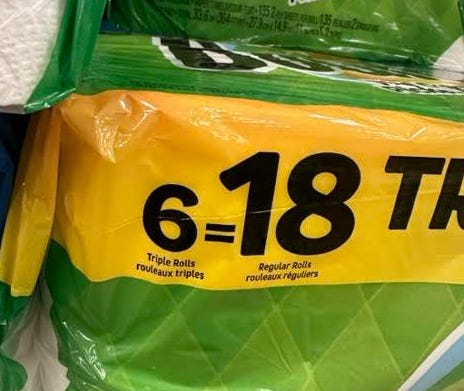
After a long day of eight or nine hours of work, I walked to my local Target store to pick up some necessities recently —basics like toilet paper and paper towels. Upon reaching the household section, the first thing I was greeted with was an array of toilet paper and paper towel brands featuring the marketing gimmicks that I absolutely abhor. In my recent article called “I’m Not F*cking Eating Bugs: A Manifesto”, I referenced these limp-dicked attempts by focus groups at Proctor and Gamble of trying to convince us that the Arabic numeral “6”, an integer known and understood for millennia, actually means “9”.

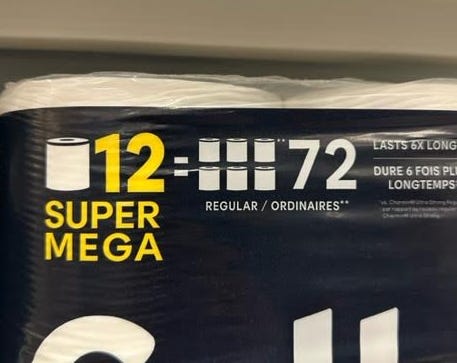
Except I live in reality, not a fantasy world, and I understand that 6 means 6 and 12 means 12 and 24 means 24, no matter how you decide you want to print it on a package of Bounty. And even Proctor and Gamble need to make up their minds. Does 6 really equal 9? Or does it really equal 18?

You guys are even terrible at the own sh*tty non-sequitur math that you invented.

And what’s the ratio between “triple rolls” and “super mega” rolls? Probably the ratio between unicorns and leprechauns, right?

But most of all, in the words of Tom Smykowski from Office Space: “What the hell is wrong with you people?!”

Immediately recognizing this bullsh*t language that a first grader could dispel as fiction as a marketing trick designed to justify “shrinkflation”—offering the consumer less for the same amount of money—I became agitated and frustrated.

To add insult to injury, I noticed that the prices of these items had increased by about 10% from where they were last year. So, the first leg of my journey ended with me taking it in the tailpipe not just in terms of price and receiving less product, but also by Procter & Gamble’s marketing department insulting my intelligence. Great start to my shopping trip.


50% OFF ALL SUBSCRIPTIONS: Subscribe and get 50% off and no price hikes for as long as you wish to be a subscriber.


From there, I walked over to get some deodorant and face scrub, both of which were located behind locked cabinets. Each was priced at about $7.99. Then I glanced at an entire wall of unlocked products priced from $13.99 to $20.99 and wondered why these particular items weren’t secured. Lacking the time to question the store’s reasoning, I hit the attendant button, reminiscent of a lab mouse pressing a lever for a pellet of food in some of sort of Pavlovian experiment.

Despite the cabinets being adjacent, it took two separate customer service attendants with two separate keys to unlock them. My total wait time was approximately 15 minutes—clearly, Target doesn’t value my time. I empathized with the store associate, who confided she was tired of constantly locking and unlocking cabinets for a living.

After enduring the condescension of Procter & Gamble’s marketing and pressing a button like a lab rat, I proceeded to checkout. A line of two dozen people waited for four self-checkout machines. There were seven or eight traditional checkout lanes, but only one was active, and even that associate appeared unengaged. An additional associate monitored the self-checkouts, which seemed to lock up if one so much as glanced at the scales the wrong way, adding to the delay.

After 20 more minutes, I reached a self-checkout station so cramped that I couldn’t comfortably maneuver my cart. When an associate suggested moving my cart, I politely responded that as long as I was doing the job of checking out my own groceries, I’d place my cart wherever the fuck I wanted.

As Bill Burr once said, “I didn’t even realize I was working today, I should have checked the schedule!”

Then, I started to take my time checking out my groceries. I had finally made it one step from leaving and was not about to rush myself. I was packing my items into double bags because I had to walk home and wanted to ensure everything would make it back to my apartment without incident. As I tried to navigate the self-checkout menus to ring up the bananas I was buying, a store associate approached me. This same associate asked if I was having trouble. I informed them I wasn’t, and they mentioned they had noticed how long it was taking me, pointing out there was a line behind me. At this point, I became irate.

Not unlike Bill Burr in the above clip, I told the self-checkout associate that I had already completed my work for the day and didn’t realize my shift would continue at the local Target, where I would be tasked with ringing up groceries. I reiterated that if they wanted to ring up my groceries, I’d happily let them do it at whatever pace they’d like. However, as long as they needed me to ring myself out, I would take as much f*cking time as I needed.

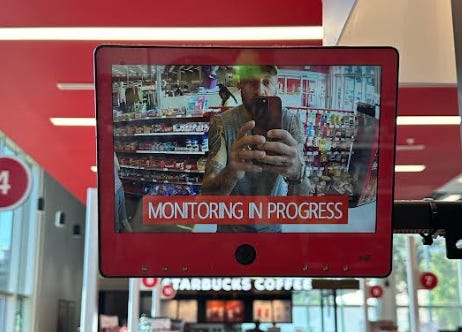
“Monitoring in Progress” a monitor atop of the automated checkout said, while showing me a photo of myself, Orwell-style. “Good,” I thought to myself, “I hope someone is on the other end of this horrific reality show and is watching me endure this shopping experience while making a face like I’m passing multiple kidney stones.”

After a brief argument, the associate eventually let me be. I finished my transaction, only to realize that my total for the same basket of items this week was about 10% higher than it was just two or three months earlier.

In addition to paying 10% more, I endured the insulting experience of reading terrible marketing aimed at justifying shrinkflation and had to engage with three store associates in what was clearly a fruitless attempt for the store to operate in a more automated fashion with fewer workers. I used to make it through the store and out the old checkout only talking to one employee, the checkout person. Now, on a normal trip, I needed to talk to three. To add insult to injury, at the very end of my transaction, when I discovered my total was about $25 more than usual, Target offered me a $5 gift card off my next purchase.

But this, like everything else I had to do that day, it required me to find the gift card on the wall, take it down, scan it, and then return to the store because you can’t use the gift card for that day’s purchase. It was the ultimate slap in the face—akin to placing a dollop of Cool Whip on a pile of dog dung I’ve been eating and telling me:

“You’re our valued customer. We hope you enjoyed your dessert.”

My experience echoes that of millions of consumers across a myriad of industries every day. Service simply isn’t what it once was. The market will correct this issue eventually, but for now, we’ve reached a trough in terms of what consumers expect from corporations and service providers. I mean, look. I’m a realist. I no longer pull up to a gas station expecting a team of uniformed guys named Roy to fill my tires with air, clean my windshield, check my oil, and top off my windshield wiper fluid. I understand that certain services have been relegated to automation and a faster-paced world. However, it’s not too much to ask to walk out of a Target without feeling like I’m doing the walk of shame back to my apartment.

This decline in service quality may have gone unnoticed for a while, but it won’t remain that way forever. Like a weighted blanket that eventually becomes too heavy, consumers will start to notice their diminishing quality of life. In the same vein, some leaders in Congress, such as Representative Matt Gaetz, are beginning to raise critical questions about the integrity of the dollar and inflation. Eventually, all fallacies get their comeuppance. It starts with a couple of minor complaints and perhaps an opinionated individual like myself penning an article on a blog, but in years to come, the issue will be evident to all.

And when we look back for an explanation as to why our quality of life has suffered so greatly, we’ll have no choice but to confront once again the nature of the nation’s monetary and fiscal policy, as well as the manipulation of all types of formerly “free” markets that have placed us in the financial and social predicaments we are in.

If you enjoy this content, we’d love to have you on our subscription list

QTR’s Disclaimer: I am an idiot and often get things wrong and lose money. I may own or transact in any names mentioned in this piece at any time without warning. This is not a recommendation to buy or sell any stocks or securities, just my opinions. I often lose money on positions I trade/invest in. I may add any name mentioned in this article and sell any name mentioned in this piece at any time, without further warning. None of this is a solicitation to buy or sell securities. These positions can change immediately as soon as I publish this, with or without notice. You are on your own. Do not make decisions based on my blog. I exist on the fringe. The publisher does not guarantee the accuracy or completeness of the information provided in this page. These are not the opinions of any of my employers, partners, or associates. I did my best to be honest about my disclosures but can’t guarantee I am right; I write these posts after a couple beers sometimes. Also, I just straight up get sh*t wrong a lot. I mention it twice because it’s that important.


Tyler Durden
Thu, 10/05/2023 – 15:20

Trust In Congress Below 20% Third Month In A Row

0
Trust In Congress Below 20% Third Month In A Row

In the first few months after President Joe Biden took office in January 2021, Congress approval ratings among the general public were at their highest points in over a decade.

However, as Statista’s Florian Zandt details below, the picture is decidedly different today, with the percentage of people satisfied with how lawmakers in the House and Senate are doing their jobs dropping below or just at 20 percent since the beginning of the year.

Infographic: Trust in Congress Below 20% Third Month in a Row | Statista

You will find more infographics at Statista

According to results from the most recent Gallup Poll Social Series conducted from September 1 to 23, 17 percent of respondents thought Congress was doing a good job, only one percent shy of this presidential term’s lowest approval ratings of 16 percent in June 2022 and April 2023. While no specific reasons are given for the low ratings, March 2023 saw the U.S. face several disastrous tornado outbreaks and the collapse of Silicon Valley Bank and Signature Bank. In May 2022, one of the deadliest school shootings in U.S. history occurred in Uvalde, Texas and Roe vs. Wade as well as Planned Parenthood vs. Casey were overturned.

When looking at Gallup data for approval of Congress since 1974, one specific period shows adults in the United States showing overwhelmingly positive feelings towards U.S. representatives.

In October and November 2001, shortly after the 9/11 attacks, approval ratings reached 84 and 73 percent, respectively.

Apart from this turning point in foreign and domestic politics, only rarely did Congress receive good marks from more than 40 percent of respondents.

Tyler Durden
Thu, 10/05/2023 – 15:00

How The Fed Destroyed The Housing Market And Created Inflation In Pictures

0
How The Fed Destroyed The Housing Market And Created Inflation In Pictures

Authored by Mike Shedlock via MishTalk.com,

The Fed erroneously does not consider rising home prices as inflation. Here’s the result in pictures.

Case-Shiller national and 10-city home prices vs CPI, Rent, and Owners’ Equivalent Rent

Chart Note

  • Case-Shiller measures repeat sales of the same home over time. This ensures an accurate comparison of room size, yard size, and amenities. The only drawback is the data lags a bit. The most current data is from July representing transactions in May and June.

  • OER stands for Owners’ Equivalent Rent. It’s the price of rent one would pay to rent one’s own house, unfurnished without utilities.

For 12 years, home prices, OER, Rent, and the overall CPI all rose together. That changed in 2000 with another trendline touch in 2012. Then it was off to the races as the Fed did round after round of QE, suppressing mortgage rates.

Case-Shiller Home Price vs Hourly Earnings, the CPI, and Rent

Case-Shiller national home prices vs CPI, Rent, and Average Hourly Earnings.

As with the previous chart, for 12 years, home prices, rent, the overall CPI and hourly earnings all rose together. That changed in 2000 with another trendline touch in 2012.

How Much Are Homes Overpriced?

If the 12-year trend of home prices rising with average hourly earnings stayed intact, the home price index would be 211, not 308.

From that we can calculate home prices are ((308-211) / 211) percent too high, roughly 46 percent too high. If you prefer, home prices would need to fall ((308-211) / 308), roughly 31 percent.

Alternatively, if home prices stagnate for years, wages may eventually catch up.

Case-Shiller Home Price 1988=$150,000

The same home that cost $150,000 in 1988 now costs $678,366. But wages have gone up too. And mortgage rates have had wild swings.

Mortgage Payment and Wage Adjusted Mortgage Payment

The Least Affordable Mortgages in History

Factoring in wage growth, home prices, and mortgage rates, homes are the most expensive ever.

It’s actually much worse than the chart indicates because property taxes and insurance are not factored into.

Mortgage Rates

Mortgage Rate chart courtesy of Mortgage News Daily.

Through massive and totally unwarranted QE, foolishly hoping to create more inflation, the Fed suppressed interest rates to record lows and mortgage rates followed.

Anyone with an an existing mortgage could and did refinance at 3.00 percent or below.

This increased “affordability” and we now have two classes of people courtesy of the Fed: winners and losers (existing home owners who refinanced low and those who want to buy).

Mortgage Application at 30-Year Lows

Refinance Index courtesy of Mortgage News Daily

Please note Mortgage Application Volume Nears 30-Year Lows

“Mortgage rates continued to move higher last week as markets digested the recent upswing in Treasury yields. Rates for all mortgage products increased, with the 30-year fixed mortgage rate increasing for the fourth consecutive week, up to and above 7.53 percent – the highest rate since 2000,” said Joel Kan, MBA’s Vice President and Deputy Chief Economist. “As a result, mortgage applications ground to a halt, dropping to the lowest level since 1996. The purchase market slowed to the lowest level of activity since 1995, as the rapid rise in rates pushed an increasing number of potential homebuyers out of the market. ARM loan applications picked up over the week and the ARM share increased to 8 percent, as some borrowers searched for ways to lower their payments.” 

What About the Winners?

Good question. The winners refinanced at 3.0 percent or below. This put extra money in their pockets every month to spend.

And rising wages further stimulated ability of the winners to buy goods and services.

Thus the Fed is still paying for its asinine push to create inflation.

Meanwhile, the housing market is dead and will remain dead with mortgage rates approaching 8.00 percent.

What About Rent?

CPI data from the BLS, chart by Mish.

That’s another good question. For 24 months or so, economists have been predicting an ease in rent inflations.

On September 13, I noted Consumer Price Inflation Jumps 0.6 Percent Led by Energy and Shelter

The price of gasoline rose 10.6 percent, rent another 0.5 percent, shelter, 0.3 percent, and new cars 0.3 percent leading the way for a 0.6 percent increase in the CPI in August.

The price of rent has gone up at least 0.4 percent for 25 straight months. Not to worry, Paul Krugman says this is lagging.

When Will Record Housing Units Under Construction Ease Rent Inflation?

On October 2, I asked When Will Record Housing Units Under Construction Ease Rent Inflation?

That’s really a trick question. For a better question, remove the lead “when” from the sentence.

The answer is: I don’t know, nor does anyone else, although people claim to be clairvoyant.

Housing Units Under Construction vs CPI Rent Year-Over-Year

Housing units from Census Department, Rent CPI from BLS, chart By Mish

I saw the theory that rent would collapse as soon as housing units get completed so many times that I almost started believing it myself.

However, the data shows no discernable correlation no matter how you shift the lead or lag times.

The chart looks totally random. So perhaps rent abate. Perhaps not. The data itself provides no reason to believe anything.

Regardless, please note the floor. Year-over-year rent has a floor of about 2 percent except in the Great Recession housing crash.

And these charts are not imputed Owner’s Equivalent Rent prices for which people pay no actual rent. These charts reflect rent of primary residence.

34 Percent are Screwed

Well, don’t worry. Only 34 percent of the nation rents, and besides, rent is lagging.

Sarcasm aside, the Fed blew huge asset bubbles and did not see that as inflation. Nor did the Fed see that three massive rounds of fiscal stimulus would cause inflation.

Real Income and Spending Billions of Chained Dollars

Note the three rounds of massive fiscal stimulus in the Covid pandemic. This triggered the most inflation since the 1970s. Economists debate how much “excess savings” still remains.

For discussion of excess savings, please see Excess Pandemic Savings, How Much is Still Unspent?

The Fed never saw this coming, never saw a housing bubble in 2007, and has never once predicted a recession.

Heck, former Fed chair Ben Bernanke denied a housing bubble and denied a severe recession that had already started.

Expect More Inflation Everywhere

Unfortunately, Biden is doing everything humanly possible to stoke inflation with EV mandates, natural gas mandates, union pandering, student debt forgiveness, and regulations, some of which is blatantly unconstitutional.

As a result, Fed Rate Interest Rate Hike Expectations Are Still Higher for Even Longer

Looking to Buy a Home?

If you are looking to buy your first home and need to finance, good luck.

The longer the Fed holds rates high, the longer the housing transaction crash lasts. But cutting rates will further expand the housing bubble, asset bubbles in general. And bubbles are destabilizing.

That is the Fed’s tightrope dilemma, of its own making.

If you are one of the winners, congrats. But that extra money the Fed put in your pocket every month may stoke inflation for a long time.

Tyler Durden
Thu, 10/05/2023 – 14:40

Walmart Warns Weight-Loss Drug Users Are Eating Less, But Cheez-It Maker Not Giving Up On America’s Fatsos

0
Walmart Warns Weight-Loss Drug Users Are Eating Less, But Cheez-It Maker Not Giving Up On America’s Fatsos

Two months ago, we asked if America’s anti-obesity craze courtesy of GLP-1 based weight-loss drugs such as Wegovy and Mounjaro made by Novo Nordisk and Eli Lilly, would lead to a “food revolution”, and wrote that “with the US food industry having itself turned fat and lazy, comfortable in assuming that nothing will ever change with America’s infatuation with fast food, greasy burgers and fatty and carby junk food, even the smallest deviation could have devastating consequences for a food market that us valued at a little under $1 trillion per year in 2022.”

To underscore the potential impact from the growing use of GLP-1 drugs, we linked to a recent Morgan Stanley presentation (available to pro subs) which found that there would likely by a 1.7% reduction (vs baseline) in calories consumed…

Not surprisingly, MS found a more pronounced impact on certain food categories among those on the weight-loss drugs.

Also not surprising, the biggest losers appear to be fast food and pizza restaurants…

… confections, cookies and salty snacks…

… as well as makers of sugary drinks and snacks.

Well, it didn’t take long for corporate America’s chronic infatuation with social obesity to blow up and on Wednesday, Walmart warned that it is already seeing an impact on shopping demand from people taking the diabetes drug Ozempic, Wegovy and other appetite-suppressing medications.

“We definitely do see a slight change compared to the total population, we do see a slight pullback in overall basket,” John Furner, the chief executive officer of Walmart’s sprawling US operation, said in an interview Wednesday. “Just less units, slightly less calories.”

America’s largest bricks and mortar retailer said it was studying changes in sales patterns using “anonymized” data on shopper populations. The retail giant is comparing shoppers who pick up a prescription for those medications at its pharmacies to shoppers who are otherwise similar but aren’t filling those scripts at Walmart. It is then looking for patterns in the spending of those groups, and it says the first group is buying less food.

Doug McMillon, CEO of Walmart, Inc., said in August that the growing popularity of the drugs was helping its sales. although clearly not of high calorie fast foods.

Walmart sells GLP-1 drugs, a category that includes Ozempic, through its pharmacies. In August, it said they were giving the retailer a revenue boost. US sales for those medicines increased 300% between 2020 and 2022, according to a recent report from Trilliant Health.

“We still expect food, consumables, and health and wellness primarily due to the popularity of some GLP-1 drugs to grow as a percent of total in the back half,” Walmart CEO Doug McMillon said on a call with analysts in August.

And while an increasing number of CEOs and investors are talking about how popular weight-loss drugs might change the economy and business, with many increasingly worried what the country’s significant calorie consumption means for their business (at least until the peasantry runs out of the $1,000 per month it needs to sustain its wegovy habit), some CEOs aren’t giving up on the prospect of the obese American fatso with an incurable penchant for cheap junk food.

Earlier this week, the CEO of the maker of Pringles and Cheez-Its said the company is studying their potential impact on dietary behaviors.

“Like everything that potentially impacts our business, we’ll look at it, study it and, if necessary, mitigate,” Steve Cahillane, the CEO of Kellanova, f/k/a Kelloggs, said in an interview, adding that “We’re by no means complacent.”

Cahillane called it “very, very early days” for the drug but said the company was studying its potential impact on dietary behaviors so it could respond if necessary.

The pragmatic view, however, is perhaps the best one: Kellanova is looking at potential penetration levels in both the US and other markets, and asked the simplest questions: “Who’s gonna cover it? Who’s gonna be on it? Do they stay on it?” he said, listing questions the company will try to answer. “There’s growing stories about the secondary effects of it, so we’re studying that,” he added

Finally, there is the extension of the old truism: never bet against the American consumer… and never bet against the American consumer eating all the freely available junk food in their immediate presence.

For more, please see “Will America’s Anti-Obesity Craze Lead To A Food Revolution“.

Tyler Durden
Thu, 10/05/2023 – 14:20

Speaker Trump? Former Prez To Attend GOP’s Closed Candidate Forum On Tuesday

0
Speaker Trump? Former Prez To Attend GOP’s Closed Candidate Forum On Tuesday

Former President Donald Trump will attend a GOP closed candidate House forum next Tuesday, where Republicans will discuss potential nominees to replace Kevin McCarthy (R-CA).

So far, Reps. Jim Jordan and Steve Scalise have thrown their hats in the ring, however many have floated the prospect of ‘Speaker Trump.’

On Wednesday, Trump posted the above photo of himself in the Speaker’s chair holding a gavel, however as the NY Post reported the same day, there’s a little-known House GOP rule barring anyone with a felony indictment against serving in the role.

“A member of the Republican Leadership shall step aside if indicted for a felony for which a sentence of two or more years’ imprisonment may be imposed,” according to the Republican Conference Rules of the 118th Congress.

That said, the rules could be altered to make way for Trump.

Despite the gavel post, however, it appears Trump doesn’t actually want the job – and may just be attending to help steer the process. In a Thursday Truth social post, he said:

I am running for President, have a 62 Point lead over Republicans, and am up on Crooked Joe Biden, despite the Democrat Party’s massive Law-fare, Weaponization, and Election Interference efforts, by 4 to 11 Points, but will do whatever is necessary to help with the Speaker of the House selection process, short term, until the final selection of a GREAT REPUBLICAN SPEAKER is made – A Speaker who will help a new, but highly experienced President, ME, MAKE AMERICA GREAT AGAIN!

So, Jordan or Scalise?

Tyler Durden
Thu, 10/05/2023 – 13:08

Happy 15th Birthday to The QE Era

0
Happy 15th Birthday to The QE Era

Two weeks after we celebrated the 25th anniversary of the start of the TBTF era (courtesy of two Nobel laureate economists and a famous bond trader who received a $3.65bln bailout from fourteen financial institutions at the behest of the Federal Reserve on Sept 23, 2023), today we celebrate an even more famous anniversary in the annals of central planning: as DB’s Jim Reid reminds us, today marks the 15th anniversary since the start of the QE era.

Some more excerpted from the Deutsche Bank strategist’s birthday celebration report (full note here)

It’s 15 years this week since TARP finally got passed through Congress at the second attempt. Although the financial crisis was in full flow by then, this legislation arguably marked the point where central bank asset purchases became mainstream. G10 balance sheets totalled around $5tn at this point, having slowly reached this over centuries of history. By the end of 2021, this figure was close to $30tn. These are now declining given QT and various other run-offs. Currently, this is having the greatest impact on government bonds as reduced demand (which QT is a big part) has met higher supply.

Given that TARP marked the point that asset purchases became mainstream, it’s worth looking at asset performance from that point across the globe over this 15-year era. We’ve ordered by local currency returns but have shown a dollar return bar for non-US assets. As you can see the dollar has had a very good run over this period, depressing global asset returns in dollar terms. For reference though, all of the below in the text is in local currency terms.

Undoubtedly, US equities have been the star turn with the NASDAQ and S&P 500 returning 14.3% and 11.3% p.a. over this 15 year period in total return terms, respectively. This is above the 10.4% p.a. that the S&P 500 has returned over the last 100 years. However, we would note that both are broadly unchanged (very slightly up) since QE stopped last March.

Equities elsewhere have done ok, with the STOXX 600 up +7.6% p.a., and the MSCI EM index up +4.1% p.a. For the STOXX 600 that’s a bit better than its long-term trend since the late-1980s, but the MSCI EM has underperformed its previous trend.

Bonds have been poor performers, which is a legacy of the index rebalancing repeatedly at lower and lower (near zero) yields in the 2010s. Yields are generally around the same level as they were just before TARP so the poor returns are not because of the yield on offer back then. The long-term 100 year return of 10yr USTs and Bunds has been 4.8% and 4.1% p.a., respectively. But over the last 15yrs they’ve been at 1.9% and 1.7%, respectively. So while QE directly purchased them, the reality is that eventually so much QE and government spending occurred, that ultimately inflation and supply have overwhelmed bonds in return terms.

With all the talk about commodities of late, it’s interesting that Oil has gone nowhere and the commodity index overall is slightly lower. In our long term studies we always show that commodities rarely outperform inflation over the long-run apart from in specific rare periods where they out-perform everything.

So in the QE era you’ve wanted to own equities, especially in the US, but be light on exposure to bonds even though that’s what central banks have been buying. Despite the ultimate reflation, commodities have been very poor. One exception is Gold, which has done quite well with a +5.1% p.a. return over the last 15 years (last 100 years 4.7% p.a.). This makes some sense given the QE currency debasement.

Now we’re out of QE and into QT, bonds have been the first casualty. Can equities retain their strong performance from this era? The bulls would argue that QE had limited impact on them and that it was earnings that drove the returns. The bears would argue that equities have tracked the broad ebbing and flowing of QE closely over the last 15 years and have overall gone nowhere in this QT era, hinting that they’ve been starved of liquidity. Something that’s unlikely to change soon.

Tyler Durden
Thu, 10/05/2023 – 13:00

Doctor Received $150 Million In ‘Largest Fraud Scheme’ Involving COVID-19 Relief Program

0
Doctor Received $150 Million In ‘Largest Fraud Scheme’ Involving COVID-19 Relief Program

Authored by Julianne Foster via The Epoch Times (emphasis ours),

The Ronald Reagan Federal Building & US Courthouse is seen in Santa Ana, Calif., on May 28, 2010. (Robyn Beck/AFP via Getty Images)

In what the U.S. Attorney’s Office is calling the “largest fraud scheme” targeting a COVID-19 program for uninsured patients, an Orange County, California, doctor was charged Sept. 27 with an 18-count indictment for submitting false claims and receiving around $150 million in payments.

Anthony Hao Dinh, 64, from Newport Coast was charged with 12 counts of wire fraud, five counts of money laundering—two of which included the transfer of over $11 million to personal stock trading accounts—and one count of obstructing justice, according to a Sept. 28 statement from the U.S. Attorney’s Office.

Mr. Dinh allegedly submitted false patient reports in response to a grand jury subpoena to cover up the false claims.

He faces up to 50 years in prison for all charges combined if he is convicted.

Mr. Dinh allegedly submitted over a quarter billion dollars in claims for unprovided or non-covered services by the Health Resources and Services Administration (HRSA) COVID-19 Uninsured Program.

The millions he received—as an ear, nose, and throat specialist and facial plastic surgeon—were allegedly for services to insured patients, not rendered, or not medically necessary between July 2020 and March 2021 in his offices located in Westminster and Garden Grove.

The indictment also alleges that he submitted, or caused to be submitted, around 65 false loan applications for almost $8 million, which caused the Paycheck Protection Program (PPP) and Economic Injury Disaster Loan (EIDL) programs to grant funds around $2.8 million.

Mr. Dinh is set to be arraigned on Oct. 30 at the U.S. District Court in Santa Ana.

Two others charged in the money laundering scheme in April were Mr. Dinh’s sister Hannah “Hang” Trinh Dinh, 65, of Lake Forest and Matthew Hoang Ho, 66, of Melbourne, Florida.

Ms. Dinh agreed to plead guilty to conspiracy to commit wire fraud and helping submit false applications for PPP and EIDL for over $260,000 in COVID-19 relief funds.

Mr. Ho is scheduled for trial on Feb. 6, 2024, and was charged on May 2 for conspiracy to commit wire fraud, wire fraud, and money laundering in connection to PPP and EIDL applications.

Tyler Durden
Thu, 10/05/2023 – 12:40