77.5 F
Chicago
Friday, September 4, 2026
Home Blog Page 3280

Newsom Neutered – Repeals California’s Orwellian ‘COVID Misinformation’ Law

0
Newsom Neutered – Repeals California’s Orwellian ‘COVID Misinformation’ Law

Authored by Brad Jones via The Epoch Times,

California Gov. Gavin Newsom has signed legislation to repeal a portion of the state’s COVID-19 “misinformation” and “disinformation” law intended to punish doctors who refused to comply with the government’s narrative on masks, vaccines, and treatments during the pandemic.

On Sept. 30, the governor signed Senate Bill 815 repealing provisions in the law—under Assembly Bill 2098—that “expressly designate the dissemination of misinformation or disinformation related to COVID-19 as unprofessional conduct,” according to an analysis by the bill’s author, Assemblyman Richard Roth (D-Riverside).

A year ago when Mr. Newsom signed AB 2098, introduced by Assemblyman Evan Low (D-Campbell) and co-authored by then-Sen. Richard Pan (D-Sacramento) into law, he warned of a “chilling effect” other potential laws could have on the freedom of physicians and surgeons to effectively talk to their patients about the risks and benefits of treatments for COVID-19 but said he was “confident” the bill was “narrowly tailored” to apply only to egregious instances in which a doctor was acting with malicious intent or clearly deviating from the “required standard of care.”

Just days later, the law, which vaguely defined “misinformation and disinformation” as “unprofessional conduct,” was challenged in court. The law defined disinformation as “misinformation that the licensee deliberately disseminated with malicious intent or an intent to mislead” and misinformation as “false information that is contradicted by contemporary scientific consensus contrary to the standard of care.”

Dr. Aaron Kheriaty, a former professor of psychiatry and human behavior at the University of California–Irvine’s School of Medicine and director of the medical ethics program, was fired on Dec. 16, 2021, for refusing to get a COVID-19 vaccine, claiming he had natural immunity after contracting the illness and recovering from it.

He and four other doctors—Tracy Hoeg, Ram Duriseti, Pete Mazolewski, and Azadeh Khatibi—sued Mr. Newsom, state Attorney General Rob Bonta, and several administrators at the Medical Board of California.

“We were being discriminated against because we had a form of immunity that was equally good, in fact superior … compared to vaccine immunity,” Dr. Kheriaty told The Epoch Times.

“People with vaccine immunity were allowed on campus, and I was not.”

Judge William Shubb of the U.S. District Court for the Eastern District of California granted a preliminary injunction blocking the state from enforcing AB 2098, ruling that the statute’s “unclear phrasing and structure” could have a “chilling effect.”

Dr. Kheriaty said he’s glad SB 815 has negated the “misinformation” and “disinformation” provisions of AB 2098.

“This is a good victory, but we can’t rest on our laurels,” he said.

“We’ve got to be very vigilant because people who want to take control over medicine and intervene in the doctor-patient relationship are going to keep trying to find other angles.”

Dr. Kheriaty suspects the governor and state legislators realized when the preliminary injunction was granted that the court would most likely rule against AB 2098 and ultimately declare it unconstitutional.

“So, rather than getting slapped down by the court in ways that would have probably made the newspapers, they decided to quietly shuffle the law off the stage as a kind of embarrassment and hope that no one really noticed,” he said.

Attorneys for the five doctors have filed a motion for a summary judgment from the court.

“We would like to see the government lawyers have to argue in court in our favor … because the law has been struck down,” Dr. Kheriaty said.

“We would like to hear them publicly say that in court.”

Dr. Kheriaty said the case shows that because “scientific consensus” during the pandemic evolved quickly, doctors were punished for simply being ahead of the curve and expressing or endorsing ideas the rest of the medical community had not yet caught up with because they weren’t paying as close attention to the available research.

While AB 2098 attempted “to fixate a particular scientific consensus,” the court found scientific consensus to be an ill-defined legal concept, he said.

“The fact that this law was struck down is obviously meaningful to me … but it’s also concerning that this law was passed in the first place,” he said.

The U.S. Centers for Disease Control and Prevention (CDC) has since indicated that it should not discriminate between vaccinated and unvaccinated because vaccines don’t stop infection and transmission.

Natural immunity is “robust, durable, and long-lasting,” Dr. Kheriaty said. “So, I guess I lost my job for being nine months ahead of the curve.”

Mixing Politics With Science

In his book, “The New Abnormal: The Rise of the Biomedical Security State,” Dr. Kheriaty examines the “age-old problem” of mixing politics with science.

The book, he said, is about the biomedical security state melding an increasingly militarized public health apparatus with the use of digital technologies of surveillance and control, such as vaccine passports, and backing those two elements with police powers of the state and the declared state of emergency which allowed governors and the president to accrue additional extra-constitutional powers and “wield tremendous authority” effectively “micromanaging the lives of citizens.”

“Especially today, when science has a certain authority or prestige, political power wants to commandeer and weaponize science to achieve its aims, and that’s what you saw during the pandemic,” he said. “It’s what I call scientism.”

Scientism, he explained, tries to monopolize science and claim that it is the only valid form of knowledge and then appoints its preferred “so-called experts” to speak in the name of science.

“That has nothing to do with science. That’s a power move. In fact, it’s a totalitarian move because that’s what totalitarian regimes do: They monopolize what counts as knowledge and rationality, and they exclude anyone who doesn’t endorse their ideology,” Dr. Kheriaty said.

“That was done with science during the pandemic. Science was weaponized.”

Scientism is “totally antithetical to science,” which relies on open-ended inquiry, hypothesis, conjecture and debate, evidence, reputation and the willingness to change one’s mind, he said. “And so, trying to fix a particular ‘consensus’ as unassailable completely contradicts the whole ethos of scientific investigation. Science advances precisely by challenging conventional thinking or consensus or what we take to be common sense.”

Prior to the lawsuit, Dr. Kheriaty challenged the University of California system’s vaccine policies in an opinion article published in the Wall Street Journal “just to try to get a conversation going,” he said.

But the UC Irvine authorities weren’t interested in discussion or debate and fired him for allegedly refusing to comply with the vaccine mandate after they twice declined a medical exemption signed by his physician and accused him of unprofessional conduct.

“I was a threat,” he said. “So, it was easier just to shut down the debate.”

The state then used him as an example to send a message to other doctors who dared to step out of line, he suggested.

“You don’t have to fire too many people before it has a real chilling effect on everyone else,” he said.

“Obviously, other people could look at what happened to me, and it was very clear: ‘OK, this is one issue that you just don’t touch. You don’t open your mouth and speak your mind unless it’s to endorse the position that the university wants to take.’”

Dr. Kheriaty now runs a private practice in Orange County. He is also a scholar at the Ethics and Public Policy Center, a Judeo-Christian based group in Washington, D.C., the chief of medical ethics at The Unity Project, a non-profit medical freedom and parental rights group, and the Brownstone Institute has supported his work in public health.

“So, I’m very happy,” he said. “I’ve landed on my feet. I don’t really have a desire to go back to the university.”

Dr. Kheriaty is also a plaintiff in the Missouri v. Biden case, alleging the federal government violated the First Amendment by pressuring social media companies to censor disfavored speech.

‘Legislative Power Grab’

Dr. Robert Malone, who helped invent the technology used in the Moderna and Pfizer vaccines, told The Epoch Times on Oct. 2 that AB 2098 would not likely have survived a legal challenge and is “an embarrassment for Newsom” and his presidential ambitions.

Dr. Malone called AB 2098 a “legislative power grab” from the state medical board to the legislature and criticized state lawmakers for interfering in the practice of medicine.

To have COVID-specific legislation on regulating medical standards is “bizarre” in the first place because there is already “perfectly adequate” legislation regulating medical standards, he said.

He said Mr. Low’s Sept. 12 statement that the “update” will still hold doctors accountable suggests the new law is “a wolf in sheep’s clothing,” he said.

“Fortunately, with this update, the Medical Board of California will continue to maintain the authority to hold medical licensees accountable for deviating from the standard of care and misinforming their patients about COVID-19 treatments,” Mr. Low said in the statement emailed to The Epoch Times.

A doctor with an adverse finding or even a pending investigation against their medical license cannot transfer their licenses to another state, so physicians in this situation are forced to decide whether to leave the state before it has an opportunity to impose an action against their license or run the risk of losing it, “which would make it impossible for them to leave the state,” said Dr. Malone.

“Independent thinkers—the very people that you most want to have medicine—are being run out by the state legislative policies,” he said. “It means that people with no qualifications to practice medicine are mandating how medicine must be practiced directly.

Dr. Malone, the chief medical officer at The Unity Project, is known for expressing concerns about the possibility of immune imprinting. He claimed vaccines provide poor protection over time, with some indications the shielding turns negative.

The “politicization of medicine,” during the pandemic years was “bad medicine,” he said, noting that recent reports about myocarditis are “stunning.”

For more than a year-and-a-half, news reports have documented that the CDC “has been withholding critical information from the medical community relating to COVID-19 vaccines and their safety, Dr. Malone said.

Laura Sextro, CEO of The Unity Project, told the Epoch Times there was no need for SB 815 or AB 2098.

“The writing is on the wall,” she said. “There’s a temporary injunction right now against AB 2098, and I think the authors of this terrible legislation knew that they had to do something to modify this because it’s so horrendous.”

Ms. Sextro said a doctor who owns an urgent care clinic with seven practitioners in California told her on Oct. 2 the clinic would be shuttered because of legislation like AB 2098 and SB 815.

“They’ve made the decision to close the clinic,” she said.

“I think that bills like AB 2098 are actually designed to penalize the sole proprietor doctors—the single-practice doctors who are not associated with … big box medical groups,” she said.

Other Legal Challenges

AB 2098 has since met other legal challenges, including complaints from Democratic presidential candidate Robert F. Kennedy Jr. and the American Civil Liberties Union and two California doctors, Dr. Mark McDonald and Dr. Jeff Barke.

Shubb’s ruling runs contrary to Judge Fred W. Slaughter’s earlier decision to deny a preliminary injunction in the case involving Dr. Barke and Dr. McDonald, who sued the medical board, Mr. Newsom, and AG Bonta in the U.S. District Court for the Central District of California last year. The lawsuit, which is still pending, asked the court to declare AB 2098 unconstitutional and sought a preliminary injunction to prevent its enforcement.

Dr. Simone Gold, a Beverly Hills physician who founded America’s Frontline Doctors, called AB 2098 an “unconstitutional, Orwellian gag-order,” that attempts to mandate a new and undefined standard known as ‘contemporary scientific consensus’ and illegally suppress dissenting professional medical opinions.

Eric Hintz, legislative director for Assemblyman Bill Essayli (R-Corona) told The Epoch Times several Republicans voted against SB 815 because they knew the Democratic majority would pass it to remove the “misinformation” and “disinformation” provisions in AB 2098 and because Republicans wanted to voice opposition to fee increases for medical licenses in the state.

The bill increases medical license fees for all physicians by $288, from $863 to $1,151.

“So, I think that’s the reason why a lot of Republicans decided to vote against it,” Mr. Hintz said.

The bill would also extend the regulatory powers of the medical board by two more years from a Jan. 1, 2026, sunset clause to Jan. 1, 2028.

“That would be another reason why someone might oppose the bill,” he said.

Tyler Durden
Wed, 10/04/2023 – 20:20
Harder Than Gold, Faster Than Fiat

0
Harder Than Gold, Faster Than Fiat

Authored by Nick Giambruno via InternationalMan.com,

French Emperor Napoleon III would use a unique set of aluminum cutlery only for his most honored dinner guests.

Normal guests had to contend with gold utensils.

In the middle of the 19th century, aluminum was more scarce and desirable than even gold.

As a result, aluminum bullion bars found a place among the national treasures of France, and aluminum jewelry became a symbol of the French aristocracy.

Aluminum, known by its atomic number 13 on the periodic table, is a ubiquitous element, yet it mainly exists intertwined in complex chemical compounds and not in its metallic state.

The complex procedure of transforming aluminum compounds into pure aluminum metal was costly, making aluminum harder to produce than gold. The aluminum price at the time reflected that.

In 1852, aluminum hovered around $37 per ounce, significantly more expensive than gold at $20.67 per ounce.

But aluminum’s fate was about to take a dramatic turn towards the end of the 19th century.

A monumental discovery in 1886 made it possible to produce pure aluminum on an enormous scale at a fraction of the previous cost.

Before this groundbreaking finding, global aluminum production was a mere handful of ounces per month.

After the discovery, America’s leading aluminum company manufactured 800 ounces daily. Within two decades, this company, which would later become Alcoa, made over 1.4 million ounces of aluminum daily.

The price of aluminum plummeted from a staggering $550 per pound in 1852 to a mere $12 in 1880. By the dawn of the 20th century, a pound of aluminum cost approximately 20 cents.

In less than a decade and a half, aluminum transitioned from the planet’s most expensive metal to one of the cheapest.

Nowadays, aluminum is no longer a precious metal fit for royal feasts or a country’s national treasure. It has become an everyday item used in soda cans and cooking foil.

Aluminum’s dramatic transformation from a highly prized metal to an inexpensive household material illustrates “hardness”—the most important characteristic of a good money.

Hardness does not mean something that is necessarily tangible or physically hard, like metal. Instead, it means “hard to produce.” By contrast, “easy money” is easy to produce.

The best way to think of hardness is “resistance to debasement,” which helps make it a good store of value—an essential function of money.

Would you want to put your savings into something somebody else can create without effort or cost?

Of course, you wouldn’t.

It would be like storing your life savings in Chuck E. Cheese arcade tokens, airline frequent flyer miles, aluminum, or government fiat currencies.

What is desirable in a good money is something that someone else cannot make easily.

The Stock-to-Flow (S2F) Ratio

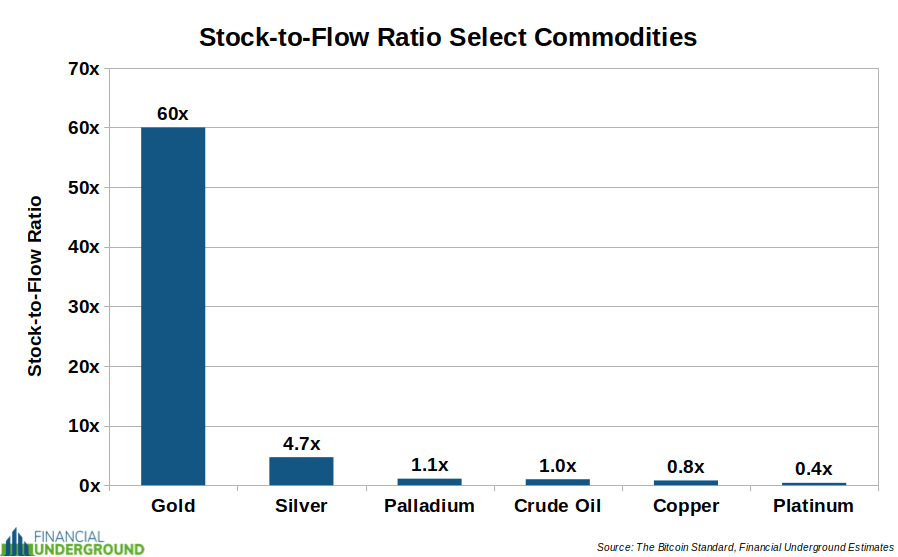
The stock-to-flow (S2F) ratio measures an asset’s hardness.

S2F Ratio = Stock / Flow

The “stock” part refers to the amount of something available, like current stockpiles. It’s the supply already mined. It’s available right away.

The “flow” part refers to the new supply added from production and other sources each year.

A high S2F ratio means that annual supply growth is small relative to the existing supply, which indicates a hard asset resistant to debasement.

A low S2F ratio indicates the opposite. A low S2F ratio means new annual production can easily influence the overall supply—and prices. That’s not desirable for something to function as a store of value.

In the chart below, we can see the hardness of various physical commodities.

No other physical commodity comes close to gold’s hardness or resistance to debasement.

Monetary commodities such as gold and silver have higher S2F ratios. On the other hand, industrial commodities have low S2F ratios, typically around 1x.

With an S2F ratio of 60x, it would take about 60 years of the current production rate to equal the existing gold supply.

Another way to think of it is to look at the inverse of the SF ratio, which is the annual production rate relative to existing stockpiles. So, for example, gold’s yearly production is about a trivial 1.7% of its existing stockpiles.

Two things can explain gold’s uniquely high S2F ratio.

First, gold is indestructible.

Gold doesn’t decay or corrode. That means that most gold people produced even thousands of years ago is still around today and contributing to current stockpiles.

Second, gold has a history of thousands of years of production, unlike other metals.

These two factors make gold’s existing stockpiles so large relative to new production. That means nobody can arbitrarily increase the gold supply, which helps make it a neutral store of value. It’s what gives gold unique and unmatched monetary properties among other metals.

It’s important to clarify that hardness is not the same as scarcity. They are related concepts but not the same thing.

For example, platinum and palladium are scarcer than gold but not hard assets. Current production is high relative to existing stockpiles.

Unlike gold, stockpiles of platinum and palladium have not built up over thousands of years. It’s the primary reason why new supply can easily rock the market.

Because of their low S2F ratios, platinum (0.4x) and palladium (1.1x) are even less suitable as money than silver. Their low S2F ratios indicate they are primarily industrial metals, corresponding to how people use them today. Almost nobody uses platinum and palladium as money.

Here’s the main point.

Hardness is the most important characteristic of a good money. All other monetary characteristics are meaningless if the money is easy for someone to produce.

That’s why the history of money is the history of the hardest asset winning and why gold has always reigned supreme.

But now gold has a serious competitor…

Bitcoin’s S2F ratio today is about 57x, slightly below gold’s.

According to its fixed protocol, we know precisely how Bitcoin’s supply will grow in the future.

A key feature is that the new supply gets cut in half every four years, which causes Bitcoin’s hardness to double every four years.

The process where Bitcoin’s new supply is cut in half every four years is known as the “halving”—or what I like to call “quantitative hardening.”

Here’s another way to think of it.

In 2023, the gold market must absorb roughly 117 million troy ounces of new supply.

In 2024 we can expect that the gold market must absorb slightly more, say 119 million troy ounces of new supply.

In subsequent years we can expect the amount of new supply the gold market must absorb to increase gradually.

Bitcoin has the opposite dynamic. The amount of new supply the market must absorb is constantly shrinking.

In 2023, the Bitcoin market must adsorb roughly 328,500 Bitcoin of new supply.

After the halving in May 2024, the Bitcoin market must adsorb roughly an additional 164,250 Bitcoin of new supply each year until the halving in 2028.

After the halving in 2028, the Bitcoin market must adsorb roughly an additional 82,128 Bitcoin of new supply each year until the halving in 2032.

This process of new supply decreases will continue until the year 2140, when the last Bitcoin will be created. That’s when the total Bitcoin supply will reach 21 million. Today it’s about 19.5 million, meaning the vast majority—about 93%—of the total Bitcoin supply has already been created.

That means only 1.5 million more Bitcoin will be created over the next 117 years at a decreasing rate.

In other words, Bitcoin’s supply will only grow about 7% in the next 117 years. By reference, the US money supply has increased by around 35% since March 2020.

Historically, halvings and their massive supply shocks have catalyzed eye-popping Bitcoin bull markets where Bitcoin has skyrocketed 10x (or more).

The next time Bitcoin’s supply growth will be cut in half will be in May 2024—less than eight months from now.

But this coming halving will be very different…

That’s because Bitcoin’s hardness, as measured by the S2F ratio, will be twice that of gold’s when that happens.

That’s how Bitcoin will soon become the hardest money the world has ever known—in less than eight months. And it will keep getting harder as its S2F ratio approaches infinity.

For thousands of years, gold has always been mankind’s hardest money. That is all set to change in a matter of months, and most people have no idea.

I think now is the time to get positioned for this unique moment in monetary history.

Absolute Scarcity

Bitcoin has another unique scarcity attribute. It isn’t just scarce. It is absolutely scarce.

For example, imagine the price of copper going 5x or 10x.

You can be sure that would spur increased production, eventually expanding the copper supply. Of course, the same is true of any other commodity.

That’s why there is a famous saying in mining: “the cure for high prices is high prices.”

The dynamic of higher prices incentivizing more production and ultimately more supply, bringing prices down, exists with every physical commodity. However, gold is the most resistant to this process.

That supply response is why most commodity prices tend to revert around the cost of production over time.

This dynamic is even more profound with money.

When an asset obtains monetary properties, the natural reaction is for people to make more of it—a lot more of it.

This known as the easy money trap.

However, Bitcoin totally defies it because its supply is perfectly inflexible. It’s the only commodity where higher prices cannot induce more supply.

In other words, Bitcoin is the first—and only—monetary asset with a supply entirely unaffected by increased demand.

That is an astonishing and game-changing characteristic.

Here’s the bottom line. Gold and other commodities are scarce, but only Bitcoin is absolutely scarce.

That means the only way Bitcoin can respond to an increase in demand is for the price to go up. Unlike every other commodity, increasing the supply in response to increased demand is not an option.

The market cap for Bitcoin today is around $528 billion.

The market cap for all the mined gold in the world, which took thousands of years to accumulate, is about $12.3 trillion.

That means Bitcoin has a market cap roughly equal to 4.2% of gold’s, even though it is about to surpass—double—gold’s hardness.

Assuming gold stays flat and Bitcoin goes up about 23x, it would have a market cap roughly equal to gold. At that point, a single Bitcoin would be worth over $620,000.

I think that’s a real possibility in the years ahead, though it could happen much sooner as the fiat currency scam continues to collapse at an accelerating rate.

If that sounds outrageous, consider this…

Ten years ago, the Bitcoin price was around $100. Today, it’s roughly 271x that.

Bitcoin has made numerous breathtaking moves to the upside in the past. I think it can do it again, especially as corporations, institutional investors, and even nation states start buying Bitcoin for the first time and as Bitcoin surpasses gold and becomes the hardest money mankind has ever known. Of course, it’s important to remember that past performance does not indicate future results for any investment.

That’s why I’ve just released an urgent PDF report revealing three crucial Bitcoin techniques to ensure you avoid the most common—sometimes fatal—mistakes. Check it out as soon as possible because it could soon be too late to take action. Click here to get it now.

Tyler Durden
Wed, 10/04/2023 – 19:00

FBI Creates ‘MAGA’ Extremist Category, Targets Trump Supporters Ahead Of 2024 Election

0
FBI Creates ‘MAGA’ Extremist Category, Targets Trump Supporters Ahead Of 2024 Election

The Biden FBI has ‘quietly created a new category of extremists that it seeks to track and counter: Donald Trump’s army of MAGA followers’ ahead of the 2024 election, according to prolific (and well connected) anti-war journalist and political commentator, William Arkin, who has previously reported on the FBI’s efforts to “Fight MAGA Terrorism.”

In a Wednesday Newsweek article, Arkin reveals that the vast majority of FBI investigations into “anti-government” activities are of Trump supporters.

“The FBI is in an almost impossible position,” a current FBI official told Arkin, who added that the agency’s stated intent is stopping a repeat of January 6th type incidents (which was riddled with feds), while balancing the Constitutional right of Americans to protest the government “Especially at a time when the White House is facing Congressional Republican opposition claiming that the Biden administration has ‘weaponized’ the Bureau against the right wing, it has to tread very carefully,” the official continued.

Newsweek spoke to over a dozen current or former government officials who specialize in terrorism in a three-month investigation to understand the current domestic-security landscape and to evaluate what President Joe Biden‘s administration is doing about what it calls domestic terrorism. Most requested anonymity because they were not authorized to talk publicly, were reluctant to stray into partisan politics or feared the repercussions of speaking frankly.

Newsweek has also reviewed secret FBI and Department of Homeland Security data that track incidents, threats, investigations and cases to try to build a better picture. While experts agree that the current partisan environment is charged and uniquely dangerous (with the threat not only of violence but, in the most extreme scenarios, possibly civil war), many also question whether “terrorism” is the most effective way to describe the problem, or that the methods of counterterrorism developed over the past decade in response to Al-Qaeda and other Islamist groups constitute the most fruitful way to craft domestic solutions.

We would note that an FBI whistleblower in March claimed that the agency pressured him to inflate domestic terrorism figures against conservatives, and that the agency created a specific threat tag for pro-lifers “THREATSCOTUS2022” following the leaked Supreme Court opinion on abortion (and not a threat tag for the violent leftists who threatened SCOTUS justices?).

The FBI told Newsweek in a statement that: “The threat posed by domestic violent extremists is persistent, evolving, and deadly. The FBI’s goal is to detect and stop terrorist attacks, and our focus is on potential criminal violations, violence and threats of violence. Anti-government or anti-authority violent extremism is one category of domestic terrorism, as well as one of the FBI’s top threat priorities,” adding “We are committed to protecting the safety and constitutional rights of all Americans and will never open an investigation based solely on First Amendment protected activity, including a person’s political beliefs or affiliations.”

According to the FBI’s data leaked to Arkin, the number of domestic extremism cases has dropped since Jan 6, but that “Sociopolitical developments—such as narratives of fraud in the recent general election, the emboldening impact of the violent breach of the U.S. Capitol, conditions related to the COVID-19 pandemic, and conspiracy theories promoting violence—will almost certainly spur some domestic terrorists to try to engage in violence.”

So – while the threat that the FBI has encouraged agents to inflate may have fallen, they’re on the lookout!

The agency has even created a new subcategory of threats, “AGAAVE-Other,” to denote those who are a threat but don’t fit into its anarchist, militia or Sovereign Citizen categories.

Introduced without any announcement, and reported here for the first time, the new classification is officially defined as “domestic violent extremists who cite anti-government or anti-authority motivations for violence or criminal activity not otherwise defined, such as individuals motivated by a desire to commit violence against those with a real or perceived association with a specific political party or faction of a specific political party.” -Newsweek

Trump or MAGA aren’t directly menti0oned in the official description of AGAAVE-Other, however “government insiders acknowledge that it applies to political violence ascribed to the former president’s supporters.

“What other name could we use?” said one FBI officer, who added: “Obviously if Democratic Party supporters resort to violence, it [AGAAVE-Other] would apply to them as well. It doesn’t matter that there is a low likelihood of that. So yes, in practical terms, it refers to MAGA, though the carefully constructed language is wholly nonpartisan.”

Sure anonymous FBI guy… there’s a ‘low likelihood’ that Democrats (the party which the FBI’s top brass belong to) aren’t causing political violence. Did someone get into Hunter’s crack stash?

A parked limousine burns during a demonstration after the inauguration of President Donald Trump, Friday, Jan. 20, 2017, in Washington.

More:

3 cops, pepper spray used in arrest of Sen. Tim Kaine’s son near Trump rally at Capitol

 “100% Antifa” Portland Shooting Suspect Brought Loaded Gun To July Riot

 “We Know Where You Sleep At Night”: Antifa Mob Whose Founder Loves Assassination Targets Tucker Carlson At Home

As The Federalist perfectly notes;

Despite widespread, leftist-led and encouraged riots during the 2020 summer of rage, FBI data says that spikes in domestic violent extremism and domestic terrorism investigations in 2020 and 2021 “show clearly that the main targets of the investigations and cases open were of Trump supporters,” not the people who wreaked billions of dollars of damage on American cities.

Similarly, “assessments,” a shadowy tool used by the FBI to spy on Americans who have political or ideological associations deemed unfavorable by the agency, “more than doubled from 2019 to 2021.”

A drastic rise in politicized probes of Trump voters follows an avalanche of rhetoric touted by President Joe Biden, his White House, Democrats in Congress, Attorney General Merrick Garland, FBI Director Christopher Wray, and other officials who have named the “domestic extremism” often pinned on Republican voters as the nation’s biggest threat.

The increase also serves as a continuation of the Biden regime’s persecution of its number one political opponent and his popular brand of wrongthink ahead of the 2024 presidential election.

Totally ‘not weaponized.’ 

Tyler Durden
Wed, 10/04/2023 – 18:40

Big Tech’s Armageddon

0
Big Tech’s Armageddon

Authored by Betsy McCaughey via The Epoch Times,

Never before in U.S. history have Americans been less free to see and say what they want. The blame goes mostly to the social media giants such as Facebook, YouTube, and Google that censor political views they don’t like.

But the tech giants’ day of reckoning is near. Justice Clarence Thomas is taking them on.

Phone companies such as AT&T or Sprint can’t shut down your account because of your political views. American Airlines can’t refuse to sell you a ticket because you’ve questioned climate change or COVID lockdowns. The law forbids it.

That same ban against political discrimination should apply to social media platforms. Justice Thomas has argued against Big Tech censorship since at least 2021, saying these companies should have to serve all customers, just like phone companies, utilities, and public accommodations.

On Sept. 29, the U.S. Supreme Court announced it will rule on state laws enacted by Florida and Texas that prohibit tech giants from canceling users based on their political views. Expect Justice Thomas to lead a majority of the justices to conclude that internet censorship is inconsistent with democracy and must be stopped.

A high court ruling against censorship will deal a powerful blow against Big Tech tyranny. Not a day too soon. Hallelujah.

Right now, social media platforms freely censor, taking down posts and deplatforming users whose views they don’t like—even a former president of the United States—and burying information so it’s impossible to find with a Google search.

Big Tech censorship impacts far more people than when colleges silence dissent or even when workplaces and schools indoctrinate.

Texas’s anti-censorship law is designed to protect the public against this loss of freedom. The law still allows the removal of items that are pornographic, threaten violence, or promote the sexual exploitation of children—what’s truly harmful.

To defend Texas’s law, the state’s attorney general, Ken Paxton, specifically cited Justice Thomas’s argument.

The law was upheld by the 5th Circuit Court of Appeals, deciding that corporations don’t have a “right to muzzle speech.”

But a similar Florida law was struck down by the 11th Circuit, arguing that Big Tech platforms have a First Amendment right to pick and choose views like a newspaper does.

Now, the Supreme Court is poised to resolve those conflicting outcomes. The court will decide who is protected by the First Amendment—the tech companies that claim they’re like newspapers, or the millions of social media users.

The smart money is on Justice Thomas persuading a majority of the justices that democracy requires an uncensored internet.

In a 2021 concurring opinion, Justice Thomas suggested a role for Congress to provide a legislative fix, including changing Section 230 of the Communications Decency Act. But Congress is unlikely to act, as long as Democrats control either house.

Most Democrats in Congress are rooting for more censorship. They’ve become the anti-free speech party. Sen. Chris Coons (D-Del.) told tech executives during a 2020 Senate hearing that he wants them to censor “climate denialism.” Sen. Richard Blumenthal (D-Conn.) urged them to do more “content modification” and eliminate “disinformation” in future elections.

When Mr. Blumenthal says “content modification,” it’s a euphemism for silencing the opposition—in short, rigging elections.

“Disinformation.” Don’t be fooled by that word. Justice Oliver Wendell Holmes explained that the way to test the truth of any statement is to see if it survives in the marketplace of ideas. Truth will prevail.

Lousy ideas, falsehoods, and loser politicians such as President Joe Biden need censorship to survive.

At the Supreme Court, Biden’s Department of Justice is siding with Big Tech against the public’s right to free expression.

That’s no surprise. President Biden likely owes his 2020 election to Big Tech’s rush to squash the New York Post’s Hunter Biden laptop reporting.

Since taking office, Joe Biden has erected a vast censorship operation, with the White House, FBI, Centers for Disease Control and Prevention, and other government agencies colluding with Big Tech to limit what you can see and say. Bravo that Elon Musk’s company X, formerly Twitter, refuses.

The next move belongs to the Supreme Court, which will hear oral arguments and rule early in 2024.

Count on Justice Thomas’s anti-censorship views to prevail. Americans will be freer as a result.

Thank you, Justice Thomas.

Tyler Durden
Wed, 10/04/2023 – 18:20

Gold Held Up Extremely Well In September Against Rising Real Rates

0
Gold Held Up Extremely Well In September Against Rising Real Rates

By Jan Nieuwenhijs of Gainesville Coins

Despite the gold price declining for several months, its performance is extremely strong considering sharply rising real interest rates. To measure gold’s performance against real rates (TIPS yield) I’m introducing the “Gold Price–TIPS Model Tracker” to improve our understanding of how the gold price is set and its future potential.

Introduction

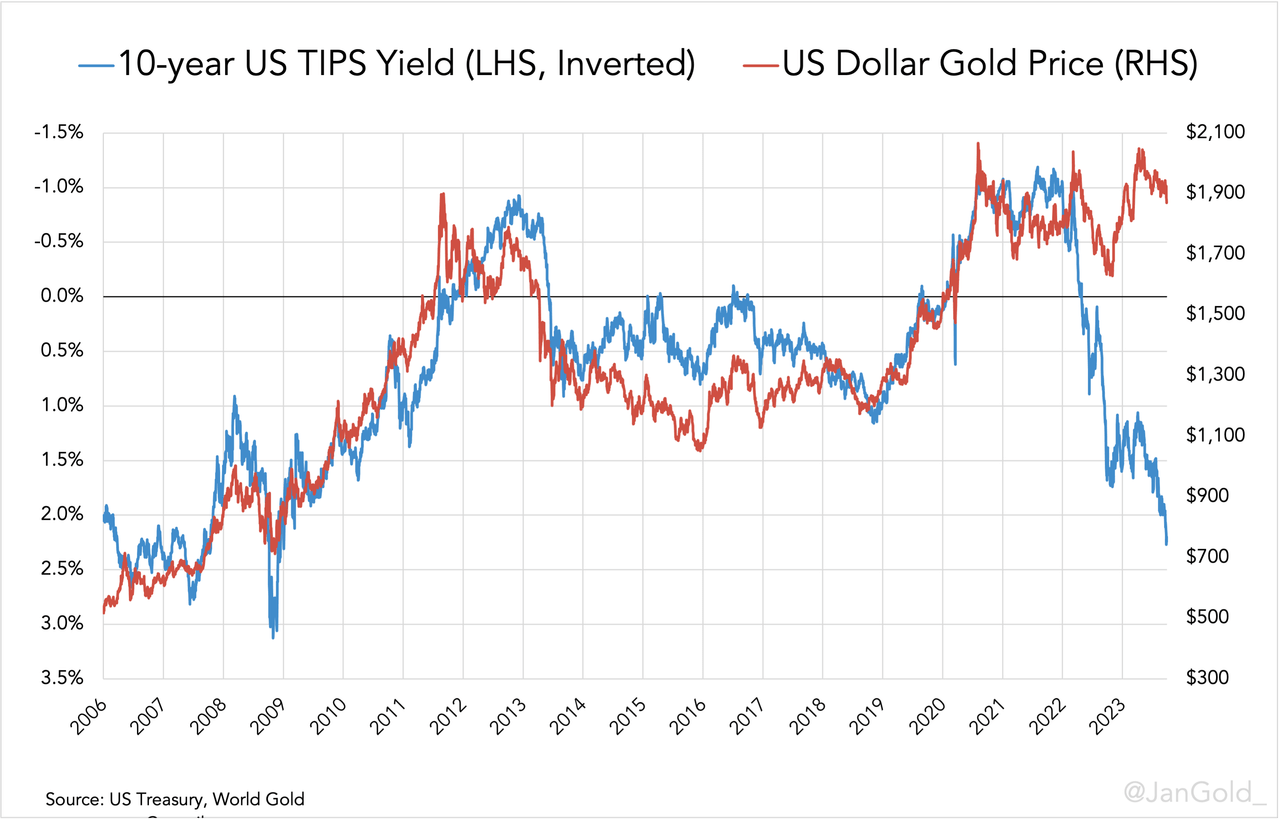
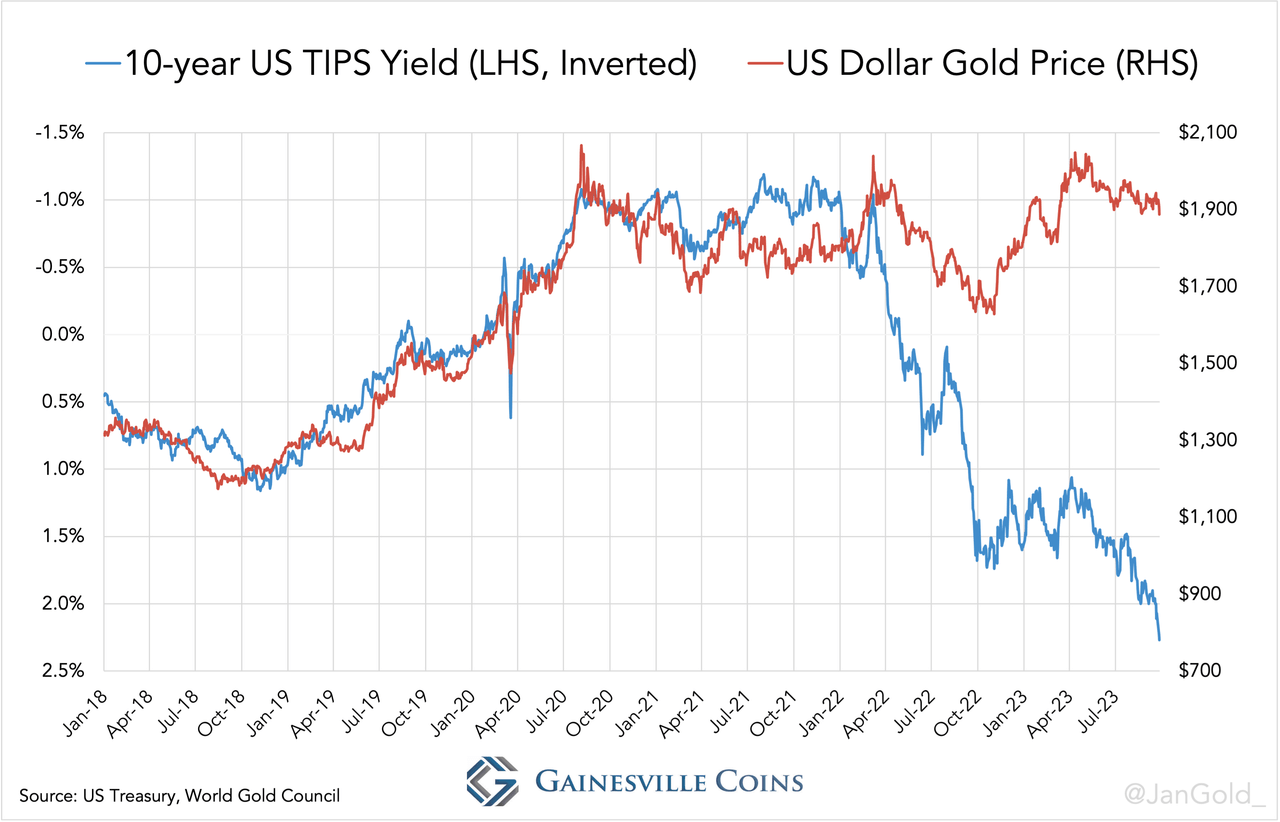
As we have discussed repeatedly on these pages, the gold price has been set by Western institutional money for nearly a century, and from 2006 through February 2022 there was a tight inverse correlation between the price of gold and the yield of 10-year Treasury Inflation Protected Securities (TIPS), which reflect real interest rates.

Then, early 2022, things started to change.

The Gold Market in Motion

At the outset of the Ukraine war early 2022, when the West froze Russia’s dollar assets, the gold price started drifting higher than the price previously suggested by the “TIPS model.” Dollar assets had become more risky—next to the fact the TIPS model wasn’t sustainable to begin with—pulling investors into gold.

Initially I was cautious to say the change in how gold was priced was permanent. After a few months, though, in November 2022, I wrote gold was in a transition phase. War, inflation, and insolvency risk had changed the market’s perception of how gold should be priced. To the upside, that is.

In July I reiterated gold was showing momentous strength against real rates.

Additionally, in August I demonstrated that the West was losing control over the price of gold. For ninety years the gold price was set in wholesale markets such as London and Switzerland, but the East started to overrule the West in late 2022 and early 2023.

The Gold Price–TIPS Model Tracker

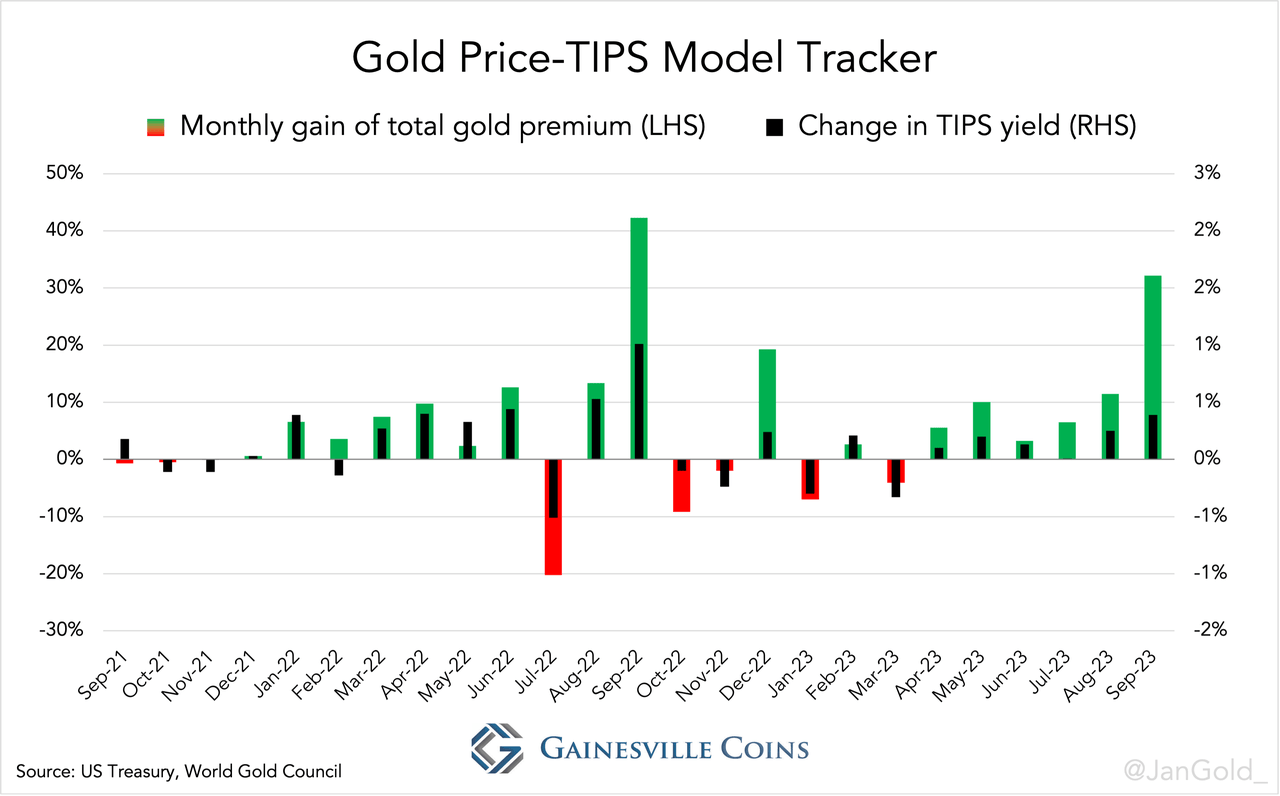
To get a better grip on gold’s fate going forward I created the Gold Price–TIPS Model Tracker that shows gold’s strength or weakness versus the TIPS model on a monthly basis. In the future we will add the Tracker to other parameters, like global cross-border trade statistics, to get a clearer view on what’s happening in the market and where it’s heading.

The purpose of the Tracker is to learn how the gold price is performing against the price suggested by the TIPS model that ruled from 2006 until 2021. By measuring the difference between the actual gold price and the price suggested by the TIPS model, we can compute the total premium and the monthly increase or decrease of the total premium. The Tracker does not tell us if the price went up or down, but if it went up or down versus the TIPS model.

According to my calculations, the suggested gold price by the TIPS model at the end of September 2023 was $779 per troy ounce, while in reality an ounce changed hands for $1,871 (see chart 2). Consequently, by September the total premium had reached 140%.

Last month alone, in September, the Tracker indicates a whopping 32% was added to the total premium, a sign of extraordinary strength of the gold price relative to real rates.

Conclusion

All of the above seems bullish for gold, as the trend of the total premium is up. Apparently, the market has altered its view and prices gold higher against real rates. A few observations to consider, though.

The Tracker doesn’t have a very long track record, and the total premium started accelerating at the start of a hiking cycle by the Federal Reserve in early 2022. Ever since, the total premium has been growing while real rates have been rising. Currently, we don’t know for sure how the Tracker will perform when rates fall.

What we do know is that in the few months since February 2022 that rates went down, the Tracker showed weakness—the total premium declined (see chart 4 below). If rates fall there is less gold buying strength as some investors still apply the old model.

Up until now the Tracker has only shown strength when rates rise and the West sells gold that the East, mainly the Chinese central bank, is buying aggressively.

It’s hard to say how the Tracker reacts when rates truly reverse. For sure the gold price will rise from a higher base on falling rates, but it’s hard to say at this stage if the total premium will decline or increase in such a scenario.

Tyler Durden
Wed, 10/04/2023 – 17:40

Hunter Biden To Mount 2nd Amendment Defense Against Gun Charges

0
Hunter Biden To Mount 2nd Amendment Defense Against Gun Charges

Hunter Biden on Tuesday entered a plea of not guilty to federal charges related to lying on the form he submitted when he bought a pistol in 2018 and to being an illegal drug user in possession of a firearm.

In a heartwarming twist for those who treasure the human right of armed self-defense, lawyers for the son of the country’s gun-grabber-in-chief declared they will argue that the principal charge violates the Second Amendment. 

Their argument will exploit the Supreme Court’s pivotal 2022 ruling in New York State Rifle & Pistol Association Inc. v Bruen.

The court not only struck down a New York law restricting the carry of concealed firearms, but, in doing so, also laid down a standard by which all gun laws are to be judged. Specifically, the court said that, to justify any gun law, “the government must demonstrate that the regulation is consistent with this Nation’s historical tradition of firearm regulation.” 

A photo from Hunter Biden’s “laptop from Hell” shows him demonstrating poor trigger discipline with a different pistol than the one at the center of his federal case 

We like Hunter’s chances of beating the rap and pinning a defeat on his father and other gun control advocates. He wouldn’t be the first to successfully use Bruen against the federal Gun Control Act’s prohibition against illegal drug users possessing firearms.  

In February, a U.S. district judge in Oklahoma found the law flunked the Bruen test in a case where a man was arrested after police found a loaded revolver and marijuana in his vehicle. Judge Patrick Wyrick wrote that the government cannot claim that the defendant’s “mere status as a user of marijuana justifies stripping him of his fundamental right to possess a firearm.”

Referencing Bruen’s requirements, Wyrick added that “the United States has not identified a single historical law that is ‘distinctly similar'” to the one barring marijuana users from possessing firearms.” The Biden case will be heard by a judge in Delaware, who may reach a different conclusion. 

A .38 Special Colt Cobra revolver, similar to the one purchased by Hunter Biden (via Colt)

In 2018, Hunter Biden bought a .38 Special Colt Cobra revolver at a time when he was a crack cocaine fiend. Federal prosecutors have charged him with falsifying a federal firearms application — by asserting that he was not a user of illegal drugs — lying to to a licensed gun dealer and possessing an illegally-procured firearm.  

In July, Hunter Biden was poised to take a plea agreement in the case. That agreement imploded after the judge expressed concern that it could grant Hunter excessive immunity from additional charges unrelated to the gun charges or his tax problems. “I don’t really understand the scope,” said Judge Maryellen Noreika.  

With the plea agreement on the rocks, we can look forward to a trial next year in which Hunter Biden’s lawyers attack a long-standing gun law while his father’s presidential campaign extolls such laws and calls for more of them. Hopefully a new plea agreement doesn’t emerge. 

Hunter Biden’s pending fight for firearms liberty isn’t only awkward for the White House and gun control organizations, but also for the unprincipled National Rifle Association, which is frequently more bent on catering to conservative donors than upholding gun rights. Asked for comment on the Biden case, the NRA told Politico “criminals ought to pay the price for their crimes,” then ignored a follow-up question about the constitutionality of the law barring drug users from gun possession. 

The Firearms Policy Coalition, on the other hand, has used the case to underscore its relentless and highly effective work against gun laws: 

In September, the Biden administration announced the launch of the first White House Office of Gun Violence Prevention, to be led by Vice President Kamala Harris. While the White House was free to launch the office at any time, Harris strangely attributed it “the activism, the organizing, the marching, the voting of all of you leaders.” To her credit, she did somehow manage to control her cackle impulses.   


Tyler Durden
Wed, 10/04/2023 – 17:20

GM Taps JPMorgan For $6 Billion Credit Line As Strikes Hit Third Week

0
GM Taps JPMorgan For $6 Billion Credit Line As Strikes Hit Third Week

The strike by the United Auto Workers union against Detroit’s three major automakers (Ford Motor Co., General Motors Co., and Chrysler-parent Stellantis) entered its third week on Monday, with seemingly little progress made. Notably, General Motors has activated a multi-billion dollar credit line from JPMorgan Chase Bank, an indication the automaker might be bracing for the strike to continue for an extended period. 

GM issued a filing on Wednesday morning detailing how it “entered into a new 364-Day Revolving Credit Agreement with JPMorgan Chase Bank, NA” for “an available borrowing capacity of $6 billion” that matures on Oct. 1, 2024. 

Bloomberg pointed out GM’s total automotive liquidity was around $39 billion, and there is no fear of the automaker depleting funds anytime soon. However, it noted, “But the new credit line is a sign GM may be buckling in for a prolonged work stoppage by the United Auto Workers.” 

Last Friday, UAW boss Shawn Fain launched another wave of strikes against Ford and GM for failing to agree on a new four-year labor deal. Fain said Stellantis avoided additional strikes because of meaningful progress on a new labor contract.

On Tuesday, Ford and GM announced another 500 workers were laid off at four Midwestern plants because of the worsening impacts of labor actions. The Wall Street Journal said, “With the layoffs disclosed by GM and Ford on Monday, more than 6,000 factory workers are off the job because of spillover effects from the strike. That figure includes several suppliers who have cited furloughs directly tied to the walkouts.” 

As of mid-week, about 25,000 out of 146,000 UAW workers are on strike at plants operated by the three automakers. UAW Boss Fain will likely provide another update on Friday. 

A recent report by Morgan Stanley’s auto strategist, Adam Jonas, said automakers stand to lose $250 million in lost profit each day of the strike:

“The value of N. American light production of the D3 (F, GM, STLA collectively) is approximately $750mm per day (approx. 15k units per day). Applying slightly more than a 30% decremental (yes, mix is that high) implies around $250mm of lost profit per day (assuming 100% of production impacted).”

If GM pulling the credit line with JPM is any indication of what’s to come, it appears the automaker is preparing for strikes to extend. 

Tyler Durden
Wed, 10/04/2023 – 15:25

RNC Threatens To Ban Ramaswamy, Christie From Next GOP Debate For ‘Unsanctioned Dialogue’

0
RNC Threatens To Ban Ramaswamy, Christie From Next GOP Debate For ‘Unsanctioned Dialogue’

Authored by Naveen Athrappully via The Epoch Times,

GOP presidential hopefuls—Vivek Ramaswamy and Chris Christie—have been threatened with expulsion from future debates by the Republican National Committee (RNC) after the duo decided to hold a discussion on Fox News.

“The GOP needs more actual argument on substance, not fake one-liners. I agreed to spar with @ChrisChristie tomorrow for a full hour on Fox at 6pm,” Mr. Ramaswamy said in an Oct. 3 post on X, with Mr. Christie confirming the meeting.

However, it was later revealed that the RNC threatened to ban them from the next GOP primary debate if they took part in the discussion.

“It is very disappointing that we were threatened with exclusion from the Miami debate and future debates for trying to have a more complete dialogue with each other and the voters,” Mr. Christie said in an Oct. 3 X post.

“Every campaign was offered that opportunity by Fox News and they have now been effectively banned by the RNC,” he said.

“I am always up for those discussions—it’s a shame the RNC and @realDonaldTrump aren’t.”

Mr. Christie stressed the need for the GOP to have “more debates and in-depth discussion, not less.”

He praised Mr. Ramaswamy for his willingness to engage with him.

“When the RNC stops conversations between candidates from happening, that is real cause for concern,” Mr. Christie stated.

In response to the RNC threat, Mr. Ramaswamy said that while the second GOP debate was a “disgrace,” he is beginning to believe that it was done “by design.”

“This is what a brokered and rigged nomination process looks like,” he wrote in an X post.

“Instead of allowing open dialogue and the airing of ideas to give primary voters a real choice, the Establishment would rather cut backroom deals and offer up phony debates, including candidates with no viable path and questions that no voter would ever ask,” Mr. Ramaswamy said.

“It’s pathetic that the Super PAC puppet masters have now ‘summoned’ their favored Establishment puppets to broker a path to defeating Trump instead of allowing GOP voters to make a real choice on their own by hearing directly from candidates. Republican voters deserve better than this broken process.”

In order to take part in the GOP presidential debates, potential candidates must sign a pledge agreeing that they will not take part in any debate during the campaign that is not sanctioned by the RNC.

A spokesperson from RNC criticized Mr. Christie and Mr. Ramaswamy for their outbursts against the committee.

“The same candidates complaining about the rules governing RNC debates all signed a pledge and agreed months ago to not participate in unsanctioned debates,” the spokesperson said in a statement.

“The RNC will continue to enact a fair, transparent debate process and we will not give in to pressure from individuals seeking to change the rules to favor their candidacy.”

Ramaswamy Versus Christie

There have been two GOP presidential debates so far. Both Mr. Christie and Mr. Ramaswamy have been at loggerheads on several issues, with their conflict evident during the events.

In the first GOP debate, Mr. Christie compared Mr. Ramaswamy to ChatGPT. When Mr. Ramaswamy called former President Donald Trump the “best president of the 21st century,” Mr. Christie responded by saying “you make me laugh.”

In the second debate, the two disagreed on the Ukraine issue. Mr. Christie batted for continued American support for Ukraine while Mr. Ramaswamy called for ending the support and seeking a peace deal with Russia.

President Trump did not take part in either of the debates. The third debate is scheduled for Nov. 8 in Miami and will have stricter participation requirements.

In the first debate, a candidate needed to secure 1 percent support in three national polls or 1 percent in two national polls and two early state polls. For the third debate, this has been upped to 4 percent in two national polls or 4 percent in one national poll and 4 percent in two early state polls.

Iowa, New Hampshire, Nevada, and South Carolina are classified as “early states.” While the first debate required participants to secure 40,000 unique donors, the third one raised the bar to at least 70,000 unique donors.

During the second GOP debate, multiple candidates called out President Trump for not taking part in the discussions. President Trump said he skipped the events owing to the large lead he enjoys in polls.

The Trump campaign has called on the RNC to “immediately cancel” the Nov. 8 debate in Miami as well as all future debates so as to “refocus its manpower and money on preventing Democrats’ efforts to steal the 2024 election,” campaign senior advisors Susie Wiles and Chris LaCivita said in a statement.

“Anything less, along with other reasons not to cancel, are an admission to the grassroots that their concerns about voter integrity are not taken seriously and national Republicans are more concerned about helping Joe Biden than ensuring a safe and secure election.”

In a Sept. 29 X post, InteractivePolls said that President Trump posted the “biggest lead yet” over his rival Florida Governor Ron DeSantis following the second debate.

While President Trump received 63 percent support, Mr. DeSantis was far back with only 12 percent support, followed by Mr. Ramaswamy with 7 percent, former Vice President Mike Pence with 5 percent, former U.S. Ambassador to the U.N. Nikki Haley with 5 percent, and Mr. Christie with 3 percent.

Tyler Durden
Wed, 10/04/2023 – 15:05

Biden’s “Secret Money Machine”: New Book Delves Into Hunter’s China-Linked Partnership With University Of Delaware

0
Biden’s “Secret Money Machine”: New Book Delves Into Hunter’s China-Linked Partnership With University Of Delaware

While the general public is well aware of allegations against the Biden family involving international influence-peddling schemes, bribes from Ukrainian oligarchs, and attempts to write off prostitutes on tax returns, major facets of the first family’s sphere of wealth and influence have gone largely unreported.

According to a wide-ranging new book by Breitbart Editor-in-Chief Alex Marlow, who collaborated with researchers from investigative journalist Peter Schweizer’s multiple books (perhaps most notably, “Clinton Cash“), the Biden family has a second, virtually unknown institute. And much like the widely-reported Penn-Biden Center at the University of Pennsylvania, the Biden Institute at the University of Delaware – established on the same day as UPenn’s, resulted in a flood of Chinese money into said institutions.

“The key players at the University of Delaware’s Biden Institute were either Biden family members, people with deep ties to China, or both,” writes Marlow.

Modeled after the Clinton Global Initiative, the University of Delaware Biden Institute was referred to as Hunter’s “baby” by his aunt and former Joe Biden campaign manager, Valerie Owens (who now chairs the Biden Institute).

On December 11, 2018, the University of Delaware announced that it was naming its public policy school after Vice President Biden. Emails show that this move was orchestrated by members of UD’s Biden Institute. It was on the day of the announcement that Hunter Biden received a text message from his aunt and former Joe Biden campaign manager, Valerie Owens (who chairs the Biden Institute), crediting him for the deepening partnership with between the Biden family and the university: “Bravo Hunter—UD was your baby and you made sure I was part of it.

The University of Delaware Biden Institute was Hunter’s “baby.” And this was the type of baby the family most certainly was not going to ignore. -Breitbart

What’s more, the UD Biden Institute became home to at least 12 future Biden administration appointees, including soon-to-be senior Biden advisor Mike Donilon and Surgeon General Vivek Murthy, while UD President Dennis Assanis would be named to Biden’s Council of Advisors on Science and Technology.

But perhaps most intriguing is that soon after forging its partnership with the Bidens, the University of Delaware (UD) disclosed receiving funds from China.

Assanis notably “has deep and long-standing ties to China,” according to Marlow, who reports that in addition to serving as the founding director of the US-China Clean Energy Research Center and Clean Vehicle Consortium (CERC-CVC) since 2003, Assanis has served as both a guest professor and an advisory professor at Shanghai Jiao Tong University (SJTU) – which has a partnership with the Chinese military, and which has been identified as the source of cyberattacks on American companies.

President Joe Biden delivers the commencement address at the University of Delaware graduation ceremony in Newark, Delaware, on May 28, 2022. (MANDEL NGAN/AFP via Getty Images)

And then the Chinese funds start flowing…

As Marlow reports;

The University of Delaware had never disclosed receiving funds from China until April 2018, when it accepted over $3.2 million for a contract with an unnamed Chinese entity. This came two months after the Penn Biden Center opened its DC office. Then, in December 2018, UD received $1.9 million from an unnamed Chinese entity. In 2019, UD received another $625,000 from China. In 2020, UD initiated three contracts with the Chinese entities and received over $1 million in funds. In sum, UD has received over $6.7 million from unnamed Chinese sources, including a substantial amount from the Chinese government.

All these funds started flowing to UD after the Biden Institute was announced and increased immediately after the launch of the Penn Biden Center.

In addition to the obvious pay-for-play implications, the influx of Chinese money is even more alarming in light of UD’s thirty-seven international partnerships with Chinese universities – including several which are involved in the development of Chinese military technology.

Concern over UD’s relationship with Chinese entities is such a concern that on Feb. 8, 2022, Sen. Marco Rubio (R-FL) wrote Assanis to ask him to terminate the institution’s academic and research partnership with Xiamen University, an active component of the CCP military-industrial complex, and which allegedly conspired with Huawei to perform corporate espionage against a US semiconductor start-up. According to the report, UD has worked with at least four other universities linked to CCP defense laboratories.

The Clinton model…

For those who don’t know, the Bidens are prolific plagiarists. Their institutes at the University of Delaware / UPenn appear to be no exception.

In April 2016, Hunter emailed (and met with) talent agent Craig Gering of the Creative Artists Agency about then-VP Joe Biden’s future after he leaves office. According to “confidential notes” taken by Gering, the two discussed the possibility of Hunter serving in the Penn Biden Center’s DC office – which Gering described as having a “Focus on foreign policy. In addition to the institute at U of Penn, the school has an existing office in DC that will be expanded to house a DC office for VP Biden (and Mike, Hunter and Steve?). Operates like The Clinton Global Initiative without the money raise.”

“Yes,” Hunter replied. “in theory that’s the way I would like to see it shake out— BUT please keep this very confidential between us because nothing has been set in stone and there’s still a lot of sensitivity around all of this both internally and externally. He hasn’t made any decisions and this could all be changed overnight.”

And while there may not have been a ‘money raise’ like CGI, it’s now been established that both universities saw an influx of Chinese money following the establishment of the Biden entities.

As Marlow notes;

CGI claims it convenes “established and emerging global leaders to create and implement solutions to the world’s most pressing challenges,” according to its website, but functionally, it was an easy way for the Clintons to reap donor funds to leverage relationships with celebrities and major corporations to boost their profiles all the while promoting their own cultural and political agenda items. Donations to CGI dried up when it came under media scrutiny from Schweizer and others for soliciting millions of dollars from foreign governments and businesses—the same governments and businesses that received favorable treatment from the Obama administration during Hillary’s tenure as secretary of state. -Breitbart

Most recently, CGI rebooted in 2022 (after shutting down in 2016 when Hillary Clinton lost the election and donor funds dried up), and has now set its sights on Ukraine.

The big question then becomes – what did Gering mean by “Wealth Creation” in his email to Hunter, listed after his summaries of the various Biden family matters the two discussed? Was it in relation to the UD/UPenn centers? Was it Hunter’s ‘art’ career that’s been the focus of speculation over pay-for-play?

Whatever it was, the Biden family launched several entities as the Clinton charities began to fold up shop, one of which Hunter’s CAA pal described as operating “like the Clinton Global Initiative.”

*  *  *

Check out Marlow’s new book, Breaking Biden: Exposing the Hidden Forces and Secret Money Machine Behind Joe Biden, His Family, and His Administration.

Tyler Durden
Wed, 10/04/2023 – 13:25

Battered Utilities May Morph From Bond Proxy To Inflation Hedge

0
Battered Utilities May Morph From Bond Proxy To Inflation Hedge

Authored by Simon White, Bloomberg macro strategist,

The US utilities sector has taken a hammering as bond prices fall, with the sector seeing its tenth largest weekly underperformance versus the S&P on Monday, going back over 30 years.

But utilities (and other low-duration sectors such as energy) may soon see their traditional “bond-proxy” role reversed, and begin to outperform when the market perceives that inflation risks have not gone way.

Sectors such as utilities that have strong and steady cash flows and high ROICs have bond-like qualities that have earned them the moniker of bond proxies. Unfortunately that cuts both ways as when bonds fall, utilities tend to underperform, as has happened recently.

That being said, the correlation between utilities and bonds has been secularly falling over the past three decades, and today sits at an unremarkable ~20% (based on correlation of daily changes). Recent moves may be more of a knee-jerk reaction than a balanced assessment of whether holding low-duration sectors such as utilities and energy is actually a good idea when inflation is elevated.

Utilities, along with energy and health, were the best performing sectors in 2021 to 2022.

Low-duration sectors prospered at a time when inflation was reaching multi-decade peaks and the Federal Reserve had not yet started raising rates.

But utilities et al began to lag as the Fed tightened, and higher-duration sectors such as tech and semis began to lead the rally, later fuelled by OpenAI’s release of ChatGPT 3.5.

The market was essentially giving the Fed a vote of confidence that it would durably bring inflation down, and owning stocks with a high duration was a safe long-term bet. We can see this clearly in the chart below, showing that the sectors with the highest duration saw the greatest outperformance this year, and vice versa.

Inflation is likely to re-accelerate, and at that point utilities and similar sectors may be sought after once more for their low-duration characteristics.

But for now, they are likely to struggle as long as bond prices are falling, and they continue to erroneously be perceived as simply bond proxies.

Tyler Durden
Wed, 10/04/2023 – 13:05