94.8 F
Chicago
Thursday, September 3, 2026
Home Blog Page 3319

Thousands Of ‘Bogus’ Jet-Engine Parts Sold To Global Airline Fleets: Report

0
Thousands Of ‘Bogus’ Jet-Engine Parts Sold To Global Airline Fleets: Report

Lawyers representing jet engine maker CFM International and its co-owners General Electric and Safran said “documentary evidence” shows thousands of jet engine parts with falsified documents were sold to global aircraft fleets by London-based AOG Technics, according to Bloomberg

On Wednesday, in a London court, lawyers for CFM requested the judge force AOG to hand over documentation of “every product sale” since the company was set up in 2015. 

Since late August, AOG has been at the center of a counterfeit components controversy, supplying third-party repair shops with “unapproved parts” for CFM56 engines used on older Airbus SE A320s and Boeing Co. 737s. 

“The apparent large-scale falsification of documentation uncovered by the claimants gives rise to the risk that evidence relevant to these proceedings will be destroyed by the defendants,” lawyers for CFM wrote in a court filing. 

CFM lawyers noted there is documentary evidence that thousands of these jet engine parts were flooded into global aircraft fleets over the years.

Matthew Reeve, a CFM lawyer, said 86 “falsified release certificates” have been found, and the number of engines suspected to have parts with falsified documents has jumped to 96. 

“Potentially, that means between 48 and 96 aircraft being taken out of service whilst airlines arrange for the parts to be removed,” Reeve added.

According to aviation news website Simple Flying, “United Airlines, Southwest Airlines, and Virgin Airlines have all discovered faulty engine parts supplied by fraudulent manufacturer AOG Technics.” 

CFM warned the court: “The apparent large-scale falsification of documentation uncovered by the claimants gives rise to the risk that evidence relevant to these proceedings will be destroyed by the defendants.” 

Although the findings affect only a tiny portion of the 23,000 CFM56 engines in operation, the presence of unauthorized parts in such a tightly regulated aviation industry raises significant alarms.

Tyler Durden
Thu, 09/21/2023 – 15:00

Broadcom Recovers Losses After Google States “No Change” In Chip Relationship 

0
Broadcom Recovers Losses After Google States “No Change” In Chip Relationship 

Update (1234ET):

Broadcom’s stock recovers some of its losses after Google announced that it foresees “no change” in its relationship with the chip manufacturer. This statement comes in response to an earlier report by The Information, which claimed that Google aimed to cut ties with Broadcom for AI chips by 2027 and produce them in-house.

Broadcom shares have recovered most losses on the session. 

*   *   * 

Broadcom Inc. shares fell in premarket trading in New York following a report from The Information that detailed Alphabet-owned Google has “extensively discussed dropping Broadcom as a supplier of artificial intelligence chips as early as 2027.”

According to a person with direct knowledge of the discussions, Google execs plan to develop in-house AI chips, known as tensor processing units, that could save the tech giant billions of dollars annually as it invests heavily in AI data centers.

“Google executives set a goal earlier this year to ditch Broadcom following a monthslong standoff between the companies over the price Broadcom was charging for the TPU [Tensor Processing Unit] chips,” the person said. 

Breaking free from Broadcom will allow Google to profit handsomely off these chips and, most importantly, directly control its AI costs. The Information noted Broadcom generates a 70% profit margin on TPU and network chips. 

In July, Google CFO Ruth Porat told analysts on an earnings call the company spent $13.2 billion on capital expenditures, including data centers, in the first half of 2023. She expects AI investments in data centers to continue surging through 2024 while the company continues to develop AI products, such as its Bard chatbot and AI services for Google Cloud customers. 

The Information explained Google’s AI investment spending spree has made Broadcom billions and transformed it into one of the world’s largest AI chip sellers after Nvidia by revenue over the last year. 

In May, JPMorgan analyst Harlan Sur projected that Google would spend $3 billion on TPUs from Broadcom this year, citing “recent order acceleration.” SemiAnalysis forecasts that this amount is expected to climb to $7 billion next year and even higher in the years after, driven by AI demand. 

Broadcom shares slid as much as 6% in premarket trading. 

Google’s move to explore in-house AI chips echoes Amazon and Microsoft’s strategy of creating specialized in-house chips for AI. 

The only question is if all this investment is worth it, as JPMorgan’s top tech trader Ron Adler made a striking admission last week, detailing how the AI bubble just popped (full note available to pro subs). 

Tyler Durden
Thu, 09/21/2023 – 12:34

McCarthy Fails For 2nd Time To Advance Bill Funding Defense Department As Ukraine Sows Division

0
McCarthy Fails For 2nd Time To Advance Bill Funding Defense Department As Ukraine Sows Division

Update(12:20ET): With Zelensky in Capitol Hill, and with Ukraine aid hanging in the balance, Kevin McCarthy has failed for a second time to advance a bill funding the Defense Department, which keeps the government on a path toward a shutdown on Oct. 1. Politico has reported secret, urgent cross-aisle talks as follows: “Small groups of centrist Democrats are holding secret talks with several of McCarthy’s close GOP allies about a last-ditch deal to fund the government, according to more than a half-dozen people familiar with the discussions.”

  • The House voted 212-216 against moving the funding bill to a final vote: Axios

AFP/Getty Images

A small group of conservative holdouts are harping on the key controversial issues of Ukraine and the US border:

Generally, the bipartisan group is focusing on two major ideas: a procedural maneuver to force a vote on a compromise spending plan — or somehow crafting a bill so popular that McCarthy can pass it and survive any challenge from the right. That bill would likely be a bipartisan short-term patch with some disaster money, Ukraine aid and small-scale border policies, according to multiple people briefed on the talks who spoke on condition of anonymity.

And more of today’s scrambling via Politico:

Two people familiar with those conversations pointed to New York Rep. Mike Lawler, who sits in one of the GOP’s toughest battleground seats, as especially vocal in private meetings about threats to sign a discharge petition.

Asked if he sees an increasing chance of centrists from both parties teaming up as the stalemate continues, Lawler said that “I would like to see the House Republican majority govern” by passing a short-term patch that can start further talks with the Senate.

“But until that happens,” he added, “we need to keep the government funded and operational. And my only comment to my colleagues is: If we want to govern, we need to do so expeditiously.”

The pushback from McCarthy on a possible discharge petition comes after he repeatedly failed to get his own members behind a GOP-only bill that would pair a stopgap funding patch with spending cuts and a Republican border bill. One Republican lawmaker involved in the talks acknowledged that the bipartisan maneuvering could help pressure conservatives to stop resisting any solution.

On the other hand, this lawmaker added, “If you are a nihilist and you want to burn the place down, you don’t care.”

On the prospect of $24 billion for Ukraine, some vocal Republicans have grown bolder in highlighting Ukraine’s problems, urging that America must first fix its own pressing crises at home. McCarthy is also trying to appease the hardliners by appealing to Biden.

MCCARTHY: BIDEN NEEDS TO ADDRESS BORDER BEFORE FUNDING UKRAINE

And a similar sentiment from Hawley, aimed at the GOP Russia hawks…

Meanwhile…

* * *

Ukrainian President Volodoymr Zelensky is in Washington Thursday, where he’s expected at the White House to meet with President Joe Biden. Importantly, he’s also soon due to meet with House Speaker Kevin McCarthy, at a moment some GOP dissenters are holding up Pentagon funding and the potential for more Ukraine aid.

McCarthy vowed Tuesday to confront and intensely question Zelensky when the two meet. He posed going into the meeting, “Is Zelensky elected to Congress? Is he our president? I don’t think I have to commit anything and I think I have questions for him.”

Via CNN

“Where’s the accountability on the money we’ve already spent? What is the plan for victory? I think that’s what the American public wants to know,” McCarthy added.

Central here is the Biden and Democrat-backed effort to include an additional $24 billion in Ukraine funding. Zelensky will seek to rally Congressional Republicans behind it. 

At the start of the week Senate Majority Leader Chuck Schumer said, “And with no Ukraine funding, the proposal is an insult to Ukraine and a gift to Putin. I cannot think of a worse welcome for Zelensky who visits us this week than this House proposal, which ignores Ukraine entirely.”

Toward this end of unquestionably pushing through the billions in US taxpayer dollars for Ukraine, John Fetterman says he’s willing to leave the hoodie at home and finally wear a suit on the Senate floor if “jagoffs” in the House decide to “fully support Ukraine”

The Washington Post and others are meanwhile reporting on a new letter that GOP Congressional leaders sent the White House, which vows to reject the $24 billion in Ukraine aid

In a letter viewed by The Wall Street Journal, the group says it is rejecting President Biden’s request for an additional $24 billion in security, economic and humanitarian aid. The lawmakers said they have concerns about the more than $100 billion in funding Congress already has approved, complained that the administration supports an “open-ended commitment” to Ukraine and criticized what they say is an unclear strategy. It is signed by 23 House members and six senators, led by Sen. J.D. Vance (R., Ohio) and Rep. Chip Roy (R., Texas), and addressed to Shalanda Young, the director of the White House Office of Management and Budget.

Among the other signatories is Sen. Rand Paul, who has said, “It’s as if no one has noticed that we have no extra money to send to Ukraine.” He further pointed out that “Our deficit this year will exceed $1.5 trillion. Borrowing money from China to send it to Ukraine makes no sense.”

And Sen. Vance on the proposed spending bill said: “Now you hear people talking about the long haul. Well, is the long haul a year, $100 billion, in 10 years, a trillion dollars?”

Among the key questions that the GOP letter to the White House poses are: “How is the counteroffensive going? Are the Ukrainians any closer to victory than they were 6 months ago? What is our strategy, and what is the president’s exit plan?” the Republicans wrote. “It would be an absurd abdication of congressional responsibility to grant this request without knowing the answers to these questions.”

So a fight is brewing with the hawks, of which there are plenty in the GOP. But overall, the timing couldn’t be worse for Zelensky, for the many reasons we covered here.

Tyler Durden
Thu, 09/21/2023 – 12:20

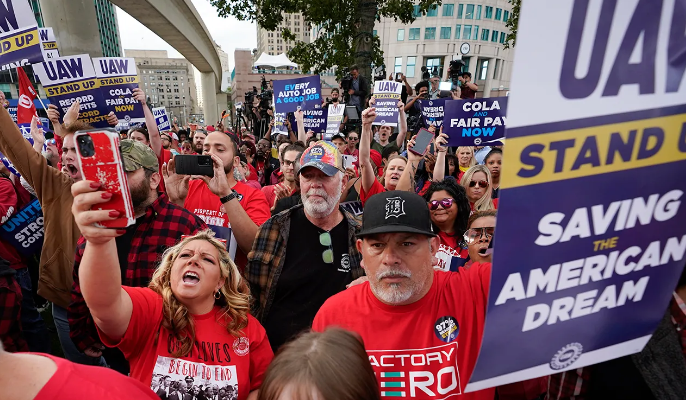
The Permanent Strikes Continue: GM Joins Ford, Stellantis With Mass Layoffs As Result Of UAW Action

0
The Permanent Strikes Continue: GM Joins Ford, Stellantis With Mass Layoffs As Result Of UAW Action

As the ill effects of the ongoing UAW strike continue, we will continue to document them. 

First, we wrote about Stellantis looking to close 18 facilities as part of contract negotiations.

Then, we wrote about Ford laying off 600 employees due to the strike.

On Thursday morning we reported that Stellantis was laying off 68 employees and furloughing another 300 as a result of the strike.

Now, the “permanent strike” numbers are moving even higher: GM has announced it is laying of 2,000 workers as a result of the strike. 

On Wednesday, General Motors took the step of suspending operations at a manufacturing facility located in Kansas, resulting in the layoff of nearly all of its workforce, comprising approximately 2,000 individuals, according to NBC

In its official statement, the automaker clarified that the reason behind this decision stems from the absence of available tasks for the majority of employees stationed at the Fairfax assembly plant. This scarcity of work is a direct consequence of a strike initiated by workers at another GM facility this past Friday.

Furthermore, the company conveyed that it is unable to offer supplemental unemployment benefits in this instance, citing the unique circumstances surrounding the situation.

These layoffs come in the wake of the United Auto Workers union initiating a strike on Friday, following the expiration of its previous contract with Stellantis, Ford, and GM. This strike saw approximately 12,700 workers walk off the job.

As the first week of the strike nears its end, these layoffs serve as a clear indication that both sides involved are becoming increasingly steadfast in their positions.

On Tuesday, the head of United Auto Workers, Shawn Fain, declared he will unleash additional strikes across manufacturing facilities of General Motors Co., Ford Motor Co., and Stellantis NV on Friday. This move is contingent on the three automakers not properly addressing the union’s demands for a new four-year labor contract for its 146,000 members. 

“Either the Big Three get down to business and work with us to make progress in negotiations, or more locals will be called on to stand up and go out on strike,” UAW boss Fain said in a YouTube video published Monday evening. 

Fain said, “We’re not waiting around, and we’re not messing around. So, noon on Friday, Sept. 22 is a new deadline.” 

Keep “holding out”, UAW – pretty soon there will be no auto industry left and you can claim victory over the evil executives who work there. Except, no one will have jobs, of course…

Tyler Durden
Thu, 09/21/2023 – 12:05

Fed’s Dots Imply Highest Treasury Yields Since 2000

0
Fed’s Dots Imply Highest Treasury Yields Since 2000

By Ven Ram, Bloomberg Markets Live reporter and cross-asset strategist

The resounding selloff in front-end Treasuries we have seen in this cycle isn’t done yet, with yields likely to reach the highest in more than two decades should the Federal Reserve follow the path of its latest dot plot.

Treasury two-year yields will reach 5.43%, a level not seen since December 2000, if the Fed were to raise rates once more in this cycle and the US labor market continues to stay resilient through the spring of 2024.

The Fed’s stance — together with rising real rates — also spells bearishness for 10-year bonds, with that yield likely to hit 4.55%. That implies a deeper curve inversion, with the differential between the two maturities set to reach -88 basis points from -75 basis points now.

The outlook marks an update to my previous view, where I had suggested the two-year yield might reach 5.22%.

The bearish revision stems from the Fed’s dot plot for September, which was pretty hawkish. The central bank — which had penciled in rate cuts of 100 basis points through 2024 when it met in June — took 50 basis points off the table, concurrent with a lower unemployment rate and faster inflation.

“Don’t fight the Fed” may be one of the oldest commandments in the financial markets, but traders have continually ignored what the central bank has been saying through much of this cycle, on conviction that a recession will force policy makers to pivot.

Almost a year ago, traders were similarly skeptical of the dot plot and reckoned that the Fed, whose benchmark rate then was 3.25%, would stop at 4.50%. And yet we are at 5.50% and counting.

Investors have been positioned for a recession since the middle of 2022 as the yield curve inverted. But so far, positioning for rate cuts has failed to pay off. As happened before the dotcom bubble and the financial crisis, the yield-curve inversion may continue for long before we actually see an economic contraction.

Meanwhile, real rates have also been surging, with the 10-year yield having shot up above 2% — a far cry from levels of zero that prevailed at the start of the pandemic. That may be due to a structural shift in the markets, and so long as that trend continues, 10-year nominal yields will stay aloft.

What could go wrong with the outlook for Treasuries? The resilience in the labor market may snap abruptly, which would cause the markets to pivot and the Fed to abandon its dot plot.

Two-year Treasuries have had an eminently forgettable 2023 so far, and indications suggest that there is no turnaround in sight

Tyler Durden
Thu, 09/21/2023 – 11:45

Adidas CEO Extends Olive Branch To Kanye West? 

0
Adidas CEO Extends Olive Branch To Kanye West? 

On a recent Norges Bank Investment Management podcast, Adidas CEO Bjorn Gulden appeared to extend an olive branch to “Ye,” formerly Kanye West. Gulden, who previously served as Puma’s CEO, took the helm at Adidas on Jan. 1. His leadership followed the termination of the German sportswear brand’s relationship with Ye last fall over anti-Semitic comments. 

Gulden told the “In Good Company” podcast that Ye’s comments, such as “Death con 3 On JEWISH PEOPLE,” were “Very unfortunate, because I don’t think he meant what he said, and I don’t think he’s a bad person. It just came across that way.” 

The episode, titled “Bjørn Gulden CEO of Adidas: shoes, leadership, and fast decisions,” was aired on Sept. 13, and the CEO praised Ye as “one of the most creative people in the world … both in music and what I will call street culture”.

The ongoing fallout of Ye’s “Yeezy” line with Adidas has left the sportswear company with an estimated $1.3 billion of inventory. In recent months, the company has been able to sell down its inventory while allocating those proceeds to “organizations working to combat discrimination and hate, including racism and antisemitism.” 

Gulden said Ye’s partnership was before his time. He continued, Adidas “lost that business, one of the most successful collaborations in the history. Very sad. But when you work with third parties it can happen, and it’s part of the game.” 

Morningstar analyst David Swartz estimated that Adidas earned $2 billion annually on Yeezy shoes. The sportswear maker has suffered without Ye, slashing its dividend by 80% earlier this year as shares have been more than halved in the last few years. 


Gulden’s comments have infuriated liberals, some of whom have called for a “Boycott Adidas.” 

What we find interesting is X user “Donda Times,” which appears to be an account that follows “everything about Ye,” stated, “Bjørn has been CEO since the separation between Adidas and Yeezy, he notably follows Ye fan pages on Instagram.” 

Maybe Adidas is having second thoughts about firing Ye… 


Tyler Durden
Thu, 09/21/2023 – 11:25

Hollywood Writers Strike Could Be Over As Soon As Today

0
Hollywood Writers Strike Could Be Over As Soon As Today

Hollywood writers and producers are close to an agreement to end the Writers Guild of America strike following face-to-face meetings on Wednesday, CNBC reports, citing people close to the negotiations.

If discussions hold together, the two sides hope to finalize a deal Thursday. That said, if the tentative deal unravels, the strike could last through the end of the year – keeping more than 11,000 film and TV writers in limbo. The writers and producers have argued that t hey aren’t being paid enough relative to the income generated during the streaming era.

In a Wednesday night joint statement, the WGA and the Alliance of Motion Picture and Television Producers released a joint statement to announce that the two groups had met at the bargaining table, and would meet again on Thursday.

The writers strike has been in effect for more than 100 days, with actors joining in July, causing Hollywood production to grind to a halt. Several high profile shows such as Netflix’s “Stranger Things,” as well as various Marvel/Disney productions (and of course, Dune: Part Two featuring Christopher Walken) are among the high-profile projects to hit the pause button.

Earlier in the week, the writers’ union said it would resume negotiations with the studios.

This appears to be the closest the two sides have come to a resolution since the more than 11,000 film and TV writers went on strike beginning May 2. They have argued their compensation doesn’t match the revenue that’s been generated during the streaming era. -CNBC

Beyond higher pay, the WGA has been pushing for new rules which would require studios to guarantee employment for specific lengths of time. The writers are also seeking to be compensated throughout the creative process (preproduction, production and postproduction). Currently writers are often required to provide revisions or new material without pay.

Tyler Durden
Thu, 09/21/2023 – 07:45

BOE Surprises Markets By Keeping Rates Unchanged For The First Time In Two Years

0
BOE Surprises Markets By Keeping Rates Unchanged For The First Time In Two Years

One day after the Fed kept rates unchanged in what multiple banks said cemented the end of the Fed’s hiking cycle, and just a few hours after the Swiss franc tumbled when the SNB unexpectedly also kept rates unchanged at 1.75% against expectations of a rate hike to 2%, moments ago the Bank of England made it three for three, when it surprised markets by leaving the key policy rate unchanged at 5.25% after nearly two years of hikes, disappointing economists who were as looking for a 25bps rate hike to 5.50%, after a razor-edge vote that put an end to the most aggressive cycle of interest-rate rises in more than three decades amid falling inflation and mounting fears of recession.

Following weaker than expected inflation data in August, five members of the Monetary Policy Committee voted to leave rates unchanged and four wanted to raise them to 5.5%. Governor Andrew Bailey, who had the casting vote, chose to hold.

The decision to keep rates unchanged was the first pause after 14 consecutive rate rises since the tightening cycle started in December 2021.

The Committee indicated that it now wanted to leave interest rates at 5.25% for some time to ensure that it still brought inflation back down to the BoE’s 2 per cent target.

The BOE also stepped up the pace of quantitative tightening as it seeks to reduce the size of its balance sheet as quickly as possible to provide headroom for potential future financial stability interventions. Over the 12 months form October, it plans to reduce its gilt portfolio by £100 billion to £658 billion. Last year, it unwound £80 billion. That implies £50 billion of active gilt sales on top of the £50 billion of maturing assets. The gilt portfolio peaked in 2022 at £875 billion.

Here are the highlights from the BoE statement, courtesy of Newsquawk:

VOTE:

  • 4 voted for hike (exp. 8). 5 voted for unchanged (exp. 1)
  • Bailey, Broadbent. Dhingra, Ramsden, Pill voted to hold rates
  • Cunliffe, Greene. Haskel, Mann voted to raise rates

MOTIVATION:

  • Majority cited loosening labor market, August CPI data, falling business sentiment
  • Minority saw persistent inflation pressure, and August fall in CPI likely to be short-lived
  • One member sees growing risks falling output will require sharper rate cuts

INFLATION:

  • Inflation has fallen a lot in recent months, will continue to do so
  • Policy will be sufficiently restrictive to get inflation back to target
  • Inflation seen falling significantly in near-term despite rising oil prices
  • Services inflation set to remain elevated

ECONOMY:

  • Says GDP growth is now seen at 0.1% in 03 (prev. saw *0.4%)
  • Underlying growth in H2 likely weakened by more than forecast

GUIDANCE:

  • Says further tightening would be needed if evidence of more persistent inflation pressures is seen.

BALANCE SHEET:

  • The BOE would reduce the stock of gilts by GBP 100BN in 12-months starting October
  • Will continue to sell Gilts evenly across short-, medium-, and long-buckets
  • In Q4, will hold four Gilt auctions in each sector, at planned GBP 670mln size

According to UBS, the opening section of the Bank of England’s Monetary Policy Statement is basically the same as Chief Economist, Huw Pill’s South Africa speech he gave last month. Unchanged rates at 5.25% with inflation back to target by Q2 2025, then it is expected to fall below target as economic slack grows. In other words, the BoE has pivoted from its prior fears of an economy that’s much too tight to one that’s going to end up looking loose.

The BoE has almost dismissed the recent strong wage data, saying average weekly earnings growth was reported as 8.1% in July, but that was “difficult to reconcile with other indicators of pay growth. Most of these have tended to be more stable at rates of growth that are elevated but not quite as high as the average weekly earnings (AWE) series.”

Normally central banks place a very great weight on wage growth as a forward indicator, but in the UK’s case, the bank is mistrustful of the data it’s being supplied. It’s not often that a central bank will openly and publicly question the accuracy of official data, but in the case of wages, the BoE has done so. It noted that official data for average weekly earnings pointed to wage growth around 8%, but its own agents surveys were around 6 to 6.5%. Indeed it also said the official ONS data couldn’t be reconciled with what the HMRC payrolls data showed. Wage growth remains elevated, but the BoE is willing to accept survey evidence that it is slowing.

As Bloomberg notes, the decision will come as a relief to millions of households facing the threat of even higher mortgage costs and indebted businesses. It will also be welcomed by Prime Minister Rishi Sunak, who has promised to ease the inflation crisis and improve living standards ahead of an election expected next year.

The BOE, however, signaled that policy was only on pause and it would respond if inflation, which remains more than three times above the 2% target, doesn’t fall as expected. The MPC forecasts consumer-price inflation to hit the target in the second quarter of 2025.

“Inflation has fallen a lot in recent months and we think it will continue to do so,” Bailey said in a written statement. “That’s welcome news. But there is no room for complacency. We need to be sure inflation returns to normal and we will continue to take the decisions necessary to do just that.”

Ahead of the decision, Chancellor of the Exchequer Jeremy Hunt told Bailey in a letter than the MPC has his full support. “The tough action taken by the MPC to squeeze inflation out of the system is working,” Hunt said, adding that the government needed to show fiscal discipline to bolster the bank’s actions.

Repeating its former guidance, the committee said rates would be “sufficiently restrictive for sufficiently long” and “further tightening in monetary policy would be required if there were evidence of more persistent pressures.” Like other major central banks, the implication is that rates would remain high for longer.

“Today’s decision to keep the base rate unchanged will be welcomed by companies already struggling to meet interest obligations,” said Nils Kuhlwein, partner at management consulting firm Kearney. “Successive base rate jumps over recent years have turned the screw on these companies.”

The MPC has been laying the ground to pause policy as the UK’s economic outlook darkened in recent weeks. Bailey said this month that rates were “much nearer now to the top of the cycle” and Deputy Governor Jon Cunliffe said the bank was close to a turning point.

The MPC expressed concerns that the economy was stalling after output in July contracted 0.5%, a sharper fall than expected, and official figures showed unemployment rising and job vacancies dropping. The committee also noted that business activity data is contracting, while raising questions about official measures that show wage growth is accelerating.

The BOE cut its GDP growth forecast for the third quarter to 0.1% from 0.4%, the minutes showed. Underlying growth in the second half of 2023 is also likely to be weaker than the 0.25% expected in August.

The bank said past rate hikes were having an impact: “There are increasing signs of some impact of tighter monetary policy on the labor market and on momentum in the real economy more general.”

As the economy slows, inflation was expected to drop below 2% “in the medium term.” In the short term, the bank expects a “significant” fall in inflation “despite the renewed upward pressure from oil prices” due to declining energy and goods inflation.

Higher rates have been punishing homeowners, who face a £15 billion repayment crunch, according to the Resolution Foundation, much of which has yet to come through. Several MPC members have been warning that policy lags mean the BOE was already at risk of overtightening.

Swati Dhingra, an external member has been voting to hold since December last year. She was joined by Bailey, Deputy Governors Ben Broadbent and Dave Ramsden and Chief Economist Huw Pill. Cunliffe and external members Megan Greene, Catherine Mann and Jonathan Haskel voted to raise rates by a quarter point to 5.5%.

Other central banks are signalling that cycle is over, too. The ECB raised rates to 4% last week and said “sufficient contributions” had been made to return inflation to target. The US Federal Reserve on Wednesday held rates in the 5.25%-5.5% range, but did suggest further increases were on the cards and ruled out any imminent rate cuts.

Markets were split before the vote, betting on a roughly 50% chance of a vote to hold, after a surprise fall in August inflation to 6.7% this week. Investors still expect one more quarter-point increase although Goldman Sachs and Nomura reckon rates have now peaked.

The pound extended losses to the lowest since March as traders trimmed bets on further interest-rate hikes.

The market is pricing in around 18 basis points of more tightening compared to a full quarter-point before the decision.


Tyler Durden
Thu, 09/21/2023 – 07:23

This Is The Worst Global Food Crisis In Modern History, And It Is About To Go To An Entirely New Level

0
This Is The Worst Global Food Crisis In Modern History, And It Is About To Go To An Entirely New Level

Authored by Michael Snyder via The Economic Collapse blog,

Hundreds of millions of people are desperately hungry all over the world, and by the time you are done reading this article more children will starve to death.  Earlier this year, CNN actually admitted that we are in the midst of “the worst food crisis in modern history”, but because the mainstream media rarely features images of the tremendous suffering on the other side of the globe most Americans don’t even know that it is happening.  Here in the western world, the primary way that the global food crisis is manifesting is through significantly higher prices at the grocery store.  Those higher prices are certainly painful, but we can deal with that.  But when you don’t have enough food to feed your family on a consistent basis, that really is a nightmare scenario.  According to the official UN website, 735 million people were in a “state of chronic hunger” last year…

By 2022, approximately 735 million people – or 9.2% of the world’s population – found themselves in a state of chronic hunger – a staggering rise compared to 2019. This data underscores the severity of the situation, revealing a growing crisis.

In addition, an estimated 2.4 billion people faced moderate to severe food insecurity in 2022. This classification signifies their lack of access to sufficient nourishment. This number escalated by an alarming 391 million people compared to 2019.

The persistent surge in hunger and food insecurity, fueled by a complex interplay of factors, demands immediate attention and coordinated global efforts to alleviate this critical humanitarian challenge.

We have never seen numbers like this before.

And the final numbers for 2023 will inevitably be even higher, because crops are failing all over the planet.

For example, this has been a catastrophic year for rice crops in India

Satish Kumar sits in front of his submerged rice paddy in India’s Haryana state, looking despairingly at his ruined crops.

“I’ve suffered a tremendous loss,” said the third generation farmer, who relies solely on growing the grain to feed his young family. “I will not be able to grow anything until November.”

The newly planted saplings have been underwater since July after torrential rain battered northern India, with landslides and flash floods sweeping through the region.

The government of India responded to this crisis by banning the export of non-basmati white rice, but this has created a massive problem for the dozens of countries that rely on rice exports from India

Last month, India, which is the world’s largest exporter of rice, announced a ban on exporting non-basmati white rice in a bid to calm rising prices at home and ensure food security. India then followed with more restrictions on its rice exports, including a 20% duty on exports of parboiled rice.

The move has triggered fears of global food inflation, hurt the livelihoods of some farmers and prompted several rice-dependent countries to seek urgent exemptions from the ban.

More than three billion people worldwide rely on rice as a staple food and India contributed to about 40% of global rice exports.

Please read that last sentence again.

Without rice exports from India, the number of people that starve in poor countries in Africa and the Middle East will soar.

Some impoverished nations are literally begging India to start exporting non-basmati white rice again, but so far the government of India is not budging.

So the price of rice has been surging all over the world, and supplies are getting tighter and tighter.

Let me ask you a question.

What would you do if your child was wasting away from malnutrition right in front of your eyes?

In Somalia, that is actually happening to half of all children under the age of five

In Somalia, families are currently facing a catastrophic food crisis. This is the result of a severe and prolonged drought and decades of conflict that have destroyed crop production and made it almost impossible for herders to find food for their animals.

Unfortunately, the most vulnerable are children, with 50% of children under five in the country experiencing acute malnutrition.

Here in the western world, our children are not starving.

So we should be thankful for that.

But the lines at our food banks are getting longer.  Here is an example from the state of Ohio

Kam McKenzie, SNAP outreach manager for the food bank, said the Liberty Street pantry is seeing 940 more families per month since the end of February, when COVID-era SNAP benefits were halted.

“So now we’re averaging maybe a little over 300 families a day coming into our Liberty Street pantry to shop for groceries,” said McKenzie.

Based on the amount of food given out by Freestore, she estimated the demand on the pantry is up 27% compared to June of 2022.

And we are experiencing problems with our crops too.

In the middle of the country, seemingly endless drought conditions have greatly affected corn crops this year…

Lack of rain has hit crops hard: In Missouri, for example, 40% of the state’s corn crop was classified as poor or very poor, according to the drought monitor. Iowa, the nation’s top corn producer, is in the midst of its worst drought in a decade with about 80% of the state in some measure of drought.

Prolonged drought has even reached the banks of Lake Superior: Parts of Wisconsin have the most severe drought designation for the first time since the 1999 inception of the U.S. Drought Monitor, said Dennis Todey, director of the U.S. Department of Agriculture’s Midwest Climate Hub.

“It’s the severity of the drought and the length of the drought that are causing some confounding issues right now,” he said.

Unfortunately, we are still only in the very early stages of this new global food crisis.

Multiple long-term trends will combine to make it impossible for us to feed everyone on the planet in the years ahead.

Our politicians know this, but they are being very quiet about our rapidly growing food crisis because they don’t want to alarm the general population.

But there will be no escape.  Hundreds of millions will not have enough food to eat tonight, and it won’t be too long before the number of people that are facing chronic hunger exceeds a billion.

Michael’s new book entitled “End Times” is now available in paperback and for the Kindle on Amazon.com, and you can check out his new Substack newsletter right here.

Tyler Durden
Thu, 09/21/2023 – 07:20

Broadcom Shares Slide On Report Google Plans To Abandon Chip Supplier 

0
Broadcom Shares Slide On Report Google Plans To Abandon Chip Supplier 

Broadcom Inc. shares fell in premarket trading in New York following a report from The Information that detailed Alphabet-owned Google has “extensively discussed dropping Broadcom as a supplier of artificial intelligence chips as early as 2027.”

According to a person with direct knowledge of the discussions, Google execs plan to develop in-house AI chips, known as tensor processing units, that could save the tech giant billions of dollars annually as it invests heavily in AI data centers.

“Google executives set a goal earlier this year to ditch Broadcom following a monthslong standoff between the companies over the price Broadcom was charging for the TPU [Tensor Processing Unit] chips,” the person said. 

Breaking free from Broadcom will allow Google to profit handsomely off these chips and, most importantly, directly control its AI costs. The Information noted Broadcom generates a 70% profit margin on TPU and network chips. 

In July, Google CFO Ruth Porat told analysts on an earnings call the company spent $13.2 billion on capital expenditures, including data centers, in the first half of 2023. She expects AI investments in data centers to continue surging through 2024 while the company continues to develop AI products, such as its Bard chatbot and AI services for Google Cloud customers. 

The Information explained Google’s AI investment spending spree has made Broadcom billions and transformed it into one of the world’s largest AI chip sellers after Nvidia by revenue over the last year. 

In May, JPMorgan analyst Harlan Sur projected that Google would spend $3 billion on TPUs from Broadcom this year, citing “recent order acceleration.” SemiAnalysis forecasts that this amount is expected to climb to $7 billion next year and even higher in the years after, driven by AI demand. 

Broadcom shares slid as much as 6% in premarket trading. 

Google’s move to explore in-house AI chips echoes Amazon and Microsoft’s strategy of creating specialized in-house chips for AI. 

The only question is if all this investment is worth it, as JPMorgan’s top tech trader Ron Adler made a striking admission last week, detailing how the AI bubble just popped (full note available to pro subs). 

Tyler Durden
Thu, 09/21/2023 – 06:55