85.8 F
Chicago
Wednesday, September 2, 2026
Home Blog Page 3328

How Far Are We From Revolution?

0
How Far Are We From Revolution?

Authored by Jim Quinn via The Burning Platform blog,

Our government, or the unelected billionaire globalists behind the curtain, are telling us the bad guys are Russia and China.

I do not consider them enemies. I consider them countries acting in a way that benefits them.

The U.S. is the global bully, intimidating and bribing countries to do their bidding.

Ukraine, the most corrupt country in the world, and the playground of the Biden Crime Family, has been utilized by Biden and his neo-con handlers, to try and bleed Russia so they can beat them in their next war. Instead, they have used the young men of Ukraine as cannon fodder, leaving that country with no future.

That’s what the U.S. global empire does. It destroys.

Franklin was right.

The government is telling us who the bad guy is, but the real bad guys are them.

We will not be allowing our youth to be used as cannon fodder in their next wars of choice.

These lunatic sociopaths are willing to initiate Armageddon to achieve their goals.

Before they can accomplish this destruction we will have to decide when revolution will be absolutely necessary.

That time will be within the next few years. The choice is yours.

Tyler Durden
Mon, 09/18/2023 – 18:40

Trump Leads Biden Nationally As RealClear Asks ‘What Happened To DeSantis?’

0
Trump Leads Biden Nationally As RealClear Asks ‘What Happened To DeSantis?’

Former President Donald Trump would claim victory over President Biden, according to a pair of recent polls from CBS News/YouGov and Harvard Harris (which no longer disclose how many Democrats were oversampled).

Illustration via Barron’s

When broken down by party identification (or lack thereof), 57% of independents chose Trump vs. Biden’s 42%, while just 34% of everyone polled thought Biden would be able to finish a second term if reelected.

Biden is well below Trump in terms of job approval at this point in their terms…

But Trump and Biden are tied for favorability, with the recent trend towards Trump…


44% think Biden wouldn’t be able to carry out an entire second term, while most voters say Trump would.

Registered voter respondents were also asked if they find Trump and Biden to be physically and mentally healthy enough to serve as president, finding that only 28 percent of voters think Biden is physically well enough, while most say the 45th president is. Just 16 percent of voters say only Biden is physically healthy enough to serve, while 44 percent say Trump is the only one who is healthy enough. Another 12 percent see them both as physically fit versus 28 percent who say neither are. -Breitbart

Trump’s lead over Biden increased in the Harvard-Harris poll, at 44% vs. 40%. Trump would lead Vice President Kamala Harris by 46% to 40%.

(Anyone else getting a ‘potentially sensitive content’ warning on the Trump electoral map?)

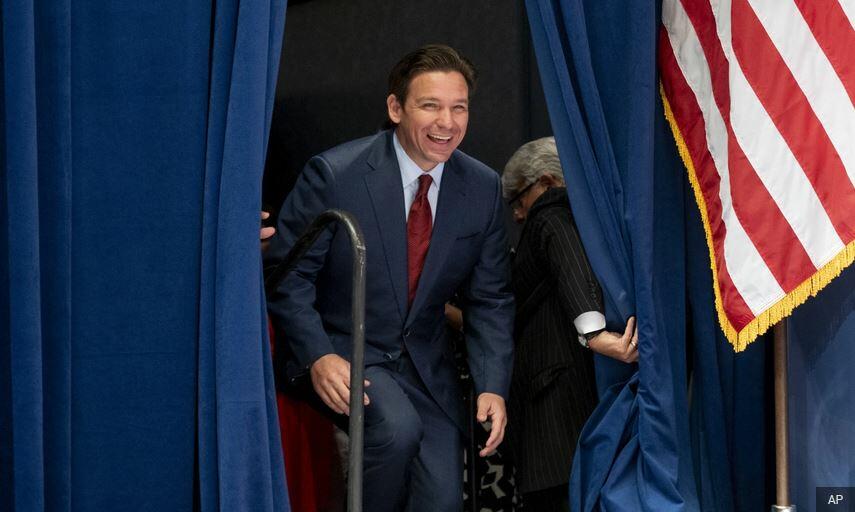
Ron who?

Meanwhile, RealClear Politics‘ Sean Terende asks: “What happened to the DeSantis campaign?”

DeSantis isn’t quite a penny stock, but he briefly fell behind Vivek Ramaswamy among bettors, and languishes with primary season voters at just 14.9% in the RealClearPolitics Average.

What went wrong? It’s important to acknowledge up front that it is still early. As late as October of 2007, Hillary Clinton held a 26-point lead over Barack Obama. At this point in 2007, John McCain was in fourth place, behind Rudy Giuliani, Mitt Romney, and Fred Thompson. For that matter, eventual second-place finisher Mike Huckabee was polling at just 3% nationally. Eventual winner John Kerry was in third place in Iowa.

But none of those contenders had been in first place previously. It seems that there is a difference between being an unknown to whom the public eventually warms, and being a known quantity that the public changes their mind about. Regardless, while the DeSantis campaign is likely not dead, it is clearly in a bit of a predicament. How did this happen? It seems that there are four factors:

He doesn’t know his own brand. After the 2022 elections, DeSantis’ “lane” in the GOP primary campaign seemed pretty clear: He’s Donald Trump, but able to get things done. Or, if you prefer, “Trump, but without the baggage.” DeSantis had many of the traits MAGA Republicans most liked about Trump. He was willing to battle the media. He didn’t apologize for his actions. In the parlance of the times, “He fights.”

DeSantis also notched up a series of high-profile wins, including taking on the college board over the content of the AP African American History curriculum, replacing the leadership of a famously liberal state school, and going to war with the Walt Disney Co. over its progressive practices. One could fairly say that the current backlash against “woke corporations” began in Florida.

That opened a pretty good line of attack against Trump. Yes, Trump was an important course correction for the Republican Party, whose leadership had become too concerned with currying favor in the D.C. “Swamp.” Yes, he showed that it was possible to fight on issues that the GOP establishment had written off as too toxic, and still win elections.

But, the argument went, Trump was ultimately ineffective. At the end of four years, there was no wall, much less a wall financed by Mexico. Obamacare wasn’t repealed, much less replaced. And it was hard to say with a straight face that Trump had really hired only the “best people,” after his cabinet was constantly reshuffled and moved around. Trump’s constant tweeting and punching back at political detractors, regardless of their station in the political pecking order, created a constant stream of mini-storm that distracted from his agenda.

In other words, DeSantis was well-positioned to argue that he’d take the lessons of Trump, but could deliver on the promises. It was a good strategic position as well, as it wouldn’t require him actually to attack the still-popular (within the Republican Party) Trump.

Instead, DeSantis seemingly opted to re-run Ted Cruz’s failed 2016 campaign. While he had initially defended Florida’s ban on abortions after the 15th week of pregnancy – a position that is broadly popular among the American public – DeSantis later pushed for and signed a six-week ban, which is much less popular. He attacked Trump for being too progressive on trans rights. He claimed Trump had tried to push through an “amnesty” bill on immigration.

The problem here is twofold. First, that approach was tried by Cruz and others in 2015 and 2016, and it failed spectacularly. There’s no reason to believe it would suddenly work in 2023 after Trump’s actual presidency.

This leads to the second problem: People either don’t believe it or don’t care. Few people consider Trump a hard-charging social conservative on gay rights or abortion, but this is a known quantity at this point (and whatever else you may say about his beliefs, Trump’s three justices provided the conservative margin of victory in Dobbs). No one is going to get to Trump’s right on immigration. Other issues, like Trump’s refusal to pursue entitlement reform and his profligate spending, are throwbacks to an earlier GOP that likely no longer exists.

DeSantis’ opponents aren’t giving up. In 2015 and 2016, one of the keys to Trump’s success was that the anti-Trump wing of the GOP was splintered among many candidates, all eager to try to get to the “final round” against him. Something similar seems to be happening in 2023. Nikki Haley, Mike Pence, Chris Christie and Tim Scott are all competent candidates with different appeals to different types of anti-Trump Republicans. Vivek Ramaswamy gives no indication he wants to leave the field anytime soon. This is potentially consequential in Iowa, where Trump is polling below 50% in the RealClearPolitics Average.

In short, while DeSantis had hoped – and many analysts expected – that this would morph into a two-person race, that situation has not materialized. Instead, what we have right now is a one-person race, and a second tier occupied by four or five other candidates. Moreover, none of those candidates really has any incentive to drop out right now, given DeSantis’ stumbles and the chance for someone to claim the momentum that was once his. In other words, Republicans find themselves in a similar dynamic to the one that prevailed in 2015 and 2016, with whatever anti-Trump momentum there is split among multiple candidates, none of whom has a clear incentive to leave the race.

He’s not up to the task. While DeSantis’ big win in Florida ought not be dismissed, we should also remind ourselves that the road to the presidency is paved with the bones of overhyped campaigns that wilted under the national spotlight. DeSantis has proved to be awkward on the national trail, with difficulty gladhanding and connecting with “regular” people. Case in point: his awkward expression when asked about trailing in the polls.

DeSantis is certainly not the first politician to suffer from this fault. Bob Dole was criticized for always seeming grumpy, despite the fact that he was recognized as one of the funniest members of the United States Senate during his tenure. Those who know the Clintons say they’d rather be stuck in an airport with Hillary than Bill. But the presidency isn’t about a candidate’s “true” self; it’s about the external-facing product that the public is asked to choose to lead the country.

Events, dear boy, events. Perhaps the most frustrating possibility is this: The Republican nomination was never really there for Ron DeSantis to win. It is there for Donald Trump to lose. Under this telling, a large part of the reason why DeSantis was competitive with Trump in November and December was that November of 2022 reminded Republicans about the costs of Donald Trump, with Trump-endorsed candidates losing close races nationally and likely costing Republicans control of the Senate.

This started to turn around for Trump not when he began to hit DeSantis. Rather, it happened when the possibility that criminal indictments of the former president brought by Democratic prosecutors – or prosecutors hired by Democrats – transformed into a reality. It enabled Trump to focus media attention on himself and his campaign. Perhaps most importantly, it inherently positioned him as a Republican fighting against Democrats and the media, two of the things for which Republicans tend to like him the most.

In other words, DeSantis was, and continues to be, captive to events. Had Trump’s candidates won in 2022 rather than lost, we probably wouldn’t even be talking seriously about what went wrong for DeSantis, because his campaign would have been stillborn. Perhaps events will break his way again in the future. But it seems more likely that they won’t.

Sean Trende is senior elections analyst for RealClearPolitics. He is a co-author of the 2014 Almanac of American Politics and author of The Lost Majority. He can be reached at strende@realclearpolitics.com. Follow him on Twitter @SeanTrende.

Tyler Durden
Mon, 09/18/2023 – 18:15

Here’s How The Market Will React To Next Week’s Government Shutdown: Lessons From The Past

0
Here’s How The Market Will React To Next Week’s Government Shutdown: Lessons From The Past

As we noted earlier Monday, House Speaker Kevin McCarthy is trying to pull a rabbit out of a hat (or something out of something), as he scrambles to avoid the fourth potential government shutdown in a decade before an anticipated September 1st drop-dead date.

Any House bill would still need to be reconciled with a Senate bill that would likely raise spending levels.

In the event McCarthy can’t convince Freedom Caucus House Republicans to agree to a short-term 30-day continuing resolution (CR) to fund the government at last year’s levels into the fall, Society Generale’s head of US Rates Strategy, Subadra Rajappa, lays out what has happened in previous shutdowns – and what might be in store for investors.

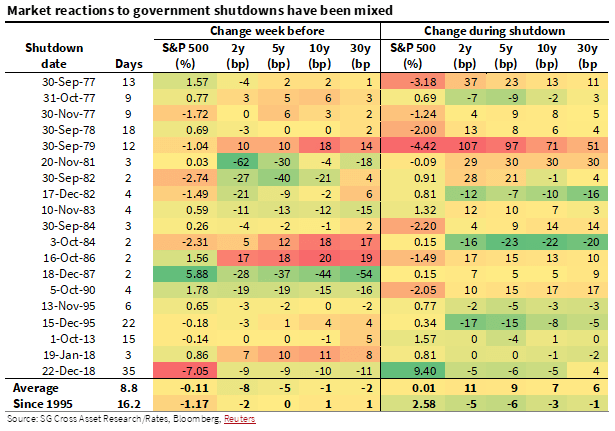
Government shutdowns, while disruptive, have generally been short-lived affairs, averaging just 8.8 days. However, some outliers like those in 1995 and 2018, which extended beyond 20 days, suggest that the current political climate might again facilitate a more prolonged face-off.

So, when the feds turn off the lights – investors historically shuffle into front-end Treasuries as a safe haven, while yields and stocks tend to seesaw – guided by investors’ anticipation of a deal. The front-end and belly of the US Treasury curve generally outperform the long end, providing some directional cues for traders. However, the data is not uniformly so, as the Treasury market is more nuanced.

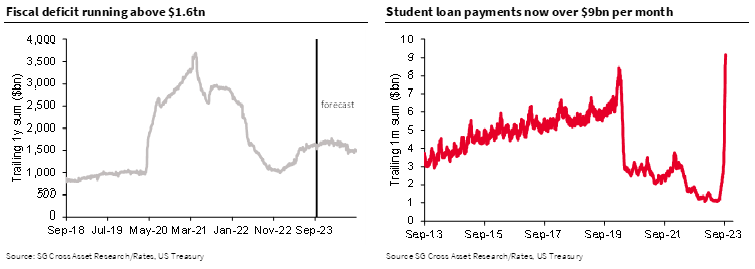
The nature and eventual outcome of the budget negotiations may determine how Treasury bonds react. The moves in the long end of the UST curve have been varied during previous episodes. The 30y yield rose in the week preceding thirteen out of nineteen of the previous shutdowns. Some of the selloff in the long end over the past few months has likely been prompted by increased worries over rising deficits and increased privately-held UST supply.

If a shutdown ends with a deal that significantly reduces future deficits, it could be a positive for the long end. On the other hand, a protracted political fight that does not result in any meaningful budget reform could prompt higher yields, as it would be another sign of gridlock in Washington, particularly in the context of the debt ceiling debacle and Fitch rating downgrade earlier this year. -SocGen

In the run-up to the five government shutdowns since 1995, the 2-year UST yield only rallied by 2 basis points, while the belly and the long end of the curve exhibited some sell-off.

On the long end, perhaps the most intriguing aspect is the divergent movements in the long-end yield. If this shutdown culminates in a deal that significantly trims future deficits, the long end could see a positive bump. But if we’re treated to another theatrical episode of Washington gridlock, expect higher yields and increased anxieties about fiscal irresponsibility, especially after the recent Fitch downgrade.

As for stocks, While the S&P 500 typically suffers in the week preceding a shutdown, a different picture emerges during the shutdown itself – with the index averaging a 2.3% uptick since 1995.

This seemingly paradoxical behavior could be linked to a variety of factors, but it seems to align with the safe-haven bid favoring front-end Treasuries.


Tyler Durden
Mon, 09/18/2023 – 16:40

Kunstler: Party Of Chaos Is “Certainly Trying To Provoke Something Like Civil War”

0
Kunstler: Party Of Chaos Is “Certainly Trying To Provoke Something Like Civil War”

Authored by James Howard Kunstler via Kunstler.com,

Boldly Into The Chaos

“When you give power over law to people who see law only as a weapon with which to get enemies, you destroy the rule of law. That’s what the dumbshit white liberals have done.”

– Paul Craig Roberts

Everybody I talk to feels a gnawing tingle of dread in their livers and lights as our world tilts into the season of darkness. The Party of Chaos rules solely on the basis of insults to its citizens. They are certainly trying to provoke something like civil war, something they can label “white supremacy,” as if that would justify declaring a state of siege — an emergency suspension of rights to speak, to move, to assemble, to resist the sticky pseudopods of the malevolent Blob that Washington has become.

These insults are all obvious untruths, and behind them, you can be sure, lurk great crimes. Crimes, of course, call for adjudication and payment. That has been the American way. So, naturally, the Party of Chaos, stolidly based against the American way, has hijacked the law to prevent it from being applied to them. They have spoiled and dishonored every authority in this land and disgracing the law is their ultimate prize.

It’s hard to say which of their insults is the worst, they are all so gross and arrant, but the untruths around the Covid-19 vaccine operation seem the most conspicuously sinister. CDC director Mandy K. Cohen is still pushing these shots for all Americans down to six-month-old babies, despite a freight train of evidence that they are useless for preventing the disease and blatantly harmful, especially for children. She is either very stupid, dangerously wicked, or insane. You decide:

Last autumn, the “uptake” on Covid boosters was 17 percent. That number should not induce a whole lot of confidence this time around among the CDC officials and their masters from Pfizer Inc. Papers are now circulating that say all the Covid variants coming out of the woodwork are lab-made pathogens. The CDC and its sister public health agencies lied extravagantly about the original virus, of course, and now everybody knows it. Who is left to fool in our country? If they move to surreptitiously release something with a much higher fatality rate — to reignite fear in the population — they could easily put their own lives in jeopardy, since its unlikely their labs might as quickly develop a vaccine they could protect themselves with.

Calling for more lockdowns and school closures won’t go over so well this time either, and federal enforcement efforts will be laughed at in the states where a majority is not insane. Working people know they’ll be ruined financially again if the schools are not available for babysitting. Even the states under the sway of mass formation psychosis, such as my New York, will be deeply divided. New Yorkers are sick of the vile automaton Kathy Hochul, even down in New Woke City.

The Ukraine war caper has pretty clearly lost its appeal as a supposed crusade for “democracy.” The yellow and blue flags vanished from the front porches and car bumpers months ago. It was a lie from the get-go that we have any national interest in that sad sack country. Our own government engineered the fiasco, and from every angle it has been a dead loss for all parties on our side. Ukraine has been reduced to a failed state in-waiting; Euroland has sacrificed its industrial economy for nothing; and the USA has squandered its last bits of prestige among other nations in this ignominious game of Lets You and Him Fight. Also, Americans have begun to notice that the billions funneled into Mr. Zelensky’s cadre of neo-Nazis and kleptocrats is money that is not going to places like East Palestine, Ohio, Lahaina, Maui, and the towns along our tortured southern border from Matamoros to Tijuana. Even the people who supposedly elected “Joe Biden” are becoming a little concerned about blundering into World War Three over the mess created by Victoria Nuland & Company.

How did we come to the point that it is now illegal to question the veracity of elections in America? And to charge a former president of the US for doing it? Much as the deck is stacked against Mr. Trump, his enemies have stupidly stuffed that deck full of jokers that are liable to shriek and giggle their way out of court when turned face-up. Judge Tanya Chutkan of the DC District Court is one of the jokers, having already branded Mr. Trump a seditious insurrectionist in the trails of many J-6 demonstrators she sent to jail on longer sentences than the prosecutors even asked for. DA Fani Willis of Fulton County, Ga, is another joker who constructed a career-ending booby-trap for herself, and DA Alvin Bragg of New York County (Manhattan) will not be the one laughing when he’s finally bum-rushed out of his law license.

An interesting fate awaits “Joe Biden” in the months ahead as the revenue stream of the Biden family foreign consulting firm gets audited in a House impeachment Inquiry. And an interesting-er fate awaits the Party of Chaos when it finally has to admit that it doesn’t have a candidate for the 2024 presidential election — at least a candidate anyone has ever heard of. The “president” stands (shakily) bestride a dilemma. He can gracefully bow out of office and avoid the historic humiliation of being unmasked as the crookedest chief executive ever — but if he does that, he loses the ability to pardon the son he so loves in any upcoming indictments, or pardon himself as CEO of Biden Consulting Inc.

Or, just maybe, the Blob will steal into the White House residence some gloomy pre-dawn morn, and settle its quivering, gelatinous endoplasm over “JB’s” face until his struggles with Congress and everything else on this plane of existence come mercifully (for us) to their end.

*  *  *

Support his blog by visiting Jim’s Patreon Page

Tyler Durden
Mon, 09/18/2023 – 16:20

Bitcoin & Big-Tech Pump-And-Dump; Gold Gains As Yield-Curve Crushed

0
Bitcoin & Big-Tech Pump-And-Dump; Gold Gains As Yield-Curve Crushed

Quiet-ish post-quad-witch unclenching of gamma with the big decline in homebuilder confidence probably the most notable macro news – somewhat ruining the soft-landing religion.

VIX continued higher after OpEx fom Friday’s open as gamma unclenched…

The cash open was very messy in stocks today – Small Caps puked, mega-cap tech bid and then reversed. Small Caps extended losses but the rest of the majors lifted majestically into the European closed before giving it all back…

Regional banks skidded to 2 month lows…

0-DTE traders fought the S&P rally in the morning… and won…

Source: SpotGamma

‘Most Shorted’ stocks fell further today, unable to stage a squeezy comeback…

Source: Bloomberg

NVDA’s decline left it unchanged for the last three months…

Bonds were mixed with the long-end outperforming (30Y -3bps, 2Y +3bps). Japan was closed…

Source: Bloomberg

Yield curve flattened (2s30s inverted deeper) bigly back to recent lows…

Source: Bloomberg

Bitcoin pumped and dumped… again… jumping up around $1000, just shy of $27,500 before giving it all back…

Source: Bloomberg

The dollar went nowhere for the second day in a row…

Source: Bloomberg

Spot Gold rallied further (back above $1930)…

Source: Bloomberg

Oil prices managed to hold gains (despite intraday dump). WTI found support at $90…

Finally, we note that he last few days have seen a trend change in rate expectations. While this year remains on a more dovish trend (no more hikes), next year is shifting hawkishly (less and less cuts)…

Source: Bloomberg

We suspect this “higher for longer” shift is exactly what The Fed wants to see ahead of this week’s meeting.

Tyler Durden
Mon, 09/18/2023 – 16:00

Operation Choke Point 2.0: How US Regulators Fight Bitcoin With Financial Censorship

0
Operation Choke Point 2.0: How US Regulators Fight Bitcoin With Financial Censorship

Authored by Peter Chawaga via BitcoinMagazine.com,

“The reason that we are focused on financial institutions and payment processors is because they are the so-called bottlenecks, or choke-points, in the fraud committed by so many merchants that victimize consumers and launder their illegal proceeds,” Bresnickat explained to the club.

“We hope to close the access to the banking system that mass marketing fraudsters enjoy – effectively putting a choke hold on it…”

This concerted effort, later labeled “Operation Choke Point”, targeted a wide range of business categories, including ammunition sales, drug paraphernalia, payday loans, dating services, pornography, telemarketing, tobacco sales, and government grants. This broad application of financial exclusion ultimately prompted multiple lawsuits and federal investigations into the conduct of both the DOJ and the Federal Deposit Insurance Corporation (FDIC), as well as harsh criticism from all corners.

“The clandestine Operation Choke Point had more in common with a purge of ideological foes than a regulatory enforcement action”, wrote Frank Keating, a former governor of Oklahoma who served in the DOJ during the Reagan administration, in a 2018 editorial for The Hill. “It targeted wide swaths of businesses with little regard for whether legal businesses were swept up and harmed. In fact, that seemed to be the goal.”

In 2017, the Trump administration’s DOJ wrote a letter to Congress indicating that Operation Choke Point was officially over. In 2018, the FDIC promised to limit its personnel’s ability to “terminate account relationships” and to put “additional training” into place for its examiners.

But in the years since the federal government so blatantly demonstrated its interest in dictating access to banking services and its power to do so deliberately with little or no consequences, many feel that little has changed.

BANK RUNS, WITH BIAS

On March 8, 2023, it was announced that the cryptocurrency-focused institution Silvergate Bank would be voluntarily liquidated by its holding company. The bank had been focused on serving cryptocurrency clients since 2013 when its CEO Alan Lane first invested in bitcoin. In 2022, it had acquired the technology behind Meta’s failed stablecoin project, Diem, with hopes of launching its own dollar-backed token. As the cryptocurrency market declined in late 2022, marked by the collapse of one of its biggest clients in cryptocurrency exchange FTX, the bank’s stock price plummeted. It likely did not help that at the same time, U.S. Senators Elizabeth Warren, Roger Marshall, and John Kennedy asked Silvergate to disclose details of its financial relationship with collapsed cryptocurrency exchange FTX.

Soon after, on March 10, 2023, almost ten years to the day from Bresnickat’s public detailing of Operation Choke Point, Silicon Valley Bank (SVB) was seized by the California Department of Financial Protection and Innovation and placed under FDIC receivership, marking what was then the second-largest bank failure in U.S. history.

Since 2021, the bank had been increasing its long-term securities holdings but, as the market value of these assets deteriorated amid U.S. dollar inflation and Federal Reserve interest rate hikes, it was left with unrealized losses. Simultaneously, its customers, many of whom were prominent businesses within the cryptocurrency industry and were similarly strained by economic conditions, were withdrawing their money. On March 8, 2023, SVB announced that it had sold more than $21 billion worth of securities, borrowed another $15 billion, and was planning an emergency sale to raise yet another $2.25 billion. Perhaps unsurprisingly, this sparked a run on its remaining funds, totaling some $42 billion in withdrawals by March 9, 2023. On Sunday, March 12, state and federal authorities stepped in; customers of Signature Bank had withdrawn more than $10 billion.

Since 2018, Signature Bank had maintained a focus on cryptocurrency businesses, with some 30% of its deposits coming from the sector by early 2023. Signature Bank had also accrued a large proportion of uninsured deposits, worth some $79.5 billion and constituting almost 90% of its total deposits. It was holding relatively little cash on hand — only about 5% of its total assets (compared to an industry average of 13%) — so it was poorly prepared for a run on crypto-friendly banks spurred by SVB’s issues. On March 12, 2023, the New York State Department of Financial Services closed Signature Bank and placed it under FDIC receivership as it faced a mountain of withdrawal requests. At the time, this represented the third-largest bank failure in U.S. history.

Following their seizures of SVB and Signature Bank, the U.S. Department of the Treasury, Federal Reserve, and FDIC described the takeovers as “decisive actions to protect the U.S. economy by strengthening public confidence in our banking system”. But others suggested the actions, particularly against Signature Bank, signified a blatant reemergence of the prejudice displayed during Operation Choke Point and connected to a larger effort to stymie cryptocurrency businesses.

“I think part of what happened was that regulators wanted to send a very strong anti-crypto message”, Barney Frank, a Signature Bank Board member and former congressman who helped draft the seminal “Dodd-Frank Act” to overhaul financial regulation following the Great Recession, told CNBC in March 2023. “We became the poster boy because there was no insolvency based on the fundamentals.”

Following an FDIC announcement that Flagstar Bank would assume all of Signature Bank’s cash deposits except for those “related to the digital-asset banking businesses”, the editorial board of The Wall Street Journal announced that Frank was right to call out this bias.

“This confirms Mr. Frank’s suspicions — and ours — that Signature’s seizure was motivated by regulators’ hostility toward crypto”, the board wrote. “That means crypto companies will have to find another bank to safeguard their deposits. Many say that government warnings to banks about doing business with crypto customers is making that hard.”

TARGETING A NEW CHOKE POINT

Public officials, financial professionals, and Bitcoin advocates had been pointing out an apparent bias against cryptocurrency businesses from the Biden administration well before the March 2023 bank runs. There were numerous policy events in the early part of 2023 to back up those sentiments.

A January 3, 2023, “Joint Statement on Crypto-Asset Risks to Banking Organizations” from the Federal Reserve, FDIC, and Office of the Comptroller of the Currency (OCC) noted that, “The events of the past year have been marked by significant volatility and the exposure of vulnerabilities in the crypto-asset sector. These events highlight a number of key risks associated with crypto-assets and crypto-asset sector participants that banking organizations should be aware of…”, effectively serving to dissuade financial institutions from taking on those risks.

A White House “Roadmap to Mitigate Cryptocurrencies’ Risks” released on January 27, 2023, indicated that the Biden administration sees the proliferation of cryptocurrencies as a threat to the country’s financial system and warned against the prospect of granting cryptocurrencies more access to mainstream financial products.

“As an administration, our focus is on continuing to ensure that cryptocurrencies cannot undermine financial stability, to protect investors, and to hold bad actors accountable”, per the roadmap. “Legislation should not greenlight mainstream institutions, like pension funds, to dive headlong into cryptocurrency markets… It would be a grave mistake to enact legislation that reverses course and deepens the ties between cryptocurrencies and the broader financial system.”

On February 7, 2023, the Federal Reserve pushed a rule to the Federal Register clarifying that the institution would “presumptively prohibit” state member banks from holding crypto assets as principal in any amount and that “issuing tokens on open, public, and/or decentralized networks, or similar systems is highly likely to be inconsistent with safe and sound banking practices”.

And on May 2, 2023, the Biden administration proposed a Digital Asset Mining Energy (DAME) excise tax, suggested as a way to force cryptocurrency mining operations to financially compensate the government for the “economic and environmental costs” of their practices with a 30% tax on the electricity they use.

For Brian Morgenstern, the head of public policy at Riot Platforms, one of the largest, publicly traded bitcoin miners based in the U.S., these policy suggestions, updates, and rule changes clearly indicate a larger attempt to hinder Bitcoin advancement by targeting financial choke points.

“The White House has proposed an excise tax on electricity use by Bitcoin mining businesses specifically — an admitted attempt to control legal activity they do not like, in the name of environmental protection”, Morgenstern explained in an interview with Bitcoin Magazine. “The only explanation for such inexplicable behavior is deep-rooted bias in favor of the status quo and against decentralization.”

Collectively, this behavior could influence the conduct of regulated banks, just as the pressure applied by the DOJ in the 2010s unduly limited the businesses in its crosshairs back then. For many, it’s clear that Operation Choke Point has been reinstated.

“‘Operation Choke Point 2.0’ refers to the coordinated effort by the Biden administration’s financial regulators to suffocate our domestic crypto economy by de-banking the industry and severing entrepreneurs from the capital necessary to invest here in America”, U.S. Senator Bill Hagerty, a member of the committees on banking and appropriations, told Bitcoin Magazine. “It appears that financial regulators have bought into the false narrative that cryptocurrency-focused businesses solely exist to facilitate or conduct illicit activities, and they seem blind to the opportunities for the potential innovations and new businesses that can be built.”

PRESSURE WHERE IT HURTS

It may be fairly obvious how such a pressure campaign by federal regulators would hurt cryptocurrency-focused projects that depend on access to banks. But the larger ramifications of such financial prohibitions for retail customers and the advancement of Bitcoin in particular may not be.

Why should proponents of Bitcoin, a decentralized financial rail designed to function outside of the legacy system, care about a choke point in regulated financial institutions?

Caitlin Long, the founder of Custodia Bank, which is focused on bridging the gap between digital assets and legacy financial services, recognizes that for users in the U.S. to legitimately participate in Bitcoin, the regulatory landscape must be accommodating.

“I’ve been working for years to help enable laws to be enacted, in multiple U.S. states and federally, precisely because in the absence of legal clarity about Bitcoin, legal systems can become attack vectors on Bitcoiners”, she said in an interview with Bitcoin Magazine. “All of us live under legal regimes of some sort, and we should be aware of legal attack vectors and work toward resolving them in an enabling way.”

Long’s advocacy may best represent the potential that favorable or even just equitable financial access could mean for Bitcoin adoption and the advancement of its technology for everyone. Through her work, Custodia (then under the name Avanti) obtained a 2020 bank charter in its home state of Wyoming that made it a special-purpose depository institution capable of custodying bitcoin and other cryptocurrencies on behalf of clients. But, following a prolonged delay in approval of Custodia’s application for a master account with the Federal Reserve that would allow it to leverage the FedWire network and facilitate large transactions for clients without enrolling intermediaries, Custodia filed a lawsuit against the Fed last year.

“Operation Choke Point 2.0 is real — Custodia learned about its existence in late January when press leaks hit and reporters started calling Custodia to say they learned that all bank charter applicants at the Fed and OCC with digital assets in their business models, including Custodia, were recently asked to withdraw their pending applications”, Long said. “Reporters told us that the Fed’s vote on Custodia’s application would be a foregone conclusion before the Fed governors actually voted.”

But, more than just stifling innovators who seek to build bridges between Bitcoin and legacy financial services, targeting the choke points of Bitcoin platforms will only push these platforms outside of the scope of regulators, giving those with malicious intent an advantage over those who are attempting to play by the rules.

“Internet-native money exists. It won’t be uninvented”, Long added. “If federal bank regulators have a prayer of controlling its impact on the traditional U.S. dollar banking system, they will wake up and realize it’s in their interest to enable regulatory-compliant bridges. Otherwise, just as with other industries that the internet has disrupted — corporate media, for example — the internet will just go around them and they will face even bigger problems down the road.”

As was laid bare by the collapse of cryptocurrency exchange FTX, Bitcoin is still very much tied to the world of cryptocurrency at large in the portfolios of investors and the eyes of most people around the world. Indeed, the revelations around FTX’s criminal operations have been a case in point for regulators who seek the financial prohibition of cryptocurrency businesses. But this very prohibition may have enabled FTX’s operators to fleece billions in customer funds: Based on a Caribbean island, the vast majority of FTX’s business was outside of the jurisdiction of U.S. regulators. As U.S. regulators limit the growth of domestic businesses, offshore alternatives like FTX benefit.

And while many Bitcoiners may think that policymakers are powerless to determine the success of this permissionless technology, adverse or absent regulations can limit Bitcoin-specific businesses just as harshly as they do broader, cryptocurrency-related ones. In fact, it may be Bitcoin’s unique properties that make the current regulatory landscape such a daunting one for growth.

“Bitcoiners should care about Operation Choke Point 2.0 because certain policymakers are trying to take away our ability to participate in the Bitcoin network”, Morgenstern argued. “Moreover, Bitcoin is different. It is not only the oldest and most tested asset in this space, it is perhaps the only one that everyone agrees is a digital commodity. That means the on-ramp for inclusion into any policy frameworks will have less friction inherently, and Bitcoiners need to understand this.”

RELIEVING THE CHOKE POINTS

Reviewing the recent, hostile policy updates from federal regulators, it seems clear that Bitcoin is firmly entrenched along with “crypto” in their minds. And, Bitcoin proponents in particular will agree, many businesses focused on other cryptocurrencies are apt to hurt investors. But some in the Bitcoin sector think that more education could help underscore the distinctions between Bitcoin and altcoins, and better protect Bitcoin from more justified regulatory limits on manipulated tokens and vaporware.

“Engage with your elected officials”, Morgenstern encouraged. “Help them understand that Bitcoin’s decentralized ledger technology is democratizing finance, creating faster and cheaper transactions and providing much-needed optionality for consumers at a time when the centralized finance system is experiencing distress. This will take time, effort and a lot of communication, but we must work together to help our leaders appreciate how many votes and how much prosperity is at stake.”

Indeed, for those elected officials who do recognize this bias as unduly harmful to innovation, continued advocacy from Bitcoin’s supporters is the best way out of the choke hold.

“This isn’t an issue where people can afford to be on the sidelines anymore”, Hagerty concluded. “I encourage those who want to see digital assets flourish in the United States to make your voice heard, whether that is at the ballot box or by contacting your lawmakers and urging them to support constructive policy proposals.”

*  *  *

This article is featured in Bitcoin Magazine’s “The Withdrawal Issue”. Click here to subscribe now.

A PDF pamphlet of this article is available for download.

Tyler Durden
Mon, 09/18/2023 – 15:45

First France, Now Korea Probes iPhone 12 Radiation Concerns To Curb “Public Anxiety”

0
First France, Now Korea Probes iPhone 12 Radiation Concerns To Curb “Public Anxiety”

Less than a week after France ordered Apple to halt iPhone 12 sales due to possible breaches of European Union radiation exposure limits, South Korea has opened an investigation into the smartphone. 

Local paper Korea JoongAng Daily reports the Korean Ministry of Science and ICT released a statement on Sunday explaining it will investigate iPhone 12 radiation issues to “resolve public anxiety.” 

“All smartphones retailed in Korea, including the iPhone 12, have qualified for the global standard related to radiation safety and have been certified,” the ministry said in a statement.

The ministry continued, “However, in order to resolve public anxiety, we requested that Apple report on the issue and will have four variations of the iPhone 12 model go under deliberate inspection and have the results made public.”

It warned if the results are over the Korean government’s acceptable levels, then the iPhone 12, 12 Pro, 12 Mini, and 12 Pro Max may face import and retail bans.

Besides France and South Korea, Germany’s network regulator BNetzA and Spain’s OCU consumers’ group have voiced concerns about the iPhone 12 radiation issues. 

France used accredited labs and found the iPhone 12’s absorption of electromagnetic energy by the body is around 5.74 watts per kilogram. The acceptable standard for Europe and South Korea is 4.0 watts per kilogram. 

Last week, France’s junior minister for the digital economy, Jean-Noel Barrot, explained an over-the-air software update for the iPhone 12 is sufficient. He said, “Apple is expected to respond within two weeks.” 

South Korea’s probe into the radiation concerns of the iPhone 12 could prompt other nations to follow suit. This development coincides with the launch of China’s Huawei Mate 60 Pro.

Tyler Durden
Mon, 09/18/2023 – 15:25

The Coming Collapse Of The Global Ponzi Scheme

0
The Coming Collapse Of The Global Ponzi Scheme

Authored by George Ford Smith via The Mises Instititute,

It won’t be long before governments around the world, including the one in Washington, self-destruct.

Strong words, but anything less would be naïve.

As economist Herbert Stein once said, “If something cannot go on forever, it has a tendency to stop.” Case in point: fiat money political regimes. Interventionist economies of the West are in a fatal downward spiral, comparable to that of the Roman Empire in the second century, burdened with unsustainable debt and the antiprosperity policies of governments, especially the Green New Deal.

In the global Ponzi scheme, thin air and deceit substitute for sound money. As hedge-fund manager Mitch Feierstein wrote in Planet Ponzi, “You don’t solve a Ponzi scheme; you end it.” Charles Ponzi and Bernie Madoff

…made some of their investors a whole lot poorer, but the world didn’t come crashing down as a result.

For that‌—‌for a Ponzi scheme that would threaten to bankrupt capitalism across the entire Western world‌—‌you need people much smarter than Ponzi or Madoff. You need time, you need energy, you need motivation. In a word, you need Wall Street.

But Wall Street alone doesn’t have the strength to deliver a truly cataclysmic outcome. If your ambition is to create havoc on the largest possible scale, you need access to a balance sheet running into the tens of trillions. You need power. You need prestige. You need a remarkable willingness to deceive. In a word, you need Washington.

As Gary North wrote in a brief review of Feierstein’s book, “The central banks have colluded with the national governments in order to fund huge increases of national debt, beyond what can ever be paid off. In other words, [Feierstein] has described government promises as part of a gigantic international Ponzi scheme.”

In a recent interview, Peter Schiff, who was laughed at when he predicted the economic meltdown of 2007–9, said interest on the federal debt alone “will be about a trillion by the end of this year. By the end of next year [it will reach] two trillion dollars—and that’s if interest rates don’t go up. . . . This is a huge debt bomb that’s going to explode.”

Ultra-high corporate and credit card debt, along with bank insolvency sustains his argument for a coming collapse, the polar opposite of Biden’s economic dream.

Along with this, Reuters notes that the spread between two- and ten-year Treasuries is at the deepest inversion since 1981. Rarely has an inverted yield curve not signaled a recession.

Can Jerome Powell and his advisors steer the economy into a soft landing? Not this time. “The only landing possible is a crash, where everyone on board dies,” Schiff recently tweeted.

Ponzi and Madoff went to jail for their schemes, but how do you prosecute governments for theirs? Prosecution implies being a part of government. And with rare exceptions such as Ron Paul, those who go into government believe gold is a barbarous relic and the Fed is a good thing that just needs a little government tinkering. So, the guilty will go unpunished, unless public outrage misguidedly turns to nonjudicial violence. The rest will be too busy trying to survive and protect those they care about.

The War on Being Human

A study of history, including US monetary history, makes clear that the state is not in the business of securing our liberty. As the previous nine hundred plus days have made clear, any defense of “liberty” would likely be regarded as hate speech. Instead, we are inundated with the feel-good words of diversity, equity, and inclusion along with the fear-driven campaigns of climate change and killer covid. Challenge any of it and you’re demonized—or worse.

But the state can’t do anything significant without monopolizing money, and the Orwellian central bank digital currencies (CBDCs) will be the latest installment to control the monetary system. The new FedNow payment system with its emphasis on user convenience is providing the framework and psychological grooming for CBDCs.

The Shadow Superpower

We can stop this from happening. Two states, Florida and Indiana, have effectively banned CBDCs as money in those states. Other states will likely follow. The government will outlaw cash at some point, but those who use it now are casting a vote against CBDCs.

Many people will turn to barter, some using barter metals, and to the shadow economy. If this sounds desperate, consider how the global black market in 2011 was the world’s fastest-growing economy. Sometimes referred to as System D, it features both the usual, small transactions of flea market trades or workers looking for employment in the parking lots of home improvement stores and also larger, international trades. David Obi, a Nigerian, relying on his cell phone and his own initiative, contacted a Chinese firm to have small diesel-powered generators shipped to his home country, where electric power is often scarce: “Like almost all the transactions between Nigerian traders and Chinese manufacturers, it was also sub rosa: under the radar, outside of the view or control of government, part of the unheralded alternative economic universe of System D.”

Friedrich Schneider, research fellow at Johannes Kepler University Linz, Austria, whose expertise is in off-government economies and who coauthored The Shadow Economy, found that System D is growing faster in many countries than the officially recognized gross domestic product. If System D were an independent nation, it would be the second-largest economy in the world.

Conclusion

The future is undecided, but we can help determine the outcome if we take responsibility for it. Wikipedia defines System D as “a manner of responding to challenges that require one to have the ability to think quickly, to adapt, and to improvise when getting a job done.” In this sense success has always depended on System D, with or without government.

The American term for it is life hack, “any trick, shortcut, skill, or novelty method that increases productivity and efficiency, in all walks of life.” Whatever you call it, it describes a spirit all of humanity needs to adopt if we are to survive the coming collapse of government Ponzi schemes.

Tyler Durden
Mon, 09/18/2023 – 11:55

“Another Utterly False Article”: Musk Blasts WSJ For Report On Tesla Potentially Building Saudi Gigafactory

0
“Another Utterly False Article”: Musk Blasts WSJ For Report On Tesla Potentially Building Saudi Gigafactory

Update (1145ET):

Elon Musk called The Wall Street Journal’s report about Tesla and Saudi Arabia being in early talks for a gigafactory as “Yet another utterly false article from WSJ.” 

Here’s what X user said about Musk’s comment:

*   *   *

Elon Musk in May said that Tesla would pick a new gigafactory location by the end of the year. Lately, the billionaire has spoken with a handful of world leaders as they present enticing offers to persuade the world’s wealthiest man to build a new factory in their respective countries. 

On Sunday, Turkish President Recep Tayyip Erdogan and Musk met in New York City to discuss a potential Tesla factory in Turkey, which borders Southeast Europe and Western Asia. 
Turkish state-owned Anadolu Agency confirmed the meeting at the Turkish House, a skyscraper near the United Nations, on Sunday afternoon. Images of the meeting were posted on X. 

“Recalling that with the Turkish electric car Togg hitting the roads in Türkiye, Tesla entered the Turkish market, Erdogan called on Tesla to establish its seventh factory in Türkiye,” Anadolu reported, citing the country’s communications directorate.

Erdogan also offered a partnership with Musk’s SpaceX and Turkey’s space program. Musk told the president that several Turkish suppliers are already working with Tesla and that Turkey “is among the most important candidates” for Tesla’s next factory. 

In a separate report, The Wall Street Journal said Musk has spoken with Saudi Arabia about a new gigafactory factory. Sources familiar with the discussions said the talks were in the “very early stage and could fall apart” given the kingdom’s interest in electric-vehicle rival Lucid Group.

Earlier this summer, Musk met with Indian Prime Minister Narendra Modi in NYC about expanding Tesla operations inside the world’s most populous country. 

Tesla has six gigafactories in Fremont, California; Sparks, Nevada; Berlin, Germany; Shanghai, China; Austin, Texas; and Buffalo, New York. It’s planning another and is a move to expand its international footprint. 

Tyler Durden
Mon, 09/18/2023 – 11:45

Hunter Biden Sues IRS, Claims Whistleblowers Tried To ‘Target’ And ‘Embarrass’ Him

0
Hunter Biden Sues IRS, Claims Whistleblowers Tried To ‘Target’ And ‘Embarrass’ Him

Fresh off his felony indictment for gun charges, Hunter Biden is suing the IRS, alleging that agents have “targeted and sought to embarrass” him.

Yes, the same Hunter who tried to deduct hookers from his tax return. And the same IRS that let him  ‘call in‘ for interviews (so he never did), and abruptly swapped out the team investigating him in May – leading to several whistleblowers coming forward to allege not just slow-walking the case, but a coverup involving (obviously) preferential treatment.

So, on Monday morning, with Hunter in congressional crosshairs, Hunter’s lawyers filed a lawsuit Monday morning which cites two major examples in IRS whistleblowers Gary Shapley and Joseph Ziegler, who claimed that the agency mishandled aspects of the Biden investigation.

Biden’s lawyers allege that the IRS “willfully, knowingly, and/or by gross negligence, unlawfully disclosed Mr. Biden’s confidential tax information,” and have demanded $1,000 in damages for “each and every unauthorized disclosure of his tax returns,” Fox News reports.

“Biden is the son of the President of the United States. He has all the same responsibilities as any other American citizen, and the IRS can and should make certain that he abides by those responsibilities,” reads the filing. “Similarly, Mr. Biden has no fewer or lesser rights than any other American citizen, and no government agency or government agent has free rein to violate his rights simply because of who he is.”

“Yet the IRS and its agents have conducted themselves under a presumption that the rights that apply to every other American citizen do not apply to Mr. Biden,” the filing continues.

Shapley and Ziegler in the crosshairs?

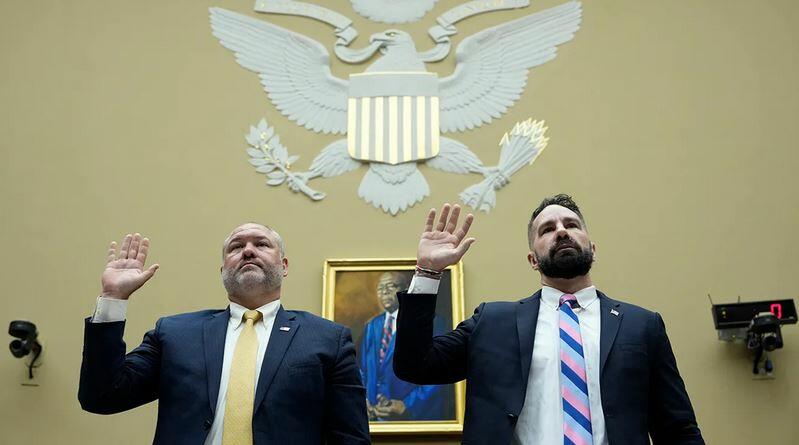
Supervisory IRS Special Agent Gary Shapley (L) and IRS Criminal Investigator Joseph Ziegler allegedly “targeted and sought to embarrass” Hunter Biden, according to a Monday lawsuit. (Drew Angerer/Getty Images)

According to Hunter’s legal team, IRS agents Shapley and Ziegler (the latter being a gay Democrat) “targeted and sought to embarrass” Hunter with statements to the media, and that the pair of agents are only the “most recent” example.

The pair (which regime puppet ABC News referred to as “so-called” whistleblowers) testified before the House Oversight Committee earlier this year, where they say they were hindered at various points in their investigation into Hunter.

Hunter’s lawsuit argues that the pair’s whistleblower status “cannot and does not shield them from their wrongful conduct in making unauthorized public disclosures that are not permitted by the whistleblower process.”

Tyler Durden
Mon, 09/18/2023 – 11:35